Market Minds Advisory
Ionising Air Gun Market

Ionising Air Gun Market: Ionising Air Gun Market: The Air Costs More Than The Gun

The gun costs about three hundred dollars and the air it burns costs nine hundred a year, which is the argument that almost nobody in this business ever bothers to make properly.

Lead Analyst

Published

September 2026

Make Smarter Decisions with Customized Research Insights

Request a free sample report and evaluate market opportunities, growth trends, and competitive dynamics relevant to your business needs.

2025 MARKET VALUE$0.4BMarket Size 2025
2036 FORECAST VALUE$0.7BBase Case , 2026 to 2036
CAGR 2026 TO 20365.8 %Bull 7.0% / Bear 4.6%
INCREMENTAL OPPORTUNITY$0.3BNet 10- year value creation
EXPANSION MULTIPLE1.76x2036 value over 2026 base
Strategic Levers
M&A Pipeline
Regional Outlook
Country Rankings
Competitive Intelligence
Segmental Deep-dive
Call-Us : 91 93563 13602

Executive Snapshot and Market Trajectory.

The device is not where the money goes. A conventional ionising gun costs around USD 340 and consumes roughly USD 890 of compressed air a year running continuously, which means running cost exceeds purchase price within about five months of the day it was first installed.
High-efficiency amplifying nozzle guns grow at 8.7%, half again the market rate of 5.8%, because entraining ambient air rather than blowing compressed air cuts consumption by well over half on identical cleaning performance. East Asia holds 34% of demand, above its usual band, on electronics assembly where static control is a mandated discipline and on the plastics moulding base sitting alongside it. No other region combines those two industries at anything like that scale.
Concentration is moderate at 46% of units shipped, and the genuinely interesting failure mode is invisible. Emitter points contaminate within about six months and stop neutralising while the gun continues blowing air perfectly well, so an operator sees nothing wrong and the static problem quietly returns. Almost nobody in this sector sells the verification that would catch it. That is a service business sitting entirely unclaimed on the table.
Market Definition
The ionising air gun market covers handheld and fixed compressed-air devices that deliver ionised air to neutralise electrostatic charge and remove particulate from surfaces, spanning corona discharge handheld guns, high-efficiency amplifying nozzle guns, fixed-mount ionising nozzles and bars, steady-state direct current ionising guns, photoionisation and soft X-ray guns, and pulsed alternating current ionising guns. Scope covers units supplied into industrial production and cleanroom environments together with replacement emitter consumables. Excluded are non-ionising blow guns and air knives, room and overhead ionisation systems, static measurement instruments, compressed air generation and treatment equipment, and personal grounding products.
Base Year Value
$0.4B in 2025 (MMA Primary Research Dataset, September 2026)
Forecast Period
2026 to 2036, eleven discrete annual values
CAGR
5.8% base case. Bull 7.0%. Bear 4.6%.
Fastest Growth Segment
High-Efficiency Amplifying Nozzle Guns: 8.7% CAGR
Fastest Growth Country
India: 7.8% CAGR
Fastest Growth Region
South Asia and Pacific: 7.8% CAGR
Largest Region
East Asia: 34% of 2025 global value
Market Leaders
EXAIR, SMC Corporation, Simco-Ion, Keyence and Hugle Electronics. Source: MMA Analysis, July 2026.
Primary Survey
n=3,800 procurement and R&D decision-makers, Q4 2025, six countries
Methodology
Demand-side build-up, cross-validated against public data, 47 expert interviews

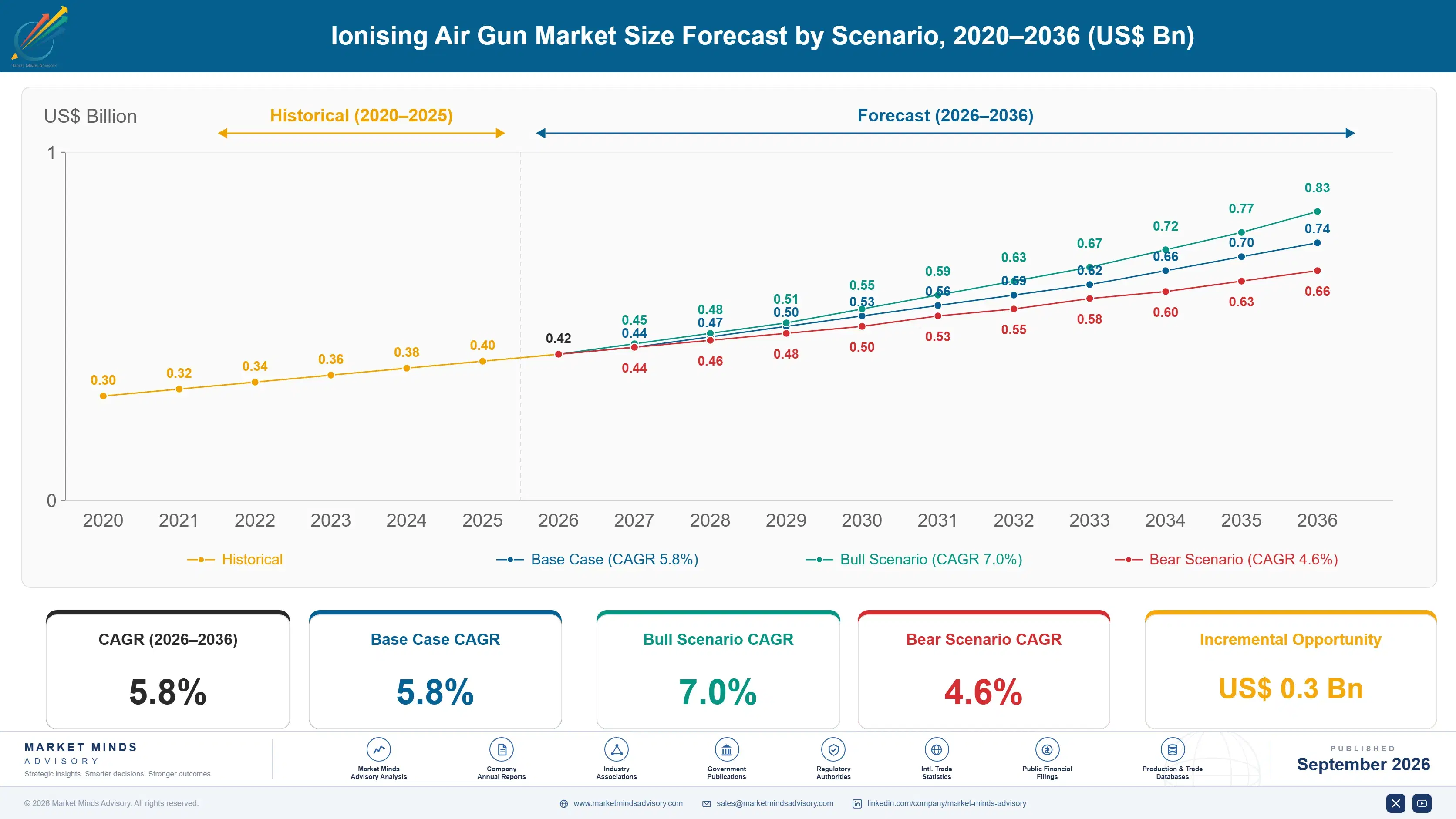
Ionising Air Gun Market Forecast Scenarios

ionising-air-gun-market-size-forecast-scenario-1788255445457
Between 2020 and 2025 the sector compounded at 4.8% and two opposite movements sat underneath it. Electronics assembly capacity expanded across Asia and took units with it, while compressed air efficiency programmes in mature plants removed guns that had been running continuously for no good reason. Net growth was modest and the mix shifted decisively toward engineered nozzles that use considerably less air.
The 5.8% base case rests on three mechanisms. Electronics assembly keeps expanding across Asia and India under incentive programmes, and every line handling boards needs static control at multiple stations. Compressed air cost reduction programmes are pushing plants toward amplifying nozzle designs that cut consumption without cutting performance. And cleanroom pharmaceutical and medical device capacity keeps growing with verification requirements attached. None of the three depends on any new technology arriving.
The bull case at 7.0% turns on compressed air cost accounting reaching plant floors properly, which would make the replacement case for engineered nozzles obvious rather than an argument somebody has to win. The bear case at 4.6% is automation: enclosed and automated handling reduces the number of stations where an operator points a gun at something, and every line converted removes several units permanently.

Nine Hundred Dollars Of Air

Compressed air is among the most expensive utilities in any plant and almost nobody costs it properly. Generating it wastes most of the electrical energy going in, and a gun drawing 14 standard cubic feet per minute runs through roughly USD 890 of it annually. The gun itself costs USD 340. Purchasing departments compare gun prices and the plant pays for air.
TOP FIVE CONCENTRATION46%Share of units shipped held by five largest suppliers
AVERAGE SELLING PRICEUSD 340Mean price per unit across all ionisation technologies
COMPRESSED AIR CONSUMPTION14 SCFMAir drawn by a conventional gun at working pressure
ANNUAL AIR COSTUSD 890Yearly compressed air spend for one continuously operated gun
DEAD-END PRESSURE LIMIT30 psiRegulatory ceiling for compressed air used in cleaning
EMITTER SERVICE INTERVAL6 monthsPeriod before ioniser points require cleaning to hold performance
Regulation shapes the product more than any customer requirement does. Rules limiting compressed air for cleaning to 30 pounds per square inch dead-end pressure force relief ports or engineered nozzle geometry rather than a plain orifice. That constraint turned out to be commercially useful, because the same engineered geometry that satisfies it also entrains ambient air and cuts consumption. That constraint turned out to be commercially convenient.
The failure mode in this product is silent and that matters more than anything about the design. Corona emitter points contaminate and erode within about six months, after which the gun blows air exactly as before and neutralises very little, so defects return without any obvious cause. Electronics and cleanroom users are required to verify performance periodically, and a great many do not.
"Every purchasing conversation in this category is about the price of the gun and every plant is quietly spending three times that on the air each year. The supplier that shows up with the compressed air bill instead of a catalogue is having a completely different meeting."
Director, Industrial Air and Static Control Practice · MMA Construction and Industrial Equipment Practice · September 2026

Market Trends

Compressed air cost finally reached the specification

Energy management programmes in manufacturing have started costing compressed air at what it genuinely costs to make rather than treating it as free once the compressor is running, and a station consuming 14 standard cubic feet per minute continuously becomes visible the moment anybody does that arithmetic. Amplifying nozzle designs that entrain ambient air deliver the same cleaning force on well under half the compressed air. Those guns grow at 8.7% against a market rate of 5.8% as a direct result, and the argument is financial rather than technical in every case.
Market Impact: Drives 34% of world demand
Static control became an audited discipline rather than practice

Electronics assembly operating under recognised electrostatic discharge control programmes must document that ionisation equipment performs within specification, with periodic measurement of discharge time and offset voltage rather than an assurance that the equipment is switched on. That converts a consumable maintenance task into an auditable compliance record, and it makes emitter contamination a finding rather than an inconvenience. Suppliers offering verification and documented service alongside the hardware are selling into a requirement, and remarkably few of them have organised to do it at all. Verification is where the recurring money sits.
Market Impact: Serves 4 plastics processes directly

Market Opportunities and Growth Drivers

Electronics assembly keeps adding controlled stations

Every printed circuit assembly line handling boards, components and trays needs static neutralisation at multiple points, and capacity expansion across China, Vietnam, Korea and increasingly India adds those stations in quantity rather than one at a time. Component miniaturisation makes the requirement stricter rather than looser, since smaller devices tolerate less discharge energy before damage occurs. East Asia takes 34% of category demand largely on this basis. Indian growth at 7.8% is the fastest of any country covered and rests on manufacturing incentive programmes rather than on any change in the technology.
Market Impact: Replaces 4 handhelds with 2 fixed

Plastics processing generates charge that must be removed

Injection moulding, film extrusion, thermoforming and web converting all generate substantial electrostatic charge as polymer separates from tooling or passes over rollers, which attracts dust onto parts destined for painting, printing or packaging and causes handling problems on automated equipment. That is a physical certainty rather than a preference, so the equipment is bought wherever plastics are processed at any scale. The application is far larger by units than electronics and attracts a fraction of the attention, largely because nobody writes about injection moulding. Charge generation is physics, and it does not negotiate with anybody.
Market Impact: Degrades within 6 months silently

Market Restraints and Challenges

Automation removes the operator holding the gun

Enclosed handling, robotic transfer and automated cleaning stations all reduce the number of positions where a person points a handheld gun at a part, and lines converted to automation typically replace several handheld units with one or two fixed nozzles. The root cause is that the handheld device exists because a human was already standing there, and automation removes the human first. Commercial impact is unit volume falling even where static control requirements tighten. Participants are responding by developing fixed-mount ranges, integrating with machine control, selling into equipment builders and pricing the fixed products as engineered components.
Market Impact: Cuts 14 SCFM by over half

Nobody sees the emitter points degrading

Corona emitter points collect contamination and erode within roughly six months, after which airflow is unchanged and ionisation performance has fallen substantially, so the operator observes a working gun while defects reappear downstream with no obvious cause. The root cause is that the failure produces no symptom at the device itself, only at the process it was protecting. Commercial impact is customers concluding that ionisation does not work. Mitigation runs through scheduled emitter replacement programmes, verification instruments sold alongside, service contracts with documented measurement, and designs with visible performance indication built in.
Market Impact: Requires records every 6 months
3 additional market trends, 4 additional growth drivers, and 2 additional restraints and challenges are covered in the full report. Contact sales@marketmindsadvisory.com to access the complete intelligence.

Segment CAGR and Growth Architecture

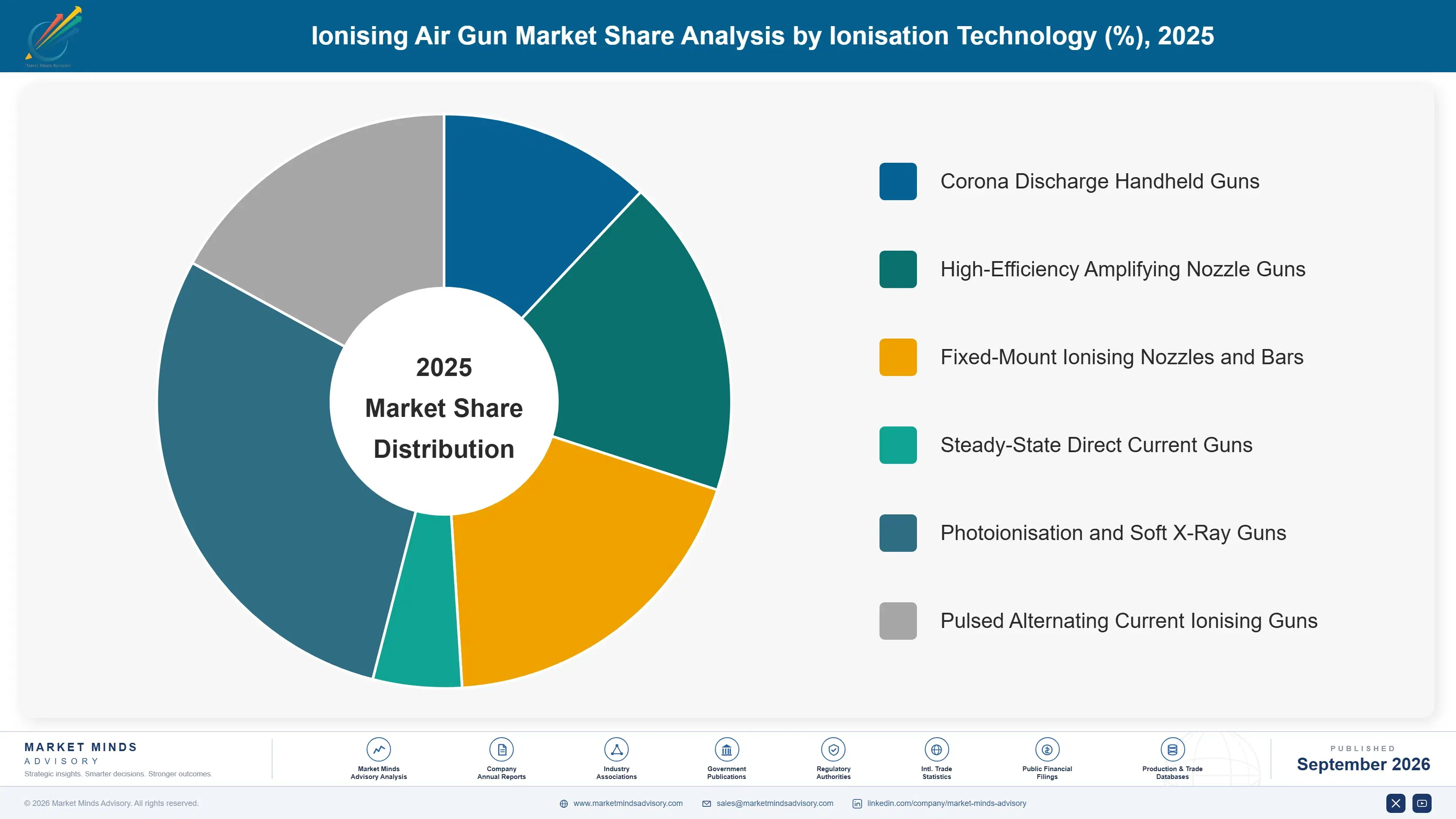
Segmentation follows ionisation and nozzle technology, the dimension on which air consumption, cleanroom suitability and unit price all move together. Corona handheld and pulsed alternating current guns carry the installed base at commodity prices. Amplifying nozzles and photoionisation carry the growth, because one saves compressed air and the other suits environments corona cannot enter.
ionising-air-gun-market-market-share-analysis-1788255446008

High-Efficiency Amplifying Nozzle Guns

High-efficiency amplifying nozzle guns grow at 8.7%, half again the market rate of 5.8%, and the reason is an energy bill rather than any improvement in static neutralisation. A converging nozzle geometry entrains a large volume of ambient air alongside a small compressed air flow, delivering the same force at the target on well under half the consumption, which turns roughly USD 890 of annual air cost into something closer to USD 350 per station. The same geometry satisfies the 30 pound dead-end pressure rule that plain orifices cannot meet safely. Purchasing departments comparing unit prices see a more expensive gun and plant engineers running the arithmetic see a payback measured in months.
CAGR 8.7%

Photoionisation and Soft X-Ray Guns

Photoionisation and soft X-ray guns at 7.8% solve the problem corona discharge creates in the cleanest environments, which is that a corona emitter generates particles and ozone while it neutralises charge. Semiconductor fabrication, medical device assembly and pharmaceutical filling all operate to particle counts that make that trade unacceptable, and soft X-ray ionisation produces neither contamination nor emitter erosion because there are no points to erode. Unit prices run several multiples of corona equipment and the devices require radiation safety compliance and periodic source certification. Adoption tracks cleanroom class rather than any general preference, which keeps volumes small and margins unusually comfortable. Cleanroom class rather than budget decides adoption here.
CAGR 7.8%
Full segment breakdown across 6 segments available in the complete report.

Regional Architecture and Country Demand Map

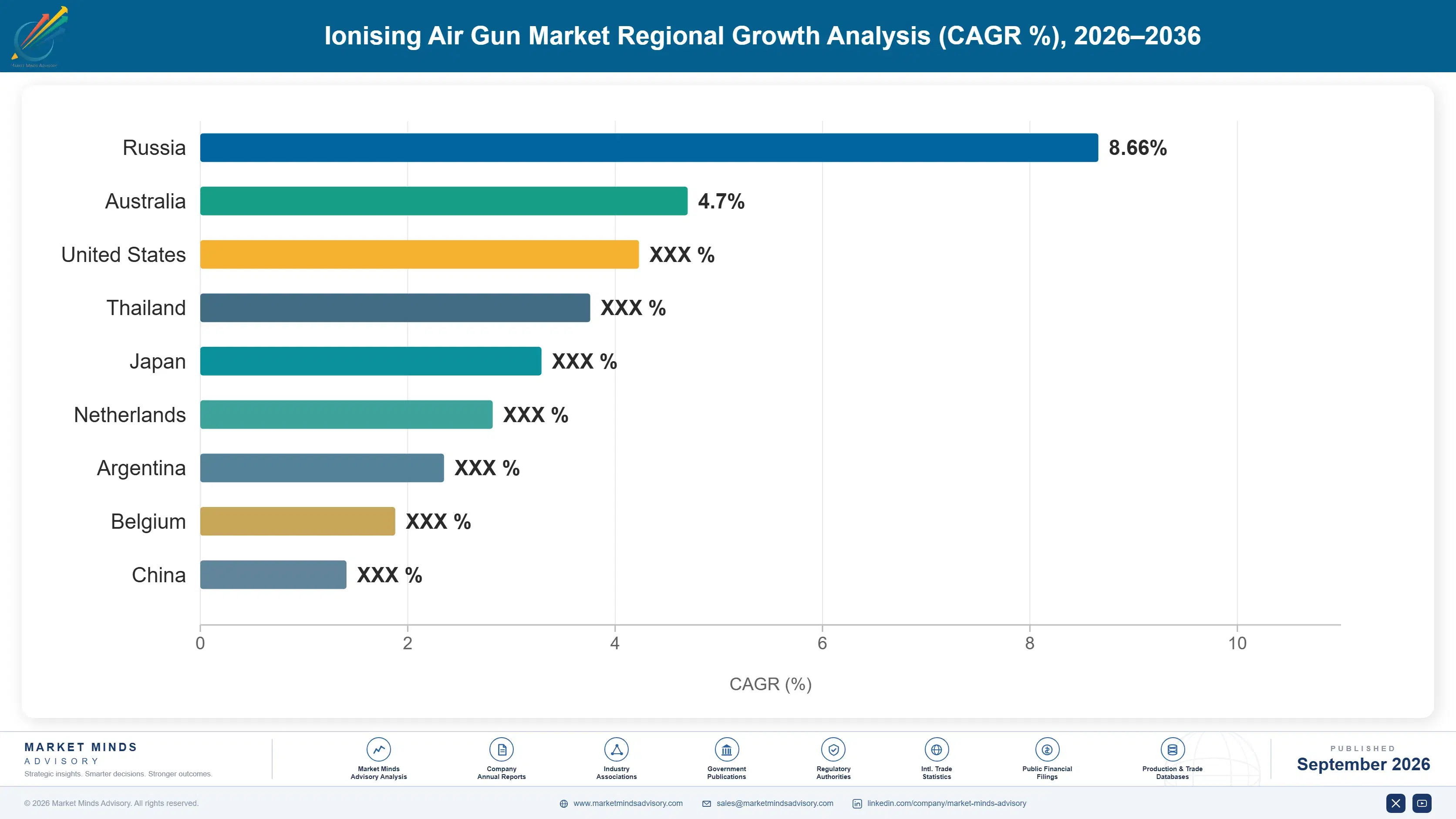
East Asia takes 34%, above its usual band, on electronics assembly with mandated static control alongside the world's largest plastics processing base. India grows fastest of any country covered. Two very different customer groups sit behind these figures, and almost no supplier serves both of them well.

East Asia

Two enormous industries sit here together and each buys this equipment for entirely different reasons. Electronics assembly across China, Korea, Japan, Taiwan and Vietnam operates under documented electrostatic discharge control programmes that specify ionisation at multiple stations on every line, and capacity keeps expanding. Separately, the region processes more plastic than anywhere else, where charge generation during moulding and film handling is a physical certainty rather than a preference. Japanese and Korean suppliers hold strong positions in the electronics segment while Chinese manufacturers serve plastics processing at prices imported units cannot approach. Growth at 6.6% tracks a manufacturing base that is still adding capacity. Two customer types, two channels, one region.
Share: 34% | CAGR: 6.6% (2026 to 2036)

North America

Compressed air cost accounting is more advanced here than anywhere else, which shapes the market in a specific way. Industrial energy management programmes have made air consumption visible on plant floors, and that has driven earlier and deeper adoption of amplifying nozzle designs than any other region shows. The 30 pound dead-end pressure rule for cleaning applications originated here and set the design constraint the whole world now works within. Electronics assembly is a smaller share of demand than in Asia, with plastics processing, packaging, printing and medical device manufacture carrying more of it. Growth at 5.2% reflects a mature base replacing rather than expanding. Air accounting arrived here first and it shows in the mix.
Share: 23% | CAGR: 5.2% (2026 to 2036)
Regional intelligence for 5 additional markets available in the complete report: Western Europe, South Asia and Pacific, Latin America, Middle East and Africa, Eastern Europe. Contact sales@marketmindsadvisory.com.
ionising-air-gun-market-country-cagr-analysis-1788255446535

Four Moves On The Air Bill

None of these four requires a better ioniser, because corona physics has not changed in decades and every serious supplier neutralises charge adequately. Each works on the two things that actually decide money here: what the air costs to make, and the fact that nobody can see the device failing. Both are commercial problems rather than engineering ones.

Quote the air bill, not the gun

A conventional gun consumes around USD 890 of compressed air annually against a purchase price of USD 340, and purchasing departments compare the second number because it is the only one on the quotation. Presenting a calculated annual air cost for the customer's own operating hours and electricity tariff, alongside the saving an amplifying nozzle delivers, changes what is being compared entirely. It requires a spreadsheet and the customer's compressor data. Suppliers who did this stopped competing on unit price and started selling payback periods instead. Payback periods are easier to sell than unit prices.
Market Impact: Attacks USD 890 of annual compressed air spending

Sell the verification nobody is performing

Emitter points contaminate within about 6 months and stop neutralising while airflow continues unchanged, and documented electrostatic discharge programmes require periodic measurement of discharge time that a great many sites simply do not perform. A supplier offering scheduled verification with a measurement record is selling into an existing compliance requirement rather than creating demand. It needs a technician, an instrument and a route, all of which are inexpensive. The recurring revenue on a service round exceeds the hardware margin on the guns it covers. It is the cheapest recurring revenue available anywhere here.
Market Impact: Serves the whole 6 month verification cycle properly

Build a fixed-mount range for automated lines

Automation removes the operator holding a handheld gun, typically replacing 4 units with 2 fixed nozzles integrated into the machine, which reduces unit volume for anybody selling only handhelds. The answer is to be the fixed nozzle rather than to resist the change, which means selling to equipment builders during machine design rather than to plants after installation. Fixed products also price as engineered components rather than as catalogue tools. Suppliers organised entirely around handheld distribution are watching a conversion they could be supplying. Machine builders decide this years ahead.
Market Impact: Captures 2 fixed nozzles on every converted line

Follow the electronics standards into new geography

Indian assembly capacity grows at 7.8%, the fastest of any country covered, and those lines are built to international electrostatic discharge control standards because their customers require it, which means specification-driven purchasing rather than price-driven distribution. Suppliers already approved under those standards elsewhere can enter with credentials rather than samples. It requires local presence and stock rather than any product change. The plastics processing volume in the same country buys entirely differently and needs a separate approach altogether. Entering with credentials rather than samples is a far cheaper route in.
Market Impact: Enters a market now growing at 7.8% annually

Who Controls the Margin Pool

CR5 stands at 46% of units shipped into industrial and cleanroom use, which is the only comparable basis since this product disappears inside far larger pneumatic and automation reporting for most participants. Concentration is moderate because two very different customer groups buy it, and the suppliers strong in electronics static control are rarely the same firms serving plastics processing through distribution. Very few participants serve both groups properly.
Competition runs on air efficiency, standards credentials and distribution reach. Air efficiency decides the argument wherever a plant costs compressed air properly. Standards credentials decide access to electronics assembly, where documented programmes specify what may be used. Distribution decides the plastics and packaging volume, which buys on availability and price. Ionisation performance differentiates almost nothing between established suppliers. Availability decides more of this market than performance does.

Rankings will move on service rather than on hardware, because emitter verification is an unmet compliance requirement with recurring revenue attached and nobody has built it out properly. The pressure comes from an auditing practice rather than from any competitor's product. Suppliers organised purely around catalogue distribution are poorly placed to answer a customer asking for a measurement record. Nobody here sells measurement records.
ionising-air-gun-market-company-positioning-matrix-1788255447051

Competitive Moat and Risk Dimensions

EXAIR

Moat: Air efficiency engineering and documentation

Long specialisation in engineered nozzle geometry gives the company genuinely lower air consumption on comparable performance, together with published data letting a customer calculate the saving before buying anything. That documentation is the product as much as the hardware is. Competitors quoting only unit prices cannot participate in the conversation the company has already framed.
EXAIR

Risk: Handheld exposure to automation

Strength in handheld products sits directly in the path of automated handling, which replaces several operator-held units with one or two fixed nozzles built into a machine. The efficiency argument holds and the unit count does not survive. Competing for fixed integration means selling to equipment builders during design rather than to plants, which is a different organisation entirely.
KEYENCE

Moat: Electronics standards and direct selling

Direct technical selling into electronics assembly, combined with instrumentation that measures ionisation performance rather than merely producing it, positions the company inside documented static control programmes where measurement records are required. Selling the measurement alongside the device is a genuinely stronger position. Distribution-led competitors reach the same plants without reaching the specification.
KEYENCE

Risk: Premium pricing outside electronics

Pricing supported by electronics assembly specifications translates poorly into plastics processing, packaging and printing, where buyers purchase through industrial distribution on availability and price and have no written specification to satisfy. That is the larger application by units. Reaching it means competing on ground where the company's direct selling model carries cost it cannot recover.

Players Tracked

Prominent Players

EXAIR
SMC Corporation
Simco-Ion
Keyence
Hugle Electronics

Other Key Players

Nex Flow Air Products
Meech International
Fraser Anti-Static Techniques
Transforming Technologies
Takk Industries
Static Clean International
Haug Biel
Eltex Elektrostatik
Botron Company
Desco Industries
Kinetronics
Air Control Industries
Silvent
Guardair Corporation
Festo

Recent Developments

FEBRUARY 2025

Industrial energy programmes targeted compressed air consumption

Manufacturing energy management programmes across several regions began costing compressed air at full generation cost rather than treating it as an overhead absorbed by the compressor, making continuously operated blowing stations visible for the first time. Amplifying nozzle replacement projects followed quickly wherever that accounting reached the plant floor.
Signal: An accounting change made a decade of efficiency arguments suddenly persuasive to purchasing departments almost everywhere.
JUNE 2025

Electronics audits flagged unverified ionisation equipment

Electrostatic discharge control audits across contract electronics manufacturers repeatedly recorded ionisation equipment operating without the periodic performance measurement that documented programmes require, since contaminated emitters produce no visible symptom. Demand for verification instruments and for documented service rounds rose noticeably across the following two quarters.
Signal: An audit finding created service demand that a decade of technical advice had not managed to.
OCTOBER 2025

Indian assembly capacity specified international static standards

Electronics assembly capacity commissioned in India under manufacturing incentive programmes was built to international electrostatic discharge control standards, because the customers placing the work required documented compliance. Suppliers already approved under those same standards elsewhere entered with credentials rather than having to establish any locally.
Signal: Standards written overseas decided which suppliers could compete here before anybody had visited a single site.

Machining, Electronics And Emitters

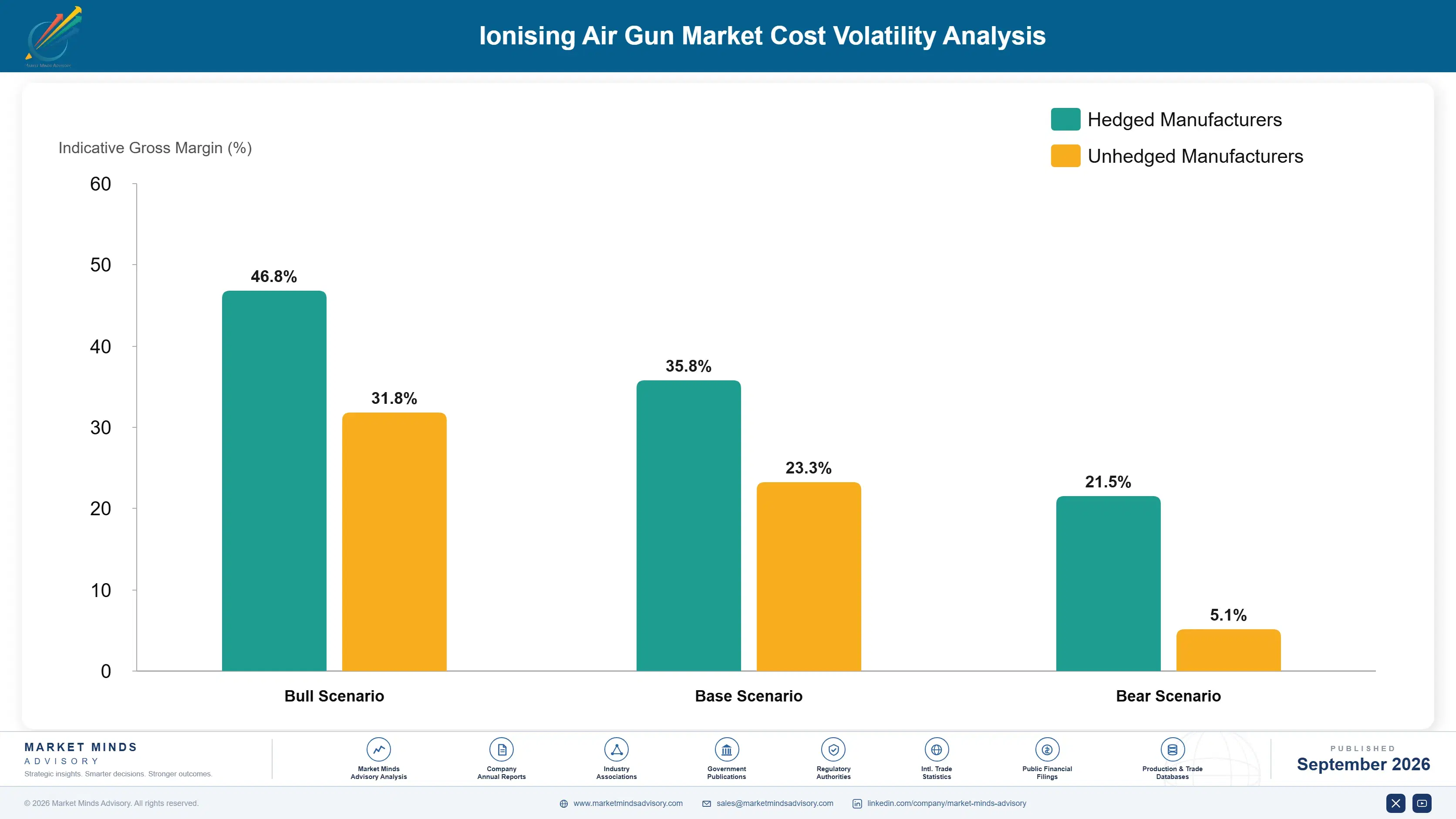
Machined aluminium and moulded polymer bodies account for roughly 31% of unit cost, high voltage power supply electronics around 26%, and tungsten or stainless emitter points a further 9%. Assembly, testing and certification make up most of the remainder. Emitter points are a small share of the device cost and a large share of the recurring revenue, which is a relationship very few participants have thought about properly.
Aluminium and electronic component pricing through 2021 and 2022 moved sharply on entirely separate drivers, with metal following energy costs and trade measures while semiconductors followed allocation shortages nobody in this sector could influence. US Geological Survey mineral commodity reporting recorded the metal movement. Suppliers holding annual contracts and component buffer stock absorbed both. Those buying on spot faced extended lead times and price increases against distribution price lists set annually.

The disadvantage falls on production volume rather than on purchasing capability, which is where most attention goes. A supplier making tens of thousands of units machines and moulds at costs a supplier making thousands cannot approach, and the same applies to electronics bought in quantity. That volume gap explains most of the cost variation here, and no purchasing improvement closes it.
ionising-air-gun-market-cost-volatility-analysis-1788255447256

Hold buffer stock of high voltage components

Power supply electronics are 26% of unit cost and their availability follows semiconductor allocation cycles that have nothing to do with industrial equipment demand. Buffer inventory on the small number of critical components costs modest financing and prevents the extended lead times that cost distribution shelf position. Suppliers holding stock through the last shortage kept their distributor listings.

Standardise bodies across the product range

Machined and moulded bodies are 31% of cost and most suppliers carry more distinct designs across a range than the applications actually require. Consolidating onto fewer common bodies with variant nozzles and emitters raises batch sizes without reducing what the range can do. It costs engineering work once and returns on every unit produced afterwards, which few seem to do.

Price emitters as consumables, not spares

Emitter points are 9% of device cost and require replacement every six months or so, which makes them a recurring revenue line rather than a spare part sitting in a catalogue. Pricing and packaging them as a scheduled consumable, ideally on a subscription attached to a service round, captures revenue customers do not currently spend because nobody prompts them.

Portfolio Architecture for Margin Defence

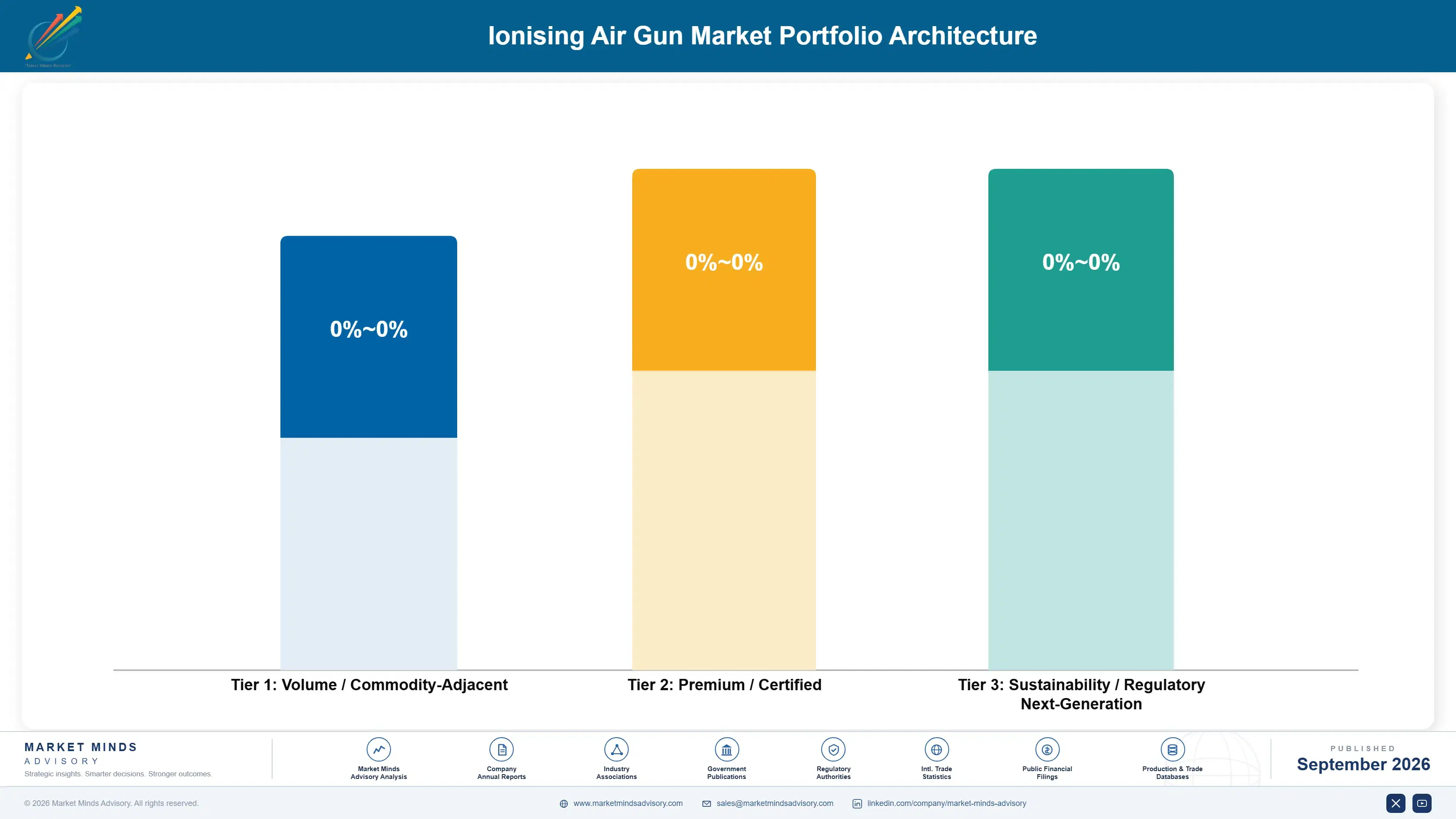
Margin here follows air efficiency and consumables rather than the device itself, which is not how any catalogue is arranged. A plain corona gun competes on unit price against equivalent products and earns very little. An amplifying nozzle sold against a calculated air saving earns a premium the customer can justify arithmetically, and the emitter points it consumes earn again every six months without any further selling.
Volume and premium pull against each other through distribution rather than the factory. Standard corona guns carry the volume that justifies stocking depth at industrial distributors and keeps the brand in catalogues plastics processors actually buy from, and that presence is what gets the efficient products considered when an energy programme starts. Abandoning the commodity range saves margin and removes the shelf position everything else depends on.

High-value pools sit in photoionisation for cleanrooms, in emitter consumables and in verification service nobody has built. The third is genuinely unclaimed: documented electrostatic programmes require periodic measurement that many sites do not perform, and a technician with an instrument on a scheduled round generates recurring revenue exceeding the hardware margin on every gun covered.

Volume / Commodity-Adjacent

Standard corona discharge and pulsed alternating current handheld guns sold through industrial distribution on price and availability. Differentiation is minimal and buyers compare unit cost only. The 8 point spread reflects production volume and whether bodies are machined or moulded.
Gross Margin: 24 to 32%

Premium / Certified

Amplifying nozzle guns and fixed-mount systems sold against calculated compressed air savings and integrated into equipment during machine design. Documented efficiency rather than ionisation supports the price. The 8 point spread reflects whether the sale is direct or through distribution.
Gross Margin: 38 to 46%

Sustainability / Regulatory / Next-Generation

Photoionisation and soft X-ray equipment for cleanrooms, emitter consumables and scheduled verification service with measurement records. Margins are high because compliance and recurring revenue both attach. The 22 point spread separates capital equipment from consumables and service work entirely.
Gross Margin: 48 to 70%
ionising-air-gun-market-portfolio-architecture-1788255447763

High-value Sub-segments and Strategic Watch-out

High-Efficiency Amplifying Nozzle Guns

High value and high growth at 8.7%. Entrained ambient air cuts compressed air consumption by more than half, which turns the sale into an arithmetic exercise rather than an argument. The 8 point spread reflects whether the supplier publishes consumption data customers can verify independently.
Gross Margin: 40 to 48%

Photoionisation and Soft X-Ray Guns

High value with strong growth at 7.8%. Corona emitters generate particles and ozone that the cleanest environments cannot accept, and soft X-ray ionisation produces neither of them at all, at any class. The 8 point spread reflects radiation source certification and whether periodic recertification service is included.
Gross Margin: 54 to 62%

Corona Discharge Handheld Guns

The volume core. It earns modestly and it holds the distributor shelf position that gets efficient products considered when an energy programme eventually starts. The 8 point spread reflects production volume, which decides these economics considerably more than any design difference between competing suppliers. Scale decides here.
Gross Margin: 22 to 30%

Pulsed Alternating Current Ionising Guns

The strategic watch-out. Steady-state direct current designs increasingly outperform pulsed alternating current on offset voltage and response time at comparable cost. The 22 point spread separates legacy replacement work on installed equipment from the new specification that is steadily migrating away. The function is migrating steadily.
Gross Margin: 16 to 38%

Emitters Every Six Months

The annuity here is a consumable and almost nobody collects it. Emitter points require replacement roughly every six months across every installed gun, which across a plant with dozens of stations is a predictable recurring order that suppliers currently leave to whoever the customer remembers to call. The hardware sale is a single transaction and the emitters behind it are worth considerably more over the life of the device.
Stickiness varies enormously by customer type rather than by product. An electronics assembler operating under a documented static control programme specifies approved equipment and stays with it, because changing means revalidating against the programme. A plastics processor buys whatever the distributor has in stock this week and will buy something else next time. Those two customers demand entirely different commercial approaches and most suppliers run only one.

Buyer profiles have shifted from maintenance purchasing toward energy management and quality functions, and the sales approach has not followed. A maintenance buyer asked for a replacement gun at a good price. An energy manager asks what the station consumes in compressed air, and a quality manager asks for a measurement record proving the ionisation still works. Neither question is answered by a catalogue.
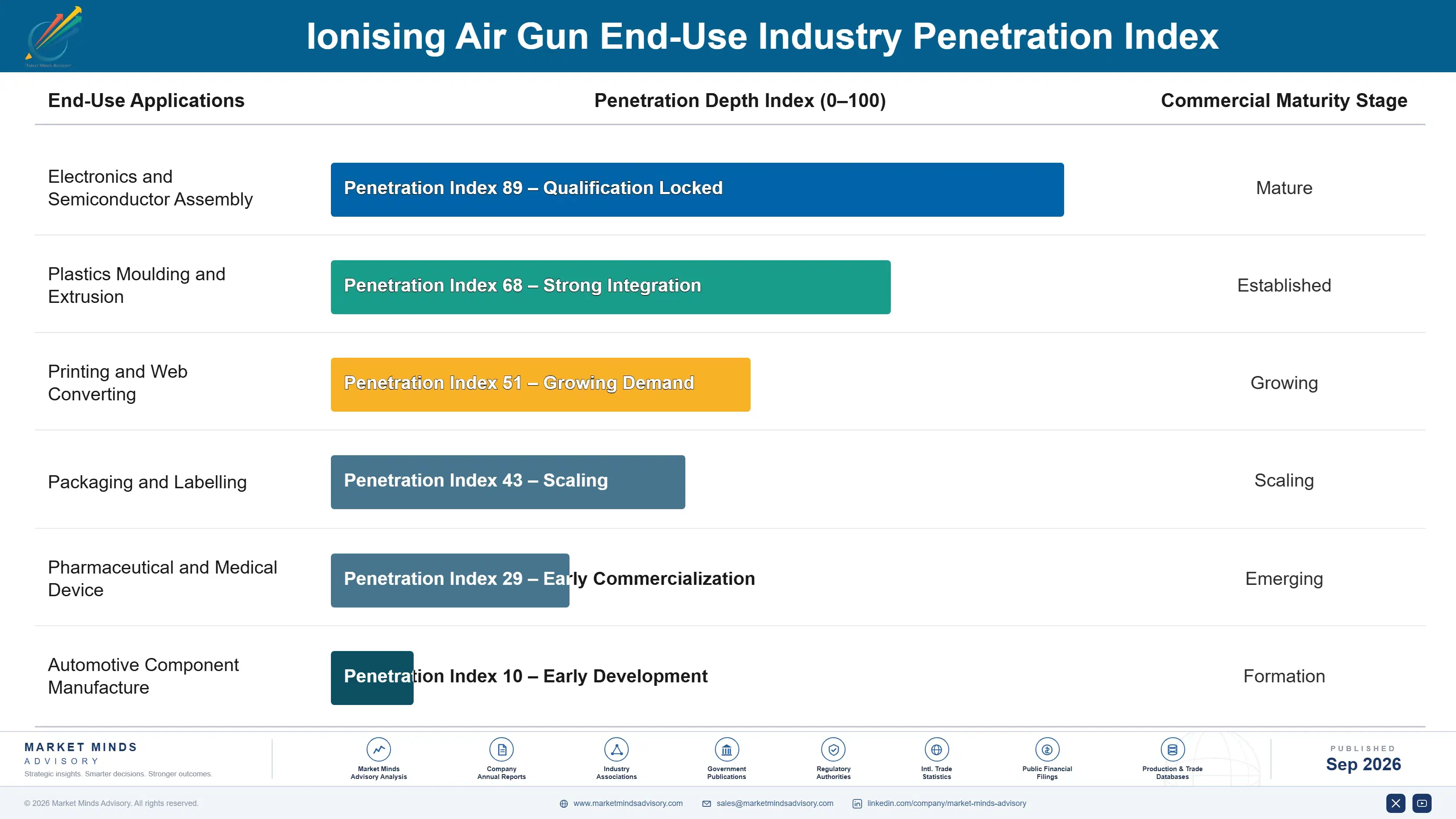
ionising-air-gun-market-end-use-penetration-index-1788255448276

Where The Money Actually Is

These are among the four positions where our research anticipates prominent divergence between winners and laggards over the coming forecast period. Each is grounded in the demand model, the regulatory perimeter, and the announced capacity pipeline.
01 / AIR COST SELLING

Bring the compressed air bill to the meeting

A conventional gun consumes around USD 890 of compressed air every year against a purchase price of USD 340, and purchasing departments compare the second number simply because it is the only one printed on a quotation anywhere. Presenting a calculated annual air cost using the customer's own operating hours and electricity tariff, alongside what an amplifying nozzle would save, changes what is being compared entirely. It takes a spreadsheet and some compressor data, and suppliers who did it stopped competing on unit price altogether.
02 / VERIFICATION SERVICE BUILDING

Sell the measurement, not just the machine

Emitter points contaminate within roughly 6 months and stop neutralising charge while airflow continues completely unchanged, and documented electrostatic discharge programmes require periodic measurement that a great many sites simply never perform at all. A supplier offering scheduled verification with a proper measurement record sells into an existing compliance requirement rather than having to create any demand. It needs only a technician, an instrument and a route, and the recurring revenue exceeds the hardware margin on every single gun covered.
03 / FIXED MOUNT POSITIONING

Be the nozzle the machine builder designs in

Automation removes the operator holding a handheld gun and typically replaces several units with one or two fixed nozzles integrated directly into the machine, which reduces volume for anybody selling only handhelds through distribution. The correct answer is to become the fixed nozzle rather than to resist the conversion, which means selling to equipment builders during machine design instead of to plants after installation. Fixed products also price as engineered components rather than as catalogue tools, which helps the margin considerably.
04 / CONSUMABLE REVENUE CAPTURE

Package emitters as a subscription, not spares

Emitter points are around 9% of device cost and need replacing every six months across every installed unit, which across a plant with dozens of stations is a large and entirely predictable recurring order. Most suppliers list them as spare parts in a catalogue and wait, which means the revenue is only collected when a customer happens to remember. Packaging them as a scheduled consumable, ideally attached to a verification round, captures money that customers do not currently spend because nobody prompts them.

Engagement Snapshot From the Field

A live engagement with an industry participant carrying material or product regulatory and market exposure ahead of a defining policy shift, showing how our research translates into a defensible multi-year portfolio strategy.
MARKET MINDS ADVISORY · CLIENT ENGAGEMENT SUMMARY
Ionising Air Gun Producer Strategic Portfolio Review and Transition Roadmap 2026·Investment Scenario on Ionising Air Gun Exposure Evaluation 2025-26
CLIENT PROFILE
A European supplier of ionising air guns and static control equipment selling through industrial distribution across eight countries, with annual revenue in the low tens of millions of euros and unit volumes flat for four consecutive years despite a growing installed base (client-reported, unverified by MMA). Margins had compressed steadily throughout the period. Nobody had questioned the model.
STRATEGIC CHALLENGE
Distributors were pushing the client on price against cheaper imported guns of adequate performance, and the client had responded by cutting prices, which held volume and destroyed margin. Management wanted to know whether any defensible position existed in a product where the ionisation performance was genuinely comparable across every supplier competing.
MMA APPROACH
MMA analysed the client's installed base by customer type, modelling compressed air consumption and emitter replacement demand against what the client actually invoiced for each. Forty-seven expert interviews with plant engineers, energy managers, quality managers, distributors and competing suppliers established what each buyer type valued and who was making the purchase decision.
KEY FINDINGS
  1. The installed base consumed an estimated 11 times the client's annual revenue in compressed air, and the client had never quantified that figure for any customer.
  2. Emitter replacement demand across the installed base was worth roughly 40% of hardware revenue annually, and the client captured under a quarter of it.
  3. Electronics customers making up 18% of units bought on documented specification and were entirely insensitive to the price competition affecting everything else.
  4. No competitor in the client's markets offered scheduled ionisation verification, despite audits repeatedly recording it as an unmet requirement at customer sites.
CLIENT PROFILE
A European supplier of ionising air guns and static control equipment selling through industrial distribution across eight countries, with annual revenue in the low tens of millions of euros and unit volumes flat for four consecutive years despite a growing installed base (client-reported, unverified by MMA). Margins had compressed steadily throughout the period. Nobody had questioned the model.
STRATEGIC CHALLENGE
Distributors were pushing the client on price against cheaper imported guns of adequate performance, and the client had responded by cutting prices, which held volume and destroyed margin. Management wanted to know whether any defensible position existed in a product where the ionisation performance was genuinely comparable across every supplier competing.
MMA APPROACH
MMA analysed the client's installed base by customer type, modelling compressed air consumption and emitter replacement demand against what the client actually invoiced for each. Forty-seven expert interviews with plant engineers, energy managers, quality managers, distributors and competing suppliers established what each buyer type valued and who was making the purchase decision.
KEY FINDINGS
  1. The installed base consumed an estimated 11 times the client's annual revenue in compressed air, and the client had never quantified that figure for any customer.
  2. Emitter replacement demand across the installed base was worth roughly 40% of hardware revenue annually, and the client captured under a quarter of it.
  3. Electronics customers making up 18% of units bought on documented specification and were entirely insensitive to the price competition affecting everything else.
  4. No competitor in the client's markets offered scheduled ionisation verification, despite audits repeatedly recording it as an unmet requirement at customer sites.
RECOMMENDED STRATEGY
Phase 1: Phase one: build an air cost calculator using customer operating data and lead with payback rather than unit price on every amplifying nozzle quotation. Phase 2: Phase two: convert emitter supply into a scheduled consumable subscription rather than a catalogue spare part awaiting a customer call. Phase 3: Phase three: launch a verification service round covering electronics and cleanroom customers, since no competitor in the client's markets currently offers one.
OUTCOME
Within five quarters emitter revenue had roughly tripled and the verification service covered eleven customer sites on scheduled rounds (client-reported, unverified by MMA). Hardware pricing was restored on amplifying nozzle products. Unit volumes remained flat and total contribution rose considerably. The verification round is being extended to a second country.

Frequently Asked Questions

Foundational context covering the market sizes, CAGR, scope, country, region and competition that inform every finding below. This section is provided to cover basics and most often pre-purchase conversations, answered from the MMA Primary Research Dataset.

What is the current size of the Ionising Air Gun Market?

The global ionising air gun market was valued at USD 0.4 billion in 2025, covering compressed air devices delivering ionised air for static neutralisation. The 2026 figure reaches USD 0.42 billion.

How large will the Ionising Air Gun Market be by 2036?

MMA forecasts USD 0.74 billion by 2036, an increase of USD 0.32 billion over the 2026 base. That represents an expansion multiple of 1.76 times across the forecast period.

What is the CAGR for the Ionising Air Gun Market 2026 to 2036?

The base case compound annual growth rate is 5.8%, with a bull case at 7.0% and a bear case at 4.6%. Historical growth between 2020 and 2025 ran at 4.8%.

Which segment is growing fastest?

High-efficiency amplifying nozzle guns grow at 8.7%, half again the market rate of 5.8%, because entrained ambient air halves compressed air consumption. Photoionisation follows at 7.8%.

Who are the major companies in the Ionising Air Gun Market?

EXAIR, SMC Corporation, Simco-Ion, Keyence and Hugle Electronics lead on units shipped into industrial and cleanroom use, with combined CR5 of 46%. Electronics and plastics buyers are served by different suppliers.

Which country is growing fastest?

India grows fastest at 7.8%, on electronics assembly capacity built to international static control standards under manufacturing incentive programmes. South Asia and Pacific leads regionally at 7.8%.

Report Segmentation Architecture

The full report scope spans multiple orthogonal segmentation dimensions, with cross-tabulated demand data provided for each dimension pair. Coverage extends further to regional breakdowns, trend trajectories, and the competitive detail needed to support segment-level decision-making.

By Ionisation Technology

  • Corona Discharge Handheld Guns
  • High-Efficiency Amplifying Nozzle Guns
  • Fixed-Mount Ionising Nozzles and Bars
  • Steady-State Direct Current Guns
  • Photoionisation and Soft X-Ray Guns
  • Pulsed Alternating Current Ionising Guns

By End-Use Industry

  • Electronics and Semiconductor Assembly
  • Plastics Moulding and Extrusion
  • Printing and Web Converting
  • Packaging and Labelling
  • Pharmaceutical and Medical Device
  • Automotive Component Manufacture

By Commercial Dimension

  • Industrial Distribution Channels
  • Direct Technical Selling
  • Equipment Builder Integration
  • Consumable and Emitter Supply
  • Verification Service Contracts
  • Online and Catalogue Sales

By Region

  • North America
  • Western Europe
  • East Asia
  • South Asia and Pacific
  • Latin America
  • Middle East and Africa
  • Eastern Europe

Scope, Methodology, and Coverage

Every figure in this report is reproducible from documented input assumptions. The scope below maps the historical period, the forecast horizon, the segmentation dimensions, and the countries covered, alongside the underlying primary and qualitative methodology.
Historical Period
2020 to 2025
Forecast Period
2026 to 2036
Base Year
2025 (USD billions; MMA Primary Research Dataset, September 2026)
Market Definition
The ionising air gun market covers handheld and fixed compressed-air devices that deliver ionised air to neutralise electrostatic charge and remove particulate from surfaces, spanning corona discharge handheld guns, high-efficiency amplifying nozzle guns, fixed-mount ionising nozzles and bars, steady-state direct current ionising guns, photoionisation and soft X-ray guns, and pulsed alternating current ionising guns. Scope covers units supplied into industrial production and cleanroom environments together with replacement emitter consumables. Excluded are non-ionising blow guns and air knives, room and overhead ionisation systems, static measurement instruments, compressed air generation and treatment equipment, and personal grounding products.
Quantitative Units
USD billion, 2025 base year, 2026 to 2036 forecast period
Segmentation Dimensions
Ionisation technology, end-use industry, commercial channel, region
Regions Covered
North America, Western Europe, East Asia, South Asia and Pacific, Latin America, Middle East and Africa, Eastern Europe
Countries Covered
United States, Canada, Germany, United Kingdom, France, Italy, Poland, Czechia, China, Japan, South Korea, India, Australia, Brazil, Mexico, Saudi Arabia, South Africa, Vietnam
Key Companies Profiled
20 companies across pneumatic specialists, static control suppliers and instrument manufacturers
Quantitative Methodology
Primary survey, n=3,800 respondents, Q4 2025, six countries; demand-side model with trade association cross-validation
Qualitative Methodology
47 expert interviews, Q4 2025; applied to validate demand model assumptions, identify emerging dynamics, and assess competitive positioning
Report Format
PDF and XLSX data workbook (Word format preview document)
Publisher
Market Minds Advisory
Report Code
MMA-2026-CON-541
Published
September 2026
Contact
sales@marketmindsadvisory.com | www.marketmindsadvisory.com

Purchase the full Ionising Air Gun Market Report (2026 to 2036).

The full MMA report on the ionising air gun market runs to detailed technology and regional models across the 2026 to 2036 forecast period, with total cost benchmarks combining purchase price, compressed air consumption and emitter consumables. It profiles 20 companies on a consistent units shipped basis, covering pneumatic specialists, static control suppliers and instrument manufacturers. Electronics and plastics processing demand are modelled separately, since the two buy through entirely different channels. Regional chapters cover the seven MMA regions with country-level detail on the eighteen markets surveyed. Primary research draws on a quantitative survey of 3,800 respondents across six countries and 47 expert interviews conducted in Q4 2025.
Total cost benchmarks combining purchase, compressed air and consumables
Electronics and plastics processing demand modelled through separate channels
Air consumption compared across nozzle geometries at working pressure
Twenty company profiles on consistent units shipped basis
Emitter replacement and verification service revenue sized by installed base
Seven regional chapters with eighteen country detail tables

Built For The People Who Decide

From boardroom strategy to bench-side execution, this report is read cover-to-cover by leaders shaping the next decade of their industry, turning demand scenarios, market dynamics and valuation benchmarks into decisions.
CXOs/ Presidents/ VPs/ Managers
M&A and Corporate Development
Strategy Teams and R&D Heads
Procurement and Product Directors
Regulatory and Compliance Leaders
Investor Relations and Equity Analysts