Market Minds Advisory
IO-Link technology Market

IO-Link technology Market: IO-Link Technology Market: Retrofit Economics, Master Port Density and Why Sensor Data Stops At The Cabinet 2026 to 2036

The wiring was never the problem. Plants adopted IO-Link to get sensor data upward and then discovered the data stops at the control cabinet, because nobody funded the layer above it.

Lead Analyst

Published

September 2026

Make Smarter Decisions with Customized Research Insights

Request a free sample report and evaluate market opportunities, growth trends, and competitive dynamics relevant to your business needs.

2025 MARKET VALUE$2.1BMarket Size 2025
2036 FORECAST VALUE$6.2BBase Case , 2026 to 2036
CAGR 2026 TO 203610.4 %Bull 11.6% / Bear 9.2%
INCREMENTAL OPPORTUNITY$3.9BNet 10- year value creation
EXPANSION MULTIPLE2.70x2036 value over 2026 base
Strategic Levers
M&A Pipeline
Regional Outlook
Country Rankings
Competitive Intelligence
Segmental Deep-dive
Call-Us : 91 93563 13602

Executive Snapshot and Market Trajectory.

The wiring was never really the problem. Plants adopted IO-Link to move sensor data upward and then found that the data stops at the control cabinet, because nobody funded the layer that was supposed to consume it. Roughly 71% of deployment still arrives with new machinery.
The market reaches USD 2.3 billion in 2026 and USD 6.2 billion by 2036, a 2.70 times expansion at 10.4% annually. IO-Link wireless and safety devices grow at 15.6%, half again the market rate of 10.4%, because cabling is what limits deployment on moving machinery and safety-rated equipment. East Asia holds 31% of shipments and India compounds fastest at 17.2% on new plant construction. Concentration is high.
Five suppliers hold 57% of device and master revenue, which is high and reflects installed automation platform position rather than IO-Link capability itself. Siemens, SICK, Balluff, Turck and Pepperl and Fuchs lead. Master port density per plant decides most competitive outcomes here. Master port utilisation runs near 46%, which means half the installed capacity awaits devices nobody has specified yet, and the supplier holding those ports sits inside every subsequent decision that plant takes.
Market Definition
This report covers IO-Link technology hardware and enabling software: IO-Link sensors and actuators, IO-Link masters and gateway modules, IO-Link wireless and safety-rated devices, hubs and port expansion equipment, and the device description, parameterisation and configuration software supporting them. It excludes fieldbus and industrial Ethernet infrastructure, programmable controllers, conventional analogue sensors without IO-Link capability, manufacturing execution software, and plant-level analytics platforms.
Base Year Value
$2.1B in 2025 (MMA Primary Research Dataset, September 2026)
Forecast Period
2026 to 2036, eleven discrete annual values
CAGR
10.4% base case. Bull 11.6%. Bear 9.2%.
Fastest Growth Segment
IO-Link Wireless And Safety Devices: 15.6% CAGR
Fastest Growth Country
India: 17.2% CAGR
Fastest Growth Region
South Asia and Pacific: 12.6% CAGR
Largest Region
East Asia: 31% of 2025 global value
Market Leaders
Siemens, SICK, Balluff, Turck and Pepperl and Fuchs lead on IO-Link device and master revenue. Source: MMA Analysis.
Primary Survey
n=3,800 procurement and R&D decision-makers, Q4 2025, six countries
Methodology
Demand-side build-up, cross-validated against public data, 47 expert interviews

IO-Link technology Market Forecast Scenarios

io-link-technology-market-size-forecast-scenario-1789999017902
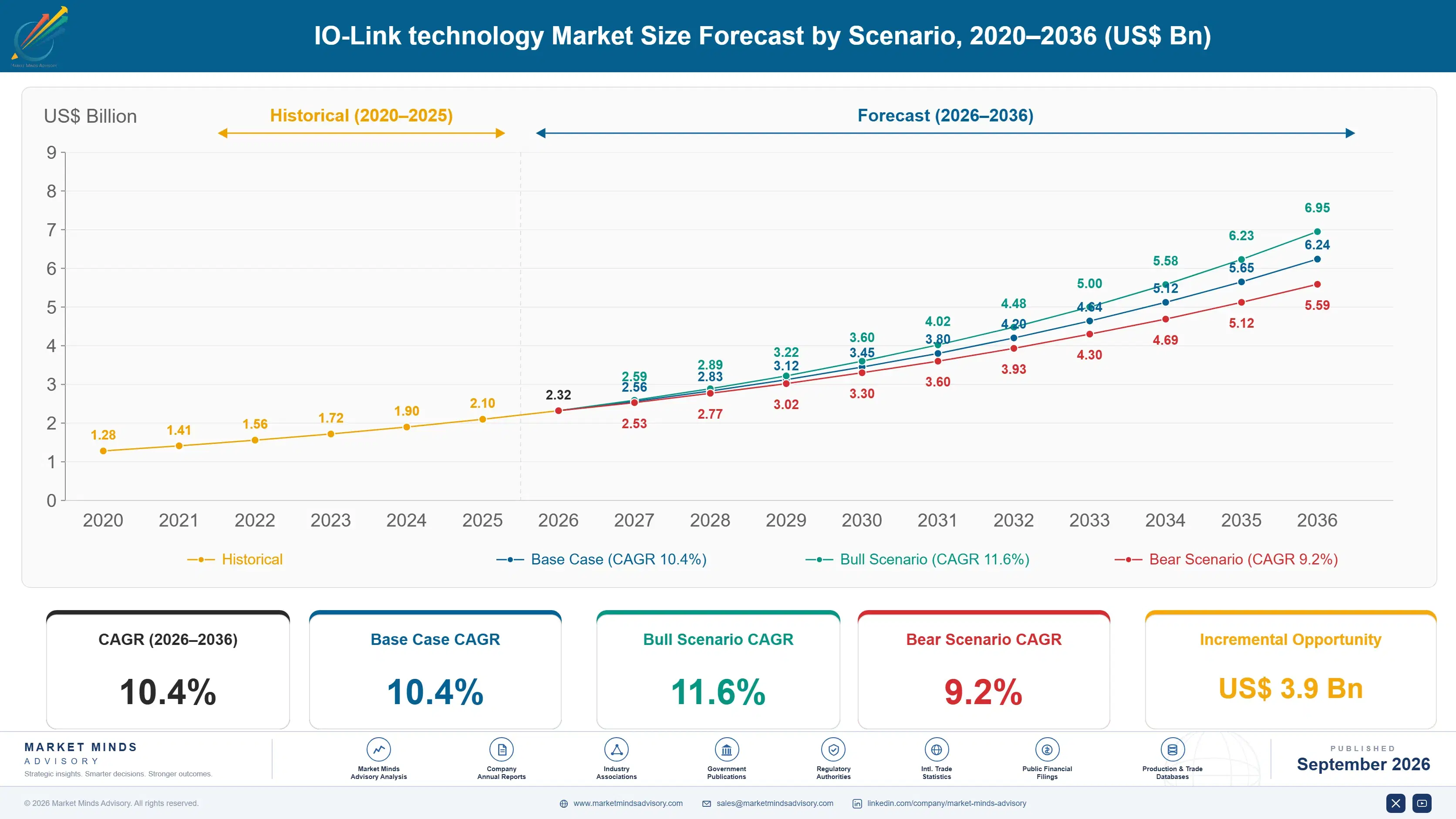
Between 2020 and 2025 the category compounded at 9.3%, driven by new machine builds rather than by retrofit. Machine builders adopted IO-Link because it cut wiring and commissioning time on equipment they were designing anyway. Existing plants moved far more slowly, since rewiring a working line rests on data value most operations could not capture.
The base case holds 10.4% on three mechanisms. New plant construction in Asia keeps specifying IO-Link at the design stage where the cost premium disappears into the build. Wireless and safety-rated devices keep opening applications that cabling made impractical, particularly on rotating and moving machinery. And diagnostics requirements in regulated production keep making device-level parameter history worth capturing rather than merely available. Those three mechanisms run largely independently of one another.
The bull case at 11.6% assumes plant analytics layers mature enough to consume device data, which would convert IO-Link from a wiring decision into a data one and change retrofit economics entirely. The bear case at 9.2% is continued retrofit reluctance, where working lines stay on analogue signalling because nobody can build a return case for the rewiring cost involved.

Data That Stops At The Cabinet

Roughly 71% of IO-Link deployment arrives with new machinery rather than through retrofit, and that ratio explains most of what this market is. A machine builder specifying IO-Link cuts commissioning time by around 38% against analogue wiring, and the premium disappears into a build budget nobody itemises. A plant manager rewiring a working line justifies that against data value instead.
TOP FIVE CONCENTRATION57%Held by suppliers with installed automation platform position across plants
NEW BUILD SHARE71%Deployment arriving with new machinery rather than through plant retrofit
MASTER PORT UTILISATION46%Installed ports actually carrying devices rather than sitting unused
DEVICE DATA CONSUMED22%Diagnostic parameters reaching any system above the control cabinet
COMMISSIONING TIME SAVED38%Reduction against conventional analogue wiring on comparable machine builds
WIRELESS DEVICE SHARE9%Deployment on moving machinery where cabling remains genuinely impractical
The data mostly does not go anywhere. Only around 22% of device diagnostic parameters reach any system above the control cabinet, because the controller was programmed to read a process value and nothing else. Every IO-Link sales argument rests on parameter richness that most installations never capture. That gap is not a technology failure. It is that the analytics layer meant to consume the data was a separate project nobody funded.
Port density is where the commercial position actually sits. Master port utilisation runs near 46%, so half the installed capacity is available for devices that have not been specified yet, and the supplier holding those ports has a considerable advantage on every subsequent device decision. Wireless and safety-rated devices grow at 15.6% against 10.4% for the market, opening applications cabling made impractical.
"Every plant I visit has IO-Link masters full of diagnostic data that nothing upstream reads. The protocol did its job. What nobody budgeted was the part that turns a parameter into a maintenance decision, and that is not a wiring problem anybody can solve with better connectors."
Director, Industrial Automation and Connectivity Practice · MMA Industrial Equipment Practice · September 2026

Market Trends

Deployment Arrives With Machines, Not Retrofits

Roughly 71% of IO-Link deployment comes with new machinery rather than through plant retrofit, because a machine builder absorbs the premium into a build budget while a plant manager must justify rewiring a working line against data value. Commissioning time falls around 38% against analogue wiring on comparable builds, which is the argument that actually closes. Suppliers positioned with machine builders reach the market where decisions are made; those selling retrofit are arguing against equipment that already works. Specification decisions taken at a machine builder persist across the whole programme.
Market Impact: India compounds at 17.2% yearly
Wireless And Safety Devices Open Blocked Applications

IO-Link wireless and safety-rated devices grow at 15.6% against 10.4% for the market, because cabling is what made rotating machinery, moving tooling and safety-rated equipment impractical to instrument at device level. Wireless deployment still accounts for only around 9% of devices, so the headroom is considerable rather than theoretical. These applications also carry higher device pricing than standard sensing, which improves mix for suppliers who invested in the certification these categories require. Suppliers who never made that certification investment are confined to standard sensing, where Asian competitors compete hard on manufacturing cost and barriers to entry are lowest.
Market Impact: Only 22% of data reaches upward

Market Opportunities and Growth Drivers

Asian Plant Construction Specifies At Design Stage

India compounds at 17.2%, ahead of every other market, because new plant construction specifies IO-Link at design stage where the cost premium disappears into the build rather than requiring separate justification. That is the same mechanism driving adoption across East Asia, where manufacturing capacity is being added rather than merely maintained. Suppliers positioned with engineering contractors and machine builders in those markets reach decisions that retrofit-focused competitors never see at all. Engineering contractors rather than plant operators take those decisions, which changes entirely who a supplier has to reach and when.
Market Impact: Just 22% of parameters consumed

Regulated Production Needs Device Parameter History

Pharmaceutical, food and automotive production increasingly require evidence of device configuration and drift over time rather than merely a process value at the moment of measurement. IO-Link carries that parameter history natively, which turns a capability most plants ignore into a compliance requirement they cannot. Only around 22% of device data currently reaches any system above the cabinet, so regulated sectors are the ones actually building the layer that consumes it. Compliance requirements fund the consuming layer that efficiency arguments never persuaded anybody to build, which is why regulated production leads adoption of the diagnostic capability.
Market Impact: Retrofit supplies only 29% of demand

Market Restraints and Challenges

The Consuming Layer Was Never Funded

Only around 22% of device diagnostic parameters reach any system above the control cabinet, because controllers were programmed to read a process value and the analytics layer meant to use the rest was a separate project. The root cause is budget separation between automation and information technology. Commercially this undermines every argument built on parameter richness. Mitigation runs through gateway products that publish data without controller changes, through preconfigured diagnostic templates, and through selling to maintenance rather than engineering. None of those fixes the budget separation; they route around it so the data reaches somebody who can act on it.
Market Impact: New builds carry 71% of deployment

Retrofit Cases Fail Against Working Equipment

Roughly 71% of deployment arrives with new machinery precisely because rewiring a functioning line requires a return case that data value rarely supports on its own. The root cause is that the line already produces acceptable output, so the benefit is avoided downtime rather than added throughput. Commercially this caps the addressable installed base. Mitigation runs through partial retrofit at maintenance intervals, through master installation ahead of device replacement, and through downtime cost quantification. Master installation ahead of device replacement is the cheapest route in, since it buys port position without requiring the line to stop at all.
Market Impact: Wireless holds just 9% today
3 additional market trends, 4 additional growth drivers, and 2 additional restraints and challenges are covered in the full report. Contact sales@marketmindsadvisory.com to access the complete intelligence.

Segment CAGR and Growth Architecture

Segmentation follows device and infrastructure class, since each carries quite different pricing, certification burden and dependence on new machine builds. Six classes cover the market: wireless and safety devices, masters and gateway modules, standard IO-Link sensors, IO-Link actuators, hubs and port expansion, and configuration and parameterisation software. Industry and procurement route are separate dimensions handled elsewhere.
io-link-technology-market-market-share-analysis-1789999018446

IO-Link Wireless And Safety Devices

IO-Link wireless and safety devices grow at 15.6%, half again the market rate of 10.4%, because cabling is exactly what made rotating machinery, moving tooling and safety-rated equipment impractical to instrument at device level. Wireless still accounts for only around 9% of devices deployed, so the remaining headroom is considerable rather than theoretical. These categories also carry materially higher device pricing than standard sensing and demand certification that narrows the supplier field, which is why they improve mix for the participants who invested early rather than merely adding volume. Cabling was the constraint, and removing it opens equipment that could never previously be instrumented at device level. That headroom is genuine rather than notional.
CAGR 15.6%

IO-Link Masters And Gateway Modules

IO-Link masters and gateway modules compound at 12.1% and matter far beyond their revenue share, because master port utilisation runs near 46% and the supplier holding installed ports has a considerable advantage on every subsequent device decision at that plant. Gateways also address the consuming layer problem directly, publishing device parameters upward without requiring controller reprogramming that plant engineering will not authorise. That capability converts a stranded diagnostic capability into something a maintenance function can actually use, which is the argument that moves retrofit. Suppliers pricing masters purely for master margin are protecting the smaller revenue line while conceding the recurring device revenue that follows the port. Port position compounds over the whole line life.
CAGR 12.1%
Full segment breakdown across 6 segments available in the complete report.

Regional Architecture and Country Demand Map

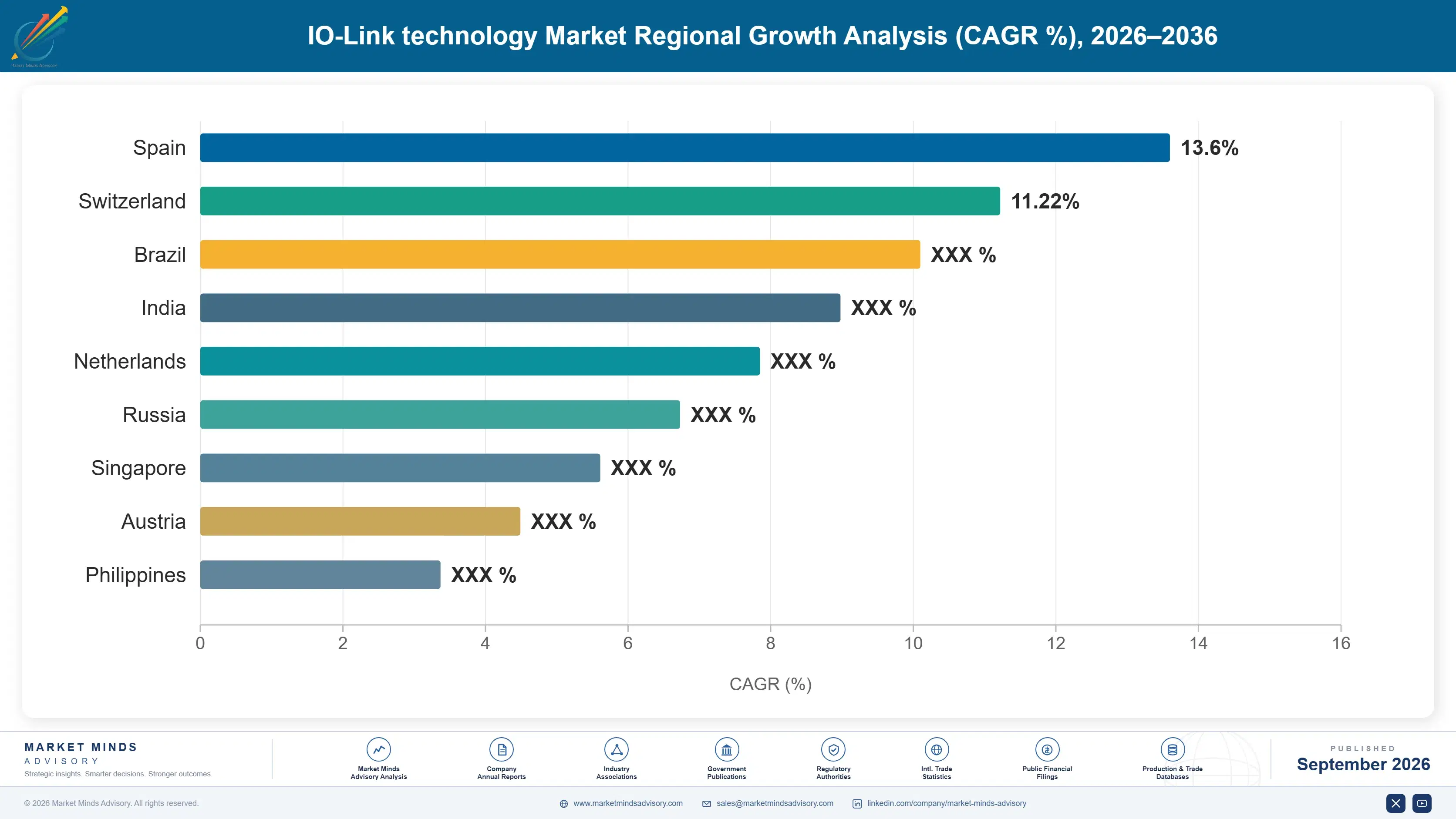
East Asia holds 31% of IO-Link shipments, the largest regional share, because machine building and new manufacturing capacity are both concentrated there and specification happens at design stage. Western Europe follows at 27% as the technology's origin market. India compounds fastest at 17.2% on new plant construction.

East Asia

East Asia takes 31% of IO-Link shipments, the largest regional share and above the usual band ceiling, because machine building and new manufacturing capacity both concentrate here and specification therefore happens at design stage rather than through retrofit. Chinese machine builders adopted IO-Link primarily for commissioning time savings near 38% rather than for any diagnostic capability. Japanese and South Korean automation suppliers compete domestically against European incumbents on price. Growth at 11.5% runs above the global rate on capacity addition rather than plant modernisation. Regional device suppliers compete hard on price in standard sensing while European incumbents retain the safety and wireless categories that certification protects. That split is widening steadily.
Share: 31% | CAGR: 11.5% (2026 to 2036)

Western Europe

Western Europe accounts for 27% of shipments as the technology's origin market, where Siemens, SICK, Balluff, Turck and Pepperl and Fuchs all developed their positions. Penetration here is deepest and consequently growth is slowest, since most new machinery already specifies IO-Link and remaining opportunity sits in retrofit that plant managers keep declining. Regulated pharmaceutical and food production here does consume device parameter data more than elsewhere. Growth at 8.9% is the slowest of any region, on maturity rather than any weakness in demand. Gateway products publishing parameters without controller changes have opened retrofit conversations here that had previously stalled. Retrofit remains the harder half of the opportunity, and it is where most remaining regional growth has to come from.
Share: 27% | CAGR: 8.9% (2026 to 2036)
Regional intelligence for 5 additional markets available in the complete report: North America, South Asia and Pacific, Latin America, Middle East and Africa, Eastern Europe. Contact sales@marketmindsadvisory.com.
io-link-technology-market-country-cagr-analysis-1789999018959

Where IO-Link Position Is Won

Deployment arrives with new machines rather than retrofits, device data mostly stops at the control cabinet, and installed master ports decide who wins the next device order. The four levers below follow those conditions rather than any argument about protocol capability, which every serious supplier now holds equally. Each addresses a commercial condition instead.

Sell Through Machine Builders Not Plant Managers

Roughly 71% of deployment arrives with new machinery, because a builder absorbs the premium into a build budget while a plant manager must justify rewiring equipment that already works. Commissioning time falling around 38% is the argument that closes with builders. Suppliers positioned with machine builders and engineering contractors reach the point where specification happens, and those selling retrofit into operating plants are arguing against working equipment they cannot easily displace. A specification won at a builder persists across the whole machine programme, frequently for years afterwards. Retrofit arguments rarely displace that.
Market Impact: New builds now carry fully 71% of deployment

Ship Gateways That Publish Without Controller Changes

Only around 22% of device parameters reach any system above the cabinet, because publishing them normally requires controller reprogramming that plant engineering will not authorise on a running line. Gateway products that publish independently remove that dependency entirely. That converts a stranded capability into something a maintenance function can use, and it is the single argument that makes retrofit conversations viable at all with operators who have already declined once. Only around 22% of parameters currently reach anything upward at all. Maintenance functions fund what engineering will not. Work orders are what the data has to produce.
Market Impact: Just 22% of all parameters now reach upward

Install Master Ports Ahead Of Device Demand

Master port utilisation runs near 46%, which means half of installed capacity awaits devices nobody has specified yet, and the supplier holding those ports has a considerable advantage on every subsequent decision. Pricing masters to win port share rather than to maximise master margin buys position in future device revenue. Suppliers optimising master pricing in isolation are protecting the smaller line while conceding the recurring one entirely. Half of installed capacity awaits devices that have not yet been chosen by anybody. Winning the port is cheaper than winning every device.
Market Impact: Port utilisation now sits near just 46% today

Certify For Safety And Wireless Applications Early

Wireless and safety-rated devices grow at 15.6% while holding only around 9% of deployment, and both carry materially higher pricing than standard sensing alongside certification requirements that narrow the field. Suppliers who invested in that certification improve mix rather than merely adding volume. Those who did not are competing in standard sensing where price competition is severe and where the applications cabling blocked remain closed to them entirely. Certification takes years rather than quarters, which is precisely why it holds. Standard sensing offers volume without any margin. Mix improves rather than merely volume.
Market Impact: Wireless devices now hold only 9% of deployment

Who Controls the Margin Pool

Five suppliers hold 57% of IO-Link device and master revenue, which is high and reflects installed automation platform position rather than any protocol capability, since IO-Link is an open standard everybody implements. Siemens, SICK, Balluff, Turck and Pepperl and Fuchs lead. All participants are assessed on IO-Link device, master and enabling software revenue rather than on broader automation businesses they also operate. Concentration has held steady for years despite the standard being open to every supplier.
Competition runs on installed master port share and machine builder relationships far more than on device specification, which converges quickly across suppliers. The second dimension is safety and wireless certification, because those categories carry higher pricing and narrower supplier fields while standard sensing competes largely on price and delivery. Device specification competes a distant third behind both of those.

Pressure is emerging from Asian device suppliers competing on price in standard sensing categories where certification barriers are lowest. Rankings shift where new plant construction specifies at design stage, particularly across India, East Asia and the Gulf, and where wireless applications open equipment that cabling excluded. Suppliers confined to standard sensing face the sharpest price pressure in the category.
io-link-technology-market-company-positioning-matrix-1789999019489

Competitive Moat and Risk Dimensions

SIEMENS

Moat: Controller Platform Position

Siemens holds controller and automation platform position that makes its masters the default wherever its controllers already run, which is a very large installed base across European and Asian manufacturing. Since master port utilisation runs near 46%, holding those ports carries advantage on every subsequent device decision. Competitors must displace a platform rather than win a comparison.
SIEMENS

Risk: Device Price Exposure

Platform position wins masters and does not by itself win devices, where Asian suppliers compete hard on price in standard sensing categories carrying the lowest certification barriers. Growth sits in wireless and safety devices at 15.6% and in price-competitive standard sensing. Platform advantage defends the port and leaves the recurring device revenue genuinely contested.
SICK

Moat: Sensing Application Depth

SICK holds sensing application depth across detection, measurement and identification that device-level protocol capability does not substitute for, and that depth reaches applications where selection turns on measurement performance rather than connectivity. Safety-rated certification across those categories narrows the competing field considerably. Suppliers entering on IO-Link capability alone find the sensing problem harder than the protocol.
SICK

Risk: New Build Dependence

Roughly 71% of deployment arrives with new machinery, which ties device demand to machine builder specification decisions rather than to plant operator preference. Application depth persuades engineers who may not be the ones choosing. Where a builder standardises on a competing supplier's masters, sensing quality reaches the evaluation later than the port decision that preceded it.

Players Tracked

Prominent Players

Siemens
SICK
Balluff
Turck
Pepperl and Fuchs

Other Key Players

ifm electronic
Baumer
Banner Engineering
Omron
Keyence
Rockwell Automation
Phoenix Contact
Beckhoff Automation
Murrelektronik
Wenglor Sensoric
Contrinex
Leuze electronic
Datalogic
Panasonic Industry
Autonics

Recent Developments

FEBRUARY 2025

Wireless Device Certification Expands Across Supplier Portfolios

Several automation suppliers expanded IO-Link wireless device certification across sensing portfolios, a product development rather than any corporate transaction. Wireless still accounts for only around 9% of deployment while growing at 15.6%, and it reaches rotating and moving machinery that cabling made impractical to instrument at device level at all.
Signal: Certification rather than protocol capability is what actually narrows the supplier field across all these categories.
AUGUST 2024

Gateway Products Publish Device Data Without Controller Changes

Suppliers expanded gateway products publishing IO-Link parameter data upward without requiring controller reprogramming, a capability development rather than any acquisition. Only around 22% of device parameters currently reach systems above the control cabinet, largely because plant engineering will not authorise controller changes on lines that are running.
Signal: Removing the controller dependency is what makes any retrofit conversation possible with plant operators at all.
JUNE 2025

Indian Plant Construction Specifies IO-Link At Design Stage

Engineering contractors on Indian manufacturing construction projects increasingly specified IO-Link during design rather than leaving device connectivity to plant commissioning, a specification development rather than any corporate event. India compounds at 17.2%, and specification at design stage is where the cost premium disappears into the overall build budget.
Signal: Suppliers reaching engineering contractors see specification decisions that plant-focused competitors simply never encounter at all today.

What A Device Costs To Build

Semiconductors and sensing elements absorb roughly 41% of device cost, sourced from specialist suppliers producing industrial-grade parts at moderate volume. Enclosure, connector and cable assembly takes around 19%, and industrial sealing requirements make that more expensive than the components suggest. Certification and compliance testing absorbs about 14%, rising sharply for safety-rated and wireless categories, with production labour taking the remainder.
Industrial semiconductor availability tightened through 2022 and 2023 as automotive and consumer demand competed for the same fabrication capacity that industrial parts depend on at lower volumes. Siemens Annual Report 2024 and Pepperl and Fuchs Annual Report 2024 both record component availability and certification cost among principal operating variables. Suppliers holding multi-year component agreements maintained delivery commitments that competitors buying spot could not match. Missed build windows cost specification positions lasting years.

The competitive disadvantage mechanism is certification amortisation rather than component price. A supplier spreading safety and wireless certification across a wide device portfolio carries far lower cost per product than one certifying a narrow range. Exposure concentrates among smaller specialists, since the categories growing fastest are precisely the ones demanding the certification investment their portfolio breadth cannot amortise properly.
io-link-technology-market-cost-volatility-analysis-1789999019685

Amortise Safety Certification Across Wide Device Families

Certification and compliance testing absorbs roughly 14% of device cost and rises sharply for safety-rated and wireless categories that are growing fastest. Designing device families around common certified platforms spreads that expense across many products rather than a few. The architecture decision has to be made early, since retrofitting certification commonality into an existing portfolio is not realistically achievable.

Contract Industrial Semiconductor Supply Across Multiple Years

Semiconductors and sensing elements absorb roughly 41% of device cost and come from suppliers whose capacity is shared with far larger automotive and consumer demand. Multi-year agreements secure allocation and support delivery commitments machine builders can schedule around. Buying spot means missing build windows, which loses specification positions that then persist across the whole machine programme.

Standardise Enclosures Across Sensing And Actuator Ranges

Enclosure, connector and cable assembly absorbs around 19% of cost, and industrial sealing requirements make tooling expensive relative to the volumes any single product carries. Sharing enclosure platforms across sensing and actuator ranges spreads that tooling considerably further. The constraint is product management discipline rather than engineering, and it erodes quietly whenever ranges are developed independently.

Portfolio Architecture for Margin Defence

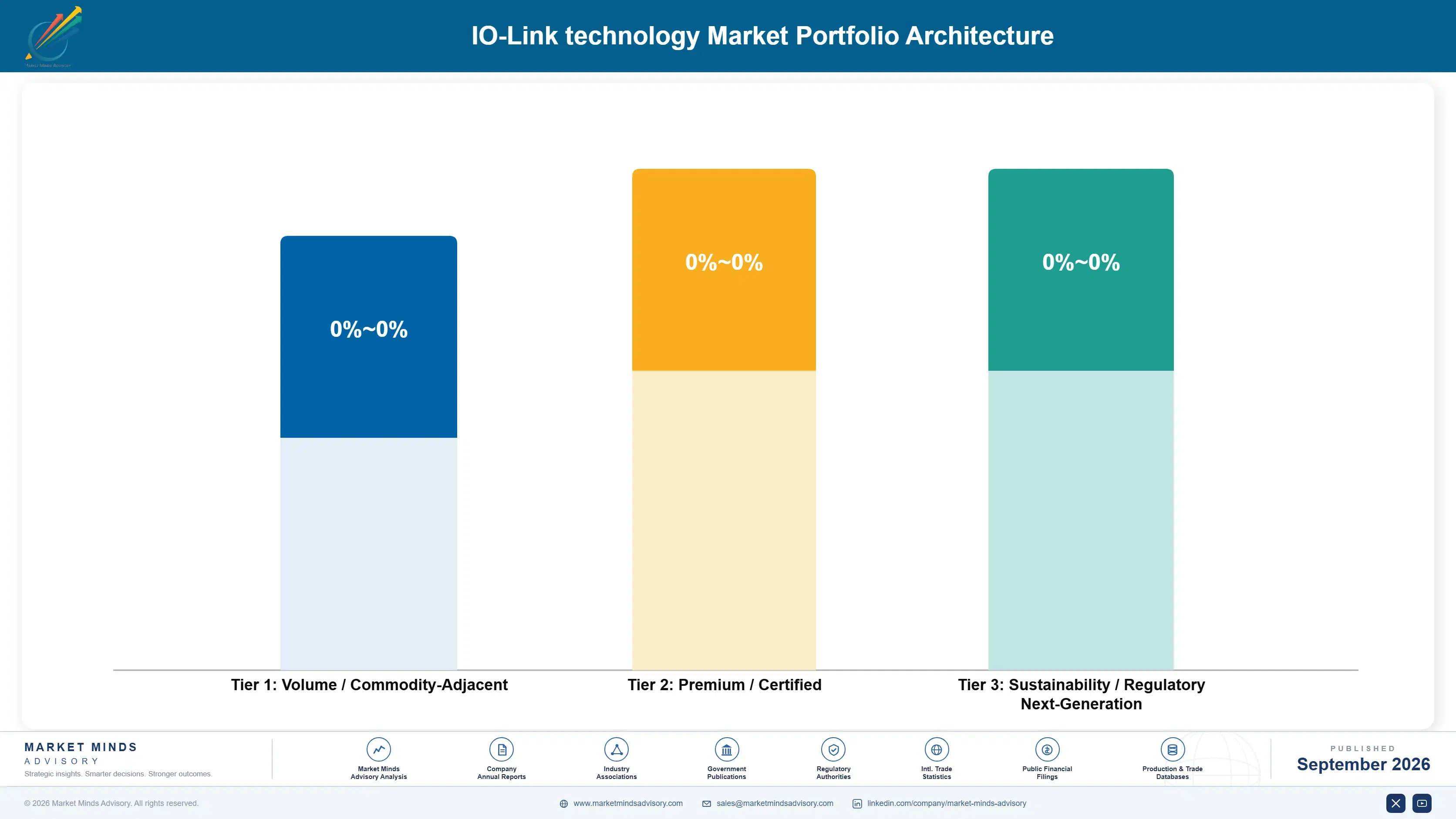
Margin architecture separates on certification burden rather than on manufacturing difficulty. Standard IO-Link sensors and hubs earn least, since specification converges across suppliers and Asian competitors compete hard on price. Actuators and configuration software sit above on application specificity. Wireless devices, safety-rated devices and masters earn most, because each combines certification barriers with position that carries into subsequent device decisions.
The volume versus premium tension runs between standard sensing and certified categories, which reward opposite investment entirely. Volume requires manufacturing cost discipline against competitors with lower labour and component costs. Premium requires certification investment amortised across device families. Suppliers attempting both from a narrow portfolio carry certification cost they cannot spread and lose price competitions they cannot win either. Choosing one deliberately beats serving both indifferently.

High-value pools concentrate in wireless and safety devices and in masters, and none is reached through protocol capability, which is an open standard. Wireless and safety require certification investment measured in years. Masters require automation platform position that determines the default choice at a plant. Both explain why the same five suppliers keep holding 57% while standard sensing fragments beneath them.

Volume / Commodity-Adjacent

Standard IO-Link sensors, hubs and port expansion equipment, where specification converges quickly across suppliers and Asian competitors compete hard on manufacturing cost. The twelve point spread separates suppliers with shared enclosure platforms from those tooling each product range independently.
Gross Margin: 24% to 36%

Premium / Certified

IO-Link actuators and configuration and parameterisation software, where application specificity and integration depth determine selection rather than unit price comparison. The twelve point spread tracks how much of each supplier's range shares common certified platforms against bespoke development per product.
Gross Margin: 41% to 53%

Sustainability / Regulatory / Next-Generation

IO-Link wireless devices, safety-rated devices and masters, each combining certification barriers with position carrying into subsequent device decisions at the same plant. The fourteen point spread reflects certification amortisation across portfolio breadth, which smaller specialists cannot reach.
Gross Margin: 57% to 71%
io-link-technology-market-portfolio-architecture-1789999020202

High-value Sub-segments and Strategic Watch-out

IO-Link Wireless And Safety Devices

Grows at 15.6% because cabling is what made rotating machinery and safety-rated equipment impractical to instrument. The fourteen point spread reflects certification amortisation. Wireless holds only around 9% of deployment, so remaining headroom is considerable rather than theoretical. Pricing sits well above standard sensing. Certification narrows entry.
Gross Margin: 57% to 71%

IO-Link Masters And Gateway Modules

Grows at 12.1% and carries advantage far beyond revenue, since port utilisation near 46% leaves capacity awaiting devices. The fourteen point spread reflects platform position. Gateways also publish parameters upward without any controller reprogramming. Plant engineering will not authorise those. Gateways route around that entirely.
Gross Margin: 57% to 71%

IO-Link Actuators And Valve Interfaces

Grows at 10.8% on pneumatic and valve applications where parameter feedback genuinely changes maintenance practice. The twelve point spread reflects platform commonality. Application specificity keeps price competition milder than in standard sensing categories. Parameter feedback changes maintenance practice here more than in any other device category.
Gross Margin: 41% to 53%

Standard IO-Link Sensors And Hubs

Grows at 8.4%, slowest of the six classes, as specification converges and Asian suppliers compete hard on manufacturing cost. The twelve point spread reflects enclosure platform sharing. Certification barriers here are the lowest anywhere in the category. Price competition is severe throughout. Barriers to entry are lowest here.
Gross Margin: 24% to 36%

Why Ports Decide Devices

The annuity here is the installed master port rather than any contract. A plant with masters installed buys devices against those ports for as long as the line runs, and master port utilisation near 46% means half that capacity is still waiting for devices nobody has specified. The supplier holding the port sits inside every subsequent decision. Suppliers optimising master margin in isolation concede the recurring line entirely.
Depth varies by who made the original specification. A plant whose machinery arrived from a builder that standardised on one supplier inherits that position without ever evaluating it, and roughly 71% of deployment arrives exactly that way. A plant that retrofitted chose deliberately and will choose again. The inherited positions are stickier, which is why supplier competition concentrates at the machine builder rather than at the operating plant.

The buyer has changed less than the category expected. An automation engineer evaluated wiring reduction and commissioning time against a build schedule. A maintenance function evaluates whether device parameters reach anything that produces a work order, and only around 22% currently do. A compliance function in regulated production evaluates configuration history. The third buyer funds the consuming layer the other two never did.
io-link-technology-market-end-use-penetration-index-1789999020692

What Wins Device Position

These are among the four positions where our research anticipates prominent divergence between winners and laggards over the coming forecast period. Each is grounded in the demand model, the regulatory perimeter, and the announced capacity pipeline.
01 / MACHINE BUILDER COVERAGE

Specify With The Builder, Not The Plant

Roughly 71% of IO-Link deployment arrives with new machinery, because a builder absorbs the premium into a build budget nobody itemises while a plant manager must justify rewiring equipment that already works acceptably. Commissioning time falling around 38% against analogue wiring is the argument that actually closes with builders. Suppliers positioned with builders and engineering contractors reach the point where specification happens rather than arguing against working lines afterwards, which is a considerably harder position to argue from once the machinery is already installed and producing.
02 / CONSUMING LAYER ENABLEMENT

Publish The Data Without Touching Controllers

Only around 22% of device parameters reach any system above the control cabinet, because publishing them normally requires controller reprogramming that plant engineering will not authorise on running lines. Gateway products publishing independently remove that dependency entirely and convert a stranded capability into something maintenance can use. That is the single argument making retrofit conversations viable with operators who have already declined the proposition once, and it is the only argument that reliably reopens those accounts after they have declined the proposition once already.
03 / PORT SHARE INVESTMENT

Buy Ports Now, Sell Devices Later

Master port utilisation runs near 46%, so half of installed capacity is waiting for devices nobody has specified yet, and the supplier holding those ports sits inside every subsequent decision that plant makes. Pricing masters to win port share rather than to maximise master margin buys position in the recurring device revenue. Suppliers optimising master pricing in isolation protect the smaller line and concede the larger one, which is a poor trade over any full machine lifetime measured across the full life of the line.
04 / CERTIFIED CATEGORY ENTRY

Invest Where Certification Narrows The Field

Wireless and safety-rated devices grow at 15.6% while holding only around 9% of deployment, and both carry materially higher pricing alongside certification requirements that narrow the competing supplier field considerably. Suppliers who made that investment improve mix rather than merely adding volume to a price-competitive base. Those who did not are left in standard sensing, where Asian competitors compete hard and certification barriers are lowest anywhere and the applications cabling blocked stay closed to them, which is a difficult place to hold any margin.

Engagement Snapshot From the Field

A live engagement with an industry participant carrying material or product regulatory and market exposure ahead of a defining policy shift, showing how our research translates into a defensible multi-year portfolio strategy.
MARKET MINDS ADVISORY · CLIENT ENGAGEMENT SUMMARY
IO-Link technology Producer Strategic Portfolio Review and Transition Roadmap 2026·Investment Scenario on IO-Link technology Exposure Evaluation 2025-26
CLIENT PROFILE
An automation component supplier with a broad standard IO-Link sensing range, losing share to Asian competitors on price while its own device volumes stalled against a growing installed base of masters supplied by others. Leadership had approved a manufacturing cost reduction programme, without establishing where in the specification chain the company was actually losing. Nobody had traced the losses to specification.
STRATEGIC CHALLENGE
Manufacturing wanted further cost reduction to defend standard sensing pricing. Sales wanted a wireless and safety range to reach higher-margin categories. Nobody had established which decisions the company was losing and at what stage, and two large machine builder programmes were entering specification within the following two quarters. Both proposals assumed the company was reaching evaluation at all.
MMA APPROACH
MMA traced lost device opportunities back to the specification decision that preceded them, distinguishing plant-level losses from those decided years earlier at the machine builder. We costed safety and wireless certification against the portfolio breadth available to amortise it. Work drew on 47 expert interviews conducted in Q4 2025 with machine builders, plant engineers and distribution partners.
KEY FINDINGS
  1. Around 74% of lost device opportunities had been decided at machine builder specification rather than at the plant, frequently 2 or more years earlier.
  2. Manufacturing cost reduction would not have changed those outcomes, since the company was not present at the specification stage in any of them.
  3. Certifying 1 shared platform across safety and wireless ranges cost far less than certifying each product individually would have (client-reported, unverified by MMA).
  4. Plants where the company held installed master ports bought its devices at roughly 3 times the rate of plants where it held none.
CLIENT PROFILE
An automation component supplier with a broad standard IO-Link sensing range, losing share to Asian competitors on price while its own device volumes stalled against a growing installed base of masters supplied by others. Leadership had approved a manufacturing cost reduction programme, without establishing where in the specification chain the company was actually losing. Nobody had traced the losses to specification.
STRATEGIC CHALLENGE
Manufacturing wanted further cost reduction to defend standard sensing pricing. Sales wanted a wireless and safety range to reach higher-margin categories. Nobody had established which decisions the company was losing and at what stage, and two large machine builder programmes were entering specification within the following two quarters. Both proposals assumed the company was reaching evaluation at all.
MMA APPROACH
MMA traced lost device opportunities back to the specification decision that preceded them, distinguishing plant-level losses from those decided years earlier at the machine builder. We costed safety and wireless certification against the portfolio breadth available to amortise it. Work drew on 47 expert interviews conducted in Q4 2025 with machine builders, plant engineers and distribution partners.
KEY FINDINGS
  1. Around 74% of lost device opportunities had been decided at machine builder specification rather than at the plant, frequently 2 or more years earlier.
  2. Manufacturing cost reduction would not have changed those outcomes, since the company was not present at the specification stage in any of them.
  3. Certifying 1 shared platform across safety and wireless ranges cost far less than certifying each product individually would have (client-reported, unverified by MMA).
  4. Plants where the company held installed master ports bought its devices at roughly 3 times the rate of plants where it held none.
RECOMMENDED STRATEGY
Phase 1: Phase one: redirect commercial effort to machine builders and engineering contractors, where roughly three quarters of device decisions are actually taken. Phase 2: Phase two: certify a shared platform across safety and wireless ranges rather than certifying individual products at considerably higher total cost. Phase 3: Phase three: price masters to win installed port share, accepting lower master margin in exchange for the recurring device revenue that follows.
OUTCOME
The supplier moved commercial coverage to machine builders and priced masters for port share (client-reported, unverified by MMA). Device attach rates improved substantially at plants where ports were won, and the shared certification platform reached market faster than individual products would have. Specification stage presence is now tracked as a commercial metric, which outlasted the engagement.

Frequently Asked Questions

Foundational context covering the market sizes, CAGR, scope, country, region and competition that inform every finding below. This section is provided to cover basics and most often pre-purchase conversations, answered from the MMA Primary Research Dataset.

What is the current size of the IO-Link technology Market?

Global value reaches USD 2.3 billion in 2026, measured as device, master and enabling software revenue. The 2025 base was USD 2.1 billion on the same basis.

How large will the IO-Link technology Market be by 2036?

The market reaches USD 6.2 billion by 2036, an increase of USD 3.9 billion across the forecast period. That represents 2.70 times expansion from the 2026 base.

What is the CAGR for the IO-Link technology Market 2026 to 2036?

The base case runs at 10.4% annually, with a bull case at 11.6% if plant analytics layers mature enough to consume device data and a bear case at 9.2% if retrofit reluctance persists.

Which segment is growing fastest?

IO-Link wireless and safety devices grow at 15.6%, half again the market rate of 10.4%. Cabling is what made rotating and safety-rated machinery impractical to instrument.

Who are the major companies in the IO-Link technology Market?

Siemens, SICK, Balluff, Turck and Pepperl and Fuchs lead on device and master revenue, holding 57% between them. ifm electronic and Baumer hold smaller positions.

Which country is growing fastest?

India leads at 17.2%, as new plant construction specifies IO-Link at design stage where the cost premium disappears into the overall build. China and Vietnam follow.

Report Segmentation Architecture

The full report scope spans multiple orthogonal segmentation dimensions, with cross-tabulated demand data provided for each dimension pair. Coverage extends further to regional breakdowns, trend trajectories, and the competitive detail needed to support segment-level decision-making.

By Device And Infrastructure Class

  • IO-Link Wireless And Safety Devices
  • IO-Link Masters And Gateway Modules
  • IO-Link Actuators And Valve Interfaces
  • Standard IO-Link Sensors
  • Hubs And Port Expansion Equipment
  • Configuration And Parameterisation Software

By End-Use Industry

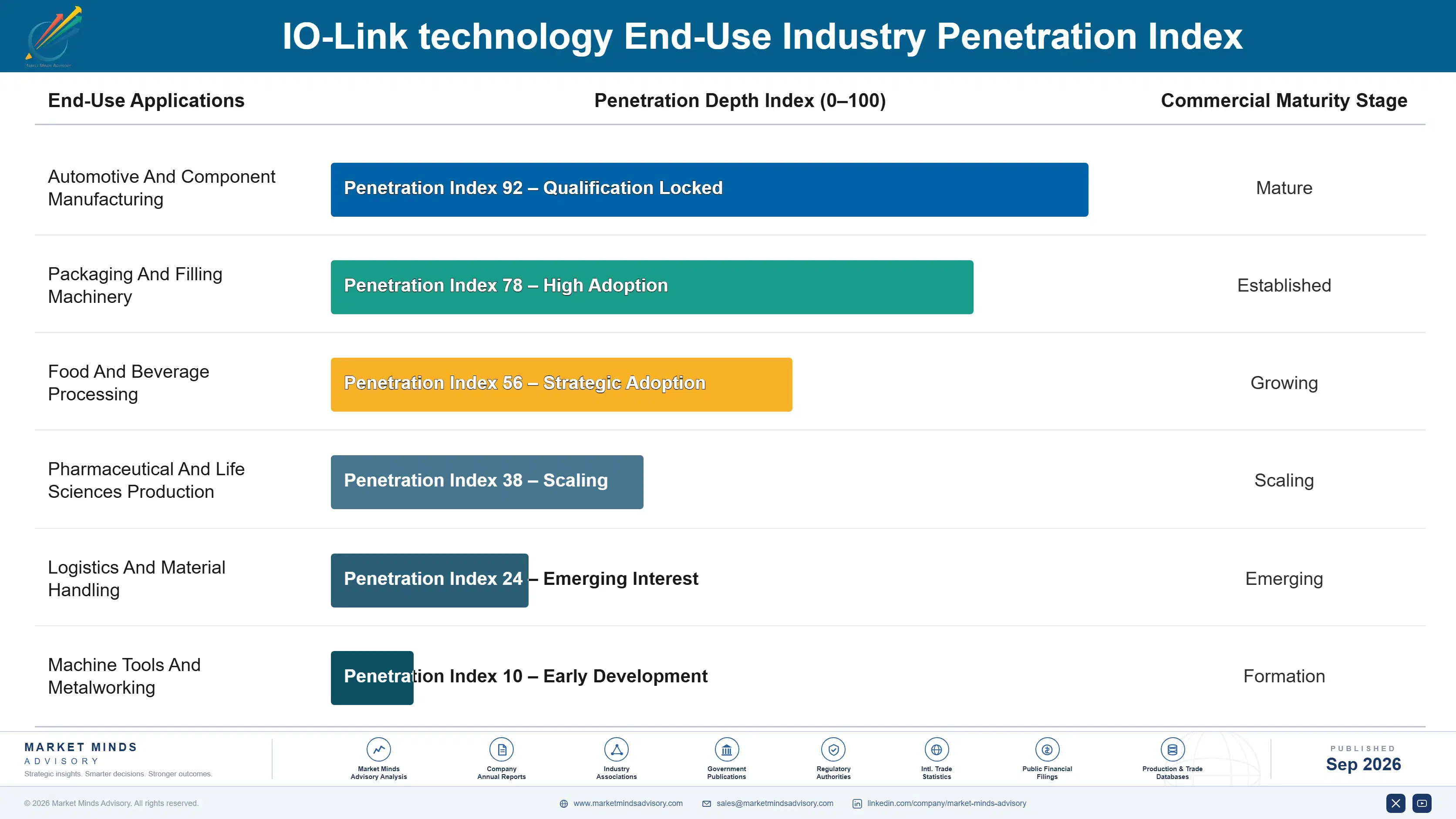
  • Automotive And Component Manufacturing
  • Packaging And Filling Machinery
  • Food And Beverage Processing
  • Pharmaceutical And Life Sciences Production
  • Logistics And Material Handling
  • Machine Tools And Metalworking

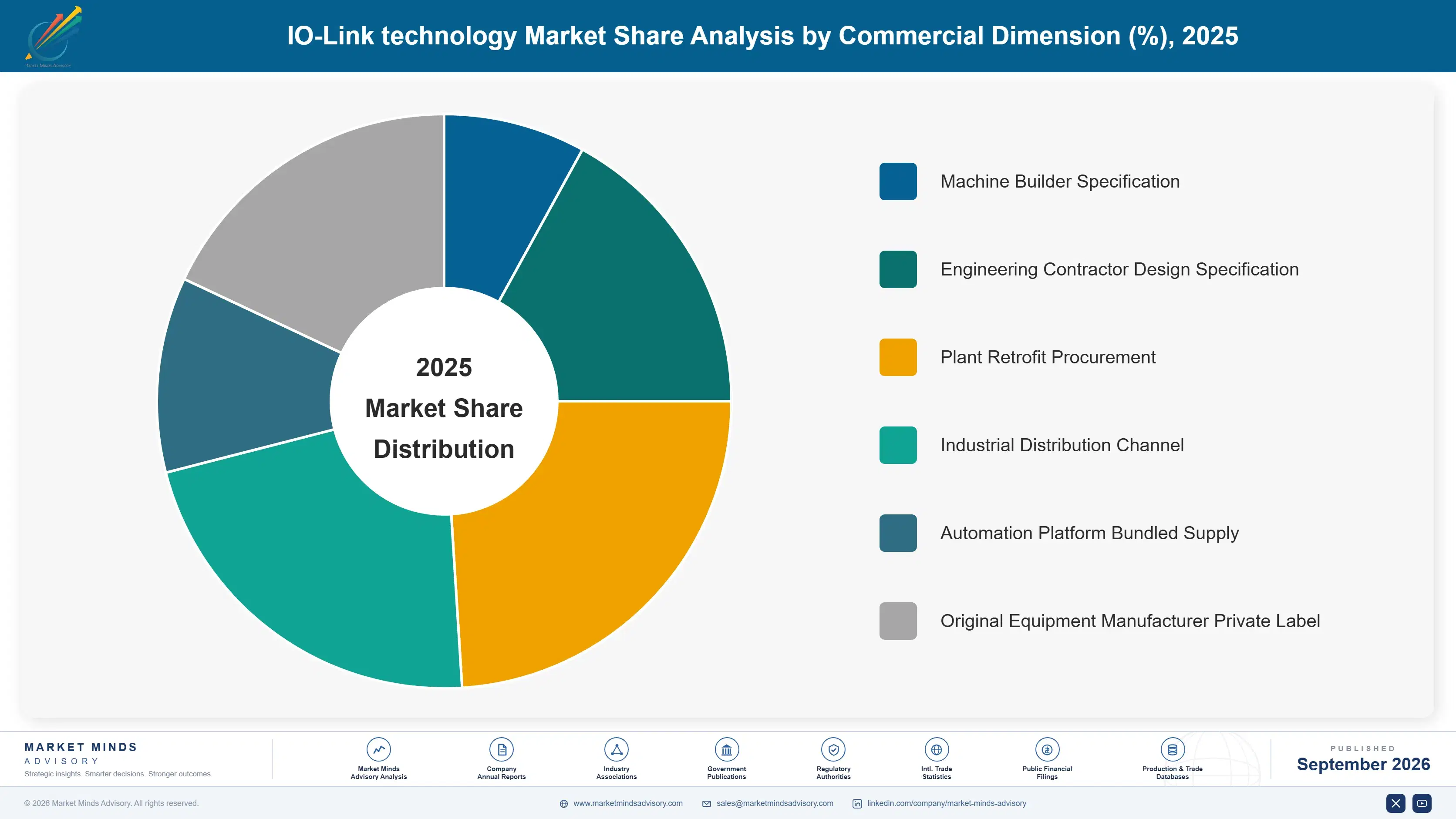
By Commercial Dimension

  • Machine Builder Specification
  • Engineering Contractor Design Specification
  • Plant Retrofit Procurement
  • Industrial Distribution Channel
  • Automation Platform Bundled Supply
  • Original Equipment Manufacturer Private Label

By Region

  • North America
  • Western Europe
  • East Asia
  • South Asia and Pacific
  • Latin America
  • Middle East and Africa
  • Eastern Europe

Scope, Methodology, and Coverage

Every figure in this report is reproducible from documented input assumptions. The scope below maps the historical period, the forecast horizon, the segmentation dimensions, and the countries covered, alongside the underlying primary and qualitative methodology.
Historical Period
2020 to 2025
Forecast Period
2026 to 2036
Base Year
2025 (USD billions; MMA Primary Research Dataset, September 2026)
Market Definition
This report covers IO-Link technology hardware and enabling software: IO-Link sensors and actuators, masters and gateway modules, wireless and safety-rated devices, hubs and port expansion equipment, and the device description, parameterisation and configuration software supporting them. It excludes fieldbus and industrial Ethernet infrastructure, programmable controllers, conventional analogue sensors, manufacturing execution software, and plant-level analytics platforms.
Quantitative Units
USD millions, device, master and enabling software revenue basis; devices and master ports shipped; new build share of deployment as a percentage; master port utilisation rates; device parameter consumption rates; commissioning time savings against analogue wiring.
Segmentation Dimensions
Device and infrastructure class; end-use industry; commercial specification route; geography across seven regions.
Regions Covered
North America, Western Europe, East Asia, South Asia and Pacific, Latin America, Middle East and Africa, Eastern Europe
Countries Covered
Germany, Italy, France, United Kingdom, Spain, Netherlands, Switzerland, Poland, Czechia, United States, Mexico, China, Japan, South Korea, Taiwan, India, Australia, Brazil, Saudi Arabia, South Africa.
Key Companies Profiled
Siemens, SICK, Balluff, Turck, Pepperl and Fuchs, ifm electronic, Baumer, Banner Engineering, Omron, Keyence, Rockwell Automation, Phoenix Contact, Beckhoff Automation, Leuze electronic, Autonics.
Quantitative Methodology
Primary survey, n=3,800 respondents, Q4 2025, six countries; demand-side model with trade association cross-validation
Qualitative Methodology
47 expert interviews, Q4 2025; applied to validate demand model assumptions, identify emerging dynamics, and assess competitive positioning
Report Format
PDF and XLSX data workbook (Word format preview document)
Publisher
Market Minds Advisory
Report Code
MMA-2026-CON-961
Published
September 2026
Contact
sales@marketmindsadvisory.com | www.marketmindsadvisory.com

Purchase the full IO-Link technology Market Report (2026 to 2036).

This report sizes the global IO-Link technology market from 2026 to 2036 across six device and infrastructure classes, six industries and seven regions. It explains why roughly 71% of deployment arrives with new machinery rather than through retrofit, and why only around 22% of device parameters reach any system above the control cabinet. Master port utilisation near 46% is analysed as the position that decides subsequent device revenue. Wireless and safety certification is examined as the barrier separating premium categories from price-competitive standard sensing. Regional analysis explains why East Asia holds 31% of shipments.
Six device and infrastructure classes sized to 2036
New build against retrofit deployment economics quantified
Master port utilisation analysed as competitive position
Twenty named suppliers assessed on device revenue
Four revenue levers with quantified commercial impact
Anonymised component supplier channel engagement documented in full

Built For The People Who Decide

From boardroom strategy to bench-side execution, this report is read cover-to-cover by leaders shaping the next decade of their industry, turning demand scenarios, market dynamics and valuation benchmarks into decisions.
CXOs/ Presidents/ VPs/ Managers
M&A and Corporate Development
Strategy Teams and R&D Heads
Procurement and Product Directors
Regulatory and Compliance Leaders
Investor Relations and Equity Analysts