Market Minds Advisory
Investment Banking Market

Investment Banking Market: Private Credit Redraws Fee Pool Composition

Investment banks are scaling private capital advisory as private credit growth, elevated deal financing costs, and technology-driven trading efficiency reshape fee pool composition across mergers, underwriting, and capital markets advisory channels worldwide.

Lead Analyst

Published

September 2026

Make Smarter Decisions with Customized Research Insights

Request a free sample report and evaluate market opportunities, growth trends, and competitive dynamics relevant to your business needs.

2025 MARKET VALUE$145.0BMarket Size 2025
2036 FORECAST VALUE$289.9BBase Case , 2026 to 2036
CAGR 2026 TO 20366.5 %Bull 7.8% / Bear 5.2%
INCREMENTAL OPPORTUNITY$135.4BNet 10- year value creation
EXPANSION MULTIPLE1.88x2036 value over 2026 base
Strategic Levers
M&A Pipeline
Regional Outlook
Country Rankings
Competitive Intelligence
Segmental Deep-dive
Call-Us : 91 93563 13602

Executive Snapshot and Market Trajectory

Investment Banking Market fee pools are shifting toward private placement and structured finance advisory as private credit growth increasingly competes with traditional syndicated lending and public market underwriting across every major deal size, sector, and geography today and quite well beyond considerably still.
Private placement and structured finance advisory and leveraged finance syndication are the fastest-expanding categories as private credit funds and direct lenders compete directly with bank balance sheets for large financing mandates across every major market segment worldwide today. North America holds the largest share of global fee pools, anchored by Wall Street's dominant position in mega-deal advisory, while East Asia sustains strong demand through expanding capital markets activity in China and India nationwide.
Competition splits between large diversified bulge bracket banks with integrated advisory, underwriting, and trading capability and numerous boutique advisory firms competing mainly on relationship depth for mid-market mergers and acquisitions mandates across most deal size tiers worldwide today and well beyond. Rising interest rates have compressed leveraged buyout financing volume, while private credit competition accelerates fee pool fragmentation across every major deal category, price tier, and geographic market globally.
Market Definition
The Investment Banking Market comprises advisory and underwriting fee revenue generated from mergers and acquisitions advisory, equity and debt capital markets underwriting, leveraged finance syndication, restructuring advisory, and private placement services. It excludes commercial banking net interest income and retail brokerage revenue.
Base Year Value
$145.0B in 2025 (MMA Primary Research Dataset, August 2026)
Forecast Period
2026 to 2036, eleven discrete annual values
CAGR
6.5% base case. Bull 7.8%. Bear 5.2%.
Fastest Growth Segment
Private Placement and Structured Finance Advisory: 11.5% CAGR
Fastest Growth Country
India: 8.5% CAGR
Fastest Growth Region
South Asia and Pacific: 8.5% CAGR
Largest Region
North America: 32% of 2025 global value
Market Leaders
Goldman Sachs, JPMorgan Chase, Morgan Stanley, Bank of America, and Citigroup lead by global fee share and advisory relationship depth. Source: MMA Analysis based on company annual reports.
Primary Survey
n=3,800 procurement and R&D decision-makers, Q4 2025, six countries
Methodology
Demand-side build-up, cross-validated against public data, 47 expert interviews

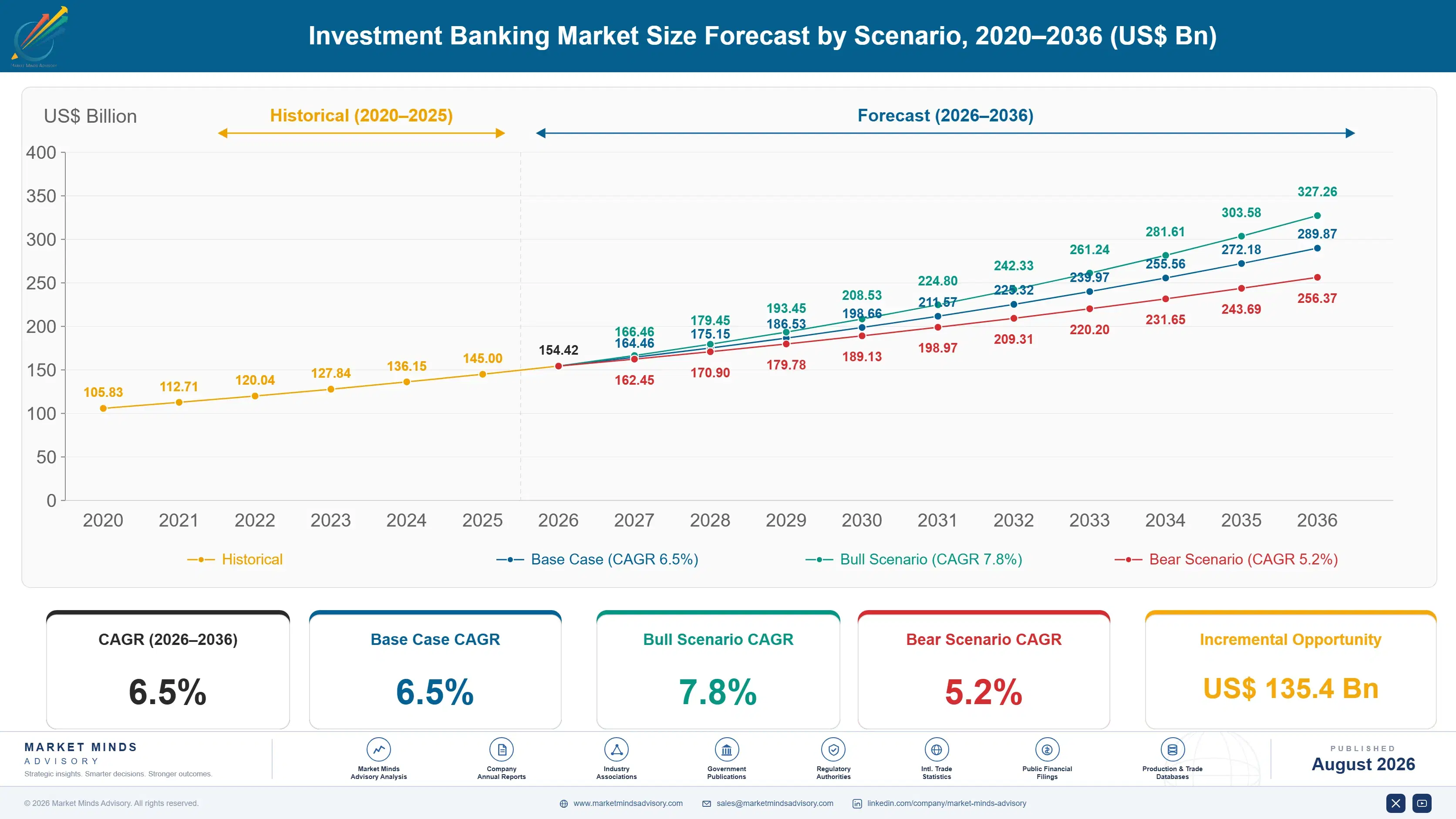
Investment Banking Market Forecast Scenarios

investment-banking-industry-size-forecast-scenario-1787913109836
Between 2020 and 2025, investment banking fee pools grew at an estimated 5.5% compound rate as capital markets activity recovered from pandemic disruption and record-low interest rates fueled leveraged buyout and merger financing volume. Private credit competition emerged as a meaningful fee pool disruptor through this period, while traditional syndicated lending still dominated total large-cap deal financing.
The base case assumes continued expansion as three mechanisms compound: private credit funds and direct lenders scaling structured finance advisory mandates as an alternative to traditional syndicated lending, corporate merger and acquisition activity rebounding as financing costs stabilize following the recent rate cycle, and capital markets issuance recovering as equity valuations support renewed initial public offering activity. Banks are expanding private capital advisory teams to meet anticipated demand across multiple deal types and client segments simultaneously.
The bull case turns on merger and acquisition activity accelerating faster than expected as corporate balance sheets deploy record cash reserves into strategic acquisitions, pulling fee pools sharply higher across advisory and financing channels. The bear case centers on a prolonged high interest rate environment suppressing deal volume, which would constrain the strongest single demand driver behind investment banking fee growth across the industry.

Fee Pool Economics and the Private Capital Transition

Investment Banking Market sits at the intersection of two converging forces: enduring baseline demand tied to routine capital markets issuance and merger advisory across a global corporate client base and an accelerating shift toward private credit and structured finance advisory required by an increasingly disintermediated financing landscape. Banks that once treated balance sheet lending as their primary financing tool now invest heavily in private capital advisory and fund placement capability, betting that advisory fee income will command durable value as direct lending expands.
MARKET CONCENTRATIONCR5 38%Leading five banks hold well under half of total fees
STRUCTURED FINANCE PREMIUM1.4-1.9xStructured finance mandates command meaningfully higher advisory pricing overall
TOP FEE POOL COUNTRYUnited States 30%United States deal volume anchors global fee pool concentration share
BANKER UTILIZATION88%Senior bankers operate near full utilization amid strong deal flow
COMPENSATION SHARE OF COST58%Compensation and technology costs dominate total advisory operating expense
AVERAGE MANDATE DURATION6-18 monthsAdvisory mandates typically span six to eighteen months per deal
Commercially, the market still behaves partly like a mature professional services category: standard merger advisory and public underwriting mandates trade on relationship depth and league table position, with margins tied closely to deal complexity and competitive mandate intensity. Private placement and leveraged finance syndication command distinctly different economics, priced on structuring sophistication and balance sheet commitment rather than advisory relationship alone, giving banks who master these capabilities a differentiated margin position across large-cap transactions.
Looking ahead, the decade defining forces are competitive and regulatory: how quickly private credit continues displacing traditional syndicated lending will determine fee pool composition, while merger and acquisition activity recovery determines which banks capture the richest advisory mandates.
"Every bank still calls itself a lender first. The ones actually making money now are the ones that stopped believing that and started acting like placement agents."
Director, Financial Services Advisory Practice · MMA Financial Services Advisory Practice · August 2026

Market Trends

Private Credit Displaces Traditional Syndicated Lending

Private credit funds and direct lenders are increasingly winning large financing mandates that would previously have gone to bank-led syndicated loan facilities, responding to demand from sponsors and corporate borrowers for faster execution certainty and fewer disclosure requirements across the entire leveraged finance market today. Several leading investment banks have disclosed dedicated private capital advisory team expansion during 2024 and 2025, targeting both direct lending placement and structured finance mandates specifically. This shift is compressing the addressable market available to banks offering only traditional syndicated lending, pushing banks toward deeper investment in private capital fund placement and advisory capability.
Market Impact: Corporate cash reserves add roughly 5%
Boutique Advisory Firms Gain Mid-Market Share

Independent boutique advisory firms are increasingly winning mid-market merger and acquisition mandates from bulge bracket banks, responding to client demand for senior banker attention and conflict-free advice unencumbered by lending or underwriting relationships across the entire advisory market. Several boutique firms have disclosed senior banker recruitment expansion during 2024 and 2025, extending their coverage into sectors previously dominated by large diversified banks alone. This shift is compressing fee pool share available to bulge bracket banks in mid-market mandates, rewarding boutiques who can deliver validated sector expertise and relationship-driven advisory rather than balance sheet leverage alone.
Market Impact: Dry powder exceeds 2 trillion dollars

Market Opportunities and Growth Drivers

Corporate Cash Reserves Fuel Acquisition Activity

Corporations across major sectors continue holding record levels of cash and undrawn credit facilities, creating substantial dry powder available for strategic acquisitions once management teams gain confidence in valuation stability and macroeconomic conditions across the broader business cycle. Every incremental quarter of stabilizing financing costs increases the probability that corporate boards approve previously shelved acquisition mandates, directly translating into advisory fee generation for banks with established sector coverage relationships. This directly sustains addressable demand for merger and acquisition advisory regardless of broader public market volatility, benefiting both bulge bracket banks and boutique advisory firms across the industry.
Market Impact: Financing costs add 200 basis points

Private Equity Dry Powder Requires Deployment

Private equity firms are sitting on substantial uncommitted capital that must be deployed within fund investment periods, creating sustained pressure for acquisition activity and corresponding financing and advisory mandates across every sector and deal size tier globally. Every incremental year of unspent private equity capital increases pressure on fund managers to pursue acquisitions even in a moderately elevated financing cost environment, extending demand for structured finance advisory and leveraged buyout financing that previously waited for more favorable conditions. This expands addressable demand for investment banking services well beyond what organic corporate acquisition activity alone would suggest.
Market Impact: Capital rules cede 15% of volume

Market Restraints and Challenges

Elevated Interest Rates Suppress Leveraged Deal Volume

Elevated benchmark interest rates have meaningfully increased the cost of debt financing for leveraged buyouts and corporate acquisitions, a friction rooted in the direct pass-through of higher base rates to floating-rate leveraged loan and high-yield bond pricing across the entire financing market. This cost pressure slows deal volume among financial sponsors unwilling to underwrite acquisitions at return hurdles compressed by higher financing costs, risking continued subdued leveraged buyout activity relative to prior lower-rate cycles. Banks are investing in structured financing alternatives and equity-heavy capital structures to narrow this remaining financing gap over time considerably.
Market Impact: Private credit funding grows roughly 26%

Regulatory Capital Requirements Constrain Balance Sheet Lending

Post-financial-crisis regulatory capital requirements continue constraining how much balance sheet risk banks can extend toward leveraged lending and underwriting commitments, a constraint rooted in capital adequacy rules designed to prevent systemic risk concentration within regulated banking institutions. This constraint pushes large financing mandates toward private credit funds and non-bank lenders who operate outside comparable regulatory capital frameworks, ceding fee pool share that banks would otherwise capture through balance sheet commitment. Banks are responding by emphasizing fee-based advisory and fund placement services that require less regulatory capital than direct lending commitments.
Market Impact: Boutique advisory share grows roughly 14%
3 additional market trends, 4 additional growth drivers, and 2 additional restraints and challenges are covered in the full report. Contact sales@marketmindsadvisory.com to access the complete intelligence.

Segment CAGR and Growth Architecture

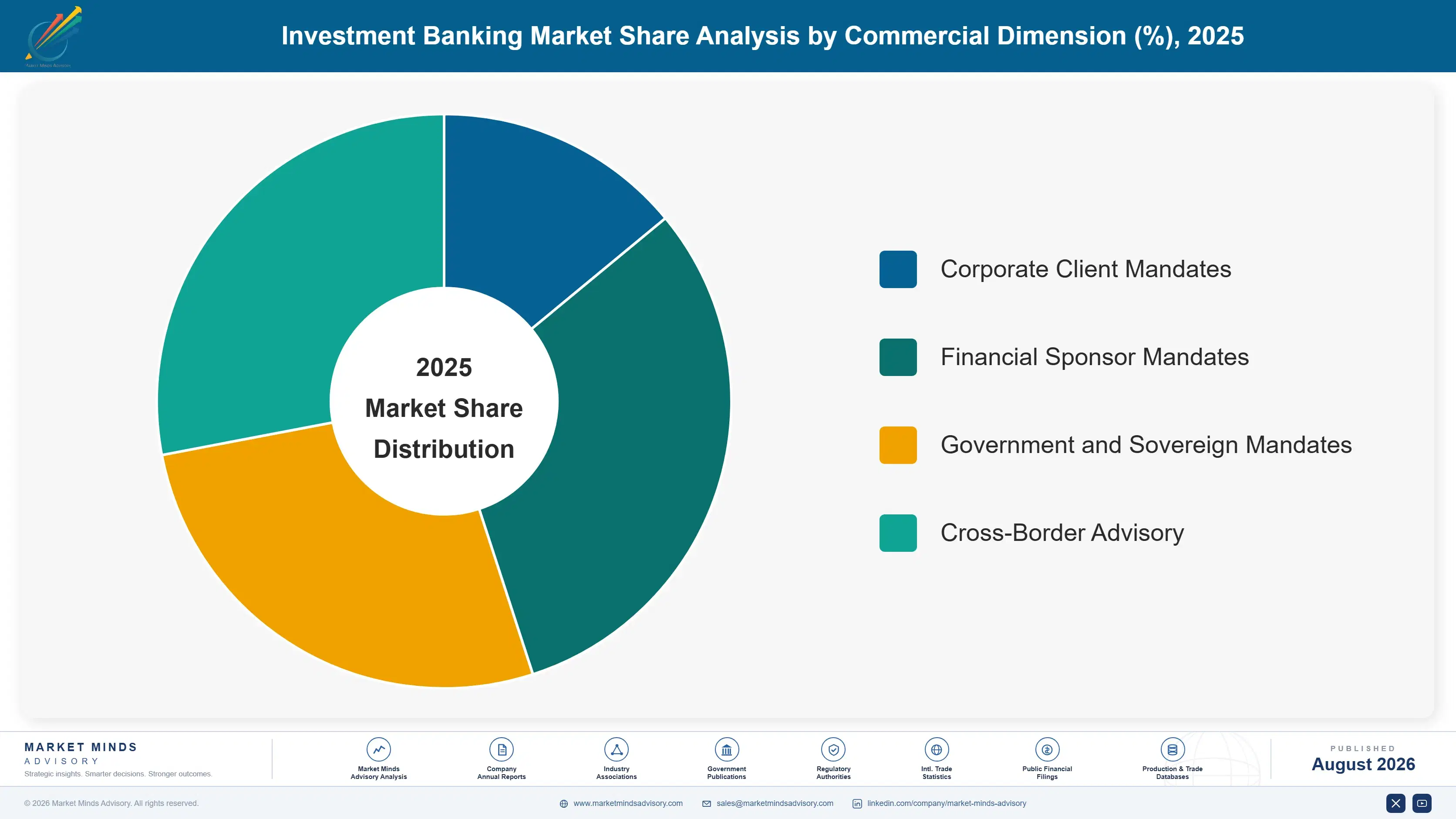
Investment Banking Market segments by service line rather than client industry, since the specific service determines fee structure, balance sheet commitment, and competitive dynamics across corporate, sponsor, and government client relationships sold worldwide today. Six categories span traditional advisory through emerging private capital placement mandates across the entire global financial services industry overall today.
investment-banking-industry-market-share-analysis-1787913110371

Private Placement and Structured Finance Advisory

Private placement and structured finance advisory connects corporate and sponsor borrowers directly with private credit funds and institutional investors, structuring bespoke financing arrangements that substitute for traditional syndicated bank lending across large-cap and middle-market transactions worldwide today and quite well beyond still indeed consistently across the industry. This is the fastest-growing category, expanding at an estimated 11.5 percent annually as private credit funds continue displacing traditional syndicated lending across every major financing category and deal size tier. Banks with dedicated private capital advisory teams and established institutional investor relationships are capturing outsized share of this category's growth, while banks without private capital placement capability struggle to compete for these emerging mandates nationwide.
CAGR 11.5%

Leveraged Finance and Private Credit Syndication

Leveraged finance and private credit syndication arranges debt financing for sponsor-backed acquisitions and corporate recapitalizations, increasingly structured through club deals combining traditional bank commitments with private credit fund participation across the industry today and quite well beyond still indeed consistently worldwide and beyond. This is the second-fastest category, expanding at an estimated 9.0 percent annually as private equity sponsors increasingly demand hybrid financing structures that combine speed of execution with competitive pricing across every deal size tier. Banks with established private credit fund relationships and syndication capability are winning these mandates fastest, since sponsors increasingly prefer arrangers who can access both traditional and private financing pools nationwide and well beyond.
CAGR 9.0%
Full segment breakdown across 6 segments available in the complete report.

Regional Architecture and Country Demand Map

Investment Banking Market fee pools span all major regions, with North America leading given Wall Street's dominant position in mega-deal advisory and capital markets underwriting, East Asia sustaining strong growth through expanding China and India capital markets, and South Asia and Pacific expanding fastest as regional capital markets mature worldwide.

North America

US bulge bracket banks capture the largest share of global mega-deal advisory and capital markets underwriting fees given Wall Street's concentration of large-cap corporate clients and deepest institutional investor base nationwide and well beyond it entirely and quite consistently indeed still today and well beyond that too indeed still. The region's fee pool also includes substantial private credit advisory activity tied to sponsors and corporate borrowers seeking alternative financing structures across multiple deal categories nationwide and well beyond considerably. Canada's investment banking sector follows similar patterns on a smaller scale given shared capital markets integration with the United States. Demand concentrates in mega-deal advisory, leveraged finance, and technology sector underwriting nationwide.
Share: 32% | CAGR: 7.0% (2026 to 2036)

Western Europe

The United Kingdom anchors European investment banking fee pools given London's position as a global financial center and deep capital markets infrastructure, both increasingly serving cross-border merger and private credit advisory mandates ahead of most other regional markets nationwide and well beyond entirely and quite consistently indeed still today. Germany and France follow closely, where domestic banks have expanded private capital advisory adoption faster than the broader category overall this cycle across most markets nationwide and beyond considerably and quite steadily indeed. The European Union's capital markets union initiative sustains steady cross-border underwriting demand across the region. Growth trails East Asia given the region's comparatively mature, slower-expanding deal volume base overall today indeed.
Share: 21% | CAGR: 5.0% (2026 to 2036)
Regional intelligence for 5 additional markets available in the complete report: East Asia, South Asia and Pacific, Latin America, Middle East and Africa, Eastern Europe. Contact sales@marketmindsadvisory.com.
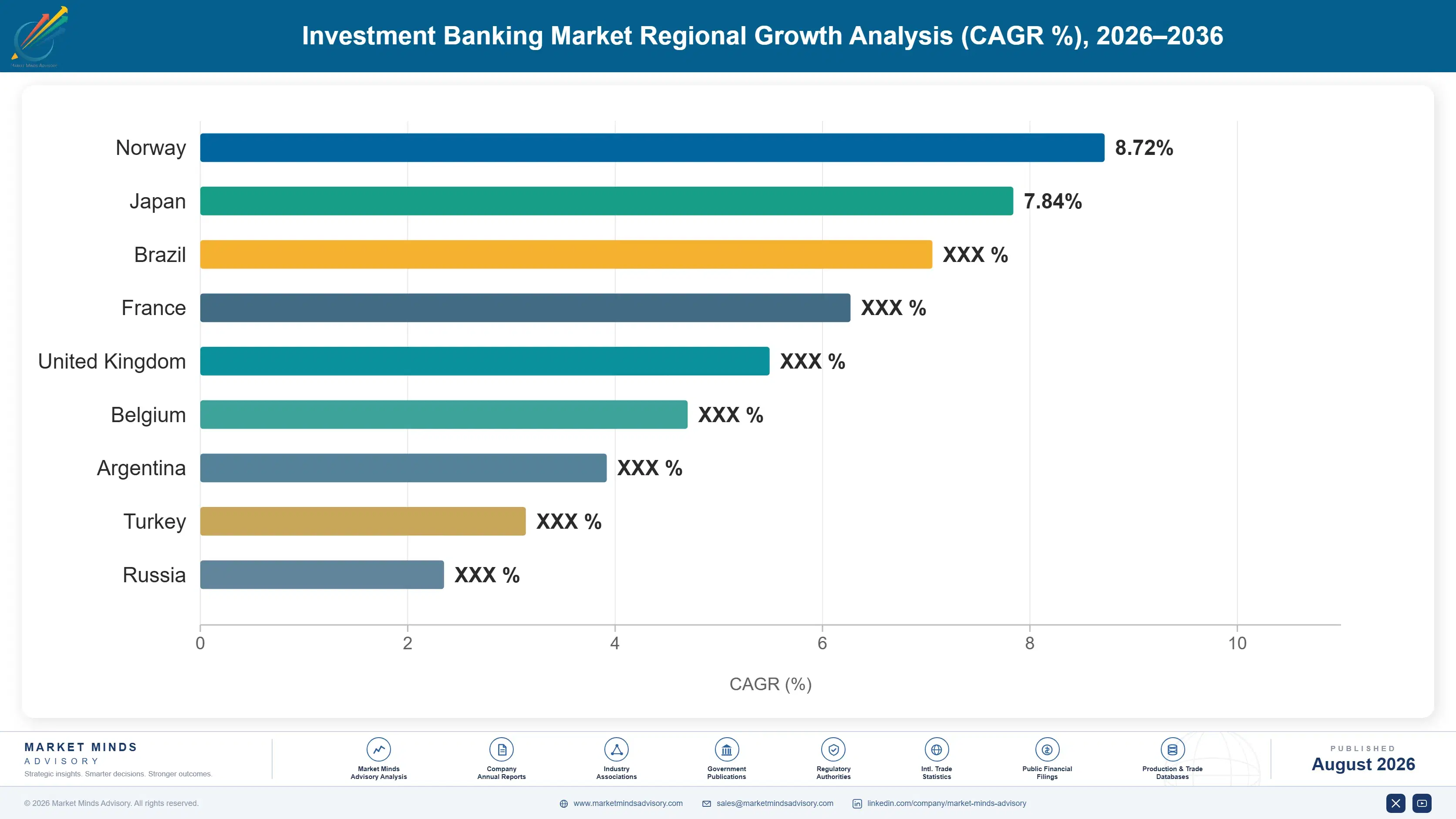
investment-banking-industry-country-cagr-analysis-1787913110875

Where Investment Banking Fees Concentrate

Margin expansion in investment banking flows through four distinct commercial levers: private capital placement fee premiums over traditional syndicated lending, mega-deal advisory relationship depth, structured finance balance sheet commitment, and sponsor coverage relationships that lock in durable multi-year advisory positions across every major consuming market across the entire wider world today still quite consistently.

Private Placement Advisory Commands Premium Fees

Private placement and structured finance advisory mandates command a fee premium of roughly 1.4 to 1.9 times traditional syndicated loan arrangement fees, reflecting both specialized structuring expertise and the execution certainty premium sponsors and corporate borrowers pay for to access institutional private credit capital efficiently. Banks who develop differentiated private capital placement technology capture pricing power that traditional syndication desks competing purely on balance sheet capacity cannot access. This premium has proven durable because private capital relationship expertise is difficult to replicate quickly, giving early movers a multi-year head start over competitors still building comparable institutional investor networks from scratch.
Market Impact: Private placement fees run 1.4 to 1.9 times syndication

Mega-Deal Advisory Relationships Lock In Recurring Fees

Banks with established mega-deal advisory relationships at the largest global corporations capture meaningfully more recurring advisory fee volume than banks competing purely on individual transaction pitches, since chief executives and boards increasingly consolidate advisory relationships under fewer, trusted senior banking relationships worth roughly 30 percent additional recurring mandate flow. This relationship depth requires sustained investment in senior banker coverage and sector expertise that smaller regional banks typically cannot commit to building independently. Banks with established mega-deal relationships are capturing additional premium fee share beyond transactional competitors, often embedding themselves more deeply into a client's broader capital allocation strategy.
Market Impact: Mega-deal relationships add roughly 30 percent fee share

Structured Finance Capability Captures Sponsor Volume

Banks investing in structured finance and private credit fund placement capability now are positioned to capture the fastest-growing segment of sponsor financing demand as private credit continues displacing traditional syndicated lending, with disclosed structured finance team expansion programs often spanning 2 to 3 years before reaching full mandate scale. Banks who establish this capability early secure preferential positioning with private equity sponsors before competitors complete comparable institutional investor relationship building. This lever favors banks with dedicated structured finance teams and requires sustained investment that smaller regional banks often cannot commit at comparable scale.
Market Impact: Structuring programs often span 2 to 3 years

Sector Coverage Depth Extends Advisory Reach

Banks with dedicated sector coverage teams spanning technology, healthcare, and energy capture meaningfully more advisory mandate volume than generalist advisory desks, since corporate clients increasingly prefer bankers with deep sector expertise and specific transaction pattern recognition worth roughly 22 percent additional mandate share within covered sectors. This sector coverage depth requires sustained investment in specialized banker recruitment and sector research infrastructure that smaller regional banks typically cannot access independently. Banks with established sector coverage depth are capturing additional premium fee pricing beyond generalist competitors, often embedding themselves more deeply into a client's long-term strategic planning process.
Market Impact: Sector coverage adds roughly 22 percent mandate share

Who Controls the Margin Pool

Investment Banking Market concentration sits at a CR5 of 38 percent, evaluated on global advisory and underwriting fee volume, with Goldman Sachs and JPMorgan Chase holding the largest positions built on diversified advisory, underwriting, and trading capability spanning multiple client sectors. The gap between these established leaders and numerous smaller boutique advisory firms remains wide on balance sheet commitment and structured finance capability, though narrower on relationship depth for mid-market advisory categories.
Current competitive activity concentrates in three areas: private capital placement team investment to meet accelerating private credit demand, boutique advisory firm senior banker recruitment to capture mid-market mandates, and sector coverage expansion to lock in recurring advisory relationships with strategic corporate clients.

Rankings are most likely to shift as private credit and structured finance advisory become larger shares of total fee pools, a dynamic that could let banks with the strongest private capital placement capability pull meaningfully ahead of conventional syndicated lending specialists. Smaller banks without dedicated private capital relationships face the greatest pressure, and several are pursuing partnership arrangements with private credit funds rather than building institutional investor relationships internally, a defensive posture that could reshape the competitive leaderboard within the next five years.
investment-banking-industry-company-positioning-matrix-1787913111395

Competitive Moat and Risk Dimensions

GOLDMAN SACHS

Moat: Broad Advisory And Underwriting Portfolio

Goldman Sachs operates the industry's broadest advisory and underwriting portfolio spanning mega-deal advisory, equity and debt underwriting, and private capital placement, supported by dedicated sector coverage teams serving the largest global corporations. This breadth lets Goldman Sachs offer integrated advisory solutions across every deal type that narrower boutique firms cannot match at comparable scale and relationship depth.
GOLDMAN SACHS

Risk: Diluted Specialty Focus

Goldman Sachs's broad advisory portfolio means individual service lines represent one of several strategic priorities relative to boutique competitors more narrowly focused on specific advisory categories, potentially slowing dedicated investment pace in any single specialty area. Intensifying competition from private capital specialists could erode its share in structured finance mandates if broader investment pace fails to keep up.
JPMORGAN CHASE

Moat: Integrated Banking Relationship Heritage

JPMorgan Chase's decades of balance sheet lending and corporate banking relationship heritage give it distinctive credibility with clients seeking a single trusted provider across both advisory and financing needs. This established reputation and integrated banking platform give the firm a durable position in the large-cap corporate segment specifically across multiple regions.
JPMORGAN CHASE

Risk: Less Agile On Conflicted Mandates

JPMorgan Chase's specialized focus on integrated banking relationships leaves it comparatively less nimble in pure advisory mandates relative to boutique competitors unencumbered by lending relationships, potentially limiting its exposure to conflict-sensitive mandates. Sustained competition from independent advisory specialists could pressure its advisory-only positioning over time considerably.

Players Tracked

Prominent Players

The Goldman Sachs Group, Inc.
JPMorgan Chase & Co.
Morgan Stanley
Bank of America Corporation
Citigroup Inc.

Other Key Players

Barclays plc
Deutsche Bank AG
UBS Group AG
Credit Agricole CIB
BNP Paribas
Wells Fargo Securities
RBC Capital Markets
Jefferies Financial Group
Evercore Inc.
Lazard Ltd.
Moelis & Company
PJT Partners
Rothschild & Co
Mizuho Financial Group
Nomura Holdings

Recent Developments

MARCH 2025

Goldman Sachs Expands Private Capital Advisory Team

Goldman Sachs announced an expansion of its private capital advisory team to increase structured finance placement capacity, responding to sustained demand from corporate borrowers and sponsors seeking alternative financing structures outside traditional syndicated lending. The expansion adds meaningful senior banker headcount across multiple regional offices.
Signal: Signals established bulge bracket banks are prioritizing private capital advisory ahead of accelerating private credit market demand.
OCTOBER 2024

JPMorgan Chase Launches Private Credit Fund Placement Platform

JPMorgan Chase launched a new integrated private credit fund placement platform specifically engineered to connect institutional investors with structured finance mandates without requiring traditional balance sheet commitment from the bank itself. The launch includes documented investor matching technology benchmarked against standalone syndication processes currently in wide use.
Signal: Signals established banks are prioritizing private capital platforms as a distinct competitive battleground across the industry.
MAY 2025

Morgan Stanley Opens Dedicated Sector Coverage Practice

Morgan Stanley opened a new dedicated sector coverage practice focused on technology and healthcare mega-deal advisory, expanding senior banker presence closer to key corporate client relationships across multiple regions and industry verticals worldwide today. The practice includes dedicated research infrastructure supporting sector-specific transaction advisory requirements.
Signal: Signals banks are investing in sector specialization to compete directly with established mega-deal advisory practices today.

Talent And Technology Cost Exposure

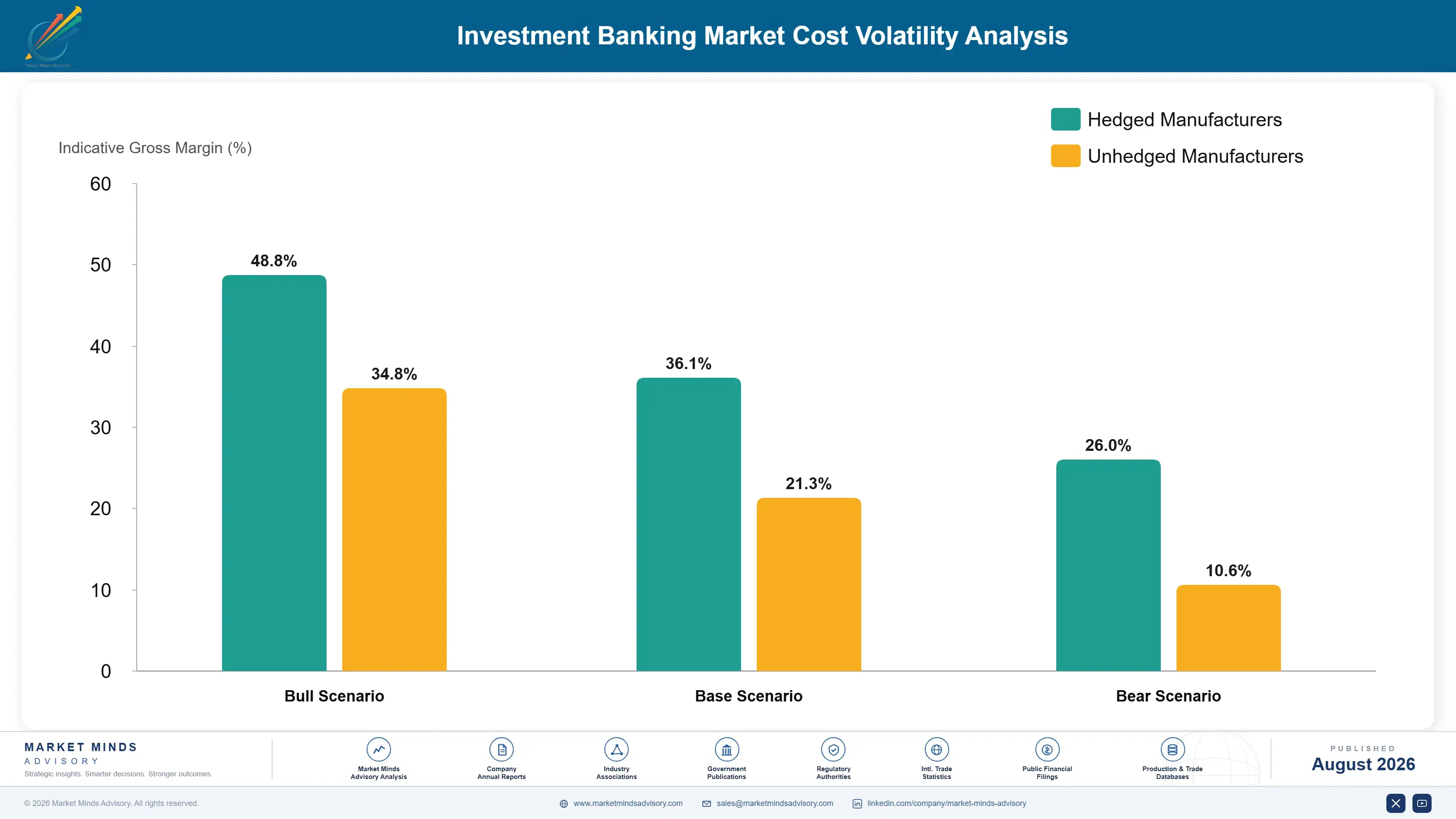
Compensation for senior bankers and deal teams accounts for an estimated 55 to 62 percent of cost of revenue for advisory and underwriting mandates, while trading technology and compliance infrastructure represent a growing cost category across the industry worldwide today. Senior talent competition originates mainly from private equity firms and hedge funds recruiting away experienced bankers.
Senior banker compensation packages rose more than 18 percent during 2024 following intense recruiting competition from private equity firms and private credit funds, according to compensation data cited by industry associations, pushing advisory cost structures up substantially and squeezing margins for banks who could not pass costs through fee increases. Several banks disclosed talent-linked cost inflation as a specific pressure on segment margins in recent annual reporting periods, prompting wider adoption of deferred compensation retention structures.

Banks without diversified talent retention programs face a persistent cost disadvantage during recruiting cycles, since senior banker departures cannot easily be replaced on short notice without losing existing client relationships and deal pipeline continuity. Exposure concentrates most heavily among smaller regional banks who lack the compensation flexibility that larger diversified competitors maintain across multiple business lines and geographic markets simultaneously.
investment-banking-industry-cost-volatility-analysis-1787913111589

Deploy Deferred Compensation Retention Structures

Banks are expanding multi-year deferred compensation and equity vesting structures to reduce senior banker attrition risk, tying a meaningful share of total compensation to continued employment rather than paying fully upfront cash bonuses each year. This retention structure adds administrative complexity but meaningfully lowers the probability that a competitor recruiting effort successfully poaches an entire deal team mid-mandate.

Expand Junior Banker Development Pipelines

Capital allocation is shifting toward expanded junior banker training and development programs precisely because internally developed talent trades on more predictable retention economics than externally recruited senior hires competing against private equity compensation packages. Banks pursuing this path reduce long-run exposure to senior talent bidding wars, even though development pipelines still require multi-year investment before junior bankers reach full productivity.

Diversify Revenue Across Advisory And Trading

Banks are increasingly building diversified revenue models spanning advisory, underwriting, and trading rather than depending on any single fee category, reducing exposure to cyclical mandate volume swings in any one business line. This diversification protects margins during advisory downturns but requires sustained investment across multiple business lines that smaller boutique firms typically cannot replicate.

Portfolio Architecture for Margin Defence

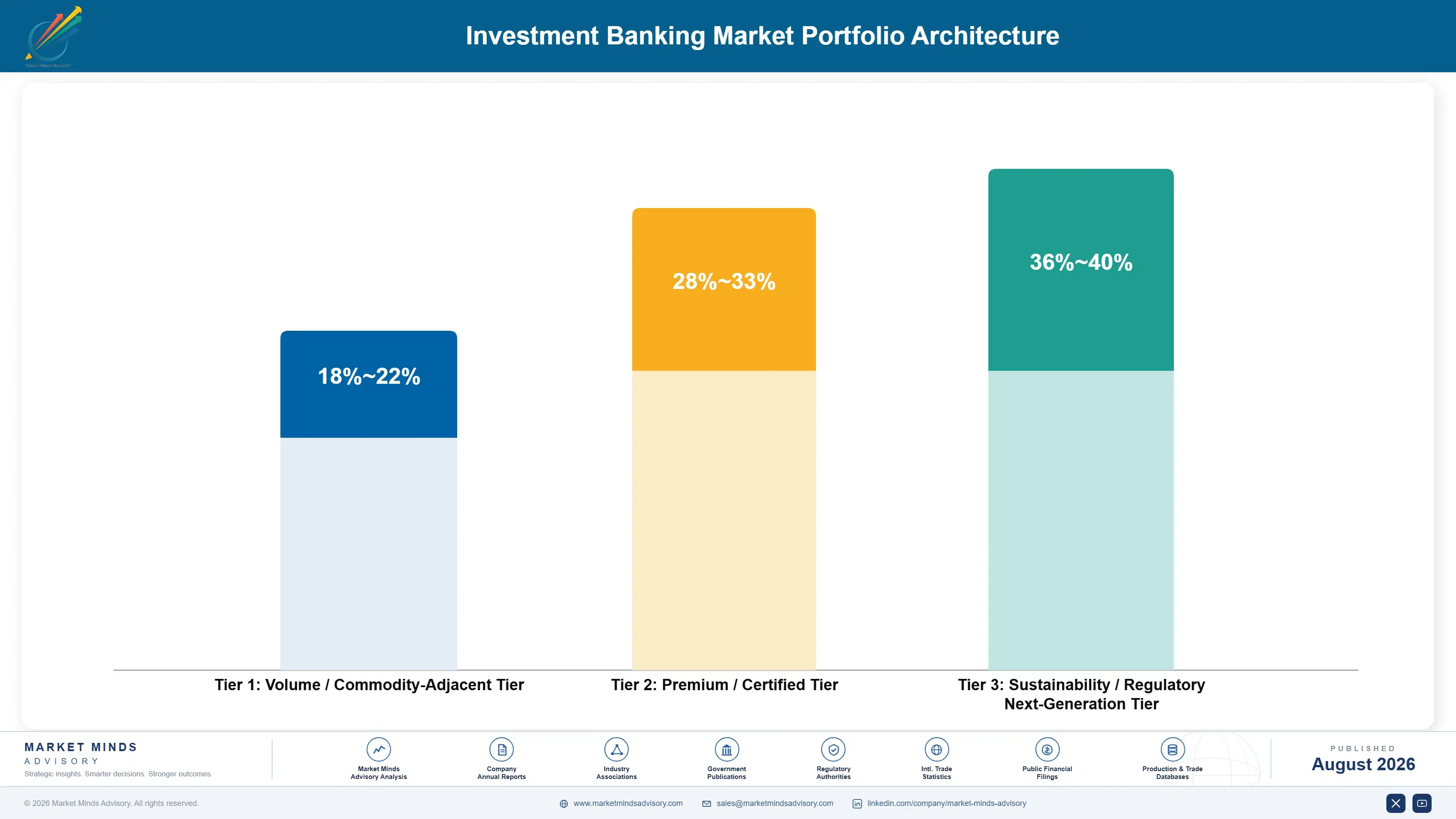
Investment Banking Market splits into three commercial tiers with different margin economics: a volume tier built on standard mid-market advisory and underwriting sold into mainstream corporate financing, a premium tier built on large-cap mega-deal advisory commanding differentiated positioning, and a next-generation tier built on private placement and structured finance advisory still scaling toward full commercial economics. Margins range from roughly 18 percent to over 40 percent for differentiated mandates sold under long-term client relationships.
Volume-tier banks compete primarily on price and reliable execution into commodity mid-market advisory mandates, where relationship depth matters less than consistent deal execution at competitive fee levels. Premium-tier banks instead compete on sector expertise and relationship depth for corporate clients unwilling to compromise on strategic advisory quality, accepting materially higher talent costs in exchange for pricing power volume-tier competitors cannot access.

High-value fee pools concentrate in private placement and structured finance mandates sold under long-term relationships to sponsors and large corporate borrowers, where clients pay for both structuring expertise and institutional investor access simultaneously. Standard mid-market advisory remains the volume backbone of the market, but its fee ceiling is capped by an increasingly competitive set of boutique advisory firms.

Volume / Commodity-Adjacent Tier

Standard mid-market advisory and underwriting mandates sold into mainstream corporate financing at competitive fee levels, prioritizing reliable execution over relationship exclusivity, serving mid-tier corporate clients and regional deal segments across mature advisory categories.
Gross Margin: 18-22%

Premium / Certified Tier

Large-cap mega-deal advisory and capital markets underwriting with documented senior banker relationships sold to the largest global corporations requiring proven execution track records, commanding higher fee percentages than mid-market equivalents under long-term advisory relationships.
Gross Margin: 28-33%

Sustainability / Regulatory / Next-Generation Tier

Private placement and structured finance advisory marketed on institutional investor access and structuring sophistication benefits, targeting sponsors and large corporate borrowers pursuing alternative financing, commanding the highest fee margins as private capital placement capability continues expanding.
Gross Margin: 36-40%
investment-banking-industry-portfolio-architecture-1787913112087

High-value Sub-segments and Strategic Watch-out

Private Placement And Structured Finance Advisory

Private placement and structured finance advisory are both the highest-margin and fastest-growing segment as sponsors and corporate borrowers fund exclusive structuring relationships to access institutional private capital, attracting the bulk of all new senior banker hiring investment from leading banks worldwide during this current strong cycle.
Gross Margin: 36-40%

Large-Cap Mega-Deal Advisory

Large-cap mega-deal advisory for conventional strategic transactions continues generating strong fees even as growth moderates relative to private capital co-development, supported by established client relationships and execution track records that newer entrants still need many long years to replicate credibly with major corporations globally today.
Gross Margin: 28-33%

Standard Mid-Market Core Advisory

Standard mid-market advisory sold at competitive fee levels into mainstream corporate financing remains the market's core revenue base even as fee compression continues under rising competition from lower-cost regional advisory firms entering the segment at a very meaningful scale across many quite different geographies worldwide still today.
Gross Margin: 18-22%

Senior Talent Retention Risk

Talent retention and senior banker compensation cycles tied to private equity recruiting pressure in major financial centers represents the segment producers and investors should watch most closely, since a sustained multi-year talent bidding war could strand deal execution capacity and force very costly compensation restructuring across the entire industry.
Gross Margin: 10-14%

Why Advisory Relationships Renew Reliably

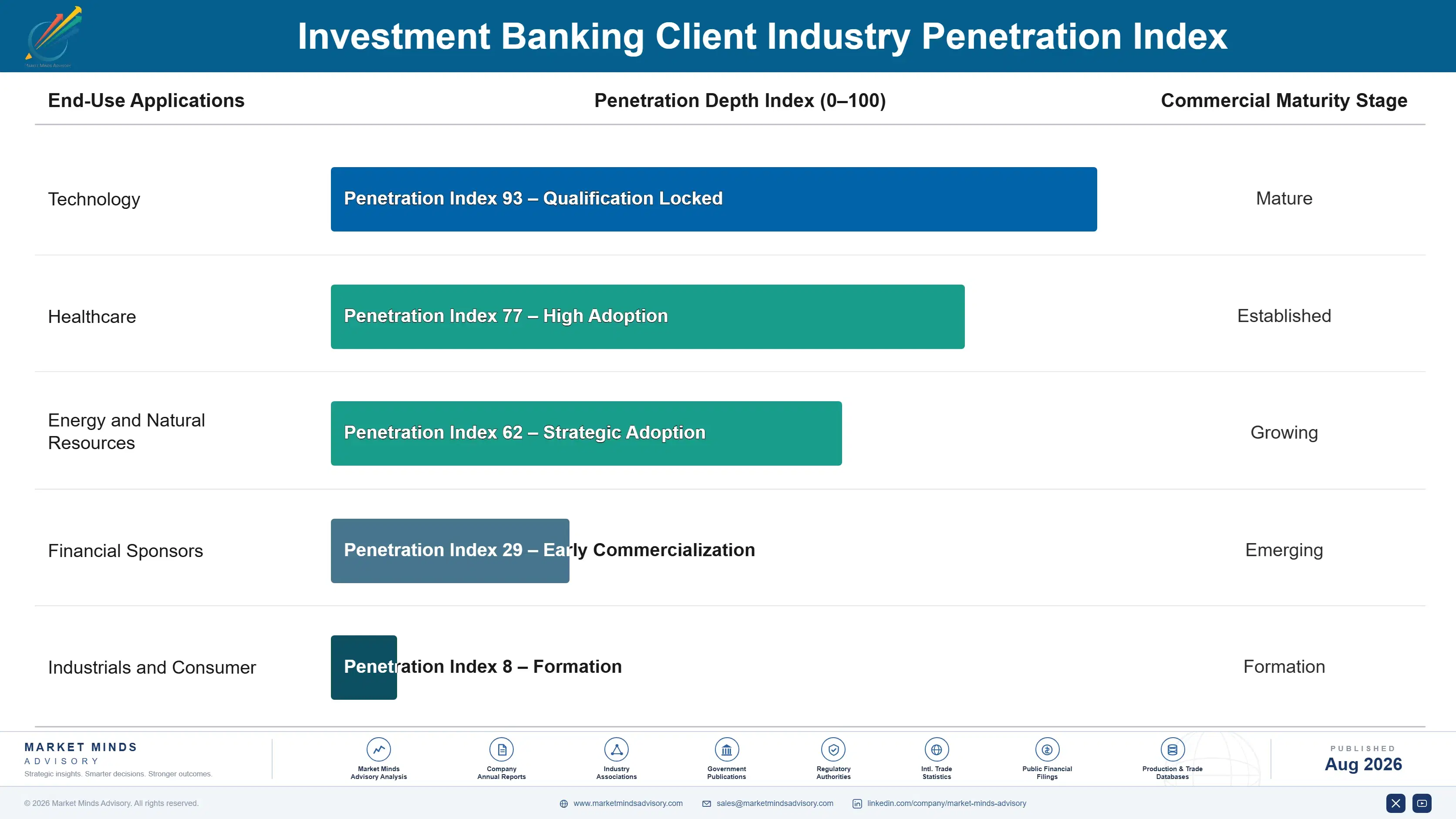
Once a corporation establishes a lead advisory relationship with a bank for a specific transaction category, the relationship tends to persist across multiple subsequent mandates rather than being re-tendered for every transaction, since institutional knowledge and trusted senior relationships carry real switching cost for the client. This relationship stickiness gives incumbent banks reliable, repeat mandate flow once a lead advisory position is won, rewarding established client relationships over aggressive fee competition alone.
Adoption of private capital placement and structured finance advisory runs deepest among sponsors and large corporate borrowers actively pursuing alternative financing structures, where structuring sophistication is a defining determinant of execution success that clients cannot easily substitute with generic advisory relationships, and shallowest among smaller corporate borrowers retaining traditional bank financing relationships. Mid-market segments sit between these extremes, adopting private capital solutions selectively as financing needs grow more complex.

A younger cohort of chief financial officers, now negotiating financing relationships, treats private capital access as a baseline expectation rather than a differentiator their predecessors debated case by case during the traditional bank lending era. This generational shift is compressing the qualification timeline for new private capital advisory relationships at corporations that previously relied on traditional bank financing exclusively.
investment-banking-industry-end-use-penetration-index-1787913112574

Where To Place Investment Banking Bets

These are among the four positions where our research anticipates prominent divergence between winners and laggards over the coming forecast period. Each is grounded in the demand model, the regulatory perimeter, and the announced capacity pipeline.
01 / PRIVATE CAPITAL PLACEMENT INVESTMENT

Back Private Capital Placement Before Rivals

Private capital placement is growing faster than any other segment as private credit funds demand institutional structuring expertise that traditional syndication desks increasingly cannot deliver at competitive execution speed. Banks that invest in private capital advisory technology now will lock in preferential access to premium sponsor and corporate borrower mandates before conventional competitors complete their own capability build-out. Waiting for private credit growth to fully mature before investing risks ceding the most defensible long-term position to competitors who moved earlier and already control the strongest institutional investor relationship portfolios.
02 / SECTOR COVERAGE DEPTH BUILDING

Build Sector Coverage Depth Now

Sector coverage depth offers banks a durable, multi-year advisory relationship position as corporate clients increasingly prefer bankers with specific transaction pattern recognition and deep industry knowledge, a capability generalist advisory desks are not naturally positioned to serve without dedicated sector investment. Banks that invest in dedicated sector coverage teams now capture preferential access to this emerging category before competitors recognize the shift and respond with their own dedicated investment programs. This capability requires sustained investment but offers durable, multi-year returns once firmly established.
03 / REVENUE DIVERSIFICATION STRATEGY

Diversify Revenue Before Next Cycle Shift

Elevated interest rates and regulatory capital requirements remain persistent headwinds that have already produced sharp leveraged deal volume compression in recent years, and further disruption to traditional syndicated lending remains a credible risk given concentrated private credit competition. Banks that diversify revenue across advisory, underwriting, and structured finance now protect fee income during the next inevitable financing cycle shift rather than depending on any single business line. This diversification is a comparatively low-cost hedge relative to the downside it protects against.
04 / TALENT RETENTION INFRASTRUCTURE

Build Talent Retention Infrastructure Now

Talent retention infrastructure has become a genuine competitive differentiator for banks serving clients who increasingly demand continuity of senior banker relationships across multi-year advisory engagements amid intense private equity recruiting competition. Banks that build rigorous deferred compensation and retention programs now capture preferential access to premium mandates that talent-depleted competitors increasingly cannot fulfill under tightening client relationship continuity requirements and expectations. Early movers in this specific capability will likely retain preferred-advisor status well beyond the current recruiting wave and into the next one.

Engagement Snapshot From the Field

A live engagement with an industry participant carrying material or product regulatory and market exposure ahead of a defining policy shift, showing how our research translates into a defensible multi-year portfolio strategy.
MARKET MINDS ADVISORY · CLIENT ENGAGEMENT SUMMARY
Investment Banking Producer Strategic Portfolio Review and Transition Roadmap 2026·Investment Scenario on Investment Banking Exposure Evaluation 2025-26
CLIENT PROFILE
The client is a multinational industrial corporation generating approximately 12.4 billion dollars (client-reported, unverified by MMA) in annual revenue across North America and Western Europe. The company had committed publicly to refinancing a substantial acquisition-related debt load within an eighteen-month timeline tied to upcoming maturity wall commitments, credit rating preservation goals, and broader balance sheet strategy.
STRATEGIC CHALLENGE
The client's existing financing relied heavily on traditional syndicated bank lending facing renewal at meaningfully higher interest rates, risking credit rating pressure against peers already securing more favorable private credit terms across the wider industry. Management needed an independent assessment of financing providers to determine which could realistically deliver comparable terms within the required timeline.
MMA APPROACH
MMA conducted primary interviews with treasury and banking relationship leadership across five investment banks and private credit providers, benchmarking structured finance capability, institutional investor access, and prior large-scale refinancing experience against the client's timeline. The analysis included pricing benchmark testing review and stress-tested each candidate's execution timeline against the client's maturity wall schedule.
KEY FINDINGS
  1. Two of five evaluated providers had prior commercial experience refinancing comparably sized industrial borrowers within a twelve-month execution window across similar sectors.
  2. Pricing benchmark testing showed one candidate's private credit structure achieving 40 basis points lower all-in cost than the client's existing syndicated facility overall.
  3. Execution timelines across candidates ranged from nine to sixteen months, with the fastest candidate requiring meaningfully less lead time before closing the transaction.
  4. Terms varied significantly across candidates, with proposed covenant flexibility ranging from moderate to substantial depending on structure and provider relationship depth overall.
CLIENT PROFILE
The client is a multinational industrial corporation generating approximately 12.4 billion dollars (client-reported, unverified by MMA) in annual revenue across North America and Western Europe. The company had committed publicly to refinancing a substantial acquisition-related debt load within an eighteen-month timeline tied to upcoming maturity wall commitments, credit rating preservation goals, and broader balance sheet strategy.
STRATEGIC CHALLENGE
The client's existing financing relied heavily on traditional syndicated bank lending facing renewal at meaningfully higher interest rates, risking credit rating pressure against peers already securing more favorable private credit terms across the wider industry. Management needed an independent assessment of financing providers to determine which could realistically deliver comparable terms within the required timeline.
MMA APPROACH
MMA conducted primary interviews with treasury and banking relationship leadership across five investment banks and private credit providers, benchmarking structured finance capability, institutional investor access, and prior large-scale refinancing experience against the client's timeline. The analysis included pricing benchmark testing review and stress-tested each candidate's execution timeline against the client's maturity wall schedule.
KEY FINDINGS
  1. Two of five evaluated providers had prior commercial experience refinancing comparably sized industrial borrowers within a twelve-month execution window across similar sectors.
  2. Pricing benchmark testing showed one candidate's private credit structure achieving 40 basis points lower all-in cost than the client's existing syndicated facility overall.
  3. Execution timelines across candidates ranged from nine to sixteen months, with the fastest candidate requiring meaningfully less lead time before closing the transaction.
  4. Terms varied significantly across candidates, with proposed covenant flexibility ranging from moderate to substantial depending on structure and provider relationship depth overall.
RECOMMENDED STRATEGY
Phase 1: Phase 1 (0 to 3 months): Complete pricing and covenant benchmarking across shortlisted providers and select a partner based on fit. Phase 2: Phase 2 (3 to 14 months): Execute refinancing transaction across the full maturity wall, running documentation and closing processes throughout. Phase 3: Phase 3 (14 to 18 months): Complete full refinancing close with documented credit rating preservation, finalizing long-term banking relationship terms.
OUTCOME
Within sixteen months, the client completed its refinancing transaction across its full maturity wall, achieving 35 basis points (client-reported, unverified by MMA) lower all-in cost versus prior syndicated terms. The transaction closed ahead of schedule, with financing now structured under a long-term private credit relationship.

Frequently Asked Questions

Foundational context covering the market sizes, CAGR, scope, country, region and competition that inform every finding below. This section is provided to cover basics and most often pre-purchase conversations, answered from the MMA Primary Research Dataset.

What is the current size of the Investment Banking Market?

The Investment Banking Market generated approximately 145.0 billion dollars in fees in 2025. Growth is driven by private credit expansion and rebounding merger and acquisition activity.

How large will the Investment Banking Market be by 2036?

The market is projected to reach approximately 289.88 billion dollars by 2036, up from 154.42 billion dollars in 2026. That represents roughly a 1.88 times expansion over the ten-year forecast window.

What is the CAGR for the Investment Banking Market 2026 to 2036?

The market is forecast to expand at a compound annual growth rate of 6.5 percent between 2026 and 2036. Bull and bear scenarios range from 7.8 percent to 5.2 percent depending on deal volume recovery.

Which segment is growing fastest?

Private placement and structured finance advisory is the fastest-growing segment, expanding at an estimated 11.5 percent annually, roughly 1.8 times the overall market rate. Leveraged finance syndication follows at 9.0 percent.

Who are the major companies in the Investment Banking Market?

Goldman Sachs, JPMorgan Chase, Morgan Stanley, Bank of America, and Citigroup lead the market by global fee share. Combined, the top five banks hold a CR5 of approximately 38 percent.

Which country is growing fastest?

India is the fastest-growing single major market, expanding rapidly as its capital markets and initial public offering pipeline scale. China sustains strong growth given its expansive capital markets base.

Report Segmentation Architecture

The full report scope spans multiple orthogonal segmentation dimensions, with cross-tabulated demand data provided for each dimension pair. Coverage extends further to regional breakdowns, trend trajectories, and the competitive detail needed to support segment-level decision-making.

By Service Line

  • Mergers and Acquisitions Advisory
  • Equity Underwriting (ECM)
  • Debt Underwriting (DCM)
  • Leveraged Finance and Private Credit Syndication
  • Restructuring Advisory
  • Private Placement and Structured Finance Advisory

By Client Industry

  • Technology
  • Healthcare
  • Energy and Natural Resources
  • Financial Sponsors
  • Industrials and Consumer

By Commercial Dimension

  • Corporate Client Mandates
  • Financial Sponsor Mandates
  • Government and Sovereign Mandates
  • Cross-Border Advisory

By Region

  • North America
  • Western Europe
  • East Asia
  • South Asia and Pacific
  • Latin America
  • Middle East and Africa
  • Eastern Europe

Scope, Methodology, and Coverage

Every figure in this report is reproducible from documented input assumptions. The scope below maps the historical period, the forecast horizon, the segmentation dimensions, and the countries covered, alongside the underlying primary and qualitative methodology.
Historical Period
2020 to 2025
Forecast Period
2026 to 2036
Base Year
2025 (USD billions; MMA Primary Research Dataset, August 2026)
Market Definition
The Investment Banking Market comprises advisory and underwriting fee revenue generated from mergers and acquisitions advisory, equity and debt capital markets underwriting, leveraged finance syndication, restructuring advisory, and private placement services. It excludes commercial banking net interest income and retail brokerage revenue.
Quantitative Units
USD billions (current prices); global fee pool share where disclosed
Segmentation Dimensions
Service Line; Client Industry; Commercial Dimension; By Region
Regions Covered
North America, Western Europe, East Asia, South Asia and Pacific, Latin America, Middle East and Africa, Eastern Europe
Countries Covered
USA, China, Germany, France, UK, Japan, South Korea, India, Australia, Canada, Brazil, Mexico, UAE, Saudi Arabia, South Africa, Nigeria, Turkey, Poland, Netherlands, Italy, Spain, Sweden, Switzerland, Argentina, Egypt, Indonesia, Vietnam, Thailand, Singapore, and additional markets relevant to this sector
Key Companies Profiled
The Goldman Sachs Group, Inc., JPMorgan Chase & Co., Morgan Stanley, Bank of America Corporation, Citigroup Inc., Barclays plc, Deutsche Bank AG, UBS Group AG, Credit Agricole CIB, BNP Paribas, Wells Fargo Securities, RBC Capital Markets, Jefferies Financial Group, Evercore Inc., Lazard Ltd., Moelis & Company, PJT Partners, Rothschild & Co, Mizuho Financial Group, Nomura Holdings
Quantitative Methodology
Primary survey, n=3,800 respondents, Q4 2025, six countries; demand-side model with trade association cross-validation
Qualitative Methodology
47 expert interviews, Q4 2025; applied to validate demand model assumptions, identify emerging dynamics, and assess competitive positioning
Report Format
PDF and XLSX data workbook (Word format preview document)
Publisher
Market Minds Advisory
Report Code
MMA-2026-TEC-309
Published
August 2026
Contact
sales@marketmindsadvisory.com | www.marketmindsadvisory.com

Purchase the full Investment Banking Market Report (2026 to 2036).

The full Investment Banking Market report delivers a complete service line segmentation model spanning merger advisory, equity and debt underwriting, leveraged finance, restructuring, and private placement categories. It includes detailed regional fee pool data across all seven world regions. The report profiles twenty banks, including detailed fee share, advisory positioning, and moat and risk assessment for the top five, supported by primary interviews with sourcing and banking leadership. It also includes ten-year forecast scenarios under base, bull, and bear cases, talent cost exposure analysis by region and player type, and a strategic verdict framework for advisory and financing decisions.
Ten-Year Base, Bull, and Bear Forecasts
Service Line Segmentation Across Six Categories
Full Seven-Region Fee Pool Data Breakdown
Twenty-Bank Competitive Profiles With Moat Analysis
Talent Cost Exposure and Mitigation Playbook
Primary Interview Data From Banking Leadership Teams

Built For The People Who Decide

From boardroom strategy to bench-side execution, this report is read cover-to-cover by leaders shaping the next decade of their industry, turning demand scenarios, market dynamics and valuation benchmarks into decisions.
CXOs/ Presidents/ VPs/ Managers
M&A and Corporate Development
Strategy Teams and R&D Heads
Procurement and Product Directors
Regulatory and Compliance Leaders
Investor Relations and Equity Analysts