Market Minds Advisory
Intravenous Iron Drugs Market

Intravenous Iron Drugs Market: Chair Time Economics, Phosphate Safety Differentiation, and Heart Failure Indication

A formulation delivering a full iron replacement dose in one fifteen minute visit beats five cheaper infusions on total cost, which is why the price of the drug has almost never decided these contracts.

Lead Analyst

Alice Ballenger

Published

September 2026

Make Smarter Decisions with Customized Research Insights

Request a free sample report and evaluate market opportunities, growth trends, and competitive dynamics relevant to your business needs.

2025 MARKET VALUE$2.8BMarket Size 2025
2036 FORECAST VALUE$6.9BBase Case , 2026 to 2036
CAGR 2026 TO 20368.6 %Bull 9.9% / Bear 7.3%
INCREMENTAL OPPORTUNITY$3.9BNet 10- year value creation
EXPANSION MULTIPLE2.28x2036 value over 2026 base
Strategic Levers
M&A Pipeline
Regional Outlook
Country Rankings
Competitive Intelligence
Segmental Deep-dive
Call-Us : 91 93563 13602

Executive Snapshot and Market Trajectory

Chair time is the economic unit in this market, not milligrams of iron. A single fifteen minute infusion replacing a full deficit costs a health system less than five cheaper visits, even where the drug itself is ten times the price, and every commercial argument here follows from that.
Ferric derisomaltose compounds at 12.9%, a full 1.50x the market rate, on a safety difference rather than a convenience one: it induces far less renal phosphate wasting than ferric carboxymaltose, which affects roughly half of patients receiving that alternative. Western Europe holds the largest share at 26%, because European guidelines adopted high-dose intravenous iron in heart failure and perioperative care years before other systems did.
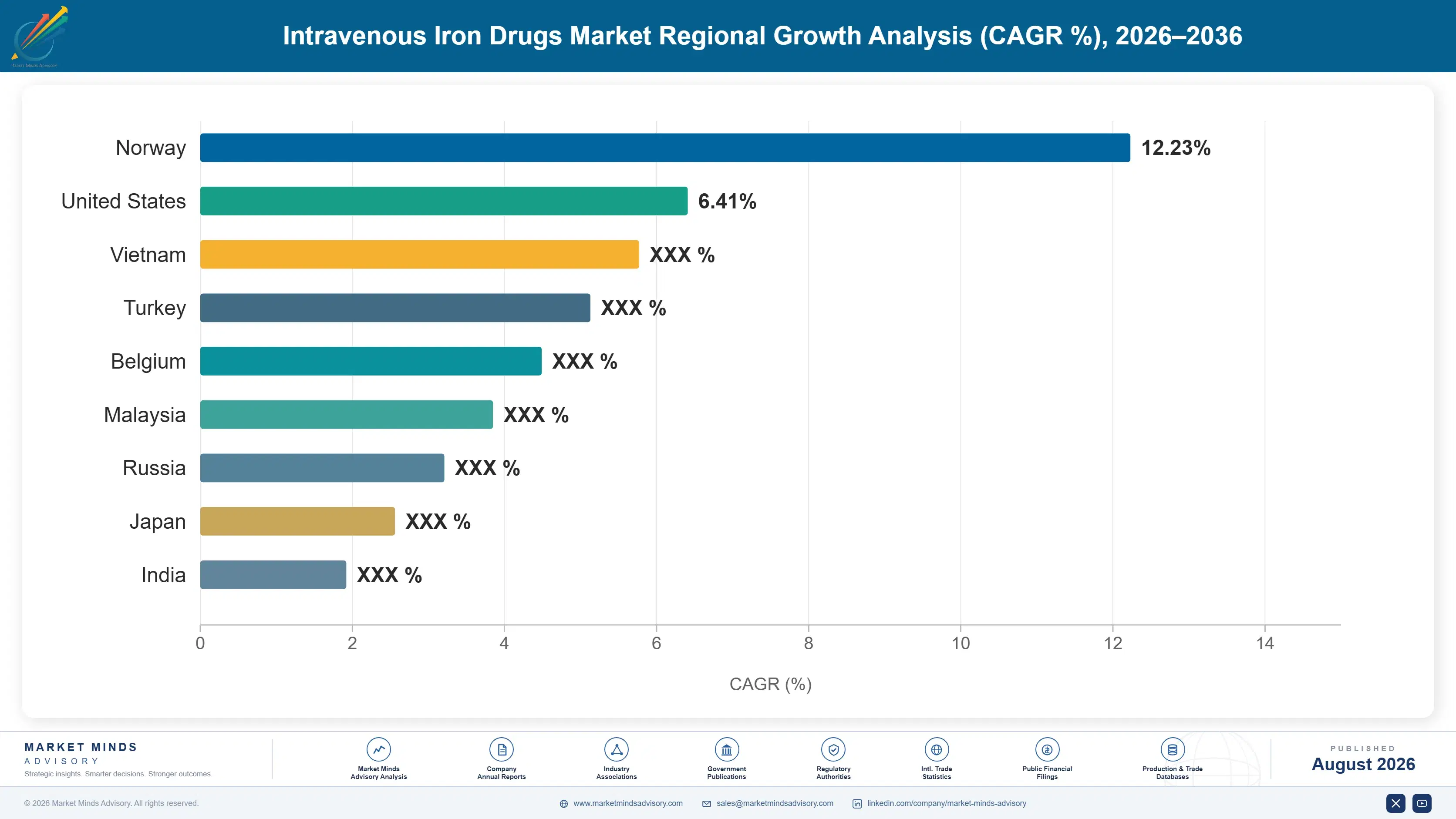
Concentration sits at 71%, with CSL Vifor and Pharmacosmos leading two European originator franchises that between them defined modern practice. Roughly 68% of iron deficiency worldwide goes undiagnosed. India carries the heaviest burden of anyone and compounds at 13.4%, on domestic iron sucrose priced so low that the Western formulations are commercially irrelevant there. Volume and value part company almost entirely here, and the gap between them keeps widening rather than closing.
Market Definition
This market covers parenteral iron formulations administered intravenously for the treatment of iron deficiency and iron deficiency anaemia, spanning ferric carboxymaltose, ferric derisomaltose, iron sucrose, iron dextran, ferumoxytol and sodium ferric gluconate complex, including generic and branded presentations. Measurement is at manufacturer revenue net of rebates. Oral iron preparations, intramuscular iron, erythropoiesis stimulating agents, blood transfusion products, and iron supplements sold without prescription are excluded.
Base Year Value
$2.8B in 2025 (MMA Primary Research Dataset, August 2026)
Forecast Period
2026 to 2036, eleven discrete annual values
CAGR
8.6% base case. Bull 9.9%. Bear 7.3%.
Fastest Growth Segment
Ferric Derisomaltose: 12.9% CAGR
Fastest Growth Country
India: 13.4% CAGR
Fastest Growth Region
South Asia and Pacific: 10.8% CAGR
Largest Region
Western Europe: 26% of 2025 global value
Market Leaders
CSL Vifor, Pharmacosmos, American Regent, Covis Pharma, and Fresenius Kabi. Source: MMA Primary Research Dataset, July 2026.
Primary Survey
n=3,800 procurement and R&D decision-makers, Q4 2025, six countries
Methodology
Demand-side build-up, cross-validated against public data, 47 expert interviews

Intravenous Iron Drugs Market Forecast Scenarios

intravenous-iron-drugs-market-size-forecast-scenario-1787304247463
Growth ran at roughly 7.4% between 2020 and 2025, and infusion capacity shaped both halves of it. Elective procedures and outpatient infusion slots were suspended through 2020, cutting volumes sharply for a category that requires a patient to sit in a chair. Recovery was quick, and heart failure trial results then moved intravenous iron from a haematology product into a cardiology one.
Base case growth of 8.6% rests on three mechanisms. Heart failure guidelines in Europe and increasingly elsewhere now recommend intravenous iron for patients with reduced ejection fraction and iron deficiency, which is a large population that cardiologists had not previously treated. Perioperative patient blood management programmes correct anaemia before elective surgery specifically to avoid transfusion. And roughly 68% of iron deficiency remains undiagnosed, so screening improvements convert directly into treated patients.
The bull case at 9.9% assumes United States cardiology guidance moves closer to European practice, which would open the largest single national population to routine treatment. The bear case at 7.3% is a pricing case: generic ferric carboxymaltose entry following patent expiry would compress the branded pricing that currently funds the health economic argument, without changing the clinical case for high-dose therapy at all.

Intravenous Iron: Infusion Economics and Safety Differentiation

The economics of this market are decided in the infusion suite rather than the pharmacy. Iron sucrose costs little per vial and needs up to five attendances to replace a full deficit, each consuming a chair, a nurse and a patient's day. Ferric carboxymaltose and ferric derisomaltose deliver the whole dose in one fifteen minute visit. Total episode cost favours the expensive drug comfortably, and health systems worked that out years ago.
TOP FIVE CONCENTRATION71%Two European originator franchises define most of the branded market
SINGLE VISIT COMPLETION82%Patients receiving a full replacement dose in one attendance
AVERAGE COURSE PRICEUSD 480Blended cost of a complete iron replacement course per patient
HYPOPHOSPHATAEMIA INCIDENCE51%Patients developing low serum phosphate after certain formulations
UNDIAGNOSED DEFICIENCY SHARE68%Iron deficiency worldwide never identified or clinically treated
INFUSION CHAIR TIME15 minutesAdministration duration for modern high dose intravenous formulations
Safety has become the live differentiator between the two modern options. Ferric carboxymaltose induces fibroblast growth factor 23 mediated renal phosphate wasting, and head-to-head trials found clinically meaningful hypophosphataemia in around half of patients receiving it against a small fraction on ferric derisomaltose. Most cases resolve without consequence and a minority do not. That evidence has driven switching in a category where switching is otherwise rare.
Indication expansion has done more for volume than any formulation improvement. Heart failure trials established that correcting iron deficiency in patients with reduced ejection fraction reduces hospitalisation, and European guidance responded. Cardiologists now treat a population haematologists never saw. Perioperative programmes correcting anaemia before surgery to avoid transfusion have added another, and both sit far outside the original nephrology and gastroenterology base.
"This is one of very few markets where the expensive drug is genuinely the cheap option, and it took health systems about a decade to believe it. The argument was never about iron. It was about how many times you make a patient come back."
Director, Hospital Pharmaceuticals and Supportive Care Practice · MMA Healthcare

Market Trends

Phosphate wasting becomes the deciding clinical difference

Ferric carboxymaltose triggers fibroblast growth factor 23 mediated renal phosphate loss, and randomised head-to-head comparison found clinically meaningful hypophosphataemia in roughly half of treated patients against a small fraction receiving ferric derisomaltose. Most episodes resolve quietly and a minority produce fatigue, bone pain or, with repeated dosing, osteomalacia. Formulary committees in Europe and Australia have begun writing that difference into preferred product decisions. Safety differentiation between two otherwise interchangeable products is unusual, and it has driven switching that convenience arguments never achieved. Cross-trial inference persuades nobody in that forum, so only direct comparison actually counts.
Market Impact: Cuts transfusion need by 40%
Cardiology becomes the largest new prescribing specialty

Trials in heart failure with reduced ejection fraction established that correcting iron deficiency reduces hospitalisation, and European guidance now recommends intravenous iron for those patients whether or not they are anaemic. That moved a haematology and nephrology product into cardiology clinics that had never used it. The eligible population is very large, since iron deficiency affects a substantial share of heart failure patients, and cardiologists prescribe from hospital budgets that behave quite differently from haematology pharmacy allocations. Reaching them requires different congresses, different evidence and different opinion leaders from anything a haematology organisation already has.
Market Impact: Roughly 68% remains undiagnosed

Market Opportunities and Growth Drivers

Patient blood management programmes correct anaemia before surgery

Preoperative anaemia raises transfusion rates, length of stay and complication risk, and correcting it with intravenous iron in the weeks before elective surgery measurably reduces all three. European and Australian perioperative guidelines have embedded that practice, and hospital transfusion committees fund it because a unit of blood costs several hundred dollars before any adverse event is counted. Orthopaedic, cardiac and colorectal surgical pathways account for most of the volume, and the referral comes from a surgeon rather than a physician. Anaesthetists running these programmes select on administration time rather than acquisition cost, which their budgets do not carry.
Market Impact: Chair time still 15 minutes

Heavy menstrual bleeding remains the largest untreated population

Iron deficiency from heavy menstrual bleeding affects an enormous number of women and is routinely dismissed, managed with oral iron that many cannot tolerate, or simply never investigated. Roughly 68% of iron deficiency worldwide goes undiagnosed and this population accounts for a large share of it. Where gynaecology services have introduced systematic ferritin screening, treated volumes rise sharply. The clinical case is settled and the constraint is entirely a diagnostic and referral pathway problem rather than anything about the drugs. Systematic ferritin screening in gynaecology services lifts treated volumes sharply wherever it has been introduced.
Market Impact: Observation adds 30 minutes

Market Restraints and Challenges

Infusion chair capacity limits how many patients can be treated

Every dose requires a patient in a monitored chair with a nurse and an observation period afterwards, and outpatient infusion capacity in most health systems is already committed to oncology and biologic therapy. The root cause is that infusion suites were built for a smaller set of indications than now compete for them. Commercial impact is that demand exceeds delivery capacity in several markets regardless of budget. Manufacturers respond by shortening administration time, simplifying observation requirements and supporting community infusion models. Shortening administration is the only lever a manufacturer genuinely controls here.
Market Impact: Affects roughly 51% of patients

Hypersensitivity warnings shape administration workflow and prescriber caution

Parenteral iron carries a recognised risk of hypersensitivity reactions, and regulatory warnings following historical dextran formulations still govern how these products are given. The root cause is immune reaction to the carbohydrate shell rather than to iron itself, which modern formulations reduced without eliminating. Commercial impact is mandatory observation periods, resuscitation availability and prescriber reluctance in primary care settings. Manufacturers have responded with reformulation, simplified administration guidance and education programmes targeting the non-specialist prescribers who remain most cautious. Primary care prescribing remains rare almost everywhere as a direct result of those requirements.
Market Impact: Reaches over 50% of failure patient
3 additional market trends, 4 additional growth drivers, and 2 additional restraints and challenges are covered in the full report. Contact sales@marketmindsadvisory.com to access the complete intelligence.

Segment CAGR and Growth Architecture

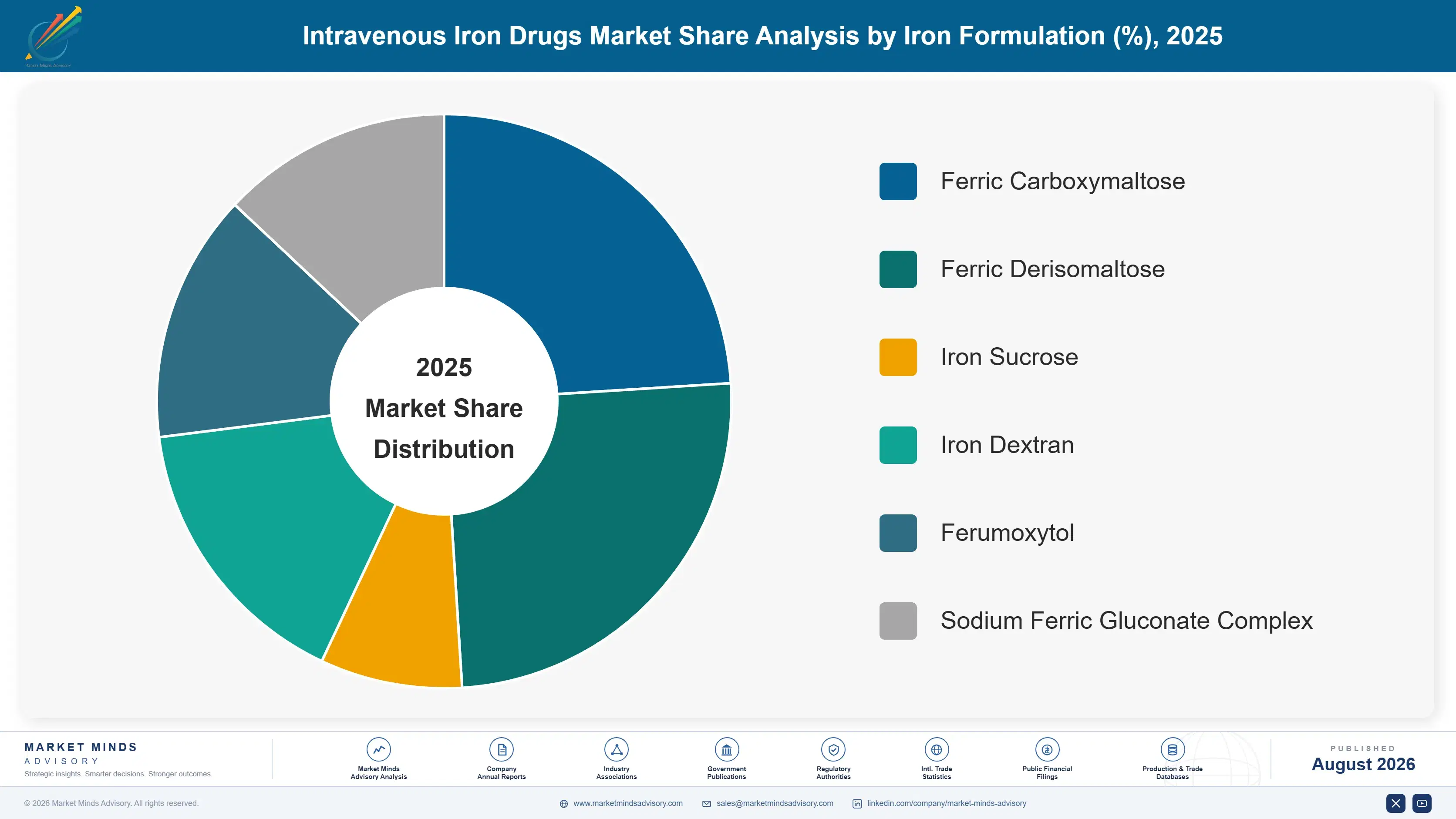
Segmentation follows the iron formulation itself, because the carbohydrate complex determines the maximum single dose, the administration time, the hypersensitivity profile and the phosphate effect that now separates otherwise similar products. Six formulations cover intravenous iron supply without overlap. Clinical indication cuts across every formulation and is treated here as an application attribute rather than a segment.
intravenous-iron-drugs-market-market-share-analysis-1787304248405

Ferric Derisomaltose

Growing at 12.9%, a full 1.50x the market rate, ferric derisomaltose delivers a complete replacement dose in a single short infusion while producing far less renal phosphate wasting than its principal competitor. Randomised head-to-head evidence rather than marketing established that difference, which is why formulary committees across Europe and Australia have begun writing preferences around it. The matrix structure of the iron carbohydrate complex releases iron more slowly, which underlies both the tolerability and the phosphate profile. Pharmacosmos built the franchise from a Danish base and has expanded into North America comparatively recently. Commercial coverage across cardiology and surgery remains thinner than the competing franchise holds, which is the principal constraint on how fast the position can grow.
CAGR 12.9%

Ferric Carboxymaltose

Ferric carboxymaltose grows at 9.4% and remains the most widely used modern formulation by a considerable margin, supported by the largest clinical evidence base in the category including the heart failure trials that opened cardiology prescribing. Its difficulty is the phosphate effect, which affects around half of treated patients and has become the principal argument competitors deploy against it. Patent expiry brings generic entry across major markets during the forecast period, which compresses pricing on the volume leader and reshapes the economics that currently fund the whole high-dose category. The evidence breadth that opened cardiology prescribing for the whole category was generated on this molecule, which continues to support guideline positions competitors cannot claim.
CAGR 9.4%
Full segment breakdown across 6 segments available in the complete report.

Regional Architecture and Country Demand Map

Regional value follows clinical guideline adoption and formulation mix rather than disease burden, and those two diverge almost completely. The regions carrying the heaviest iron deficiency burden treat it with the cheapest available products, where they treat it at all. Guidelines rather than prevalence set regional value.

Western Europe

Western Europe holds the largest share at 26%, and the reason is guideline adoption rather than population or burden. European cardiology guidance recommended intravenous iron in heart failure years ahead of other systems, and European perioperative patient blood management programmes embedded preoperative anaemia correction into surgical pathways well before that. Both originator franchises are European, with CSL Vifor operating from Switzerland and Pharmacosmos from Denmark, which shaped early evidence generation and prescriber education across the region. Growth at 7.0% is the slowest tracked here, because adoption is already deep and generic entry will compress pricing across the largest formulation. Adoption depth here is what every other region is measured against.
Share: 26% | CAGR: 7.0% (2026 to 2036)

North America

Twenty-four per cent of value, growing at 9.2%. United States practice adopted high-dose intravenous iron considerably later than Europe, held back by hypersensitivity warnings following historical dextran experience and by cardiology guidance that remains more cautious than its European equivalent. That lag is now the opportunity: the eligible population is enormous and treatment rates remain well below European levels for comparable patients. Infusion suite reimbursement under the buy-and-bill model shapes product selection materially, since a practice earns on the drug it administers. Canadian provincial formularies restrict access more tightly on cost grounds. Treatment rates for comparable patients still sit well below European levels, and closing that gap is the whole opportunity here.
Share: 24% | CAGR: 9.2% (2026 to 2036)
Regional intelligence for 5 additional markets available in the complete report: East Asia, South Asia and Pacific, Latin America, Middle East and Africa, Eastern Europe. Contact sales@marketmindsadvisory.com.
intravenous-iron-drugs-market-country-cagr-analysis-1787304249287

Where Intravenous Iron Value Is Won

Nobody buys this product on milligrams of iron, and the cheapest vial has repeatedly lost to the most expensive one. Value accrues to whoever can prove total episode cost, whoever holds the safety evidence that formulary committees now weigh, and whoever reaches the specialties that have only recently started prescribing. Vial price has decided almost nothing.

Build the total episode cost argument, not the vial price

Iron sucrose costs very little and needs up to five attendances to replace a deficit, each consuming a chair, a nurse and a patient's working day. A single fifteen minute infusion completes the same replacement in 82% of cases. Health economic submissions built on episode cost rather than acquisition price win formulary decisions that pure price comparison always loses. Manufacturers who supply infusion suite time-and-motion data alongside clinical evidence secure preferred status considerably more often than those presenting efficacy alone. Acquisition price comparison loses that argument every single time it is attempted.
Market Impact: Completes treatment in 82% of all s

Compete on phosphate safety where the evidence supports it

Randomised head-to-head comparison found clinically meaningful hypophosphataemia in roughly 51% of patients receiving ferric carboxymaltose against a small fraction on ferric derisomaltose, and formulary committees in Europe and Australia have begun writing that into preferred product choices. Safety differentiation between near-interchangeable products is rare and it moves prescribing where convenience arguments do not. The evidence has to be generated through direct comparison rather than cross-trial inference, which costs real money and is the only version formulary committees accept. Formulary committees across Europe and Australia have already begun acting on the published comparison.
Market Impact: Affects roughly 51% of patients on

Reach cardiology and surgery rather than haematology alone

Heart failure guidance opened a prescriber population that had never used intravenous iron, and perioperative blood management brought surgical teams in behind it. Both prescribe from budgets and referral pathways entirely separate from haematology pharmacy. Commercial organisations built around haematology and nephrology detailing consistently under-reach them, and treated volume in cardiology alone now exceeds the traditional base in several European markets. Reaching those specialties requires different evidence, different congresses and different key opinion leaders altogether. Cardiology volume already exceeds haematology across several markets, and roughly 50% of heart failure patients carry iron deficiency.
Market Impact: Reaches over 50% of all heart failu

Prepare for generic entry on the volume-leading formulation

Ferric carboxymaltose patent expiry brings generic competition across major markets within the forecast period, and it will compress pricing on the formulation carrying most of the category's volume. That erodes the branded margin currently funding health economic evidence generation and specialty education for everybody. Differentiated formulations, indication breadth and safety evidence are the defences available. Manufacturers assuming the current pricing environment persists through the decade are planning against a change that is already scheduled and entirely predictable. Generic entry lands on the formulation carrying 9.4% growth and most of the category's branded margin.
Market Impact: Compresses pricing across the whole

Who Controls the Margin Pool

Concentration sits at 71% across the top five, measured on annual revenue from parenteral iron products, the single basis applied throughout. CSL Vifor and Pharmacosmos lead, two European originators whose franchises between them defined modern high-dose practice. American Regent, Covis Pharma and Fresenius Kabi follow through United States distribution rights, the ferumoxytol franchise and iron sucrose generics respectively. Indian manufacturers supply enormous volume at negligible value.
Competition runs on evidence rather than on product characteristics that a prescriber can observe. Health economic data on total episode cost decides formulary access, since acquisition price comparison always favours iron sucrose. Head-to-head safety evidence on phosphate wasting decides between the two modern options, and only direct comparison counts with committees. Specialty reach decides volume, because cardiology and surgery now prescribe more than haematology in several markets.

Pressure builds from two directions. Generic ferric carboxymaltose enters across major markets within the forecast period and will compress pricing on the formulation carrying most volume. Separately, Indian manufacturers including Emcure and Sun Pharmaceutical supply domestic and emerging market demand at prices that make Western formulations commercially irrelevant there. Rankings shift most where safety evidence rather than convenience decides between near-equivalent products.
intravenous-iron-drugs-market-company-positioning-matrix-1787304250164

Competitive Moat and Risk Dimensions

CSL VIFOR

Moat: Deepest clinical evidence base

Ferric carboxymaltose carries the largest body of randomised evidence in the category, including the heart failure trials that opened cardiology prescribing for everybody. That evidence supports indication breadth no competitor matches and it underpins guideline positions across multiple specialties. Prescribers who learned high-dose intravenous iron practice largely learned it on this product.
CSL VIFOR

Risk: Phosphate safety exposure

Hypophosphataemia in roughly half of treated patients is a demonstrated head-to-head disadvantage that competitors deploy directly, and formulary committees have begun acting on it. Patent expiry brings generic entry on the volume-leading formulation within the forecast period. Both pressures land on the same product simultaneously, which leaves limited room to manoeuvre.
PHARMACOSMOS

Moat: Head-to-head safety differentiation

Pharmacosmos generated direct randomised comparison showing substantially lower hypophosphataemia with ferric derisomaltose, which is the only form of evidence formulary committees genuinely accept when choosing between near-equivalent products. That data is expensive, difficult to replicate and gives the company an argument in exactly the forum where product selection is decided.
PHARMACOSMOS

Risk: Scale and reach limitation

The company is far smaller than its principal competitor and entered North America comparatively recently, which limits commercial coverage across the cardiology and surgical specialties now driving volume growth. Generic ferric carboxymaltose will reset price expectations across the whole high-dose category, including for differentiated products competing against it.

Players Tracked

Prominent Players

CSL Vifor
Pharmacosmos
American Regent
Covis Pharma
Fresenius Kabi

Other Key Players

Emcure Pharmaceuticals
Sun Pharmaceutical Industries
Cipla
Zydus Lifesciences
Intas Pharmaceuticals
Hikma Pharmaceuticals
Teva Pharmaceutical Industries
Sandoz Group
Accord Healthcare
Amneal Pharmaceuticals
Hetero Labs
Rockwell Medical
Nipro Corporation
Dr. Reddy's Laboratories
Lupin

Recent Developments

MARCH 2025

European formulary committees adopt phosphate monitoring guidance for parenteral iron

Several European hospital formulary committees introduced serum phosphate monitoring requirements following repeated ferric carboxymaltose dosing, and a number moved toward preferring alternative formulations in patients requiring more than one treatment course within a twelve month period. Serum phosphate monitoring was not previously required at all.
Signal: Safety evidence between near-equivalent pr
AUGUST 2025

Pharmacosmos expands North American commercial coverage into cardiology

Pharmacosmos widened its North American commercial organisation to cover cardiology practices directly, an organic expansion rather than a partnership, following heart failure guidance movement that brought intravenous iron prescribing into a specialty that had not previously used it. No partnership or acquisition was involved in the expansion.
Signal: Cardiology already prescribes more intrave
JANUARY 2026

Indian manufacturers expand iron sucrose capacity under national anaemia programme

Several Indian manufacturers commissioned additional iron sucrose production capacity supporting the national anaemia programme, organic expansions serving maternal and child health services that treat very large patient volumes at prices a small fraction of Western branded levels. Export volume was not the primary objective at all.
Signal: The heaviest disease burden anywhere is be

Iron Complex, Sterile Fill and Distribution Exposure

Cost structures here are dominated by sterile manufacturing rather than by materials, which surprises people who assume iron is cheap. The iron carbohydrate complex accounts for roughly 19% of cost of goods, and the shell chemistry is where the technical difficulty and the intellectual property sit. Sterile fill-finish, vial and container systems and release testing together contribute around 44%, and the remainder covers cold chain and distribution.
Sterile injectable capacity constraint through 2022 and 2024 illustrated the exposure. Contract fill-finish slots were allocated to higher-value biologics as manufacturers competed for the same lines, and Fresenius Kabi and Hikma both documented sterile capacity and cost pressure in their annual reporting for those years. Parenteral iron rarely outbids a monoclonal antibody for a filling slot, and hospital tender contracts already signed could not be repriced mid-term.

The disadvantage falls hardest on manufacturers without owned sterile capacity. A company holding its own fill-finish lines controls both schedule and cost while a competitor buying capacity queues behind pharmaceutical customers paying considerably more per unit. Geography compounds it: Indian manufacturers hold sterile cost positions Western producers cannot approach, which is why domestic iron sucrose pricing there bears no relation to Western levels.
intravenous-iron-drugs-market-cost-volatility-analysis-1787304250469

Secure owned or dedicated sterile fill-finish capacity

Contract sterile capacity goes to whoever pays most per filled unit, and parenteral iron rarely outbids biologics when lines tighten. Owned or reserved capacity costs more per vial in normal conditions and converts an allocation problem into a scheduling one, which matters enormously when a hospital tender carries supply guarantees the manufacturer cannot otherwise meet.

Qualify secondary carbohydrate raw material sources ahead of need

The carbohydrate shell rather than the iron determines product identity, and its raw materials come from a narrow specialist supplier base. Regulatory change control makes substitution slow, so qualification has to happen before any disruption. Manufacturers holding a second qualified source avoid an exposure that has interrupted supply at several competitors during past cycles.

Index multi-year hospital tender contracts to sterile manufacturing costs

Fixed multi-year tender pricing transferred the whole sterile capacity cost increase onto manufacturers during the last cycle. Newer agreements increasingly carry narrow adjustment tied to published pharmaceutical manufacturing cost indices. Hospital procurement accepts that more readily than any general escalator, because the underlying data is external, published and clearly outside a single supplier's control.

Portfolio Architecture for Margin Defence

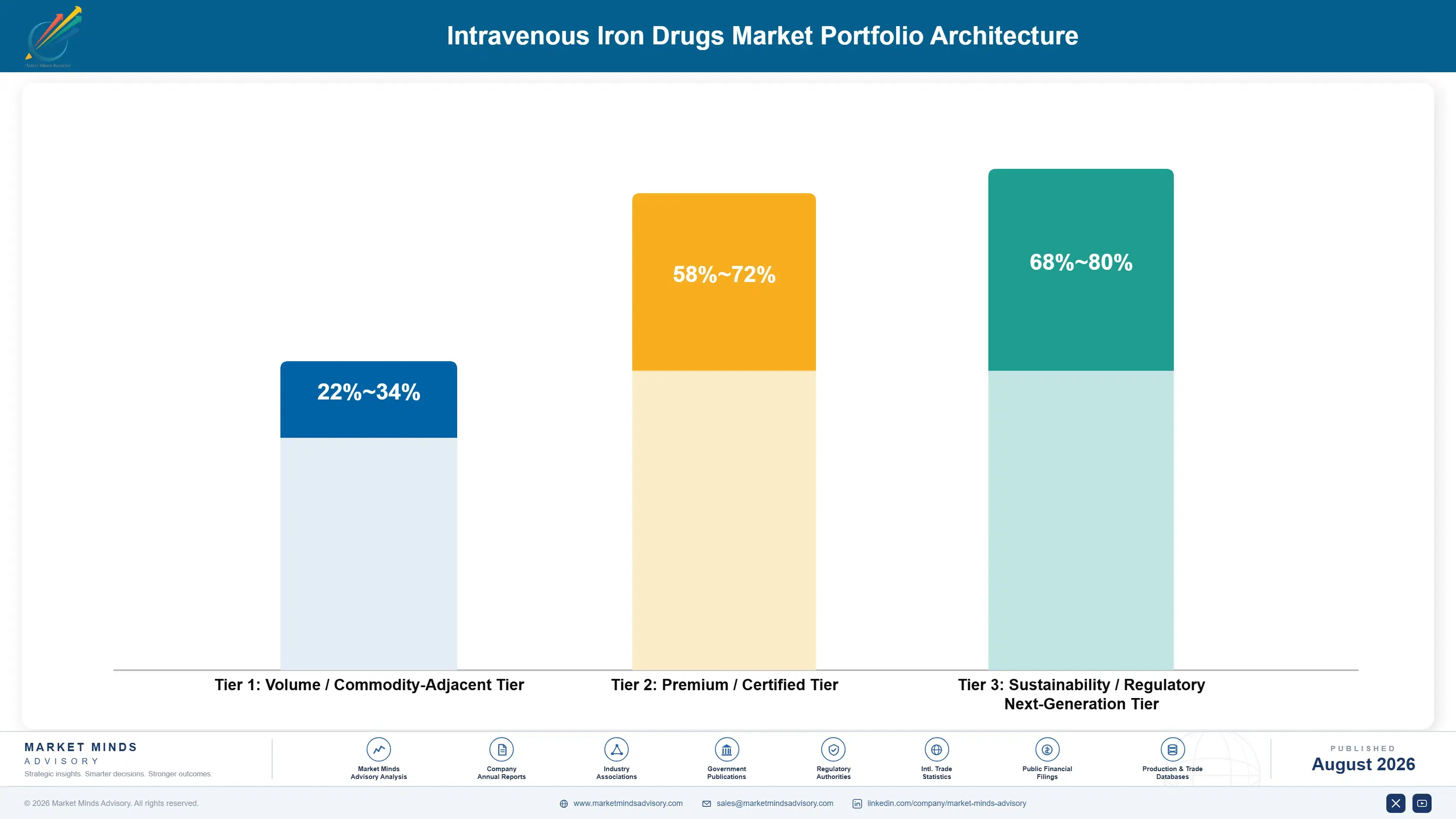
Margin architecture divides on whether a product carries differentiating evidence. Iron sucrose and sodium ferric gluconate are long generic, supplied by many manufacturers, and earn commodity returns on tendered volume. Ferumoxytol and iron dextran occupy narrow positions shaped by historical safety perception. The two modern high-dose formulations earn considerably more, protected by patent, health economic evidence and head-to-head safety comparison.
The volume versus premium tension runs along a geographic line and it is stark. Most treated patients worldwide receive inexpensive iron sucrose in markets where Western formulations are commercially irrelevant, particularly across South Asia and Africa. Most value sits with a much smaller number of patients in Europe, North America and the Gulf receiving high-dose branded therapy. Serving both requires manufacturing and pricing models that almost nobody operates simultaneously.

High-value pools sit where a specialty has recently started prescribing and evidence still decides. Cardiology heart failure treatment, perioperative blood management and gynaecology anaemia pathways all involve prescribers making a new decision rather than repeating an old one, which is when evidence and education actually change behaviour. Established nephrology and gastroenterology use sits at the other extreme, with settled protocols and procurement running largely on tendered price.

Volume / Commodity-Adjacent Tier

Iron sucrose, sodium ferric gluconate and iron dextran, long generic and supplied by many manufacturers into hospital tenders decided on delivered price. Indian producers set the cost floor across most emerging market volume.
Gross Margin: 22-34%

Premium / Certified Tier

Ferric carboxymaltose and ferumoxytol, protected by clinical evidence breadth, guideline positions and administration convenience, though patent expiry on the volume leader will reset pricing within the forecast period. Guideline positions built on trial breadth still protect prescribing habit.
Gross Margin: 58-72%

Sustainability / Regulatory / Next-Generation Tier

Ferric derisomaltose and differentiated formulations carrying head-to-head safety evidence, protected by direct comparative data that formulary committees accept and that competitors cannot replicate cheaply. Best margins available here. Direct comparison is expensive and competitors cannot replicate it cheaply.
Gross Margin: 68-80%
intravenous-iron-drugs-market-portfolio-architecture-1787304251327

Episode Treatment Against Recurring Deficiency

Treatment here is episodic rather than chronic, which shapes everything. A patient receives a replacement course, ferritin recovers, and the relationship ends until the underlying cause produces deficiency again. Where that cause persists, whether heavy menstrual bleeding, inflammatory bowel disease, chronic kidney disease or heart failure, patients return at intervals of months to years. Lifetime value therefore depends on the indication rather than on anything the manufacturer controls.
Stickiness sits with the protocol rather than the patient. An infusion suite that has written a formulation into its standing order set, trained nurses on its administration and observation requirements, and stocked it accordingly will keep using it until a formulary committee decides otherwise. Patients have no view and rarely know which product they received. Changing a protocol needs a committee decision supported by evidence.

Buyer profiles have broadened considerably with indication expansion. A decade ago haematologists and nephrologists prescribed and hospital pharmacy procured. Today cardiologists, surgeons, obstetricians and gynaecologists all prescribe, each from separate budgets and referral pathways, while formulary committees and national tender bodies decide which products are available to any of them. Manufacturers organised around a single specialty relationship now find several separate approvals sit between them and volume.
intravenous-iron-drugs-market-end-use-penetration-index-1787304252153

Where Iron Strategy Must Land

These are among the four positions where our research anticipates prominent divergence between winners and laggards over the coming forecast period. Each is grounded in the demand model, the regulatory perimeter, and the announced capacity pipeline.
01 / EPISODE COST EVIDENCE

The expensive drug is genuinely the cheaper option

Iron sucrose costs very little per vial and requires up to five separate attendances to replace a full deficit, each consuming an infusion chair, nursing time and a patient's working day for no clinical gain. A single high-dose infusion completes replacement in 82% of cases within fifteen minutes. Health economic submissions built on total episode cost win formulary decisions that acquisition price comparison loses every time, and infusion suite time-and-motion data persuades committees in ways that efficacy evidence alone never manages to.
02 / COMPARATIVE SAFETY GENERATION

Only head-to-head data moves a formulary committee

Randomised direct comparison found clinically meaningful hypophosphataemia in roughly 51% of patients receiving ferric carboxymaltose against a small fraction on ferric derisomaltose, and formulary committees across Europe and Australia have begun writing that difference directly into preferred product decisions. Cross-trial inference persuades nobody sitting in that particular forum and never once has done. Generating direct comparative evidence is expensive and genuinely difficult to replicate, which is precisely what makes it the most defensible commercial asset available anywhere in this category.
03 / NEW SPECIALTY REACH

Cardiology now prescribes more than haematology does

Heart failure guidance opened up an entire prescriber population that had never once used intravenous iron, and perioperative blood management brought surgical teams in behind it, both from budgets entirely separate from haematology pharmacy allocation. Treated volume in cardiology already exceeds the traditional haematology base across several established European markets. Commercial organisations built around haematology and nephrology detailing consistently under-reach them, because the congresses, the evidence required and the opinion leaders involved are all completely different from the traditional base.
04 / PATENT CLIFF PREPARATION

Generic entry on the volume leader is already scheduled

Ferric carboxymaltose patent expiry brings generic competition across every major market within this forecast period, compressing pricing on the one formulation that carries most of the category's volume and most of its branded margin too. That branded margin currently funds the health economic evidence generation and the specialty education from which the whole category benefits. Manufacturers planning on the present pricing environment persisting through this decade are ignoring a change that is entirely predictable and which already carries a firm date.

Engagement Snapshot From the Field

A live engagement with an industry participant carrying material or product regulatory and market exposure ahead of a defining policy shift, showing how our research translates into a defensible multi-year portfolio strategy.
MARKET MINDS ADVISORY · CLIENT ENGAGEMENT SUMMARY
Intravenous Iron Drugs Producer Strategic Portfolio Review and Transition Roadmap 2026·Investment Scenario on Intravenous Iron Drugs Exposure Evaluation 2025-26
CLIENT PROFILE
A European specialty pharmaceutical company marketing a modern high-dose intravenous iron formulation across Western European and selected Asia Pacific markets, with annual parenteral iron revenue of approximately USD 190 million (client-reported, unverified by MMA). Roughly 80% came from haematology and nephrology prescribing. The company held limited head-to-head comparative evidence and no dedicated cardiology or surgical commercial coverage anywhere.
STRATEGIC CHALLENGE
Formulary committees in three markets had begun requesting comparative safety data the company could not supply, while a competitor was actively promoting head-to-head phosphate evidence against the category. The board needed to decide whether to fund a direct comparative trial, or to invest the same capital in building cardiology and perioperative commercial coverage where the indication expansion was creating new prescribing volume.
MMA APPROACH
MMA conducted 47 expert interviews across hospital formulary committee chairs, haematologists, cardiologists, anaesthetists leading blood management programmes, and hospital procurement leads in six countries. A quantitative survey of 3,800 respondents established prescribing drivers, product selection authority and evidence requirements by specialty. We then modelled share and revenue outcomes for both options against observed formulary decision patterns and guideline adoption timelines in each market.
KEY FINDINGS
  1. Formulary committee chairs in five of six markets stated they would not act on cross-trial safety comparisons and required direct randomised evidence before changing any preferred product designation.
  2. Cardiologists reported prescribing intravenous iron regularly following guideline changes, and none had been visited by any manufacturer commercial representative in the preceding twelve months.
  3. Anaesthetists running perioperative blood management programmes selected products on administration time and observation requirements rather than on acquisition cost, which their budgets did not carry.
  4. Health economic submissions built on total episode cost rather than vial price achieved preferred formulary status roughly twice as often across the decisions reviewed in the engagement.
CLIENT PROFILE
A European specialty pharmaceutical company marketing a modern high-dose intravenous iron formulation across Western European and selected Asia Pacific markets, with annual parenteral iron revenue of approximately USD 190 million (client-reported, unverified by MMA). Roughly 80% came from haematology and nephrology prescribing. The company held limited head-to-head comparative evidence and no dedicated cardiology or surgical commercial coverage anywhere.
STRATEGIC CHALLENGE
Formulary committees in three markets had begun requesting comparative safety data the company could not supply, while a competitor was actively promoting head-to-head phosphate evidence against the category. The board needed to decide whether to fund a direct comparative trial, or to invest the same capital in building cardiology and perioperative commercial coverage where the indication expansion was creating new prescribing volume.
MMA APPROACH
MMA conducted 47 expert interviews across hospital formulary committee chairs, haematologists, cardiologists, anaesthetists leading blood management programmes, and hospital procurement leads in six countries. A quantitative survey of 3,800 respondents established prescribing drivers, product selection authority and evidence requirements by specialty. We then modelled share and revenue outcomes for both options against observed formulary decision patterns and guideline adoption timelines in each market.
KEY FINDINGS
  1. Formulary committee chairs in five of six markets stated they would not act on cross-trial safety comparisons and required direct randomised evidence before changing any preferred product designation.
  2. Cardiologists reported prescribing intravenous iron regularly following guideline changes, and none had been visited by any manufacturer commercial representative in the preceding twelve months.
  3. Anaesthetists running perioperative blood management programmes selected products on administration time and observation requirements rather than on acquisition cost, which their budgets did not carry.
  4. Health economic submissions built on total episode cost rather than vial price achieved preferred formulary status roughly twice as often across the decisions reviewed in the engagement.
RECOMMENDED STRATEGY
Phase 1: Phase one: build cardiology and perioperative commercial coverage immediately, since that prescribing population was entirely unserved and required no new clinical evidence at all. Phase 2: Phase two: commission a direct comparative safety study rather than continuing to rely on cross-trial inference that formulary committees had explicitly rejected. Phase 3: Phase three: rebuild health economic submissions around infusion suite time-and-motion data instead of acquisition price comparison across all tender markets.
OUTCOME
The client established cardiology coverage in four markets within two quarters and initiated a comparative safety study (client-reported, unverified by MMA). Cardiology prescribing reached roughly a fifth of national volume in the first year, and revised health economic submissions secured preferred formulary status in two markets where the previous submission had failed.

Frequently Asked Questions

Foundational context covering the market sizes, CAGR, scope, country, region and competition that inform every finding below. This section is provided to cover basics and most often pre-purchase conversations, answered from the MMA Primary Research Dataset.

What is the current size of the Intravenous Iron Drugs Market?

The global intravenous iron drugs market was valued at USD 2.8 billion in 2025, covering ferric carboxymaltose, ferric derisomaltose, iron sucrose, iron dextran, ferumoxytol and sodium ferric gluconate. Oral iron and transfusion products fall outside this definition.

How large will the Intravenous Iron Drugs Market be by 2036?

MMA forecasts the market at USD 6.94 billion by 2036, expanding 2.28 times from the 2026 base of USD 3.04 billion. That represents roughly USD 3.9 billion of incremental value across the forecast decade.

What is the CAGR for the Intravenous Iron Drugs Market 2026 to 2036?

The base case compound annual growth rate is 8.6%, with a bull case of 9.9% and a bear case of 7.3%. The bear case reflects generic ferric carboxymaltose entry compressing pricing on the volume-leading formulation.

Which segment is growing fastest?

Ferric derisomaltose grows at 12.9%, a full 1.50x the overall market rate. It produces substantially less renal phosphate wasting than its principal competitor, which affects roughly half of patients receiving that alternative.

Who are the major companies in the Intravenous Iron Drugs Market?

CSL Vifor, Pharmacosmos, American Regent, Covis Pharma and Fresenius Kabi together hold 71% of revenue. The two leaders are European originators whose franchises between them defined modern high-dose intravenous iron practice.

Which country is growing fastest?

India grows fastest at 13.4%, carrying the heaviest iron deficiency anaemia burden of any country and treating it through domestically manufactured iron sucrose. Western Europe remains the largest region at 26% of value.

Report Segmentation Architecture

The full report scope spans multiple orthogonal segmentation dimensions, with cross-tabulated demand data provided for each dimension pair. Coverage extends further to regional breakdowns, trend trajectories, and the competitive detail needed to support segment-level decision-making.

By Iron Formulation

  • Ferric Carboxymaltose
  • Ferric Derisomaltose
  • Iron Sucrose
  • Iron Dextran
  • Ferumoxytol
  • Sodium Ferric Gluconate Complex

By End-Use Industry

  • Hospital Haematology and Nephrology Services
  • Cardiology and Heart Failure Clinics
  • Perioperative and Blood Management Programmes
  • Obstetrics and Gynaecology Services
  • Gastroenterology and Inflammatory Bowel Disease Clinics
  • Community and Ambulatory Infusion Centres

By Commercial Dimension

  • Hospital Formulary Contracts
  • National Tender and Reimbursement Programmes
  • Buy-and-Bill Infusion Practice Supply
  • Public Health Programme Procurement
  • Specialty Distributor Networks
  • Private Insurance Funded Administration

By Region

  • Western Europe
  • North America
  • East Asia
  • South Asia and Pacific
  • Latin America
  • Middle East and Africa
  • Eastern Europe

Scope, Methodology, and Coverage

Every figure in this report is reproducible from documented input assumptions. The scope below maps the historical period, the forecast horizon, the segmentation dimensions, and the countries covered, alongside the underlying primary and qualitative methodology.
Historical Period
2020 to 2025
Forecast Period
2026 to 2036
Base Year
2025 (USD billions; MMA Primary Research Dataset, August 2026)
Market Definition
This market comprises parenteral iron formulations administered intravenously for the treatment of iron deficiency and iron deficiency anaemia, measured at manufacturer revenue net of rebates across hospital formulary, national tender, buy-and-bill infusion practice, public health programme and private insurance funded channels. Coverage spans ferric carboxymaltose, ferric derisomaltose, iron sucrose, low molecular weight iron dextran, ferumoxytol and sodium ferric gluconate complex, including both originator and generic presentations, across haematology, nephrology, cardiology, perioperative, obstetric and gastroenterology indications. Oral iron preparations including ferrous salts and ferric maltol, intramuscular iron injections, erythropoiesis stimulating agents, blood transfusion products and blood management devices, iron chelation therapy, over-the-counter iron supplements, and diagnostic iron studies fall outside scope.
Quantitative Units
USD billions (current prices, net of rebates); treated patient courses by formulation; average cost per replacement course; infusion administration volumes; undiagnosed deficiency prevalence
Segmentation Dimensions
By Iron Formulation; By End-Use Industry; By Commercial Dimension; By Region
Regions Covered
Western Europe, North America, East Asia, South Asia and Pacific, Latin America, Middle East and Africa, Eastern Europe
Countries Covered
Germany, United Kingdom, France, Italy, Spain, Switzerland, Denmark, Netherlands, Sweden, United States, Canada, Japan, China, South Korea, Taiwan, India, Australia, Indonesia, Vietnam, Brazil, Mexico, Argentina, Colombia, Saudi Arabia, United Arab Emirates, Egypt, South Africa, Nigeria, Poland, Czechia, Hungary, Romania, and additional markets relevant to parenteral iron access analysis
Key Companies Profiled
CSL Vifor, Pharmacosmos, American Regent, Covis Pharma, Fresenius Kabi, Emcure Pharmaceuticals, Sun Pharmaceutical Industries, Cipla, Zydus Lifesciences, Intas Pharmaceuticals, Hikma Pharmaceuticals, Teva Pharmaceutical Industries, Sandoz Group, Accord Healthcare, Amneal Pharmaceuticals, Hetero Labs, Rockwell Medical, Nipro Corporation, Dr. Reddy's Laboratories, Lupin
Quantitative Methodology
Primary survey, n=3,800 respondents, Q4 2025, six countries; demand-side model with trade association cross-validation
Qualitative Methodology
47 expert interviews, Q4 2025; applied to validate demand model assumptions, identify emerging dynamics, and assess competitive positioning
Report Format
PDF and XLSX data workbook (Word format preview document)
Publisher
Market Minds Advisory
Report Code
MMA-2026-HLT-178
Published
August 2026
Contact
sales@marketmindsadvisory.com | www.marketmindsadvisory.com

Purchase the full Intravenous Iron Drugs Market Report (2026 to 2036).

The full MMA report treats infusion chair time rather than vial price as the economic unit in this category, quantifying total episode cost across formulations and health systems. It sizes six iron formulations and seven regions to 2036, modelling treated patient courses, administration volumes and pricing separately so that value concentration can be distinguished from disease burden. Competitive assessment covers twenty manufacturers on one consistent net revenue basis, with particular attention to head-to-head comparative safety evidence. Cost exposure is traced through iron complex chemistry, sterile fill-finish capacity and distribution. Four commercial levers and a strategic verdict close the report, grounded in 47 expert interviews and a 3,800-respondent survey.
Six iron formulations sized separately to 2036
Total episode cost modelled against acquisition price comparison
Phosphate safety evidence mapped to formulary decision patterns
Twenty manufacturers assessed on one consistent basis
Indication expansion tracked across cardiology and perioperative specialties
Anonymised client engagement with tested strategic recommendations

Built For The People Who Decide

From boardroom strategy to bench-side execution, this report is read cover-to-cover by leaders shaping the next decade of their industry, turning demand scenarios, market dynamics and valuation benchmarks into decisions.
CXOs/ Presidents/ VPs/ Managers
M&A and Corporate Development
Strategy Teams and R&D Heads
Procurement and Product Directors
Regulatory and Compliance Leaders
Investor Relations and Equity Analysts