Market Minds Advisory
Intrauterine Insemination (IUI) Devices Market

Intrauterine Insemination (IUI) Devices Market: Thriving Wherever IVF Is Out Of Reach

A cycle works about one time in eight and costs a tenth of laboratory fertilisation. Clinics that can offer the alternative mostly do, which is why this market grows fastest where money is tightest.

Lead Analyst

Alice Ballenger

Published

September 2026

Make Smarter Decisions with Customized Research Insights

Request a free sample report and evaluate market opportunities, growth trends, and competitive dynamics relevant to your business needs.

2025 MARKET VALUE$0.6BMarket Size 2025
2036 FORECAST VALUE$1.4BBase Case , 2026 to 2036
CAGR 2026 TO 20368.6 %Bull 9.8% / Bear 7.4%
INCREMENTAL OPPORTUNITY$0.8BNet 10- year value creation
EXPANSION MULTIPLE2.28x2036 value over 2026 base
Strategic Levers
M&A Pipeline
Regional Outlook
Country Rankings
Competitive Intelligence
Segmental Deep-dive
Call-Us : 91 93563 13602

Executive Snapshot and Market Trajectory

Intrauterine insemination succeeds about 12% of the time per cycle and costs roughly a tenth of laboratory fertilisation. A clinic offering both earns a tenth as much for doing it, which largely shapes where this market grows. It reaches USD 0.58 billion in 2025 and compounds at 8.6%.
At-home and self-insemination kits grow fastest at 12.9%, exactly 1.50 times the market rate, sold directly to single women and same-sex couples who need donor sperm rather than any fertility diagnosis at all. South Asia and Pacific holds 23% of value, well above the band that this framework applies, because India performs an enormous share of global cycles. East Asia follows closely at 22% of value.
Concentration sits at 41% across the top five, where fertility device specialists lead a field that many small entrants keep joining every single year. Competition turns on catheter softness and passage through a difficult cervix, on sperm preparation media performance, and increasingly on direct consumer channels bypassing clinics entirely. Device cost per cycle is around USD 95, which makes procurement a minor line inside a treatment already priced to be affordable.
Market Definition
The intrauterine insemination devices market covers products used to prepare and deliver washed sperm into the uterine cavity, spanning insemination catheters, sperm preparation media and consumables, semen collection and handling devices, laboratory processing equipment, and at-home self-insemination kits. In-vitro fertilisation laboratory equipment and media, embryo culture and transfer devices, cryopreservation storage services, fertility drugs and hormones, and diagnostic fertility testing are excluded.
Base Year Value
$0.6B in 2025 (MMA Primary Research Dataset, August 2026)
Forecast Period
2026 to 2036, eleven discrete annual values
CAGR
8.6% base case. Bull 9.8%. Bear 7.4%.
Fastest Growth Segment
At-Home and Self-Insemination Kits: 12.9% CAGR
Fastest Growth Country
India: 12.4% CAGR
Fastest Growth Region
South Asia and Pacific: 10.6% CAGR
Largest Region
South Asia and Pacific: 23% of 2025 global value
Market Leaders
CooperSurgical, Cook Medical, Vitrolife, Kitazato, Rocket Medical. Source: MMA Primary Research Dataset, July 2026.
Primary Survey
n=3,800 procurement and R&D decision-makers, Q4 2025, six countries
Methodology
Demand-side build-up, cross-validated against public data, 47 expert interviews

Intrauterine Insemination (IUI) Devices Market Forecast Scenarios

intrauterine-insemination-iui-devices-market-size-forecast-scenario-1787297673631
Between 2020 and 2025 the shape of demand shifted more than its size did. Fertility clinics closed through 2020 and rebounded strongly afterwards, while donor insemination for single women and same-sex couples grew steadily and became a meaningful share of total cycles. Indian and Southeast Asian clinic numbers expanded quickly. A 7.5% historical CAGR blends a recovery with a change in who is being treated.
Three mechanisms carry the 8.6% base case. Affordability is the largest, since insemination remains the only fertility treatment most of the world can pay for and clinic access keeps widening across South and Southeast Asia. Donor insemination is the second, growing with household structures that fertility services were never originally designed around. And at-home kits are the third, reaching people who want donor conception without any clinical pathway at all.
The 9.8% bull case rests on regulated at-home insemination becoming an accepted route in more countries, which would open a consumer channel far larger than the clinical one. The 7.4% bear case is insemination being skipped entirely as laboratory fertilisation costs fall, since a clinic that can offer a treatment with three times the success rate has every commercial reason to recommend it first.

Cheap, Modest Odds, And Widely Skipped

The commercial position of insemination is awkward and everybody in fertility medicine knows it. A cycle produces a live birth about 12% of the time, laboratory fertilisation produces one roughly three times as often, and the clinic charges ten times as much for the second. Guidelines in several countries require insemination attempts first, and where they do not, clinics reach for the treatment that works better and pays better.
TOP FIVE CONCENTRATION41%Fertility device specialists lead a field with many small entrants
CYCLE SUCCESS RATE12%Live birth probability from a single insemination attempt performed
COST VERSUS IVF10 times lowerTreatment cost against an equivalent laboratory fertilisation cycle
CYCLES BEFORE ESCALATION3Attempts typically completed before moving to laboratory fertilisation
CONSUMABLE COST PER CYCLEUSD 95Device and media spend for a single clinic-performed procedure
DONOR CYCLE SHARE34%Procedures using donor rather than partner gametes worldwide
So this market thrives on constraint. Where laboratory fertilisation is unaffordable, unreimbursed, or simply unavailable, insemination is what fertility care actually consists of, and India alone performs an enormous share of global cycles for exactly that reason. Growth follows access to affordable treatment rather than any advance in the technique itself.
The other growth story has nothing to do with infertility. Around 34% of cycles now use donor rather than partner sperm, driven by single women and same-sex couples who need gametes rather than treatment, and a growing share of those people would rather do it at home than in a clinic. That buyer has no fertility diagnosis and no clinician in the transaction at all.
"Every fertility clinic will tell you insemination is first-line care. Look at the revenue mix and you will see how quickly patients get moved past it. The market is growing in the places where nobody has that option."
Director, Reproductive Health Practice · MMA Medical Devices Practice &mid

Market Trends

Donor Conception Reaches Buyers Without Infertility

Roughly 34% of insemination cycles now use donor sperm, and a substantial share of those involve single women and same-sex couples who have no fertility problem at all and need gametes rather than treatment. That population approaches the market through sperm banks and increasingly through direct channels rather than through a fertility referral. It buys differently, values discretion and cost transparency, and has no reason to accept the clinical gatekeeping the pathway was built around. Suppliers organised entirely around clinics are invisible to the fastest-growing group of users. The clinical pathway was never designed around them at all.
Market Impact: Cycles cost 10 times less
At-Home Kits Remove The Clinic From The Transaction

Self-insemination kits combining a syringe, cervical cap, or applicator with ovulation timing support are sold directly to consumers in a growing number of markets, at a fraction of clinic cost and with no appointment involved. Success rates are lower than a clinical procedure because the sperm is not washed and placement is less precise, and buyers accept that trade for privacy and price. Regulators differ sharply on whether these are devices requiring approval or consumer products. This is the fastest segment at 12.9% and the least clinical part of the market.
Market Impact: India operates 2,000 fertility clinics

Market Opportunities and Growth Drivers

Affordability Makes Insemination The Only Available Option

A laboratory fertilisation cycle costs more than most households in South Asia, Southeast Asia, Latin America, and Africa can raise, while an insemination cycle sits within reach for a far larger population. Indian clinics number in the thousands and perform cycles at prices that make treatment possible where it otherwise would not be. Infertility prevalence in these regions is at least as high as anywhere and social pressure around childlessness is frequently more acute. Demand is limited by clinic access and by cost rather than by any clinical consideration. Nothing clinical limits demand here.
Market Impact: IVF succeeds 3 times more often

Clinic Networks Expand Into Secondary Cities

Fertility clinic chains across India, Southeast Asia, and Latin America have been opening in secondary and tertiary cities where no service previously existed, backed by private equity and by demand that had been travelling to metropolitan centres or going untreated. Those clinics start with insemination because the capital requirement is a fraction of a laboratory fertilisation unit and the caseload builds faster. Each new clinic is a new consumable account. This is genuinely new capacity rather than share moving between existing providers. Every opening is a consumable account that lasts years. Field coverage decides who wins them.
Market Impact: Consumables cost 95 dollars per cycle

Market Restraints and Challenges

Clinics Have Every Reason To Skip Straight Past It

Laboratory fertilisation succeeds around three times as often per cycle and generates roughly ten times the revenue, so a clinic offering both faces an obvious commercial pull toward the second. The root cause is that reimbursement and pricing reward the more intensive treatment rather than the appropriate one. Commercially this caps insemination volume in exactly the wealthy markets that pay most per device. Participants are mitigating by supporting guideline bodies that mandate insemination attempts first, and by concentrating commercially on markets where the alternative is unaffordable anyway. Guidelines are the only thing holding the sequence.
Market Impact: Donor cycles reach 34% of total

Device Spend Is Too Small To Command Attention

Consumables for an insemination cycle cost around USD 95 against a treatment priced in the hundreds or low thousands, which makes the device a rounding error in the clinic's economics. The root cause is that the procedure itself is simple and the components are inexpensive to manufacture. Commercially this means procurement barely engages, price competition is fierce among many small suppliers, and premium claims struggle to find a receptive audience. Mitigation runs toward bundling media with catheters, supporting laboratory accreditation, and reaching consumers directly where margins are entirely different. Premium claims struggle to find any audience.
Market Impact: Kits cost 90% less than clinic
3 additional market trends, 2 additional growth drivers, and 4 additional restraints and challenges are covered in the full report. Contact sales@marketmindsadvisory.com to access the complete intelligence.

Segment CAGR and Growth Architecture

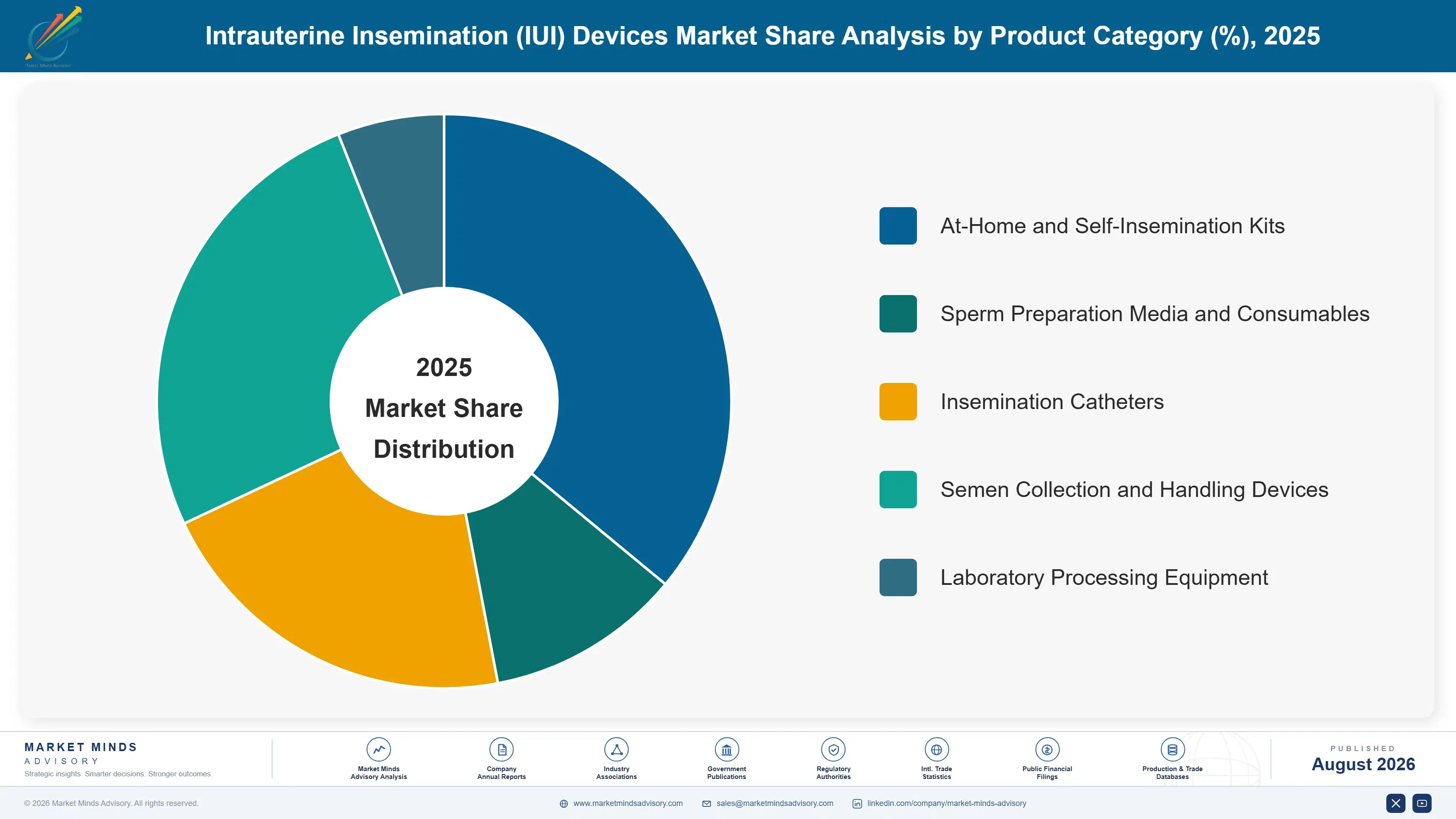
Segmentation follows product category, because each element of an insemination cycle is bought by a different person through a different channel, from a laboratory buying media to a consumer buying a kit online. Cycle type, gamete source, and clinic setting are handled in the framework and commentary rather than being treated as segments here.
intrauterine-insemination-iui-devices-market-market-share-analysis-1787297674164

At-Home and Self-Insemination Kits

Self-insemination kits grow fastest at 12.9%, exactly 1.50 times the market rate, and almost none of that growth touches a fertility clinic. A syringe, applicator or cervical cap combined with ovulation timing support sells directly to single women and same-sex couples for a small fraction of a clinical procedure. Success rates are lower because the sperm is unwashed and placement is less precise, and buyers accept that trade for privacy, cost, and the absence of any appointment. Regulatory treatment differs sharply between countries, with some classifying these as devices requiring approval and others as consumer products. Several small suppliers have withdrawn from markets where classification tightened. The channel itself is entirely outside fertility medicine.
CAGR 12.9%

Sperm Preparation Media and Consumables

Preparation media grow at 10.4%, covering the density gradients, swim-up media, and washing solutions that separate motile sperm from seminal plasma before insemination. This is the part of the cycle where laboratory quality genuinely affects outcome, and embryologists have strong preferences that procurement rarely overrides. Media are consumed on every cycle regardless of result, which makes the revenue proportional to attempts rather than to successes. Accreditation requirements increasingly specify validated media rather than laboratory-prepared solutions, which has moved volume toward commercial suppliers steadily. Embryologists rather than purchasing decide this line, which is unusual for a consumable at this price. Media revenue therefore holds where catheter revenue does not. Volume tracks attempts rather than successes.
CAGR 10.4%
Full segment breakdown across 5 segments available in the complete report.

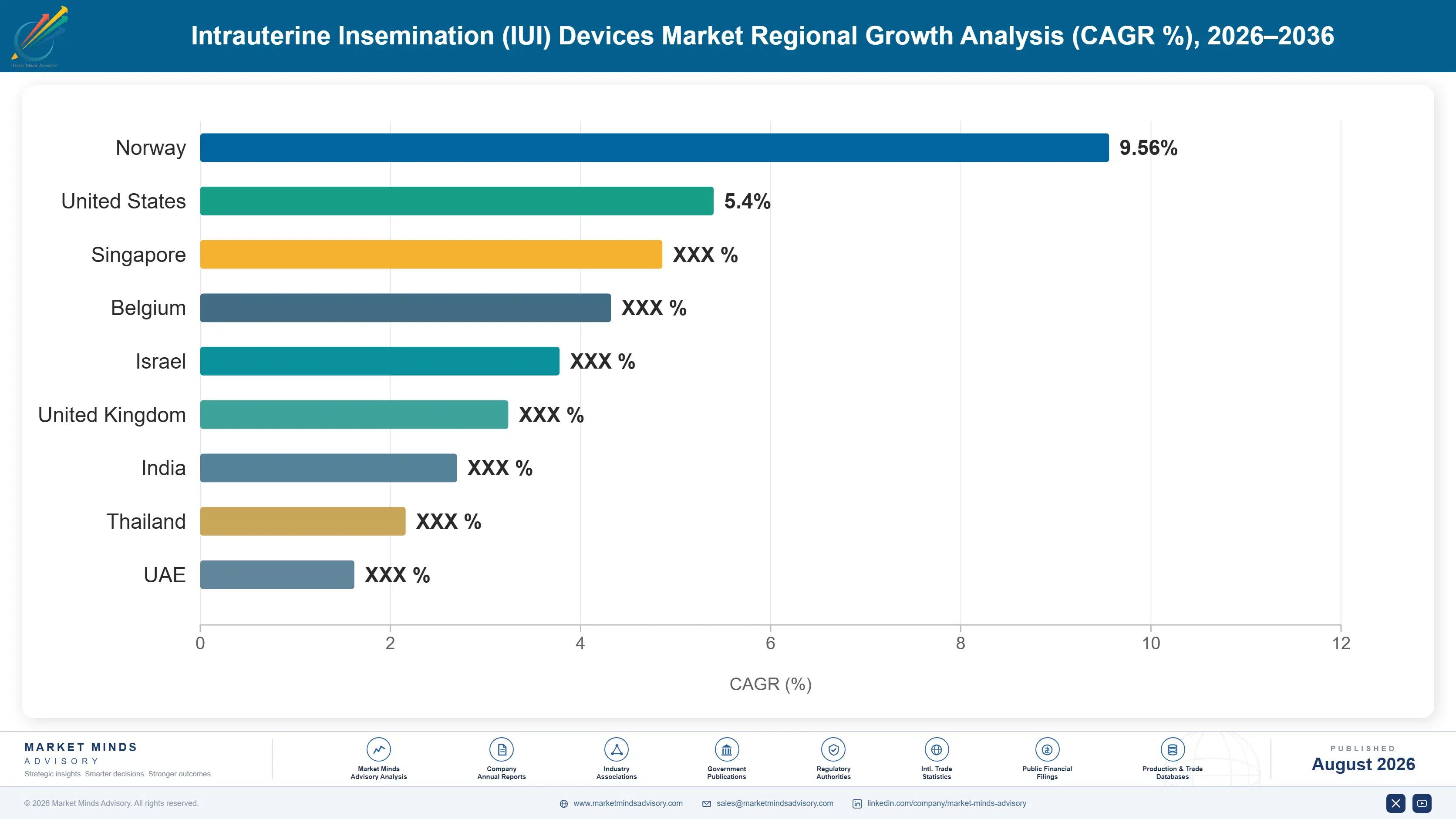
Regional Architecture and Country Demand Map

Regional shares here follow affordability far more than they follow infertility prevalence, which happens to be broadly similar almost everywhere. Insemination volume runs highest where laboratory fertilisation is out of reach, and lowest where clinics and patients can freely choose the treatment that works considerably better.

South Asia and Pacific

South Asia and Pacific holds 23% of value against a 12% ceiling in this framework, and Indian cycle volume explains the breach on its own. India operates roughly two thousand fertility clinics and performs an enormous number of insemination cycles annually, because it is the treatment most households can actually afford and social pressure around childlessness is acute. Clinic chains backed by private capital keep opening in secondary cities where no service existed. Southeast Asian and Bangladeshi volumes are growing on the same logic. Growth at 10.6% is the fastest anywhere, driven by access rather than by any clinical change. Nothing else in fertility care is affordable at this scale.
Share: 23% | CAGR: 10.6% (2026 to 2036)

East Asia

East Asia records 22% of value, and Chinese demand accounts for most of it despite a treatment landscape that pushes hard toward laboratory fertilisation. Assisted reproduction in China is tightly regulated and concentrated in licensed centres, where insemination is performed as a required first-line step before escalation rather than as a preferred endpoint. Declining birth rates have made fertility treatment a policy priority with reimbursement now extended in several provinces. Japanese and Korean volumes are smaller and similarly first-line in character. Growth at 9.4% exceeds the global rate on reimbursement widening rather than on demand appearing. Policy rather than patient preference sustains the sequence. Reimbursement is widening steadily. Licensing restricts where treatment happens.
Share: 22% | CAGR: 9.4% (2026 to 2036)
Regional intelligence for 5 additional markets available in the complete report: North America, Western Europe, Latin America, Middle East and Africa, Eastern Europe. Contact sales@marketmindsadvisory.com.
intrauterine-insemination-iui-devices-market-country-cagr-analysis-1787297674688

Where Insemination Device Money Actually Sits

Ninety-five dollars of consumables inside a treatment priced in the hundreds means procurement barely notices this category, and price competition among many small suppliers is fierce. Margin comes from reaching the embryologist rather than the buyer, from selling directly to consumers where no clinic takes a margin, and from the clinics being built rather than the ones already running.

Sell Media To The Embryologist, Not Procurement

Sperm preparation is the step where laboratory quality genuinely changes the outcome, and embryologists hold strong preferences that a purchasing department rarely overrides on a line item worth USD 95. Suppliers who reach the laboratory directly with performance data and accreditation support hold positions worth 30% to 45% more than catheter supply commands. It also makes the account harder to tender, since a hospital cannot easily switch validated media without the laboratory objecting on quality grounds. Procurement rarely overrides a laboratory objection on quality grounds. That protection is worth more than the price difference.
Market Impact: Media command 30 to 45 percent more margin

Go Direct To Consumers For Donor Conception

Around 34% of cycles now use donor sperm and a growing share of those buyers have no fertility diagnosis, no clinic relationship, and no wish to acquire either. Selling kits directly captures the entire margin that a clinic would otherwise take, at consumer price points several times the wholesale device value. It requires marketing capability, regulatory clarity by country, and a tolerance for consumer service that medical device organisations rarely have. Very few incumbents have attempted it seriously. Incumbents find the consumer service obligation genuinely uncomfortable. Very few have attempted it seriously.
Market Impact: Direct sales capture 3 times the clinical margin

Win New Clinics Before They Have A Supplier

Fertility clinic chains across India, Southeast Asia, and Latin America keep opening in cities with no existing service, and a new clinic chooses its consumables once and then reorders for years. Reaching those openings before a competitor does is a field coverage question rather than a product one, and each account is worth USD 15,000 to USD 60,000 annually in recurring consumables. Suppliers covering only established metropolitan clinics are competing for accounts that were settled years ago. Established metropolitan accounts were settled a decade ago. Reaching an opening before a competitor is purely a coverage question.
Market Impact: Accounts worth 15,000 to 60,000 dollars each year

Who Controls the Margin Pool

Concentration sits at 41% across the top five measured on insemination device revenue, which is moderate for a category where the products are inexpensive and technically undemanding to manufacture. CooperSurgical and Cook Medical lead on catheters and clinical consumables through dedicated fertility sales organisations. Vitrolife and Kitazato hold strong media and laboratory positions, and Rocket Medical supplies widely into European services. Below them new entrants keep appearing every year.
Competition currently turns on catheter softness and how easily it passes a difficult cervix, on media performance that an embryologist can observe directly at the bench, and on field coverage reaching clinics as they open. Price matters enormously in tendered public systems and considerably less where a laboratory has a stated preference. Nothing about the underlying technology separates the suppliers meaningfully.

Pressure comes from consumer channels that bypass clinics entirely and from Indian and Chinese manufacturers supplying domestic clinic networks at prices imported product cannot approach. Rankings will shift toward suppliers who reach the donor conception buyer directly, because that population is growing fastest and has no attachment to the clinical pathway these companies were built to serve.
intrauterine-insemination-iui-devices-market-company-positioning-matrix-1787297675303

Competitive Moat and Risk Dimensions

COOPERSURGICAL

Moat: Fertility portfolio breadth and channel

CooperSurgical supplies across insemination, laboratory fertilisation, and genetics through a dedicated fertility sales organisation that reaches clinics as complete accounts rather than as individual product opportunities. A clinic sourcing most of its consumable requirement from one supplier with one relationship is difficult to unpick for a category worth ninety-five dollars a cycle.
COOPERSURGICAL

Risk: Clinical channel misses consumer buyers

The entire organisation is built to sell to fertility clinics, while the fastest-growing buyer is a consumer purchasing a donor conception kit online with no clinic involved anywhere. Building consumer marketing, direct fulfilment, and country-by-country regulatory positions is a different business, and specialist entrants have moved into it considerably faster.
COOK MEDICAL

Moat: Catheter design and clinician preference

Cook's insemination catheters are widely preferred by clinicians for tip softness and passage through a difficult cervix, which is the one part of the procedure where product choice visibly affects the patient experience. Clinicians who have found a catheter that works on hard cases do not experiment, and that preference survives procurement pressure on a low-value consumable.
COOK MEDICAL

Risk: Low value limits category attention

Insemination catheters are inexpensive components inside a much larger interventional device business, which limits how much commercial and development attention the category attracts internally. Fertility-focused specialists can invest in this narrow space at levels Cook would struggle to justify, and consumer channels sit even further from its operating model.

Players Tracked

Prominent Players

CooperSurgical
Cook Medical
Vitrolife
Kitazato
Rocket Medical

Other Key Players

Gynetics Medical Products
MedGyn Products
Laboratoire CCD
FUJIFILM Irvine Scientific
Nidacon International
Cryos International
Genea Biomedx
Prince Medical
Sarstedt
Hamilton Thorne
Esco Medical
Rinovum Womens Health
Bioline Technologies
Cryo Bio System
Labotect

Recent Developments

FEBRUARY 2025

Sperm bank launched integrated at-home insemination service

A donor sperm bank launched an integrated service pairing gamete supply with an at-home insemination kit and ovulation timing support, delivered directly to customers without any clinic appointment being involved. Regulatory treatment of the combined offering differed considerably between the various markets that it entered.
Signal: The fastest-growing buyer never enters a clinic, which leaves the clinical channel entirely blind to them.
AUGUST 2024

Indian clinic chain standardised consumables across new openings

An Indian fertility chain standardised its insemination consumables across a rapid programme of secondary city openings, awarding a single supplier agreement covering both catheters and preparation media. Each new clinic had previously chosen its own products, which produced inconsistent laboratory results across the whole network.
Signal: Chain consolidation turns dozens of separate clinic decisions into a single supplier agreement genuinely worth defending.
NOVEMBER 2024

Health system mandated insemination attempts before funding IVF

A national health system reaffirmed its requirement for documented insemination attempts before laboratory fertilisation would be publicly funded at all, following a review of treatment escalation patterns. Clinics had been moving patients past insemination considerably faster than clinical criteria supported, which the funder considered avoidable expenditure.
Signal: Funders rather than clinicians are now the ones actually defending insemination as a first-line treatment step.

Polymers, Media Components, And Sterilisation

Medical grade polymers carry roughly 22% to 30% of cost of goods, principally polyurethane, polyethylene, and nylon for catheters that must be soft enough to pass a difficult cervix without stiffening in use. Media components including human serum albumin, buffers, and density gradient polymers add 26% to 34% and come from a narrow qualified supply base. Sterilisation, embryo toxicity testing, and lot release account for most of the remainder.
Human serum albumin and specialty media component pricing rose sharply through 2021 and 2022 as biopharmaceutical demand competed for the same plasma-derived and recombinant supply, and European Commission energy statistics record industrial electricity roughly doubling at the 2022 peak. Vitrolife and CooperSurgical both noted raw material and logistics cost pressure across that period. Suppliers holding annual clinic price agreements absorbed most of it rather than reopening terms.

Exposure divides by whether a supplier makes media or devices. Catheter manufacturers buy commodity polymers with wide substitution options and reasonable pricing transparency. Media producers depend on albumin and specialty components from very few qualified sources, and every batch requires embryo toxicity testing before release. That testing is slow, cannot be shortened, and makes rapid supplier substitution effectively impossible when something tightens.
intrauterine-insemination-iui-devices-market-cost-volatility-analysis-1787297675606

Qualify recombinant albumin alongside plasma-derived supply

Plasma-derived albumin availability moves with a collection system that fertility media demand cannot influence at all, and prices follow biopharmaceutical competition rather than anything in this market. Recombinant sources cost more and remove that dependency entirely. Qualification requires full embryo toxicity validation on the alternative, which has to be completed well before the shortage arrives.

Hold finished media inventory against release testing time

Embryo toxicity testing cannot be accelerated and adds weeks between manufacture and release, which means a demand spike cannot be met from current production however much capacity exists. Carrying finished inventory sized against that lag is the only practical answer. Shelf life limits how much can usefully be held, so the calculation has to be revisited as demand grows.

Standardise catheter tooling across the product range

Insemination catheters differ mainly in tip geometry and stiffness, and each variant historically carried its own tooling and validation. Common shaft and hub platforms across the range cut both tooling investment and inventory considerably. Clinician preference for specific tip designs is real and has to be preserved, which limits how far standardisation can sensibly be pushed.

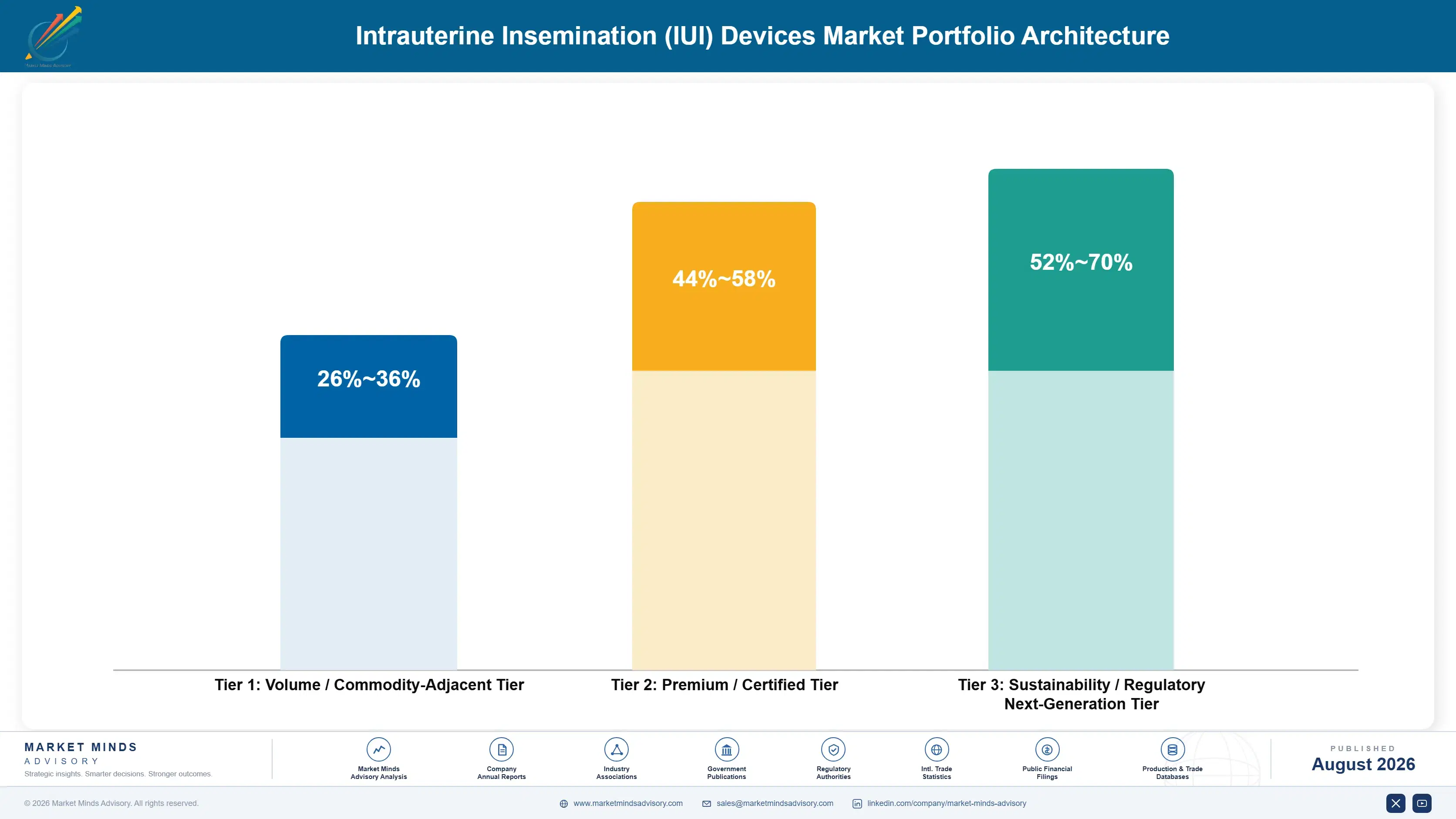
Portfolio Architecture for Margin Defence

Margin here tracks who is choosing and who is paying. A catheter selected by procurement on price inside a treatment already priced to be affordable earns very little, whatever its design merits. Media chosen by an embryologist on observable performance earns considerably more, and a kit sold directly to a consumer earns the entire chain margin because no clinic sits in between taking any of it.
The volume tension is between clinical and consumer channels that share a product category and nothing else. Clinical volume is larger, predictable, and reached through a fertility sales organisation that took years to build. Consumer volume is growing much faster, priced several times higher, and requires marketing and fulfilment capability that medical device companies do not naturally have. Building the second risks the first, since clinics notice.

High-value pools sit in three places. Preparation media where laboratory preference overrides procurement, direct consumer sales for donor conception where no clinic takes a margin, and new clinic openings across Asia and Latin America where consumable choices are being made for the first time. None of the three is won on catheter design.

Volume / Commodity-Adjacent Tier

Standard insemination catheters, collection containers, and general laboratory disposables bought on price. Many small suppliers compete directly, and the range reflects how differently imported and regionally manufactured product carry the same item.
Gross Margin: 26-36%

Premium / Certified Tier

Sperm preparation media, embryo toxicity tested consumables, and catheters carrying clinician-preferred tip designs. Laboratory preference and validation rather than manufacturing cost sustain the margin here against equivalent and considerably cheaper products.
Gross Margin: 44-58%

Sustainability / Regulatory / Next-Generation Tier

Direct-to-consumer insemination kits, bundled donor conception services, and integrated ovulation timing products. The very wide range reflects genuinely different economics between clinical consumables and consumer products sold at full retail margins.
Gross Margin: 52-70%
intrauterine-insemination-iui-devices-market-portfolio-architecture-1787297676499

High-value Sub-segments and Strategic Watch-out

Direct Consumer Insemination Kits

Growing at 12.9% and capturing the entire chain margin because no clinic sits between supplier and buyer taking a share. The population buying has no fertility diagnosis and no attachment whatever to the clinical pathway. Regulatory classification is the only real uncertainty here. Growth is real.
Gross Margin: 56-72%

Sperm Preparation Media

The one step where laboratory quality visibly changes the outcome, which gives embryologists a preference that procurement rarely overrides on a low-value line. Accreditation increasingly requires validated commercial media rather than laboratory-prepared solutions. Accreditation is steadily displacing laboratory-prepared solutions. Switching means revalidating a protocol nobody wants to disturb.
Gross Margin: 46-60%

Standard Insemination Catheters

Inexpensive, technically undemanding, and contested by many suppliers inside a treatment priced to be affordable. It is the entry point into a clinic account, which is the only compelling reason to keep competing for it at all. Abandoning it forfeits the clinic relationship entirely. Margin here is thin.
Gross Margin: 26-36%

New Clinic Account Capture

Chains opening in secondary cities across Asia and Latin America choose consumables once and reorder for years afterwards. The watch-out is that field coverage costs money in exactly the markets where each individual account is smallest. Coverage costs most where individual accounts are smallest. Timing decides it.
Gross Margin: 40-54%

What Keeps A Clinic Reordering

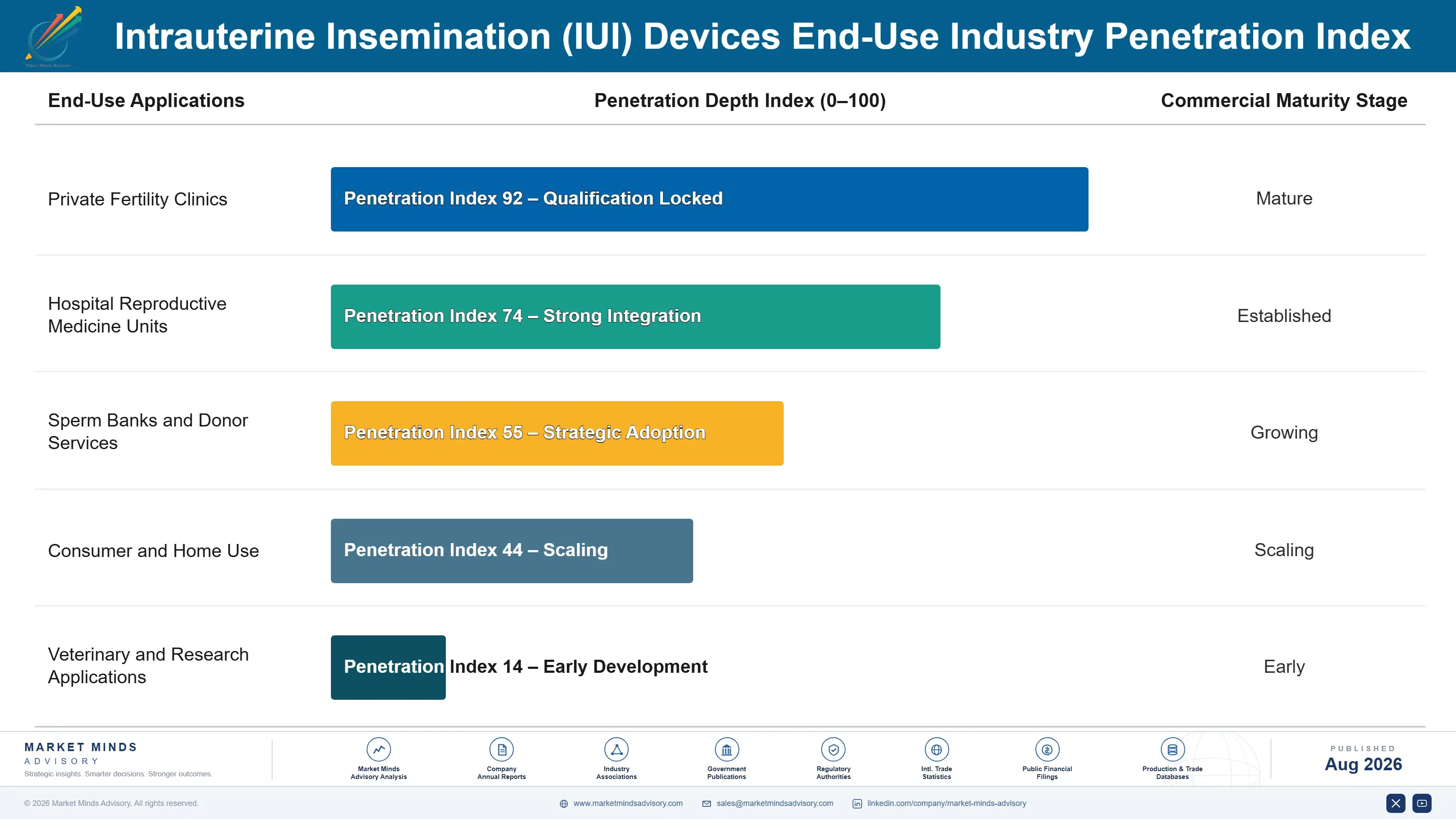
Consumable revenue here is proportional to attempts rather than to successes, which is unusual and commercially convenient. A clinic performing three cycles before escalating a patient buys three sets of everything regardless of outcome, and a failed cycle consumes exactly as much as a successful one. That makes revenue track patient volume and treatment protocol rather than clinical effectiveness, and it removes the pricing pressure that outcome-linked purchasing creates elsewhere.
Stickiness rests on the laboratory rather than on any contract. An embryologist who has validated a preparation protocol around specific media will resist changing it, because the laboratory carries responsibility for outcomes and a change means revalidating against a benchmark nobody wants to disturb. Catheters move more easily on price. Consumer buyers are the least sticky of all and switch on cost, delivery, and whatever they read most recently.

Buyer profiles have split in a way this industry has not fully absorbed. Clinical purchasing runs through procurement with embryologist influence over media specifically. Consumer purchasing is a person searching online, comparing prices, and reading reviews. The two require completely different organisations, and companies built entirely for the first are watching the faster-growing half of their category develop without them.
intrauterine-insemination-iui-devices-market-end-use-penetration-index-1787297677396

Where To Compete Here

These are among the four positions where our research anticipates prominent divergence between winners and laggards over the coming forecast period. Each is grounded in the demand model, the regulatory perimeter, and the announced capacity pipeline.
01 / CONSUMER CHANNEL ENTRY

The fastest buyer never enters a clinic

Around 34% of insemination cycles now use donor sperm, and a growing share of those buyers are single women or same-sex couples with no fertility diagnosis and no wish at all to acquire a clinical relationship. Selling those kits directly captures the whole chain margin at consumer prices several times the wholesale device value. It demands marketing, fulfilment, and country-by-country regulatory work that medical device organisations find genuinely uncomfortable, which is precisely why so few incumbents have yet attempted it.
02 / LABORATORY PREFERENCE CAPTURE

Sell media to the embryologist directly

Sperm preparation is the single step in this procedure where laboratory quality visibly changes the outcome, and embryologists hold preferences that procurement very rarely overrides on a line item worth ninety-five dollars a cycle. Suppliers reaching the laboratory directly with performance data and accreditation support hold positions worth a third to nearly half more than catheter supply ever earns. It also makes the account far harder to tender, because a hospital cannot switch validated media without the laboratory objecting on quality grounds.
03 / NEW CLINIC FIELD COVERAGE

Reach the clinic before it opens

Fertility chains across India, Southeast Asia, and Latin America keep opening in cities that previously had no service at all, and a new clinic chooses its consumables once and then reorders for years afterwards. Getting there first is purely a field coverage question rather than a product one, and each account is worth tens of thousands of dollars annually in recurring consumable supply. Suppliers covering only established metropolitan clinics are competing hard for accounts that were settled a decade ago.
04 / ESCALATION SEQUENCING DEFENCE

Support the guidelines that protect the treatment

Laboratory fertilisation succeeds around three times as often and earns a clinic roughly ten times as much, which gives every provider a commercial reason to move patients past insemination as quickly as possible. Where funders mandate documented attempts first the volume holds, and where they do not it erodes regardless of clinical appropriateness. Suppliers who support guideline bodies and funders with escalation outcome data are defending their entire market, and almost none of them treat that as a commercial activity.

Engagement Snapshot From the Field

A live engagement with an industry participant carrying material or product regulatory and market exposure ahead of a defining policy shift, showing how our research translates into a defensible multi-year portfolio strategy.
MARKET MINDS ADVISORY · CLIENT ENGAGEMENT SUMMARY
Intrauterine Insemination (IUI) Devices Producer Strategic Portfolio Review and Transition Roadmap 2026·Investment Scenario on Intrauterine Insemination (IUI) Devices Exposure Evaluation 2025-26
CLIENT PROFILE
A fertility device manufacturer with annual revenue near USD 140 million (client-reported, unverified by MMA) supplying insemination catheters and sperm preparation media to clinics across Europe and North America. Growth had been entirely flat for three consecutive years even as published fertility treatment volumes across its served markets continued rising steadily throughout the same period.
STRATEGIC CHALLENGE
Management had assumed it was losing share to competitors and responded with pricing concessions that damaged margin without recovering any volume at all. Nobody had examined whether the clinic channel itself was capturing the growth, or whether treatment volume was appearing somewhere the company had no visibility into at all.
MMA APPROACH
MMA reconstructed insemination cycle volumes by channel rather than by clinic, separating clinical procedures from donor conception performed outside fertility services. Sperm bank shipment data and consumer search behaviour were used to size the at-home segment. The client's own account base was then mapped against where new clinics had actually opened.
KEY FINDINGS
  1. Clinical cycle volumes in the client's served markets had grown far more slowly than total insemination activity, because donor conception outside clinics had absorbed most of the growth (client-reported, unverified by MMA).
  2. At-home and sperm bank direct channels accounted for a rising share of cycles in the client's two largest markets, and the client supplied none of it.
  3. The client had not opened a new clinic account in either market for two years, because almost no new fertility clinics had opened in them.
  4. Its media business held share comfortably wherever an embryologist had a clearly stated preference, and lost share consistently wherever purchasing decided alone.
CLIENT PROFILE
A fertility device manufacturer with annual revenue near USD 140 million (client-reported, unverified by MMA) supplying insemination catheters and sperm preparation media to clinics across Europe and North America. Growth had been entirely flat for three consecutive years even as published fertility treatment volumes across its served markets continued rising steadily throughout the same period.
STRATEGIC CHALLENGE
Management had assumed it was losing share to competitors and responded with pricing concessions that damaged margin without recovering any volume at all. Nobody had examined whether the clinic channel itself was capturing the growth, or whether treatment volume was appearing somewhere the company had no visibility into at all.
MMA APPROACH
MMA reconstructed insemination cycle volumes by channel rather than by clinic, separating clinical procedures from donor conception performed outside fertility services. Sperm bank shipment data and consumer search behaviour were used to size the at-home segment. The client's own account base was then mapped against where new clinics had actually opened.
KEY FINDINGS
  1. Clinical cycle volumes in the client's served markets had grown far more slowly than total insemination activity, because donor conception outside clinics had absorbed most of the growth (client-reported, unverified by MMA).
  2. At-home and sperm bank direct channels accounted for a rising share of cycles in the client's two largest markets, and the client supplied none of it.
  3. The client had not opened a new clinic account in either market for two years, because almost no new fertility clinics had opened in them.
  4. Its media business held share comfortably wherever an embryologist had a clearly stated preference, and lost share consistently wherever purchasing decided alone.
RECOMMENDED STRATEGY
Phase 1: Phase one: stop conceding price in the clinical channel, since share loss was not the cause of the flat revenue and discounting only damaged margin. Phase 2: Phase two: enter the consumer donor conception channel through sperm bank partnerships rather than by building direct retail capability from nothing. Phase 3: Phase three: redirect field coverage toward markets where new clinics are actually opening, which are not the ones currently receiving most attention.
OUTCOME
The client ended blanket price concessions and entered two sperm bank partnerships supplying kits into donor conception, reporting consumer channel revenue reaching roughly 9% of total within a year (client-reported, unverified by MMA). Field resource was reallocated toward Asian and Latin American clinic openings, and clinical margin recovered to its previous level.

Frequently Asked Questions

Foundational context covering the market sizes, CAGR, scope, country, region and competition that inform every finding below. This section is provided to cover basics and most often pre-purchase conversations, answered from the MMA Primary Research Dataset.

What is the current size of the Intrauterine Insemination (IUI) Devices Market?

The market reached USD 0.58 billion in 2025 and is forecast at USD 0.63 billion for 2026. Volumes concentrate where laboratory fertilisation is unaffordable rather than where fertility spending is highest.

How large will the Intrauterine Insemination (IUI) Devices Market be by 2036?

MMA forecasts USD 1.44 billion by 2036, an increase of USD 0.81 billion over 2026. That represents an expansion multiple of 2.28 times across the forecast period.

What is the CAGR for the Intrauterine Insemination (IUI) Devices Market 2026 to 2036?

The base case CAGR is 8.6%, with a bull case at 9.8% and a bear case at 7.4%. The bear case is insemination being skipped entirely as laboratory fertilisation costs fall.

Which segment is growing fastest?

At-home and self-insemination kits grow fastest at 12.9%, exactly 1.50 times the market rate. They sell directly to people who need donor sperm rather than a fertility diagnosis.

Who are the major companies in the Intrauterine Insemination (IUI) Devices Market?

CooperSurgical, Cook Medical, Vitrolife, Kitazato, and Rocket Medical lead the market. The top five hold roughly 41% of insemination device revenue, with many small entrants competing on inexpensive and technically undemanding products.

Which country is growing fastest?

India grows fastest at 12.4%, because insemination is the fertility treatment most households can afford and clinic chains keep opening in secondary cities. Cycle volume there is among the largest anywhere.

Report Segmentation Architecture

The full report scope spans multiple orthogonal segmentation dimensions, with cross-tabulated demand data provided for each dimension pair. Coverage extends further to regional breakdowns, trend trajectories, and the competitive detail needed to support segment-level decision-making.

By Product Category

  • At-Home and Self-Insemination Kits
  • Sperm Preparation Media and Consumables
  • Insemination Catheters
  • Semen Collection and Handling Devices
  • Laboratory Processing Equipment

By End-Use Industry

  • Private Fertility Clinics
  • Hospital Reproductive Medicine Units
  • Sperm Banks and Donor Services
  • Consumer and Home Use
  • Veterinary and Research Applications

By Commercial Dimension

  • Direct Clinic Supply
  • Clinic Chain Framework Agreements
  • Distributor and Dealer Channel
  • Direct-to-Consumer Retail
  • Sperm Bank Bundled Supply

By Region

  • South Asia and Pacific
  • East Asia
  • North America
  • Western Europe
  • Latin America
  • Middle East and Africa
  • Eastern Europe

Scope, Methodology, and Coverage

Every figure in this report is reproducible from documented input assumptions. The scope below maps the historical period, the forecast horizon, the segmentation dimensions, and the countries covered, alongside the underlying primary and qualitative methodology.
Historical Period
2020 to 2025
Forecast Period
2026 to 2036
Base Year
2025 (USD billions; MMA Primary Research Dataset, August 2026)
Market Definition
The intrauterine insemination devices market comprises products used to collect, prepare, and deliver sperm into the uterine cavity or cervical canal, valued at supplier selling prices to fertility clinics, hospital reproductive medicine units, sperm banks, distributors, and consumers. It spans insemination and intracervical catheters, sperm preparation media including density gradients and washing solutions, semen collection and transport devices, laboratory processing equipment for sperm separation and assessment, and at-home self-insemination kits with associated ovulation timing products. In-vitro fertilisation laboratory equipment, embryo culture media and transfer catheters, intracytoplasmic sperm injection consumables, cryopreservation equipment and storage services, donor gametes themselves, fertility drugs and hormonal stimulation products, and diagnostic fertility testing are excluded.
Quantitative Units
USD billions (current prices); volume in cycles supplied and kits shipped
Segmentation Dimensions
By Product Category; By End-Use Industry; By Commercial Dimension; By Region
Regions Covered
South Asia and Pacific, East Asia, North America, Western Europe, Latin America, Middle East and Africa, Eastern Europe
Countries Covered
India, Indonesia, Bangladesh, Pakistan, Vietnam, Thailand, Philippines, Australia, China, Japan, South Korea, Taiwan, USA, Canada, Mexico, Brazil, Argentina, Colombia, Chile, UK, France, Germany, Spain, Netherlands, Denmark, Sweden, Belgium, Italy, Czechia, Poland, Greece, Ukraine, Saudi Arabia, United Arab Emirates, Egypt, Nigeria, South Africa, and additional markets relevant to this sector
Key Companies Profiled
CooperSurgical, Cook Medical, Vitrolife, Kitazato, Rocket Medical, Gynetics Medical Products, MedGyn Products, Laboratoire CCD, FUJIFILM Irvine Scientific, Nidacon International, Cryos International, Genea Biomedx, Prince Medical, Sarstedt, Hamilton Thorne, Esco Medical, Rinovum Womens Health, Bioline Technologies, Cryo Bio System, Labotect
Quantitative Methodology
Primary survey, n=3,800 respondents, Q4 2025, six countries; demand-side model with trade association cross-validation
Qualitative Methodology
47 expert interviews, Q4 2025; applied to validate demand model assumptions, identify emerging dynamics, and assess competitive positioning
Report Format
PDF and XLSX data workbook (Word format preview document)
Publisher
Market Minds Advisory
Report Code
MMA-2026-MED-715
Published
August 2026
Contact
sales@marketmindsadvisory.com | www.marketmindsadvisory.com

Purchase the full Intrauterine Insemination (IUI) Devices Market Report (2026 to 2036).

The full report examines intrauterine insemination device demand across seven regions and five product categories, with particular attention to why volume concentrates where laboratory fertilisation is unaffordable rather than where fertility spending is greatest. It sizes the donor conception population buying outside clinics entirely and traces where at-home kits are displacing clinical procedures. Competitive analysis covers twenty participants assessed on insemination device revenue, including which suppliers have any route to the consumer buyer at all. Regional chapters map affordability, clinic access, and escalation practice separately.
Seven-region affordability and clinic access analysis
Five product category segmentation with growth rates
Twenty participant competitive assessment and channel positioning
Donor conception volume sizing outside clinical pathways
Escalation practice and guideline mandate comparison by country
New clinic opening pipeline and account capture assessment

Built For The People Who Decide

From boardroom strategy to bench-side execution, this report is read cover-to-cover by leaders shaping the next decade of their industry, turning demand scenarios, market dynamics and valuation benchmarks into decisions.
CXOs/ Presidents/ VPs/ Managers
M&A and Corporate Development
Strategy Teams and R&D Heads
Procurement and Product Directors
Regulatory and Compliance Leaders
Investor Relations and Equity Analysts