

Market Minds Advisory
Intraoral Scanners Market

Intraoral Scanners Market: Digital Impressions, Chairside CAD/CAM, and Clear Aligner Workflows Through 2036

Clear aligner volume keeps pulling general dentists off analog impression trays faster than orthodontic specialists alone ever could, while dental service organisations standardise scanner fleets to cut remake rates and lock in chairside CAD/CAM margin.

Lead Analyst

Alice Ballenger

Published

September 2026

Make Smarter Decisions with Customized Research Insights

Request a free sample report and evaluate market opportunities, growth trends, and competitive dynamics relevant to your business needs.

2025 MARKET VALUE$3.2BMarket Size 2025
2036 FORECAST VALUE$9.3BBase Case , 2026 to 2036
CAGR 2026 TO 203610.2 %Bull 11.5% / Bear 9.0%
INCREMENTAL OPPORTUNITY$5.8BNet 10- year value creation
EXPANSION MULTIPLE2.64x2036 value over 2026 base
Strategic Levers
M&A Pipeline
Regional Outlook
Country Rankings
Competitive Intelligence
Segmental Deep-dive
Call-Us : 91 93563 13602

Executive Snapshot and Market Trajectory

General dentists are abandoning alginate impression trays faster than orthodontic specialists ever pushed them to, mostly because clear aligner referrals now arrive pre-digitised and remakes cost real chair time. That single workflow shift is reshaping scanner purchasing across the entire dental supply chain right now.
Teledentistry-integrated scanning is pulling ahead of every other use case, growing at roughly one and a half times the market's blended rate as remote monitoring platforms let orthodontists track treatment progress between visits without bringing every patient back into the chair. East Asia now holds the largest single regional share, reflecting both China's rapidly digitising clinic base and Korea's manufacturing strength in compact chairside scanner hardware sold worldwide to general practices and specialty clinics alike.
A handful of device majors, Align Technology, Dentsply Sirona, 3Shape, Medit, and Straumann among them, still set the pace on scanner accuracy and software integration, while a longer tail of regional manufacturers compete hard on price for general-practice buyers who care more about upfront cost than sub-micron capture precision. Dental service organisation consolidation and open-versus-closed CAD/CAM platform decisions are both reshaping which platforms independent practices commit to.
Market Definition
The intraoral scanners market covers handheld optical scanning devices and their companion software used to capture digital impressions of dental and oral anatomy for restorative, orthodontic, and implant workflows. It excludes standalone dental laboratory desktop scanners not used for direct intraoral capture and excludes CAD/CAM milling and printing hardware sold separately.
Base Year Value
$3.2B in 2025 (MMA Primary Research Dataset, August 2026)
Forecast Period
2026 to 2036, eleven discrete annual values
CAGR
10.2% base case. Bull 11.5%. Bear 9.0%.
Fastest Growth Segment
Teledentistry and Remote Monitoring Integration: 15.6% CAGR
Fastest Growth Country
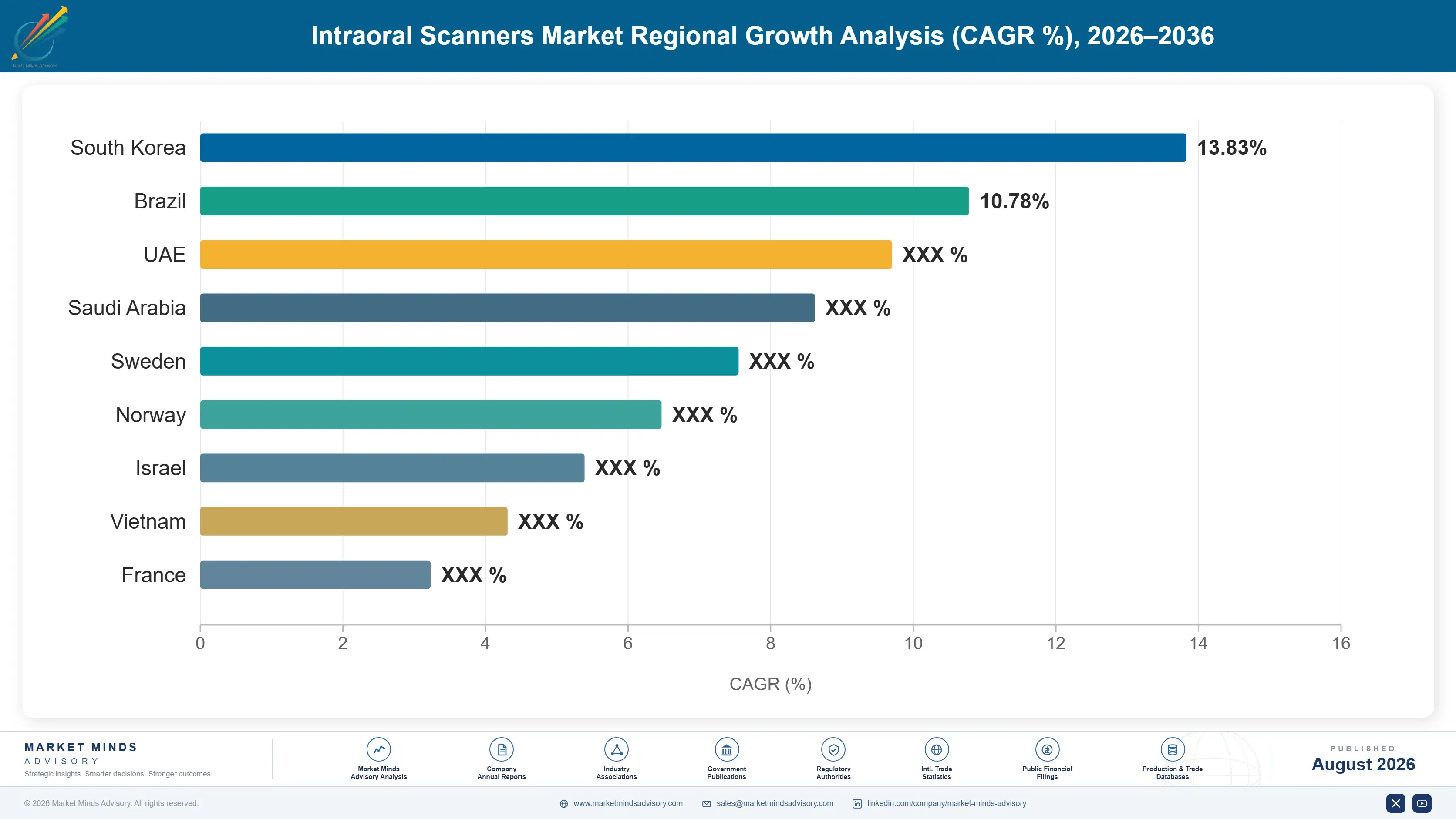
India: 13.4% CAGR
Fastest Growth Region
South Asia and Pacific: 12.2% CAGR
Largest Region
East Asia: 27% of 2025 global value
Market Leaders
Align Technology, Dentsply Sirona, 3Shape, Medit, Straumann Group. Source: MMA Analysis based on company annual reports.
Primary Survey
n=3,800 procurement and R&D decision-makers, Q4 2025, six countries
Methodology
Demand-side build-up, cross-validated against public data, 47 expert interviews

Intraoral Scanners Market Forecast Scenarios

intraoral-scanners-market-size-forecast-scenario-1787304088487
Between 2020 and 2025 the market grew through a pandemic-era dip in elective dental visits followed by a sharp rebound as clear aligner demand surged and general practices raced to digitise before losing referral volume to scanner-equipped competitors down the street. Chairside scanner penetration among United States general practices roughly doubled across that entire stretch.
The base case through 2036 rests on three mechanisms: continued clear aligner category growth pulling general dentists toward digital impressions as a referral prerequisite rather than an optional upgrade, dental service organisations standardising scanner fleets across acquired practices to cut remake costs and centralise lab relationships network-wide, and software makers bundling AI-assisted diagnostics that justify premium hardware pricing well beyond pure impression capture alone. Each mechanism reinforces the other as digital workflows become the default rather than the exception.
A bull scenario turns on faster reimbursement recognition for digital impression codes across more national insurance systems, pulling adoption forward among still-analog general practices that have resisted the upfront capital cost so far. The bear case is scanner commoditisation from low-cost Asian manufacturers compressing hardware margins faster than software and AI features can offset the decline.

Where Hardware Commoditisation Meets Software-Led Differentiation

Intraoral scanning sits at the intersection of dental hardware, CAD/CAM software, and clinical workflow redesign, three commercial layers that used to be sold and priced entirely separately from one another. That convergence is now the defining feature of the category, since a single unit sale increasingly comes bundled with a recurring software subscription and a lab-integration relationship the hardware alone never used to carry.
MARKET CONCENTRATIONCR5 48%top five manufacturers hold just under half combined share
AVERAGE SELLING PRICE$10,400 per unitblended price spanning entry-level and premium chairside hardware units
TOP PRODUCING COUNTRYSouth Korea, 22% shareleads global scanner hardware manufacturing and component assembly
CAPACITY UTILISATION79%manufacturers running comfortably below peak available assembly throughput
TRADE INTENSITY46% cross-bordershare of finished scanner units shipped across national borders
FEEDSTOCK COST SHARE38% of COGSoptical and imaging components within total unit production cost
Entry-level scanners aimed at general practices compete mostly on upfront price and ease of learning, while premium platforms serving orthodontic and implant specialists compete on accuracy, open-file compatibility, and integration depth with existing lab and aligner platforms built over years of clinical relationships and referral trust. Align Technology's closed-loop iTero and clear aligner bundle behaves less like hardware retail and more like a subscription business built around recurring case volume rather than one-time unit sales, a distinction that matters enormously for investor valuation models and long-term margin forecasting.
Over the next decade, falling component costs from Asian optics manufacturers, AI-assisted diagnostic feature bundling, and tightening open-versus-closed platform competition will keep reshaping who captures margin at each layer of this increasingly software-driven category.
"Everyone still calls this a scanner market, but the winners are increasingly running a software and case-volume business that happens to require a camera in a dentist's hand."
Director, Dental Technology and Digital Workflow Practice · MMA Medical Devices

Market Trends

Clear Aligner Referrals Push General Practices to Scan In-House

Clear aligner platforms now require a digital impression as the default intake step, and general dentists referring patients into aligner programs increasingly need in-house scanning capability just to participate in the referral pipeline at all. Roughly 61% of United States general practices reported owning at least one intraoral scanner in 2025, up from under 35% five years earlier, largely driven by this referral pressure rather than restorative case economics alone. Scanner makers are responding by bundling aligner-brand-specific software modules directly into their platforms, since compatibility with a specific aligner platform increasingly decides which hardware a practice buys first.
Market Impact: 24% rise in aligner starts tracked

DSO Consolidation Drives Fleet-Wide Scanner Standardisation

Dental service organisations acquiring independent practices are standardising scanner fleets across their networks to centralise lab relationships and cut remake rates that vary wildly between individual dentists' manual technique and experience level. Large DSO networks report remake rate reductions of roughly 40% after fleet-wide scanner standardisation compared with the mixed analog-digital practices they originally acquired. The shift favours manufacturers able to negotiate enterprise-wide contracts over those selling practice-by-practice, since a single DSO procurement decision can now determine hardware standards across hundreds of individual clinic locations at once, reshaping the entire sales motion for the category.
Market Impact: Saves roughly $340 per case

Market Opportunities and Growth Drivers

Rising Clear Aligner Case Volume Requires Digital Intake

Clear aligner case volume keeps climbing across nearly every major market tracked, and each new case requires an accurate digital impression before treatment planning can begin at all. Aligner starts across the MMA-tracked practice sample rose roughly 24% since 2022, a pace orthodontic and general dental associations expect to continue as consumer awareness and financing options both expand steadily. Every incremental aligner case effectively requires scanner access somewhere in the referral chain, whether owned directly by the treating dentist or accessed through a referral partner practice down the street nearby.
Market Impact: Cuts entry-level pricing by 25-30%

Digital Workflows Cut Remake and Material Costs

Digital impressions eliminate the material cost, patient discomfort, and remake risk associated with traditional alginate and PVS trays, and practices switching to scanners report meaningfully fewer chairside remakes tied to distorted or incomplete manual impressions taken under time pressure. Practice management data shows digital workflows save an estimated $340 per case in reduced remake and lab communication costs versus comparable analog workflows, a figure practice owners increasingly cite directly when justifying scanner capital purchases to their accountants and equipment lenders during financing conversations each and every annual budget cycle review meeting.
Market Impact: Cited by roughly 30% of practices

Market Restraints and Challenges

Optical Component Commoditisation Compresses Hardware Margins

Entry-level scanner pricing has fallen sharply as Chinese and other Asian manufacturers scale production, compressing the margin premium that established Western and Korean brands could previously command on hardware alone in nearly every market segment. The root cause is optical component commoditisation, since the core imaging sensors and structured-light modules are now sourced from a shared, competitive supplier base rather than proprietary in-house manufacturing built up over years. Established brands are responding by shifting revenue emphasis toward software subscriptions and AI diagnostic add-ons that low-cost hardware challengers have not yet matched or replicated at scale.
Market Impact: 61% of US practices scan

Closed Platform Lock-In Frustrates Practice Buyers

Closed-platform scanners that restrict file export to a single manufacturer's lab or aligner partner create real switching costs for practices, but they also generate growing dentist frustration as labs and specialists increasingly demand open, interoperable file formats. Roughly 30% of general practices surveyed by MMA cited platform lock-in as a factor in scanner dissatisfaction, a friction point vendors are addressing unevenly. Manufacturers are responding with tiered software licensing that enables open export at a premium price point, partially resolving the tension without fully abandoning the recurring revenue closed platforms generate.
Market Impact: Cuts remake rates by roughly 40%
3 additional market trends, 2 additional growth drivers, and 4 additional restraints and challenges are covered in the full report. Contact sales@marketmindsadvisory.com to access the complete intelligence.

Segment CAGR and Growth Architecture

Segmentation follows clinical application, the dimension practices and specialists themselves use to justify purchase, since orthodontic, restorative, implant, and laboratory workflows each demand distinct accuracy thresholds, software integrations, and file compatibility standards that a single scanner rarely satisfies equally well across every clinical use case a practice actually encounters day to day in real life.
intraoral-scanners-market-market-share-analysis-1787304089018

Teledentistry and Remote Monitoring Integration

Teledentistry and remote monitoring integration is the smallest product category today but growing fastest as orthodontic practices adopt platforms that let patients self-scan progress images between in-office visits using consumer-grade attachments or dedicated home devices. This reduces chair time per case while letting orthodontists intervene earlier when treatment drifts off plan, a genuine clinical and commercial win that practices are willing to pay a premium subscription to access. Growth concentrates among larger orthodontic groups with the case volume to justify platform investment, while solo practitioners remain slower to adopt given the added software complexity and patient education burden involved in rolling out remote monitoring correctly across an entire patient roster.
CAGR 15.6%

Orthodontic Clear Aligner Impressions

Orthodontic clear aligner impression scanning is the second-fastest category, propelled directly by clear aligner category growth and the referral requirement it now places on general dentistry practices nationwide. Scanners serving this segment must integrate tightly with specific aligner manufacturers' treatment planning software, creating a genuine switching cost once a practice commits to a particular aligner brand and its compatible hardware platform. Purchasing decisions increasingly happen at the moment a practice signs an aligner provider agreement rather than as a standalone equipment decision, giving aligner companies meaningful influence over which scanner brands succeed in this specific channel, and forcing hardware makers to court aligner partnerships directly rather than selling to dentists alone.
CAGR 13.8%
Full segment breakdown across 6 segments available in the complete report.

Regional Architecture and Country Demand Map

East Asia holds the largest single share, reflecting Korea's scanner manufacturing base and China's rapidly digitising clinic network. South Asia and the Pacific is growing fastest as dental infrastructure and financing access expand from a comparatively small installed base across the region's many emerging markets today.

North America

United States general practices carry the highest scanner penetration per dentist globally, driven by clear aligner referral pressure and dental service organisation consolidation that standardises fleet purchasing across hundreds of acquired clinics at once. Reimbursement recognition for digital impression codes has expanded steadily since 2023, though coverage still varies meaningfully by state and individual insurer, leaving some practices to absorb the capital cost without direct reimbursement offset. Canadian provincial dental associations trail US adoption by several years, largely due to slower private insurance recognition of digital workflow billing codes across provincial plans. Solo and small-group practices remain the last meaningful pocket of analog holdouts across the region, constrained mainly by upfront capital cost rather than clinical scepticism about scanner accuracy.
Share: 26% | CAGR: 10.7% (2026 to 2036)

Western Europe

German and Scandinavian dental associations were early adopters of digital impression standards, publishing much of the clinical accuracy data other regions now cite when justifying national reimbursement decisions before their own local trial data existed. United Kingdom National Health Service dental contracts still favour traditional impression billing in many cases, slowing private-practice scanner adoption relative to fully private continental European markets nearby. French and Italian dental laboratories have invested heavily in digital receiving infrastructure, pulling practice-side scanner adoption forward faster than reimbursement policy alone would otherwise support. Premium platform makers concentrate marketing spend here given the region's high average practice revenue per dentist relative to most emerging markets tracked worldwide.
Share: 20% | CAGR: 8.7% (2026 to 2036)
Regional intelligence for 5 additional markets available in the complete report: East Asia, South Asia and Pacific, Latin America, Middle East and Africa, Eastern Europe. Contact sales@marketmindsadvisory.com.
intraoral-scanners-market-country-cagr-analysis-1787304089534

Where Scanner Margin Actually Concentrates

Margin in intraoral scanning concentrates wherever a manufacturer can attach recurring software revenue and platform lock-in to its hardware, not wherever unit volume is largest. Four commercial moves separate makers capturing durable subscription margin from those still competing on one-time hardware price alone against increasingly capable low-cost challengers entering every single market price tier.

Bundling AI Diagnostics Into Recurring Subscriptions

Manufacturers that bundle AI-assisted diagnostic features, caries detection, occlusion analysis, and treatment simulation, into a recurring software subscription build a revenue stream that survives well beyond the initial hardware sale and resists the price erosion hitting commodity scanner bodies. Platforms with mature AI diagnostic suites command subscription attachment rates roughly 45% higher than those offering hardware alone, since practices increasingly view the software layer as the actual clinical differentiator rather than the camera itself. That attachment rate compounds over a scanner's multi-year service life into a meaningfully larger total contract value than the unit price alone would suggest.
Market Impact: Lifts subscription attachment rate

Securing Preferred Clear Aligner Brand Integration

Securing exclusive or preferred integration agreements with major clear aligner brands gives a scanner maker a durable referral channel that competitors cannot easily replicate without a comparable partnership of their own. Manufacturers with aligner-brand integration report new-practice acquisition costs roughly 30% lower than those relying purely on direct sales outreach, since the aligner brand's own sales force effectively pre-sells compatible hardware during onboarding conversations with new practices. This channel advantage becomes self-reinforcing as more practices standardise on the combination, further raising switching costs for any practice considering a change down the road.
Market Impact: Cuts new-practice acquisition cost

Negotiating Enterprise-Wide DSO Fleet Supply Contracts

Negotiating enterprise-wide contracts directly with dental service organisations, rather than selling practice by practice through a slow individual sales process, converts a slow, fragmented sales cycle into a single decision that can place hardware across hundreds of clinics at once. DSO enterprise deals typically carry unit pricing roughly 20% below individual-practice retail, but the volume and multi-year software attachment more than compensate for the discount, and the relationship gives manufacturers privileged access to future acquisition targets the DSO eventually folds into its growing network over time as consolidation continues steadily across the wider sector.
Market Impact: Trades a 20% unit discount for DSO

Expanding Certified Dental Laboratory Integration Networks

Expanding dental laboratory integration partnerships, ensuring scanner file output works smoothly with the labs a practice already uses, removes a real adoption barrier that otherwise requires a practice to switch labs alongside switching scanners entirely. Manufacturers with broad, certified lab network compatibility report meaningfully faster new-customer onboarding than those requiring a practice to also change its laboratory relationship at the same time as switching hardware, cutting the effective sales cycle by roughly 35% in markets where lab switching carries real clinical and logistical friction for the practice involved in the entire transition process.
Market Impact: Cuts the onboarding sales cycle by

Who Controls the Margin Pool

Concentration sits moderate at CR5 48%, evaluated on global scanner unit and software revenue combined, the basis that best captures scale across hardware-only challengers and software-integrated incumbents alike. Align Technology and Dentsply Sirona lead on installed base and platform depth respectively, while the gap down to Medit and other fast-growing Asian challengers is narrower than the headline CR5 figure suggests.
Competitive activity now runs across three fronts simultaneously. Premium incumbents compete on AI diagnostic depth and aligner-brand integration, since that combination increasingly decides which hardware a practice standardises on for years. Entry-level Asian manufacturers compete mainly on price and component quality, undercutting Western incumbents on hardware alone. A third front has opened around DSO enterprise contracts, as manufacturers increasingly compete for network-wide standardisation deals that determine hardware share across hundreds of clinics in a single negotiation.

Emerging pressure is coming from Chinese manufacturers scaling optical component quality fast enough to threaten the premium tier, not just the entry-level segment they originally targeted. Rankings could shift meaningfully if any low-cost challenger builds a credible AI diagnostic software layer, since that would remove the last major differentiator premium incumbents currently hold over hardware-only competitors.
intraoral-scanners-market-company-positioning-matrix-1787304090063

Competitive Moat and Risk Dimensions

ALIGN TECHNOLOGY

Moat: Closed Aligner-Scanner Platform Lock-In

Align's iTero scanner integrates tightly with its own Invisalign clear aligner platform, creating a closed-loop referral and treatment planning platform that competitors without a comparable aligner brand cannot replicate. That integration depth anchors Align's premium pricing and drives repeat scanner purchasing across its franchise network.
ALIGN TECHNOLOGY

Risk: Regulatory and Antitrust Scrutiny Risk

Align's closed platform has drawn periodic regulatory and competitor scrutiny over interoperability practices in several markets over recent years. Any enforced move toward open file compatibility would erode the switching-cost advantage that currently protects its premium pricing from lower-cost, open-platform challengers entering this specific category quickly.
DENTSPLY SIRONA

Moat: Restorative and Lab Network Depth

Dentsply Sirona's decades-long relationships across restorative dentistry, CAD/CAM milling, and dental laboratory networks give it integration depth beyond scanning alone that newer entrants cannot replicate quickly, anchoring its position across the broader restorative workflow that competitors serve only in part rather than end to end.
DENTSPLY SIRONA

Risk: Slower Software Innovation Cadence

Dentsply Sirona's software update cadence has lagged nimbler competitors like Medit in recent years, risking gradual share loss among practices that increasingly prioritise AI diagnostic features and frequent software improvements over broad legacy product breadth built up gradually over decades of prior acquisitions and integrations.

Players Tracked

Prominent Players

Align Technology Inc.
Dentsply Sirona Inc.
3Shape A/S
Medit Corp.
Straumann Group

Other Key Players

Carestream Dental LLC
Planmeca Oy
Envista Holdings Corporation
Shining 3D Tech Co., Ltd.
Dental Wings Inc.
GC Corporation
Vatech Co., Ltd.
Runyes Medical Instrument Co., Ltd.
Condor Digital
Zirkonzahn GmbH
Amann Girrbach AG
Ivoclar Vivadent AG
Midmark Corporation
Ray Co., Ltd.
DOF Inc.

Recent Developments

APRIL 2025

Medit Launches AI-Enabled Caries Detection Scanner

Medit launched a next-generation intraoral scanner with integrated AI-based caries detection built directly into its capture software, aiming to close the diagnostic feature gap with premium Western competitors. The launch was an organic product introduction rather than an acquisition, reflecting continued internal investment in software differentiation.
Signal: AI diagnostic features are becoming a comp
AUGUST 2025

Align Technology Signs DSO Network Supply Agreement

Align Technology signed a multi-year supply agreement with a large dental service organisation network to deploy iTero scanners across its acquired practice portfolio. The agreement is a commercial supply contract rather than a joint venture or acquisition, securing enterprise-wide hardware standardisation ahead of anticipated network expansion.
Signal: DSO enterprise contracts are increasingly
DECEMBER 2025

Straumann Group Acquires Digital Workflow Software Developer

Straumann Group acquired a digital dentistry software developer to expand its CAD/CAM workflow portfolio beyond its existing implant and restorative hardware lines into adjacent software territory. The transaction was structured as a full acquisition rather than a licensing arrangement or minority equity stake of any kind.
Signal: Implant and restorative incumbents are acq

Optical Component and Compute Exposure

Optical and imaging components, structured-light projectors, CMOS sensors, and precision optics assemblies, account for roughly 38% of total unit production cost, sourced mainly from specialty component manufacturers in South Korea, Japan, and Taiwan who supply the bulk of the industry's qualified volume. Software development and AI model training add a growing second cost layer that scales with feature complexity rather than unit count.
Medit Corp.'s 2024 annual report cited elevated component costs for precision optical assemblies as a meaningful drag on hardware margins, tracing much of it to semiconductor and specialty optics supply disruptions that lingered from 2022 into 2023. Component prices rose double digits at the peak of that disruption before partially easing through 2024, and several manufacturers reported extending supplier qualification to additional optics producers to reduce single-source dependency going forward into 2025.

Smaller regional manufacturers without diversified optics sourcing absorb these cost swings directly, a disadvantage that compounds for challengers concentrated in a single country's component supply base. Established majors with diversified, multi-region sourcing can smooth these swings across a broader supplier base, while premium AI-feature makers carry the added exposure of sourcing both specialty optics and compute infrastructure for model training simultaneously.
intraoral-scanners-market-cost-volatility-analysis-1787304090266

Qualifying Multiple Optics Suppliers Across Regions

Extending supplier qualification to additional precision optics producers across South Korea, Japan, and Taiwan reduces reliance on any single supplier's capacity or pricing power. Several manufacturers accelerated this diversification after 2022's disruption exposed how concentrated their sourcing had become across too few qualified vendors regionally, adding redundancy across multiple countries and several newly qualified sources.

Long-Term Component Supply Contracts

Locking in multi-year supply agreements with sensor and optics manufacturers protects production schedules from shortages that periodically affect the broader semiconductor and precision imaging supply chain and its many contract manufacturers. This approach requires forecasting demand further out than manufacturers traditionally have, but it has paid off reliably during past shortage episodes across the wider industry.

Vertical Integration Into Optics Assembly

Owning precision optics assembly rather than outsourcing it reduces exposure to supplier pricing swings and gives manufacturers priority access during periods of tight component capacity across the sector. The approach requires significant capital but has paid off for majors that invested early, insulating margins better than pure integrators eventually managed to achieve across comparable product lines.

Portfolio Architecture for Margin Defence

Three margin tiers coexist within this single hardware category. Volume-grade entry-level scanners sold to price-sensitive general practices run thin margins set largely by component cost and direct competition among many Asian manufacturers competing almost entirely on price. Certified mid-tier platforms with lab integration sit meaningfully higher, while premium AI-enabled platforms with aligner-brand integration command the richest margin of the three because software depth and platform lock-
The volume-versus-premium tension shows up clearly in capital allocation. Manufacturers that keep reinvesting in entry-level hardware capacity are chasing a shrinking margin pool relative to those redirecting capital toward AI software and platform integration, even though entry-level hardware still generates the larger absolute unit volume for most companies today. Boards increasingly favour the specialty software side when allocating the next dollar of capital investment, despite its smaller current revenue base.

High-value margin pools concentrate specifically in AI-diagnostic-enabled platforms with aligner-brand integration and in DSO enterprise contracts carrying multi-year software attachment. Everything else in the portfolio behaves closer to a commodity electronics product than a differentiated medical device, priced on component cost rather than clinical performance.

Volume / Commodity-Adjacent Tier

Entry-level scanners sold to price-sensitive general practices, priced largely on component cost and hardware specification rather than software depth or platform integration, with thin room to compete on anything else meaningfully.
Gross Margin: 24-30%

Premium / Certified Tier

Mid-tier platforms with certified dental laboratory integration and standard diagnostic software, sold at a real, defensible premium over unbranded entry-level alternatives across most major markets studied in this report today.
Gross Margin: 36-44%

Sustainability / Regulatory / Next-Generation Tier

AI-enabled platforms with aligner-brand integration and outcomes documentation, requiring sustained software investment that thins the competitive field sharply and protects incumbent pricing for years at a stretch each product cycle.
Gross Margin: 46-56%
intraoral-scanners-market-portfolio-architecture-1787304090762

Platform-Driven Practice Loyalty

Intraoral scanners are not a subscription business by default, but platform-integrated platforms increasingly behave like one. Once a practice standardises on a specific scanner tied to its preferred aligner brand or laboratory network, switching costs run high enough that repeat purchasing continues for years without a full vendor re-evaluation each cycle.
Adoption depth varies sharply by practice type. Orthodontic and DSO-affiliated practices, once integrated with a specific platform, rarely switch unless quality or referral support genuinely slips, since retraining staff and re-establishing lab relationships carries real disruption cost. Solo general practices without aligner-brand ties behave completely differently, re-tendering on price far more readily since no comparable platform lock-in constrains their choice. Software attachment depth increasingly separates sticky accounts from price-sensitive ones across most markets tracked.

A generational shift is underway in who specifies scanner purchases. Decisions once made almost entirely by practice owners chasing lowest upfront hardware cost are increasingly shaped by younger associate dentists and DSO clinical directors who weight software capability and workflow integration well above unit price alone. That shift favours manufacturers who invested early in AI diagnostics over those still competing purely on hardware specification.
intraoral-scanners-market-end-use-penetration-index-1787304091255

Where Scanner Margin Concentrates

These are among the four positions where our research anticipates prominent divergence between winners and laggards over the coming forecast period. Each is grounded in the demand model, the regulatory perimeter, and the announced capacity pipeline.
01 / SOFTWARE INVESTMENT PRIORITY

Prioritise AI diagnostic software over entry-level hardware expansion.

Clear aligner referral pressure is pushing practices toward platform-integrated platforms faster than commodity hardware makers can realistically catch up on software depth, which means investment made today captures demand that entry-level scanners cannot reach at comparable margin. Manufacturers that keep expanding entry-level capacity are chasing a shrinking margin pool relative to those building AI diagnostics and platform integration instead. Software attachment itself functions as a moat, since a rival cannot simply undercut hardware price once a practice has already standardised on a specific platform's workflow.
02 / ALIGNER PARTNERSHIP STRATEGY

Secure aligner-brand integration agreements before competitors lock in exclusivity.

Winning general-practice referral volume increasingly requires tight integration with a major clear aligner brand's treatment planning software, not just strong scanner accuracy on its own merits or optical engineering quality alone. Manufacturers that secure these partnerships early build a durable referral channel advantage that outlasts any single product cycle or short-term price competition from hardware-only challengers entering the category. Waiting too long cedes the richest referral channel in the category to whichever competitor locks in the partnership first with the largest aligner brands.
03 / REGIONAL MARKET ENTRY

Enter East Asian and South Asian markets ahead of infrastructure build-out.

East Asia already leads on manufacturing scale and clinic digitisation, and South Asia and the Pacific is growing fastest as dental infrastructure and financing access expand from a comparatively small installed base across the wider region today. Manufacturers without local distributor relationships risk missing multi-year fleet contracts already being awarded to early movers with established local presence and physician trust built over years. Establishing regional service and training capability now positions a manufacturer well ahead of the next wave of digital dentistry build-out across these fast-growing markets.
04 / DSO CHANNEL STRATEGY

Build enterprise DSO sales capability before consolidation accelerates further.

Dental service organisations are consolidating independent practices fast enough that a single procurement decision can now determine hardware standards across hundreds of clinics at once, and manufacturers without enterprise sales capability are locked out of these deals entirely before negotiations even begin. Building that capability early, rather than reacting once a competitor has already secured the relationship, positions a manufacturer to capture disproportionate share as consolidation continues. This channel will only grow more decisive as DSO networks keep expanding their acquired practice footprint each year.

Engagement Snapshot From the Field

A live engagement with an industry participant carrying material or product regulatory and market exposure ahead of a defining policy shift, showing how our research translates into a defensible multi-year portfolio strategy.
MARKET MINDS ADVISORY · CLIENT ENGAGEMENT SUMMARY
Intraoral Scanners Producer Strategic Portfolio Review and Transition Roadmap 2026·Investment Scenario on Intraoral Scanners Exposure Evaluation 2025-26
CLIENT PROFILE
The client is a fourteen-clinic dental service organisation operating across three midwestern United States metro areas, serving a mixed general and orthodontic patient base. The organisation reported annual equipment and supply spend of approximately $18 million (client-reported, unverified by MMA) and was evaluating whether to standardise on a single scanner platform across all fourteen acquired practices rather than the fragmented multi-vendor equipment inherited through acquisition.
STRATEGIC CHALLENGE
The organisation's fourteen clinics ran four different scanner brands inherited from acquired practices, creating inconsistent staff training, duplicated software licensing costs, and inconsistent lab file compatibility that made centralised lab negotiation and remake tracking nearly impossible to manage accurately, weakening its position in annual vendor contract renegotiations across the entire network.
MMA APPROACH
MMA benchmarked the four incumbent scanner brands on software capability, lab network compatibility, and total cost per clinic across all fourteen locations. The engagement combined vendor interviews with clinic-level procurement data analysis to model the total cost and clinical impact of standardising on a single platform organisation-wide across the entire practice network.
KEY FINDINGS
  1. One vendor's integrated lab network compatibility cut remake-related communication delays by roughly 38% versus the organisation's current blended average total delay today.
  2. Standardising on a single platform would reduce annual software licensing costs by an estimated $410,000 across all fourteen clinics combined each fiscal year.
  3. Two incumbent vendors lacked sufficient regional service coverage to reliably support all fourteen locations without meaningful response delay during peak seasonal demand.
  4. Bundled enterprise procurement could lower blended per-unit hardware cost by roughly 17% organisation-wide within the first full fiscal year of active operation.
CLIENT PROFILE
The client is a fourteen-clinic dental service organisation operating across three midwestern United States metro areas, serving a mixed general and orthodontic patient base. The organisation reported annual equipment and supply spend of approximately $18 million (client-reported, unverified by MMA) and was evaluating whether to standardise on a single scanner platform across all fourteen acquired practices rather than the fragmented multi-vendor equipment inherited through acquisition.
STRATEGIC CHALLENGE
The organisation's fourteen clinics ran four different scanner brands inherited from acquired practices, creating inconsistent staff training, duplicated software licensing costs, and inconsistent lab file compatibility that made centralised lab negotiation and remake tracking nearly impossible to manage accurately, weakening its position in annual vendor contract renegotiations across the entire network.
MMA APPROACH
MMA benchmarked the four incumbent scanner brands on software capability, lab network compatibility, and total cost per clinic across all fourteen locations. The engagement combined vendor interviews with clinic-level procurement data analysis to model the total cost and clinical impact of standardising on a single platform organisation-wide across the entire practice network.
KEY FINDINGS
  1. One vendor's integrated lab network compatibility cut remake-related communication delays by roughly 38% versus the organisation's current blended average total delay today.
  2. Standardising on a single platform would reduce annual software licensing costs by an estimated $410,000 across all fourteen clinics combined each fiscal year.
  3. Two incumbent vendors lacked sufficient regional service coverage to reliably support all fourteen locations without meaningful response delay during peak seasonal demand.
  4. Bundled enterprise procurement could lower blended per-unit hardware cost by roughly 17% organisation-wide within the first full fiscal year of active operation.
RECOMMENDED STRATEGY
Phase 1: Phase 1 (Months 1 to 2): Finalise vendor selection and negotiate an organisation-wide multi-year enterprise supply agreement with pricing terms. Phase 2: Phase 2 (Months 3 to 7): Roll out standardised hardware and staff training across all fourteen clinics in staged regional waves. Phase 3: Phase 3 (Months 8 to 11): Consolidate lab relationships and renegotiate vendor software licensing using the unified organisation-wide data sets.
OUTCOME
The organisation completed platform standardisation across twelve of fourteen clinics within eleven months and reported a 15% reduction in blended equipment and licensing cost per clinic (client-reported, unverified by MMA), alongside meaningfully faster remake resolution times organisation-wide following the switch to a single integrated platform.

Frequently Asked Questions

Foundational context covering the market sizes, CAGR, scope, country, region and competition that inform every finding below. This section is provided to cover basics and most often pre-purchase conversations, answered from the MMA Primary Research Dataset.

What is the current size of the Intraoral Scanners Market?

The global intraoral scanners market was valued at approximately $3.2 billion in 2025. This spans entry-level, mid-tier, and premium AI-enabled scanning platforms sold across dental practices worldwide.

How large will the Intraoral Scanners Market be by 2036?

The market is projected to reach approximately $9.32 billion by 2036. Growth is led by teledentistry-integrated and clear aligner scanning formats rather than entry-level hardware alone.

What is the CAGR for the Intraoral Scanners Market 2026 to 2036?

The market is expected to grow at a compound annual growth rate of 10.2% across the forecast period. Bull and bear scenarios range from roughly 9.0% to 11.5% depending on component pricing trends.

Which segment is growing fastest?

Teledentistry and remote monitoring integration is the fastest-growing segment, expanding at roughly one and a half times the market's blended rate. Orthodontic clear aligner impressions follow as the second-fastest segment.

Who are the major companies in the Intraoral Scanners Market?

Leading participants include Align Technology, Dentsply Sirona, 3Shape, Medit, and Straumann Group. Assessments are based on global scanner unit and software revenue combined across every product tier.

Which country is growing fastest?

India is the fastest-growing country tracked, driven by rising clear aligner demand and rapid private dental sector expansion. Its growth rate sits well above the region's already elevated average.

Report Segmentation Architecture

The full report scope spans multiple orthogonal segmentation dimensions, with cross-tabulated demand data provided for each dimension pair. Coverage extends further to regional breakdowns, trend trajectories, and the competitive detail needed to support segment-level decision-making.

By Product Tier

  • Entry-Level General Practice Scanners
  • Mid-Tier Lab-Integrated Platforms
  • Premium AI-Enabled Diagnostic Platforms
  • Aligner-Brand Integrated Systems
  • Enterprise DSO Fleet Hardware
  • Teledentistry and Remote Monitoring Devices

By End-Use Setting

  • General Dental Practices
  • Orthodontic Specialty Clinics
  • Implantology and Oral Surgery Centres
  • Dental Laboratories
  • Dental Service Organisation Networks

By Commercial Dimension

  • Direct Practice Sales Channels
  • Dental Service Organisation Enterprise Contracts
  • Aligner Brand Referral Partnerships
  • Distributor and Reseller Networks

By Region

  • North America
  • Western Europe
  • East Asia
  • South Asia and Pacific
  • Latin America
  • Middle East and Africa
  • Eastern Europe

Scope, Methodology, and Coverage

Every figure in this report is reproducible from documented input assumptions. The scope below maps the historical period, the forecast horizon, the segmentation dimensions, and the countries covered, alongside the underlying primary and qualitative methodology.
Historical Period
2020 to 2025
Forecast Period
2026 to 2036
Base Year
2025 (USD billions; MMA Primary Research Dataset, August 2026)
Market Definition
The intraoral scanners market covers handheld optical scanning devices and their companion software used to capture digital impressions of dental and oral anatomy for restorative, orthodontic, and implant workflows. It excludes standalone dental laboratory desktop scanners not used for direct intraoral capture and excludes CAD/CAM milling and printing hardware sold separately.
Quantitative Units
USD billions (current prices); units of scanner hardware shipped annually
Segmentation Dimensions
By Product Tier; By End-Use Setting; By Commercial Dimension; By Region
Regions Covered
North America, Western Europe, East Asia, South Asia and Pacific, Latin America, Middle East and Africa, Eastern Europe
Countries Covered
USA, China, Germany, France, UK, Japan, South Korea, India, Australia, Canada, Brazil, Mexico, Indonesia, Vietnam, Thailand, Malaysia, UAE, Saudi Arabia, South Africa, Nigeria, Turkey, Poland, Netherlands, Italy, Spain, Sweden, Switzerland, Argentina, Colombia, Singapore, and additional markets relevant to this sector
Key Companies Profiled
Align Technology Inc., Dentsply Sirona Inc., 3Shape A/S, Medit Corp., Straumann Group, Carestream Dental LLC, Planmeca Oy, Envista Holdings Corporation, Shining 3D Tech Co., Ltd., Dental Wings Inc., GC Corporation, Vatech Co., Ltd., Runyes Medical Instrument Co., Ltd., Condor Digital, Zirkonzahn GmbH, Amann Girrbach AG, Ivoclar Vivadent AG, Midmark Corporation, Ray Co., Ltd., DOF Inc.
Quantitative Methodology
Primary survey, n=3,800 respondents, Q4 2025, six countries; demand-side model with trade association cross-validation
Qualitative Methodology
47 expert interviews, Q4 2025; applied to validate demand model assumptions, identify emerging dynamics, and assess competitive positioning
Report Format
PDF and XLSX data workbook (Word format preview document)
Publisher
Market Minds Advisory
Report Code
MMA-2026-MED-118
Published
August 2026
Contact
sales@marketmindsadvisory.com | www.marketmindsadvisory.com

Purchase the full Intraoral Scanners Market Report (2026 to 2036).

The full report delivers a complete quantitative and qualitative assessment of the global intraoral scanners market across entry-level, mid-tier, and premium platform categories. It includes detailed segmentation by product tier, end-use setting, and commercial channel, alongside country-level sizing across thirty-plus individual markets worldwide. Competitive profiling covers twenty companies assessed on global scanner unit and software revenue, with primary research drawn from MMA's expert interview program and its quantitative industry survey. Buyers receive fully editable data files supporting internal strategic planning, investment screening, and supplier qualification decisions each quarter.
Segment-level sizing and 2026 to 2036 forecasts
Full seven-region breakdown with country-level detail
Twenty-company competitive revenue benchmarking data set
Editable data tables delivered in Excel format
Primary survey and expert interview findings included
Quarterly market update subscription option available

Built For The People Who Decide

From boardroom strategy to bench-side execution, this report is read cover-to-cover by leaders shaping the next decade of their industry, turning demand scenarios, market dynamics and valuation benchmarks into decisions.
CXOs/ Presidents/ VPs/ Managers
M&A and Corporate Development
Strategy Teams and R&D Heads
Procurement and Product Directors
Regulatory and Compliance Leaders
Investor Relations and Equity Analysts