Market Minds Advisory
Interdental Cleaning Products Market

Interdental Cleaning Products Market: Interdental Cleaning Products Market: Evidence Against Habit, Brush Sizing and Adherence Over Efficacy

Dental professionals recommend interdental brushes ahead of floss by a wide margin, consumers keep buying floss, and the fastest-growing format wins on adherence rather than on evidence. Sizing is why retail cannot convert it.

Lead Analyst

Published

September 2026

Make Smarter Decisions with Customized Research Insights

Request a free sample report and evaluate market opportunities, growth trends, and competitive dynamics relevant to your business needs.

2025 MARKET VALUE$3.8BMarket Size 2025
2036 FORECAST VALUE$7.9BBase Case , 2026 to 2036
CAGR 2026 TO 20366.8 %Bull 8.1% / Bear 5.6%
INCREMENTAL OPPORTUNITY$3.8BNet 10- year value creation
EXPANSION MULTIPLE1.93x2036 value over 2026 base
Strategic Levers
M&A Pipeline
Regional Outlook
Country Rankings
Competitive Intelligence
Segmental Deep-dive
Call-Us : 91 93563 13602

Executive Snapshot and Market Trajectory.

The evidence and the shelf point in different directions. Around 71% of dental professionals recommend interdental brushes ahead of string floss where the space allows, because the clinical support is considerably stronger, and consumers keep buying floss anyway. The profession changed its mind and told nobody in the aisle.
Water flossers grow at 10.2%, half again the market rate of 6.8%, and they win on adherence rather than on efficacy. Continued use after twelve months runs roughly 2.8 times string floss. Interdental brushes follow at 8.4%. Waxed and unwaxed floss grows slowest at 3.6%, holding habit and losing professional endorsement. Cordless designs removed the countertop, socket and reservoir that held the format back. Nobody has built a retail equivalent to a probe.
Brush sizing is the reason the better product underperforms at retail. An interdental brush works only where it matches the gap, sizes run across a wide range, and roughly 7% of products offer any selection guidance. Professionals size with a probe; consumers buy a mixed pack and guess. Households also claim daily use at roughly 3.1 times what their consumption supports. Most of it is bought rather than used.
Market Definition
This market covers products used to clean between the teeth, spanning waxed and unwaxed dental floss, floss picks and harps, interdental brushes, water flossers and oral irrigators, dental tape and wide floss, and soft picks and rubber interdental tips. Sizing is at retail value across consumer and dental professional channels. Toothbrushes, toothpaste and mouthwash, professional scaling instruments, orthodontic appliances and dental treatment services are excluded.
Base Year Value
$3.8B in 2025 (MMA Primary Research Dataset, September 2026)
Forecast Period
2026 to 2036, eleven discrete annual values
CAGR
6.8% base case. Bull 8.1%. Bear 5.6%.
Fastest Growth Segment
Water Flossers And Oral Irrigators: 10.2% CAGR
Fastest Growth Country
India: 9.6% CAGR
Fastest Growth Region
South Asia and Pacific: 8.8% CAGR
Largest Region
East Asia: 32% of 2025 global value
Market Leaders
Procter and Gamble, Colgate-Palmolive, Kenvue, Philips, Sunstar Group. Source: MMA Primary Research Dataset, July 2026.
Primary Survey
n=3,800 procurement and R&D decision-makers, Q4 2025, six countries
Methodology
Demand-side build-up, cross-validated against public data, 47 expert interviews

Interdental Cleaning Products Market Forecast Scenarios

interdental-cleaning-products-market-size-forecast-scenario-1790023439156
Growth of 5.7% between 2020 and 2025 came from devices rather than from anything happening in the floss aisle. Water flosser adoption accelerated through the period as prices fell and cordless formats removed the bathroom plumbing objection, while string floss volumes were broadly flat and professional recommendation continued shifting toward brushes without consumer purchasing following it.
Three mechanisms carry the base case. Water flossers grow at 10.2% on adherence that string floss has never achieved, which matters more commercially than any efficacy comparison. Professional recommendation continues moving toward interdental brushes, and the dental channel converts far better than retail because a clinician sizes the brush. Indian and Southeast Asian oral care spending expands from low bases as dental access improves, with India at 9.6%. Professional distribution converts far better than any shelf does.
The bull case is retail sizing. If any participant sells interdental brushes with a genuine size selection method rather than a mixed pack, the format converts at retail the way it already does in a surgery. The bear case is fluorinated material scrutiny. Regulatory attention to fluorinated substances reaches coated floss directly, and reformulating to uncoated nylon changes the glide that made the product tolerable to use.

Evidence Against Purchasing Habit

Clinical opinion in this category has moved a long way and consumer purchasing has not followed. Systematic review evidence for string floss reducing gingivitis is weak, while interdental brushes perform consistently better wherever the gap is large enough to admit one, and roughly 71% of dental professionals now recommend brushes first. Floss nonetheless remains the volume format almost everywhere. Almost nobody in the aisle has been told the profession changed its mind.
TOP FIVE CONCENTRATION58%Combined retail value share held by the five largest participants
CLAIMED AGAINST OBSERVED3.1 timesClaimed daily use against measured product consumption rates
AVERAGE SELLING PRICEUSD 6.40Weighted global retail price across all interdental formats
BRUSH SIZING OFFERED7%Products providing any embrasure size selection guidance at all
PROFESSIONAL BRUSH RECOMMENDATION71%Dental professionals recommending brushes ahead of string floss
WATER FLOSSER ADHERENCE2.8 timesContinued use against string floss after twelve months
Compliance is the failure that precedes efficacy and almost nobody measures it. Self-reported daily use runs around 3.1 times the figure implied by how much product households actually consume, which means most of what is sold is bought rather than used. A product failing in a drawer fails differently from one that does not work.
Interdental brushes underperform at retail for a reason that has nothing to do with the product. A brush cleans only where it matches the embrasure, sizes span a wide range, and around 7% of products offer any selection guidance. A clinician sizes with a probe in thirty seconds, and a consumer buys a mixed pack. Nothing at retail replicates what a probe does, and no participant has scaled a solution to it.
"The profession changed its mind about flossing and told almost nobody in the aisle. What is actually selling now is a device that wins because people keep using it, which is a lower bar than working and a far more commercial one."
Director, Oral Care and Consumer Health Practice · MMA Healthcare Practice · September 2026

Market Trends

Adherence Beats Efficacy As The Commercial Variable

Water flossers have never demonstrated clear clinical superiority over a correctly sized interdental brush, and they are growing at 10.2% against 6.8% for the category anyway. Continued use after twelve months runs roughly 2.8 times string floss, because the barrier to picking up a device at a sink is far lower than threading floss between molars. That difference matters more commercially than any trial result, since a product used daily for years outperforms a better product abandoned in a fortnight by every measure that reaches a business. Adherence is a lower bar than efficacy and a considerably more commercial one.
Market Impact: India grows 2.8 points faster

Professional Channel Converts Where Retail Cannot

A dental hygienist sizes an interdental brush with a probe, demonstrates the angle and sends a patient home with the right diameter, and that patient continues using it. Retail offers a mixed pack and a diagram. Roughly 71% of professionals now recommend brushes ahead of floss, which makes the dental channel the only route where clinical preference actually translates into household behaviour. Participants without professional distribution are selling the format that evidence favours through the channel least able to make it work. Participants without professional distribution sell the format evidence favours through the wrong channel.
Market Impact: Removes 3 separate objections

Market Opportunities and Growth Drivers

Indian Dental Access Expands Interdental Purchasing

Indian dental practice numbers and private clinic access have expanded rapidly across metropolitan and tier two cities, and interdental products follow a first professional cleaning far more reliably than they follow any advertising. India grows at 9.6%, the fastest national market covered here, from a base where interdental cleaning was almost entirely absent from household routines. Domestic manufacture serves the value tiers while international brands hold the professional channel, which is where recommendation actually happens. A first professional cleaning is what introduces the category, which makes clinic growth the leading indicator here rather than any retail measure at all.
Market Impact: Only 7% offer sizing help

Cordless Formats Remove The Plumbing Objection Entirely

Early water flossers required a countertop, a mains socket and a reservoir that dominated a small bathroom, which kept the format in a niche for two decades. Cordless rechargeable designs removed all three constraints and prices fell sharply as manufacturing moved to scale. The format grows at 10.2% as a direct result, and the addressable household base widened from people with large bathrooms to essentially everybody. Manufacturers without a cordless design are competing in a segment that has already moved past them. The addressable base widened from large bathrooms to essentially every sink.
Market Impact: Claims exceed use 3.1 times

Market Restraints and Challenges

Retail Offers No Way To Size An Interdental Brush

An interdental brush cleans only where its diameter matches the space, sizes run across a wide range and roughly 7% of products offer any selection guidance beyond a picture. The root cause is that sizing was developed as a clinical procedure using a probe, and no retail equivalent has ever been built. Commercially this means the format the evidence favours converts poorly wherever a clinician is absent. Participants are trialling gauge cards and sizing tools in pack, and almost none have scaled one. A gauge card costs pennies and nobody prints one.
Market Impact: Adherence runs 2.8 times higher

Self Reported Use Vastly Exceeds Actual Consumption

Households claim daily interdental cleaning at roughly 3.1 times the rate their product consumption supports, which means most of this category is bought and not used. The root cause is social desirability in survey response combined with a product whose absence is invisible to anyone else. Commercially it inflates every market model built on stated behaviour and hides the fact that adherence rather than efficacy is the binding constraint. Participants measuring consumption rather than asking about intention reach very different product conclusions. Adherence rather than efficacy is the binding constraint here.
Market Impact: 71% recommend brushes first
3 additional market trends, 4 additional growth drivers, and 2 additional restraints and challenges are covered in the full report. Contact sales@marketmindsadvisory.com to access the complete intelligence.

Segment CAGR and Growth Architecture

Segmentation follows product format, the dimension on which manufacturing route, clinical evidence, adherence behaviour and price all divide together in this market. Six formats are assessed at retail value. Toothbrushes, toothpaste and mouthwash, professional instruments, orthodontic appliances and dental services sit outside scope. Replacement tips and consumables for powered devices are included in sizing throughout.
interdental-cleaning-products-market-market-share-analysis-1790023439719

Water Flossers And Oral Irrigators

Water flossers grow at 10.2%, half again the market rate of 6.8%, and they win on a variable the category has historically ignored. Clinical superiority over a correctly sized interdental brush has never been clearly demonstrated, and continued use after twelve months runs roughly 2.8 times string floss, which matters far more to a business than any trial outcome. Cordless rechargeable designs removed the countertop, the socket and the reservoir that kept the format niche for two decades, and manufacturing at scale brought prices within reach of mainstream households. The addressable base widened from people with large bathrooms to essentially everybody with a sink. Manufacturers now design against an adherence curve.
CAGR 10.2%

Interdental Brushes

Interdental brushes grow at 8.4% carried almost entirely by professional recommendation rather than by retail performance. Around 71% of dental professionals now recommend them ahead of string floss where the embrasure admits one, because the clinical evidence is considerably stronger. The format nonetheless converts poorly at retail, and sizing is the whole reason: a brush cleans only where its diameter matches the gap, and roughly 7% of products offer any guidance on choosing one. A hygienist sizes with a probe in half a minute and the patient continues using the right brush, while a consumer buys a mixed pack and abandons it. The evidence favours a format the shelf cannot serve.
CAGR 8.4%
Full segment breakdown across 6 segments available in the complete report.

Regional Architecture and Country Demand Map

Regional shares measure retail value where products are sold. East Asia sits above its standard band on unusually high interdental usage, and Eastern Europe below it, with the remaining five inside their ranges. Preventive dental culture rather than income explains most of this distribution across the table.

East Asia

At 32% this sits above the standard band because interdental cleaning is embedded in daily routine here to a degree found almost nowhere else. Japanese households use interdental brushes at rates far above Western norms, supported by a preventive dental culture and by Sunstar and Lion holding deep positions in both retail and professional channels. Korean usage follows similar patterns. Chinese demand is the largest single pool by volume and grows fastest within the region as dental access broadens beyond the major cities. Growth of 7.7% reflects routine usage rather than any recent behaviour change. Interdental cleaning is a daily routine here rather than an occasional intention, which is what separates the region from every Western market covered.
Share: 32% | CAGR: 7.7% (2026 to 2036)

North America

The 24% position sits inside the standard band and water flosser penetration here is the highest of any region by a clear margin. Device adoption moved early, helped by larger bathrooms in the early countertop era and by a retail environment comfortable selling an electrical oral care appliance at a substantial price. String floss remains the volume format and professional recommendation has shifted toward brushes without retail purchasing following it. Dental insurance coverage encourages regular hygienist visits, which is where interdental recommendation actually reaches households. Growth of 6.1% reflects device mix rather than penetration. Professional recommendation has shifted decisively toward brushes without retail purchasing following it anywhere, which is the clearest expression of the category's central disconnect.
Share: 24% | CAGR: 6.1% (2026 to 2036)
Regional intelligence for 5 additional markets available in the complete report: Western Europe, South Asia and Pacific, Latin America, Middle East and Africa, Eastern Europe. Contact sales@marketmindsadvisory.com.
interdental-cleaning-products-market-country-cagr-analysis-1790023440253

Four Moves Worth Making Now

These four follow from one observation: the format with the best evidence converts worst at retail, and the format growing fastest wins on a variable this category has never measured. Each has been executed by at least one participant, and none requires new manufacturing capability anywhere. Two of the four cost pennies per pack.

Put A Sizing Gauge Inside Every Brush Pack

An interdental brush cleans only where its diameter matches the gap, and roughly 7% of products offer any guidance beyond a picture on the back. A printed or moulded gauge that a consumer can use at a mirror replicates what a hygienist does with a probe in thirty seconds, at a cost of pennies. Participants including one report repeat purchase rising by around 2.2 times, because a correctly sized brush is used and an incorrectly sized one goes in a drawer. A correctly sized brush is used and an incorrectly sized one goes in a drawer.
Market Impact: Raises brush repeat purchase to 2.2 times higher

Measure Consumption Rather Than Asking About Intention

Households claim daily interdental cleaning at roughly 3.1 times the rate their product consumption supports, which inflates every model built on stated behaviour and hides adherence as the binding constraint. Measuring actual consumption through purchase frequency and device usage data produces very different product priorities. Participants who switched to consumption-based measurement report reallocating development spend away from efficacy claims toward adherence features, and report category growth roughly 1.6 times their previous trajectory. Measuring what households consume rather than what they claim changes which features deserve development spend, and it changes them considerably.
Market Impact: Delivers roughly 1.6 times the previous growth rate

Build Professional Channel Distribution For Brushes

Around 71% of dental professionals recommend interdental brushes ahead of floss, and a clinician sizing a brush and demonstrating the angle converts a patient in a way no retail pack achieves. That makes the dental channel the only route where the evidence actually reaches a household. Participants with professional distribution report brush conversion running about 3.4 times their retail equivalent. Building it requires a clinical sales organisation rather than shelf negotiation, which is why so few consumer participants have one. Very few consumer participants hold a clinical sales organisation at all.
Market Impact: Converts roughly 3.4 times better than retail does

Reformulate Coated Floss Ahead Of Material Restriction

Regulatory attention to fluorinated substances reaches coated dental floss directly, and the coating is what produces the glide that made the product tolerable between tight contacts. Developing an alternative coating before restriction arrives preserves the product; developing it afterwards means losing a range. Participants who have qualified alternatives report retaining around 82% of affected revenue against a far smaller share among those reacting late. The development work is a formulation cycle rather than any capital investment. Losing a range is considerably more expensive than a formulation cycle, and the timeline is already published for anyone reading it.
Market Impact: Retains roughly 82% of the affected floss revenue

Who Controls the Margin Pool

Concentration is high at 58% held by the top five, measured consistently on retail sales value of interdental cleaning products rather than on units, which would overweight floss picks enormously. The leader to challenger gap is wide in retail shelf control and in device engineering, both requiring scale, and narrower in brushes, where European specialists hold professional positions that far exceed their overall share of the market.
Competition runs on three dimensions currently. Retail shelf space decides floss and pick volume, where the large oral care groups hold positions built alongside toothpaste. Device engineering and price decide water flossers, which is where the growth is and where consumer electronics manufacturers have entered credibly. Professional endorsement decides brushes, and it is held disproportionately by specialists whose entire business is built around the dental channel.

Pressure is building where clinical evidence meets retail structure. The format professionals recommend is the one consumers buy least, and any participant solving retail sizing would convert a recommendation that already exists into purchases. Fluorinated material scrutiny is the second pressure point, reaching coated floss directly in the region where regulation moves first and where floss volumes remain substantial.
interdental-cleaning-products-market-company-positioning-matrix-1790023440777

Competitive Moat and Risk Dimensions

PROCTER AND GAMBLE

Moat: Shelf Position And Brand

Oral care shelf control built alongside a dominant toothbrush and toothpaste position places interdental products in front of buyers at a scale specialists cannot approach, and the brand carries a presumption of clinical credibility with consumers that a professional-only name does not enjoy at retail.
PROCTER AND GAMBLE

Risk: Retail Strength Against Clinical Shift

Strength in the retail aisle sits awkwardly against a profession recommending a format that retail cannot size properly, and against a device segment growing fastest where consumer electronics manufacturers compete on engineering rather than brand. Neither pressure is answered by the shelf position the business is built on.
COLGATE-PALMOLIVE

Moat: Professional Relationship Depth

Long-established relationships with dental practices and dental schools give the company access to the channel where interdental recommendation actually reaches patients, and that endorsement carries weight into retail purchasing afterwards. Global reach across both emerging and developed markets supports the category as dental access expands.
COLGATE-PALMOLIVE

Risk: Limited Device Engineering Position

Water flossers grow at 10.2% and require pump, motor and battery engineering that an oral care formulator does not naturally hold, while Philips and consumer electronics entrants do. Building or acquiring that capability competes for capital against categories where the company already leads comfortably. The engineering sits outside oral care formulation entirely.

Players Tracked

Prominent Players

Procter and Gamble
Colgate-Palmolive
Kenvue
Philips
Sunstar Group

Other Key Players

Haleon
Church and Dwight
Unilever
Lion Corporation
Kao Corporation
Curaden
TePe
Dentaid
Prestige Consumer Healthcare
Panasonic
Xiaomi
Perrigo
Wisdom Toothbrushes
Piksters
Yunnan Baiyao

Recent Developments

JANUARY 2025

Philips expands oral healthcare device manufacturing capacity

The company added production capacity for powered oral care devices including water flossers to serve growing global demand. This was organic capital investment funded internally, involving no joint venture, acquisition or contract manufacturing partner in the expansion at any stage. Manual oral care lines were unaffected by the investment.
Signal: Device capacity is expanding where adherence rather than efficacy drives the category. Devices are where the growth sits.
SEPTEMBER 2024

Church and Dwight introduces cordless water flosser range

The company launched cordless rechargeable oral irrigators targeting households without countertop space or a convenient bathroom socket. This was internal product development involving no acquisition, licensing arrangement or any external engineering partnership of any kind whatsoever. Corded countertop models continue in the range alongside them.
Signal: Removing the bathroom objection matters more than any clinical claim in this format. Access beats argument in this category.
MAY 2025

Sunstar signs Indian dental professional distribution agreement

The company entered a distribution agreement covering Indian dental practice channels for interdental brushes and professional oral care products. The arrangement is a commercial distribution contract involving no equity stake, acquisition or joint venture structure at all. Retail distribution in the same market was unaffected.
Signal: Professional channels are being built where dental access expansion introduces the category. Recommendation reaches households through clinics.

What These Products Cost

Filament accounts for roughly 21% of floss cost, spanning nylon multifilament and fluorinated monofilament, with the coating that produces glide carrying a material premium. Interdental brushes combine a fine wire core with nylon filament at around 28% of cost, and the wire drawing tolerance is what determines whether small sizes work at all. Water flossers are dominated by pump, motor, battery and tank at about 54% of build cost.
Regulatory attention to fluorinated substances is the defining cost pressure here and it is a future one rather than a past one. European restriction proposals covering broad classes of fluorinated materials reach coated dental floss directly, and the coating is exactly what produces the glide between tight contacts. Procter and Gamble and Colgate-Palmolive reporting identifies regulatory and raw material change across oral care as requiring reformulation programmes across multiple product lines.

Exposure varies sharply by format and by where a participant sells. Coated floss producers carry a material exposure concentrated in one regulatory direction with no equivalent glide alternative yet proven. Brush manufacturers carry fine wire drawing capability that very few suppliers hold. Device manufacturers carry battery and semiconductor exposure moving on consumer electronics cycles unrelated to oral care.
interdental-cleaning-products-market-cost-volatility-analysis-1790023440973

Qualify an alternative floss coating before restriction arrives

Fluorinated coating is what produces the glide that makes floss usable between tight contacts, and regulatory restriction reaches it directly in the region where rules move first. Developing and qualifying an alternative costs a formulation and consumer testing cycle. Doing it after a restriction publishes means losing the range while competitors who prepared keep selling.

Secure fine wire supply for small brush sizes specifically

Interdental brush performance at the smallest diameters depends on wire drawing tolerance that very few suppliers can hold consistently, and those sizes are exactly the ones professionals size most patients into. Contracting that supply protects the part of the range that carries clinical credibility. Larger sizes can be sourced far more widely without any performance concern.

Separate device component sourcing from oral care purchasing

Water flosser cost is dominated by pump, motor and battery components priced on consumer electronics cycles that oral care purchasing teams have no visibility into. Sourcing those through an electronics purchasing function rather than a personal care one improves both terms and allocation during shortage. The organisational obstacle is that devices sit inside an oral care business unit.

Portfolio Architecture for Margin Defence

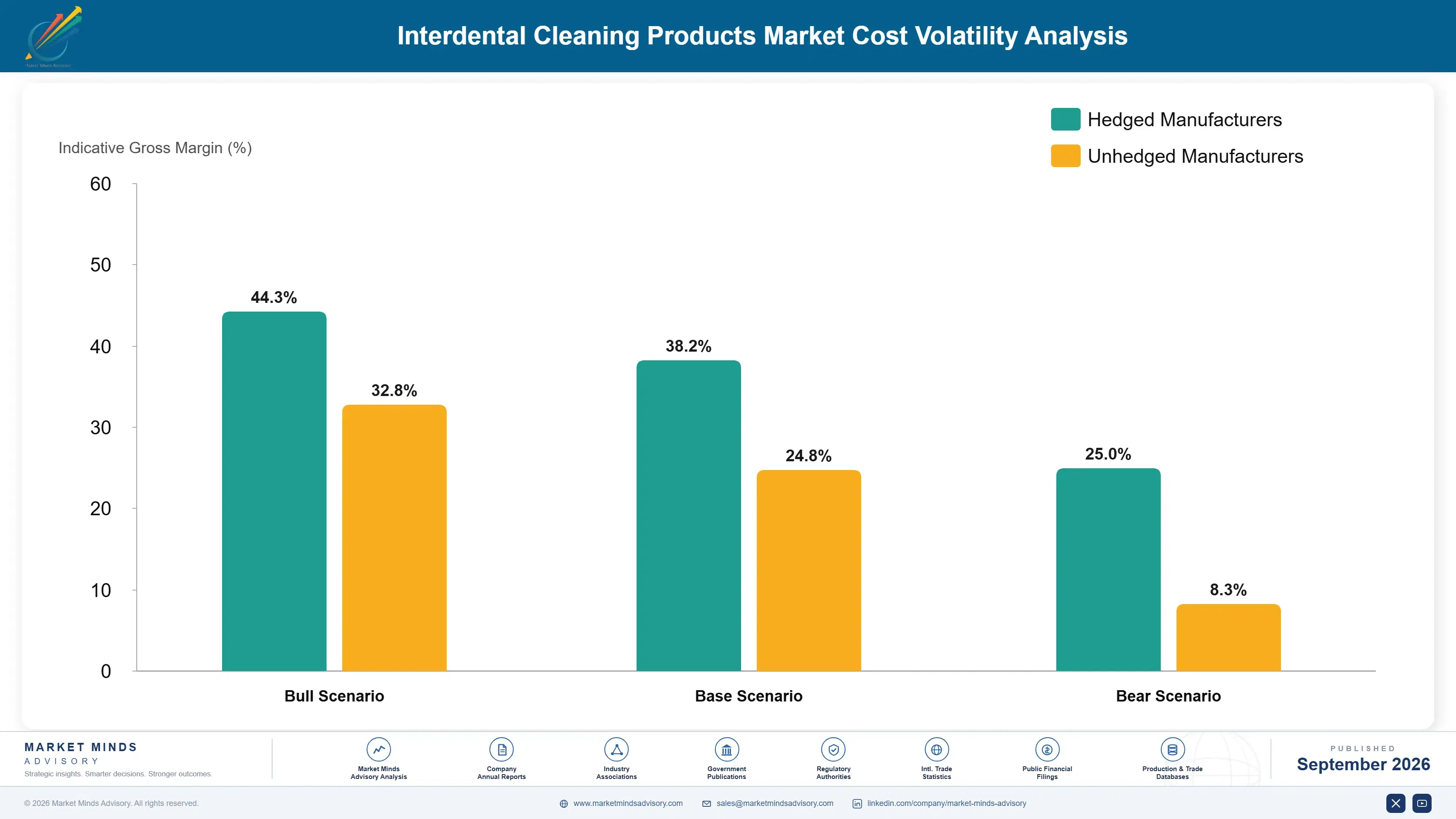
Margin architecture divides by whether a product carries a device or a professional endorsement, rather than by material cost, which is trivial across most of the category. Floss and floss picks sold through mass and drug retail run at gross margins in the mid forties to low fifties, competing on shelf position and promotional price against private label that performs identically on any measure a consumer can apply.
Interdental brushes and premium formats sold through pharmacy and professional channels hold gross margins in the mid fifties to mid sixties. The spread reflects endorsement rather than manufacturing, since a brush costs very little to produce and the clinical recommendation behind it cannot be bought. European specialists hold professional positions here that exceed their overall market share by a wide margin.

The highest-value pool is powered devices with replacement consumables, at margins in the low to high sixties once the tip and cartridge stream is included. That format grows fastest and generates a recurring purchase that no manual product achieves. Floss holds the shelf and the habit. It generates neither the growth nor the recurring revenue that sits alongside it.

Volume / Commodity-Adjacent

Floss and floss picks sold through mass and drug retail. Private label performs identically on any measure a consumer can apply, which leaves shelf position and promotional price as the only variables.
Gross Margin: 44 to 52%

Premium / Certified

Interdental brushes and premium formats through pharmacy and professional channels. The eight-point range reflects clinical endorsement rather than manufacturing, since the product itself costs very little. Clinical recommendation cannot simply be purchased.
Gross Margin: 56 to 64%

Sustainability / Regulatory / Next-Generation

Powered devices with replacement tip and cartridge streams. This format grows fastest and generates a recurring purchase that no manual interdental product has ever managed to establish. Recurring tips are what no manual format offers.
Gross Margin: 62 to 70%
interdental-cleaning-products-market-portfolio-architecture-1790023441483

High-value Sub-segments and Strategic Watch-out

Powered Devices With Consumable Streams

High value and high growth at 10.2%. Adherence after twelve months runs roughly 2.8 times string floss, and replacement tips generate recurring revenue no manual format achieves anywhere in this category. Manufacturers now design against that adherence curve rather than against any clinical endpoint. Nothing manual comes close.
Gross Margin: 64 to 70%

Professionally Distributed Interdental Brushes

High value and high growth at 8.4%. Around 71% of professionals recommend them first, and a clinician sizing with a probe converts roughly 3.4 times better than any retail pack currently manages. European specialists hold these positions far above their overall share of the market.
Gross Margin: 58 to 64%

Mass Retail Floss And Picks

Volume core, growing slowest at 3.6% and holding habit rather than evidence. Private label performs identically on every measure available to a consumer, which caps pricing across the whole tier. Shelf position and promotional price are the only variables left anywhere in this tier. Habit rather than evidence sustains it.
Gross Margin: 44 to 51%

Fluorinated Coated Floss

Strategic watch-out. Regulatory restriction reaches the coating directly, and the coating is what produces the glide that made floss tolerable between tight contacts. No equivalent alternative is proven yet. Uncoated nylon changes the glide that made the product tolerable to use between tight contacts. No proven alternative exists yet.
Gross Margin: 46 to 58%

What Sustains Daily Use

Repeat demand in this category depends on adherence rather than on satisfaction, which makes it unusual among consumer health products. A household claiming daily interdental cleaning consumes product at roughly a third of the rate that claim implies, so most purchases are made and then not followed through. Replacement therefore arrives far later than any usage model predicts, and the gap between purchase and consumption is where the whole category's growth potential sits.
Stickiness varies sharply by how the product entered the household. Patients given a sized interdental brush by a hygienist continue using it at rates no retail purchase approaches, because somebody demonstrated it and matched it to their mouth. Device owners continue because the barrier at the sink is low. Retail floss buyers are the least persistent group, and their repurchase intervals are long enough that brand memory has usually faded entirely.

Behaviour has shifted in one direction among device owners since cordless formats arrived. That cohort uses interdental cleaning more days per week than any floss-using group has ever reported, and the reason is mechanical rather than motivational. Picking up a device rather than threading floss produces a different adherence curve entirely.
interdental-cleaning-products-market-end-use-penetration-index-1790023441975

Where This Category Converts

These are among the four positions where our research anticipates prominent divergence between winners and laggards over the coming forecast period. Each is grounded in the demand model, the regulatory perimeter, and the announced capacity pipeline.
01 / RETAIL SIZING PROVISION

Give consumers what the hygienist uses

An interdental brush cleans only where its diameter matches the space, sizes span a wide range and roughly 7% of products offer any guidance beyond a picture on the back of a pack. A hygienist sizes with a probe in thirty seconds and the patient keeps using the right brush, while a consumer buys a mixed pack and abandons it. A printed or moulded gauge costs pennies, and participants including one report repeat purchase rising by around 2.2 times, and nothing at retail replicates a probe.
02 / CONSUMPTION BASED MEASUREMENT

Stop asking households whether they floss

Self-reported daily interdental cleaning runs at roughly 3.1 times the rate actual product consumption supports, which inflates every market model built on stated behaviour and conceals adherence as the binding constraint on this category. Measuring purchase frequency and device usage instead produces materially different product priorities. Participants who made that switch report reallocating development spend from efficacy claims toward adherence features and achieving category growth around 1.6 times their previous trajectory, which is a measurement decision rather than any change to what the business manufactures.
03 / PROFESSIONAL CHANNEL BUILDING

Sell the brush where somebody can size it

Around 71% of dental professionals recommend interdental brushes ahead of string floss, and a clinician who sizes a brush and demonstrates the angle converts a patient in a way no retail pack has ever managed. That makes the dental channel the only route where clinical evidence actually reaches a household routine. Participants with professional distribution report brush conversion running about 3.4 times their retail equivalent, on a capability requiring a clinical sales organisation rather than shelf negotiation, which is why so few consumer participants currently hold one at all.
04 / COATING REFORMULATION TIMING

Replace the glide before the rule arrives

Regulatory attention to fluorinated substances reaches coated dental floss directly, and that coating is precisely what produces the glide making the product tolerable between tight contacts. Developing an alternative before restriction publishes preserves the range; developing it afterwards means losing one while prepared competitors keep selling. Participants who have qualified alternatives report retaining around 82% of affected revenue, against a far smaller share among those that waited for the requirement, and the restriction timeline is already published for anyone prepared to read it.

Engagement Snapshot From the Field

A live engagement with an industry participant carrying material or product regulatory and market exposure ahead of a defining policy shift, showing how our research translates into a defensible multi-year portfolio strategy.
MARKET MINDS ADVISORY · CLIENT ENGAGEMENT SUMMARY
Interdental Cleaning Products Producer Strategic Portfolio Review and Transition Roadmap 2026·Investment Scenario on Interdental Cleaning Products Exposure Evaluation 2025-26
CLIENT PROFILE
A mid-sized oral care manufacturer selling floss, picks and interdental brushes across fourteen markets with revenue near USD 168 million (client-reported, unverified by MMA). Floss and picks accounted for 79% of revenue and brushes were sold exclusively through retail in mixed-size packs. No powered device existed in the range, and all consumer research was based on self-reported usage surveys.
STRATEGIC CHALLENGE
Brush revenue had remained flat for four years despite the company's own research showing dental professionals increasingly recommending the format, and management attributed the gap to insufficient consumer advertising. A media investment programme had been approved. Nobody had examined what happened to a mixed-size pack after purchase. No consumption data existed anywhere internally.
MMA APPROACH
MMA compared self-reported usage against actual consumption derived from purchase frequency across a panel, then tested brush size selection among 240 consumers with and without a gauge. Professional channel conversion was measured at practices stocking the client range. Coated floss lines were assessed against published regulatory restriction proposals for material exposure.
KEY FINDINGS
  1. Self-reported daily use exceeded consumption-implied use by 3.4 times, above the category figure, which meant the advertising programme was targeting a behaviour that largely was not happening.
  2. Consumers given a sizing gauge selected a correct brush diameter in 78% of cases against 31% using the existing pack diagram, and repeat purchase differed accordingly.
  3. Practices stocking the range converted brush recommendations at roughly four times the client's retail rate, and the company supplied only eleven practices across all fourteen markets.
  4. Sixty-one percent of floss revenue sat on coated lines directly exposed to published restriction proposals, with no alternative coating in development anywhere in the business.
CLIENT PROFILE
A mid-sized oral care manufacturer selling floss, picks and interdental brushes across fourteen markets with revenue near USD 168 million (client-reported, unverified by MMA). Floss and picks accounted for 79% of revenue and brushes were sold exclusively through retail in mixed-size packs. No powered device existed in the range, and all consumer research was based on self-reported usage surveys.
STRATEGIC CHALLENGE
Brush revenue had remained flat for four years despite the company's own research showing dental professionals increasingly recommending the format, and management attributed the gap to insufficient consumer advertising. A media investment programme had been approved. Nobody had examined what happened to a mixed-size pack after purchase. No consumption data existed anywhere internally.
MMA APPROACH
MMA compared self-reported usage against actual consumption derived from purchase frequency across a panel, then tested brush size selection among 240 consumers with and without a gauge. Professional channel conversion was measured at practices stocking the client range. Coated floss lines were assessed against published regulatory restriction proposals for material exposure.
KEY FINDINGS
  1. Self-reported daily use exceeded consumption-implied use by 3.4 times, above the category figure, which meant the advertising programme was targeting a behaviour that largely was not happening.
  2. Consumers given a sizing gauge selected a correct brush diameter in 78% of cases against 31% using the existing pack diagram, and repeat purchase differed accordingly.
  3. Practices stocking the range converted brush recommendations at roughly four times the client's retail rate, and the company supplied only eleven practices across all fourteen markets.
  4. Sixty-one percent of floss revenue sat on coated lines directly exposed to published restriction proposals, with no alternative coating in development anywhere in the business.
RECOMMENDED STRATEGY
Phase 1: Phase one: cancel the media programme and add a moulded sizing gauge to every interdental brush pack before the next production run. Phase 2: Phase two: build professional channel distribution for brushes, beginning in the markets where dental access is expanding fastest. Only eleven practices were supplied previously. Phase 3: Phase three: start an alternative floss coating development programme against the published restriction timeline immediately. Sixty-one percent of floss revenue is exposed to it.
OUTCOME
Brush repeat purchase rose by roughly 2.4 times within three quarters of the sizing gauge reaching shelves (client-reported, unverified by MMA), and professional distribution reached 340 practices in its first year. The media programme was abandoned once consumption measurement showed what the advertising would have been addressing.

Frequently Asked Questions

Foundational context covering the market sizes, CAGR, scope, country, region and competition that inform every finding below. This section is provided to cover basics and most often pre-purchase conversations, answered from the MMA Primary Research Dataset.

What is the current size of the Interdental Cleaning Products Market?

The market was valued at USD 3.8 billion in 2025, rising to USD 4.1 billion in 2026. Sizing is at retail value across six formats and both consumer and professional channels.

How large will the Interdental Cleaning Products Market be by 2036?

MMA forecasts USD 7.9 billion by 2036, an increase of USD 3.8 billion over the 2026 base. That represents expansion of 1.93 times across the forecast period.

What is the CAGR for the Interdental Cleaning Products Market 2026 to 2036?

The base case CAGR is 6.8%, with a bull case of 8.1% and a bear case of 5.6%. Historical growth between 2020 and 2025 ran at 5.7%.

Which segment is growing fastest?

Water flossers and oral irrigators grow at 10.2%, half again the market rate, because adherence after twelve months runs roughly 2.8 times string floss. Interdental brushes follow at 8.4%.

Who are the major companies in the Interdental Cleaning Products Market?

Procter and Gamble, Colgate-Palmolive, Kenvue, Philips and Sunstar lead on retail value, holding a combined 58%. European specialists hold professional positions well above their overall share.

Which country is growing fastest?

India grows fastest at 9.6%, because expanding dental practice access introduces interdental cleaning to households where it was previously absent from any routine. Clinic growth is therefore the leading indicator rather than any retail measure.

Report Segmentation Architecture

The full report scope spans multiple orthogonal segmentation dimensions, with cross-tabulated demand data provided for each dimension pair. Coverage extends further to regional breakdowns, trend trajectories, and the competitive detail needed to support segment-level decision-making.

By Product Format

  • Waxed and Unwaxed Dental Floss
  • Floss Picks and Harps
  • Interdental Brushes
  • Water Flossers and Oral Irrigators
  • Dental Tape and Wide Floss
  • Soft Picks and Rubber Interdental Tips

By End-Use Need

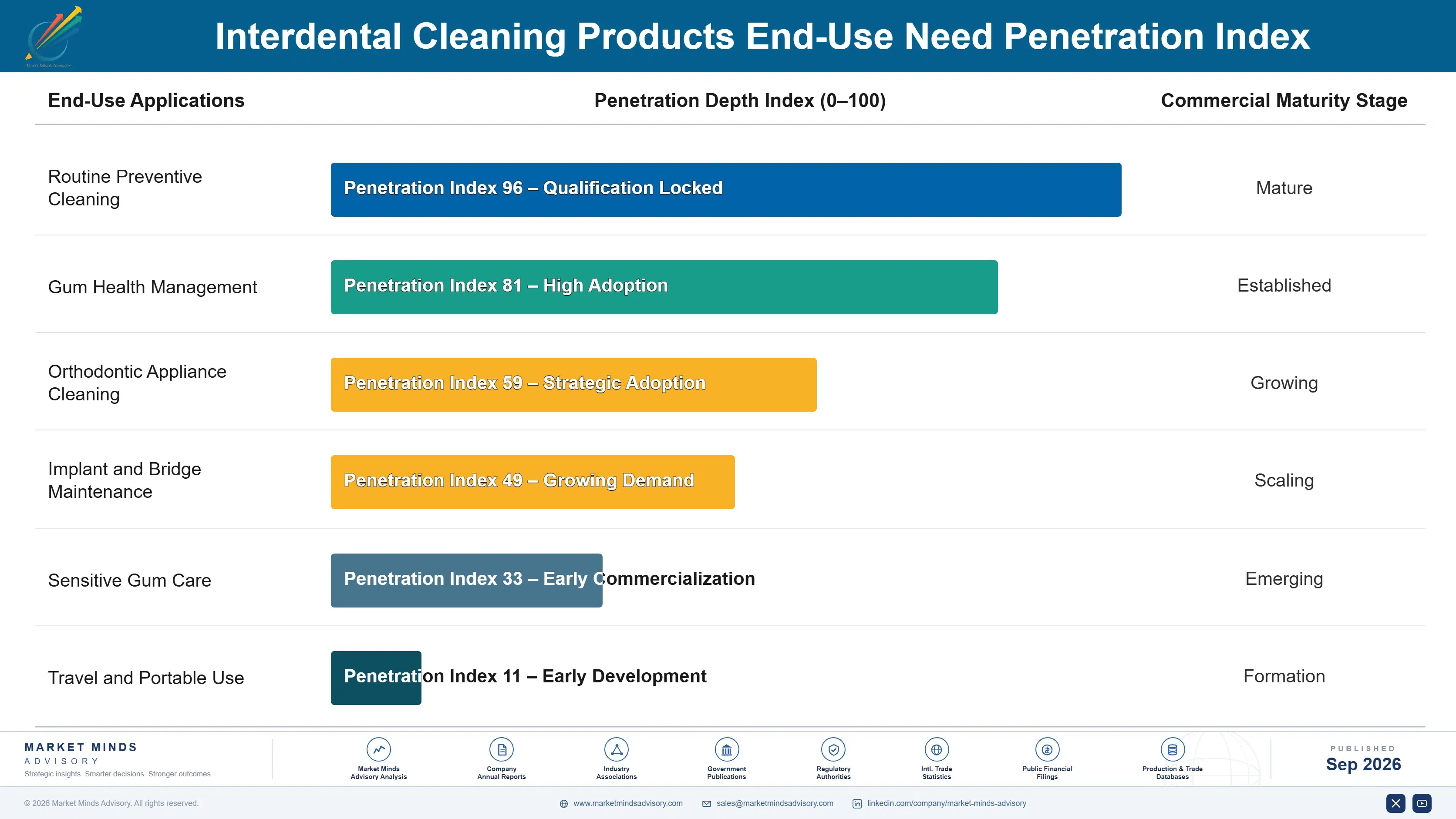
  • Routine Preventive Cleaning
  • Gum Health Management
  • Orthodontic Appliance Cleaning
  • Implant and Bridge Maintenance
  • Sensitive Gum Care
  • Travel and Portable Use

By Distribution Channel

  • Mass and Grocery Retail
  • Pharmacy and Drug Retail
  • Dental Practice and Professional Supply
  • Online and Marketplace
  • Brand Direct
  • Consumer Electronics Retail

By Region

  • East Asia
  • North America
  • Western Europe
  • South Asia and Pacific
  • Latin America
  • Middle East and Africa
  • Eastern Europe

Scope, Methodology, and Coverage

Every figure in this report is reproducible from documented input assumptions. The scope below maps the historical period, the forecast horizon, the segmentation dimensions, and the countries covered, alongside the underlying primary and qualitative methodology.
Historical Period
2020 to 2025
Forecast Period
2026 to 2036
Base Year
2025 (USD billions; MMA Primary Research Dataset, September 2026)
Market Definition
This market covers products used to clean between the teeth, spanning waxed and unwaxed dental floss, floss picks and harps, interdental brushes, water flossers and oral irrigators, dental tape and wide floss, and soft picks and rubber interdental tips. Sizing is at retail value across mass, pharmacy, dental professional, online, direct and electronics channels, and includes replacement tips and consumables sold for powered devices. Toothbrushes, toothpaste and mouthwash, professional scaling instruments, orthodontic appliances and dental treatment services are excluded throughout.
Quantitative Units
USD billions at retail value; volume in millions of units; brush diameters in millimetres.
Segmentation Dimensions
Product format, end-use need, distribution channel, and geographic region.
Regions Covered
East Asia, North America, Western Europe, South Asia and Pacific, Latin America, Middle East and Africa, Eastern Europe
Countries Covered
China, United States, Japan, Germany, India, Brazil
Key Companies Profiled
Procter and Gamble, Colgate-Palmolive, Kenvue, Philips, Sunstar Group, Haleon, Church and Dwight, Unilever, Lion Corporation, Kao Corporation, Curaden, TePe, Dentaid, Prestige Consumer Healthcare, Panasonic, Xiaomi, Perrigo, Wisdom Toothbrushes, Piksters, Yunnan Baiyao
Quantitative Methodology
Primary survey, n=3,800 respondents, Q4 2025, six countries; demand-side model with trade association cross-validation
Qualitative Methodology
47 expert interviews, Q4 2025; applied to validate demand model assumptions, identify emerging dynamics, and assess competitive positioning
Report Format
PDF and XLSX data workbook (Word format preview document)
Publisher
Market Minds Advisory
Report Code
MMA-2026-HLT-790
Published
September 2026
Contact
sales@marketmindsadvisory.com | www.marketmindsadvisory.com

Purchase the full Interdental Cleaning Products Market Report (2026 to 2036).

The full report sizes the interdental cleaning market across six product formats, six end-use needs and six distribution channels for all seven global regions. It includes self-reported usage compared against consumption derived from purchase frequency to quantify the adherence gap. Brush size selection is tested with and without a sizing gauge across consumer samples. Professional channel conversion is measured at practices stocking leading ranges, and coated floss lines are assessed against published material restriction proposals. Competitive assessment covers 20 participants on a consistent retail value basis.
Self-reported usage compared against measured consumption
Brush size selection tested with and without gauges
Professional channel conversion measured at practices
Coated floss assessed against restriction proposals
Six product formats sized through 2036
Twenty participants assessed on retail sales value

Built For The People Who Decide

From boardroom strategy to bench-side execution, this report is read cover-to-cover by leaders shaping the next decade of their industry, turning demand scenarios, market dynamics and valuation benchmarks into decisions.
CXOs/ Presidents/ VPs/ Managers
M&A and Corporate Development
Strategy Teams and R&D Heads
Procurement and Product Directors
Regulatory and Compliance Leaders
Investor Relations and Equity Analysts