Market Minds Advisory
Intelligent Completion Market

Intelligent Completion Market: Intelligent Completion Market. Fiber Optic Sensing Is Turning Wells Into Continuously Monitored Assets

Operators managing increasingly complex multi-zone offshore and unconventional wells are replacing periodic wireline logging with permanent fiber optic sensing, converting reservoir management from scheduled intervention into a continuous, real-time monitoring discipline.

Lead Analyst

Published

September 2026

Make Smarter Decisions with Customized Research Insights

Request a free sample report and evaluate market opportunities, growth trends, and competitive dynamics relevant to your business needs.

2025 MARKET VALUE$4.6BMarket Size 2025
2036 FORECAST VALUE$11.6BBase Case , 2026 to 2036
CAGR 2026 TO 20368.8 %Bull 10.0% / Bear 7.5%
INCREMENTAL OPPORTUNITY$6.6BNet 10- year value creation
EXPANSION MULTIPLE2.32x2036 value over 2026 base
Strategic Levers
M&A Pipeline
Regional Outlook
Country Rankings
Competitive Intelligence
Segmental Deep-dive
Call-Us : 91 93563 13602

Executive Snapshot and Market Trajectory.

Operators managing increasingly complex multi-zone offshore and unconventional wells are replacing periodic wireline logging with permanent fiber optic sensing, and that shift toward continuous monitoring is now the single most important qualitative dynamic reshaping completion design decisions across the category and the broader industry this year.
Demand concentrates among offshore, deepwater, and complex unconventional well operators requiring real-time zonal control and reservoir monitoring that conventional completions cannot provide, while fiber optic distributed sensing systems are growing fastest as operators seek continuous temperature and acoustic monitoring across the full wellbore length. North America carries the largest regional share, reflecting the region's concentrated offshore Gulf of Mexico and unconventional well completion activity relative to other major markets tracked in this report.
Competitive structure remains moderately concentrated among large integrated oilfield service companies with broad completion technology portfolios, alongside smaller specialist manufacturers competing on depth in specific downhole component categories. Buyers increasingly expect vendors to demonstrate documented downhole reliability data and proven long-term well integrity performance rather than accepting general completion equipment specifications alone, reshaping vendor shortlists faster than several general oilfield equipment suppliers without dedicated intelligent completion engineering anticipated.
Market Definition
This market covers downhole completion equipment and surface control systems that enable real-time monitoring and remote control of well production zones without physical intervention, including interval control valves, permanent downhole gauges, fiber optic sensing systems, and associated surface control infrastructure. It excludes conventional completion equipment without remote monitoring or control capability, and well intervention services performed using temporary wireline or coiled tubing equipment.
Base Year Value
$4.6B in 2025 (MMA Primary Research Dataset, September 2026)
Forecast Period
2026 to 2036, eleven discrete annual values
CAGR
8.8% base case. Bull 10.0%. Bear 7.5%.
Fastest Growth Segment
Fiber Optic Distributed Sensing Systems: 13.0% CAGR
Fastest Growth Country
Malaysia: 11.5% CAGR
Fastest Growth Region
South Asia and Pacific: 10.8% CAGR
Largest Region
North America: 27% of 2025 global value
Market Leaders
SLB, Halliburton Company, Baker Hughes Company, Weatherford International plc, NOV Inc. Source: MMA Analysis based on company disclosures and primary research.
Primary Survey
n=3,800 procurement and R&D decision-makers, Q4 2025, six countries
Methodology
Demand-side build-up, cross-validated against public data, 47 expert interviews

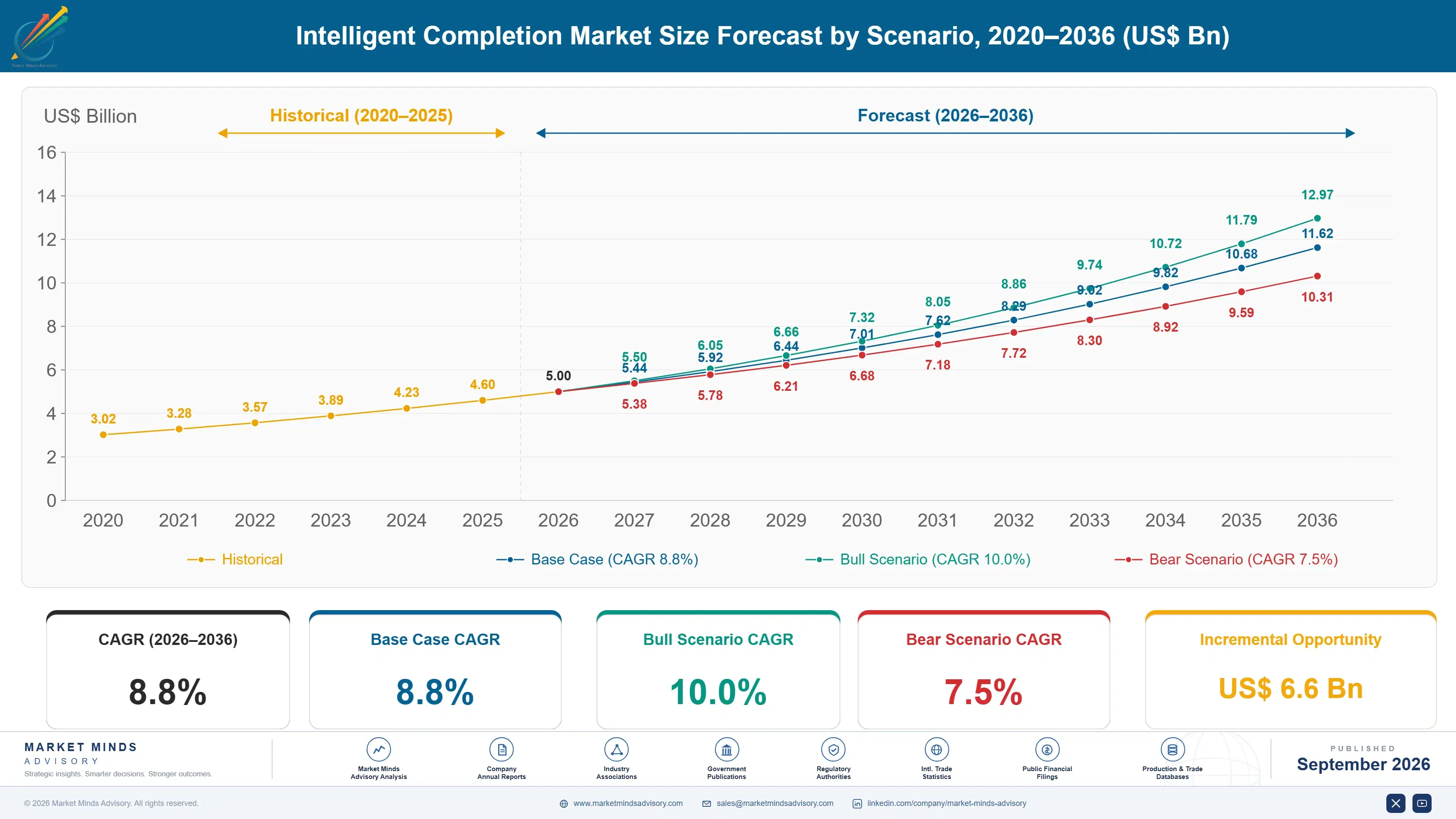
Intelligent Completion Market Forecast Scenarios

intelligent-completion-market-size-forecast-scenario-1788678122821
Between 2020 and 2025 the category grew steadily as offshore and unconventional well complexity increased and intelligent completion costs declined relative to the production optimisation value they deliver, with growth accelerating from 2023 onward as fiber optic sensing costs fell enough to support broader adoption, reflecting a historical CAGR of 8.0 percent across the trailing five-year period tracked in this analysis.
The base case assumes continued growth driven by three mechanisms. Operators are specifying intelligent completions on offshore and complex unconventional wells where zonal control improves recovery economics, fiber optic sensing costs continue declining enough to justify broader deployment across wells that could not previously justify the investment, and national oil companies across several producing regions are expanding adoption as part of digital oilfield transformation programmes. These mechanisms compound fastest among operators developing the most geologically complex reservoir formations.
A bull scenario turns on faster-than-expected fiber optic sensing cost reduction pulling forward adoption across a broader range of well types industry-wide. The bear risk is sustained lower oil price environments compressing upstream capital expenditure, delaying planned intelligent completion deployment despite the underlying reservoir management and recovery optimisation advantages driving long-term demand. This risk applies to smaller operators lacking diversified portfolios.

Fiber Optic Sensing Resets Completion Design Standards

Two forces are reshaping this category at once: fiber optic sensing costs declining enough to support deployment beyond the highest-value offshore wells, and operators increasingly treating continuous reservoir monitoring as a standard design element rather than a premium option reserved for complex wells alone. Together these pull vendor investment toward sensing cost reduction and analytics integration and away from the incremental valve competition that historically defined the broader category.
MARKET CONCENTRATIONCR5 52%Reflects a moderately concentrated global oilfield technology category
AVERAGE SYSTEM PRICEUSD 2.4 million per intelligent completion wellBlended price across single-zone and multi-zone system configurations
TOP PRODUCING COUNTRY SHAREUnited States at 31% of global unit installationsReflects the country's concentrated offshore and unconventional well activity
OFFSHORE SEGMENT REVENUE SHARE58% of total category revenueShare of revenue tied to offshore and deepwater well applications
AVERAGE INSTALLATION CYCLE12 weeks per standard well completionTypical duration from equipment delivery to full system commissioning
COMPONENT COST SHARE38% of cost of goods soldShare of manufacturing cost tied to downhole materials
Commercially, the market behaves like a mature, specification-driven oilfield technology category where documented downhole reliability data and demonstrated long-term well integrity performance increasingly separate credible vendors from general completion equipment suppliers entering the category opportunistically. Operators evaluate vendors heavily on field-proven reliability records and surface control system integration ease, creating real switching friction once a vendor's downhole architecture becomes embedded across an operator's standard well design.
Over the next decade, expect intelligent completion specification to become standard practice across a growing share of offshore and complex unconventional wells rather than a differentiated premium choice reserved for the highest-value assets alone. Vendors that build genuine sensing cost reduction alongside proven downhole reliability will capture a growing share of category value beyond the price-only competition that still defines simpler onshore conventional well segments.
"Operators used to reserve intelligent completions for the handful of wells that could justify the premium. Now the sensing cost has fallen enough that the question is which wells you would leave out, not which ones you would include."
Director, Upstream Oilfield Technology Practice · MMA Energy Practice · September 2026

Market Trends

Fiber Optic Sensing Extends Beyond Premium Offshore Wells

Operators are increasingly deploying fiber optic distributed sensing systems across a broader range of well types as sensing hardware and installation costs decline relative to the reservoir management value the continuous data provides. MMA's Q4 2025 primary research found operators reporting fiber optic sensing installation costs declining by roughly 24 percent over the past three years as manufacturers scaled production and simplified installation procedures. This shift is resetting completion design specifications across the category broadly. Operators increasingly treat this cost reduction as a mandatory evaluation criterion before expanding sensing deployment across broader well portfolios industry-wide.
Market Impact: Drives 57% of new procurement decisions
National Oil Companies Expand Digital Oilfield Programmes

National oil companies across several major producing regions are increasingly incorporating intelligent completion technology into broader digital oilfield transformation programmes covering reservoir monitoring, production optimisation, and remote operations capability. MMA's expert interview programme found reservoir engineering leaders citing continuous monitoring data quality, not equipment cost alone, as an increasingly important justification for intelligent completion investment across large-scale field development programmes specifically. This shift favours vendors that invested early in data analytics integration over vendors offering only standalone downhole hardware. Reservoir engineering teams increasingly treat this integration as a mandatory investment criterion for new field development programmes.
Market Impact: Sustains demand across 34% of programmes

Market Opportunities and Growth Drivers

Offshore Well Complexity Sustains Zonal Control Demand

Continued development of geologically complex offshore and deepwater reservoirs is sustaining demand for intelligent completion systems capable of independently controlling production across multiple zones without costly physical intervention. Surveyed reservoir engineers linked 57% of new intelligent completion procurement decisions directly to multi-zone reservoir complexity rather than single-zone conventional well economics alone, according to MMA's Q4 2025 primary research programme covering upstream operators across six countries. This complexity-driven demand is sustaining procurement volume even where broader upstream capital budgets face continued scrutiny industry-wide. Engineering teams increasingly treat this complexity as a critical field development design requirement.
Market Impact: Limits extreme-well adoption by 19 percent

Digital Oilfield Investment Sustains Baseline Sensing Demand

Continued national oil company and major operator investment in digital oilfield transformation programmes is sustaining baseline demand for permanent downhole sensing capable of feeding real-time reservoir management systems rather than relying solely on periodic intervention-based data collection. Announced new digital oilfield programmes tracked in MMA's primary research programme climbed steadily through 2025, sustaining sensing demand across operators treating continuous monitoring as essential reservoir management practice rather than a discretionary technology upgrade reserved for flagship fields only. Engineering firms increasingly treat continuous monitoring as a standard reservoir management requirement rather than a discretionary technology upgrade reserved for flagship assets only.
Market Impact: Adds 21 percent to completion cost

Market Restraints and Challenges

Extreme Downhole Conditions Limit Component Reliability

Downhole components deployed in high-pressure, high-temperature well environments continue experiencing higher failure rates than surface equipment operating in controlled conditions, limiting operator confidence in intelligent completion reliability across the most extreme well environments specifically. The root cause is that downhole electronics and sensors must withstand sustained extreme temperature and pressure exposure over years of continuous operation without any possibility of routine maintenance access. The commercial impact concentrates hesitancy among operators developing the most extreme high-pressure, high-temperature reservoir environments. Several vendors are responding by developing ruggedised electronics packages engineered specifically for sustained extreme downhole conditions.
Market Impact: Cuts installation cost by 24 percent

High Upfront Cost Limits Adoption on Marginal Wells

Intelligent completion systems carry substantial upfront capital cost relative to conventional completions, limiting adoption on lower-value or marginal wells where the incremental production optimisation value may not clearly justify the additional investment. The root cause is that downhole electronics, fiber optic sensing, and surface control integration require specialised engineering that conventional completion equipment does not, adding meaningful cost regardless of well value. The commercial impact concentrates adoption hesitancy among operators developing lower-value onshore conventional wells specifically. Vendors are responding by developing simplified, lower-cost intelligent completion configurations targeting marginal well economics.
Market Impact: Adds 26 percent programme demand
3 additional market trends, 3 additional growth drivers, and 4 additional restraints and challenges are covered in the full report. Contact sales@marketmindsadvisory.com to access the complete intelligence.

Segment CAGR and Growth Architecture

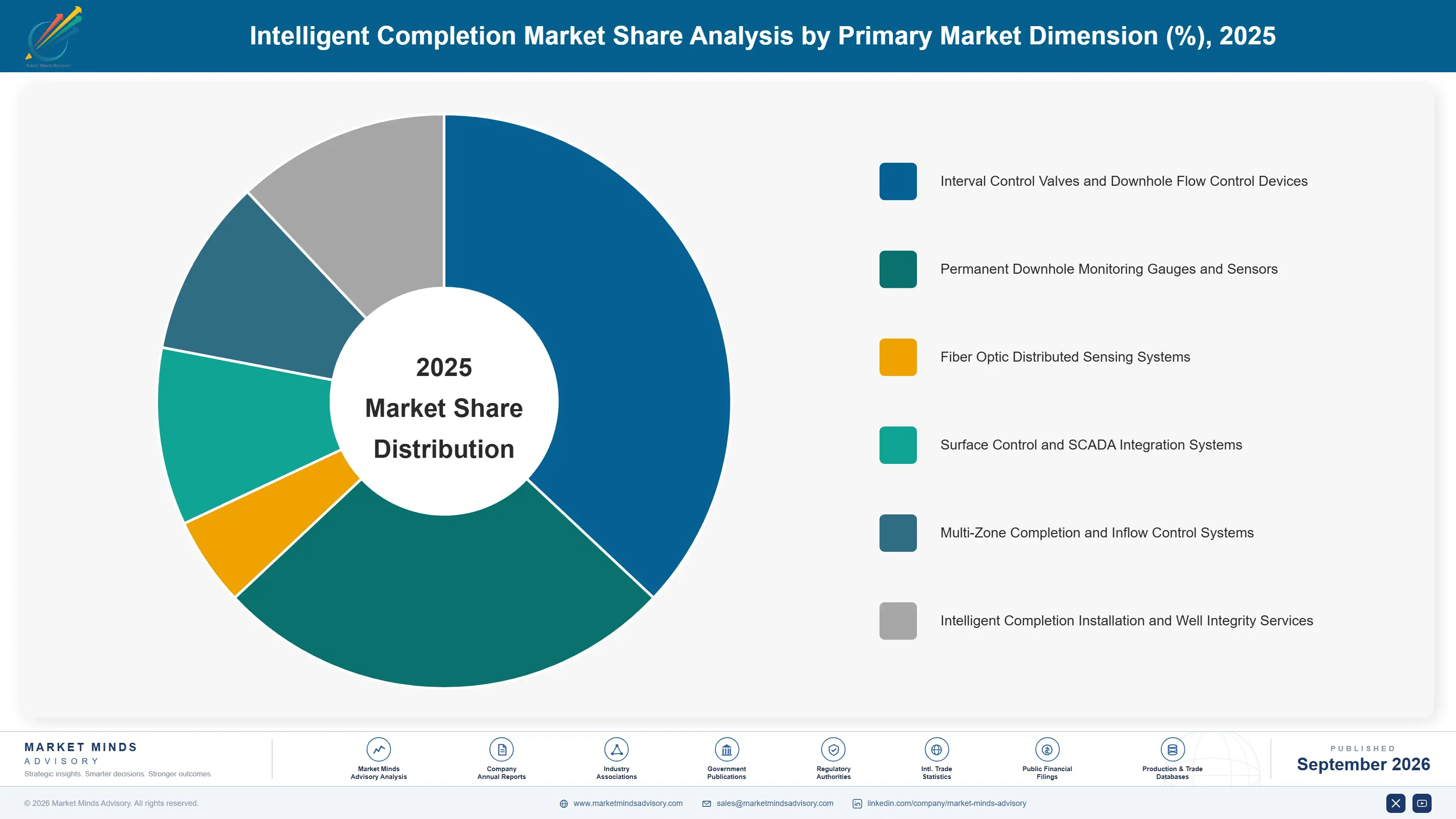
Segmentation follows product and technology architecture dimension, since that lens best explains both vendor engineering investment and operator procurement behaviour, spanning established valve and gauge formats through to newer fiber optic and multi-zone categories reshaping completion design. This structure keeps each segment cleanly distinct rather than overlapping across delivery format, certification tier, or customer type, consistent with vendor strategy.
intelligent-completion-market-market-share-analysis-1788678123422

Fiber Optic Distributed Sensing Systems

This segment covers fiber optic cable systems installed along the wellbore to provide continuous distributed temperature and acoustic sensing across the full completion length, distinct from permanent downhole gauges that provide point measurements at discrete locations rather than continuous distributed data along the entire wellbore. Adoption is concentrated among offshore and complex unconventional well operators requiring granular reservoir behaviour data that point-measurement gauges genuinely cannot provide across long horizontal sections. Growth is outpacing every other segment in this report because fiber optic sensing adoption is expanding faster than any other technology as sensing costs decline and installation procedures simplify, creating urgent competitive pressure across vendors this year specifically. Operators increasingly treat this sensing capability as essential reservoir management infrastructure.
CAGR 13.0%

Multi-Zone Completion and Inflow Control Systems

This segment covers completion systems that independently manage inflow across multiple producing zones within a single wellbore, distinct from single-zone interval control valve systems that manage flow at only one control point and from fiber optic sensing systems that provide monitoring data rather than active flow control capability. Demand is rising as operators increasingly develop geologically complex reservoirs requiring independent zonal management to optimise recovery across formations with varying pressure and permeability characteristics. Growth trails the fiber optic sensing segment only because multi-zone system adoption, while accelerating steadily, builds on an already larger existing installed base relative to the newer, faster-scaling fiber optic sensing category specifically. Operators increasingly treat this zonal control as a baseline design expectation across reservoir developments.
CAGR 11.5%
Full segment breakdown across 6 segments available in the complete report.

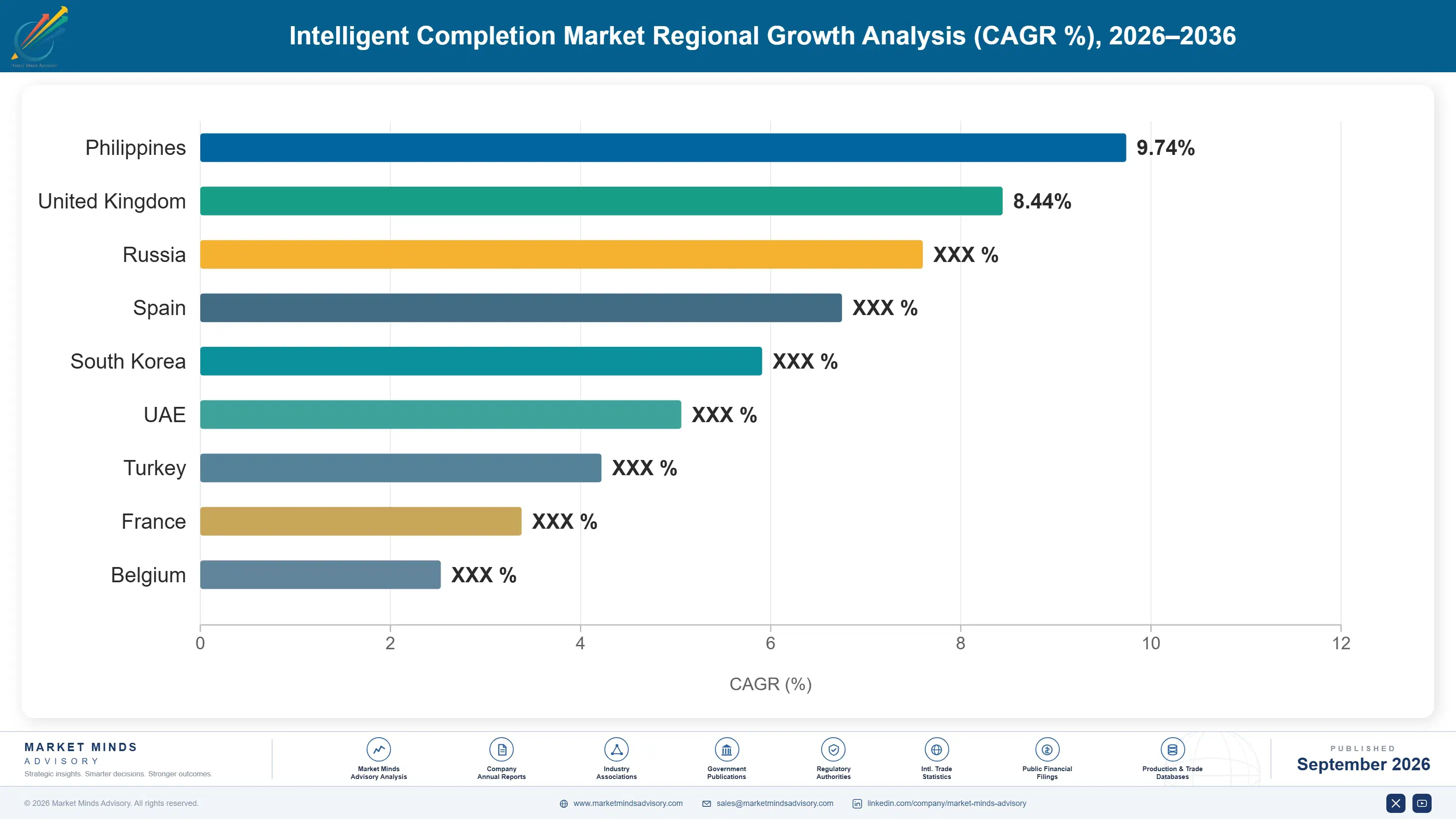
Regional Architecture and Country Demand Map

North America and Middle East and Africa together anchor a substantial share of global revenue, reflecting concentrated offshore, unconventional, and national oil company investment, while South Asia and Pacific delivers the fastest regional expansion through rising offshore field development across most tracked economies this year.

North America

United States offshore Gulf of Mexico and unconventional well operators account for the large majority of regional revenue, reflecting the country's concentrated deepwater and complex unconventional well completion activity across established production basins. Canadian oil sands and offshore operators contribute a steady secondary share tied to comparable complex well completion requirements across established production regions. Growth here tracks close to the global base as steady offshore and unconventional development sustains demand relative to faster-expanding regions elsewhere in this report, reinforcing the region's position as a durable revenue base for established vendors, well ahead of other tracked markets. This durability stands out even as completion activity itself continues concentrating elsewhere, according to current investment trends.
Share: 27% | CAGR: 8.8% (2026 to 2036)

Western Europe

United Kingdom and Norwegian North Sea operators anchor regional demand, both as major offshore field developers and as operators of established intelligent completion programmes across mature and newly developed North Sea fields. Dutch and Danish operators contribute a meaningful secondary share tied to comparable offshore completion requirements across established markets. Growth trails the global rate because the region's North Sea production base is already comparatively mature relative to faster-growing offshore development markets, limiting incremental demand growth even as digital oilfield upgrades remain steady across the forecast period overall. Nordic and Irish operators contribute a smaller but steady share tied to comparable offshore completion requirements across the region's growing exploration activity broadly.
Share: 18% | CAGR: 7.3% (2026 to 2036)
Regional intelligence for 5 additional markets available in the complete report: East Asia, South Asia and Pacific, Latin America, Middle East and Africa, Eastern Europe. Contact sales@marketmindsadvisory.com.
intelligent-completion-market-country-cagr-analysis-1788678123969

Where Completion Vendors Can Still Expand Margin

Four commercial levers separate vendors capturing durable premium pricing from those competing purely on equipment price, spanning downhole reliability depth, fiber optic sensing cost reduction, data analytics integration, and dedicated field engineering support. Each lever rewards sustained engineering investment well ahead of confirmed operator adoption rather than reactive spending once competitors already hold documented reliability advantage.

Building Validated Downhole Reliability Track Records

Vendors that built validated downhole reliability track records, demonstrated through documented field performance data across live well deployments rather than laboratory testing claims alone, are winning a disproportionate share of operator contracts from buyers wary of unproven equipment failure risk. Vendors with demonstrated field reliability reported win rates roughly 26 percent higher than vendors offering only laboratory-validated performance claims. The approach requires sustained field engineering investment that smaller vendors sometimes cannot justify given limited existing operator relationships. Operators increasingly ask for documented field performance benchmarks during procurement, making this evidence a genuine prerequisite rather than an optional differentiator overall.
Market Impact: Lifts operator win rate meaningfully by 26 points

Reducing Fiber Optic Sensing Deployment Costs

Vendors that reduced fiber optic sensing deployment costs through simplified installation procedures and manufacturing scale are winning broader well-type contracts that vendors offering only premium-priced sensing systems cannot easily secure from operators evaluating sensing investment across a wider range of well values. Vendors with reduced deployment costs reported win rates roughly 23 percent higher than vendors offering only premium-priced sensing configurations. This lever requires sustained manufacturing and installation engineering investment that smaller vendors sometimes cannot justify given the associated cost. Operators increasingly treat cost accessibility as a baseline requirement when evaluating sensing vendors for broader well portfolios.
Market Impact: Lifts sensing win rate meaningfully by 23 points

Integrating Data Analytics Into Completion Platforms

Vendors that built integrated data analytics platforms processing downhole sensor data directly are winning digital oilfield contracts that vendors selling hardware and analytics as separate, unbundled products cannot easily secure from operators seeking a single integrated reservoir management workflow. This lever requires sustained software development investment that smaller hardware-focused vendors sometimes have not built internally. Vendors with integrated analytics platforms reported average contract values roughly 25 percent above comparable vendors offering only standalone hardware. Operators increasingly favour this integration because it removes the complexity of coordinating separate hardware and software vendor relationships during field operations.
Market Impact: Lifts average contract value meaningfully by 25 points

Expanding Dedicated Field Engineering Support Coverage

Vendors that built extensive regional field engineering support coverage are winning long-term operator contracts that vendors with limited regional presence cannot easily secure from operators requiring guaranteed rapid technical support across a completion's full multi-year producing life. This lever requires sustained regional infrastructure investment that smaller vendors sometimes have not developed. Vendors with strong regional field support reported recurring service revenue per completed well roughly 2 to 3 times higher than vendors offering only initial equipment sales. Enterprise operators increasingly treat guaranteed rapid technical support as a mandatory evaluation criterion for large-scale, multi-well field development contracts.
Market Impact: Wins 2 to 3 times more recurring revenue

Who Controls the Margin Pool

CR5 sits at 52%, evaluated on disclosed intelligent completion segment revenue across the top vendors, reflecting a moderately concentrated category where large integrated oilfield service companies with broad completion technology portfolios compete alongside smaller specialist manufacturers focused on specific downhole component categories. The gap between the largest vendors and the specialist manufacturer tail remains meaningful given the engineering investment required to compete at the top tier.
Current competitive activity centers on three fronts: building validated downhole reliability track records, reducing fiber optic sensing deployment costs to serve a broader range of well values, and integrating data analytics platforms to capture digital oilfield contracts. Price competition remains most intense among smaller manufacturers serving basic single-zone completions while multi-zone and sensing contracts increasingly compete on demonstrated reliability and integration depth.

Emerging pressure is building from two directions. Oilfield equipment manufacturers without dedicated completion engineering are investing to close the reliability gap, threatening specialised completion vendors in mid-tier onshore accounts where general relationships exist. At the innovation end, digital oilfield analytics specialists are attracting renewed investor interest, a dynamic that could reorder segment rankings as data analytics integration becomes a larger share of competitive positioning.
intelligent-completion-market-company-positioning-matrix-1788678124518

Competitive Moat and Risk Dimensions

SLB

Moat: Deep Downhole Reliability Portfolio

SLB's accumulated field reliability data across decades of intelligent completion deployments gives it a credibility advantage in winning large operator contracts that narrower-focused competitors cannot easily match without comparable field engineering investment built over many years. That advantage compounds further as operators consolidate approved vendor lists across major field development programmes.
SLB

Risk: Complex Legacy Product Overhead

SLB carries a broad, complex completion product portfolio spanning multiple technology generations, and maintaining spare parts and support across that full portfolio creates cost overhead that more narrowly focused specialist competitors offering fewer, newer product lines do not carry to the same degree. This overhead can slow new product introduction relative to more narrowly focused specialist competitors.
HALLIBURTON COMPANY

Moat: Strong North American Field Presence

Halliburton's extensive North American field engineering presence gives it a durable advantage in winning long-term operator contracts requiring guaranteed rapid technical support across the region's concentrated unconventional and offshore well base relative to competitors with thinner regional coverage. That regional depth becomes especially valuable during unplanned well interventions requiring rapid on-site technical response.
HALLIBURTON COMPANY

Risk: Limited Fiber Optic Sensing Depth

Halliburton's fiber optic distributed sensing portfolio remains comparatively narrower than specialists with longer-established sensing technology development, potentially limiting its competitiveness for contracts requiring the most advanced continuous distributed sensing capability. Halliburton has been expanding sensing technology investment, but closing that gap against dedicated specialists will likely take several more years to complete fully.

Players Tracked

Prominent Players

SLB
Halliburton Company
Baker Hughes Company
Weatherford International plc
NOV Inc

Other Key Players

TechnipFMC plc
Tendeka Ltd
Welltec A/S
Expro Group Holdings NV
ChampionX Corporation
Odfjell Technology
Archer Limited
Aker Solutions ASA
Interwell AS
Petrofac Limited
Nabors Industries Ltd
Helix Energy Solutions Group Inc
Core Laboratories Inc
Forum Energy Technologies Inc
Innovex Downhole Solutions Inc

Recent Developments

FEBRUARY 2026

SLB Launches Enhanced Low-Cost Fiber Optic Sensing System

SLB launched an enhanced low-cost fiber optic distributed sensing system capable of simplified installation across a broader range of well types, extending its existing completion portfolio to address operator demand for accessible continuous monitoring ahead of accelerating adoption schedules across major customers. The launch follows field trials with anchor customers.
Signal: Confirms established vendors racing to expand fiber optic sensing accessibility as a core differentiator ahead of intensifying operator procurement scrutiny.
OCTOBER 2025

Baker Hughes Acquires Analytics Specialist ReservoirSense Systems

Baker Hughes completed the acquisition of digital oilfield analytics specialist ReservoirSense Systems, adding integrated data analytics capability intended to strengthen its intelligent completion portfolio ahead of increasing operator demand for demonstrated reservoir management software integration. The deal closed after a multi-month regulatory review process across relevant jurisdictions.
Signal: Indicates digital oilfield analytics acquisition activity accelerating among established intelligent completion vendors globally, as consolidation among analytics specialists continues.
JUNE 2025

Weatherford Signs Multi-Year Framework Agreement With National Oil Company

Weatherford signed a multi-year framework agreement with a major national oil company covering intelligent completion deployment across the company's expanding offshore field development programme, securing long-term revenue commitment tied to the company's phased development schedule extending through the remainder of the decade. The agreement includes dedicated field engineering support.
Signal: Signals large national oil company framework agreements remaining a key competitive lever for scaled vendors with deep engineering capacity.

Downhole Electronics and Specialty Alloy Sourcing Exposure

Specialised downhole electronics and corrosion-resistant specialty alloy materials together represent the largest cost input for intelligent completion manufacturers, running an estimated 38 to 45 percent of cost of goods sold, sourced primarily from a concentrated group of specialised electronics producers and specialty alloy suppliers whose components meet exacting downhole reliability requirements, reflecting the category's continued dependence on specialised, certification-grade electronic components rather than commodity industrial parts.
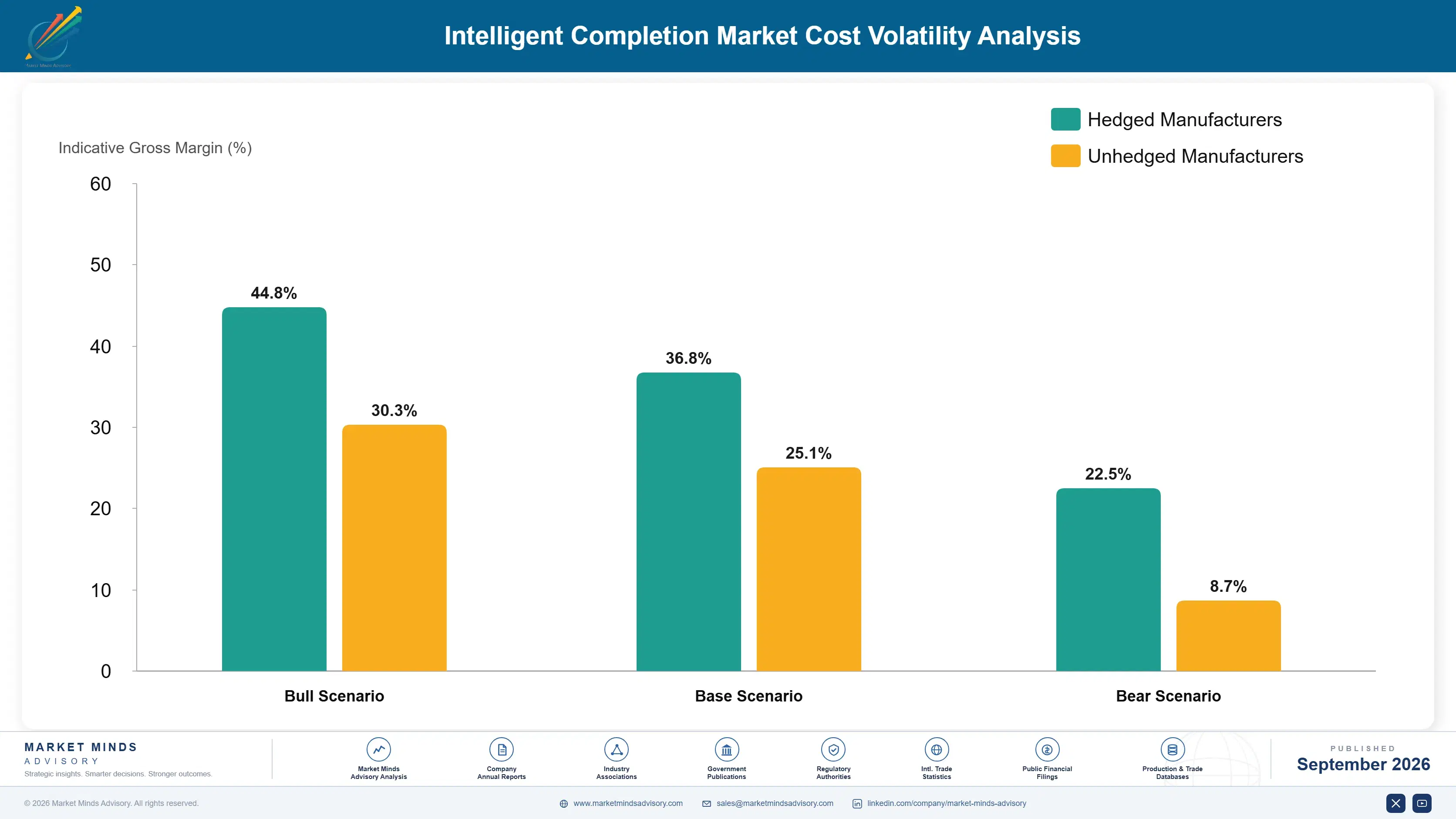
Specialised downhole electronics and specialty alloy pricing rose meaningfully across the broader oilfield equipment sector during 2022 and 2023 amid well-documented global semiconductor and specialty metals supply constraints, a pattern confirmed in multiple vendor annual reports and in EIA oilfield equipment supply chain commentary from the same period. Vendors without diversified component supplier relationships faced longer lead time extensions than those with existing multi-source agreements established beforehand.

The competitive disadvantage falls hardest on smaller vendors without the purchasing scale to secure priority allocation from constrained electronics and alloy suppliers during periods of tight component supply. Exposure varies by product positioning too, since vendors building fiber optic sensing and multi-zone systems face materially greater specialised component exposure than vendors offering simpler single-zone designs built on more widely available, less specialised materials.
intelligent-completion-market-cost-volatility-analysis-1788678124715

Qualifying Multiple Electronics and Alloy Suppliers Per Design

Larger vendors are qualifying multiple electronics and specialty alloy suppliers for each critical component in new designs from the outset, reducing single-source supply exposure while maintaining the downhole reliability consistency that field performance requirements demand across the full component bill of materials. This approach also improves long-term reliability across successive product generations overall today.

Building Strategic Electronics and Alloy Inventory Buffers

Several vendors are building larger strategic inventory buffers of critical downhole electronics and specialty alloy materials well ahead of anticipated demand, reducing exposure to short-term allocation shortages during periods of industry-wide semiconductor supply tightness across the broader sector. These programmes typically combine internship pipelines with sponsored coursework, building loyalty before graduates enter the broader competitive job market.

Extending Product Lifecycles Through Design Standardisation

Vendors are increasingly standardising electronics and alloy component selection across multiple product generations rather than redesigning for each new order, reducing the frequency of new component qualification cycles and the associated recertification cost and lead time exposure that accompanies each redesign. This discipline also simplifies spare parts supply for existing customers who can rely on one consistent specification.

Portfolio Architecture for Margin Defence

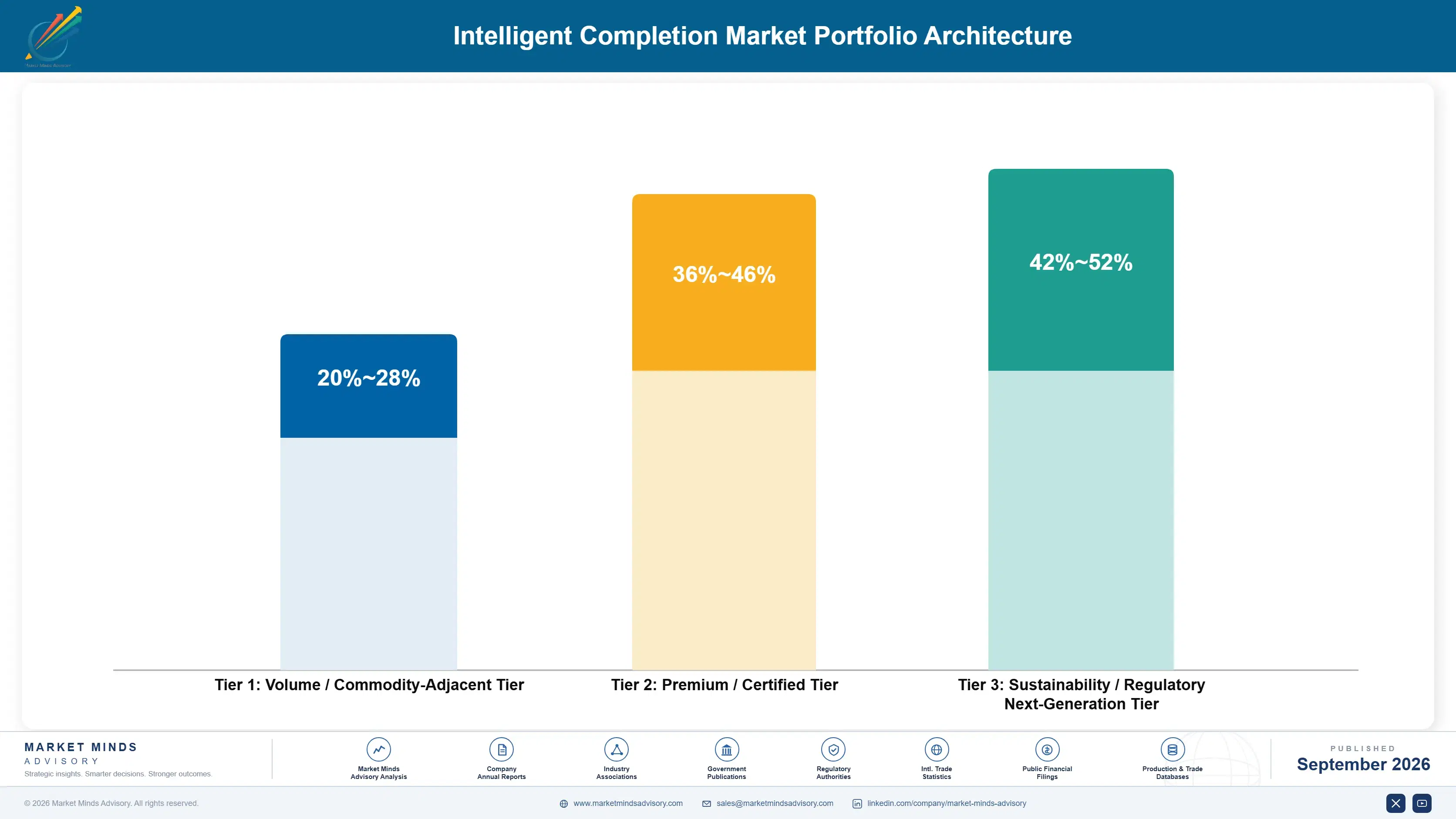
Portfolio economics split into three tiers. Volume tier single-zone conventional intelligent completions carry thinner margins under continued price competition from smaller manufacturers, while premium multi-zone offshore systems carry meaningfully higher margins tied to reliability depth and field performance track record. The sustainability and next-generation tier, built around fiber optic sensing and integrated data analytics, currently carries the strongest margins given genuine differentiation and long-term recurring service revenue.
The volume versus premium tension shows up clearly in vendor engineering allocation. Investment devoted to defending single-zone margin against smaller manufacturer price competition competes directly against investment needed for fiber optic sensing cost reduction and analytics integration depth, and vendors that under-invest in either risk losing ground to a competitor optimised specifically for that segment of the market.

High-value margin pools concentrate in fiber optic sensing and analytics-integrated multi-zone contracts, where technical differentiation and reliability depth still command premium pricing before broader commoditisation eventually sets in across the category. The volume single-zone tier remains essential for market reach among smaller operators but contributes a shrinking share of blended gross margin across the category overall. This dynamic is already visible in vendor product roadmaps announced over the past year.

Volume / Commodity-Adjacent Tier

Single-zone conventional intelligent completions facing continued price competition from smaller manufacturers across less complex well applications, leaving vendors reliant on volume rather than reliability depth to defend share, particularly among smaller operators with limited certification budgets and infrequent well development plans.
Gross Margin: 20-28%

Premium / Certified Tier

Multi-zone offshore systems bundling deep reliability validation carrying margins tied to field performance track record and complex reservoir management breadth, with operators willing to pay a meaningful premium for demonstrated durability.
Gross Margin: 36-46%

Sustainability / Regulatory / Next-Generation Tier

Fiber optic sensing and analytics-integrated systems commanding the strongest current margins given genuine differentiation, though margins should compress gradually as sensing costs continue declining, as more operators come to expect this level of sensing capability as standard practice.
Gross Margin: 42-52%
intelligent-completion-market-portfolio-architecture-1788678125219

High-value Sub-segments and Strategic Watch-out

Fiber Optic Sensing Integrated Contracts

The fastest-growing margin segment in this report, combining strong current margins with accelerating operator demand for continuous distributed monitoring across new well developments this decade. Vendors capturing early leadership here are building durable, multi-year contract relationships that later-entering competitors will struggle to dislodge once established.
Gross Margin: 42-52%

Multi-Zone Reservoir Management Contracts

Premium offerings tied to operator demand for independent zonal control across complex reservoir formations, offering strong margins and durable revenue visibility across major offshore accounts broadly. This segment increasingly determines which vendors win the largest, most strategically important contracts across critical national oil company accounts specifically.
Gross Margin: 36-46%

Standard Single-Zone Completion Contracts

The largest existing revenue base, standard engagements facing steady price competition but funding most vendors' ongoing engineering and analytics investment across the wider portfolio. Vendors that manage this segment efficiently generate the cash flow needed to fund investment in faster-growing lines across the broader supplier category today.
Gross Margin: 22-30%

Legacy Wireline-Dependent Monitoring Model

A shrinking strategic watch-out segment as permanent sensing systems continue displacing periodic wireline-based monitoring approaches across most well categories tracked in this report. Vendors still concentrated here should treat this decline as a signal to reallocate investment toward permanent sensing and analytics integration capability quickly.

Reliability Lock-In and Field Support Economics

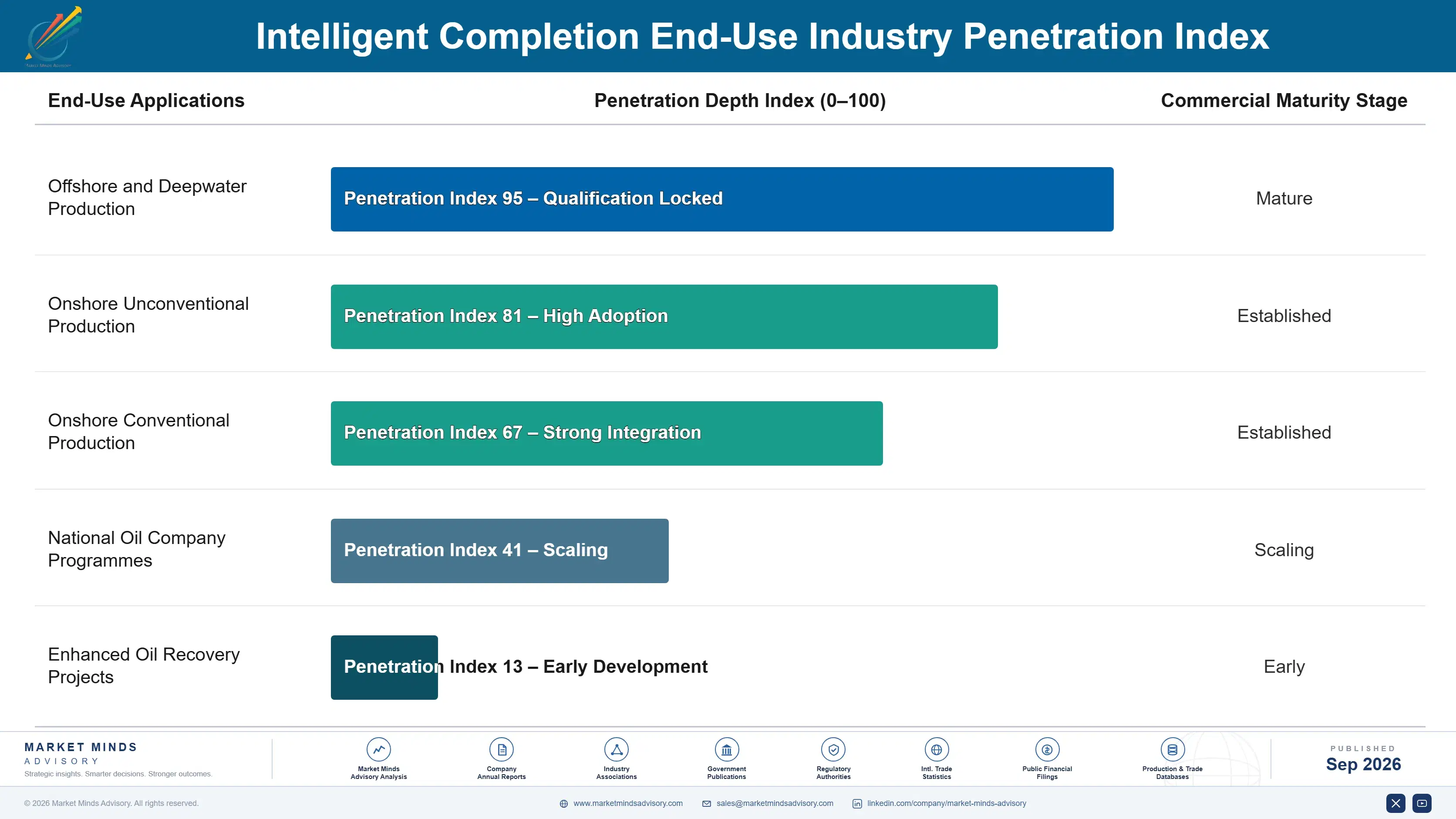
Revenue behaves like a multi-year annuity once a vendor's downhole architecture becomes embedded across an operator's standard well design, since replacing an intelligent completion vendor means requalifying the downhole system against engineering specifications rather than a simple component swap, and that switching cost explains most of this category's strong revenue visibility once a vendor secures the initial design specification for a given field development programme.
Adoption depth varies sharply by end-use vertical. Offshore and deepwater operators running continuous, high-value production operations integrate vendor relationships deeply into ongoing multi-well field development contracts spanning many completions, creating durable multi-year vendor relationships, while smaller onshore conventional operators with less complex well requirements treat intelligent completion procurement more transactionally around individual well projects, creating shallower vendor loyalty and greater exposure to competitive switching at each new project decision.

Buyer profiles are shifting generationally too. Reservoir engineers who came up through the conventional wireline logging era still favour proven, field-tested vendor relationships at a premium, while newer digital oilfield leaders increasingly default to evaluating fiber optic sensing capability and analytics platform integration as standard procurement considerations, a difference in buying philosophy that is shaping which vendors win field development programmes versus established legacy completion contracts.
intelligent-completion-market-end-use-penetration-index-1788678125718

Where the Category Reorders Next

These are among the four positions where our research anticipates prominent divergence between winners and laggards over the coming forecast period. Each is grounded in the demand model, the regulatory perimeter, and the announced capacity pipeline.
01 / RELIABILITY INVESTMENT STRATEGY

Field-validated depth is separating category leaders from unproven players

Vendors that built validated downhole reliability track records are capturing a disproportionate share of operator contracts as buyers increasingly demand documented field performance beyond laboratory testing claims alone. Vendors without demonstrated live deployment evidence risk being relegated to lower-value positioning carrying materially lower contract value than reliability leaders currently command. Building this evidence base now, while operators actively reassess vendor selection criteria, looks like the more urgent priority, since delaying investment risks ceding ground to reliability-focused competitors already gaining share.
02 / SENSING COST REDUCTION STRATEGY

Accessible fiber optic sensing is compounding into durable contract value

Vendors that reduced fiber optic sensing deployment costs are capturing a disproportionate share of broader well-type contracts as operators increasingly evaluate sensing investment across a wider range of well values beyond premium offshore assets alone. This dynamic rewards vendors willing to invest in manufacturing scale well ahead of confirmed industry-wide sensing standardisation. Vendors without established cost reduction should prioritise smaller pilot deployments first, since pilot programmes with two or three operators tend to reveal most recurring cost sensitivity requirements before committing to broader deployment.
03 / ANALYTICS INTEGRATION POSITIONING

Data platform depth remains a genuinely underexploited advantage

Integrated data analytics capability remains underexploited relative to its clear value potential as operators continue pursuing digital oilfield transformation faster than many hardware-focused vendors can credibly demonstrate comparable analytics depth. Vendors building genuine analytics integration now are positioning for meaningful contract advantage as digital oilfield adoption continues broadening across national oil company programmes. Treating analytics integration as a secondary afterthought rather than a distinct strategic asset risks underinvesting in an important competitive moat, especially as operators increasingly standardise on integrated digital oilfield platforms.
04 / LEGACY WIRELINE EXPOSURE

Vendors without sensing or analytics depth face continued displacement pressure

Vendors remaining concentrated in conventional, wireline-dependent monitoring positioning without fiber optic sensing or analytics differentiation face continued displacement pressure as operator procurement criteria shift decisively toward continuous, technically differentiated offerings across most accounts tracked in this report. Vendors should actively diversify toward fiber optic sensing, analytics integration, or broader reliability depth rather than defending wireline-dependent positioning alone. Treating wireline-dependent positioning as a stable long-term stance rather than a declining one risks meaningfully understating the category's ongoing competitive transition already underway.

Engagement Snapshot From the Field

A live engagement with an industry participant carrying material or product regulatory and market exposure ahead of a defining policy shift, showing how our research translates into a defensible multi-year portfolio strategy.
MARKET MINDS ADVISORY · CLIENT ENGAGEMENT SUMMARY
Intelligent Completion Producer Strategic Portfolio Review and Transition Roadmap 2026·Investment Scenario on Intelligent Completion Exposure Evaluation 2025-26
CLIENT PROFILE
The client is a national oil company generating approximately eighteen billion dollars in annual revenue (client-reported, unverified by MMA), operating offshore production assets across multiple giant fields with historically fragmented completion vendor relationships inherited from decades of incremental field development. The client's reservoir engineering organisation includes roughly one hundred forty engineers coordinating digital transformation programmes across multiple asset teams.
STRATEGIC CHALLENGE
Leadership needed to standardise intelligent completion specification across its offshore field development programme to simplify vendor management and enable consistent reservoir monitoring data, without triggering costly requalification of completions already installed and performing reliably on producing wells. The client's technology planning team lacked a consistent framework for comparing vendor reliability claims across its geographically dispersed asset portfolio.
MMA APPROACH
MMA benchmarked candidate vendors against disclosed field reliability data and existing client references at comparable national oil company programmes, prioritising vendors demonstrating genuine long-term downhole performance over marketing claims alone. The engagement included structured technical reviews to assess actual field reliability track records at several representative producing assets. MMA also reviewed each candidate's documented failure rate history across comparable engagements.
KEY FINDINGS
  1. Two of the client's five incumbent vendors already supplied compatible downhole architecture, suggesting a lower-cost standardisation path than qualifying entirely new vendors across the full asset portfolio.
  2. Several vendors claiming strong fiber optic sensing capability in marketing materials had not actually demonstrated sustained field reliability at comparable offshore depth and pressure conditions previously.
  3. A phased standardisation sequence starting with the asset facing the most urgent digital transformation timeline reduced total implementation risk considerably compared to a simultaneous full-portfolio vendor consolidation.
  4. Reservoir engineering team confidence in the retained vendors' reliability data exceeded initial expectations once early field performance results were validated transparently across the organisation.
CLIENT PROFILE
The client is a national oil company generating approximately eighteen billion dollars in annual revenue (client-reported, unverified by MMA), operating offshore production assets across multiple giant fields with historically fragmented completion vendor relationships inherited from decades of incremental field development. The client's reservoir engineering organisation includes roughly one hundred forty engineers coordinating digital transformation programmes across multiple asset teams.
STRATEGIC CHALLENGE
Leadership needed to standardise intelligent completion specification across its offshore field development programme to simplify vendor management and enable consistent reservoir monitoring data, without triggering costly requalification of completions already installed and performing reliably on producing wells. The client's technology planning team lacked a consistent framework for comparing vendor reliability claims across its geographically dispersed asset portfolio.
MMA APPROACH
MMA benchmarked candidate vendors against disclosed field reliability data and existing client references at comparable national oil company programmes, prioritising vendors demonstrating genuine long-term downhole performance over marketing claims alone. The engagement included structured technical reviews to assess actual field reliability track records at several representative producing assets. MMA also reviewed each candidate's documented failure rate history across comparable engagements.
KEY FINDINGS
  1. Two of the client's five incumbent vendors already supplied compatible downhole architecture, suggesting a lower-cost standardisation path than qualifying entirely new vendors across the full asset portfolio.
  2. Several vendors claiming strong fiber optic sensing capability in marketing materials had not actually demonstrated sustained field reliability at comparable offshore depth and pressure conditions previously.
  3. A phased standardisation sequence starting with the asset facing the most urgent digital transformation timeline reduced total implementation risk considerably compared to a simultaneous full-portfolio vendor consolidation.
  4. Reservoir engineering team confidence in the retained vendors' reliability data exceeded initial expectations once early field performance results were validated transparently across the organisation.
RECOMMENDED STRATEGY
Phase 1: Phase 1 (Months 1 to 3): Benchmark vendors against field reliability data and verified performance evidence gathered from comparable programmes. Phase 2: Phase 2 (Months 4 to 9): Standardise the highest-priority asset first to validate the retained vendor relationships across two representative producing assets. Phase 3: Phase 3 (Months 10 to 16): Extend standardisation across remaining assets based on initial field performance results achieved across the full asset portfolio.
OUTCOME
Sixteen months after the engagement began, the client successfully standardised on two strategic vendors across its offshore field portfolio, reporting measurably improved reservoir monitoring data consistency relative to its prior fragmented baseline (client-reported, unverified by MMA). Leadership also reported improved confidence in managing future field development programmes independently, and reduced average vendor qualification time considerably across new projects.

Frequently Asked Questions

Foundational context covering the market sizes, CAGR, scope, country, region and competition that inform every finding below. This section is provided to cover basics and most often pre-purchase conversations, answered from the MMA Primary Research Dataset.

What is the current size of the Intelligent Completion Market?

The Intelligent Completion Market reached an estimated USD 4.6 billion in global revenue in 2025. This base year figure anchors the forecast period beginning in 2026.

How large will the Intelligent Completion Market be by 2036?

MMA projects the market will reach approximately USD 11.63 billion by 2036 under the base case scenario. That represents roughly a 2.32 times expansion from the 2026 starting value of USD 5.01 billion.

What is the CAGR for the Intelligent Completion Market 2026 to 2036?

The base case compound annual growth rate is 8.8% across the 2026 to 2036 forecast window. Bull and bear scenarios range from 7.5% to 10.0% depending on fiber optic sensing cost trends and upstream capital spending patterns.

Which segment is growing fastest?

Fiber Optic Distributed Sensing Systems lead all segments at a 13.0% CAGR, roughly 1.48 times the overall market rate. This segment benefits from declining sensing costs supporting broader well-type adoption.

Who are the major companies in the Intelligent Completion Market?

Leading vendors include SLB, Halliburton Company, Baker Hughes Company, Weatherford International plc, and NOV Inc. Together these five hold an estimated 52% combined share on a disclosed segment revenue basis.

Which country is growing fastest?

Malaysia leads national growth at an estimated 11.5% CAGR, driven by rapidly expanding offshore field development and mature field redevelopment programmes. Indonesia follows within the same South Asia and Pacific region.

Report Segmentation Architecture

The full report scope spans multiple orthogonal segmentation dimensions, with cross-tabulated demand data provided for each dimension pair. Coverage extends further to regional breakdowns, trend trajectories, and the competitive detail needed to support segment-level decision-making.

By Primary Market Dimension

  • Interval Control Valves and Downhole Flow Control Devices
  • Permanent Downhole Monitoring Gauges and Sensors
  • Fiber Optic Distributed Sensing Systems
  • Surface Control and SCADA Integration Systems
  • Multi-Zone Completion and Inflow Control Systems
  • Intelligent Completion Installation and Well Integrity Services

By End-Use Industry

  • Offshore and Deepwater Production
  • Onshore Unconventional Production
  • Onshore Conventional Production
  • National Oil Company Programmes
  • Enhanced Oil Recovery Projects

By Commercial Dimension

  • Direct Operator Framework Agreements
  • Systems Integrator Channel Sales
  • National Oil Company Programme Contracts
  • Original Equipment Manufacturer Partnerships

By Region

  • North America
  • Western Europe
  • East Asia
  • South Asia and Pacific
  • Latin America
  • Middle East and Africa
  • Eastern Europe

Scope, Methodology, and Coverage

Every figure in this report is reproducible from documented input assumptions. The scope below maps the historical period, the forecast horizon, the segmentation dimensions, and the countries covered, alongside the underlying primary and qualitative methodology.
Historical Period
2020 to 2025
Forecast Period
2026 to 2036
Base Year
2025 (USD billions; MMA Primary Research Dataset, September 2026)
Market Definition
This report covers downhole completion equipment and surface control systems that enable real-time monitoring and remote control of well production zones without physical intervention, including interval control valves, permanent downhole gauges, fiber optic sensing systems, and associated surface control infrastructure. It excludes conventional completion equipment without remote monitoring or control capability, and well intervention services performed using temporary wireline or coiled tubing equipment.
Quantitative Units
USD billions (current prices); completed well unit installations; average installation cycle duration
Segmentation Dimensions
By Primary Market Dimension; By End-Use Industry; By Commercial Dimension; By Region
Regions Covered
North America, Western Europe, East Asia, South Asia and Pacific, Latin America, Middle East and Africa, Eastern Europe
Countries Covered
USA, Canada, UK, Norway, Netherlands, Denmark, China, Japan, South Korea, Malaysia, Australia, Indonesia, India, Brazil, Mexico, Argentina, Colombia, Saudi Arabia, UAE, Qatar, Nigeria, Angola, Romania, Poland, Hungary, Croatia, and additional markets relevant to this sector
Key Companies Profiled
SLB; Halliburton Company; Baker Hughes Company; Weatherford International plc; NOV Inc; TechnipFMC plc; Tendeka Ltd; Welltec A/S; Expro Group Holdings NV; ChampionX Corporation; Odfjell Technology; Archer Limited; Aker Solutions ASA; Interwell AS; Petrofac Limited; Nabors Industries Ltd; Helix Energy Solutions Group Inc; Core Laboratories Inc; Forum Energy Technologies Inc; Innovex Downhole Solutions Inc
Quantitative Methodology
Primary survey, n=3,800 respondents, Q4 2025, six countries; demand-side model with trade association cross-validation
Qualitative Methodology
47 expert interviews, Q4 2025; applied to validate demand model assumptions, identify emerging dynamics, and assess competitive positioning
Report Format
PDF and XLSX data workbook (Word format preview document)
Publisher
Market Minds Advisory
Report Code
MMA-2026-ENE-115
Published
September 2026
Contact
sales@marketmindsadvisory.com | www.marketmindsadvisory.com

Purchase the full Intelligent Completion Market Report (2026 to 2036).

The full report delivers complete segmentation data across all six product and service segments, all seven regional markets, and detailed competitive profiles for all twenty companies named in this summary. It includes the underlying primary survey dataset of three thousand eight hundred respondents and forty seven expert interviews conducted during the fourth quarter of 2025. Buyers also receive downloadable data tables covering historical 2020 to 2025 figures alongside the full 2026 to 2036 annual forecast. A dedicated appendix addresses downhole reliability benchmarks across three vendor scenarios.
Full Seven-Region Regional Data Tables and Charts
All Twenty Company Competitive Profiles and Rankings
Ten-Year Annual Forecast Model With Scenarios
Primary Survey Raw Data Access and Tables
Downhole Reliability Benchmark Appendix and Guide
Quarterly Update Subscription Option for Buyers

Built For The People Who Decide

From boardroom strategy to bench-side execution, this report is read cover-to-cover by leaders shaping the next decade of their industry, turning demand scenarios, market dynamics and valuation benchmarks into decisions.
CXOs/ Presidents/ VPs/ Managers
M&A and Corporate Development
Strategy Teams and R&D Heads
Procurement and Product Directors
Regulatory and Compliance Leaders
Investor Relations and Equity Analysts