

Market Minds Advisory
Insulated Gate Bipolar Transistors (IGBT) Market

Insulated Gate Bipolar Transistors (IGBT) Market: Capacity Reservation Economics and the Silicon Carbide Hybrid Transition

Electric vehicle traction inverters and renewable energy converters are pulling IGBT demand toward higher voltage, higher current modules, while silicon carbide hybrid designs and fab capacity discipline reshape lead times and long-term supply agreements.

Lead Analyst

David Horsley

Published

September 2026

Make Smarter Decisions with Customized Research Insights

Request a free sample report and evaluate market opportunities, growth trends, and competitive dynamics relevant to your business needs.

2025 MARKET VALUE$8.6BMarket Size 2025
2036 FORECAST VALUE$23.3BBase Case , 2026 to 2036
CAGR 2026 TO 20369.5 %Bull 10.8% / Bear 8.2%
INCREMENTAL OPPORTUNITY$13.9BNet 10- year value creation
EXPANSION MULTIPLE2.48x2036 value over 2026 base
Strategic Levers
M&A Pipeline
Regional Outlook
Country Rankings
Competitive Intelligence
Segmental Deep-dive
Call-Us : 91 93563 13602

Executive Snapshot and Market Trajectory

IGBT demand has decoupled from broad industrial cycles and now tracks electric vehicle production schedules directly. Automakers are locking multi-year supply agreements earlier than before, and module qualification timelines, not raw sensor cost, increasingly determine which suppliers win platform designs for the next vehicle generation.
SiC-hybrid IGBT modules, pairing silicon carbide diodes with silicon switches, are growing at roughly 1.5x the market average as automakers seek a lower-cost bridge toward full silicon carbide inverters without redesigning entire drivetrains. East Asia has extended its lead in both production and consumption, anchored by China's EV assembly volume and a fast-expanding domestic module supply base that is displacing European and Japanese import share across mid-range vehicle platforms and grid-scale inverter projects alike.
Competitive intensity concentrates among five diversified power semiconductor makers that now compete as much on wafer fab capacity commitments as on chip design, since automotive qualification cycles reward suppliers who can guarantee volume years in advance. Rising Chinese module output is compressing prices at the standard voltage tier even as higher voltage traction and rail segments retain pricing discipline through certification barriers few new entrants can clear quickly.
Market Definition
The IGBT market covers insulated gate bipolar transistor discretes, modules, and intelligent power modules used to switch and convert electrical power across automotive, renewable energy, rail, and industrial drive applications. It spans silicon and silicon-carbide-hybrid device architectures sold to OEMs, tier-one suppliers, and inverter manufacturers. Full silicon carbide MOSFET-only devices and gallium nitride power devices are excluded.
Base Year Value
$8.6B in 2025 (MMA Primary Research Dataset, August 2026)
Forecast Period
2026 to 2036, eleven discrete annual values
CAGR
9.5% base case. Bull 10.8%. Bear 8.2%.
Fastest Growth Segment
SiC-Hybrid IGBT Modules: 14.5% CAGR
Fastest Growth Country
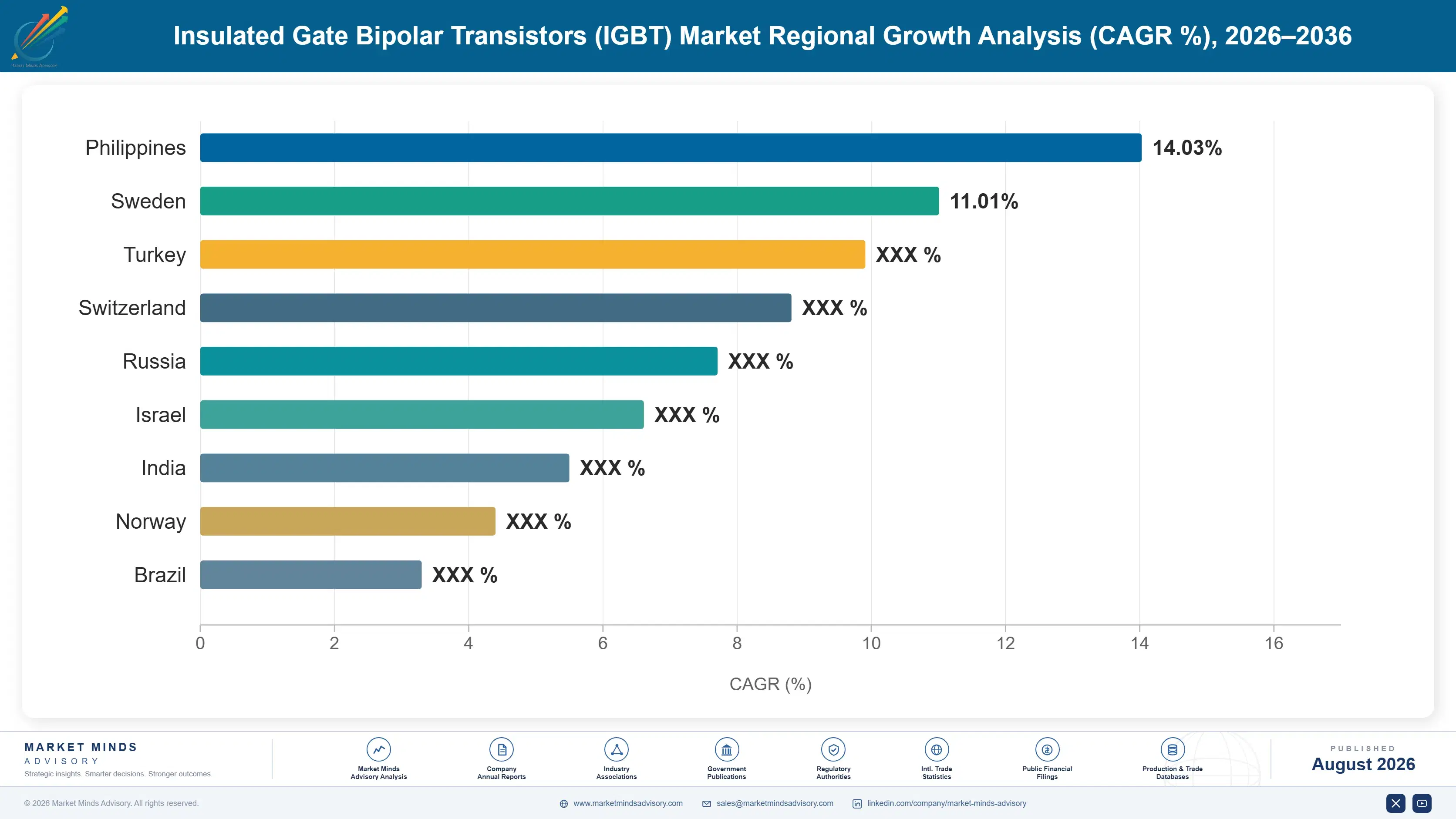
India: 13.2% CAGR
Fastest Growth Region
South Asia and Pacific: 11.8% CAGR
Largest Region
East Asia: 30% of 2025 global value
Market Leaders
Infineon Technologies, Mitsubishi Electric, Fuji Electric, Semikron Danfoss, STMicroelectronics. Source: MMA Analysis based on company annual reports.
Primary Survey
n=3,800 procurement and R&D decision-makers, Q4 2025, six countries
Methodology
Demand-side build-up, cross-validated against public data, 47 expert interviews

Insulated Gate Bipolar Transistors (IGBT) Market Forecast Scenarios

insulated-gate-bipolar-transistors-igbt-market-size-forecast-scenario-1787302272455
Between 2020 and 2025 the market expanded at an estimated 8.5% historical CAGR, slowed briefly by 2022's automotive semiconductor shortage before accelerating as EV production scaled across China, Europe, and North America. Renewable inverter demand added a second growth leg from 2023 onward as utility-scale solar and wind capacity additions reached record annual levels worldwide.
The base case assumes 9.5% CAGR through 2036, resting on three mechanisms: continued EV platform electrification pulling traction inverter volumes higher each model year, utility and commercial solar and wind installations standardizing on higher voltage IGBT modules for grid-tied inverters, and rail and industrial drive operators replacing aging silicon devices as they reach end of service life. Chinese domestic module qualification programmes add a reinforcing tailwind, pulling regional supply chains away from imported modules faster than the base case initially assumed a year ago.
A bull scenario, near 10.8% CAGR, assumes faster than expected silicon carbide hybrid adoption and accelerated EV mandates in Southeast Asia pull volume forward. The bear case, near 8.2%, assumes EV sales growth slows in mature markets and automakers extend existing platform lifecycles rather than commissioning new inverter designs, delaying the next wave of IGBT qualification cycles.

Automotive Qualification Cycles Now Set the Investment Clock

Three forces are converging on IGBT demand simultaneously: an automotive electrification cycle that rewards suppliers who commit fab capacity years ahead of production, a parallel renewable inverter buildout standardizing on higher voltage modules, and a silicon carbide transition that is reshaping module architecture without yet displacing silicon entirely. Buyers increasingly treat design-in timing as a competitive battleground alongside switching loss specifications when selecting a platform
MARKET CONCENTRATION58%Combined revenue share held by top five suppliers
AUTOMOTIVE ASP$14Blended selling price for a standard traction module
DESIGN-IN CYCLE3-4 yrsTypical span from platform selection to production start
FAB UTILIZATION82%Share of installed wafer capacity currently running production
TOP PRODUCING COUNTRYChinaLeading country for finished module assembly and test
SIC-HYBRID ATTACH RATE19%Share of new traction modules pairing silicon carbide diodes
Commercially, the category increasingly resembles a capacity reservation business more than a component sale. Automakers and inverter makers sign multi-year volume commitments well before production begins, shifting negotiating leverage toward whichever supplier can guarantee wafer output during the next capacity cycle rather than whichever offers the lowest unit price today. Distributors serving smaller industrial customers report the same dynamic, with allocation rather than price the primary loyalty lever.
Over the next decade, expect silicon carbide hybrid modules to keep gaining share in premium vehicle platforms, continued consolidation among smaller module assemblers unable to fund advanced packaging lines, and growing scrutiny of supply chain resilience as automakers diversify sourcing away from single-region wafer fabs following recent shortage memories. Regulatory pressure toward domestic content requirements in the United States and European Union is accelerating that diversification.
"Everyone talks about silicon carbide replacing IGBTs outright. In practice, most automakers are buying themselves another decade of silicon by pairing it with just enough carbide to hit the efficiency number marketing needs."
Director, Power Semiconductor and Electrification Practice · MMA Power Semicondu

Market Trends

Automakers Lock Multi-Year Wafer Capacity Reservations

Leading automakers and tier-one inverter suppliers are increasingly signing multi-year wafer capacity reservation agreements directly with IGBT fabs, a practice that was rare before the 2021 semiconductor shortage exposed how exposed just-in-time sourcing left vehicle production schedules. These agreements typically span three to five years and include minimum volume commitments in exchange for guaranteed allocation during future capacity constraints. The shift is reshaping supplier selection criteria, since fabs increasingly favor customers willing to commit capital toward dedicated capacity expansion over spot buyers, effectively locking smaller automakers and off-highway vehicle makers out of premium allocation tiers.
Market Impact: Adds 4.2 million inverter units

Silicon Carbide Hybrid Modules Gain Traction Fast

Module makers are increasingly pairing silicon carbide freewheeling diodes with conventional silicon IGBT switches inside a single package, capturing much of silicon carbide's efficiency benefit without the cost and design risk of a full silicon carbide MOSFET redesign. Early adopters report meaningful reductions in switching losses and cooling system size versus pure silicon modules, at a price premium far smaller than a complete silicon carbide bill of materials would require. Tier-one suppliers view the hybrid architecture as a practical bridge technology, buying engineering teams several additional product cycles to develop full silicon carbide platforms.
Market Impact: Adds 38 GW converted capacity yearl

Market Opportunities and Growth Drivers

Global EV Production Mandates Expanding Traction Inverter Demand

Emissions and electrification mandates across the European Union, China, and a growing list of United States state-level programmes are pushing automakers to expand battery electric and plug-in hybrid production lines, each of which requires one or more traction inverters built around IGBT or silicon carbide hybrid modules. China's new energy vehicle production alone now exceeds several million units annually, and each incremental percentage point of electrification penetration translates directly into additional module demand that did not exist a decade ago. Suppliers with qualified automotive-grade production lines are capturing outsized share of this growth.
Market Impact: Limits new entrants to 3 firms

Utility-Scale Renewable Buildout Standardizing on Higher Voltage Modules

Utility and commercial solar and wind project developers are increasingly specifying higher voltage IGBT modules for central and string inverters as project sizes grow and grid interconnection requirements tighten. The International Energy Agency's renewable capacity additions data shows record annual solar and wind installations across multiple consecutive years, each gigawatt of new capacity requiring a proportional volume of power conversion hardware. Inverter manufacturers report that module reliability and thermal cycling endurance, not raw switching efficiency alone, increasingly determine which suppliers win multi-year renewable framework agreements, since unplanned inverter downtime carries a direct revenue penalty under most utility power purchase agreements.
Market Impact: Cuts silicon IGBT share 8 points

Market Restraints and Challenges

Wafer Fab Capital Intensity Limits New Entrant Access

Building a qualified automotive-grade IGBT fabrication line requires capital investment in the hundreds of millions of dollars alongside a multi-year automotive qualification process, and the root cause is that power semiconductor fabs demand far tighter defect density and reliability tolerances than standard logic or memory fabs of comparable size. The commercial impact falls hardest on regional players attempting to build domestic supply chains without an established automotive quality track record, since automakers rarely qualify a new fab for safety-critical traction applications without years of field data. Some governments are mitigating this through direct capital grants tied to domestic semiconductor programmes.
Market Impact: Secures 5-year capacity commitments

Silicon Carbide Substitution Threatens Long-Term Silicon Share

As silicon carbide MOSFET costs continue falling, some premium vehicle platforms are bypassing silicon and hybrid architectures entirely in favor of full silicon carbide inverters, and the root cause is that silicon carbide's efficiency advantage grows more valuable as battery pack sizes and price competition among automakers both increase simultaneously. The commercial impact concentrates in the premium and performance vehicle segment first, where the switching efficiency gain translates most directly into marketable driving range. Silicon-focused suppliers are mitigating this exposure by expanding their own silicon carbide production lines and marketing hybrid modules as a lower-risk transitional option for cost-sensitive platforms.
Market Impact: Lifts SiC-hybrid attach to 19%
3 additional market trends, 3 additional growth drivers, and 2 additional restraints and challenges are covered in the full report. Contact sales@marketmindsadvisory.com to access the complete intelligence.

Segment CAGR and Growth Architecture

Segmentation follows product and package architecture, the dimension design engineers specify against when selecting a device for a given inverter topology. Discrete devices, standard modules, intelligent power modules, press-pack devices, and silicon carbide hybrid modules each serve distinct voltage, current, and thermal requirements, keeping wafer technology and application integration separate across both discrete and modular device families.
insulated-gate-bipolar-transistors-igbt-market-market-share-analysis-1787302272990

SiC-Hybrid IGBT Modules

SiC-hybrid modules pair silicon carbide freewheeling diodes with conventional silicon IGBT switches, delivering much of silicon carbide's efficiency benefit at a fraction of the cost premium a full silicon carbide MOSFET redesign would require. Adoption is concentrated in mid-range and premium electric vehicle traction inverters, where automakers need incremental efficiency and thermal headroom without committing to an entirely new inverter architecture mid-platform. Growth outpaces the broader IGBT market by roughly 1.5x as tier-one suppliers position the format as a practical bridge technology, buying engineering teams additional product cycles before a full carbide transition becomes unavoidable. Renewable inverter manufacturers are following the same logic, specifying hybrid modules in new central inverter designs to capture efficiency gains within existing qualified footprints.
CAGR 14.5%

Intelligent Power Modules

Intelligent power modules integrate IGBT switches, gate drive circuitry, and protection functions inside a single package, reducing design complexity for inverter manufacturers building mid-power motor drives, appliance compressors, and smaller renewable string inverters. Demand is shifting from basic six-pack configurations toward modules with integrated current sensing and communication interfaces that simplify functional safety compliance for industrial and automotive customers. Growth is fastest among heat pump and variable frequency drive manufacturers responding to energy efficiency mandates that favor integrated, digitally monitored power stages over discrete component designs assembled in house. Suppliers with strong embedded software integration capability are capturing a disproportionate share of this shift, since customers increasingly value a validated reference design over a lower per-unit component price today.
CAGR 9.0%
Full segment breakdown across 5 segments available in the complete report.

Regional Architecture and Country Demand Map

East Asia leads on both production and consumption as China's electric vehicle assembly volume and domestic module qualification programmes expand rapidly, while Western Europe and North America retain design authority and premium automotive platform share despite ceding unit volume growth to Asian suppliers each design cycle.

North America

North America's IGBT demand centers on electric vehicle assembly plants across the Midwest and Southeast, alongside a growing base of utility-scale solar and wind inverter manufacturing encouraged by federal clean energy incentives. Domestic content requirements tied to these incentive programmes are pushing automakers and inverter makers to qualify North American module assembly and test capacity rather than relying solely on imported finished devices from Asia. Canadian rail transit agencies continue steady replacement of aging traction converters as fleets modernize across major metropolitan systems. Growth trails East Asia because the region's automotive electrification ramp started later and remains concentrated among a smaller number of dedicated EV platforms rather than the broad model-line electrification underway across Chinese manufacturers.
Share: 24% | CAGR: 10.2% (2026 to 2036)

Western Europe

Western Europe hosts the design and engineering headquarters of several leading suppliers, giving the region outsized influence over platform architecture decisions even as manufacturing volume increasingly shifts toward Asia. German and French automakers continue specifying premium automotive-grade modules for flagship electric vehicle platforms, sustaining demand for the highest qualification tier even as unit growth slows relative to Asian markets. Regional renewable inverter demand remains steady, tied to ongoing offshore wind and utility solar capacity additions across the North Sea corridor and southern Europe. Growth trails the global rate as the region's automotive manufacturing base matures and fewer new greenfield vehicle assembly plants break ground compared to prior investment cycles across the broader European industrial base.
Share: 22% | CAGR: 8.0% (2026 to 2036)
Regional intelligence for 5 additional markets available in the complete report: East Asia, South Asia and Pacific, Latin America, Middle East and Africa, Eastern Europe. Contact sales@marketmindsadvisory.com.
insulated-gate-bipolar-transistors-igbt-market-country-cagr-analysis-1787302273510

Monetizing Capacity Guarantees and Design Services

Suppliers are shifting commercial leverage away from unit pricing toward capacity guarantees, embedded design services, and long-term supply contracts, since automotive and renewable customers now value delivery certainty and engineering support as much as underlying device cost. This shift mirrors a broader move across power semiconductors toward multi-year commercial structures rather than annual pricing.

Capacity Reservation Contracts With Guaranteed Allocation

Leading suppliers now sell multi-year capacity reservation contracts that guarantee allocation during shortage periods in exchange for minimum volume commitments and pricing locked three to five years in advance. This shifts commercial risk from the customer, who previously absorbed allocation uncertainty during shortages, onto the supplier, who now carries capital commitment risk if demand softens mid-contract. Automakers report paying a premium of roughly 8 to 12% over spot pricing for this guaranteed allocation, a trade they increasingly view as cheap insurance against a production line stoppage that would cost far more than the premium itself.
Market Impact: Commands a premium of 8 to 12 perce

Reference Design and Application Engineering Services

Suppliers increasingly bundle reference inverter designs, thermal simulation support, and functional safety documentation alongside module sales, reducing the engineering burden on smaller inverter manufacturers that lack in-house power electronics design teams. This service layer shortens customer time-to-production by an estimated 4 to 6 months versus a from-scratch design, a meaningful advantage for customers racing to hit a vehicle programme launch date. Suppliers offering validated reference designs report design-in win rates well above those competing purely on unit price, since customers increasingly view engineering support as inseparable from the physical module in total value terms.
Market Impact: Cuts customer time-to-production by

Extended Warranty and Field Reliability Data Programs

Suppliers are increasingly selling extended warranty coverage bundled with field reliability data subscriptions, giving customers real-time visibility into module thermal cycling and degradation trends across their installed fleet. This is particularly valuable for rail and utility customers operating equipment for fifteen to twenty years, where unplanned module failure carries a steep replacement and downtime cost. Early programmes report warranty attach rates above 45% among fleet customers managing more than 500 installed units, since the data subscription itself often pays for itself through avoided unplanned maintenance visits and better spare parts planning across distributed sites.
Market Impact: Lifts warranty attach rate above 45

Silicon Carbide Hybrid Upsell Within Existing Platforms

Suppliers with both silicon and silicon carbide hybrid product lines are using existing customer relationships to upsell hybrid modules within platforms originally designed around standard silicon devices, capturing incremental margin without requiring a new customer acquisition process. This upsell path is proving especially effective among automakers refreshing an existing vehicle platform mid-cycle, where a hybrid module swap can lift efficiency and range specifications without a full inverter redesign. Suppliers report hybrid upsell conversations now influence roughly 30% of mid-cycle platform refresh discussions, a share that has grown as hybrid module pricing has fallen closer to standard silicon parity.
Market Impact: Converts roughly 30 percent of plat

Who Controls the Margin Pool

The top five suppliers hold roughly 58% combined share, a meaningfully higher concentration than most power semiconductor categories, reflecting the capital intensity and multi-year qualification barriers that keep new entrants out. The gap between the leading diversified conglomerates and the next tier of regional challengers is widening as automotive design wins increasingly cluster around suppliers with proven wafer capacity scale.
Current competitive activity centers on three fronts: wafer fab capacity expansion announcements timed to automotive platform cycles, silicon carbide hybrid product line launches, and long-term capacity reservation agreements signed directly with automakers rather than through distribution. Several Chinese suppliers are pursuing aggressive capacity buildouts aimed at import substitution, a faster but less profitable route to share than the incumbents' qualification-driven growth model built over decades.

Emerging pressure comes from Chinese domestic suppliers moving up the value chain from commodity discrete devices into fully qualified automotive modules, sold initially to domestic automakers but increasingly targeting export markets as well. Rankings among the top five could shift meaningfully over the next several years if incumbents fail to match Chinese capacity growth rates, since automakers increasingly diversify sourcing across at least two qualified suppliers per platform for supply security reasons alone.
insulated-gate-bipolar-transistors-igbt-market-company-positioning-matrix-1787302274037

Competitive Moat and Risk Dimensions

INFINEON TECHNOLOGIES

Moat: Automotive design-in scale

Infineon's decade-long incumbency across major European and Asian automotive platforms, combined with the industry's broadest automotive-qualified product portfolio spanning silicon and silicon carbide, gives it a design-in advantage difficult for challengers to match without years of accumulated field reliability data. That data advantage compounds with every new platform win Infineon secures.
INFINEON TECHNOLOGIES

Risk: European manufacturing cost exposure

A manufacturing footprint weighted toward Germany and Austria leaves Infineon more exposed to European energy and labor cost inflation than Asian competitors, pressuring margins as Chinese suppliers expand qualified capacity and begin competing directly for mid-tier automotive platform allocations. That price gap is unlikely to close within the next several years.
MITSUBISHI ELECTRIC

Moat: Rail and industrial incumbency

Mitsubishi Electric's multi-decade relationships across rail traction and heavy industrial drive customers give it durable incumbency in applications where field reliability history outweighs price, and switching suppliers requires years of requalification testing most industrial customers are reluctant to fund. That incumbency compounds slowly and is difficult for challengers to replicate quickly.
MITSUBISHI ELECTRIC

Risk: Slower EV platform penetration

Mitsubishi Electric has been slower than European and some Chinese rivals to secure high-volume passenger EV traction inverter design wins, leaving it more dependent on rail, industrial, and renewable segments growing steadily but well below the pace of global electric vehicle production ramp. That gap is narrowing only slowly.

Players Tracked

Prominent Players

Infineon Technologies
Mitsubishi Electric
Fuji Electric
Semikron Danfoss
STMicroelectronics

Other Key Players

onsemi
Toshiba Electronic Devices
Hitachi Power Semiconductor
Rohm Semiconductor
Vishay Intertechnology
Littelfuse
Renesas Electronics
Bosch Semiconductor
Delta Electronics
Hestia Power
StarPower Semiconductor
CRRC Times Electric
China Resources Microelectronics
BYD Semiconductor
Wolfspeed

Recent Developments

SEPTEMBER 2025

Infineon Expands Kulim Malaysia Wafer Fab Capacity

Infineon announced an expansion of its 200mm silicon carbide and IGBT wafer fabrication capacity at its Kulim, Malaysia facility, adding automotive-qualified output aimed primarily at electric vehicle customers in Southeast Asia and China. The expansion is organic capacity growth, not an acquisition or joint venture, funded through existing capital expenditure.
Signal: Signals continued geographic diversificati
JANUARY 2026

STMicroelectronics Signs Multi-Year Supply Agreement With European Automaker

STMicroelectronics signed a multi-year IGBT and silicon carbide hybrid module supply agreement with a major European automaker, securing guaranteed wafer allocation through 2030 in exchange for minimum volume commitments. The agreement is a supply arrangement rather than a joint venture or acquisition. It extends STMicroelectronics' European automotive relationship considerably.
Signal: Confirms capacity reservation contracts, n
APRIL 2026

StarPower Semiconductor Acquires Domestic Module Packaging Facility

Chinese supplier StarPower Semiconductor completed the acquisition of a domestic module packaging and test facility, expanding its automotive-qualified assembly capacity to serve growing Chinese electric vehicle demand without relying on imported finished modules from abroad. The deal strengthens China's push toward domestic supply chain self-sufficiency in power semiconductor packaging.
Signal: Highlights accelerating Chinese domestic c

Wafer and Substrate Cost Exposure

Raw silicon and silicon carbide wafers, along with copper baseplates and ceramic substrates used in module packaging, together represent an estimated 40 to 50% of IGBT module cost of goods sold. Silicon carbide wafer supply remains concentrated among a small number of qualified crystal growers, creating a narrower supply base than mature silicon wafer production carries today.
Silicon carbide wafer prices spiked meaningfully during 2022 and 2023 as automotive demand outpaced qualified crystal growth capacity, a shortage the IEA's critical materials reporting flagged as a broader risk across power electronics categories reliant on wide-bandgap substrates. Several suppliers disclosed in annual reports that silicon carbide wafer lead times stretched beyond thirty weeks during the peak of the shortage, forcing some module makers to delay hybrid product launches or substitute costlier secondary market allocations.

Smaller module assemblers carry disproportionate exposure to these input swings since they lack the purchasing scale to negotiate multi-year fixed pricing directly with wafer growers that the top five suppliers secure. This gap is widest for assemblers dependent on silicon carbide hybrid product lines, leaving them more vulnerable to margin compression during substrate shortages than diversified competitors able to shift production mix back toward pure silicon devices.
insulated-gate-bipolar-transistors-igbt-market-cost-volatility-analysis-1787302274232

Vertical Integration Into Wafer Growth

Leading suppliers are investing directly in silicon carbide crystal growth capacity rather than relying solely on merchant wafer suppliers, insulating their hybrid module lines from the substrate shortages that stretched lead times beyond thirty weeks during 2022 and 2023 and protecting delivery commitments on automotive contracts. This also reduces exposure to sudden spot market price spikes.

Multi-Year Wafer Supply Contracts

Top five suppliers increasingly lock multi-year pricing directly with qualified silicon carbide crystal growers, smoothing substrate costs and insulating margin from the spot price volatility smaller module assemblers remain exposed to, a practice that has become standard procurement policy since the 2022 shortage cycle. This approach has already shielded margins during two subsequent price spikes since then.

Flexible Silicon and Hybrid Production Lines

Manufacturers are designing assembly lines capable of shifting between pure silicon and silicon carbide hybrid module production based on relative input cost, avoiding dedicated hybrid-only capacity that would sit idle during a substrate shortage and preserving overall factory utilization across changing input cost conditions. This flexibility also shortens new product qualification timelines for hybrid variants.

Portfolio Architecture for Margin Defence

Portfolio architecture splits across three tiers: volume priced discrete devices and standard modules competing largely on unit cost, certified automotive and rail-grade modules carrying qualification barriers that support durable pricing, and next generation silicon carbide hybrid and full silicon carbide platforms bundled with design services. Gross margins widen meaningfully moving up this ladder as qualification and engineering barriers concentrate hardest at the premium tier, squeezing vend
The volume versus premium tension is sharpest in standard industrial modules, where Chinese import competition has compressed prices fastest, pushing established vendors to defend share through design services and capacity guarantees rather than matching import pricing directly. Automotive-qualified modules retain pricing power because requalification cost and multi-year platform commitments discourage buyers from switching suppliers mid-programme.

High value margin pools concentrate in silicon carbide hybrid modules paired with reference design services, where engineering value and long-term capacity contracts together support gross margins well above the portfolio average. Vendors are consequently prioritizing capital and engineering investment toward this tier even though it remains a minority of total unit volume shipped across the broader portfolio today, betting the mix shifts within the decade.

Volume / Commodity-Adjacent Tier

Basic discrete IGBTs and standard industrial modules competing primarily on unit price against Chinese import competition, with limited design service attach and thin per-unit margins. Competitive intensity here remains highest across the entire portfolio.
Gross Margin: 22-30%

Premium / Certified Tier

Automotive and rail-grade qualified modules serving safety-critical traction and transit applications, where qualification cost and platform lock-in support durable, defensible pricing across multi-year contracts. Buyers rarely switch suppliers mid-programme once qualified.
Gross Margin: 38-46%

Sustainability / Regulatory / Next-Generation Tier

Silicon carbide hybrid and full silicon carbide platforms bundled with reference design and capacity guarantee services, sold on engineering value rather than device specification alone. Suppliers here compete primarily on roadmap credibility.
Gross Margin: 50-58%
insulated-gate-bipolar-transistors-igbt-market-portfolio-architecture-1787302274738

Platform Lock-In Drives Recurring Demand

IGBT economics function like a multi-year annuity once a supplier wins a vehicle or inverter platform design-in, since the qualified device typically remains locked in for the full production life of that platform, often seven to ten years for an automotive programme. This is why suppliers compete so aggressively, even at thin initial margins, to win the design-in in the first place, treating early wins as a foothold rather than the profit event itself.
Adoption depth varies sharply by end-use vertical. Automotive and renewable inverter platforms are still expanding rapidly as electrification penetration climbs, while rail and heavy industrial drive verticals run closer to a mature replacement cycle tied to fixed asset lifespans rather than new capacity growth across already well-instrumented industrial verticals nearing saturation.

Buyer profiles are shifting generationally as power electronics engineers who grew up designing around silicon carbide from the start increasingly influence platform architecture decisions alongside veteran engineers trained primarily on silicon. This is accelerating hybrid and full silicon carbide adoption even among conservative industrial customers who historically favored proven silicon devices exclusively, a shift some legacy-focused suppliers are struggling to answer.
insulated-gate-bipolar-transistors-igbt-market-end-use-penetration-index-1787302275229

Where Power Semiconductor Strategy Should Focus

These are among the four positions where our research anticipates prominent divergence between winners and laggards over the coming forecast period. Each is grounded in the demand model, the regulatory perimeter, and the announced capacity pipeline.
01 / CAPACITY INVESTMENT PRIORITY

Commit fab capacity to automotive customers years in advance

Automotive design-in has become a multi-year annuity, and suppliers unwilling to commit fab capacity years ahead of production are increasingly locked out of premium allocation tiers entirely. Automakers now favor suppliers who guarantee volume during shortages over those offering marginally lower unit prices, reshaping the basis of competitive advantage across the category. Vendors that continue treating IGBT sales as a spot transaction rather than a capacity relationship risk losing share to rivals willing to underwrite dedicated automotive capacity expansion across multiple qualified regions.
02 / HYBRID PRODUCT ROADMAP

Treat SiC-hybrid modules as a bridge, not an endpoint

Silicon carbide hybrid modules are growing at roughly 1.5x the overall market rate as automakers seek incremental efficiency without a full silicon carbide redesign, but the format is fundamentally transitional rather than a permanent architecture choice. Suppliers that use the hybrid window to fund full silicon carbide development will be better positioned once carbide costs fall further across the forecast period. Those treating hybrid modules as a permanent product line risk being bypassed once premium platforms move to full carbide inverters directly.
03 / REGIONAL SUPPLY DIVERSIFICATION

Build qualified capacity outside single-region concentration now

The 2022 and 2023 substrate shortage demonstrated how concentrated silicon carbide wafer supply can stretch automotive delivery lead times well beyond thirty weeks during a single disruption event. Automakers are responding by requiring at least two qualified regional suppliers per platform, rewarding vendors with genuinely diversified fab and substrate sourcing footprints across separate geographies. Suppliers still dependent on a single wafer region remain exposed to the next shortage cycle in a market where automotive delivery penalties are contractually enforced across most major platform agreements.
04 / CHINESE COMPETITIVE RESPONSE

Defend premium tiers as Chinese suppliers scale fast

Chinese domestic suppliers are moving quickly from commodity discrete devices into fully qualified automotive modules, initially serving domestic automakers but increasingly targeting export markets as capacity scales further across the decade. Incumbents that fail to match this capacity growth risk ceding standard industrial and mid-tier automotive share within the next several years of the forecast period ahead. Defending premium automotive and rail tiers through design services and reliability data, rather than competing on unit price, offers the more durable response available.

Engagement Snapshot From the Field

A live engagement with an industry participant carrying material or product regulatory and market exposure ahead of a defining policy shift, showing how our research translates into a defensible multi-year portfolio strategy.
MARKET MINDS ADVISORY · CLIENT ENGAGEMENT SUMMARY
Insulated Gate Bipolar Transistors (IGBT) Producer Strategic Portfolio Review and Transition Roadmap 2026·Investment Scenario on Insulated Gate Bipolar Transistors (IGBT) Exposure Evaluation 2025-26
CLIENT PROFILE
The client is a global automotive tier-one supplier manufacturing traction inverters for multiple original equipment manufacturer electric vehicle platforms, generating revenue in the mid single digit billions (client-reported, unverified by MMA). Facing simultaneous platform launches across three continents, the client's existing IGBT sourcing strategy relied on two suppliers with limited automotive capacity commitments, creating exposure during the 2022 and 2023 wafer shortage that delayed several vehicle programme launches significantly.
STRATEGIC CHALLENGE
Following the shortage-driven delays, corporate leadership sought a diversified, multi-year capacity-secured sourcing strategy spanning at least three qualified suppliers across two continents, while minimizing incremental unit cost and preserving existing platform qualification timelines for programmes already in late-stage development and testing, without triggering a costly platform requalification cycle for programmes already close to launch.
MMA APPROACH
MMA benchmarked seven candidate suppliers against wafer capacity commitment terms, silicon carbide hybrid roadmap maturity, and total cost of ownership over an eight-year platform horizon, then modeled a diversified sourcing allocation designed to minimize single-region concentration risk across the client's global manufacturing footprint entirely, while preserving near-term delivery reliability for programmes already in production.
KEY FINDINGS
  1. Four of seven suppliers evaluated could not guarantee capacity commitments beyond eighteen months without a signed minimum volume agreement in place upfront.
  2. Diversifying across three qualified suppliers was projected to reduce shortage-related delay risk by roughly 60% versus the prior two-supplier structure (client-reported, unverified by MMA).
  3. Silicon carbide hybrid modules offered the best efficiency-to-cost tradeoff for the client's mid-range platform relative to full silicon carbide alternatives evaluated for this use case.
  4. Suppliers with in-house reference design teams cut projected platform qualification time by nearly four months on average across the pilot programme evaluated.
CLIENT PROFILE
The client is a global automotive tier-one supplier manufacturing traction inverters for multiple original equipment manufacturer electric vehicle platforms, generating revenue in the mid single digit billions (client-reported, unverified by MMA). Facing simultaneous platform launches across three continents, the client's existing IGBT sourcing strategy relied on two suppliers with limited automotive capacity commitments, creating exposure during the 2022 and 2023 wafer shortage that delayed several vehicle programme launches significantly.
STRATEGIC CHALLENGE
Following the shortage-driven delays, corporate leadership sought a diversified, multi-year capacity-secured sourcing strategy spanning at least three qualified suppliers across two continents, while minimizing incremental unit cost and preserving existing platform qualification timelines for programmes already in late-stage development and testing, without triggering a costly platform requalification cycle for programmes already close to launch.
MMA APPROACH
MMA benchmarked seven candidate suppliers against wafer capacity commitment terms, silicon carbide hybrid roadmap maturity, and total cost of ownership over an eight-year platform horizon, then modeled a diversified sourcing allocation designed to minimize single-region concentration risk across the client's global manufacturing footprint entirely, while preserving near-term delivery reliability for programmes already in production.
KEY FINDINGS
  1. Four of seven suppliers evaluated could not guarantee capacity commitments beyond eighteen months without a signed minimum volume agreement in place upfront.
  2. Diversifying across three qualified suppliers was projected to reduce shortage-related delay risk by roughly 60% versus the prior two-supplier structure (client-reported, unverified by MMA).
  3. Silicon carbide hybrid modules offered the best efficiency-to-cost tradeoff for the client's mid-range platform relative to full silicon carbide alternatives evaluated for this use case.
  4. Suppliers with in-house reference design teams cut projected platform qualification time by nearly four months on average across the pilot programme evaluated.
RECOMMENDED STRATEGY
Phase 1: Phase 1 (Months 1-4): Qualify two additional suppliers with strong automotive capacity commitments across separate wafer regions before the next platform cycle begins. Phase 2: Phase 2 (Months 5-10): Renegotiate existing contracts to include multi-year capacity guarantees and minimum volume commitments with pricing locked through 2030. Phase 3: Phase 3 (Months 11-18): Transition a portion of hybrid module sourcing toward the highest-reliability qualified supplier identified based on field reliability data.
OUTCOME
The client secured multi-year capacity guarantees across three qualified suppliers spanning two continents within the eighteen month engagement window, reducing single-supplier concentration risk meaningfully (client-reported, unverified by MMA). Subsequent platform launches proceeded without wafer-related delays, and the client reported an improved negotiating position during the following contract renewal cycle.

Frequently Asked Questions

Foundational context covering the market sizes, CAGR, scope, country, region and competition that inform every finding below. This section is provided to cover basics and most often pre-purchase conversations, answered from the MMA Primary Research Dataset.

What is the current size of the Insulated Gate Bipolar Transistors (IGBT) Market?

The global IGBT market reached an estimated $8.6 billion in 2025. Growth is driven by electric vehicle traction inverter demand and utility-scale renewable inverter buildout worldwide.

How large will the Insulated Gate Bipolar Transistors (IGBT) Market be by 2036?

The market is projected to reach approximately $23.3 billion by 2036, roughly 2.48 times its 2026 value. Silicon carbide hybrid modules and automotive electrification drive most of the added value.

What is the CAGR for the Insulated Gate Bipolar Transistors (IGBT) Market 2026 to 2036?

The base case CAGR is 9.5% through 2036. Bull and bear scenarios range from roughly 8.2% to 10.8%, depending on EV adoption pace and silicon carbide substitution speed.

Which segment is growing fastest?

Silicon carbide hybrid IGBT modules lead at a 14.5% CAGR, about 1.5x the overall market rate. Growth is concentrated in mid-range and premium electric vehicle traction inverters.

Who are the major companies in the Insulated Gate Bipolar Transistors (IGBT) Market?

Infineon Technologies, Mitsubishi Electric, Fuji Electric, Semikron Danfoss, and STMicroelectronics lead the category. Combined, the top five suppliers hold roughly 58% of global revenue today.

Which country is growing fastest?

India leads country level growth at an estimated 13.2% CAGR. Rapid rail, solar, and electric vehicle inverter buildout is driving demand from a comparatively small installed base.

Report Segmentation Architecture

The full report scope spans multiple orthogonal segmentation dimensions, with cross-tabulated demand data provided for each dimension pair. Coverage extends further to regional breakdowns, trend trajectories, and the competitive detail needed to support segment-level decision-making.

By Product and Package Type

  • Discrete IGBTs
  • Standard IGBT Modules
  • Intelligent Power Modules
  • Press-Pack IGBTs
  • SiC-Hybrid IGBT Modules

By End-Use Industry

  • Automotive and Electric Vehicles
  • Renewable Energy Inverters
  • Rail and Transit
  • Industrial Motor Drives
  • Consumer and Appliance

By Commercial Dimension

  • OEM Direct Sales
  • Distributor Channel Sales
  • Capacity Reservation Contracts
  • Reference Design Engineering Services

By Region

  • North America
  • Western Europe
  • East Asia
  • South Asia and Pacific
  • Latin America
  • Middle East and Africa
  • Eastern Europe

Scope, Methodology, and Coverage

Every figure in this report is reproducible from documented input assumptions. The scope below maps the historical period, the forecast horizon, the segmentation dimensions, and the countries covered, alongside the underlying primary and qualitative methodology.
Historical Period
2020 to 2025
Forecast Period
2026 to 2036
Base Year
2025 (USD billions; MMA Primary Research Dataset, August 2026)
Market Definition
The IGBT market covers insulated gate bipolar transistor discretes, modules, and intelligent power modules used to switch and convert electrical power across automotive, renewable energy, rail, and industrial drive applications. It spans silicon and silicon-carbide-hybrid device architectures sold to OEMs, tier-one suppliers, and inverter manufacturers.
Quantitative Units
USD billions (current prices); unit shipment volume where disclosed
Segmentation Dimensions
By Product and Package Type; By End-Use Industry; By Commercial Dimension; By Region
Regions Covered
North America, Western Europe, East Asia, South Asia and Pacific, Latin America, Middle East and Africa, Eastern Europe
Countries Covered
USA, China, Germany, France, UK, Japan, South Korea, India, Australia, Canada, Brazil, Mexico, Indonesia, Vietnam, Thailand, Malaysia, UAE, Saudi Arabia, South Africa, Nigeria, Turkey, Poland, Netherlands, Italy, Spain, Sweden, Switzerland, Argentina, Colombia, Singapore, and additional markets relevant to this sector
Key Companies Profiled
Infineon Technologies, Mitsubishi Electric, Fuji Electric, Semikron Danfoss, STMicroelectronics, onsemi, Toshiba Electronic Devices, Hitachi Power Semiconductor, Rohm Semiconductor, Vishay Intertechnology, Littelfuse, Renesas Electronics, Bosch Semiconductor, Delta Electronics, Hestia Power, StarPower Semiconductor, CRRC Times Electric, China Resources Microelectronics, BYD Semiconductor, Wolfspeed
Quantitative Methodology
Primary survey, n=3,800 respondents, Q4 2025, six countries; demand-side model with trade association cross-validation
Qualitative Methodology
47 expert interviews, Q4 2025; applied to validate demand model assumptions, identify emerging dynamics, and assess competitive positioning
Report Format
PDF and XLSX data workbook (Word format preview document)
Publisher
Market Minds Advisory
Report Code
MMA-2026-TEC-102
Published
August 2026
Contact
sales@marketmindsadvisory.com | www.marketmindsadvisory.com

Purchase the full Insulated Gate Bipolar Transistors (IGBT) Market Report (2026 to 2036).

The full report delivers a complete quantitative and qualitative assessment of the global IGBT market through 2036. It includes detailed segmentation by product and package architecture, end-use industry, and commercial channel, alongside country level sizing across thirty markets covering every major automotive and renewable demand center. Competitive profiles cover twenty companies with capability, capacity, and pricing benchmarking assessed on a consistent revenue basis. Buyers also receive access to the underlying primary survey and expert interview datasets referenced throughout the analysis, along with editable data tables.
Segment level CAGR and sizing tables
Regional and country level market breakdowns
Twenty company competitive profiles and benchmarks
Silicon carbide hybrid roadmap capability benchmarking
Input cost and substrate supply risk analysis
Primary survey and expert interview datasets

Built For The People Who Decide

From boardroom strategy to bench-side execution, this report is read cover-to-cover by leaders shaping the next decade of their industry, turning demand scenarios, market dynamics and valuation benchmarks into decisions.
CXOs/ Presidents/ VPs/ Managers
M&A and Corporate Development
Strategy Teams and R&D Heads
Procurement and Product Directors
Regulatory and Compliance Leaders
Investor Relations and Equity Analysts