Market Minds Advisory
Instant Replay Server Market

Instant Replay Server Market: Instant Replay Server Market: Officiating Mandates, Remote Consolidation and Operator Muscle Memory, 2026 to 2036

Video officiating turned replay from a production luxury into competition infrastructure, which is why this market grew through years when broadcast capital spending was falling almost everywhere. Nobody modelled that.

Lead Analyst

Published

September 2026

Make Smarter Decisions with Customized Research Insights

Request a free sample report and evaluate market opportunities, growth trends, and competitive dynamics relevant to your business needs.

2025 MARKET VALUE$0.6BMarket Size 2025
2036 FORECAST VALUE$1.4BBase Case , 2026 to 2036
CAGR 2026 TO 20367.8 %Bull 9.0% / Bear 6.6%
INCREMENTAL OPPORTUNITY$0.7BNet 10- year value creation
EXPANSION MULTIPLE2.12x2036 value over 2026 base
Strategic Levers
M&A Pipeline
Regional Outlook
Country Rankings
Competitive Intelligence
Segmental Deep-dive
Call-Us : 91 93563 13602

Executive Snapshot and Market Trajectory.

The buyer changed and the product description did not. Around 41% of demand now exists because a competition requires video officiating rather than because a broadcaster wants better coverage, and a mandated venue needs replay whether the match is televised or not. The product description never changed.
Meanwhile the box is being taken apart. Software-defined platforms running on standard servers grow at 11.7%, half again the market rate of 7.8%, because storage, processing and control no longer have to sit in one chassis. What survives disaggregation is the control surface, since an operator takes around 9 weeks to reach speed on unfamiliar panels and nobody risks that during a live event. Muscle memory is the asset here, not the engineering.
Five vendors hold 68% of measured revenue, and remote production is consolidating the installed base beneath them. Some 57% of events are now produced from centralised facilities rather than on site, which means fewer and larger systems running at higher utilisation. Vendors selling hardware units are losing volume that vendors selling per-event capacity are collecting. Vendors measuring themselves in units shipped cannot see what is happening to them.
Market Definition
The instant replay server market covers systems that ingest, store and play back multiple synchronised video feeds for live slow-motion replay, highlights and officiating review, spanning dedicated hardware servers, software-defined on-premise platforms, cloud and remote production services, hybrid deployments, control surfaces and operator panels, and embedded venue officiating appliances. Sizing is measured at vendor shipment and subscription revenue. Cameras, vision mixers, graphics systems, transmission encoders, general media asset management and post-production editing tools are excluded.
Base Year Value
$0.6B in 2025 (MMA Primary Research Dataset, September 2026)
Forecast Period
2026 to 2036, eleven discrete annual values
CAGR
7.8% base case. Bull 9.0%. Bear 6.6%.
Fastest Growth Segment
Software-Defined On-Premise Platforms: 11.7% CAGR
Fastest Growth Country
India: 13.6% CAGR
Fastest Growth Region
South Asia and Pacific: 10.0% CAGR
Largest Region
North America: 30% of 2025 global value
Market Leaders
EVS Broadcast Equipment, Evertz Technologies, Grass Valley, Ross Video, Sony. Source: MMA Analysis based on company annual reports and measured shipment and subscription revenue.
Primary Survey
n=3,800 procurement and R&D decision-makers, Q4 2025, six countries
Methodology
Demand-side build-up, cross-validated against public data, 47 expert interviews

Instant Replay Server Market Forecast Scenarios

instant-replay-server-market-size-forecast-scenario-1788414369212
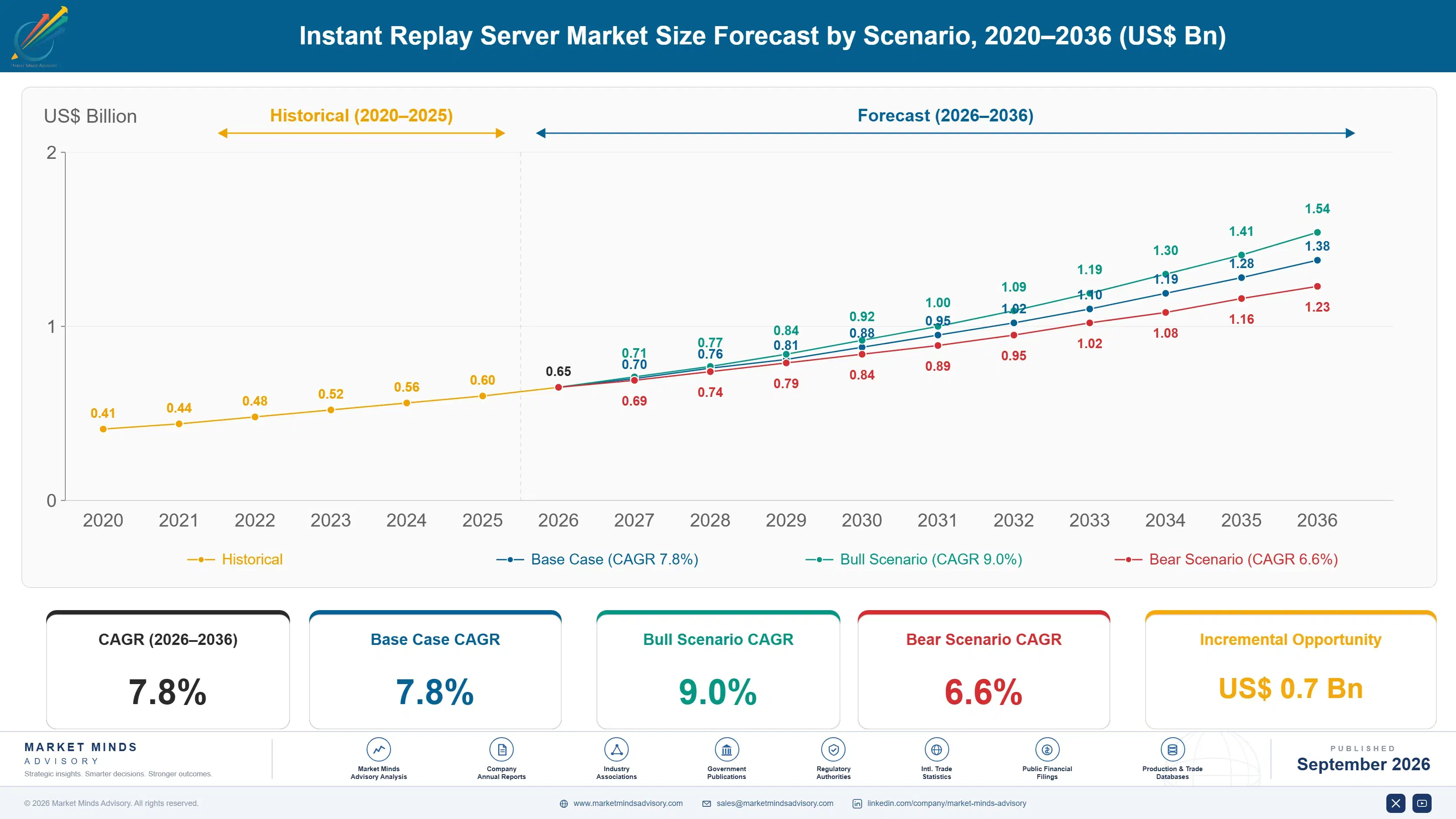
Between 2020 and 2025 the market compounded at 6.6% while broadcast capital spending fell across most of the period, which is a combination that requires explanation. Officiating requirements provided it. Leagues adopting video review needed replay capability at every venue regardless of broadcast plans, and that demand arrived on a mandated timetable rather than a discretionary one, offsetting production budgets that were otherwise contracting sharply.
The 7.8% base case rests on three commercial mechanisms. Officiating adoption continues spreading downward through second-tier competitions and outward into sports that have not previously used it, and each adoption is a mandate rather than a preference. Migration from serial digital interface to internet protocol infrastructure forces replacement of systems that would otherwise have run for years. And software-defined platforms let vendors sell capacity by event rather than boxes by venue.
The bull case is officiating requirements extending into amateur and collegiate competition at scale, which would multiply venue count far beyond professional sport. The bear case is remote production consolidating faster than expected, since every venue that stops needing local equipment removes a system, and centralised facilities serve many events with far less hardware than the venues they replaced.

Officiating Bought What Broadcasting Stopped Buying

This market grew while broadcast capital spending shrank, because its buyer changed. Video officiating turned replay into competition infrastructure: a league requiring review needs synchronised multi-angle capture and reliable playback at every venue, whether the match is televised or not covered at all. That is 41% of demand arriving on a mandated timetable rather than a production budget cycle.
TOP FIVE CONCENTRATION68%Share of measured shipment revenue held by leading vendors
OFFICIATING DEMAND SHARE41%Portion of demand created by video officiating requirements
REMOTE PRODUCTION SHARE57%Portion of events produced from centralised facilities rather than site
CHANNEL COUNT PER SYSTEM12 channelsVideo channels a typical venue replay system handles
SYSTEM SERVICE LIFE7 yearsWorking life before replacement in professional production service
OPERATOR RETRAINING TIME9 weeksTime for an operator to reach speed on unfamiliar panels
The hardware itself is being disaggregated. Storage, video processing and operator control used to share a chassis because bandwidth demanded it, and internet protocol infrastructure removed that constraint, so software-defined platforms on standard servers now do the same work. That segment grows at 11.7% against a market at 7.8%. Vendors whose value sat in proprietary hardware are watching it move into software that runs on anybody's equipment.
What survives is the control surface, which is not a technical observation but a human one. A replay operator works by feel during a live event, and moving to unfamiliar panels costs around nine weeks to regain speed that nobody will risk mid-season. That muscle memory is the genuine switching cost in this market, and it is why vendors defend their panels far more carefully than their servers.
"Everyone models this as a broadcast technology market and it stopped being one years ago. The growth came from referees, and the switching cost is an operator's thumbs. Neither of those appears anywhere in a product specification."
Director, Broadcast Production and Live Media Technology Practice · MMA Technology and Broadcast Media Practice · September 2026

Market Trends

Officiating Requirements Now Create Non-Discretionary Demand

A competition adopting video review commits every participating venue to synchronised multi-angle capture and reliable playback, and that obligation is independent of whether anyone is broadcasting the match. Around 41% of demand now originates this way, which is why the market expanded through years when production budgets contracted. Officiating buyers also specify differently, prioritising reliability, auditability and defined latency over creative capability, and they buy on a competition calendar rather than a capital cycle. Adoption continues spreading into second-tier competitions and into sports that have never used review before. Nobody negotiates a rule book.
Market Impact: Adds 4 tiers below professional
Internet Protocol Infrastructure Disaggregates The Server

Replay servers were built as single chassis because moving uncompressed video between boxes was not practical, and internet protocol transport removed that limitation entirely. Storage, processing and control can now sit in different rooms or different cities, which lets software-defined platforms on standard servers do work that required purpose-built hardware. That segment grows at 11.7% against a market at 7.8%. The commercial consequence is severe for vendors whose margin sat in proprietary hardware, and it opens the market to software companies with no manufacturing at all. Software companies with no manufacturing can now enter.
Market Impact: Replaces systems before 7 years

Market Opportunities and Growth Drivers

Video Review Spreads Downward Through Competition Tiers

Officiating technology adopted at the top of a sport creates pressure at every level beneath it, because a competition without review faces criticism the tier above no longer receives. Second-tier leagues, national cup competitions and increasingly collegiate sport are adopting simplified systems built for the purpose rather than full production installations. Those buyers need fewer channels and far less creative capability but the same reliability, which is a different product at a different price point. Venue count at that level exceeds professional sport by a very wide margin. Volume sits well below professional sport.
Market Impact: Costs 9 weeks of retraining

Interface Migration Forces Replacement Of Working Systems

Facilities moving from serial digital interface to internet protocol infrastructure cannot keep equipment that speaks only the old standard, which forces replacement of replay systems that would otherwise have run several more years. Typical service life is around 7 years and migration is compressing that considerably across the installed base. The replacement is not optional once a facility commits to the transition, since mixed infrastructure requires conversion equipment nobody wants to maintain. This is the clearest source of scheduled replacement demand in the market. Mixed infrastructure requires conversion equipment nobody wants.
Market Impact: Removes 1 system per venue

Market Restraints and Challenges

Operator Familiarity Blocks Any Competitive Displacement

A replay operator works by feel under live pressure, and moving to unfamiliar control surfaces costs around 9 weeks to regain full speed, which no production will accept during a season. The root cause is that the skill is physical rather than procedural and cannot be transferred by documentation. Commercial impact is a market where the best product frequently loses to the familiar one, and where displacement happens only at facility rebuilds. Vendors mitigate through panel layouts that mimic competitors, training programmes run in the off-season and software-defined systems that let an operator keep a preferred panel across different platforms.
Market Impact: Creates 41% of total demand

Remote Consolidation Removes Installed Systems Permanently

Every venue that stops holding local equipment because production moved to a central facility removes a system that no commercial effort recovers, and 57% of events are already produced this way. The root cause is that dedicated venue equipment sat idle most of the year while a central gallery can serve many events. Commercial impact falls hardest on vendors whose revenue is measured in units shipped. Participants mitigate by pricing capacity per event rather than per box, by targeting smaller productions that centralisation makes affordable, and by selling into the central facilities themselves.
Market Impact: Grows at 11.7% annually
3 additional market trends, 4 additional growth drivers, and 2 additional restraints and challenges are covered in the full report. Contact sales@marketmindsadvisory.com to access the complete intelligence.

Segment CAGR and Growth Architecture

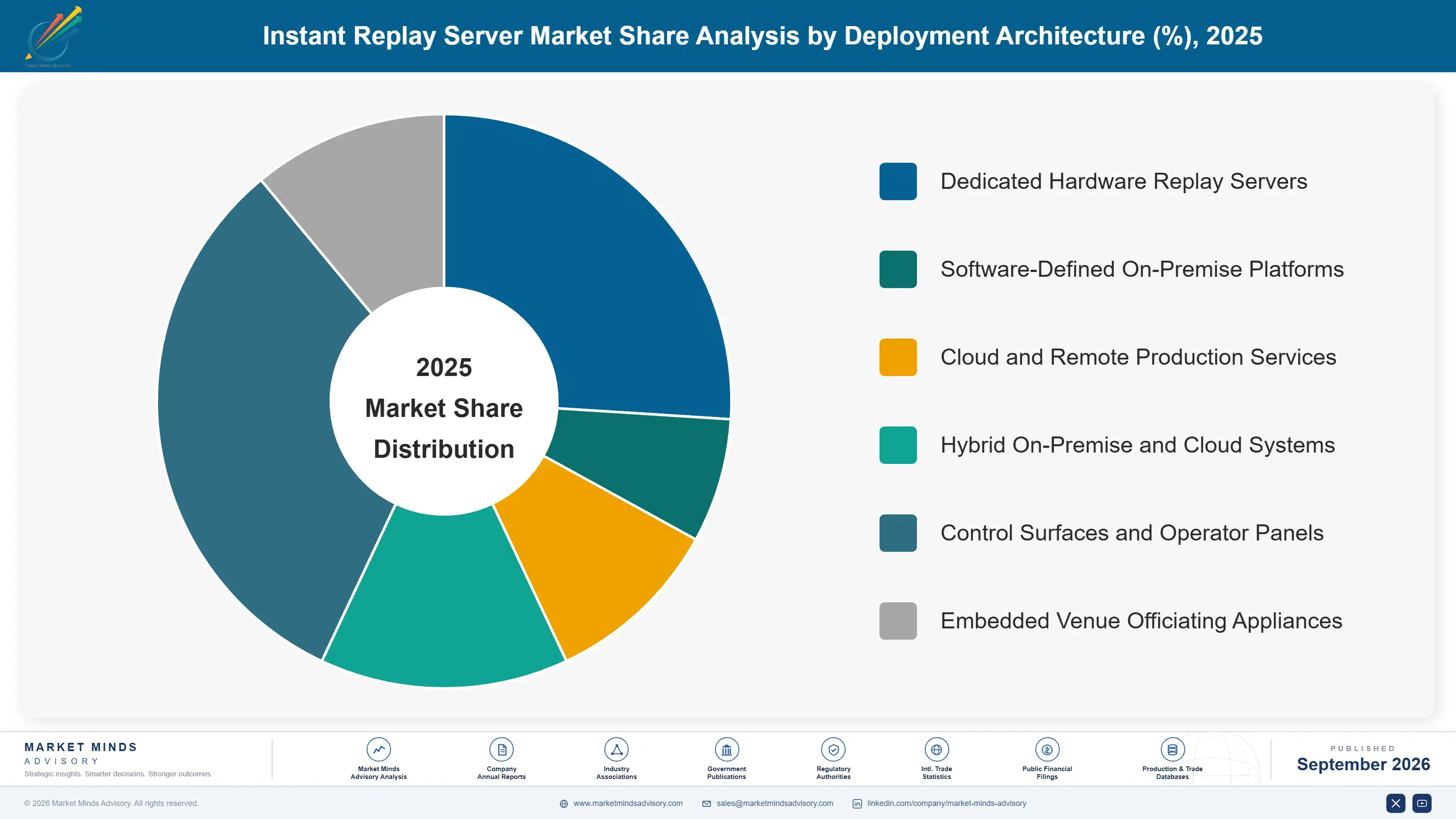
Segmentation follows deployment architecture, which determines where the processing happens, how the product is priced and who can supply it. Dedicated hardware, software-defined on-premise, cloud and remote, hybrid, control surfaces and venue officiating appliances each serve different buyers, and the growth divergence between hardware and software is now very wide indeed. Buyers rarely cross between them.
instant-replay-server-market-market-share-analysis-1788414369760

Software-Defined On-Premise Platforms

Internet protocol transport removed the reason replay servers had to be single purpose-built chassis, so the same work now runs as software on standard servers with storage and processing separated. That changes the cost structure, lets a facility scale channels without replacing hardware, and opens the market to software companies carrying no manufacturing at all. Growth at 11.7% is half again the market rate of 7.8%. The commercial consequence is severe for vendors whose margin sat in proprietary hardware design. Deterministic performance under live conditions remains genuinely difficult on general purpose equipment, which is where the established vendors still hold real advantage. Live conditions punish anything that is not deterministic.
CAGR 11.7%

Cloud and Remote Production Services

Capacity delivered from a centralised or cloud facility and priced per event rather than per box serves productions that could never justify dedicated equipment, which genuinely expands the market rather than merely relocating it. Some 57% of events already originate this way. The economics suit vendors willing to sell utilisation instead of units and penalise those measuring success in systems shipped. Growth at 10.6% reflects both new productions becoming affordable and existing ones consolidating. Latency and reliability over public networks remain the practical constraints, which is why most deployments use dedicated connectivity rather than the open internet. Vendors measuring success in systems shipped are penalised by this model. Those selling utilisation are collecting new customers instead.
CAGR 10.6%
Full segment breakdown across 6 segments available in the complete report.

Regional Architecture and Country Demand Map

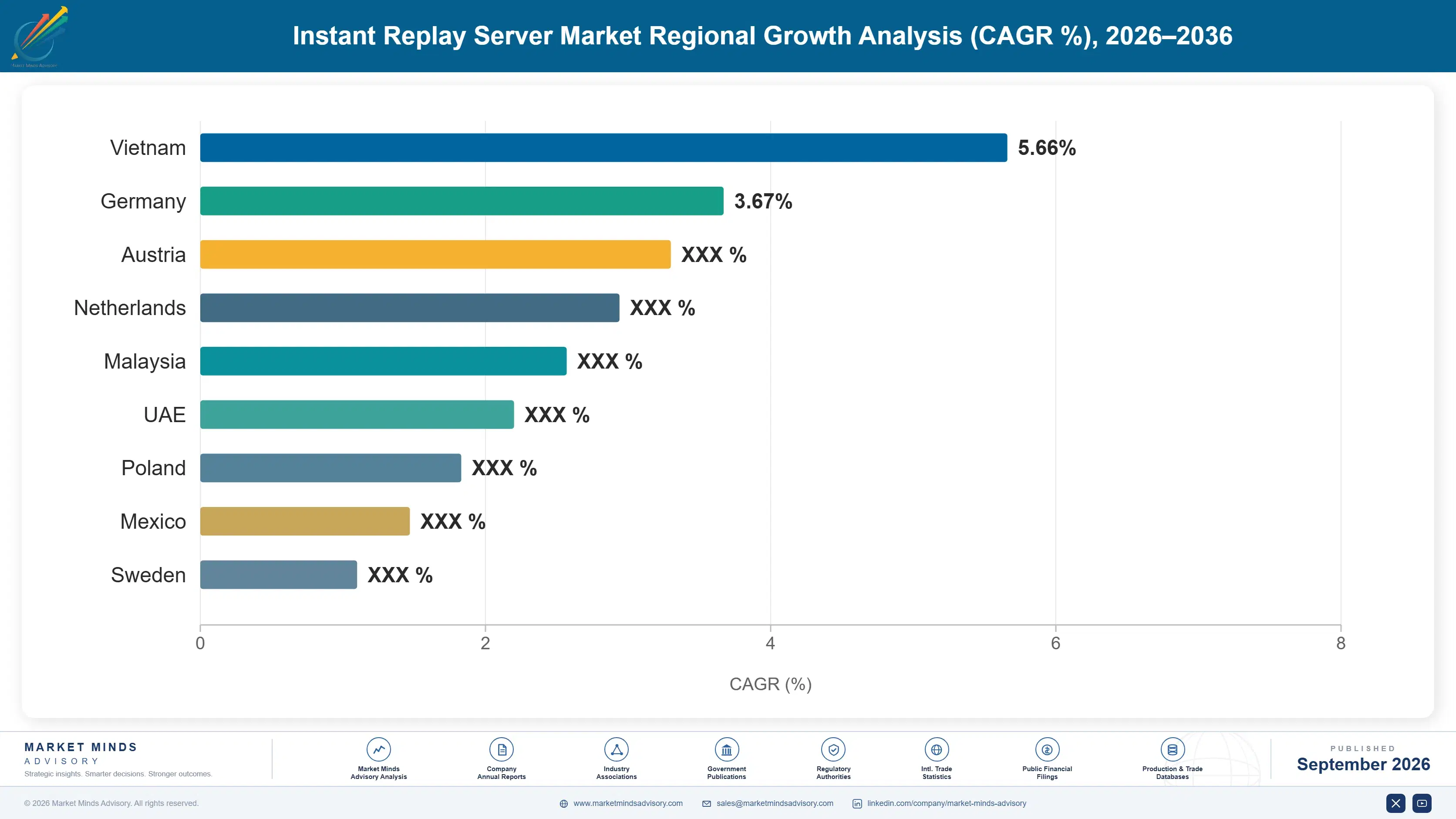
Demand follows competition structures, officiating adoption and production practice rather than population or television market size. North America and Western Europe lead because their sports carry the highest production values and adopted video review earliest. Television market size explains almost nothing here, and population explains even less.

North America

Professional leagues here operate centralised officiating review facilities that concentrate replay infrastructure into a small number of very large installations rather than distributing it across venues, which is a distinctive architecture found almost nowhere else. Collegiate sport represents an enormous venue count adopting simplified systems at lower price points. Remote production has advanced quickly, particularly in collegiate and second-tier professional coverage where economics were previously impossible. Growth of 6.8% reflects a mature installed base where replacement and interface migration rather than new adoption drive most purchasing decisions. Centralised officiating architecture here concentrates spending into a handful of very large installations, which makes the region look smaller in unit terms than its actual expenditure justifies.
Share: 30% | CAGR: 6.8% (2026 to 2036)

Western Europe

Football drove video officiating adoption earlier and more comprehensively here than anywhere, and the requirement now extends well down the competition pyramid across several national associations. Production values in premium football coverage are the highest in world sport, with camera counts and angle synchronisation that push system channel counts hard. Several of the leading vendors are headquartered in the region, which shapes product development toward European requirements. Growth of 6.2% is the slowest of any region and reflects saturation at the top of the market rather than any lack of technical ambition. Several of the leading vendors are headquartered in this region, which shapes product development toward European production requirements rather than any other market.
Share: 26% | CAGR: 6.2% (2026 to 2036)
Regional intelligence for 5 additional markets available in the complete report: East Asia, South Asia and Pacific, Middle East and Africa, Latin America, Eastern Europe. Contact sales@marketmindsadvisory.com.
instant-replay-server-market-country-cagr-analysis-1788414370287

Where Replay Revenue Holds Up

Four positions carry margin in a market being disaggregated by software and consolidated by remote production at the same time. Each involves selling something other than a box, which is uncomfortable for vendors whose organisations, factories and sales compensation were all built around shipping hardware. All four require selling something other than hardware. That is uncomfortable.

Sell Into Officiating Rather Than Production

Around 41% of demand now exists because a competition mandates video review, and that buyer purchases on a competition calendar against a rule book rather than on a capital cycle against a production budget. The requirements are reliability, auditability and defined latency rather than creative capability, which means a simpler and more defensible product. Governing bodies also specify centrally for whole competitions, so one decision covers many venues. Vendors organised around broadcast production sales are calling on the wrong department entirely. Governing bodies specify centrally, so one decision commits every venue.
Market Impact: Serves the 41% of demand that is mandated

Defend The Panel, Not The Server

An operator takes around 9 weeks to reach full speed on unfamiliar control surfaces and no production accepts that risk during a season, which makes the panel the genuine switching cost while the server underneath becomes replaceable software. Vendors that let an operator keep a familiar surface across changing platforms hold the account through architecture transitions that would otherwise open it. Those defending proprietary hardware are protecting the part customers are actively trying to commoditise. The asset is muscle memory rather than any engineering. Muscle memory rather than engineering is the asset.
Market Impact: Protects against the full 9 week retraining cost

Price Capacity Per Event Not Per Venue

With 57% of events produced from centralised facilities, unit demand is falling and no commercial effort reverses it, but per-event pricing captures productions that could never justify dedicated equipment and were therefore never customers at all. That genuinely expands the market rather than redistributing it. The obstacle is internal: sales compensation, revenue recognition and factory loading are all built around shipping units. Vendors that changed those measures early are growing while competitors report declining shipments and cannot explain why. Sales compensation and factory loading are built around shipping units. Few vendors have changed those measures successfully.
Market Impact: Addresses the 57% of all events produced remotely

Build Simplified Systems For Lower Tiers

Officiating adoption is spreading through 4 competition tiers below the professional level, where venues need fewer channels and almost no creative capability but exactly the same reliability. That is a different product at a different price, not a discounted version of the premium system, and vendors attempting the latter lose to purpose-built competitors. Venue count at these tiers exceeds professional sport by a wide margin. Building down-market properly requires accepting a lower price point rather than protecting the premium one. Accepting the lower price point is the difficult part. Protecting the premium price loses the whole segment.
Market Impact: Reaches all 4 competition tiers below professional sport

Who Controls the Margin Pool

Measured on shipment and subscription revenue, the basis used throughout this section, the top five hold 68%. Concentration is high because live production tolerates no failure and buyers return to vendors whose systems have survived major events, which is a reference nobody can shortcut. The gap between leaders and the rest is installed operator familiarity and event track record rather than any current difference in technical capability.
Competition runs on reliability references, control surface familiarity and increasingly on licensing model rather than on channel counts or processing specifications. Established vendors hold operator loyalty built over decades. Software entrants compete on cost structure and flexibility and struggle against the risk aversion of live production. Officiating specialists have built positions with governing bodies that broadcast-oriented vendors reached late.

Pressure comes from two directions. Software-defined platforms remove the hardware margin that funded development for decades, and no vendor has yet demonstrated an equivalent software business at comparable profitability. And remote consolidation shrinks the unit base regardless of who supplies it. Rankings shift where vendors moved to per-event licensing and built officiating relationships rather than defending hardware shipment volumes.
instant-replay-server-market-company-positioning-matrix-1788414370797

Competitive Moat and Risk Dimensions

EVS BROADCAST EQUIPMENT

Moat: Operator familiarity across major events

Control surfaces that a very large proportion of working replay operators learned on give the company a switching cost measured in retraining weeks rather than in purchase price, which decides accounts before any technical comparison happens. Presence at major international events provides references that cannot be acquired any other way. Long host broadcaster relationships reinforce the position continuously.
EVS BROADCAST EQUIPMENT

Risk: Hardware margin under software pressure

A business built on purpose-built hardware faces software-defined competitors with no manufacturing cost at all, and no vendor has yet shown that the software business earns what the hardware one did. Remote consolidation reduces the unit base the company has historically measured itself against. Concentration in premium sports production exposes it to a small number of very large rights cycles.
EVERTZ TECHNOLOGIES

Moat: Infrastructure breadth and migration position

Capability across routing, transport and infrastructure alongside replay gives the company a position in facility migration projects where replay is one element of a whole rebuild rather than a standalone purchase. Internet protocol infrastructure expertise matters enormously during exactly the transition forcing replacement. Selling the facility rather than the product reaches a decision maker the specialist vendors do not meet.
EVERTZ TECHNOLOGIES

Risk: Replay depth against specialists

Operator familiarity and event reference depth sit with specialist replay vendors whose panels the working population learned on, which decides accounts before infrastructure breadth becomes relevant. Officiating governing bodies buy from vendors with specific competition track record rather than from infrastructure suppliers. Breadth also means replay competes internally for engineering investment against much larger product lines.

Players Tracked

Prominent Players

EVS Broadcast Equipment
Evertz Technologies
Grass Valley
Ross Video
Sony

Other Key Players

Chyron
Vizrt
Blackmagic Design
Telestream
Imagine Communications
Avid Technology
Cinedeck
Simplylive
Slomo.tv
Riedel Communications
Lawo
Tedial
Dalet
Harmonic
Vislink

Recent Developments

FEBRUARY 2025

Governing body extends video review to further competitions

A sports governing body extended video officiating requirements to additional competitions and tiers, a rule decision rather than any procurement transaction. Participating venues became obliged to provide synchronised multi-angle capture and review playback regardless of whether matches were being broadcast at all. Compliance dates were set centrally.
Signal: One rule change commits every venue in a competition, which no sales campaign could ever achieve.
SEPTEMBER 2024

Broadcaster commissions centralised remote production facility

A broadcaster commissioned a centralised production facility covering multiple simultaneous events from one location, an organic capacity expansion rather than any acquisition. Venue equipment was reduced to capture and connectivity, with replay, graphics and vision mixing all handled centrally instead. Venue staffing fell substantially alongside it.
Signal: Every venue converted this way removes replay hardware that no vendor will ever sell into it again.
JUNE 2025

Vendor releases software-defined replay platform on standard servers

A vendor released a replay platform running entirely as software on commodity server hardware, a product decision rather than any corporate transaction. Deterministic performance under live conditions and interoperability with existing control surfaces were both emphasised in the technical documentation. Existing panels remained fully supported.
Signal: Keeping the familiar control surface is what makes a software platform acceptable to any live production.

Storage, Silicon And Software Engineering

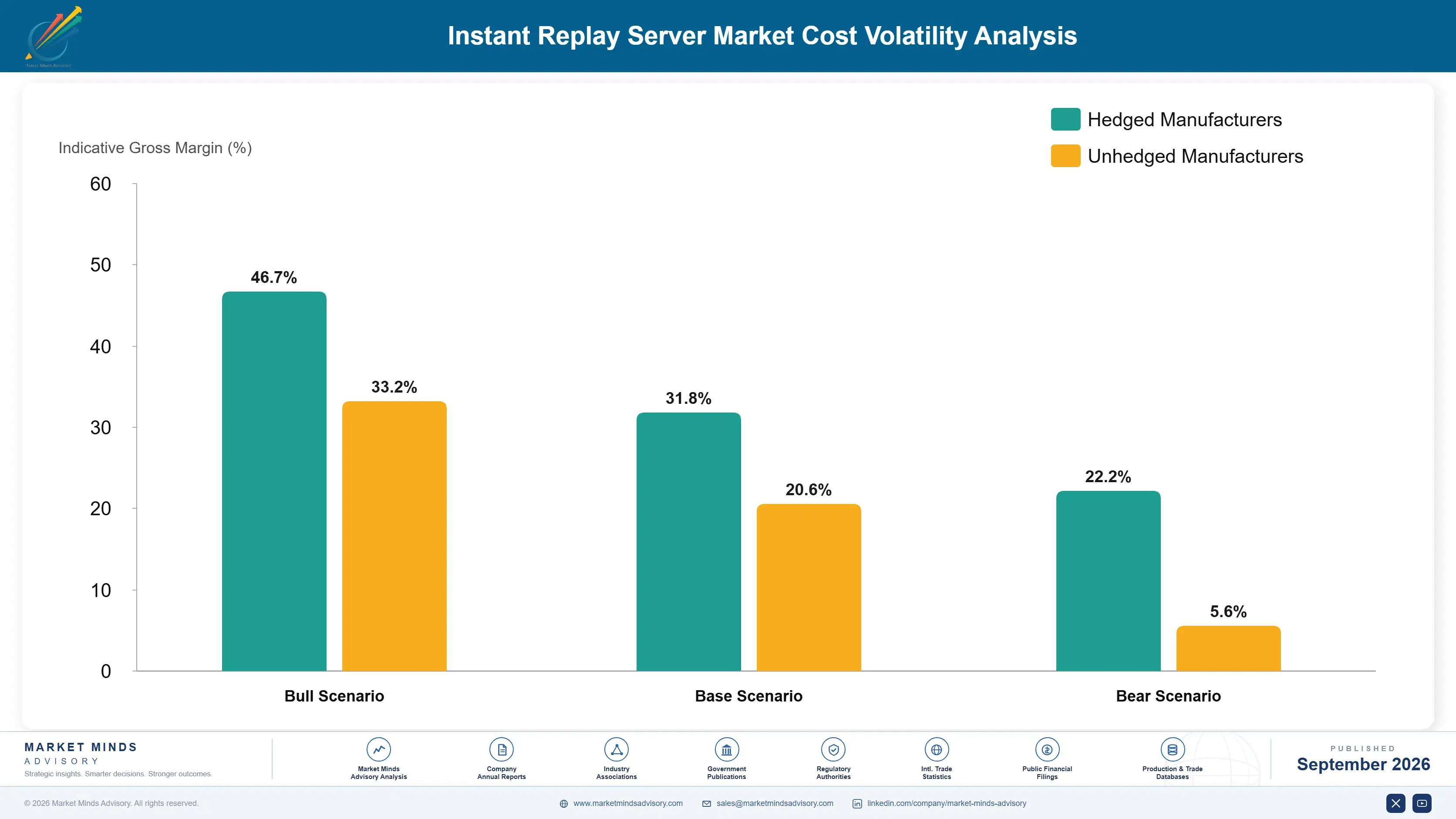
Solid state storage accounts for roughly 23% of hardware system cost, video processing silicon including programmable logic around 19%, server and chassis hardware near 16%, and software engineering, control surface manufacturing and support the balance. Storage requirements are severe because replay systems hold many hours of uncompressed or lightly compressed video across 12 or more simultaneous channels with guaranteed read performance.
Memory pricing swung violently across the period, with SEMI industry reporting documenting capacity and pricing movements through the shortage and the subsequent oversupply, and programmable logic lead times extended well beyond a year at the worst point. Vendors holding fixed-price contracts with broadcasters absorbed both, and several disclosed margin pressure and delivery delays in results covering that window. Design changes were made under supply pressure rather than for engineering reasons.

The disadvantage mechanism is architecture rather than purchasing scale. A vendor whose platform runs on commodity servers passes component volatility to the customer buying that hardware separately, while one shipping purpose-built systems absorbs it entirely. That difference has grown considerably as software platforms matured. Control surface manufacturing remains a genuine hardware exposure for everybody, since operator familiarity means the panel cannot be simplified away.
instant-replay-server-market-cost-volatility-analysis-1788414370992

Commodity server platforms transferring component exposure

Running the platform on customer-procured standard servers moves storage and processor volatility to the buyer, who is purchasing that hardware anyway on their own terms. It surrenders hardware margin that funded development for decades, which is why several vendors resisted the move far longer than the technology required them to. Hardware margin is surrendered permanently.

Multi-source qualification for programmable logic

Qualifying video processing designs across more than one programmable logic supplier protects delivery when lead times extend, and the shortage demonstrated exactly how expensive single-sourcing becomes. It costs engineering time and board area that nobody funds until a shortage has already made the case for them. The shortage made that case expensively for everybody.

Control surface commonality across product generations

Keeping the panel constant while the underlying platform changes preserves operator familiarity and amortises control surface tooling across far more units and years. It constrains industrial design ambitions considerably, which product teams dislike, and it is the single most commercially valuable constraint a vendor here can accept. Product teams dislike the constraint intensely. The trade is worth making.

Portfolio Architecture for Margin Defence

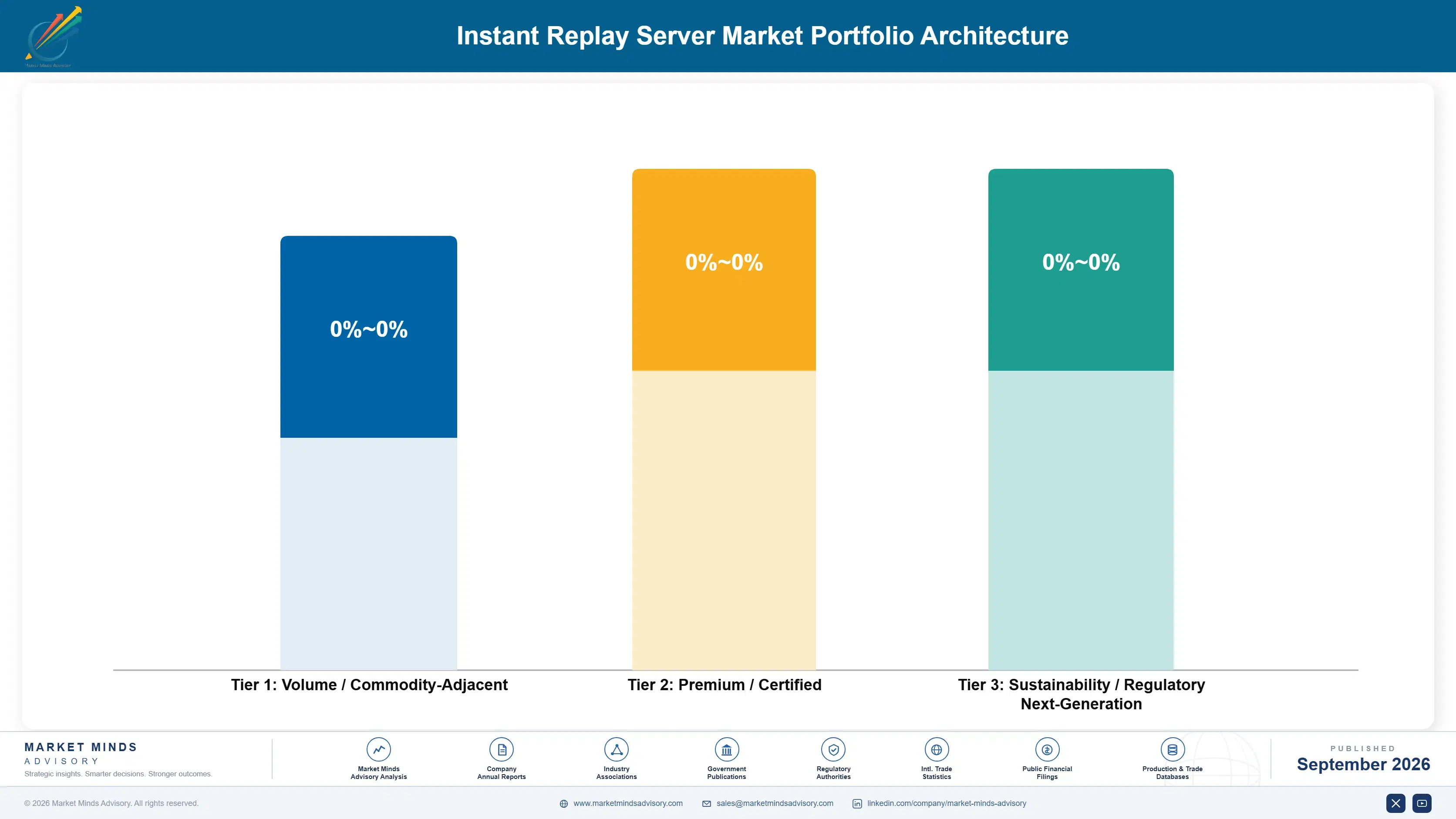
Margin separates by whether the customer has an alternative. Premium production systems sold to major broadcasters carry good margin because reliability references and operator familiarity limit the field to two or three credible vendors. Simplified officiating appliances at lower competition tiers compete against purpose-built entrants on price, and the buyer is following a rule book rather than pursuing production quality, so the specification is met rather than exceeded.
The volume against premium tension runs through the architecture transition. Hardware systems still carry the margin that funds development, and abandoning them early cedes revenue that software has not yet replaced at equivalent profitability. But every year of defending hardware is a year of ceding the software segment growing at 11.7%. Vendors managing this well run both while shifting engineering weight; most defend hardware and call it strategy.

High-value pools sit where familiarity or obligation creates the barrier: control surfaces the working operator population learned on, officiating systems specified centrally by governing bodies, and central facility installations serving many events. Each is defended by something other than product specification, which is what makes it durable. The pools are narrow in unit terms and carry most of the industry's profit.

Volume / Commodity-Adjacent

Simplified officiating appliances and entry systems for lower competition tiers, competing against purpose-built entrants on price against a rule book specification. Returns depend on manufacturing cost rather than on any capability the buyer values beyond reliability.
Gross Margin: 32 to 42%

Premium / Certified

Full production replay systems for major broadcasters and outside broadcast providers where reliability references narrow the field. The 12 point range reflects whether the account rests on operator familiarity or is genuinely contested on technical merit.
Gross Margin: 46 to 58%

Sustainability / Regulatory / Next-Generation

Control surfaces, centrally specified officiating platforms and per-event capacity licensing from central facilities. The 16 point range reflects how completely operator familiarity or a governing body mandate removes competitive pressure on price.
Gross Margin: 54 to 70%
instant-replay-server-market-portfolio-architecture-1788414371486

High-value Sub-segments and Strategic Watch-out

Control Surfaces And Operator Panels

The genuine switching cost in this market, since an operator needs around nine weeks to regain speed on unfamiliar panels and no production accepts that risk mid-season. Defended by muscle memory rather than by any engineering advantage. Vendors defend panels far more carefully than servers.
Gross Margin: 58 to 70%

Centrally Specified Officiating Platforms

Governing bodies specify once for whole competitions, so a single decision commits many venues at the same time. Purchasing follows a rule book and a competition calendar rather than any production budget cycle at all. One decision commits an entire competition for a regulation cycle.
Gross Margin: 54 to 66%

Premium Production Replay Systems

Sold to major broadcasters where reliability references narrow the field to two or three credible vendors. Still carries the hardware margin funding development, and still the segment software disaggregation attacks most directly. Reliability references rather than specifications narrow this field to very few credible vendors.
Gross Margin: 46 to 58%

Entry Tier Officiating Appliances

Competing against purpose-built entrants on price at lower competition tiers where the buyer meets a specification rather than exceeding it. Necessary for reaching the venue count but permanently thin on returns. Purpose-built competitors beat discounted premium systems here every single time, without exception. Reliability is the only shared requirement.
Gross Margin: 32 to 42%

How Live Production Actually Buys

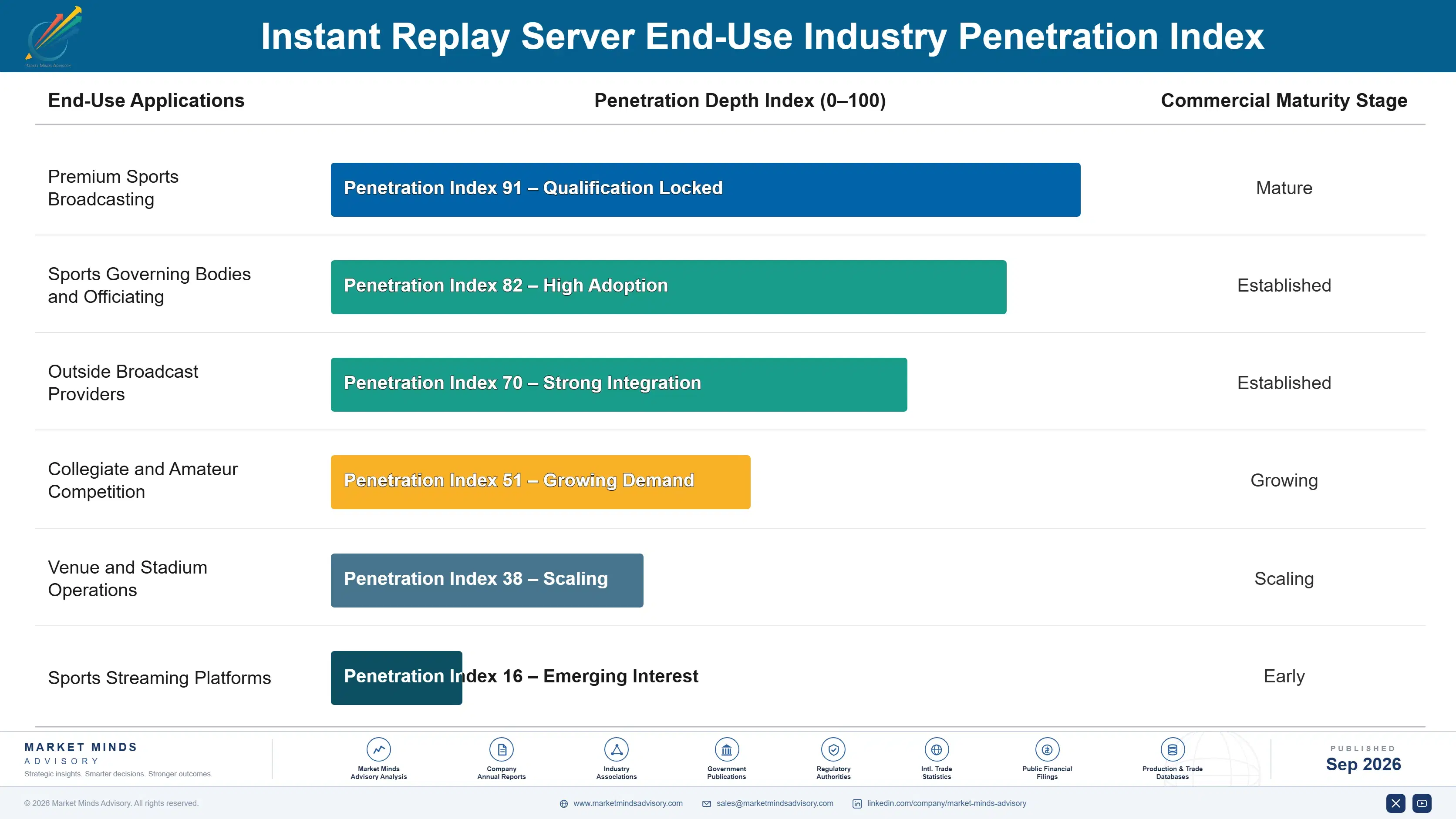
Annuity economics arrive from two quite different sources. A governing body specifying officiating equipment for a competition commits every venue for the length of the technical regulation, which renews with the rule rather than with sales effort. A broadcaster replaces systems on roughly a seven year cycle, accelerated where interface migration forces it earlier. Per-event licensing produces a third pattern, scaling with the competition calendar.
Adoption depth varies sharply by buyer type. Major broadcasters and outside broadcast providers specify deeply, test extensively and switch only at facility rebuilds because operator retraining is unacceptable mid-season. Governing bodies specify against a technical regulation and evaluate on auditability and reliability rather than creative capability. Lower tier competitions buy the cheapest system that meets the rule and treat products as broadly interchangeable, which they largely are at that level.

The buyer profile has shifted decisively. This was sold to broadcast engineering managers assessing production capability against a capital budget. It now sits with competition operations departments meeting a regulatory obligation, and with remote facility operators buying utilisation. Both ask about reliability and cost per event rather than channel counts, and vendors leading with technical specification answer questions nobody asked.
instant-replay-server-market-end-use-penetration-index-1788414371973

Where Vendors Should Compete

These are among the four positions where our research anticipates prominent divergence between winners and laggards over the coming forecast period. Each is grounded in the demand model, the regulatory perimeter, and the announced capacity pipeline.
01 / OFFICIATING CHANNEL PRIORITY

Sell to competition operations, not broadcast engineering

Around 41% of demand now exists because a competition mandates video review, and that buyer purchases against a rule book on a competition calendar rather than against a production budget on a capital cycle. Governing bodies also specify centrally for whole competitions, so a single decision commits many venues simultaneously without any further selling effort at all. Vendors organised around broadcast production accounts are calling on the wrong department entirely and frequently do not realise it until the award has already appeared.
02 / CONTROL SURFACE DEFENCE

Protect the panel and let the server commoditise

An operator needs around nine weeks to regain full speed on unfamiliar control surfaces, and no live production accepts that risk during a season, which makes the panel the genuine switching cost while the server underneath becomes entirely replaceable software underneath it. Vendors that let an operator keep a familiar surface across changing platforms hold accounts through architecture transitions that would otherwise open those accounts completely. Defending proprietary hardware protects exactly the part customers are actively trying to commoditise away.
03 / LICENSING MODEL CHANGE

Measure events served rather than units shipped

With 57% of events produced from centralised facilities, unit demand is falling and no amount of commercial effort reverses that, while per-event pricing reaches productions that could never justify dedicated equipment and and were never customers of anyone at all. The obstacle is entirely internal, sitting in sales compensation, revenue recognition and factory loading all built around shipping physical boxes. Vendors that changed those measures early are growing while competitors report falling shipments and cannot adequately explain the difference at all.
04 / LOWER TIER PRODUCT DESIGN

Build down properly instead of discounting downward

Officiating adoption is now spreading through four separate competition tiers below professional sport, where venues need fewer channels and almost no creative capability but exactly the same reliability under genuinely live conditions. That is a genuinely different product at a different price point rather than any discounted premium system, and vendors attempting the latter lose consistently to competitors who built for the purpose. Venue count at these tiers exceeds professional sport by a very wide margin indeed, several times over.

Engagement Snapshot From the Field

A live engagement with an industry participant carrying material or product regulatory and market exposure ahead of a defining policy shift, showing how our research translates into a defensible multi-year portfolio strategy.
MARKET MINDS ADVISORY · CLIENT ENGAGEMENT SUMMARY
Instant Replay Server Producer Strategic Portfolio Review and Transition Roadmap 2026·Investment Scenario on Instant Replay Server Exposure Evaluation 2025-26
CLIENT PROFILE
A European supplier of live production replay and media systems with annual revenue reported at approximately USD 190 million (client-reported, unverified by MMA). The business sold purpose-built hardware systems to broadcasters and outside broadcast providers, measured performance in units shipped, and had built no relationship at all with any sports governing body specifying officiating equipment.
STRATEGIC CHALLENGE
Unit shipments had declined for three consecutive years while the company's own estimates showed the market growing, and nobody could reconcile the two figures. A software-defined product existed but was being held back to protect hardware revenue. Management could not decide whether the decline was competitive loss or something else entirely.
MMA APPROACH
MMA reconstructed the client's addressable demand by buyer type rather than by product, separating broadcast production purchasing from officiating mandates and centralised facility procurement, and measured how many events the client's installed systems were serving rather than how many systems it had shipped in total. Competitor licensing models were benchmarked directly.
KEY FINDINGS
  1. Declining unit shipments coincided with rising events served, because remote consolidation meant fewer and larger systems covering considerably more production than before.
  2. Around 41% of market demand originated in officiating mandates that the client had never bid for, since it held no relationship with any governing body specifying equipment.
  3. Operator familiarity with the client's control surfaces was the strongest asset in the business and was being risked by tying panels exclusively to legacy hardware platforms.
  4. Holding back the software product to protect hardware revenue was ceding the fastest growing segment to competitors carrying no manufacturing cost whatsoever.
CLIENT PROFILE
A European supplier of live production replay and media systems with annual revenue reported at approximately USD 190 million (client-reported, unverified by MMA). The business sold purpose-built hardware systems to broadcasters and outside broadcast providers, measured performance in units shipped, and had built no relationship at all with any sports governing body specifying officiating equipment.
STRATEGIC CHALLENGE
Unit shipments had declined for three consecutive years while the company's own estimates showed the market growing, and nobody could reconcile the two figures. A software-defined product existed but was being held back to protect hardware revenue. Management could not decide whether the decline was competitive loss or something else entirely.
MMA APPROACH
MMA reconstructed the client's addressable demand by buyer type rather than by product, separating broadcast production purchasing from officiating mandates and centralised facility procurement, and measured how many events the client's installed systems were serving rather than how many systems it had shipped in total. Competitor licensing models were benchmarked directly.
KEY FINDINGS
  1. Declining unit shipments coincided with rising events served, because remote consolidation meant fewer and larger systems covering considerably more production than before.
  2. Around 41% of market demand originated in officiating mandates that the client had never bid for, since it held no relationship with any governing body specifying equipment.
  3. Operator familiarity with the client's control surfaces was the strongest asset in the business and was being risked by tying panels exclusively to legacy hardware platforms.
  4. Holding back the software product to protect hardware revenue was ceding the fastest growing segment to competitors carrying no manufacturing cost whatsoever.
RECOMMENDED STRATEGY
Phase 1: Phase one: change internal measurement from units shipped to events served and realign sales compensation to match before doing anything else. Phase 2: Phase two: decouple control surfaces from hardware platforms so that operators keep their familiar panels across the whole architecture transition entirely. Phase 3: Phase three: build a dedicated governing body relationship function targeting officiating specification decisions rather than chasing broadcast production accounts alone.
OUTCOME
Within twelve months the client had released the software platform with full control surface compatibility, won its first officiating specification, and reported revenue up 8.4% despite unit shipments declining further (client-reported, unverified by MMA). Sales compensation now measures events served rather than the systems actually delivered.

Frequently Asked Questions

Foundational context covering the market sizes, CAGR, scope, country, region and competition that inform every finding below. This section is provided to cover basics and most often pre-purchase conversations, answered from the MMA Primary Research Dataset.

What is the current size of the Instant Replay Server Market?

The market was valued at USD 0.6 billion in 2025 and reaches USD 0.65 billion in 2026. Video officiating requirements rather than broadcast production drive most of the recent growth.

How large will the Instant Replay Server Market be by 2036?

MMA forecasts USD 1.38 billion by 2036, an increase of USD 0.73 billion over the 2026 base. That represents an expansion multiple of 2.12 times.

What is the CAGR for the Instant Replay Server Market 2026 to 2036?

The base case CAGR is 7.8%, with a bull case of 9.0% and a bear case of 6.6%. The historical rate between 2020 and 2025 was 6.6%.

Which segment is growing fastest?

Software-defined on-premise platforms grow at 11.7%, half again the market rate of 7.8%. Internet protocol transport removed the reason replay had to be purpose-built hardware.

Who are the major companies in the Instant Replay Server Market?

EVS Broadcast Equipment, Evertz Technologies, Grass Valley, Ross Video and Sony lead on measured shipment and subscription revenue. Together they account for roughly 68% of the market.

Which country is growing fastest?

India grows fastest at 13.6%, driven by cricket production operating at camera counts few sports match and by domestic league expansion across multiple other sports.

Report Segmentation Architecture

The full report scope spans multiple orthogonal segmentation dimensions, with cross-tabulated demand data provided for each dimension pair. Coverage extends further to regional breakdowns, trend trajectories, and the competitive detail needed to support segment-level decision-making.

By Deployment Architecture

  • Dedicated Hardware Replay Servers
  • Software-Defined On-Premise Platforms
  • Cloud and Remote Production Services
  • Hybrid On-Premise and Cloud Systems
  • Control Surfaces and Operator Panels
  • Embedded Venue Officiating Appliances

By End-Use Industry

  • Premium Sports Broadcasting
  • Sports Governing Bodies and Officiating
  • Outside Broadcast Providers
  • Collegiate and Amateur Competition
  • Venue and Stadium Operations
  • Sports Streaming Platforms

By Commercial Model and Procurement Route

  • Capital System Purchase
  • Per-Event Capacity Licensing
  • Managed Remote Production Service
  • Governing Body Central Specification
  • Systems Integrator Delivery
  • Rental and Outside Broadcast Fleet

By Region

  • North America
  • Western Europe
  • East Asia
  • South Asia and Pacific
  • Middle East and Africa
  • Latin America
  • Eastern Europe

Scope, Methodology, and Coverage

Every figure in this report is reproducible from documented input assumptions. The scope below maps the historical period, the forecast horizon, the segmentation dimensions, and the countries covered, alongside the underlying primary and qualitative methodology.
Historical Period
2020 to 2025
Forecast Period
2026 to 2036
Base Year
2025 (USD billions; MMA Primary Research Dataset, September 2026)
Market Definition
The instant replay server market covers systems that ingest, store and play back multiple synchronised video feeds for live slow-motion replay, highlights and officiating review, spanning dedicated hardware servers, software-defined on-premise platforms, cloud and remote production services, hybrid deployments, control surfaces and operator panels, and embedded venue officiating appliances. Sizing is measured at vendor shipment and subscription revenue. Cameras, vision mixers, graphics systems, transmission encoders, general media asset management and post-production editing tools are excluded.
Quantitative Units
USD millions at vendor shipment and subscription revenue, with supporting system counts and events served by region
Segmentation Dimensions
Deployment architecture, end-use industry, commercial model and procurement route, region
Regions Covered
North America, Western Europe, East Asia, South Asia and Pacific, Middle East and Africa, Latin America, Eastern Europe
Countries Covered
United States, Canada, Mexico, Brazil, Argentina, United Kingdom, Germany, France, Spain, Italy, Belgium, Poland, Japan, South Korea, China, India, Australia, Saudi Arabia
Key Companies Profiled
EVS Broadcast Equipment, Evertz Technologies, Grass Valley, Ross Video, Sony, Chyron, Vizrt, Blackmagic Design, Telestream, Imagine Communications, Avid Technology, Cinedeck, Simplylive, Slomo.tv, Riedel Communications, Lawo, Tedial, Dalet, Harmonic, Vislink
Quantitative Methodology
Primary survey, n=3,800 respondents, Q4 2025, six countries; demand-side model with trade association cross-validation
Qualitative Methodology
47 expert interviews, Q4 2025; applied to validate demand model assumptions, identify emerging dynamics, and assess competitive positioning
Report Format
PDF and XLSX data workbook (Word format preview document)
Publisher
Market Minds Advisory
Report Code
MMA-2026-TEC-661
Published
September 2026
Contact
sales@marketmindsadvisory.com | www.marketmindsadvisory.com

Purchase the full Instant Replay Server Market Report (2026 to 2036).

The full report separates officiating demand from broadcast production demand throughout, which is the distinction that explains how this market grew while broadcast capital spending fell. It sizes six deployment architectures with individual growth rates, seven regions built from competition structures and officiating adoption, and the remote consolidation reducing unit counts while raising utilisation. Competitive analysis covers twenty vendors on a consistent shipment and subscription revenue basis, with operator familiarity and governing body relationships treated as the decisive variables. Input cost modelling breaks out storage, silicon and control surface exposure by platform architecture.
Six deployment architectures with individual growth rates
Officiating demand separated from broadcast production
Events served tracked against systems shipped
Operator retraining cost quantified as switching barrier
Twenty vendors on consistent revenue basis
Storage, silicon and control surface cost exposure

Built For The People Who Decide

From boardroom strategy to bench-side execution, this report is read cover-to-cover by leaders shaping the next decade of their industry, turning demand scenarios, market dynamics and valuation benchmarks into decisions.
CXOs/ Presidents/ VPs/ Managers
M&A and Corporate Development
Strategy Teams and R&D Heads
Procurement and Product Directors
Regulatory and Compliance Leaders
Investor Relations and Equity Analysts