Market Minds Advisory
Inspection and Weighing Machine Market

Inspection and Weighing Machine Market: Combination Quality Control and the AI Vision Transition

Food and pharmaceutical processors are consolidating separate checkweighing and contaminant detection lines into single combination systems as AI vision algorithms finally match dedicated inspection equipment on defect detection accuracy at comparable line speed.

Lead Analyst

Bilal Shaikh

Published

September 2026

Make Smarter Decisions with Customized Research Insights

Request a free sample report and evaluate market opportunities, growth trends, and competitive dynamics relevant to your business needs.

2025 MARKET VALUE$2.3BMarket Size 2025
2036 FORECAST VALUE$5.4BBase Case , 2026 to 2036
CAGR 2026 TO 20368.0 %Bull 9.3% / Bear 6.7%
INCREMENTAL OPPORTUNITY$2.9BNet 10- year value creation
EXPANSION MULTIPLE2.16x2036 value over 2026 base
Strategic Levers
M&A Pipeline
Regional Outlook
Country Rankings
Competitive Intelligence
Segmental Deep-dive
Call-Us : 91 93563 13602

Executive Snapshot and Market Trajectory

Processors globally are consolidating standalone checkweighers and contaminant detection lines into single combination systems as AI vision algorithms finally close the accuracy gap with dedicated inspection equipment running at comparable line speed and throughput, a shift accelerating faster than most equipment makers had originally planned for or budgeted around.
Retailer audit requirements and tightening food safety and pharmaceutical serialization regulation are pushing processors toward equipment that documents every rejected unit automatically rather than relying on manual quality checks performed by line workers under time pressure. Combination systems and AI vision formats post the fastest unit growth, concentrated among large processing facilities across East Asia and North America's most automated production lines and newest facility investments.
Five equipment makers hold 45% of global revenue, with Mettler-Toledo and Ishida forming the clearest leading pair on installed base and service network depth built up over many decades of continuous operation and reinvestment. Recall liability exposure and mandatory pharmaceutical serialization deadlines across multiple jurisdictions continue pushing processors to invest ahead of formal regulatory enforcement dates rather than wait for penalties to force the decision belatedly and at greater cost.
Market Definition
The inspection and weighing machine market covers checkweighers, metal detection systems, X-ray inspection systems, vision inspection systems, and combination multi-technology inspection and weighing systems used in food, pharmaceutical, and industrial packaging lines. It excludes laboratory-grade analytical instruments and manual handheld inspection tools.
Base Year Value
$2.3B in 2025 (MMA Primary Research Dataset, August 2026)
Forecast Period
2026 to 2036, eleven discrete annual values
CAGR
8.0% base case. Bull 9.3%. Bear 6.7%.
Fastest Growth Segment
AI-Powered Vision Inspection Systems: 12.5% CAGR
Fastest Growth Country
India: 10.0% CAGR
Fastest Growth Region
South Asia and Pacific: 10.0% CAGR
Largest Region
East Asia: 28% of 2025 global value
Market Leaders
Mettler-Toledo International Inc, Ishida Co Ltd, Yamato Scale Co Ltd, Bizerba SE & Co KG, Thermo Fisher Scientific Inc. Source: MMA Analysis based on company annual reports.
Primary Survey
n=3,800 procurement and R&D decision-makers, Q4 2025, six countries
Methodology
Demand-side build-up, cross-validated against public data, 47 expert interviews

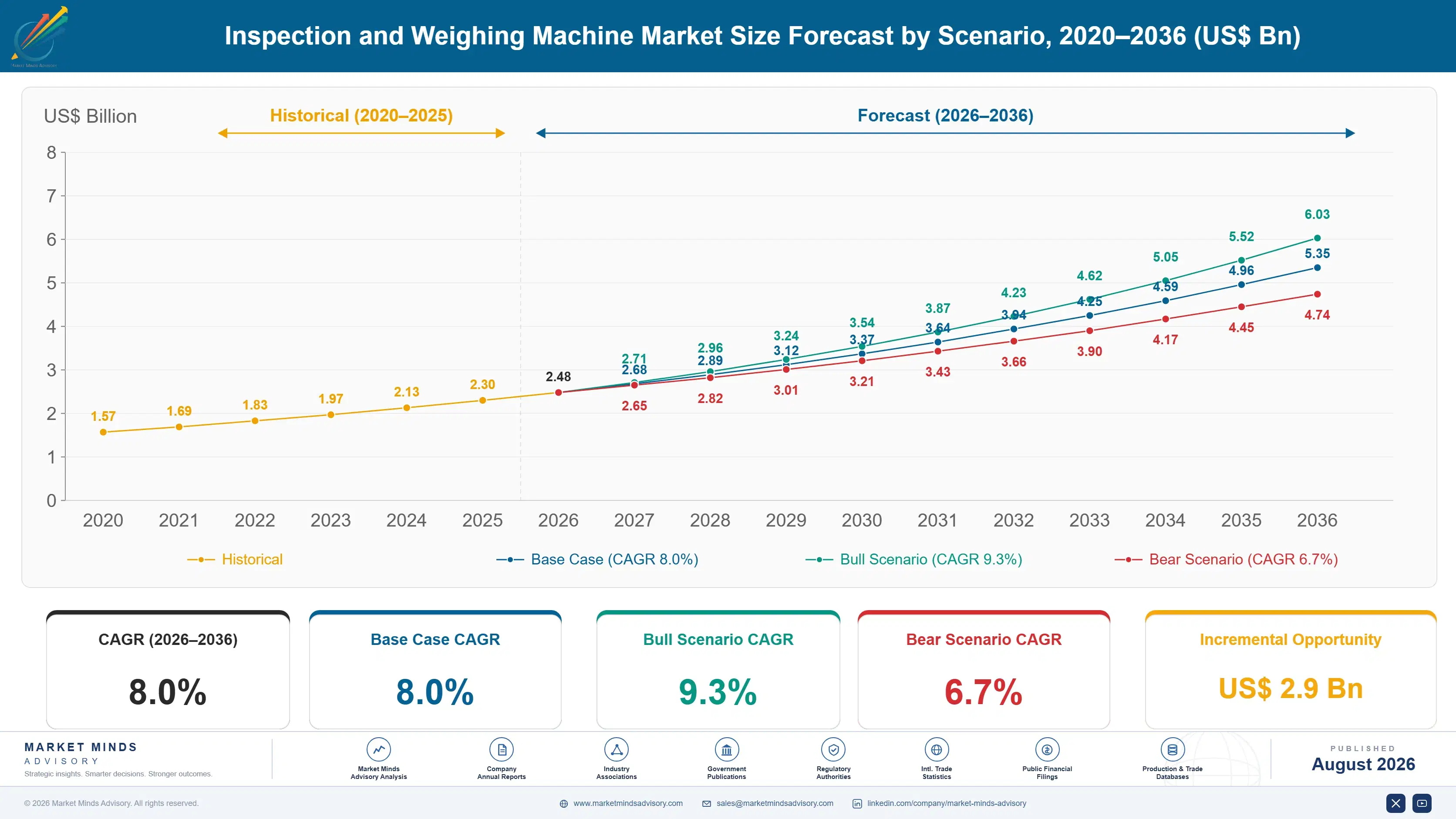
Inspection and Weighing Machine Market Forecast Scenarios

inspection-and-weighing-machine-market-size-forecast-scenario-1787308818457
Inspection and weighing equipment demand grew at an estimated 7.0% annually between 2020 and 2025, propelled by post-pandemic food safety regulation tightening across most major markets and by processors accelerating automation investment to offset persistent quality control labor shortages across major processing regions throughout that five-year period, a trend that shows little sign of reversing anytime soon.
The base case assumes 8.0% annual growth through 2036, resting on three mechanisms: AI vision algorithms reaching accuracy parity with dedicated detection technology and pulling combination systems into mainstream adoption across most new-line installations worldwide, pharmaceutical serialization mandates expanding across additional national markets including India and several Gulf states, and processors replacing aging standalone equipment with multi-technology combination lines during routine capital refresh cycles over the coming decade of investment.
The bull case centers on AI vision retrofit kits reaching mid-market processors faster than expected, lifting unit volume well above trend across nearly every processing segment tracked in this report. The bear case centers instead on capital spending caution among small and mid-size processors delaying planned equipment upgrades industry-wide amid broader economic uncertainty and tighter credit conditions overall.

Combination Systems and the AI Vision Transition

Inspection and weighing equipment sits at the center of food and pharmaceutical quality assurance, where a single missed contaminant or mis-weighed package can trigger a costly recall that dwarfs the equipment's original purchase price many times over across a single incident and its downstream reputational fallout. Processors increasingly view inspection equipment as recall insurance rather than a discretionary line upgrade, reshaping how purchasing decisions get made, budgeted, and approved at
MARKET CONCENTRATIONCR5 45%revenue share held by the five leading equipment makers
AVERAGE SELLING PRICE$68,000/unitwholesale price point for a standard combination line
TOP PRODUCING COUNTRYJapan 24% shareshare of global equipment manufacturing and export volume
CAPACITY UTILIZATION79%share of nameplate manufacturing capacity running currently today
TRADE INTENSITY38% cross-bordershare of equipment shipped across national borders yearly
REPLACEMENT CYCLE LENGTH9 yearsaverage operating life before processors replace equipment fully
AI vision systems are closing the detection accuracy gap with dedicated X-ray and metal detection technology fast enough that combination systems bundling multiple detection methods into a single line footprint are becoming the default specification for new processing line installations rather than the premium exception they once represented only a few years ago across most major processing regions and facility types.
The next decade will be shaped by mandatory pharmaceutical serialization deadlines spreading to additional national markets, retailer audit requirements demanding automatic rejection documentation on every line, and AI vision retrofit kits extending combination system capability to older installed equipment that would otherwise require full replacement at considerably greater capital cost and downtime.
"The processor buying a standalone metal detector in 2030 will be buying obsolescence on day one. Combination systems have crossed the price and performance threshold where separate boxes stopped making commercial sense for nearly every new line installation."
Director, Industrial Automation Practice · MMA Industrial Equipment / Quality Co

Market Trends

AI Vision Algorithms Reach Detection Accuracy Parity

AI-powered vision inspection systems now match or exceed the defect detection accuracy of dedicated X-ray and metal detection equipment for a widening range of contaminant types, closing a performance gap that historically justified keeping separate single-technology inspection stations on processing lines. Equipment makers report false reject rates falling by roughly 30% to 40% as deep learning models trained on larger defect image libraries improve classification accuracy across variable product presentations and packaging formats. This accuracy improvement is the single largest factor pulling combination systems into mainstream specification across food and pharmaceutical processing lines industry-wide today.
Market Impact: Recalls average over $10 million
Pharmaceutical Serialization Mandates Expand to New Markets

Pharmaceutical serialization and track-and-trace regulations, already enforced across the United States Drug Supply Chain Security Act and the European Union Falsified Medicines Directive, are extending to additional national markets including India and several Gulf states, each requiring combination inspection and vision verification equipment capable of reading and validating unique serialized codes on every packaged unit produced. Pharmaceutical manufacturers report serialization-compliant line retrofits adding 15% to 20% to total packaging line capital cost, a cost equipment makers are increasingly absorbing into bundled combination system pricing rather than selling as a separate add-on module.
Market Impact: Cuts labor 40 to 55%

Market Opportunities and Growth Drivers

Recall Liability Costs Keep Rising Across Categories

Average food and pharmaceutical recall costs now exceed $10 million per incident when accounting for product destruction, retailer penalties, and brand reputation damage, according to United States Food and Drug Administration enforcement data tracking recall actions across major product categories in recent years and reporting cycles. Processors increasingly treat inspection equipment upgrades as insurance against a single catastrophic recall event rather than as a discretionary productivity investment, a framing that has meaningfully shortened capital approval timelines for combination system purchases across procurement committees at large processing organizations nationwide and beyond.
Market Impact: Adds a 40 to 60% premium

Labor Shortages Accelerate Automated Inspection Adoption

Persistent quality control labor shortages across food and pharmaceutical processing regions are pushing processors toward automated inspection equipment that requires far less skilled manual oversight than legacy visual inspection stations staffed by trained line workers who are increasingly hard to recruit and retain at competitive wages today. Processors report automated combination systems cutting quality control labor requirements by 40% to 55% per line while simultaneously improving detection consistency across shifts, a combination that is proving decisive for processors struggling to fill quality control positions in tight regional labor markets worldwide.
Market Impact: Extends install timelines by 3 mont

Market Restraints and Challenges

Combination Systems Carry a Steep Upfront Cost Premium

Combination inspection and weighing systems cost 40% to 60% more than equivalent standalone equipment purchased separately, a gap rooted in the engineering complexity of integrating multiple detection technologies into a single synchronized line footprint without compromising throughput speed. Small and mid-size processors without direct recall liability exposure or regulatory serialization mandates often continue purchasing standalone equipment simply because procurement teams optimize on upfront capital cost alone. Equipment makers are pursuing modular combination architectures that let processors add detection technologies incrementally, narrowing the effective upfront cost gap over a multi-year adoption path.
Market Impact: Cuts false rejects 30 to 40%

Line Integration Complexity Slows Retrofit Adoption

Retrofitting AI vision and combination inspection capability onto existing processing lines frequently requires significant mechanical and software integration work that can extend installation timelines well beyond the equipment maker's original estimate, particularly on older lines never designed around modern inspection equipment footprints and data connectivity requirements. This integration risk discourages some processors from retrofitting until a full line replacement cycle arrives naturally. Equipment makers are responding with standardized modular retrofit kits and dedicated installation service teams that shrink typical integration timelines by roughly a third compared with custom engineering approaches used previously.
Market Impact: Adds 15 to 20% to cost
3 additional market trends, 4 additional growth drivers, and 3 additional restraints and challenges are covered in the full report. Contact sales@marketmindsadvisory.com to access the complete intelligence.

Segment CAGR and Growth Architecture

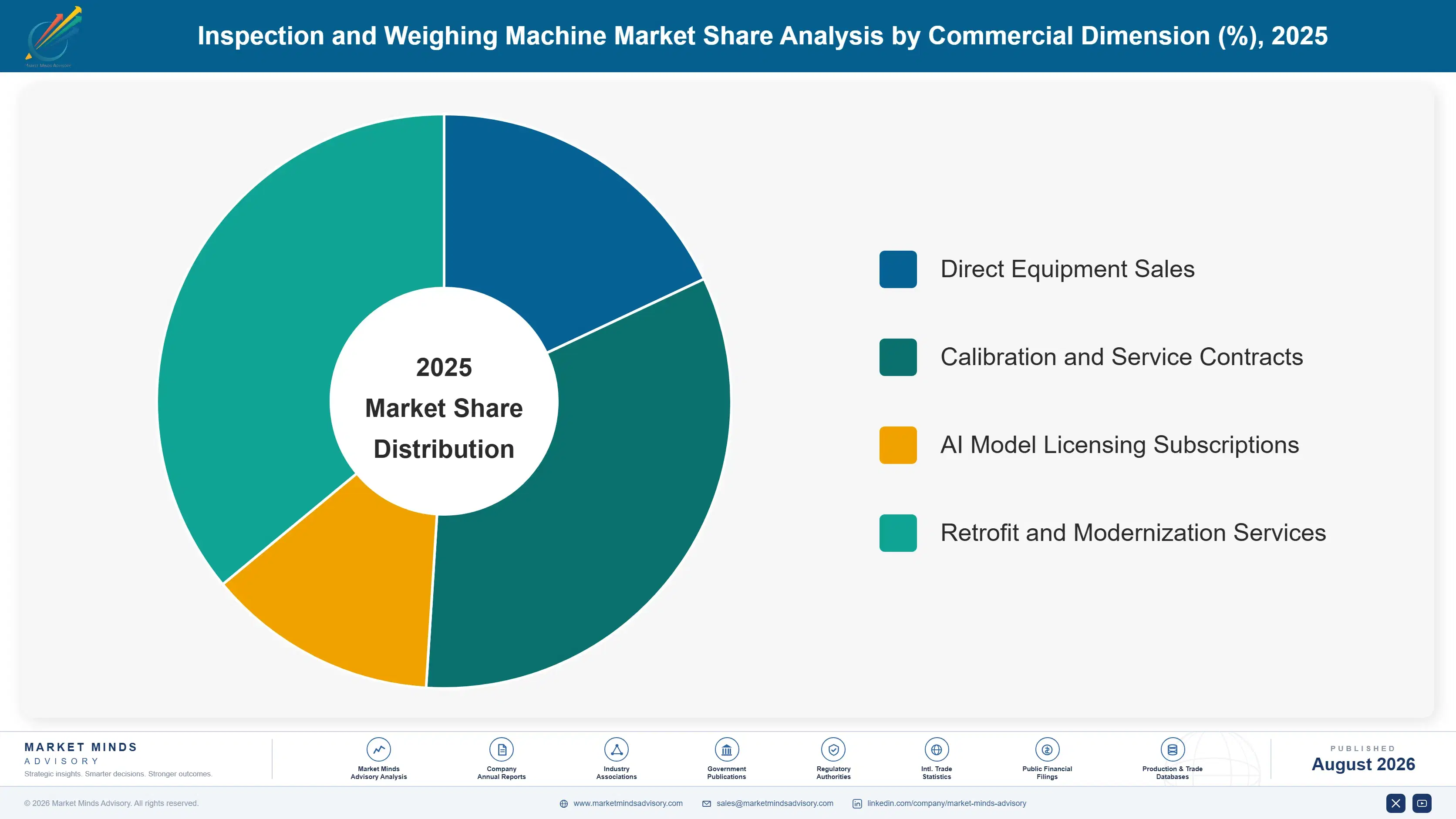
Inspection and weighing machines segment by detection technology, the classification that determines both contaminant detection capability and line integration complexity, the two variables now driving nearly every processor specification decision and equipment maker product roadmap across the industry's largest facilities and most heavily regulated accounts operating today and well into the next several years.
inspection-and-weighing-machine-market-market-share-analysis-1787308819030

AI-Powered Vision Inspection Systems

AI-powered vision inspection systems using deep learning algorithms trained on large defect image libraries are the fastest-growing segment, expanding as detection accuracy finally closes the gap with dedicated X-ray and metal detection technology across a widening range of contaminant and defect types. Processors increasingly specify vision systems as the default first detection layer on new lines, adding X-ray or metal detection only where product-specific contamination risk genuinely requires it rather than as a blanket standard. Equipment makers with the deepest defect image training libraries and the fastest model retraining cycles are capturing disproportionate share of this segment's growth, since detection accuracy compounds directly with the size and diversity of training data available to each vendor.
CAGR 12.5%

Combination Multi-Technology Inspection Systems

Combination systems integrating checkweighing, metal detection, X-ray, and vision inspection into a single synchronized line footprint appeal to processors wanting comprehensive contaminant coverage without the floor space and integration complexity of multiple standalone stations spread across a production line and its supporting infrastructure. Adoption concentrates among large food and pharmaceutical processors facing direct recall liability exposure or mandatory serialization compliance requirements that standalone equipment cannot satisfy on its own. The segment's higher upfront cost limits its addressable share among smaller processors, but equipment makers are steadily introducing modular combination architectures that lower the entry price point and extend the format into mid-market processing lines previously served only by standalone equipment and simpler technology.
CAGR 10.5%
Full segment breakdown across 6 segments available in the complete report.

Regional Architecture and Country Demand Map

East Asia leads on manufacturing capacity and installed base density, North America follows closely on regulatory-driven combination system adoption and strict recall enforcement, and South Asia and Pacific posts the fastest regional growth of any market tracked, off a considerably smaller existing equipment base today.

North America

The United States accounts for the large majority of regional demand, driven by strict Food and Drug Administration recall enforcement and by pharmaceutical serialization requirements under the Drug Supply Chain Security Act that mandate combination inspection and verification equipment on every packaging line operating nationwide. Large processors are consolidating standalone checkweighers and detection stations into single combination systems to satisfy both food safety and serialization requirements simultaneously without expanding line floor space. Canada contributes steady incremental demand tied to its own food processing and pharmaceutical manufacturing sectors, often served by the same equipment makers supplying comparable systems south of the border under similar regulatory expectations and audit requirements each year.
Share: 25% | CAGR: 8.3% (2026 to 2036)

Western Europe

Germany, France, and the United Kingdom drive most regional demand, anchored by strict European Union food safety and pharmaceutical serialization regulation under the Falsified Medicines Directive that has already pushed most large processors toward combination inspection equipment well ahead of comparable mandates elsewhere. This is why the region carries a growth rate below the global average: the market has already converted a larger share of its installed base to combination systems than most other regions, leaving comparatively less room for incremental replacement-driven growth going forward. Nordic markets show particularly high adoption of AI vision retrofit kits, reflecting both regulatory pressure and strong processor appetite for automation investment across the food sector.
Share: 22% | CAGR: 6.5% (2026 to 2036)
Regional intelligence for 5 additional markets available in the complete report: East Asia, South Asia and Pacific, Latin America, Middle East and Africa, Eastern Europe. Contact sales@marketmindsadvisory.com.
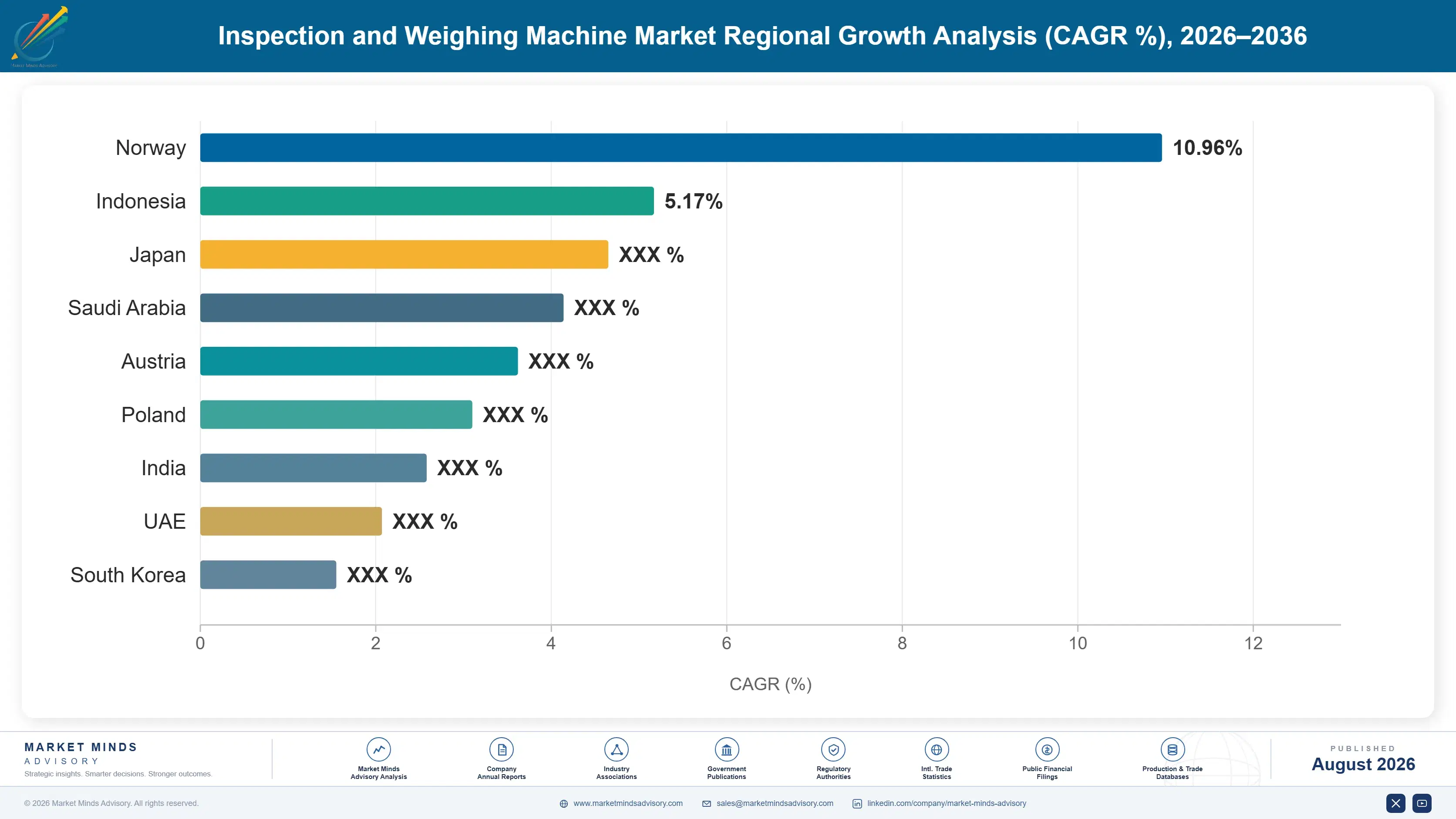
inspection-and-weighing-machine-market-country-cagr-analysis-1787308819554

Turning Compliance Complexity Into Recurring Revenue

Equipment makers have several concrete paths to lift revenue per processor account beyond raw unit sales, spanning AI model licensing, calibration and validation service contracts, serialization compliance consulting, and multi-line standardization agreements layered on top of the core combination system sale across every major processor relationship and renewal cycle each maker maintains going forward.

AI Detection Model Licensing and Update Programs

Equipment makers increasingly license AI vision detection models as a separate recurring subscription rather than bundling them entirely into the upfront system price, converting a one-time capital transaction into a recurring revenue relationship worth roughly 10% to 15% of the original equipment price annually across the subscription term and its renewal cycles each year going forward. Processors favor subscription-based model updates because it lets equipment makers continuously improve detection accuracy over the system's operating life, creating strong incentive to keep the software relationship active rather than running an outdated static detection model indefinitely without updates.
Market Impact: Adds roughly a 10 to 15% recurring

Calibration and Regulatory Validation Service Contracts

Equipment makers increasingly attach preventive calibration and regulatory validation service contracts to combination system sales, converting equipment reliability into a recurring revenue stream worth roughly 12% to 18% of the original equipment price annually across the contract term and every subsequent renewal cycle the account generates over its operating life. Processors favor bundled service agreements because a miscalibrated inspection system creates food safety and regulatory compliance risk that directly threatens retailer relationships, creating strong incentive to prioritize validation guarantees over marginal price savings from third-party calibration providers lacking comparable technical depth.
Market Impact: Adds roughly a 12 to 18% recurring

Serialization Compliance Documentation Consulting Support Programs

Equipment makers increasingly offer serialization compliance documentation consulting alongside standard system sales, helping pharmaceutical processors validate track-and-trace accuracy for regulatory audits across multiple destination markets simultaneously, a service worth roughly 6% to 10% of the underlying system contract value annually across the account relationship and every audit cycle it faces each reporting period and fiscal year. These consulting engagements typically extend the equipment maker's relationship well beyond a single system installation, since compliance documentation requires periodic revalidation as regulatory requirements evolve across the equipment's entire operating life and destination market list.
Market Impact: Adds an incremental 6 to 10% of val

Multi-Line Standardization Agreements With Large Processors

Equipment makers winning multi-line standardization agreements with large processor networks capture the full multi-facility capacity expansion pipeline rather than competing facility by facility against rival equipment makers, typically securing 3 to 5 years of predictable order volume across the network's global production footprint and every regional facility it operates or plans to commission over that period and beyond. This account continuity meaningfully reduces the cost of ongoing sales pursuit and gives equipment makers forward visibility into capital equipment demand that facility-by-facility competition never provides at comparable forecasting reliability or scale.
Market Impact: Secures 3 to 5 years of order volum

Who Controls the Margin Pool

Five equipment makers hold 45% of global revenue, with Mettler-Toledo and Ishida forming a clear leading pair whose combined installed base and service network depth give them a durable gap over the next tier of challengers, including Yamato Scale, Bizerba, and Thermo Fisher Scientific, none of which currently matches their combination system breadth or global calibration service coverage across every major processing region served.
Current competitive activity centers on three dimensions: expanding AI vision detection capability ahead of accuracy parity claims made by rivals, building modular combination architectures that let processors add detection technologies incrementally over time, and winning multi-line standardization agreements with large processor networks expanding capacity across multiple facilities and regions simultaneously under compressed procurement timelines.

Emerging pressure comes from Chinese equipment manufacturers offering lower-cost standard checkweighers and increasingly credible vision systems, gaining ground fastest in price-sensitive emerging markets across South Asia and parts of Latin America where budget constraints outweigh brand preference. Rankings among the established multinational leaders are unlikely to shift materially before 2030, but the value-tier standard equipment segment is becoming considerably more contested territory as regional manufacturers close the technical gap steadily.
inspection-and-weighing-machine-market-company-positioning-matrix-1787308820094

Competitive Moat and Risk Dimensions

METTLER-TOLEDO INTERNATIONAL INC

Moat: Installed Base and Service Depth

Mettler-Toledo's decades of precision weighing and sensor engineering experience combined with its global calibration service network give it a technical credibility and switching cost advantage that competitors without comparable service infrastructure cannot easily replicate across large multinational processor accounts and their recurring audit and compliance requirements.
METTLER-TOLEDO INTERNATIONAL INC

Risk: High Cost Structure Exposure

Mettler-Toledo's sustained investment in sensor research and global validation infrastructure creates a meaningful cost structure that leaner regional manufacturers do not carry, potentially limiting its ability to compete on price in value-tier segments where cost sensitivity outweighs precision engineering depth for many smaller processors evaluating options.
ISHIDA CO LTD

Moat: Checkweigher Engineering Heritage

Ishida's founding role in inventing the modern combination checkweigher gives it engineering credibility and installed base density in Japan and across East Asia that newer entrants to the combination system category have not yet matched with comparably large processor customers or global facility networks operated today.
ISHIDA CO LTD

Risk: Regional Concentration Risk Exposure

Ishida's revenue and manufacturing footprint remain more concentrated in Japan and East Asia than global leaders like Mettler-Toledo, limiting its ability to win large North American and European multinational contracts without relying more heavily on regional distribution and service partners across those distant, unfamiliar markets.

Players Tracked

Prominent Players

Mettler-Toledo International Inc
Ishida Co Ltd
Yamato Scale Co Ltd
Bizerba SE & Co KG
Thermo Fisher Scientific Inc

Other Key Players

Anritsu Corporation
Cognex Corporation
Multivac Sepp Haggenmüller SE & Co KG
Marel hf
Wipotec-OCS GmbH
Loma Systems Ltd
CEIA SpA
Sesotec GmbH
Minebea Intec GmbH
Eagle Product Inspection LLC
Fortress Technology Inc
Multiscan Technologies SL
TOMRA Systems ASA
ISRA VISION AG
Datalogic SpA

Recent Developments

FEBRUARY 2026

Mettler-Toledo Launches Modular AI Vision Retrofit Kit

Mettler-Toledo launched a modular AI vision retrofit kit designed to add deep learning defect detection capability to existing checkweigher installations without requiring full line replacement or downtime. The launch targeted large food processors first, with pharmaceutical-grade variants planned for release across the following fiscal year.
Signal: Retrofit-first strategies are becoming the
SEPTEMBER 2025

Ishida Expands Combination System Manufacturing Capacity

Ishida completed an expansion of combination inspection and weighing system manufacturing capacity at its Japanese production facility to meet rising demand from processors consolidating standalone equipment lines nationwide. The expansion added meaningful output capacity ahead of anticipated order backlog growth across its global customer base.
Signal: Capacity investment is concentrating aroun
MAY 2025

Yamato Scale Signs Multi-Line Standardization Agreement

Yamato Scale signed a multi-line standardization agreement with a major multinational food processor covering combination inspection equipment across the processor's full global capacity expansion pipeline and every regional facility. The agreement was a standardization supply contract, not a joint venture, merger, or acquisition of any kind.
Signal: Multi-facility, full-pipeline standardizat

Precision Sensor and Semiconductor Cost Exposure

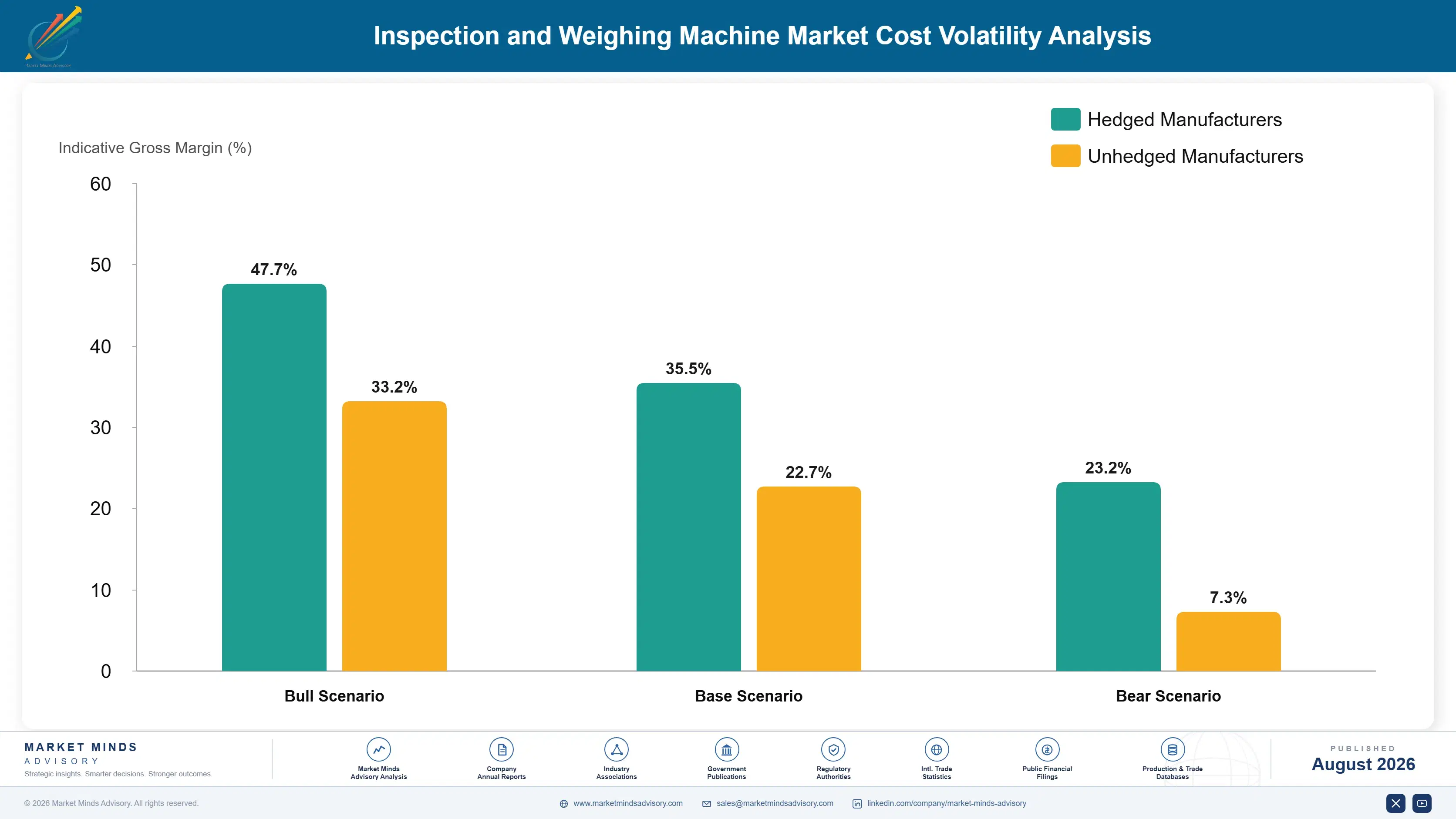
Precision load cells and optical sensors represent 30% to 40% of cost of goods sold for combination inspection and weighing systems, sourced primarily from Japanese and German component manufacturers, while semiconductor components for AI vision processing represent a comparable 20% to 30% share, sourced largely from Taiwanese and South Korean chip foundries operating at global scale and considerable output volume.
Semiconductor pricing and availability tightened sharply during the 2022 to 2023 global chip shortage, extending equipment delivery timelines industry-wide by several months in many cases and forcing some equipment makers to prioritize larger accounts over smaller ones, a dynamic documented in Semiconductor Industry Association market reports tracking global chip supply and pricing trends across major producing regions throughout the affected period and into the following recovery year as capacity gradually normalized.

Equipment makers relying heavily on AI vision processing hardware carry greater exposure to semiconductor price and availability volatility than those with simpler standalone checkweigher product portfolios spanning fewer advanced components, since advanced vision processing chips cannot easily switch to lower-grade alternatives once a system has been engineered and validated around a specific processor architecture and supplier relationship.
inspection-and-weighing-machine-market-cost-volatility-analysis-1787308820291

Multi-Region Component Sourcing Diversification

Equipment makers increasingly source precision sensors and semiconductor components from multiple regional suppliers across Japan, Germany, Taiwan, and South Korea all simultaneously, reducing exposure to any single region's capacity constraints or geopolitical supply disruptions that periodically tighten component markets without warning across the entire industry, its largest accounts, and its smallest regional suppliers alike.

Long-Term Semiconductor Supply Agreements

Large equipment makers negotiate multi-year semiconductor and sensor supply contracts with volume commitments locked in well ahead of anticipated demand spikes, smoothing availability volatility considerably and giving processors far greater delivery timeline predictability across multi-year equipment supply agreements they depend on heavily each capital planning cycle, annual budget review, and every facility expansion decision made.

Modular Architecture Component Standardization

Equipment makers are standardizing sensor and processing component specifications across multiple product lines and geographies simultaneously, reducing the number of unique components requiring dedicated supply relationships while simultaneously improving manufacturing scale economics that regulators and processors increasingly reward through faster delivery commitments, lower lead times, and considerably steadier long-term pricing across every account served.

Portfolio Architecture for Margin Defence

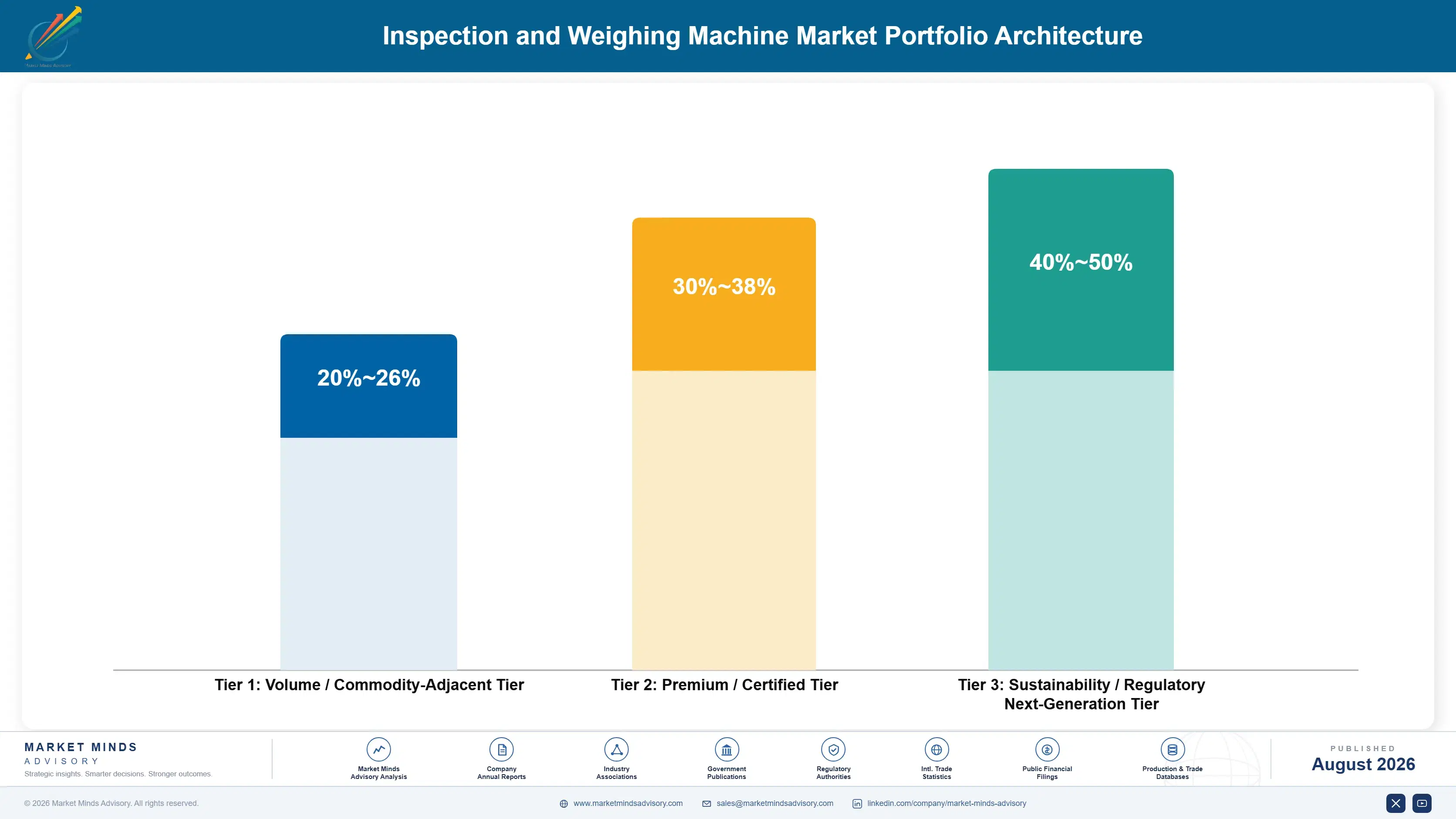
Inspection and weighing equipment portfolios organize into three tiers separated primarily by detection technology sophistication and regulatory positioning rather than by throughput speed alone, with gross margins widening considerably from the standalone commodity-adjacent volume tier through to the AI-enabled next-generation tier that regulated processors increasingly require across their largest and most heavily audited facilities and rapidly expanding production networks worldwide.
Standalone checkweighers face steady margin pressure as combination systems increasingly become the default new-line specification across large regulated facilities, pushing equipment makers to defend standalone volume through service attachment rather than unit price competition alone across most remaining accounts. Combination certified systems occupy the profitable middle ground that most large regulated processors now specify by default across new facility investments and routine capital refresh cycles worldwide.

The highest-value profit pools concentrate in AI-enabled combination systems serving pharmaceutical and large food processors facing direct serialization or recall liability exposure, where equipment makers capture both a technology premium and a recurring service premium simultaneously across the same long-term customer relationship and multi-year contract term, a combination proving considerably more durable and harder to displace than either premium captured alone.

Volume / Commodity-Adjacent Tier

Standalone checkweighers and single-technology detection units sold on unit price to small and mid-size processors without direct regulatory exposure or recall liability concerns driving specification changes across their facility networks and purchasing programs.
Gross Margin: 20-26%

Premium / Certified Tier

Combination multi-technology systems specified by mid-size and large processors seeking compliance headroom ahead of tightening food safety and serialization regulatory deadlines across regulated markets and their expanding facility networks worldwide.
Gross Margin: 30-38%

Sustainability / Regulatory / Next-Generation Tier

AI-enabled combination systems bundled with calibration, validation, and compliance documentation support for processors facing direct serialization or recall liability exposure across their global facility networks and recurring regulatory audit cycles each year.
Gross Margin: 40-50%
inspection-and-weighing-machine-market-portfolio-architecture-1787308820810

High-value Sub-segments and Strategic Watch-out

AI-Enabled Combination Inspection Systems

The fastest-growing, highest-margin segment across the whole portfolio, as AI vision accuracy improvements pull combination systems into mainstream new-line specification, drawing equipment maker capital investment fastest across the entire product category today and over the following several fiscal years of continued regulatory expansion and processor demand.
Gross Margin: 40-50%

AI Model Licensing and Update Services

A moderate-growth, high-margin recurring service layer that converts one-time equipment sales into ongoing subscription revenue tied directly to continuous detection accuracy improvement across each processor's installed equipment base, renewal cycle, and its own long-term account relationship with the equipment maker and dedicated engineering team overall.
Gross Margin: 55-65%

Standalone Checkweighers

The volume core of the market today, still generating the largest absolute unit shipments despite compressing margins, as small and mid-size processors without direct regulatory exposure continue purchasing largely on unit price alone across nearly all existing accounts and product lines shipped every single year.
Gross Margin: 20-26%

Legacy Single-Technology Detection Stations

A strategic watch-out segment facing accelerating replacement pressure from combination systems and probable phase-out across regulated processing facilities within the coming several years, creating both meaningful retrofit risk and a genuine retrofit revenue opportunity for well-positioned equipment makers able to act early, decisively, and ahead of rivals.
Gross Margin: 18-24%

Recurring Calibration Contract Economics

Inspection and weighing equipment demand behaves like an annuity for makers holding calibration and validation service contracts, since regulatory audit cycles recur predictably year over year and processors rarely switch equipment maker mid-contract once a facility standardizes its detection technology and calibration vendor relationship around a proven supplier. Switching mid-contract requires requalifying equipment against food safety and serialization audit standards, a friction that favors
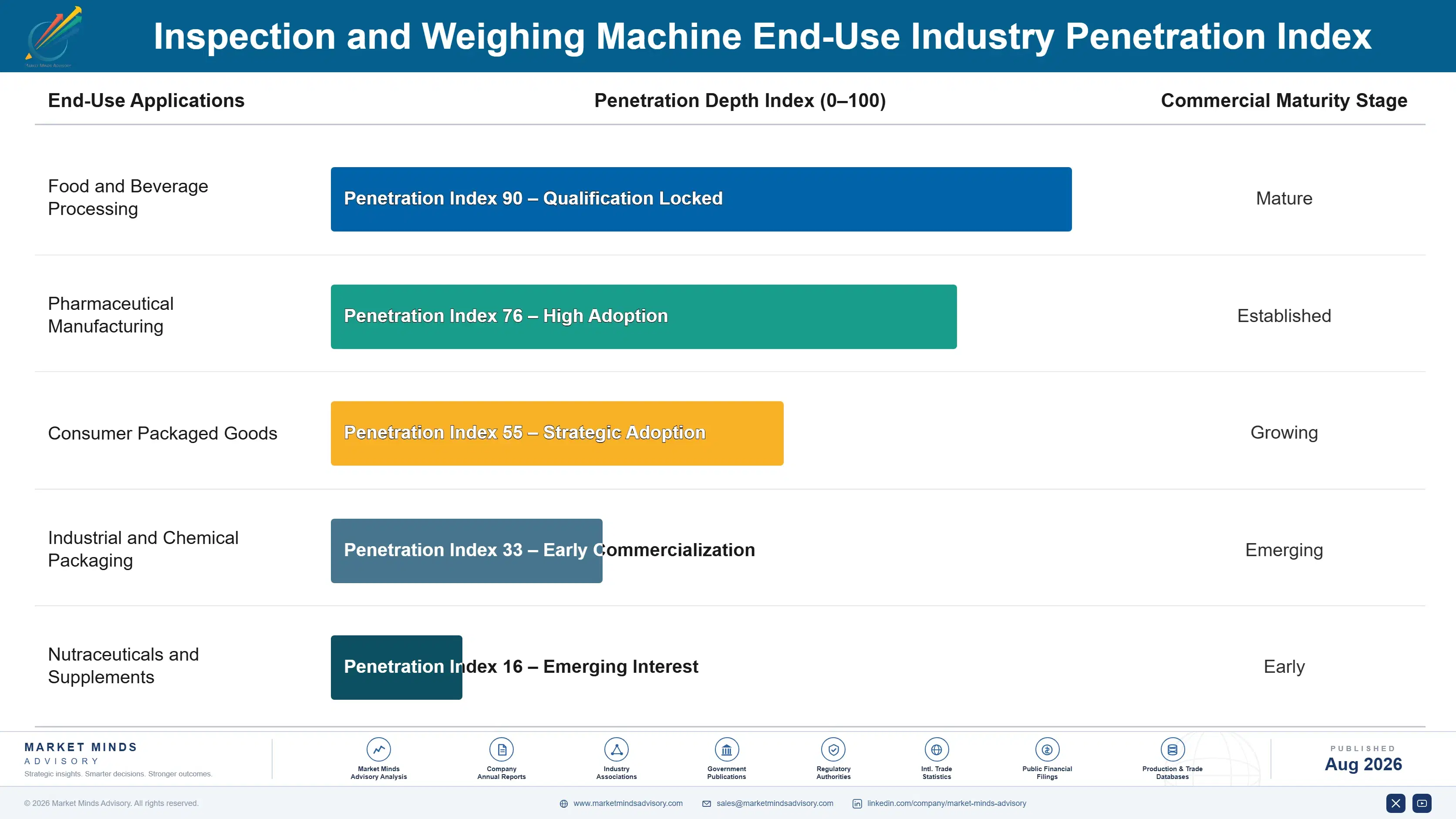
Adoption depth varies considerably by end-use vertical. Pharmaceutical processors specify combination systems with serialization verification for nearly every packaging line given direct regulatory mandate exposure across multiple destination markets, while general food processors adopt combination technology more selectively, reserving it for high-risk categories like ready-to-eat and infant nutrition products rather than every product line manufactured across a facility. Beverage processors show the shallowest penetration of all, relying mostly on standalone checkweighers.

A generational shift in buyer profiles is underway as quality assurance executives with data analytics backgrounds increasingly replace purchasing teams that once evaluated equipment purely on throughput speed, accelerating AI vision and combination system adoption faster than regulation alone would otherwise require across many processor accounts. Younger operations leaders increasingly treat detection accuracy data as a board-level reporting metric.
inspection-and-weighing-machine-market-end-use-penetration-index-1787308821304

Where Equipment Makers Should Focus Capital

These are among the four positions where our research anticipates prominent divergence between winners and laggards over the coming forecast period. Each is grounded in the demand model, the regulatory perimeter, and the announced capacity pipeline.
01 / AI MODEL INVESTMENT

Prioritize defect image training data over hardware differentiation

Equipment makers competing primarily on hardware specifications are fighting a battle that AI vision accuracy has already decided in favor of whoever holds the largest, most diverse defect image training library. Detection accuracy now compounds directly with training data scale rather than sensor resolution alone, a shift many hardware-focused rivals have been slow to recognize. Makers investing in defect data partnerships with large processor accounts today are building a durable data advantage that competitors will find increasingly difficult to close in the years ahead.
02 / SERVICE BUNDLING STRATEGY

Bundle calibration contracts with combination system sales

Equipment makers that pair calibration and validation service contracts with combination system sales lock in recurring revenue worth 12% to 18% of equipment price annually across every account they hold. That stream proves considerably stickier than equipment sales alone, since miscalibration risk directly threatens processor retailer relationships and regulatory standing across every audited facility. Processors rarely switch calibration vendors mid-contract once a validation history is established, making this bundling strategy the single most defensible account-level revenue lever available to equipment makers today.
03 / REGULATORY POSITIONING PATH

Build serialization compliance depth ahead of expanding mandates

Pharmaceutical serialization mandates are spreading well beyond the United States and European Union into India and the Gulf states, reshaping compliance requirements for exporters almost every year. Equipment makers building deep compliance documentation and multi-market serialization expertise now are positioned to capture disproportionate share of pharmaceutical processor accounts before those mandates take full effect elsewhere. Competitors treating serialization as a single-market feature rather than a global compliance discipline risk losing share to makers supporting processors expanding into newly regulated export markets.
04 / RETROFIT KIT EXPANSION

Scale modular AI vision retrofit kits for older installed lines

A vast installed base of older standalone checkweighers and single-technology detection stations represents a retrofit opportunity larger than new-line equipment sales for makers who can engineer it well and price it competitively. Equipment makers able to build modular AI vision kits that upgrade existing lines without full replacement stand to capture budgets competitors overlook entirely. Makers moving fastest into retrofit kit development will capture processor spending that would otherwise sit idle until a full capital replacement cycle arrives naturally several years from now.

Engagement Snapshot From the Field

A live engagement with an industry participant carrying material or product regulatory and market exposure ahead of a defining policy shift, showing how our research translates into a defensible multi-year portfolio strategy.
MARKET MINDS ADVISORY · CLIENT ENGAGEMENT SUMMARY
Inspection and Weighing Machine Producer Strategic Portfolio Review and Transition Roadmap 2026·Investment Scenario on Inspection and Weighing Machine Exposure Evaluation 2025-26
CLIENT PROFILE
The client operates twelve pharmaceutical packaging lines across four countries, manufacturing an estimated 800 million packaged units annually (client-reported, unverified by MMA), with serialization compliance and contaminant detection representing its two most significant quality assurance priorities across its global manufacturing network, regulatory footprint, expanding export market list, and long-term multi-year capital planning and budgeting process.
STRATEGIC CHALLENGE
The client faced expanding serialization mandates across three additional export markets alongside aging standalone inspection equipment approaching end of service life, and needed to modernize its packaging lines without disrupting existing production schedules or absorbing unsustainable capital cost increases across its global facility network and tightly managed annual capital budget.
MMA APPROACH
MMA conducted an equipment audit across all twelve packaging lines, benchmarked combination system pricing and serialization compliance capability across five qualified equipment makers, and modeled recall risk reduction against capital cost to build a phased modernization business case for client leadership and its global operations committee to formally review and approve.
KEY FINDINGS
  1. Seven of twelve lines used standalone equipment approaching end of service life, creating meaningful unplanned downtime risk across the client's production schedule.
  2. Combination systems with integrated serialization verification cut modeled compliance documentation labor by 45%, freeing quality assurance staff for higher-value audit preparation work.
  3. Only two of five equipment makers evaluated could support serialization requirements across all four countries within the client's target modernization timeline of eighteen months.
  4. Delayed modernization across the seven aging lines would have risked an estimated 18% increase in unplanned downtime within eighteen months absent proactive replacement action.
CLIENT PROFILE
The client operates twelve pharmaceutical packaging lines across four countries, manufacturing an estimated 800 million packaged units annually (client-reported, unverified by MMA), with serialization compliance and contaminant detection representing its two most significant quality assurance priorities across its global manufacturing network, regulatory footprint, expanding export market list, and long-term multi-year capital planning and budgeting process.
STRATEGIC CHALLENGE
The client faced expanding serialization mandates across three additional export markets alongside aging standalone inspection equipment approaching end of service life, and needed to modernize its packaging lines without disrupting existing production schedules or absorbing unsustainable capital cost increases across its global facility network and tightly managed annual capital budget.
MMA APPROACH
MMA conducted an equipment audit across all twelve packaging lines, benchmarked combination system pricing and serialization compliance capability across five qualified equipment makers, and modeled recall risk reduction against capital cost to build a phased modernization business case for client leadership and its global operations committee to formally review and approve.
KEY FINDINGS
  1. Seven of twelve lines used standalone equipment approaching end of service life, creating meaningful unplanned downtime risk across the client's production schedule.
  2. Combination systems with integrated serialization verification cut modeled compliance documentation labor by 45%, freeing quality assurance staff for higher-value audit preparation work.
  3. Only two of five equipment makers evaluated could support serialization requirements across all four countries within the client's target modernization timeline of eighteen months.
  4. Delayed modernization across the seven aging lines would have risked an estimated 18% increase in unplanned downtime within eighteen months absent proactive replacement action.
RECOMMENDED STRATEGY
Phase 1: Phase 1 (Months 1 to 4): Audit all twelve lines and prioritize replacement sequencing by equipment age and serialization exposure risk. Phase 2: Phase 2 (Months 5 to 10): Install combination systems on the three highest-risk lines first, validating serialization performance fully before proceeding. Phase 3: Phase 3 (Months 11 to 18): Complete rollout across remaining lines and renegotiate long-term calibration service contracts on improved terms.
OUTCOME
Within eighteen months the client modernized all seven priority lines, reporting an estimated 22% reduction in unplanned downtime and full serialization compliance across all four countries (client-reported, unverified by MMA), with remaining lines scheduled for modernization across the following fiscal year and capital budget cycle.

Frequently Asked Questions

Foundational context covering the market sizes, CAGR, scope, country, region and competition that inform every finding below. This section is provided to cover basics and most often pre-purchase conversations, answered from the MMA Primary Research Dataset.

What is the current size of the Inspection and Weighing Machine Market?

The global inspection and weighing machine market is valued at $2.3 billion in 2025, MMA's designated base year for this analysis. This figure covers checkweighers, metal detection, X-ray, vision, and combination inspection systems worldwide.

How large will the Inspection and Weighing Machine Market be by 2036?

MMA projects the market will reach $5.363 billion by 2036 under the base case scenario. That represents a 2.16 times expansion over the 2026 starting value across the ten-year forecast window.

What is the CAGR for the Inspection and Weighing Machine Market 2026 to 2036?

The base case CAGR is 8.0% annually, with a bull case of 9.3% and a bear case of 6.7%. AI vision accuracy gains and serialization mandate expansion are the primary swing factors between scenarios.

Which segment is growing fastest?

AI-powered vision inspection systems lead at a 12.5% CAGR, roughly 1.56 times the overall market rate. Detection accuracy gains closing the gap with dedicated X-ray and metal detection technology drive this growth.

Who are the major companies in the Inspection and Weighing Machine Market?

Mettler-Toledo International Inc, Ishida Co Ltd, Yamato Scale Co Ltd, Bizerba SE & Co KG, and Thermo Fisher Scientific Inc lead the market. Together these five equipment makers hold an estimated 45% of global revenue.

Which country is growing fastest?

India leads country-level growth at an estimated 10.0% CAGR, driven by rapidly expanding pharmaceutical export manufacturing requiring serialization-compliant equipment. Indonesia and Vietnam follow closely behind.

Report Segmentation Architecture

The full report scope spans multiple orthogonal segmentation dimensions, with cross-tabulated demand data provided for each dimension pair. Coverage extends further to regional breakdowns, trend trajectories, and the competitive detail needed to support segment-level decision-making.

By Detection Technology Type

  • Checkweighers
  • Metal Detection Systems
  • X-Ray Inspection Systems
  • AI-Powered Vision Inspection Systems
  • Combination Multi-Technology Inspection Systems
  • Modular Retrofit Inspection Add-On Systems

By End-Use Industry

  • Food and Beverage Processing
  • Pharmaceutical Manufacturing
  • Consumer Packaged Goods
  • Industrial and Chemical Packaging
  • Nutraceuticals and Supplements

By Commercial Dimension

  • Direct Equipment Sales
  • Calibration and Service Contracts
  • AI Model Licensing Subscriptions
  • Retrofit and Modernization Services

By Region

  • North America
  • Western Europe
  • East Asia
  • South Asia and Pacific
  • Latin America
  • Middle East and Africa
  • Eastern Europe

Scope, Methodology, and Coverage

Every figure in this report is reproducible from documented input assumptions. The scope below maps the historical period, the forecast horizon, the segmentation dimensions, and the countries covered, alongside the underlying primary and qualitative methodology.
Historical Period
2020 to 2025
Forecast Period
2026 to 2036
Base Year
2025 (USD billions; MMA Primary Research Dataset, August 2026)
Market Definition
The inspection and weighing machine market covers checkweighers, metal detection systems, X-ray inspection systems, vision inspection systems, and combination multi-technology inspection and weighing systems used in food, pharmaceutical, and industrial packaging lines. It excludes laboratory-grade analytical instruments and manual handheld inspection tools.
Quantitative Units
USD billions (current prices); unit shipments in thousands of systems
Segmentation Dimensions
By Detection Technology Type; By End-Use Industry; By Commercial Dimension; By Region
Regions Covered
North America, Western Europe, East Asia, South Asia and Pacific, Latin America, Middle East and Africa, Eastern Europe
Countries Covered
USA, China, Germany, France, UK, Japan, South Korea, India, Australia, Canada, Brazil, Mexico, Indonesia, Vietnam, Thailand, Malaysia, UAE, Saudi Arabia, South Africa, Nigeria, Turkey, Poland, Netherlands, Italy, Spain, Sweden, Switzerland, Argentina, Colombia, Singapore, and additional markets relevant to this sector
Key Companies Profiled
Mettler-Toledo International Inc, Ishida Co Ltd, Yamato Scale Co Ltd, Bizerba SE & Co KG, Thermo Fisher Scientific Inc, Anritsu Corporation, Cognex Corporation, Multivac Sepp Haggenmüller SE & Co KG, Marel hf, Wipotec-OCS GmbH, Loma Systems Ltd, CEIA SpA, Sesotec GmbH, Minebea Intec GmbH, Eagle Product Inspection LLC, Fortress Technology Inc, Multiscan Technologies SL, TOMRA Systems ASA, ISRA VISION AG, Datalogic SpA
Quantitative Methodology
Primary survey, n=3,800 respondents, Q4 2025, six countries; demand-side model with trade association cross-validation
Qualitative Methodology
47 expert interviews, Q4 2025; applied to validate demand model assumptions, identify emerging dynamics, and assess competitive positioning
Report Format
PDF and XLSX data workbook (Word format preview document)
Publisher
Market Minds Advisory
Report Code
MMA-2026-CON-101
Published
August 2026
Contact
sales@marketmindsadvisory.com | www.marketmindsadvisory.com

Purchase the full Inspection and Weighing Machine Market Report (2026 to 2036).

The full report delivers a complete analysis of the global inspection and weighing machine market, covering sizing and forecasts across all seven regions and six technology segments through 2036. It profiles twenty equipment makers with verified moat and risk assessments for the two category leaders, Mettler-Toledo and Ishida, across their installed base and service networks. The report includes detailed input cost analysis, portfolio margin benchmarking, and a primary-research-backed regulatory serialization outlook. Buyers receive full access to underlying data tables and methodology notes supporting every figure presented throughout the analysis.
Seven-region sizing and forecast data tables
Six-segment MECE technology breakdown and analysis
Twenty-company competitive profiles and full rankings
Input cost exposure and mitigation analysis
Portfolio tier margin benchmarking data included
Regulatory serialization timeline and full outlook

Built For The People Who Decide

From boardroom strategy to bench-side execution, this report is read cover-to-cover by leaders shaping the next decade of their industry, turning demand scenarios, market dynamics and valuation benchmarks into decisions.
CXOs/ Presidents/ VPs/ Managers
M&A and Corporate Development
Strategy Teams and R&D Heads
Procurement and Product Directors
Regulatory and Compliance Leaders
Investor Relations and Equity Analysts