Market Minds Advisory
Inspection and Inventory Labels Market

Inspection and Inventory Labels Market: Adhesion Failure, Audit Trails and the Label That Has to Survive Six Years Outdoors

An inspection label is legal evidence that a crane was checked, and when it falls off a girder after eighteen months the asset is out of service until somebody proves the inspection happened.

Lead Analyst

Bilal Shaikh

Published

September 2026

Make Smarter Decisions with Customized Research Insights

Request a free sample report and evaluate market opportunities, growth trends, and competitive dynamics relevant to your business needs.

2025 MARKET VALUE$2.9BMarket Size 2025
2036 FORECAST VALUE$5.8BBase Case , 2026 to 2036
CAGR 2026 TO 20366.5 %Bull 7.7% / Bear 5.3%
INCREMENTAL OPPORTUNITY$2.7BNet 10- year value creation
EXPANSION MULTIPLE1.88x2036 value over 2026 base
Strategic Levers
M&A Pipeline
Regional Outlook
Country Rankings
Competitive Intelligence
Segmental Deep-dive
Call-Us : 91 93563 13602

Executive Snapshot and Market Trajectory

This label is not marketing and not logistics. It is a record that something was inspected, calibrated or counted on a specific date, and it has to remain legible and attached until the next inspection, which may be six years away in outdoor weather that nobody controls.
RFID and NFC-enabled asset labels compound at 9.75%, exactly 1.50 times the market, as inventory counting shifts from line of sight to radio. East Asia holds 30% of demand on manufacturing asset density. Adhesion failure rather than print durability removes these labels from service, and few buyers test for it. Around 68% of losses are bond failures with the print intact and the label on the floor.
Five converters hold 41%. Substrate and adhesive formulation depth separates them, since a label surviving six years on powder-coated steel outdoors is a materials problem rather than a printing one. Distribution reach into maintenance and safety functions matters nearly as much. Radio is where the growth concentrates, and on-metal antenna design separates converters who can quote it from those who cannot. Inlays near nine cents make tagging viable far below previous thresholds.
Market Definition
The market covers pressure-sensitive labels used for asset identification, inspection recording, calibration status and inventory control, spanning durable inspection and safety labels, calibration and certification labels, asset tracking and barcode labels, RFID and NFC-enabled asset labels, tamper-evident inventory seals, and write-on maintenance record labels. Product identification labels, retail barcode labels on saleable goods, and shipping and logistics labels are excluded.
Base Year Value
$2.9B in 2025 (MMA Primary Research Dataset, August 2026)
Forecast Period
2026 to 2036, eleven discrete annual values
CAGR
6.5% base case. Bull 7.7%. Bear 5.3%.
Fastest Growth Segment
RFID and NFC-Enabled Asset Labels: 9.8% CAGR
Fastest Growth Country
India: 9.2% CAGR
Fastest Growth Region
South Asia and Pacific: 8.7% CAGR
Largest Region
East Asia: 30% of 2025 global value
Market Leaders
Brady Corporation, Avery Dennison, 3M, Seton Identification Products, HellermannTyton. Source: MMA Analysis based on company annual reports.
Primary Survey
n=3,800 procurement and R&D decision-makers, Q4 2025, six countries
Methodology
Demand-side build-up, cross-validated against public data, 47 expert interviews

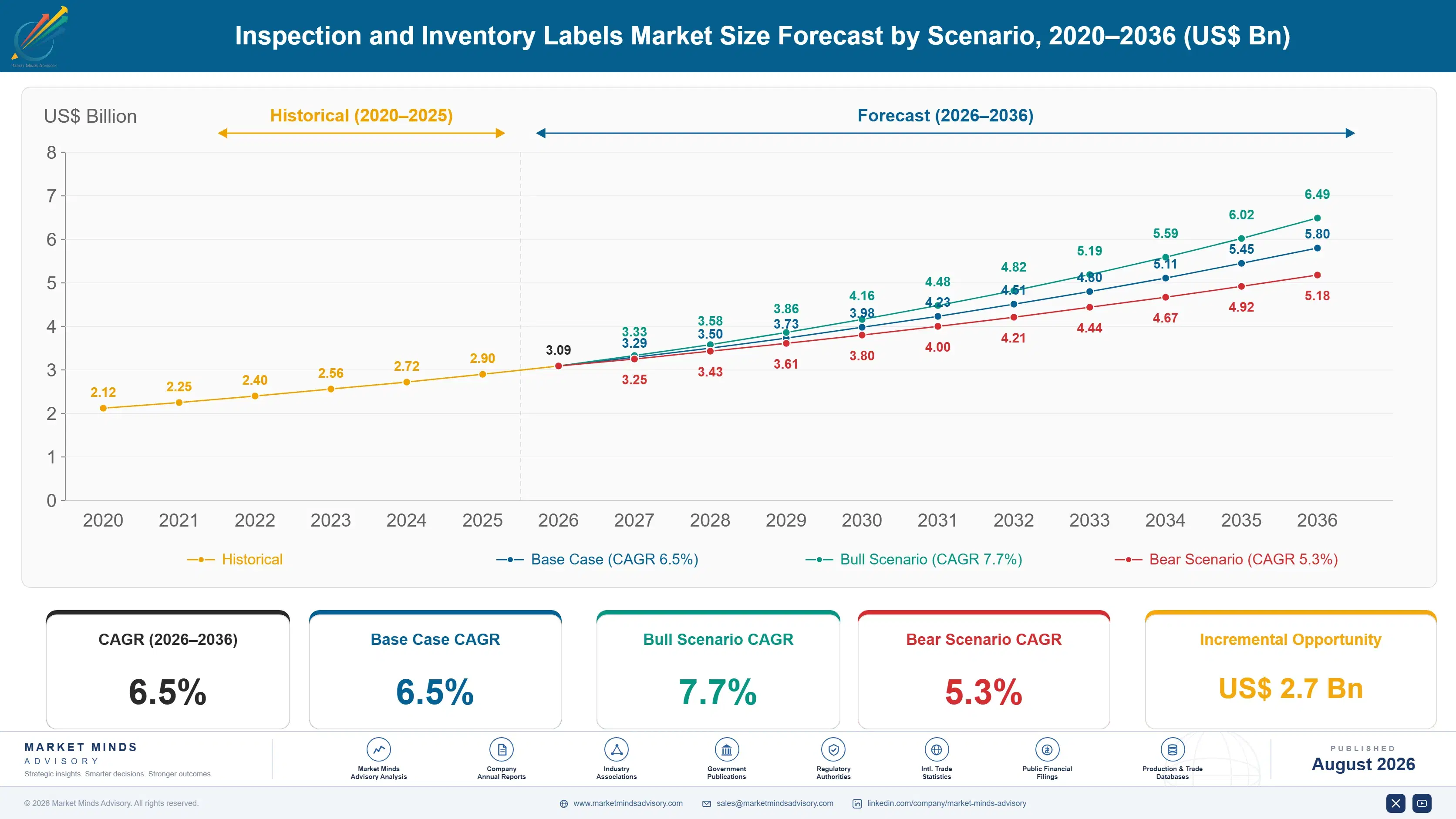
Inspection and Inventory Labels Market Forecast Scenarios

inspection-and-inventory-labels-market-size-forecast-scenario-1787308527696
Growth ran at an implied 5.4% across 2020 to 2025, and the composition changed more than the total did. Manual inventory labelling grew slowly while asset tracking and inspection recording grew considerably faster, driven by maintenance compliance regimes tightening and by insurers asking harder questions about inspection evidence after equipment failures. Radio-enabled labelling grew from a small base throughout the period.
The base case at 6.5% rests on three mechanisms. Regulated inspection regimes across lifting equipment, pressure systems, electrical installations and fire safety keep expanding in scope and in documentation requirements. Radio-based inventory counting keeps displacing line-of-sight barcode scanning. And asset registers keep growing as organisations tag equipment they previously tracked on spreadsheets or not at all. Radio labels compound at 9.75% against a market at 6.5%, and durable inspection product takes further share.
The bull case at 7.7% assumes RFID tag cost declines continue and reach the point where labelling individual tools and portable equipment becomes routine rather than exceptional. The bear case at 5.3% follows from digital inspection records displacing physical labels where regulations permit, and from asset tagging programmes stalling once the obvious high-value equipment has been covered.

Proof That Somebody Checked It

The commercial logic of this category is unusual. A label costing a few cents is the documentary evidence that a statutory inspection took place, and when it goes missing the asset it identifies comes out of service until the record can be reconstructed. For a mobile crane or a pressure vessel, that is days of lost availability against a label spend measured in pennies.
TOP FIVE CONCENTRATION41%Combined share held by the five largest label converters globally
REQUIRED SERVICE LIFE6 yearsOutdoor durability expected on typical statutory inspection labels
ADHESION FAILURE SHARE68% of lossesProportion of label losses caused by bond failure not fading
FACESTOCK COST SHARE39% of COGSSubstrate and adhesive as a proportion of converter cost base
RFID TAG COSTUSD 0.09Inlay cost governing where radio tagging becomes economically routine
ASSET REGISTER COVERAGE57%Share of tracked equipment carrying a durable identification label
What removes these labels is not what buyers expect. Around 68% of losses are adhesion failures rather than print degradation: the label is perfectly legible, lying on the floor beside the equipment. Powder-coated steel, textured plastics, cold application temperatures and surfaces that flex under load all defeat adhesives selected on a datasheet rather than tested on the actual substrate.
Radio is changing the counting half of the market faster than the inspection half. RFID inlays at around nine cents make tagging economically sensible far below the asset values that justified it a decade ago, and counting a store room without line of sight changes inventory practice completely. Compounding at 9.75%, that segment is where the growth sits while inspection labelling grows steadily on regulation.
"Buyers agonise over UV resistance and print permanence, then apply the label to powder-coated steel at four degrees in a car park. The ink will outlast the bond by about five years."
Principal, Industrial Labels and Asset Identification Practice · MMA Industrial

Market Trends

Radio Counting Displaces Line-of-Sight Barcode Scanning

Counting a store room or a tool crib by barcode requires handling and sighting every item, which is why most organisations count infrequently and trust the result partially. RFID inlays at roughly nine cents make radio tagging viable on items whose value would never have justified it before, and a room can be counted in minutes without touching anything. That changes inventory practice rather than just speeding it up. RFID and NFC asset labels compound at 9.75% against a market at 6.5%, and tag cost is the only remaining brake.
Market Impact: Downtime measured in 3 days
Inspection Regimes Expand Scope and Documentation Demands

Statutory inspection requirements across lifting equipment, pressure systems, electrical installations and fire safety have widened in scope and tightened on record keeping, and insurers now ask for inspection evidence far more aggressively after equipment failures. A durable label carrying inspection date, inspector identity and next due date is the primary field record in most of these regimes. Service life expectations reach six years outdoors, which puts the requirement well beyond what general purpose industrial labels deliver reliably. Insurers have hardened on documentary evidence, which makes the physical record harder to remove than regulation alone does.
Market Impact: Coverage at 57% of assets

Market Opportunities and Growth Drivers

Asset Downtime Cost Dwarfs Any Conceivable Label Spend

When an inspection label goes missing, the equipment it identifies typically comes out of service until the inspection record can be reconstructed or the inspection repeated. For a mobile crane, a pressure vessel or a fleet of access equipment, that means days of lost availability against a label costing a few cents. The arithmetic is overwhelming once anybody performs it, and converters who present durability testing against downtime cost rather than against competitor pricing change the purchase entirely. Three days of lost availability is the typical exposure per occurrence. Few converters ever do it.
Market Impact: Bond failures at 68% share

Asset Registers Grow as Spreadsheet Tracking Collapses

Organisations that tracked equipment on spreadsheets or in somebody's memory are moving to formal asset registers under audit, insurance and maintenance system pressure, and every register entry needs a physical identifier that survives the asset's working environment. Coverage across tracked equipment sits near 57%, which leaves substantial expansion available before saturation. Each tagging programme also creates a recurring replacement requirement, since labels fail and assets are added continuously rather than in one initial exercise. Insurance and audit pressure is what actually forces the move, since maintenance functions rarely fund register formalisation on their own budget alone.
Market Impact: Removing 8% of applications

Market Restraints and Challenges

Adhesion Failure Undermines Confidence in the Whole Category

Around 68% of label losses are bond failures rather than print degradation, and the root cause is that adhesives are selected from datasheets rather than tested against the actual substrate, surface energy and application temperature. Powder coating, textured plastics and flexing surfaces defeat general purpose acrylics routinely. Converters mitigate by testing customer substrates before quoting and by supplying application temperature guidance, which sounds obvious and is almost never done in a category bought on price per thousand. Test panels cost almost nothing against a single asset standing idle. Failure rates above 20% follow.
Market Impact: Inlay cost near USD 0.09

Digital Inspection Records Displace Physical Labels Selectively

Where regulations permit an electronic record as the primary evidence, some organisations are removing physical inspection labels entirely and relying on maintenance system entries. The root cause is genuine duplication, since the label and the database record the same event twice. Converters mitigate by supplying NFC-enabled labels that link the physical asset to the digital record rather than competing with it, which preserves the label as the field-readable index into a system nobody can see from a gantry. Roughly 8% of applications have already gone that way. Insurers pushing back have slowed it.
Market Impact: Service life reaching 6 years
4 additional market trends, 3 additional growth drivers, and 2 additional restraints and challenges are covered in the full report. Contact sales@marketmindsadvisory.com to access the complete intelligence.

Segment CAGR and Growth Architecture

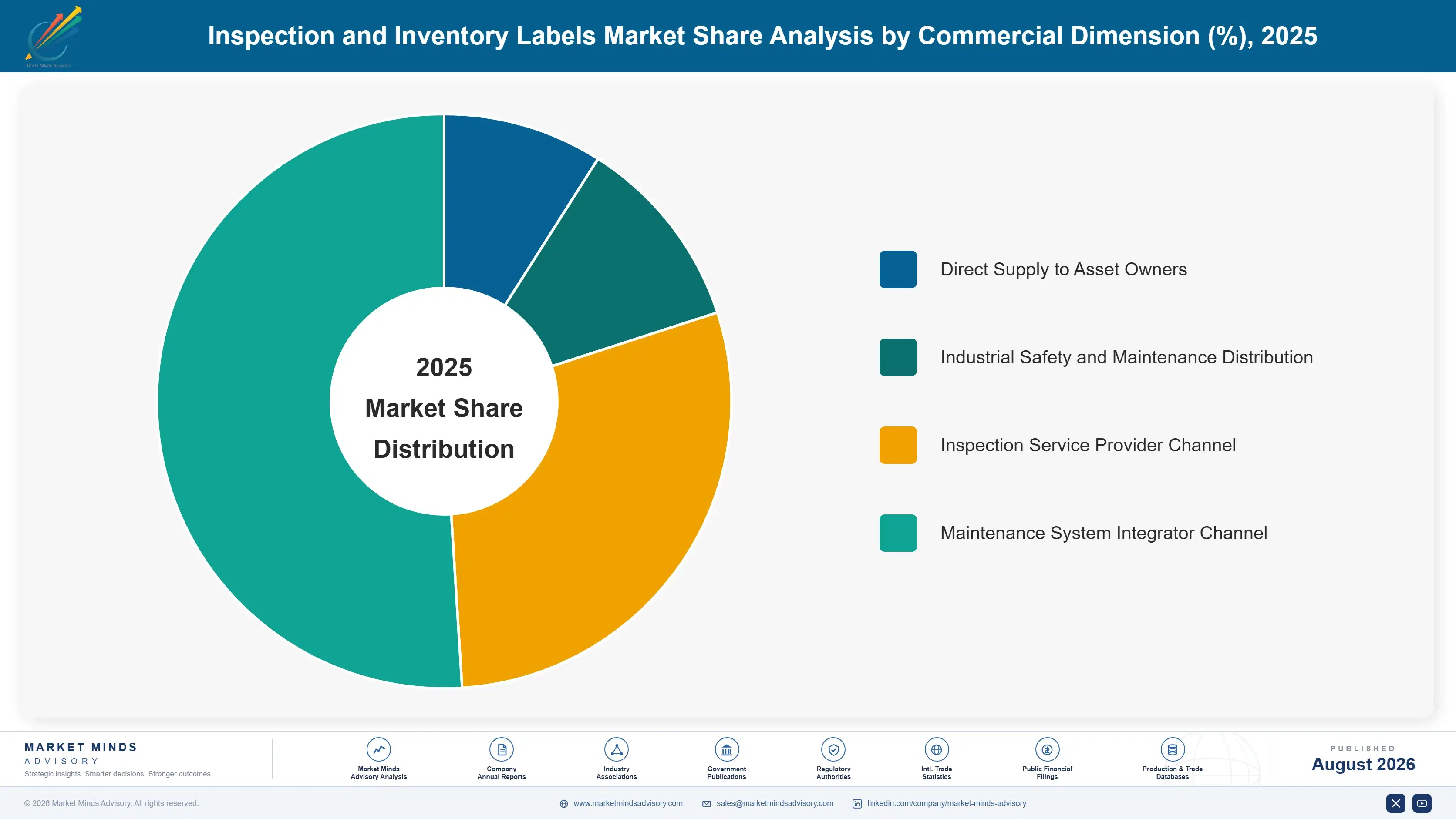
Segmentation follows label function and identification method, because what the label has to record determines its substrate, adhesive class and data carrier together. An inspection label proving a date and a radio-enabled inventory label solving a counting problem are different products serving different buyers inside the same building. Six functional classes sit here, separated by what the label records.
inspection-and-inventory-labels-market-market-share-analysis-1787308528231

RFID and NFC-Enabled Asset Labels

Radio-enabled labels compound at 9.75%, exactly 1.50 times the market, on inlay costs near nine cents that make tagging viable well below the asset values that once justified it. The commercial change is not speed but practice: a store room counted without line of sight gets counted weekly rather than annually, and the inventory accuracy that follows changes purchasing and maintenance behaviour downstream. NFC variants serve a different purpose, linking a physical asset to its digital maintenance record through a phone tap rather than supporting bulk counting. The engineering difficulty is metal and liquid detuning the antenna, which requires on-metal inlay designs and spacer construction that add cost and thickness against a plain label.
CAGR 9.8%

Durable Inspection and Safety Labels

Durable inspection labels grow at 7.6% on statutory regimes widening across lifting equipment, pressure systems, electrical installations and fire safety. The requirement is unforgiving: six years outdoors, legible after UV, thermal cycling, wash-down chemicals and abrasion, and still bonded to a surface that may be powder-coated, textured or flexing under load. Polyester and polycarbonate facestocks with high-performance acrylic or rubber adhesives handle most of it, and subsurface printing protects the image where abrasion is severe. Adhesion rather than print life is what fails in the field, which makes substrate testing before specification the single most valuable service a converter can supply here. Almost nobody asks for it, and the ones who do rarely change supplier again.
CAGR 7.6%
Full segment breakdown across 6 segments available in the complete report.

Regional Architecture and Country Demand Map

Demand follows installed industrial asset density and inspection regulation together, since a labelled asset requires both something worth tracking and a rule requiring the record. Manufacturing intensity therefore predicts volume better than economic size does. East Asia leads on installed asset density rather than on regulation.

East Asia

East Asia takes 30% of global demand and grows at 7.5%. Chinese manufacturing asset density is the largest single block anywhere, and inspection regulation across lifting equipment and pressure systems has tightened substantially as industrial safety enforcement has become more consistent. Japanese demand skews toward high-durability and precision applications, with calibration labelling in electronics and instrument manufacturing forming a distinctive segment. Korean shipbuilding, petrochemical and electronics facilities carry heavy inspection labelling loads in genuinely hostile environments. Taiwanese semiconductor fabrication drives calibration and asset labelling with cleanroom-compatible substrate requirements few converters can supply. Regional converting is extensive on printing and thinner on durable substrate formulation, so material is often imported while conversion happens locally.
Share: 30% | CAGR: 7.5% (2026 to 2036)

North America

Twenty-five percent of demand sits in North America, growing at 6.2%. Occupational safety and equipment inspection enforcement is well established and insurers press hard on inspection evidence following equipment failures, which sustains durable label demand independently of industrial growth. Asset tagging programmes are further advanced than elsewhere, and RFID adoption in maintenance stores and tool cribs leads other regions by a clear margin. The distribution structure runs heavily through industrial safety and maintenance suppliers rather than through packaging channels, which shapes who can reach the buyer at all. Fleet and construction plant operators are the most demanding buyers, since their assets sit outdoors in freeze-thaw conditions on powder-coated and galvanised surfaces that defeat general purpose adhesives within two winters.
Share: 25% | CAGR: 6.2% (2026 to 2036)
Regional intelligence for 5 additional markets available in the complete report: Western Europe, South Asia and Pacific, Latin America, Middle East and Africa, Eastern Europe. Contact sales@marketmindsadvisory.com.
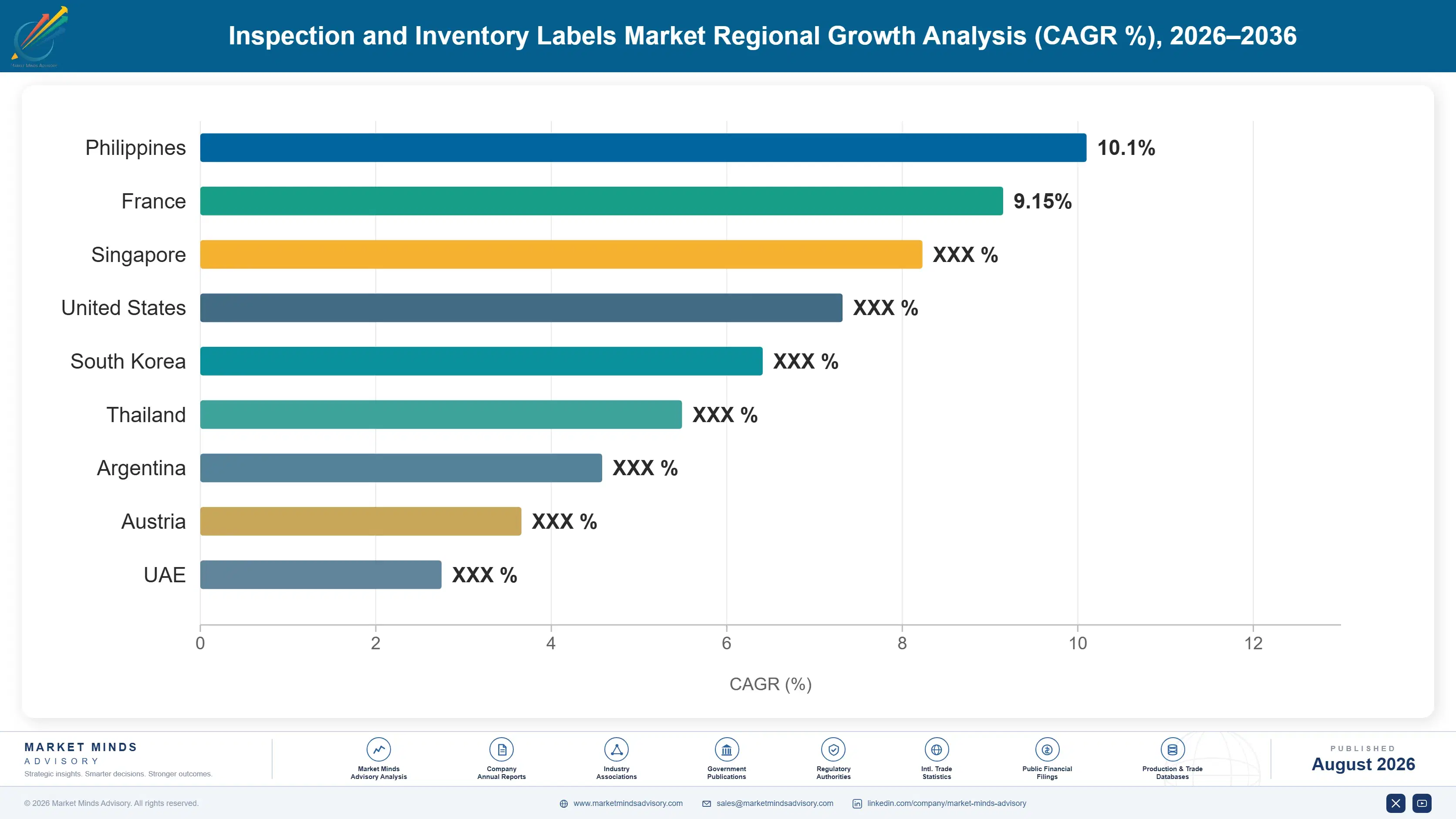
inspection-and-inventory-labels-market-country-cagr-analysis-1787308528743

Testing the Substrate Before Quoting

Durable labels are bought on price per thousand against print specifications that describe the wrong failure mode entirely. Every position worth holding here starts from adhesion rather than from printing. Four qualify: two need material sent to a customer site before any order exists, and two turn on radio engineering and digital record integration.

Test Customer Substrates Before Any Quotation

Around 68% of label losses are bond failures, not print degradation, and adhesives are almost always selected from a datasheet rather than tested against the actual powder coating, textured plastic or flexing surface involved. Converters who send test panels and applied samples for a customer's own substrate at realistic application temperatures convert a price comparison into a technical qualification. The cost is trivial against a single asset coming out of service for a missing inspection record, and few competitors will do the work at all. Failure rates above 20% are common where nobody tested.
Market Impact: Adhesion causing 68% of all durable

Present Durability Against Asset Downtime Arithmetic

A missing inspection label typically removes equipment from service for around three days while the record is reconstructed or the inspection repeated. Against a label costing a few cents, that arithmetic ends any price discussion immediately, but somebody has to perform it in front of the buyer. Converters who quantify downtime exposure per asset class rather than quoting per thousand reach maintenance and safety functions who control the outcome, instead of procurement functions who only control the unit price. A fleet losing 940 equipment days annually against a 40,000 dollar label spend makes the point without argument.
Market Impact: Downtime running about 3 days for e

Supply On-Metal Radio Inlays Competitors Cannot Match

Metal and liquid detune RFID antennas, and most asset tagging targets exactly those surfaces. On-metal inlay design with spacer construction solves it at added cost and thickness, and it is genuine engineering rather than a purchasing decision. Radio-enabled labels compound at 9.75% and inlays sit near nine cents, so the volume is arriving whether converters are ready or not. Those holding on-metal capability quote work that general label printers cannot, which narrows the field before price enters the conversation. Spacer construction adds thickness that some applications will not accept. Read reliability is what customers actually test.
Market Impact: Radio labels compounding at 9.75% e

Position NFC as the Bridge to Digital Records

Digital inspection records remove roughly 8% of physical label applications where regulation permits, and converters who argue against that trend lose. Those who supply NFC labels linking the physical asset to its maintenance record win instead, because a technician on a gantry cannot see a database and needs a field-readable index into it. That reframes the label as infrastructure for the digital system rather than as its competitor, and it protects the position where duplication arguments would otherwise remove it. Maintenance platforms have added native NFC linking, which makes the integration straightforward.
Market Impact: Digital records now displacing 8% o

Who Controls the Margin Pool

Five converters hold 41% measured on industrial identification label revenue, the basis used consistently here. Brady and Avery Dennison lead from opposite directions: Brady from maintenance and safety channel depth, Avery Dennison from materials science and facestock manufacture. The gap to the challenger group is narrow on printing and considerably wider on adhesive formulation.
Competition runs on three dimensions. Substrate and adhesive capability decides who survives the field conditions that remove two thirds of labels. Channel access into maintenance, safety and reliability functions decides who reaches the buyer who actually cares about durability. And radio inlay engineering decides participation in the fastest-growing part of the category. Printing capability itself qualifies nobody, since every commercial label house has it.

Two pressures are moving position. Radio tagging at nine cents per inlay is pulling volume toward converters with on-metal design capability and away from general printers. Meanwhile digital inspection records threaten applications where the label merely duplicates a database entry. Rankings will shift toward converters pairing materials depth with NFC integration into maintenance systems. Materials depth without channel access still loses the specification, and channel access without materials depth loses the account eighteen months later when labels start appearing on the floor.
inspection-and-inventory-labels-market-company-positioning-matrix-1787308529268

Competitive Moat and Risk Dimensions

BRADY CORPORATION

Moat: Maintenance and safety channel

Brady sells through industrial safety, maintenance and reliability channels rather than through packaging distribution, which puts it in front of the functions that care about six year outdoor durability instead of the procurement functions comparing price per thousand. That channel position took decades to build and it is where durable label specifications are actually decided.
BRADY CORPORATION

Risk: Radio inlay engineering depth

On-metal RFID design requires antenna engineering and spacer construction that sits closer to electronics than to label converting, and specialists have built deeper capability. As radio-enabled labels compound at 9.75% and take a rising share of asset identification spend, printing and channel strength alone stop being sufficient to hold the work.
AVERY DENNISON

Moat: Adhesive and facestock formulation

Adhesion failure removes around 68% of labels that fail, and Avery Dennison manufactures its own facestocks and adhesive systems rather than buying them, which gives it formulation control across surface energy, temperature range and substrate compatibility. That capability directly addresses the dominant failure mode and cannot be replicated by converters buying material on the open market.
AVERY DENNISON

Risk: End-user channel proximity

Materials strength reaches converters and printers rather than the maintenance and safety functions who specify durability requirements. Competitors selling directly into those functions shape the specification before any material decision is made, which means a superior adhesive can lose to a supplier who was in the room when the requirement was written.

Players Tracked

Prominent Players

Brady Corporation
Avery Dennison
3M
Seton Identification Products
HellermannTyton

Other Key Players

CCL Industries
UPM Raflatac
Zebra Technologies
Multi-Color Corporation
Lintec Corporation
Nitto Denko
Weber Packaging Solutions
Camcode
Metalcraft
ID Label
InfoSight Corporation
Marking Services
Nichiban
Herma
Sato Holdings

Recent Developments

JANUARY 2025

RFID inlay pricing reaches the tool and portable equipment threshold

Inlay costs near nine cents brought radio tagging within economic reach of hand tools, portable test equipment and small plant items that had never justified it. This reflects inlay component pricing rather than any transaction among label converters. Tool cribs became viable tagging targets for the first time.
Signal: Cheap inlays expand the taggable asset bas
MAY 2025

Insurers tighten inspection evidence requirements after equipment failures

Industrial insurers hardened their position on documentary inspection evidence following lifting and pressure equipment incidents, requiring field-legible records alongside system entries. These were underwriting policy changes rather than regulatory actions. Operators went on to reinstate physical labelling on plant where digital records had already replaced it outright.
Signal: Insurer evidence requirements make the phy
SEPTEMBER 2025

Maintenance systems adopt NFC asset linking at scale

Computerised maintenance management platforms added native NFC asset linking, letting a technician open an equipment record by tapping the label. This was software capability development rather than any corporate transaction between label converters and system vendors. Converters supplying NFC construction gained positions that duplication arguments had previously threatened.
Signal: NFC linking converts the label from a dupl

Facestock, Adhesive and Silicon

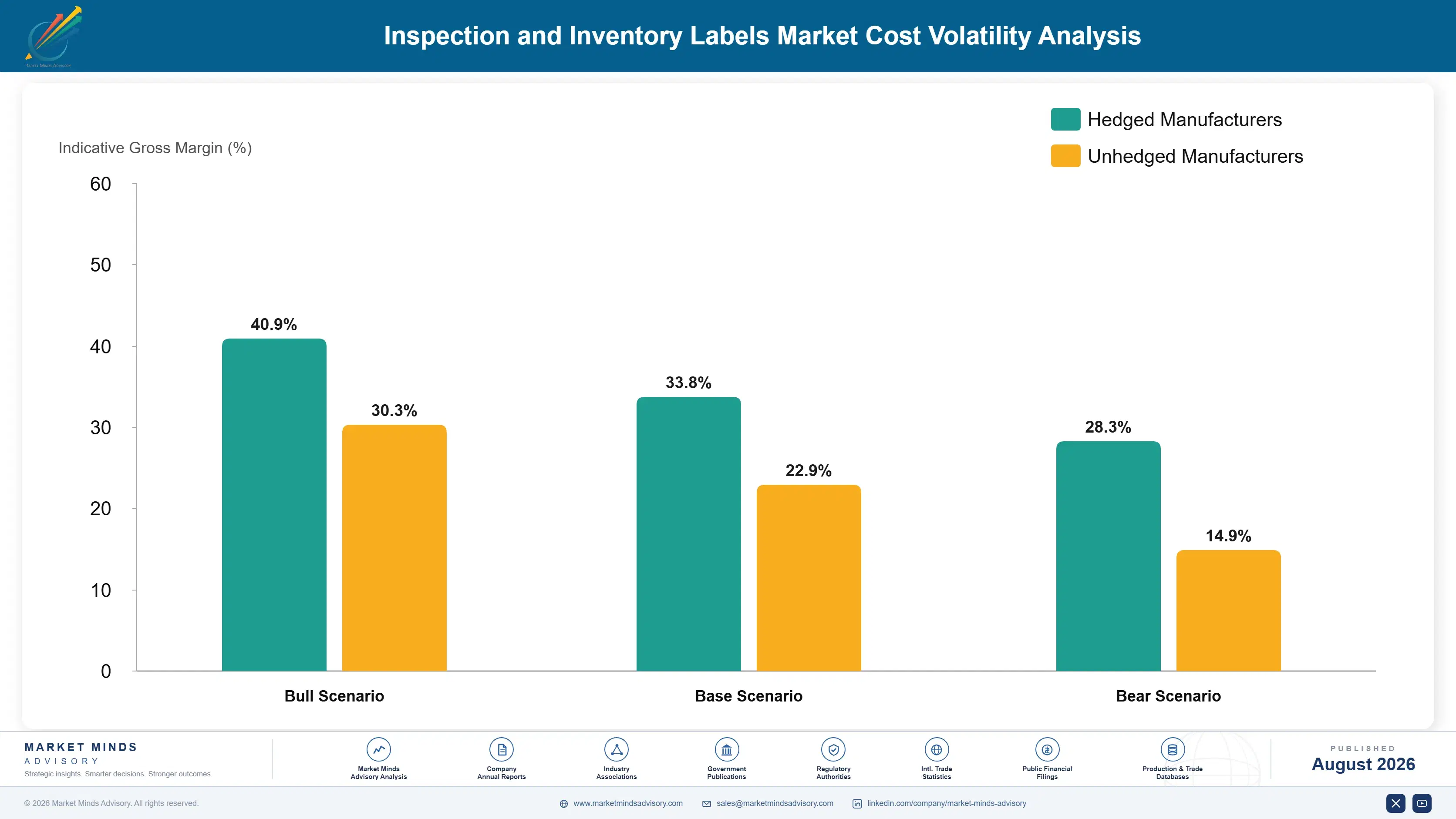
Facestock and adhesive together account for roughly 39% of converter cost of goods, with polyester and polycarbonate durable substrates costing several times what paper facestocks do. Inks, ribbons and subsurface printing consumables add about 11%. RFID inlays are the volatile element, near nine cents each and representing the dominant cost in any radio-enabled label, which changes the cost structure of that segment entirely.
Polyester film and specialty adhesive availability tightened sharply through 2021 and 2022, and durable label converters carried it worse than paper label producers because substitution options were limited by performance requirements they could not compromise. Company annual reports across the materials and labelling groups disclose the resulting margin pressure. Energy costs documented in International Energy Agency reporting added to European converting overhead across the same period.

Exposure divides by materials integration and by product mix. Converters manufacturing their own facestock and adhesive see cost early and formulate around constraints. Those buying finished laminate absorb whatever the market offers and cannot reformulate. Radio-enabled work carries inlay exposure instead of substrate exposure, which moves with semiconductor and antenna supply rather than with polymer pricing at all.
inspection-and-inventory-labels-market-cost-volatility-analysis-1787308529465

Qualify two adhesive systems per durable application class

Specialty adhesive availability failed for durable converters during 2021 and 2022 precisely because performance requirements ruled out substitution. Qualifying a second adhesive system per application class, tested on the same substrates, costs one round of field trials and converts a supply interruption from a lost contract into a specification switch that a customer can accept quickly.

Price radio-enabled labels separately from converting work

Inlays near nine cents dominate the cost of a radio-enabled label and move with semiconductor and antenna supply rather than with polymer or paper markets. Quoting the inlay as a pass-through line with the converting priced separately keeps a substrate cost model from absorbing volatility it was never built for, and customers accept the split readily.

Match facestock grade to actual service environment

Converters frequently run one durable polyester grade across most output because it satisfies every specification and simplifies inventory. Matching facestock to the real service environment, indoor versus outdoor, chemical exposure versus abrasion, recovers material cost across the large share of applications that never needed the top grade at all. The inventory simplification rarely justifies the cost.

Portfolio Architecture for Margin Defence

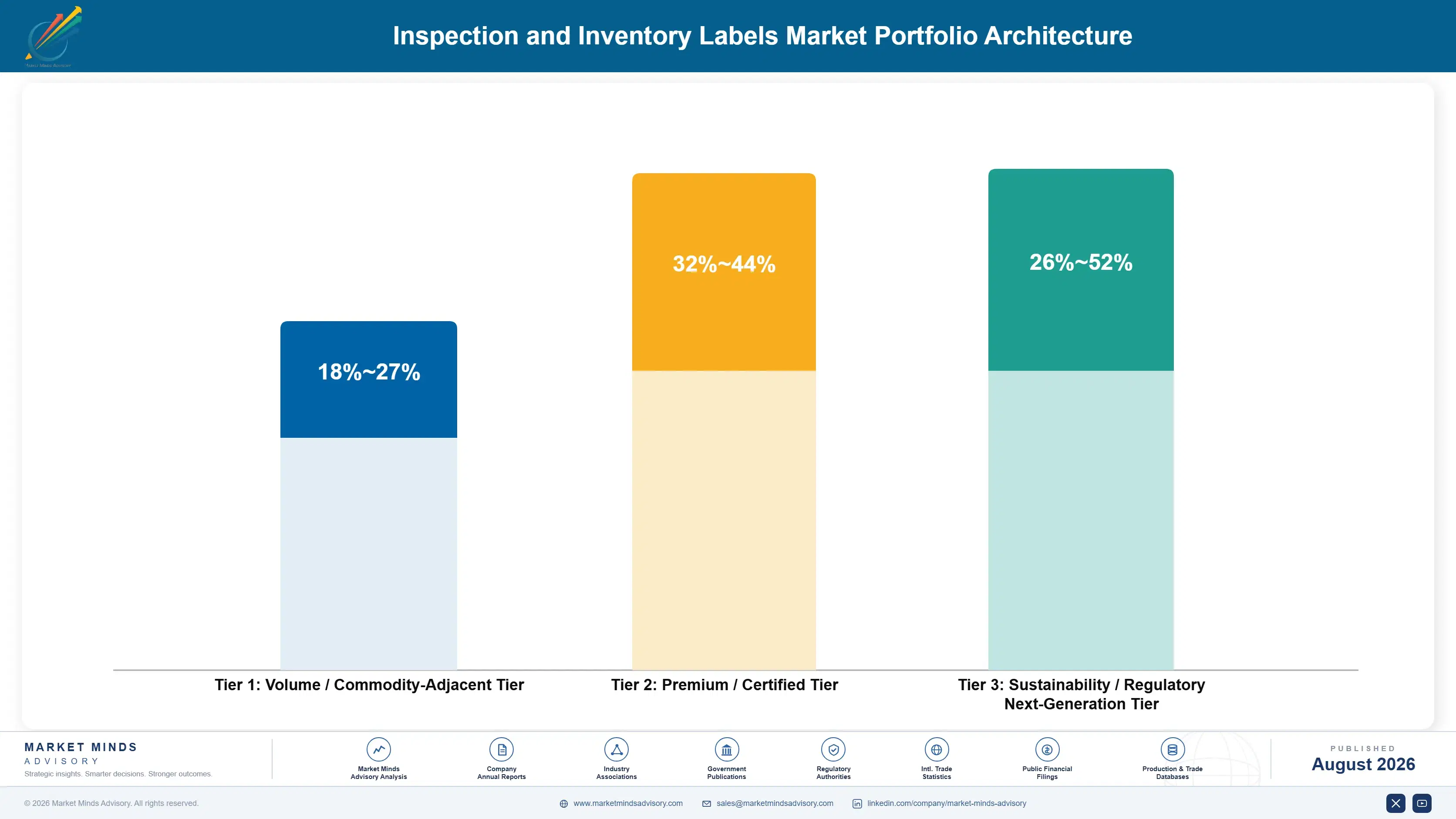
The portfolio separates on what the label has to survive and what it has to carry. Write-on maintenance labels and paper inventory labels are commodity printing. Durable inspection and calibration labels add substrate and adhesive engineering. Radio-enabled labels add antenna design and inlay integration. Tamper-evident seals add a security construction requirement that sits apart from all of it.
The tension is between materials depth and channel access. A converter with superior adhesive formulation still loses when a competitor is sitting with the maintenance manager writing the durability requirement. Conversely, channel strength without materials capability wins the specification and then loses the account eighteen months later when labels start appearing on the floor beside the equipment. Holding both is rare, which is most of why concentration sits at 41%.

High-value pools concentrate where failure is expensive and capability is scarce. Durable inspection labels for hostile environments, on-metal radio inlays and NFC integration into maintenance systems all qualify, and none of them is decided on price per thousand. What they share is a buyer in maintenance or safety rather than procurement, comparing field failure rates rather than unit prices.

Volume / Commodity-Adjacent Tier

Paper inventory labels, write-on maintenance records and general purpose asset barcodes for indoor use. Bought on price per thousand against print specification, and any commercial label printer can supply them competently.
Gross Margin: 18-27%

Premium / Certified Tier

Durable inspection, calibration and safety labels rated for six years outdoors on demanding substrates. Adhesive formulation and substrate testing qualify the supplier, and field failure history is what changes an incumbent.
Gross Margin: 32-44%

Sustainability / Regulatory / Next-Generation Tier

Radio-enabled asset labels including on-metal inlay construction and NFC maintenance system integration. The wide margin range separates converters with antenna engineering capability from those reselling standard inlays at thin markup.
Gross Margin: 26-52%
inspection-and-inventory-labels-market-portfolio-architecture-1787308529956

High-value Sub-segments and Strategic Watch-out

RFID and NFC-Enabled Asset Labels

Compounding at 9.75% as inlays near nine cents make radio tagging viable on tools and portable equipment. On-metal antenna design is the capability barrier, since most asset surfaces detune a standard inlay badly enough to break the read. Inlay cost is a pass-through rather than a margin line.
Gross Margin: 26-52%

Durable Inspection and Safety Labels

Growing at 7.6% on statutory inspection regimes widening across lifting, pressure, electrical and fire safety. Six year outdoor service life on powder-coated and flexing substrates is where most general purpose product quietly fails. Insurers pressing for documentary evidence are reinforcing the requirement independently of regulation.
Gross Margin: 34-44%

Paper Inventory and Barcode Labels

The volume core at 3.6%, sold on price per thousand for indoor use where durability is not tested. It sustains press utilisation and contributes almost nothing above that, and radio tagging is steadily eroding the counting applications. Press utilisation is the only real reason to keep it.
Gross Margin: 18-27%

Tamper-Evident Inventory Seals

The strategic watch-out. Security construction requirements are genuinely specialised and the buyers sit in loss prevention rather than maintenance, which means a converter needs a different channel to reach them at all. Volumes are modest and the construction requirements do not transfer to any other part of the portfolio.
Gross Margin: 30-46%

Every Inspection Cycle Buys Again

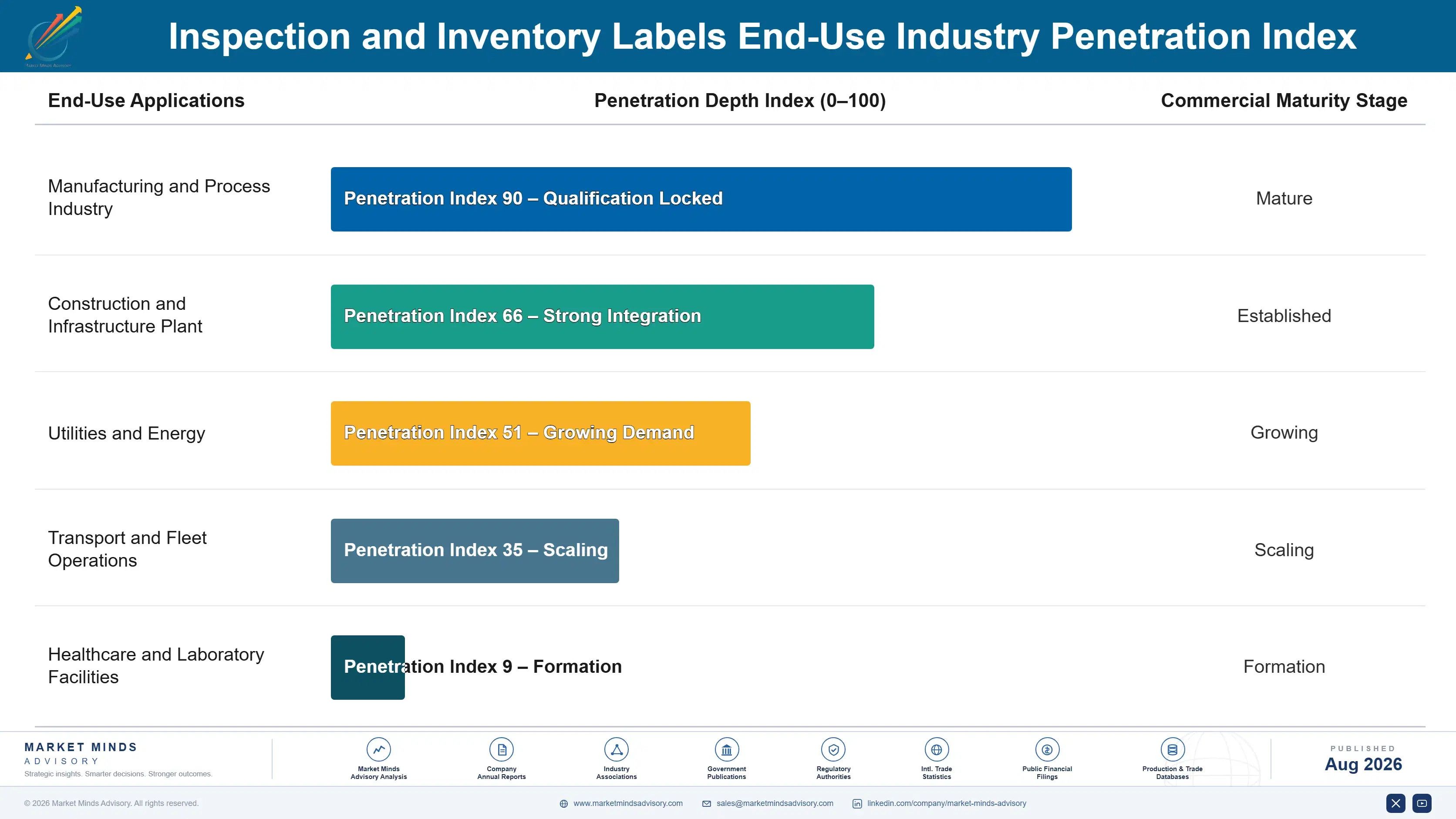
Recurring demand comes from inspection cycles rather than from contracts. An asset inspected annually needs a new status label annually, and an organisation with 4,000 tracked assets therefore buys continuously against a schedule it publishes internally. That makes volumes unusually predictable, and it makes the incumbent converter difficult to displace, since it already holds the artwork, substrate specification and application guidance for every asset class in the register.
Depth varies by inspection intensity and environment. Lifting equipment, pressure systems and electrical installation operators buy deepest, with statutory cycles and hostile conditions together. Manufacturing maintenance functions buy steadily across calibration and asset tagging. Warehousing and distribution buy inventory labels in volume with low durability requirements. Fleet and construction operators buy episodically, with the harshest environmental demands of any group.

The buying population is splitting. Inventory labels remain a procurement purchase on price per thousand, while inspection and asset labels have moved toward maintenance, reliability and safety functions who care about field failure and downtime. Converters who reach only the first group are competing for the part of the market that radio tagging is currently absorbing. That split is widening rather than closing.
inspection-and-inventory-labels-market-end-use-penetration-index-1787308530446

Where Label Converters Win

These are among the four positions where our research anticipates prominent divergence between winners and laggards over the coming forecast period. Each is grounded in the demand model, the regulatory perimeter, and the announced capacity pipeline.
01 / SUBSTRATE ADHESION TESTING

The ink outlasts the bond by about five years

Roughly 68% of durable label losses are adhesion failures, and the label is usually perfectly legible when somebody finds it on the floor. Adhesives get selected from datasheets rather than tested against the actual powder coating, textured plastic or flexing surface involved. Converters who send test panels for a customer's own substrates at realistic application temperatures convert a price comparison into a technical qualification that competitors will not do the work to contest, and the resulting position holds for as long as the customer keeps the asset class.
02 / DOWNTIME COST FRAMING

A missing label takes the asset out of service

When an inspection label disappears, the equipment comes out of service for around three days while the record is reconstructed or the inspection repeated. Against a label costing a few cents that arithmetic ends any price discussion, but somebody has to put it in front of the buyer explicitly. Quantifying downtime exposure per asset class reaches maintenance and safety functions rather than the procurement functions who only control unit price, and those functions can approve a price increase procurement would never consider.
03 / ON-METAL ANTENNA CAPABILITY

Most asset surfaces detune a standard inlay badly

Metal and liquid detune RFID antennas, and asset tagging targets precisely those surfaces, so on-metal inlay design with spacer construction is a genuine antenna engineering requirement rather than a purchasing choice made from a catalogue. Radio-enabled labels compound at 9.75% with inlays near nine cents, so the volume is arriving regardless of which converters are ready for it. Converters holding that capability quote work that general label printers cannot approach, which narrows the competitive field long before any price discussion begins.
04 / DIGITAL RECORD INTEGRATION

Be the index into the system, not its duplicate

Digital inspection records remove around 8% of physical label applications where regulation allows, and converters arguing against that trend simply lose those positions. Supplying NFC labels that link a physical asset to its maintenance record wins instead, because a technician standing on a gantry cannot see a database. That reframes the label as infrastructure for the digital system rather than as the thing it is replacing, and maintenance platforms adding native NFC linking have made that argument considerably easier to win.

Engagement Snapshot From the Field

A live engagement with an industry participant carrying material or product regulatory and market exposure ahead of a defining policy shift, showing how our research translates into a defensible multi-year portfolio strategy.
MARKET MINDS ADVISORY · CLIENT ENGAGEMENT SUMMARY
Inspection and Inventory Labels Producer Strategic Portfolio Review and Transition Roadmap 2026·Investment Scenario on Inspection and Inventory Labels Exposure Evaluation 2025-26
CLIENT PROFILE
A civil infrastructure contractor operating roughly 6,200 items of plant and lifting equipment across eleven regional depots, with about USD 1.4 billion in annual revenue (client-reported, unverified by MMA). Inspection labels were purchased on price per thousand from a general commercial printer, specified only by size, colour and print content with no substrate or adhesive requirement.
STRATEGIC CHALLENGE
Equipment was repeatedly failing pre-use checks because inspection labels were missing, and each occurrence removed the item from service until the inspection record could be retrieved from the maintenance system or the inspection repeated. Depot managers had begun keeping informal paper duplicates, which created its own audit exposure. Procurement had reduced label unit cost in each of the previous three years.
MMA APPROACH
MMA sampled 480 assets across four depots, recording label condition, substrate, application surface and elapsed service time. Failed labels were classified by mode. Application practice was observed directly at two depots, including surface preparation and ambient temperature at the point of application. Lost availability from failed pre-use checks was quantified against depot records for the preceding twelve months.
KEY FINDINGS
  1. Seventy-one percent of missing labels were adhesion failures with the printed image entirely intact, and none of the recovered samples showed meaningful ink degradation despite up to four years of outdoor exposure.
  2. Failures clustered heavily on powder-coated and galvanised surfaces, which together accounted for most of the fleet, while labels on machined steel and painted panels performed acceptably.
  3. Application in cold conditions was routine across all four depots, with no temperature guidance supplied and no surface preparation step in any depot procedure.
  4. Lost availability from failed pre-use checks was estimated at 940 equipment days annually across the fleet, against an annual label spend under USD 40,000 (client-reported, unverified by MMA).
CLIENT PROFILE
A civil infrastructure contractor operating roughly 6,200 items of plant and lifting equipment across eleven regional depots, with about USD 1.4 billion in annual revenue (client-reported, unverified by MMA). Inspection labels were purchased on price per thousand from a general commercial printer, specified only by size, colour and print content with no substrate or adhesive requirement.
STRATEGIC CHALLENGE
Equipment was repeatedly failing pre-use checks because inspection labels were missing, and each occurrence removed the item from service until the inspection record could be retrieved from the maintenance system or the inspection repeated. Depot managers had begun keeping informal paper duplicates, which created its own audit exposure. Procurement had reduced label unit cost in each of the previous three years.
MMA APPROACH
MMA sampled 480 assets across four depots, recording label condition, substrate, application surface and elapsed service time. Failed labels were classified by mode. Application practice was observed directly at two depots, including surface preparation and ambient temperature at the point of application. Lost availability from failed pre-use checks was quantified against depot records for the preceding twelve months.
KEY FINDINGS
  1. Seventy-one percent of missing labels were adhesion failures with the printed image entirely intact, and none of the recovered samples showed meaningful ink degradation despite up to four years of outdoor exposure.
  2. Failures clustered heavily on powder-coated and galvanised surfaces, which together accounted for most of the fleet, while labels on machined steel and painted panels performed acceptably.
  3. Application in cold conditions was routine across all four depots, with no temperature guidance supplied and no surface preparation step in any depot procedure.
  4. Lost availability from failed pre-use checks was estimated at 940 equipment days annually across the fleet, against an annual label spend under USD 40,000 (client-reported, unverified by MMA).
RECOMMENDED STRATEGY
Phase 1: Phase 1 (months 1 to 4): Test candidate adhesive systems on the actual powder-coated and galvanised surfaces at realistic depot application temperatures. Phase 2: Phase 2 (months 4 to 11): Reissue labels across the fleet on qualified substrate and adhesive, with written surface preparation and temperature guidance. Phase 3: Phase 3 (months 11 to 20): Add NFC linking on high-value lifting plant so field records index directly into the maintenance system.
OUTCOME
Label loss on reissued assets fell to under 4% across the first twelve months against a prior rate above 20% (client-reported, unverified by MMA). Annual label spend approximately doubled while recovered equipment availability was valued at several hundred times that increase (client-reported, unverified by MMA). Substrate and adhesive requirements now sit in the purchase specification alongside print content.

Frequently Asked Questions

Foundational context covering the market sizes, CAGR, scope, country, region and competition that inform every finding below. This section is provided to cover basics and most often pre-purchase conversations, answered from the MMA Primary Research Dataset.

What is the current size of the Inspection and Inventory Labels Market?

The global market was worth USD 2.9 billion in 2025, reaching USD 3.09 billion in 2026. East Asia holds the largest regional share at 30% of demand.

How large will the Inspection and Inventory Labels Market be by 2036?

MMA forecasts USD 5.8 billion by 2036, an expansion multiple of 1.88 times the 2026 base. That represents roughly USD 2.71 billion of incremental value.

What is the CAGR for the Inspection and Inventory Labels Market 2026 to 2036?

The base case compounds at 6.5% annually, with a bull case of 7.7% and a bear case of 5.3%. Historical growth from 2020 to 2025 ran at 5.4%.

Which segment is growing fastest?

RFID and NFC-enabled asset labels compound at 9.75%, exactly 1.50 times the market rate. Inlay costs near nine cents have made radio tagging viable on far cheaper assets.

Who are the major companies in the Inspection and Inventory Labels Market?

Brady Corporation, Avery Dennison, 3M, Seton Identification Products and HellermannTyton together hold a combined 41% of the market. Materials formulation and maintenance channel access sustain those positions.

Which country is growing fastest?

India compounds at 9.2%, ahead of every other national market. Industrial capacity additions and formal asset register adoption together create newly labelled assets on a continuous basis.

Report Segmentation Architecture

The full report scope spans multiple orthogonal segmentation dimensions, with cross-tabulated demand data provided for each dimension pair. Coverage extends further to regional breakdowns, trend trajectories, and the competitive detail needed to support segment-level decision-making.

By Label Function and Identification Method

  • Durable Inspection and Safety Labels
  • Calibration and Certification Labels
  • Asset Tracking and Barcode Labels
  • RFID and NFC-Enabled Asset Labels
  • Tamper-Evident Inventory Seals
  • Write-On Maintenance Record Labels

By End-Use Industry

  • Manufacturing and Process Industry
  • Construction and Infrastructure Plant
  • Utilities and Energy
  • Transport and Fleet Operations
  • Healthcare and Laboratory Facilities

By Commercial Dimension

  • Direct Supply to Asset Owners
  • Industrial Safety and Maintenance Distribution
  • Inspection Service Provider Channel
  • Maintenance System Integrator Channel

By Region

  • North America
  • Western Europe
  • East Asia
  • South Asia and Pacific
  • Latin America
  • Middle East and Africa
  • Eastern Europe

Scope, Methodology, and Coverage

Every figure in this report is reproducible from documented input assumptions. The scope below maps the historical period, the forecast horizon, the segmentation dimensions, and the countries covered, alongside the underlying primary and qualitative methodology.
Historical Period
2020 to 2025
Forecast Period
2026 to 2036
Base Year
2025 (USD billions; MMA Primary Research Dataset, August 2026)
Market Definition
The market covers pressure-sensitive labels used for asset identification, inspection recording, calibration status and inventory control, spanning durable inspection and safety labels, calibration and certification labels, asset tracking and barcode labels, RFID and NFC-enabled asset labels, tamper-evident inventory seals, and write-on maintenance record labels, together with the substrate testing and application guidance supplied alongside them. Product identification labels on saleable goods, retail barcode labels, shipping and logistics labels, engraved or etched metal plates, and the printing hardware used to produce labels on site are excluded. Sizing is measured at converter revenue in current prices.
Quantitative Units
USD billions (current prices); label units and service life in years where applicable
Segmentation Dimensions
By Label Function and Identification Method; By End-Use Industry; By Commercial Dimension; By Region
Regions Covered
North America, Western Europe, East Asia, South Asia and Pacific, Latin America, Middle East and Africa, Eastern Europe
Countries Covered
USA, China, Germany, France, UK, Japan, South Korea, India, Australia, Canada, Brazil, Mexico, Indonesia, Vietnam, Thailand, Taiwan, UAE, Saudi Arabia, South Africa, Nigeria, Turkey, Poland, Netherlands, Italy, Spain, Sweden, Switzerland, Chile, Peru, Czech Republic, and additional markets relevant to this sector
Key Companies Profiled
Brady Corporation, Avery Dennison, 3M, Seton Identification Products, HellermannTyton, CCL Industries, UPM Raflatac, Zebra Technologies, Multi-Color Corporation, Lintec Corporation, Nitto Denko, Weber Packaging Solutions, Camcode, Metalcraft, ID Label, InfoSight Corporation, Marking Services, Nichiban, Herma, Sato Holdings
Quantitative Methodology
Primary survey, n=3,800 respondents, Q4 2025, six countries; demand-side model with trade association cross-validation
Qualitative Methodology
47 expert interviews, Q4 2025; applied to validate demand model assumptions, identify emerging dynamics, and assess competitive positioning
Report Format
PDF and XLSX data workbook (Word format preview document)
Publisher
Market Minds Advisory
Report Code
MMA-2026-PAC-836
Published
August 2026
Contact
sales@marketmindsadvisory.com | www.marketmindsadvisory.com

Purchase the full Inspection and Inventory Labels Market Report (2026 to 2036).

The full report sizes inspection and inventory labels across six functional classes, three commercial dimensions and seven regions, with annual forecasts to 2036 under base, bull and bear scenarios. Field failure modes are analysed by substrate, adhesive class and application environment, which is where two thirds of label losses originate and where almost no buyer specification reaches. Statutory inspection regimes are mapped by equipment class and jurisdiction. RFID inlay economics are modelled against asset value thresholds to establish where radio tagging becomes routine. Twenty converters are profiled on a consistent identification label revenue basis.
Field failure modes analysed by substrate and adhesive class
Statutory inspection regimes mapped by equipment class and jurisdiction
RFID inlay economics modelled against asset value thresholds
On-metal antenna capability assessed across the converter base
Downtime cost arithmetic quantified by asset class and sector
NFC maintenance system integration tracked across major platforms

Built For The People Who Decide

From boardroom strategy to bench-side execution, this report is read cover-to-cover by leaders shaping the next decade of their industry, turning demand scenarios, market dynamics and valuation benchmarks into decisions.
CXOs/ Presidents/ VPs/ Managers
M&A and Corporate Development
Strategy Teams and R&D Heads
Procurement and Product Directors
Regulatory and Compliance Leaders
Investor Relations and Equity Analysts