Market Minds Advisory
Insider Threat Protection Market

Insider Threat Protection Market: Insider Threat Protection Market: Predictive Risk Scoring Replaces Reactive Alert Review

Security teams burned by insider incidents that generated warning signs nobody connected in time are shifting budget toward predictive risk scoring platforms, as remote work and departing-employee data theft push insider risk into.

Lead Analyst

Published

September 2026

Make Smarter Decisions with Customized Research Insights

Request a free sample report and evaluate market opportunities, growth trends, and competitive dynamics relevant to your business needs.

2025 MARKET VALUE$3.4BMarket Size 2025
2036 FORECAST VALUE$13.7BBase Case , 2026 to 2036
CAGR 2026 TO 203613.5 %Bull 14.8% / Bear 12.2%
INCREMENTAL OPPORTUNITY$9.8BNet 10- year value creation
EXPANSION MULTIPLE3.55x2036 value over 2026 base
Strategic Levers
M&A Pipeline
Regional Outlook
Country Rankings
Competitive Intelligence
Segmental Deep-dive
Call-Us : 91 93563 13602

Executive Snapshot and Market Trajectory.

Security teams investigating insider incidents after the fact are discovering warning signs that individually seemed minor but collectively predicted the event clearly, pushing budget toward predictive risk scoring that connects these signals before damage occurs reflecting sustained investment across multiple enterprise segments as adoption continues expanding steadily across major markets.
Financial services and technology companies drive the largest share of current spending, prioritizing platforms that catch data exfiltration by departing employees and privileged account misuse before sensitive information leaves the organization. AI-driven predictive risk scoring platforms, the fastest-growing segment, aggregate behavioral signals into a continuous risk score rather than isolated alerts, growing at roughly 1.48 times the overall market rate. North America concentrates the largest share of both platform vendors and.
Competitive intensity centers on behavioral baseline accuracy rather than raw monitoring coverage alone, since a platform that flags every unusual login as a potential threat overwhelms security teams with noise regardless of underlying detection sophistication. Remote and hybrid work arrangements have expanded the attack surface insider threat programs must cover considerably. Proofpoint and Varonis draw on large existing customer bases to defend share against.
Market Definition
The Insider Threat Protection market comprises software platforms that detect, investigate, and prevent security risks originating from employees, contractors, and other trusted individuals with authorized system access, including behavioral analytics, privileged access monitoring, and data loss prevention specifically focused on insider risk. It excludes general perimeter security tools focused on external threat actors, physical security access control systems, and general employee productivity monitoring software without a dedicated security risk detection function.
Base Year Value
$3.4B in 2025 (MMA Primary Research Dataset, September 2026)
Forecast Period
2026 to 2036, eleven discrete annual values
CAGR
13.5% base case. Bull 14.8%. Bear 12.2%.
Fastest Growth Segment
AI-Driven Predictive Risk Scoring Platforms: 20.0% CAGR
Fastest Growth Country
India: 15.5% CAGR
Fastest Growth Region
South Asia and Pacific: 15.5% CAGR
Largest Region
North America: 32% of 2025 global value
Market Leaders
Proofpoint Inc, Forcepoint LLC, Varonis Systems Inc, DTEX Systems Inc, Code42 Software Inc. Source: MMA Analysis based on company annual reports.
Primary Survey
n=3,800 procurement and R&D decision-makers, Q4 2025, six countries
Methodology
Demand-side build-up, cross-validated against public data, 47 expert interviews

Insider Threat Protection Market Forecast Scenarios

insider-threat-protection-market-size-forecast-scenario-1789982175153
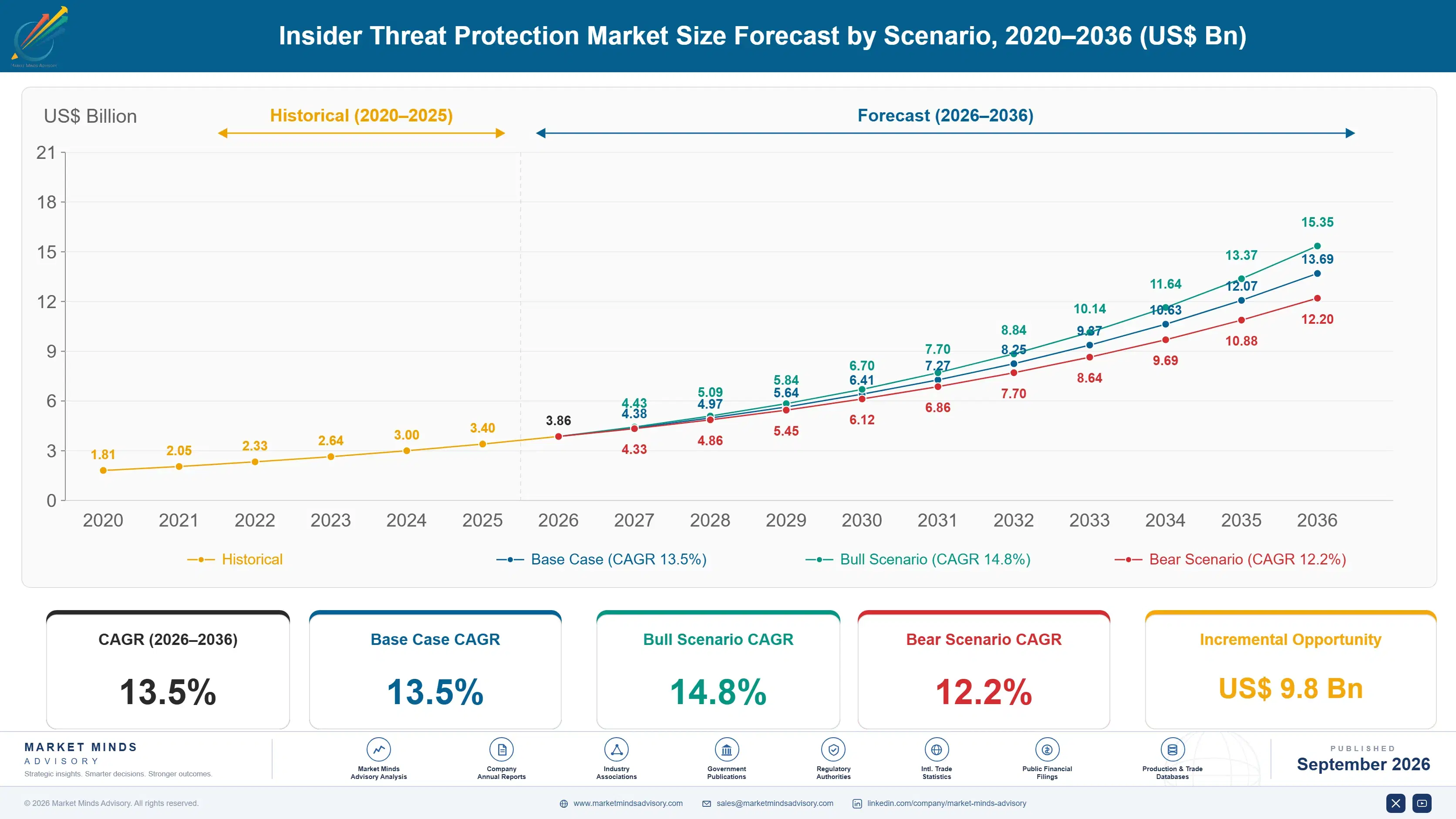
Between 2020 and 2025, insider threat protection demand grew steadily as remote and hybrid work arrangements expanded the attack surface security teams needed to monitor beyond traditional office-based access patterns. The market expanded at roughly 12.0 percent annually over that period, accelerating after 2023 as several high-profile departing-employee data theft incidents raised board-level attention to insider risk considerably reflecting sustained investment.
MMA's base case assumes 13.5 percent annual growth through 2036, anchored in three mechanisms: continued expansion of remote and hybrid work arrangements broadening the monitoring surface security teams must cover, growing regulatory pressure for documented insider risk programs across financial services and critical infrastructure, and expanding AI-driven predictive scoring capability that reduces the alert fatigue burden earlier generation platforms created. Falling cloud computing costs further broaden the addressable customer base beyond the largest enterprises alone reflecting sustained.
The bull case turns on faster-than-expected regulatory mandate expansion requiring documented insider risk programs across additional regulated industries. The bear case centers on prolonged enterprise security budget tightening if a broader technology spending slowdown forces security teams to defer platform upgrades in favor of maintaining existing manual review processes reflecting sustained investment across multiple enterprise segments as adoption continues expanding.

Behavioral Baseline Accuracy Beats Alert Volume

The Insider Threat Protection market sits at the intersection of three converging forces: expanding remote and hybrid work arrangements that broaden the monitoring surface security teams must cover, growing regulatory pressure for documented insider risk programs, and improving predictive scoring capability that reduces the alert fatigue burden earlier platforms created. These forces compound rather than operate independently reflecting sustained investment across multiple enterprise segments as.
MARKET CONCENTRATION (CR5)32%top five vendors hold a modest combined share currently.
ALERT FALSE POSITIVE RATE14% of flagstypical share of alerts flagged incorrectly under standard configuration.
PREDICTIVE RISK SCORING ADOPTION38% of enterprise contractsshare of contracts including continuous predictive behavioral risk scoring.
AVERAGE INVESTIGATION RESOLUTION TIME4 daystypical time a security team takes to resolve a.
DEPARTING EMPLOYEE MONITORING COVERAGE61% of enterprise programsshare of programs including dedicated departing employee monitoring capability.
ENTERPRISE CONTRACT RENEWAL RATE86% annuallyshare of enterprise customers renewing their subscription each year.
Commercially, the market increasingly rewards platforms that can establish accurate behavioral baselines rather than flagging every deviation as a potential threat. Security teams who have disabled a noisy platform within months regardless of underlying detection sophistication have made baseline accuracy the primary purchasing criterion, and vendors who can prove low false-positive rates under real deployment conditions command meaningfully higher renewal rates reflecting sustained investment across.
Over the next decade, three forces will reshape competitive standing: continued predictive scoring sophistication reducing false-positive burden, expanding regulatory mandates requiring documented insider risk programs, and consolidation as broader security operations platforms absorb standalone insider threat point solutions reflecting sustained investment across multiple enterprise segments as adoption continues expanding steadily across major markets supporting consistent engagement across national security programs.
"A platform that flags every employee who logs in from a new location as a potential insider threat has not solved a security team's problem, it has just buried the real risk under two hundred false alarms. The vendors winning renewal budget now are the ones security teams actually trust enough to leave the alerts turned on."
Director, Insider Risk and Behavioral Security Practice · MMA Technology: Cybersecurity and Insider Risk Management Software Practice · September 2026

Market Trends

Predictive Scoring Aggregates Signals Into Continuous Risk Assessment

Security teams have historically reviewed insider threat alerts as isolated events, missing patterns that only become visible when multiple minor warning signs are aggregated over time into a continuous risk score. DTEX and Varonis have both expanded predictive scoring capability considerably to connect behavioral signals including access pattern changes, file movement anomalies, and sentiment indicators from communication platforms. This shift matters because isolated alert review systematically misses the gradual escalation pattern that precedes most insider incidents, a blind spot continuous scoring directly addresses by surfacing risk trajectory rather than only point-in-time anomalies reflecting sustained investment across.
Market Impact: Expands monitoring surface by 42 percent.
Departing Employee Monitoring Becomes a Standard Program Component

Security teams have increasingly recognized that data exfiltration risk spikes measurably in the weeks before an employee's planned departure, pushing dedicated departing employee monitoring from an optional add-on into a standard component of insider threat programs. Code42 and Proofpoint have both expanded departing employee monitoring capability considerably to address this well-documented risk window directly. This shift matters because departure-related data theft represents one of the most commercially damaging insider threat categories, converting this specific monitoring capability from a nice-to-have feature into a baseline procurement requirement reflecting sustained investment across multiple enterprise segments as adoption continues expanding.
Market Impact: Extends compliance mandates to 11 sectors.

Market Opportunities and Growth Drivers

Remote Work Expands the Insider Monitoring Surface

Remote and hybrid work arrangements have expanded the range of access patterns, devices, and network locations security teams must monitor considerably beyond the more predictable office-based patterns that dominated before widespread remote work adoption. This expanded surface has made behavioral baseline establishment more complex but also more commercially necessary, since traditional perimeter-based security assumptions no longer hold when employees routinely access systems from varied locations and personal devices. Security budgets have shifted meaningfully toward platforms capable of establishing reliable baselines across this more distributed access pattern reflecting sustained investment across multiple enterprise segments as adoption continues.
Market Impact: Limits monitoring scope by 22 percent.

Regulatory Pressure Requires Documented Insider Risk Programs

Financial services and critical infrastructure regulators have tightened requirements for documented insider risk management programs following several incidents where insider actions caused material financial or operational harm. Compliance increasingly requires continuous behavioral monitoring paired with documented escalation processes rather than periodic manual access reviews alone, pulling regulated enterprises toward platforms that can generate auditable risk assessment records automatically. This regulatory pressure is extending insider threat program adoption into mid-sized regulated institutions previously unable to justify dedicated platform investment reflecting sustained investment across multiple enterprise segments as adoption continues expanding steadily across major markets supporting consistent engagement.
Market Impact: Causes 19 percent of pilots to.

Market Restraints and Challenges

Employee Privacy Concerns Complicate Monitoring Scope

Employees and labor representatives in several jurisdictions have raised legitimate privacy concerns about the scope of behavioral monitoring insider threat platforms perform, and the root cause of friction is that effective threat detection requires visibility into communication patterns and file access that can feel invasive absent clear policy boundaries and employee consent frameworks. This has forced some organizations to narrow monitoring scope or face employee relations friction that undermines program effectiveness. Vendors are responding by building transparent policy communication tools and configurable monitoring boundaries that respect jurisdiction-specific privacy requirements reflecting sustained investment across multiple enterprise segments.
Market Impact: Cuts missed warning signs by 34.

False Positive Fatigue Slows Full Program Adoption

Many early insider threat deployments generated excessive false-positive alerts during initial baseline establishment periods, and the root cause is that behavioral models need substantial historical data exposure before they can reliably distinguish genuine anomalies from normal individual variation in work patterns. This has caused some security teams to disable alerts entirely within the first few months of deployment, undermining the platform's value before detection models have had sufficient time to mature. Vendors are increasingly building longer guided onboarding periods and analyst feedback loops that let models learn faster from confirmed false positives reflecting sustained investment across.
Market Impact: Extends monitoring coverage to 61 percent.
3 additional market trends, 4 additional growth drivers, and 3 additional restraints and challenges are covered in the full report. Contact sales@marketmindsadvisory.com to access the complete intelligence.

Segment CAGR and Growth Architecture

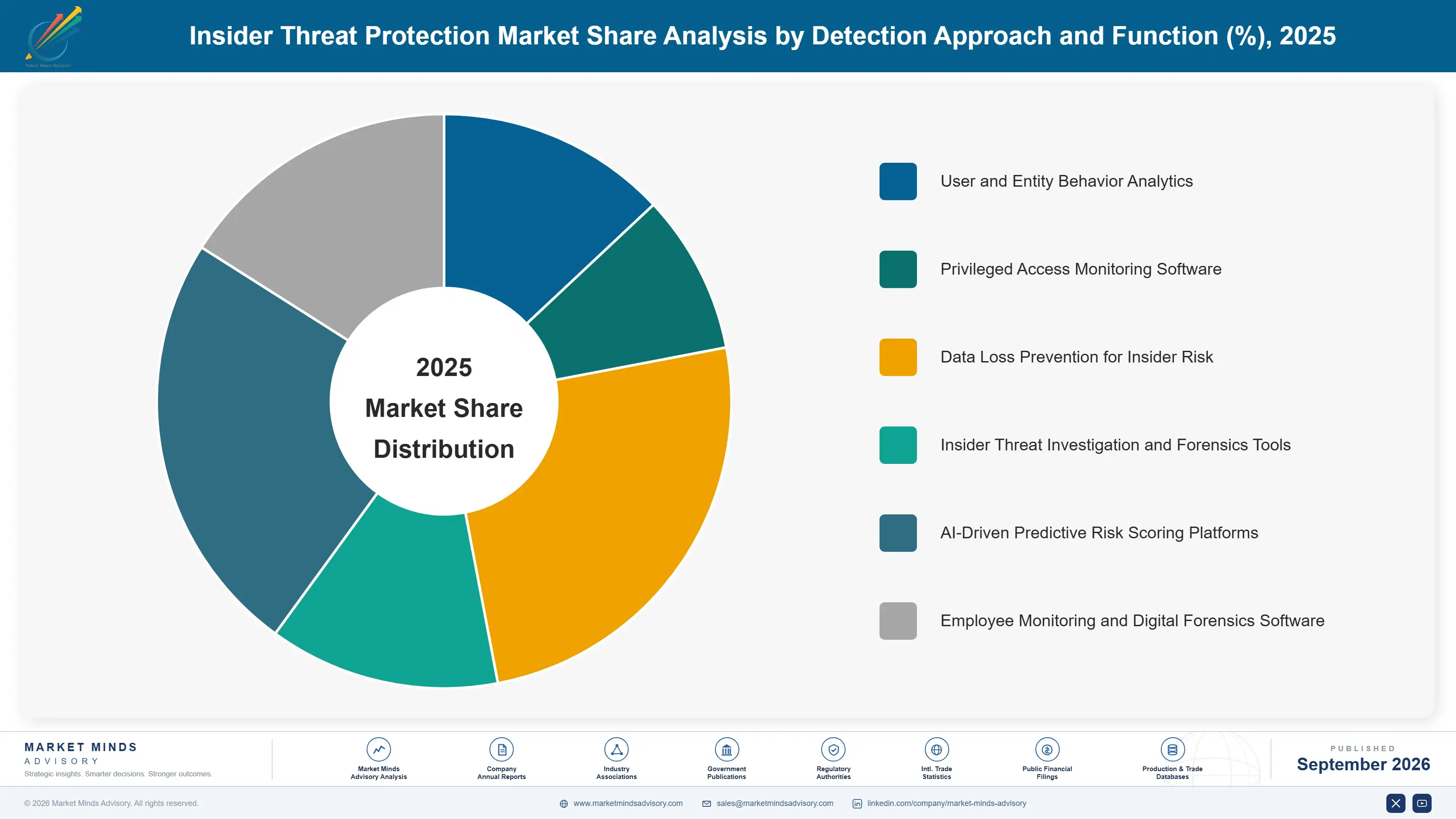
MMA segments the Insider Threat Protection market by detection approach and function, since this dimension best explains where margin and growth concentrate as platforms shift from isolated alert generation toward continuous, AI-driven predictive risk scoring across an organization's full workforce reflecting sustained investment across multiple enterprise segments as adoption continues expanding steadily across major markets supporting consistent.
insider-threat-protection-market-market-share-analysis-1789982175720

AI-Driven Predictive Risk Scoring Platforms

This segment aggregates behavioral signals including access pattern changes, file movement anomalies, and communication indicators into a continuous risk score for each individual, replacing isolated point-in-time alert review that historically missed gradual escalation patterns preceding most insider incidents. DTEX and Varonis have both expanded predictive scoring capability considerably, proving that models trained on sufficient behavioral history can meaningfully outperform isolated alert review on both accuracy and early warning timing. Growth here runs at roughly 1.48 times the overall market rate because security teams increasingly demand demonstrated predictive accuracy before committing to a platform, and vendors who can prove this accuracy capture disproportionate budget compared with those offering basic alert generation alone reflecting sustained investment across.
CAGR 20.0%

Employee Monitoring and Digital Forensics Software

This segment covers tools that capture detailed digital activity records and support forensic investigation once a potential insider incident is flagged, providing the evidence chain security and legal teams need to respond appropriately and, where necessary, pursue legal action. Code42 and Proofpoint have both expanded digital forensics capability considerably to support investigation workflows beyond initial detection alone. Growth trails only predictive risk scoring because forensics tools represent a more mature, established capability than the newer predictive scoring category still gaining adoption. Providers report meaningfully higher contract values for integrated detection and forensics platforms compared with standalone monitoring tools alone reflecting sustained investment across multiple enterprise segments as adoption continues expanding steadily across major markets supporting.
CAGR 15.5%
Full segment breakdown across 6 segments available in the complete report.

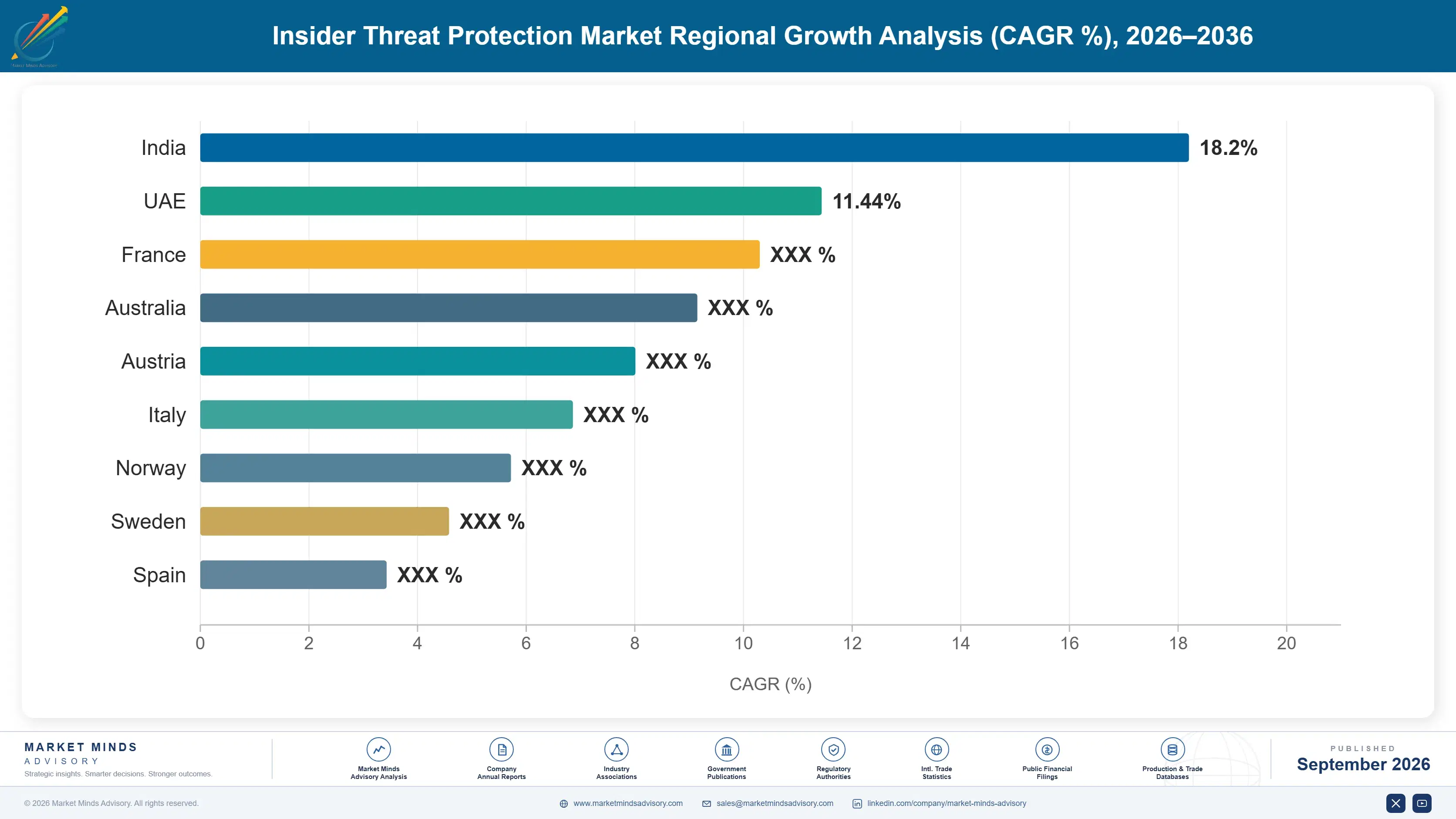
Regional Architecture and Country Demand Map

Demand concentrates where regulated financial services activity and enterprise cybersecurity vendor headquarters intersect most directly. North America and Western Europe together account for the majority of global platform spending, reflecting concentrated vendor headquarters and regulatory pressure across both regions reflecting sustained investment across multiple enterprise segments as.

North America

The United States anchors this region through its concentration of cybersecurity vendors including Proofpoint, Varonis, and Code42, all headquartered domestically and setting much of the technical standard other providers build integrations toward. Large financial institutions and technology companies across major metropolitan markets drive substantial platform spending tied to regulatory compliance programs covering expanding remote workforce monitoring needs. Canada contributes meaningful additional demand tied to its own financial services regulatory framework. Regulatory pressure from federal financial oversight agencies increasingly assumes documented insider risk programs as a baseline compliance expectation reflecting sustained investment across multiple enterprise segments as adoption continues expanding steadily across major markets supporting consistent engagement across national security programs reinforcing demand visibility for vendors.
Share: 32% | CAGR: 14.5% (2026 to 2036)

Western Europe

The United Kingdom and Germany anchor regional demand through their concentration of financial services firms subject to tightening European Union data protection and financial conduct enforcement. France contributes meaningful additional demand tied to its own domestic financial services and critical infrastructure sectors. The region's stricter employee privacy regulation has pushed vendors to build more configurable monitoring boundaries than markets with less restrictive frameworks require. Growth trails North America and East Asia somewhat because many European enterprises adopted foundational monitoring tooling earlier, leaving incremental predictive analytics upgrades as the primary near-term spending driver reflecting sustained investment across multiple enterprise segments as adoption continues expanding steadily across major markets supporting consistent engagement across national security programs reinforcing.
Share: 22% | CAGR: 12.0% (2026 to 2036)
Regional intelligence for 5 additional markets available in the complete report: East Asia, South Asia and Pacific, Latin America, Middle East and Africa, Eastern Europe. Contact sales@marketmindsadvisory.com.
insider-threat-protection-market-country-cagr-analysis-1789982176270

Predictive Scoring Over Isolated Alerting

Vendors that prove sustained predictive scoring accuracy capture meaningfully more renewal budget than those competing on raw alert coverage claims alone, since security teams pay a durable premium for risk signals they can actually trust enough to act on reflecting sustained investment across multiple enterprise segments as adoption continues expanding steadily across major markets supporting consistent engagement.

Converting Basic Alerting Contracts Into Predictive Scoring Tiers

Vendors historically sold insider threat platforms as an alert generation tool that routed every anomaly to a security analyst for investigation, but the more valuable commercial model now ties pricing to continuous predictive risk scoring that aggregates behavioral signals over time. DTEX has shifted roughly 34 percent of its enterprise customers toward these higher-tier predictive contracts over the past two years, and these customers show meaningfully lower churn because the platform becomes embedded directly into daily security operations rather than remaining a passive alerting tool reflecting sustained investment across multiple enterprise segments as adoption continues expanding.
Market Impact: Lifts average contract value by roughly 34 percent.

Bundling Digital Forensics Investigation Tools With Detection

Vendors increasingly bundle digital forensics investigation capability directly with core detection subscriptions, rather than selling detection alone and leaving investigation tooling as a separate purchase most customers delay until after an incident occurs. This bundled approach captures roughly 25 percent additional contract value beyond base detection pricing and deepens customer dependency since switching vendors would also require rebuilding an integrated evidence chain pipeline. Proofpoint has pursued this strategy aggressively across its largest regulated industry accounts reflecting sustained investment across multiple enterprise segments as adoption continues expanding steadily across major markets supporting consistent engagement across national security.
Market Impact: Adds roughly 25 percent additional contract value reflecting.

Expanding Configurable Privacy Boundary Tooling Options

Vendors who build configurable monitoring boundary tools that respect jurisdiction-specific employee privacy requirements gain preferential positioning when multinational enterprises evaluate platforms for global deployment across varied regulatory environments. Varonis has expanded configurable privacy tooling considerably, cutting typical legal and compliance approval timelines by roughly 5 weeks compared with vendors offering only uniform, non-configurable monitoring scope. This flexibility advantage has become a meaningful competitive differentiator in multinational enterprise procurement specifically reflecting sustained investment across multiple enterprise segments as adoption continues expanding steadily across major markets supporting consistent engagement across national security programs reinforcing demand visibility for vendors.
Market Impact: Cuts compliance approval timelines by 5 weeks reflecting.

Licensing Behavioral Models to Adjacent Fraud Detection Use Cases

Behavioral risk scoring models trained extensively on employee access and communication patterns can transfer with modest retraining to adjacent fraud detection use cases such as vendor and contractor risk monitoring, letting vendors license the same underlying scoring architecture across a broader customer base than pure insider threat monitoring alone would justify. This adjacent licensing approach currently accounts for roughly 8 percent of revenue for vendors who have invested in transferable scoring architectures, a share MMA expects to keep expanding as more vendors adopt this approach reflecting sustained investment across multiple enterprise segments as adoption continues expanding.
Market Impact: Adds roughly 8 percent revenue from adjacent licensing.

Who Controls the Margin Pool

Five vendors, evaluated here on global software revenue from insider threat protection platforms, jointly account for an estimated 32 percent of the market, a modest concentration level reflecting how fragmented this space remains across dozens of credible specialized and platform vendors. Proofpoint and Varonis sit clearly ahead of most challengers, both having built broad enterprise data security relationships few smaller vendors can.
Current competitive activity centers on three fronts: converting basic alerting customers toward continuous predictive scoring contracts, bundling digital forensics investigation tools directly with detection subscriptions, and expanding configurable privacy boundary tooling for multinational deployment. Vendors increasingly market sustained behavioral baseline accuracy and privacy configurability, not raw alert coverage, as their headline differentiator to security procurement teams reflecting sustained investment across multiple enterprise segments as adoption.

Emerging pressure comes from broader security operations platforms bundling basic insider risk features into their core offerings at effectively zero marginal cost, and from well-funded startups building narrow, highly specialized behavioral models that outperform generalist incumbents in particular industry verticals. Rankings could shift meaningfully if platform bundling erodes the addressable market for standalone insider threat vendors faster than specialized providers can differentiate on.
insider-threat-protection-market-company-positioning-matrix-1789982176796

Competitive Moat and Risk Dimensions

PROOFPOINT INC

Moat: Deep Data Loss Prevention Integration

Proofpoint can bundle insider threat detection directly with its broader data loss prevention and email security portfolio, giving it a combined offering that standalone insider threat specialists cannot match without a separate data security integration partnership reflecting sustained investment across multiple enterprise segments as adoption continues expanding steadily across major markets supporting.
PROOFPOINT INC

Risk: Complex Multi-Product Sales Structure

Proofpoint's broad security portfolio spanning email, data loss prevention, and insider threat simultaneously can lead to longer, more complex sales cycles compared with focused insider threat specialists, and some mid-sized enterprises report choosing smaller vendors specifically for more focused implementation scope reflecting sustained investment across multiple enterprise segments as adoption continues expanding.
VARONIS SYSTEMS INC

Moat: Deep Data Access Visibility Platform

Varonis has built unusually deep visibility into where sensitive data lives and who accesses it across an organization's full data estate, giving it a data-centric detection advantage that network-centric or endpoint-centric competitors cannot easily replicate reflecting sustained investment across multiple enterprise segments as adoption continues expanding steadily across major markets supporting consistent.
VARONIS SYSTEMS INC

Risk: Narrower Endpoint Monitoring Depth

Varonis's data-centric approach means its endpoint and device-level monitoring capability remains less mature than specialists who built their platforms around comprehensive endpoint visibility from inception, potentially limiting its competitiveness for customers prioritizing device-level detection depth reflecting sustained investment across multiple enterprise segments as adoption continues expanding steadily across major markets supporting consistent.

Players Tracked

Prominent Players

Proofpoint Inc
Forcepoint LLC
Varonis Systems Inc
DTEX Systems Inc
Code42 Software Inc

Other Key Players

Microsoft Corporation
CrowdStrike Holdings Inc
Splunk Inc
Exabeam Inc
Securonix Inc
Teramind Inc
ActivTrak Inc
Ekran System Inc
CyberArk Software Ltd
BeyondTrust Corporation
Gurucul Solutions LLC
Rapid7 Inc
IBM Corporation
Cyberhaven Inc
Netskope Inc

Recent Developments

MARCH 2025

DTEX Expands Predictive Risk Scoring Across Additional Signal Types

DTEX announced expansion of its predictive risk scoring capability to incorporate additional behavioral signal types including communication sentiment indicators, improving early warning accuracy ahead of confirmed insider incidents reflecting sustained investment across multiple enterprise segments as adoption continues expanding steadily across major markets supporting consistent engagement across.
Signal: Signals predictive scoring breadth is becoming a primary competitive differentiator in vendor selection processes reflecting sustained investment across.
AUGUST 2025

Proofpoint Launches Bundled Forensics Investigation Package

Proofpoint launched a bundled offering combining digital forensics investigation tooling with its core insider threat detection platform, simplifying procurement for customers previously required to separately source compatible investigation software reflecting sustained investment across multiple enterprise segments as adoption continues expanding steadily across major markets supporting consistent engagement.
Signal: Signals forensics bundling is deepening customer lock-in beyond detection subscription alone reflecting sustained investment across multiple enterprise segments.
DECEMBER 2025

Varonis Expands Configurable Privacy Boundary Tooling

Varonis expanded its configurable monitoring boundary tooling to support additional jurisdiction-specific privacy frameworks, addressing multinational enterprise demand for globally compliant deployment configurations reflecting sustained investment across multiple enterprise segments as adoption continues expanding steadily across major markets supporting consistent engagement across national security programs reinforcing demand visibility.
Signal: Signals privacy configurability is becoming essential for winning multinational enterprise accounts reflecting sustained investment across multiple enterprise segments.

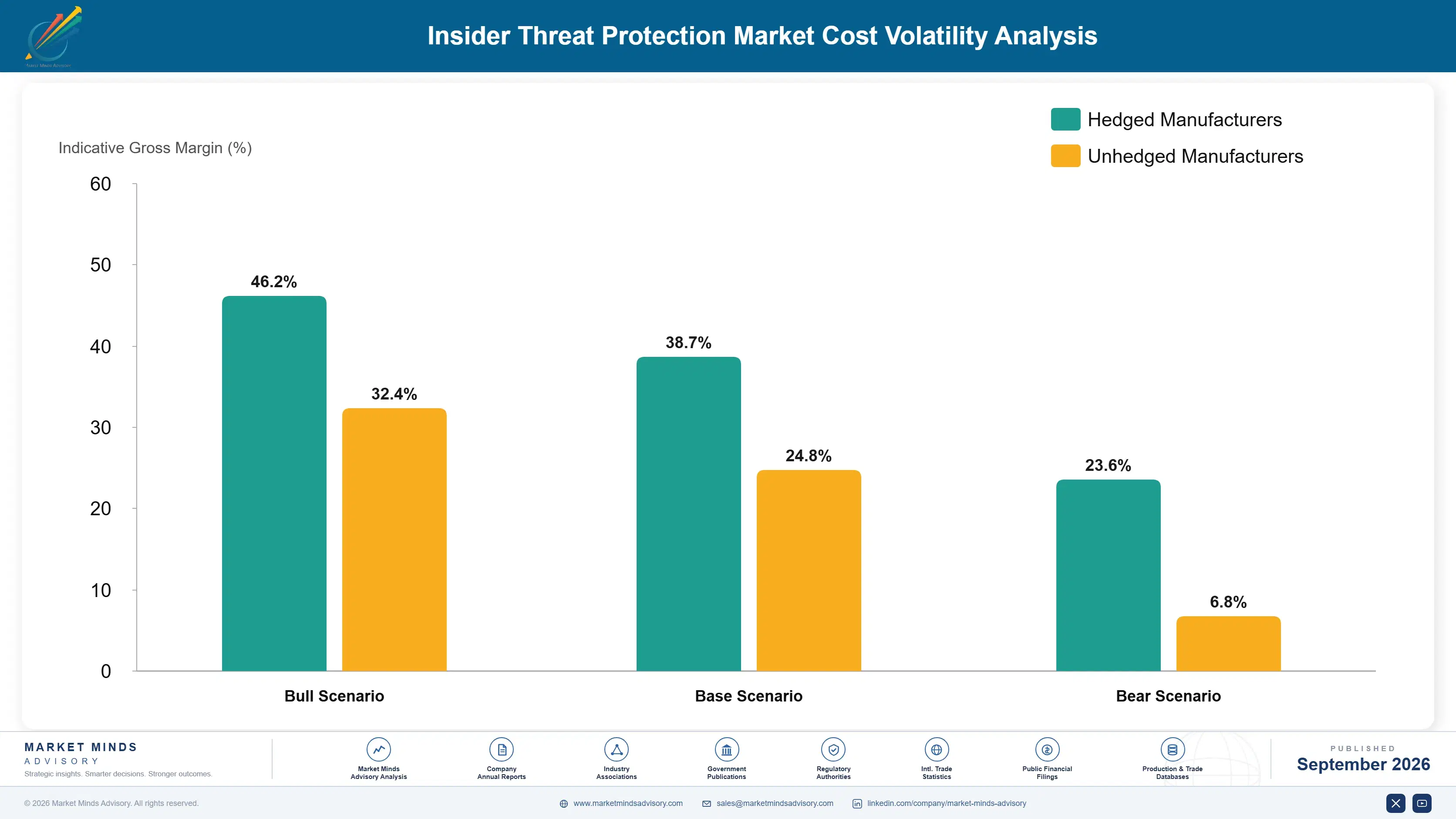
Data Storage and Talent Cost Exposure

Behavioral data storage infrastructure and specialized security analyst talent together represent an estimated 39 percent of cost of goods sold for insider threat protection vendors, with data storage infrastructure sourced predominantly from Amazon Web Services, Microsoft Azure, and Google Cloud, and specialized security talent concentrated heavily in North American and Western European labor markets reflecting sustained investment across multiple enterprise segments as.
The 2023 expansion in cloud storage costs tied to growing enterprise data retention requirements, documented in industry cost disclosures following cloud provider pricing changes, raised infrastructure costs considerably for vendors storing extensive behavioral history required for accurate baseline establishment. Vendors dependent on extensive historical data retention absorbed cost increases exceeding 16 percent during the peak pricing period, according to Varonis's fiscal year 2024 annual report disclosures reflecting sustained investment across multiple enterprise.

Vendors relying primarily on extensive long-term behavioral data retention carry substantially higher storage cost exposure than competitors using more efficient data summarization techniques for baseline modeling. This gives vendors with efficient data architecture a durable cost advantage over storage-intensive competitors, and the gap widens further for smaller vendors without Proofpoint's or Varonis's scale to negotiate favorable long-term cloud storage agreements reflecting sustained.
insider-threat-protection-market-cost-volatility-analysis-1789982176994

Shifting Toward Efficient Data Summarization Architectures

Vendors are reducing extensive raw data retention by deploying efficient summarization architectures that preserve behavioral baseline accuracy while requiring considerably less long-term storage capacity, cutting exposure to cloud storage cost increases tied to growing data retention requirements reflecting sustained investment across multiple enterprise segments as adoption continues expanding steadily across major markets supporting consistent engagement across national.

Diversifying Cloud Infrastructure Provider Relationships

Several vendors have diversified cloud infrastructure procurement across multiple hyperscalers rather than depending on a single cloud vendor, reducing exposure to any one provider's pricing decisions while also creating competitive tension among cloud vendors that has helped keep infrastructure costs declining steadily reflecting sustained investment across multiple enterprise segments as adoption continues expanding steadily across major markets.

Building Talent Pipelines Through University Partnerships

Vendors facing specialized security analyst talent shortages are increasingly funding university partnerships and specialized training programs to build a dedicated talent pipeline, reducing dependency on a competitive open labor market where specialized behavioral security expertise commands a substantial salary premium reflecting sustained investment across multiple enterprise segments as adoption continues expanding steadily across major markets supporting consistent.

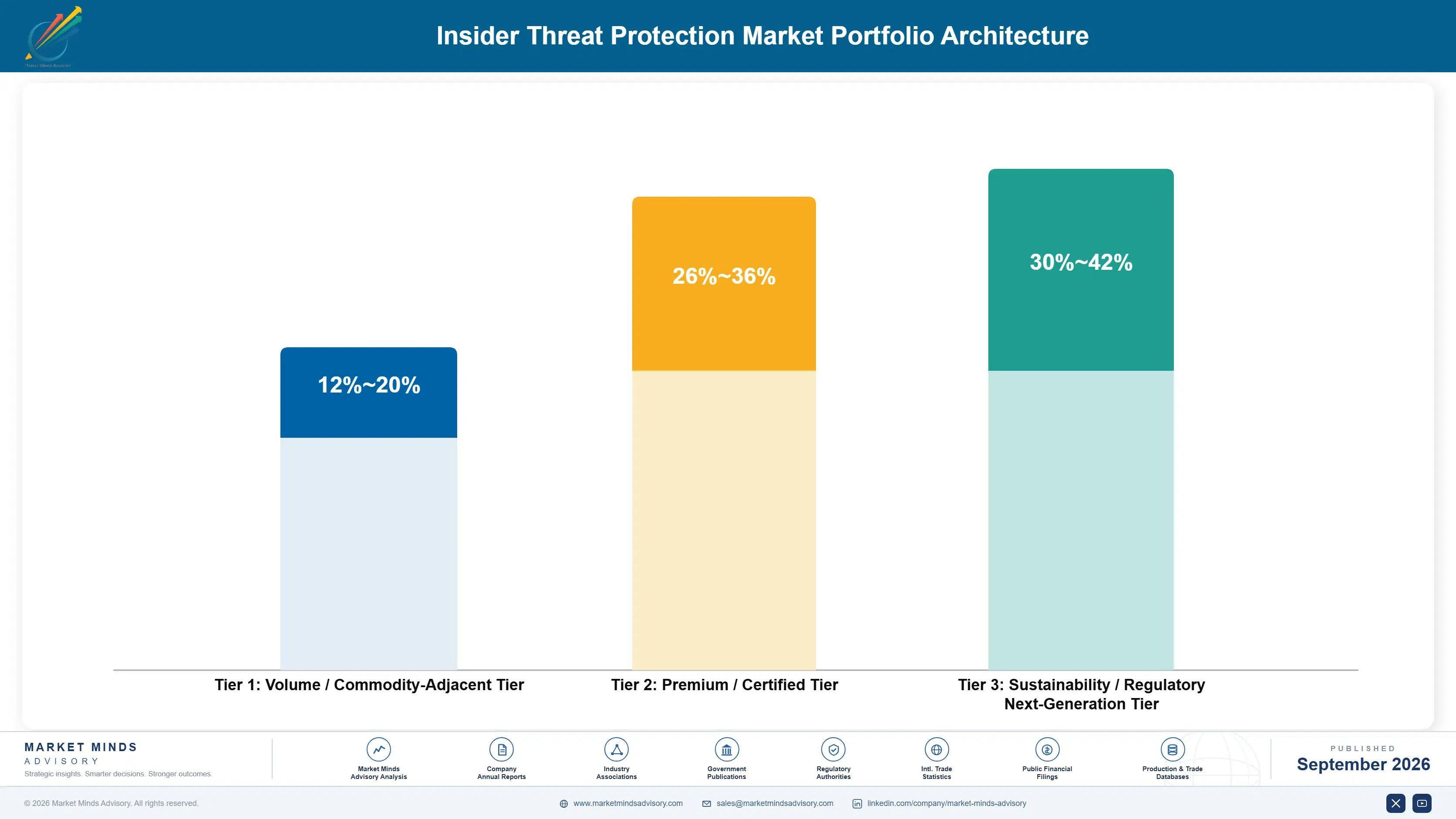
Portfolio Architecture for Margin Defence

MMA organizes the competitive landscape into three tiers: volume and commodity-adjacent basic alerting sold largely on price and monitoring coverage breadth, premium certified behavioral analytics platforms carrying validated baseline accuracy guarantees regulated enterprises require, and next-generation predictive scoring platforms built around continuous, AI-driven risk trajectory analysis. Margins widen meaningfully moving up this ladder as differentiation shifts from basic alerting toward validated predictive accuracy reflecting sustained.
Volume-tier providers compete mostly on price per user and struggle to defend margin as basic alerting becomes commoditized, while premium-tier providers commanding validated behavioral baseline guarantees retain substantially stronger pricing power because regulated enterprises cannot easily substitute an unvalidated monitoring source into a compliance-critical risk management program reflecting sustained investment across multiple enterprise segments as adoption continues expanding steadily across major markets supporting consistent engagement.

High-value margin pools concentrate specifically around predictive scoring and forensics-integrated contracts tied to regulated financial services and technology sectors, where validated continuous risk assessment justifies premium recurring pricing far above what basic alerting tools could ever command reflecting sustained investment across multiple enterprise segments as adoption continues expanding steadily across major markets supporting consistent engagement across national security programs reinforcing.

Volume / Commodity-Adjacent Tier

Basic alerting sold largely on price and monitoring coverage breadth, serving smaller organizations and lower-criticality environments where predictive scoring is not commercially required reflecting sustained investment across multiple enterprise segments as adoption continues expanding steadily across major markets.
Gross Margin: 12%-20%

Premium / Certified Tier

Validated behavioral analytics platforms meeting documented baseline accuracy requirements for regulated enterprise use cases, commanding meaningfully higher pricing given the validation and audit assurance regulated customers require reflecting sustained investment across multiple enterprise segments as adoption continues expanding.
Gross Margin: 26%-36%

Sustainability / Regulatory / Next-Generation Tier

Predictive scoring platforms built around continuous, AI-driven risk trajectory analysis, increasingly favored by enterprises pursuing alternatives to isolated point-in-time alert review reflecting sustained investment across multiple enterprise segments as adoption continues expanding steadily across major markets supporting consistent.
Gross Margin: 30%-42%
insider-threat-protection-market-portfolio-architecture-1789982177507

High-value Sub-segments and Strategic Watch-out

AI-Driven Predictive Risk Scoring Platforms

This segment combines the fastest unit growth in the market with strong and improving margins as predictive accuracy matures, since validated continuous scoring commands pricing that risk-conscious enterprises readily accept given the cost of undetected insider incidents reflecting sustained investment across multiple enterprise segments as adoption continues.
Gross Margin: 30%-40%

Employee Monitoring and Digital Forensics Software

Digital forensics platforms command strong recurring margins and meaningfully higher contract values than basic detection, though growth trails the fastest segment slightly given the more established maturity of this capability compared with newer predictive scoring reflecting sustained investment across multiple enterprise segments as adoption continues expanding steadily.
Gross Margin: 26%-36%

Data Loss Prevention for Insider Risk

This remains a substantial revenue base by absolute dollars today, covering established basic data protection applications, but margins are compressing steadily as broader security suites commoditize pricing for basic data loss prevention reflecting sustained investment across multiple enterprise segments as adoption continues expanding steadily across major markets.
Gross Margin: 14%-22%

Employee Privacy Regulation Risk

Persistent employee privacy concerns across multiple jurisdictions represent a genuine watch-out for the broader category, since restrictive regulation could narrow effective monitoring scope and reduce platform detection effectiveness reflecting sustained investment across multiple enterprise segments as adoption continues expanding steadily across major markets supporting consistent engagement across.
Gross Margin: 16%-26%

Predictive Contracts Anchor Customer Retention

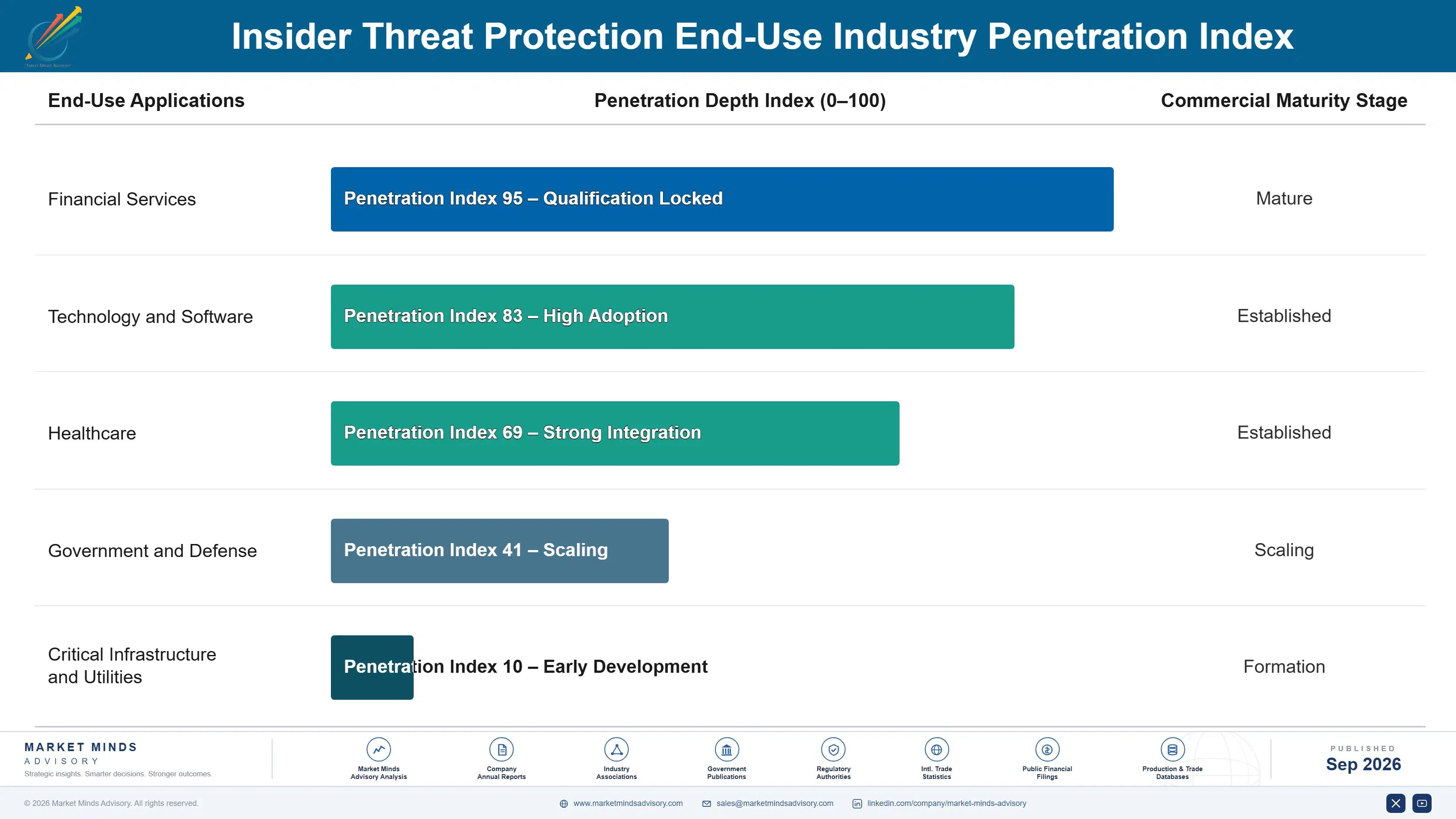
Insider threat protection revenue increasingly behaves like an annuity rather than a one-time software sale, since enterprises that integrate predictive scoring into daily security operations cannot easily switch vendors without disrupting behavioral baseline history, investigation workflows, and escalation processes already built around a specific platform's data model reflecting sustained investment across multiple enterprise segments as adoption continues expanding steadily across major markets supporting consistent engagement.
Adoption runs deepest in financial services and technology companies facing the strictest data protection requirements, where continuous monitoring is operationally essential, followed by critical infrastructure operators where adoption is growing but not yet universal across all functions. Small and mid-sized enterprises represent the shallowest current adoption depth, though usage is expanding as modular deployment options make platform pricing more accessible to smaller organizations reflecting sustained.

A generational shift is underway as organizations move from security teams evaluating platforms primarily on price and monitoring coverage breadth toward risk and compliance leaders evaluating providers on predictive accuracy, privacy configurability, and audit readiness, a change that favors vendors with genuine behavioral analytics credibility over pure alerting tool positioning reflecting sustained investment across multiple enterprise segments as adoption continues.
insider-threat-protection-market-end-use-penetration-index-1789982178001

Where MMA Sees the Opportunity

These are among the four positions where our research anticipates prominent divergence between winners and laggards over the coming forecast period. Each is grounded in the demand model, the regulatory perimeter, and the announced capacity pipeline.
01 / PREDICTIVE SCORING INVESTMENT

Prioritize Continuous Scoring Over Isolated Alerting

AI-driven predictive risk scoring is growing at roughly 1.48 times the overall market rate, and vendors who convert basic alerting customers into continuous scoring contracts now will capture meaningfully higher lifetime value than competitors still selling isolated point-in-time alerts. This is not a marginal upsell opportunity, it fundamentally changes whether security teams catch a gradual escalation pattern before damage occurs. MMA recommends vendors prioritize predictive scoring product development ahead of expanding basic alert coverage in any near-term roadmap decision reflecting sustained investment across multiple enterprise.
02 / FORENSICS INVESTIGATION INTEGRATION

Bundle Digital Forensics Tools With Core Detection

Vendors bundling digital forensics investigation capability directly with detection subscriptions capture additional contract value and meaningfully deepen customer lock-in compared with vendors selling detection alone. This combined approach also positions vendors to defend against broader security operations platforms that currently compete primarily on basic detection bundling alone. MMA recommends vendors without forensics capability pursue it selectively for their largest regulated industry accounts first reflecting sustained investment across multiple enterprise segments as adoption continues expanding steadily across major markets supporting consistent engagement across national security programs.
03 / PRIVACY CONFIGURABILITY INVESTMENT

Build Configurable Privacy Boundaries for Global Deployment

Multinational enterprises increasingly require monitoring configurations that respect jurisdiction-specific employee privacy requirements, and vendors with configurable privacy tooling capture considerably faster legal and compliance approval than vendors offering only uniform monitoring scope. This flexibility advantage has become a meaningful competitive differentiator in multinational procurement specifically. MMA recommends vendors without configurable privacy boundaries build them for their highest-priority global accounts first reflecting sustained investment across multiple enterprise segments as adoption continues expanding steadily across major markets supporting consistent engagement across national security programs reinforcing demand visibility.
04 / ALERT FATIGUE MANAGEMENT

Build Guided Onboarding to Prevent Early Platform Abandonment

Excessive false-positive alerts during initial baseline establishment have already caused some security teams to disable platforms before detection models mature, and vendors with longer guided onboarding periods protect realized platform value considerably better than those expecting immediate full accuracy. This onboarding investment compounds as models learn faster from structured analyst feedback loops. MMA recommends vendors without extended onboarding programs build them before early abandonment limits customer lifetime value reflecting sustained investment across multiple enterprise segments as adoption continues expanding steadily across major markets supporting consistent.

Engagement Snapshot From the Field

A live engagement with an industry participant carrying material or product regulatory and market exposure ahead of a defining policy shift, showing how our research translates into a defensible multi-year portfolio strategy.
MARKET MINDS ADVISORY · CLIENT ENGAGEMENT SUMMARY
Insider Threat Protection Producer Strategic Portfolio Review and Transition Roadmap 2026·Investment Scenario on Insider Threat Protection Exposure Evaluation 2025-26
CLIENT PROFILE
The client is a global financial services firm managing a large, geographically distributed workforce, previously relying on a legacy alerting system that generated excessive false positives and had already been partially disabled by frustrated security analysts. A departing-employee data theft incident that the legacy system failed to flag in time prompted the client to seek a more capable insider threat partner reflecting.
STRATEGIC CHALLENGE
The client needed to select a platform capable of both continuous predictive risk scoring and configurable monitoring boundaries that satisfied varied employee privacy regulations across its multiple operating jurisdictions. Internal teams disagreed over whether to prioritize the broadest behavioral signal coverage or the platform with the strongest documented false-positive reduction reflecting sustained investment across multiple enterprise segments.
MMA APPROACH
MMA conducted a structured vendor evaluation benchmarking five leading insider threat protection providers across predictive scoring accuracy, privacy configurability, and total contract cost over a three-year horizon, supplementing public information with primary interviews across the client's security and legal organizations. The analysis modeled false-positive burden explicitly against the client's actual workforce distribution reflecting sustained investment across multiple.
KEY FINDINGS
  1. Platforms with extensive documented behavioral baseline validation showed meaningfully lower false-positive rates than platforms relying on generic detection configurations reflecting sustained investment across multiple enterprise segments as adoption.
  2. Configurable privacy boundaries proved essential given the client's operations spanned several jurisdictions with materially different employee monitoring regulations reflecting sustained investment across multiple enterprise segments as adoption continues.
  3. Total three-year platform investment was estimated at 5 million dollars (client-reported, unverified by MMA), concentrated primarily in enterprise licensing and integration engineering work reflecting sustained investment across multiple.
  4. The selected platform reduced false-positive alert volume by an estimated 44 percent (client-reported, unverified by MMA) compared with the prior legacy system reflecting sustained investment across multiple enterprise.
CLIENT PROFILE
The client is a global financial services firm managing a large, geographically distributed workforce, previously relying on a legacy alerting system that generated excessive false positives and had already been partially disabled by frustrated security analysts. A departing-employee data theft incident that the legacy system failed to flag in time prompted the client to seek a more capable insider threat partner reflecting.
STRATEGIC CHALLENGE
The client needed to select a platform capable of both continuous predictive risk scoring and configurable monitoring boundaries that satisfied varied employee privacy regulations across its multiple operating jurisdictions. Internal teams disagreed over whether to prioritize the broadest behavioral signal coverage or the platform with the strongest documented false-positive reduction reflecting sustained investment across multiple enterprise segments.
MMA APPROACH
MMA conducted a structured vendor evaluation benchmarking five leading insider threat protection providers across predictive scoring accuracy, privacy configurability, and total contract cost over a three-year horizon, supplementing public information with primary interviews across the client's security and legal organizations. The analysis modeled false-positive burden explicitly against the client's actual workforce distribution reflecting sustained investment across multiple.
KEY FINDINGS
  1. Platforms with extensive documented behavioral baseline validation showed meaningfully lower false-positive rates than platforms relying on generic detection configurations reflecting sustained investment across multiple enterprise segments as adoption.
  2. Configurable privacy boundaries proved essential given the client's operations spanned several jurisdictions with materially different employee monitoring regulations reflecting sustained investment across multiple enterprise segments as adoption continues.
  3. Total three-year platform investment was estimated at 5 million dollars (client-reported, unverified by MMA), concentrated primarily in enterprise licensing and integration engineering work reflecting sustained investment across multiple.
  4. The selected platform reduced false-positive alert volume by an estimated 44 percent (client-reported, unverified by MMA) compared with the prior legacy system reflecting sustained investment across multiple enterprise.
RECOMMENDED STRATEGY
Phase 1: Phase 1 (Months 1 to 2): Benchmark candidate platforms directly against predictive scoring accuracy and privacy configurability for the client's global workforce reflecting sustained. Phase 2: Phase 2 (Months 3 to 8): Deploy the selected platform across the highest-risk business units first, validating detection accuracy and privacy compliance under real. Phase 3: Phase 3 (Months 9 to 15): Extend the validated platform across all remaining jurisdictions, standardizing governance reporting for enterprise-wide audit readiness reflecting sustained investment.
OUTCOME
The client selected a predictive scoring platform with configurable privacy boundaries, replacing its legacy alerting system entirely. False-positive alert volume declined by roughly 44 percent (client-reported, unverified by MMA) compared with the prior system, and security teams reported meaningfully faster detection of genuine risk escalation patterns across the full workforce reflecting sustained.

Frequently Asked Questions

Foundational context covering the market sizes, CAGR, scope, country, region and competition that inform every finding below. This section is provided to cover basics and most often pre-purchase conversations, answered from the MMA Primary Research Dataset.

What is the current size of the Insider Threat Protection Market?

MMA estimates the Insider Threat Protection market at approximately 3.4 billion dollars in 2025. This reflects sustained growth in remote work risk and regulatory compliance demand reflecting sustained investment across multiple enterprise.

How large will the Insider Threat Protection Market be by 2036?

MMA projects the market will reach approximately {value2036:.1f} billion dollars by 2036 under the base case scenario. Growth is driven by predictive scoring adoption, regulatory mandates, and departing employee monitoring demand reflecting.

What is the CAGR for the Insider Threat Protection Market 2026 to 2036?

MMA forecasts a base case compound annual growth rate of 13.5 percent between 2026 and 2036. The bull case reaches 14.8 percent while the bear case falls to 12.2 percent, reflecting adoption.

Which segment is growing fastest?

AI-Driven Predictive Risk Scoring Platforms lead growth at 20.0 percent CAGR, roughly 1.48 times the overall market rate. This reflects rising demand for continuous behavioral risk assessment over isolated alerts reflecting sustained.

Who are the major companies in the Insider Threat Protection Market?

Leading vendors include Proofpoint Inc, Forcepoint LLC, Varonis Systems Inc, DTEX Systems Inc, and Code42 Software Inc. Together these five companies account for an estimated 32 percent of global market activity reflecting.

Which country is growing fastest?

India shows the fastest national growth rate at approximately 15.5 percent CAGR, driven by rapidly expanding technology services behavioral security adoption under evolving governance frameworks reflecting sustained investment across multiple enterprise segments.

Report Segmentation Architecture

The full report scope spans multiple orthogonal segmentation dimensions, with cross-tabulated demand data provided for each dimension pair. Coverage extends further to regional breakdowns, trend trajectories, and the competitive detail needed to support segment-level decision-making.

By Detection Approach and Function

  • User and Entity Behavior Analytics
  • Privileged Access Monitoring Software
  • Data Loss Prevention for Insider Risk
  • Insider Threat Investigation and Forensics Tools
  • AI-Driven Predictive Risk Scoring Platforms
  • Employee Monitoring and Digital Forensics Software

By End-Use Industry

  • Financial Services
  • Technology and Software
  • Healthcare
  • Government and Defense
  • Critical Infrastructure and Utilities

By Commercial Dimension

  • Enterprise Direct Subscription
  • Managed Security Services
  • Systems Integrator Partnerships
  • Cloud Marketplace Channel Sales

By Region

  • North America
  • Western Europe
  • East Asia
  • South Asia and Pacific
  • Latin America
  • Middle East and Africa
  • Eastern Europe

Scope, Methodology, and Coverage

Every figure in this report is reproducible from documented input assumptions. The scope below maps the historical period, the forecast horizon, the segmentation dimensions, and the countries covered, alongside the underlying primary and qualitative methodology.
Historical Period
2020 to 2025
Forecast Period
2026 to 2036
Base Year
2025 (USD billions; MMA Primary Research Dataset, September 2026)
Market Definition
The Insider Threat Protection market covers software platforms that detect, investigate, and prevent security risks originating from employees, contractors, and other trusted individuals with authorized system access, including behavioral analytics, privileged access monitoring, and data loss prevention specifically focused on insider risk. It excludes general perimeter security tools focused on external threat actors, physical security access control systems, and general employee productivity monitoring software without a dedicated security risk detection function.
Quantitative Units
USD billions (current prices); segment and regional CAGR in percent
Segmentation Dimensions
By Detection Approach and Function; By End-Use Industry; By Commercial Dimension; By Region
Regions Covered
North America, Western Europe, East Asia, South Asia and Pacific, Latin America, Middle East and Africa, Eastern Europe
Countries Covered
USA, China, Germany, France, UK, Japan, South Korea, India, Australia, Canada, Brazil, Mexico, Singapore, UAE, Saudi Arabia, South Africa, Poland, Netherlands, Italy, Spain, and additional markets relevant to this sector
Key Companies Profiled
Proofpoint Inc, Forcepoint LLC, Varonis Systems Inc, DTEX Systems Inc, Code42 Software Inc, Microsoft Corporation, CrowdStrike Holdings Inc, Splunk Inc, Exabeam Inc, Securonix Inc, Teramind Inc, ActivTrak Inc, Ekran System Inc, CyberArk Software Ltd, BeyondTrust Corporation, Gurucul Solutions LLC, Rapid7 Inc, IBM Corporation, Cyberhaven Inc, Netskope Inc
Quantitative Methodology
Primary survey, n=3,800 respondents, Q4 2025, six countries; demand-side model with trade association cross-validation
Qualitative Methodology
47 expert interviews, Q4 2025; applied to validate demand model assumptions, identify emerging dynamics, and assess competitive positioning
Report Format
PDF and XLSX data workbook (Word format preview document)
Publisher
Market Minds Advisory
Report Code
MMA-2026-TEC-502
Published
September 2026
Contact
sales@marketmindsadvisory.com | www.marketmindsadvisory.com

Purchase the full Insider Threat Protection Market Report (2026 to 2036).

The full report delivers a complete view of the Insider Threat Protection market, covering detailed segmentation, regional forecasts, and competitive benchmarking across all six detection approach categories through 2036. It includes company profiles for all 20 evaluated vendors, detailed analysis of remote work risk and regulatory compliance trends, and a dedicated section on predictive scoring economics. Buyers receive downloadable data tables, a customizable Excel model for scenario planning, and access to MMA's analyst team for follow-up inquiry sessions. The report is designed for strategy, corporate development, and product teams evaluating vendor selection or platform investment.
Detailed profiles of all 20 evaluated vendors
Regional forecasts across all seven MMA-defined regions
Customizable Excel model for scenario planning analysis
Remote work risk and regulatory compliance analysis
Segment-level CAGR and margin benchmarking data
Direct analyst access for follow-up inquiries

Built For The People Who Decide

From boardroom strategy to bench-side execution, this report is read cover-to-cover by leaders shaping the next decade of their industry, turning demand scenarios, market dynamics and valuation benchmarks into decisions.
CXOs/ Presidents/ VPs/ Managers
M&A and Corporate Development
Strategy Teams and R&D Heads
Procurement and Product Directors
Regulatory and Compliance Leaders
Investor Relations and Equity Analysts