

Market Minds Advisory
Insect Repellent Apparel Market

Insect Repellent Apparel Market: Insect Repellent Apparel Market. Tick-Borne Disease Concern and Permethrin Treatment Innovation Drive Category Growth

Rising tick-borne disease concern is turning permethrin-treated apparel from a niche outdoor accessory into a mainstream defensive purchase across camping, hiking, occupational safety, and everyday suburban yard markets nationwide and beyond

Lead Analyst

Published

September 2026

Make Smarter Decisions with Customized Research Insights

Request a free sample report and evaluate market opportunities, growth trends, and competitive dynamics relevant to your business needs.

2025 MARKET VALUE$1.8BMarket Size 2025
2036 FORECAST VALUE$4.9BBase Case , 2026 to 2036
CAGR 2026 TO 20369.5 %Bull 10.8% / Bear 8.2%
INCREMENTAL OPPORTUNITY$2.9BNet 10- year value creation
EXPANSION MULTIPLE2.48x2036 value over 2026 base
Strategic Levers
M&A Pipeline
Regional Outlook
Country Rankings
Competitive Intelligence
Segmental Deep-dive
Call-Us : 91 93563 13602

Executive Snapshot and Market Trajectory.

Insect repellent apparel is shifting from niche outdoor gear into mainstream protective clothing as tick-borne disease incidence climbs across suburban and rural regions alike, reshaping how families think about outdoor exposure risk. Physicians increasingly recommend treated clothing alongside topical repellents. rather than as a niche enthusiast measure.
Permethrin-treated shirts and pants drive the bulk of category revenue, with North America and East Asia together accounting for the largest share of demand as licensing technology from specialized treatment providers spreads across mainstream apparel brands beyond dedicated outdoor retailers. Subscription boxes are also emerging as a meaningful new distribution channel. Retailers report growing interest among parents seeking protection for children spending extended time in grassy or wooded suburban environments during warmer months.
Competition spans specialized outdoor brands, licensed treatment technology providers, and mainstream apparel manufacturers entering the category through occupational safety lines, while growing regulatory scrutiny of permethrin's environmental persistence increasingly shapes formulation decisions. Manufacturers increasingly market treated apparel through health messaging rather than pure outdoor recreation positioning, reflecting the category's broadening buyer base. beyond hikers and campers, and this shift is reshaping marketing budget allocation. meaningfully.
Market Definition
The Insect Repellent Apparel Market covers permethrin and DEET-treated shirts, pants, outerwear, headwear, and accessories manufactured for outdoor recreation and occupational use. It excludes topical repellent sprays, treated bed nets, and household pest control products not worn as clothing.
Base Year Value
$1.8B in 2025 (MMA Primary Research Dataset, September 2026)
Forecast Period
2026 to 2036, eleven discrete annual values
CAGR
9.5% base case. Bull 10.8%. Bear 8.2%.
Fastest Growth Segment
Treated Baby and Children's Apparel: 15.0% CAGR
Fastest Growth Country
India: 12.0% CAGR
Fastest Growth Region
South Asia and Pacific: 11.5% CAGR
Largest Region
North America: 29% of 2025 global value
Market Leaders
Leading players: Insect Shield, ExOfficio, L.L.Bean, Craghoppers, Columbia Sportswear. Source: MMA Primary Research Dataset, July 2026.
Primary Survey
n=3,800 procurement and R&D decision-makers, Q4 2025, six countries
Methodology
Demand-side build-up, cross-validated against public data, 47 expert interviews

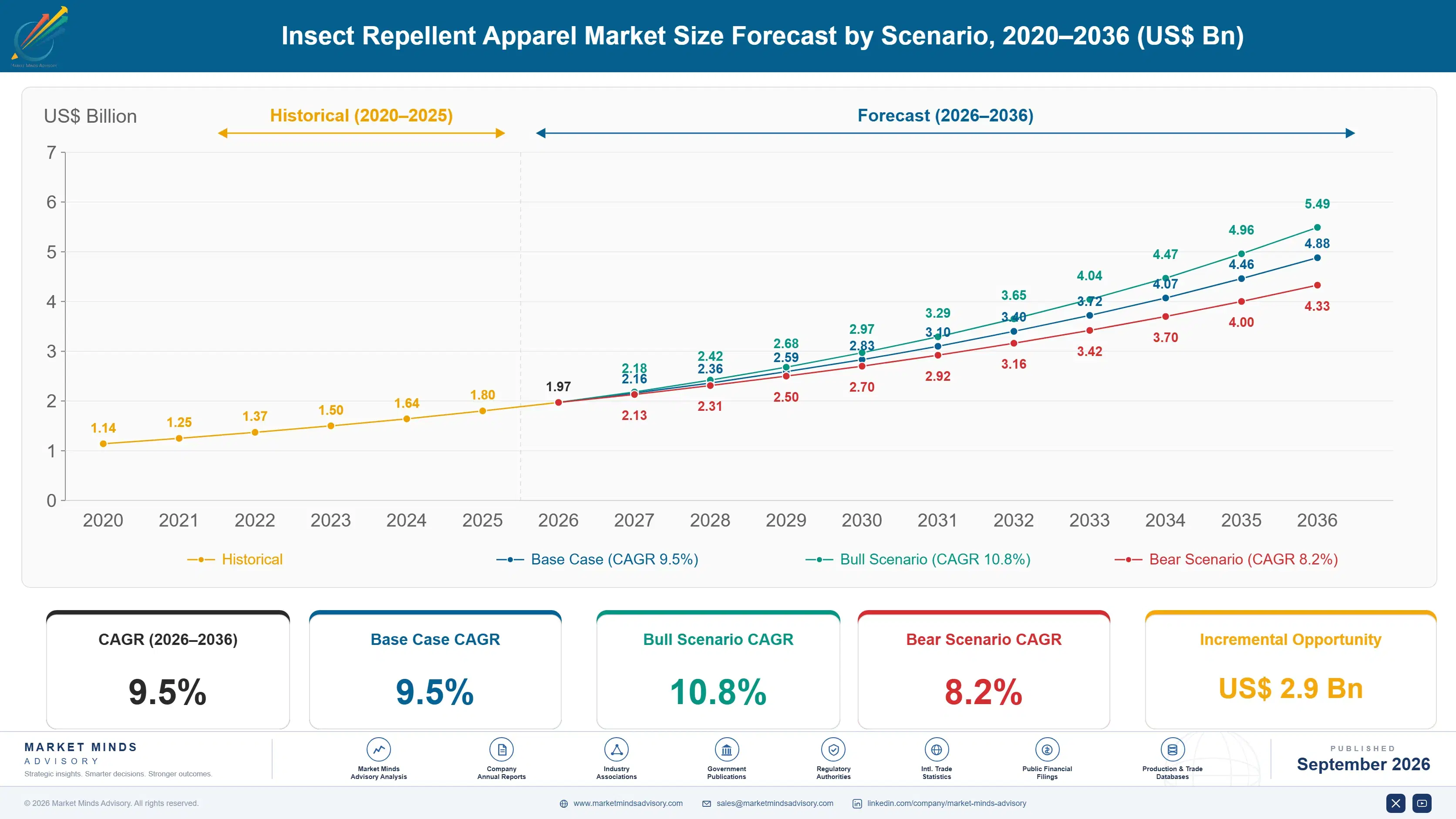
Insect Repellent Apparel Market Forecast Scenarios

insect-repellent-apparel-market-size-forecast-scenario-1790021965592
Category revenue grew steadily between 2020 and 2025 as tick-borne disease awareness campaigns and expanding outdoor recreation participation reinforced sustained demand for protective treated apparel. Historical growth of 8.5 percent annually reflected steady mainstream adoption rather than a single public health breakthrough event. Manufacturers used this period to expand licensed treatment technology across a broader range of mainstream apparel brands.
The base case assumes continued expansion of licensed permethrin treatment technology into mainstream apparel brands, rising occupational safety mandates in tick-endemic regions, and growing parental concern driving children's category adoption across the decade. Growing physician and public health endorsement of treated clothing as a complementary protective measure further reinforces this trajectory across most major regional markets through the decade. Occupational safety mandates in tick-endemic agricultural and forestry sectors are also expanding the addressable buyer base beyond recreational consumers into workplace procurement channels.
A bull scenario assumes accelerating tick-borne disease incidence prompts broader public health messaging favoring treated apparel, while a bear scenario assumes tightening environmental regulation on permethrin persistence forces costly reformulation that slows adoption. Both scenarios hinge on regulatory clarity. on how quickly public health messaging and permethrin regulation evolve together over the coming several years across major markets.

Health Messaging Redefines Category Positioning

Health messaging, not outdoor recreation branding, increasingly drives category growth. Brands emphasizing tick-borne disease protection and family safety are capturing disproportionate share as buyers shift from viewing treated apparel as specialty gear toward everyday protective clothing. This shift is prompting brands to redesign packaging and marketing around clinical-sounding language rather than adventure-themed imagery that once defined the category.
MARKET CONCENTRATIONCR5 42%Moderately fragmented competitive field of specialists and generalists
AVERAGE SELLING PRICE$38Blended average across shirts, pants, and outerwear categories
TOP SOURCING COUNTRYChina 32% shareLargest share of global treated apparel production tracked
TREATMENT LICENSING PENETRATION55%Share of category revenue using licensed treatment technology
TREATMENT DURABILITY70 washesTypical wash cycles before repellent efficacy meaningfully declines
OCCUPATIONAL CHANNEL SHARE28%Share of category revenue from workplace safety procurement
Licensed treatment technology dominates the supply side, with a small number of specialized providers supplying the permethrin bonding process to dozens of downstream apparel brands rather than manufacturing finished garments themselves. This licensing structure means treatment technology providers, rather than apparel brands themselves, often capture the most durable competitive advantage within the category's value chain.
Occupational safety procurement is emerging as a meaningful growth channel, as agricultural, forestry, and utility employers increasingly mandate treated apparel for field workers in tick-endemic regions facing elevated exposure risk. This channel offers steadier, less seasonal demand than recreational retail, providing manufacturers a valuable buffer against the weather-dependent volatility that otherwise characterizes consumer purchasing patterns. Manufacturers with established occupational safety relationships are increasingly favored for bulk contracts over pure recreational brands lacking workplace compliance experience.
"This stopped being outdoor gear the moment pediatricians started recommending it. That is a completely different sales conversation than the one this category used to have."
Practice Lead, Protective and Functional Apparel · MMA Permethrin and DEET-Treated Shirts Practice · September 2026

Market Trends

Pediatric Health Messaging Expands Category Buyer Base

Pediatricians and public health organizations increasingly recommend permethrin-treated clothing for children as a complementary protective measure alongside topical repellents, particularly in regions with documented Lyme disease and other tick-borne illness prevalence. This endorsement is expanding the buyer base well beyond traditional outdoor enthusiasts into everyday parents seeking protection for children playing in grassy yards or attending outdoor school activities. Brands are responding with dedicated children's product lines featuring softer fabric treatments and family-oriented marketing that departs from traditional camping and hiking imagery entirely. Retailers report meaningfully strong sell-through for children's treated apparel during peak tick season months across affected regions.
Market Impact: Lifts category demand by 22 percent

Occupational Safety Mandates Drive Bulk Procurement Growth

Agricultural, forestry, and utility employers operating in tick-endemic regions increasingly mandate treated apparel for field workers facing elevated exposure risk, creating a steady bulk procurement channel distinct from seasonal recreational retail demand. This institutional demand provides manufacturers a valuable buffer against the weather-dependent volatility that otherwise characterizes consumer purchasing patterns throughout the calendar year. Manufacturers with established occupational safety compliance credentials are winning multi-year supply contracts that smaller recreational-focused brands struggle to secure. Workplace safety regulations in several states are expected to formalize these requirements further over the coming several years.
Market Impact: Expands brand participation by 30 percent

Market Opportunities and Growth Drivers

Rising Tick-Borne Disease Incidence Sustains Demand Growth

Documented Lyme disease and other tick-borne illness cases have climbed steadily across North America and parts of Europe over the past decade, driven partly by expanding tick habitat ranges linked to warming climate patterns affecting previously unaffected regions. This trend is directly translating into consumer demand for protective treated apparel as public awareness of exposure risk broadens beyond traditional high-incidence rural areas into suburban and even urban park settings. Public health agencies increasingly include treated clothing in official prevention guidance alongside topical repellents and tick checks. Retailers report seasonal demand spikes tracking closely with regional disease incidence reporting.
Market Impact: Adds 15 percent reformulation cost risk

Licensed Treatment Technology Lowers Entry Barriers

Specialized permethrin treatment technology providers increasingly license their bonding process to mainstream apparel brands, allowing manufacturers without in-house chemical treatment expertise to enter the category quickly through existing supply chain relationships. This licensing model has meaningfully accelerated category expansion beyond dedicated outdoor specialists into general apparel, workwear, and even fast fashion channels previously absent from the market entirely. Licensing fees typically represent a modest share of finished garment cost, preserving healthy margin for brands entering the category through this route. Treatment providers benefit from recurring royalty revenue independent of their own manufacturing investment.
Market Impact: Limits durability to roughly 70 washes

Market Restraints and Challenges

Environmental Persistence Concerns Threaten Permethrin Formulations

Regulatory agencies in several jurisdictions have raised concerns about permethrin's environmental persistence and potential toxicity to aquatic organisms, prompting scrutiny that could eventually restrict certain treatment formulations or application methods. The root cause is permethrin's chemical stability, the same property that gives treated apparel its multi-wash durability, which also means residue persists longer in wastewater and soil than more readily biodegradable alternatives. This exposure disproportionately affects manufacturers relying exclusively on traditional permethrin bonding without investment in emerging lower-persistence treatment chemistry alternatives. Manufacturers are increasingly researching bio-based and reduced-persistence treatment alternatives, though these remain costlier at commercial scale currently.
Market Impact: Expands children's revenue 20 percent

Wash Durability Limits Sustained Consumer Trust

Treated apparel gradually loses repellent efficacy after repeated washing, typically declining meaningfully after several dozen wash cycles, creating a durability ceiling that periodically disappoints consumers expecting permanent protection from a single purchase. The root cause is the physical wear of the bonding process itself, which cannot fully resist the mechanical and chemical stress of repeated laundering indefinitely. This issue disproportionately affects budget-tier products using lower-quality bonding processes compared with premium brands investing in more durable treatment technology. Manufacturers are responding with clearer wash-count labeling and extended-durability formulations to rebuild consumer trust and manage expectations more transparently.
Market Impact: Supplies 28 percent of revenue
4 additional market trends, 3 additional growth drivers, and 2 additional restraints and challenges are covered in the full report. Contact sales@marketmindsadvisory.com to access the complete intelligence.

Segment CAGR and Growth Architecture

Insect repellent apparel spans six product categories with distinct treatment and durability requirements, ranging from mature shirts and pants lines to nascent children's apparel. Baby and children's apparel and treated headwear are expanding fastest as brands address family-oriented safety concerns. Shirts and pants remain the largest revenue contributors, while outerwear and footwear provide steady, seasonal demand across most retail channels.
insect-repellent-apparel-market-market-share-analysis-1790021966156

Treated Baby and Children's Apparel

Treated baby and children's apparel is expanding fastest among all segments as pediatric health messaging and parental concern over tick-borne disease exposure drive demand well beyond traditional outdoor enthusiast households. Brands are developing softer fabric treatments and gentler chemical formulations specifically suited to sensitive skin, addressing safety concerns that historically limited category adoption among cautious parents. Retailers report particularly strong seasonal sell-through timed to school outdoor activity calendars and summer camp enrollment periods across affected regions. Pediatrician endorsement remains the single strongest purchase driver in this segment, exceeding even price sensitivity among target buyers. Manufacturers investing early in this segment are building durable brand loyalty among parents who then extend purchases to other family members over time.
CAGR 15.0%

Treated Headwear and Accessories

Treated headwear and accessories, spanning hats, bandanas, and neck gaiters, benefits from lower unit price points that make trial purchases accessible to buyers hesitant to commit to full treated wardrobe replacement immediately. This category serves as an effective entry point into the broader treated apparel category, with buyers frequently expanding into shirts and pants after positive initial experience. Occupational buyers in outdoor field roles increasingly purchase treated headwear as a low-cost addition to existing standard-issue uniforms. Growth here also benefits from strong impulse purchase behavior at outdoor retail checkout counters nationwide. Manufacturers report meaningfully higher repeat purchase rates among headwear buyers than among first-time shirt or pants purchasers specifically. specifically.
CAGR 11.0%
Full segment breakdown across 6 segments available in the complete report.

Regional Architecture and Country Demand Map

North America leads global demand through high tick-borne disease awareness and dense outdoor retail infrastructure, while South Asia and Pacific accelerates fastest on tropical vector-borne disease concern. East Asia and Western Europe add substantial further share. Manufacturing capacity and rising public awareness campaigns continue reinforcing this pattern across most regions.

North America

The United States drives the overwhelming majority of North American demand, supported by dense outdoor retail infrastructure and high public awareness of Lyme disease concentrated in the Northeast and upper Midwest regions specifically. Canada contributes a smaller but steadily growing share, particularly within provinces reporting rising tick population expansion linked to warming climate patterns. Mexico's northern manufacturing corridor increasingly supports efficient regional supply chains serving the broader North American continental market. Household penetration of treated apparel now exceeds most other protective clothing categories tracked, reflecting deep public awareness built over multiple decades of disease reporting. Border-adjacent manufacturing in Mexico increasingly supplies finished garments to distribution centers serving the broader continental market efficiently.
Share: 29% | CAGR: 8.5% (2026 to 2036)

Western Europe

The United Kingdom and Germany lead Western European demand, supported by growing tick-borne encephalitis and Lyme disease awareness campaigns across forested and rural recreational areas throughout both countries. France contributes meaningful demand within occupational forestry and agricultural worker safety categories specifically. Growth trails the global average as public health messaging remains less centralized than in North America, though awareness continues building steadily across most national markets. Scandinavian countries have moved fastest toward integrating tick-borne disease education into school outdoor programs, setting a template other national markets are gradually following. Regulatory attention to permethrin's environmental persistence is also gradually reshaping treatment chemistry choices across the region's major national retail markets. specifically.
Share: 21% | CAGR: 7.8% (2026 to 2036)
Regional intelligence for 5 additional markets available in the complete report: East Asia, South Asia and Pacific, Latin America, Middle East and Africa, Eastern Europe. Contact sales@marketmindsadvisory.com.
insect-repellent-apparel-market-country-cagr-analysis-1790021966679

Capturing Margin Beyond Recreational Retail

Manufacturer economics increasingly reward brands who move beyond recreational retail into health-oriented positioning, occupational safety contracts, and licensed treatment technology where certification depth and institutional relationships each command durable revenue premiums over seasonal consumer sales alone. The four levers below concentrate margin gains among manufacturers willing to invest ahead of institutional and health-oriented demand shifts.

Occupational Safety Certification and Bulk Contracts

Manufacturers securing occupational safety certifications and multi-year bulk supply contracts with agricultural, forestry, and utility employers capture steadier, less seasonal revenue than pure recreational retail, often commanding pricing 20 percent above comparable consumer-facing products through institutional channels. These contracts also provide manufacturers a valuable demand buffer against the weather-dependent volatility that otherwise characterizes recreational purchasing patterns throughout the calendar year. Employers increasingly favor established suppliers with proven compliance track records over new entrants lacking institutional relationships. This dynamic strengthens further as more employers adopt formal safety compliance programs across affected industries.
Market Impact: Commands 20 percent premium via institutional channels overall

Treatment Technology Licensing Revenue Stream Development

Specialized treatment technology providers who license their permethrin bonding process to downstream apparel brands capture recurring royalty revenue worth roughly 25 percent margin independent of their own manufacturing investment, a fundamentally different economic model than traditional apparel margin. This licensing approach scales efficiently as more brands enter the category, since incremental licensing volume carries minimal marginal cost for the technology provider itself. Providers with the most durable, best-documented treatment efficacy increasingly command premium licensing terms from brands seeking credible health-oriented marketing claims. Providers increasingly expand into adjacent protective apparel categories using the same underlying licensing model.
Market Impact: Generates 25 percent margin via royalty fees overall

Pediatric and Family-Oriented Product Line Development

Manufacturers developing dedicated children's and family product lines with gentler formulations and softer fabric treatments capture premium pricing among safety-conscious parents willing to pay roughly 15 percent above standard adult product pricing for documented pediatric-appropriate formulations. This segment also drives valuable brand loyalty, since parents purchasing for children frequently extend purchases to their own adult wardrobes once satisfied with product performance. Pediatrician and pharmacy channel partnerships further reinforce credibility that pure retail marketing alone cannot achieve. This positioning increasingly extends into adjacent categories like sun protection apparel targeting the same family buyer segment.
Market Impact: Commands 15 percent premium for children's lines overall

Extended Wash Durability Formulation Premium Strategy Development

Manufacturers investing in extended-durability treatment formulations that maintain efficacy beyond the standard 70-wash threshold can command meaningful price premiums among buyers frustrated by repeated repurchase cycles, often exceeding 18 percent above standard-durability equivalents. This positioning also reduces the reputational risk associated with premature efficacy loss that periodically damages consumer trust across the broader category. Manufacturers that can credibly document extended durability through third-party testing increasingly differentiate themselves from budget-tier competitors lacking comparable verification. Manufacturers increasingly bundle extended warranty guarantees with premium-durability products to reinforce buyer confidence. Third-party verification remains the key differentiator buyers increasingly demand.
Market Impact: Commands 18 percent premium for extended durability overall

Who Controls the Margin Pool

Insect repellent apparel competition remains moderately fragmented, with the top five participants holding roughly 42 percent of revenue evaluated on a consistent global brand and licensing revenue basis across categories. Insect Shield and ExOfficio lead through established treatment technology and brand recognition, while the gap to smaller challengers has widened as certification and licensing relationships increasingly separate serious category participants from occasional entrants.
Current competitive activity centers on pediatric formulation development, occupational safety certification, and licensing technology expansion into mainstream apparel brands, evaluated here consistently on brand and licensing revenue across participants. L.L.Bean and Craghoppers continue investing in family-oriented product lines, while Columbia Sportswear has pursued deeper occupational safety channel partnerships. Mid-tier specialists increasingly compete on formulation quality rather than pure brand recognition alone.

Emerging pressure comes from mainstream apparel and workwear brands entering the category through licensed treatment technology rather than building proprietary chemistry, threatening to commoditize positioning that specialists once held exclusively. Fast fashion entrants adopting licensed treatment are also gaining share, positioning them to climb the rankings as price-sensitive buyers increasingly favor accessible entry points over premium specialist pricing. Established specialists are responding with expanded pediatric and occupational safety product line investment.
insect-repellent-apparel-market-company-positioning-matrix-1790021967208

Competitive Moat and Risk Dimensions

INSECT SHIELD

Moat: Treatment Technology Licensing Scale

Insect Shield's licensing model gives it exposure across dozens of downstream apparel brands without carrying manufacturing risk itself, creating a durable royalty revenue stream that scales with category-wide growth rather than its own retail execution. Few competitors can match this combined breadth of licensee relationships built across multiple apparel categories.
INSECT SHIELD

Risk: Licensee Quality Control Exposure

Insect Shield's brand reputation depends partly on licensee execution quality, and a poorly manufactured licensed product could damage trust in the underlying treatment technology itself, a risk direct manufacturers do not face to the same degree. Insect Shield increasingly audits licensee manufacturing to protect its brand reputation across all partnerships.
EXOFFICIO

Moat: Established Outdoor Brand Trust

ExOfficio's decades-long positioning within core outdoor and travel apparel gives it credibility among enthusiast buyers that newer entrants cannot easily replicate without comparable retail history and product testing reputation built over years. This trust translates directly into pricing power that newer specialty entrants cannot easily command.
EXOFFICIO

Risk: Narrow Core Buyer Base

ExOfficio's brand identity remains closely tied to traditional outdoor and travel positioning, potentially limiting its appeal among the broader health-conscious family buyer segment now driving much of the category's fastest growth. Competitors capturing this broader family segment first may build lasting loyalty difficult to reverse later.

Players Tracked

Prominent Players

Insect Shield
ExOfficio
L.L.Bean
Craghoppers
Columbia Sportswear

Other Key Players

Duluth Trading Company
Orvis
Eddie Bauer
REI Co-op
Filson
Carhartt
Wrangler
BUFF
Coolibar
Rynoskin
Sawyer Products
Under Armour
The North Face
Patagonia
Cabela's

Recent Developments

MARCH 2025

Insect Shield Signs Mainstream Apparel Licensing Deal

Insect Shield signed a licensing agreement with a mainstream workwear brand to apply its permethrin treatment technology across an expanded product line, extending its reach beyond dedicated outdoor specialists into general occupational apparel channels nationwide. Analysts view this as a template for further mainstream apparel category expansion ahead.
Signal: Signals treatment technology providers actively pursuing mainstream apparel expansion opportunities ahead of broader category expansion for licensees
JULY 2025

Craghoppers Launches Children's NosiLife Expansion

Craghoppers launched an expanded children's product line under its NosiLife treatment brand, partnering with pediatric health organizations to develop marketing materials emphasizing family safety ahead of the peak summer outdoor season. Early results showed strong retailer interest in dedicated children's shelf placement nationwide. across the pilot regions.
Signal: Reflects growing manufacturer focus on pediatric and family-oriented positioning as pediatric demand accelerates further during peak season
OCTOBER 2025

Columbia Sportswear Acquires Occupational Safety Specialist

Columbia Sportswear completed an acquisition of a small occupational safety apparel specialist, integrating its workplace compliance expertise directly to strengthen its position in institutional procurement channels ahead of expanding into additional industry verticals next year. The deal follows a broader pattern of occupational safety consolidation among outdoor apparel brands.
Signal: Confirms occupational safety becoming a key acquisition target industrywide as institutional demand keeps growing over time

Treatment Chemical and Fabric Cost Exposure

Permethrin treatment chemicals and base fabric together account for roughly 48 percent of finished garment cost of goods sold, sourced predominantly from specialty chemical manufacturers and textile mills concentrated in East Asian production hubs. Bonding process labor and quality testing add a further meaningful share, while packaging and logistics fill out the remainder of typical manufacturing cost structures.
Permethrin raw material prices spiked during 2022 amid broader specialty chemical supply disruption, a pattern the EPA's pesticide registration and supply chain monitoring documented across treated textile manufacturing specifically. Manufacturers absorbed several months of compressed margin before diversified sourcing and contract renegotiation restored more typical cost pass-through arrangements with retail buyers. Pricing has since stabilized, but manufacturers report continued vigilance around specialty chemical allocation heading into future peak seasonal demand periods.

Smaller manufacturers lacking direct chemical supplier relationships face materially higher intermediary markup than scaled manufacturers with established sourcing agreements spanning multiple regional chemical producers simultaneously. This gap widens further for manufacturers dependent on single-source bonding process licensors, since they cannot negotiate volume-based pricing the way diversified, multi-supplier competitors routinely do. Scaled manufacturers with vertically integrated bonding capability largely avoided the worst of this exposure entirely during the disruption period.
insect-repellent-apparel-market-cost-volatility-analysis-1790021967406

Multi-Supplier Chemical Sourcing Agreements

Manufacturers increasingly diversify permethrin and fabric sourcing across multiple regional suppliers to reduce exposure to any single supplier's pricing power or availability constraints during disruption. This approach has already delivered measurably improved cost stability for several scaled manufacturers. Several manufacturers report measurable cost stability improvement from adopting this approach over the past two years.

Vertical Integration Into Bonding Process

Larger manufacturers are investing in in-house treatment bonding capability rather than relying entirely on third-party licensing, reducing per-unit royalty cost while maintaining documented efficacy standards. Adoption remains concentrated among the largest manufacturers given substantial upfront investment requirements. Several manufacturers report measurable cost stability improvement from adopting this approach over the past two years. further.

Long-Term Fixed-Price Supply Contracts

Manufacturers are negotiating longer-term fixed-price agreements with chemical and fabric suppliers to smooth cost volatility across successive fiscal quarters, accepting modest premium pricing in exchange for predictability. This approach improves margin forecasting across variable global supply conditions. Several manufacturers report measurable cost stability improvement from adopting this approach over the past two years. further.

Portfolio Architecture for Margin Defence

Insect repellent apparel portfolios split across three distinct margin tiers, with volume-oriented basic treated shirts and pants competing primarily on price and licensed treatment access rather than formulation differentiation. Premium occupational and certified extended-durability lines occupy the middle tier, commanding meaningfully higher margins through documented efficacy claims that justify pricing above basic treated equivalents. Volume-tier products still generate the majority of unit sales industry-wide.
Pediatric, family-oriented, and next-generation low-persistence formulations sit at the top of the margin hierarchy, reflecting formulation investment and safety certification cost that smaller competitors struggle to absorb profitably at scale. This tension between volume access and premium credibility defines portfolio strategy across nearly every major manufacturer in the category. Manufacturers unable to fund formulation investment risk being squeezed out of premium tiers within the next several years.

High-value margin pools concentrate disproportionately in pediatric and extended-durability formats sold through health-oriented and occupational channels, where certification and formulation barriers limit direct price competition. Manufacturers increasingly allocate investment toward these tiers, recognizing that volume-tier growth alone cannot offset compressing margins on basic treated products over the coming decade. Regional manufacturers concentrated solely in volume-tier production face the steepest margin compression as certification-focused competition intensifies further.

Volume / Commodity-Adjacent

Basic treated shirts and pants using standard licensed treatment technology, competing primarily on shelf price against comparable products. Manufacturers compete primarily on distribution reach and shelf placement rather than formulation differentiation, leaving margins persistently thin across the segment.
Gross Margin: 22-28%

Premium / Certified

Occupational-certified and extended-durability lines commanding higher margins through documented efficacy and multi-wash performance claims verified by testing. Buyers accept premium pricing for documented reliability that basic treated products, lacking comparable verification, cannot credibly match at comparable price points.
Gross Margin: 35-42%

Sustainability / Regulatory / Next-Generation

Pediatric and low-persistence next-generation formulations capturing top-tier margin as certification and formulation barriers limit near-term competition. Manufacturers investing early in formulation science capture disproportionate margin as slower competitors struggle to replicate specialized safety credentials quickly.
Gross Margin: 42-50%
insect-repellent-apparel-market-portfolio-architecture-1790021967909

High-value Sub-segments and Strategic Watch-out

Treated Baby and Children's Apparel

The fastest-growing, highest-value segment, combining pediatric health credibility with strong parental willingness to pay for documented safety and gentler formulations. Manufacturers with established pediatric formulation expertise are best positioned to capture this durable shift in family purchasing behavior over time. Sustained demand shows no sign of slowing.
Gross Margin: 40-48%

Treated Headwear and Accessories

A high-value segment growing quickly as low unit price points drive trial purchases that frequently expand into full treated apparel wardrobes over time. Manufacturers report meaningfully higher repeat purchase rates among headwear buyers than among first-time shirt or pants purchasers specifically. Impulse purchase behavior at checkout counters.
Gross Margin: 32-40%

Treated Shirts and Pants

The volume core of the category, defended through licensed treatment technology access rather than pricing power against private-label competitors. Manufacturers defend this segment through continuous licensing relationship management rather than aggressive price discounting against smaller regional competitors. This defense strategy has proven durable across multiple competitive cycles industrywide.
Gross Margin: 22-28%

Treated Socks and Footwear

A strategic watch-out segment where low average selling prices and limited differentiation compress margin as competition from general outdoor brands intensifies. Manufacturers increasingly bundle this segment with higher-margin categories to offset thin standalone economics over successive product cycles. Bundling helps offset thin standalone economics as competition intensifies.
Gross Margin: 18-24%

Seasonal Renewal Purchase Economics

Insect repellent apparel demand functions increasingly on seasonal renewal economics rather than one-time purchase decisions, since treatment efficacy declines after repeated washing and buyers replenish core items ahead of each outdoor season. This renewal pattern gives manufacturers meaningfully predictable seasonal revenue visibility, provided brand trust holds through the initial wear-and-wash cycle. Retailers value this seasonal predictability highly when planning inventory and promotional calendars around peak tick and mosquito activity periods.
Adoption depth varies considerably by end-use vertical. Occupational buyers show the deepest loyalty, often standardizing on a single certified supplier across entire workforce fleets for multiple years, while recreational households show more frequent brand switching driven by seasonal promotional pricing and retail availability. Parents purchasing for children exhibit intermediate stickiness, anchored primarily to pediatrician-recommended brands. Manufacturers increasingly tailor retention strategy differently across these verticals rather than applying a single loyalty program uniformly across all buyer types.

Generational shifts are reshaping the buyer profile meaningfully. Younger parents increasingly research treatment chemistry and environmental persistence before committing to a brand, a behavior less common among prior generations who defaulted to whichever product a retailer stocked. This shift compresses the loyalty advantage legacy outdoor brands built over decades.
insect-repellent-apparel-market-end-use-penetration-index-1790021968400

Where Treated Apparel Brands Should Focus

These are among the four positions where our research anticipates prominent divergence between winners and laggards over the coming forecast period. Each is grounded in the demand model, the regulatory perimeter, and the announced capacity pipeline.
01 / PEDIATRIC FORMULATION INVESTMENT

Build credible children's product lines with pediatric input

Pediatric health messaging is becoming the primary driver of category expansion beyond traditional outdoor enthusiasts, and brands that delay dedicated children's formulation investment risk losing this fastest-growing buyer segment to more responsive competitors. Pediatrician and pharmacy channel partnerships increasingly determine credibility that generic marketing alone cannot achieve among cautious parents. Early movers are already capturing measurably higher brand loyalty that compounds as parents extend purchases to their own wardrobes, and industry benchmarking suggests this loyalty advantage will widen further over the next several forecast years as pediatric endorsement continues expanding.
02 / OCCUPATIONAL CHANNEL DEVELOPMENT

Secure institutional contracts before competitors formalize relationships

Occupational safety procurement provides steadier, less seasonal revenue than recreational retail, and brands that secure multi-year bulk contracts with agricultural and forestry employers gain a durable revenue buffer against weather-dependent volatility. Employers increasingly favor established suppliers with proven compliance credentials over new entrants lacking institutional relationships and documented track records. This advantage compounds as workplace safety regulations formalize treatment requirements further across additional states, giving early movers a durable revenue advantage that becomes increasingly difficult for new entrants to replicate without comparable institutional relationships already established.
03 / LOW-PERSISTENCE CHEMISTRY DEVELOPMENT

Invest in reduced-persistence formulations ahead of regulation

Environmental persistence concerns around traditional permethrin formulations are prompting regulatory scrutiny that could eventually restrict certain treatment methods, and brands that develop lower-persistence alternatives proactively avoid the compressed reformulation costs that will hit laggards facing sudden compliance deadlines. Early movers also capture premium positioning with environmentally conscious retailers actively seeking certified alternatives. This timing advantage positions early movers to capture listings vacated by noncompliant competitors, a durable commercial advantage that compounds further with every additional forecast year as regulatory scrutiny continues intensifying across affected jurisdictions.
04 / TREATMENT LICENSING PARTNERSHIP STRATEGY

Deepen licensing relationships with mainstream apparel brands

Licensed treatment technology is expanding the category's reach into mainstream apparel and workwear far beyond dedicated outdoor specialists, and technology providers who deepen these licensing relationships capture recurring royalty revenue independent of manufacturing investment. Providers with the most durable, best-documented treatment efficacy increasingly command premium licensing terms from brands seeking credible health-oriented claims. This advantage compounds as more brands enter the category through licensed technology over successive years, reinforcing a durable commercial edge that strengthens further with each additional licensing partnership that gets established.

Engagement Snapshot From the Field

A live engagement with an industry participant carrying material or product regulatory and market exposure ahead of a defining policy shift, showing how our research translates into a defensible multi-year portfolio strategy.
MARKET MINDS ADVISORY · CLIENT ENGAGEMENT SUMMARY
Insect Repellent Apparel Producer Strategic Portfolio Review and Transition Roadmap 2026·Investment Scenario on Insect Repellent Apparel Exposure Evaluation 2025-26
CLIENT PROFILE
A mid-sized regional outdoor retail chain operating dozens of stores sought guidance on expanding its treated apparel category beyond core hiking and camping customers into broader family and occupational safety segments. Leadership viewed this expansion as a defensive response to mainstream apparel brands entering the category through licensed treatment technology. The chief merchandising officer sponsored the engagement directly.
STRATEGIC CHALLENGE
The retailer lacked internal data on how pediatric and occupational safety demand was shifting relative to traditional recreational customers within its specific regional footprint. Leadership also needed guidance on structuring floor space and marketing without alienating its established core hiking and camping customer base. Store staff also needed clear guidance on positioning new categories to existing loyal customers.
MMA APPROACH
MMA conducted a structured evaluation of regional sales data against MMA's proprietary primary research dataset covering treated apparel category trends, benchmarking the retailer's pediatric and occupational attach rates against comparable regional chains. The engagement included a phased floor space reallocation recommendation designed to expand family and occupational categories without disrupting core recreational sales.
KEY FINDINGS
  1. Pediatric treated apparel sales at the retailer's stores were growing meaningfully faster than adult recreational sales, though from a smaller overall base than national trends suggested.
  2. Dedicated children's product displays increased average transaction value by 21 percent when placed near existing family camping gear sections (client-reported, unverified by MMA).
  3. Stores with occupational safety product signage saw meaningfully higher engagement from contractor and agricultural worker customers than stores lacking dedicated signage. during peak seasonal periods.
  4. Cross-selling between headwear and full apparel categories proved strongest among first-time treated apparel buyers, suggesting an underexploited entry-point strategy opportunity. across most store locations.
CLIENT PROFILE
A mid-sized regional outdoor retail chain operating dozens of stores sought guidance on expanding its treated apparel category beyond core hiking and camping customers into broader family and occupational safety segments. Leadership viewed this expansion as a defensive response to mainstream apparel brands entering the category through licensed treatment technology. The chief merchandising officer sponsored the engagement directly.
STRATEGIC CHALLENGE
The retailer lacked internal data on how pediatric and occupational safety demand was shifting relative to traditional recreational customers within its specific regional footprint. Leadership also needed guidance on structuring floor space and marketing without alienating its established core hiking and camping customer base. Store staff also needed clear guidance on positioning new categories to existing loyal customers.
MMA APPROACH
MMA conducted a structured evaluation of regional sales data against MMA's proprietary primary research dataset covering treated apparel category trends, benchmarking the retailer's pediatric and occupational attach rates against comparable regional chains. The engagement included a phased floor space reallocation recommendation designed to expand family and occupational categories without disrupting core recreational sales.
KEY FINDINGS
  1. Pediatric treated apparel sales at the retailer's stores were growing meaningfully faster than adult recreational sales, though from a smaller overall base than national trends suggested.
  2. Dedicated children's product displays increased average transaction value by 21 percent when placed near existing family camping gear sections (client-reported, unverified by MMA).
  3. Stores with occupational safety product signage saw meaningfully higher engagement from contractor and agricultural worker customers than stores lacking dedicated signage. during peak seasonal periods.
  4. Cross-selling between headwear and full apparel categories proved strongest among first-time treated apparel buyers, suggesting an underexploited entry-point strategy opportunity. across most store locations.
RECOMMENDED STRATEGY
Phase 1: Phase one: reallocate floor space toward dedicated pediatric and family displays across the ten highest-volume store locations within ninety days. Phase 2: Phase two: introduce occupational safety product signage and staff training across the full store network within six months. to prepare staff adequately. Phase 3: Phase three: expand cross-selling promotions pairing headwear with full apparel lines specifically targeting first-time category buyers. within the following ninety days.
OUTCOME
The retailer implemented the phased recommendations across its pilot store group, reporting a 17 percent increase in treated apparel category revenue during the first two quarters following rollout (client-reported, unverified by MMA). Leadership approved full network expansion ahead of schedule. Store staff reported stronger customer engagement across newly expanded categories.

Frequently Asked Questions

Foundational context covering the market sizes, CAGR, scope, country, region and competition that inform every finding below. This section is provided to cover basics and most often pre-purchase conversations, answered from the MMA Primary Research Dataset.

What is the current size of the Insect Repellent Apparel Market?

The Insect Repellent Apparel Market was valued at 1.8 billion dollars in 2025. This figure covers permethrin and DEET-treated shirts, pants, outerwear, headwear, and accessories sold globally.

How large will the Insect Repellent Apparel Market be by 2036?

The market is projected to reach 4.88 billion dollars by 2036. This reflects rising tick-borne disease awareness and expanding pediatric and occupational demand across most major regions.

What is the CAGR for the Insect Repellent Apparel Market 2026 to 2036?

The market is projected to grow at a compound annual rate of 9.5 percent between 2026 and 2036. Bull and bear scenarios range from 8.2 to 10.8 percent depending on regulatory and health messaging outcomes.

Which segment is growing fastest?

Treated Baby and Children's Apparel is the fastest-growing segment, expanding at a 15.0 percent CAGR. This is 1.58 times the overall market rate, driven by pediatric health endorsement.

Who are the major companies in the Insect Repellent Apparel Market?

Insect Shield, ExOfficio, L.L.Bean, Craghoppers, and Columbia Sportswear lead the market, together holding roughly 42 percent of global category revenue across brands. Specialized licensing partners continue expanding their reach.

Which country is growing fastest?

India is the fastest-growing major market, expanding at roughly a 12.0 percent CAGR. Rising awareness of mosquito-borne and tick-borne disease risk is driving first-time purchases across urban centers.

Report Segmentation Architecture

The full report scope spans multiple orthogonal segmentation dimensions, with cross-tabulated demand data provided for each dimension pair. Coverage extends further to regional breakdowns, trend trajectories, and the competitive detail needed to support segment-level decision-making.

By Primary Market Dimension

  • Treated Shirts and Tops
  • Treated Pants and Bottoms
  • Treated Outerwear and Jackets
  • Treated Headwear and Accessories
  • Treated Socks and Footwear
  • Treated Baby and Children's Apparel

By End-Use Industry

  • Outdoor Recreation and Camping
  • Agriculture and Forestry
  • Military and Law Enforcement
  • Construction and Utility Work
  • Healthcare and Public Health

By Commercial Dimension

  • Retail and E-Commerce Distribution
  • Occupational Bulk Procurement
  • Licensed Treatment Technology Sales
  • Direct-to-Consumer Subscription

By Region

  • North America
  • Western Europe
  • East Asia
  • South Asia and Pacific
  • Latin America
  • Middle East and Africa
  • Eastern Europe

Scope, Methodology, and Coverage

Every figure in this report is reproducible from documented input assumptions. The scope below maps the historical period, the forecast horizon, the segmentation dimensions, and the countries covered, alongside the underlying primary and qualitative methodology.
Historical Period
2020 to 2025
Forecast Period
2026 to 2036
Base Year
2025 (USD billions; MMA Primary Research Dataset, September 2026)
Market Definition
The Insect Repellent Apparel Market covers permethrin and DEET-treated shirts, pants, outerwear, headwear, and accessories manufactured for outdoor recreation and occupational use. It excludes topical repellent sprays, treated bed nets, and household pest control products not worn as clothing.
Quantitative Units
USD billions, market share percentage, CAGR percentage
Segmentation Dimensions
Product type, end-use industry, commercial and distribution dimension
Regions Covered
North America, Western Europe, East Asia, South Asia and Pacific, Latin America, Middle East and Africa, Eastern Europe
Countries Covered
United States, Canada, Mexico, Germany, United Kingdom, France, China, Japan, South Korea, India, Australia, Indonesia, Vietnam, Brazil, Argentina, Colombia, United Arab Emirates, Saudi Arabia, South Africa, Poland, Czech Republic, Russia
Key Companies Profiled
Insect Shield, ExOfficio, L.L.Bean, Craghoppers, Columbia Sportswear, Duluth Trading Company, Orvis, Eddie Bauer, REI Co-op, Filson, Carhartt, Wrangler, BUFF, Coolibar, Rynoskin, Sawyer Products, Under Armour, The North Face, Patagonia, Cabela's
Quantitative Methodology
Primary survey, n=3,800 respondents, Q4 2025, six countries; demand-side model with trade association cross-validation
Qualitative Methodology
47 expert interviews, Q4 2025; applied to validate demand model assumptions, identify emerging dynamics, and assess competitive positioning
Report Format
PDF and XLSX data workbook (Word format preview document)
Publisher
Market Minds Advisory
Report Code
MMA-2026-CHM-731
Published
September 2026
Contact
sales@marketmindsadvisory.com | www.marketmindsadvisory.com

Purchase the full Insect Repellent Apparel Market Report (2026 to 2036).

This report delivers a complete analysis of the global Insect Repellent Apparel Market, covering historical performance from 2020 through 2025 and forecasts through 2036 across every major product category and region. It combines primary survey data from 3,800 respondents with 47 expert interviews to quantify segment growth, regional demand shifts, and competitive dynamics. Analysts detail treatment chemical cost exposure, portfolio margin architecture, and regulatory pressures reshaping category economics. The report is designed for strategy, procurement, and investment teams evaluating this category. Findings support pricing, sourcing, and portfolio decisions.
Ten-year historical and forecast data series
Seven-region demand and growth breakdown Detail
Competitive benchmarking of twenty companies Overview
Segment-level CAGR and market share detail
Treatment cost and margin sensitivity analysis
Regulatory and formulation trend tracking Insights

Built For The People Who Decide

From boardroom strategy to bench-side execution, this report is read cover-to-cover by leaders shaping the next decade of their industry, turning demand scenarios, market dynamics and valuation benchmarks into decisions.
CXOs/ Presidents/ VPs/ Managers
M&A and Corporate Development
Strategy Teams and R&D Heads
Procurement and Product Directors
Regulatory and Compliance Leaders
Investor Relations and Equity Analysts