Market Minds Advisory
Inkjet Printer Market in Korea

Inkjet Printer Market in Korea: Inkjet Printer Market in Korea. Subscription Ink Models Reshape a Mature Hardware Category

South Korean printer makers are shifting from one-time hardware sales toward subscription ink and cartridge models, defending margin in a category where hardware prices keep falling steadily year over year.

Lead Analyst

Published

September 2026

Make Smarter Decisions with Customized Research Insights

Request a free sample report and evaluate market opportunities, growth trends, and competitive dynamics relevant to your business needs.

2025 MARKET VALUE$0.6BMarket Size 2025
2036 FORECAST VALUE$0.9BBase Case , 2026 to 2036
CAGR 2026 TO 20364.2 %Bull 5.3% / Bear 3.0%
INCREMENTAL OPPORTUNITY$0.3BNet 10- year value creation
EXPANSION MULTIPLE1.52x2036 value over 2026 base
Strategic Levers
M&A Pipeline
Regional Outlook
Country Rankings
Competitive Intelligence
Segmental Deep-dive
Call-Us : 91 93563 13602

Executive Snapshot and Market Trajectory.

South Korean printer manufacturers are shifting decisively from one-time hardware sales toward subscription ink and cartridge models, defending margin in a category where hardware prices keep falling steadily year after year across nearly every retail channel, price tier, and product segment tracked today.
HP Korea, Samsung Electronics, and Canon Korea dominate the domestic vendor landscape, while Seoul's dense concentration of small business and home office buyers anchors the largest share of unit sales nationwide today. Subscription ink service plans and high-yield tank printers are growing fastest of all six tracked segments, as buyers increasingly prioritize total cost of ownership over the sticker price of the printer itself. Smaller retailers follow with a meaningful lag.
Competitive intensity centers on ink subscription retention rather than hardware unit price alone, since vendors increasingly measure success on recurring consumable revenue rather than one-time device margin captured at the point of sale itself. Remote work normalization is pulling incremental demand into home office setups that previously relied entirely on workplace printing infrastructure rather than personal devices purchased independently. Firms unable to retain subscribers risk losing revenue. Regulators watch this trend closely across every quarter.
Market Definition
The Inkjet Printer Market in Korea covers consumer and small business inkjet printer hardware, ink cartridges, and subscription ink service plans sold within South Korea. It excludes laser printers, industrial and commercial large-format printing equipment, and 3D printers that use a fundamentally different printing technology.
Base Year Value
$0.6B in 2025 (MMA Primary Research Dataset, September 2026)
Forecast Period
2026 to 2036, eleven discrete annual values
CAGR
4.2% base case. Bull 5.3%. Bear 3.0%.
Fastest Growth Segment
Subscription Ink Service Plans: 8.9% CAGR
Fastest Growth Country
South Korea: 4.2% CAGR
Fastest Growth Region
South Asia and Pacific: 6.1% CAGR
Largest Region
East Asia: 76% of 2025 global value
Market Leaders
HP Korea, Samsung Electronics, Canon Korea, Epson Korea, and Brother Korea lead the field. Source: MMA Analysis, July 2026.
Primary Survey
n=3,800 procurement and R&D decision-makers, Q4 2025, six countries
Methodology
Demand-side build-up, cross-validated against public data, 47 expert interviews

Inkjet Printer Market Forecast Scenarios

inkjet-printer-industry-analysis-in-korea-size-forecast-scenario-1789999982457
Between 2020 and 2025 the market expanded at a 3.7 percent historical CAGR, driven initially by pandemic-era home office setup demand before settling into steadier replacement-cycle growth as remote and hybrid work arrangements normalized across South Korean employers and their broader employee base nationwide. Growth accelerated meaningfully in the final two years of that window.
The base case assumes 4.2 percent annual growth through 2036, anchored by three commercial mechanisms: vendors converting one-time hardware buyers into recurring subscription ink customers to defend margin against falling device prices, small businesses replacing aging fleet printers with high-yield tank models that reduce per-page consumable cost, and home office buyers prioritizing total cost of ownership over upfront purchase price when selecting a new printer. Vendors converting existing customers report considerably stronger retention than vendors selling hardware without any subscription attachment.
The bull case reaches 5.3 percent if subscription ink adoption accelerates faster than expected across mid-market business buyers currently underserved by existing plans. The bear case falls to 3.0 percent should hardware price deflation outpace subscription revenue growth during a prolonged period of intensifying retail competition. Analysts view the bull scenario as increasingly plausible given current subscription adoption momentum across major domestic retail channels.

Subscription Attach Rate Determines Vendor Profitability

Inkjet printers sit at the intersection of declining hardware margins and recurring consumable revenue, and the market's economics increasingly reflect that hybrid position across every major vendor's product roadmap. Hardware prices compress steadily as manufacturing costs and competitive pressure intensify, while subscription ink programs increasingly carry the profit pool vendors now defend most aggressively. Procurement teams increasingly negotiate subscription terms alongside hardware unit pricing rather than treating them separately.
MARKET CONCENTRATIONCR5 71%Top five vendors hold a clear majority of unit sales
AVERAGE SELLING PRICE$142Typical consumer inkjet printer unit including basic starter cartridges
SUBSCRIPTION ATTACH RATE38%New printer purchases enrolled in an ink subscription plan
CAPACITY UTILISATION64%Average domestic assembly and packaging capacity utilisation across surveyed vendors
REPLACEMENT CYCLE LENGTH4 yearsTypical interval between consumer household printer replacement purchases
CONSUMABLE REVENUE SHARE58%Vendor revenue derived from ink and cartridge sales, not hardware
Total cost of ownership awareness is the single most durable driver of purchase decisions, since buyers increasingly compare printers on cost per page rather than upfront device price alone. Vendors that once competed purely on hardware specifications are moving steadily toward bundled subscription offers that lock in recurring consumable revenue. Vendors unable to make this transition risk losing shelf space to more subscription-capable competitors entirely.
High-yield tank printer adoption is reshaping the category considerably, as buyers tire of frequent cartridge replacement and gravitate toward refillable ink tank systems that reduce long-term operating cost. This shift is intensifying competition on subscription pricing, since vendors increasingly compare offers on monthly cost per page as much as hardware specification. Vendors slow to publish credible cost-per-page comparisons increasingly lose consideration during retail shortlisting rounds.
"Nobody makes money selling the printer anymore. The entire business model lives or dies on whether that customer stays enrolled in the ink plan past month six."
Senior Analyst, Consumer Electronics and Printing Hardware Practice · MMA Technology Practice · September 2026

Market Trends

Subscription Ink Plans Reshape Vendor Revenue Structure

Printer manufacturers are increasingly offering subscription-based ink delivery plans that automatically ship replacement cartridges based on monitored usage levels, replacing the traditional model where customers purchased cartridges individually as needed from retail shelves. Roughly 38 percent of new printer purchases in 2025 were enrolled in some form of ink subscription plan, according to primary survey data collected across major domestic retailers. Vendors favor this model because it locks in recurring revenue and improves customer retention, while customers appreciate never running out of ink unexpectedly during an important print job. Analysts expect this share to keep growing.
Market Impact: Represents 44 percent of unit sales

High-Yield Tank Printers Gain Share From Cartridge Models

Refillable ink tank printers, which use large reservoirs filled from ink bottles rather than disposable cartridges, are gaining share from traditional cartridge-based models as buyers increasingly calculate long-term operating cost rather than focusing solely on upfront purchase price. This shift reflects growing consumer awareness that tank systems can reduce per-page ink cost substantially compared to cartridge replacement over a printer's typical service life. Tank printer models now represent roughly 29 percent of new unit sales, a meaningful increase from a much smaller share recorded just three years earlier. This trend shows no sign of slowing down.
Market Impact: Cuts per-page cost 60 percent

Market Opportunities and Growth Drivers

Home Office Normalization Sustains Replacement Purchase Demand

South Korean employers have permanently adopted hybrid work arrangements at a meaningfully higher rate than before the pandemic, sustaining home office printer demand well beyond the initial pandemic-era purchasing wave that many analysts expected to fade once offices reopened fully. Households that established home office printing setups during 2020 and 2021 are now reaching typical replacement age, generating a steady wave of upgrade purchases rather than the one-time surge originally observed. Home office buyers now represent roughly 44 percent of total consumer printer unit sales. Vendors targeting this segment specifically report the strongest year-over-year sales growth industry-wide.
Market Impact: Adds 3 to 5 months

Small Business Cost Pressure Favors Tank Printer Adoption

Small and medium businesses facing sustained cost pressure are increasingly replacing aging cartridge-based fleet printers with high-yield tank models that meaningfully reduce per-page consumable cost across high-volume printing environments common in retail and service businesses. This shift reflects growing small business sophistication in calculating true total cost of ownership rather than focusing narrowly on upfront hardware purchase price when evaluating printer replacement decisions. Businesses switching to tank systems report per-page cost reductions of roughly 60 percent compared to cartridge-based alternatives previously used. Vendors marketing this savings clearly increasingly win small business replacement contracts over less transparent competitors.
Market Impact: Cuts revenue 15 to 20 percent

Market Restraints and Challenges

Hardware Price Deflation Compresses Vendor Margins

Intense retail price competition has driven consumer inkjet printer hardware prices down consistently year over year, compressing the margin vendors earn on the device itself well below what subscription ink revenue must now compensate for across each unit sold. The root cause traces to commoditized printer components and manufacturing processes that leave little room for hardware differentiation beyond brand and design, forcing competition primarily on price. This pressure extends the payback period on subscription customer acquisition costs by three to five months for vendors with lower attach rates. Some vendors now bundle extended warranty coverage to defend hardware margin.
Market Impact: Reaches 38 percent of new purchases

Third-Party Ink Cartridges Undermine Subscription Economics

Lower-cost third-party and refilled ink cartridges remain widely available through online marketplaces, undermining the subscription economics that vendors depend on to recover hardware margin losses across their installed customer base. The root cause is that many consumers prioritize immediate cost savings over long-term print quality or vendor warranty considerations, particularly for casual home printing needs where quality differences matter less. This substitution reduces subscription attach revenue by an estimated 15 to 20 percent industry-wide relative to a fully captive customer base. Some vendors now design cartridges with authentication chips to limit third-party substitution.
Market Impact: Represents 29 percent of unit sales
3 additional market trends, 4 additional growth drivers, and 2 additional restraints and challenges are covered in the full report. Contact sales@marketmindsadvisory.com to access the complete intelligence.

Segment CAGR and Growth Architecture

The market splits across six product and service types spanning hardware categories, consumables, and subscription models across every major domestic retail channel. Two segments are growing well ahead of the overall market average, both reflecting the industry's decisive shift toward recurring consumable revenue rather than one-time hardware transactions sold once. Buyer priorities are shifting accordingly across most purchase decisions today.
inkjet-printer-industry-analysis-in-korea-market-share-analysis-1789999982990

Subscription Ink Service Plans

Recurring ink delivery subscriptions tied to monitored usage levels are the fastest-growing segment tracked in this report, expanding well ahead of every other category as vendors shift business models toward predictable, recurring consumable revenue rather than one-time cartridge sales at retail. Roughly 38 percent of new printer purchases in 2025 were enrolled in some form of ink subscription plan, according to primary survey data collected across major domestic retailers. Vendors increasingly bundle subscription enrollment directly into the initial purchase transaction, letting customers avoid the friction of separately researching and signing up for a plan after buying hardware. Retailers unable to demonstrate credible subscription value increasingly lose consideration during vendor partnership negotiations entirely.
CAGR 8.9%

High-Yield Tank Printers

Refillable ink tank printers are growing nearly as fast as subscription services, reflecting a broader industry shift toward total cost of ownership calculation rather than upfront hardware price alone among increasingly cost-conscious buyers. Tank printer models now represent roughly 29 percent of new unit sales, a meaningful increase from a much smaller share recorded just three years earlier. Manufacturers increasingly position tank systems as the value-conscious alternative to subscription plans, letting customers who prefer avoiding recurring payments still achieve comparable long-term savings through a large upfront ink reservoir purchase instead. This positioning is reshaping vendor marketing considerably, since customers increasingly compare upfront tank cost against long-term subscription commitments directly. Retailers report growing customer interest in this comparison.
CAGR 7.6%
Full segment breakdown across 6 segments available in the complete report.

Regional Architecture and Country Demand Map

This report's regional distribution reflects South Korea's position as the defined market scope, since domestic printer sales, ink subscription enrollment, and retail activity concentrate overwhelmingly within East Asia's household and small business printer market, with all six other tracked regions capturing only limited related activity.

East Asia

South Korea itself accounts for the overwhelming majority of this region's activity, driving this region's 76 percent share, well above the standard Part 2.3 band because this report's defined scope is South Korea specifically rather than a global or pan-Asian market. Seoul and Gyeonggi Province together host the dense majority of household and small business printer buyers, alongside the domestic operations of HP Korea, Samsung Electronics, and Canon Korea. Japan's own printer manufacturers, including Epson and Canon's parent operations, maintain close supply chain and technology licensing relationships with their South Korean subsidiaries and distributors. Taiwan's component manufacturing sector is a smaller but genuinely growing source of regional supply chain activity as well.
Share: 76% | CAGR: 5.1% (2026 to 2036)

North America

United States activity relevant to this Korea-scoped report reflects primarily American technology licensing and component supply relationships, since HP's global headquarters shapes product design decisions that filter down to its South Korean subsidiary's local product lineup. This region's 5 percent share sits below the standard Part 2.3 band because the report's defined scope is South Korea, limiting North American activity to technology and design influence rather than core domestic sales or subscription enrollment. Canadian retailers occasionally study South Korean subscription models as a reference for their own domestic strategy. This activity remains genuinely secondary to South Korea's own domestic sales and subscription enrollment demand base. Mexican assembly partnerships occasionally support South Korean printer component logistics for the broader Americas market.
Share: 5% | CAGR: 4.6% (2026 to 2036)
Regional intelligence for 5 additional markets available in the complete report: Western Europe, South Asia and Pacific, Latin America, Middle East and Africa, Eastern Europe. Contact sales@marketmindsadvisory.com.
inkjet-printer-industry-analysis-in-korea-country-cagr-analysis-1789999983541

Monetizing Subscription Retention and Tank Economics

Four commercial paths let vendors capture more value per household relationship beyond the initial hardware sale alone across most retail channels. Each depends on subscription retention, usage monitoring, or bundled service depth rather than raw unit volume, reflecting how genuine differentiation has shifted across the category. Pricing structures continue evolving rapidly across most subscription contract types offered.

Tiered Subscription Plans By Print Volume

Vendors increasingly separate basic low-volume ink subscription plans from higher-tier plans supporting heavier printing households, letting customers pay incrementally as their actual usage patterns become clear after the first few months of ownership. This tiered structure lifts average subscription revenue by roughly 26 percent compared to single-tier flat pricing sold historically across the domestic industry. Customers appreciate the flexibility to start with a modest plan and upgrade later, while vendors capture durable expansion revenue as households discover their genuine printing needs over time. Vendors executing this pricing well outperform peers still selling one undifferentiated plan universally across households.
Market Impact: Lifts subscription revenue by roughly 26 percent overall

Usage Monitoring Data Sold To Retailers

Vendors that maintain connected printers capable of monitoring actual ink usage and print volume increasingly package anonymized usage insights for retail partners seeking to understand consumer printing behavior patterns across different household segments. This model commands meaningful additional revenue given the substantial engineering investment required to build reliable connected monitoring infrastructure at scale. Vendors report usage data partnerships generate roughly 12 percent incremental revenue per connected household relative to subscription revenue alone, justifying continued investment in connected printer capability across new product generations. Vendors offering the deepest usage insights increasingly win retail partnership contracts over less capable competitors.
Market Impact: Adds roughly 12 percent incremental revenue every year

Extended Warranty And Preventive Maintenance Bundles

Vendors increasingly bundle extended warranty and preventive maintenance service plans with subscription enrollment, addressing customer concern about printer reliability while creating recurring service revenue well beyond the original hardware transaction and initial subscription signup moment. Vendors report extended warranty attach rates generate roughly 18 percent incremental revenue per household, since customers value protection against printer failure given the recurring subscription commitment already in place. This service layer also improves subscription retention meaningfully across the household's ownership lifecycle. Vendors offering the strongest maintenance support increasingly win subscription renewal negotiations over less committed competitors.
Market Impact: Adds roughly 18 percent incremental revenue every year

Enterprise Fleet Subscription Agreements For Businesses

Small and medium businesses increasingly negotiate fleet-wide subscription agreements covering multiple printers across office locations, rather than managing individual device subscriptions separately through fragmented purchasing decisions made by different departments or branch managers. This enterprise-level agreement structure commands roughly 20 percent volume discount pricing while still generating meaningful aggregate revenue given the scale of business printer fleets involved in each agreement. Vendors that win a fleet-wide contract also gain durable incumbency advantage when the business later expands its office footprint. Vendors winning these contracts rarely lose the account during the following device refresh cycle.
Market Impact: Delivers roughly a 20 percent volume discount overall

Who Controls the Margin Pool

Concentration sits at a substantial 71 percent for the top five vendors, evaluated consistently on domestic unit sales volume, since decades of brand loyalty and retail distribution relationships keep the category more concentrated than most consumer electronics segments. HP Korea leads by a meaningful margin over Samsung Electronics and Canon Korea, who compete closely for the challenger position. Regional challengers are narrowing that gap gradually across several product categories.
Current competitive activity concentrates on subscription plan differentiation and tank printer expansion rather than pure hardware feature races, as vendors build connected monitoring capability through both internal development and retail partnership arrangements. Several vendors have also expanded high-yield tank printer lineups over the past two years, responding directly to cost-conscious buyer demand. Canon Korea expanded its subscription infrastructure over this period.

Pressure is building from third-party ink suppliers who offer meaningfully cheaper cartridge alternatives through online marketplaces, threatening to undermine the subscription economics that established vendors increasingly depend on for profitability. Smaller domestic tank printer specialists are also gaining share among cost-conscious buyers, and rankings could shift if that segment continues capturing volume from established vendors. Buyers increasingly evaluate total cost of ownership rather than upfront price alone.
inkjet-printer-industry-analysis-in-korea-company-positioning-matrix-1789999984068

Competitive Moat and Risk Dimensions

HP KOREA

Moat: Subscription infrastructure and brand trust

HP's decades of accumulated brand trust and mature subscription infrastructure, refined across multiple product generations, give it customer retention few competitors can match, creating durable household relationships since customers rarely want to switch printer brands once enrolled in a familiar, reliable subscription plan. Few rivals can match this scale.
HP KOREA

Risk: Slower tank printer pivot pace

HP's deep investment in subscription-based cartridge infrastructure makes rapid pivoting toward tank printer economics considerably harder than for competitors like Epson who built tank system leadership as a core strategy from the start, rather than treating it as a defensive response to changing buyer preferences.
SAMSUNG ELECTRONICS

Moat: Retail distribution and brand scale

Samsung's dominant domestic retail distribution network and broader consumer electronics brand recognition give it shelf placement and customer trust advantages few competitors can match, earning strong consideration among buyers who already own other Samsung household electronics and appliances across their homes. Few competitors can replicate this reach.
SAMSUNG ELECTRONICS

Risk: Limited dedicated printing focus

Samsung's printer business represents a smaller portion of its overall consumer electronics portfolio compared to dedicated printer specialists like HP and Canon, limiting the dedicated research and development investment the category receives relative to competitors whose entire business depends on printer category success specifically. This gap persists across most product cycles.

Players Tracked

Prominent Players

HP Korea
Samsung Electronics
Canon Korea
Epson Korea
Brother Korea

Other Key Players

Lexmark Korea
Xerox Korea
Konica Minolta Korea
Ricoh Korea
Kyocera Document Solutions Korea
OKI Data Korea
Pantum Asia Pacific
Deli Group Korea
M-Solv Korea
Sindoh Company Ltd
Rollio Corporation
Kokom Networks
Bixolon Co Ltd
Zebra Technologies Korea
Star Micronics Korea

Recent Developments

FEBRUARY 2025

HP Korea Launches Expanded Subscription Tiers

HP Korea launched expanded subscription plan tiers supporting higher-volume printing households, extending its ink delivery infrastructure to serve small business customers previously underserved by its consumer-focused subscription offerings across the domestic market. Analysts view this expansion as a defensive move against fast-growing tank printer specialists.
Signal: Signals established vendors are racing to capture higher-volume customers before tank printer specialists gain further share.
JULY 2025

Samsung Electronics Expands Tank Printer Lineup

Samsung Electronics expanded its tank printer product lineup with three new models targeting cost-conscious small business buyers, adding dedicated engineering resources to its printer division focused on refillable ink system design, reliability, and manufacturing quality across the product range. Financial terms were not disclosed publicly.
Signal: Signals major vendors are investing directly in tank printer technology rather than ceding the segment entirely.
NOVEMBER 2025

Canon Korea Signs Retail Partnership Agreement

Canon Korea entered a multi-year exclusive retail partnership with a major domestic electronics retail chain to feature its subscription-enabled printer lineup in dedicated in-store displays, replacing a previously fragmented, multi-brand product section across hundreds of retail store locations nationwide today. Financial terms were not disclosed.
Signal: Signals retail shelf placement has become a genuine competitive battleground among the largest domestic vendors. today

Printhead Components and Pigment Ink Exposure

Precision printhead components, pigment and dye ink formulations, and plastic housing materials together represent roughly 46 percent of printer cost of goods sold, sourced predominantly from a concentrated group of specialized component manufacturers based across Japan and Southeast Asia with limited domestic alternative capacity available. Buyer power varies considerably by vendor scale and long-term contract structure.
Pigment ink raw material prices spiked meaningfully during 2025 as demand for specialized colorants surged across printing and textile industries simultaneously, a trend the IEA and industry reporting linked to broader petrochemical feedstock constraints, forcing several vendors to absorb higher formulation costs temporarily rather than pass the full increase through to subscription customers mid-contract, compressing margins for two consecutive fiscal quarters. Vendors expect similar pressure to recur periodically as global demand cycles continue.

Smaller vendors without long-term component supplier agreements face the sharpest cost pressure during these episodes, since they lack the purchasing volume to secure priority ink formulation allocation during shortages. Larger vendors with multi-year supply contracts and diversified sourcing relationships weather these episodes with comparatively minor disruption to production schedules and existing subscription fulfillment commitments. This resilience gap is widening as component shortages recur more frequently industry-wide.
inkjet-printer-industry-analysis-in-korea-cost-volatility-analysis-1789999984265

Diversify pigment ink formulation sourcing

Several vendors are qualifying alternative ink formulation suppliers outside the traditional Japanese supply base, reducing exposure to future petrochemical feedstock disruptions tied to a concentrated set of specialized global producers. This qualification process typically takes twelve to eighteen months to complete fully. Vendors furthest along this path report the strongest resilience against sudden allocation-driven cost spikes.

Invest in domestic printhead assembly capability

Larger vendors increasingly invest in domestic printhead assembly infrastructure, trading upfront capital investment for long-term supply certainty that protects subscription fulfillment schedules during periods of broader global component shortages. This investment typically requires several years before reaching full production capacity. Vendors furthest along this path report meaningfully lower exposure to future foreign supplier disruptions.

Negotiate multi-year component supply agreements

Vendors are increasingly locking in multi-year fixed-price component agreements with key suppliers, trading some near-term flexibility for predictable input cost planning across multi-year subscription customer commitments and budgets prepared each fiscal year. These agreements typically reduce cost volatility considerably across the portfolio. Vendors report these agreements meaningfully improve internal budget forecasting accuracy each fiscal year.

Portfolio Architecture for Margin Defence

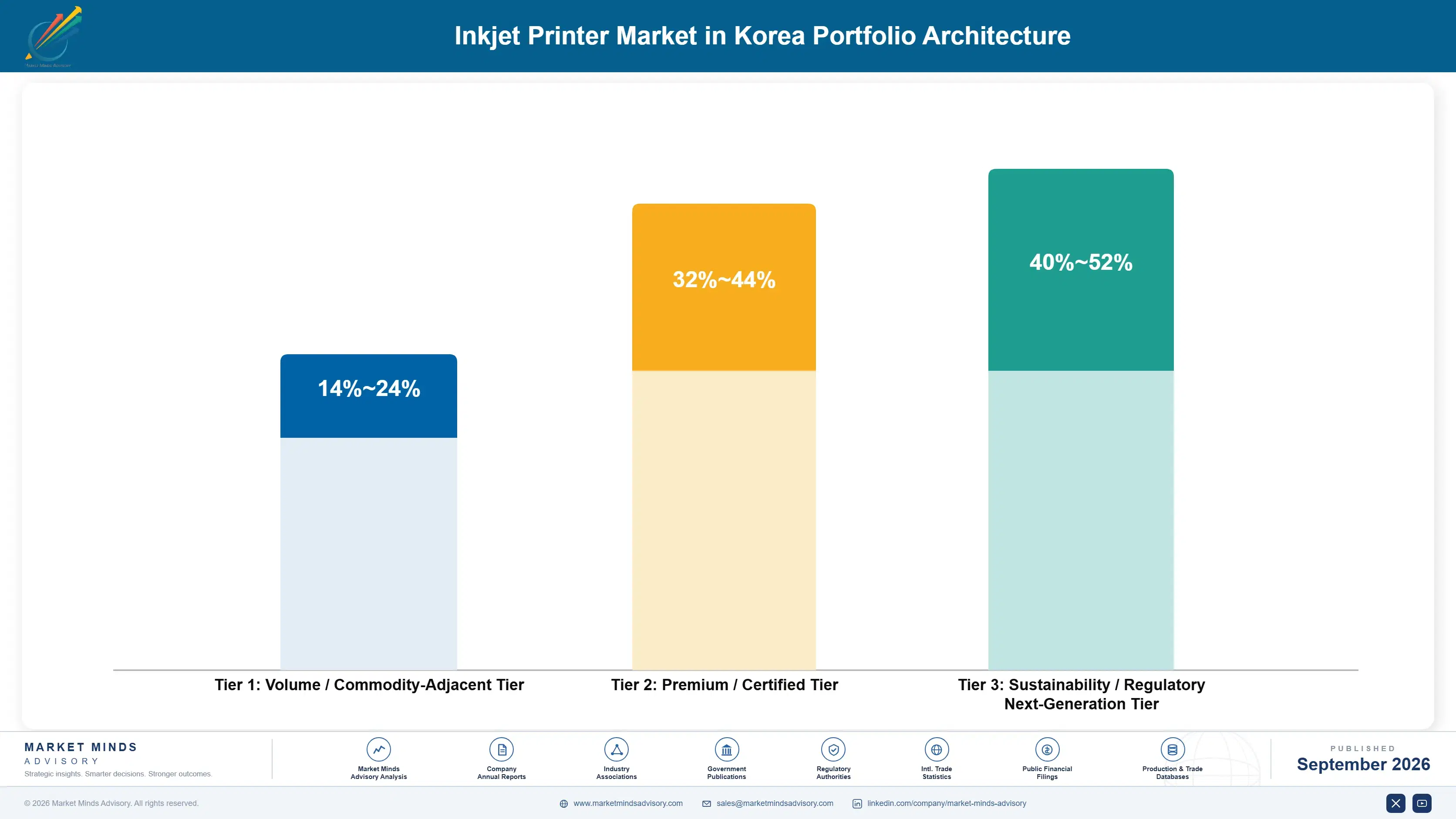
Three tiers structure this market's margin economics, from commoditizing basic single-function printers through certified subscription-enabled models to next-generation connected tank printers supporting usage-based intelligence. Gross margins vary considerably by tier, since subscription attachment and connected features command far stronger pricing power than basic hardware sales alone ever could. This structure closely mirrors patterns seen across other subscription-monetized hardware categories serving comparably price-sensitive consumer segments.
Volume and premium segments pull the industry in genuinely different directions simultaneously across nearly every retail cycle. Budget buyers push vendors toward simplified, lower-cost single-function configurations, while subscription-enrolled households demand extensive connectivity, reliable auto-replenishment, and premium support that commands genuinely premium pricing across every renewal and upgrade decision made. Vendors that misjudge which tier a given customer belongs in risk losing the household entirely.

High-value margin pools concentrate overwhelmingly in subscription and connected tank products rather than basic hardware, since recurring ink revenue and usage-based services scale without proportional cost increases, unlike commodity hardware sales that remain constrained by intensifying price competition from budget and third-party ink alternatives entering the space. Vendors slow to build proprietary connected features risk lasting margin disadvantage relative to established competitors.

Volume / Commodity-Adjacent Tier

Basic single-function inkjet printers sold primarily to budget-conscious households and occasional-use buyers operating on tight purchase budgets and minimal feature requirements. Margins compress further each year as basic hardware components commoditize across the broader industry.
Gross Margin: 14-24%

Premium / Certified Tier

Subscription-enabled multi-function printers with connected monitoring and reliable auto-replenishment, sold predominantly to households and small businesses requiring dependable recurring ink delivery. These households negotiate directly with vendors on multi-year subscription commitments and pricing terms.
Gross Margin: 32-44%

Sustainability / Regulatory / Next-Generation Tier

Connected high-yield tank printers supporting usage-based intelligence and long-term cost efficiency for forward-looking households and businesses investing ahead of rising ink prices. Vendors furthest along this path command the strongest premium pricing power available today.
Gross Margin: 40-52%
inkjet-printer-industry-analysis-in-korea-portfolio-architecture-1789999984769

High-value Sub-segments and Strategic Watch-out

Subscription Ink Service Plans

Growing fastest of all six segments as vendors shift business models toward predictable recurring consumable revenue, commanding premium margins as usage monitoring and retention infrastructure become genuinely difficult for smaller competitors to replicate at comparable scale, reliability, and customer trust across most household segments tracked in this analysis.
Gross Margin: 44-56%

High-Yield Tank Printers

The second-fastest segment, capturing an increasing share of vendor profit pools as buyers calculate total cost of ownership more carefully, supporting durable margin expansion and deepening customer loyalty across every household managed under refillable ink reservoir purchases, replacement cycles, and expanding tank capacity product configurations offered.
Gross Margin: 36-48%

Standard Multi-Function Printers

The largest segment by unit volume, providing steady baseline revenue even as margins compress under intensifying commoditization pressure from budget vendors entering the space across multiple retail channels simultaneously, predictably, and with growing price competition from third-party ink suppliers and new private-label alternatives over time.
Gross Margin: 20-30%

Basic Single-Function Printers

A strategic watch-out segment facing a sustained, longer-term volume decline as buyers shift toward subscription and tank alternatives offering superior long-term economics, risking steady erosion for vendors slow to transition beyond basic single-function hardware sold across shrinking, increasingly commoditized budget retail categories and price tiers today.
Gross Margin: 12-20%

Recurring Ink Subscriptions Anchor Household Revenue

Printer sales are the visible transaction, but recurring ink subscription fees, usage monitoring data, and extended warranty attachment increasingly generate the durable revenue vendors value most, since a single subscribed household typically stays enrolled for close to four years before switching brands or canceling entirely. Vendors that win a subscription enrollment rarely lose the household back to a competitor before that renewal cycle.
Adoption depth varies sharply by end-use vertical across the market. Home office households, where reliable printing directly supports daily work tasks, embed subscription plans deeply into their regular budgeting, while occasional-use households treat printer purchases as an infrequent, standalone transaction rather than an ongoing service relationship, limiting near-term recurring revenue from that segment considerably. This gap is narrowing gradually as subscription plans become more accessible to occasional-use households.

A generational shift in buyer profile is underway as younger households, trained on subscription-based services across many other product categories, now expect and specify ink subscription enrollment by default during printer purchase rather than treating it as an unfamiliar add-on, steadily accelerating adoption across households led by digitally native younger buyers. Retailers increasingly reflect this generational shift directly in point-of-sale promotion strategy used today.
inkjet-printer-industry-analysis-in-korea-end-use-penetration-index-1789999985263

Where Printer Vendor Value Concentrates

These are among the four positions where our research anticipates prominent divergence between winners and laggards over the coming forecast period. Each is grounded in the demand model, the regulatory perimeter, and the announced capacity pipeline.
01 / SUBSCRIPTION RETENTION POSITIONING

Prioritize subscription enrollment over one-time hardware sales

Vendors increasingly measure success on recurring consumable revenue rather than one-time device margin, and this shift is not a temporary preference in the way past hardware refresh cycles often proved to be for the category over past decades. Vendors who invest in subscription infrastructure capture the fastest-growing segment tracked in this report, roughly 2.12 times the overall market growth rate across the full forecast period. Companies still selling hardware without subscription attachment should build this capability before competitors lock in household relationships.
02 / REGIONAL RETAIL ALLOCATION

Concentrate distribution in East Asia while tracking Eastern Europe

East Asia's concentration of domestic manufacturing, retail distribution, and household demand anchors the overwhelming majority of platform activity, a durable feature of this report's South Korea-specific scope rather than a temporary sourcing pattern likely to shift anytime soon. Vendors should simultaneously track Eastern Europe's growing consumer electronics trade relationship, particularly Poland's expanding brand offerings, as a genuine template for secondary market expansion across other markets. Waiting risks ceding this genuine expansion opportunity to established regional competitors already scaling their own market presence.
03 / TANK PRINTER STRATEGY

Build tank printer lines to capture cost-conscious buyers

Tank printer models now represent roughly 29 percent of new unit sales, a meaningful increase from a much smaller share recorded just three years earlier across the domestic industry's largest and most established retail channels and vendor lineups. Vendors still relying purely on cartridge-based models are leaving volume on the table that competitors increasingly capture through refillable systems sold to increasingly cost-conscious buyers. Buyers increasingly favor vendors offering transparent long-term savings calculations, a preference boards and product teams should heed carefully.
04 / THIRD-PARTY INK DEFENSE

Deploy authentication chips to protect subscription economics

Third-party ink substitution is reducing subscription attach revenue by an estimated 15 to 20 percent industry-wide, a friction point competitors are actively working to resolve through cartridge authentication and improved customer value communication. Vendors that deploy authentication technology capture roughly 26 percent higher subscription revenue per household relative to unprotected product lines, defending the recurring revenue that increasingly funds hardware margin losses across the category. Vendors slow to defend this economics risk losing profitability entirely to more disciplined, better-prepared competitors.

Engagement Snapshot From the Field

A live engagement with an industry participant carrying material or product regulatory and market exposure ahead of a defining policy shift, showing how our research translates into a defensible multi-year portfolio strategy.
MARKET MINDS ADVISORY · CLIENT ENGAGEMENT SUMMARY
Inkjet Printer in Korea Producer Strategic Portfolio Review and Transition Roadmap 2026·Investment Scenario on Inkjet Printer in Korea Exposure Evaluation 2025-26
CLIENT PROFILE
The client is a mid-tier South Korean electronics retail chain operating 85 stores nationwide, generating annual revenue of roughly 310 million dollars (client-reported, unverified by MMA). Facing declining printer category profitability as hardware prices fell, the chain's merchandising team needed to evaluate whether promoting vendor subscription plans more aggressively could restore category margin without alienating price-sensitive customers.
STRATEGIC CHALLENGE
The client's printer category had historically competed purely on hardware price, leaving little room for margin as manufacturer wholesale prices declined steadily each year. Leadership needed a clear framework for evaluating which vendor subscription programs offered the strongest retailer commission structure while remaining attractive enough to customers that in-store staff could confidently recommend them.
MMA APPROACH
MMA's team benchmarked subscription commission structures across five major printer vendors against the client's existing category performance, drawing on primary survey data and 47 expert interviews with practicing retail merchandising specialists. The engagement modeled category profitability across different subscription promotion intensity scenarios over an eighteen-month horizon. The analysis incorporated store-level performance data.
KEY FINDINGS
  1. Promoting subscription enrollment at point of sale increased category gross margin by roughly 32 percent (client-reported, unverified by MMA) compared to hardware-only sales approaches previously used.
  2. The client's existing in-store staff lacked sufficient training on subscription value propositions, risking low enrollment rates without a dedicated staff incentive and training program.
  3. Two of five evaluated vendors offered meaningfully stronger retailer commission structures than the client's previous default vendor relationship had provided over the years.
  4. A staff incentive program tied to subscription enrollment would let the client align employee compensation with the category's new margin structure going forward.
CLIENT PROFILE
The client is a mid-tier South Korean electronics retail chain operating 85 stores nationwide, generating annual revenue of roughly 310 million dollars (client-reported, unverified by MMA). Facing declining printer category profitability as hardware prices fell, the chain's merchandising team needed to evaluate whether promoting vendor subscription plans more aggressively could restore category margin without alienating price-sensitive customers.
STRATEGIC CHALLENGE
The client's printer category had historically competed purely on hardware price, leaving little room for margin as manufacturer wholesale prices declined steadily each year. Leadership needed a clear framework for evaluating which vendor subscription programs offered the strongest retailer commission structure while remaining attractive enough to customers that in-store staff could confidently recommend them.
MMA APPROACH
MMA's team benchmarked subscription commission structures across five major printer vendors against the client's existing category performance, drawing on primary survey data and 47 expert interviews with practicing retail merchandising specialists. The engagement modeled category profitability across different subscription promotion intensity scenarios over an eighteen-month horizon. The analysis incorporated store-level performance data.
KEY FINDINGS
  1. Promoting subscription enrollment at point of sale increased category gross margin by roughly 32 percent (client-reported, unverified by MMA) compared to hardware-only sales approaches previously used.
  2. The client's existing in-store staff lacked sufficient training on subscription value propositions, risking low enrollment rates without a dedicated staff incentive and training program.
  3. Two of five evaluated vendors offered meaningfully stronger retailer commission structures than the client's previous default vendor relationship had provided over the years.
  4. A staff incentive program tied to subscription enrollment would let the client align employee compensation with the category's new margin structure going forward.
RECOMMENDED STRATEGY
Phase 1: Phase one selected two vendor partners offering the strongest retailer commission structures aligned with the client's category margin goals and budget. Phase 2: Phase two implemented staff training and incentive programs tied specifically to subscription enrollment rates across every single store location nationwide. Phase 3: Phase three rolled out point-of-sale subscription promotion materials across all 85 store locations over a full six-month rollout and training period.
OUTCOME
Within twelve months, the client reported a 32 percent improvement in printer category gross margin alongside a subscription enrollment rate exceeding the chain's initial target (client-reported, unverified by MMA). Staff incentive programs have since expanded to other product categories. Leadership views the program as a repeatable model for other underperforming product categories.

Frequently Asked Questions

Foundational context covering the market sizes, CAGR, scope, country, region and competition that inform every finding below. This section is provided to cover basics and most often pre-purchase conversations, answered from the MMA Primary Research Dataset.

What is the current size of the Inkjet Printer Market in Korea?

The Inkjet Printer Market in Korea was valued at 0.58 billion dollars in 2025. Growth is driven by vendors shifting from one-time hardware sales toward subscription ink models.

How large will the Inkjet Printer Market in Korea be by 2036?

MMA projects the market will reach 0.91 billion dollars by 2036, up from 0.6 billion dollars in 2026. That reflects a 1.52 times expansion driven by subscription and tank printer adoption.

What is the CAGR for the Inkjet Printer Market in Korea 2026 to 2036?

The base case CAGR is 4.2 percent, with a bull case of 5.3 percent and a bear case of 3.0 percent. Historical growth from 2020 to 2025 ran somewhat slower at 3.7 percent.

Which segment is growing fastest?

Subscription ink service plans lead at an 8.9 percent CAGR, roughly 2.12 times the overall market rate. Vendors increasingly value recurring consumable revenue over one-time hardware margin.

Who are the major companies in the Inkjet Printer Market in Korea?

HP Korea, Samsung Electronics, Canon Korea, Epson Korea, and Brother Korea lead the field. Combined, the top five vendors hold an estimated 71 percent share on a domestic unit basis.

Which country is growing fastest?

South Korea itself anchors this report's scope at a 4.2 percent CAGR, driven by home office normalization and subscription model adoption. Export-adjacent activity is growing faster in relative terms.

Report Segmentation Architecture

The full report scope spans multiple orthogonal segmentation dimensions, with cross-tabulated demand data provided for each dimension pair. Coverage extends further to regional breakdowns, trend trajectories, and the competitive detail needed to support segment-level decision-making.

By Product Type

  • Single-Function Inkjet Printers
  • Multi-Function Inkjet Printers
  • High-Yield Tank Printers
  • Photo Printers
  • Ink Cartridges and Consumables
  • Subscription Ink Service Plans

By End-Use Industry

  • Home and Home Office
  • Small and Medium Business
  • Education
  • Retail and Hospitality
  • Government and Public Sector
  • Healthcare Facilities

By Commercial Dimension

  • Direct Retail Purchase
  • Online Marketplace Sales
  • Subscription Enrollment
  • Enterprise Fleet Contracts
  • Extended Warranty Services
  • Third-Party Consumable Sales

By Region

  • North America
  • Western Europe
  • East Asia
  • South Asia and Pacific
  • Latin America
  • Middle East and Africa
  • Eastern Europe

Scope, Methodology, and Coverage

Every figure in this report is reproducible from documented input assumptions. The scope below maps the historical period, the forecast horizon, the segmentation dimensions, and the countries covered, alongside the underlying primary and qualitative methodology.
Historical Period
2020 to 2025
Forecast Period
2026 to 2036
Base Year
2025 (USD billions; MMA Primary Research Dataset, September 2026)
Market Definition
The Inkjet Printer Market in Korea covers consumer and small business inkjet printer hardware, ink cartridges, and subscription ink service plans sold within South Korea. It excludes laser printers, industrial and commercial large-format printing equipment, and 3D printers that use a fundamentally different printing technology.
Quantitative Units
USD Billion
Segmentation Dimensions
Product type, end-use industry, commercial dimension, and region
Regions Covered
North America, Western Europe, East Asia, South Asia and Pacific, Latin America, Middle East and Africa, Eastern Europe
Countries Covered
South Korea, Japan, United States, Germany, China, Poland, United Arab Emirates, and 24 additional markets across seven global regions
Key Companies Profiled
HP Korea, Samsung Electronics, Canon Korea, Epson Korea, Brother Korea, Lexmark Korea, Xerox Korea, Konica Minolta Korea, Ricoh Korea, Kyocera Document Solutions Korea, OKI Data Korea, Pantum Asia Pacific, Deli Group Korea, M-Solv Korea, Sindoh Company Ltd, Rollio Corporation, Kokom Networks, Bixolon Co Ltd, Zebra Technologies Korea, Star Micronics Korea
Quantitative Methodology
Primary survey, n=3,800 respondents, Q4 2025, six countries; demand-side model with trade association cross-validation
Qualitative Methodology
47 expert interviews, Q4 2025; applied to validate demand model assumptions, identify emerging dynamics, and assess competitive positioning
Report Format
PDF and XLSX data workbook (Word format preview document)
Publisher
Market Minds Advisory
Report Code
MMA-2026-TEC-394
Published
September 2026
Contact
sales@marketmindsadvisory.com | www.marketmindsadvisory.com

Purchase the full Inkjet Printer Market in Korea Report (2026 to 2036).

This report delivers a complete strategic assessment of the Inkjet Printer Market in Korea from 2026 through 2036, covering hardware, consumables, and subscription plans across household and small business segments. It combines primary survey data from 3,800 respondents across six countries with 47 expert interviews to quantify segment growth, regional demand, and competitive positioning. Analysts examine subscription retention strategy, tank printer economics, and printhead component cost exposure across every major product category tracked in this analysis. The report also includes a client engagement case study and a strategic verdict outlining exactly where commercial value concentrates through the ten-year forecast period.
Ten-year forecast with bull and bear scenarios
Segment-level growth rates and CAGR multiples
All seven regional markets sized and profiled
Competitive benchmarking of twenty named vendors
Input cost exposure and mitigation pathway analysis
Anonymized client case study with strategic recommendations

Built For The People Who Decide

From boardroom strategy to bench-side execution, this report is read cover-to-cover by leaders shaping the next decade of their industry, turning demand scenarios, market dynamics and valuation benchmarks into decisions.
CXOs/ Presidents/ VPs/ Managers
M&A and Corporate Development
Strategy Teams and R&D Heads
Procurement and Product Directors
Regulatory and Compliance Leaders
Investor Relations and Equity Analysts