Market Minds Advisory
Inkjet Paper Market

Inkjet Paper Market: Coating Chemistry, the Collapse of Office Printing and Where Volume Actually Went

Office printing has been shrinking for fifteen years, yet inkjet paper volume keeps rising, because high-speed production presses moved commercial printing onto a substrate that has to be engineered rather than merely supplied.

Lead Analyst

Bilal Shaikh

Published

September 2026

Make Smarter Decisions with Customized Research Insights

Request a free sample report and evaluate market opportunities, growth trends, and competitive dynamics relevant to your business needs.

2025 MARKET VALUE$4.7BMarket Size 2025
2036 FORECAST VALUE$9.1BBase Case , 2026 to 2036
CAGR 2026 TO 20366.2 %Bull 7.4% / Bear 5.0%
INCREMENTAL OPPORTUNITY$4.1BNet 10- year value creation
EXPANSION MULTIPLE1.82x2036 value over 2026 base
Strategic Levers
M&A Pipeline
Regional Outlook
Country Rankings
Competitive Intelligence
Segmental Deep-dive
Call-Us : 91 93563 13602

Executive Snapshot and Market Trajectory

Home and office printing has been shrinking for fifteen years, and inkjet paper volume has grown throughout. The reason is that commercial printing moved onto high-speed inkjet presses, and those machines fire water-based ink at paper travelling faster than a car on a motorway. Nobody wrote that story.
High-speed production inkjet papers compound at 9.3%, exactly 1.50 times the market, because a press running at 250 metres per minute gives ink milliseconds to be absorbed before the sheet is handled. Ordinary offset paper cockles and bleeds. East Asia holds 31% of demand on commercial print volume. Chinese and Japanese specialty coating capacity has no equivalent elsewhere. Both were built over decades rather than recently.
Five producers hold 41%. The barrier is coating chemistry rather than papermaking: a pigmented ink-receptive layer must fix colourant at the surface while letting water through into the base sheet, and getting that wrong shows up as mottle at full press speed rather than on a laboratory sample. Press manufacturers maintain approved media lists precisely because the difference is invisible until a job is already running at full speed. Papermaking alone reaches none of it.
Market Definition
The market covers paper substrates engineered for inkjet printing, spanning high-speed production inkjet papers, coated photo and graphic inkjet media, uncoated inkjet-treated office and copy papers, wide-format and technical inkjet media, inkjet label and tag facestocks, and inkjet-receptive packaging papers. Toner and offset printing papers, plain uncoated papers sold without inkjet treatment, inks and printing equipment are excluded.
Base Year Value
$4.7B in 2025 (MMA Primary Research Dataset, August 2026)
Forecast Period
2026 to 2036, eleven discrete annual values
CAGR
6.2% base case. Bull 7.4%. Bear 5.0%.
Fastest Growth Segment
High-Speed Production Inkjet Papers: 9.3% CAGR
Fastest Growth Country
India: 9.6% CAGR
Fastest Growth Region
South Asia and Pacific: 8.4% CAGR
Largest Region
East Asia: 31% of 2025 global value
Market Leaders
Sappi, Mondi, Oji Holdings, Nippon Paper Industries, Felix Schoeller Group. Source: MMA Analysis based on company annual reports.
Primary Survey
n=3,800 procurement and R&D decision-makers, Q4 2025, six countries
Methodology
Demand-side build-up, cross-validated against public data, 47 expert interviews

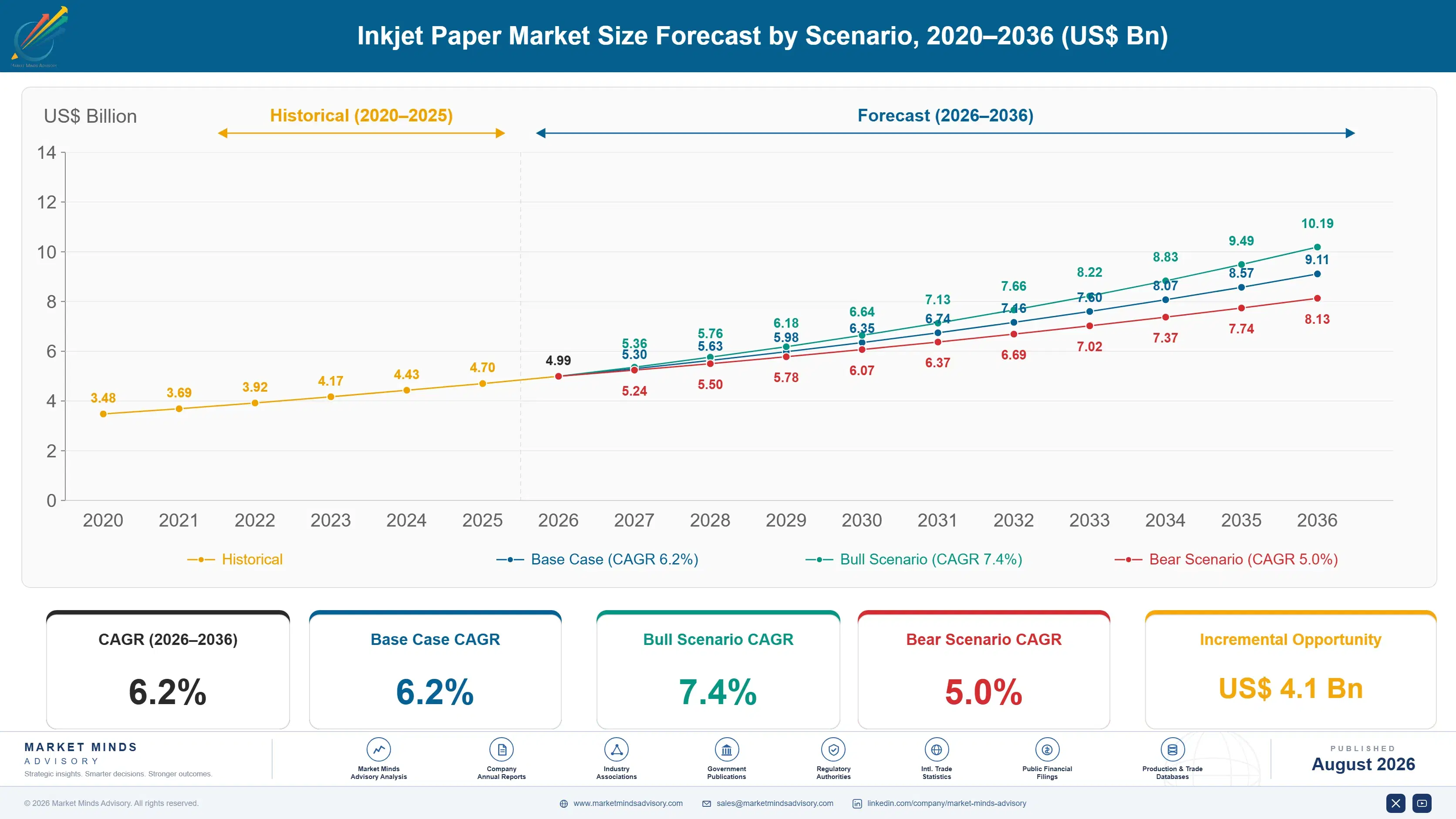
Inkjet Paper Market Forecast Scenarios

inkjet-paper-market-size-forecast-scenario-1787308517918
Growth ran at an implied 5.0% across 2020 to 2025 and the composition inverted inside it. Home printing spiked through 2020 as offices closed and then fell away faster than before, while high-speed production inkjet installations kept rising and pulled commercial transactional, book and direct mail volume onto engineered substrates that did not previously exist as a category. Two curves crossed inside one number.
The base case at 6.2% rests on three mechanisms. Production inkjet press installations continue displacing offset for shorter runs and variable data work, and every installation converts paper demand with it. Inkjet-receptive packaging papers are opening as corrugated and flexible printers adopt digital. And wide-format technical and signage media keep growing with retail and display refresh cycles. None of the three creates new pages. Each converts existing volume onto engineered substrate instead.
The bull case at 7.4% assumes production inkjet takes further offset volume in book and catalogue work, where run lengths have fallen enough to make the crossover economics favourable. The bear case at 5.0% follows from continued decline in office and home printing outpacing production gains, alongside pulp cost pressure compressing coated grade economics across the specialty producers.

Engineering a Sheet for Water at Speed

Everyone knows office printing is dying, and it is. Home and office page volumes fall around 4.1% a year and there is no reason to expect that to stop. What almost nobody outside the trade noticed is that inkjet paper volume kept climbing throughout, because a completely different application arrived and took over the category while the obituaries were being written.
TOP FIVE CONCENTRATION41%Combined share held by the five largest global producers
PRODUCTION PRESS SPEED250 metres per minuteWeb speed at which ink must fix before sheet handling
INK ABSORPTION WINDOW40 millisecondsTime available for fluid to penetrate before the next station
COATING COST SHARE37% of COGSPigment and binder chemistry as proportion of production cost
OFFICE PRINTING DECLINE4.1% annuallyRate of contraction in home and office page volumes globally
PRESS QUALIFICATION TIME14 weeksTypical period to qualify a grade on press
High-speed production inkjet presses print transactional statements, books, direct mail and catalogues at web speeds near 250 metres per minute. At that rate the ink has roughly 40 milliseconds to fix before the sheet reaches the next station, and water-based ink hitting ordinary offset paper cockles it, bleeds colour and produces mottle. The substrate has to be engineered for the process rather than merely be white and flat.
That engineering sits in the coating. A pigmented ink-receptive layer must hold colourant at the surface for density while letting the water carrier through into the base sheet fast enough to avoid distortion. Getting the balance wrong is invisible on a laboratory sample and obvious at full press speed, which is why qualification runs 14 weeks and why press manufacturers maintain approved media lists.
"Every year somebody tells me paper is finished, and every year the production inkjet installed base grows and takes another slice of offset with it. The paper did not disappear. It got harder to make and moved to a different customer."
Director, Specialty Paper and Digital Printing Substrates Practice · MMA Special

Market Trends

Production Inkjet Presses Convert Offset Volume Onto Engineered Paper

High-speed inkjet installations keep displacing offset for shorter runs, versioned work and variable data printing where plate origination cannot be justified. Every press installed converts its paper consumption to inkjet-optimised grades, because ordinary offset stock cockles and mottles under water-based ink at web speed. Transactional statements, books and direct mail have converted furthest. The segment compounds at 9.3% against a market at 6.2%, and the conversion is effectively permanent, since a printer that has retired offset capacity does not reinstate it. Offset capacity retired is rarely reinstated. Conversion moves paper demand for good.
Market Impact: Run lengths falling 11% annually
Digital Printing Reaches Packaging and Label Substrates

Corrugated, folding carton and label printers have adopted inkjet for short runs, versioning and late-stage customisation, which requires inkjet-receptive treatment on papers never previously engineered for water-based ink. Corrugated liners in particular present a difficult surface, since the flute structure and liner porosity work against controlled absorption. Packaging papers are the fastest-widening application outside commercial print, and they bring volume from producers who previously had no involvement in digital printing substrates at all. Qualification conversations start without an incumbent on either side, which is unusual in a mature substrate category.
Market Impact: Listed grades taking 78% of volume

Market Opportunities and Growth Drivers

Shorter Print Runs Make Offset Origination Uneconomic

Book publishers, catalogue producers and direct mail operators have all seen average run lengths fall as inventory risk, versioning and personalisation reshaped how they buy print. Below a crossover point that keeps rising with each press generation, offset plate origination cannot be amortised and inkjet wins outright on total cost. That shift converts paper demand rather than reducing it, because the same pages get printed on a substrate engineered for water-based ink instead of an offset grade. The crossover point rises with every press generation. Pages get printed either way.
Market Impact: Office volumes falling 4.1% annuall

Press Manufacturer Approved Media Lists Concentrate Demand

Production press manufacturers publish approved media lists, and printers overwhelmingly buy from them because an unlisted paper voids support arguments when print quality problems arise. Qualification onto a list takes around 14 weeks of testing at the press manufacturer and covers a specific grade and basis weight. That mechanism concentrates demand on a limited set of qualified grades and gives listed producers a position that competitors cannot reach by matching specification on paper alone. Listed grades take roughly 78% of production volume, which concentrates demand far more tightly than technical capability alone would.
Market Impact: Coating at 37% of production cost

Market Restraints and Challenges

Home and Office Printing Decline Removes the Historic Base

Home and office page volumes fall roughly 4.1% annually and the trend has not slowed in fifteen years. The root cause is straightforward substitution: documents that were printed to be read, filed or shared are now read, filed and shared on screens instead. Cut-size office inkjet paper was the category's original volume base and it shrinks every year. Producers mitigate by shifting capacity toward production, packaging and wide-format grades, though coating lines built for one application do not always convert cleanly to another. Coating lines do not always convert cleanly.
Market Impact: Production grades compounding at 9.

Coating Chemistry Costs Rise Faster Than Paper Pricing

Pigments, binders and cationic fixing agents account for 37% of cost of goods, and speciality chemistry pricing has moved faster than paper price indices allow producers to recover. The root cause is that inkjet coating uses fine precipitated pigments and synthetic binders drawn from chemical supply chains rather than the mineral and starch inputs conventional coated paper depends on. Producers mitigate by qualifying alternative pigment sources, though any coating change reopens the 14 week press qualification the customer will resist. Recovery lags the input movement by quarters. Customers resist any coating change.
Market Impact: Packaging grades at 17% of volume
4 additional market trends, 3 additional growth drivers, and 2 additional restraints and challenges are covered in the full report. Contact sales@marketmindsadvisory.com to access the complete intelligence.

Segment CAGR and Growth Architecture

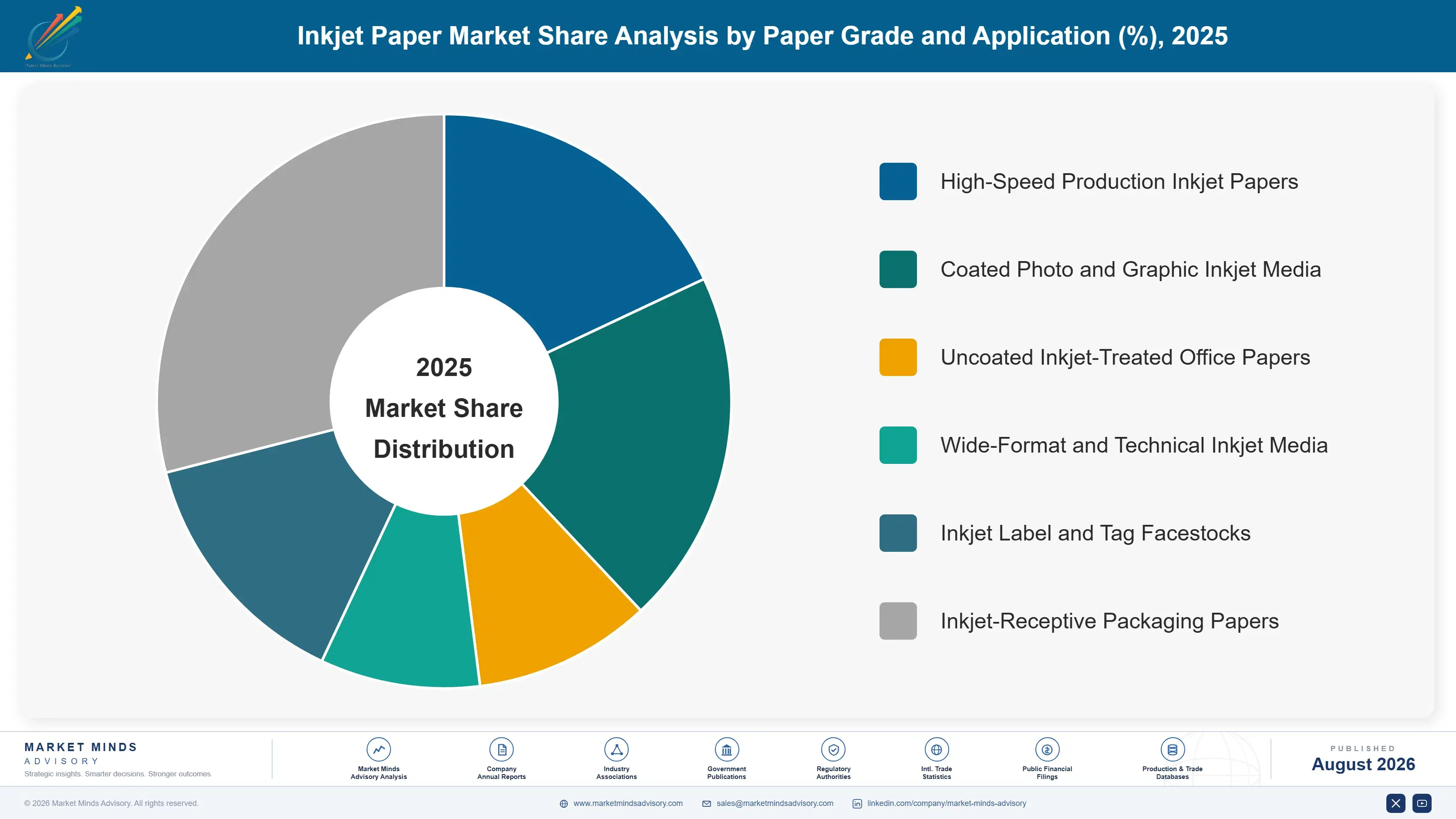
Segmentation follows paper grade and application, because each demands different coating chemistry, different base sheet construction and a different qualification route. A production inkjet grade and a photo media grade both carry ink-receptive coatings and share almost nothing else in formulation, cost structure or customer. Coating, base sheet and qualification route all follow from the application.
inkjet-paper-market-market-share-analysis-1787308518841

High-Speed Production Inkjet Papers

Production grades compound at 9.3%, exactly 1.50 times the market rate, because they solve a problem that only exists at speed. A web running at 250 metres per minute leaves roughly 40 milliseconds for water-based ink to fix before the sheet is handled, and an offset grade under that load cockles, bleeds and mottles. The coating must hold colourant at the surface for optical density while passing the water carrier into the base sheet quickly enough to prevent distortion. Press manufacturer approved media lists concentrate demand onto qualified grades, and qualification takes around 14 weeks per grade and basis weight. That barrier is why the segment carries pricing that commodity papermaking never supports.
CAGR 9.3%

Inkjet-Receptive Packaging Papers

Packaging papers grow at 8.4% as corrugated, folding carton and label printers adopt inkjet for short runs, versioning and late-stage customisation. The technical problem is different from commercial print: a corrugated liner is porous and sits over a flute structure, so ink absorption is uneven and colour density varies across the board in ways a flat sheet never shows. Coating or surface treatment has to compensate without adding cost the corrugated economics cannot bear. This is the fastest-widening application outside commercial print, and it brings substrate demand from converters who previously had no involvement in digital printing at all, which makes the qualification conversation genuinely new for both sides. Nobody holds an incumbency yet.
CAGR 8.4%
Full segment breakdown across 6 segments available in the complete report.

Regional Architecture and Country Demand Map

Demand follows printing capacity rather than population, and the mix within each region depends on how far production inkjet has displaced offset locally. Specialty coating capacity is considerably more concentrated than printing itself, which shapes trade flows in higher grades. Press installations rather than page counts matter here.

East Asia

East Asia holds 31% of global demand, the largest regional share. Note: this exceeds the standard band because Chinese commercial print volume and Japanese specialty coating capacity together have no equivalent in any other region. Chinese commercial printing is enormous and has adopted production inkjet quickly for transactional, packaging and book work, while domestic paper producers have built substantial inkjet coating capacity serving both home demand and export. Japanese specialty producers including Oji and Nippon Paper hold technical positions in photo and high-density coating that remain reference points globally,. Korean and Taiwanese demand is smaller and weighted toward packaging. Growth of 7.2% reflects press installation rather than printed volume. Photo printing culture persists there where it has faded elsewhere.
Share: 31% | CAGR: 7.2% (2026 to 2036)

South Asia and Pacific

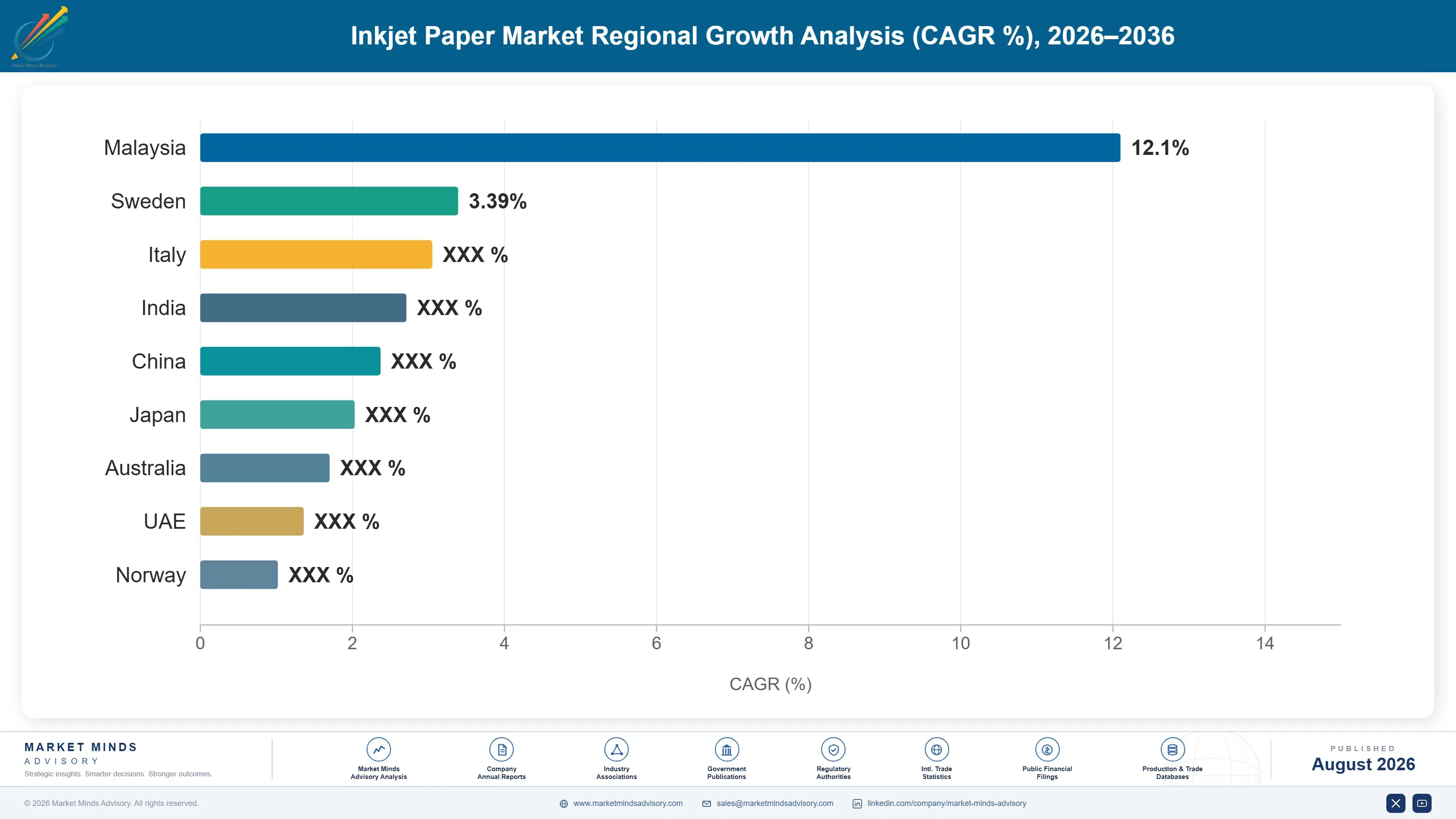
The fastest growing region at 8.4%, with India compounding at 9.6%, South Asia and Pacific accounts for 11% of demand. Indian commercial printing is expanding while much of the developed world contracts, driven by education publishing, packaging and direct marketing that has not yet moved to digital channels. Production inkjet installation has accelerated sharply as press pricing fell, and each installation converts paper demand onto engineered grades. Domestic coating capacity is limited, so higher grades are largely imported and qualification runs through press manufacturer lists established elsewhere. Australian demand is smaller and follows Western European patterns closely, with office volumes declining and production grades growing. Coating capacity has not kept pace with demand.
Share: 11% | CAGR: 8.4% (2026 to 2036)
Regional intelligence for 5 additional markets available in the complete report: North America, Western Europe, Latin America, Middle East and Africa, Eastern Europe. Contact sales@marketmindsadvisory.com.
inkjet-paper-market-country-cagr-analysis-1787308519727

Where Coated Paper Still Commands Price

The historic volume base of this category is disappearing at 4.1% a year and nothing will stop it. Everything commercially worth having sits where a printing process imposes a technical requirement that ordinary paper cannot satisfy. Four positions do exactly that, and none is defended on basis weight or brightness. Brightness sells nothing at all now.

Qualify Grades Onto Press Manufacturer Media Lists Early

Printers buy from approved media lists because an unlisted paper undermines any support argument when quality problems arise, and listed grades take roughly 78% of production volume. Qualification takes around 14 weeks at the press manufacturer and covers one grade at one basis weight. Producers that qualify ahead of press launches reach printers before alternatives exist, and the position holds for the press generation. Competitors matching the specification on paper cannot substitute without completing the same qualification, which makes list presence a durable commercial asset rather than a marketing credential.
Market Impact: Listed grades taking 78% of all pro

Solve Corrugated Liner Absorption for Digital Packaging

A corrugated liner sits over a flute structure and absorbs unevenly, so inkjet colour density varies across the board in ways a flat sheet never reveals. Coating or surface treatment must compensate without adding cost corrugated economics cannot bear, which is a genuinely harder brief than commercial print grades present. Packaging papers already represent 17% of volume and grow at 8.4%. Producers solving it reach converters who have never bought engineered printing substrates before, and those relationships start without an incumbent to displace. Corrugated economics will not carry commercial print coating costs, which is the constraint every entrant underestimates.
Market Impact: Packaging papers at 17% of the tota

Convert Coating Capacity Away From Cut-Size Office Grades

Office and home page volumes fall 4.1% annually with no prospect of reversal, and cut-size inkjet paper was the category's original base. Coating lines built for that application do not always convert cleanly to production or packaging grades, since drying profiles, coat weights and web widths differ. Producers that plan conversion against forecast decline rather than reacting to it avoid stranding assets. Production grades compound at 9.3% and command pricing that commodity cut-size never supported, so the conversion improves mix as well as protecting utilisation. Sequencing beats reacting to the decline curve.
Market Impact: Office base now declining 4.1% ever

Sell Runnability Rather Than Sheet Specification

At 250 metres per minute the ink has roughly 40 milliseconds to fix, and failures appear as cockle, mottle and bleed at full speed while looking perfect on a laboratory sample. Printers care about press stoppages, waste rates and rework, not about brightness or smoothness figures. Producers that demonstrate runnability on the customer's own press, measuring waste and stoppage rates against the incumbent grade, reach a production manager rather than a purchasing function and price against downtime avoided instead of tonnes delivered. Downtime avoided is the currency here. Tonnes delivered measure nothing useful.
Market Impact: Absorption window running just 40 b

Who Controls the Margin Pool

Five producers hold 41% of the market measured on inkjet substrate revenue, the basis applied consistently through this section. Concentration reflects coating capability and media list positions rather than papermaking scale, since base sheet production is widely available. Sappi and Mondi lead, with Japanese specialty producers holding the strongest technical positions in coated grades. Base sheet capability separates almost nobody.
Competition operates on three dimensions. Coating chemistry capability decides whether a producer can balance surface colourant fixing against water penetration at production speeds. Press manufacturer media list presence decides which grades a printer will actually buy. And drying and coating line configuration decides which grades a mill can make at all without capital work. All three are built over years rather than bought.

Two pressures are reshaping position. Chinese producers have built substantial inkjet coating capacity and compete credibly on production grades, particularly across Asian markets. Against that, packaging substrate demand rewards producers with corrugated and carton board relationships that commercial paper specialists lack. Rankings will move toward whoever pairs coating capability with packaging converter access. Very few hold both today. The producers closest to it come from packaging rather than from graphic papers.
inkjet-paper-market-company-positioning-matrix-1787308520617

Competitive Moat and Risk Dimensions

SAPPI

Moat: Coating capability and grade breadth

Sappi combines specialty coating capability across multiple mills with a grade range spanning commercial print, packaging and technical applications, which matters because a printer or converter frequently wants several substrates from one qualified relationship. Coating chemistry depth built for graphic papers transfers directly into inkjet receptivity work in a way pure commodity papermakers cannot replicate quickly.
SAPPI

Risk: Graphic paper decline exposure

A substantial installed asset base was configured for graphic and office papers, categories declining at roughly 4.1% annually with no prospect of recovery. Converting coating lines to production or packaging inkjet grades requires capital and does not always succeed cleanly, since drying profiles and coat weights differ materially between applications, and stranded capacity carries fixed cost regardless.
MONDI

Moat: Packaging paper integration

Mondi's position across kraft, containerboard and speciality papers gives it direct relationships with the corrugated and carton converters now adopting digital printing, which is where inkjet substrate demand is widening fastest. Solving liner absorption for digital corrugated requires understanding both the coating and the board it sits on, and few commercial paper producers hold both sides of that problem.
MONDI

Risk: Commercial print coating depth

High-speed production inkjet grades for transactional and book printing demand coating chemistry refined over years against press manufacturer requirements, and specialist graphic paper producers hold deeper positions on those approved media lists. Competing there means qualifying grades against incumbents already listed, which takes 14 weeks per grade and offers no guarantee of displacement.

Players Tracked

Prominent Players

Sappi
Mondi
Oji Holdings
Nippon Paper Industries
Felix Schoeller Group

Other Key Players

UPM
Stora Enso
Domtar
International Paper
Asia Pulp and Paper
Nine Dragons Paper
Ahlstrom
Koehler Paper
Mitsubishi HiTec Paper
Arjowiggins
Hansol Paper
Lecta
Burgo Group
Sylvamo
Neenah

Recent Developments

FEBRUARY 2025

Production inkjet installations extend into book and catalogue printing

Commercial printers serving trade publishing and catalogue markets continued replacing offset capacity with high-speed inkjet as average run lengths fell below the crossover point. This reflects print buying behaviour rather than any corporate transaction, and it converts paper demand onto engineered grades permanently. Run lengths keep falling below the crossover.
Signal: A printer that retires offset capacity doe
JUNE 2025

Digital corrugated printing widens inkjet substrate requirements

Corrugated converters expanded digital printing for short runs, versioning and late-stage customisation, requiring liner treatment that compensates for uneven absorption over the flute structure. These were converter investment decisions rather than commercial developments between paper producers. Colour density varies across the board in ways a flat sheet never reveals.
Signal: The hardest substrate problem in the categ
OCTOBER 2025

Coated grade producers convert capacity away from cut-size office paper

Specialty paper producers continued reconfiguring coating capacity from declining cut-size office grades toward production and packaging inkjet substrates. These were organic capital and operating decisions rather than acquisitions, and conversion success varies with existing drying and coating line configuration. Drying profiles and coat weights differ materially between applications.
Signal: Coating lines built for one application do

Pulp, Pigment and Drying Energy

Market pulp accounts for roughly 34% of cost of goods, purchased on global indices with little producer influence over pricing. Coating chemistry runs 37%, covering fine precipitated pigments, synthetic binders and cationic fixing agents drawn from chemical rather than mineral supply chains. Drying energy takes a further 14%, which is higher than uncoated grades because ink-receptive coatings carry more water into the dryer.
European energy disruption from 2022 raised both drying costs and speciality chemical pricing simultaneously, and International Energy Agency reporting across that period documents the underlying movement. Coating chemistry rose faster than paper price indices allowed producers to recover, because inkjet coatings depend on synthetic inputs rather than the starch and calcium carbonate that conventional coated papers use. Company annual reports covering specialty paper segments disclose the resulting margin compression clearly.

Exposure divides by grade mix rather than by scale. Producers weighted toward cut-size office paper compete against commodity pricing while carrying speciality coating costs, which is the worst combination available. Those weighted toward production and packaging grades price against press qualification and runnability, where a printer facing a 14 week requalification will absorb a cost movement rather than switch supplier over it.
inkjet-paper-market-cost-volatility-analysis-1787308520965

Qualify alternative pigment sources before cost pressure arrives

Any coating change reopens the 14 week press qualification that customers resist, so alternative pigment and binder sources must be qualified during grade development rather than in response to a price movement. Producers that carry two qualified sources per coating formulation can move between them without touching the customer's approved media list position at all.

Match grade mix to coating line drying configuration

Coating lines differ in drying capacity, coat weight range and web width, and forcing a grade onto an unsuitable line raises energy cost and waste simultaneously. Planning the grade portfolio around actual line capability, rather than around what the sales organisation would prefer to sell, is where most of the recoverable cost in specialty paper conversion sits.

Contract pulp against forecast rather than buying on index

Market pulp at 34% of cost moves on global indices that no producer influences, and spot exposure on that share makes quarterly margins genuinely unpredictable. Contracting a proportion against forecast volume stabilises the largest single input, though it requires demand visibility that declining office grades make harder to establish reliably. Visibility is the harder half.

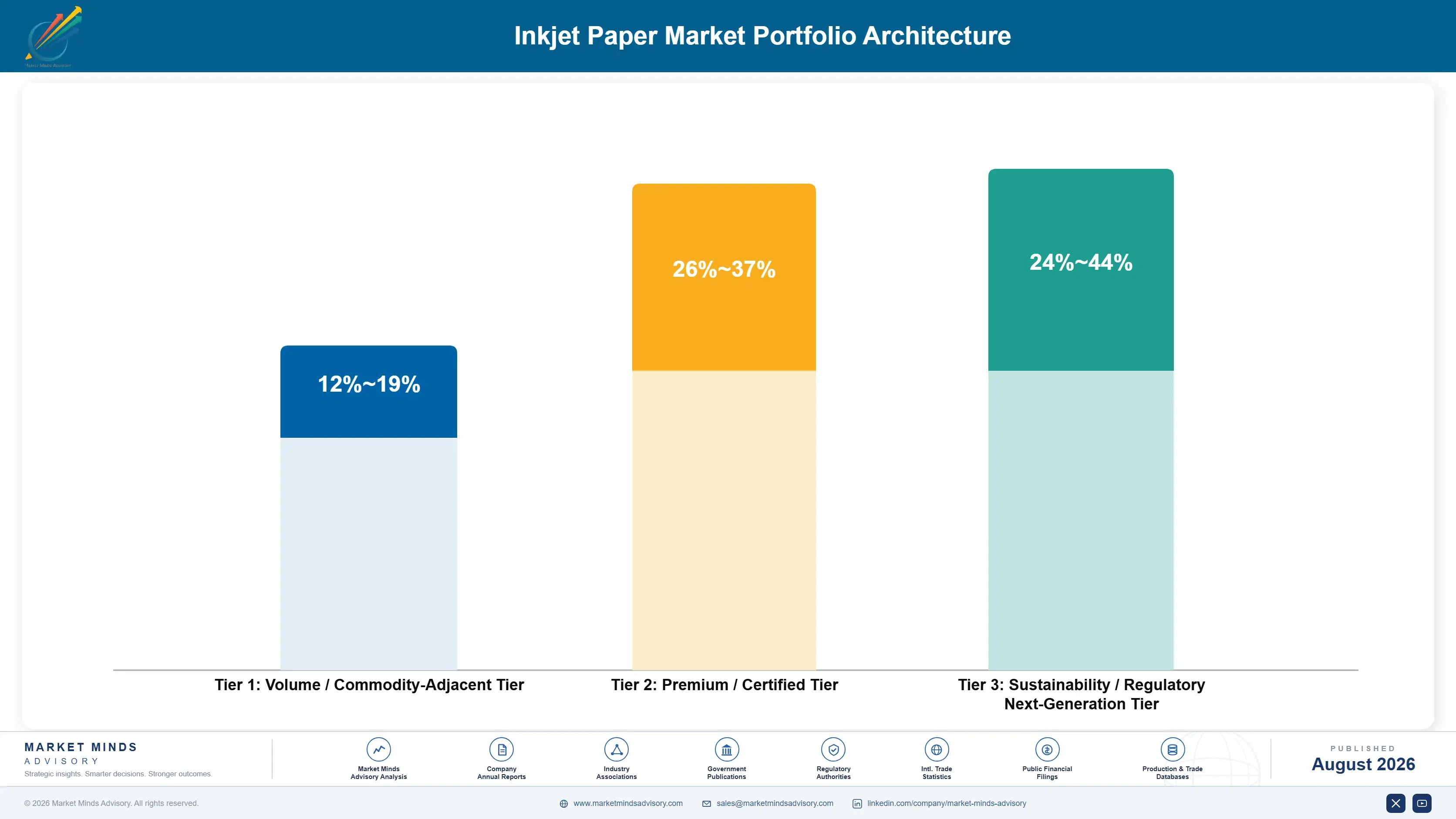
Portfolio Architecture for Margin Defence

The portfolio separates on whether a printing process imposes a technical requirement. Cut-size office and copy grades are commodity paper with light treatment, sold on price into a base declining 4.1% annually. Production inkjet grades must survive water-based ink at web speed. Photo and technical media demand high coat weights and colour gamut performance. Packaging substrates present an absorption problem nobody had previously engineered for. Process requirement draws the whole ladder.
The tension is that the declining commodity base still fills coating lines and carries fixed cost. A producer that abandons cut-size to chase production and packaging grades finds capacity idle before the replacement volume qualifies, since press qualification takes 14 weeks per grade and conversions arrive one press at a time. Sequencing that transition is the central operating problem in this category. Timing rather than direction is the difficult judgement.

High-value pools concentrate where press speed, converter economics or image quality set the requirement. Production inkjet grades, digital corrugated substrates and photo media all qualify, and none is bought on basis weight or brightness comparison. Each is chosen by someone measuring output rather than input.

Volume / Commodity-Adjacent Tier

Cut-size office and copy papers with light inkjet treatment, sold on delivered price into home and office printing. The base declines around 4.1% annually and commodity producers compete on cost while speciality coating adds expense the price does not recover.
Gross Margin: 12-19%

Premium / Certified Tier

High-speed production inkjet papers qualified onto press manufacturer approved media lists, plus wide-format and technical media. Coating chemistry and 14 week qualification cycles restrict the field of producers a printer will actually buy from.
Gross Margin: 26-37%

Sustainability / Regulatory / Next-Generation Tier

Inkjet-receptive packaging papers and coated photo and graphic media. The wide margin range reflects the gap between established photo grades and packaging substrates where liner absorption problems are still being solved commercially.
Gross Margin: 24-44%
inkjet-paper-market-portfolio-architecture-1787308521866

High-value Sub-segments and Strategic Watch-out

Production Inkjet Printing Papers

Compounding at 9.3% because water-based ink at 250 metres per minute leaves roughly 40 milliseconds to fix, which ordinary offset grades cannot survive. Press manufacturer media lists concentrate demand, and qualification takes 14 weeks per grade and basis weight. Offset stock cannot substitute. Qualification protects the position.
Gross Margin: 29-37%

Digital Corrugated and Packaging Substrates

Growing at 8.4% on a genuinely harder brief, since a liner absorbs unevenly over the flute structure in ways a flat sheet never shows. Producers solving it reach converters who have never bought engineered printing substrates before. Cost economics constrain the answer. Entrants underestimate that repeatedly.
Gross Margin: 26-40%

Cut-Size Office and Copy Grades

The declining base at negative volume growth, sold on delivered price while carrying speciality coating cost the price does not recover. Run to hold coating line utilisation during conversion rather than for any margin it might still deliver. Exiting too early strands the line. Utilisation is the point.
Gross Margin: 12-19%

Coated Photo and Graphic Media

The watch-out and the opportunity together. High coat weights and colour gamut requirements support real pricing, but consumer photo printing has largely moved to screens outside a few markets where the habit persists. Japanese demand persists where the habit survived. Elsewhere the habit has largely gone.
Gross Margin: 30-44%

Media Lists Hold the Position

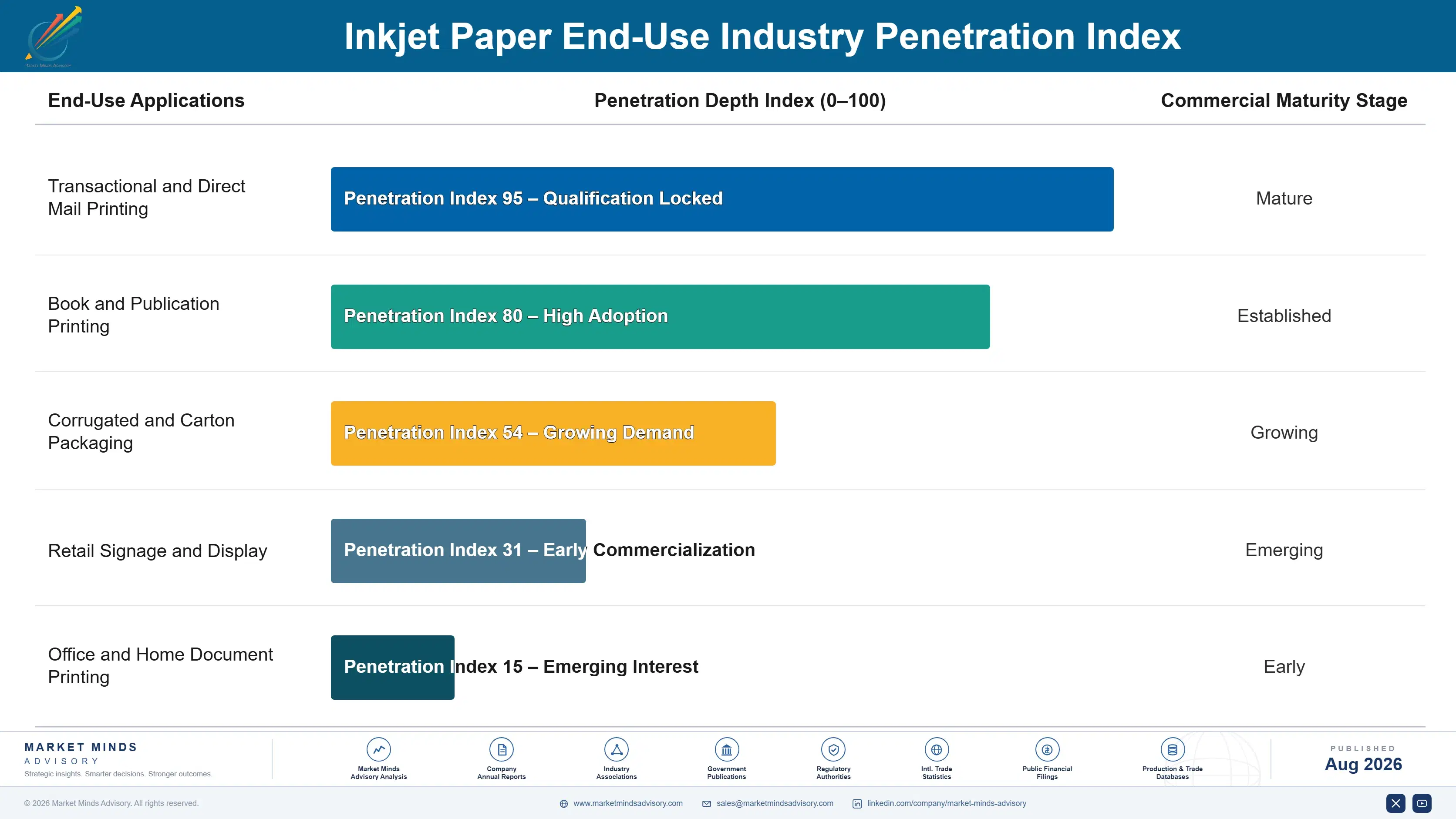
Recurring revenue here rests on qualification rather than contract. A grade listed on a press manufacturer's approved media list and running satisfactorily at a printer is reordered without being retendered, because an unlisted alternative undermines any support argument when quality problems arise and requalification takes 14 weeks. Listed grades take roughly 78% of production volume, and that concentration is what makes the position worth holding. Requalification is the deterrent.
Depth varies sharply by printer type. Transactional and book printers running production presses buy deepest, treating substrate as a process variable and involving producers in runnability testing. Packaging converters adopting digital buy on absorption performance they are still learning to specify. Commercial jobbing printers buy on delivered price with genuine substitution freedom. Office resellers sit shallowest, switching on price without any qualification involved at all. Printer type predicts depth almost perfectly.

The deciding population has moved from purchasing toward production. Office paper was bought by procurement on price and brightness. Production inkjet substrate is chosen by a press operations manager weighing waste rates and stoppages, and that participant will pay for runnability without hesitating. That is a different sale entirely.
inkjet-paper-market-end-use-penetration-index-1787308522701

Where Inkjet Paper Still Pays

These are among the four positions where our research anticipates prominent divergence between winners and laggards over the coming forecast period. Each is grounded in the demand model, the regulatory perimeter, and the announced capacity pipeline.
01 / MEDIA LIST POSITIONING

Printers buy from an approved list, not from a specification sheet

Press manufacturers publish approved media lists and printers buy from them, because an unlisted paper undermines any support argument when print quality problems arise in the middle of a run. Listed grades take roughly 78% of all production volume, and qualification runs around 14 weeks for a single grade at a single basis weight. Producers that qualify ahead of press launches reach printers before any alternative exists, and competitors matching the specification on paper cannot substitute without completing identical qualification work themselves.
02 / RUNNABILITY OVER SPECIFICATION

Failures appear at press speed and never on a laboratory sample

At 250 metres per minute the ink has roughly 40 milliseconds to fix before handling, and cockle, mottle and bleed all appear at full speed on paper that looked perfectly acceptable in laboratory testing. Printers care about press stoppages, waste rates and rework rather than about brightness or smoothness figures on a datasheet. Producers demonstrating runnability on the customer's own press, measured directly against the incumbent grade, reach a production manager and price against downtime avoided rather than against tonnes delivered.
03 / CAPACITY CONVERSION SEQUENCING

Abandoning the declining base too early strands the coating line

Cut-size office paper volume falls roughly 4.1% annually with no realistic prospect of reversal, but production and packaging grades qualify one press and one converter at a time, across 14 week cycles that cannot be compressed. A producer that exits the commodity base before replacement volume actually arrives carries idle coating capacity along with its full fixed cost. Sequencing that transition against forecast decline, rather than reacting to it after the fact, is the central operating problem this whole category presents.
04 / PACKAGING SUBSTRATE ENTRY

The hardest coating problem sits where nobody holds an incumbency

A corrugated liner absorbs unevenly across the flute structure, so digital colour density varies in ways a flat sheet never reveals, and any correction has to fit corrugated cost economics rather than the commercial print economics coating chemistry was developed against. Packaging papers already represent roughly 17% of category volume and are growing at 8.4% annually. Producers that solve it reach converters who have never bought engineered printing substrates before, which means starting a commercial relationship with no incumbent supplier to displace.

Engagement Snapshot From the Field

A live engagement with an industry participant carrying material or product regulatory and market exposure ahead of a defining policy shift, showing how our research translates into a defensible multi-year portfolio strategy.
MARKET MINDS ADVISORY · CLIENT ENGAGEMENT SUMMARY
Inkjet Paper Producer Strategic Portfolio Review and Transition Roadmap 2026·Investment Scenario on Inkjet Paper Exposure Evaluation 2025-26
CLIENT PROFILE
A specialty paper producer operating four coating lines across two mills with roughly EUR 680 million in revenue (client-reported, unverified by MMA). Cut-size office and copy grades represented about 47% of inkjet substrate volume (client-reported, unverified by MMA) and had declined for six consecutive years, while production inkjet grades sat under 15% despite the mills holding suitable coating capability.
STRATEGIC CHALLENGE
Falling cut-size volume had left one coating line running well below capacity, and management proposed closing it. The commercial team argued the mill was capable of production inkjet grades and had simply never qualified any onto press manufacturer media lists, which meant printers would not buy from it whatever the paper actually did.
MMA APPROACH
MMA mapped press manufacturer approved media lists against the client's grade capability by coating line, identifying which grades each line could produce without capital work. Cut-size decline was forecast by market and compared against qualification timelines to establish whether conversion could outrun the volume loss. Packaging customer digital plans were reviewed alongside.
KEY FINDINGS
  1. The underused coating line could produce three production inkjet grades within existing drying and coat weight capability, and none had ever been submitted for press manufacturer qualification by the client.
  2. Cut-size volume was forecast to fall a further 22% over four years, which meant closing the line addressed a symptom while removing the only capacity capable of the replacement grades.
  3. Qualification timelines of 14 weeks per grade meant conversion could begin generating volume within a year, well inside the period the declining base could still support line utilisation.
  4. Two of the client's existing packaging paper customers were installing digital corrugated capability and had not been approached about inkjet-receptive liner at all.
CLIENT PROFILE
A specialty paper producer operating four coating lines across two mills with roughly EUR 680 million in revenue (client-reported, unverified by MMA). Cut-size office and copy grades represented about 47% of inkjet substrate volume (client-reported, unverified by MMA) and had declined for six consecutive years, while production inkjet grades sat under 15% despite the mills holding suitable coating capability.
STRATEGIC CHALLENGE
Falling cut-size volume had left one coating line running well below capacity, and management proposed closing it. The commercial team argued the mill was capable of production inkjet grades and had simply never qualified any onto press manufacturer media lists, which meant printers would not buy from it whatever the paper actually did.
MMA APPROACH
MMA mapped press manufacturer approved media lists against the client's grade capability by coating line, identifying which grades each line could produce without capital work. Cut-size decline was forecast by market and compared against qualification timelines to establish whether conversion could outrun the volume loss. Packaging customer digital plans were reviewed alongside.
KEY FINDINGS
  1. The underused coating line could produce three production inkjet grades within existing drying and coat weight capability, and none had ever been submitted for press manufacturer qualification by the client.
  2. Cut-size volume was forecast to fall a further 22% over four years, which meant closing the line addressed a symptom while removing the only capacity capable of the replacement grades.
  3. Qualification timelines of 14 weeks per grade meant conversion could begin generating volume within a year, well inside the period the declining base could still support line utilisation.
  4. Two of the client's existing packaging paper customers were installing digital corrugated capability and had not been approached about inkjet-receptive liner at all.
RECOMMENDED STRATEGY
Phase 1: Phase 1 (months 1 to 8): Submit three production inkjet grades for press manufacturer qualification and hold the coating line open through the process. Phase 2: Phase 2 (months 8 to 18): Approach the two packaging customers installing digital corrugated with a liner treatment development programme. Phase 3: Phase 3 (months 18 to 30): Reduce cut-size capacity deliberately against the qualified replacement volume rather than against the decline curve.
OUTCOME
All three grades qualified within nine months and the coating line reached viable utilisation in month fourteen (client-reported, unverified by MMA). The closure was cancelled. Blended inkjet substrate margin improved by roughly seven points as mix shifted, and one digital corrugated liner programme reached commercial supply (client-reported, unverified by MMA).

Frequently Asked Questions

Foundational context covering the market sizes, CAGR, scope, country, region and competition that inform every finding below. This section is provided to cover basics and most often pre-purchase conversations, answered from the MMA Primary Research Dataset.

What is the current size of the Inkjet Paper Market?

The global market was worth USD 4.7 billion in 2025, reaching USD 4.99 billion in 2026. East Asia holds the largest regional share at 31% of demand.

How large will the Inkjet Paper Market be by 2036?

MMA forecasts USD 9.11 billion by 2036, an expansion multiple of 1.82 times the 2026 base. That represents roughly USD 4.12 billion of incremental value.

What is the CAGR for the Inkjet Paper Market 2026 to 2036?

The base case compounds at 6.2% annually, with a bull case of 7.4% and a bear case of 5.0%. Historical growth from 2020 to 2025 ran at 5.0%.

Which segment is growing fastest?

High-speed production inkjet papers compound at 9.3%, exactly 1.50 times the market rate. Water-based ink at 250 metres per minute leaves roughly 40 milliseconds to fix.

Who are the major companies in the Inkjet Paper Market?

Sappi, Mondi, Oji Holdings, Nippon Paper Industries and Felix Schoeller Group hold a combined 41% of the market. Japanese producers hold the strongest technical positions in coated grades.

Which country is growing fastest?

India compounds at 9.6%, ahead of every other national market. Commercial printing is expanding there while much of the developed world contracts, and press installation has accelerated.

Report Segmentation Architecture

The full report scope spans multiple orthogonal segmentation dimensions, with cross-tabulated demand data provided for each dimension pair. Coverage extends further to regional breakdowns, trend trajectories, and the competitive detail needed to support segment-level decision-making.

By Paper Grade and Application

  • High-Speed Production Inkjet Papers
  • Coated Photo and Graphic Inkjet Media
  • Uncoated Inkjet-Treated Office Papers
  • Wide-Format and Technical Inkjet Media
  • Inkjet Label and Tag Facestocks
  • Inkjet-Receptive Packaging Papers

By End-Use Industry

  • Transactional and Direct Mail Printing
  • Book and Publication Printing
  • Corrugated and Carton Packaging
  • Retail Signage and Display
  • Office and Home Document Printing

By Commercial Dimension

  • Direct Supply to Commercial Printers
  • Paper Merchant and Distributor Channel
  • Press Manufacturer Qualified Supply
  • Converter and Packaging Direct Supply

By Region

  • North America
  • Western Europe
  • East Asia
  • South Asia and Pacific
  • Latin America
  • Middle East and Africa
  • Eastern Europe

Scope, Methodology, and Coverage

Every figure in this report is reproducible from documented input assumptions. The scope below maps the historical period, the forecast horizon, the segmentation dimensions, and the countries covered, alongside the underlying primary and qualitative methodology.
Historical Period
2020 to 2025
Forecast Period
2026 to 2036
Base Year
2025 (USD billions; MMA Primary Research Dataset, August 2026)
Market Definition
The market covers paper substrates engineered or treated for inkjet printing, spanning high-speed production inkjet papers, coated photo and graphic inkjet media, uncoated inkjet-treated office and copy papers, wide-format and technical inkjet media, inkjet label and tag facestocks, and inkjet-receptive packaging papers including corrugated liners. Toner and offset printing papers, plain uncoated papers supplied without inkjet treatment, synthetic printing substrates, inks and printing equipment are excluded. Sizing is measured at producer revenue in current prices.
Quantitative Units
USD billions (current prices); tonnes of substrate and square metres of coated media where applicable
Segmentation Dimensions
By Paper Grade and Application; By End-Use Industry; By Commercial Dimension; By Region
Regions Covered
North America, Western Europe, East Asia, South Asia and Pacific, Latin America, Middle East and Africa, Eastern Europe
Countries Covered
USA, China, Germany, France, UK, Japan, South Korea, India, Australia, Canada, Brazil, Mexico, Indonesia, Vietnam, Thailand, Malaysia, UAE, Saudi Arabia, South Africa, Nigeria, Turkey, Poland, Netherlands, Italy, Spain, Sweden, Switzerland, Argentina, Colombia, Singapore, and additional markets relevant to this sector
Key Companies Profiled
Sappi, Mondi, Oji Holdings, Nippon Paper Industries, Felix Schoeller Group, UPM, Stora Enso, Domtar, International Paper, Asia Pulp and Paper, Nine Dragons Paper, Ahlstrom, Koehler Paper, Mitsubishi HiTec Paper, Arjowiggins, Hansol Paper, Lecta, Burgo Group, Sylvamo, Neenah
Quantitative Methodology
Primary survey, n=3,800 respondents, Q4 2025, six countries; demand-side model with trade association cross-validation
Qualitative Methodology
47 expert interviews, Q4 2025; applied to validate demand model assumptions, identify emerging dynamics, and assess competitive positioning
Report Format
PDF and XLSX data workbook (Word format preview document)
Publisher
Market Minds Advisory
Report Code
MMA-2026-PAC-731
Published
August 2026
Contact
sales@marketmindsadvisory.com | www.marketmindsadvisory.com

Purchase the full Inkjet Paper Market Report (2026 to 2036).

The full report sizes inkjet paper across six grade categories, three commercial dimensions and seven regions, with annual forecasts to 2036 under base, bull and bear scenarios. Press manufacturer approved media list positions are mapped producer by producer and grade by grade, showing where a printer can actually buy. Production inkjet installation rates are modelled against offset displacement by print category, since that conversion rather than page volume drives demand. Cut-size decline is forecast by market against coating line conversion timelines. Twenty producers are profiled on a consistent inkjet substrate revenue basis.
Approved media list positions mapped by producer and grade
Production inkjet installation modelled against offset displacement
Cut-size decline forecast against coating line conversion timelines
Corrugated liner absorption requirements assessed for digital printing
Coating chemistry cost exposure quantified by grade and region
Runnability and waste rate benchmarks compared across qualified grades

Built For The People Who Decide

From boardroom strategy to bench-side execution, this report is read cover-to-cover by leaders shaping the next decade of their industry, turning demand scenarios, market dynamics and valuation benchmarks into decisions.
CXOs/ Presidents/ VPs/ Managers
M&A and Corporate Development
Strategy Teams and R&D Heads
Procurement and Product Directors
Regulatory and Compliance Leaders
Investor Relations and Equity Analysts