

Market Minds Advisory
Ink-Cartridge Market

Ink-Cartridge Market: Ink-Cartridge Market. OEM, Compatible, and Refillable Cartridge Systems Through 2036

Subscription-based ink delivery programs and chip-locked cartridge designs push printer OEMs toward recurring consumables revenue as compatible cartridge makers fight legal and technical battles over aftermarket replacement rights reflecting reflecting sustained OEM.

Lead Analyst

Published

September 2026

Make Smarter Decisions with Customized Research Insights

Request a free sample report and evaluate market opportunities, growth trends, and competitive dynamics relevant to your business needs.

2025 MARKET VALUE$14.8BMarket Size 2025
2036 FORECAST VALUE$22.8BBase Case , 2026 to 2036
CAGR 2026 TO 20364.0 %Bull 5.2% / Bear 2.8%
INCREMENTAL OPPORTUNITY$7.4BNet 10- year value creation
EXPANSION MULTIPLE1.48x2036 value over 2026 base
Strategic Levers
M&A Pipeline
Regional Outlook
Country Rankings
Competitive Intelligence
Segmental Deep-dive
Call-Us : 91 93563 13602

Executive Snapshot and Market Trajectory.

Printer manufacturers continue shifting toward subscription-based ink delivery programs as home printing volume declines gradually, seeking recurring revenue certainty that per-cartridge retail sales no longer reliably deliver reflecting sustained OEM investment across printing hardware and consumables programs as adoption continues expanding across home office, small.
Subscription-based ink delivery programs represent the fastest-growing category as OEMs bundle automatic cartridge replenishment with printer purchases to lock in consumables revenue over the device lifetime. Standard OEM cartridge sales still account for the largest share of overall revenue given the massive installed printer base still purchasing cartridges individually. South Asia and Latin America account for meaningful growth concentration, reflecting expanding home office and small business printing adoption reflecting sustained OEM investment across printing hardware.
Competition splits between established printer OEMs defending proprietary cartridge platforms through chip authentication technology and compatible cartridge manufacturers building lower-cost alternatives that increasingly face legal challenges. Rising right-to-repair legislation and evolving cartridge chip authentication technology both shape how much of the aftermarket compatible manufacturers can realistically capture reflecting sustained OEM investment across printing hardware and consumables programs as adoption continues expanding across home office, small.
Market Definition
This report covers ink cartridges for inkjet printers including original equipment manufacturer, compatible, and refillable cartridge systems sold through retail and subscription channels. It excludes toner cartridges for laser printers and printer hardware itself reflecting sustained OEM investment.
Base Year Value
$14.8B in 2025 (MMA Primary Research Dataset, September 2026)
Forecast Period
2026 to 2036, eleven discrete annual values
CAGR
4.0% base case. Bull 5.2%. Bear 2.8%.
Fastest Growth Segment
Subscription-Based Ink Delivery Programs: 9.5% CAGR
Fastest Growth Country
India: 6.0% CAGR
Fastest Growth Region
South Asia and Pacific: 6.0% CAGR
Largest Region
North America: 28% of 2025 global value
Market Leaders
HP Inc, Canon Inc, Epson America Inc, Brother Industries Ltd, Lexmark International Inc. Source: MMA Primary Research Dataset, July 2026.
Primary Survey
n=3,800 procurement and R&D decision-makers, Q4 2025, six countries
Methodology
Demand-side build-up, cross-validated against public data, 47 expert interviews

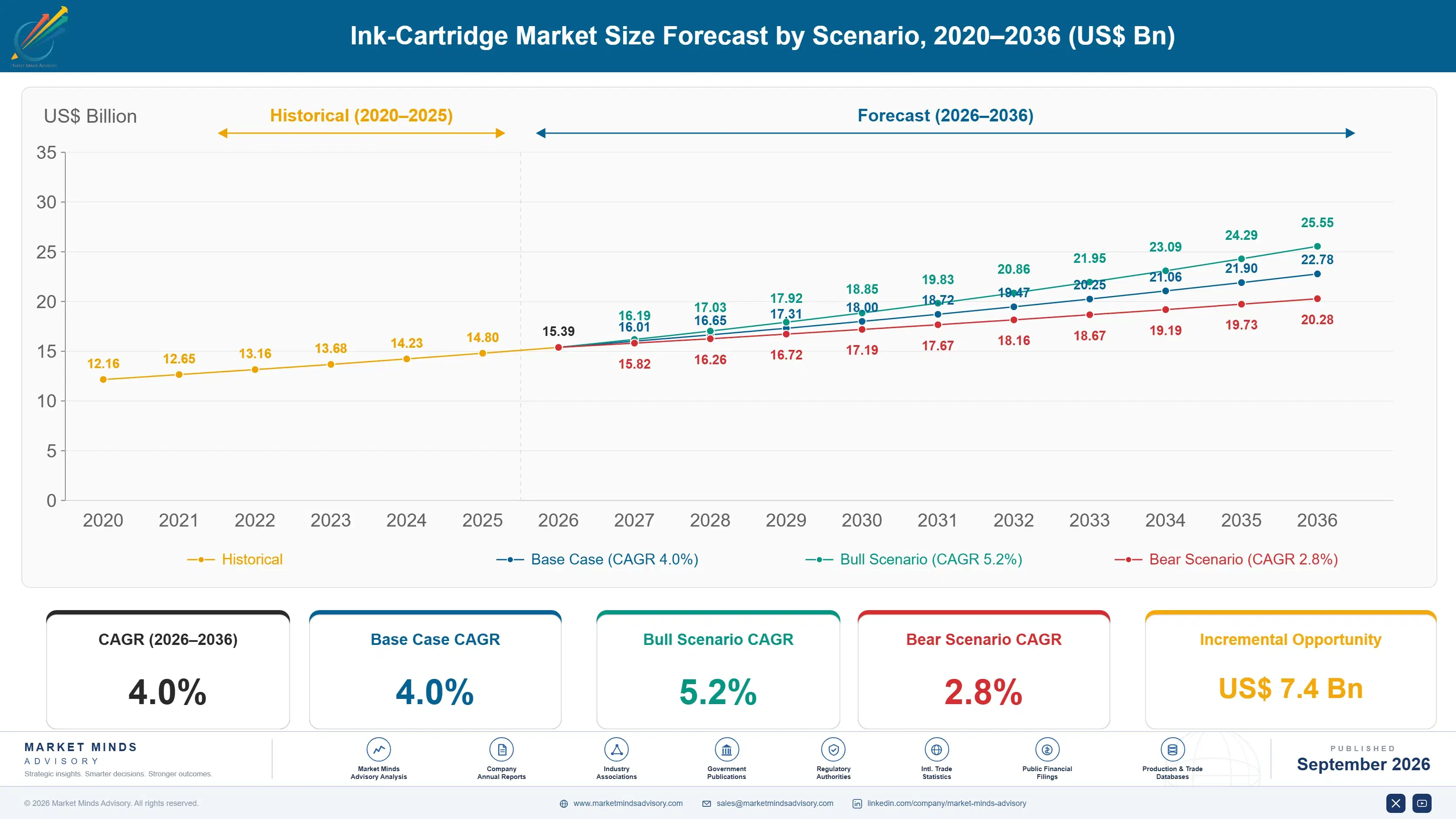
Ink-Cartridge Market Forecast Scenarios

ink-cartridge-market-size-forecast-scenario-1789999505369
The 2020 to 2025 period saw modest overall decline in home printing volume as digital document workflows continued displacing paper, partially offset by pandemic-driven home office setup demand that sustained cartridge purchasing longer than pre-pandemic trends suggested reflecting sustained OEM investment across printing hardware and consumables programs as adoption continues expanding across home office, small business, and photo printing applications.
MMA's base case assumes continued low-single-digit growth driven by three commercial mechanisms: expanding subscription-based ink delivery programs converting one-time cartridge buyers into recurring revenue subscribers, growing home office and small business printing demand across emerging markets still building foundational printing infrastructure, and rising photo printing cartridge demand tied to specialty photo printer adoption among enthusiast consumers reflecting sustained OEM investment across printing hardware and consumables programs as adoption continues expanding across home office, small business, and photo.
The bull case centers on faster-than-expected subscription program adoption converting a larger share of the installed base to recurring revenue. The bear case centers on continued digital displacement of paper documents, with several markets already showing home printing volume declining faster than OEMs had originally modeled reflecting sustained OEM investment across printing hardware and consumables programs as adoption continues expanding across home.

Subscriptions Replace The Retail Cartridge Purchase

Ink cartridge demand concentrates in standard OEM retail sales today, though subscription-based delivery programs are the fastest-growing category as manufacturers seek recurring revenue certainty. Established OEMs maintain the strongest customer lock-in given proprietary chip authentication technology that restricts compatible cartridge use reflecting sustained OEM investment across printing hardware and consumables programs as adoption continues expanding across home office, small business, and photo printing.
MARKET CONCENTRATIONCR5 68%Highly concentrated among established printer OEMs with proprietary systems.
AVERAGE SELLING PRICE$18 per cartridge unitReflects ink formulation, chip authentication, and packaging cost differences.
TOP PRODUCING COUNTRY SHAREChina 32%Concentrated among contract manufacturing facilities serving global OEM brands.
COMPATIBLE CARTRIDGE SHARE22% of unit volumeReflects aftermarket penetration despite chip authentication technical barriers reflecting.
SUBSCRIPTION PROGRAM PENETRATION18% of printer householdsIndicates meaningful headroom for continued subscription program expansion reflecting.
REPLACEMENT CYCLE LENGTH2 to 4 monthsMatches typical home and small business cartridge consumption patterns.
Manufacturers increasingly design printers specifically to encourage subscription enrollment, offering discounted hardware pricing in exchange for multi-year ink subscription commitments. This shift toward subscription revenue commands meaningful margin stability compared with unpredictable per-cartridge retail purchasing patterns reflecting sustained OEM investment across printing hardware and consumables programs as adoption continues expanding across home office, small business, and photo printing applications supporting consistent.
Consumers weigh subscription convenience against compatible cartridge cost savings, since compatible cartridges typically cost meaningfully less than OEM alternatives despite chip authentication barriers some manufacturers impose. The manufacturers succeeding most combine subscription convenience with pricing competitive enough to reduce compatible cartridge appeal reflecting sustained OEM investment across printing hardware and consumables programs as adoption continues expanding across home office, small business, and photo printing.
"Printer companies spent two decades treating the cartridge as the profit center, now they're racing to make the subscription the actual product and the printer just."
Director, Printing Consumables and Hardware Practice · MMA Technology: Printing Consumables and Ink Delivery Systems Practice · September 2026

Market Trends

Subscription Ink Programs Convert Buyers Into Recurring Subscribers reflecting.

Printer manufacturers are increasingly bundling automatic cartridge replenishment subscriptions with new printer purchases, shipping replacement cartridges automatically based on usage tracking rather than requiring consumers to purchase cartridges individually at retail. HP's Instant Ink program and similar offerings from Epson and Canon have expanded enrollment meaningfully over the past several years, converting what was previously unpredictable per-purchase retail revenue into predictable recurring subscription income. This shift has fundamentally changed how manufacturers price printer hardware, with several OEMs now offering printers at reduced cost specifically to incentivize subscription enrollment reflecting sustained OEM investment across printing hardware and consumables programs.
Market Impact: Adds over 10 million printer households.

Chip Authentication Technology Restricts Compatible Cartridge Use reflecting sustained.

Printer manufacturers continue advancing cartridge chip authentication technology designed to detect and reject compatible or refilled cartridges, restricting consumer choice while protecting the proprietary cartridge revenue that remains central to printer business economics. These authentication systems have grown increasingly sophisticated, sometimes requiring firmware updates that retroactively block previously functional compatible cartridges already purchased by consumers. This practice has drawn regulatory scrutiny and consumer advocacy criticism in several markets, though manufacturers maintain the technology protects legitimate intellectual property and print quality standards reflecting sustained OEM investment across printing hardware and consumables programs as adoption continues expanding across home office,.
Market Impact: Commands premium margins above 45 percent.

Market Opportunities and Growth Drivers

Emerging Market Home Office Adoption Drives New Cartridge Demand.

Expanding home office and small business printing adoption across emerging markets in South Asia and Latin America continues driving new cartridge demand as these regions build foundational printing infrastructure that developed markets established decades earlier. Rising internet connectivity and digital document workflows have not eliminated printing needs in these markets to the same degree observed in developed economies, since many small businesses still rely on printed documentation for regulatory compliance and customer transactions. This driver has proven particularly durable across markets with growing small business formation rates and expanding formal economy participation requiring documented paper trails reflecting sustained.
Market Impact: Reduces print volume by 5 percent.

Photo Printing Cartridge Demand Sustained By Enthusiast Consumers reflecting.

Specialty photo printer adoption among enthusiast consumers continues sustaining demand for premium photo cartridge formulations that differ meaningfully from standard document printing cartridges in both ink chemistry and pricing. This enthusiast segment has proven more resistant to compatible cartridge substitution than standard document printing, since photo print quality differences between OEM and compatible cartridges remain more visually apparent to discerning consumers. Manufacturers report premium photo cartridge margins remaining meaningfully higher than standard document cartridge margins, reflecting this segment's lower price sensitivity and stronger brand loyalty among dedicated photography enthusiasts reflecting sustained OEM investment across printing hardware and consumables.
Market Impact: Threatens revenue across 40 percent sales.

Market Restraints and Challenges

Digital Document Workflows Continue Displacing Paper Printing reflecting sustained.

Continued adoption of digital document workflows, electronic signatures, and cloud-based collaboration tools keeps displacing traditional paper printing needs across both home and office environments, gradually eroding the baseline cartridge consumption volume that sustained the industry for decades. The root cause is that digital alternatives have become genuinely more convenient than printing for many document workflows previously requiring physical paper copies, particularly as electronic signature legal recognition has expanded across jurisdictions. The commercial impact falls hardest on manufacturers dependent purely on cartridge volume rather than diversified consumables and subscription revenue. Manufacturers are mitigating by expanding subscription programs that capture.
Market Impact: Converts 18 percent of households annually.

Right-To-Repair Legislation Threatens Chip Authentication Practices reflecting sustained OEM.

Expanding right-to-repair legislation across several major markets increasingly threatens cartridge chip authentication practices that restrict consumer choice and compatible cartridge use, creating regulatory uncertainty for manufacturers dependent on proprietary cartridge revenue protection. The root cause is that policymakers increasingly view chip authentication restrictions as anticompetitive practices limiting consumer choice rather than legitimate intellectual property protection measures. The commercial impact could significantly reduce proprietary cartridge revenue if legislation succeeds broadly across major markets. Manufacturers are mitigating by shifting revenue models toward subscription programs less dependent on cartridge authentication restrictions specifically reflecting sustained OEM investment across printing hardware and consumables.
Market Impact: Blocks compatible use in 60 percent.
3 additional market trends, 4 additional growth drivers, and 3 additional restraints and challenges are covered in the full report. Contact sales@marketmindsadvisory.com to access the complete intelligence.

Segment CAGR and Growth Architecture

Ink cartridges span OEM, compatible, and refillable systems sold through retail and subscription channels, each following distinct commercial models. Subscription-based delivery programs now grow fastest as manufacturers seek recurring revenue certainty reflecting sustained OEM investment across printing hardware and consumables programs as adoption continues expanding across home office, small business, and photo printing applications supporting.
ink-cartridge-market-market-share-analysis-1789999505913

Subscription-Based Ink Delivery Programs

Subscription-based ink delivery programs lead all cartridge categories at a 9.5 percent CAGR, roughly 2.38 times the overall market rate, as printer manufacturers increasingly bundle automatic cartridge replenishment with new printer purchases, shipping replacement cartridges automatically based on usage tracking rather than requiring consumers to purchase cartridges individually at retail. HP's Instant Ink program and similar offerings from Epson and Canon have expanded enrollment meaningfully over the past several years, converting previously unpredictable per-purchase retail revenue into predictable recurring subscription income. This shift has fundamentally changed how manufacturers price printer hardware, with several OEMs now offering printers at reduced cost specifically to incentivize subscription enrollment among cost-conscious consumers reflecting sustained OEM investment across printing hardware and consumables programs.
CAGR 9.5%

Compatible And Third-Party Cartridges

Compatible and third-party cartridges grow at 5.5 percent annually as price-sensitive consumers continue seeking lower-cost alternatives to OEM cartridges despite chip authentication technology that restricts compatible cartridge use in many newer printer models. This segment has proven resilient even as manufacturers advance authentication technology, since compatible cartridge manufacturers continue developing workarounds and targeting older printer models with less sophisticated authentication systems. Right-to-repair legislation gaining traction in several major markets could meaningfully expand this segment's addressable market if legislation succeeds in restricting chip authentication practices that currently limit consumer choice across newer printer generations reflecting sustained OEM investment across printing hardware and consumables programs as adoption continues expanding across home office, small business, and photo printing applications supporting consistent.
CAGR 5.5%
Full segment breakdown across 7 segments available in the complete report.

Regional Architecture and Country Demand Map

North America leads given its large home office printer installed base and subscription program adoption, while East Asia follows closely on manufacturing scale and OEM headquarters concentration reflecting sustained OEM investment across printing hardware and consumables programs as adoption continues expanding reflecting sustained OEM investment across printing.

North America

The United States anchors this region through its large installed base of home office and small business printers, alongside the highest subscription program enrollment rates among markets tracked in this report given HP and other OEMs' aggressive subscription marketing. Canada contributes additional demand tied to its own home office printing base. Strong subscription program penetration keeps demand resilient even as overall print volume declines gradually across the installed base reflecting sustained OEM investment across printing hardware and consumables programs as adoption continues expanding across home office, small business, and photo printing applications supporting consistent order growth across cartridge manufacturer production networks reinforcing demand visibility for manufacturers planning production capacity ahead reflecting.
Share: 28% | CAGR: 4.0% (2026 to 2036)

Western Europe

Germany and the United Kingdom anchor regional demand through their established home office and small business printer installed base, though digital document adoption has progressed further here than in many other regions. France contributes additional demand tied to its own printing consumables market. European growth trails other regions given the most mature digital displacement trends and highest right-to-repair regulatory pressure limiting proprietary cartridge revenue protection reflecting sustained OEM investment across printing hardware and consumables programs as adoption continues expanding across home office, small business, and photo printing applications supporting consistent order growth across cartridge manufacturer production networks reinforcing demand visibility for manufacturers planning production capacity ahead reflecting sustained OEM investment across.
Share: 20% | CAGR: 2.5% (2026 to 2036)
Regional intelligence for 5 additional markets available in the complete report: East Asia, South Asia and Pacific, Latin America, Middle East and Africa, Eastern Europe. Contact sales@marketmindsadvisory.com.
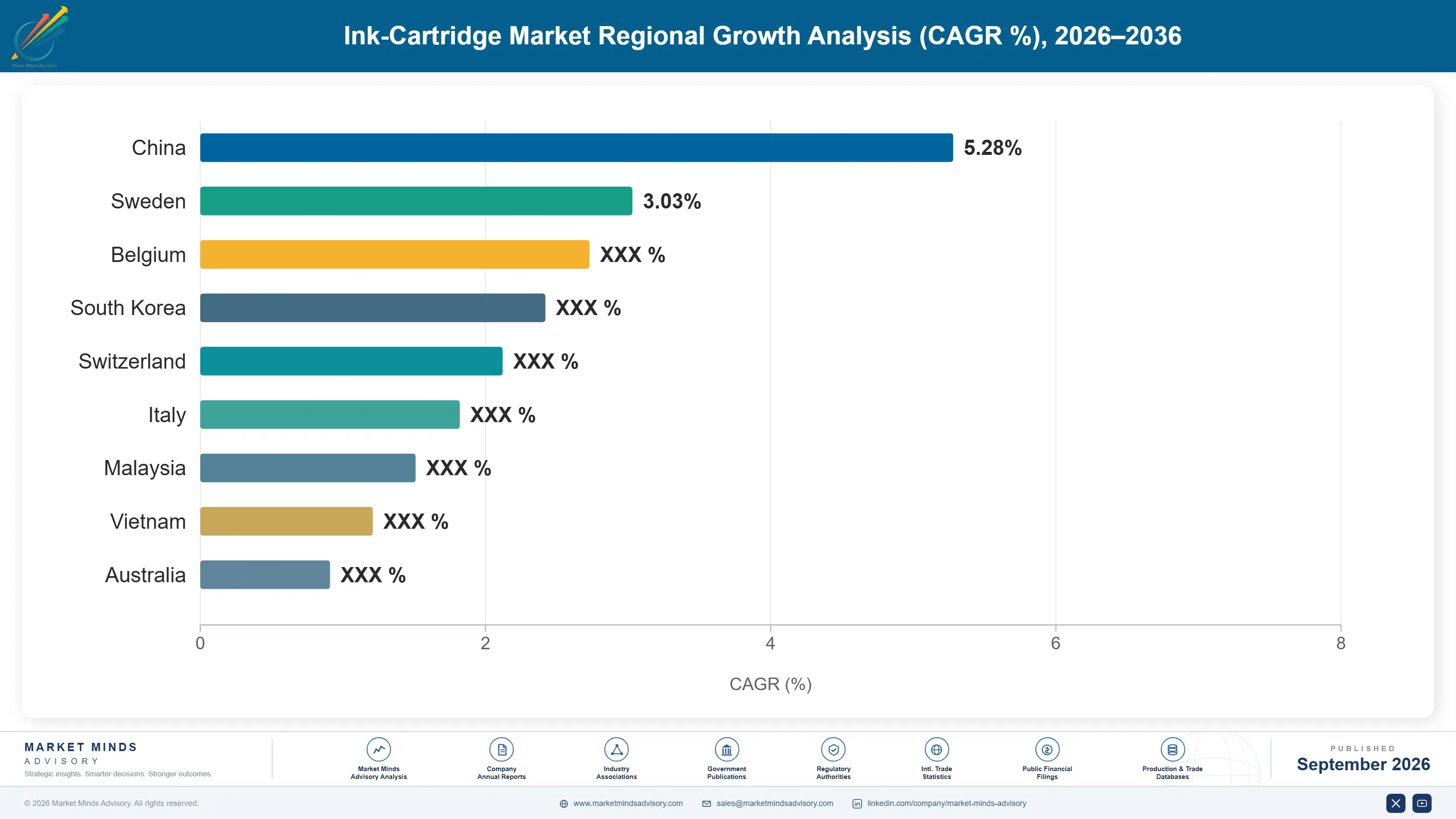
ink-cartridge-market-country-cagr-analysis-1789999506446

Where Manufacturers Can Capture Additional Margin reflecting.

Manufacturers capture disproportionate value by shifting mix toward subscription-based delivery programs and premium photo cartridge formulations that command durable revenue beyond standard retail cartridge sales alone reflecting sustained OEM investment across printing hardware and consumables programs as adoption continues expanding across home office, small business, and photo printing applications supporting consistent order reflecting sustained OEM investment.

Expand Subscription Program Enrollment Through Discounted Hardware reflecting sustained.

Manufacturers offering discounted printer hardware pricing in exchange for multi-year subscription commitments capture an estimated 35 percent higher lifetime revenue per customer than standard retail cartridge sales, since subscription revenue proves considerably more predictable and durable than unpredictable per-purchase retail buying patterns. This subscription model requires meaningful upfront hardware subsidy investment but generates substantially more predictable long-term revenue than pure retail cartridge sales reflecting sustained OEM investment across printing hardware and consumables programs as adoption continues expanding across home office, small business, and photo printing applications supporting consistent order growth across cartridge.
Market Impact: Adds approximately 35 percent higher lifetime revenue reflecting.

Develop Premium Photo Cartridge Formulations For Enthusiast Segments reflecting.

Manufacturers developing premium photo cartridge formulations for enthusiast photography consumers are generating additional revenue worth over 180 million dollars combined annually, since this segment shows considerably lower price sensitivity and stronger brand loyalty than standard document printing customers. This premium formulation development requires meaningful research investment but captures margin considerably higher than standard cartridge sales given lower compatible cartridge substitution risk reflecting sustained OEM investment across printing hardware and consumables programs as adoption continues expanding across home office, small business, and photo printing applications supporting consistent order growth across cartridge.
Market Impact: Generated over 180 million dollars in photo cartridges.

License Chip Authentication Technology To Third-Party Manufacturers reflecting sustained.

Manufacturers licensing proprietary chip authentication technology to third-party cartridge manufacturers under controlled partnership agreements are capturing licensing revenue expanding at roughly 12 percent annually, since some compatible manufacturers prefer licensed partnership over continued legal conflict with OEM patent holders. This approach converts adversarial compatible manufacturers into revenue-sharing partners rather than pure competitive threats reflecting sustained OEM investment across printing hardware and consumables programs as adoption continues expanding across home office, small business, and photo printing applications supporting consistent order growth across cartridge manufacturer production networks reinforcing demand visibility for reflecting sustained OEM investment.
Market Impact: Expanding roughly 12 percent annually industry-wide reflecting sustained.

Who Controls the Margin Pool

Market concentration sits at a high CR5 of 68 percent, reflecting a field dominated by a handful of established printer OEMs protecting proprietary cartridge revenue through chip authentication technology. HP leads through its massive installed printer base and aggressive subscription program expansion, holding a substantial gap over the nearest challenger reflecting sustained OEM investment across printing hardware and consumables programs.
Current competitive activity centers on subscription program expansion as OEMs race to convert retail cartridge buyers into recurring revenue subscribers. Established OEMs compete primarily on subscription program value and printer hardware subsidy generosity, while compatible cartridge manufacturers compete on price for consumers willing to navigate chip authentication restrictions reflecting sustained OEM investment across printing hardware and consumables programs as adoption continues expanding across home.

Emerging pressure comes from right-to-repair advocacy and legislation threatening chip authentication practices in several major markets, pressuring OEMs to defend proprietary cartridge revenue through legal and regulatory channels. Ranking shifts are most likely if major right-to-repair legislation succeeds broadly, shifting substantial value from OEMs toward compatible cartridge manufacturers reflecting sustained OEM investment across printing hardware and consumables programs as adoption continues expanding across home office, small.
ink-cartridge-market-company-positioning-matrix-1789999506964

Competitive Moat and Risk Dimensions

HP INC

Moat: Installed Base And Subscription.

HP uses its massive global installed printer base and pioneering Instant Ink subscription program to lock in recurring cartridge revenue at a scale competitors struggle to match. Its early subscription program investment gives it years of usage data and optimization advantage over OEMs launching comparable programs more recently reflecting sustained.
HP INC

Risk: Regulatory Scrutiny Of.

HP faces meaningful regulatory scrutiny and consumer advocacy criticism over its chip authentication practices, including firmware updates that have retroactively blocked previously functional compatible cartridges. This scrutiny creates reputational risk and potential regulatory restriction on practices central to its cartridge revenue protection strategy reflecting sustained OEM investment across printing.
CANON INC

Moat: Photo Print Quality Leadership.

Canon holds strong brand leadership in photo printing quality among enthusiast photography consumers, a segment showing lower price sensitivity and weaker compatible cartridge substitution risk than standard document printing customers. This positioning supports premium cartridge pricing that standard document-focused competitors cannot as easily command reflecting sustained OEM investment across.
CANON INC

Risk: Slower Subscription Program.

Canon has scaled subscription-based ink delivery programs more slowly than HP, risking a widening gap in recurring revenue capture as subscription models increasingly define industry profitability rather than traditional per-cartridge retail sales that continue declining gradually reflecting sustained OEM investment across printing hardware and consumables programs as.

Players Tracked

Prominent Players

HP Inc
Canon Inc
Epson America Inc
Brother Industries Ltd
Lexmark International Inc

Other Key Players

Xerox Holdings Corporation
Kodak Alaris Inc
Pantum Electronics Co Ltd
Ninestar Corporation
Static Control Components Inc
Cartridge World LLC
LD Products Inc
Clover Imaging Group LLC
Katun Corporation
Uninet Imaging Inc
InkOwl Inc
123inkjets.com Inc
Print-Rite Holdings Limited
Zhuhai Seine Printing Technology Co Ltd
Ricoh Company Ltd

Recent Developments

FEBRUARY 2026

HP Inc: Product Launch

HP launched an expanded Instant Ink subscription tier offering additional page allowances and photo printing support, targeting households seeking to convert from unpredictable retail cartridge purchasing to predictable monthly subscription billing across their entire printer fleet reflecting sustained OEM investment across printing hardware and reflecting sustained OEM.
Signal: Signals OEMs expanding subscription tiers to capture broader household printing needs reflecting sustained OEM reflecting sustained OEM.
SEPTEMBER 2025

Epson America Inc: Strategic Partnership

Epson entered a partnership agreement with a major retail chain to expand in-store subscription enrollment kiosks, strengthening its competitive position against HP's established subscription program lead in the retail printer sales channel reflecting sustained OEM investment across printing hardware and consumables programs as reflecting sustained OEM investment.
Signal: Signals manufacturers expanding retail subscription enrollment to compete with established leaders reflecting sustained OEM reflecting sustained OEM.
JANUARY 2026

Ninestar Corporation: Capacity Expansion

Ninestar announced an organic capacity expansion of its compatible cartridge manufacturing facility in China, aiming to support growing export demand as compatible cartridge manufacturers seek to serve price-sensitive consumers across additional international markets reflecting sustained OEM investment across printing hardware and consumables programs as reflecting sustained OEM.
Signal: Signals compatible manufacturers scaling ahead of expected right-to-repair legislation outcomes reflecting sustained OEM investment reflecting sustained OEM.

Pigment And Chip Component Cost Exposure.

Ink pigment chemicals and cartridge chip authentication components represent the largest cost input for cartridge manufacturing, running an estimated 35 to 40 percent of device bill of materials, sourced predominantly from specialty chemical processors and semiconductor suppliers. Plastic housing and printhead components add a smaller but meaningful additional share reflecting sustained OEM investment across printing hardware and consumables programs.
Specialty pigment chemical pricing showed meaningful volatility during 2022 as broader chemical feedstock cost pressure affected specialty ink formulation costs across major manufacturers, according to company annual report disclosures. Several manufacturers reported margin compression as pigment costs rose faster than they could pass through to consumers under existing retail pricing structures reflecting sustained OEM investment across printing hardware and consumables programs as adoption continues expanding across home office, small.

Smaller compatible cartridge manufacturers face a meaningful competitive disadvantage since they lack the volume commitments needed to secure priority pigment allocation from constrained suppliers, unlike HP and Canon which negotiate dedicated long-term supply agreements. This exposure varies by geography, with Chinese manufacturers benefiting from proximity to domestic chemical processing capacity reflecting sustained OEM investment across printing hardware and consumables programs as adoption continues expanding across home.
ink-cartridge-market-cost-volatility-analysis-1789999507166

Secure Multi-Year Pigment Supply Agreements Early reflecting sustained.

Leading manufacturers increasingly lock in multi-year specialty pigment chemical supply agreements with guaranteed volume commitments, reducing exposure to spot market price spikes. This requires substantial upfront capital commitment but insulates production costs from allocation shortfalls during periods of constrained industry-wide chemical supply reflecting sustained OEM investment across printing hardware and consumables programs as adoption continues.

Standardize Cartridge Designs Across Product Lines reflecting sustained.

Manufacturers are standardizing cartridge chip and housing designs across multiple printer product lines to increase purchasing volume with component suppliers, reducing per-unit cost through economies of scale. This standardization adds engineering coordination overhead but provides meaningful cost advantage when negotiating annual supply contracts with chemical and component vendors reflecting sustained OEM investment across printing hardware and.

Portfolio Architecture for Margin Defence

Portfolio economics split between commodity-adjacent standard document cartridges carrying thin margins under compatible cartridge price pressure and premium photo cartridges or subscription programs commanding substantially higher gross margins tied to differentiation. Volume plays chase unit shipment scale while premium plays extract value through subscription recurring revenue layered atop the base cartridge reflecting sustained OEM investment across printing hardware and consumables programs as adoption.
The tension between defending standard cartridge volume against compatible competition and building premium subscription positioning defines strategic choices across the manufacturer landscape. Manufacturers pursuing mainstream document printing accounts must accept thinner unit margins in exchange for installed base scale, while photo and subscription specialists sacrifice volume for durable premium per-unit economics reflecting sustained OEM investment across printing hardware and consumables programs as adoption continues.

High-value margin pools concentrate in subscription program recurring revenue, premium photo cartridge formulations, and chip authentication licensing rather than in standard document cartridge sales itself, reinforcing why manufacturers increasingly treat the cartridge as a platform for higher-margin recurring revenue that compounds across the printer lifetime reflecting sustained OEM investment across printing hardware and consumables programs as adoption continues expanding across home.

Standard Document Cartridges

Mass-market document printing cartridges sold at accessible price points through retail channels, prioritizing unit shipment volume over per-unit margin capture reflecting sustained OEM investment across printing hardware and consumables programs.
Gross Margin: 35-45%

Premium Photo Cartridge Formulations

Specialty photo printing cartridges sold to enthusiast photography consumers, carrying durable premium pricing tied to formulation quality and lower price sensitivity reflecting sustained OEM investment across printing hardware and consumables.
Gross Margin: 48-58%

Subscription-Based Ink Delivery Programs

Automatic cartridge replenishment subscriptions bundled with printer hardware, representing the fastest-growing and highest margin portion of manufacturer revenue mix today reflecting sustained OEM investment across printing hardware and consumables reflecting sustained OEM.
Gross Margin: 55-65%
ink-cartridge-market-portfolio-architecture-1789999507688

High-value Sub-segments and Strategic Watch-out

Subscription Program Recurring Revenue

Small today but expanding rapidly as manufacturers bundle automatic replenishment with printer purchases, generating high-margin recurring revenue with minimal additional capital requirement per subscriber reflecting sustained OEM investment across printing hardware and consumables programs as adoption continues expanding across home office, small business, and reflecting sustained.
Gross Margin: 55-65%

Chip Authentication Licensing Revenue

A small but expanding segment as manufacturers license authentication technology to third-party partners, generating durable licensing revenue tied to controlled partnership agreements reflecting sustained OEM investment across printing hardware and consumables programs as adoption continues expanding across home office, small business, and photo printing reflecting sustained.
Gross Margin: 60-70%

Standard Document Cartridges

The largest volume segment today, anchored by broad home and office printer adoption, though margin per unit remains comparatively thin relative to photo and subscription segments across the wider portfolio reflecting sustained OEM investment across printing hardware and consumables programs as adoption continues expanding reflecting sustained.
Gross Margin: 35-45%

Compatible And Refillable Cartridges

A strategic watch-out segment given expanding right-to-repair legislation that could significantly expand its addressable market if chip authentication restrictions face successful legal challenge reflecting sustained OEM investment across printing hardware and consumables programs as adoption continues expanding across home office, small business, and photo reflecting sustained.
Gross Margin: 20-30%

Recurring Subscriptions Beyond The Cartridge reflecting.

Cartridge sales alone increasingly fail to produce durable annuity economics as declining print volume and compatible cartridge competition erode standard retail cartridge revenue predictability. Manufacturers increasingly design subscription-based delivery programs to generate revenue continuity independent of unpredictable per-purchase retail buying patterns, a strategy borrowed from broader consumer subscription commerce models reflecting sustained OEM investment across printing hardware and consumables programs as adoption continues.
Adoption stickiness varies considerably by end-use vertical. Subscription program enrollees show the deepest stickiness once their household printing routine depends on automatic replenishment, since canceling requires actively reverting to manual retail purchasing they had specifically avoided. Standard retail cartridge buyers show shallower stickiness, frequently switching between OEM and compatible cartridges based on price at the moment of purchase reflecting sustained OEM investment across printing hardware and consumables programs.

Generational buyer shifts are also underway. Younger consumers show markedly lower overall printing frequency than older cohorts, who grew up printing documents routinely for work and personal use. Procurement decision authority within small businesses is simultaneously shifting toward evaluating total cost of ownership across subscription and retail options rather than defaulting to whichever cartridge type came with the original printer purchase reflecting sustained OEM investment across printing hardware.
ink-cartridge-market-end-use-penetration-index-1789999508190

Where MMA Sees The Opportunity reflecting.

These are among the four positions where our research anticipates prominent divergence between winners and laggards over the coming forecast period. Each is grounded in the demand model, the regulatory perimeter, and the announced capacity pipeline.
01 / SUBSCRIPTION ENROLLMENT ACCELERATION.

Accelerate Subscription Enrollment Ahead Of Print Volume Decline reflecting sustained.

Subscription-based ink delivery programs convert unpredictable retail cartridge revenue into durable recurring income, a transition that matters increasingly as overall print volume continues declining gradually across most developed markets. Manufacturers that delay subscription program expansion risk losing customers entirely to competitors already embedded in household printing routines through automatic replenishment. MMA views subscription enrollment acceleration as the single highest priority commercial strategy for manufacturers over the next three years given declining baseline print volume reflecting sustained OEM investment across printing hardware and consumables programs as adoption continues expanding.
02 / PREMIUM PHOTO SEGMENT.

Invest In Photo Cartridge Differentiation For Enthusiast Loyalty reflecting.

Photo printing cartridge demand among enthusiast consumers shows considerably lower price sensitivity and weaker compatible cartridge substitution risk than standard document printing customers, supporting durable premium margins that standard document cartridges increasingly cannot sustain under compatible price competition. Manufacturers that invest in photo formulation differentiation will preserve premium margin in a category otherwise facing sustained commoditization pressure. MMA views photo segment investment as a durable margin defense strategy rather than a niche product line consideration reflecting sustained OEM investment across printing hardware and consumables programs as adoption.
03 / RIGHT-TO-REPAIR RISK PREPARATION REFLECTING.

Prepare Revenue Models For Weakening Chip Authentication Protection reflecting sustained.

Expanding right-to-repair legislation across major markets increasingly threatens chip authentication practices that currently protect proprietary cartridge revenue, creating meaningful regulatory uncertainty for manufacturers dependent on this protection mechanism. Manufacturers that shift revenue models toward subscription programs less dependent on authentication restrictions will prove more resilient than those relying primarily on chip protection if legislation succeeds broadly across major markets. MMA views this diversification as prudent risk management rather than premature retreat from current legal protections reflecting sustained OEM investment across printing hardware and consumables programs as adoption continues.
04 / EMERGING MARKET GROWTH PRIORITIZATION.

Prioritize Emerging Market Expansion Over Mature Market Defense reflecting.

Expanding home office and small business printing adoption across South Asia and Latin America continues driving new cartridge demand as these regions build foundational printing infrastructure that developed markets established decades earlier, unlike mature markets facing continued digital displacement pressure. Manufacturers that prioritize emerging market expansion capture disproportionate volume growth relative to competitors focused primarily on defending declining mature market share. MMA views emerging market growth investment as more valuable than incremental mature market retention spending reflecting sustained OEM investment across printing hardware and consumables programs as adoption.

Engagement Snapshot From the Field

A live engagement with an industry participant carrying material or product regulatory and market exposure ahead of a defining policy shift, showing how our research translates into a defensible multi-year portfolio strategy.
MARKET MINDS ADVISORY · CLIENT ENGAGEMENT SUMMARY
Ink-Cartridge Producer Strategic Portfolio Review and Transition Roadmap 2026·Investment Scenario on Ink-Cartridge Exposure Evaluation 2025-26
CLIENT PROFILE
The client is a regional office supply retailer operating approximately 200 stores across the United States, evaluating whether to expand in-store printer subscription enrollment programs following declining foot traffic for standalone cartridge purchases across its retail footprint reflecting sustained OEM investment across printing hardware and consumables programs as adoption continues expanding reflecting sustained OEM investment across printing hardware.
STRATEGIC CHALLENGE
The client needed to determine whether subscription enrollment kiosks could offset declining cartridge retail sales while maintaining customer relationships that historically drove repeat store visits for cartridge purchases reflecting sustained OEM investment across printing hardware and consumables programs as adoption continues expanding across home office, small business, and photo printing.
MMA APPROACH
MMA combined its primary retailer survey data with expert interviews across printer manufacturers and competing retail chains to benchmark subscription enrollment conversion rates and customer retention impact across comparable office supply retail deployments reflecting sustained OEM investment across printing hardware and consumables programs as adoption continues expanding across home office,.
KEY FINDINGS
  1. In-store subscription enrollment kiosks converted a meaningful share of cartridge buyers into recurring subscribers during initial store visits reflecting sustained OEM reflecting sustained OEM.
  2. Subscription customers showed reduced overall store visit frequency but increased other product category purchases during remaining visits reflecting sustained OEM investment reflecting sustained OEM.
  3. Staff training on subscription program benefits significantly improved enrollment conversion rates compared with self-service kiosk-only approaches reflecting sustained OEM investment across reflecting sustained OEM.
  4. Customers citing unpredictable cartridge costs as a pain point showed the highest subscription enrollment conversion rates among surveyed shoppers reflecting sustained reflecting sustained OEM.
CLIENT PROFILE
The client is a regional office supply retailer operating approximately 200 stores across the United States, evaluating whether to expand in-store printer subscription enrollment programs following declining foot traffic for standalone cartridge purchases across its retail footprint reflecting sustained OEM investment across printing hardware and consumables programs as adoption continues expanding reflecting sustained OEM investment across printing hardware.
STRATEGIC CHALLENGE
The client needed to determine whether subscription enrollment kiosks could offset declining cartridge retail sales while maintaining customer relationships that historically drove repeat store visits for cartridge purchases reflecting sustained OEM investment across printing hardware and consumables programs as adoption continues expanding across home office, small business, and photo printing.
MMA APPROACH
MMA combined its primary retailer survey data with expert interviews across printer manufacturers and competing retail chains to benchmark subscription enrollment conversion rates and customer retention impact across comparable office supply retail deployments reflecting sustained OEM investment across printing hardware and consumables programs as adoption continues expanding across home office,.
KEY FINDINGS
  1. In-store subscription enrollment kiosks converted a meaningful share of cartridge buyers into recurring subscribers during initial store visits reflecting sustained OEM reflecting sustained OEM.
  2. Subscription customers showed reduced overall store visit frequency but increased other product category purchases during remaining visits reflecting sustained OEM investment reflecting sustained OEM.
  3. Staff training on subscription program benefits significantly improved enrollment conversion rates compared with self-service kiosk-only approaches reflecting sustained OEM investment across reflecting sustained OEM.
  4. Customers citing unpredictable cartridge costs as a pain point showed the highest subscription enrollment conversion rates among surveyed shoppers reflecting sustained reflecting sustained OEM.
RECOMMENDED STRATEGY
Phase 1: Phase one: deploy staffed subscription enrollment kiosks at highest-traffic store locations with dedicated employee training reflecting sustained OEM investment across. Phase 2: Phase two: expand kiosk deployment to remaining stores based on initial conversion rate and customer feedback results reflecting sustained OEM. Phase 3: Phase three: integrate subscription messaging into broader in-store marketing emphasizing cost predictability benefits reflecting sustained OEM investment across printing reflecting sustained.
OUTCOME
The client deployed staffed subscription enrollment kiosks across all 200 stores, reporting subscription conversion rates meaningfully above initial forecast within two quarters (client-reported, unverified by MMA), and subsequently expanded staff training programs to reinforce enrollment messaging chain-wide reflecting sustained OEM investment across printing hardware and consumables programs as adoption continues expanding.

Frequently Asked Questions

Foundational context covering the market sizes, CAGR, scope, country, region and competition that inform every finding below. This section is provided to cover basics and most often pre-purchase conversations, answered from the MMA Primary Research Dataset.

What is the current size of the Ink-Cartridge Market?

The global ink cartridge market is valued at 14.8 billion dollars in 2025, the base year for this report's forecast period reflecting sustained OEM investment across.

How large will the Ink-Cartridge Market be by 2036?

MMA projects the market will reach approximately 22.78 billion dollars by 2036, driven by subscription program adoption and emerging market growth reflecting sustained OEM reflecting sustained.

What is the CAGR for the Ink-Cartridge Market 2026 to 2036?

The market is forecast to grow at a compound annual growth rate of 4.0 percent between 2026 and 2036 under MMA's base case scenario reflecting sustained.

Which segment is growing fastest?

Subscription-based ink delivery programs lead at a 9.5 percent CAGR, roughly 2.38 times the overall market rate, driven by recurring revenue models reflecting sustained OEM.

Who are the major companies in the Ink-Cartridge Market?

HP, Canon, Epson America, Brother Industries, and Lexmark International hold leading positions across OEM and subscription markets reflecting sustained OEM investment across reflecting sustained OEM investment.

Which country is growing fastest?

India leads at a 6.0 percent CAGR, supported by its rapidly expanding small business formation and home office printing adoption reflecting sustained reflecting sustained OEM investment.

Report Segmentation Architecture

The full report scope spans multiple orthogonal segmentation dimensions, with cross-tabulated demand data provided for each dimension pair. Coverage extends further to regional breakdowns, trend trajectories, and the competitive detail needed to support segment-level decision-making.

By Product Type

  • OEM Standard Document Cartridges
  • Premium Photo Cartridges
  • Compatible And Third-Party Cartridges
  • Refillable Cartridge Systems
  • Subscription-Based Ink Delivery Programs
  • Chip Authentication Technology

By End-Use Industry

  • Home and Residential
  • Small Business and Home Office
  • Corporate and Enterprise
  • Education
  • Photography and Creative Professional
  • Government and Public Sector

By Commercial Dimension

  • Retail Channel Sales
  • Subscription Direct-to-Consumer
  • Online E-Commerce Distribution
  • Office Supply Chain Channel

By Region

  • North America
  • Western Europe
  • East Asia
  • South Asia and Pacific
  • Latin America
  • Middle East and Africa
  • Eastern Europe

Scope, Methodology, and Coverage

Every figure in this report is reproducible from documented input assumptions. The scope below maps the historical period, the forecast horizon, the segmentation dimensions, and the countries covered, alongside the underlying primary and qualitative methodology.
Historical Period
2020 to 2025
Forecast Period
2026 to 2036
Base Year
2025 (USD billions; MMA Primary Research Dataset, September 2026)
Market Definition
This report covers ink cartridges for inkjet printers including original equipment manufacturer, compatible, and refillable cartridge systems sold through retail and subscription channels. It excludes toner cartridges for laser printers and printer hardware itself reflecting sustained OEM investment.
Quantitative Units
USD billions, cartridge unit shipments where cited
Segmentation Dimensions
Product Type, End-Use Industry, Commercial Dimension, Region
Regions Covered
North America, Western Europe, East Asia, South Asia and Pacific, Latin America, Middle East and Africa, Eastern Europe
Countries Covered
United States, Japan, China, Germany, United Kingdom, India, Brazil, Mexico, and 30 additional countries
Key Companies Profiled
20
Quantitative Methodology
Primary survey, n=3,800 respondents, Q4 2025, six countries; demand-side model with trade association cross-validation
Qualitative Methodology
47 expert interviews, Q4 2025; applied to validate demand model assumptions, identify emerging dynamics, and assess competitive positioning
Report Format
PDF and XLSX data workbook (Word format preview document)
Publisher
Market Minds Advisory
Report Code
MMA-2026-TEC-589
Published
September 2026
Contact
sales@marketmindsadvisory.com | www.marketmindsadvisory.com

Purchase the full Ink-Cartridge Market Report (2026 to 2036).

The full report provides comprehensive coverage of the global ink cartridge market across all segments, regions, and competitive dynamics outlined in this summary. It includes detailed manufacturer profiles, pricing benchmarks, and quantified segment-level forecasts through 2036. These findings draw on MMA's primary survey of 3,800 respondents and 47 expert interviews conducted in the fourth quarter of 2025. Subscribers receive quarterly data updates tracking subscription program adoption trends and competitive positioning shifts as the market evolves. Regional appendices break out country-level detail across thirty nine markets covered in this study.
Segment-level revenue forecasts through 2036 reflecting sustained.
Twenty manufacturer competitive profiles and benchmarking reflecting.
Country-level market sizing across 39 countries reflecting.
Quarterly data updates through subscription access reflecting.
Primary survey data across six countries reflecting.
Expert interview transcripts and analyst commentary reflecting.

Built For The People Who Decide

From boardroom strategy to bench-side execution, this report is read cover-to-cover by leaders shaping the next decade of their industry, turning demand scenarios, market dynamics and valuation benchmarks into decisions.
CXOs/ Presidents/ VPs/ Managers
M&A and Corporate Development
Strategy Teams and R&D Heads
Procurement and Product Directors
Regulatory and Compliance Leaders
Investor Relations and Equity Analysts