Market Minds Advisory
Injection Moulding Cosmetic Packaging Market

Injection Moulding Cosmetic Packaging Market: Where Recycled Resin Meets a Class A Surface

Cosmetics demands a flawless moulded surface and heavy walls that signal quality. Recycled resin delivers neither reliably, which is why sustainability commitments keep colliding with the industry's own aesthetic standard.

Lead Analyst

Bilal Shaikh

Published

September 2026

Make Smarter Decisions with Customized Research Insights

Request a free sample report and evaluate market opportunities, growth trends, and competitive dynamics relevant to your business needs.

2025 MARKET VALUE$6.8BMarket Size 2025
2036 FORECAST VALUE$13.4BBase Case , 2026 to 2036
CAGR 2026 TO 20366.4 %Bull 7.6% / Bear 5.2%
INCREMENTAL OPPORTUNITY$6.2BNet 10- year value creation
EXPANSION MULTIPLE1.86x2036 value over 2026 base
Strategic Levers
M&A Pipeline
Regional Outlook
Country Rankings
Competitive Intelligence
Segmental Deep-dive
Call-Us : 91 93563 13602

Executive Snapshot and Market Trajectory

A cosmetic jar is moulded at 3.2 millimetres because weight signals quality to the hand holding it. That thickness costs thirty-one extra seconds of cooling every shot, and the surface it produces must be flawless, which is where recycled resin fails. Both constraints came from marketing rather than engineering.
Growth comes from format architecture rather than from more products launched. Refillable system components grow fastest at 9.6%, exactly 1.50 times the market rate, because a refill sells the outer once and the insert repeatedly. Lipstick and stick mechanisms follow at 7.8%. East Asia holds the largest share, well above its framework band, since Chinese and Korean moulders supply global brands as well as their own.
Concentration is only 23% across the top five measured on annual moulded component volume, split between Asian volume moulders and European prestige specialists. Tooling at fourteen weeks and six figures is what actually holds an account, and whoever paid for the mould holds the relationship. Recycled resin rejection runs at 18% against cosmetic surface standards. Brands who let the moulder pay discover this at renewal, and cannot move for a quarter.
Market Definition
This market covers injection moulded components supplied to cosmetic and personal care products, spanning caps and closures, jars and rigid containers, compacts and palettes, lipstick and stick mechanisms, refillable system components, and applicator components. Scope is measured at moulder realised prices including applied decoration. Glass primary containers, dropper and pipette assemblies, dispensing pumps sold separately, tubes and flexible packaging, formulation, and contract filling services are excluded.
Base Year Value
$6.8B in 2025 (MMA Primary Research Dataset, August 2026)
Forecast Period
2026 to 2036, eleven discrete annual values
CAGR
6.4% base case. Bull 7.6%. Bear 5.2%.
Fastest Growth Segment
Refillable System Components: 9.6% CAGR
Fastest Growth Country
South Korea: 11.2% CAGR
Fastest Growth Region
South Asia and Pacific: 8.5% CAGR
Largest Region
East Asia: 32% of 2025 global value
Market Leaders
Albea Group. HCP Packaging. Quadpack. AptarGroup. Toly Group. Source: MMA Analysis based on company annual reports.
Primary Survey
n=3,800 procurement and R&D decision-makers, Q4 2025, six countries
Methodology
Demand-side build-up, cross-validated against public data, 47 expert interviews

Injection Moulding Cosmetic Packaging Market Forecast Scenarios

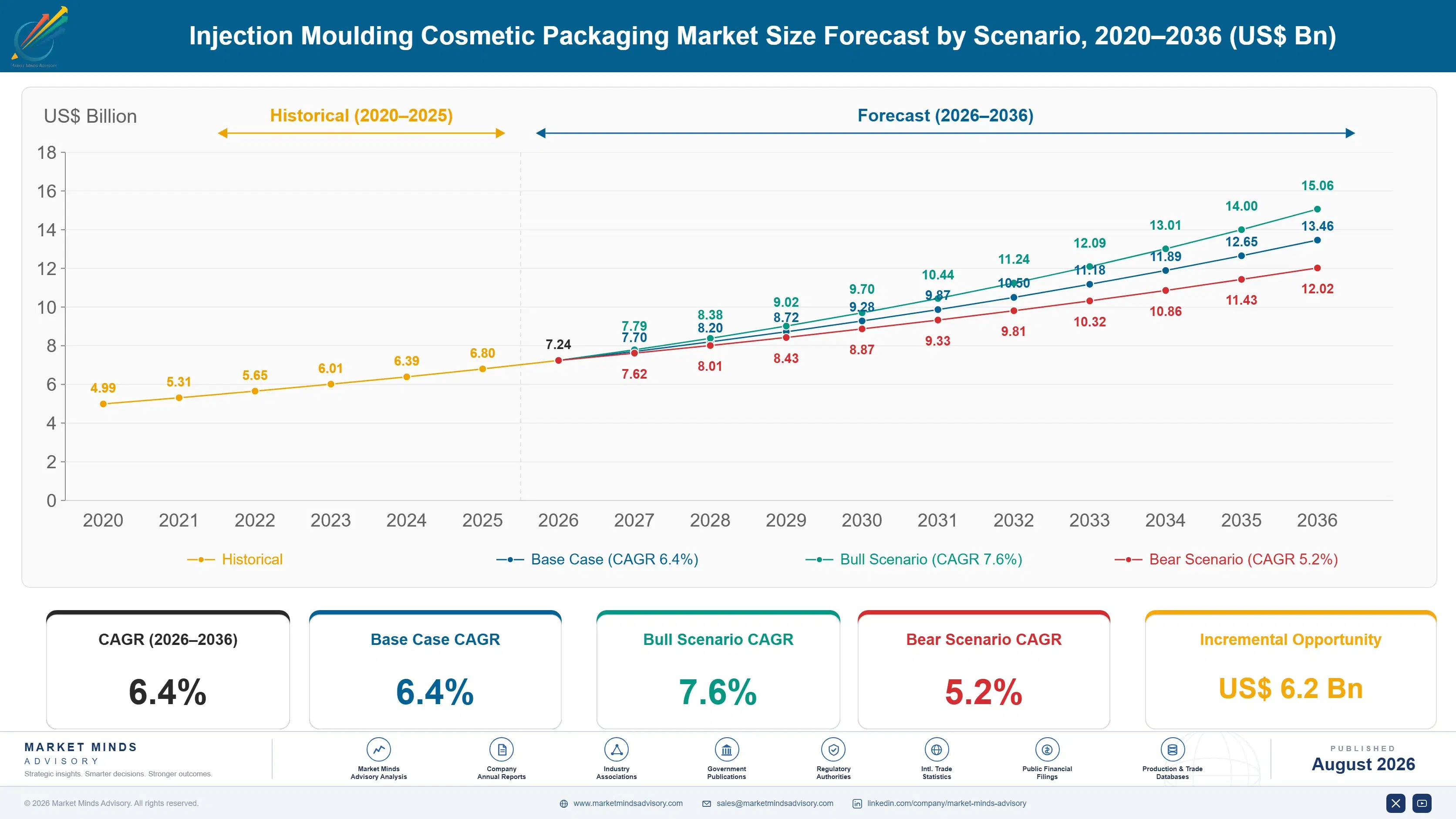
injection-moulding-cosmetic-packaging-market-size-forecast-scenario-1787299368817
The 2020 to 2025 period reset which categories mattered. Colour cosmetics collapsed through 2020 and 2021 while skincare grew strongly, which moved demand from compacts and lipstick mechanisms toward jars and closures almost overnight. Colour then recovered hard from 2022. Recycled content commitments arrived across the same window and collided immediately with cosmetic surface standards. A 5.1% historical rate averages a category rotation against a materials problem nobody had anticipated.
Three mechanisms carry the 6.4% base case. Refillable architecture is the largest, since a refill system sells an outer component once and an insert repeatedly rather than replacing the whole pack. Asian brand proliferation is the second, with Chinese and Korean houses launching at a pace Western brands cannot match. And decoration content is the third, as metallisation, lacquer, and in-mould labelling raise value per component without changing the moulding itself.
The 7.6% bull case rests on recycled resin grades reaching cosmetic surface consistency, which would remove the single obstacle blocking sustainability commitments across the category. The 5.2% bear case is colour cosmetics weakening again, since compacts, palettes, and stick mechanisms carry far more moulded component value per unit sold than skincare jars and closures do.

What a Flawless Surface Actually Costs

Cosmetic moulding is ordinary injection moulding with two unusual constraints bolted on. The wall is thick because a heavy jar feels expensive, and thick sections cool slowly, adding around thirty-one seconds to every cycle against a functionally identical thin-wall part. The surface must be flawless, which means polished tooling, gates hidden where nobody looks, and no weld line or sink mark anywhere a customer might see.
TOP FIVE CONCENTRATION23%Fragmented across Asian moulders and European prestige specialists
TOOLING LEAD TIME14 weeksFrom approved design to first article on multi-cavity moulds
COSMETIC WALL THICKNESS3.2 mmTypical for jars where weight signals perceived product quality
CYCLE TIME PENALTY31 secondsAdded for thick-wall cosmetic parts against thin-wall equivalents
RECYCLED CONTENT REJECTION18%Parts failing cosmetic surface inspection when running recycled resin
TOOLING COST PER CAVITYUSD 9,400Across polished cosmetic-grade multi-cavity injection mould sets today
Recycled resin fails both tests at once. Post-consumer material carries colour variation, occasional black specks, and inconsistent melt flow, and a Class A cosmetic surface displays every one of those defects clearly. Rejection runs around 18% on recycled runs against low single digits on virgin. Brand sustainability teams commit to recycled content and moulders quietly discover what it costs to deliver.
Two forces shape the next decade. Refillable architecture changes what gets sold, replacing one complete pack with an outer that lasts and an insert that repeats. And tooling remains the commercial anchor, since whoever paid for a fourteen-week six-figure mould effectively holds the account. Neither force has anything to do with moulding skill, which is what most suppliers still compete on.
"A brand will announce thirty percent recycled content in a press release and then spend nine months arguing with its moulder about black specks on a lid. Nobody in that press release knew the surface standard they had already signed off makes the commitment technically difficult. The two decisions were taken in different buildings."
Director. Cosmetic Packaging and Component Manufacturing Practice · MMA Packagin

Market Trends

Refill Architecture Changes What A Component Sale Is

A refillable compact or jar splits into an outer that a customer keeps and an insert they replace, which converts one pack sale into an outer sale plus a recurring insert stream. For the moulder that is a better business than it looks, because insert tooling is simpler while outer tooling is more elaborate and therefore more defensible. Brands adopted refills expecting to lose component revenue and largely have not. Refillable components grow at 9.6% against a market rate of 6.4%, and interface design decides whether third parties can supply the inserts.
Market Impact: South Korea grows at 11.2%
Recycled Content Commitments Collide With Surface Standards

Brand recycled content targets were set by sustainability functions and the cosmetic surface standard was set by marketing years earlier, and the two are barely compatible. Post-consumer resin carries colour drift, contamination specks, and melt flow variation that a polished Class A surface shows immediately, producing rejection around 18% against low single digits on virgin material. Moulders absorb that yield loss or renegotiate. Dedicated compounding, colour masking through pigment loading, and textured rather than gloss finishes are the practical responses currently in use. The two decisions were taken in different buildings entirely.
Market Impact: Adds 40 to 60% to price

Market Opportunities and Growth Drivers

Asian Brand Proliferation Outpaces Western Launch Cadence

Chinese and Korean cosmetic houses launch new products at a pace Western brands cannot approach, and each launch specifies components, tooling, and decoration from scratch rather than reusing an existing pack. That generates tooling revenue and moulded volume simultaneously. South Korea contributes the fastest national growth rate in this forecast at 11.2%, driven by compacts, cushion formats, and stick mechanisms where Korean design leads globally. Regional moulders serve both domestic brands and export contract work for Western houses, which doubles their exposure to the growth. Each launch specifies tooling and decoration from scratch.
Market Impact: Adds 31 seconds per cycle

Decoration Content Raises Value Without Changing The Moulding

Vacuum metallisation, ultraviolet lacquer, hot stamping, pad printing, and in-mould labelling all add value to a component that was moulded identically either way. For a moulder holding decoration capability in house, that is margin captured rather than passed to a subcontractor. Prestige brands specify multiple decoration operations on a single cap, and each one is a separate process step with its own yield. Decoration typically adds 40 to 60% to the realised price of a component while adding considerably less to the underlying cost. Each operation is a separate process step with its own yield.
Market Impact: Costs 9,400 dollars per cavity

Market Restraints and Challenges

Thick Walls Triple Cycle Time For Perceived Quality Alone

A cosmetic jar is moulded at around 3.2 millimetres because consumers associate weight with quality, and thick sections cool slowly. That adds roughly thirty-one seconds to every cycle against a functionally equivalent thin-wall part, which is the largest cost in the component after resin itself. The root cause is consumer perception rather than any functional requirement. Participants are working on weight-neutral design that keeps mass in the base where it is felt, gas-assisted moulding, and structural ribbing that maintains rigidity at lower average wall. Machine hours are the binding constraint in any busy shop.
Market Impact: Refill components grow at 9.6%

Tooling Ownership Decides Who Really Holds The Account

A multi-cavity cosmetic mould costs around 9,400 dollars per cavity and takes fourteen weeks, and whoever funded it controls whether production can move. Brands that let the moulder pay discover at renewal that switching means buying new tooling and waiting a quarter. The root cause is that tooling is capital nobody wants on their own balance sheet. Commercial impact runs both ways, since moulders funding tools tie up capital in relationships that may not last. Amortisation schedules, shared ownership, and buyout clauses are all used to manage it. Nobody wants that capital on their own balance sheet.
Market Impact: Rejection reaches 18% on recycled
4 additional market trends, 2 additional growth drivers, and 3 additional restraints and challenges are covered in the full report. Contact sales@marketmindsadvisory.com to access the complete intelligence.

Segment CAGR and Growth Architecture

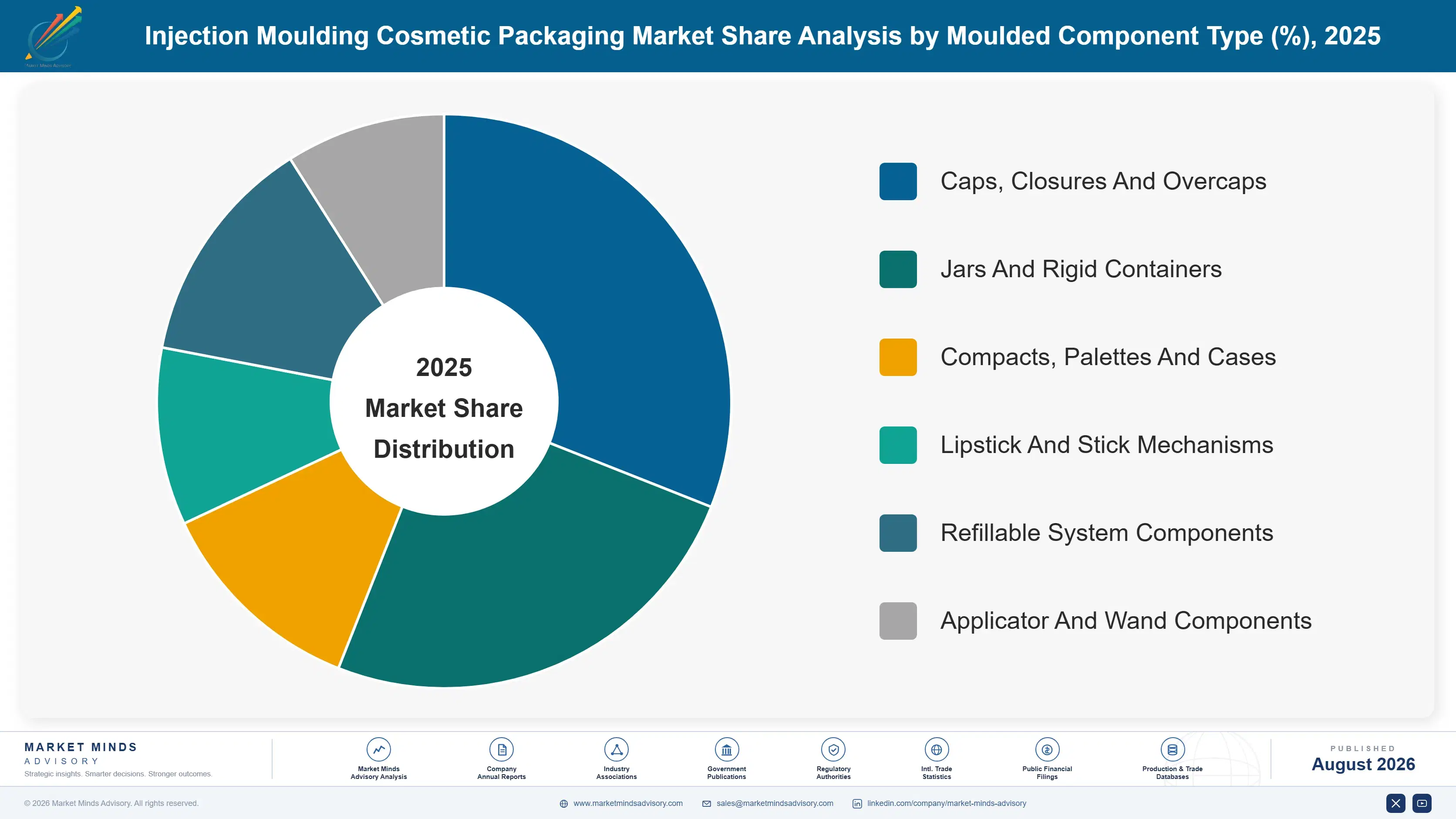
Segmentation follows moulded component type, because each type carries its own tooling complexity, cycle characteristics, decoration requirement, and surface standard. Brand tier and product category both cut across every component rather than separating them cleanly, so neither functions as a workable primary dimension for this market. Six component types result, and they tool very differently.
injection-moulding-cosmetic-packaging-market-market-share-analysis-1787299369356

Refillable System Components

The fastest component type at 9.6%, exactly 1.50 times the market rate, and the only one that changes the shape of the revenue rather than merely its size. A refillable pack splits into a durable outer the customer keeps and an insert they replace repeatedly, which converts a single component sale into an outer plus a recurring stream. Outer tooling is more elaborate and therefore more defensible, while insert tooling is simple enough that third parties could supply it unless the interface is designed to prevent that. Brands expected refills to reduce component revenue and generally found the opposite, which has accelerated adoption considerably across prestige skincare and colour. Interface design decides whether third parties can supply inserts.
CAGR 9.6%

Lipstick And Stick Mechanisms

Second fastest at 7.8%, and technically the most demanding moulding in cosmetics by a clear margin. A stick mechanism is an assembly of moulded parts that must rotate smoothly, hold position under load, resist backlash, and do all of it silently, because a mechanism that rattles reads as cheap regardless of what the pack cost. Tolerances are tighter than anywhere else in cosmetic moulding. Korean and Chinese specialists lead on mechanism design and supply Western prestige brands under contract. Deodorant and solid balm sticks apply the same mechanics at larger scale, which broadens the addressable volume well beyond colour cosmetics alone. A mechanism that rattles reads as cheap regardless of cost, which is why tolerances here are the tightest anywhere.
CAGR 7.8%
Full segment breakdown across 6 segments available in the complete report.

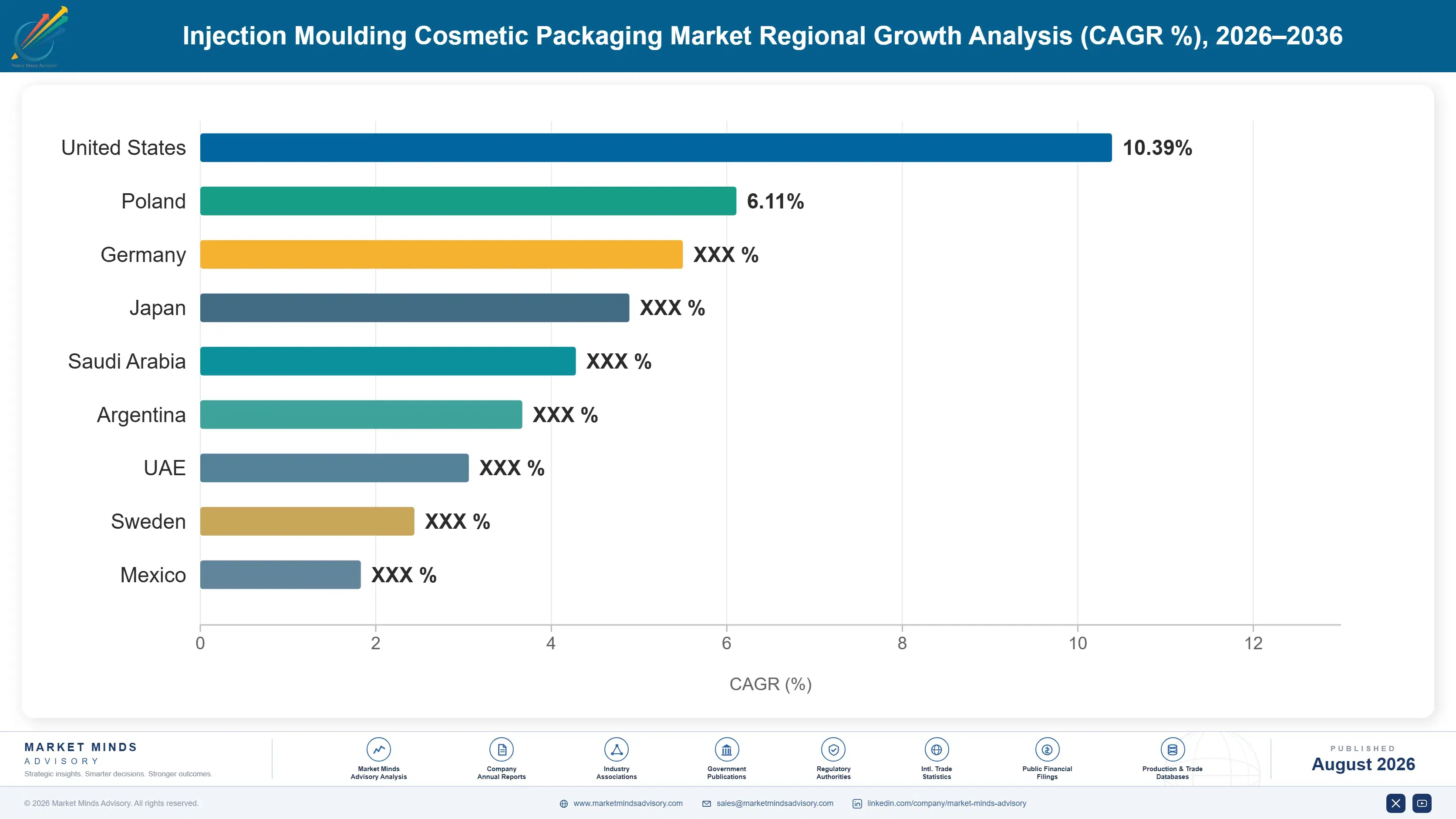
Regional Architecture and Country Demand Map

Component moulding follows brand launch activity and contract manufacturing capacity together rather than population size. East Asia sits well above its framework band here because Chinese and Korean moulders supply global prestige brands alongside a domestic launch cadence that nobody else in the world matches.

East Asia

Thirty-two percent, above the framework band, and the justification is that manufacture and launch activity concentrate together here. Chinese moulders supply Western prestige brands under contract while serving a domestic brand population launching faster than anywhere, and Korean specialists lead globally on compact, cushion, and stick mechanism design. South Korea contributes the fastest national growth rate in this forecast at 11.2%. Taiwanese moulders hold long-standing relationships with global beauty groups. Growth at 7.5% runs above the global rate on domestic launch cadence and on continuing contract work for Western houses. Taiwanese moulders hold long-standing relationships with global beauty groups, which the domestic figures do not capture, Korean specialists lead globally on compact and stick design.
Share: 32% | CAGR: 7.5% (2026 to 2036)

South Asia and Pacific

Eleven percent, and India carries most of it as a beauty market formalising quickly across colour, skincare, and personal care. Domestic brands and established Indian groups both launch heavily, and moulding capacity has grown to serve them rather than relying on imported components as it once did. Price sensitivity keeps wall thickness and decoration content below Western specifications, which lowers value per component considerably. Australian and Southeast Asian demand adds at higher price points. Growth at 8.5% is the highest of any region, driven by category penetration and by domestic moulding capacity replacing imports. Wall thickness and decoration content sit below Western specifications, which lowers value per component considerably, Moulding capacity has grown to replace imported components.
Share: 11% | CAGR: 8.5% (2026 to 2036)
Regional intelligence for 5 additional markets available in the complete report: North America, Western Europe, Latin America, Middle East and Africa, Eastern Europe. Contact sales@marketmindsadvisory.com.
injection-moulding-cosmetic-packaging-market-country-cagr-analysis-1787299369882

Four Levers in Cosmetic Component Moulding

Resin is a commodity every moulder buys at similar prices, and machine time is available everywhere. Value comes from owning tooling, from attacking the cycle time that wall thickness imposes, from solving recycled resin surface defects, and from designing refill interfaces others cannot supply. Four levers follow, and the first is about capital, not about manufacturing at all.

Fund The Tooling And Price The Relationship Accordingly

A multi-cavity cosmetic mould costs around 9,400 dollars per cavity and takes fourteen weeks, and whoever paid for it controls whether production can move at renewal. Moulders who fund tooling and amortise it across a multi-year volume commitment hold accounts that price competition alone cannot dislodge. The capital is real and the risk is that a programme ends early, which amortisation floors and buyout clauses both address. Moulders who insist the brand pays are competing on piece price forever. Amortisation floors handle the early termination risk, and buyout clauses cover the rest.
Market Impact: Tooling costs 9,400 dollars for every single cavity

Attack Wall Thickness Without Losing Perceived Weight

Cosmetic jars run around 3.2 millimetres because heaviness signals quality, and that adds roughly thirty-one seconds to every cycle. Concentrating mass in the base where the hand actually registers it, while thinning the walls and adding internal ribbing, preserves the perception and cuts cycle time by 30 to 40%. Machine hours are the constraint in any busy moulding shop, so recovered cycle time converts directly into capacity. The redesign needs brand approval, which is why it is presented as a sustainability improvement rather than a cost one. Recovered cycle time converts directly into capacity.
Market Impact: Cuts press cycle time by 30 to 40%

Solve Recycled Resin Surface Defects Through Dedicated Compounding

Post-consumer resin fails cosmetic surface inspection at around 18% because of colour drift, contamination specks, and melt flow variation. Dedicated compounding with tightened input specification, pigment loading calibrated to mask variation, and textured finishes in place of high gloss brings rejection close to virgin levels. Establishing that compounding capability costs roughly 4 million dollars. It converts a brand commitment that moulders currently absorb as yield loss into a capability those brands will pay a premium to access. Brands currently absorb this as somebody else's yield loss, and would pay a premium to stop.
Market Impact: Compounding capability costs roughly 4 million dollars total

Design Refill Interfaces Third Parties Cannot Easily Supply

Refillable systems sell an outer once and an insert repeatedly, and the insert stream is the valuable half. That stream only stays with the original moulder if the mechanical interface between outer and insert cannot be copied without infringing design registration or requiring tooling nobody else will fund. Proprietary interfaces secure roughly 45% higher lifetime component value per programme than open-fit systems. Brands increasingly specify this themselves, since they face the same substitution risk on their own refill revenue. Design registration rather than moulding skill protects it, which many moulders have not understood.
Market Impact: Secures roughly 45% higher lifetime value per programme

Who Controls the Margin Pool

Concentration reaches only 23% across the top five measured on annual moulded component volume, and the field splits geographically rather than by capability tier. Asian moulders hold volume and mechanism design. European specialists hold prestige decoration and surface standards, and a handful of groups operate across both. Tooling ownership rather than manufacturing capability is what actually determines account tenure in most relationships. Manufacturing capability matters less than most supp
Competition runs on three fronts. Decoration capability held in house is the first, since subcontracting hands away 40 to 60% of realised price uplift. Mechanism design is the second, where Korean and Chinese specialists lead outright. Recycled resin surface capability is the third and newest, and almost nobody has solved it properly yet. Almost nobody has solved the recycled surface problem properly.

Pressure builds from two directions. Chinese moulders have closed the surface quality gap on all but the most demanding prestige work. And brand recycled content commitments are arriving faster than the material capability to deliver them at cosmetic surface standards. Both pressures squeeze the European prestige position specifically, from opposite directions at the same time.
injection-moulding-cosmetic-packaging-market-company-positioning-matrix-1787299370403

Competitive Moat and Risk Dimensions

ALBEA GROUP

Moat: Decoration integrated across component range

Holding metallisation, lacquering, hot stamping, and printing in house across a wide component range captures the 40 to 60% price uplift decoration adds, which subcontracting moulders hand elsewhere. Prestige brands specifying several operations on one component need a single supplier who can sequence them without shipping parts between sites.
ALBEA GROUP

Risk: European cost base against Asia

A largely European manufacturing footprint carries labour, energy, and overhead costs that Chinese and Korean moulders do not, and the surface quality gap that once justified the difference has narrowed on all but the most demanding prestige work. Brands under margin pressure test that comparison constantly. Decoration integration protects the premium tier and offers considerably less below it.
HCP PACKAGING

Moat: Asian manufacturing with Western reach

Operating substantial moulding capacity across Asia while holding direct relationships with Western prestige brands combines a cost base European moulders cannot match with account access most Asian moulders never obtain. That position took decades to build and requires both manufacturing depth and Western commercial presence. Brands consolidating suppliers value a single partner covering both requirements.
HCP PACKAGING

Risk: Squeezed between two competitor types

European specialists compete above on prestige decoration and surface standards while domestic Chinese moulders compete below on price for anything less demanding, which leaves the middle position defended from both directions simultaneously. Holding it requires continuous investment in surface capability and in Western account management at once. Neither competitor group carries both cost structures.

Players Tracked

Prominent Players

Albea Group
HCP Packaging
Quadpack
AptarGroup
Toly Group

Other Key Players

Silgan Dispensing Systems
Berry Global
Cosmopak
Fusion Packaging
Yonwoo
Samhwa
Baralan
Lumson
Virospack
Shya Hsin Packaging
Weener Plastics
Gerresheimer
Rieke
Nissha
Raepak

Recent Developments

FEBRUARY 2025

European moulder commissions dedicated recycled resin compounding line

A cosmetic component manufacturer commissioned in-house compounding capacity for post-consumer resin, with tightened input specification and pigment systems calibrated to mask colour variation on visible surfaces. The investment was organic capital expenditure rather than any partnership with a resin supplier or recycler. Rejection rate improvements were not published.
Signal: Somebody has finally treated recycled surface defects as a compounding problem rather than as an unavoidable yield loss
MAY 2025

Korean specialist launches refill mechanism with registered interface

A Korean cosmetic component manufacturer introduced a refillable compact mechanism with a proprietary insert interface protected by registered design, supplied to prestige brands seeking refill architecture. The launch was internal product development rather than any licensing arrangement with a brand or competitor. Brand customers were not identified publicly.
Signal: Refill interface design is being treated as intellectual property, which is where the recurring insert revenue actually gets protected
SEPTEMBER 2025

Prestige group extends refillable architecture across skincare range

An international beauty group extended refillable jar and compact architecture across a substantial part of its prestige skincare portfolio, standardising a single insert interface. The rollout was an internal packaging decision rather than any commercial arrangement, and it required retooling across several component suppliers. Supplier retooling costs were not disclosed.
Signal: One brand standardising an insert interface forces every supplier in its chain to tool against that specification

Resin. Machine Hours, and Tooling

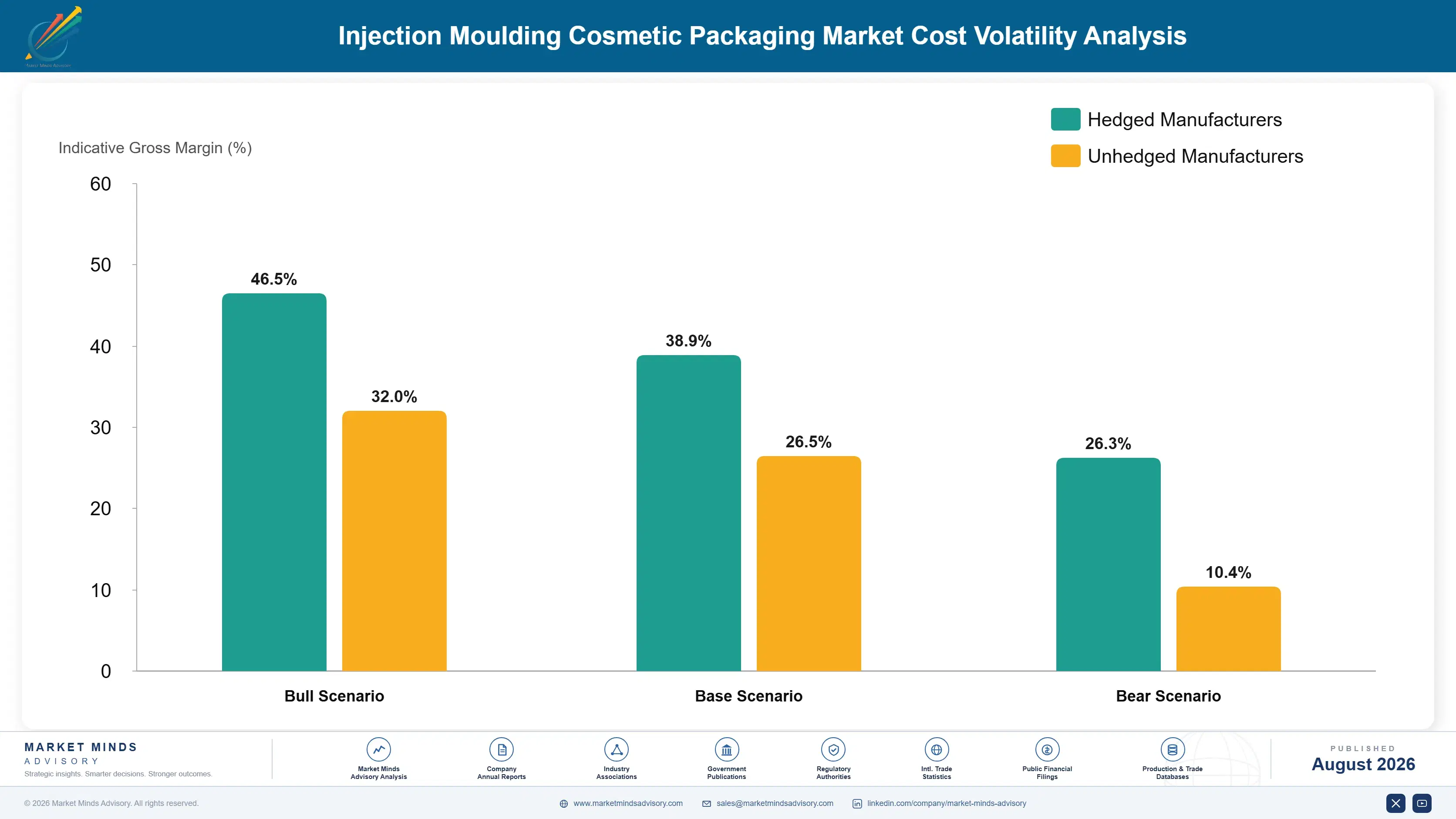
Three inputs carry the cost. Engineering and commodity resins including polypropylene, styrene acrylonitrile, acrylic, and polyethylene terephthalate glycol run about 34% of component cost, bought regionally on published indices. Machine hours, meaning electricity, depreciation, and operator time on the moulding press, add roughly 27%. Tooling amortisation accounts for around 14%, and decoration consumables and labour make up the remainder.
Resin pricing and electricity were the exposures that bit. Styrenic and acrylic grades moved sharply through the recent period on feedstock and capacity changes, and EIA reporting on petrochemical markets documents the underlying movements. Electricity mattered more than moulders expected, since thick-wall cosmetic parts hold the press far longer per shot than thin-wall parts and the energy per component follows directly. European moulders absorbed both while Asian competitors did not.

The competitive disadvantage mechanism runs through cycle time rather than purchasing. A moulder running 3.2 millimetre walls pays for thirty-one extra seconds of press time and electricity on every single shot, while one who redesigned to concentrate mass in the base pays for far less. Resin exposure is broadly shared across the industry. Small moulders without design capability to challenge a brand's wall specification carry the full penalty permanently.
injection-moulding-cosmetic-packaging-market-cost-volatility-analysis-1787299370598

Challenge wall specification at the design stage every time

Thirty-one seconds of additional cycle time on every shot compounds across millions of parts and shows up as both electricity cost and as lost machine capacity. Concentrating mass where the hand actually registers it while thinning elsewhere preserves the perception a brand is genuinely buying, and the tool has to be cut that way.

Contract resin annually with quarterly index-linked review

Styrenic and acrylic grades move on cycles a moulder cannot influence, and buying spot through a volatile period exposes fixed component pricing directly. Annual volume commitments with quarterly index review convert that into a known exposure. Resin producers offer these readily because they value volume certainty, and smaller moulders routinely fail to ask for them at all.

Meter energy per component rather than per moulding machine

Moulders track electricity by machine and rarely by part, which hides how much thick-wall cosmetic components actually consume relative to everything else running in the shop. Measuring energy per component makes the cycle time penalty visible in a currency brands understand. It also identifies which programmes are genuinely unprofitable once press time is costed properly.

Portfolio Architecture for Margin Defence

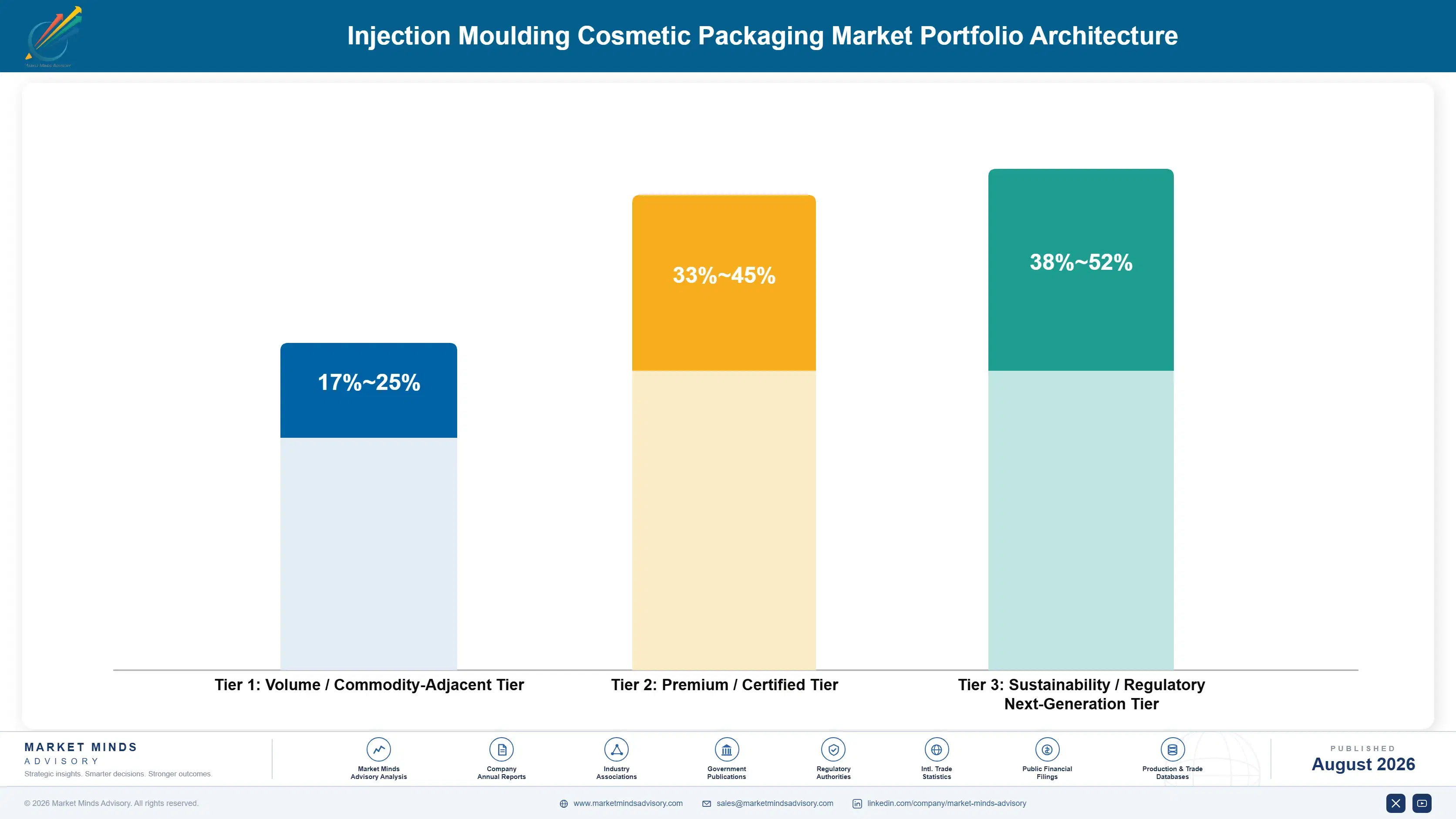
Three tiers describe this business and the margin spread reflects decoration and surface capability rather than moulding difficulty. Standard closures and simple containers sit at the bottom, competing on piece price against every moulder with a suitable press. Decorated prestige components sit considerably higher, protected by in-house finishing and surface standards. And refill systems, proprietary mechanisms, and validated recycled-content components occupy a third tier where very few supplie
The tension is that standard work fills the presses. A moulding shop running below capacity carries machine depreciation across fewer parts, and cosmetic campaigns are seasonal and short. Several moulders repositioned toward prestige decoration exclusively and found presses idle between launches, with cost per component rising across everything they made. Cosmetic campaigns are seasonal and short by nature across the whole shop.

High-value pools concentrate where the moulder controls an interface or a capability the brand cannot source elsewhere. Refill mechanisms and recycled surface quality both fit that description precisely. Neither can be sourced from a commodity moulder anywhere, which is exactly what makes them defensible.

Volume / Commodity-Adjacent Tier

Standard closures, simple jars, and undecorated components supplied on piece price to mass and private label brands. Thin margin against every moulder with a suitable press, and the volume that keeps machine hours loaded between prestige campaigns.
Gross Margin: 17-25%

Premium / Certified Tier

Decorated prestige components with metallisation, lacquer, and hot stamping applied in house to Class A surface standards. Margin reflects finishing capability and surface control rather than any difference in the resin or the moulding itself.
Gross Margin: 33-45%

Sustainability / Regulatory / Next-Generation Tier

Refill system components with proprietary interfaces, precision stick mechanisms, and validated recycled-content parts meeting cosmetic surface standards. Best margin because very few moulders can supply them and brands face commitments they must meet.
Gross Margin: 38-52%
injection-moulding-cosmetic-packaging-market-portfolio-architecture-1787299371091

High-value Sub-segments and Strategic Watch-out

Refill System Components

Best margin and fastest growth at 9.6%, converting one pack sale into an outer plus a recurring insert stream worth roughly 45% more where the interface cannot be copied. Brands increasingly specify proprietary interfaces themselves to protect their own refill revenue. Outer tooling is elaborate and therefore genuinely defensible.
Gross Margin: 38-52%

Decorated Prestige Components

Strong margin from in-house finishing that adds 40 to 60% to realised price while adding considerably less to cost. Chinese moulders have closed the surface quality gap on all but the most demanding prestige work, which is compressing this tier steadily. Subcontracting hands that uplift away to somebody else.
Gross Margin: 33-45%

Standard Closures And Containers

The volume core at thin margin under competition from every moulder holding a suitable press, and the loading that makes machine economics work at all. Moulders who repositioned toward prestige exclusively found presses idle between seasonal launches. Cost per component rose across everything they made.
Gross Margin: 17-25%

Validated Recycled Content Parts

The strategic watch-out and opportunity together, since brand commitments are arriving faster than material capability and rejection runs at 18% on cosmetic surfaces. Dedicated compounding costs around 4 million dollars and almost nobody has invested in it. Brand commitments are arriving faster than material capability.
Gross Margin: 31-46%

Why Tooling Holds the Account

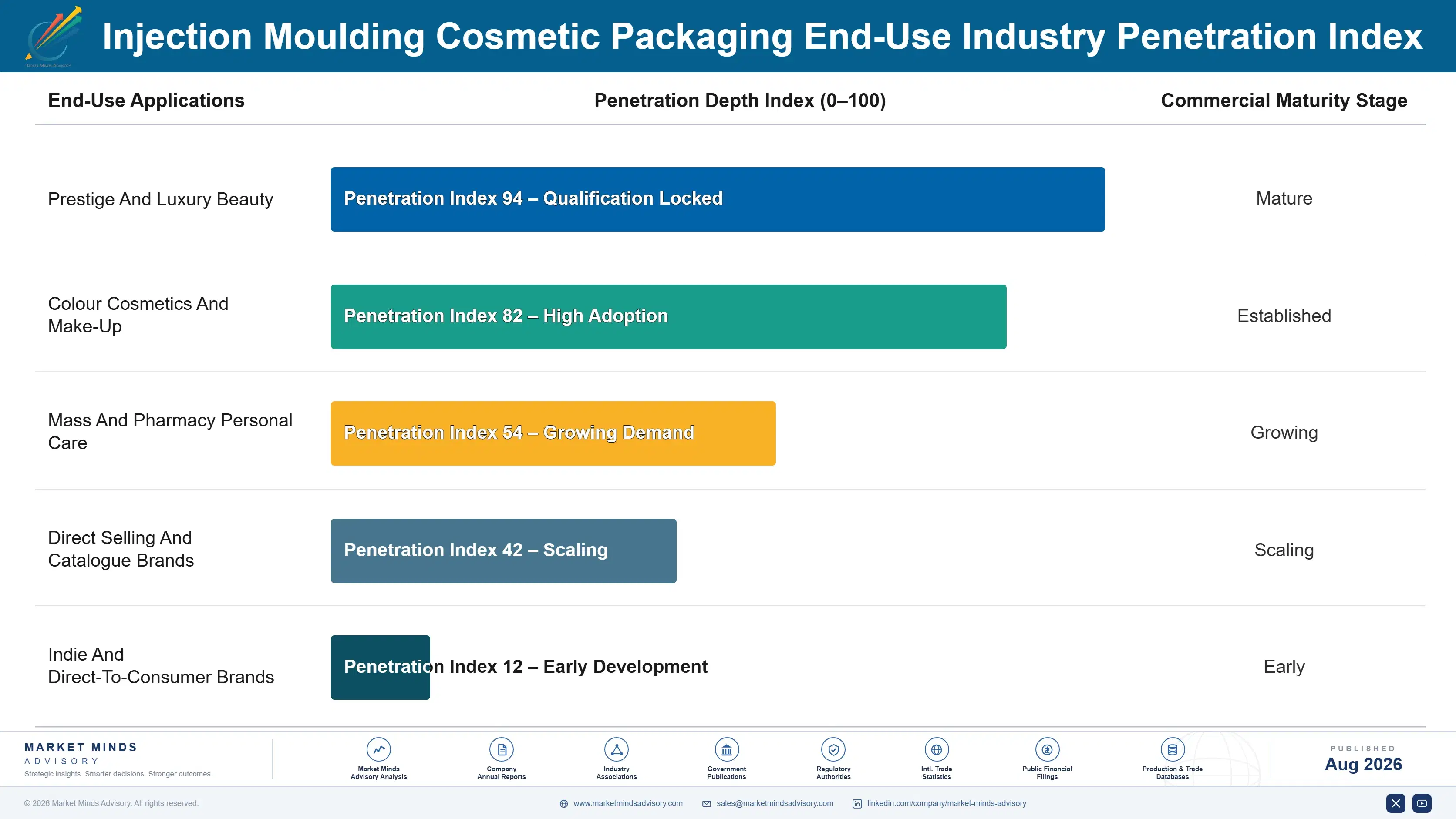
Component programmes run for the commercial life of a product, and what holds them is the mould rather than the contract. A multi-cavity cosmetic tool takes fourteen weeks and costs six figures, so switching moulder mid-programme means new tooling and a quarter of delay that no brand accepts willingly. Whoever funded the tool therefore controls the relationship, which is why tooling ownership is negotiated harder than piece price and discussed considerably less openly.
Depth of relationship varies sharply by brand type. Prestige houses run bespoke tooling, audit surface standards relentlessly, and hold suppliers across product generations. Indie and direct-to-consumer brands launch small and need shared or standard tooling with custom decoration instead. Mass brands buy stock components on price and switch readily. Direct selling houses in Brazil and elsewhere behave differently again, prioritising transit durability over decoration entirely, which makes them the hardest accounts to serve profitably.

Buyer profiles are shifting as sustainability functions gain influence over decisions packaging development previously owned alone. Recycled content percentages now arrive as fixed requirements rather than as aspirations to be discussed. Packaging development is being consulted rather than deciding, and moulders have been slow to notice.
injection-moulding-cosmetic-packaging-market-end-use-penetration-index-1787299371579

What We Would Tell a Board

These are among the four positions where our research anticipates prominent divergence between winners and laggards over the coming forecast period. Each is grounded in the demand model, the regulatory perimeter, and the announced capacity pipeline.
01 / TOOLING CAPITAL STRATEGY

Fund the mould or compete on piece price forever

A multi-cavity cosmetic tool costs around 9,400 dollars per cavity and takes fourteen weeks, and the party who paid for it controls whether production can move when the contract comes up for renewal. Moulders funding tooling against multi-year volume commitments hold accounts that price competition alone cannot dislodge, while those insisting the brand pays are effectively re-tendering their own business every cycle. Amortisation floors and buyout clauses both manage the genuine capital risk that an early programme termination would otherwise create.
02 / CYCLE TIME RECOVERY

Keep the weight, lose the wall, recover the press

Cosmetic jars run at around 3.2 millimetres because heaviness signals quality to the hand, and that thickness adds roughly thirty-one seconds to every single cycle. Concentrating mass in the base where the customer actually registers it, while thinning walls and adding internal ribbing, preserves the perception and recovers 30 to 40% of cycle time. Machine hours are the binding constraint in any busy moulding shop, so recovered cycle time converts directly into capacity that costs nothing at all to add.
03 / RECYCLED SURFACE CAPABILITY

Nobody has solved specks on a Class A surface

Post-consumer resin fails cosmetic surface inspection at around 18% against low single digits on virgin, because colour drift and contamination specks both show clearly on the polished finishes that brands specified years before making any recycled content commitment. Dedicated compounding with tightened input specification and calibrated pigment masking costs roughly 4 million dollars to establish as a capability. It converts a yield loss that moulders currently absorb silently into a capability that brands will pay a genuine premium to access.
04 / REFILL INTERFACE OWNERSHIP

The insert stream is where refill value actually sits

A refillable pack sells the outer once and the insert repeatedly, and that recurring insert revenue is worth roughly 45% more in lifetime component value wherever the interface cannot be copied by a third party. Design registration and tooling that nobody else will fund are what actually protect that stream, rather than the moulding capability itself ever could. Brands increasingly specify proprietary interfaces without being asked at all, because they face precisely the same substitution risk on their own refill revenue.

Engagement Snapshot From the Field

A live engagement with an industry participant carrying material or product regulatory and market exposure ahead of a defining policy shift, showing how our research translates into a defensible multi-year portfolio strategy.
MARKET MINDS ADVISORY · CLIENT ENGAGEMENT SUMMARY
Injection Moulding Cosmetic Packaging Producer Strategic Portfolio Review and Transition Roadmap 2026·Investment Scenario on Injection Moulding Cosmetic Packaging Exposure Evaluation 2025-26
CLIENT PROFILE
A European cosmetic component manufacturer with approximately 240 million dollars in annual revenue (client-reported, unverified by MMA), moulding jars, closures, and compacts for prestige and masstige brands across Europe and North America. The company required brands to fund all tooling, subcontracted metallisation and lacquering, and had absorbed rising rejection rates on recycled content programmes without renegotiating any of them.
STRATEGIC CHALLENGE
Margin had fallen for two years while volumes held, and the company had lost three prestige programmes at renewal to competitors quoting lower piece prices. Recycled content work was running at a loss nobody had quantified. Management proposed further price reductions to defend the remaining accounts, and the board wanted independent assessment first.
MMA APPROACH
We reconstructed programme profitability including press hours and rejection, benchmarked decoration margin retained against subcontracted across seven comparable moulders, and modelled tooling funding scenarios against account tenure across the client's own history. Wall thickness on the principal jar programmes was analysed against achievable cycle time at equivalent perceived weight. Rejection data was reconstructed from production records.
KEY FINDINGS
  1. All three lost programmes had been brand-funded tooling, and the winning competitors had simply used the existing moulds, which the brands owned outright and moved freely.
  2. Recycled content programmes were running at rejection near 21% and had never been repriced, making them the least profitable work in the portfolio by a considerable margin.
  3. Subcontracted decoration was returning roughly eight percentage points of margin against the twenty-three points that integrated comparables retained on equivalent decorated volume.
  4. Wall thickness on the two largest jar programmes exceeded what perceived weight required, with base-weighted redesign offering around 34% cycle time reduction at unchanged hand feel.
CLIENT PROFILE
A European cosmetic component manufacturer with approximately 240 million dollars in annual revenue (client-reported, unverified by MMA), moulding jars, closures, and compacts for prestige and masstige brands across Europe and North America. The company required brands to fund all tooling, subcontracted metallisation and lacquering, and had absorbed rising rejection rates on recycled content programmes without renegotiating any of them.
STRATEGIC CHALLENGE
Margin had fallen for two years while volumes held, and the company had lost three prestige programmes at renewal to competitors quoting lower piece prices. Recycled content work was running at a loss nobody had quantified. Management proposed further price reductions to defend the remaining accounts, and the board wanted independent assessment first.
MMA APPROACH
We reconstructed programme profitability including press hours and rejection, benchmarked decoration margin retained against subcontracted across seven comparable moulders, and modelled tooling funding scenarios against account tenure across the client's own history. Wall thickness on the principal jar programmes was analysed against achievable cycle time at equivalent perceived weight. Rejection data was reconstructed from production records.
KEY FINDINGS
  1. All three lost programmes had been brand-funded tooling, and the winning competitors had simply used the existing moulds, which the brands owned outright and moved freely.
  2. Recycled content programmes were running at rejection near 21% and had never been repriced, making them the least profitable work in the portfolio by a considerable margin.
  3. Subcontracted decoration was returning roughly eight percentage points of margin against the twenty-three points that integrated comparables retained on equivalent decorated volume.
  4. Wall thickness on the two largest jar programmes exceeded what perceived weight required, with base-weighted redesign offering around 34% cycle time reduction at unchanged hand feel.
RECOMMENDED STRATEGY
Phase 1: Phase 1 (months one to six): reprice recycled content programmes against measured rejection and offer tooling funding on renewal for the largest accounts. Phase 2: Phase 2 (months six to twenty-one): acquire or build metallisation and lacquering capability in order to retain decoration margin internally. Phase 3: Phase 3 (months twenty-one to thirty-six): present base-weighted redesigns to jar customers as sustainability improvements with the cycle benefit retained.
OUTCOME
The client repriced its recycled work and introduced tooling funding at renewal, retaining two accounts that had signalled they were testing the market. Decoration integration was approved and commissioned within the year, and margin recovered above prior levels without any change in piece pricing (client-reported, unverified by MMA).

Frequently Asked Questions

Foundational context covering the market sizes, CAGR, scope, country, region and competition that inform every finding below. This section is provided to cover basics and most often pre-purchase conversations, answered from the MMA Primary Research Dataset.

What is the current size of the Injection Moulding Cosmetic Packaging Market?

The market is valued at USD 6.8 billion in 2025, rising to USD 7.24 billion in 2026. Decoration adds 40 to 60% to realised component price.

How large will the Injection Moulding Cosmetic Packaging Market be by 2036?

MMA forecasts USD 13.45 billion by 2036, an increase of USD 6.21 billion over the 2026 base. That represents an expansion multiple of 1.86 times.

What is the CAGR for the Injection Moulding Cosmetic Packaging Market 2026 to 2036?

The base case CAGR is 6.4%, with a bull case of 7.6% and a bear case of 5.2%. The historical rate from 2020 to 2025 was 5.1%.

Which segment is growing fastest?

Refillable system components at 9.6%, exactly 1.50 times the market rate. A refill sells the outer once and the insert repeatedly, which improves revenue quality rather than merely volume.

Who are the major companies in the Injection Moulding Cosmetic Packaging Market?

Albea Group, HCP Packaging, Quadpack, AptarGroup, and Toly Group lead on annual moulded component volume. The top five hold only 23% of a highly fragmented market.

Which country is growing fastest?

South Korea at 11.2%, driven by compact, cushion, and stick mechanism design that leads globally and by a domestic brand launch cadence nobody else matches. Korean specialists also supply Western prestige brands.

Report Segmentation Architecture

The full report scope spans multiple orthogonal segmentation dimensions, with cross-tabulated demand data provided for each dimension pair. Coverage extends further to regional breakdowns, trend trajectories, and the competitive detail needed to support segment-level decision-making.

By Moulded Component Type

  • Caps, Closures And Overcaps
  • Jars And Rigid Containers
  • Compacts, Palettes And Cases
  • Lipstick And Stick Mechanisms
  • Refillable System Components
  • Applicator And Wand Components

By End-Use Industry

  • Prestige And Luxury Beauty
  • Colour Cosmetics And Make-Up
  • Mass And Pharmacy Personal Care
  • Direct Selling And Catalogue Brands
  • Indie And Direct-To-Consumer Brands

By Commercial Model

  • Bespoke Tooled Development Programmes
  • Standard Tooling With Custom Decoration
  • Stock Component Catalogue Supply
  • Contract Moulding For Brand-Owned Tools

By Region

  • East Asia
  • South Asia and Pacific
  • North America
  • Western Europe
  • Latin America
  • Middle East and Africa
  • Eastern Europe

Scope, Methodology, and Coverage

Every figure in this report is reproducible from documented input assumptions. The scope below maps the historical period, the forecast horizon, the segmentation dimensions, and the countries covered, alongside the underlying primary and qualitative methodology.
Historical Period
2020 to 2025
Forecast Period
2026 to 2036
Base Year
2025 (USD billions; MMA Primary Research Dataset, August 2026)
Market Definition
This market comprises injection moulded components supplied to cosmetic and personal care products, measured at moulder realised prices inclusive of applied decoration and assembly. Component coverage spans caps, closures and overcaps, jars and rigid containers, compacts, palettes and cases, lipstick and stick mechanisms, refillable system components, and applicator and wand components across all brand tiers. Glass primary containers, dropper and pipette assemblies, dispensing pumps and airless systems sold separately, extruded tubes and flexible packaging, secondary cartons, formulation, and contract filling services fall outside scope.
Quantitative Units
USD billions (current prices); million components moulded annually; realised price per component
Segmentation Dimensions
By Moulded Component Type; By End-Use Industry; By Commercial Model; By Region
Regions Covered
East Asia, South Asia and Pacific, North America, Western Europe, Latin America, Middle East and Africa, Eastern Europe
Countries Covered
China, South Korea, Japan, Taiwan, India, Indonesia, Thailand, Vietnam, Australia, France, Italy, Germany, Spain, UK, Netherlands, Poland, Turkey, USA, Canada, Mexico, Brazil, Argentina, Colombia, Saudi Arabia, UAE, Egypt, Morocco, South Africa, Switzerland, and additional markets relevant to this sector
Key Companies Profiled
Albea Group, HCP Packaging, Quadpack, AptarGroup, Toly Group, Silgan Dispensing Systems, Berry Global, Cosmopak, Fusion Packaging, Yonwoo, Samhwa, Baralan, Lumson, Virospack, Shya Hsin Packaging, Weener Plastics, Gerresheimer, Rieke, Nissha, Raepak
Quantitative Methodology
Primary survey, n=3,800 respondents, Q4 2025, six countries; demand-side model with trade association cross-validation
Qualitative Methodology
47 expert interviews, Q4 2025; applied to validate demand model assumptions, identify emerging dynamics, and assess competitive positioning
Report Format
PDF and XLSX data workbook (Word format preview document)
Publisher
Market Minds Advisory
Report Code
MMA-2026-PAC-336
Published
August 2026
Contact
sales@marketmindsadvisory.com | www.marketmindsadvisory.com

Purchase the full Injection Moulding Cosmetic Packaging Market Report (2026 to 2036).

The full report sizes injection moulded cosmetic packaging across six component types, five brand categories, four commercial models, and seven regions, with country detail for the twenty largest national markets. Recycled resin rejection rates are documented by surface finish and resin grade, since that conflict is the defining technical problem in the category today. Tooling cost, lead time, and ownership practice are benchmarked across supplier types and brand tiers. Competitive profiling covers twenty moulders on annual component volume. Cycle time and energy per component are modelled against wall thickness specification.
Recycled resin rejection documented by surface finish and grade
Tooling cost, lead time, and ownership practice benchmarked by tier
Cycle time and energy modelled against wall thickness specification
Decoration margin retained versus subcontracted across supplier types
Refill interface architecture compared across proprietary systems
Asian and European surface quality capability assessed by application

Built For The People Who Decide

From boardroom strategy to bench-side execution, this report is read cover-to-cover by leaders shaping the next decade of their industry, turning demand scenarios, market dynamics and valuation benchmarks into decisions.
CXOs/ Presidents/ VPs/ Managers
M&A and Corporate Development
Strategy Teams and R&D Heads
Procurement and Product Directors
Regulatory and Compliance Leaders
Investor Relations and Equity Analysts