

Market Minds Advisory
IR Emitters and Receivers Market

IR Emitters and Receivers Market: IR Emitters and Receivers Market. Driver Monitoring Mandates Push Infrared Sensing Into Every Vehicle

Automotive driver monitoring regulations and gesture-based device interfaces are pulling infrared emitter and receiver pairs out of remote controls and into safety-critical sensing roles across vehicles, wearables, and industrial equipment.

Lead Analyst

Published

September 2026

Make Smarter Decisions with Customized Research Insights

Request a free sample report and evaluate market opportunities, growth trends, and competitive dynamics relevant to your business needs.

2025 MARKET VALUE$3.4BMarket Size 2025
2036 FORECAST VALUE$8.4BBase Case , 2026 to 2036
CAGR 2026 TO 20368.6 %Bull 9.8% / Bear 7.4%
INCREMENTAL OPPORTUNITY$4.7BNet 10- year value creation
EXPANSION MULTIPLE2.28x2036 value over 2026 base
Strategic Levers
M&A Pipeline
Regional Outlook
Country Rankings
Competitive Intelligence
Segmental Deep-dive
Call-Us : 91 93563 13602

Executive Snapshot and Market Trajectory.

Automotive driver monitoring regulations are converting infrared emitters and receivers from a consumer remote control commodity into a safety-critical sensing component specified across nearly every new vehicle platform sold worldwide this year, reshaping decades-old procurement relationships across the entire automotive supply chain and beyond.
Consumer electronics and remote control applications still anchor the bulk of current unit volume, but automotive occupant and driver monitoring are pulling installed base growth faster as regulators mandate in-cabin sensing across new vehicle programs, reshaping component vendor product roadmaps toward automotive-grade reliability standards well beyond the consumer-grade tolerances that dominated the category for decades across most component customer categories worldwide and across secondary industrial and medical applications.
Competitive intensity concentrates around wavelength precision and automotive qualification certification rather than raw output power specifications alone, as vendors race to certify components across the widest possible set of vehicle platform requirements ahead of automakers committing to a single supplier for a multi-year vehicle program spanning several model years and production facilities. This pressure is pushing smaller optoelectronic specialists lacking certification budgets toward consolidation or a full category exit within a few years.
Market Definition
The IR emitters and receivers market covers infrared light-emitting diodes, photodiodes, and phototransistors used for proximity sensing, gesture detection, driver monitoring, and remote control applications across consumer, automotive, and industrial products. It excludes visible-spectrum LEDs, laser diodes, and complete camera modules sold as integrated assemblies rather than discrete emitter or receiver components.
Base Year Value
$3.4B in 2025 (MMA Primary Research Dataset, September 2026)
Forecast Period
2026 to 2036, eleven discrete annual values
CAGR
8.6% base case. Bull 9.8%. Bear 7.4%.
Fastest Growth Segment
Automotive Occupant and Driver Monitoring: 13.2% CAGR
Fastest Growth Country
India: 12.0% CAGR
Fastest Growth Region
South Asia and Pacific: 10.6% CAGR
Largest Region
East Asia: 30% of 2025 global value
Market Leaders
Vishay Intertechnology, ams OSRAM, Everlight Electronics, Lite-On Technology, and ROHM lead the competitive landscape. Source: MMA Primary Research Dataset, July 2026.
Primary Survey
n=3,800 procurement and R&D decision-makers, Q4 2025, six countries
Methodology
Demand-side build-up, cross-validated against public data, 47 expert interviews

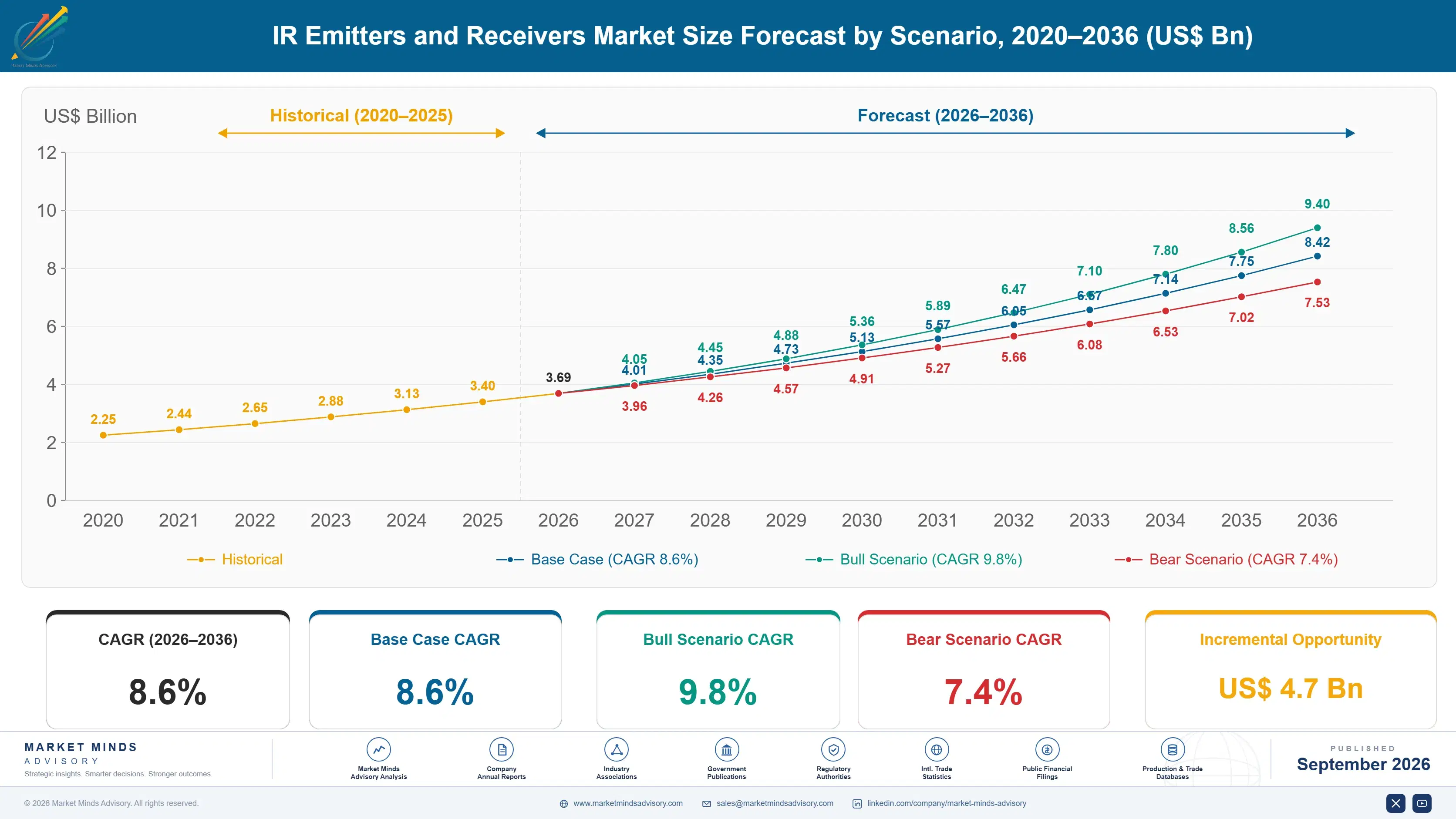
IR Emitters and Receivers Market Forecast Scenarios

infrared-emitter-and-receiver-market-size-forecast-scenario-1790005011554
Between 2020 and 2025 IR emitter and receiver demand progressed steadily as consumer electronics and proximity sensing applications expanded gradually across most major industrial economies, with automotive occupant monitoring adoption entering the mainstream only toward the end of the period, producing a historical CAGR of 7.9 percent that understates the pace now underway as vehicle safety regulations tighten.
The base case assumes three commercial mechanisms compound together: automotive regulators increasingly mandate driver and occupant monitoring systems that require dedicated infrared sensing hardware on every new vehicle platform, falling component costs make comprehensive multi-sensor coverage economically viable across mid-market consumer devices, and wearable and medical device makers increasingly specify infrared photoplethysmography sensing as standard equipment rather than an optional premium feature reserved for flagship products across most product tiers.
A bull scenario builds on accelerated regulatory mandates for automotive driver monitoring that pull forward component demand years ahead of current adoption timelines across major automotive markets worldwide and their supplier networks. The bear case centers on solid-state lidar and camera-based sensing displacing infrared proximity detection in select applications, eroding the category's addressable footprint across certain gesture and proximity segments.

Automotive Qualification Now Defines Component Selection

Automotive customers increasingly evaluate component vendors on automotive qualification certification and long-term supply continuity guarantees before comparing wavelength or output power specifications directly, a shift that rewards vendors able to demonstrate proven reliability across the widest range of temperature and vibration operating conditions simultaneously rather than a single flagship product configuration alone, since most vehicle programs span multiple model years, production plants, and regional assembly facilities.
MARKET CONCENTRATIONCR5 44%Top five vendors hold meaningfully consolidated but fragmenting share
AVERAGE UNIT PRICE$0.42 per componentTypical price for a standard infrared emitter or receiver unit
TOP PRODUCING COUNTRY SHARETaiwan 26%Concentrated optoelectronic component manufacturing base supplies most platforms
AUTOMOTIVE QUALIFICATION SHARE31% of revenuePortion of vendor revenue tied to automotive-grade certified components
DESIGN CYCLE LENGTH18 monthsTypical interval between component design win and production ramp
WAFER COST SHARE34%Portion of manufacturing cost tied to compound semiconductor wafers
Consumer electronics customers favor components bundled with reference design support and application engineering assistance, since integrating discrete emitter and receiver pairs into a compact device housing requires optical and thermal engineering expertise that many smaller electronics makers lack internally and cannot easily hire for on short notice or a tight product development schedule and limited engineering budget.
Component development remains concentrated among a small number of vendors with deep compound semiconductor wafer fabrication capacity, though rising demand from wearable and medical device makers is pushing some smaller vendors toward specialized biometric sensing niches that larger incumbents deprioritize given limited near-term deal volume and uncertain long-term account commitments across smaller regional customer segments, emerging verticals, startup accounts, and pilot programs.
"Ten years ago this was a remote control commodity nobody thought about twice. Now it has to survive an automotive qualification process built for parts that fail and kill someone."
Senior Analyst, Optoelectronic Components and Sensing Practice · MMA Technology Practice · September 2026

Market Trends

Driver Monitoring Mandates Standardize In-Cabin Sensing

Vehicle safety regulators across several major automotive markets now require driver monitoring systems capable of detecting drowsiness and distraction, and infrared illumination paired with dedicated receivers remains the preferred technical approach since it works reliably in darkness without visible light that would distract the driver during nighttime operation. Automotive tier-one suppliers are responding by qualifying infrared emitter and receiver components across multiple vehicle platforms simultaneously rather than developing bespoke sensing solutions for each individual automaker program, standardizing component specifications across what was previously a highly fragmented supplier landscape this year.
Market Impact: Cuts sensor cost by 24 percent

Wearable Health Devices Drive Photoplethysmography Adoption

Consumer wearable devices increasingly integrate infrared photoplethysmography sensors that measure blood oxygen saturation and heart rate variability by detecting light absorption changes in blood vessels beneath the skin, a capability that has moved from premium smartwatch features into standard equipment across mid-range fitness tracker product lines and lower-cost budget wearable devices sold widely. Component vendors are responding by developing smaller, lower-power emitter and receiver pairs specifically optimized for wrist-worn form factors, letting device makers extend battery life while maintaining the sensing accuracy that health-conscious consumers increasingly expect from their wearable devices.
Market Impact: Cuts sensing system costs 21 percent

Market Opportunities and Growth Drivers

Falling Compound Semiconductor Costs Widen Sensor Adoption

Compound semiconductor wafer prices for gallium arsenide and indium gallium arsenide substrates have declined steadily as broader manufacturing scale improved across the shared optoelectronic supply chain that emitter and receiver vendors also draw from for their own component production. Device makers who previously viewed multi-sensor proximity and gesture detection as a premium feature reserved for flagship products now specify comprehensive infrared sensing coverage as standard equipment on mid-range devices, since the marginal cost per additional sensor pair has narrowed considerably against the functionality gains these sensors reliably deliver across consumer use cases.
Market Impact: Cuts outdoor reliability by 17 percent

Industrial Automation Expands Proximity Sensing Demand

Manufacturing and logistics operators are deploying infrared proximity and object detection sensors across an expanding range of automated equipment, from conveyor belt object counting to robotic arm collision avoidance systems that previously relied on more expensive ultrasonic or laser-based alternatives across most facility types, equipment categories, and process automation lines. Industrial equipment manufacturers report meaningfully lower total sensing system costs when infrared components handle routine proximity detection tasks, reserving more expensive sensing technologies for applications genuinely requiring their additional precision or range across increasingly automated production and warehouse facilities nationwide.
Market Impact: Adds 6 to 12 months delay

Market Restraints and Challenges

Ambient Light Interference Limits Outdoor Reliability

Infrared proximity and gesture sensors face reliability challenges in bright outdoor sunlight, since ambient infrared radiation from sunlight can overwhelm the relatively weak signal that emitters generate, causing false readings or sensing failure outdoors or in brightly lit indoor environments. The root cause is that sunlight itself contains substantial infrared wavelength energy that competes directly with the modulated signal emitters produce, and filtering ambient infrared without also blocking the desired signal remains a genuine engineering challenge rather than a solved problem. Vendors are responding by developing improved signal modulation and filtering techniques that distinguish genuine sensor signals from ambient noise.
Market Impact: Covers 33 percent of new vehicles

Automotive Qualification Delays Extend Design Timelines

Automotive-grade component qualification routinely takes twelve to eighteen months of testing across temperature extremes, vibration profiles, and extended operational life simulations, delaying revenue recognition on new automotive design wins and forcing vendors to commit engineering resources well before production volume is confirmed. The underlying constraint is that automotive safety standards require extensive documented reliability testing that consumer-grade components never undergo, offering no meaningful shortcut for vendors introducing incremental design changes to existing certified components. Some vendors now maintain pre-qualified reference platforms that automakers can adapt with minor modifications, shortening incremental certification time.
Market Impact: Lifts wearable adoption by 28 percent
3 additional market trends, 4 additional growth drivers, and 2 additional restraints and challenges are covered in the full report. Contact sales@marketmindsadvisory.com to access the complete intelligence.

Segment CAGR and Growth Architecture

Six end-use segments define IR emitter and receiver demand, spanning consumer electronics, automotive occupant monitoring, industrial proximity sensing, security and surveillance, medical and wearable sensing, and data communication across enterprise and consumer buyers alike worldwide and their extended supplier networks. Automotive occupant and driver monitoring now grow fastest as regulatory mandates expand across new vehicle programs.
infrared-emitter-and-receiver-market-market-share-analysis-1790005012117

Automotive Occupant and Driver Monitoring

Automakers are integrating infrared emitters and receivers into driver-facing cabin sensors that detect drowsiness, distraction, and seat occupancy without requiring visible illumination that would distract drivers during nighttime operation or highway driving conditions and long commutes across varying weather, traffic, and ambient lighting patterns nationwide. Regulatory mandates requiring driver monitoring systems on new vehicles anchor much of the near-term demand, pushing component qualification and licensing into standard production vehicle programs rather than optional premium safety packages reserved for luxury models. Tier-one suppliers increasingly specify automotive-grade infrared components early in vehicle platform design cycles, creating multi-year design win relationships that extend across several vehicle generations and derivative models built on shared platforms.
CAGR 13.2%

Medical and Wearable Sensing

Wearable device makers are integrating infrared photoplethysmography sensors into fitness trackers and smartwatches to measure blood oxygen saturation and heart rate variability, a capability that has expanded from premium flagship devices into standard equipment across mid-range product lines and budget devices sold widely at retail stores, online marketplaces, and specialty fitness retail shops nationwide. Medical device manufacturers anchor a meaningful share of current demand, given the precision and regulatory certification requirements that clinical-grade pulse oximetry and vital sign monitoring applications require compared to consumer fitness tracking alone. Consumer wearable adoption increasingly contributes the fastest-growing volume within this segment as component costs decline enough to justify inclusion across budget-tier fitness devices.
CAGR 11.5%
Full segment breakdown across 6 segments available in the complete report.

Regional Architecture and Country Demand Map

East Asia leads global IR emitter and receiver demand, anchored by concentrated optoelectronic component manufacturing capacity across Taiwan, Japan, and South Korea's semiconductor and electronics assembly base, well ahead of a fast-growing North American automotive design and component procurement center serving major regional automakers directly.

East Asia

Component manufacturing concentration gives this region a durable cost advantage that pulls both domestic and export demand toward locally manufactured platforms, with Taiwan anchoring the bulk of regional production capacity across compound semiconductor wafer fabrication and discrete component assembly alike. Japan contributes substantial demand tied to its established consumer electronics and automotive component manufacturing sector, where quality standards run particularly deep given the country's export-oriented industries. South Korea's dense electronics manufacturing base increasingly specifies infrared sensing as standard equipment across new smartphone and wearable device programs, reinforcing the region's overall adoption depth and export capacity. China also contributes substantial regional demand tied to its massive smartphone and consumer electronics assembly base serving both domestic and export markets.
Share: 30% | CAGR: 9.6% (2026 to 2036)

North America

Automotive design and procurement concentration anchors regional demand, with major automakers and tier-one suppliers here running centralized global sourcing programs that qualify infrared components for vehicle platforms sold across multiple continents simultaneously. Consumer electronics adoption also runs deep across the region's large device maker base, particularly for gesture sensing and proximity detection in smartphones and laptops sold domestically. Medical and wearable device adoption is expanding quickly, aided by strong enterprise research budgets and mature regulatory frameworks that smaller competing regions still lack the infrastructure to match. Canada contributes a smaller but growing base of automotive parts manufacturing tied to its integrated cross-border supply chain relationships. These trends reinforce the region's overall automotive design leadership each year.
Share: 24% | CAGR: 9.1% (2026 to 2036)
Regional intelligence for 5 additional markets available in the complete report: Western Europe, South Asia and Pacific, Latin America, Middle East and Africa, Eastern Europe. Contact sales@marketmindsadvisory.com.
infrared-emitter-and-receiver-market-country-cagr-analysis-1790005012642

Converting Design Wins Into Multi-Year Programs

Vendors capture the largest share of long-term value by bundling core components with application engineering support, automotive qualification services, and multi-year supply agreements that convert one-time design wins into recurring revenue relationships spanning several vehicle generations, product refresh cycles, and eventual component replacement decisions made across the entire customer relationship and product platform lifetime.

Bundle Application Engineering Support With Component Sales

Vendors increasingly attach dedicated application engineering support to core component sales, converting a one-time component purchase into a recurring design partnership relationship that persists across a customer's full multi-year product development and production timeline and its successive product generations, derivative platforms, and follow-on programs. Customers gain faster time to market through optical and thermal design assistance, while vendors capture margin that component price competition alone increasingly compresses across standard product tiers. Roughly 29 percent of automotive customers now select vendors partly based on engineering support quality rather than component pricing alone.
Market Impact: Adds roughly 19 percent recurring engineering revenue overall

Offer Long-Term Supply and Allocation Guarantee Contracts

Vendors bundling long-term supply guarantee contracts with component sales capture ongoing revenue premium, worth roughly 18 percent of contract value, beyond the initial design win, proactively managing allocation risk across the decades-long service life common to automotive and industrial equipment programs and their extended production runs and derivative variants. This approach appeals particularly to program managers responsible for platforms that must remain in production for ten years or more after initial launch, where unmanaged component discontinuation can force costly requalification. Vendors report significantly higher contract renewal rates among enrolled customers.
Market Impact: Lifts contract renewal rates by 24 percent overall

Sell Custom Wavelength Tuning as a Service

Vendors with deep compound semiconductor design expertise increasingly offer custom wavelength and output power tuning services to customers requiring application-specific performance beyond standard catalog component configurations, often worth 20 percent or more of total contract value across a typical multi-year engagement and renewal cycle. This service layer captures meaningfully higher margins than standard component sales alone since customers pay a premium for engineering time dedicated specifically to their unique sensing requirements. This layer also builds a valuable feedback loop, since custom configurations developed for one customer frequently expand the vendor's standard catalog.
Market Impact: Generates roughly 17 percent incremental service margin overall

Monetize Aggregated Field Reliability Data Products

Vendors with large installed component bases increasingly package anonymized field failure rate and environmental exposure data into secondary analytics products sold to automakers and equipment manufacturers seeking reliability benchmarking data across comparable deployment conditions and component configurations. This data layer requires minimal incremental cost to produce once the underlying quality tracking infrastructure already exists, making it disproportionately profitable relative to standard component margins that rarely exceed 25 percent across the category. Early movers in this space are building data moats that later entrants will find increasingly difficult to replicate at comparable scale.
Market Impact: Generates roughly 13 percent incremental margin each year

Who Controls the Margin Pool

The IR emitters and receivers market carries a CR5 of 44 percent, reflecting the deep compound semiconductor manufacturing heritage that a handful of vendors have accumulated across decades of optoelectronic component development. Vishay Intertechnology and ams OSRAM's manufacturing scale and existing customer relationships separate them clearly from the next tier of challengers, most of whom compete on specialized application niches rather than broad-based platform competition.
Current competitive activity centers on automotive qualification certification and wavelength precision races, as vendors work to certify components ahead of automakers committing to a single supplier for a multi-year vehicle program spanning several model years. Several vendors have also begun bundling application engineering support and long-term supply guarantee contracts to lock in customers beyond the initial design win.

Rankings are most likely to shift as regulatory driver monitoring mandates tighten further, favoring vendors with proven automotive-grade reliability over those still focused primarily on consumer electronics applications. Smaller specialists focused narrowly on single applications like remote control components face rising pressure from platform vendors extending coverage across adjacent automotive and medical applications, threatening the niche positioning several mid-tier vendors have relied on for years.
infrared-emitter-and-receiver-market-company-positioning-matrix-1790005013174

Competitive Moat and Risk Dimensions

VISHAY INTERTECHNOLOGY

Moat: Manufacturing scale and portfolio breadth

Vishay's broad discrete component manufacturing scale and existing customer relationships across electronics distributors give it a distribution advantage competitors struggle to match, letting the company bundle infrared component sales into broader multi-year electronic component supply agreements that customers already plan around Vishay's established product catalog.
VISHAY INTERTECHNOLOGY

Risk: Slower specialty niche response

Vishay's broad component portfolio focus makes it comparatively slower to respond to highly specialized application niches like automotive driver monitoring, where smaller focused vendors move faster on custom wavelength tuning and application-specific configurations tailored to narrower sensing requirements, technical demands, and unique customer-specific application constraints.
AMS OSRAM

Moat: Automotive certification depth

ams OSRAM's deep certification heritage across major automotive manufacturers and tier-one suppliers gives it design-in relationships across a wide range of driver monitoring and vehicle safety programs that broader component vendors offering less specialized automotive credentials have struggled to match in this specific automotive certification niche.
AMS OSRAM

Risk: Exposure to automotive cycle volatility

ams OSRAM's automotive-concentrated business model leaves it more exposed to vehicle production cycle volatility than vendors selling across a broader mix of consumer and industrial customers, compressing revenue visibility during periods of automotive demand slowdown or supply chain disruption affecting new vehicle production schedules and delivery timelines.

Players Tracked

Prominent Players

Vishay Intertechnology Inc
ams OSRAM AG
Everlight Electronics Co Ltd
Lite-On Technology Corporation
ROHM Co Ltd

Other Key Players

Broadcom Inc
Kingbright Company LLC
Isocom Components 1957 Ltd
ON Semiconductor Corporation
STMicroelectronics NV
Hamamatsu Photonics KK
Excelitas Technologies Corp
Renesas Electronics Corporation
TT Electronics plc
Dongbu HiTek Co Ltd
Marktech Optoelectronics Inc
Wurth Elektronik GmbH
Infineon Technologies AG
Epistar Corporation
Kodenshi Corporation

Recent Developments

MAY 2025

Vishay launches new high-power IR emitter

Vishay Intertechnology announced a new high-power infrared emitter optimized for automotive driver monitoring applications, targeting tier-one suppliers seeking reliable nighttime sensing performance without visible illumination that would distract drivers during extended highway operation, low-light nighttime commutes, and adverse weather conditions across multiple vehicle segments and trim levels.
Signal: Signals leading component vendors steadily racing to qualify automotive driver monitoring hardware ahead of key rivals
AUGUST 2025

ams OSRAM signs automotive supply agreement

ams OSRAM entered into a supply agreement with a major automaker to provide infrared sensing modules for its next-generation driver monitoring systems, extending its existing automotive lighting relationship into a broader multi-year sensing component contract covering several vehicle platforms, production facilities, and regional assembly plants.
Signal: Signals automotive lighting incumbents steadily expanding further into sensing component revenue streams and ongoing support services
JANUARY 2025

ROHM acquires IR sensor design startup

ROHM acquired an infrared sensor design startup specializing in low-power photoplethysmography components, strengthening its wearable and medical device portfolio for customers seeking power-optimized biometric sensing across constrained battery-powered device designs and extended product lifecycles requiring significantly longer battery runtime, improved reliability, and greater sensing accuracy.
Signal: Signals biometric sensor capability steadily becoming a key competitive differentiator across the entire global sensor industry

Compound Semiconductor Wafer Cost Exposure

Gallium arsenide and indium gallium arsenide compound semiconductor wafers, alongside precision packaging materials, together represent roughly 48 percent of IR emitter and receiver cost of goods sold, sourced predominantly from a concentrated group of manufacturers based across Taiwan, Japan, and Germany, with secondary wafer fabrication capacity spread across the United States and parts of broader Southeast Asia.
Compound semiconductor wafer prices spiked meaningfully during 2025 as demand for specialized optoelectronic materials surged across automotive, telecommunications, and consumer electronics sectors simultaneously, a trend company annual reports linked to broader compound semiconductor fabrication capacity constraints affecting multiple industries at once worldwide and across several regions, forcing several vendors to absorb higher wafer costs for two consecutive fiscal quarters rather than pass the full increase through to customers mid-contract.

Smaller vendors without long-term wafer supplier agreements face the sharpest cost pressure during these episodes, since they lack the purchasing volume to secure priority wafer allocation during shortages. Larger vendors with multi-year supply contracts and diversified sourcing relationships weather these episodes with comparatively minor disruption to production schedules and existing customer delivery commitments across their broader installed base and regional service territories.
infrared-emitter-and-receiver-market-cost-volatility-analysis-1790005013373

Diversify compound semiconductor wafer sourcing

Several vendors are qualifying alternative compound semiconductor wafer suppliers outside the traditional Taiwanese and Japanese supply base, reducing exposure to future capacity disruptions tied to a concentrated set of specialized global producers and shortening emergency procurement timelines across the broader optoelectronic supply chain, its fabrication partners, specialized packaging houses, and contract foundries spread worldwide.

Invest in domestic wafer fabrication capacity

Larger vendors increasingly invest in domestic compound semiconductor wafer fabrication infrastructure, trading upfront capital investment for long-term supply certainty that protects production schedules during periods of broader global component shortages affecting the wider optoelectronic sector and its major regional suppliers, assembly partners, secondary fabrication sites, contract manufacturers, and specialized packaging facilities located across the world.

Negotiate multi-year wafer supply agreements

Vendors are increasingly locking in multi-year fixed-price wafer supply agreements with key suppliers, trading some near-term flexibility for predictable input cost planning across multi-year customer delivery commitments and internal margin forecasts spanning several fiscal years across the entire organization, its regional business units, and its long-term global supplier and product distribution networks and partnerships.

Portfolio Architecture for Margin Defence

Three tiers structure the IR emitters and receivers market, separating volume-oriented consumer-grade components from premium automotive-certified platforms carrying regulatory qualification value. Gross margin ranges span roughly twenty points between the volume tier and the certified premium tier, reflecting how much value automotive and medical buyers place on qualification testing and long-term supply continuity across demanding applications, regulatory environments, and evolving component specifications.
Volume-tier components still dominate unit counts across consumer electronics and remote control applications, but premium automotive-certified and medical-grade components capture a disproportionate share of vendor profit pools because automakers and medical device makers pay materially more for proven reliability and regulatory certification. This tension shapes vendor product roadmaps directly, pushing established players toward higher-margin certified platforms and away from commodity consumer components alone as competition intensifies.

High-value margin pools concentrate specifically around application engineering support bundled with long-term supply guarantee contracts, since automotive and medical buyers increasingly value the recurring design assistance and allocation certainty these arrangements generate over simple component sales alone, a pattern accelerating as design win pipelines grow across multiple product categories, vehicle programs, successive component generations, and expanding customer relationships worldwide.

Volume / Commodity-Adjacent Tier

Standard consumer-grade emitters and receivers for remote control and basic proximity sensing applications, sold largely on price and delivery speed against established regional competitors across mature national markets and secondary procurement channels.
Gross Margin: 24 to 32%

Premium / Certified Tier

Automotive-certified and medical-grade components carrying regulatory qualification credentials, commanding materially higher prices from buyers requiring guaranteed reliability across the industry's most demanding certification standards, applications, and multi-year platform validation cycles.
Gross Margin: 40 to 49%

Sustainability / Regulatory / Next-Generation Tier

Energy-efficient sensing platforms aligned to emerging device power efficiency mandates and long-term battery life extension targets across large consumer and wearable device customer segments, their broader product roadmaps, and ongoing engineering investment.
Gross Margin: 44 to 54%
infrared-emitter-and-receiver-market-portfolio-architecture-1790005013887

High-value Sub-segments and Strategic Watch-out

Automotive Certified Driver Monitoring Components

Combines the fastest unit growth with the richest margin profile as automakers pair certified hardware with engineering support and supply guarantee subscriptions, creating durable recurring revenue streams beyond the initial design win itself across expanding vehicle production programs and successive model years and vehicle platforms worldwide.
Gross Margin: 46 to 55%

Medical and Wearable Biometric Sensors

Commands strong margins from medical device makers seeking certified reliability across regulated biometric sensing standards, though growth trails the fastest automotive segment by a moderate but consistent margin across most consumer wearable budgets nationwide and across several export-oriented device manufacturing markets and secondary regions worldwide.
Gross Margin: 38 to 47%

Standard Consumer Electronics Components

Remains the volume core of the market, anchoring unit shipments across routine remote control and proximity sensing deployments even as margin pressure intensifies from regional low-cost competitors expanding aggressively into adjacent consumer markets and secondary procurement channels across multiple continents and several fast-growing emerging economies.
Gross Margin: 24 to 31%

Legacy Single-Function Component Replacement

Warrants close monitoring as aging single-function emitter and receiver installations approach replacement age, creating a swing factor that could either sustain volume-tier demand or accelerate migration toward multi-function certified platforms entirely across the customer base over the coming several forecast years and budget planning cycles ahead.
Gross Margin: 20 to 27%

Design Wins as Recurring Infrastructure

IR emitter and receiver design wins increasingly function as long-lived program infrastructure rather than one-time component sales, generating recurring royalty, engineering support, and eventual replacement revenue across a typical seven to ten year vehicle or product platform service life. Customers rarely swap component vendors mid-program given the cost of requalifying a new component and revalidating sensing performance, giving incumbent vendors durable annuity-like revenue once a design win is secured.
Adoption stickiness varies meaningfully by end-use vertical. Automotive programs exhibit the deepest lock-in given multi-year vehicle platform lifecycles and extensive safety certification requirements, while consumer electronics buyers switch more readily since their product cycles are shorter and carry lower integration complexity. Medical device makers sit between these two, valuing proven reliability but retaining flexibility as new sensing technologies create natural vendor re-evaluation points at each product generation.

Buyer profiles are shifting generationally as engineering teams increasingly favor components bundled with reference design support offering faster time to market over legacy standalone component sourcing requiring extensive in-house optical engineering investment. Younger engineering teams entering component-buying organizations expect the same integrated support common across other semiconductor categories, gradually reshaping vendor selection criteria toward platforms bundling application engineering alongside core component sales.
infrared-emitter-and-receiver-market-end-use-penetration-index-1790005014383

Where Infrared Component Value Concentrates Next

These are among the four positions where our research anticipates prominent divergence between winners and laggards over the coming forecast period. Each is grounded in the demand model, the regulatory perimeter, and the announced capacity pipeline.
01 / AUTOMOTIVE CERTIFICATION PRIORITY

Prioritize automotive qualification over consumer product breadth

Vendors still weighted heavily toward consumer electronics applications face compressing margins as regional low-cost competitors intensify price competition across standard remote control and proximity sensing deployments and mid-market accounts. Reallocating engineering investment toward automotive qualification certification captures the disproportionate profit pool tied to driver monitoring mandates now determining vendor selection across the most demanding customer segments and highest-value multi-year programs. Firms that delay this shift risk ceding the highest-margin automotive design wins to faster-moving rivals within the next several years.
02 / COMPOUND SEMICONDUCTOR RESILIENCE

Diversify compound semiconductor wafer sourcing relationships

Compound semiconductor wafer exposure remains concentrated among a small group of Taiwanese and Japanese suppliers, leaving vendors without diversified sourcing relationships vulnerable during future capacity shortages tied to competing automotive and telecommunications demand across multiple industries simultaneously. Securing multi-year fixed-price wafer contracts protects production schedules against the kind of cost compression seen during the 2025 pricing spike, when several vendors absorbed higher costs for two consecutive quarters. This single step meaningfully reduces earnings volatility tied to component pricing swings ahead.
03 / GEOGRAPHIC MARKET PRIORITIZATION

Prioritize East Asia and India expansion investment

East Asia anchors regional volume through concentrated optoelectronic component manufacturing capacity, while India's faster growth trajectory reflects an earlier stage of electronics manufacturing and automotive component investment across its expanding industrial base and government incentive programs supporting domestic component production. Vendors that establish local assembly or service partnerships in these regions gain meaningful cost and delivery advantages over competitors operating from more distant headquarters locations. This positioning matters increasingly as customers favor suppliers who can meet compressed delivery timelines reliably.
04 / RECURRING REVENUE MONETIZATION

Build recurring revenue through supply guarantee contracts

Bundling application engineering support with subscription-based long-term supply guarantee contracts creates a recurring revenue stream that one-time component sales alone cannot replicate across a vendor's installed customer base and multi-year vehicle design programs spanning several successive vehicle platform generations. Vendors making this transition report materially stronger blended margins than peers still selling standard components as one-time hardware transactions, and several have begun restructuring sales compensation around subscription attachment rates. Building this capability now positions vendors ahead of the broader industry shift toward subscription-based supply management.

Engagement Snapshot From the Field

A live engagement with an industry participant carrying material or product regulatory and market exposure ahead of a defining policy shift, showing how our research translates into a defensible multi-year portfolio strategy.
MARKET MINDS ADVISORY · CLIENT ENGAGEMENT SUMMARY
IR Emitters and Receivers Producer Strategic Portfolio Review and Transition Roadmap 2026·Investment Scenario on IR Emitters and Receivers Exposure Evaluation 2025-26
CLIENT PROFILE
A tier-one automotive supplier providing driver monitoring systems to several major automakers approached MMA to evaluate consolidating fragmented infrared component sourcing across its product lines into a smaller supplier base. The supplier's individual product teams had qualified components from six different vendors over the prior several years, creating inconsistent reliability standards that complicated corporate-level quality benchmarking and warranty claim analysis.
STRATEGIC CHALLENGE
The supplier faced a choice between standardizing on a small set of preferred vendors immediately across all product lines or pursuing a phased consolidation that would let individual teams retain existing qualified components until natural program renewal dates. Internal teams disagreed on which approach better balanced near-term requalification risk against the corporate-level quality consistency automakers increasingly demanded.
MMA APPROACH
MMA conducted primary interviews with product engineering and quality management executives and benchmarked vendor reliability data against the supplier's warranty claim history across its full product portfolio. The team modeled requalification cost and quality improvement under three consolidation scenarios, drawing on comparable supplier standardization engagements across the broader automotive components industry.
KEY FINDINGS
  1. Roughly thirty-six percent of existing component qualifications were already approaching natural renewal within the following eighteen months across the entire supplier portfolio.
  2. A phased consolidation tied to existing program renewal dates reduced requalification risk relative to immediate full-scale vendor replacement (client-reported, unverified by MMA).
  3. Standardizing on two primary vendors reduced projected total component and support costs by roughly sixteen percent compared to maintaining six separate vendor relationships (client-reported, unverified by MMA).
  4. Warranty claim rates improved measurably once at least half of the entire product portfolio had migrated to the newly standardized vendor base.
CLIENT PROFILE
A tier-one automotive supplier providing driver monitoring systems to several major automakers approached MMA to evaluate consolidating fragmented infrared component sourcing across its product lines into a smaller supplier base. The supplier's individual product teams had qualified components from six different vendors over the prior several years, creating inconsistent reliability standards that complicated corporate-level quality benchmarking and warranty claim analysis.
STRATEGIC CHALLENGE
The supplier faced a choice between standardizing on a small set of preferred vendors immediately across all product lines or pursuing a phased consolidation that would let individual teams retain existing qualified components until natural program renewal dates. Internal teams disagreed on which approach better balanced near-term requalification risk against the corporate-level quality consistency automakers increasingly demanded.
MMA APPROACH
MMA conducted primary interviews with product engineering and quality management executives and benchmarked vendor reliability data against the supplier's warranty claim history across its full product portfolio. The team modeled requalification cost and quality improvement under three consolidation scenarios, drawing on comparable supplier standardization engagements across the broader automotive components industry.
KEY FINDINGS
  1. Roughly thirty-six percent of existing component qualifications were already approaching natural renewal within the following eighteen months across the entire supplier portfolio.
  2. A phased consolidation tied to existing program renewal dates reduced requalification risk relative to immediate full-scale vendor replacement (client-reported, unverified by MMA).
  3. Standardizing on two primary vendors reduced projected total component and support costs by roughly sixteen percent compared to maintaining six separate vendor relationships (client-reported, unverified by MMA).
  4. Warranty claim rates improved measurably once at least half of the entire product portfolio had migrated to the newly standardized vendor base.
RECOMMENDED STRATEGY
Phase 1: Phase one migrated the two product lines with qualifications nearest to natural renewal onto the newly standardized vendors right away. Phase 2: Phase two extended migration to the remaining product lines as their existing qualifications gradually reached renewal over the following two years. Phase 3: Phase three established a formal supplier governance process requiring all future product lines to standardize on preferred vendors immediately upon launch.
OUTCOME
The supplier adopted the phased consolidation approach, reporting a sixteen percent reduction in total component and support costs once the full product portfolio was standardized (client-reported, unverified by MMA). Warranty claim rates declined measurably within the first full year of the entire multi-phase consolidation program.

Frequently Asked Questions

Foundational context covering the market sizes, CAGR, scope, country, region and competition that inform every finding below. This section is provided to cover basics and most often pre-purchase conversations, answered from the MMA Primary Research Dataset.

What is the current size of the IR Emitters and Receivers Market?

The IR emitters and receivers market reached an estimated 3.4 billion dollars globally in 2025. Growth reflects accelerating automotive driver monitoring and wearable sensing adoption across most major regions worldwide.

How large will the IR Emitters and Receivers Market be by 2036?

MMA projects the market will reach roughly 8.4 billion dollars by 2036 under the base case scenario. That reflects more than a doubling of 2026 revenue over the eleven-year forecast window.

What is the CAGR for the IR Emitters and Receivers Market 2026 to 2036?

The base case compound annual growth rate is 8.6 percent across the forecast period. Bull and bear scenarios range from 7.4 percent to 9.8 percent depending on regulatory mandate adoption pace.

Which segment is growing fastest?

Automotive Occupant and Driver Monitoring leads growth at a 13.2 percent CAGR, roughly 1.53 times the overall market rate. Expanding regulatory safety mandates drive this accelerating adoption pace.

Who are the major companies in the IR Emitters and Receivers Market?

Vishay Intertechnology, ams OSRAM, Everlight Electronics, Lite-On Technology, and ROHM lead the competitive landscape. Combined, the top five players hold an estimated 44 percent share on a revenue basis.

Which country is growing fastest?

India leads country-level growth at a 12.0 percent CAGR, outpacing the global average as its electronics and automotive component manufacturing base scales rapidly. Government incentive programs contribute meaningfully to this pace.

Report Segmentation Architecture

The full report scope spans multiple orthogonal segmentation dimensions, with cross-tabulated demand data provided for each dimension pair. Coverage extends further to regional breakdowns, trend trajectories, and the competitive detail needed to support segment-level decision-making.

By Primary Market Dimension

  • Infrared LED Emitters
  • PIN Photodiodes
  • Phototransistors
  • Photoplethysmography Sensor Modules
  • Proximity Sensor Modules
  • Reflective and Transmissive Photointerrupters

By End-Use Industry

  • Consumer Electronics
  • Automotive
  • Industrial Automation
  • Security and Surveillance
  • Medical and Wearable Devices
  • Data Communication and Networking

By Commercial Dimension

  • Direct OEM Component Sales
  • Distributor and Reseller Channel
  • Tier-One Automotive Supply Agreements
  • Design Win and Reference Design Services
  • Long-Term Supply Guarantee Contracts
  • Application Engineering Support Services

By Region

  • East Asia
  • North America
  • Western Europe
  • South Asia and Pacific
  • Latin America
  • Middle East and Africa
  • Eastern Europe

Scope, Methodology, and Coverage

Every figure in this report is reproducible from documented input assumptions. The scope below maps the historical period, the forecast horizon, the segmentation dimensions, and the countries covered, alongside the underlying primary and qualitative methodology.
Historical Period
2020 to 2025
Forecast Period
2026 to 2036
Base Year
2025 (USD billions; MMA Primary Research Dataset, September 2026)
Market Definition
The IR emitters and receivers market covers infrared light-emitting diodes, photodiodes, and phototransistors used for proximity sensing, gesture detection, driver monitoring, and remote control applications across consumer, automotive, and industrial products. It excludes visible-spectrum LEDs, laser diodes, and complete camera modules sold as integrated assemblies rather than discrete emitter or receiver components.
Quantitative Units
USD Billion
Segmentation Dimensions
Application, End-Use Industry, Commercial Channel, Region
Regions Covered
East Asia, North America, Western Europe, South Asia and Pacific, Latin America, Middle East and Africa, Eastern Europe
Countries Covered
United States, Canada, Germany, United Kingdom, France, China, Japan, South Korea, India, Taiwan, Brazil, Mexico, Saudi Arabia, Israel, Poland
Key Companies Profiled
Vishay Intertechnology Inc, ams OSRAM AG, Everlight Electronics Co Ltd, Lite-On Technology Corporation, ROHM Co Ltd, Broadcom Inc, Kingbright Company LLC, Isocom Components 1957 Ltd, ON Semiconductor Corporation, STMicroelectronics NV, Hamamatsu Photonics KK, Excelitas Technologies Corp, Renesas Electronics Corporation, TT Electronics plc, Dongbu HiTek Co Ltd, Marktech Optoelectronics Inc, Wurth Elektronik GmbH, Infineon Technologies AG, Epistar Corporation, Kodenshi Corporation
Quantitative Methodology
Primary survey, n=3,800 respondents, Q4 2025, six countries; demand-side model with trade association cross-validation
Qualitative Methodology
47 expert interviews, Q4 2025; applied to validate demand model assumptions, identify emerging dynamics, and assess competitive positioning
Report Format
PDF and XLSX data workbook (Word format preview document)
Publisher
Market Minds Advisory
Report Code
MMA-2026-TEC-596
Published
September 2026
Contact
sales@marketmindsadvisory.com | www.marketmindsadvisory.com

Purchase the full IR Emitters and Receivers Market Report (2026 to 2036).

This report delivers a comprehensive analysis of the global IR emitters and receivers market across the 2026 to 2036 forecast period. It covers market sizing, segmentation by application and end-use industry, and regional demand dynamics across all seven major world regions. The report profiles twenty leading vendors, benchmarks competitive positioning, and quantifies input cost exposure tied to compound semiconductor wafer supply chains. Analysts detail revenue diversification strategies, portfolio margin economics, and the demand mechanisms shaping automotive and consumer procurement decisions through the coming decade. A dedicated client case study illustrates how these findings translate into practical vendor consolidation decisions.
Seven-region demand and CAGR breakdown analysis
Twenty-company competitive benchmarking and positioning profile
Revenue lever and monetization pathway analysis
Input cost exposure and mitigation strategies
Segment-level growth and margin forecasting detail
Client engagement case study with outcomes

Built For The People Who Decide

From boardroom strategy to bench-side execution, this report is read cover-to-cover by leaders shaping the next decade of their industry, turning demand scenarios, market dynamics and valuation benchmarks into decisions.
CXOs/ Presidents/ VPs/ Managers
M&A and Corporate Development
Strategy Teams and R&D Heads
Procurement and Product Directors
Regulatory and Compliance Leaders
Investor Relations and Equity Analysts