Market Minds Advisory
Inflatable U Shaped Travel Pillow Market

Inflatable U Shaped Travel Pillow Market: Inflatable U Shaped Travel Pillow Market: Chin Drop, Valve Reliability and the Packability Advantage Nobody Sells, 2026 to 2036

A U-shape holds the back and the sides of a neck. What actually wakes a sleeping passenger is the chin dropping forward, which is the one direction this shape does not support at all.

Lead Analyst

Published

September 2026

Make Smarter Decisions with Customized Research Insights

Request a free sample report and evaluate market opportunities, growth trends, and competitive dynamics relevant to your business needs.

2025 MARKET VALUE$0.3BMarket Size 2025
2036 FORECAST VALUE$0.6BBase Case , 2026 to 2036
CAGR 2026 TO 20367.4 %Bull 8.6% / Bear 6.2%
INCREMENTAL OPPORTUNITY$0.3BNet 10- year value creation
EXPANSION MULTIPLE2.00x2036 value over 2026 base
Strategic Levers
M&A Pipeline
Regional Outlook
Country Rankings
Competitive Intelligence
Segmental Deep-dive
Call-Us : 91 93563 13602

Executive Snapshot and Market Trajectory.

About 72% of upright sleepers still experience the chin drop that a U-shaped pillow does nothing to prevent. The shape supports the neck backward and sideways, and forward is the direction the head actually falls. Designs addressing forward drop work and look strange enough that nobody buys them.
Valve-regulated adjustable firmness pillows grow at 11.1%, half again the market rate of 7.4%, because partial inflation is the one genuine advantage an inflatable holds over memory foam. Only 14% of product listings mention it. Hybrid inflatable cores with foam shells follow at 9.6%, selling the shop-floor feel of foam with something closer to inflatable pack size. Manual bladder formats grow at barely a third of that rate.
Valves cause 58% of returns in a category where the bladder almost never fails. A cheap valve leaks slowly enough that a passenger wakes flat somewhere over an ocean and blames inflatables generally rather than the component. That single part determines whether the whole architecture keeps losing shelf space to foam. A dual-seal design costs cents more and removes the failure mode entirely. That single component shapes how buyers judge every inflatable on the shelf.
Market Definition
This market covers inflatable U-shaped travel pillows for neck support during seated travel, including manual inflation bladder pillows, self-inflating open cell foam pillows, hybrid inflatable cores with foam shells, valve-regulated adjustable firmness pillows, pump-integrated inflatable pillows, and compressible non-valve squeeze pillows. It excludes memory foam and microbead travel pillows without any inflation mechanism, bed pillows, lumbar and seat cushions, inflatable camping mattresses and pillows, and medical cervical collars or braces.
Base Year Value
$0.3B in 2025 (MMA Primary Research Dataset, September 2026)
Forecast Period
2026 to 2036, eleven discrete annual values
CAGR
7.4% base case. Bull 8.6%. Bear 6.2%.
Fastest Growth Segment
Valve-Regulated Adjustable Firmness Pillows: 11.1% CAGR
Fastest Growth Country
China: 12.8% CAGR
Fastest Growth Region
South Asia and Pacific: 9.4% CAGR
Largest Region
East Asia: 32% of 2025 global value
Market Leaders
Cabeau, Trtl, Sea to Summit, Therm-a-Rest, and Samsonite lead the field. Source: MMA Primary Research Dataset, July 2026.
Primary Survey
n=3,800 procurement and R&D decision-makers, Q4 2025, six countries
Methodology
Demand-side build-up, cross-validated against public data, 47 expert interviews

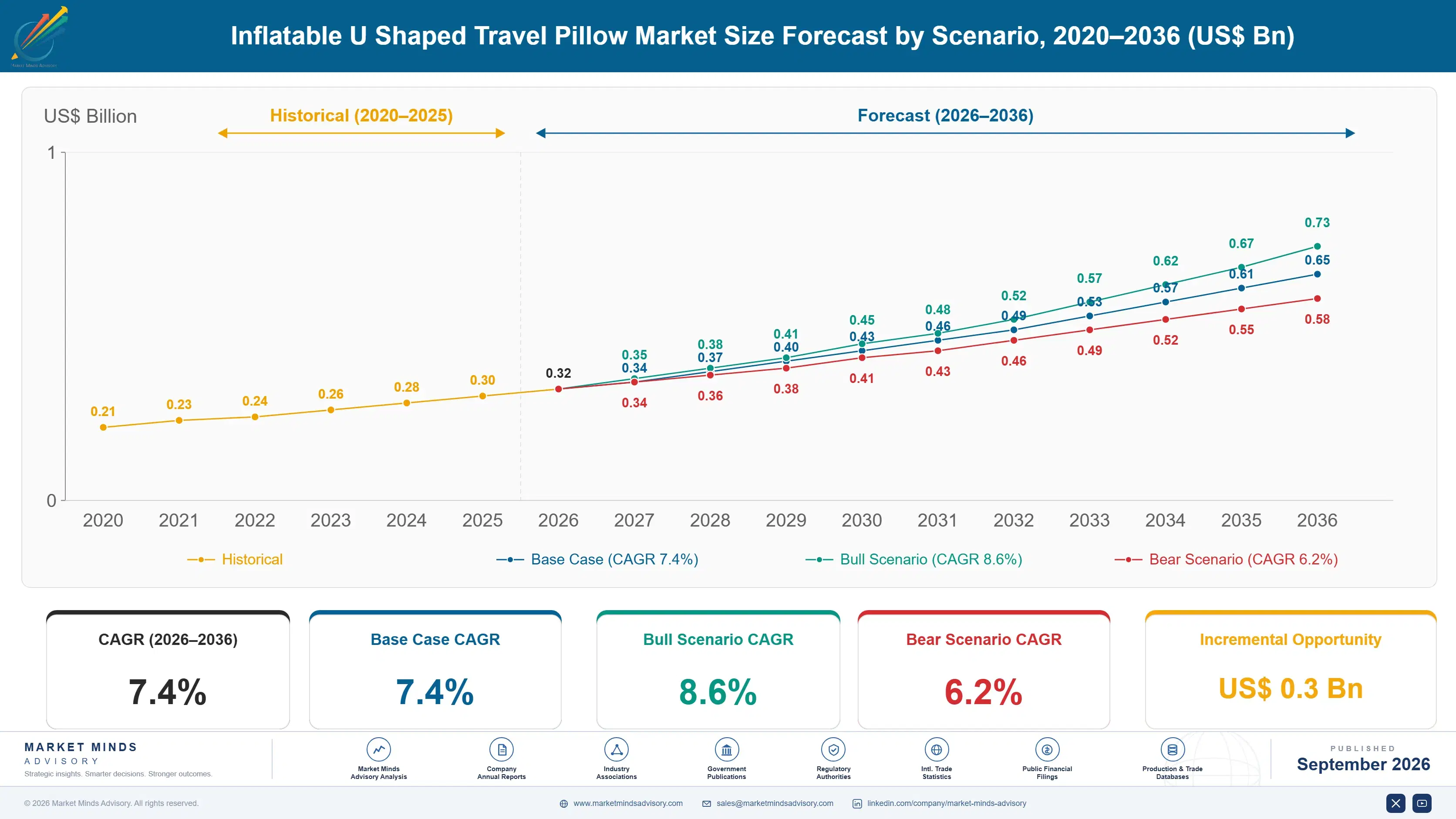
Inflatable U Shaped Travel Pillow Market Forecast Scenarios

inflatable-u-shaped-travel-pillow-market-size-forecast-scenario-1790014442882
Between 2020 and 2025 the category grew at 6.1% through collapse and recovery. Travel volumes fell to almost nothing and returned faster than anybody forecast, and memory foam took shelf space from inflatables throughout because it feels better when a shopper squeezes it in an airport. Inflatable share recovered only where pack size mattered enough to think about.
The base case at 7.4% rests on three mechanisms. Valve-regulated adjustable firmness products keep growing because partial inflation genuinely differentiates against foam. Chinese outbound travel and domestic e-commerce expand faster than any other market. And airline seat pitch continues tightening, which raises the value of anything that packs to a fraction of foam volume in a bag that must fit under a seat. None of the three requires the conventional shape to be improved at all.
The bull case at 8.6% depends on the category finally marketing adjustability, which currently appears in around 14% of listings despite being the only real advantage inflatables hold. The bear case at 6.2% is valve quality: 58% of returns trace to the valve, cheap imports dominate marketplace listings, and a category judged by its worst products loses shelf space to foam.

The Direction Heads Actually Fall

The U-shape is a design that solves a problem passengers do not have. It supports the neck when the head tilts back or to the side, both of which the seat itself already handles reasonably well. What wakes a person sleeping upright is the chin falling toward the chest, and around 72% of upright sleepers experience exactly that regardless of what they have around their neck.
TOP FIVE CONCENTRATION21%Share of category revenue held by the leading brands
CHIN DROP FAILURE RATE72%Sleepers whose head still falls forward despite neck support
VALVE RELATED RETURNS58%Product returns caused by the valve rather than bladder
PACK SIZE VERSUS FOAM11%Volume occupied against an equivalent memory foam pillow
ADJUSTABLE FIRMNESS MARKETING14%Listings mentioning partial inflation as a genuine benefit
AVERAGE RETAIL SELLING PRICEUSD 27Delivered retail price averaged across all inflation mechanisms sold
Designs that address forward drop exist and they work. Chin-supporting and forward-leaning constructions hold the head where the U-shape cannot, and they have never taken meaningful share because a passenger will not wear something that looks strange in a departure lounge. The category persists in a shape that is socially comfortable rather than functionally correct, and everybody in it understands that perfectly well.
Where inflatables genuinely win is volume. An inflatable packs to roughly 11% of the space an equivalent memory foam pillow occupies, which matters enormously to anybody who has carried a foam pillow clipped to a bag through three airports. The buyer discovers that value after the purchase rather than before it, which is why foam keeps taking shelf space from a product that performs better in transit.
"We are all building supports for the two directions the head does not fall. The shape that works looks ridiculous in an airport, so the shape that does not work outsells it by a wide margin. This is a design problem the industry solved and then declined to sell."
Practice Director, Travel Accessories and Consumer Comfort Products · MMA Chemicals and Materials Practice · September 2026

Market Trends

Adjustable Firmness Is The Advantage Nobody Markets

Valve-regulated pillows grow at 11.1%, the fastest rate here, because part-inflating changes the support height and firmness to suit a seat, a neck, and a sleeping preference in ways a fixed foam block cannot approach. Around 14% of listings mention this at all. The category spends its marketing on cover fabrics and pack straps while ignoring the one property that genuinely separates an inflatable from the foam competitor sitting next to it on the shelf. The gain therefore requires no product development whatsoever, only a decision to describe accurately what the product in the box already does for its owner.
Market Impact: Country grows at 12.8%
Hybrids Sell Foam Feel With Inflatable Volume

Hybrid constructions with an inflatable core inside a foam shell grow at 9.6% by winning the shop floor moment that pure inflatables lose. A shopper squeezes the product, feels foam, and buys it, then discovers it packs considerably smaller than a solid foam pillow. The compromise costs pack size against a pure inflatable and gains conversion at retail, which is a rational trade in a category where point of sale decides most purchases outright. Manufacturing complexity is higher than either pure format and margins are correspondingly better. Several brands have moved their premium ranges toward this construction entirely.
Market Impact: Packs to 11% of volume

Market Opportunities and Growth Drivers

Chinese Outbound Travel Recovery Leads Every Market

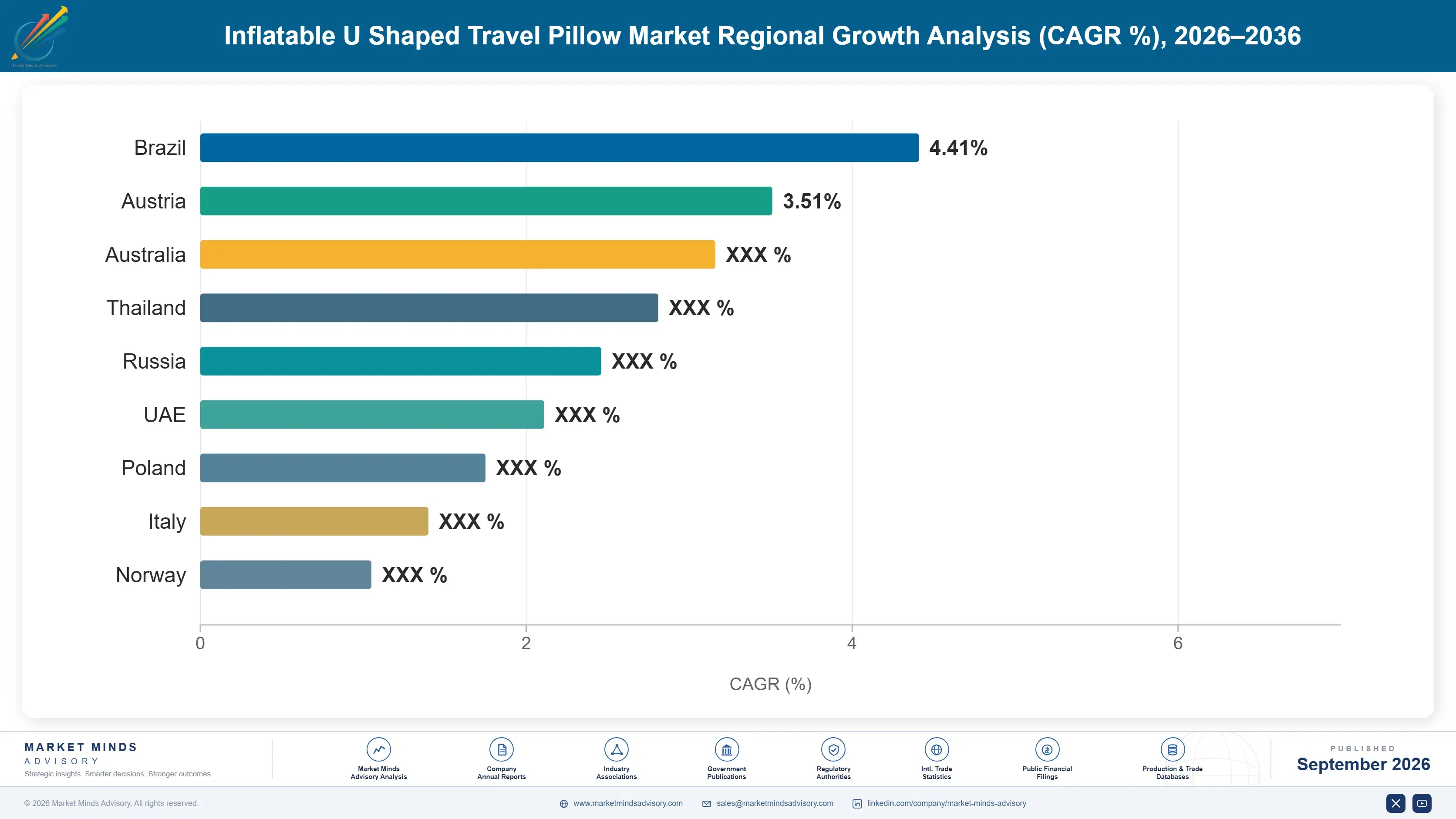
Chinese growth of 12.8% leads every country covered, driven by outbound travel returning alongside a domestic e-commerce channel that sells travel accessories at volumes no Western retailer approaches. Domestic manufacture supplies almost the entire world market from the same industrial base, so Chinese producers capture both the export volume and the fastest growing consumption at once. Marketplace listings there emphasise pack size more consistently than Western retail does. Western brands sourcing from the same factories therefore compete against their own suppliers, who reach domestic buyers directly and at considerably lower delivered prices than any importer can match.
Market Impact: Valves cause 58% returns

Shrinking Seat Pitch Raises The Packability Premium

Airline seat pitch has tightened steadily and personal item allowances have narrowed alongside it, which makes anything occupying bag volume genuinely costly to a passenger. An inflatable packs to around 11% of equivalent foam volume, and that gap has moved from a convenience to a constraint for travellers working within a single under-seat bag. Brands communicating pack size at the point of sale convert considerably better than those describing comfort alone. Cabin-baggage-only travellers arrive at this category already understanding the trade, which makes them far easier to convert than a passenger buying at a departure gate in a hurry.
Market Impact: Affects 72% of sleepers

Market Restraints and Challenges

Valve Failure Defines How The Category Is Judged

About 58% of returns trace to the valve rather than the bladder, and the root cause is that a valve costing a few cents determines whether a product holds pressure for eight hours or slowly deflates over three. Commercially it damages the whole architecture, since a passenger waking flat blames inflatables generally. Brands respond with published leak testing, with dual-seal valve designs, and with warranty terms that cheap marketplace listings cannot match. None of that helps a buyer comparing photographs on a marketplace listing where every product looks the same.
Market Impact: Only 14% mention adjustability

The Shape Does Not Address Forward Head Drop

Roughly 72% of upright sleepers still experience chin drop with a U-shaped pillow in place, and the root cause is that the shape supports backward and lateral movement while the head falls forward. Commercially it caps satisfaction across the entire category regardless of build quality. Brands respond with chin straps, with forward extension designs, and with hybrid constructions that add front support, all of which face resistance on appearance rather than performance. The engineering was solved years ago and the industrial design was never taken seriously, which is where the available advantage in this category actually sits today.
Market Impact: Segment grows at 9.6%
3 additional market trends, 4 additional growth drivers, and 2 additional restraints and challenges are covered in the full report. Contact sales@marketmindsadvisory.com to access the complete intelligence.

Segment CAGR and Growth Architecture

Segmentation follows inflation mechanism across six categories: valve-regulated adjustable firmness pillows, hybrid inflatable cores with foam shells, pump-integrated inflatable pillows, self-inflating open cell foam pillows, compressible non-valve squeeze pillows, and manual inflation bladder pillows. Cover material, packing format, and retail channel are treated as separate dimensions entirely. Valves are counted within the mechanism they serve.
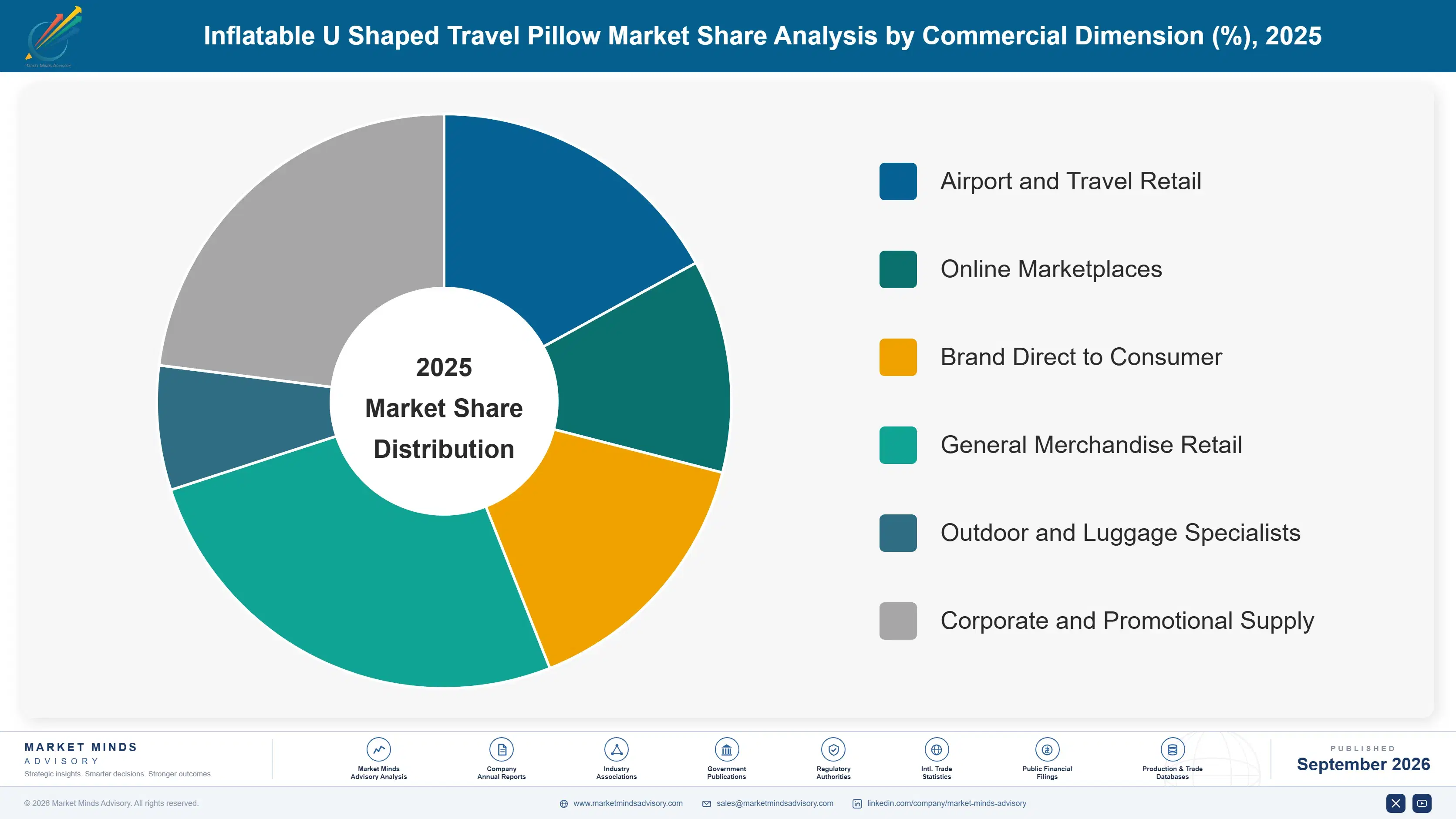
inflatable-u-shaped-travel-pillow-market-market-share-analysis-1790014443463

Valve-Regulated Adjustable Firmness Pillows

Valve-regulated pillows grow at 11.1%, half again the market rate of 7.4%, on the one property that genuinely distinguishes an inflatable from a foam block. Part-inflating changes support height and firmness to suit a particular seat, neck length, and sleeping preference, and no fixed foam product can approach that flexibility at any price. Around 14% of listings across the category mention it. The valve is also where the segment lives or dies, since a dual-seal design holds pressure for a long-haul flight while a cheap single seal deflates slowly enough that the passenger blames the concept rather than the component. Published leak testing is the only way a buyer can tell those apart.
CAGR 11.1%

Hybrid Inflatable Core With Foam Shell

Hybrid constructions grow at 9.6% by winning the retail moment that pure inflatables consistently lose. A shopper picks the product up, squeezes it, feels memory foam, and buys, then finds later that it packs considerably smaller than the solid foam pillow they would otherwise have chosen. Pack size lands between the two architectures rather than matching a pure inflatable, which is a rational compromise in a category where the point of sale decides most purchases. Manufacturing complexity is higher and margins are correspondingly better than either pure format achieves. Several brands have moved their premium ranges entirely toward this construction as a result, accepting the pack size compromise in exchange for conversion at the shelf.
CAGR 9.6%
Full segment breakdown across 6 segments available in the complete report.

Regional Architecture and Country Demand Map

Regional shares here reflect where travel pillows are purchased by consumers rather than where they are manufactured, since Chinese production supplies buyers in every region covered. Three regions sit outside the standard bands, for reasons named in their own paragraphs and summarised for operator review.

East Asia

At 32% this sits above the standard band, and the justification runs both ways: Chinese factories manufacture very nearly the entire world supply, and Chinese consumption is now the largest and fastest growing of any market. Chinese growth of 12.8% leads every country covered. Domestic e-commerce sells travel accessories at volumes Western retail does not approach, and listings there emphasise pack size far more consistently. Japanese and Korean demand skews toward premium constructions at considerably higher unit prices. Chinese producers now capture both the export volume and the fastest growing domestic consumption from the same industrial base, which is an unusually strong position in a consumer category. Very few consumer categories concentrate that way.
Share: 32% | CAGR: 8.4% (2026 to 2036)

North America

Long domestic flight sectors and a large travelling population support the highest per capita spending on travel comfort products anywhere, and specialist travel retail is more developed here than in most markets. Growth of 7.0% tracks close to the world rate. Memory foam holds more shelf space here than elsewhere, since airport retail favours products a passenger can judge by squeezing rather than by reading a pack size specification on a label. Frequent flyer populations who have already owned a pillow that deflated form an unusually receptive audience for published valve testing, and no brand has yet reached them systematically with that argument. That audience is receptive and unreached. No brand has systematically reached them.
Share: 27% | CAGR: 7.0% (2026 to 2036)
Regional intelligence for 5 additional markets available in the complete report: Western Europe, South Asia and Pacific, Latin America, Middle East and Africa, Eastern Europe. Contact sales@marketmindsadvisory.com.
inflatable-u-shaped-travel-pillow-market-country-cagr-analysis-1790014444007

Where Brands Can Actually Differentiate

Four commercial moves separate brands building real positions from those competing on cover fabric against anonymous marketplace listings. Each addresses an honest problem here: the shape does not stop chin drop, the valve decides everything, packability is undersold, and retail rewards squeezing over specification. Three of the four require no product change whatsoever. Only the fourth touches the product itself.

Publish Valve Leak Testing With Every Product

About 58% of returns trace to the valve rather than the bladder, and no shopper can assess a valve by looking at it or squeezing the product in a shop. Brands publishing hold-pressure test results over a defined period report return rates 3.4 times lower than category norms. The testing costs very little, it addresses the actual failure mode, and it separates a considered product from the anonymous marketplace listings that define how buyers judge the whole category. It is the one specification a photograph cannot convey. Buyers currently have no basis for choosing at all.
Market Impact: Cuts product return rates to 3.4 times lower

Market Partial Inflation As The Real Difference

Adjustable firmness is the only property that genuinely separates an inflatable from a foam pillow, and roughly 14% of listings mention it. Brands leading on adjustability rather than on cover material report conversion rates 2.1 times higher against foam competitors at the same shelf. The feature already exists in almost every valve product on the market, so the gain requires nothing beyond deciding to describe what the product already does. The valve already permits it and the listing simply does not say so, which makes this the cheapest available gain anywhere in the category today.
Market Impact: Raises retail conversion rates to 2.1 times higher

Put Pack Size On The Front Of Pack

An inflatable occupies around 11% of the volume an equivalent foam pillow needs, and shrinking seat pitch and personal item allowances have turned that from a convenience into a genuine constraint. Brands showing packed dimensions prominently at point of sale report basket conversion 34% to 46% higher than those describing comfort alone. The buyer currently discovers this advantage after purchasing, which is precisely the wrong moment for it to matter. Cabin baggage limits have made the comparison genuinely material rather than merely convenient for a large share of travellers. The specification is already known.
Market Impact: Raises basket conversion by 34 to 46% higher

Add Forward Support Without Looking Absurd

Roughly 72% of upright sleepers still experience chin drop, and every design that genuinely prevents it has failed commercially on appearance rather than performance. Brands adding discreet forward support within a conventional U profile report satisfaction scores 2.6 times higher than standard shapes. The engineering problem was solved years ago and the industrial design problem was not, which is where the available advantage in this category actually sits. Appearance rather than performance has always been the binding constraint here. Discreet forward support within a conventional profile remains largely untried. Appearance was always the binding constraint here.
Market Impact: Raises satisfaction scores to 2.6 times higher overall

Who Controls the Margin Pool

Concentration is very low. Five brands hold 21% of category revenue, measured consistently on that basis across all participants, and the remainder spreads across travel accessory specialists, outdoor equipment brands, luggage houses, and an enormous population of unbranded marketplace listings manufactured in the same Chinese industrial base. Barriers to entry are effectively zero, since the same Chinese factories will manufacture for anybody willing to place an order.
Competition currently turns on three dimensions: valve engineering and published reliability, which decides whether a product survives a long-haul flight; retail presentation, where foam wins the squeeze test and inflatables must argue on specification; and forward support design, where the unsolved comfort problem in the category still sits. Pack size communication has become a fourth dimension as cabin baggage limits tighten across low cost carriers everywhere.

Pressure builds from two directions. Memory foam continues taking shelf space on point-of-sale feel. Meanwhile unbranded imports define how buyers judge inflatable reliability. Rankings will shift toward brands publishing valve performance, since that is the only way to separate from listings that look identical online. Forward support design remains the largest unclaimed opportunity in the whole category. Nobody has yet claimed the forward support position properly.
inflatable-u-shaped-travel-pillow-market-company-positioning-matrix-1790014444528

Competitive Moat and Risk Dimensions

CABEAU

Moat: Valve And Retention Engineering

Sustained investment in valve design and pressure retention produces products that hold through a long-haul flight where cheaper competitors do not, and that reliability generates the repeat purchasing and recommendation that this category otherwise lacks entirely. The engineering is inexpensive to include and demonstrably absent from most of the market.
CABEAU

Risk: Marketplace Listing Price Pressure

Anonymous listings manufactured in the same industrial base look identical in a product photograph and sell at a fraction of the price, and no online shopper can assess valve quality before buying. Competing on engineering requires communicating something the format of an online listing is poorly suited to conveying.
TRTL

Moat: Alternative Support Geometry

Building outside the conventional U profile addresses forward head drop that the standard shape cannot, and the business established that position when nobody else was willing to look different on a shelf. Consumers who tried it and found it worked provide word of mouth that conventional shapes rarely generate.
TRTL

Risk: Appearance Resistance Limits Reach

Products that look unusual face a ceiling in a category where a substantial share of buyers will not wear something conspicuous in an airport. Broadening beyond early adopters means either compromising the geometry that works or accepting a smaller addressable base than conventional shapes reach easily.

Players Tracked

Prominent Players

Cabeau
Trtl
Sea to Summit
Therm-a-Rest
Samsonite

Other Key Players

Huzi Design
Ostrich Pillow
BCOZZY
Travelrest
Klymit
Nemo Equipment
Eagle Creek
Lewis N. Clark
Design Go
Trunki
Naturehike
Decathlon
MUJI
Exped
Kelty

Recent Developments

MARCH 2026

Cabeau Publishes Valve Hold-Pressure Testing Across Inflatable Range

Cabeau began publishing measured pressure retention over defined periods across its inflatable range, disclosing performance on the component that causes most returns and that no shopper can assess by handling the product. Test conditions and durations are stated alongside the results rather than summarised into a claim.
Signal: Disclosure separates engineered products from identical-looking marketplace listings. Competitors must now answer or concede the reliability argument.
OCTOBER 2025

Naturehike Expands Thermoplastic Bladder Production Capacity

Naturehike completed an organic capacity expansion for thermoplastic polyurethane bladder production, funded internally with no partner involved, after domestic e-commerce and export demand together outran available welding and assembly throughput. Welding capacity rather than film supply had been the binding constraint on output. Output serves domestic and export demand alike.
Signal: Chinese producers now serve domestic growth and export volume simultaneously. Suppliers now compete with their own export customers.
MAY 2025

Samsonite Acquires Travel Comfort Accessories Brand

Samsonite completed an acquisition of a travel comfort accessories brand with established airport retail distribution, adding neck support products to a luggage portfolio that reaches the same traveller at the same purchasing moment. The airport retail distribution was the principal asset rather than the product range itself.
Signal: Luggage brands are buying adjacency at the point of travel purchase. Shelf position at the gate decides most category purchases.

What A Travel Pillow Costs

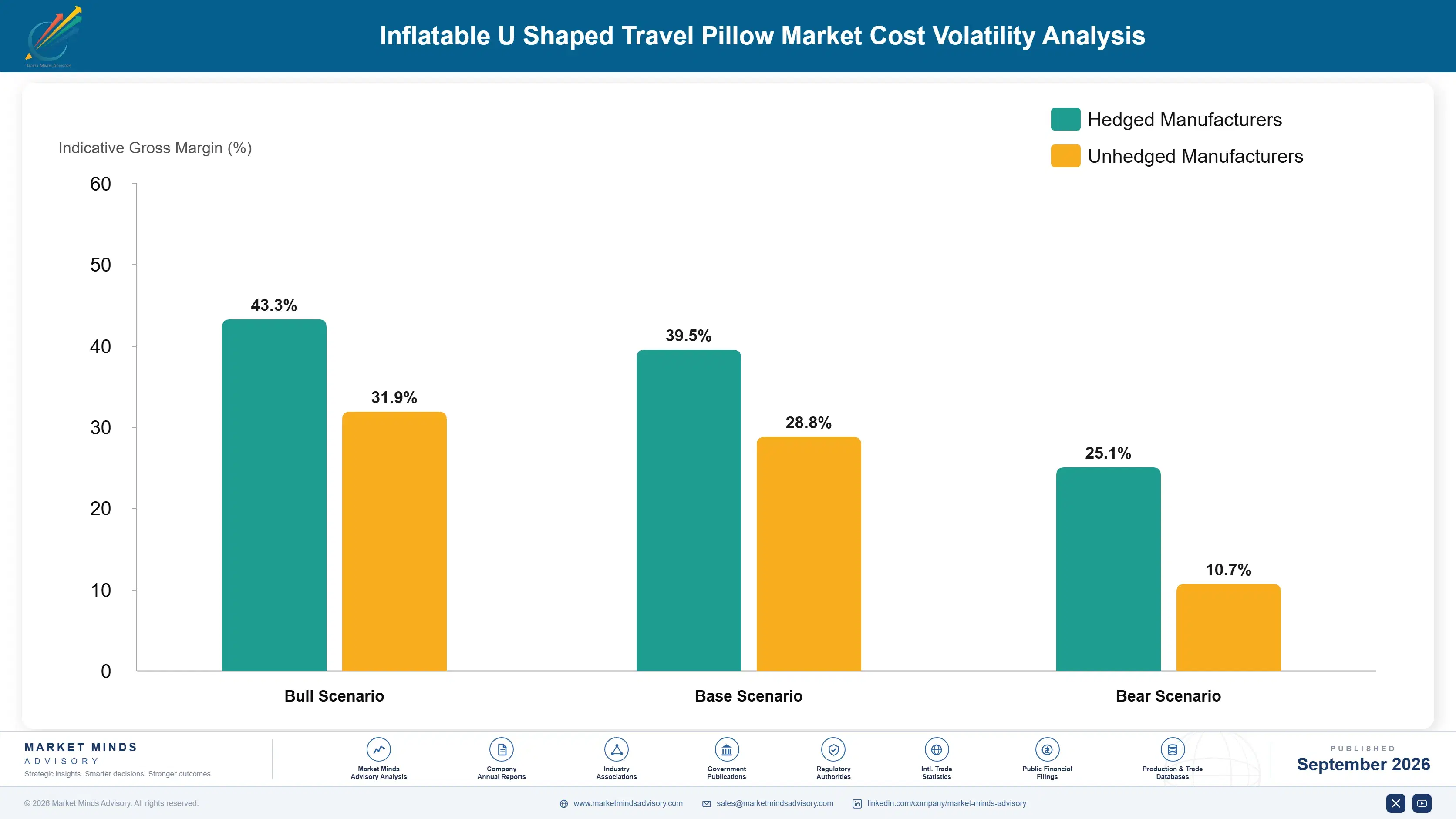
Three input groups dominate cost. Thermoplastic polyurethane and vinyl bladder film runs 30% to 38% of cost of goods sold, and the eight-point range separates thin single-layer bladders from welded multi-chamber constructions. Valve assemblies take 18% to 26%, with dual-seal designs at the upper end. Fabric covers, flocking, and retail packaging add 28% to 36%, which is high for a product of this size.
Thermoplastic polyurethane resin pricing moved through 2024 and 2025 as isocyanate and polyol availability shifted across coatings and footwear demand entirely unrelated to travel accessories, and American Chemistry Council statistics documented the underlying movement. Several manufacturers described the resulting margin pressure in their annual reports. Cover fabric pricing followed polyester and textile markets separately throughout the same period. Freight moved on a third track again throughout.

The competitive disadvantage mechanism runs through the valve rather than through materials. A dual-seal valve costs a few cents more than a single seal and determines whether 58% of returns happen at all, so a producer economising there carries a warranty and reputation cost far exceeding the saving. Exposure varies sharply by channel: branded retail absorbs return costs directly while marketplace sellers frequently do not.
inflatable-u-shaped-travel-pillow-market-cost-volatility-analysis-1790014444723

Specify Dual-Seal Valves Regardless Of Unit Cost

Valves account for 58% of returns while representing a very small share of manufactured cost, which makes economising on them among the worst trades available in this category. A dual-seal design costs cents and removes the failure mode that shapes how buyers judge the whole product class. The saving is measured in cents and the cost in reputation.

Contract Bladder Film Against Coatings Demand Cycles

Thermoplastic polyurethane pricing follows coatings and footwear demand across industries far larger than travel accessories, and this category has no influence over it whatever. Contracting against those cycles rather than reacting to them removes most of the exposure at modest administrative cost and improves supply security alongside. Supply security improves alongside the price stability, which matters when welding capacity tightens.

Reduce Packaging Volume Rather Than Cover Quality

Packaging and cover together run up to 36% of cost of goods sold, and retail packaging is where volume can be removed without any customer noticing a reduction. Cover fabric is what a shopper touches at the point of sale, so cutting cost there damages conversion far more than the saving justifies. Retail packaging volume is invisible to the buyer.

Portfolio Architecture for Margin Defence

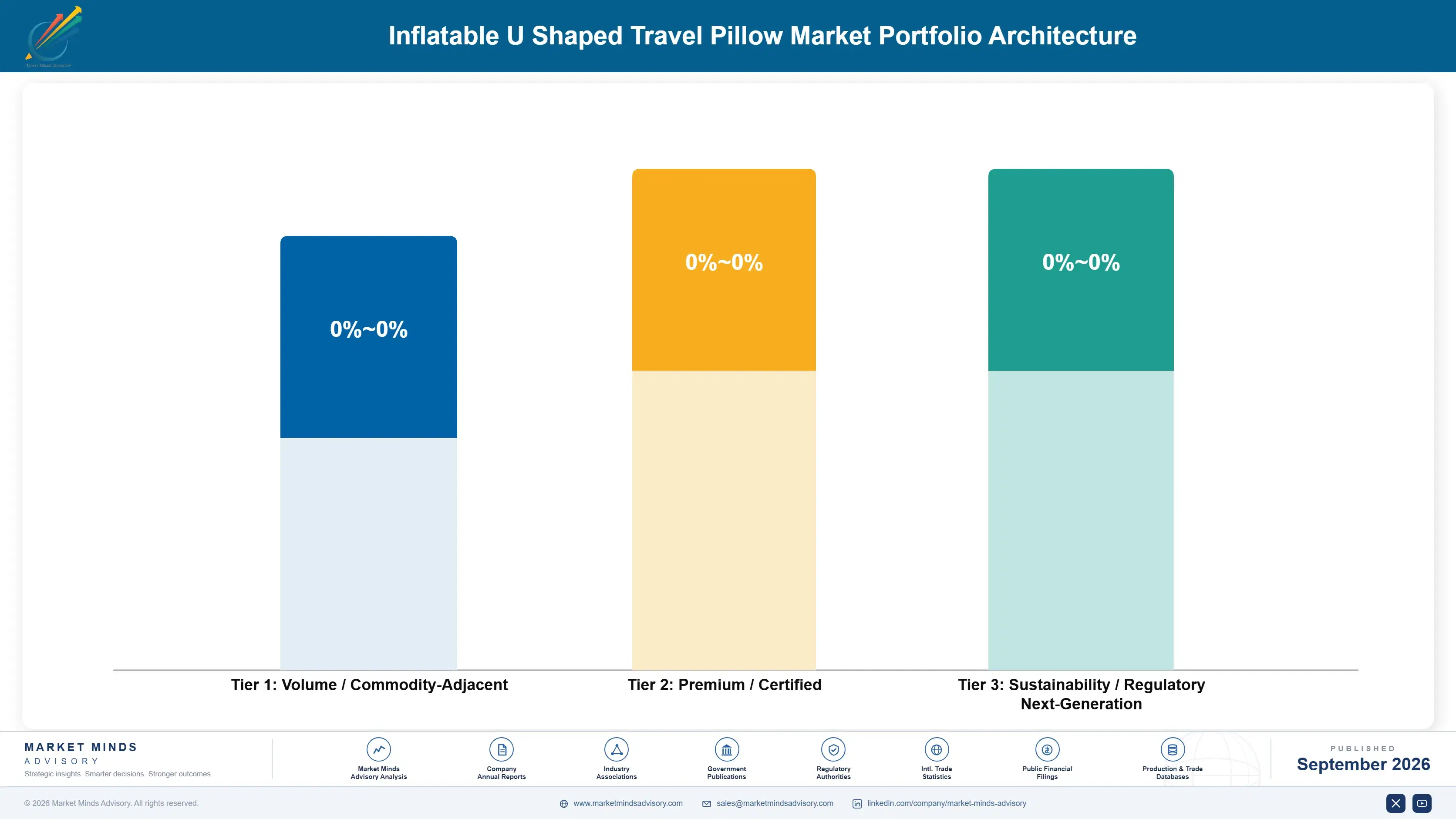
Margin follows engineering a shopper cannot see and a marketplace listing cannot fake. Manual bladder and squeeze formats compete close to commodity terms against anonymous imports. Self-inflating products earn moderately on convenience. Hybrid constructions earn better on retail conversion, and valve-regulated adjustable products earn most, because the valve engineering that makes them work is exactly what cheap competitors leave out. The margin spread across those four groups is wide for a simple product.
The tension between volume and premium runs through where the purchase happens. Airport and travel retail rewards products a passenger can judge by handling, which favours foam and hybrid constructions at premium prices. Online marketplace listings reward the lowest price on a photograph that looks identical to every other, which is where unbranded product takes most of the volume.

High-value pools concentrate where the traveller has been disappointed before: frequent long-haul flyers who have owned a pillow that deflated, cabin-baggage-only travellers who value pack size acutely, and buyers who have already tried foam and found it too bulky. Where the purchase is a first pillow bought in a hurry at a gate, price and appearance decide everything. That divide follows prior disappointment rather than income.

Volume / Commodity-Adjacent

Manual inflation bladder and compressible squeeze formats sold through marketplace listings against anonymous imports of identical construction. The ten-point range reflects manufacturing scale and film purchasing rather than any property a buyer could assess before purchase.
Gross Margin: 22% to 32%

Premium / Certified

Self-inflating and hybrid foam shell constructions sold through travel and airport retail where handling decides the purchase. The twelve-point range separates products with genuine memory foam shells from those using lower grade foam that feels similar only briefly.
Gross Margin: 36% to 48%

Sustainability / Regulatory / Next-Generation

Valve-regulated adjustable products with published pressure retention and constructions adding discreet forward support. The fourteen-point range reflects valve engineering depth and whether reliability performance is measured and disclosed or simply asserted.
Gross Margin: 50% to 64%
inflatable-u-shaped-travel-pillow-market-portfolio-architecture-1790014445232

High-value Sub-segments and Strategic Watch-out

Valve-Regulated Adjustable Products

Highest value in the category, growing at 11.1% on the only property genuinely distinguishing an inflatable from a foam block. The fourteen-point range reflects valve engineering, which decides both reliability and whether the adjustability actually holds. Almost nobody markets the feature at all. Published testing settles the difference.
Gross Margin: 52% to 66%

Forward Support Constructions

High value addressing the chin drop that 72% of upright sleepers experience with conventional shapes. The fourteen-point range reflects industrial design quality, since the engineering works and appearance decides whether anybody will wear it. Appearance is the entire remaining obstacle. Engineering works and design has not.
Gross Margin: 44% to 58%

Hybrid Foam Shell Constructions

Volume core winning the retail handling moment that pure inflatables consistently lose to memory foam competitors. The twelve-point range reflects foam grade, which determines whether the shop floor impression survives more than a few uses. Retail handling decides most purchases here. Pack size lands between both formats.
Gross Margin: 34% to 46%

Manual Bladder And Squeeze Formats

The strategic watch-out. Anonymous marketplace listings match the construction exactly, buyers compare on price and photograph alone, and no engineering difference is visible before purchase. The ten-point range reflects film purchasing and scale only. Nothing visible separates one listing from another. Price is the whole basis of comparison.
Gross Margin: 20% to 30%

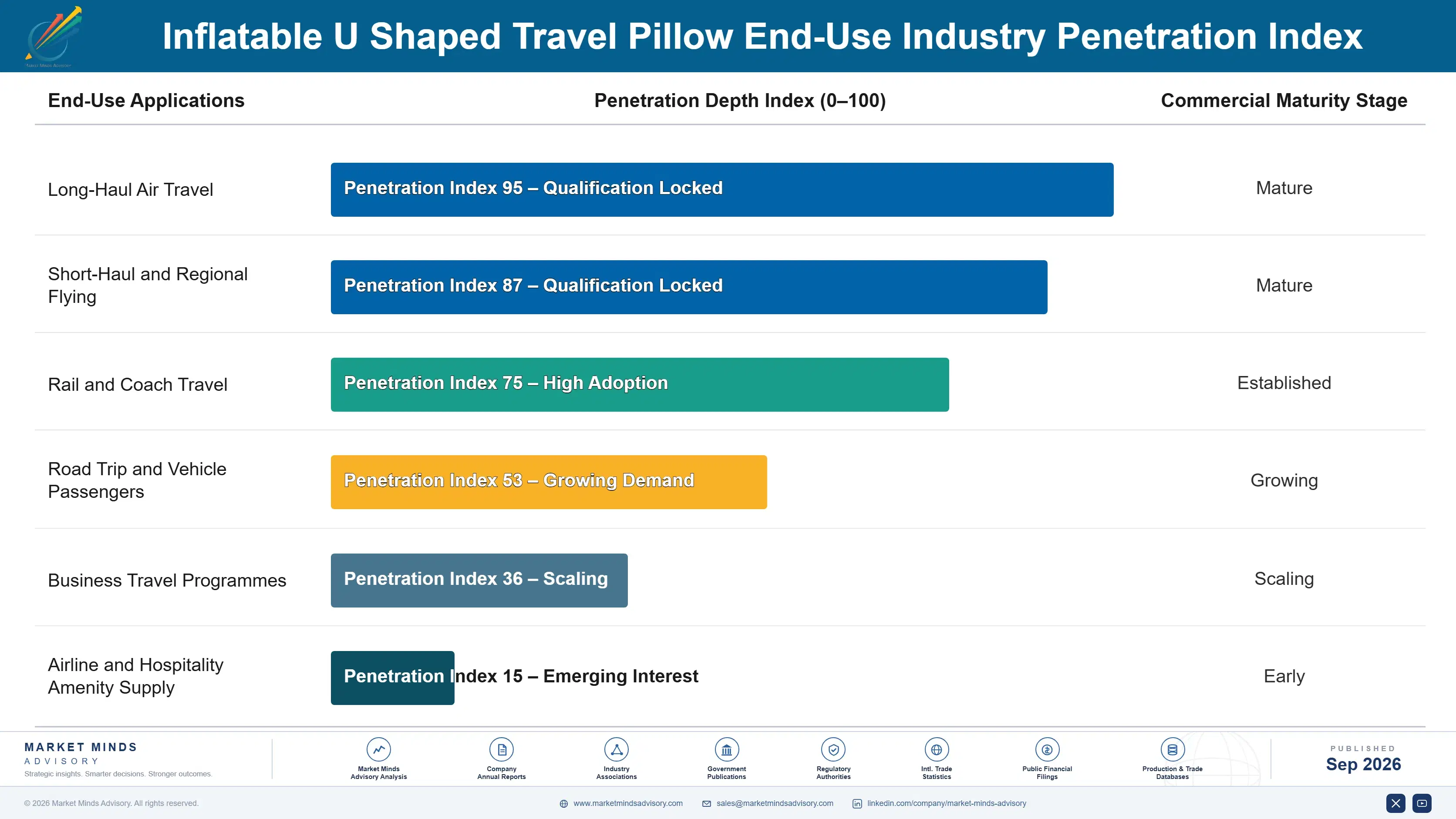
How This Demand Recurs

Replacement rather than growth in travel drives most volume, and replacement happens when a product fails rather than on any schedule. A pillow that deflates mid-flight is replaced immediately and a pillow that works is kept for years, which makes valve reliability the single largest determinant of category volume and simultaneously the thing brands economise on most readily when costs tighten.
Attachment depth is almost entirely a function of disappointment. A traveller who has never owned one buys on price and appearance at an airport. A traveller whose last pillow failed buys carefully, reads about valves, and will pay several times the price for something that holds pressure. The second group is small, growing, and worth far more than its share of units suggests.

The buyer profile has shifted with cabin baggage policy. Passengers travelling with a single under-seat bag treat volume as a hard constraint rather than a preference, and they arrive at this category already understanding why an inflatable might be worth the compromise on comfort. That group buys online after research rather than at a gate in a hurry, which changes what a brand must communicate.
inflatable-u-shaped-travel-pillow-market-end-use-penetration-index-1790014445725

Where This Market Rewards

These are among the four positions where our research anticipates prominent divergence between winners and laggards over the coming forecast period. Each is grounded in the demand model, the regulatory perimeter, and the announced capacity pipeline.
01 / VALVE RELIABILITY DISCLOSURE

Nobody can assess a valve by squeezing

About 58% of returns in this category trace to the valve rather than the bladder, and no shopper can evaluate that component by handling a product or looking at a photograph. Brands publishing measured hold-pressure results over defined periods report return rates 3.4 times lower than category norms. The testing costs very little and it separates an engineered product from the anonymous listings that shape how buyers judge inflatables, and it is the single specification a product photograph cannot convey to anybody.
02 / ADJUSTABILITY MARKETING FOCUS

Sell the thing foam cannot do

Partial inflation is the only property genuinely distinguishing an inflatable from a memory foam block, and roughly 14% of listings across this category bother to mention it at all. Brands leading on adjustability rather than cover material report conversion rates 2.1 times higher against foam competitors on the same shelf. The feature already exists in nearly every valve product sold, so capturing the gain requires only describing it, which makes it the cheapest available gain anywhere in this whole category today.
03 / PACK SIZE PROMINENCE

The bag is now the constraint

An inflatable occupies around 11% of the volume an equivalent foam pillow needs, and tightening seat pitch has turned that from a convenience into a genuine constraint for many travellers. Brands showing packed dimensions prominently at point of sale report basket conversion 34% to 46% higher than competitors describing comfort alone. Buyers currently discover this advantage after purchase, which is exactly the wrong moment for it to influence anything, by which time the purchase has already been made on somebody else's product.
04 / FORWARD SUPPORT DESIGN

The head falls the other way

Roughly 72% of upright sleepers experience chin drop with a conventional U-shape in place, and every design that genuinely prevents it has failed commercially on appearance rather than on performance. Brands adding discreet forward support within an otherwise conventional profile report satisfaction scores 2.6 times higher than standard shapes manage to achieve. The engineering problem was solved years ago and the industrial design problem was simply never taken seriously, which is where the largest unclaimed opportunity in this category currently sits.

Engagement Snapshot From the Field

A live engagement with an industry participant carrying material or product regulatory and market exposure ahead of a defining policy shift, showing how our research translates into a defensible multi-year portfolio strategy.
MARKET MINDS ADVISORY · CLIENT ENGAGEMENT SUMMARY
Inflatable U Shaped Travel Pillow Producer Strategic Portfolio Review and Transition Roadmap 2026·Investment Scenario on Inflatable U Shaped Travel Pillow Exposure Evaluation 2025-26
CLIENT PROFILE
A travel accessories brand with inflatable pillow revenue near USD 46 million (client-reported, unverified by MMA), selling through airport retail, online marketplaces, and its own channel across nine countries. Marketplace return rates ran at more than three times its retail channel rate on identical products, and margin had fallen for two consecutive years. The board wanted the gap explained before withdrawing from any channel.
STRATEGIC CHALLENGE
Operations attributed the return gap to marketplace buyer behaviour and had proposed withdrawing from those channels entirely. Nobody had examined what returning customers actually reported, or whether the products sold through each channel differed in specification despite carrying the same model names. A behavioural explanation and a specification explanation imply entirely different remedies at very different costs.
MMA APPROACH
MMA coded eighteen months of return reasons by channel, tested valve pressure retention across production batches supplied to each channel, surveyed buyers on what they had understood at purchase, and modelled outcomes under channel withdrawal, valve upgrade, and listing revision. Bills of materials were compared across channels, which nobody within the business had previously thought to examine.
KEY FINDINGS
  1. Marketplace units carried a lower cost single-seal valve introduced two years earlier to meet a price point, while retail units retained the original dual-seal design.
  2. Around 61% of marketplace returns cited deflation overnight, against 14% of retail returns on the nominally identical product model. Both carried the same model designation on pack.
  3. Buyers in both channels could not recall any mention of adjustable firmness, despite it appearing in the product manual for every valve model sold.
  4. Withdrawing from marketplaces would have removed roughly a third of unit volume without addressing the valve specification causing the returns. The underlying specification would have remained unchanged.
CLIENT PROFILE
A travel accessories brand with inflatable pillow revenue near USD 46 million (client-reported, unverified by MMA), selling through airport retail, online marketplaces, and its own channel across nine countries. Marketplace return rates ran at more than three times its retail channel rate on identical products, and margin had fallen for two consecutive years. The board wanted the gap explained before withdrawing from any channel.
STRATEGIC CHALLENGE
Operations attributed the return gap to marketplace buyer behaviour and had proposed withdrawing from those channels entirely. Nobody had examined what returning customers actually reported, or whether the products sold through each channel differed in specification despite carrying the same model names. A behavioural explanation and a specification explanation imply entirely different remedies at very different costs.
MMA APPROACH
MMA coded eighteen months of return reasons by channel, tested valve pressure retention across production batches supplied to each channel, surveyed buyers on what they had understood at purchase, and modelled outcomes under channel withdrawal, valve upgrade, and listing revision. Bills of materials were compared across channels, which nobody within the business had previously thought to examine.
KEY FINDINGS
  1. Marketplace units carried a lower cost single-seal valve introduced two years earlier to meet a price point, while retail units retained the original dual-seal design.
  2. Around 61% of marketplace returns cited deflation overnight, against 14% of retail returns on the nominally identical product model. Both carried the same model designation on pack.
  3. Buyers in both channels could not recall any mention of adjustable firmness, despite it appearing in the product manual for every valve model sold.
  4. Withdrawing from marketplaces would have removed roughly a third of unit volume without addressing the valve specification causing the returns. The underlying specification would have remained unchanged.
RECOMMENDED STRATEGY
Phase 1: Phase one: restore the dual-seal valve across every channel and absorb the unit cost rather than continuing to meet the marketplace price point. Phase 2: Phase two: publish measured hold-pressure data in listings and on packaging, addressing the failure mode buyers cannot otherwise assess. Photographs cannot convey a valve. Phase 3: Phase three: lead product listings on adjustable firmness and packed size rather than on cover material and colour options. Neither currently appears in any listing.
OUTCOME
Marketplace return rates fell to within two points of the retail channel within three quarters (client-reported, unverified by MMA). Channel withdrawal was cancelled entirely. Listing revisions raised marketplace conversion despite a higher price point. Marketplace volumes grew despite the price increase, and margin recovered above its earlier level.

Frequently Asked Questions

Foundational context covering the market sizes, CAGR, scope, country, region and competition that inform every finding below. This section is provided to cover basics and most often pre-purchase conversations, answered from the MMA Primary Research Dataset.

What is the current size of the Inflatable U Shaped Travel Pillow Market?

The market was worth USD 0.3 billion in 2025 and stands at USD 0.3 billion in 2026. Value covers inflatable U-shaped neck pillows across all inflation mechanisms.

How large will the Inflatable U Shaped Travel Pillow Market be by 2036?

MMA forecasts USD 0.6 billion by 2036, an increase of USD 0.3 billion across the forecast period. That represents 2.00 times the 2026 base of USD 0.3 billion.

What is the CAGR for the Inflatable U Shaped Travel Pillow Market 2026 to 2036?

The base case compound annual growth rate is 7.4%, with a bull case at 8.6% and a bear case at 6.2%. Historical growth from 2020 to 2025 ran at 6.1%.

Which segment is growing fastest?

Valve-regulated adjustable firmness pillows grow at 11.1%, half again the market rate of 7.4%. Partial inflation is the only property genuinely distinguishing an inflatable from foam.

Who are the major companies in the Inflatable U Shaped Travel Pillow Market?

Cabeau, Trtl, Sea to Summit, Therm-a-Rest, and Samsonite lead the category. Together they hold only 21% of revenue, with unbranded marketplace listings taking substantial volume.

Which country is growing fastest?

China grows at 12.8%, the fastest of any country covered here. Outbound travel recovery runs alongside a domestic e-commerce channel selling travel accessories at volumes Western retail does not approach.

Report Segmentation Architecture

The full report scope spans multiple orthogonal segmentation dimensions, with cross-tabulated demand data provided for each dimension pair. Coverage extends further to regional breakdowns, trend trajectories, and the competitive detail needed to support segment-level decision-making.

By Inflation Mechanism

  • Valve-Regulated Adjustable Firmness Pillows
  • Hybrid Inflatable Core with Foam Shell
  • Pump-Integrated Inflatable Pillows
  • Self-Inflating Open Cell Foam Pillows
  • Compressible Non-Valve Squeeze Pillows
  • Manual Inflation Bladder Pillows

By End-Use Industry

  • Long-Haul Air Travel
  • Short-Haul and Regional Flying
  • Rail and Coach Travel
  • Road Trip and Vehicle Passengers
  • Business Travel Programmes
  • Airline and Hospitality Amenity Supply

By Commercial Dimension

  • Airport and Travel Retail
  • Online Marketplaces
  • Brand Direct to Consumer
  • General Merchandise Retail
  • Outdoor and Luggage Specialists
  • Corporate and Promotional Supply

By Region

  • East Asia
  • North America
  • Western Europe
  • South Asia and Pacific
  • Latin America
  • Middle East and Africa
  • Eastern Europe

Scope, Methodology, and Coverage

Every figure in this report is reproducible from documented input assumptions. The scope below maps the historical period, the forecast horizon, the segmentation dimensions, and the countries covered, alongside the underlying primary and qualitative methodology.
Historical Period
2020 to 2025
Forecast Period
2026 to 2036
Base Year
2025 (USD billions; MMA Primary Research Dataset, September 2026)
Market Definition
This market covers inflatable U-shaped travel pillows for neck support during seated travel, across valve-regulated adjustable firmness pillows, hybrid inflatable cores with foam shells, pump-integrated inflatable pillows, self-inflating open cell foam pillows, compressible non-valve squeeze pillows, and manual inflation bladder pillows. It excludes memory foam and microbead pillows without inflation, bed pillows, lumbar and seat cushions, inflatable camping products, and medical cervical collars.
Quantitative Units
USD billions, retail value at manufacturer selling price
Segmentation Dimensions
Inflation mechanism, travel application, commercial dimension, region
Regions Covered
East Asia, North America, Western Europe, South Asia and Pacific, Latin America, Middle East and Africa, Eastern Europe
Countries Covered
China, Japan, South Korea, Taiwan, United States, Canada, Mexico, Germany, United Kingdom, France, Italy, Spain, Netherlands, Poland, Czechia, India, Australia, Singapore, Thailand, Indonesia, Vietnam, Brazil, Colombia, Chile, Argentina, United Arab Emirates, Saudi Arabia, Qatar, Egypt, South Africa
Key Companies Profiled
Cabeau, Trtl, Sea to Summit, Therm-a-Rest, Samsonite, Huzi Design, Ostrich Pillow, BCOZZY, Travelrest, Klymit, Nemo Equipment, Eagle Creek, Lewis N. Clark, Design Go, Trunki, Naturehike, Decathlon, MUJI, Exped, Kelty
Quantitative Methodology
Primary survey, n=3,800 respondents, Q4 2025, six countries; demand-side model with trade association cross-validation
Qualitative Methodology
47 expert interviews, Q4 2025; applied to validate demand model assumptions, identify emerging dynamics, and assess competitive positioning
Report Format
PDF and XLSX data workbook (Word format preview document)
Publisher
Market Minds Advisory
Report Code
MMA-2026-CHM-311
Published
September 2026
Contact
sales@marketmindsadvisory.com | www.marketmindsadvisory.com

Purchase the full Inflatable U Shaped Travel Pillow Market Report (2026 to 2036).

The full report sizes the inflatable U-shaped travel pillow market across six inflation mechanisms, seven regions, and thirty countries, with forecasts to 2036 under base, bull, and bear cases. It establishes why the conventional shape does not address the direction the head actually falls, quantifies valve failure as the dominant return cause, and measures the pack size advantage that buyers discover only after purchasing. Competitive analysis covers twenty participants evaluated consistently on category revenue, with detailed treatment of unbranded marketplace supply. Cost structure, valve economics, and channel margin architecture are analysed throughout. Primary research includes 3,800 survey responses and 47 expert interviews.
Six inflation mechanisms sized and forecast separately
Twenty participants evaluated on category revenue consistently
Chin drop incidence measured against conventional and alternative geometries
Valve failure rates analysed by seal design and channel
Pack size advantage quantified against equivalent foam products
Marketplace and retail channel economics compared by construction

Built For The People Who Decide

From boardroom strategy to bench-side execution, this report is read cover-to-cover by leaders shaping the next decade of their industry, turning demand scenarios, market dynamics and valuation benchmarks into decisions.
CXOs/ Presidents/ VPs/ Managers
M&A and Corporate Development
Strategy Teams and R&D Heads
Procurement and Product Directors
Regulatory and Compliance Leaders
Investor Relations and Equity Analysts