Market Minds Advisory
Infant Incubators & Warmers Market

Infant Incubators & Warmers Market: Infant Incubators and Warmers Market. Connected Monitoring Integration Reshapes Neonatal Intensive Care Equipment

Expanding neonatal intensive care capacity and growing preterm birth rates are pushing hospitals toward connected incubator and warmer systems that integrate vital sign monitoring directly into the care platform itself.

Lead Analyst

Published

September 2026

Make Smarter Decisions with Customized Research Insights

Request a free sample report and evaluate market opportunities, growth trends, and competitive dynamics relevant to your business needs.

2025 MARKET VALUE$2.6BMarket Size 2025
2036 FORECAST VALUE$5.2BBase Case , 2026 to 2036
CAGR 2026 TO 20366.5 %Bull 7.8% / Bear 5.2%
INCREMENTAL OPPORTUNITY$2.4BNet 10- year value creation
EXPANSION MULTIPLE1.88x2036 value over 2026 base
Strategic Levers
M&A Pipeline
Regional Outlook
Country Rankings
Competitive Intelligence
Segmental Deep-dive
Call-Us : 91 93563 13602

Executive Snapshot and Market Trajectory.

Neonatal care equipment demand is shifting from standalone incubators and warmers toward connected hybrid systems that integrate vital sign monitoring directly into the care platform for continuous data capture across most neonatal intensive care units worldwide today. Hospitals increasingly view this integration as baseline rather than premium.
Hospitals expanding neonatal intensive care unit capacity in response to rising preterm birth rates are driving fastest growth in hybrid incubator-warmer systems, particularly across South Asia and East Asia where birth volumes remain high and preterm rates are elevated. Government maternal and child health investment programs are expanding access to advanced neonatal equipment in previously underserved secondary and tertiary care facilities across many regions. Adoption is broadening steadily.
Competition spans a concentrated group of established medical device manufacturers and a growing field of regional producers serving cost-sensitive public hospital procurement, each competing under somewhat different regulatory and reimbursement frameworks entirely depending on market maturity. Interoperability standards connecting incubators to hospital electronic health record systems are becoming a genuine competitive differentiator as digital health infrastructure investment accelerates. Manufacturers investing early in these connectivity standards are positioning for a durable procurement advantage.
Market Definition
This report covers the global market for infant incubators, radiant warmers, and hybrid incubator-warmer systems used in neonatal intensive care and delivery room settings. It excludes general pediatric hospital beds and phototherapy units sold as standalone devices unless integrated into a hybrid platform.
Base Year Value
$2.6B in 2025 (MMA Primary Research Dataset, September 2026)
Forecast Period
2026 to 2036, eleven discrete annual values
CAGR
6.5% base case. Bull 7.8%. Bear 5.2%.
Fastest Growth Segment
Connected Hybrid Incubator-Warmer Systems: 10.0% CAGR
Fastest Growth Country
India: 9.0% CAGR
Fastest Growth Region
South Asia and Pacific: 8.8% CAGR
Largest Region
East Asia: 28% of 2025 global value
Market Leaders
Draeger, GE HealthCare, Natus Medical, Phoenix Medical Systems, Atom Medical. Source: MMA Primary Research Dataset, July 2026.
Primary Survey
n=3,800 procurement and R&D decision-makers, Q4 2025, six countries
Methodology
Demand-side build-up, cross-validated against public data, 47 expert interviews

Infant Incubators & Warmers Market Forecast Scenarios

infant-incubators-warmers-market-size-forecast-scenario-1790017435774
Between 2020 and 2025 infant incubator and warmer demand grew steadily as hospital capital budgets recovered from pandemic-era disruption and neonatal intensive care unit expansion resumed across public and private health systems, supporting a historical CAGR near 5.5 percent across the tracked historical period overall. Manufacturers used this recovery period to invest in expanded manufacturing capacity and updated regulatory certifications across major markets.
The base case assumes continued neonatal intensive care unit capacity expansion across South Asia and East Asia, sustained government maternal and child health investment programs improving equipment access in underserved facilities, and gradual conversion from standalone units toward connected hybrid incubator-warmer systems commanding premium pricing across most major hospital procurement channels tracked through the full forecast period. Reimbursement policy support in several developed markets further reinforces this conversion trend among hospital procurement committees.
The bull case assumes accelerated government health infrastructure spending in emerging markets brings advanced neonatal equipment to facilities sooner than expected. The bear case assumes hospital capital budget constraints in mature markets slow replacement cycles meaningfully, particularly affecting premium connected systems competing against lower-cost standalone alternatives. Currency volatility in several emerging markets adds further uncertainty to procurement timing for imported equipment.

Connected Care Platforms Redefine Neonatal Equipment Value

Infant incubators and warmers have moved beyond passive thermal regulation devices into connected care platforms integrating continuous vital sign monitoring, humidity control, and increasingly, direct data transmission to hospital electronic health record systems. Manufacturers report growing procurement conversations that begin with connectivity requirements rather than thermal specification alone.
MARKET CONCENTRATION55% CR5Top five manufacturers hold more than half of global share
AVERAGE UNIT PRICE$18,500Per hybrid incubator-warmer system across major hospital procurement markets
TOP PRODUCING COUNTRYUnited States 22%Leads global production by installed hospital equipment base
EQUIPMENT REPLACEMENT CYCLE8 to 10 yearsTypical service life before hospital replacement procurement begins
NICU BED PENETRATION RATE64%Share of tertiary hospitals with dedicated neonatal intensive care units
ELECTRONICS COST SHARE34% of COGSReflects sensor and monitoring component sourcing complexity overall
Hybrid systems combining incubator and radiant warmer functionality in a single convertible platform now anchor premium hospital procurement, since neonatal units value the flexibility to transition a single infant between care modes without physical transfer. Equipment manufacturers increasingly bundle service contracts and software update subscriptions with hardware sales, shifting revenue mix toward recurring streams. This shift mirrors broader medical device industry trends toward outcomes-linked service contracts rather than one-time capital sales.
Government maternal and child health investment programs across South Asia and East Asia are expanding neonatal intensive care unit capacity in secondary and tertiary hospitals previously limited to basic warming equipment, creating a substantial replacement and greenfield installation opportunity for manufacturers offering financing arrangements suited to public procurement budget cycles. Local assembly partnerships are also emerging as a way to reduce import costs and satisfy domestic content procurement preferences.
"The incubator is becoming a data platform, not just a warming box. Manufacturers still selling on thermal performance alone are competing on yesterday's value proposition."
Practice Lead, Medical Devices and Neonatal Care · MMA Neonatal Incubators Practice · September 2026

Market Trends

Hybrid Incubator-Warmer Systems Displace Standalone Units

Hospitals increasingly favor hybrid systems combining incubator and radiant warmer functionality in a single convertible platform, avoiding the physical transfer risk and workflow disruption associated with moving fragile neonates between separate dedicated devices during care transitions. Manufacturers report hybrid systems now representing a growing share of new procurement orders in tertiary hospitals across developed markets, with adoption spreading into secondary facilities as unit pricing gradually declines with manufacturing scale. Several established manufacturers have discontinued standalone product lines entirely in favor of hybrid-only new product development going forward. Retrofit packages are also emerging for hospitals unable to justify full replacement.
Market Impact: Adds 340,000 additional NICU admissions annually

Electronic Health Record Integration Becomes Procurement Requirement

Hospital procurement committees increasingly specify direct electronic health record integration as a baseline requirement for new incubator and warmer purchases, reflecting broader hospital digital infrastructure investment and clinician demand for continuous data capture without manual transcription. Manufacturers without established integration partnerships or open data standards compliance face exclusion from an increasing share of tender processes at leading hospital systems. This requirement is reshaping competitive dynamics in favor of manufacturers with software development capability alongside traditional hardware engineering expertise. Smaller regional manufacturers are forming software partnerships to remain competitive in this changing landscape.
Market Impact: Funds 12,000 new NICU bed installations

Market Opportunities and Growth Drivers

Rising Preterm Birth Rates Drive NICU Capacity Expansion

Preterm birth rates continue rising across several major markets due to factors including advanced maternal age and increased multiple births from assisted reproduction, directly increasing demand for neonatal intensive care unit beds and associated incubator and warmer equipment. Hospitals in South Asia and East Asia, where birth volumes remain high and preterm rates are elevated relative to mature markets, are expanding NICU capacity fastest to meet this growing clinical need across both public and private facilities nationwide. Equipment manufacturers report order backlogs extending well beyond historical norms in these expansion markets.
Market Impact: Excludes 22 percent of budget-constrained facilities

Government Maternal and Child Health Investment Expands Access

Government programs targeting maternal and child health outcomes are directing capital investment toward expanding neonatal equipment access in secondary and tertiary hospitals previously limited to basic warming devices lacking modern monitoring capability. Multilateral health financing institutions are co-funding several large-scale procurement programs across emerging markets, creating meaningful order volume for manufacturers able to meet public procurement pricing and financing requirements. This channel increasingly represents a growing share of total unit volume even though average selling prices remain below developed market levels. Manufacturers with dedicated public-sector sales teams are capturing a disproportionate share of this expanding channel.
Market Impact: Cuts feature utilization by 31 percent

Market Restraints and Challenges

High Capital Cost Limits Access in Budget-Constrained Facilities

Hybrid incubator-warmer systems carry substantially higher upfront capital cost than basic standalone units, placing them out of reach for many public hospitals in lower-income regions operating under severely constrained capital budgets and competing procurement priorities across the broader health system. The root cause traces to the sensor arrays, software licensing, and connectivity infrastructure embedded in hybrid systems that basic thermal-only devices do not require. Manufacturers are mitigating this by offering tiered product lines and financing arrangements structured around multi-year public procurement budget cycles rather than single upfront payments. Some manufacturers now offer modular upgrade paths to ease this transition.
Market Impact: Lifts hybrid adoption 26 percent

Technician Training Gaps Slow Equipment Utilization

Many secondary and tertiary hospitals in emerging markets lack biomedical engineering staff trained to maintain and calibrate increasingly sophisticated connected incubator systems, leading to equipment downtime and underutilization of advanced monitoring features already purchased. The root cause is that biomedical technician training programs have not scaled proportionally with equipment sophistication in many public health systems facing broader staffing shortages. Manufacturers are mitigating this through remote diagnostic support platforms and expanded regional training center partnerships with local technical institutions. Telemedicine partnerships are also helping bridge this expertise gap in the interim across several pilot programs.
Market Impact: Excludes 18 percent of legacy bids
3 additional market trends, 4 additional growth drivers, and 3 additional restraints and challenges are covered in the full report. Contact sales@marketmindsadvisory.com to access the complete intelligence.

Segment CAGR and Growth Architecture

Infant incubators and warmers segment by product type across standalone incubators, radiant warmers, and connected hybrid systems, with hybrid platforms increasingly blurring category lines as hospitals prioritize equipment flexibility, integrated monitoring capability, and workflow efficiency over single-function devices in most tertiary and secondary hospital procurement decisions made globally today across nearly all neonatal care settings.
infant-incubators-warmers-market-market-share-analysis-1790017436792

Connected Hybrid Incubator-Warmer Systems

Connected hybrid systems combining incubator and radiant warmer functionality with integrated vital sign monitoring and electronic health record connectivity represent the fastest-growing segment, driven by tertiary hospital procurement prioritizing equipment flexibility and continuous data capture over single-function devices. Manufacturers command meaningfully higher per-unit pricing for hybrid platforms than standalone equivalents, since hospitals value the reduced workflow disruption and improved clinical documentation these systems provide during critical care transitions. Several manufacturers have discontinued standalone product development entirely, concentrating research investment on hybrid platform features and software capability that differentiate offerings in increasingly competitive tender processes. This shift is reshaping how manufacturers allocate engineering talent across their broader neonatal equipment product portfolios going forward.
CAGR 10.0%

Standalone Radiant Warmers

Standalone radiant warmers remain widely used in delivery rooms and lower-acuity care settings where immediate thermal stabilization takes priority over extended monitoring capability, representing a substantial installed base across both developed and emerging markets. Lower upfront capital cost relative to hybrid systems keeps this segment relevant for budget-constrained public hospitals and smaller birthing centers unable to justify premium equipment investment. Replacement cycles in this segment tend to run longer than hybrid systems, since basic thermal regulation technology changes less rapidly than the software and connectivity features driving hybrid system innovation and upgrade cycles. This durability gives standalone radiant warmers continued relevance despite the broader industry shift toward hybrid platform adoption across most developed markets.
CAGR 7.5%
Full segment breakdown across 6 segments available in the complete report.

Regional Architecture and Country Demand Map

East Asia leads global infant incubator and warmer demand through concentrated hospital installed base and manufacturing scale across China, Japan, and South Korea, while South Asia and Pacific accelerates fastest on India's rapidly expanding neonatal intensive care capacity investment across secondary and tertiary cities nationwide.

East Asia

East Asia commands the largest regional share through a combination of concentrated manufacturing scale and one of the world's largest hospital installed equipment bases across China, Japan, and South Korea. China's expanding tertiary hospital network continues adding neonatal intensive care unit beds in provincial capitals beyond the established coastal hospital systems, while Japan and South Korea drive premium hybrid system adoption given their advanced healthcare infrastructure and aging population policy priorities around maternal health. Regional manufacturers also export finished units and components to other Asian and African markets, reinforcing East Asia's position as both a leading consumption and production hub simultaneously. Regional certification harmonization efforts are further easing cross-border equipment sales.
Share: 28% | CAGR: 7.6% (2026 to 2036)

North America

North America sustains a large regional share on the strength of extensive hospital capital budgets and early adoption of connected hybrid incubator-warmer systems across leading academic medical centers and community hospital networks alike. The United States hosts the largest concentration of Level Three and Level Four neonatal intensive care units globally, supporting sustained replacement demand as older equipment reaches end of service life. Reimbursement structures favoring advanced neonatal care technology further support premium equipment adoption relative to markets where public procurement budgets constrain purchasing decisions more directly. Group purchasing organizations increasingly negotiate bundled service and hardware contracts across hospital networks. Academic medical centers frequently pilot new connected features ahead of broader market rollout.
Share: 26% | CAGR: 6.5% (2026 to 2036)
Regional intelligence for 5 additional markets available in the complete report: Western Europe, South Asia and Pacific, Latin America, Middle East and Africa, Eastern Europe. Contact sales@marketmindsadvisory.com.
infant-incubators-warmers-market-country-cagr-analysis-1790017437758

Connected Platform Margin Expansion Strategy

Manufacturers capture disproportionate margin by shifting product mix toward connected hybrid systems that command sustained premium pricing across most global hospital markets, by bundling recurring service and software subscription revenue with hardware sales over the full equipment lifecycle, and by structuring financing arrangements that make premium equipment accessible to budget-constrained public hospital procurement worldwide.

Shifting Product Mix Toward Hybrid Systems

Manufacturers shifting production and sales focus toward connected hybrid incubator-warmer systems capture meaningfully higher per-unit margins than standalone equipment allows, since hospitals pay a substantial premium for integrated monitoring and workflow flexibility that reduces clinical risk during care transitions. This requires sustained investment in software development and sensor integration capability beyond traditional hardware engineering, but establishes a durable pricing advantage over competitors still selling primarily standalone devices. Manufacturers with mature hybrid product lines report gross margins running roughly 16 percentage points above legacy standalone equipment across comparable unit volume. Retail service partners also train staff to support these premium platforms.
Market Impact: Lifts hybrid segment gross margin by 16 points

Recurring Software and Service Subscription Bundling

Bundling software update subscriptions and preventive maintenance service contracts with hardware sales converts what was historically a one-time capital transaction into a recurring revenue relationship extending across the equipment's full service life. This structure also deepens the hospital relationship, since ongoing service touchpoints create natural opportunities to introduce additional connected features or upsell fleet-wide software upgrades as new capabilities become available. Manufacturers offering bundled subscriptions report lifetime revenue per installed unit roughly 42 percent higher than those selling hardware alone without ongoing service attachment. Larger hospital networks increasingly favor this bundled model for budget predictability across fiscal years.
Market Impact: Raises per-unit lifetime revenue by roughly 42 percent

Building Public Procurement Financing Partnership Development

Structuring multi-year financing partnerships with multilateral development institutions and government health agencies makes premium hybrid equipment accessible to budget-constrained public hospitals that could not otherwise afford large upfront capital purchases. This expands addressable market considerably into secondary and tertiary facilities across emerging markets previously limited to basic thermal-only devices due to financing constraints alone. Manufacturers with established financing partnership programs report unit volume roughly 34 percent higher in public procurement channels than competitors requiring conventional upfront payment terms. These partnerships also strengthen brand loyalty among procurement officials managing multi-year national health programs.
Market Impact: Expands addressable public hospital volume by 34 percent

Regional Assembly and Local Content Partnerships

Establishing local assembly partnerships in high-growth emerging markets reduces import duty exposure and satisfies domestic content procurement preferences that increasingly favor locally assembled equipment in public tender evaluation criteria across several government health systems. This approach also shortens delivery timelines and simplifies after-sales service logistics relative to fully imported equipment shipped from distant manufacturing hubs. Manufacturers with established local assembly operations report winning roughly 29 percent more public tenders in markets with domestic content requirements than fully import-dependent competitors. These operations also create valuable local employment that strengthens government relationships over time.
Market Impact: Wins roughly 29 percent more domestic content tenders

Who Controls the Margin Pool

Infant incubator and warmer competition is fairly concentrated, with the top five manufacturers holding roughly 55 percent combined share on an installed hospital equipment base basis across major global markets. Draeger and GE HealthCare lead through diversified neonatal care portfolios spanning ventilation, monitoring, and warming equipment sold as integrated systems to tertiary hospitals. The gap between these established leaders and smaller regional manufacturers remains substantial in premium hybrid system categories.
Current competitive activity centers on connected hybrid system development, electronic health record integration partnerships, and public procurement financing structures rather than pure price competition among established players. Companies are racing to secure hospital group purchasing organization contracts before rivals establish similar preferred vendor relationships across major hospital networks. Software development capability has become a genuine competitive differentiator alongside traditional hardware engineering expertise.

Emerging pressure is coming from regional manufacturers in India and China offering lower-cost standalone and basic hybrid equipment to public hospital systems previously served entirely by imported premium equipment. This threatens established manufacturers' pricing power in price-sensitive public procurement channels across emerging markets. Expect further reshuffling as domestic manufacturing initiatives in several countries favor locally assembled equipment in public tender evaluation criteria.
infant-incubators-warmers-market-company-positioning-matrix-1790017438771

Competitive Moat and Risk Dimensions

DRAEGER

Moat: Integrated Neonatal Care Portfolio

Draeger's breadth across ventilation, monitoring, and warming equipment lets it sell integrated neonatal care solutions to tertiary hospitals as a single vendor relationship, reducing procurement complexity that hospitals face when sourcing multiple critical care modalities from separate specialized suppliers across different departments. This bundled relationship is difficult for narrower competitors to replicate at comparable scale.
DRAEGER

Risk: Premium Pricing Limits Access

Draeger's premium positioning and pricing structure limits access to budget-constrained public hospital procurement in emerging markets, where lower-cost regional manufacturers increasingly win tenders on price alone, potentially ceding volume growth in the fastest-growing geographic markets over time. Regional competitors report growing tender win rates specifically in this segment.
GE HEALTHCARE

Moat: Global Service Network Scale

GE HealthCare's extensive global service and technical support network gives hospitals confidence in equipment uptime and maintenance responsiveness that smaller regional manufacturers lacking comparable infrastructure cannot easily match, particularly in markets with limited local biomedical engineering capacity available on demand. This service reliability advantage particularly matters in markets with limited local biomedical engineering capacity.
GE HEALTHCARE

Risk: Complex Organizational Decision Cycles

Operating within a large diversified healthcare technology conglomerate can slow product development and pricing decisions relative to smaller, more focused neonatal equipment specialists able to respond faster to shifting hospital procurement requirements and emerging connectivity standard changes across regional markets. Smaller competitors increasingly market this agility advantage directly to hospital procurement committees.

Players Tracked

Prominent Players

Draeger
GE HealthCare
Natus Medical
Phoenix Medical Systems
Atom Medical

Other Key Players

Getinge
Fanem
Medela
Weyer
Bistos
Vyaire Medical
Ningbo David Medical Device
Advanced Instrumentations
Fuda Medical
Amico Corporation
Narang Medical
TSE Medical
Embrace Innovations
Blue Star Medical
Chirana Medical

Recent Developments

FEBRUARY 2026

Draeger Launches Connected NICU Platform

Draeger launched an expanded connected hybrid incubator-warmer platform with native electronic health record integration, targeting tertiary hospitals seeking to standardize neonatal data capture across their broader critical care technology environment. The launch represents a proactive platform expansion rather than a response to a specific competitive threat.
Signal: Established manufacturers are launching natively connected platforms ahead of formal hospital procurement requirements emerging nationwide overall
OCTOBER 2025

GE HealthCare Signs Group Purchasing Deal

GE HealthCare signed a multi-year preferred vendor agreement with a major North American hospital group purchasing organization covering neonatal incubator and warmer equipment across the network's member hospitals. The agreement was structured as a supply contract rather than an equity transaction or joint venture arrangement.
Signal: Manufacturers are securing long-term preferred vendor status with major hospital group purchasing organizations nationwide directly overall
MAY 2025

Phoenix Medical Systems Expands Production Capacity

Phoenix Medical Systems expanded manufacturing capacity at its Indian production facility to meet rising domestic government procurement demand tied to national maternal health investment programs across secondary cities. The expansion was funded through internal capital investment rather than external financing or acquisition. Domestic manufacturers benefit from favorable local content scoring.
Signal: Regional manufacturers are expanding domestic production capacity to capture growing government procurement volume nationwide steadily overall

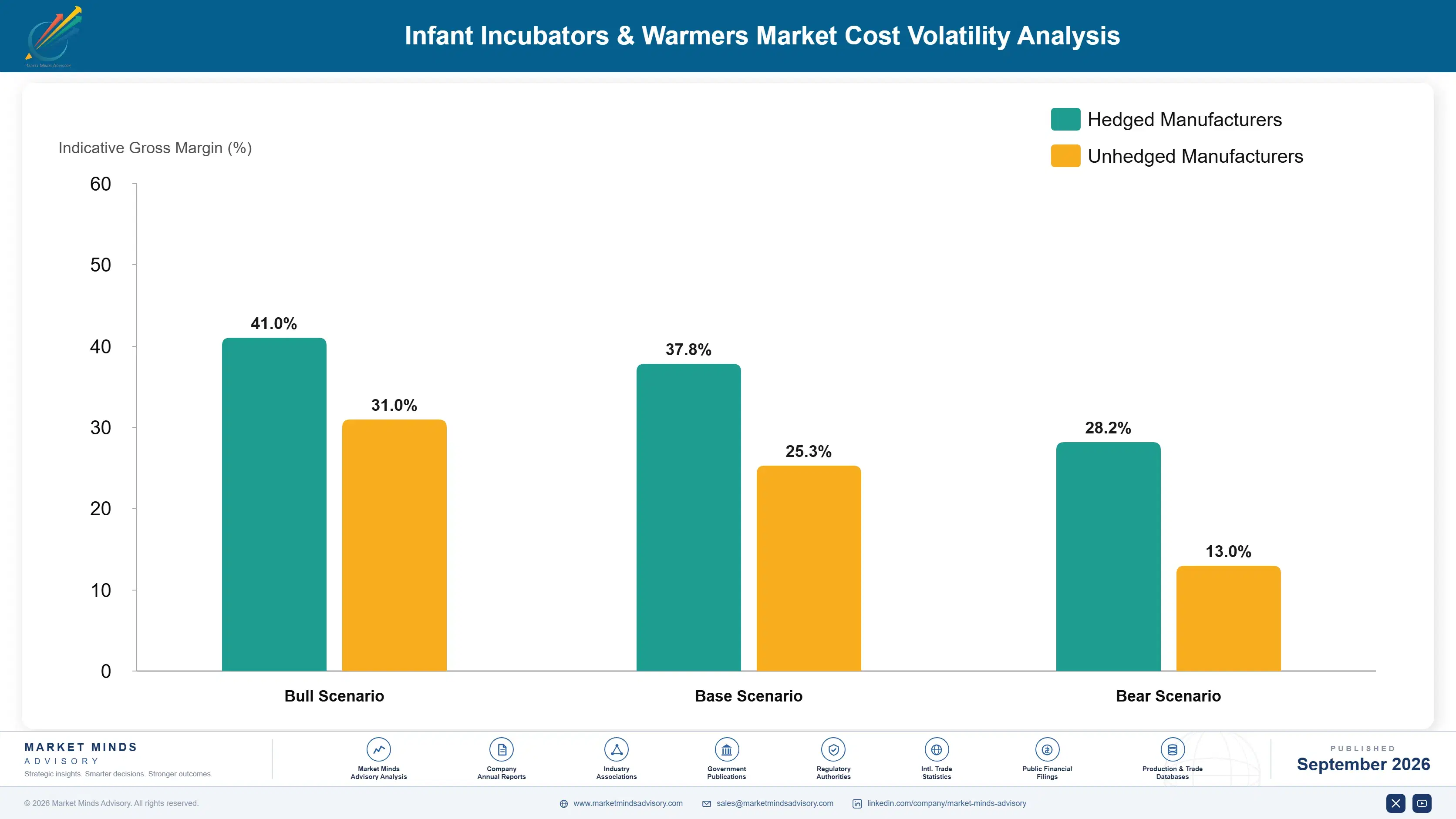
Electronics and Sensor Cost Exposure

Electronic components including temperature and humidity sensors, microcontrollers, and connectivity modules together represent roughly 34 percent of cost of goods sold for a typical connected hybrid incubator-warmer system. These components source primarily from semiconductor manufacturers concentrated in East Asia, with specialized medical-grade sensors sourced increasingly from smaller specialized suppliers in Japan and Germany serving precision instrumentation needs.
Semiconductor supply constraints during 2024, tracked by the IEA and industry reporting, tightened availability of specific microcontroller families widely used across medical device categories, delaying production schedules at several incubator manufacturers by multiple months. Manufacturers without diversified component sourcing saw electronics input costs rise an estimated 10 to 14 percent during the tightest supply window, compressing margins on multi-year fixed-price public procurement contracts. Currency fluctuations add further budgeting complexity for manufacturers holding fixed multi-year contracts.

Manufacturers without diversified semiconductor sourcing or long-term supply agreements face a meaningful competitive disadvantage relative to larger diversified medical technology companies like GE HealthCare, which use broader corporate purchasing scale across multiple product categories to secure component allocation priority during periods of industry-wide tightness. Regional manufacturers without this scale advantage often face longer component lead times during shortages.
infant-incubators-warmers-market-cost-volatility-analysis-1790017439085

Diversifying Semiconductor Component Sourcing

Manufacturers are qualifying additional microcontroller and sensor suppliers across multiple geographies to reduce dependence on any single component family facing potential allocation constraints during industry-wide semiconductor tightness. This diversification also shortens qualification timelines for future component substitutions across product lines. Clinical hospital customers benefit from more stable, predictable delivery timelines as a result. Costs improve gradually.

Long-Term Component Supply Agreements

Larger manufacturers are locking in multi-year supply agreements with semiconductor and sensor suppliers to secure allocation priority during periods of tightness, trading pricing flexibility for guaranteed component availability. Smaller manufacturers without comparable purchasing scale often struggle to secure similarly favorable priority terms. This negotiating gap is widening as semiconductor demand grows across many industries.

Modular Design Reducing Component Specificity

Manufacturers are redesigning electronics architecture toward modular components that can substitute between multiple qualified suppliers without full product recertification, reducing exposure to any single supplier's availability constraints. This flexibility also shortens development timelines for future product generations across the broader portfolio. Engineering teams report faster time to market under this new modular approach overall.

Portfolio Architecture for Margin Defence

Infant incubator and warmer margin architecture splits across three tiers, with volume-oriented standalone basic warming devices competing on price accessibility while premium connected hybrid systems and certified advanced monitoring platforms command far wider margins on integrated software capability and clinical documentation features. The gap between basic thermal-only devices and premium connected platforms keeps widening as tertiary hospital procurement increasingly favors integrated systems.
Volume and premium tiers pull manufacturer strategy in different directions across the category. Public hospital procurement in emerging markets rewards price accessibility and financing flexibility for basic equipment, while tertiary hospital procurement in developed markets rewards software capability, connectivity, and documented clinical outcomes that justify premium pricing. Manufacturers straddling both must maintain genuinely distinct product lines rather than attempting a single design to serve both market segments simultaneously.

The highest-value margin pools concentrate in connected hybrid systems sold through direct sales to tertiary academic medical centers, where manufacturers capture full premium pricing alongside recurring software and service revenue. Sustainability and regulatory-driven next-generation platforms incorporating energy-efficient thermal regulation are smaller today but growing as hospital sustainability procurement criteria increasingly factor into purchasing decisions at several leading health systems.

Volume / Commodity-Adjacent

Basic standalone incubators and radiant warmers sold through public hospital procurement on price accessibility and financing flexibility rather than advanced monitoring capability. Government fixed-price tenders dominate purchasing decisions in this segment.
Gross Margin: 22 to 30 percent

Premium / Certified

Connected hybrid incubator-warmer systems with integrated monitoring and electronic health record connectivity, sold to tertiary hospitals at meaningfully higher per-unit pricing. Hospital IT integration requirements support this pricing power further.
Gross Margin: 38 to 48 percent

Sustainability / Regulatory / Next-Generation

Energy-efficient next-generation platforms developed to satisfy hospital sustainability procurement criteria and evolving regulatory standards around device energy consumption and materials. Adoption remains uneven across hospital systems with differing sustainability priorities.
Gross Margin: 34 to 44 percent
infant-incubators-warmers-market-portfolio-architecture-1790017439969

High-value Sub-segments and Strategic Watch-out

Connected Hybrid Incubator-Warmer Systems

The fastest-growing and highest-value segment, integrating monitoring and connectivity at premium price points backed by hospital demand for continuous clinical documentation across most tertiary care facility procurement decisions currently expanding. Manufacturers increasingly dedicate specialized engineering teams to this segment alone. Growth momentum here shows no sign of slowing soon.
Gross Margin: 42 to 52 percent

Standalone Radiant Warmers

A large and steadily growing segment serving delivery rooms and lower-acuity care settings, capturing meaningful public hospital procurement volume at moderate price points across most emerging markets currently. Replacement cycles remain longer here than in the connected hybrid segment. Multi-year hospital budget cycles provide unusually strong revenue predictability here.
Gross Margin: 24 to 32 percent

Basic Standalone Incubators

The volume core of the category, sold at accessible price points through public procurement channels, sustaining category awareness even as growth concentrates elsewhere in connected hybrid platforms. Financing programs heavily influence purchasing timing across this tier. Scale efficiency remains the primary competitive differentiator in this tier.
Gross Margin: 20 to 28 percent

Phototherapy-Integrated Warming Systems

A strategic watch-out segment combining warming and jaundice treatment functionality, currently small but positioned to gain share as hospitals seek consolidated equipment footprints across neonatal care units. Early movers are building credibility with hospital sustainability procurement officers. Regulatory tailwinds should accelerate adoption over the coming years steadily.
Gross Margin: 30 to 40 percent

Service Contract Retention Economics

Infant incubator and warmer equipment behaves like an annuity relationship once a hospital signs a multi-year service and software subscription contract, since the equipment's fifteen-year service life creates a long runway for recurring maintenance revenue and periodic software feature upgrades. Manufacturers capturing that initial equipment sale retain the service relationship for years, and this dynamic is what makes bundled service contracts commercially durable across the category.
Adoption depth varies meaningfully by end-use vertical. Tertiary academic medical centers show the deepest stickiness, since integrated electronic health record connectivity and staff training investment create meaningful switching costs that discourage changing vendors even when competitors offer marginally lower pricing. Secondary and community hospitals show shallower loyalty, often switching vendors based on price during equipment replacement cycles when budget constraints outweigh established vendor relationships.

Generational shifts among hospital biomedical engineering and procurement staff are reshaping demand architecture. Younger procurement officers increasingly research connectivity standards and total cost of ownership data before purchasing, a behavior less common a decade ago when purchasing decisions leaned more heavily on established vendor relationships alone. Manufacturers serving both cohorts need distinctly different sales approaches rather than a single unified pitch.
infant-incubators-warmers-market-end-use-penetration-index-1790017440766

Where to Compete Next

These are among the four positions where our research anticipates prominent divergence between winners and laggards over the coming forecast period. Each is grounded in the demand model, the regulatory perimeter, and the announced capacity pipeline.
01 / CONNECTED PLATFORM PRIORITY

Prioritize connected hybrid capability over standalone equipment expansion

Connected hybrid incubator-warmer systems are growing at roughly 10.0 percent annually, well above the overall category rate, and tertiary hospitals increasingly specify electronic health record integration as a baseline procurement requirement rather than an optional feature across most developed markets. Manufacturers still organized purely around standalone thermal equipment are losing tender eligibility to competitors with established software and connectivity capability built over several product generations. The window to build credible connected platform capability before procurement requirements fully solidify across most major hospital markets is closing within roughly three years.
02 / PUBLIC FINANCING DEVELOPMENT

Build public procurement financing partnerships in emerging markets

Government maternal and child health investment programs are directing substantial capital toward expanding neonatal equipment access in secondary and tertiary hospitals across South Asia and East Asia specifically, creating meaningful new procurement volume. Manufacturers with established financing partnership programs already position themselves ahead of competitors requiring conventional upfront payment terms that many public hospitals simply cannot afford given tight capital budgets. Waiting until financing partnerships become commercially urgent means competing against manufacturers who built these relationships and government trust years earlier already.
03 / REGIONAL ASSEMBLY INVESTMENT

Establish local assembly capacity in high-growth import markets

Domestic content procurement preferences are already reshaping tender outcomes in India, China, and several other high-growth markets favoring locally assembled equipment over fully imported alternatives from established manufacturers. Manufacturers without local assembly operations face meaningful exclusion from an increasing share of public tenders in these markets regardless of underlying product quality or pricing competitiveness overall. Establishing local partnerships now secures tender eligibility before domestic content requirements tighten further across additional government procurement categories and adjacent public health equipment tenders nationwide.
04 / SOFTWARE TALENT ACQUISITION

Build software development capability alongside hardware engineering

Competitive differentiation is shifting toward software capability and connectivity standards compliance rather than traditional hardware engineering and thermal performance specifications that historically defined this equipment category for decades. Manufacturers without in-house software development capacity increasingly rely on external partnerships that slow product development cycles relative to competitors with integrated engineering teams working under one unified roadmap. Building this capability now positions manufacturers to compete on the dimension increasingly deciding hospital procurement outcomes across most developed and emerging markets served today.

Engagement Snapshot From the Field

A live engagement with an industry participant carrying material or product regulatory and market exposure ahead of a defining policy shift, showing how our research translates into a defensible multi-year portfolio strategy.
MARKET MINDS ADVISORY · CLIENT ENGAGEMENT SUMMARY
Infant Incubators & Warmers Producer Strategic Portfolio Review and Transition Roadmap 2026·Investment Scenario on Infant Incubators & Warmers Exposure Evaluation 2025-26
CLIENT PROFILE
A regional hospital network operating eight facilities across South Asia, generating roughly $340 million in annual revenue (client-reported, unverified by MMA), with neonatal intensive care equipment across its facilities ranging from decade-old standalone incubators to a handful of recently purchased hybrid systems at its flagship tertiary location. Network leadership sought an outside perspective before committing to a multi-year capital plan across all facilities.
STRATEGIC CHALLENGE
Network leadership faced a multi-year capital planning decision on whether to standardize all facilities on connected hybrid systems immediately, phase the upgrade over several years starting with highest-volume facilities, or maintain the existing mixed equipment fleet and prioritize other capital investments given constrained overall hospital budgets. The decision carried significant multi-year budget implications regardless of which path leadership ultimately chose.
MMA APPROACH
MMA conducted primary interviews with the network's biomedical engineering staff and neonatal care physicians across all eight facilities to assess clinical priority and equipment condition. The engagement combined total cost of ownership modeling across three modernization scenarios with financing partnership benchmarking against comparable regional hospital networks, drawing on MMA's primary research dataset for procurement trend context.
KEY FINDINGS
  1. Physician interviews across all eight facilities identified electronic health record integration as the single most requested feature, ahead of any other equipment capability considered (client-reported, unverified by MMA).
  2. Total cost of ownership modeling showed that phased modernization starting with the three highest-birth-volume facilities delivered better five-year returns than either immediate full standardization or continued deferral.
  3. Financing benchmarking revealed that multilateral development institution partnerships could cover a substantial share of upfront capital cost, reducing the network's required direct capital outlay considerably.
  4. Biomedical engineering interviews identified staff training gaps as a meaningful implementation risk requiring dedicated budget allocation alongside the equipment purchase itself. Leadership had underestimated this cost in early internal planning discussions.
CLIENT PROFILE
A regional hospital network operating eight facilities across South Asia, generating roughly $340 million in annual revenue (client-reported, unverified by MMA), with neonatal intensive care equipment across its facilities ranging from decade-old standalone incubators to a handful of recently purchased hybrid systems at its flagship tertiary location. Network leadership sought an outside perspective before committing to a multi-year capital plan across all facilities.
STRATEGIC CHALLENGE
Network leadership faced a multi-year capital planning decision on whether to standardize all facilities on connected hybrid systems immediately, phase the upgrade over several years starting with highest-volume facilities, or maintain the existing mixed equipment fleet and prioritize other capital investments given constrained overall hospital budgets. The decision carried significant multi-year budget implications regardless of which path leadership ultimately chose.
MMA APPROACH
MMA conducted primary interviews with the network's biomedical engineering staff and neonatal care physicians across all eight facilities to assess clinical priority and equipment condition. The engagement combined total cost of ownership modeling across three modernization scenarios with financing partnership benchmarking against comparable regional hospital networks, drawing on MMA's primary research dataset for procurement trend context.
KEY FINDINGS
  1. Physician interviews across all eight facilities identified electronic health record integration as the single most requested feature, ahead of any other equipment capability considered (client-reported, unverified by MMA).
  2. Total cost of ownership modeling showed that phased modernization starting with the three highest-birth-volume facilities delivered better five-year returns than either immediate full standardization or continued deferral.
  3. Financing benchmarking revealed that multilateral development institution partnerships could cover a substantial share of upfront capital cost, reducing the network's required direct capital outlay considerably.
  4. Biomedical engineering interviews identified staff training gaps as a meaningful implementation risk requiring dedicated budget allocation alongside the equipment purchase itself. Leadership had underestimated this cost in early internal planning discussions.
RECOMMENDED STRATEGY
Phase 1: Phase one: modernize the three highest-birth-volume facilities with connected hybrid systems, securing multilateral financing partnership support upfront. This sequencing maximized clinical impact per capital dollar deployed. Phase 2: Phase two: establish a centralized biomedical engineering training program before deploying equipment to the remaining five facilities network-wide. This program reduced implementation risk considerably across subsequent phases. Phase 3: Phase three: complete network-wide standardization within three years, reassessing financing terms as the network's credit profile improves. This timeline balanced clinical urgency against realistic budget constraints.
OUTCOME
Within the first year of phased implementation, the three initial facilities reported meaningfully improved clinical documentation completeness and reduced equipment downtime relative to their prior standalone equipment (client-reported, unverified by MMA). The network secured financing partnership terms covering a substantial share of remaining phase capital costs.

Frequently Asked Questions

Foundational context covering the market sizes, CAGR, scope, country, region and competition that inform every finding below. This section is provided to cover basics and most often pre-purchase conversations, answered from the MMA Primary Research Dataset.

What is the current size of the Infant Incubators and Warmers Market?

The global infant incubators and warmers market was valued at $2.6 billion in 2025. Growth is driven by rising preterm birth rates and expanding neonatal intensive care capacity.

How large will the Infant Incubators and Warmers Market be by 2036?

The market is projected to reach approximately $5.2 billion by 2036. This represents a 1.88 times expansion driven primarily by connected hybrid system adoption and NICU expansion.

What is the CAGR for the Infant Incubators and Warmers Market 2026 to 2036?

The market is forecast to grow at a 6.5 percent CAGR between 2026 and 2036. Bull and bear scenarios range from 5.2 to 7.8 percent depending on hospital capital spending.

Which segment is growing fastest?

Connected Hybrid Incubator-Warmer Systems lead growth at a 10.0 percent CAGR, roughly 1.54 times the overall market rate. This reflects hospital demand for integrated monitoring capability.

Who are the major companies in the Infant Incubators and Warmers Market?

Leading players include Draeger, GE HealthCare, Natus Medical, Phoenix Medical Systems, and Atom Medical. Together they hold roughly 55 percent combined market share on an installed base basis.

Which country is growing fastest?

India leads country-level growth at a 9.0 percent CAGR. Expanding government maternal health investment programs are driving faster adoption than in most established Western markets.

Report Segmentation Architecture

The full report scope spans multiple orthogonal segmentation dimensions, with cross-tabulated demand data provided for each dimension pair. Coverage extends further to regional breakdowns, trend trajectories, and the competitive detail needed to support segment-level decision-making.

By Primary Market Dimension

  • Connected Hybrid Incubator-Warmer Systems
  • Standalone Radiant Warmers
  • Basic Standalone Incubators
  • Phototherapy-Integrated Warming Systems
  • Transport Incubators
  • Servo-Controlled Incubators

By End-Use Industry

  • Tertiary Academic Medical Centers
  • Secondary and Community Hospitals
  • Delivery Room and Birthing Centers
  • Neonatal Transport Services

By Commercial Dimension

  • Direct Hospital Procurement
  • Group Purchasing Organization Contracts
  • Public Government Tender Sales
  • Financed Equipment Leasing

By Region

  • North America
  • Western Europe
  • East Asia
  • South Asia and Pacific
  • Latin America
  • Middle East and Africa
  • Eastern Europe

Scope, Methodology, and Coverage

Every figure in this report is reproducible from documented input assumptions. The scope below maps the historical period, the forecast horizon, the segmentation dimensions, and the countries covered, alongside the underlying primary and qualitative methodology.
Historical Period
2020 to 2025
Forecast Period
2026 to 2036
Base Year
2025 (USD billions; MMA Primary Research Dataset, September 2026)
Market Definition
This report covers the global market for infant incubators, radiant warmers, and hybrid incubator-warmer systems used in neonatal intensive care and delivery room settings. It excludes general pediatric hospital beds and phototherapy units sold as standalone devices unless integrated into a hybrid platform.
Quantitative Units
USD billions, market share percentages, CAGR percentages
Segmentation Dimensions
Product type, end-use industry, commercial distribution channel, region
Regions Covered
North America, Western Europe, East Asia, South Asia and Pacific, Latin America, Middle East and Africa, Eastern Europe
Countries Covered
United States, Canada, Germany, United Kingdom, France, China, Japan, South Korea, India, Australia, Brazil, Mexico, Saudi Arabia, United Arab Emirates, Poland
Key Companies Profiled
Draeger, GE HealthCare, Natus Medical, Phoenix Medical Systems, Atom Medical, Getinge, Fanem, Medela, Weyer, Bistos, Vyaire Medical, Ningbo David Medical Device, Advanced Instrumentations, Fuda Medical, Amico Corporation, Narang Medical, TSE Medical, Embrace Innovations, Blue Star Medical, Chirana Medical
Quantitative Methodology
Primary survey, n=3,800 respondents, Q4 2025, six countries; demand-side model with trade association cross-validation
Qualitative Methodology
47 expert interviews, Q4 2025; applied to validate demand model assumptions, identify emerging dynamics, and assess competitive positioning
Report Format
PDF and XLSX data workbook (Word format preview document)
Publisher
Market Minds Advisory
Report Code
MMA-2026-MED-215
Published
September 2026
Contact
sales@marketmindsadvisory.com | www.marketmindsadvisory.com

Purchase the full Infant Incubators & Warmers Market Report (2026 to 2036).

This report delivers a comprehensive analysis of the global infant incubators and warmers market and its shifting equipment landscape. It covers product segmentation, regional demand patterns, and competitive dynamics across the full forecast period from 2026 through 2036 in careful detail. The analysis combines primary survey data from 3,800 respondents across six countries with 47 expert interviews to quantify connected hybrid system adoption trends and public procurement financing patterns across the category. Analysts examine input cost exposure, margin architecture, and revenue lever strategy across hospital and public procurement channels.
Seven-region demand share and CAGR breakdown
Five to six segment competitive positioning analysis
Twenty-company competitive landscape and moat assessment
Input cost exposure and mitigation strategy review
Revenue growth lever and margin expansion playbook
Anonymized client engagement case study analysis

Built For The People Who Decide

From boardroom strategy to bench-side execution, this report is read cover-to-cover by leaders shaping the next decade of their industry, turning demand scenarios, market dynamics and valuation benchmarks into decisions.
CXOs/ Presidents/ VPs/ Managers
M&A and Corporate Development
Strategy Teams and R&D Heads
Procurement and Product Directors
Regulatory and Compliance Leaders
Investor Relations and Equity Analysts