Market Minds Advisory
Infant Formula Ingredients Market

Infant Formula Ingredients Market: Oligosaccharide Authorisation, Falling Birth Cohorts And Qualification That Almost Never Reverses

Birth numbers are falling across every major formula market at once, which makes ingredient value per feed the only route to growth and puts oligosaccharide authorisation at the centre of every recipe decision.

Lead Analyst

Lisa Gevelber

Published

September 2026

Make Smarter Decisions with Customized Research Insights

Request a free sample report and evaluate market opportunities, growth trends, and competitive dynamics relevant to your business needs.

2025 MARKET VALUE$7.8BMarket Size 2025
2036 FORECAST VALUE$16.1BBase Case , 2026 to 2036
CAGR 2026 TO 20366.8 %Bull 8.0% / Bear 5.6%
INCREMENTAL OPPORTUNITY$7.8BNet 10- year value creation
EXPANSION MULTIPLE1.93x2036 value over 2026 base
Strategic Levers
M&A Pipeline
Regional Outlook
Country Rankings
Competitive Intelligence
Segmental Deep-dive
Call-Us : 91 93563 13602

Executive Snapshot and Market Trajectory

Birth numbers are falling across China, Europe, Japan, Korea and most of the developed world simultaneously, which removes the volume growth this industry was built on. Value per feed is the only route left, and that puts ingredient composition at the centre of everything. Composition arguments intensified accordingly, and quickly.
Human milk oligosaccharides carry the growth because they are the one ingredient class where the science genuinely moved rather than the marketing, replicating structures formula previously could not. Specialty protein fractions grow nearly as fast on composition that brings formula closer to human milk. East Asia holds the largest share on Chinese formula manufacturing scale despite the birth decline running underneath it. Value per feed is now the only route to growth anywhere.
Concentration reads at 64% for the top five, high because ingredient qualification into a registered formula recipe is slow, expensive and almost never reversed afterwards. Regulatory authorisation for novel ingredients differs by jurisdiction and does not arrive simultaneously, which means the same formula frequently cannot be sold everywhere it was designed for. That means the same formula frequently cannot be sold everywhere it was designed for.
Market Definition
This market covers specialty ingredients supplied into infant and follow-on formula manufacturing, spanning human milk oligosaccharides, specialty protein fractions, structured lipids and fat blends, prebiotic and probiotic ingredients, and vitamin and mineral premixes for infant nutrition. Base dairy commodities including skimmed milk powder and whey powder, finished infant formula, toddler and growing-up milks beyond follow-on stage, and clinical nutrition for other age groups are excluded.
Base Year Value
$7.8B in 2025 (MMA Primary Research Dataset, August 2026)
Forecast Period
2026 to 2036, eleven discrete annual values
CAGR
6.8% base case. Bull 8.0%. Bear 5.6%.
Fastest Growth Segment
Human Milk Oligosaccharides: 10.2% CAGR
Fastest Growth Country
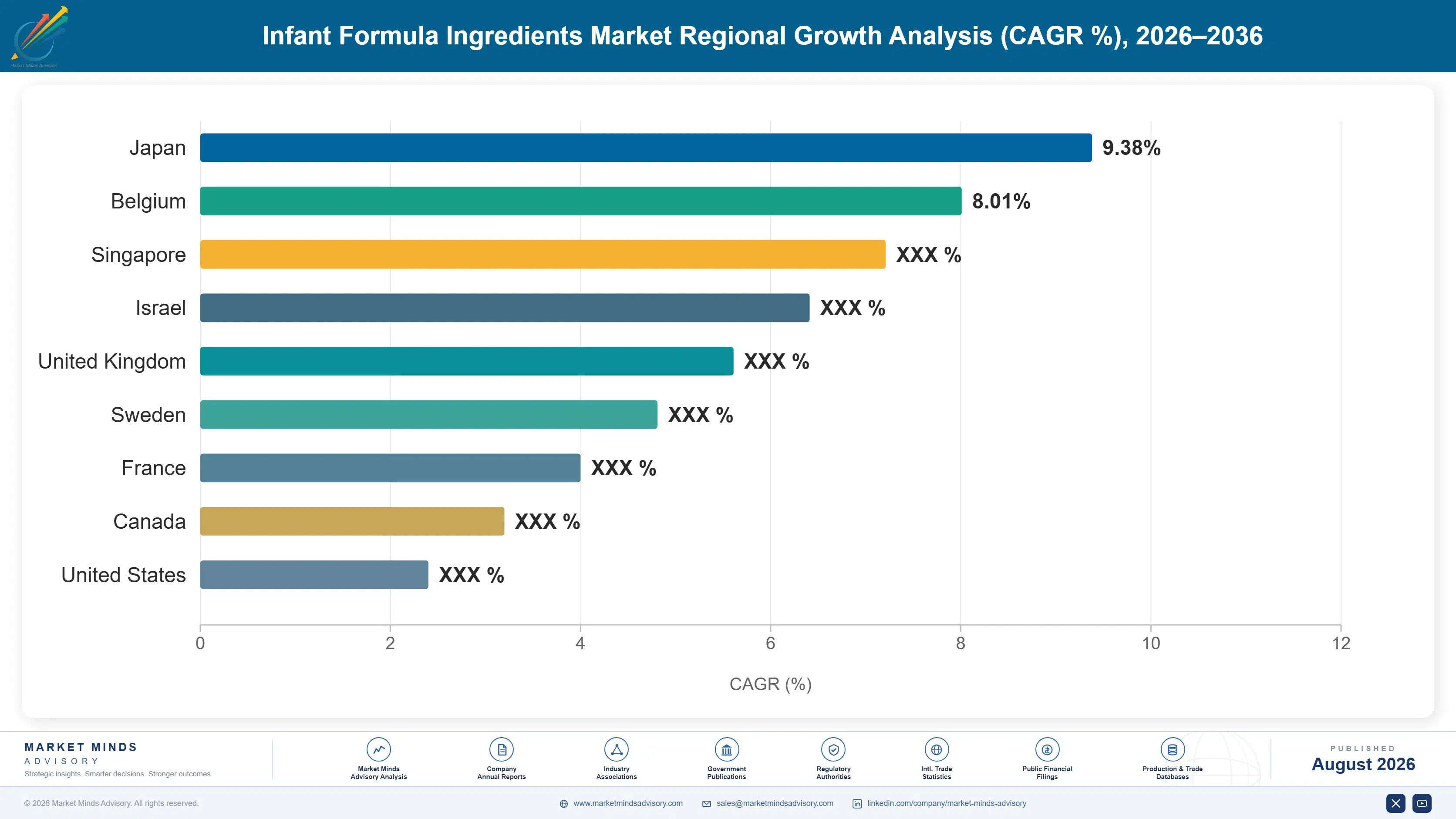
India: 9.6% CAGR
Fastest Growth Region
South Asia and Pacific: 9.0% CAGR
Largest Region
East Asia: 34% of 2025 global value
Market Leaders
DSM-Firmenich, FrieslandCampina Ingredients, Arla Foods Ingredients, BASF and Glanbia Nutritionals lead on infant formula ingredient revenue. Source: MMA Primary Research Dataset, July 2026.
Primary Survey
n=3,800 procurement and R&D decision-makers, Q4 2025, six countries
Methodology
Demand-side build-up, cross-validated against public data, 47 expert interviews

Infant Formula Ingredients Market Forecast Scenarios

infant-formula-ingredients-market-trends-size-forecast-scenario-1787460175859
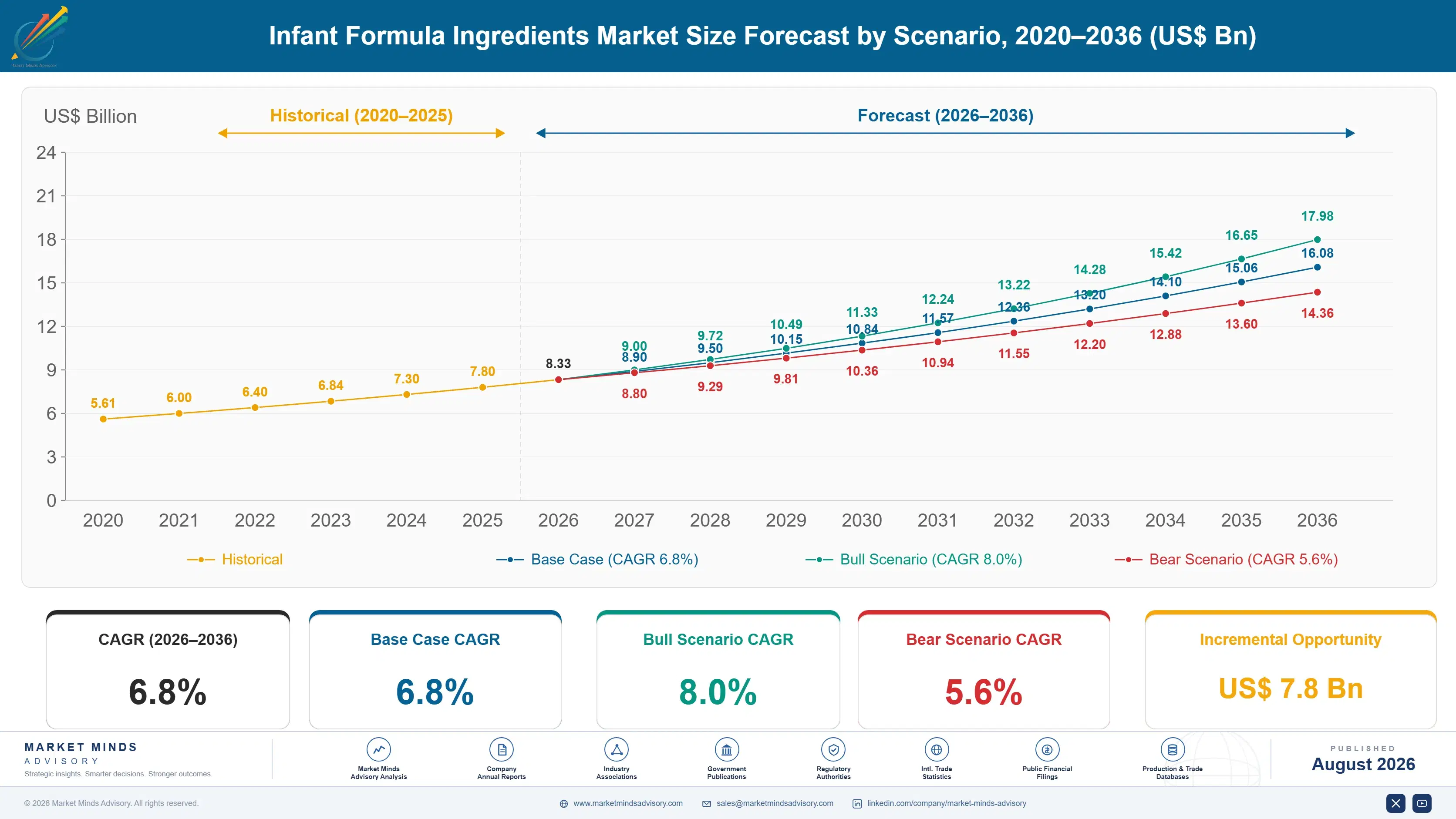
Growth ran at 5.8% annually between 2020 and 2025, and the composition of that growth was unusual. Volume fell across most major markets as birth numbers declined, particularly in China where the drop was steep and sustained. Value nonetheless rose, because oligosaccharide and specialty protein inclusion lifted ingredient value per feed faster than the volume decline removed it.
The base case at 6.8% rests on three mechanisms. Oligosaccharide inclusion keeps spreading from premium into mainstream formula tiers as production scales and cost per kilogram falls. Specialty protein fractions keep being added as manufacturers compete on composition rather than on price. And Indian and Southeast Asian demand grows on birth numbers that are still substantial and formula penetration that continues rising from a low base. None of the three depends on birth numbers recovering anywhere.
The bull case at 8.0% turns on oligosaccharide authorisation widening across jurisdictions that currently restrict it, which would let manufacturers sell one recipe internationally rather than several. The bear case at 5.6% reflects birth decline accelerating beyond current projections, since no amount of ingredient value per feed compensates indefinitely for fewer babies being born. Demographics sit entirely outside industry influence here.

Fewer Babies, More Ingredients Per Feed

Every major formula market is losing births at once. China fell furthest and fastest, Europe, Japan and Korea are all declining, and even markets that grew for decades have turned. That removes the volume growth this industry was built on and leaves ingredient value per feed as the only route, which is why composition arguments have become so intense. Volume growth was the foundation of this industry and it has gone.
TOP FIVE CONCENTRATION64%High, since qualification into registered recipes is slow and expensive
INGREDIENT VALUE PER FEED$0.19Specialty ingredient content in a typical prepared infant feed
OLIGOSACCHARIDE INCLUSION RATE38%Share of formula volume including human milk oligosaccharide ingredients
QUALIFICATION CYCLE26 monthsTypical time to qualify an ingredient into a registered formula
SPECIALTY SHARE OF COST31% of COGSSpecialty ingredient contribution to finished formula manufactured cost
POSITION RETENTION9 yearsAverage duration an ingredient holds inside a registered formula
Human milk oligosaccharides are where that argument concentrates. These are structures present in breast milk that formula genuinely could not replicate before fermentation production made them available, which is a rare case of science moving rather than marketing. Roughly 38% of formula volume now includes them, spreading from premium tiers into mainstream as production scales. Supply concentration among few producers is the constraint on how fast that spreads.
Qualification is what makes ingredient positions valuable and rigid together. Getting an ingredient into a registered formula recipe takes around 26 months of formulation, clinical and regulatory work, after which it stays an average of nine years because changing it means revisiting registrations in every market the product is sold. Displacement is genuinely rare rather than merely difficult.
"This industry spent thirty years selling more formula to more babies. There are fewer babies now and there will be fewer still. Everything commercially interesting has moved to what goes into each feed, which is a different business entirely."
Director, Nutritional Ingredients and Infant Nutrition Practice · MMA Nutritional Ingredients Practice · August 2026

Market Trends

Oligosaccharide Inclusion Spreads From Premium Into Mainstream Tiers

Human milk oligosaccharides replicate structures present in breast milk that formula could not previously deliver, which is the one place in infant nutrition where the science genuinely moved rather than the positioning. Fermentation production made them commercially available and cost per kilogram keeps falling as capacity scales. Roughly 38% of formula volume now includes them and the share climbs as inclusion spreads down from premium tiers. Supply concentration among very few producers remains the constraint on how fast that happens. Cost per kilogram is high but inclusion is small, so finished formula cost rises less than the price suggests.
Market Impact: Positions hold for 9 years typically
Falling Birth Cohorts Force Value Per Feed Competition

China, Europe, Japan and Korea are all losing births simultaneously and several markets that grew for decades have turned, which removes the volume growth this industry was built on entirely. Value per feed is the only remaining route, and that has made composition arguments considerably more intense than they were when volume covered everything. Specialty ingredients now carry roughly 31% of finished formula manufactured cost, up substantially from where that share sat a decade ago. Several markets that grew for decades have now turned, and none is expected to recover. Value per feed is the only remaining route.
Market Impact: India grows at 9.6% annually

Market Opportunities and Growth Drivers

Qualification Rigidity Makes Ingredient Positions Unusually Durable

Getting an ingredient into a registered infant formula takes around 26 months of formulation, clinical and regulatory work, and once inside it stays an average of nine years because changing it means revisiting product registrations in every market where the formula is sold. That is a considerable disincentive for any manufacturer to switch supplier casually. Displacement is genuinely rare rather than merely difficult, which makes incumbent ingredient positions worth far more than the annual volume alone suggests. Manufacturers do not undertake registration changes lightly and very rarely undertake them to save money.
Market Impact: Adds 18 months per jurisdiction

Indian And Southeast Asian Birth Numbers Remain Substantial

India still records more births annually than any other country and formula penetration continues rising from a low base, which is a combination that no longer exists in any developed market. Indian demand grows near 9.6% annually as a result. Regulatory frameworks differ from Western practice and marketing restrictions around infant formula are enforced firmly, which shapes how manufacturers can operate. Southeast Asian markets combine similar demographics with formula penetration that is further advanced. That combination no longer exists anywhere across the developed world at all. Southeast Asian penetration is further advanced than India's.
Market Impact: Chinese births fell 45% since 2016

Market Restraints and Challenges

Authorisation Divergence Prevents One Recipe Serving Every Market

Novel ingredient authorisation for oligosaccharides and specialty fractions arrives at different times in different jurisdictions and sometimes not at all, so a formula designed around a particular composition frequently cannot be sold everywhere it was intended for. The root cause is that infant nutrition regulation is national and deliberately conservative. Commercially this multiplies formulation and registration work considerably. Participants are responding with market-specific recipes, parallel dossier submissions and phased launches following authorisation sequence. Infant nutrition regulation is national and deliberately conservative everywhere. Phased launches follow authorisation sequence rather than commercial preference.
Market Impact: Inclusion reaches 38% of volume

Birth Decline Removes Volume No Composition Can Replace

Fewer babies are born in every major formula market each year and the trend shows no sign of reversing, which removes volume that ingredient value per feed can offset for a period but not indefinitely. The root cause is demographic and entirely outside industry influence. Commercially this caps the category regardless of how sophisticated formulations become. Participants are responding with premium composition, geographic shift toward markets with birth numbers, and extension into adjacent nutrition categories. Extension into adjacent nutrition categories is the other response participants are attempting. Geographic shift is the other partial response.
Market Impact: Specialty carries 31% of cost
3 additional market trends, 4 additional growth drivers, and 2 additional restraints and challenges are covered in the full report. Contact sales@marketmindsadvisory.com to access the complete intelligence.

Segment CAGR and Growth Architecture

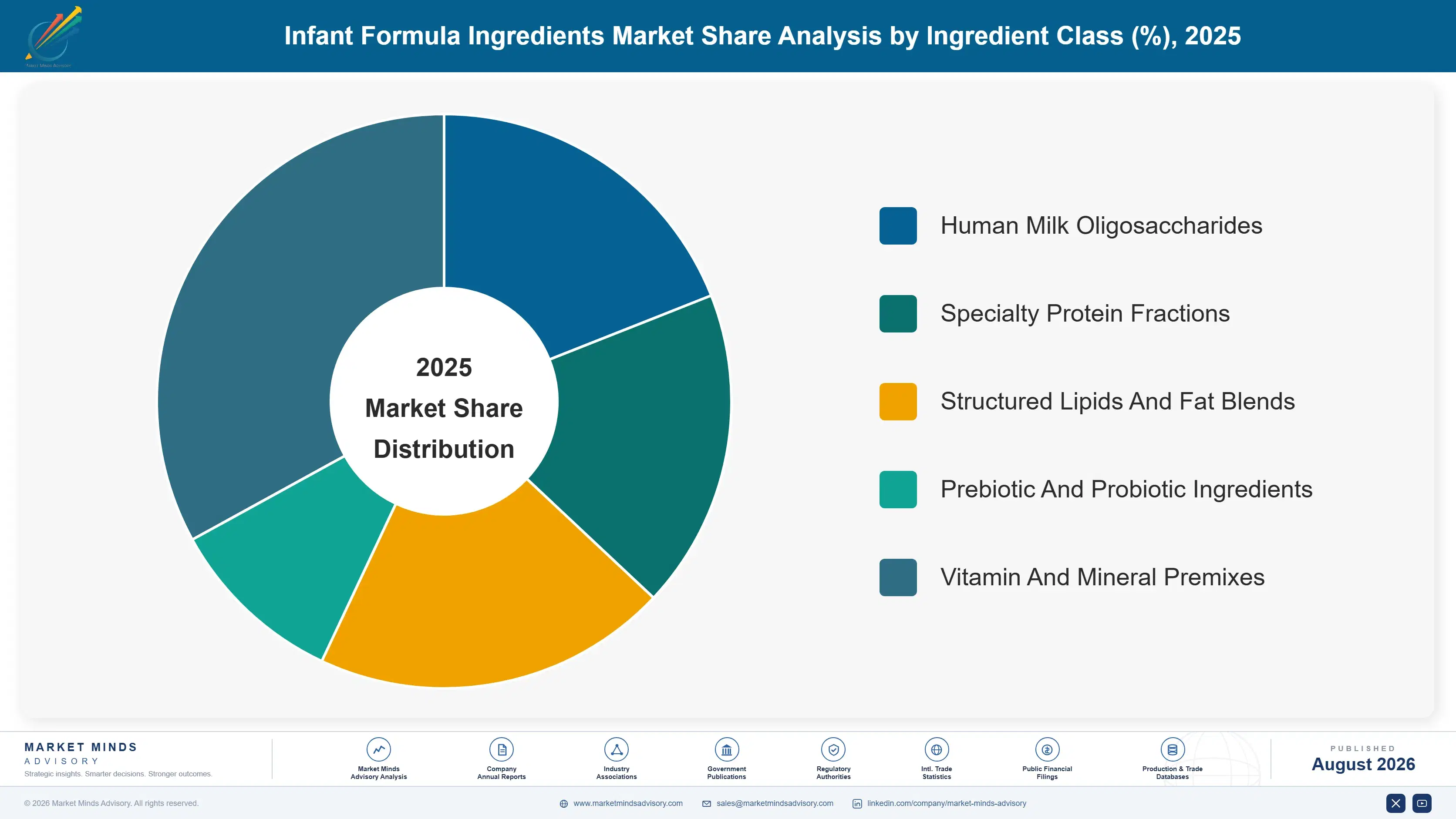
Five ingredient classes divide this market on what each one contributes to formula composition rather than on the raw material behind it. That reflects how manufacturers actually formulate, since a recipe is assembled from functions that bring composition closer to human milk, and the sourcing route matters far less to that decision than the function does.
infant-formula-ingredients-market-trends-market-share-analysis-1787460176388

Human Milk Oligosaccharides

Growing at 10.2% and the fastest part of this market. Human milk oligosaccharides are the only ingredient class in infant nutrition where the science genuinely moved rather than the marketing, since these are structures present in breast milk that formula could not previously replicate at all. Fermentation production made them commercially available and regulatory authorisation followed across major jurisdictions, though not simultaneously and not identically. Supply sits with very few producers holding the strains and capacity, which concentrates the segment severely. Cost per kilogram is high and inclusion levels are small, so the effect on finished formula cost is far less than the ingredient price alone suggests. Regulatory authorisation followed fermentation availability rather than preceding it.
CAGR 10.2%

Specialty Protein Fractions

Growing at 8.5% on specialty protein fractions including alpha-lactalbumin, lactoferrin, osteopontin and milk fat globule membrane, which are isolated from dairy streams and included to bring formula composition closer to human milk. Lactoferrin in particular has become commercially significant and its pricing swings violently with dairy supply and Chinese demand. These fractions require processing capability that ordinary dairy operations do not possess, since isolating a minor protein without denaturing it is genuinely difficult. Qualification into a formula recipe is slow and displacement afterwards is rare, which makes incumbent positions unusually durable here. Dairy stream availability rather than demand caps how much can be produced. Isolation without denaturing is the genuine technical barrier here. Chinese demand moves lactoferrin pricing violently.
CAGR 8.5%
Full segment breakdown across 5 segments available in the complete report.

Regional Architecture and Country Demand Map

East Asia holds 34% of global value on Chinese formula manufacturing scale, which remains the largest anywhere despite the birth decline running underneath it. Western Europe follows at 22% on ingredient production, while South Asia and Pacific grows fastest on birth numbers. Authorisation divergence shapes every recipe.

East Asia

Note: East Asia sits above the standard share band because Chinese formula manufacturing remains the largest anywhere by a considerable margin even after a birth decline that removed roughly 45% of annual births since 2016, which no realistic allocation avoids. That decline is the defining commercial fact for every supplier serving the region. Chinese registration requirements are demanding and recipe approval is market-specific, which shapes ingredient selection directly. Domestic manufacturers have gained share against imported formula since regulation tightened. Japanese and Korean markets are smaller, technically demanding and also declining, with premium composition the only route to value growth available in either of them. Domestic manufacturers have gained share against imported formula since regulation tightened considerably.
Share: 34% | CAGR: 7.7% (2026 to 2036)

Western Europe

Ingredient production rather than formula consumption carries this region, with FrieslandCampina, Arla and DSM all holding substantial positions in specialty fractions and oligosaccharides supplied worldwide. Dairy processing depth is what made that possible, since specialty protein fractions come from dairy streams that need scale to isolate economically. European infant nutrition regulation is conservative and authorisation for novel ingredients takes considerable time, which delays inclusion relative to other markets. Birth numbers are falling across most member states. Export of both ingredients and finished formula into Asian markets is commercially more important than domestic consumption for several of these businesses. Dairy processing depth is what made specialty fractionation possible here rather than elsewhere. Export matters more than domestic consumption.
Share: 22% | CAGR: 5.3% (2026 to 2036)
Regional intelligence for 5 additional markets available in the complete report: North America, South Asia and Pacific, Latin America, Middle East and Africa, Eastern Europe. Contact sales@marketmindsadvisory.com.
infant-formula-ingredients-market-trends-country-cagr-analysis-1787460176905

Where Formula Ingredient Value Concentrates

Four positions separate ingredient suppliers with durable business from those selling dairy fractions on specification: qualifying into registered recipes early, holding oligosaccharide production access, sequencing regulatory authorisation across jurisdictions, and shifting geographic weight toward the markets where births still happen. Only the second is genuinely difficult to acquire quickly through any route. The rest are decisions.

Qualify Into Registered Recipes Before Competitors Do

Getting an ingredient into a registered infant formula takes around 26 months of formulation, clinical and regulatory work, and once inside it stays an average of nine years because changing it means revisiting registrations in every market the formula is sold into. Qualified suppliers realise 35% to 45% higher pricing than those quoting on specification, on volume that repeats annually. Displacement is genuinely rare rather than merely difficult, which makes early qualification worth considerable effort. Manufacturers rarely change a registered recipe to save money on an ingredient. Registration burden holds it there.
Market Impact: Holds qualified positions averaging around 9 years apiece

Hold Oligosaccharide Production Access Competitors Cannot Match

Human milk oligosaccharide supply sits with very few producers holding the fermentation strains and capacity, which concentrates the segment severely and gives holders pricing that reflects scarcity rather than production cost. Roughly 38% of formula volume now includes them and inclusion is spreading down from premium tiers as capacity scales. Suppliers without access cannot answer the composition briefs that increasingly define premium formula, whatever else their portfolio contains. Pricing reflects scarcity rather than production cost, which is unusual. Composition briefs increasingly assume oligosaccharide inclusion as standard. Access decides who competes here.
Market Impact: Reaches the 38% of volume including these ingredients

Sequence Regulatory Authorisation Across Jurisdictions Deliberately

Novel ingredient authorisation arrives at different times in different markets and sometimes not at all, adding roughly 18 months per jurisdiction and preventing one recipe from serving everywhere it was designed for. Suppliers sequencing dossiers by regulatory proximity rather than by market size reach multi-market authorisation 30% to 40% faster. Those sequencing by demand alone discover that the largest market frequently carries the longest and least transferable regulatory pathway. Regulatory proximity beats market size as a sequencing criterion here. Parallel dossiers help where jurisdictions permit them. Sequencing by demand alone wastes years.
Market Impact: Cuts multi-market authorisation timelines by up to 40%

Shift Geographic Weight Toward Markets With Births

China lost roughly 45% of annual births since 2016 and Europe, Japan and Korea are all declining, which removes volume that ingredient value per feed offsets for a period rather than permanently. India, Southeast Asia and Africa still have substantial birth numbers and rising formula penetration together. Indian demand grows near 9.6% annually. Building position there requires navigating marketing restrictions enforced firmly, which is slower than the demographics alone would suggest. No amount of composition improvement replaces babies who are not born. Formula penetration matters as much as birth numbers themselves.
Market Impact: Indian demand keeps growing at 9.6% every year

Who Controls the Margin Pool

Concentration reads at 64% for the top five measured on infant formula ingredient revenue, the basis used throughout this section, and it reflects qualification rigidity rather than manufacturing scale. DSM-Firmenich holds the broadest position across oligosaccharides and nutritional ingredients. FrieslandCampina and Arla bring dairy fractionation depth, BASF fermentation capability, and Glanbia breadth across nutritional formulation.
Competition runs on three fronts. Qualification position is the first and by a wide margin the most decisive, since displacement almost never happens once an ingredient sits in a registered recipe. Oligosaccharide access is the second, determining which composition briefs a supplier can answer at all. Regulatory capability is the third, and it governs how many markets a formula can reach. None of the three is a pricing argument.

Pressure arrives from two directions. Birth decline removes volume across every developed market simultaneously, which no composition improvement offsets indefinitely. Separately, Chinese domestic ingredient producers are building fractionation and fermentation capability. Rankings will shift toward suppliers holding oligosaccharide access and positions in markets where births still occur rather than mature market qualification alone. Mature market qualification alone no longer carries a business.
infant-formula-ingredients-market-trends-company-positioning-matrix-1787460177425

Competitive Moat and Risk Dimensions

DSM-FIRMENICH

Moat: Oligosaccharide and portfolio breadth

Fermentation capability across human milk oligosaccharides combined with breadth across nutritional ingredients lets the group answer composition briefs that single-category suppliers cannot address at all, and formula manufacturers value sourcing several qualified ingredients from one supplier. Regulatory affairs capability across jurisdictions also shortens the authorisation work manufacturers would otherwise carry themselves.
DSM-FIRMENICH

Risk: Birth decline across mature markets

Heavy exposure to markets where births are falling leaves the business dependent on ingredient value per feed rising faster than volume declines, which works for a period rather than permanently. Chinese domestic producers building fermentation capability also threaten a segment whose pricing currently reflects scarcity more than production economics.
FRIESLANDCAMPINA INGREDIENTS

Moat: Dairy fractionation capability depth

Isolating minor proteins from dairy streams without denaturing them requires processing capability that ordinary dairy operations simply do not have, and decades of investment produce specialty fractions that formula manufacturers build recipes around. Cooperative milk supply also gives the business raw material access and traceability that infant nutrition customers examine closely before qualifying anybody.
FRIESLANDCAMPINA INGREDIENTS

Risk: Limited oligosaccharide production position

Oligosaccharides are the fastest growing ingredient class and require fermentation capability rather than dairy fractionation, which sits outside the business's traditional strengths and where competitors moved earlier. Dairy stream availability also constrains specialty fraction volume in ways that a fermentation route would not, particularly as demand for individual fractions rises.

Players Tracked

Prominent Players

DSM-Firmenich
FrieslandCampina Ingredients
Arla Foods Ingredients
BASF
Glanbia Nutritionals

Other Key Players

Kerry Group
IFF
Chr. Hansen
Fonterra
Lactalis Ingredients
Ingredia
Agropur Ingredients
Hilmar Ingredients
Milk Specialties Global
Inner Mongolia Yili
Sirio Pharma
Advanced Protein Technologies
Synlait Milk
Westland Milk Products
Hipp Ingredients

Recent Developments

FEBRUARY 2025

Oligosaccharide authorisation granted in additional major jurisdiction

Regulators in a major infant formula market authorised an additional human milk oligosaccharide for use in infant formula, allowing manufacturers to align recipes across more markets and reducing the formulation divergence that jurisdictional differences had forced on them. Recipe alignment across more markets became possible for the first time.
Signal: Authorisation divergence is the practical barrier preventing one recipe from serving several markets at once anywhere
JUNE 2025

Fermentation capacity expanded as oligosaccharide inclusion spreads downward

An ingredient producer expanded human milk oligosaccharide fermentation capacity, responding to inclusion spreading from premium formula tiers into mainstream ranges and to supply concentration that had been constraining how fast that shift could proceed. Inclusion had been spreading from premium into mainstream ranges throughout. Capacity comes on stream soon.
Signal: Supply concentration rather than any manufacturer appetite has been limiting how fast this inclusion spreads downward
OCTOBER 2025

Chinese domestic ingredient producer qualifies specialty protein fraction

A Chinese ingredient producer completed qualification of a specialty dairy protein fraction with a domestic formula manufacturer, entering a segment that imported European suppliers had held almost exclusively for the previous decade. Imported European suppliers had held this segment almost exclusively for a decade. Qualification took over two years.
Signal: Chinese domestic ingredient capability is now entering segments that imported suppliers had previously held almost exclusively

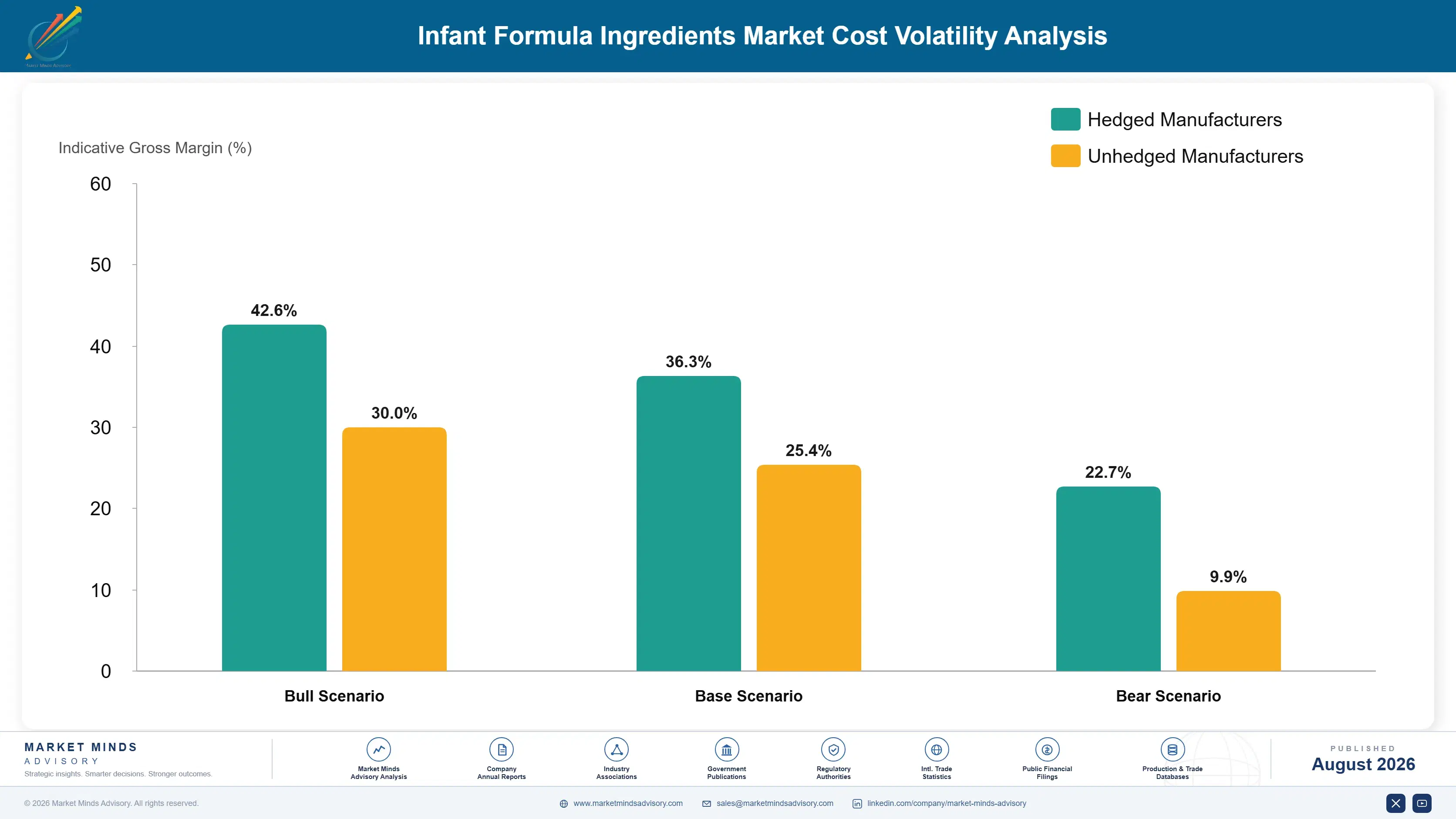
What Drives Formula Ingredient Cost

For specialty protein fractions, dairy stream raw material accounts for roughly 38% of manufactured cost and isolation processing a further 27%, since separating a minor protein without denaturing it is genuinely demanding. For oligosaccharides the structure differs entirely, with fermentation and downstream purification together near 61% and feedstock sugars around 14%. Regulatory maintenance and quality documentation add close to 9% across both routes.
Dairy commodity pricing moved sharply through 2022 and 2023 on herd contraction across Europe and Oceania, with United States Department of Agriculture dairy data showing the movement, which fed directly into specialty fraction costs. Lactoferrin pricing in particular swung violently on Chinese demand and available supply. Fermentation energy costs rose in parallel according to International Energy Agency figures across the same period. Suppliers absorbed a considerable share of both movements.

The disadvantage mechanism is that specialty fraction volume is capped by dairy stream availability rather than by demand, and it falls on dairy-route suppliers rather than fermentation ones. A minor protein present at low concentration in milk cannot simply be produced in greater quantity when customers want more of it. Exposure therefore varies by production route entirely, since fermentation capacity can be built while dairy fractions cannot.
infant-formula-ingredients-market-trends-cost-volatility-analysis-1787460177619

Contract dairy stream access on multi-year committed terms

Specialty fraction volume is limited by dairy stream availability rather than by demand, which makes secured access considerably more valuable than it appears on a cost line. Multi-year arrangements with processors or cooperatives lock in the raw material that constrains output. The commitment carries volume risk if demand softens, and the alternative is finding somebody else contracted the stream first.

Build fermentation routes where dairy supply constrains volume

Fermentation capacity can be expanded when demand justifies it while dairy fractions cannot, since a minor milk protein exists at whatever concentration nature provides. Fermentation-derived equivalents remove that ceiling entirely for the ingredients where the route is technically viable. Development takes years and capital, which is why the capability separates suppliers who can scale from those whose volume is fixed.

Spread regulatory maintenance across a wider portfolio

Registration and documentation maintenance run near 9% of cost and much of it is fixed per jurisdiction rather than per ingredient, which punishes narrow portfolios. Widening the qualified range spreads that burden while offering formula manufacturers several ingredients from one qualified supplier. Each additional ingredient requires its own dossier work first, so sequencing matters as much as the decision itself.

Portfolio Architecture for Margin Defence

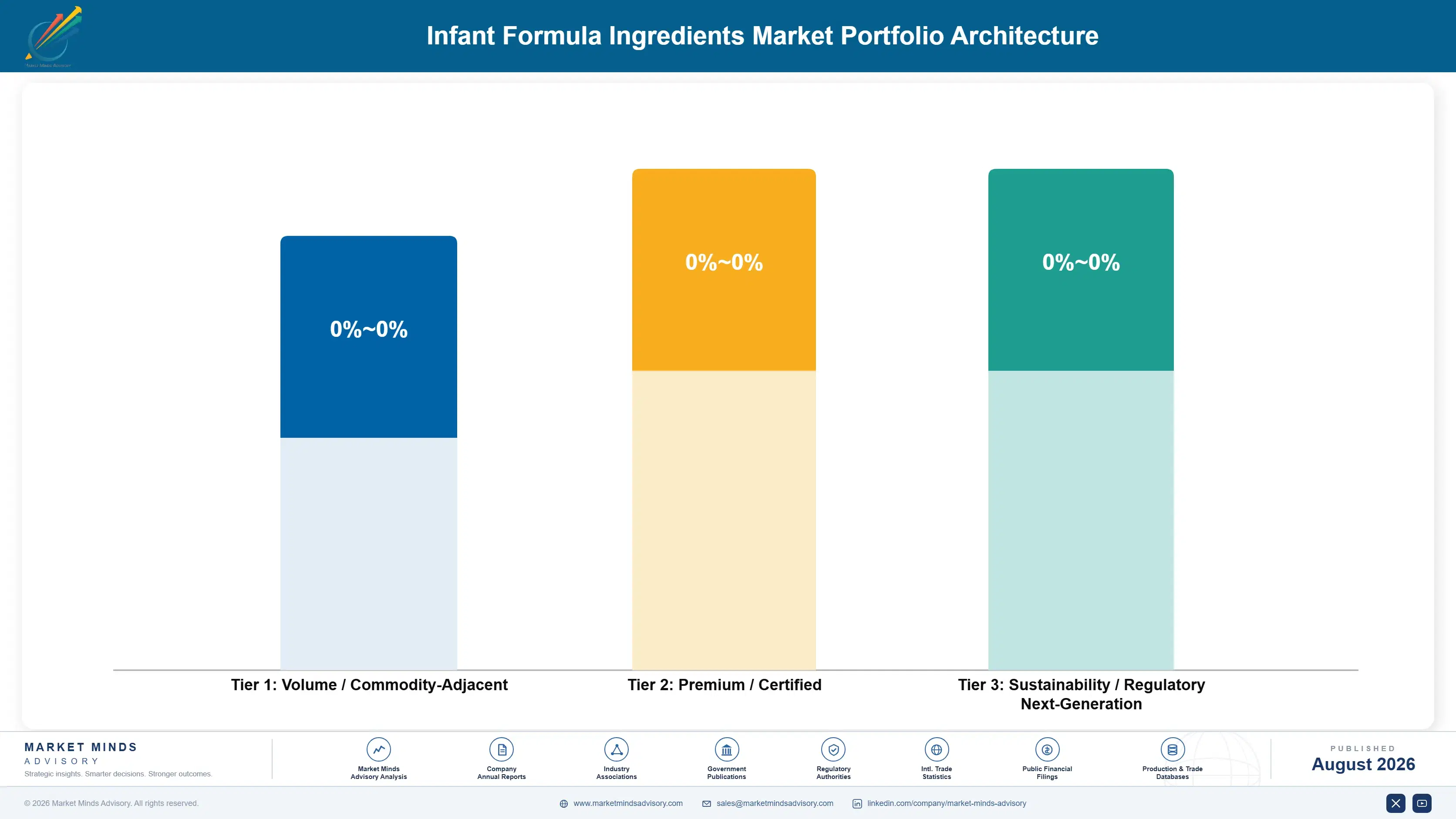
Portfolio economics here divide on qualification status and ingredient scarcity rather than on nutritional argument. Commodity dairy fractions quoted on specification against an established formula compete against every other supplier of the same material, and since the recipe already exists the buyer is comparing price rather than capability. Nothing about that position rewards technical capability at all.
The middle tier is qualified specialty fractions inside registered recipes. Twenty-six months of formulation, clinical and regulatory work produce a position averaging nine years, because changing it means revisiting registrations everywhere the formula sells. Margins reach the high thirties and hold across the life of the product rather than across a contract term. Registration burden is what genuinely holds it in place.

Above both sit oligosaccharides with production access. Supply sits with very few producers holding strains and capacity, pricing reflects scarcity rather than production cost, and inclusion is spreading from premium into mainstream. Margins reach the high fifties. Suppliers without access cannot answer the composition briefs that increasingly define premium formula, whatever their portfolio otherwise contains. Very few suppliers hold that access at present. Composition briefs assume it now.

Volume / Commodity-Adjacent

Commodity dairy fractions quoted on specification into existing recipes. The range reflects dairy commodity pricing rather than capability, and the buyer is comparing price against identical material elsewhere. Switching costs the buyer nothing.
Gross Margin: 17 to 25%

Premium / Certified

Qualified specialty protein fractions inside registered formula recipes. The range reflects isolation capability and whether dairy stream access is contracted or purchased on prevailing market terms. Displacement is genuinely rare here.
Gross Margin: 33 to 42%

Sustainability / Regulatory / Next-Generation

Human milk oligosaccharides with fermentation production access. The wide range reflects strain and capacity position, since supply concentration means pricing follows scarcity rather than production economics. Access is the whole barrier.
Gross Margin: 52 to 63%
infant-formula-ingredients-market-trends-portfolio-architecture-1787460178119

High-value Sub-segments and Strategic Watch-out

Human Milk Oligosaccharide Supply

High value and high growth together, with supply concentrated among very few producers holding strains and capacity. The wide range reflects that position, since pricing follows scarcity rather than any underlying production economics at all. Inclusion keeps spreading downward from premium tiers. Strain access decides everything.
Gross Margin: 52 to 63%

Qualified Specialty Protein Fractions

High value on steady growth inside recipes that almost never change once registered. The range reflects isolation capability and whether dairy stream access is contracted or bought on prevailing market terms. Dairy stream availability caps the volume entirely. Registration burden holds positions. Isolation capability decides it.
Gross Margin: 33 to 42%

Structured Lipid And Fat Blends

A steady position where composition brings formula fat profile closer to human milk. The range reflects processing capability and whether the supplier holds qualified positions or supplies against an existing recipe specification. Clinical positioning supports the better positions here. Processing capability is the barrier. Qualification still applies.
Gross Margin: 28 to 37%

Commodity Fraction Specification Supply

The strategic watch-out. Volumes exist but the recipe is already written, buyers compare price against identical material, and no relationship makes switching difficult. The range reflects dairy commodity pricing rather than commercial skill. Buyers compare price against identical material elsewhere. The recipe is already written.
Gross Margin: 17 to 25%

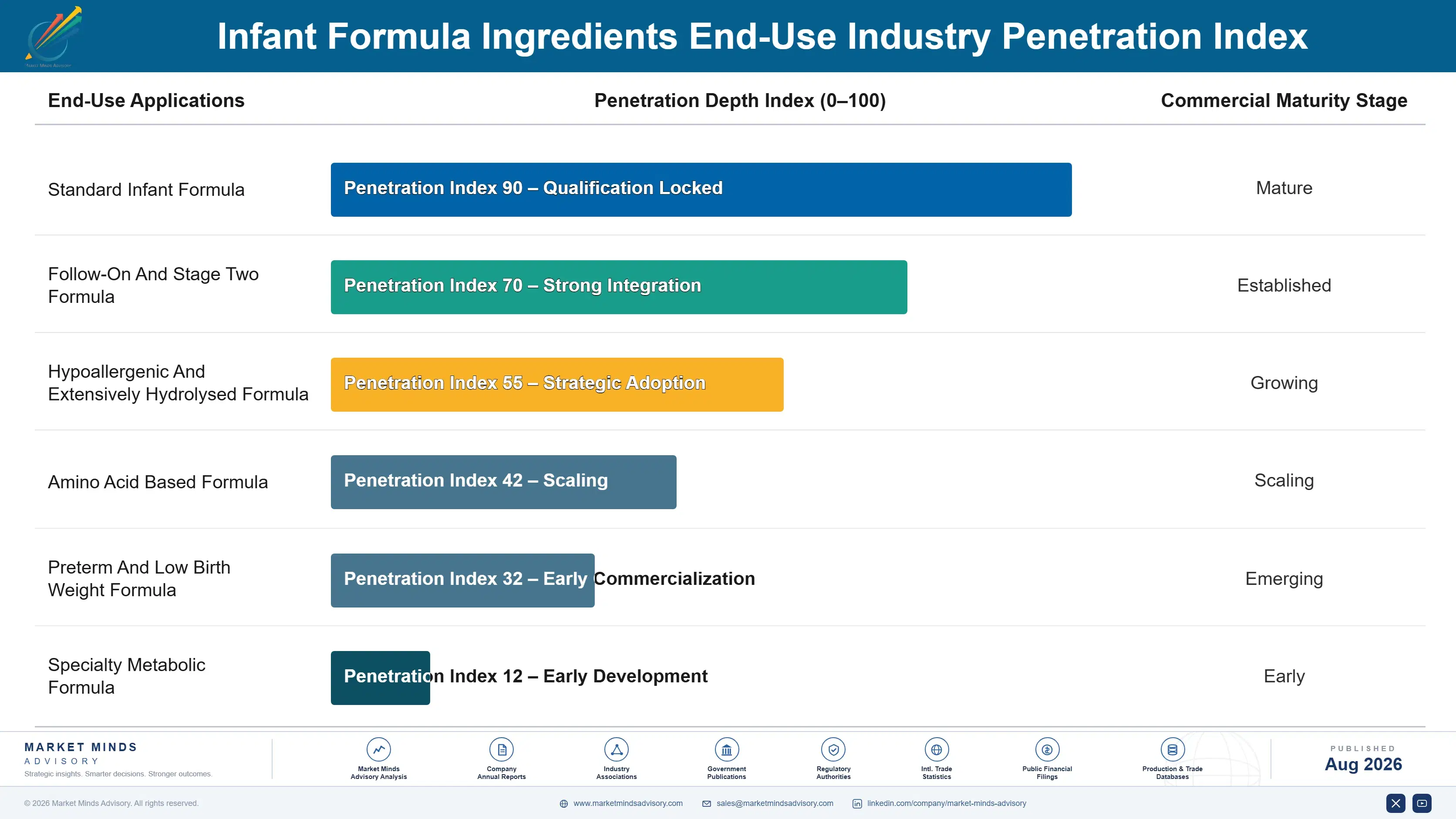
How Formula Ingredient Demand Repeats

This is among the most rigid repeat businesses in food ingredients, and the rigidity is regulatory rather than commercial. An ingredient inside a registered formula repeats every production run for an average of nine years, because changing it means revisiting product registrations in every market where that formula is sold. Manufacturers do not undertake that lightly, and they very rarely undertake it to save money.
Stickiness varies by ingredient class. Oligosaccharide positions hold best, since supply concentration means few alternatives exist even if a manufacturer wanted one. Qualified specialty fractions hold nearly as well on registration burden alone. Structured lipids hold well where clinical positioning supports them. Commodity fraction supply against an existing specification holds worst, moving on price whenever a buyer reviews it.

The buyer profile has changed with the volume decline. Ingredient purchasing once ran alongside growing formula volume where procurement functions negotiated on scale. Falling births moved the decision toward formulation and regulatory teams competing on composition rather than cost, which rewards suppliers with novel ingredients and authorisation capability and disadvantages those whose argument was a competitive price on a familiar material.
infant-formula-ingredients-market-trends-end-use-penetration-index-1787460178605

Where To Compete And Why

These are among the four positions where our research anticipates prominent divergence between winners and laggards over the coming forecast period. Each is grounded in the demand model, the regulatory perimeter, and the announced capacity pipeline.
01 / RECIPE QUALIFICATION TIMING

Twenty-six months buys nine years

Getting an ingredient into a registered infant formula takes around 26 months of formulation, clinical and regulatory work, and once inside it stays an average of nine years because changing it means revisiting registrations in every market the formula reaches. Qualified suppliers realise 35% to 45% higher pricing than those quoting on specification alone, on volume repeating annually. Displacement is genuinely rare rather than merely difficult, which makes early qualification worth considerably more effort than most suppliers currently give it.
02 / OLIGOSACCHARIDE ACCESS HOLDING

Very few producers, no substitutes

Human milk oligosaccharide supply sits with only a very few producers holding the fermentation strains and capacity, which concentrates the segment severely and lets pricing reflect scarcity rather than production cost. Roughly 38% of formula volume now includes them, and inclusion keeps spreading down from premium tiers as fermentation capacity scales up. Suppliers without access cannot answer the composition briefs that increasingly define premium formula, whatever else their portfolio happens to contain, which is a genuinely difficult position to argue around.
03 / AUTHORISATION SEQUENCING DISCIPLINE

Largest market, longest pathway

Novel ingredient authorisation arrives at quite different times across jurisdictions and sometimes not at all, adding roughly 18 months per market and preventing any single recipe from serving everywhere it was originally designed to reach. Suppliers sequencing their dossiers by regulatory proximity rather than by market size achieve multi-market authorisation 30% to 40% faster than competitors who sequence any other way. Those sequencing by demand alone find the largest market carries the longest and least transferable regulatory pathway of them all.
04 / BIRTH GEOGRAPHY REPOSITIONING

Composition cannot replace babies

China lost roughly 45% of annual births since 2016 while Europe, Japan and Korea all decline, which removes volume that ingredient value per feed offsets for a period rather than permanently or indefinitely. India, Southeast Asia and Africa still combine substantial birth numbers with formula penetration that is still rising, and Indian demand grows near 9.6% annually. Building position there means navigating firmly enforced marketing restrictions, which is considerably slower than the demographics alone would ever suggest to anybody looking.

Engagement Snapshot From the Field

A live engagement with an industry participant carrying material or product regulatory and market exposure ahead of a defining policy shift, showing how our research translates into a defensible multi-year portfolio strategy.
MARKET MINDS ADVISORY · CLIENT ENGAGEMENT SUMMARY
Infant Formula Ingredients Producer Strategic Portfolio Review and Transition Roadmap 2026·Investment Scenario on Infant Formula Ingredients Exposure Evaluation 2025-26
CLIENT PROFILE
A European dairy ingredient producer with annual revenue near $420 million (client-reported, unverified by MMA), supplying specialty protein fractions into infant formula manufacturers across Europe and Asia. The business held strong fractionation capability and several long-standing qualified positions, but no oligosaccharide access and heavy revenue concentration in markets where birth numbers were falling away sharply.
STRATEGIC CHALLENGE
Chinese volume had fallen substantially with the birth decline while European demand also softened, and formula manufacturers were increasingly briefing composition around oligosaccharides the client could not supply. Management needed to decide between defending existing fraction positions, acquiring oligosaccharide access, or shifting commercial weight toward markets that still have birth numbers.
MMA APPROACH
MMA modelled revenue and contribution by ingredient, customer and geography across five years of the client's own data, benchmarked oligosaccharide access routes through build, partner and licence options, and assessed regulatory pathways in target growth markets. Twenty-four expert interviews with formula manufacturers, regulatory consultants and fermentation producers tested each option.
KEY FINDINGS
  1. Qualified fraction positions had averaged nine years and had never been lost to a competitor on price, but three of the largest sat in formulas whose volumes were declining with the birth cohort.
  2. Formula manufacturers increasingly briefed composition around oligosaccharides, and the client had been excluded from four premium development projects in two years for lack of access.
  3. Building fermentation capability internally would have taken longer than the commercial window allowed, while a licensing arrangement could have provided access within roughly eighteen months.
  4. Indian and Southeast Asian formula manufacturers had qualified almost no European specialty fractions, representing addressable positions the client had never pursued commercially.
CLIENT PROFILE
A European dairy ingredient producer with annual revenue near $420 million (client-reported, unverified by MMA), supplying specialty protein fractions into infant formula manufacturers across Europe and Asia. The business held strong fractionation capability and several long-standing qualified positions, but no oligosaccharide access and heavy revenue concentration in markets where birth numbers were falling away sharply.
STRATEGIC CHALLENGE
Chinese volume had fallen substantially with the birth decline while European demand also softened, and formula manufacturers were increasingly briefing composition around oligosaccharides the client could not supply. Management needed to decide between defending existing fraction positions, acquiring oligosaccharide access, or shifting commercial weight toward markets that still have birth numbers.
MMA APPROACH
MMA modelled revenue and contribution by ingredient, customer and geography across five years of the client's own data, benchmarked oligosaccharide access routes through build, partner and licence options, and assessed regulatory pathways in target growth markets. Twenty-four expert interviews with formula manufacturers, regulatory consultants and fermentation producers tested each option.
KEY FINDINGS
  1. Qualified fraction positions had averaged nine years and had never been lost to a competitor on price, but three of the largest sat in formulas whose volumes were declining with the birth cohort.
  2. Formula manufacturers increasingly briefed composition around oligosaccharides, and the client had been excluded from four premium development projects in two years for lack of access.
  3. Building fermentation capability internally would have taken longer than the commercial window allowed, while a licensing arrangement could have provided access within roughly eighteen months.
  4. Indian and Southeast Asian formula manufacturers had qualified almost no European specialty fractions, representing addressable positions the client had never pursued commercially.
RECOMMENDED STRATEGY
Phase 1: Phase one: pursue oligosaccharide access through licensing rather than internal build, since the commercial window is shorter than a fermentation development programme requires. Phase 2: Phase two: open commercial coverage in Indian and Southeast Asian formula manufacturing, where existing fractions are unqualified and birth numbers remain substantial. Phase 3: Phase three: maintain declining qualified positions rather than defending them with investment, since they generate cash without requiring further commitment.
OUTCOME
The client signed an oligosaccharide licensing arrangement within eleven months and re-entered two premium development projects (client-reported, unverified by MMA). Asian commercial coverage was established with three formula manufacturers, revenue from growth markets rose from 8% to 21%, and blended gross margin improved by roughly five points.

Frequently Asked Questions

Foundational context covering the market sizes, CAGR, scope, country, region and competition that inform every finding below. This section is provided to cover basics and most often pre-purchase conversations, answered from the MMA Primary Research Dataset.

What is the current size of the Infant Formula Ingredients Market?

The global infant formula ingredients market was valued at $7.80 billion in 2025, reaching an estimated $8.33 billion in 2026. That covers specialty ingredients supplied into infant and follow-on formula manufacturing.

How large will the Infant Formula Ingredients Market be by 2036?

MMA forecasts the market reaching $16.08 billion by 2036, an increase of $7.75 billion over the 2026 base. That represents an expansion multiple of 1.93 times across the forecast period.

What is the CAGR for the Infant Formula Ingredients Market 2026 to 2036?

The base case compound annual growth rate is 6.8%, with a bull case of 8.0% and a bear case of 5.6%. Historical growth between 2020 and 2025 ran at 5.8% annually.

Which segment is growing fastest?

Human milk oligosaccharides grow at 10.2%, a full 1.50 times the market rate, replicating breast milk structures formula could not previously deliver. Specialty protein fractions follow at 8.5%.

Who are the major companies in the Infant Formula Ingredients Market?

DSM-Firmenich, FrieslandCampina Ingredients, Arla Foods Ingredients, BASF and Glanbia Nutritionals lead on ingredient revenue. Together they account for roughly 64% of global value, high for an ingredient market.

Which country is growing fastest?

India grows fastest at 9.6% annually, still recording more births than any other country while formula penetration rises from a low base. Indonesia and Vietnam follow closely.

Report Segmentation Architecture

The full report scope spans multiple orthogonal segmentation dimensions, with cross-tabulated demand data provided for each dimension pair. Coverage extends further to regional breakdowns, trend trajectories, and the competitive detail needed to support segment-level decision-making.

By Ingredient Class

  • Human Milk Oligosaccharides
  • Specialty Protein Fractions
  • Structured Lipids And Fat Blends
  • Prebiotic And Probiotic Ingredients
  • Vitamin And Mineral Premixes

By End-Use Industry

  • Standard Infant Formula
  • Follow-On And Stage Two Formula
  • Hypoallergenic And Extensively Hydrolysed Formula
  • Amino Acid Based Formula
  • Preterm And Low Birth Weight Formula
  • Specialty Metabolic Formula

By Commercial Dimension

  • Direct Supply To Formula Manufacturers
  • Contract Manufacturer Supply
  • Premix And Blend House Channel
  • Licensing And Technology Agreements
  • Distributor And Trading Supply

By Region

  • North America
  • Western Europe
  • East Asia
  • South Asia and Pacific
  • Latin America
  • Middle East and Africa
  • Eastern Europe

Scope, Methodology, and Coverage

Every figure in this report is reproducible from documented input assumptions. The scope below maps the historical period, the forecast horizon, the segmentation dimensions, and the countries covered, alongside the underlying primary and qualitative methodology.
Historical Period
2020 to 2025
Forecast Period
2026 to 2036
Base Year
2025 (USD billions; MMA Primary Research Dataset, August 2026)
Market Definition
This report covers specialty ingredients supplied into infant and follow-on formula manufacturing, spanning human milk oligosaccharides, specialty protein fractions including lactoferrin and alpha-lactalbumin, structured lipids and fat blends, prebiotic and probiotic ingredients, and vitamin and mineral premixes for infant nutrition, across direct manufacturer, contract manufacturing, premix, licensing and distribution channels. Base dairy commodities including skimmed milk powder and whey powder, finished infant formula, toddler and growing-up milks beyond follow-on stage, and clinical nutrition for other age groups are excluded from the sizing.
Quantitative Units
USD billions at supplier realised value; volume in thousand tonnes; ingredient value in USD per prepared feed.
Segmentation Dimensions
By ingredient class; by end-use industry; by commercial dimension; by region.
Regions Covered
North America, Western Europe, East Asia, South Asia and Pacific, Latin America, Middle East and Africa, Eastern Europe
Countries Covered
China, Japan, South Korea, India, Indonesia, Vietnam, Philippines, Australia, United States, Canada, Mexico, Brazil, Netherlands, Denmark, Germany, France, Ireland, Poland, Nigeria, Saudi Arabia.
Key Companies Profiled
DSM-Firmenich, FrieslandCampina Ingredients, Arla Foods Ingredients, BASF, Glanbia Nutritionals, Kerry Group, IFF, Chr. Hansen, Fonterra, Lactalis Ingredients, Ingredia, Agropur Ingredients, Synlait Milk, Inner Mongolia Yili and others.
Quantitative Methodology
Primary survey, n=3,800 respondents, Q4 2025, six countries; demand-side model with trade association cross-validation
Qualitative Methodology
47 expert interviews, Q4 2025; applied to validate demand model assumptions, identify emerging dynamics, and assess competitive positioning
Report Format
PDF and XLSX data workbook (Word format preview document)
Publisher
Market Minds Advisory
Report Code
MMA-2026-AGR-257
Published
August 2026
Contact
sales@marketmindsadvisory.com | www.marketmindsadvisory.com

Purchase the full Infant Formula Ingredients Market Report (2026 to 2036).

The full report sizes the infant formula ingredients market across five ingredient classes, six formula types and seven regions, with tonnage and value per feed detail behind every estimate. It profiles twenty companies on qualification positions, oligosaccharide access and regulatory capability. Regional chapters cover birth cohorts, formula penetration and registration requirements by market. Cost analysis quantifies dairy stream, fermentation and regulatory exposure by production route. Authorisation analysis maps novel ingredient approval status and timing across every one of the major jurisdictions covered in the report.
Tonnage and value per feed by ingredient class
Novel ingredient authorisation status mapped by jurisdiction
Birth cohort projections and formula penetration by market
Qualification cycles and position duration measured across manufacturers
Competitive position assessments across twenty companies
Dairy fractionation against fermentation route economics compared

Built For The People Who Decide

From boardroom strategy to bench-side execution, this report is read cover-to-cover by leaders shaping the next decade of their industry, turning demand scenarios, market dynamics and valuation benchmarks into decisions.
CXOs/ Presidents/ VPs/ Managers
M&A and Corporate Development
Strategy Teams and R&D Heads
Procurement and Product Directors
Regulatory and Compliance Leaders
Investor Relations and Equity Analysts