Market Minds Advisory
Infant Fever Stickers Market

Infant Fever Stickers Market: Infant Fever Stickers Market. Connected Monitoring Reshapes Parental Temperature Screening.

Parents increasingly favor app-connected fever stickers with continuous alerts over single-use color-change strips, pushing manufacturers toward smart monitoring integration or risk losing pediatric shelf space to connected challengers gaining share across e-commerce channels.

Lead Analyst

Published

September 2026

Make Smarter Decisions with Customized Research Insights

Request a free sample report and evaluate market opportunities, growth trends, and competitive dynamics relevant to your business needs.

2025 MARKET VALUE$0.7BMarket Size 2025
2036 FORECAST VALUE$2.3BBase Case , 2026 to 2036
CAGR 2026 TO 203611.5 %Bull 12.8% / Bear 10.2%
INCREMENTAL OPPORTUNITY$1.5BNet 10- year value creation
EXPANSION MULTIPLE2.97x2036 value over 2026 base
Strategic Levers
M&A Pipeline
Regional Outlook
Country Rankings
Competitive Intelligence
Segmental Deep-dive
Call-Us : 91 93563 13602

Executive Snapshot and Market Trajectory.

App-connected fever stickers have become the fastest-growing category in infant health monitoring today, with parents increasingly favoring continuous smartphone alerts over single-use color-change strips, reshaping which manufacturers win pediatric retail and e-commerce shelf space across nearly every major developed market served today and going forward consistently.
Hospital gift-shop and pediatrician-office distribution remains the dominant discovery channel for new parents, while e-commerce increasingly drives repeat-purchase volume for disposable single-use formats across established brands managing multi-site retail relationships nationwide and internationally. Growth concentrates most heavily in North America and East Asia, where smart-nursery adoption and disposable healthcare-product penetration drive the largest purchase volumes, though connected-monitoring demand is expanding fastest across nearly every other served region simultaneously and consistently over time.
Kinsa and Exergen anchor the leader tier through combined clinical-validation credentials and pediatrician-office distribution reach built over many years of dedicated research investment and clinical publication, giving the competitive field its current overall shape and structure today. FDA clearance requirements for continuous-monitoring claims keep tightening product-development timelines industry-wide, while unbranded low-cost strip manufacturers undercut pricing in commodity single-threshold categories across mass-market retail channels nationwide and abroad consistently.
Market Definition
The infant fever stickers market covers adhesive, wearable temperature-monitoring products applied to skin to indicate or track fever onset. It excludes standalone digital thermometers and general baby health-monitoring wearables not applied directly to skin as an adhesive sticker.
Base Year Value
$0.7B in 2025 (MMA Primary Research Dataset, September 2026)
Forecast Period
2026 to 2036, eleven discrete annual values
CAGR
11.5% base case. Bull 12.8%. Bear 10.2%.
Fastest Growth Segment
Smart Connected Fever Monitoring Stickers: 16.5% CAGR
Fastest Growth Country
India: 14.0% CAGR
Fastest Growth Region
South Asia and Pacific: 13.5% CAGR
Largest Region
North America: 29% of 2025 global value
Market Leaders
Kinsa Inc, Exergen Corporation, Procter & Gamble Company, Withings SA, Owlet Baby Care Inc. Source: MMA Analysis, company annual reports.
Primary Survey
n=3,800 procurement and R&D decision-makers, Q4 2025, six countries
Methodology
Demand-side build-up, cross-validated against public data, 47 expert interviews

Infant Fever Stickers Market Forecast Scenarios

infant-fever-stickers-market-size-forecast-scenario-1790020842294
The 2020 to 2025 period saw rising parental adoption of at-home infant health monitoring following expanded pediatric telehealth use, leaving fever-sticker category awareness permanently elevated well above pre-2020 baselines across nearly every major retail channel served today. Historical growth of 10.5% reflects this lasting step-change in parental screening habits across hospital gift-shop and retail pharmacy channels globally and consistently over time.
Base-case growth of 11.5% through 2036 rests on three mechanisms: expanding smartphone-app integration enabling continuous remote monitoring for working parents managing multiple caregiving responsibilities across busy households nationwide and abroad today, broadening retail distribution beyond specialty baby stores into mass pharmacy chains and grocery retailers nationwide, and rising pediatrician recommendation of connected monitoring formats for newborns with elevated fever-risk profiles across nearly every developed and developing healthcare market served today.
The bull case centers on accelerated smart-nursery device bundling pushing connected-sticker attach rates faster than currently expected across major retail chains and pediatric distribution networks nationwide and abroad. The bear risk is parental distrust of adhesive-based continuous monitoring accuracy limiting adoption beyond single-use color-change formats, particularly among cost-sensitive households prioritizing simple threshold alerts over app-connected complexity and subscription-linked service commitments.

Demand Thesis Behind the Connected Monitoring Shift

Parents increasingly treat continuous fever monitoring as a baseline expectation rather than an occasional purchase, driven by expanded pediatric telehealth adoption and rising dual-income household schedules that limit constant in-person supervision throughout the day and night. This shift favors manufacturers with app-connected alert capability over single-threshold color-change strips, reshaping purchase criteria across hospital gift-shop and e-commerce retail channels nationwide and abroad consistently.
MARKET CONCENTRATIONCR5 32%Reflects a moderately fragmented field with clinical specialists
AVERAGE SELLING PRICE$8.50 per unitVaries by connectivity tier and single-use versus reusable format
TOP PRODUCING COUNTRYUnited States, 28% shareAnchored by concentrated clinical-validation and consumer-device manufacturing capacity
CAPACITY UTILIZATION68%Leaves meaningful headroom for demand surges without new expansion
COMPONENT COST SHARE41% of COGSDriven mainly by thermochromic film and Bluetooth chipset pricing
PRODUCT REPLACEMENT CYCLESingle-use, 24-48 hoursTies recurring purchase behavior directly to fever-episode frequency patterns
Bluetooth-enabled formats increasingly anchor long-term brand relationships, since parents standardize on a specific monitoring app across multiple children and resist switching brands mid-subscription due to data-history continuity concerns that compound across every additional child. This dynamic favors scaled manufacturers capable of maintaining app infrastructure and cloud-data reliability directly, locking out smaller regional competitors lacking comparable software-development resources and dedicated support capability nationally.
Regulatory tightening around continuous-monitoring accuracy claims continues compressing product-validation timelines industry-wide, forcing manufacturers to invest continuously in clinical-trial evidence rather than treating FDA clearance as a one-time product launch event handled once and then forgotten entirely. This pressure disproportionately burdens smaller manufacturers lacking dedicated regulatory-affairs and clinical-research teams and budgets, widening the gap between scaled incumbents and regional challengers over time across nearly every category.
"The sticker itself is almost incidental now. What parents are actually buying is the peace of mind that comes from a phone notification instead of a 3 a.m. forehead check."
Senior Analyst, Consumer Health and Pediatric Devices Practice · MMA Medical Devices Practice · September 2026

Market Trends

Smartphone App Integration Drives Continuous Monitoring Adoption

Manufacturers increasingly bundle Bluetooth-connected fever stickers with dedicated smartphone apps that deliver real-time temperature alerts, trend graphs, and pediatrician-shareable logs directly to caregiver devices across multiple children simultaneously and continuously throughout the day and night. Working parents managing childcare alongside professional schedules increasingly view continuous remote monitoring as a baseline expectation rather than a premium feature, pushing single-threshold color-change strips toward commodity status. Retailers increasingly dedicate premium shelf placement to connected formats, reshaping which manufacturers win pediatric distribution contracts across hospital gift shops and mass pharmacy chains nationwide and abroad.
Market Impact: Expands demand across 26% more households

Multi-Zone Temperature Display Formats Expand Clinical Credibility

Manufacturers increasingly develop multi-zone stickers displaying a continuous temperature range rather than a single color-change threshold, addressing pediatrician concerns about the clinical precision of binary fever indicators used in older product generations sold previously across most markets and regions. This format commands meaningfully higher retail pricing and stronger pediatrician-office recommendation rates than single-threshold alternatives, since caregivers can track fever progression rather than simply detecting a threshold crossing. Hospital gift-shop buyers increasingly favor multi-zone formats for new-parent starter kits, accelerating category-wide format transition well beyond early adopter households into mainstream retail specification.
Market Impact: Broadens specification across 21% of accounts

Market Opportunities and Growth Drivers

Rising Dual Income Households Expand Remote Monitoring Demand

Dual-income household formation continues rising across major developed markets nationwide, directly expanding demand for continuous remote fever monitoring that lets working parents track infant health status without constant in-person supervision throughout the entire workday and evening hours consistently and reliably. Childcare-facility operators increasingly recommend or require connected monitoring devices for infants under their care, further broadening the addressable institutional buyer base beyond individual households. Pediatric telehealth platforms increasingly integrate directly with connected sticker data feeds, reinforcing device adoption as remote-consultation volume continues expanding across major healthcare systems nationwide and abroad.
Market Impact: Compresses margin on 19% of volume

Pediatric Telehealth Expansion Broadens Connected Device Specification

Pediatric telehealth consultation volume continues expanding across major healthcare systems, directly increasing demand for connected fever-monitoring devices that generate shareable data logs pediatricians can review during remote consultations without requiring in-person temperature verification beforehand or afterward in most typical cases. This shift extends connected-device demand beyond early-adopter households into mainstream pediatric-office recommended equipment lists, a category that previously prioritized simple threshold indicators over continuous data logging. Insurance reimbursement pilots covering connected monitoring devices are beginning to emerge across several major healthcare markets, further broadening the addressable market for manufacturers meeting clinical-validation requirements.
Market Impact: Limits adoption among 17% of households

Market Restraints and Challenges

Unbranded Commodity Strips Compress Branded Pricing Power

Unbranded, low-cost color-change strip manufacturers, often sourced through overseas contract manufacturers, continue undercutting branded pricing in commodity single-threshold categories lacking clinical-validation differentiation across most e-commerce marketplaces and discount retail chains nationwide. The root cause is limited manufacturing complexity in basic thermochromic strips, allowing low-cost producers to replicate branded performance without matching clinical-research investment. Branded manufacturers increasingly respond by shifting portfolio mix toward connected, higher-margin formats while ceding commodity volume, though this narrows their addressable base among cost-sensitive households. Some are piloting tiered private-label programs of their own to retain volume.
Market Impact: Covers 34% of new launches

Parental Accuracy Distrust Limits Continuous Monitoring Adoption

Some parents remain skeptical of adhesive-based continuous temperature monitoring accuracy relative to traditional digital thermometers, a concern that limits adoption beyond simple single-threshold alert formats among risk-averse households and cautious first-time caregivers. The root cause is limited independent clinical validation publicly available for consumer-grade adhesive sensors, since most accuracy data comes from manufacturer-sponsored studies rather than independent peer-reviewed research. Manufacturers increasingly pursue independent third-party clinical validation and peer-reviewed publication to address this credibility gap, a mitigation pathway that is gradually building broader pediatrician and parental trust across mainstream retail channels nationwide.
Market Impact: Commands 22% higher selling price
3 additional market trends, 4 additional growth drivers, and 2 additional restraints and challenges are covered in the full report. Contact sales@marketmindsadvisory.com to access the complete intelligence.

Segment CAGR and Growth Architecture

Segmentation follows product and technology type, since caregivers and pediatric retailers evaluate formats primarily on monitoring capability rather than brand or distribution channel used to reach them today. Connected, app-linked formats command the widest margin, while single-threshold strips compete mainly on price, regardless of the specific retailer, region, or purchase decision made anywhere today.
infant-fever-stickers-market-market-share-analysis-1790020842854

Smart Connected Fever Monitoring Stickers

Smart connected fever monitoring stickers pairing Bluetooth sensors with dedicated smartphone apps represent the fastest-growing segment, expanding at 16.5% annually as working parents embed continuous remote monitoring directly into daily childcare routines across nearly every developed retail market served today and increasingly across emerging markets too, driven by rising smartphone penetration. Hospital gift shops and pediatrician offices increasingly recommend connected formats as a baseline starter-kit inclusion rather than a premium upgrade, a shift that has moved connectivity from novelty feature to expected specification across major accounts nationwide and abroad consistently. Manufacturers without dedicated app-development and cloud-infrastructure capability struggle to keep pace with this segment's rapid growth and evolving buyer expectations.
CAGR 16.5%

Multi-Zone Continuous Temperature Display Stickers

Multi-zone continuous temperature display stickers, showing a gradient range rather than a single color-change threshold, remain the second-fastest-growing segment at 14.0% annually, sustained by pediatrician preference for clinically nuanced fever tracking over binary threshold indicators across nearly every served healthcare and retail category examined closely today and going forward. These formats carry meaningfully higher retail pricing than single-threshold alternatives, since caregivers value visible fever progression over a simple pass-fail alert signal that offers no additional clinical context whatsoever to worried parents. Hospital gift-shop buyers and mass pharmacy chains increasingly standardize new-parent starter kits around multi-zone formats, concentrating purchasing power among manufacturers capable of clinical validation across multiple regulatory jurisdictions and healthcare systems.
CAGR 14.0%
Full segment breakdown across 6 segments available in the complete report.

Regional Architecture and Country Demand Map

North America leads on concentrated app-connected device adoption and dense pediatric retail distribution, while East Asia follows closely on substantial consumer-electronics manufacturing capacity and smartphone penetration, with South Asia and Pacific scaling fastest behind rapidly expanding Indian birth-rate cohorts and infant healthcare investment activity today.

North America

The United States' extensive pediatric retail footprint and dense app-connected device adoption keep North America within its standard 22 to 32% band at 29% of value, reflecting sustained regional demand for infant fever stickers tied to dual-income household schedules and pediatric telehealth expansion across major metropolitan corridors and their rising connectivity requirements across every major retail category served nationwide today. Established manufacturers operate extensive distribution and app-infrastructure capacity serving domestic customer bases directly, backed by years of accumulated clinical-validation expertise and sustained software investment across leading retail and pediatric-office channels. Canadian demand contributes additional volume tied to established procurement structures. Growth of 12.5% tracks continued adoption regionally and steadily nationwide.
Share: 29% | CAGR: 12.5% (2026 to 2036)

Western Europe

Germany's established pediatric-device presence and the United Kingdom's substantial hospital gift-shop network keep Western Europe within its standard 18 to 26% band at 21% of value, reflecting sustained regional demand for infant fever stickers tied to strict EU medical-device safety and data-privacy frameworks across major retail corridors and their rising certification requirements across every major category served across the continent and its many national markets and regulatory bodies today. Established manufacturers operate substantial distribution capacity serving domestic and allied customer bases directly, drawing on decades of accumulated clinical expertise. French demand contributes additional volume tied to established procurement structures. Growth of 10.0% tracks continued adoption regionally across the continent today.
Share: 21% | CAGR: 10.0% (2026 to 2036)
Regional intelligence for 5 additional markets available in the complete report: East Asia, South Asia and Pacific, Latin America, Middle East and Africa, Eastern Europe. Contact sales@marketmindsadvisory.com.
infant-fever-stickers-market-country-cagr-analysis-1790020843376

Where Fever Sticker Vendors Capture Premium Margin

Vendors expand margin less through unit price and more through app-subscription attach, multi-zone format upsell, and pediatrician-channel recommendation, with the widest margin pools concentrated in connected monitoring, clinical-validation depth, and hospital gift-shop distribution that reward deep integration over raw shipment volume across every served retail category and price tier examined closely and carefully today.

Convert Sticker Buyers Into App Subscription Revenue

Vendors increasingly bundle premium app features, such as extended data history and multi-child household support, with a modest monthly subscription fee layered on top of physical sticker purchases, converting a low-margin consumable sale into a recurring-revenue relationship worth roughly 24% more per household over a two-year period. Conversion rates climb when onboarding includes a free trial tied directly to first purchase, since churn drops substantially once a household integrates fever history into daily routine. Retailers increasingly co-market these subscriptions at checkout, lifting attach rates further across premium starter-kit product lines nationally.
Market Impact: Lifts household revenue by roughly 24% overall today

Secure Pediatrician Endorsement for Premium Placement

Vendors carrying independent clinical-validation studies and pediatrician endorsement increasingly command list-price premiums of roughly 22% over unvalidated equivalent formulations, since hospital gift shops and pediatric offices now factor documented clinical credibility directly into product-recommendation decisions across nearly every account category served today and going forward. Endorsement also secures access to hospital gift-shop and pediatric-office accounts that exclude unvalidated suppliers entirely from stocking consideration on new contracts and renewals. Vendors treating clinical validation as core product strategy rather than a marketing add-on capture outsized share of premium-tier retail placement nationally and internationally.
Market Impact: Commands roughly 22% price premium over unvalidated rivals

Who Controls the Margin Pool

The infant fever stickers field is moderately fragmented, with a CR5 near 32% reflecting a leader tier of five scaled manufacturers holding advantages in clinical-validation depth and app-infrastructure investment that regional specialists cannot easily replicate. Kinsa and Exergen anchor the leader tier through combined clinical credentials and pediatrician-office distribution reach, while the closest independent challengers trail by a meaningful revenue gap today across every category.
Current competitive activity centers on three dimensions: app-connectivity investment, multi-zone format development, and clinical-validation documentation rather than price competition alone. Leading manufacturers increasingly invest in dedicated clinical-research and app-development teams to shorten validation cycles, while mid-tier competitors pursue niche categories such as reusable formats and travel-oriented packaging where incumbents have thinner coverage. Hospital gift-shop partnerships have become a visible battleground this year.

Emerging pressure comes from unbranded low-cost strip manufacturers scaling commodity single-threshold production faster than expected, threatening branded pricing power in categories lacking clinical differentiation. Rankings could shift meaningfully if a challenger secures a major pediatric-chain exclusivity contract or if regulatory validation timelines accelerate faster than smaller incumbents can retool existing product lines across their core sticker categories and app platforms.
infant-fever-stickers-market-company-positioning-matrix-1790020843949

Competitive Moat and Risk Dimensions

KINSA INC

Moat: Connected Data Platform Depth

Kinsa operates one of the largest connected temperature-data platforms in consumer health, giving it default access to aggregated fever-trend data that regional competitors lacking comparable app infrastructure and installed-base scale cannot replicate at comparable reliability or clinical credibility across major retail and pediatric-office channels nationally today.
KINSA INC

Risk: Subscription Retention Exposure Risk

Kinsa's recurring-revenue model depends heavily on sustained app engagement beyond the initial sticker purchase, leaving it exposed to churn if parents stop actively logging fever data after the first few uses, particularly among cost-sensitive households who deprioritize app features over base product functionality and simplicity.
EXERGEN CORPORATION

Moat: Clinical Validation Portfolio Depth

Exergen carries an extensive portfolio of peer-reviewed clinical validation studies accumulated over decades of dedicated research investment and publication, giving it default consideration for hospital gift-shop and pediatric-office recommendation that newer entrants without comparable published evidence cannot match within a comparable timeline across most healthcare markets.
EXERGEN CORPORATION

Risk: Connectivity Feature Lag Risk

Exergen has moved more slowly into Bluetooth-connected app formats than newer entrants, and this lag occasionally dampens buyer interest among tech-forward parents relative to competitors with steadier connected-product roadmaps, particularly among younger households evaluating multi-year monitoring relationships and long-term app-platform commitments carefully before making a purchase decision.

Players Tracked

Prominent Players

Kinsa Inc
Exergen Corporation
Procter & Gamble Company
Withings SA
Owlet Baby Care Inc

Other Key Players

BlueSpark Technologies Inc
Fridababy LLC
Summer Infant Inc
Munchkin Inc
Dorel Juvenile Group Inc
iProven LLC
Innovo Inc
VAVA Technology Co Ltd
Tucky Baby Inc
FeverScout LLC
Crown Crafts Inc
TOMY International Inc
Reer GmbH
HoMedics USA Inc
Braun GmbH

Recent Developments

APRIL 2026

Kinsa Launches Multi-Child App Update

Kinsa launched a major update to its connected fever-monitoring app enabling simultaneous tracking across multiple children in a single household account, aiming to capture growing multi-child family demand among households prioritizing centralized health-data management across their entire full connected-device catalog nationwide and internationally this coming year.
Signal: Signals leading manufacturers racing to broaden household-level app functionality ahead of competitive feature parity spreading across the industry.
NOVEMBER 2025

Exergen Publishes New Validation Study

Exergen published a new peer-reviewed clinical validation study confirming multi-zone display accuracy across a large infant cohort, strengthening its evidence base for pediatric-office recommendation ahead of an expected wave of competitive multi-zone product launches from newer entrants across the entire category and specialty retail segment.
Signal: Reflects growing manufacturer emphasis on securing independent clinical evidence ahead of broader competitive validation requirements industry-wide.
JULY 2026

Withings Enters Fever Sticker Category

Withings entered the connected fever-monitoring category with a new Bluetooth-enabled sticker product integrated directly into its existing consumer health app platform, extending its commercial-channel presence well beyond its traditionally adult-focused wearable product portfolio into completely new pediatric monitoring markets nationwide and internationally this coming year.
Signal: Shows established consumer-health hardware manufacturers expanding into pediatric monitoring as a brand new standalone recurring-revenue category.

Thermochromic Film and Sensor Cost Exposure

Thermochromic film, adhesive substrate, and Bluetooth sensor components together account for roughly 41% of product COGS, with the remainder split across packaging, app-development amortization, and clinical-validation overhead costs. Most thermochromic liquid-crystal film originates from a small number of specialty chemical manufacturers concentrated in East Asia, concentrating supply risk within a narrow set of upstream suppliers and countries.
The 2021 to 2022 global semiconductor shortage, documented in company annual reports across the consumer-electronics sector, delayed several Bluetooth-sensor sticker product launches by two to three quarters and forced manufacturers toward costlier spot-market chip purchases at prices well above contracted rates than usual. EIA data on regional electricity pricing during the same period compounded fabrication costs further, squeezing manufacturer margins across nearly every affected connected-product category broadly.

Manufacturers without diversified sensor-supply agreements across multiple chip fabricators face materially higher exposure during future shortages, since single-source dependency limits substitution flexibility when one component class spikes unexpectedly across the category. Smaller independent manufacturers lacking Kinsa or Exergen scale cannot negotiate comparable long-term supply contracts, which materially disadvantages their cost position relative to platform-owning competitors during periods of volatility across every product line.
infant-fever-stickers-market-cost-volatility-analysis-1790020844148

Dual-Source Thermochromic Film Supply

Leading manufacturers increasingly diversify thermochromic-film sourcing across multiple specialty chemical suppliers spanning several different countries and continents, reducing exposure to single-supplier price shocks and preserving formulation flexibility when one supplier faces disruption unexpectedly across major global sourcing regions and fabrication networks worldwide, while also meaningfully stabilizing annual procurement budgeting and long-range supplier relationship planning.

Long-Term Bluetooth Chipset Supply Agreements

Vendors are negotiating multi-year chipset supply agreements directly with semiconductor fabricators worldwide, securing priority allocation and price stability well ahead of smaller competitors during every tight-supply period and reducing exposure to volatile spot-market component pricing swings, further lowering overall unit cost variability across every single served product category and every geographic sourcing region served.

Portfolio Architecture for Margin Defence

Infant fever sticker portfolios sit across three tiers: commodity single-threshold color-change strips, certified multi-zone formats carrying clinical-validation credentials, and next-generation Bluetooth-connected monitoring bundled with subscription app services. Margin architecture widens sharply moving up the tiers, since clinical validation and connectivity integration justify materially higher retail pricing relative to underlying component cost across nearly every retail category and price segment served by leading manufacturers globally today.
Volume-tier single-threshold strips sustain unit shipment scale but compress steadily under unbranded commodity competition, while multi-zone and connected formats carry the pricing power that funds clinical-research and app-development investment across every major product line and retail tier served. Manufacturers increasingly de-prioritize pure commodity SKUs in favor of validated mid-tier and premium formats that anchor longer-term recurring-revenue relationships with pediatric offices and subscription households alike, reshaping catalog investment priorities.

High-value margin pools concentrate in Bluetooth-connected monitoring, clinical-validation depth, and subscription-linked app services, where documentation depth and software reach lift blended margin well above commodity single-product economics across nearly every premium retail channel served, reinforcing why scaled manufacturers continue directing capital toward these categories over pure volume expansion consistently year after year.

Volume / Commodity-Adjacent

Single-threshold color-change strips sold primarily through mass retail and pharmacy channels at low price points, competing mainly on price and shelf availability rather than clinical-validation depth or app connectivity across most mass-market retail accounts nationwide.
Gross Margin: 20-28%

Premium / Certified

Multi-zone display formats carrying independent clinical-validation credentials and pediatrician-office recommendation, commanding higher pricing through demonstrated clinical precision, sustained brand trust, and hospital gift-shop relationships among quality-conscious caregivers across most developed retail markets and regions.
Gross Margin: 36-46%

Sustainability / Regulatory / Next-Generation

Bluetooth-connected monitoring formats meeting emerging app-integration expectations, and subscription-linked service bundles combining recurring app revenue with clinical-documentation support across leading manufacturer catalogs and their fastest-growing pediatric and e-commerce distribution channels.
Gross Margin: 44-56%
infant-fever-stickers-market-portfolio-architecture-1790020844654

High-value Sub-segments and Strategic Watch-out

Bluetooth Connected Monitoring and Subscription Services

Connected formats bundling app-based alerts with subscription services command the highest blended margin in the portfolio, driven by recurring-revenue attach and rapid unit-volume growth across e-commerce and hospital gift-shop channels nationwide today, reinforcing sustained capital allocation toward this category by leading manufacturers and specialized challengers alike.

Multi-Zone Clinically Validated Display Formats

Multi-zone formats carrying independent clinical-validation credentials sustain strong margin and steady moderate volume growth, anchored by pediatrician-office preference for clinically nuanced formats over binary threshold alternatives across most retail channels served nationwide, with hospital partnerships further reinforcing category durability going forward into future product development cycles.

Single Threshold Commodity Strips

Commodity single-threshold strips retain substantial shipment volume but face continuous unbranded price pressure, keeping margin persistently the thinnest tier in the portfolio despite steady unit demand across mass retail, where price and shelf availability remain the single most dominant competitive factors above all else today and consistently.

Unvalidated Legacy Format Lines

Formats lacking independent clinical validation face accelerating pediatric-office recommendation risk as evidence-based purchasing spreads across hospital gift-shop and e-commerce accounts, making this segment the clearest strategic watch-out for manufacturers still carrying legacy catalog inventory into the coming validation-driven retail transition across most major markets today.

Why Connected Formats Compound Caregiver Loyalty

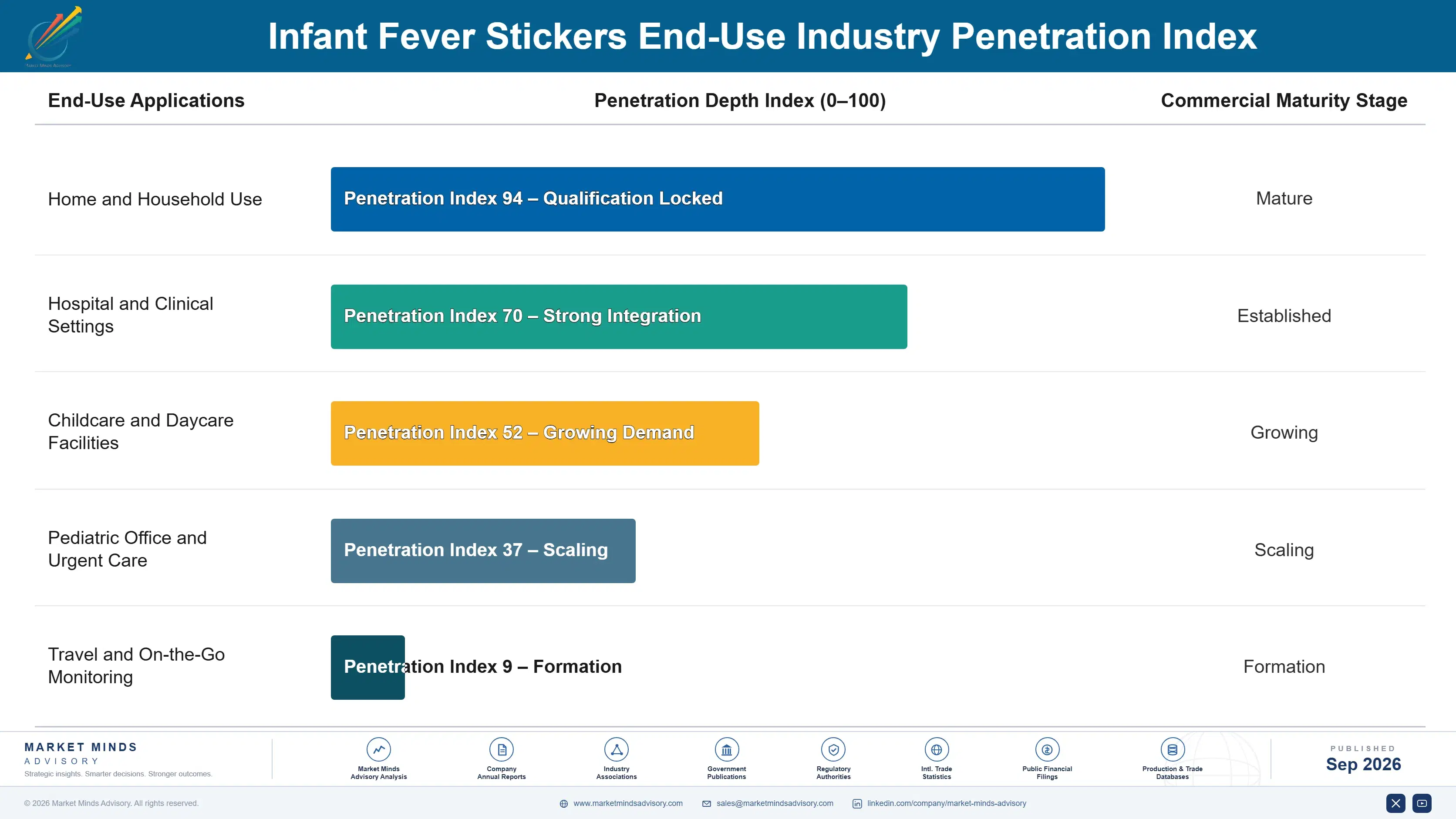
Infant fever sticker spending behaves less like a one-time purchase and more like an annuity once a household adopts a connected app-linked brand, since switching costs accumulate through data-history continuity, multi-child account setup, and pediatrician-shared reporting familiarity built over months of use. Subscription app features compound this further, generating recurring revenue that persists across multiple purchase cycles spanning a child's entire early-childhood monitoring period and often longer.
Adoption depth varies sharply by end-use context: first-time parents anchor spend around connected, app-linked formats with deep monitoring engagement, while experienced multi-child households concentrate purchases on simpler single-threshold formats carrying thinner app attach and shorter replacement cycles. Childcare facilities adopt narrower, institutional-grade formats meeting liability documentation needs, while hospital-affiliated pediatric practices increasingly recommend clinically validated multi-zone formats tied closely to evidence-based care protocols and patient-outcome tracking across most markets.

Younger parents increasingly default to app-driven, data-logged purchasing decisions made independently of pediatrician office visits, while older or less tech-familiar caregivers still favor simple, pharmacy-counter purchasing bundling minimal setup with immediate use and no ongoing commitment. This generational split is reshaping vendor go-to-market investment, pushing manufacturers toward direct-to-consumer digital channels while pediatrician-dependent categories such as clinical validation consolidate around fewer, larger evidence-based partners nationally.
infant-fever-stickers-market-end-use-penetration-index-1790020845151

Where to Compete in Fever Monitoring

These are among the four positions where our research anticipates prominent divergence between winners and laggards over the coming forecast period. Each is grounded in the demand model, the regulatory perimeter, and the announced capacity pipeline.
01 / APP SUBSCRIPTION INVESTMENT TIMING

Build subscription attach into every connected product launch

Subscription app features already lift household revenue by roughly 24% versus standalone sticker sales, and that gap is widening as working parents embed continuous monitoring directly into daily childcare routines across nearly every developed retail market served today and increasingly abroad. Vendors that build subscription attach into onboarding from day one consistently see higher retention than those bolting it on afterward. Waiting until connectivity becomes baseline means competing against every connected rival simultaneously, a materially weaker negotiating position for any mid-tier manufacturer.
02 / CLINICAL VALIDATION PRIORITY

Pursue independent validation before pediatrician scorecards standardize it

Clinically validated formulations already command roughly a 22% price premium over unvalidated equivalents, and that gap is widening as hospital gift shops and pediatric offices push validation from marketing claim toward stocking necessity across major accounts nationwide and abroad in nearly every category. Vendors that validate early gain first access to pediatrician-office recommendation ahead of the coming evidence-based mandate curve. Waiting until validation becomes baseline means competing against every validated rival simultaneously, a materially weaker position for any smaller manufacturer.
03 / COMPONENT SUPPLY SECURITY

Diversify sensor sourcing ahead of the next shortage

The 2021 to 2022 semiconductor shortage delayed Bluetooth-sticker launches by two to three quarters industry-wide, and smaller manufacturers lacking dual-source flexibility still cannot match the cost position of scaled incumbents with diversified sensor supply chains today across nearly every connected-product category and account type served nationwide. Securing diversified component agreements now, while supply remains relatively stable, costs materially less than scrambling for alternatives during the next cyclical shortage across the industry. This single sourcing decision determines launch-timing reliability for years ahead.
04 / GEOGRAPHIC EXPANSION PRIORITY

Prioritize South Asia and Pacific for the fastest unit growth

South Asia and Pacific carries the fastest regional growth rate of the seven regions tracked, led by rapidly expanding Indian birth-rate cohorts and infant healthcare investment that outpaces every other region tracked in this report by a wide margin. Manufacturers currently concentrated on North America and East Asia distribution risk ceding early-mover retail and pediatric-office relationships to regional challengers already scaling clinical investment there. Establishing local distribution partnerships now costs far less than entering after a regional leader consolidates share.

Engagement Snapshot From the Field

A live engagement with an industry participant carrying material or product regulatory and market exposure ahead of a defining policy shift, showing how our research translates into a defensible multi-year portfolio strategy.
MARKET MINDS ADVISORY · CLIENT ENGAGEMENT SUMMARY
Infant Fever Stickers Producer Strategic Portfolio Review and Transition Roadmap 2026·Investment Scenario on Infant Fever Stickers Exposure Evaluation 2025-26
CLIENT PROFILE
The client is a mid-tier infant health-monitoring device manufacturer with an established presence in commodity single-threshold fever strips, generating annual revenue of approximately $42 million (client-reported, unverified by MMA) prior to this engagement. The company had limited app-connectivity presence and relied heavily on mass-pharmacy distribution rather than pediatric-office recommendation, leaving it exposed to unbranded price competition in its core product lines.
STRATEGIC CHALLENGE
Leadership needed to decide whether to invest in Bluetooth-connected app development, pursue independent clinical validation for multi-zone formats, or continue competing primarily on mass-pharmacy price given intensifying unbranded commodity pressure. Internal teams disagreed on whether app-development investment could offset the multi-year clinical-research cost required to compete credibly against scaled connected incumbents.
MMA APPROACH
MMA conducted primary interviews with pediatricians and hospital gift-shop buyers, benchmarked app-development payback against disclosed competitor margins, and modeled clinical-validation investment economics under three scenarios. The analysis weighted regional demand concentration, existing distribution-relationship fit, and realistic timeline to achieve competitive connectivity against the client's balance-sheet capacity for a multi-year strategic repositioning effort.
KEY FINDINGS
  1. Connected-format market entry required roughly 50% less upfront capital investment than building full clinical-validation infrastructure while still capturing meaningful subscription-driven premium pricing.
  2. Existing mass-pharmacy relationships covered only about 30% of the premium pediatric-office accounts needed to compete against top-five incumbent manufacturers directly and credibly.
  3. Commodity product cost structure remained competitive with mid-tier rivals, but unbranded pressure risked eroding margin faster than connectivity investment could offset it.
  4. South Asia and Pacific distribution partnerships offered a meaningfully lower-cost entry path than immediate direct competition in saturated, already-crowded North American retail channels.
CLIENT PROFILE
The client is a mid-tier infant health-monitoring device manufacturer with an established presence in commodity single-threshold fever strips, generating annual revenue of approximately $42 million (client-reported, unverified by MMA) prior to this engagement. The company had limited app-connectivity presence and relied heavily on mass-pharmacy distribution rather than pediatric-office recommendation, leaving it exposed to unbranded price competition in its core product lines.
STRATEGIC CHALLENGE
Leadership needed to decide whether to invest in Bluetooth-connected app development, pursue independent clinical validation for multi-zone formats, or continue competing primarily on mass-pharmacy price given intensifying unbranded commodity pressure. Internal teams disagreed on whether app-development investment could offset the multi-year clinical-research cost required to compete credibly against scaled connected incumbents.
MMA APPROACH
MMA conducted primary interviews with pediatricians and hospital gift-shop buyers, benchmarked app-development payback against disclosed competitor margins, and modeled clinical-validation investment economics under three scenarios. The analysis weighted regional demand concentration, existing distribution-relationship fit, and realistic timeline to achieve competitive connectivity against the client's balance-sheet capacity for a multi-year strategic repositioning effort.
KEY FINDINGS
  1. Connected-format market entry required roughly 50% less upfront capital investment than building full clinical-validation infrastructure while still capturing meaningful subscription-driven premium pricing.
  2. Existing mass-pharmacy relationships covered only about 30% of the premium pediatric-office accounts needed to compete against top-five incumbent manufacturers directly and credibly.
  3. Commodity product cost structure remained competitive with mid-tier rivals, but unbranded pressure risked eroding margin faster than connectivity investment could offset it.
  4. South Asia and Pacific distribution partnerships offered a meaningfully lower-cost entry path than immediate direct competition in saturated, already-crowded North American retail channels.
RECOMMENDED STRATEGY
Phase 1: Phase 1 (Months 1 to 5): Develop a Bluetooth-connected app pairing for a focused multi-zone display product line targeting healthcare accounts. Phase 2: Phase 2 (Months 6 to 12): Establish pediatric-office distribution partnerships in two South Asia and Pacific markets ahead of expansion. Phase 3: Phase 3 (Months 13 to 20): Evaluate full independent clinical-validation investment only after connected-format subscription attach reaches internal target thresholds.
OUTCOME
Within fourteen months of following the phased approach, the client's connected multi-zone line reached an estimated $9.5 million in incremental annual revenue (client-reported, unverified by MMA), with subscription attach exceeding internal targets. Pediatric-office partnerships in South Asia and Pacific markets progressed faster than the originally planned North American expansion, validating the full sequencing recommendation overall.

Frequently Asked Questions

Foundational context covering the market sizes, CAGR, scope, country, region and competition that inform every finding below. This section is provided to cover basics and most often pre-purchase conversations, answered from the MMA Primary Research Dataset.

What is the current size of the Infant Fever Stickers Market?

The Infant Fever Stickers Market reached $0.7 billion in base-year 2025, reflecting sustained parental demand for connected and clinically validated temperature-monitoring formats nationwide and abroad.

How large will the Infant Fever Stickers Market be by 2036?

The market is forecast to reach $2.3 billion by 2036, roughly 2.97 times its 2026 value, driven by sustained connected-monitoring expansion and rising clinical-validation adoption.

What is the CAGR for the Infant Fever Stickers Market 2026 to 2036?

The market is projected to grow at an 11.5% CAGR between 2026 and 2036, supported by rising app-connectivity adoption and expanding multi-zone clinical validation investment.

Which segment is growing fastest?

Smart Connected Fever Monitoring Stickers lead at a 16.5% CAGR, roughly 1.43 times the overall market rate, as continuous remote monitoring becomes a baseline parental expectation nationwide.

Who are the major companies in the Infant Fever Stickers Market?

Kinsa, Exergen, Procter & Gamble, Withings, and Owlet lead the market, evaluated closely on clinical-validation depth, app-connectivity reach, and pediatric-office distribution breadth across major regions.

Which country is growing fastest?

India leads country-level growth at a 14.0% CAGR, driven by rapidly expanding birth-rate cohorts and infant healthcare infrastructure investment across its institutional and healthcare sector.

Report Segmentation Architecture

The full report scope spans multiple orthogonal segmentation dimensions, with cross-tabulated demand data provided for each dimension pair. Coverage extends further to regional breakdowns, trend trajectories, and the competitive detail needed to support segment-level decision-making.

By Primary Market Dimension

  • Smart Connected Fever Monitoring Stickers
  • Multi-Zone Continuous Temperature Display Stickers
  • Single-Threshold Color-Change Alert Stickers
  • Thermochromic Liquid Crystal Stickers
  • Disposable Single-Use Fever Stickers
  • Reusable Multi-Use Fever Stickers

By End-Use Industry

  • Home and Household Use
  • Hospital and Clinical Settings
  • Childcare and Daycare Facilities
  • Pediatric Office and Urgent Care
  • Travel and On-the-Go Monitoring

By Commercial Dimension

  • Mass Pharmacy and Retail Channel
  • Hospital Gift Shop Distribution
  • E-Commerce and Direct-to-Consumer
  • Subscription-Linked App Service Models

By Region

  • North America
  • Western Europe
  • East Asia
  • South Asia and Pacific
  • Latin America
  • Middle East and Africa
  • Eastern Europe

Scope, Methodology, and Coverage

Every figure in this report is reproducible from documented input assumptions. The scope below maps the historical period, the forecast horizon, the segmentation dimensions, and the countries covered, alongside the underlying primary and qualitative methodology.
Historical Period
2020 to 2025
Forecast Period
2026 to 2036
Base Year
2025 (USD billions; MMA Primary Research Dataset, September 2026)
Market Definition
The infant fever stickers market covers adhesive, wearable temperature-monitoring products applied to an infant's skin to indicate or track fever onset. It excludes standalone digital thermometers and general baby health-monitoring wearables not applied directly to skin as an adhesive sticker.
Quantitative Units
USD billions (current prices); unit shipment volumes where applicable
Segmentation Dimensions
By Primary Market Dimension; By End-Use Industry; By Commercial Dimension; By Region
Regions Covered
North America, Western Europe, East Asia, South Asia and Pacific, Latin America, Middle East and Africa, Eastern Europe
Countries Covered
USA, China, Germany, France, UK, Japan, South Korea, India, Australia, Canada, Brazil, Mexico, Indonesia, Vietnam, Thailand, Malaysia, UAE, Saudi Arabia, South Africa, Nigeria, Turkey, Poland, Netherlands, Italy, Spain, Sweden, Switzerland, Argentina, Colombia, Singapore, and additional markets relevant to this sector
Key Companies Profiled
Kinsa Inc, Exergen Corporation, Procter & Gamble Company, Withings SA, Owlet Baby Care Inc, BlueSpark Technologies Inc, Fridababy LLC, Summer Infant Inc, Munchkin Inc, Dorel Juvenile Group Inc, iProven LLC, Innovo Inc, VAVA Technology Co Ltd, Tucky Baby Inc, FeverScout LLC, Crown Crafts Inc, TOMY International Inc, Reer GmbH, HoMedics USA Inc, Braun GmbH
Quantitative Methodology
Primary survey, n=3,800 respondents, Q4 2025, six countries; demand-side model with trade association cross-validation
Qualitative Methodology
47 expert interviews, Q4 2025; applied to validate demand model assumptions, identify emerging dynamics, and assess competitive positioning
Report Format
PDF and XLSX data workbook (Word format preview document)
Publisher
Market Minds Advisory
Report Code
MMA-2026-MED-185
Published
September 2026
Contact
sales@marketmindsadvisory.com | www.marketmindsadvisory.com

Purchase the full Infant Fever Stickers Market Report (2026 to 2036).

The complete report expands substantially on this shorter preview summary. It provides detailed country-level sizing across all thirty covered markets, full historical and forecast data tables spanning 2020 through 2036, and granular segment-level revenue breakdowns unavailable in this preview version. Extended competitive profiles cover all twenty companies profiled here in much greater depth, alongside complete primary-research and expert-interview methodology documentation. A downloadable data appendix supports direct integration into internal corporate forecasting and strategic planning models used regularly by category strategy, product, and procurement teams across the organization.
Full 2020 to 2036 historical and forecast data
Country-level sizing across thirty covered markets
Complete competitive profiles for twenty companies
Downloadable data appendix and Excel workbook
Segment-level revenue breakdowns by all dimensions
Primary survey and expert interview source data

Built For The People Who Decide

From boardroom strategy to bench-side execution, this report is read cover-to-cover by leaders shaping the next decade of their industry, turning demand scenarios, market dynamics and valuation benchmarks into decisions.
CXOs/ Presidents/ VPs/ Managers
M&A and Corporate Development
Strategy Teams and R&D Heads
Procurement and Product Directors
Regulatory and Compliance Leaders
Investor Relations and Equity Analysts