

Market Minds Advisory
Industry 4.0 Market

Industry 4.0 Market: Industry 4.0 Market. Labor Shortage Pressure Turns Factory Automation Into a Board-Level Capital Priority

Skilled manufacturing labor shortages and reshoring pressure are pushing plant operators to fund connected sensor, digital twin, and autonomous robotics deployments that were previously treated as discretionary efficiency projects rather than production necessities.

Lead Analyst

Published

September 2026

Make Smarter Decisions with Customized Research Insights

Request a free sample report and evaluate market opportunities, growth trends, and competitive dynamics relevant to your business needs.

2025 MARKET VALUE$142.0BMarket Size 2025
2036 FORECAST VALUE$381.5BBase Case , 2026 to 2036
CAGR 2026 TO 20369.4 %Bull 10.7% / Bear 8.2%
INCREMENTAL OPPORTUNITY$226.1BNet 10- year value creation
EXPANSION MULTIPLE2.46x2036 value over 2026 base
Strategic Levers
M&A Pipeline
Regional Outlook
Country Rankings
Competitive Intelligence
Segmental Deep-dive
Call-Us : 91 93563 13602

Executive Snapshot and Market Trajectory.

Manufacturers can no longer treat connected sensors, digital twins, and autonomous robotics as discretionary efficiency projects, since skilled labor shortages and reshoring commitments have turned automation investment into a genuine production necessity across most industrial sectors and geographies worldwide today and going forward.
Predictive maintenance and asset performance software remain the largest deployed category by installed base, but AI-driven quality inspection and autonomous mobile robots are capturing the fastest-growing share of new capital budget as manufacturers move beyond pilot programs into full production-line deployment across most facility types nationwide. North America and East Asia are absorbing the bulk of new spending, driven respectively by reshoring incentives and dense electronics manufacturing supply chains investing heavily in automation infrastructure.
Siemens and Rockwell Automation hold the deepest installed base through decades of industrial control system relationships, but newer software-first entrants including PTC and cloud-native platform vendors are winning share in analytics and digital twin layers where legacy hardware vendors move more slowly. Standardization pressure around interoperability protocols is reshaping competitive dynamics, favoring vendors that can integrate across a plant's existing equipment rather than requiring a full rip-and-replace hardware upgrade.
Market Definition
The Industry 4.0 market covers connected sensors, industrial software, digital twin platforms, and autonomous robotics deployed to automate and optimize manufacturing operations. It excludes traditional non-connected industrial machinery, generic enterprise resource planning software without a manufacturing operations link, and consumer-facing IoT devices unrelated to industrial production.
Base Year Value
$142.0B in 2025 (MMA Primary Research Dataset, September 2026)
Forecast Period
2026 to 2036, eleven discrete annual values
CAGR
9.4% base case. Bull 10.7%. Bear 8.2%.
Fastest Growth Segment
Autonomous Mobile Robots and AI Quality Inspection: 14.6% CAGR
Fastest Growth Country
India: 12.8% CAGR
Fastest Growth Region
South Asia and Pacific: 11.4% CAGR
Largest Region
East Asia: 29% of 2025 global value
Market Leaders
Siemens, Rockwell Automation, Schneider Electric, PTC, and ABB lead the competitive landscape.
Primary Survey
n=3,800 procurement and R&D decision-makers, Q4 2025, six countries
Methodology
Demand-side build-up, cross-validated against public data, 47 expert interviews

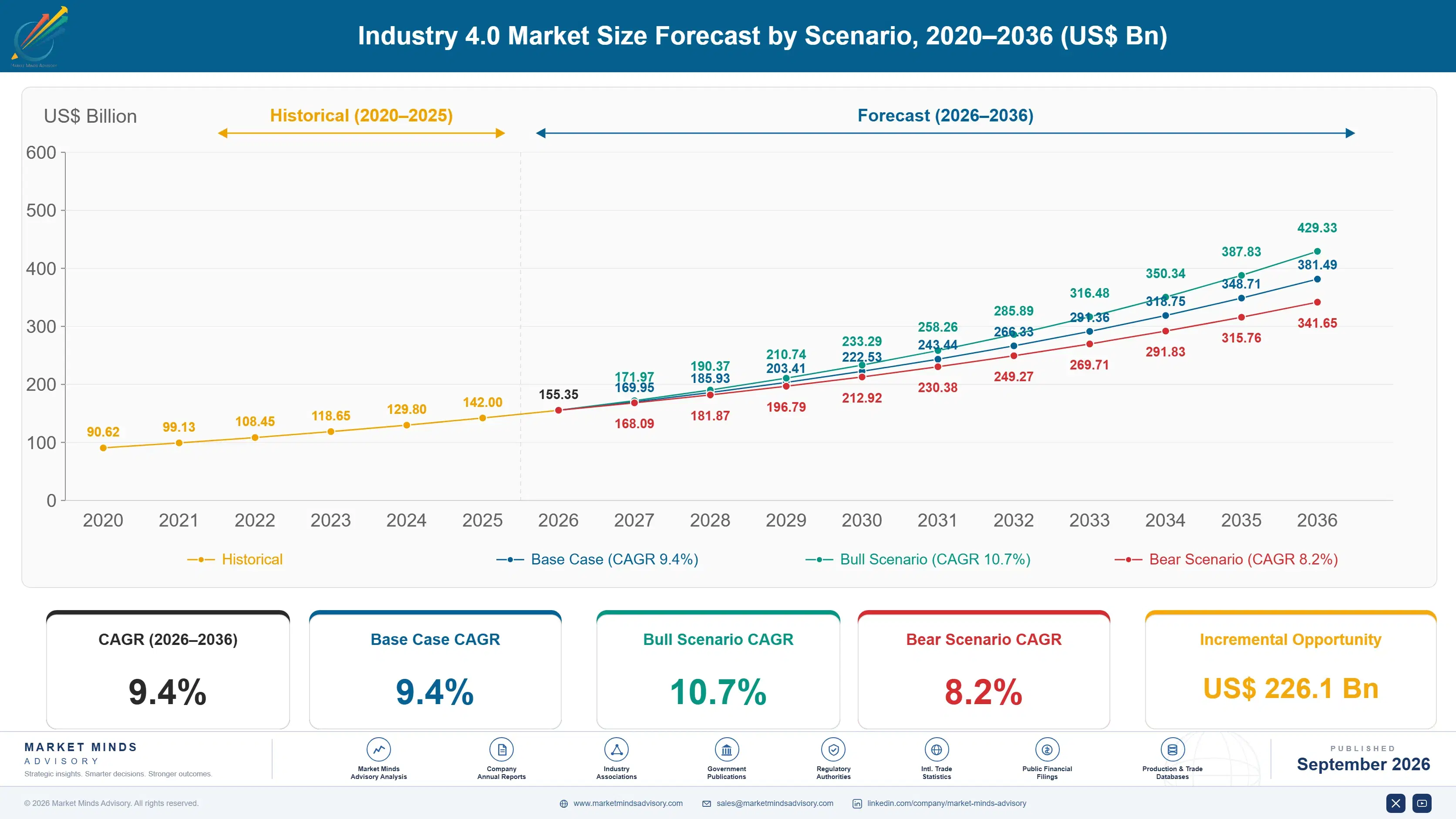
Industry 4.0 Market Forecast Scenarios

industry-4-0-market-size-forecast-scenario-1790007323569
The Industry 4.0 market compounded at roughly 8.6 percent between 2020 and 2025, a period shaped by pandemic-driven supply chain disruption that first exposed manufacturing visibility gaps, followed by a steadier build-out of connected sensor and predictive maintenance infrastructure across large industrial manufacturers globally who had previously deferred this kind of capital investment for years.
MMA's base case assumes 9.4 percent annual growth through 2036, anchored by three commercial mechanisms: skilled labor shortages forcing automation investment that was previously deferred indefinitely, reshoring and nearshoring programs requiring new greenfield facilities to be built automation-ready from the outset rather than retrofitted later, and interoperability standardization lowering the integration cost that historically slowed multi-vendor deployment across legacy brownfield manufacturing sites with mixed equipment vintages, generations, and control system architectures.
The bull case centers on accelerated reshoring policy support pulling forward new automated facility construction faster than current investment plans assume across most industrial sectors. The bear case is a broader industrial recession that delays capital equipment spending across manufacturers already operating on thin margins, since automation investment is often the first budget line deferred when production volumes soften unexpectedly and cash flow tightens.

Labor Scarcity Now Drives Industry 4.0 Capital Decisions

Industry 4.0 spending has shifted from a pure efficiency argument to a genuine operational survival argument as manufacturers face a shrinking pool of skilled machine operators and technicians willing to work available shift patterns across most industrial regions. That labor scarcity, more than any productivity metric, is now the argument capital committees actually respond to when evaluating proposals.
MARKET CONCENTRATIONCR5 38%top five vendors hold well under half of category revenue
AVERAGE DEPLOYMENT VALUE$2.4 milliontypical mid-size factory automation project across major manufacturers today
CONNECTED ASSET PENETRATION34%of industrial equipment now transmits real-time operational performance data
DOWNTIME REDUCTION23%average improvement following predictive maintenance software deployment across facilities
PAYBACK PERIOD18 monthstypical time to positive return on a full deployment investment
SENSOR COST SHARE28% of COGSconnected sensor and edge hardware remains a large cost input
Predictive maintenance software remains the most widely deployed application, since downtime reduction delivers the clearest, most easily quantified return that finance teams can model confidently before approving budget. Autonomous mobile robots and AI-driven quality inspection are newer but growing faster, as manufacturers move beyond single-line pilots into full facility rollouts once initial deployments prove reliable enough for continuous, uninterrupted production use.
Vendors that can demonstrate a fast, documented payback period are winning budget away from competitors selling on long-term strategic vision alone, since plant managers increasingly need to justify capital requests against an eighteen-month or shorter return horizon. Siemens and Rockwell Automation both lean on decades of installed control system relationships to compress deployment timelines relative to newer software-first entrants still building integration reference cases across comparable facilities.
"Nobody buys a digital twin because it's futuristic anymore. They buy it because they can't hire enough technicians to run the plant the old way."
Senior Analyst, Industrial Automation and Manufacturing Technology Practice · MMA Technology Practice · September 2026

Market Trends

Autonomous Mobile Robots Move Beyond Warehouse Pilots

Autonomous mobile robots, initially deployed almost exclusively in warehouse logistics, are increasingly moving onto production floors themselves, handling material transport between workstations without the fixed infrastructure conveyor systems previously required. This shift matters commercially because production-floor deployment requires far tighter safety certification and real-time coordination with human workers than warehouse-only applications ever demanded, raising both the technical bar and the average deal size for vendors competing in this category. Manufacturers that have completed successful production-floor pilots are now committing to facility-wide rollouts at a pace that surprised even optimistic vendor sales forecasts made just two years ago.
Market Impact: Cuts required headcount by 18 percent

Digital Twin Adoption Extends Beyond Design Into Live Operations

Digital twin technology, historically used mainly during facility design and commissioning phases, is increasingly being kept live throughout ongoing production operations rather than retired once a plant opens, creating an entirely new recurring software revenue category vendors did not previously monetize this way. Manufacturers are using live operational twins to simulate production schedule changes before committing physical resources, cutting costly trial-and-error changeovers that used to consume real production time on the actual factory floor. Vendors offering this operational extension are converting what was once a one-time design services engagement into an ongoing platform subscription relationship.
Market Impact: Cuts integration cost by 30 percent

Market Opportunities and Growth Drivers

Skilled Labor Shortage Forces Automation Capital Commitment

Manufacturing employers across most major industrial economies report persistent difficulty filling skilled machine operator and maintenance technician positions, a gap that shows no sign of closing given demographic trends among the current workforce nearing retirement age. This shortage has converted automation spending from a discretionary productivity initiative into a genuine operational necessity, since some facilities simply cannot maintain planned production volumes without reducing dependence on scarce skilled labor for routine, repetitive tasks. Capital committees that once required a multi-year payback case for automation projects are now approving faster paybacks specifically to address near-term staffing gaps directly.
Market Impact: Adds 6 to 9 months

Reshoring Programs Require Automation-Ready Greenfield Facilities

Government reshoring incentives and supply chain resilience concerns are driving a wave of new manufacturing facility construction across North America and parts of Europe, and nearly every new greenfield facility is being designed automation-ready from the ground up rather than retrofitted after opening. This shift is fundamentally different from retrofit spending, since greenfield automation integration costs considerably less per unit of capacity than adding equivalent capability to an existing brownfield facility with legacy infrastructure constraints. Vendors with strong greenfield design partnerships are capturing a disproportionate share of this new capital wave relative to competitors focused mainly on retrofit projects.
Market Impact: Adds 3 to 5 months

Market Restraints and Challenges

Legacy Equipment Integration Complexity Slows Brownfield Rollout

Many established manufacturing facilities run decades-old industrial equipment that predates modern connectivity standards entirely, and the root cause is that this equipment was designed for isolated, standalone operation long before industrial IoT protocols existed as a concept. Retrofitting sensors and connectivity onto this legacy equipment frequently costs more than the sensor hardware itself, since custom integration engineering is required for each unique equipment vintage and configuration a facility happens to operate. Vendors are mitigating this by building modular retrofit kits designed specifically for the most common legacy equipment models still in wide industrial use today.
Market Impact: Covers 340,000 deployed production-floor units

Cybersecurity Concerns Delay Connected Equipment Deployment

Manufacturing IT and operational technology security teams remain genuinely cautious about connecting previously isolated production equipment to broader networks, and the root cause is that a successful cyberattack on connected industrial equipment can halt physical production entirely rather than just compromising data, a materially higher-stakes failure mode than typical enterprise IT breaches. This has extended procurement timelines considerably, as security review cycles for connected industrial deployments now routinely add months that pure software purchases never faced previously. Some vendors are mitigating this by offering air-gapped deployment options that limit network exposure while still capturing operational data locally.
Market Impact: Cuts changeover time 35 percent
4 additional market trends, 3 additional growth drivers, and 2 additional restraints and challenges are covered in the full report. Contact sales@marketmindsadvisory.com to access the complete intelligence.

Segment CAGR and Growth Architecture

Six technology categories cover the market: connected sensors and edge hardware, predictive maintenance and asset performance software, digital twin platforms, autonomous mobile robots, AI-driven quality inspection, and industrial cybersecurity software. Classification follows technology function alone, not industry vertical, facility type, or vendor business model, keeping the hierarchy consistent throughout this report and its appendices.
industry-4-0-market-market-share-analysis-1790007324131

Autonomous Mobile Robots and AI Quality Inspection

Autonomous mobile robots and AI-driven quality inspection together form the fastest-growing technology category, at a 14.6 percent CAGR against a base rate of 9.4 percent, pulled forward by manufacturers moving beyond single-line pilot programs into full production-floor rollouts once initial deployments prove reliable for continuous, uninterrupted use. Robots now handle material transport tasks between workstations that previously required either fixed conveyor infrastructure or dedicated human labor, a flexibility advantage that greenfield facility designers increasingly build around from the earliest planning stages. AI quality inspection is following a similar adoption curve, replacing manual visual inspection with camera-based systems that catch defects at a rate humans cannot sustain across long production shifts.
CAGR 14.6%

Digital Twin Platforms

Digital twin platforms carry the second-fastest growth rate, at 12.1 percent, as manufacturers extend twin usage beyond initial facility design and commissioning into ongoing live production operations, creating a genuinely new recurring software revenue category vendors did not previously monetize this way at all before now. Manufacturers increasingly use live operational twins to simulate production schedule changes and equipment reconfigurations before committing physical resources, cutting costly trial-and-error changeovers that used to consume real production time directly on the factory floor. Siemens and PTC have both prioritized this category in recent product roadmaps, since digital twin data creates a stickier, more durable customer relationship than one-time design services engagements ever provided.
CAGR 12.1%
Full segment breakdown across 6 segments available in the complete report.

Regional Architecture and Country Demand Map

East Asia leads Industry 4.0 demand by a modest margin, anchored by dense electronics and precision manufacturing clusters investing heavily in automation, narrowly ahead of a North American base scaling fast on reshoring incentives and acute skilled labor shortage pressure across most industrial sectors today.

East Asia

China's electronics and precision manufacturing base, concentrated in Guangdong and Jiangsu provinces, drives the largest single share of regional demand, backed by national industrial policy explicitly targeting smart manufacturing capability as a strategic priority worth pursuing aggressively. Japan's aging workforce and persistent labor shortage have made automation adoption a genuine operational necessity rather than a competitive nice-to-have, particularly in automotive and precision equipment manufacturing sectors nationwide. South Korea's semiconductor and electronics giants maintain some of the world's most automated production facilities, setting a technology benchmark other regional manufacturers increasingly try to match. Growth here outpaces the global base rate as automation investment across the region continues compounding faster than in more mature Western markets.
Share: 29% | CAGR: 10.4% (2026 to 2036)

North America

Reshoring incentives under recent federal industrial policy have driven a wave of new automated manufacturing facility construction across the United States, particularly in semiconductor, electric vehicle, and battery production plants nationwide. The country's acute skilled machine operator shortage, worsened by an aging manufacturing workforce nearing retirement in large numbers, has converted automation spending from a discretionary efficiency project into a genuine operational necessity for many facilities across the country. Canada's smaller but steady automotive and industrial manufacturing base adds incremental volume through its own parallel automation investment programs. Growth here slightly outpaces the global base rate as reshoring-driven greenfield construction continues at a steady pace across the country and beyond.
Share: 26% | CAGR: 10.6% (2026 to 2036)
Regional intelligence for 5 additional markets available in the complete report: Western Europe, South Asia and Pacific, Latin America, Middle East and Africa, Eastern Europe. Contact sales@marketmindsadvisory.com.
industry-4-0-market-country-cagr-analysis-1790007324677

Where Industry 4.0 Margin Actually Concentrates

Hardware sales no longer define this category's economics anymore at all, not even remotely close to what they once did. Margin concentrates in recurring software subscriptions, documented payback speed, and greenfield design partnerships, capabilities that pure equipment vendors competing on unit price cannot easily replicate without genuine platform investment and years of accumulated deployment experience.

Recurring Software Attachment to Hardware Deployment

Vendors that bundle predictive maintenance and analytics software subscriptions with connected sensor hardware convert a one-time equipment sale into an ongoing recurring revenue relationship worth far more over the equipment's full operating life span and beyond. Rockwell Automation and Siemens both report software attachment rates now exceeding 55 percent among new sensor deployments, each adding meaningful recurring revenue per facility once the subscription relationship stabilizes across a full multi-year contract term. This mechanism works because operational data creates a switching cost that hardware alone never could establish with any customer.
Market Impact: Achieves a 55 percent software attachment rate today

Documented Payback Speed as a Sales Accelerant

Vendors that can document an eighteen-month or shorter payback period are closing enterprise deals meaningfully faster than competitors selling on long-term strategic vision alone, since plant managers increasingly need to justify capital requests against a compressed return horizon that finance teams actually trust and can model. Published case studies showing measurable downtime reduction of 20 to 25 percent give vendors with this evidence a real basis for premium pricing over competitors relying purely on feature comparison. This dynamic is pulling the entire competitive set toward heavier outcomes documentation investment industry-wide.
Market Impact: Cuts sales cycle length by 3 full months

Greenfield Facility Design Partnership Revenue Capture

Vendors that secure design partnerships with manufacturers planning new greenfield facilities capture automation specification decisions years before construction completes, locking in equipment and software standards that are costly for the manufacturer to later switch away from once installed. Greenfield integration costs roughly 30 percent less per unit of capacity than equivalent brownfield retrofit work, giving vendors with strong greenfield partnerships a genuine cost advantage they can pass through as either margin or competitive pricing. This channel is becoming increasingly important as reshoring drives new facility construction across multiple regions worldwide.
Market Impact: Cuts integration cost 30 percent below typical retrofit

Cybersecurity Add-On Services Beyond Core Platform

Vendors are increasingly separating industrial cybersecurity monitoring and air-gapped deployment services into standalone recurring add-on contracts rather than bundling this capability into the base automation platform sale, converting a compliance requirement into genuine incremental revenue. This add-on category now accounts for roughly 8 to 12 percent of total vendor revenue among the largest automation providers, a share growing steadily as manufacturers face increasing pressure to secure newly connected production equipment against emerging threats. This mirrors a broader industrial software trend toward security-layer monetization beyond the core operational technology platform itself.
Market Impact: Adds 8 to 12 percent recurring revenue share

Who Controls the Margin Pool

At 38 percent, CR5 concentration leaves a genuinely fragmented tail of regional and specialty vendors beneath the top five. Siemens leads through decades of industrial control system relationships, but Rockwell Automation and Schneider Electric both hold comparably deep installed bases, narrowing what would otherwise be a much larger gap between the platform leader and its closest challengers.
Current competitive activity centers on software attachment rate, documented payback speed, and greenfield design partnerships rather than raw hardware specification. Vendors are racing to publish quantified downtime reduction case studies since capital committees increasingly demand measurement rigor before approving budget. Several vendors have also begun offering bundled cybersecurity monitoring services, folding what used to be a separate procurement decision into a single automation platform contract.

The next competitive shift is coming from cloud-native software platform vendors entering from the enterprise IT side rather than traditional industrial control system manufacturing, a threat that could compress hardware vendor margins on the software layer specifically. That threat remains contained to analytics and digital twin software for now, since production-floor hardware still requires deep industrial engineering expertise these newer entrants generally lack. Smaller specialty robotics vendors are proving harder for large platform vendors to displace quickly.
industry-4-0-market-company-positioning-matrix-1790007325204

Competitive Moat and Risk Dimensions

SIEMENS

Moat: Industrial control system depth

Siemens' decades-long presence in industrial control system manufacturing gives it the deepest installed base and integration expertise of any vendor in the category, and manufacturers rarely switch control platforms once processes are built around a specific system. That installed base also generates a large, recurring software and services revenue stream newer software-first vendors cannot match at comparable scale.
SIEMENS

Risk: Slower cloud-native software pace

Siemens' hardware-anchored development culture moves more slowly on cloud-native software features than newer entrants building analytics platforms from a blank slate without legacy architecture constraints. Competitors focused purely on software are iterating faster on digital twin and analytics capability, capturing mindshare among manufacturers evaluating the newest generation of operational technology.
ROCKWELL AUTOMATION

Moat: North American installed base scale

Rockwell holds the deepest installed base among North American manufacturers specifically, a regional concentration that gives it strong positioning to capture reshoring-driven greenfield facility investment as new automated plants come online domestically. This regional depth translates into faster deployment timelines and stronger reference relationships than competitors without comparable North American installed density.
ROCKWELL AUTOMATION

Risk: Thinner international presence

Rockwell's revenue concentrates more heavily in North America than global competitors like Siemens and Schneider Electric, leaving it more exposed to a North American industrial slowdown and less positioned to capture East Asia's larger overall regional demand pool. Expanding international presence requires competing against entrenched regional incumbents with decades of local relationships.

Players Tracked

Prominent Players

Siemens AG
Rockwell Automation Inc
Schneider Electric SE
PTC Inc
ABB Ltd

Other Key Players

Honeywell International Inc
Emerson Electric Co
Mitsubishi Electric Corporation
General Electric Company
Yokogawa Electric Corporation
Fanuc Corporation
KUKA AG
Bosch Rexroth AG
Dassault Systemes SE
SAP SE
Cognex Corporation
Zebra Technologies Corporation
Aveva Group plc
National Instruments Corporation
Advantech Co Ltd

Recent Developments

MARCH 2026

Siemens Launches Expanded Digital Twin Operations Module

Siemens introduced an expanded digital twin module specifically designed for ongoing live production operations rather than only facility design and commissioning, extending its existing product portfolio into a faster-growing recurring software category. The launch targets manufacturers seeking to simulate production schedule changes before committing physical resources.
Signal: Live operational digital twin capability is fast becoming a standard product requirement across the whole industry
OCTOBER 2025

Rockwell Automation Acquires Autonomous Robotics Startup

Rockwell Automation completed the acquisition of a smaller autonomous mobile robotics startup to strengthen its production-floor material transport capability beyond its existing control system portfolio. The deal brings robotics engineering talent that Rockwell had previously developed more slowly through internal resources alone, compressing its product roadmap by roughly a year.
Signal: Autonomous robotics capability is increasingly acquired rather than built organically by incumbent automation vendors even today
MAY 2026

Schneider Electric Signs Major Greenfield Design Partnership

Schneider Electric signed an exclusive automation design partnership with a major electric vehicle manufacturer to standardize automation specification across several new greenfield battery production facilities under construction. The agreement extends Schneider's existing greenfield strategy and provides a reference deployment other manufacturers are likely to evaluate.
Signal: Greenfield design partnerships are becoming a preferred channel for capturing new capital investment across the industry today

Semiconductor and Sensor Cost Exposure

Connected sensors and edge computing hardware account for roughly 28 percent of Industry 4.0 deployment cost of goods sold, sourced predominantly from semiconductor fabrication capacity in Taiwan, South Korea, and the United States. Cloud and edge compute infrastructure adds a further 12 to 16 percent, with vendors increasingly deploying edge processing directly on factory floors to reduce latency.
Semiconductor pricing volatility hit hardest during the 2021 to 2022 global chip shortage, when automotive and consumer electronics demand competed directly with industrial sensor manufacturing for constrained fabrication capacity, extending lead times across the industry. TSMC's 2022 annual report cited capacity allocation decisions favoring higher-margin customer categories as a driver of extended wait times for industrial sensor orders, and several automation vendors disclosed multi-quarter component shortages as a direct consequence through 2023 and into 2024.

Larger automation vendors with long-term semiconductor supply agreements absorbed the 2021 to 2022 shortage with far less disruption than smaller vendors reliant on spot-market component purchases, a resilience gap that persists today. Exposure also varies by product category: sensor-heavy deployments face materially higher semiconductor cost sensitivity than software-centric offerings, giving vendors with a stronger software revenue mix better insulation from component price swings affecting the broader industry.
industry-4-0-market-cost-volatility-analysis-1790007325401

Multi-Year Semiconductor Supply Agreements

Larger vendors are securing multi-year semiconductor supply commitments with major foundries, locking in guaranteed capacity allocation and stable pricing that shields them from spot-market volatility during industry-wide demand surges affecting the broader global chip supply chain, unlike smaller rivals that remain fully exposed to volatile spot pricing swings during nearly every single passing quarter.

Multi-Source Component Qualification Programs

Vendors are increasingly qualifying two or more component suppliers for the same sensor design specifically to avoid single-source dependency, a lesson drawn directly from the 2021 to 2022 shortage that left several automation vendors unable to fulfill customer orders, and the practice is now spreading to mid-sized vendors previously reliant on one supplier alone.

Software Revenue Mix Diversification Strategy

Vendors are deliberately shifting revenue mix toward software and services rather than hardware to reduce overall semiconductor cost exposure, a strategic pivot that also happens to improve margin structure independent of any component pricing consideration, and one that several close competitors have now begun openly imitating across the whole entire category as well today.

Portfolio Architecture for Margin Defence

Margin architecture in Industry 4.0 splits sharply along software attachment rather than hardware type alone. Basic connected sensor hardware holds gross margins around 22 to 30 percent as component cost pressure and competitive commoditization keep pricing tight. Software-centric predictive maintenance and digital twin platforms hold materially higher margins, since recurring subscriptions and documented payback data create real switching costs manufacturers cannot easily walk away from once integrated.
The volume versus premium tension runs through the entire vendor base: hardware-focused suppliers scale on unit count but face relentless component price pressure, while software-centric vendors grow more slowly in deployment count but capture disproportionate revenue per facility. High-value margin pools concentrate almost entirely in recurring software and greenfield design partnerships rather than one-time sensor sales, and that concentration is where the strongest vendors now direct the bulk of new product investment.

Reshoring-driven demand, particularly greenfield facility construction requiring automation-ready specification from day one, is opening a genuinely new premium tier that smaller hardware-only vendors struggle to enter quickly, since building software platform credibility takes years of accumulated deployment evidence. Vendors positioned early in this category are compounding an advantage that hardware-focused competitors will find increasingly hard to close.

Volume / Commodity-Adjacent Tier

Basic connected sensors and edge hardware sold at high volume across most manufacturing categories, competing almost entirely on unit price against semiconductor component cost pressure with limited room for differentiation.
Gross Margin: 22-30%

Premium / Certified Tier

Predictive maintenance and asset performance software carrying documented downtime reduction evidence, where measurement credibility and payback speed give established vendors durable pricing power over newer, unproven entrants still building reference deployments.
Gross Margin: 38-48%

Sustainability / Regulatory / Next-Generation Tier

Digital twin platforms, autonomous mobile robots, and AI quality inspection tied to reshoring-driven greenfield facility construction, the fastest-compounding and highest-margin tier as automation-ready specification becomes standard practice across most new industrial builds.
Gross Margin: 45-58%
industry-4-0-market-portfolio-architecture-1790007325903

High-value Sub-segments and Strategic Watch-out

Autonomous Mobile Robots and AI Quality Inspection

The highest-value, fastest-growing pool in the market, converting a fixed-conveyor material handling model into a flexible robotics deployment as manufacturers move beyond pilot programs into full production-floor rollouts across most major facility types tracked in this report, a trend MMA expects to persist through 2036.
Gross Margin: 45-58%

Digital Twin Platforms

High-value and growing steadily as manufacturers extend twin usage beyond design and commissioning into live production operations across most major sectors, though building the software platform credibility required to compete takes years for newer entrants without established reference deployments to draw upon in sales conversations with buyers.
Gross Margin: 45-58%

Predictive Maintenance and Asset Performance Software

The volume core of the market, generating the bulk of installed deployments as the single most widely adopted application category available, but facing steady margin normalization as this category matures and competitive intensity increases across most large manufacturing accounts renewing contracts each passing year nationwide.
Gross Margin: 38-48%

Cloud-Native Enterprise IT Platform Entrants

The clearest strategic watch-out for traditional industrial control vendors, as marketing technology and enterprise software companies build analytics and digital twin capability that threatens to capture the highest-margin software layer independent of any specific control hardware platform, a shift genuinely worth monitoring closely over time.
Gross Margin: n/a

Why Industry 4.0 Revenue Compounds

Industry 4.0 revenue increasingly behaves like an annuity business in its software-centric segments rather than a one-time equipment sale. Once a manufacturer embeds a predictive maintenance or digital twin platform into daily production workflow, switching costs rise sharply, and renewal rates for enterprise automation software contracts now commonly exceed 80 percent, turning what used to be a capital equipment purchase into a durable, multi-year relationship.
Adoption depth varies significantly by end-use vertical. Automotive and electronics manufacturers show the deepest stickiness, since production lines there run continuous, high-volume operations where automation downtime carries immediate, quantifiable cost. Aerospace runs nearly as sticky, tied to certification requirements rarely redesigned once approved, while smaller food and beverage processors remain more transactional and show comparatively less loyalty to any single automation vendor.

Buyer profiles are shifting generationally as well. Younger plant engineers entering the workforce now expect connected, data-driven operations as a baseline expectation rather than a novel feature, while procurement has moved from pure equipment buyers toward operations and continuity teams, who evaluate vendors on documented payback rather than technical specifications alone. This buyer shift is steadily raising the evidentiary bar every vendor must clear.
industry-4-0-market-end-use-penetration-index-1790007326393

Where Industry 4.0 Value Concentrates

These are among the four positions where our research anticipates prominent divergence between winners and laggards over the coming forecast period. Each is grounded in the demand model, the regulatory perimeter, and the announced capacity pipeline.
01 / SOFTWARE ATTACHMENT STRATEGY

Bundle recurring software subscriptions with every hardware deployment going forward

Hardware sales alone no longer sustain competitive vendor economics in this category, and vendors that bundle predictive maintenance and analytics software with sensor hardware are converting one-time equipment sales into durable, multi-year recurring revenue relationships. Rockwell and Siemens both report software attachment rates now exceeding half of new deployments, a benchmark competitors without comparable software capability are struggling to match in enterprise sales conversations. Building this attachment motion now, before competitors close the gap, protects margin against continued hardware commoditization pressure.
02 / PAYBACK EVIDENCE BUILDING

Document payback speed rigorously before capital committees demand it universally

Plant managers increasingly need to justify automation capital requests against a compressed, eighteen-month or shorter return horizon that finance teams actually trust and can confidently model before signing off on any purchase. Vendors that can show documented downtime reduction data are winning budget away from competitors selling on long-term strategic vision alone, a shift that is only accelerating as capital scrutiny tightens across most industrial sectors globally. Building this evidence base now, before it becomes table stakes, gives early movers a genuine competitive advantage.
03 / GREENFIELD PARTNERSHIP PURSUIT

Pursue greenfield design partnerships ahead of the reshoring construction wave

Reshoring and nearshoring policy is driving substantial new manufacturing facility construction across several major economies, and vendors that secure design partnerships early lock in automation specification decisions years before construction actually completes on any given project. Greenfield integration costs meaningfully less than brownfield retrofit work, giving vendors with strong greenfield relationships a genuine cost advantage they can pass through as either margin or aggressive competitive pricing against rivals. Waiting until facilities are already under construction concedes this advantage to faster-moving, better-connected competitors.
04 / CYBERSECURITY SERVICE EXPANSION

Build cybersecurity monitoring capability before connectivity mandates arrive

Manufacturing operational technology security teams remain genuinely cautious about connecting previously isolated production equipment to broader networks, a caution that is meaningfully extending procurement timelines across the entire category today and likely well beyond. Vendors offering air-gapped deployment options and dedicated cybersecurity monitoring services are closing deals faster than competitors leaving security entirely to the purchasing manufacturer's own limited internal team to manage. Building this capability now, ahead of tightening regulatory connectivity mandates, positions vendors well ahead of slower-moving competitors.

Engagement Snapshot From the Field

A live engagement with an industry participant carrying material or product regulatory and market exposure ahead of a defining policy shift, showing how our research translates into a defensible multi-year portfolio strategy.
MARKET MINDS ADVISORY · CLIENT ENGAGEMENT SUMMARY
Industry 4.0 Producer Strategic Portfolio Review and Transition Roadmap 2026·Investment Scenario on Industry 4.0 Exposure Evaluation 2025-26
CLIENT PROFILE
A mid-size industrial equipment manufacturer operating six production facilities across North America engaged MMA to evaluate Industry 4.0 vendors ahead of a multi-year automation modernization program. The client faced persistent difficulty hiring skilled machine operators and sought a standardized automation platform to reduce dependence on scarce labor while consolidating vendor relationships across all six facilities.
STRATEGIC CHALLENGE
Leadership needed to modernize automation across six facilities with varying equipment vintages without disrupting active production commitments to major customers under strict delivery contracts. Existing equipment varied significantly by facility, creating inconsistent integration requirements, while budget constraints ruled out simultaneous modernization across all six locations at the exact same time.
MMA APPROACH
MMA benchmarked five candidate automation vendors against a weighted scorecard covering software attachment capability, documented payback period, greenfield versus brownfield integration cost, and total cost of ownership over a seven-year horizon. The team conducted structured interviews with each vendor's implementation team and cross-referenced disclosed client references against MMA's primary survey dataset covering comparable mid-size manufacturer deployments.
KEY FINDINGS
  1. The lowest-priced hardware option ranked last once software licensing costs and integration complexity were fully factored into the seven-year total cost of ownership scoring model.
  2. Vendors with strong brownfield retrofit kits cut projected integration timelines by roughly three months compared with vendors requiring custom engineering for legacy equipment.
  3. Documented payback period varied significantly across candidate vendors, directly affecting how confidently the client's finance team could approve the multi-year capital request.
  4. Phased facility rollout sequencing, prioritizing highest-impact locations first, secured meaningful vendor financing terms that a simultaneous six-facility rollout could not have negotiated.
CLIENT PROFILE
A mid-size industrial equipment manufacturer operating six production facilities across North America engaged MMA to evaluate Industry 4.0 vendors ahead of a multi-year automation modernization program. The client faced persistent difficulty hiring skilled machine operators and sought a standardized automation platform to reduce dependence on scarce labor while consolidating vendor relationships across all six facilities.
STRATEGIC CHALLENGE
Leadership needed to modernize automation across six facilities with varying equipment vintages without disrupting active production commitments to major customers under strict delivery contracts. Existing equipment varied significantly by facility, creating inconsistent integration requirements, while budget constraints ruled out simultaneous modernization across all six locations at the exact same time.
MMA APPROACH
MMA benchmarked five candidate automation vendors against a weighted scorecard covering software attachment capability, documented payback period, greenfield versus brownfield integration cost, and total cost of ownership over a seven-year horizon. The team conducted structured interviews with each vendor's implementation team and cross-referenced disclosed client references against MMA's primary survey dataset covering comparable mid-size manufacturer deployments.
KEY FINDINGS
  1. The lowest-priced hardware option ranked last once software licensing costs and integration complexity were fully factored into the seven-year total cost of ownership scoring model.
  2. Vendors with strong brownfield retrofit kits cut projected integration timelines by roughly three months compared with vendors requiring custom engineering for legacy equipment.
  3. Documented payback period varied significantly across candidate vendors, directly affecting how confidently the client's finance team could approve the multi-year capital request.
  4. Phased facility rollout sequencing, prioritizing highest-impact locations first, secured meaningful vendor financing terms that a simultaneous six-facility rollout could not have negotiated.
RECOMMENDED STRATEGY
Phase 1: Phase one modernized the two highest-priority facilities and standardized predictive maintenance software across all six locations within the first six months. Phase 2: Phase two extended automation deployment to three additional facilities over a nine-month rollout window with dedicated vendor implementation and training support. Phase 3: Phase three completed modernization across the remaining facility and launched a documented payback tracking program across the full manufacturing network.
OUTCOME
The manufacturer reported a 24 percent reduction in unplanned downtime within the first year following modernization, alongside a 17 percent reduction in dependence on contract labor across the six facilities (client-reported, unverified by MMA). Overall equipment effectiveness improved measurably following the rollout, according to internal tracking.

Frequently Asked Questions

Foundational context covering the market sizes, CAGR, scope, country, region and competition that inform every finding below. This section is provided to cover basics and most often pre-purchase conversations, answered from the MMA Primary Research Dataset.

What is the current size of the Industry 4.0 Market?

The global Industry 4.0 market reached 142.0 billion dollars in 2025. Growth is concentrated in autonomous mobile robots and AI quality inspection rather than basic connected sensors.

How large will the Industry 4.0 Market be by 2036?

MMA projects the market will reach 381.49 billion dollars by 2036, up from 155.35 billion dollars in 2026. That represents a 2.46 times expansion over the ten-year forecast window.

What is the CAGR for the Industry 4.0 Market 2026 to 2036?

The base case compound annual growth rate is 9.4 percent. MMA's bull scenario projects 10.7 percent, while the bear scenario projects 8.2 percent over the same forecast period.

Which segment is growing fastest?

Autonomous Mobile Robots and AI Quality Inspection is the fastest-growing segment at a 14.6 percent CAGR, roughly 1.55 times the overall market rate, driven by production-floor deployment.

Who are the major companies in the Industry 4.0 Market?

Siemens, Rockwell Automation, Schneider Electric, PTC, and ABB lead the competitive landscape. The top five hold roughly 38 percent of global category revenue combined across all applications.

Which country is growing fastest?

India leads country-level growth at a 12.8 percent CAGR, helped by government production-linked incentive programs targeting electronics and automotive assembly manufacturing across most major states.

Report Segmentation Architecture

The full report scope spans multiple orthogonal segmentation dimensions, with cross-tabulated demand data provided for each dimension pair. Coverage extends further to regional breakdowns, trend trajectories, and the competitive detail needed to support segment-level decision-making.

By Technology Type

  • Connected Sensors and Edge Hardware
  • Predictive Maintenance and Asset Performance Software
  • Digital Twin Platforms
  • Autonomous Mobile Robots
  • AI-Driven Quality Inspection
  • Industrial Cybersecurity Software

By End-Use Industry

  • Automotive and Transportation
  • Electronics and Semiconductors
  • Aerospace and Defense
  • Food and Beverage Processing
  • Pharmaceuticals and Chemicals
  • Heavy Machinery and Equipment

By Commercial Dimension

  • Greenfield Facility Deployment
  • Brownfield Retrofit Deployment
  • Cloud Subscription Licensing
  • Equipment Leasing and Financing
  • Managed Services Contracts

By Region

  • East Asia
  • North America
  • Western Europe
  • South Asia and Pacific
  • Latin America
  • Middle East and Africa
  • Eastern Europe

Scope, Methodology, and Coverage

Every figure in this report is reproducible from documented input assumptions. The scope below maps the historical period, the forecast horizon, the segmentation dimensions, and the countries covered, alongside the underlying primary and qualitative methodology.
Historical Period
2020 to 2025
Forecast Period
2026 to 2036
Base Year
2025 (USD billions; MMA Primary Research Dataset, September 2026)
Market Definition
The Industry 4.0 market covers connected sensors, industrial software, digital twin platforms, and autonomous robotics deployed to automate and optimize manufacturing operations. It excludes traditional non-connected industrial machinery, generic enterprise resource planning software without a manufacturing operations link, and consumer-facing IoT devices unrelated to industrial production.
Quantitative Units
USD Billion
Segmentation Dimensions
By Technology Type, By End-Use Industry, By Commercial Dimension, By Region
Regions Covered
East Asia, North America, Western Europe, South Asia and Pacific, Latin America, Middle East and Africa, Eastern Europe
Countries Covered
United States, China, Germany, Japan, South Korea, India, Brazil, United Kingdom, France, Poland
Key Companies Profiled
Siemens AG, Rockwell Automation Inc, Schneider Electric SE, PTC Inc, ABB Ltd, Honeywell International Inc, Emerson Electric Co, Mitsubishi Electric Corporation, General Electric Company, Yokogawa Electric Corporation, Fanuc Corporation, KUKA AG, Bosch Rexroth AG, Dassault Systemes SE, SAP SE, Cognex Corporation, Zebra Technologies Corporation, Aveva Group plc, National Instruments Corporation, Advantech Co Ltd
Quantitative Methodology
Primary survey, n=3,800 respondents, Q4 2025, six countries; demand-side model with trade association cross-validation
Qualitative Methodology
47 expert interviews, Q4 2025; applied to validate demand model assumptions, identify emerging dynamics, and assess competitive positioning
Report Format
PDF and XLSX data workbook (Word format preview document)
Publisher
Market Minds Advisory
Report Code
MMA-2026-CON-312
Published
September 2026
Contact
sales@marketmindsadvisory.com | www.marketmindsadvisory.com

Purchase the full Industry 4.0 Market Report (2026 to 2036).

This report provides a comprehensive analysis of the global Industry 4.0 market, covering historical performance from 2020 to 2025 and a detailed forecast through 2036. It examines segmentation by technology type, end-use industry, and commercial model, alongside regional demand dynamics across all seven MMA-tracked geographies. The analysis includes competitive benchmarking of twenty leading vendors, input cost exposure, portfolio margin architecture, and strategic recommendations grounded in primary survey data. Findings draw on MMA's proprietary quantitative survey and expert interview programs conducted in the fourth quarter of 2025.
Segment-level revenue forecasts through the year 2036
Competitive benchmarking of twenty leading market vendors
Regional demand analysis across all seven geographies
Input cost exposure and mitigation strategy review
Portfolio margin architecture and pricing tier analysis
Strategic verdict with actionable commercial recommendations included

Built For The People Who Decide

From boardroom strategy to bench-side execution, this report is read cover-to-cover by leaders shaping the next decade of their industry, turning demand scenarios, market dynamics and valuation benchmarks into decisions.
CXOs/ Presidents/ VPs/ Managers
M&A and Corporate Development
Strategy Teams and R&D Heads
Procurement and Product Directors
Regulatory and Compliance Leaders
Investor Relations and Equity Analysts