Market Minds Advisory
Industrial X-Ray Films Market

Industrial X-Ray Films Market: Silver cost pass-through, digital displacement and regulated archival demand 

Film volume is falling every year as detectors replace it, yet the market value holds up because silver keeps repricing and what remains is the demanding inspection work digital has not been accepted for.

Lead Analyst

Bilal Shaikh

Published

September 2026

Make Smarter Decisions with Customized Research Insights

Request a free sample report and evaluate market opportunities, growth trends, and competitive dynamics relevant to your business needs.

2025 MARKET VALUE$0.6BMarket Size 2025
2036 FORECAST VALUE$0.8BBase Case , 2026 to 2036
CAGR 2026 TO 20363.2 %Bull 4.4% / Bear 2.0%
INCREMENTAL OPPORTUNITY$0.2BNet 10- year value creation
EXPANSION MULTIPLE1.37x2036 value over 2026 base
Strategic Levers
M&A Pipeline
Regional Outlook
Country Rankings
Competitive Intelligence
Segmental Deep-dive
Call-Us : 91 93563 13602

Executive Snapshot and Market Trajectory

This market is shrinking in square metres and holding its value in dollars, which is an uncomfortable combination to manage. Digital detectors take roughly six percent of film volume every year, while silver repricing and a steady mix shift toward the finest grain classes together keep revenue broadly intact.
Growth concentrates in Class I very fine grain film, expanding at 4.8%, where the flaw detectability required on critical welds and castings still exceeds what digital systems are accepted for under several inspection codes. East Asia holds 30% of value, the largest regional share, because Chinese and Korean pressure vessel fabrication, shipbuilding and pipeline construction together generate more radiographic inspection work than any other region currently does.
The supplier base is extremely concentrated, with the top five holding 78% of production capacity, and it splits between the remaining Western imaging houses and Chinese film producers who serve both domestic and export demand. Competition here runs on code acceptance and on silver pass-through terms rather than on image quality. Digital displacement is the force now determining which parts of this market survive at all and which of them do not.
Market Definition
Industrial x-ray film comprises silver halide radiographic film manufactured for non-destructive testing, classified by grain and speed across Class I through Class V and screen-type emulsions, together with specialty and non-standard emulsions supplied for industrial radiography. Sizing covers film sold to inspection service companies, fabricators and end users at realised delivered price. Processing chemistry and developer solutions, lead screens and cassettes, digital detectors and computed radiography plates, medical and dental radiographic film, and radiographic inspection services all fall outside scope.
Base Year Value
$0.6B in 2025 (MMA Primary Research Dataset, August 2026)
Forecast Period
2026 to 2036, eleven discrete annual values
CAGR
3.2% base case. Bull 4.4%. Bear 2.0%.
Fastest Growth Segment
Class I Very Fine Grain Film: 4.8% CAGR
Fastest Growth Country
India: 6.0% CAGR
Fastest Growth Region
South Asia and Pacific: 5.5% CAGR
Largest Region
East Asia: 30% of 2025 global value
Market Leaders
Carestream Health, Agfa-Gevaert, Fujifilm, Lucky Film and Konica Minolta lead on industrial radiographic film production capacity across all grain classes. Source: MMA Primary Research Dataset, July 2026.
Primary Survey
n=3,800 procurement and R&D decision-makers, Q4 2025, six countries
Methodology
Demand-side build-up, cross-validated against public data, 47 expert interviews

Industrial X-Ray Films Market Forecast Scenarios

industrial-x-ray-films-market-trends-size-forecast-scenario-1787311126225
Growth of 2.2% across 2020 to 2025 masked a volume decline that value figures hide entirely. Inspection activity collapsed through 2020 as construction and turnaround work was deferred, recovered from 2022, and then met accelerating detector adoption that removed film volume permanently rather than cyclically. Silver moved sharply upward across 2024 and 2025, which lifted realised pricing enough to offset much of the square metre decline.
The base case at 3.2% rests on three mechanisms. Silver keeps repricing and producers keep passing it through, since the metal carries nearly half of delivered cost and buyers accept indexed terms. Mix keeps shifting toward the finest grain classes as digital takes the undemanding inspection work first and leaves the critical welds behind. And fabrication across South Asia and the Gulf keeps generating inspection volume that digital adoption has not yet reached.
The bull case at 4.4% turns on silver strength continuing alongside slower digital adoption in code-governed applications, since inspection standards move a good deal more slowly than detector technology does. The bear case at 2.0% turns instead on code revision. Broad acceptance of digital radiography in pressure vessel and pipeline codes would accelerate displacement beyond the current six percent annual rate.

Radiography film: silver cost against digital displacement

Two forces move in opposite directions here and the net result flatters the market. Digital detectors take roughly six percent of film volume each year, permanently, and nobody who converts ever goes back. Against that, silver carries around 46% of delivered cost and has repriced sharply, which lifts revenue per square metre enough that the value line looks considerably healthier than the tonnage line does.
TOP FIVE CONCENTRATION78%Share of global film production capacity held collectively
SILVER COST SHARE46% of COGSPortion of delivered cost tied to the emulsion metal
PIPELINE AND WELD SHARE38% of volumeLargest single application by consumed film area globally
ANNUAL DIGITAL DISPLACEMENT6% annuallyRate at which film volume moves toward digital detectors
REQUIRED ARCHIVAL RETENTION40 yearsRetention period regulators demand for radiographic inspection records
PROCESSING WATER INTENSITY12 litres/m2Water consumed developing each square metre of exposed film
The remaining demand is not distributed randomly at all. Digital takes the easy inspection work first, where geometry is simple and access is good, and it leaves behind the critical welds, complex castings and field radiography operating under code regimes that have not yet accepted digital equivalence. That residual work uses the finest grain film classes and pays for them without much argument.
Applications divide according to whether a governing code decides the choice at all. Pipeline and weld inspection takes 38% of volume and moves at whatever pace the governing standard permits. Casting, aerospace component and archival inspection work sits tighter still, because the forty year record retention that regulators require remains a genuinely awkward problem for every digital format.
"Everybody in this industry runs a decline model and most of them get the shape wrong. The volume that leaves first is the easy work with the worst margin, so a shrinking market can improve its mix for a decade before the floor actually arrives."
Director, Imaging Materials and Inspection Technologies Practice · MMA Chemicals

Market Trends

Digital detectors removing the least demanding inspection work first

Digital radiography converts easily where geometry is simple, access is good and the inspection is repeated often enough to justify detector capital, which describes a great deal of shop-floor weld inspection. It converts slowly where geometry is awkward, radiation levels are high or the governing code has not accepted digital equivalence. The result is that roughly six percent of film volume leaves each year, and it is consistently the lowest value work that goes first. Producers who model uniform decline across their portfolio consistently misjudge which product lines actually matter.
Market Impact: Retains 38% of remaining volume

Silver repricing supporting revenue against falling physical volume

Silver carries roughly 46% of delivered film cost and moved sharply upward across 2024 and 2025 as industrial demand from photovoltaics competed with every other consuming application. Producers holding indexed pass-through terms recovered that movement, while those on flat annual pricing absorbed it and watched margins compress at exactly the wrong moment. The commercial consequence is that revenue per square metre has risen enough to offset much of the volume decline, which flatters the headline market figures considerably and disguises how quickly the underlying physical volume is actually falling away.
Market Impact: Grows 6.0% annually across India

Market Opportunities and Growth Drivers

Code-governed inspection retaining film where digital lacks acceptance

Pressure vessel, pipeline and boiler inspection codes specify acceptable radiographic methods, and several have been slower to accept digital equivalence than detector capability alone would justify, because code committees revise on multi-year cycles and require substantial validation evidence. That regulatory lag holds film in place across critical weld inspection long after the technology case for conversion has been made elsewhere. Class I and Class II film classes between them serve most of that remaining work. Code-governed applications now account for the great majority of all remaining film volume across developed inspection markets.
Market Impact: Removes 6% of volume each year

Fabrication activity across South Asia and the Gulf generating inspection

Pipeline construction, refinery and petrochemical capacity, shipbuilding and pressure vessel fabrication across India, Southeast Asia and the Gulf generate radiographic inspection volume at a rate that digital adoption in those regions has not yet matched. Inspection service companies there operate with older equipment bases and price sensitivity that favours film economics, since detector capital is difficult to justify against project-based work. Indian inspection demand grows at 6.0% annually as a direct result of all that activity. That regional demand partly offsets the permanent decline now occurring right across developed inspection markets everywhere.
Market Impact: Consumes 12 litres per square metre

Market Restraints and Challenges

Digital radiography permanently displacing film across converting applications

Every inspection operation that installs digital detectors removes its film demand permanently rather than cyclically, because the capital is sunk and the workflow advantages in speed, storage and re-examination are genuine. The root cause is that detector cost has fallen far enough that the payback works on inspection volume most service companies already have. Commercially this makes the addressable market smaller every year regardless of pricing. Producers are responding by concentrating on code-governed applications, on field radiography where detectors are impractical, and on regions where detector capital remains hard to justify.
Market Impact: Removes 6% of film volume annually

Processing chemistry and effluent requirements deterring remaining film users

Wet processing consumes around 12 litres of water per square metre developed and generates silver-bearing effluent that requires recovery and controlled disposal under tightening discharge rules. The root cause is the chemistry itself, which has not fundamentally changed in decades and cannot be reformulated to remove the requirement. Commercially this adds an operating burden that pushes marginal users toward digital detectors considerably sooner than image quality alone ever would. Producers are responding with lower replenishment chemistry, silver recovery services bundled into the supply arrangement, and dry-process formats aimed at field applications.
Market Impact: Carries 46% of delivered film cost
3 additional market trends, 2 additional growth drivers, and 4 additional restraints and challenges are covered in the full report. Contact sales@marketmindsadvisory.com to access the complete intelligence.

Segment CAGR and Growth Architecture

Segmentation follows the film grain and speed classification used by inspection codes worldwide, because that class determines flaw detectability, exposure time, code acceptance and realised price simultaneously. Six classes cover the whole market, running from the very fine grain films used on critical work through the standard and high speed classes to screen-type and specialty emulsions.
industrial-x-ray-films-market-trends-market-share-analysis-1787311126769

Class I Very Fine Grain Film

Expanding at 4.8%, a full 1.50 times the market rate, on the finest grain emulsions used where flaw detectability governs everything and where several inspection codes have not accepted digital equivalence at the required sensitivity level. Critical pressure vessel welds, aerospace castings and nuclear component inspection consume most of this volume, and each is specified by a code committee rather than by an inspection manager weighing capital cost. Exposure times are long and the film itself is expensive, neither of which matters much when the alternative is simply not permitted. This class grows steadily while the overall market shrinks, because digital conversion takes everything easier first and simply leaves this work behind.
CAGR 4.8%

Class II Fine Grain Film

Growing at 4.2% annually on fine grain emulsions covering the substantial band of inspection work which requires rather better detectability than standard film provides without demanding the very long exposure times that Class I inevitably imposes. Pipeline girth welds, heavy fabrication and pressure equipment inspection between them consume most of this volume across every producing region. Digital conversion here is considerably slower than in the coarser classes, because the sensitivity requirement sits close to the boundary of accepted detector performance under several of the governing inspection codes. Demand here tracks fabrication activity rather than any technology cycle at all, which makes it comfortably the most predictable class in the entire market.
CAGR 4.2%
Full segment breakdown across 6 segments available in the complete report.

Regional Architecture and Country Demand Map

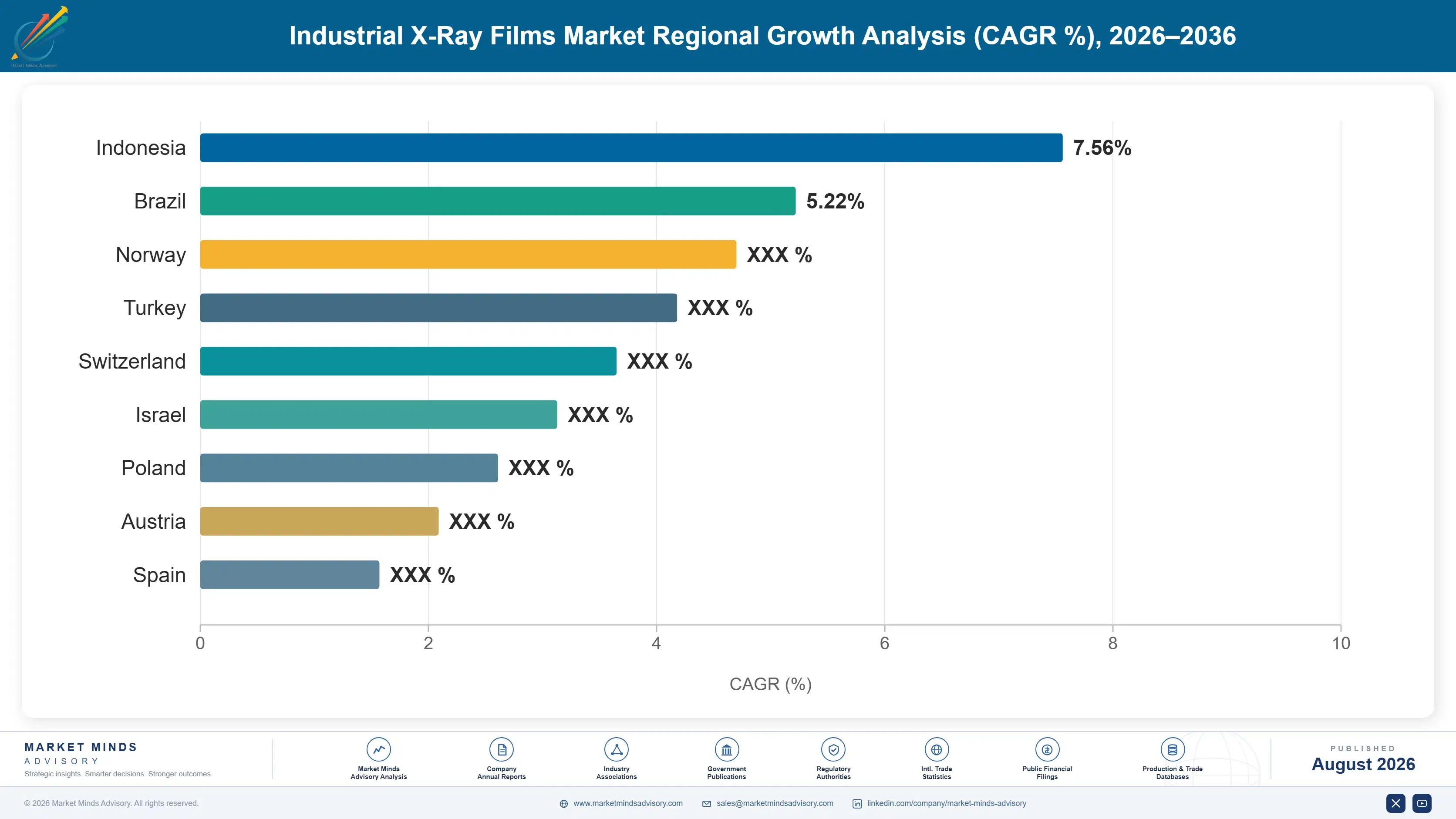
Radiographic film demand tends to follow heavy fabrication and pipeline construction activity rather than tracking population or general economic output, and film survives longest wherever inspection codes lag behind detector capability and wherever detector capital is genuinely hard for an inspection service company to justify.

East Asia

Thirty percent of global value here, comfortably the largest regional share, because Chinese and Korean pressure vessel fabrication, shipbuilding and pipeline construction together generate more radiographic inspection work than any other region currently produces. Chinese film manufacture serves both that domestic demand and a substantial export volume shipped into price-sensitive inspection markets elsewhere in the world. Japanese inspection practice has moved toward digital considerably faster than the regional average, which pulls that country's film consumption down against an otherwise rising regional total. Growth of 4.1% here runs above the overall global rate, supported by continued fabrication activity and by domestic film production that keeps delivered costs unusually low across the region.
Share: 30% | CAGR: 4.1% (2026 to 2036)

North America

Twenty-two percent of global value here, weighted heavily toward pipeline integrity inspection, refinery turnaround work and an aerospace component inspection base carrying unusually demanding code requirements of its own. Digital adoption here is the most advanced found anywhere in the world and has already removed a great deal of the shop-floor volume, thereby leaving behind only the code-governed critical inspection work that detectors have not yet been able to displace. Field radiography carried out on pipelines remains very substantially film-based, given the access and radiation conditions involved on site. Growth of 2.6% here reflects that residual demand holding steady while silver repricing lifts the realised value per square metre consumed.
Share: 22% | CAGR: 2.6% (2026 to 2036)
Regional intelligence for 5 additional markets available in the complete report: Western Europe, South Asia and Pacific, Latin America, Middle East and Africa, Eastern Europe. Contact sales@marketmindsadvisory.com.
industrial-x-ray-films-market-trends-country-cagr-analysis-1787311127296

Where radiography film margin still remains

Four commercial positions separate producers managing a decline profitably from those watching square metres fall and repricing nothing. Each one of them rests on something a competitor cannot copy quickly: indexed contract terms, code-accepted product positions, genuine distribution reach into slow-converting regions, or else field format capability that nobody else has bothered to build.

Index silver into every contract before the next move

Silver carries roughly 46% of delivered cost and moved by a substantial multiple across 2024 and 2025, yet a great many supply agreements remain priced flat for twelve months at a time. Producers holding indexed pass-through terms tied to a published reference realise roughly 20% above competitors absorbing the movement, because the difference falls straight to margin rather than being competed away. Customers accept indexation readily once the arithmetic is shown plainly. The producers who have not done this are financing their customers' silver exposure without being paid for it.
Market Impact: Realises roughly 20% above flat-pri

Concentrate on code-governed applications digital cannot enter

Inspection codes revise on multi-year cycles and require substantial validation before accepting digital equivalence, which holds film in place across critical weld and casting work long after the technology case elsewhere has been settled. Producers concentrating on Class I and Class II supply into code-governed applications realise roughly 35% above those competing across the whole portfolio, because the customer has no permitted alternative. Tracking code committee activity is genuinely a commercial function rather than a technical one. Almost nobody in this industry has ever staffed it that way at all.
Market Impact: Realises roughly 35% above whole-po

Follow the fabrication into slow-converting inspection markets

Detector capital is difficult to justify against project-based inspection work with uneven utilisation, which is exactly how service companies across South Asia, the Gulf and Latin America operate. Producers with genuine distribution and technical support in those markets hold roughly 2 times the volume per unit of fabrication activity that they achieve in converted markets. The investment is distribution relationships and local technical service rather than manufacturing capital. Most Western producers have been steadily withdrawing from precisely the regions where their product still has a decade of commercial life left.
Market Impact: Holds roughly 2 times volume per fa

Build field and ready-pack formats for difficult access work

Pipeline crawlers, offshore risers and remote site radiography all defeat digital detectors on access, radiation level and site conditions in ways that shop-floor inspection simply does not, and that work needs vacuum-packed, pre-screened and roll formats rather than sheet film. Producers supplying properly engineered field formats earn roughly 25% above standard sheet pricing on the same emulsion, because the packaging solves a site problem. Converting capital involved is modest measured against emulsion coating capacity itself. Very few producers have ever treated field packaging as anything other than a converting afterthought.
Market Impact: Earns roughly 25% above standard sh

Who Controls the Margin Pool

Concentration is very high, with the top five holding 78% of industrial radiographic film production capacity, the basis on which every participant here is assessed. Carestream and Agfa lead through emulsion technology and code-accepted product ranges built over many decades, while the remaining field spans Fujifilm and Konica Minolta in Asia, Chinese producers such as Lucky Film serving domestic and export demand, and a small number of specialist converters and regional distributors.
Competition currently runs on code acceptance, silver pass-through terms and distribution reach into slow-converting markets rather than on image quality, which is comparable between credible producers within each class. Emulsion coating capacity is the barrier to entry and nobody is adding any, since the market is in physical decline. Distribution positions in emerging inspection markets have become disproportionately valuable.

Emerging pressure comes from two directions at once. Chinese producers compete hard on price into export markets where code acceptance is less restrictive, which pressures Western positions in exactly the regions where volume still grows. And detector manufacturers are steadily working code committees toward digital equivalence, which means the rankings that matter may eventually be decided by regulators rather than by any commercial action a film producer takes.
industrial-x-ray-films-market-trends-company-positioning-matrix-1787311127829

Competitive Moat and Risk Dimensions

CARESTREAM HEALTH

Moat: Code acceptance and emulsion range

A product range accepted across the major inspection codes, combined with emulsion technology developed over decades of radiographic manufacture, gives Carestream positions that a new entrant could not establish even if emulsion coating capacity were available. Code acceptance takes years of validation evidence and cannot be bought, which matters far more in a declining market than manufacturing scale does.
CARESTREAM HEALTH

Risk: Permanent volume decline exposure

The addressable market shrinks by roughly six percent of volume every year as detectors convert inspection operations permanently, and no commercial action reverses a conversion once the capital is sunk. Silver repricing has masked the effect on revenue so far, but a period of stable metal pricing would expose the underlying decline immediately and without any cushion.
AGFA-GEVAERT

Moat: Technical service and European position

Deep technical service capability alongside inspection service companies, combined with manufacturing and quality positions built over many decades, keeps Agfa specified in demanding European and export applications where an inspection house values support over delivered price. That relationship depth is what keeps volume attached as the overall market contracts around it.
AGFA-GEVAERT

Risk: Most converted regional exposure

Western Europe is the most digitally converted inspection market in the world and carries the tightest silver effluent regulation, which compounds the pressure on film demand there specifically. A regional position built where displacement is furthest advanced leaves less time to redeploy capability toward the markets that still have a decade of film consumption remaining.

Players Tracked

Prominent Players

Carestream Health
Agfa-Gevaert
Fujifilm
Lucky Film
Konica Minolta

Other Key Players

Kodak Alaris
Foma Bohemia
Shanghai Yiyi Film
Tianjin Media Chemical
Sino Chemical Film
Yingkou Tianyuan Chemical
Chugai Photo Chemical
Mitsubishi Paper Mills
ORWO Filmotec
Retec NDT
NDT Supply
Amerin
DURR NDT
Elcometer
Ashtead Technology

Recent Developments

FEBRUARY 2025

Silver movement forces indexed pass-through across film contracts

Sustained silver price movement prompted several radiographic film producers to renegotiate the pass-through terms written across all of their annual supply contracts, after realised margins on volumes priced before the move proved wholly insufficient to cover the emulsion silver content actually consumed during the manufacture itself.
Signal: Indexed silver pass-through is now becomin
JUNE 2025

Code committee defers digital equivalence for critical weld inspection

An inspection code committee deferred a proposal that would have extended digital radiography acceptance to critical pressure vessel weld examination, requiring further comparative sensitivity validation evidence and leaving Class I and Class II film as the only permitted examination method for that particular category of work.
Signal: Code committee timing rather than detector
OCTOBER 2025

Inspection service company converts shop radiography to detectors

A large inspection service company converted the whole of its shop-floor radiographic examination work to digital detectors while retaining film for its field pipeline and code-governed critical work, thereby removing a substantial volume of standard class film consumption permanently from the market rather than temporarily.
Signal: Conversions consistently remove the least

Silver and film base cost exposure

Silver accounts for roughly 46% of delivered radiographic film cost, purchased through precious metal refiners and dealers and applied as halide crystals within the emulsion. Polyester base contributes about 14%, gelatin and emulsion chemistry around 11%, coating energy 9%, packaging and vacuum sealing 8%, with quality testing, freight and working capital carrying the remaining 12%.
Silver was the defining exposure of the recent history and remains so. Prices climbed steeply across 2024 and into 2025 as industrial demand from photovoltaic manufacture competed with every other silver-consuming application, and film producers holding annual contracts priced beforehand absorbed the difference. Agfa-Gevaert Annual Report 2024 recorded raw material cost pressure across its imaging operations, and Fujifilm Annual Report 2024 noted input cost recovery lagging across imaging materials lines.

The competitive disadvantage mechanism runs through contract terms rather than manufacturing efficiency. Producers on flat annual pricing finance customer silver exposure without compensation, which in a declining market removes the margin funding an orderly wind-down. Those without code-accepted ranges compete only where price decides, which is exactly the volume digital takes first. Smaller producers frequently carry both limitations, which leaves them exposed to the fastest-converting parts of a shrinking market.
industrial-x-ray-films-market-trends-cost-volatility-analysis-1787311128025

Index silver pass-through into every supply agreement

Silver carries nearly half of delivered cost and has moved by a substantial multiple in recent years, yet many film contracts remain priced flat for twelve months at a time. Indexed clauses tied to a published metal reference remove that exposure completely, and inspection customers accept them readily once the underlying arithmetic is laid out plainly for them.

Recover silver from processing effluent as a supply service

Wet processing generates silver-bearing effluent that customers must handle under tightening discharge rules, and the recovered metal carries real value that most inspection houses never capture properly at all. Offering recovery as part of the supply arrangement returns metal into manufacture while simultaneously removing a compliance burden that the customer genuinely dislikes having to carry.

Match coating capacity to a declining volume base honestly

Emulsion coating lines carry heavy fixed costs and were built for volumes that will not return, so running them against optimistic demand forecasts converts a manageable decline into a loss-making one. Consolidating production onto fewer lines earlier than feels comfortable is what preserves the margin that actually funds the remaining product positions worth holding.

Portfolio Architecture for Margin Defence

Margin architecture separates by code acceptance rather than by emulsion technology, which is not how most producers in this industry present their own economics. Standard and high speed classes sold into general inspection work earn whatever import competition allows, because the customer has a permitted digital alternative available and knows exactly what it would cost to install.
Value climbs wherever a governing code removes the digital alternative entirely. Class II fine grain film for pipeline girth welds and pressure equipment defends real pricing through sensitivity requirements sitting at the boundary of accepted detector performance. Class I supply into critical weld, casting and nuclear inspection sits higher again, since no permitted substitute exists at all at the required detectability level.

The highest value pools concentrate where code acceptance meets field access difficulty, because both remove the digital option rather than merely making it less convenient. Those pools are small measured in film area and quite disproportionate in realised margin terms. The commercial tension is that standard class volume keeps coating lines loaded, which the fixed cost base genuinely requires, while being precisely the volume converting away fastest.

Volume / Commodity-Adjacent Tier

Class IV, Class V and screen-type films supplied into general inspection work where a permitted digital alternative exists, import competition is fierce and delivered price decides nearly every enquiry that arrives.
Gross Margin: 12-20%

Premium / Certified Tier

Class II and Class III films supplied into pipeline girth weld and pressure equipment inspection under code requirements. Sensitivity requirements and code acceptance defend pricing here. The ten-point range reflects general supply against code-governed positions.
Gross Margin: 24-34%

Sustainability / Regulatory / Next-Generation Tier

Class I very fine grain film and engineered field formats for critical weld, casting, nuclear and remote radiography. Absent permitted alternatives defend pricing very strongly. The thirteen-point range reflects established critical positions against field format economics.
Gross Margin: 38-51%
industrial-x-ray-films-market-trends-portfolio-architecture-1787311128536

High-value Sub-segments and Strategic Watch-out

Class I film for code-governed critical inspection

High value and a genuinely rising share together here, because inspection codes have not accepted digital equivalence at the required sensitivity and code committees revise on multi-year cycles that detector capability alone cannot accelerate. Realised margin here reflects the complete absence of any permitted alternative.
Gross Margin: 38-51%

Engineered field and ready-pack formats

Strong realised value on genuinely durable underlying demand, because pipeline crawlers, offshore risers and remote sites all defeat detectors on access and on the radiation conditions in ways that ordinary shop-floor inspection work never really does. Packaging genuinely solves a real site access problem here.
Gross Margin: 34-46%

Standard and high speed class general inspection

The volume core of this entire market, keeping the emulsion coating lines properly loaded while earning whatever import competition permits against inspection work that already has a permitted digital alternative. Necessary for basic fixed cost recovery, and yet it is precisely the volume converting away fastest.
Gross Margin: 12-20%

Digital displacement exposure across the portfolio

The strategic watch-out running right across the whole of this business here, given that roughly 6% of all film volume converts permanently each and every year and that no commercial action whatsoever reverses a conversion once the detector capital has been sunk into a conversion.
Gross Margin: 10-38%

How radiography film demand behaves

Demand is code-mediated and permanently attritional at the same time, which is a combination very few markets present at once. An inspection code determines whether film may be used at all, and once a service company installs detectors for work the code permits digitally, that volume simply never returns. What remains is defined by regulation rather than by any commercial effort a producer makes, and that boundary moves in one direction only.
Stickiness therefore tracks the governing standard rather than any supplier relationship at all. General inspection film is loosest, substituted on price and increasingly abandoned for detectors entirely. Code-governed Class II work sits tighter, because the sensitivity requirement sits at the boundary of accepted detector performance and nobody risks a rejected examination. Class I critical work is effectively locked, since no permitted alternative exists at that detectability level.

The buyer profile splits between service companies and asset owners in ways defeating any single commercial model. Inspection service companies buy on delivered price and availability, run conversion analyses continuously and switch once the payback works. Asset owners and code authorities decide what is permitted, never appear in the transaction, and are the constituency that actually determines a producer's future volume.
industrial-x-ray-films-market-trends-end-use-penetration-index-1787311129026

What we would actually do here

These are among the four positions where our research anticipates prominent divergence between winners and laggards over the coming forecast period. Each is grounded in the demand model, the regulatory perimeter, and the announced capacity pipeline.
01 / SILVER PASS-THROUGH PRICING

Stop financing your customers' metal exposure for free

Silver carries roughly 46% of delivered cost and moved by a substantial multiple across 2024 and 2025, yet a great many film supply agreements remain priced flat for a full twelve months. Producers holding indexed pass-through terms realise roughly 20% above competitors absorbing that movement, because the difference falls straight to margin rather than being competed away. Customers accept indexation readily once the arithmetic is set out, and producers who have not done it are simply carrying somebody else's exposure.
02 / CODE-GOVERNED APPLICATION FOCUS

Follow the code committees, not the detector roadmaps

Inspection codes revise on multi-year cycles and demand substantial validation before accepting digital equivalence, which holds film across critical weld and casting work long after the technology argument has been settled elsewhere. Producers concentrating on Class I and Class II supply into code-governed applications realise roughly 35% above those competing across the whole portfolio. Tracking committee activity is a commercial function rather than a technical one, and almost nobody in this industry has ever staffed it that way at all.
03 / SLOW-CONVERSION REGION FOCUS

Go where detector capital still cannot be justified

Detector capital is genuinely hard to justify against project-based inspection work with uneven utilisation, which describes how service companies operate across South Asia, the Gulf and Latin America today. Producers with real distribution and technical support in those markets hold roughly 2 times the volume per unit of fabrication activity that they achieve in converted markets. Most Western producers have been steadily withdrawing from exactly the regions where their product still has a decade or more of commercial life remaining.
04 / FIELD FORMAT ENGINEERING

Package for the access problems detectors cannot solve

Pipeline crawlers, offshore risers and remote site radiography defeat digital detectors on access, radiation level and site conditions in ways that shop-floor inspection never does, and that residual work needs vacuum-packed and roll formats rather than ordinary sheet film. Producers supplying properly engineered field formats earn roughly 25% above standard sheet pricing on exactly the same emulsion. Converting capital is genuinely modest measured against coating capacity, and very few producers have ever treated field packaging as anything more than an afterthought.

Engagement Snapshot From the Field

A live engagement with an industry participant carrying material or product regulatory and market exposure ahead of a defining policy shift, showing how our research translates into a defensible multi-year portfolio strategy.
MARKET MINDS ADVISORY · CLIENT ENGAGEMENT SUMMARY
Industrial X-Ray Films Producer Strategic Portfolio Review and Transition Roadmap 2026·Investment Scenario on Industrial X-Ray Films Exposure Evaluation 2025-26
CLIENT PROFILE
A radiographic film producer operating emulsion coating and converting capacity in Western Europe, supplying inspection service companies, fabricators and distributors across Europe, the Middle East and Latin America. Industrial film revenue approached EUR 54 million annually (client-reported, unverified by MMA), roughly sixty percent of it standard and high speed class film sold to service companies on annual contracts priced flat.
STRATEGIC CHALLENGE
Volume had fallen for six consecutive years and management treated the decline as uniform across the portfolio, planning a proportional cost reduction across all product lines. Silver movement through 2024 had compressed margins badly with no pass-through mechanism in place. Emerging market distribution and technical support had both been reduced to cut cost.
MMA APPROACH
We separated volume decline by product class and by governing inspection code rather than treating the portfolio as one, quantified silver exposure across the contract book under recent price movements, and reconstructed nine lost or converted accounts through interviews with inspection service company operations managers rather than the purchasing contacts the client normally dealt with.
KEY FINDINGS
  1. Volume decline was heavily concentrated in the standard and high speed classes, while Class I and Class II volumes had actually grown across the same six-year period.
  2. Unhedged silver exposure across the flat-priced contract book exceeded a full year of divisional operating profit under the 2024 and 2025 price movement.
  3. Eight of nine converted accounts had retained film for code-governed and field work, and none had been offered a product range built around that residual demand.
  4. Emerging market distribution reductions had been made in exactly the regions where film volume per unit of fabrication activity remained highest and most durable.
CLIENT PROFILE
A radiographic film producer operating emulsion coating and converting capacity in Western Europe, supplying inspection service companies, fabricators and distributors across Europe, the Middle East and Latin America. Industrial film revenue approached EUR 54 million annually (client-reported, unverified by MMA), roughly sixty percent of it standard and high speed class film sold to service companies on annual contracts priced flat.
STRATEGIC CHALLENGE
Volume had fallen for six consecutive years and management treated the decline as uniform across the portfolio, planning a proportional cost reduction across all product lines. Silver movement through 2024 had compressed margins badly with no pass-through mechanism in place. Emerging market distribution and technical support had both been reduced to cut cost.
MMA APPROACH
We separated volume decline by product class and by governing inspection code rather than treating the portfolio as one, quantified silver exposure across the contract book under recent price movements, and reconstructed nine lost or converted accounts through interviews with inspection service company operations managers rather than the purchasing contacts the client normally dealt with.
KEY FINDINGS
  1. Volume decline was heavily concentrated in the standard and high speed classes, while Class I and Class II volumes had actually grown across the same six-year period.
  2. Unhedged silver exposure across the flat-priced contract book exceeded a full year of divisional operating profit under the 2024 and 2025 price movement.
  3. Eight of nine converted accounts had retained film for code-governed and field work, and none had been offered a product range built around that residual demand.
  4. Emerging market distribution reductions had been made in exactly the regions where film volume per unit of fabrication activity remained highest and most durable.
RECOMMENDED STRATEGY
Phase 1: Phase one: index silver pass-through across every supply agreement and consolidate emulsion coating onto fewer lines matched to a realistic volume forecast. Phase 2: Phase two: rebuild the product range around Class I, Class II and engineered field formats, and withdraw from price-led standard class tenders. Phase 3: Phase three: restore distribution and technical support across South Asian, Gulf and Latin American inspection markets where conversion remains slowest.
OUTCOME
The client indexed silver across the contract book and consolidated coating capacity onto two lines. Class I and field format volume rose to a third of shipments within twelve months, and realised margin improved by 21% (client-reported, unverified by MMA) against the prior year on lower total film area shipped.

Frequently Asked Questions

Foundational context covering the market sizes, CAGR, scope, country, region and competition that inform every finding below. This section is provided to cover basics and most often pre-purchase conversations, answered from the MMA Primary Research Dataset.

What is the current size of the Industrial X-Ray Films Market?

The market is valued at USD 0.6 billion in 2025, rising to USD 0.62 billion in 2026. Sizing covers film sold to inspection service companies, fabricators and end users at realised delivered price.

How large will the Industrial X-Ray Films Market be by 2036?

The market reaches USD 0.85 billion by 2036, an increase of USD 0.23 billion across the forecast period. That represents an expansion multiple of 1.37 times the 2026 base.

What is the CAGR for the Industrial X-Ray Films Market 2026 to 2036?

The base case CAGR is 3.2% across 2026 to 2036, driven by silver pricing and mix rather than volume. The bull case reaches 4.4%, the bear case 2.0%.

Which segment is growing fastest?

Class I very fine grain film grows fastest at 4.8%, a full 1.50 times the market rate. Inspection codes have not accepted digital equivalence at the sensitivity this class delivers.

Who are the major companies in the Industrial X-Ray Films Market?

Carestream Health, Agfa-Gevaert, Fujifilm, Lucky Film and Konica Minolta lead on production capacity, holding 78% collectively. The remaining field is Chinese producers and specialist converters.

Which country is growing fastest?

India grows fastest at 6.0%, driven by pipeline construction, refinery capacity and pressure vessel fabrication generating inspection volume faster than detector adoption has reached there.

Report Segmentation Architecture

The full report scope spans multiple orthogonal segmentation dimensions, with cross-tabulated demand data provided for each dimension pair. Coverage extends further to regional breakdowns, trend trajectories, and the competitive detail needed to support segment-level decision-making.

By Film Grain and Speed Class

  • Class I Very Fine Grain Film
  • Class II Fine Grain Film
  • Class III Medium Grain Film
  • Class IV High Speed Film
  • Class V and Screen-Type Films
  • Specialty and Non-Standard Emulsions

By End-Use Industry

  • Oil, Gas and Pipeline Inspection
  • Power Generation and Nuclear
  • Aerospace and Defence Components
  • Shipbuilding and Heavy Fabrication
  • Foundry and Castings Inspection
  • Chemical and Process Plant Maintenance

By Customer Type and Channel

  • Inspection Service Companies
  • Asset Owner In-House Inspection
  • Fabrication and Foundry Operations
  • Specialist NDT Distribution
  • Government and Defence Facilities
  • Training and Certification Bodies

By Region

  • North America
  • Western Europe
  • East Asia
  • South Asia and Pacific
  • Latin America
  • Middle East and Africa
  • Eastern Europe

Scope, Methodology, and Coverage

Every figure in this report is reproducible from documented input assumptions. The scope below maps the historical period, the forecast horizon, the segmentation dimensions, and the countries covered, alongside the underlying primary and qualitative methodology.
Historical Period
2020 to 2025
Forecast Period
2026 to 2036
Base Year
2025 (USD billions; MMA Primary Research Dataset, August 2026)
Market Definition
The market comprises silver halide radiographic film manufactured for industrial non-destructive testing, classified by grain and speed across Class I very fine grain, Class II fine grain, Class III medium grain, Class IV high speed, Class V and screen-type films, and specialty and non-standard emulsions. Sizing captures film revenue at realised delivered price across oil, gas and pipeline inspection, power generation and nuclear, aerospace and defence components, shipbuilding and heavy fabrication, foundry and castings inspection, and chemical and process plant maintenance applications. Processing chemistry and developer solutions, lead screens and cassettes sold separately, digital detectors and computed radiography plates, medical and dental radiographic film, and radiographic inspection services all fall outside scope.
Quantitative Units
USD billions (current prices); film shipped annually in millions of square metres; USD per square metre at realised delivered price
Segmentation Dimensions
By Film Grain and Speed Class; By End-Use Industry; By Customer Type and Channel; By Region
Regions Covered
North America, Western Europe, East Asia, South Asia and Pacific, Latin America, Middle East and Africa, Eastern Europe
Countries Covered
USA, Canada, Mexico, UK, Germany, France, Italy, Spain, Netherlands, Belgium, Poland, Romania, Czech Republic, Turkey, China, Japan, South Korea, Taiwan, India, Singapore, Malaysia, Thailand, Vietnam, Indonesia, Australia, Brazil, Argentina, Colombia, Saudi Arabia, UAE, Qatar, Kuwait, Egypt, Nigeria, Algeria, South Africa, and additional markets relevant to this sector
Key Companies Profiled
Carestream Health, Agfa-Gevaert, Fujifilm, Lucky Film, Konica Minolta, Kodak Alaris, Foma Bohemia, Shanghai Yiyi Film, Tianjin Media Chemical, Sino Chemical Film, Yingkou Tianyuan Chemical, Chugai Photo Chemical, Mitsubishi Paper Mills, ORWO Filmotec, Retec NDT, NDT Supply, Amerin, DURR NDT, Elcometer, Ashtead Technology.
Quantitative Methodology
Primary survey, n=3,800 respondents, Q4 2025, six countries; demand-side model with trade association cross-validation
Qualitative Methodology
47 expert interviews, Q4 2025; applied to validate demand model assumptions, identify emerging dynamics, and assess competitive positioning
Report Format
PDF and XLSX data workbook (Word format preview document)
Publisher
Market Minds Advisory
Report Code
MMA-2026-CHM-620
Published
August 2026
Contact
sales@marketmindsadvisory.com | www.marketmindsadvisory.com

Purchase the full Industrial X-Ray Films Market Report (2026 to 2036).

The full report sizes the industrial x-ray films market across six grain and speed classes, six end-use industries, six customer channels and seven regions, with annual forecasts to 2036 in revenue and square metres shipped. It separates volume decline by product class and by governing inspection code rather than treating the portfolio as one, which is the analysis that establishes which product lines actually have a future. Twenty participants are assessed on a consistent production capacity basis, with code acceptance positions mapped separately from coating capacity. Digital displacement rates are quantified application by application.
Six grain and speed classes sized and forecast annually
Volume decline separated by class and governing code
Twenty participants assessed on consistent production capacity basis
Code acceptance positions mapped separately from coating capacity
Digital displacement rates quantified application by application throughout
Silver exposure quantified across contracted supply arrangements

Built For The People Who Decide

From boardroom strategy to bench-side execution, this report is read cover-to-cover by leaders shaping the next decade of their industry, turning demand scenarios, market dynamics and valuation benchmarks into decisions.
CXOs/ Presidents/ VPs/ Managers
M&A and Corporate Development
Strategy Teams and R&D Heads
Procurement and Product Directors
Regulatory and Compliance Leaders
Investor Relations and Equity Analysts