Market Minds Advisory
Industrial Strainers Market

Industrial Strainers Market: Process Automation Is Pulling a Commodity Fitting Toward Self-Cleaning Technology

Process plant operators are trading manual-cleaning basket and Y-strainers for automatic self-cleaning units as unplanned downtime costs climb faster than most maintenance budgets can absorb across continuous-flow production lines nationwide.

Lead Analyst

David Horsley

Published

September 2026

Make Smarter Decisions with Customized Research Insights

Request a free sample report and evaluate market opportunities, growth trends, and competitive dynamics relevant to your business needs.

2025 MARKET VALUE$1.4BMarket Size 2025
2036 FORECAST VALUE$2.2BBase Case , 2026 to 2036
CAGR 2026 TO 20364.4 %Bull 5.6% / Bear 3.2%
INCREMENTAL OPPORTUNITY$0.8BNet 10- year value creation
EXPANSION MULTIPLE1.54x2036 value over 2026 base
Strategic Levers
M&A Pipeline
Regional Outlook
Country Rankings
Competitive Intelligence
Segmental Deep-dive
Call-Us : 91 93563 13602

Executive Snapshot and Market Trajectory

Industrial strainer demand is shifting from a commodity replacement cycle into a genuine automation upgrade wave as process plant operators trade manual-cleaning basket and Y-strainers for self-cleaning units that eliminate scheduled shutdown time entirely across their production lines.
Automatic self-cleaning strainers are pulling capital investment fastest as continuous-process plants in chemicals, power, and water treatment value uptime over upfront equipment cost across their operating budgets nationwide today. Duplex strainers follow closely behind, driven by facilities needing uninterrupted flow during element servicing across their production lines. East Asia commands the largest share, anchored by China's vast process industry base and continued heavy manufacturing expansion across the region overall.
Twenty eight percent of category revenue concentrates among five manufacturers, leaving considerable share open to regional fabricators competing on price in basic basket and Y-strainer segments across smaller facilities. A technology transition toward automatic self-cleaning and duplex configurations, combined with expanding process industry capacity across Asia, is reshaping which manufacturers win the largest plant-wide equipment specification contracts over the coming decade and beyond.
Market Definition
The market comprises mechanical filtration devices installed in piping systems to remove solid particulate from liquid and gas flow, including Y-strainers, basket strainers, T-strainers, duplex strainers, automatic self-cleaning strainers, and temporary cone strainers. It excludes downstream fine filtration cartridges, membrane systems, and water treatment chemicals sold as separate equipment categories.
Base Year Value
$1.4B in 2025 (MMA Primary Research Dataset, August 2026)
Forecast Period
2026 to 2036, eleven discrete annual values
CAGR
4.4% base case. Bull 5.6%. Bear 3.2%.
Fastest Growth Segment
Automatic Self-Cleaning Strainers: 8.5% CAGR
Fastest Growth Country
India: 7.6% CAGR
Fastest Growth Region
South Asia and Pacific: 6.5% CAGR
Largest Region
East Asia: 28% of 2025 global value
Market Leaders
Eaton Corporation plc, Parker Hannifin Corporation, Amiad Water Systems Ltd., Boll & Kirch Filterbau GmbH, Watts Water Technologies, Inc. Source: MMA Analysis based on company annual reports.
Primary Survey
n=3,800 procurement and R&D decision-makers, Q4 2025, six countries
Methodology
Demand-side build-up, cross-validated against public data, 47 expert interviews

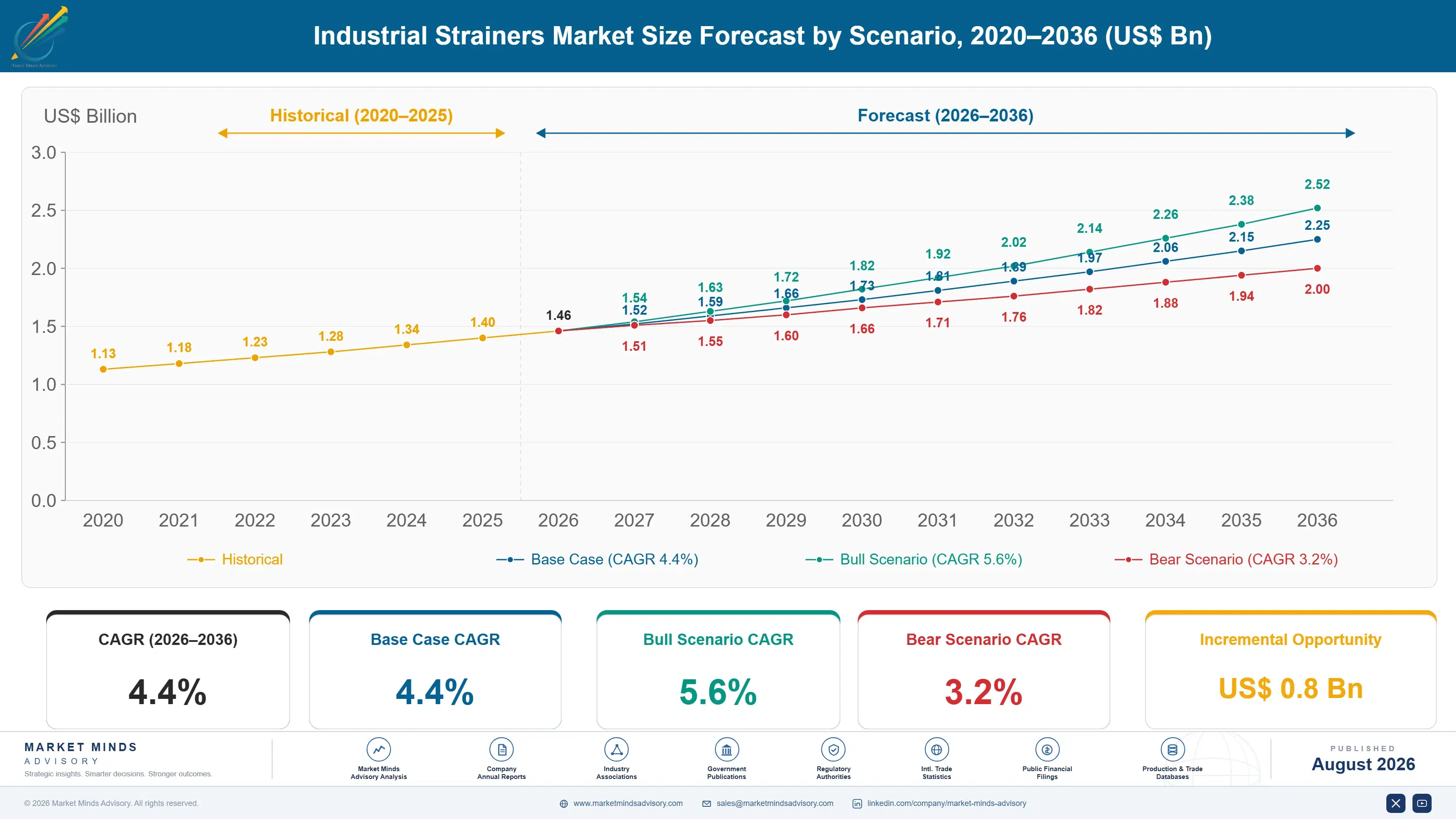
Industrial Strainers Market Forecast Scenarios

industrial-strainers-market-size-forecast-scenario-1787302345453
Between 2020 and 2025 the market grew at a historical pace of 3.8 percent as steady industrial replacement demand continued alongside an early wave of automatic self-cleaning strainer adoption in chemical and power generation applications, a transition that has since broadened well beyond its original process industry origins into water treatment and marine applications across the world.
The base case rests on three commercial mechanisms holding together over the decade: continued process industry capacity expansion across Asia requiring new strainer specification at plant commissioning, operators upgrading legacy manual-cleaning units to automatic self-cleaning equipment to eliminate unplanned downtime, and tightening water treatment regulation requiring finer particulate removal ahead of downstream membrane and reverse osmosis systems across multiple sectors and geographies worldwide.
A bull scenario hinges on process industry capacity investment accelerating faster than current industry roadmaps suggest, pulling forward equipment orders considerably ahead of current schedules. The bear case centers on a slowdown in global industrial capital spending that would compress replacement demand across the largest basket and Y-strainer segments faster than the automation-driven upgrade wave can offset the resulting revenue gap.

A Commodity Fitting Meets an Uptime Economy

Three forces are converging on this mature category at once: a large global installed base of manual-cleaning basket and Y-strainers still anchoring the majority of replacement revenue, a fast-scaling automatic self-cleaning segment paying materially higher prices per unit, and tightening water treatment and process purity regulation pushing operators toward finer mesh specifications than legacy equipment can economically deliver.
MARKET CONCENTRATIONCR5 28%top five manufacturers hold roughly a quarter of category revenue
AVERAGE UNIT PRICE$3,200/unitblended average selling price across all strainer formats worldwide
LEADING PRODUCING COUNTRYChina, 22% sharelargest single-country share of global strainer manufacturing output
AUTOMATIC STRAINER REVENUE SHARE31% of revenueproportion of category revenue tied to self-cleaning equipment
EQUIPMENT SERVICE LIFE20 to 30 yearstypical operating lifespan before major strainer body replacement
STAINLESS STEEL COST SHARE38% of COGSstructural steel and mesh element proportion of goods sold
Commercially, the market increasingly splits along maintenance philosophy rather than pure equipment class. General industrial buyers still purchase largely on price and proven reliability across decades of continuous operation, while chemical, power, and water treatment operators evaluate suppliers on differential pressure monitoring, automatic backwash cycle reliability, and total cost of ownership far more heavily than purchase price alone.
Over the next decade, backwash cycle reliability and mesh customization depth will matter as much as raw filtration efficiency. Suppliers who move fastest to deliver proven automatic cleaning cycles and finer mesh engineering will capture a disproportionate share of the largest process industry specification contracts before the broader commodity supplier base can match that reliability depth.
"Strainers used to be the part of a piping spec nobody argued about. Now plant operators fight over backwash cycle counts, because every unplanned shutdown to clean a basket by hand costs more than the strainer did in the first place."
Director, Fluid Handling Equipment Practice · MMA Fluid Handling and Filtration

Market Trends

Automatic Self-Cleaning Adoption Accelerates Across Process Plants

Continuous-process operators in chemicals, power generation, and water treatment are increasingly specifying automatic self-cleaning strainers over manual basket and Y-strainers, since scheduled shutdown time for manual cleaning has become measurably more expensive as production lines run closer to continuous capacity utilization. Several major chemical processors have disclosed that automatic strainer retrofits reduced unplanned maintenance shutdown hours by a meaningful margin across their largest production units. This shift is reshaping supplier selection criteria toward proven automatic backwash cycle reliability rather than pure basket and mesh price competitiveness that dominated procurement decisions in prior decades.
Market Impact: Adds 1 specification per new plant
Tighter Water Treatment Standards Require Finer Mesh

Municipal and industrial water treatment operators face increasingly stringent particulate removal standards ahead of downstream membrane and reverse osmosis systems, requiring strainer mesh specifications finer than the standard configurations most legacy installations still use across their treatment trains and pre-filtration stages. Several water utilities have disclosed upgrading pre-filtration strainer specifications specifically to protect increasingly sensitive membrane assets from particulate fouling and premature replacement. This trend is pulling demand toward higher-precision mesh engineering that commands meaningfully higher prices than standard commodity strainer configurations sold into less demanding applications across the industry.
Market Impact: 40% of newbuilds require duplex uni

Market Opportunities and Growth Drivers

Asian Process Industry Capacity Expansion Lifts Demand

Chemical, petrochemical, and power generation capacity across Asia has continued expanding at a steady pace, and each new process plant requires a complete strainer specification across its piping network from initial commissioning through commercial operation. Several major process industry capacity announcements have continued across China and India in recent years, each representing incremental strainer demand that did not previously exist within the category's traditional order base. This capacity-driven demand has proven more durable than pure replacement cycles, since new plant commitments tend to specify equipment under long-term engineering procurement contracts.
Market Impact: Limits replacement to 20-30 years

Marine and Offshore Applications Sustain Premium Demand

Marine vessels and offshore platforms require duplex and automatic strainers capable of continuous operation without interrupting seawater cooling and ballast systems, a requirement that general industrial strainers cannot reliably satisfy given the safety-critical nature of continuous marine operation across long voyages. Roughly 40 percent of newbuild commercial vessels now specify duplex strainers as a standard requirement rather than an optional upgrade, according to industry classification society specification tracking reviewed for this report. This certification-driven demand has sustained premium equipment investment even as broader commercial shipbuilding activity has moderated across several established markets recently.
Market Impact: Concentrates buyers in top 30%

Market Restraints and Challenges

Long Equipment Service Life Suppresses Replacement Frequency

Industrial strainer bodies are engineered for exceptional durability, commonly operating reliably for twenty to thirty years with proper maintenance, a standard that limits how frequently even well-capitalized operators replace functioning equipment regardless of automation gains newer units might offer. The root cause is that core mechanical filtration technology has matured over decades of refinement, leaving little room for the performance leaps that drive faster replacement cycles elsewhere. The commercial impact is that suppliers depend heavily on new capacity investment rather than replacement demand to sustain growth. Manufacturers are mitigating this through retrofit conversion kits that upgrade manual bodies to automatic cleaning without full replacement.
Market Impact: Cuts downtime hours by roughly 40%

Automatic Strainer Cost Limits Small Plant Access

Automatic self-cleaning strainers represent a substantial capital investment commonly running several multiples of comparable manual basket units, a cost barrier that concentrates premium purchasing among larger, well-capitalized process operators and excludes many smaller facilities from purchasing automated equipment outright. The root cause is the mechanical and control system engineering required to reliably execute automatic backwash cycles without unacceptable failure rates. The commercial impact is that suppliers depend on a concentrated customer base for premium orders. Manufacturers are mitigating this through leasing and modular retrofit programs that lower the capital barrier for smaller operators.
Market Impact: Requires mesh below 100 microns
4 additional market trends, 3 additional growth drivers, and 4 additional restraints and challenges are covered in the full report. Contact sales@marketmindsadvisory.com to access the complete intelligence.

Segment CAGR and Growth Architecture

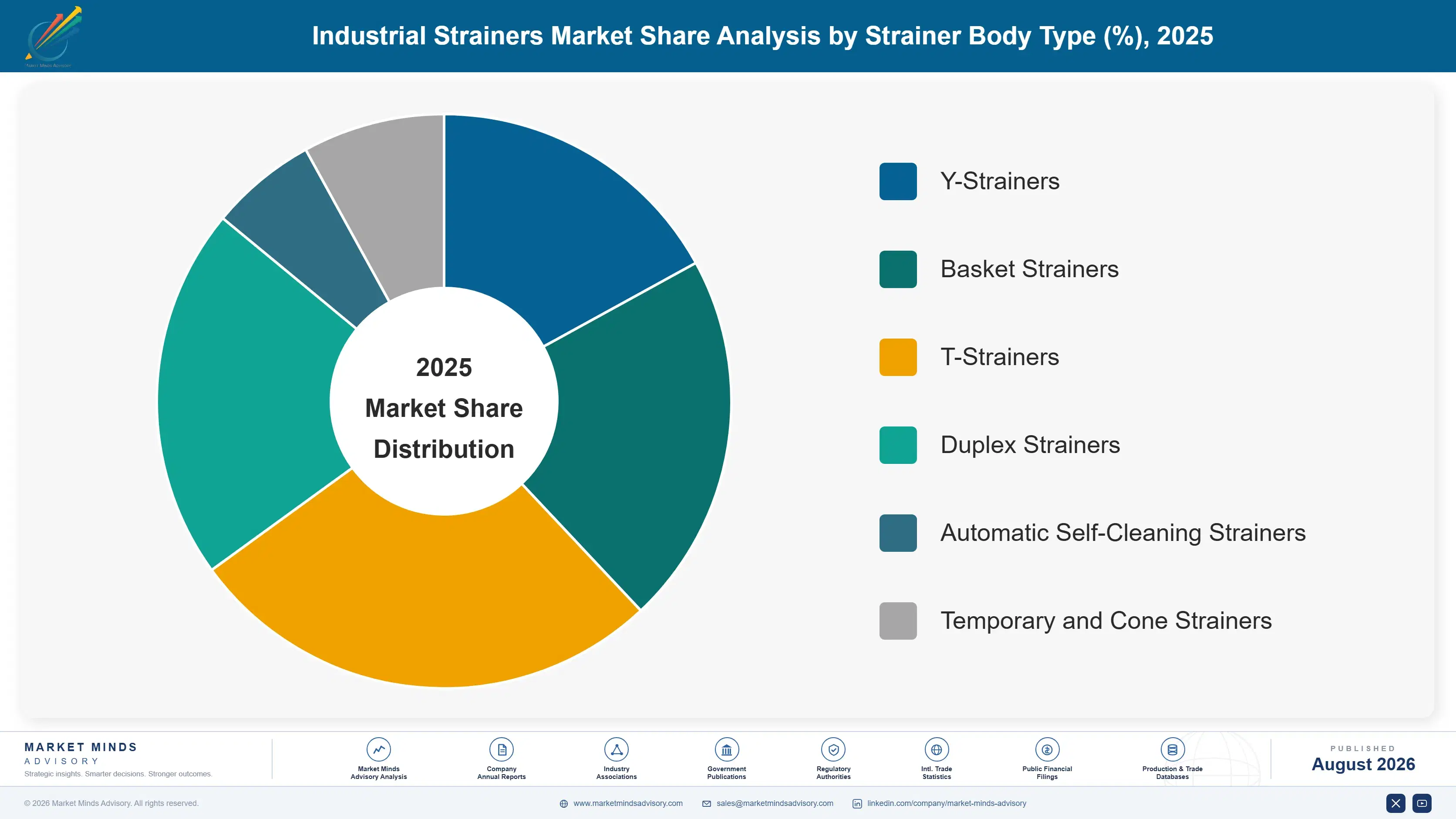
Segmentation follows strainer body type, the dimension operators use to specify filtration equipment for a given piping application and maintenance requirement. Automatic self-cleaning strainers are treated as a distinct category given their fundamentally different mechanical and control complexity relative to manual-cleaning equipment sold separately across the industry today.
industrial-strainers-market-market-share-analysis-1787302346029

Automatic Self-Cleaning Strainers

Automatic self-cleaning strainers are the fastest-growing product category, engineered with motorized backwash mechanisms and differential pressure sensors capable of clearing accumulated debris without operator intervention or process interruption across continuous production lines. Demand concentrates among chemical, power generation, and water treatment operators requiring uninterrupted flow, where manual cleaning introduces shutdown risk that automated backwash cycles eliminate. Production capacity for this specialized equipment remains constrained by the mechanical and control system engineering expertise required, which differs from conventional strainer body manufacturing experience most established players already possess. Suppliers with proven backwash cycle reliability track records and strong differential pressure monitoring integration are winning a disproportionate share of new equipment orders, since operators increasingly evaluate total uptime performance rather than raw filtration cost alone.
CAGR 8.5%

Duplex Strainers

Duplex strainers, which pair two parallel filtration chambers allowing one basket to be serviced while the other continues filtering, form the second-fastest-growing category as continuous-process facilities and marine applications require uninterrupted flow during routine element cleaning across their operating cycles. Demand concentrates among marine, offshore, and continuous chemical process operators, each requiring valve switching mechanisms distinct from single-chamber strainer applications entirely. Growth tracks the broader continuous-operation industrial buildout closely, since duplex configuration increasingly represents a specification default rather than an optional upgrade across safety-critical applications worldwide. Suppliers with proven valve switching reliability and marine classification certification hold a meaningful advantage over general strainer manufacturers attempting to extend into this technically demanding segment without comparable engineering experience already established over years.
CAGR 6.5%
Full segment breakdown across 6 segments available in the complete report.

Regional Architecture and Country Demand Map

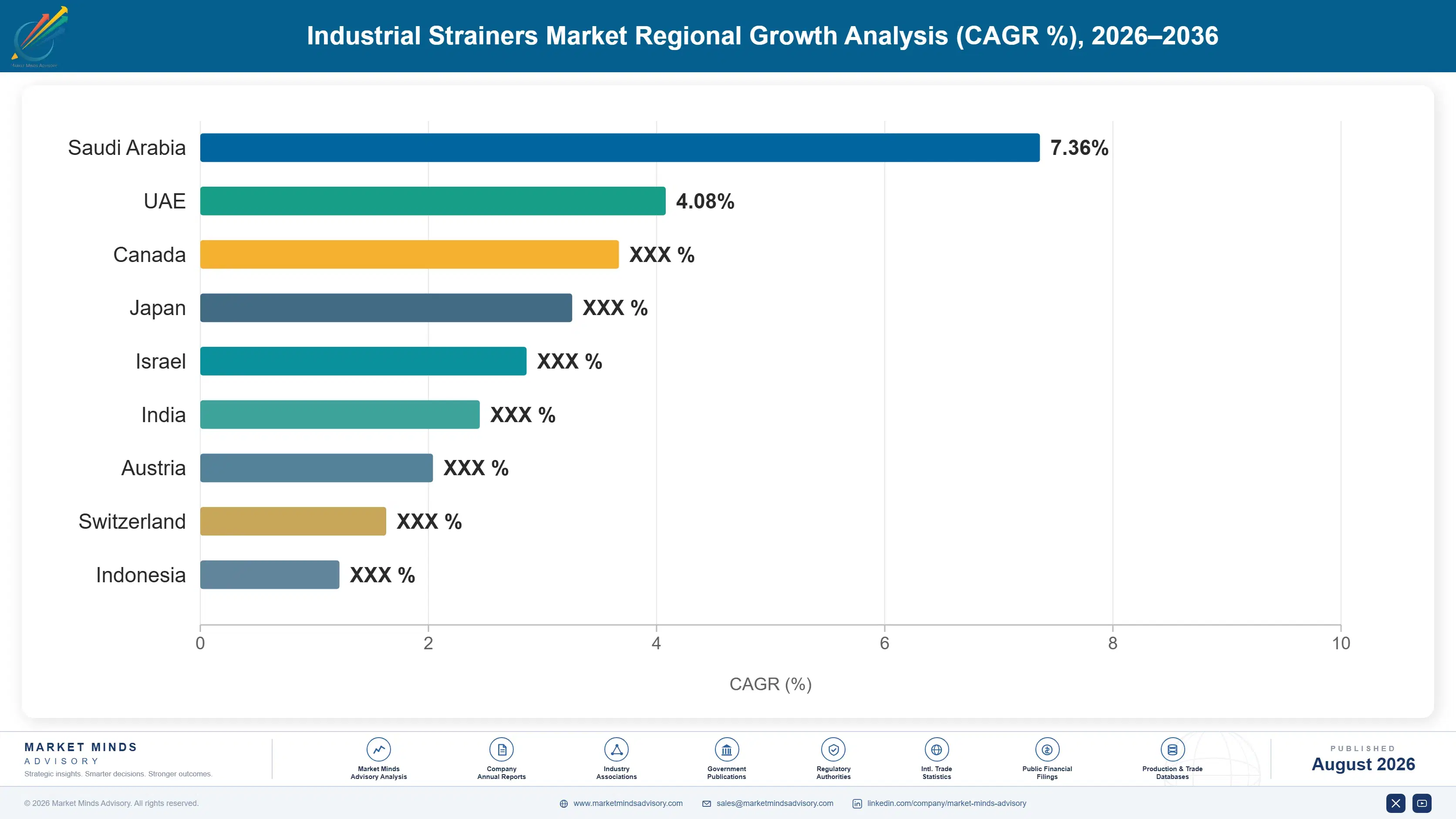
East Asia commands the largest share anchored by China's vast process industry manufacturing base and continued heavy industrial capacity expansion, while South Asia and Pacific is the fastest-growing region on rapid process plant investment and industrial policy support nationwide.

North America

The United States sustains substantial demand across chemical, power generation, and water treatment applications, supported by a mature domestic process industry base that continues investing in automatic self-cleaning upgrades tied to unplanned downtime reduction initiatives nationwide today. Domestic petrochemical capacity expansion, supported by continued natural gas feedstock availability, is driving growing demand for precision strainer specification across new facility construction. Canada's oil sands and water treatment sectors sustain steady replacement demand at a smaller absolute scale relative to its southern neighbor overall. Mexico's expanding manufacturing sector, tied to nearshoring investment, is driving growing demand for industrial strainer equipment across its major industrial facilities nationwide and near the border.
Share: 24% | CAGR: 3.8% (2026 to 2036)

Western Europe

Germany anchors the region's demand, home to Boll & Kirch Filterbau and a broader precision engineering cluster that has defined global duplex strainer manufacturing standards for decades of continuous refinement across the industry worldwide today. The United Kingdom and France both sustain steady demand tied to established chemical and power generation sectors operating under comparable water discharge quality requirements imposed across supply chains. Italy's marine and shipbuilding sector sustains meaningful duplex strainer demand tied to its established vessel construction base nationwide. The Netherlands' concentrated chemical processing hub, anchored around Rotterdam, sustains steady demand for precision strainer equipment across its major industrial facilities and export terminals.
Share: 20% | CAGR: 2.9% (2026 to 2036)
Regional intelligence for 5 additional markets available in the complete report: East Asia, South Asia and Pacific, Latin America, Middle East and Africa, Eastern Europe. Contact sales@marketmindsadvisory.com.
industrial-strainers-market-country-cagr-analysis-1787302346558

Where Suppliers Can Defend Category Margin

As standard basket and Y-strainer pricing compresses under Asian manufacturer competition, suppliers are shifting commercial strategy toward automatic backwash reliability, mesh customization, and financing programs to defend margin across the fastest-growing process industry segments over the coming decade, a shift that rewards suppliers who move first.

Build Deep Automatic Backwash Reliability Data

Suppliers who build deep operating reliability data for automatic backwash cycles are creating meaningful switching costs that pure mechanical body manufacturers cannot replicate through equipment specifications alone across every customer relationship formed over years of accumulated trust. Suppliers with strong reliability data report contract renewal rates roughly 2x higher than competitors offering standalone equipment hardware without comparable proven cycle performance built in from the start. This lever requires sustained field data collection investment but converts into a durable, multi-year revenue relationship considerably more predictable than one-time equipment sales alone across the broader industry today.
Market Impact: Doubles contract renewal rate to ro

Expand Equipment Leasing and Retrofit Financing

Suppliers who offer equipment leasing and structured retrofit financing programs are broadening their addressable customer base beyond the largest, most well-capitalized process operators into smaller facilities who cannot justify the full upfront capital cost of automatic strainer equipment despite genuine operational need for reduced downtime already identified. Suppliers with established financing programs report winning meaningfully more small-facility accounts, in several cases exceeding 30 percent higher penetration, than competitors selling exclusively on an outright purchase basis alone. This lever requires financial partnership infrastructure but expands the addressable market beyond the category's traditional large-buyer concentration considerably.
Market Impact: Wins over 30% more small-facility a

Develop Fine-Mesh Water Treatment Application Expertise

Suppliers who develop specialized mesh engineering expertise for water treatment pre-filtration applications are winning a disproportionate share of the fastest-growing municipal and industrial water treatment contracts, since operators strongly prefer suppliers with demonstrated fine-mesh application experience over general-purpose equipment vendors lacking comparable specialization built over time. Suppliers with proven fine-mesh application expertise report new-contract win rates roughly 3x higher than competitors offering only general-purpose strainer technology today across the industry. This lever requires meaningful upfront application engineering investment but converts into a durable, multi-year revenue relationship worth defending against new entrants.
Market Impact: Triples water treatment win rate to

Establish Long-Term Process Operator Supply Partnerships

Suppliers who establish direct, multi-year equipment supply partnerships with major chemical and power generation operators, rather than competing for individual facility orders transactionally, are building deeper commercial relationships that guarantee order volume across a customer's full multi-year capacity expansion roadmap rather than a single equipment purchase made once. Suppliers with established operator partnerships report contract values roughly 35 percent higher than comparable one-off equipment sales for similar total production capacity delivered across accounts served. This lever requires sustained relationship investment but delivers outsized revenue predictability once established across the account base overall.
Market Impact: Lifts total contract value roughly

Who Controls the Margin Pool

The top five manufacturers hold roughly 28 percent of revenue on a company-revenue basis, a fragmented structure reflecting how standard basket and Y-strainer segments remain accessible to numerous regional fabricators even as automatic self-cleaning and duplex segments concentrate among a narrower set of established precision equipment specialists. The gap between Eaton and Parker Hannifin, two of the largest players, and the broader field remains meaningful but leaves substantial room for regi
Current competitive activity centers on three fronts: automatic backwash reliability races to capture the fastest-growing process industry accounts, equipment financing program expansion designed to broaden the addressable customer base beyond the largest operators, and fine-mesh water treatment application engineering investment intended to win specialized municipal contracts.

Pressure is building from Chinese and Indian equipment manufacturers, who are moving up the value chain from standard strainer supply into premium automatic self-cleaning systems that historically only European and North American specialists could reliably provide. Several have already won reference contracts with major domestic process operators, evidence that could accelerate their move into export markets faster than established incumbents currently expect.
industrial-strainers-market-company-positioning-matrix-1787302347079

Competitive Moat and Risk Dimensions

EATON CORPORATION PLC

Moat: Broadest Integrated Filtration Portfolio

Eaton operates one of the broadest integrated filtration equipment portfolios in the industry, giving it customer relationships across nearly every process industry application that narrower single-product competitors cannot easily match without comparable decades of engineering investment behind them across the sector.
EATON CORPORATION PLC

Risk: Premium Pricing Invites Value Competition

Eaton's premium brand positioning and pricing create an opening for well-capitalized Chinese and Indian manufacturers offering comparable core filtration performance at meaningfully lower prices, particularly in cost-sensitive standard equipment segments where brand loyalty matters considerably less to price-focused buyers today.
PARKER HANNIFIN CORPORATION

Moat: Deepest Automatic Cleaning Technology

Parker Hannifin has built specialized expertise in automatic self-cleaning strainer technology specifically, giving it a qualification advantage in demanding continuous-process applications that broader diversified competitors have been slower to develop with comparable engineering depth and specialization built over decades of investment.
PARKER HANNIFIN CORPORATION

Risk: Smaller Scale Than Diversified Rivals

Parker Hannifin's specialized focus on premium automatic strainer segments leaves it with a narrower overall product range and smaller manufacturing scale in commodity strainer categories than diversified competitors, potentially limiting its ability to compete effectively across the broader standard strainer volume segment overall.

Players Tracked

Prominent Players

Eaton Corporation plc
Parker Hannifin Corporation
Amiad Water Systems Ltd.
Boll & Kirch Filterbau GmbH
Watts Water Technologies, Inc.

Other Key Players

Hayward Flow Control
Titan Flow Control, Inc.
Spirax Sarco Engineering plc
Mueller Steam Specialty
Sure Flow Equipment Inc.
Wm. Powell Company
Yoshitake Inc.
Filtra Systems
R.P. Adams Co., Inc.
Metal Textiles Corporation
Nihon Filter Co., Ltd.
Duplex Fabrications Ltd.
Val-Matic Valve & Manufacturing Corp.
Crane Co.
Emerson Electric Co.

Recent Developments

MARCH 2025

Eaton Launches New Automatic Self-Cleaning Strainer Platform With Predictive Maintenance Sensors

Eaton introduced an organic product launch of a new automatic self-cleaning strainer platform incorporating predictive differential pressure sensors, designed to reduce unplanned maintenance events without requiring separate third-party monitoring integration from outside vendors across the broader customer base it serves.
Signal: Established filtration equipment manufactu
JULY 2025

Amiad Signs Multi-Year Supply Agreement With Major Water Utility

Amiad Water Systems signed a multi-year supply agreement, not an acquisition or joint venture, with a major municipal water utility to provide fine-mesh pre-filtration strainers across the customer's expanding treatment network, securing predictable order revenue tied directly to that expansion.
Signal: Water utilities are increasingly securing
JANUARY 2026

Boll & Kirch Acquires Specialty Duplex Valve Automation Company

Boll & Kirch Filterbau completed the acquisition of a specialty duplex valve automation company, adding proprietary switching integration capability rather than continuing to rely on third-party partnerships for its high-reliability duplex strainer product lines going forward across every regional market it serves.
Signal: Established equipment manufacturers are ac

Stainless Steel and Mesh Component Exposure

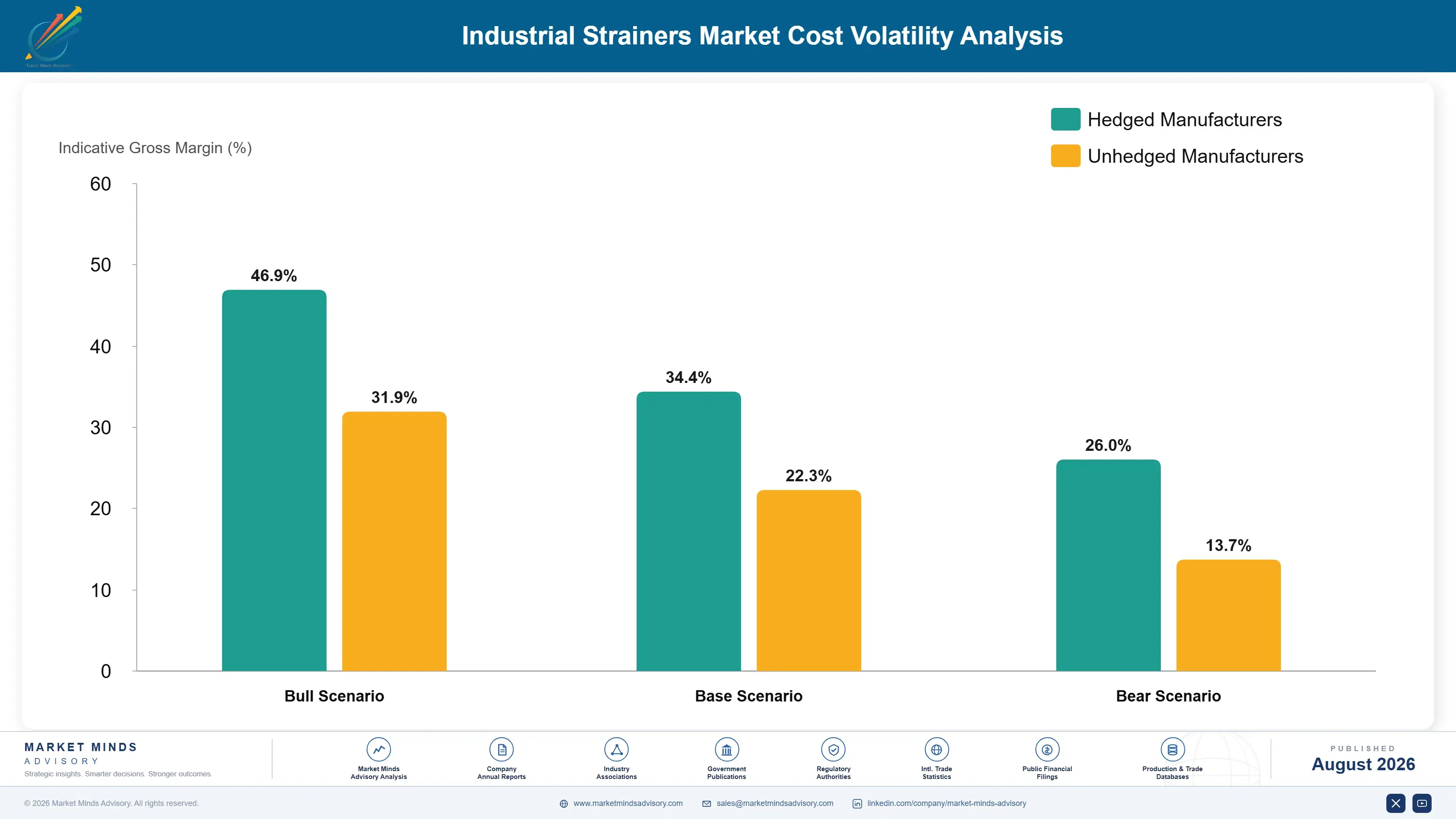
Stainless steel bodies and precision mesh elements together account for roughly 38 percent of cost of goods sold across the category, with machining, assembly, and testing labor making up most of the remainder of total equipment manufacturing cost. Precision mesh weaving and stainless steel fabrication capacity concentrates among a relatively small number of specialized manufacturers serving the broader fluid handling equipment industry.
Stainless steel prices tightened meaningfully during the broader 2021 to 2022 global commodity cycle, a period several equipment manufacturers described in earnings materials as unusually disruptive for stainless steel input planning across the sector overall. Several smaller strainer manufacturers disclosed order fulfillment delays during this period as raw material supply constraints affected production timelines industry-wide considerably across most product lines and shipment schedules.

Exposure varies by company scale and integration. Larger diversified manufacturers with long-term steel supply agreements or partial backward integration into mesh weaving absorbed the volatility with comparatively limited disruption, while smaller specialists reliant entirely on spot-market steel purchasing faced sharper cost swings that occasionally opened share for better-hedged competitors during the tightest supply quarters of the cycle.
industrial-strainers-market-cost-volatility-analysis-1787302347274

Secure Long-Term Stainless Steel Supply Agreements

Leading manufacturers are increasingly securing multi-year fixed-volume agreements directly with stainless steel producers, trading some pricing flexibility for meaningfully greater supply certainty during periods of tight global stainless steel capacity across the broader industry worldwide, particularly during the sharpest phases of the recent commodity cycle.

Diversify Precision Mesh Component Sourcing

Manufacturers are qualifying multiple precision mesh weaving suppliers across different regions rather than relying on a single geographic source, reducing exposure to regional supply disruptions affecting the broader industrial mesh component industry generally and protecting delivery schedules.

Invest In Backward Integration Into Mesh Weaving

Several of the largest suppliers have built or acquired captive precision mesh weaving capacity, insulating a meaningful share of production from third-party component pricing pressure and allowing faster new product development cycles across their broader equipment portfolios and regional manufacturing footprints.

Portfolio Architecture for Margin Defence

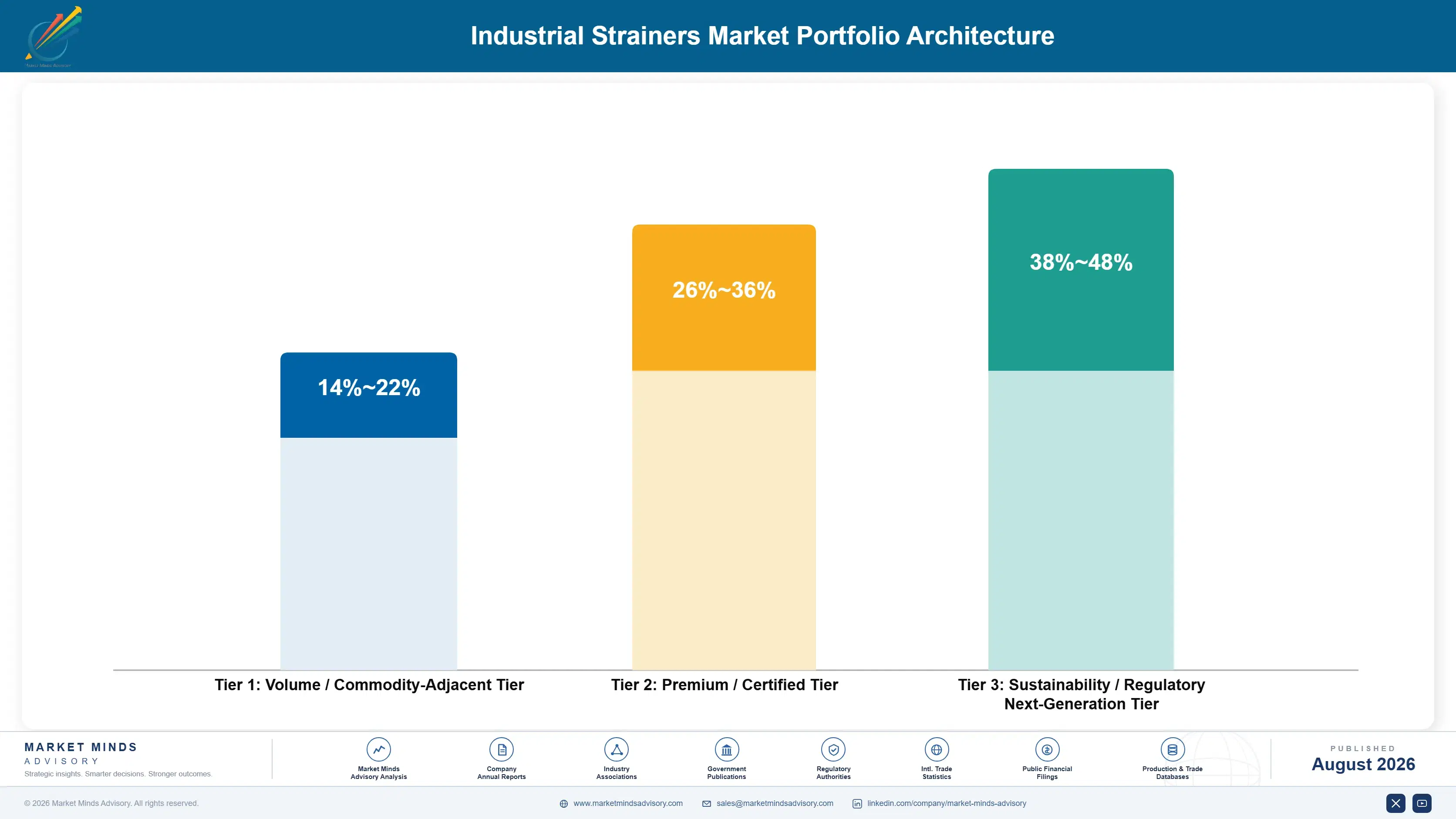
The market splits into three commercial tiers with distinct margin economics. Standard manual basket and Y-strainers compete largely on price and proven reliability across a mature global replacement channel, duplex strainers carry meaningfully higher margin on continuous-operation application engineering, and automatic self-cleaning strainers with predictive monitoring command the highest margin given their precision specification requirements and constrained qualified supplier base.
The tension between volume and premium positioning shapes how manufacturers allocate engineering investment: standard manual strainers still represent meaningful unit volume across smaller facilities and general maintenance channels, but nearly all incremental profit growth over the forecast period concentrates in automatic self-cleaning and duplex applications, where the leading suppliers increasingly direct precision engineering and reliability data spending.

High-value margin pools concentrate specifically in automatic self-cleaning strainers serving the current process industry uptime-driven upgrade window and in duplex strainers serving marine and continuous-process operators. Both pools reward manufacturers who invest ahead of demand in mechanical reliability and control system integration rather than those who compete purely on standard equipment price.

Volume / Commodity-Adjacent Tier

Standard manual basket and Y-strainers sold largely on price and proven reliability across a mature global replacement channel worldwide serving smaller facilities and general industrial buyers on tight budgets.
Gross Margin: 14-22%

Premium / Certified Tier

Duplex strainers and fine-mesh water treatment units with application-specific engineering, commanding meaningful premiums tied directly to continuous-operation reliability and certification requirements across audited installations.
Gross Margin: 26-36%

Sustainability / Regulatory / Next-Generation Tier

Automatic self-cleaning strainers with predictive maintenance sensors, carrying the category's highest margins given tightened uptime specifications and a constrained pool of qualified suppliers.
Gross Margin: 38-48%
industrial-strainers-market-portfolio-architecture-1787302347776

Capital Equipment Meets Multi-Decade Service Life

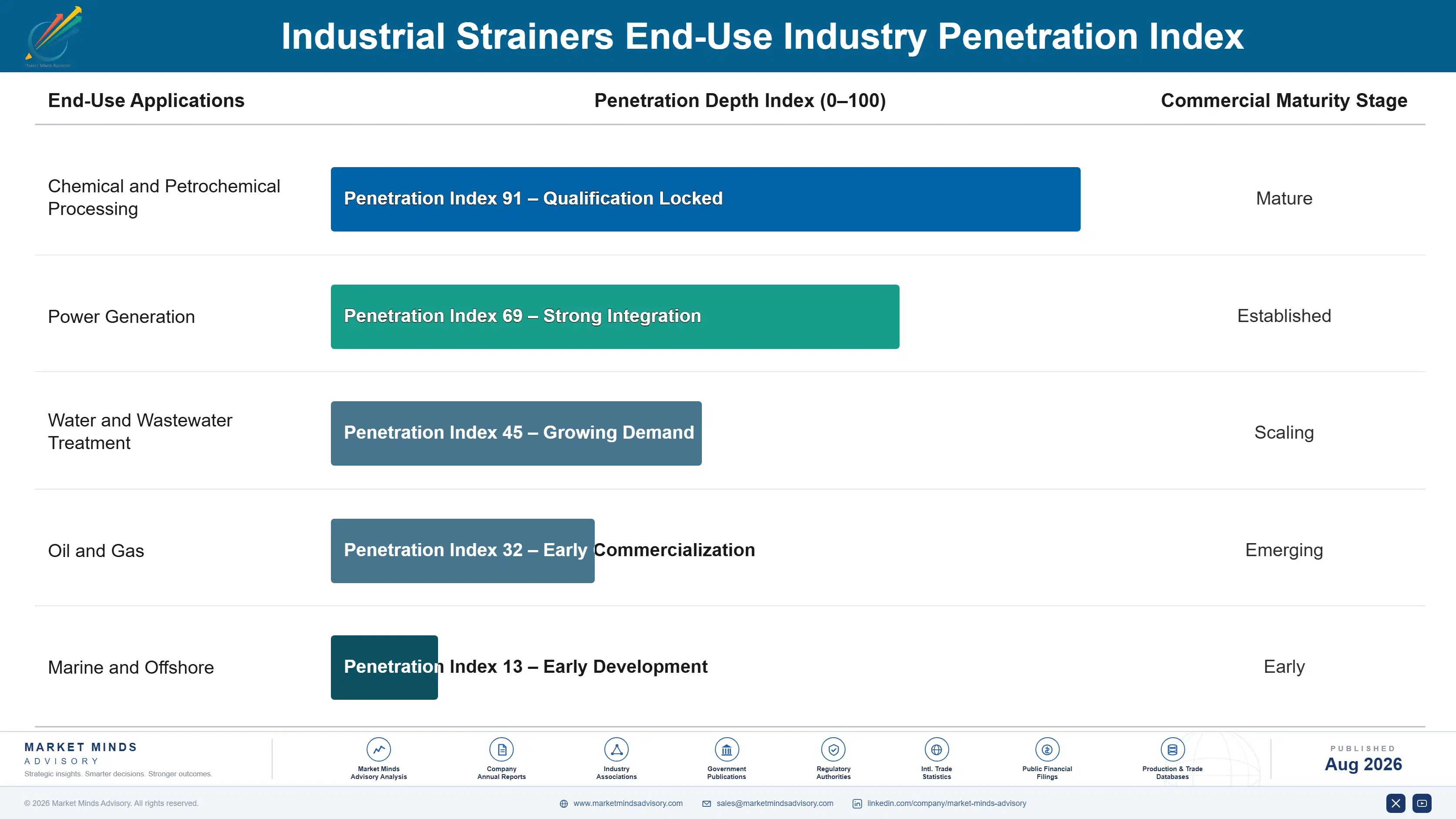
Industrial strainers behave as a genuine long-cycle capital equipment purchase, generating a large upfront sale followed by twenty to thirty years of maintenance, mesh replacement, and eventual retrofit revenue rather than a recurring subscription-like relationship, reflecting the category's exceptionally long typical equipment service life across most industrial applications worldwide.
Adoption depth varies sharply by end-use vertical. Chemical and power generation operators show the fastest automation-driven purchasing cycle given rapid uptime economics demand growth, general municipal buyers remain the slowest-cycling segment given their equipment's exceptional durability, and marine and offshore operators sit between the two, tied more closely to classification society certification cycles than to pure equipment age or mechanical wear.

A generational shift in buyer profile is underway as operator capital planning teams increasingly include dedicated reliability and process engineering specialists rather than pure maintenance engineers trained under an older run-to-failure replacement model. Water utility procurement teams are also reshaping how suppliers must present mesh precision and pre-filtration performance data earlier in the capital approval process, well before a purchase order is finalized.
industrial-strainers-market-end-use-penetration-index-1787302348264

Where This Market Goes Next

These are among the four positions where our research anticipates prominent divergence between winners and laggards over the coming forecast period. Each is grounded in the demand model, the regulatory perimeter, and the announced capacity pipeline.
01 / AUTOMATIC RELIABILITY DATA

Backwash cycle proof will decide who captures growth

Process operators reward equipment suppliers who deliver proven automatic backwash cycle reliability first, because unplanned shutdown costs make operators deeply reluctant to risk unproven equipment during a capacity expansion program. Suppliers who developed reliability data early are already winning a disproportionate share of new process operator contracts across major producing regions. This gap should widen rather than narrow as qualified suppliers accumulate reference installations that competitors cannot replicate quickly regardless of how much capital they eventually commit to catching up on mechanical engineering depth.
02 / FINE-MESH WATER TREATMENT EXPERTISE

Specialized engineering is winning the fastest-growing accounts

Water utilities increasingly weigh fine-mesh application expertise as heavily as core filtration performance when selecting equipment suppliers, rewarding suppliers who invest in specialized pre-filtration capability ahead of formal procurement processes across multiple treatment facilities. Suppliers with proven fine-mesh expertise are already reporting meaningfully higher contract win rates than competitors offering only general-purpose strainer technology. Manufacturers who underinvest in application specialization risk losing deals to more focused competitors regardless of underlying mechanical performance differences across their broader equipment lines and service offerings today.
03 / EQUIPMENT FINANCING EXPANSION

Leasing programs are broadening the addressable customer base

Smaller operators with genuine capacity or uptime needs but limited capital availability represent an underserved segment that suppliers offering leasing and structured financing programs are increasingly capturing away from cash-purchase-only competitors across the industry. Suppliers with established financing infrastructure report meaningfully higher small-facility account penetration than competitors requiring full upfront capital commitment from every customer served. This lever requires financial partnership investment but expands the addressable market beyond the category's traditional concentration among only the largest, best-capitalized operators.
04 / PROCESS OPERATOR PARTNERSHIP STRATEGY

Multi-year supply relationships are reshaping order book predictability

Chemical and power generation operators increasingly prefer consolidating equipment supply under fewer, deeper supplier relationships covering their full multi-year capacity roadmap rather than negotiating each purchase as a standalone transaction separately across their facilities. Suppliers with established multi-year partnerships report contract values and order book visibility meaningfully higher than competitors competing for individual purchases one at a time today across the industry. This consolidation trend should continue as more operators announce multi-year capacity expansion programs requiring sustained equipment supply relationships rather than isolated one-off purchases going forward.

Engagement Snapshot From the Field

A live engagement with an industry participant carrying material or product regulatory and market exposure ahead of a defining policy shift, showing how our research translates into a defensible multi-year portfolio strategy.
MARKET MINDS ADVISORY · CLIENT ENGAGEMENT SUMMARY
Industrial Strainers Producer Strategic Portfolio Review and Transition Roadmap 2026·Investment Scenario on Industrial Strainers Exposure Evaluation 2025-26
CLIENT PROFILE
The client is a regional petrochemical processor operating multiple production facilities, historically reliant on manual-cleaning basket and Y-strainers representing substantial annual maintenance labor cost across its operated units (client-reported, unverified by MMA). The company needed to reduce unplanned shutdown frequency tied to manual strainer cleaning cycles across its full production network.
STRATEGIC CHALLENGE
Leadership needed to select automatic self-cleaning strainer suppliers capable of meeting the client's continuous production requirements while completing a fleet-wide retrofit within a compressed timeline set by planned turnaround windows already scheduled across several major production units and process lines.
MMA APPROACH
MMA benchmarked candidate equipment suppliers against backwash cycle reliability track record, retrofit compatibility, and total cost of ownership including downtime avoidance, modeled expected uptime improvement under three distinct equipment scenarios, and recommended a supplier selection and phased retrofit sequence prioritized by turnaround schedule and capital availability.
KEY FINDINGS
  1. Only three of ten candidate suppliers evaluated offered retrofit kits compatible with the client's existing piping configuration without additional custom engineering work required.
  2. Backwash cycle reliability varied by roughly 25 percent across candidate equipment options, a meaningful factor given the client's stringent continuous production requirements in place.
  3. Retrofit installation timelines varied by more than four weeks across candidate suppliers, materially affecting which suppliers could realistically fit within the client's turnaround windows.
  4. Modeled uptime improvement differences across candidate equipment translated into a meaningful cost avoidance impact over the equipment's operating life (client-reported, unverified by MMA).
CLIENT PROFILE
The client is a regional petrochemical processor operating multiple production facilities, historically reliant on manual-cleaning basket and Y-strainers representing substantial annual maintenance labor cost across its operated units (client-reported, unverified by MMA). The company needed to reduce unplanned shutdown frequency tied to manual strainer cleaning cycles across its full production network.
STRATEGIC CHALLENGE
Leadership needed to select automatic self-cleaning strainer suppliers capable of meeting the client's continuous production requirements while completing a fleet-wide retrofit within a compressed timeline set by planned turnaround windows already scheduled across several major production units and process lines.
MMA APPROACH
MMA benchmarked candidate equipment suppliers against backwash cycle reliability track record, retrofit compatibility, and total cost of ownership including downtime avoidance, modeled expected uptime improvement under three distinct equipment scenarios, and recommended a supplier selection and phased retrofit sequence prioritized by turnaround schedule and capital availability.
KEY FINDINGS
  1. Only three of ten candidate suppliers evaluated offered retrofit kits compatible with the client's existing piping configuration without additional custom engineering work required.
  2. Backwash cycle reliability varied by roughly 25 percent across candidate equipment options, a meaningful factor given the client's stringent continuous production requirements in place.
  3. Retrofit installation timelines varied by more than four weeks across candidate suppliers, materially affecting which suppliers could realistically fit within the client's turnaround windows.
  4. Modeled uptime improvement differences across candidate equipment translated into a meaningful cost avoidance impact over the equipment's operating life (client-reported, unverified by MMA).
RECOMMENDED STRATEGY
Phase 1: Phase 1 (Months 1-3): Complete supplier evaluation and finalize equipment selection based on reliability and retrofit fit overall today. Phase 2: Phase 2 (Months 4-9): Execute phased equipment retrofit across the client's priority production units identified in the initial plan. Phase 3: Phase 3 (Months 10-13): Complete remaining unit retrofits and establish ongoing uptime and reliability performance monitoring systems across all lines.
OUTCOME
Thirteen months into the engagement, the client reported successful fleet-wide retrofit completion meeting all turnaround schedule commitments with uptime improvement matching modeled projections across every retrofitted unit and process line (client-reported, unverified by MMA), validating MMA's supplier selection recommendation fully across the entire modernization program.

Frequently Asked Questions

Foundational context covering the market sizes, CAGR, scope, country, region and competition that inform every finding below. This section is provided to cover basics and most often pre-purchase conversations, answered from the MMA Primary Research Dataset.

What is the current size of the Industrial Strainers Market?

The market is valued at approximately 1.4 billion dollars in 2025, expanding to roughly 1.46 billion dollars in 2026 as process industry expansion and automation upgrades continue driving equipment demand.

How large will the Industrial Strainers Market be by 2036?

MMA forecasts the market reaching approximately 2.25 billion dollars by 2036, roughly 1.54 times its 2026 value, driven primarily by expanding process industry capacity and automatic strainer adoption worldwide.

What is the CAGR for the Industrial Strainers Market 2026 to 2036?

The base-case compound annual growth rate is 4.4 percent, with a bull scenario of 5.6 percent and a bear scenario of 3.2 percent depending on industrial capital spending pace.

Which segment is growing fastest?

Automatic self-cleaning strainers are growing fastest at an 8.5 percent CAGR, roughly 1.93 times the overall market rate, driven by process operators prioritizing uptime over upfront equipment cost.

Who are the major companies in the Industrial Strainers Market?

Eaton Corporation plc, Parker Hannifin Corporation, Amiad Water Systems Ltd., Boll & Kirch Filterbau GmbH, and Watts Water Technologies, Inc. lead the market, together holding roughly 28 percent of revenue.

Which country is growing fastest?

India is the fastest-growing country at a 7.6 percent CAGR, driven by rapid chemical and power generation capacity expansion tied to national industrial policy initiatives nationwide.

Report Segmentation Architecture

The full report scope spans multiple orthogonal segmentation dimensions, with cross-tabulated demand data provided for each dimension pair. Coverage extends further to regional breakdowns, trend trajectories, and the competitive detail needed to support segment-level decision-making.

By Strainer Body Type

  • Y-Strainers
  • Basket Strainers
  • T-Strainers
  • Duplex Strainers
  • Automatic Self-Cleaning Strainers
  • Temporary and Cone Strainers

By End-Use Industry

  • Chemical and Petrochemical Processing
  • Power Generation
  • Water and Wastewater Treatment
  • Oil and Gas
  • Marine and Offshore

By Commercial Dimension

  • Direct OEM and Enterprise Contracts
  • Authorized Distributor Channel
  • Equipment Leasing and Financing
  • Retrofit and Aftermarket Service Contracts

By Region

  • North America
  • Western Europe
  • East Asia
  • South Asia and Pacific
  • Latin America
  • Middle East and Africa
  • Eastern Europe

Scope, Methodology, and Coverage

Every figure in this report is reproducible from documented input assumptions. The scope below maps the historical period, the forecast horizon, the segmentation dimensions, and the countries covered, alongside the underlying primary and qualitative methodology.
Historical Period
2020 to 2025
Forecast Period
2026 to 2036
Base Year
2025 (USD billions; MMA Primary Research Dataset, August 2026)
Market Definition
The market covers mechanical filtration devices installed in piping systems to remove solid particulate from liquid and gas flow, including Y-strainers, basket strainers, T-strainers, duplex strainers, automatic self-cleaning strainers, and temporary cone strainers. Downstream fine filtration cartridges, membrane systems, and water treatment chemicals are excluded.
Quantitative Units
USD billions (current prices); unit shipments where cited
Segmentation Dimensions
By Strainer Body Type; By End-Use Industry; By Commercial Dimension; By Region
Regions Covered
North America, Western Europe, East Asia, South Asia and Pacific, Latin America, Middle East and Africa, Eastern Europe
Countries Covered
USA, China, Germany, France, UK, Japan, South Korea, India, Australia, Canada, Brazil, Mexico, Indonesia, Vietnam, Thailand, Malaysia, UAE, Saudi Arabia, South Africa, Nigeria, Turkey, Poland, Netherlands, Italy, Spain, Sweden, Switzerland, Argentina, Colombia, Singapore, and additional markets relevant to this sector
Key Companies Profiled
Eaton Corporation plc, Parker Hannifin Corporation, Amiad Water Systems Ltd., Boll & Kirch Filterbau GmbH, Watts Water Technologies, Inc., Hayward Flow Control, Titan Flow Control, Inc., Spirax Sarco Engineering plc, Mueller Steam Specialty, Sure Flow Equipment Inc., Wm. Powell Company, Yoshitake Inc., Filtra Systems, R.P. Adams Co., Inc., Metal Textiles Corporation, Nihon Filter Co., Ltd., Duplex Fabrications Ltd., Val-Matic Valve & Manufacturing Corp., Crane Co., Emerson Electric Co.
Quantitative Methodology
Primary survey, n=3,800 respondents, Q4 2025, six countries; demand-side model with trade association cross-validation
Qualitative Methodology
47 expert interviews, Q4 2025; applied to validate demand model assumptions, identify emerging dynamics, and assess competitive positioning
Report Format
PDF and XLSX data workbook (Word format preview document)
Publisher
Market Minds Advisory
Report Code
MMA-2026-CON-134
Published
August 2026
Contact
sales@marketmindsadvisory.com | www.marketmindsadvisory.com

Purchase the full Industrial Strainers Market Report (2026 to 2036).

The full report delivers a complete quantitative and strategic assessment of the industrial strainers market across all seven regions and more than thirty countries covered in this study. It includes detailed segment-level forecasts through 2036, competitive benchmarking across twenty profiled manufacturers, and primary research drawn from 3,800 survey respondents and 47 expert interviews conducted in Q4 2025. Buyers receive editable data tables and full regional narrative detail beyond the two regions previewed in this summary document. A dedicated appendix covers mesh precision standards and automatic backwash reliability benchmarks by application.
Fully editable Excel data tables and models
All seven full regional narratives fully included
Twenty full company competitive profiles included
Mesh precision and reliability appendix included fully
Segment-level 2026-2036 detailed annual forecasts
Full primary survey and expert interview data included fully

Built For The People Who Decide

From boardroom strategy to bench-side execution, this report is read cover-to-cover by leaders shaping the next decade of their industry, turning demand scenarios, market dynamics and valuation benchmarks into decisions.
CXOs/ Presidents/ VPs/ Managers
M&A and Corporate Development
Strategy Teams and R&D Heads
Procurement and Product Directors
Regulatory and Compliance Leaders
Investor Relations and Equity Analysts