Market Minds Advisory
Industrial Security System Market

Industrial Security System Market: Converging Physical and Network Defense

Manufacturers are converging physical security with cybersecurity as networked cameras and access control systems become entry points for industrial network attacks, forcing plant operators to treat perimeter fencing and firewall configuration as one integrated defense.

Lead Analyst

David Horsley

Published

September 2026

Make Smarter Decisions with Customized Research Insights

Request a free sample report and evaluate market opportunities, growth trends, and competitive dynamics relevant to your business needs.

2025 MARKET VALUE$42.0BMarket Size 2025
2036 FORECAST VALUE$106.2BBase Case , 2026 to 2036
CAGR 2026 TO 20368.8 %Bull 10.1% / Bear 7.5%
INCREMENTAL OPPORTUNITY$60.5BNet 10- year value creation
EXPANSION MULTIPLE2.32x2036 value over 2026 base
Strategic Levers
M&A Pipeline
Regional Outlook
Country Rankings
Competitive Intelligence
Segmental Deep-dive
Call-Us : 91 93563 13602

Executive Snapshot and Market Trajectory

Industrial security is shifting from standalone cameras and badge readers toward integrated platforms that treat physical intrusion and network intrusion as the same threat, a change driven by attackers increasingly using networked security hardware itself as the primary entry point into plant control systems.
Physical-cyber security convergence platforms are growing fastest at roughly 1.48 times the market average as facility operators respond to attackers exploiting networked cameras and access controllers as entry points, while video surveillance and analytics systems follow closely on AI-driven detection replacing passive recording across most large facilities. East Asia holds the largest share of global spending because China's manufacturing base and government-mandated critical infrastructure security rules drive procurement volume no other region matches.
Honeywell, Johnson Controls, Bosch Security Systems, Axis Communications, and Hikvision hold under half of global revenue in a market spanning hardware, software, and monitoring services rather than concentrated around a single product category. Rising plant network attacks and stricter critical infrastructure regulation are reshaping which suppliers get specified into new facility builds, favoring proven convergence platforms over legacy standalone camera or access control vendors lacking network security depth.
Market Definition
The industrial security system market covers video surveillance and analytics systems, access control and identity management systems, perimeter intrusion detection systems, physical-cyber security convergence platforms, fire and hazard detection integration systems, and security monitoring and command center services deployed at manufacturing plants, critical infrastructure, and industrial logistics facilities. It excludes residential and retail security systems, general enterprise IT cybersecurity products unrelated to physical infrastructure, and consumer-grade smart home devices.
Base Year Value
$42.0B in 2025 (MMA Primary Research Dataset, August 2026)
Forecast Period
2026 to 2036, eleven discrete annual values
CAGR
8.8% base case. Bull 10.1%. Bear 7.5%.
Fastest Growth Segment
Physical-Cyber Security Convergence Platforms: 13.0% CAGR
Fastest Growth Country
India: 11.5% CAGR
Fastest Growth Region
South Asia and Pacific: 10.8% CAGR
Largest Region
East Asia: 30% of 2025 global value
Market Leaders
Honeywell, Johnson Controls, Bosch Security Systems, Axis Communications, Hikvision. Source: MMA Analysis based on company annual reports.
Primary Survey
n=3,800 procurement and R&D decision-makers, Q4 2025, six countries
Methodology
Demand-side build-up, cross-validated against public data, 47 expert interviews

Industrial Security System Market Forecast Scenarios

industrial-security-system-market-size-forecast-scenario-1787300973523
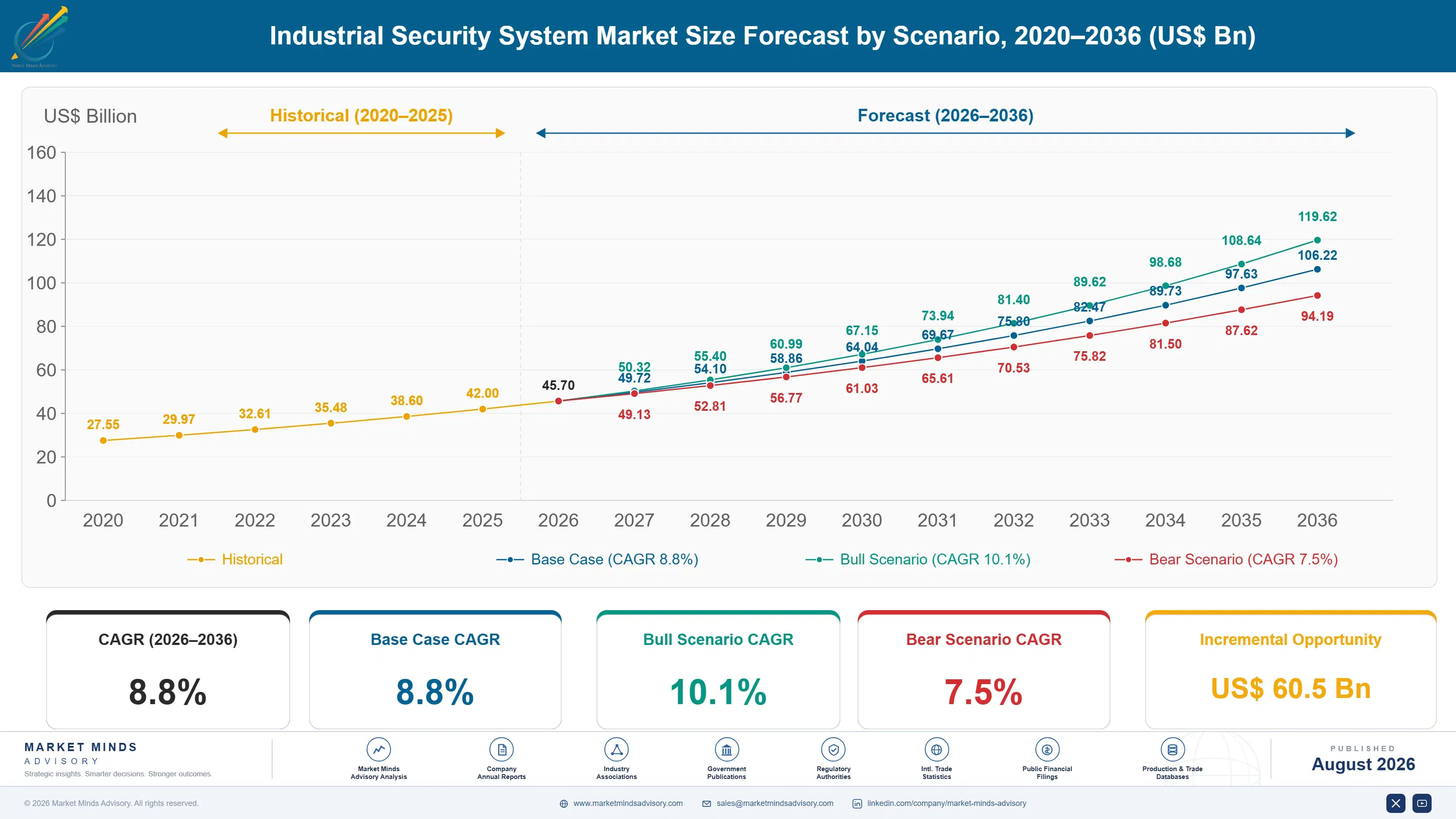
The market grew steadily through the early 2020s as manufacturers gradually replaced analog camera systems with networked digital alternatives across most facility types. Growth accelerated from 2023 as AI-driven video analytics matured enough for reliable deployment and plant network attacks made physical-cyber convergence a board-level priority. The result was a 7.8 percent historical CAGR, now accelerating.
The base case rests on three mechanisms. First, attackers increasingly target networked security hardware itself as an entry point into plant control systems, forcing operators to treat physical and network security as one integrated discipline. Second, AI-driven video analytics is replacing passive recording with active threat detection, expanding the value proposition beyond simple monitoring. Third, stricter critical infrastructure regulation in multiple countries is mandating minimum security standards that push operators toward comprehensive platform upgrades rather than incremental hardware replacement.
The bull case turns on a major publicized industrial cyberattack originating through compromised physical security hardware, which would force accelerated convergence platform adoption well beyond currently budgeted upgrade cycles across most facility types. The bear case centers on capital spending caution among manufacturers facing broader economic uncertainty, which could delay comprehensive platform upgrades in favor of cheaper incremental hardware replacement.

Convergence Reshapes Industrial Security Procurement

Industrial security has moved from a facilities-department afterthought to a board-level risk category, since attackers now treat networked cameras and access controllers as viable entry points into plant control systems rather than isolated physical assets requiring separate protection. That shift means procurement decisions increasingly involve IT security teams alongside facilities managers, a genuinely different buying process than the standalone camera and badge reader purchases this market
CR5 CONCENTRATION38%Fragmented supply chain spans hardware, software, and monitoring services broadly
AVERAGE ENTERPRISE DEAL SIZE$2.4 million per facility rolloutEnterprise platform deals dwarf individual camera and reader purchases
TOP PRODUCING COUNTRY SHARE26%China's domestic manufacturing base drives global hardware production volume
AI ANALYTICS PENETRATION31% of new deploymentsAI-driven analytics increasingly replace passive video recording infrastructure broadly
TRADE INTENSITY24% of output exportedCross-border hardware and software shipments rise with facility expansion
INPUT COST SHARE30% of COGSSemiconductor sensors and optical components dominate total production expenditure
Commercially, the market splits between traditional physical security hardware suppliers expanding into network security, and IT security vendors building physical security capability from the opposite direction entirely. Honeywell and Johnson Controls dominate integrated facility platforms, while Hikvision and Dahua compete primarily on camera hardware volume through entirely separate channels than the convergence-focused segment of the market increasingly commands premium pricing within across most developed economies.
Over the next decade, physical-cyber convergence platforms and AI-driven video analytics will keep growing faster than conventional standalone hardware, and suppliers that build genuine network security depth will increasingly outcompete those selling cameras and access controllers as isolated products into an increasingly regulation-driven procurement process shaped by evolving critical infrastructure requirements.
"A camera on the network is a network device first and a camera second. Every operator who still budgets it as a facilities line item rather than an IT security line item is going to relearn that lesson the hard way."
Director, Industrial Security and Infrastructure Practice · MMA Construction and

Market Trends

Networked Security Hardware Becomes a Genuine Network Attack Surface

Attackers increasingly target networked cameras and access controllers as entry points into plant control systems, exploiting the fact that these devices sit on the same network as production equipment yet often receive far less security scrutiny than traditional IT infrastructure. Facility operators are responding by treating physical security hardware as a genuine network attack surface requiring dedicated firmware patching, network segmentation, and monitoring rather than a standalone facilities concern managed separately from IT security. Honeywell and Bosch both report accelerating demand for convergence platforms specifically framed by customers as a network security necessity rather than a physical security upgrade alone.
Market Impact: Expands compliance-driven spending 23 percent
AI-Driven Video Analytics Replace Passive Recording Infrastructure

AI-driven video analytics have matured enough for reliable deployment across most facility types, letting operators shift from passive recording reviewed after an incident toward active real-time threat detection that can trigger immediate response. This capability meaningfully changes the value proposition of video surveillance, since detection speed during an active incident often matters more than recorded footage available only after the fact for investigation purposes. Axis Communications and Hikvision both report accelerating demand for analytics-enabled camera systems specifically from facility operators seeking to reduce dependence on manual monitoring staff during round-the-clock operations.
Market Impact: Adds 19 percent greenfield facility orders

Market Opportunities and Growth Drivers

Critical Infrastructure Regulation Mandates Comprehensive Security Standards

Critical infrastructure regulation has tightened considerably in multiple countries, with governments mandating minimum physical and network security standards for facilities in energy, water, and manufacturing sectors considered strategically important to national resilience. This regulatory pressure is pushing facility operators toward comprehensive platform upgrades rather than incremental hardware replacement, since compliance increasingly requires demonstrated integration between physical access control and network security monitoring rather than standalone systems. Suppliers including Johnson Controls report growing demand for compliance-focused convergence platforms specifically designed to meet these expanding regulatory requirements across multiple jurisdictions and sectors simultaneously.
Market Impact: Delays upgrades by 16 months

Manufacturing Expansion Drives Greenfield Security Infrastructure Investment

Manufacturing facility expansion, particularly in India and Southeast Asia as companies diversify supply chains away from single-country concentration, is driving substantial new industrial security infrastructure investment as newly built facilities specify modern integrated systems rather than retrofitting legacy standalone hardware. This greenfield construction dynamic favors suppliers with proven convergence platforms, since new facilities can specify comprehensive systems from the outset rather than navigating the technical constraints legacy facility retrofits typically face. Bosch and Honeywell both report growing order volume tied specifically to new facility construction across expanding Asian manufacturing hubs rather than replacement cycles at existing older plants.
Market Impact: Adds 20 percent integration cost

Market Restraints and Challenges

Capital Spending Caution Delays Convergence Platform Upgrades

Facility operators frequently delay comprehensive convergence platform upgrades in favor of cheaper incremental hardware replacement, particularly during periods of broader capital spending caution when security budgets compete directly against production equipment investment for the same limited funding. The root cause is that security spending rarely generates directly measurable revenue the way production equipment does, making it an easier target for budget deferral during uncertain economic periods regardless of underlying risk exposure. Some suppliers are addressing this by offering phased upgrade paths that let facilities adopt convergence capability incrementally rather than requiring a single large capital commitment upfront.
Market Impact: Lifts convergence platform orders 27 percent

Legacy Hardware Integration Costs Slow Platform Modernization

Integrating legacy standalone security hardware with modern network-based convergence platforms often requires extensive facility rewiring and system replacement that many operators find prohibitively expensive relative to simply maintaining existing standalone systems until they eventually fail. The root cause is that older facilities were built with security systems isolated from broader network infrastructure by design, a deliberate architecture choice that now conflicts directly with modern convergence requirements. Some suppliers are addressing this by developing retrofit-friendly gateway devices that bridge legacy hardware with modern network security platforms, reducing the cost and disruption of full system replacement.
Market Impact: Cuts manual monitoring staffing 32 percent
3 additional market trends, 3 additional growth drivers, and 3 additional restraints and challenges are covered in the full report. Contact sales@marketmindsadvisory.com to access the complete intelligence.

Segment CAGR and Growth Architecture

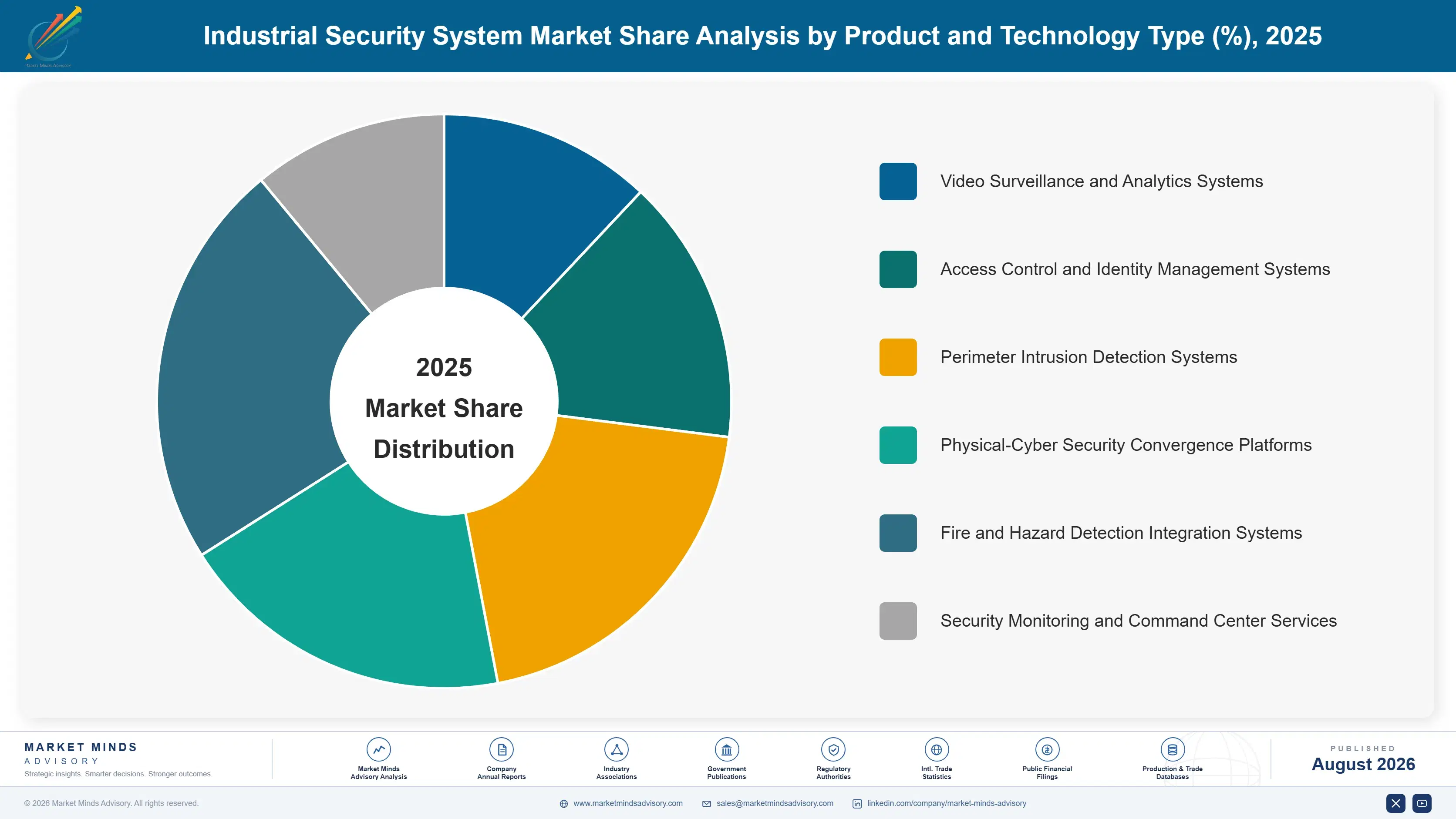
Segmentation follows product and technology type across the industrial security value chain rather than facility type or deployment model, since a single site typically procures across every category from perimeter detection through convergence platforms and monitoring services. Six categories capture that value chain, reflecting how facility operators budget for each distinct system component separately.
industrial-security-system-market-market-share-analysis-1787300974054

Physical-Cyber Security Convergence Platforms

Physical-cyber security convergence platforms are growing fastest as facility operators respond to attackers exploiting networked cameras and access controllers as entry points into plant control systems rather than isolated physical assets. Honeywell and Johnson Controls lead convergence platform deployments, offering integrated network security and physical access management that reduces the attack surface legacy standalone systems create. Smaller specialized providers compete on specific integration capabilities targeting particular facility types or regulatory requirements. This category carries meaningfully higher margins than conventional hardware, since convergence combines specialized network security expertise with physical hardware that few competitors can easily replicate. Demand is growing especially quickly at critical infrastructure facilities, where regulatory compliance increasingly requires demonstrated integration between physical and network security.
CAGR 13.0%

Video Surveillance and Analytics Systems

Video surveillance and analytics systems are growing quickly as AI-driven detection matures enough for reliable deployment, letting operators shift from passive recording toward active real-time threat response across most facility types worldwide today. Axis Communications and Hikvision lead analytics-enabled camera deployments, while smaller specialized providers compete on detection accuracy for specific threat categories. Growing adoption of convergence platforms has increased demand for cameras that integrate cleanly with broader network security systems, a meaningfully different technical requirement than standalone recording equipment previously needed for most facility deployments. Qualification cycles for analytics platforms run considerably longer than for simpler hardware, creating durable customer relationships once a system is deployed and fully validated.
CAGR 10.5%
Full segment breakdown across 6 segments available in the complete report.

Regional Architecture and Country Demand Map

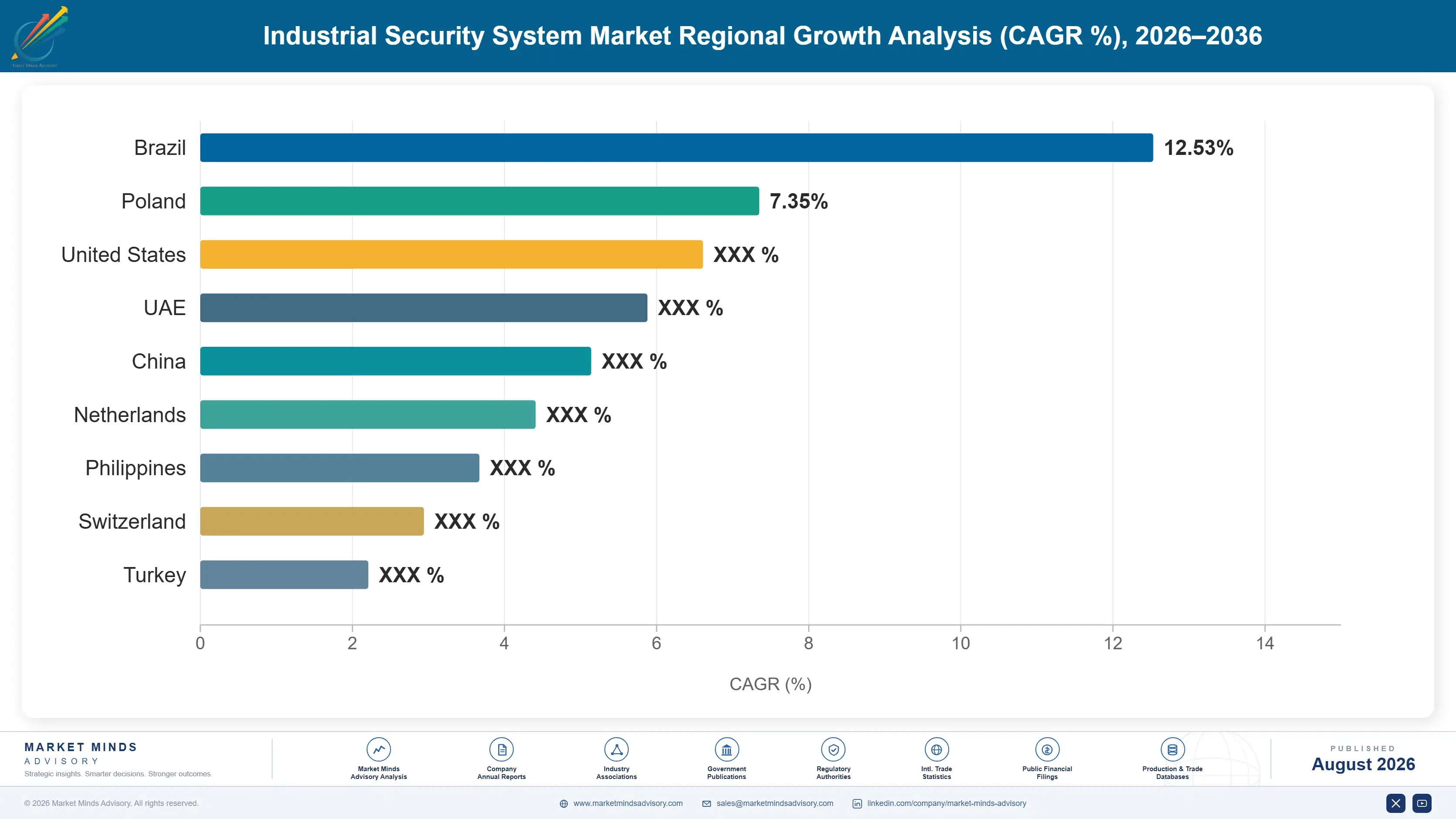
Demand concentrates where manufacturing scale and security regulation are both highest. East Asia leads on China's manufacturing base and mandated critical infrastructure rules, South Asia and Pacific gains share fastest on India's greenfield expansion, while North America sustains steady demand tied to critical infrastructure protection.

East Asia

China's manufacturing base drives more industrial security procurement volume than any other country, anchored by both domestic hardware production and government-mandated critical infrastructure security rules applying across energy, water, and manufacturing facilities nationwide and across most provinces. Hikvision and Dahua, both headquartered domestically, hold deep manufacturing and channel relationships that let them capture the bulk of this domestic demand growth despite export restrictions limiting their reach elsewhere in several developed markets. Japan and South Korea's established manufacturing sectors sustain steady demand tied to both domestic development and technology partnerships with Western convergence platform suppliers. Singapore's regional hub status draws demand from across Southeast Asian manufacturing expansion as well, reinforcing its role.
Share: 30% | CAGR: 10.0% (2026 to 2036)

North America

The United States accounts for the largest share of North American industrial security spending, driven by critical infrastructure protection mandates spanning energy, water, and manufacturing facilities considered strategically important to national resilience, supply chain security, and broader economic competitiveness overall. Honeywell and Johnson Controls both maintain deep enterprise relationships with major American manufacturers, positioning them well to capture continued convergence platform modernization spending across expanding facility networks nationwide. Axis Communications and other established suppliers bring analytics and network security expertise built across decades of adjacent building automation work. Canada's smaller industrial security market contributes a genuinely additive layer of regional demand tied to similar regulatory pressures and cross-border trade integration.
Share: 26% | CAGR: 9.8% (2026 to 2036)
Regional intelligence for 5 additional markets available in the complete report: Western Europe, South Asia and Pacific, Latin America, Middle East and Africa, Eastern Europe. Contact sales@marketmindsadvisory.com.
industrial-security-system-market-country-cagr-analysis-1787300974573

Where Suppliers Can Grow Margin Per Facility

Standalone hardware sales alone will not sustain margins as convergence platforms mature and price competition intensifies across commodity camera and access control components. The more durable path runs through monitoring subscriptions, analytics licensing, and network security service contracts, each of which carries pricing power that hardware sales increasingly lack in this maturing procurement environment.

Bundling Monitoring Subscriptions With Hardware Platform Sales

Bundling monitoring and analytics subscriptions with convergence platform hardware sales turns a one-time equipment purchase into a recurring revenue relationship that captures ongoing value from threat detection and network security monitoring delivered over the platform's operating life. Honeywell reports subscription-attached platform sales command an estimated 26 percent higher lifetime revenue than hardware-only sales, since customers pay recurring fees for continued access to analytics algorithms and monitoring support rather than a single upfront payment. This model also deepens customer relationships, since switching away from a bundled platform requires replacing both hardware and accumulated monitoring configuration built up over years.
Market Impact: Subscription-attached sales add 26 percent more lifetime revenue

Offering Network Security Assessment Service Contracts

Facility operators increasingly need help identifying network security vulnerabilities in their existing physical security hardware, creating demand for suppliers that can offer bundled vulnerability assessment services alongside their core convergence platform products. Suppliers with established network security assessment capability can charge a meaningful premium for that support, since operators avoid the substantial cost and risk of building independent assessment capability internally for infrequent specialized work. Johnson Controls has built dedicated assessment capability specifically to serve manufacturers transitioning from legacy standalone systems, capturing an estimated 21 percent premium on contracts where assessment is included.
Market Impact: Assessment services command a 21 percent price premium

Expanding Analytics-as-a-Service Subscription Platforms Rapidly Worldwide

Video analytics suppliers that offer detection capability as a recurring subscription platform rather than a one-time software license capture predictable revenue tied to growing camera network scale across their client facility base worldwide and internationally. This model particularly appeals to facilities expanding camera coverage incrementally, since subscription pricing scales more predictably with network growth than one-time software purchases alone can support financially over time. Axis Communications has expanded subscription-based analytics platforms considerably since 2023, capturing an estimated 19 percent larger share of new deployment contracts than competitors selling perpetual software licenses.
Market Impact: Subscription platforms win 19 percent more new contracts

Building Legacy Retrofit Gateway Device Portfolios

Suppliers that build dedicated retrofit gateway devices bridging legacy standalone hardware with modern convergence platforms can command premium pricing for the additional engineering work involved, since facilities avoid the substantial cost and disruption full system replacement would otherwise require. This approach particularly appeals to operators of older facilities where complete rewiring is prohibitively expensive relative to available security budgets and operational disruption tolerance. Bosch has expanded its retrofit gateway portfolio significantly since 2023, capturing an estimated 17 percent larger share of legacy facility upgrade contracts than competitors requiring full system replacement.
Market Impact: Wins 17 percent more new legacy retrofit contracts

Who Controls the Margin Pool

Honeywell, Johnson Controls, Bosch Security Systems, Axis Communications, and Hikvision hold under half of global revenue combined in a market spanning hardware, software, and monitoring services rather than concentrated around a single product category. Honeywell and Johnson Controls lead integrated facility platforms with the deepest enterprise account relationships in the industry, built over decades of building automation adjacency.
Current competitive activity centers on three fronts. Suppliers are racing to build physical-cyber convergence platforms as facility operators treat networked security hardware as a genuine network attack surface requiring dedicated protection. They are also expanding AI-driven video analytics capability to replace passive recording with active threat detection. Network security specialists are entering by partnering directly with physical security hardware makers on integrated convergence platform development.

Emerging pressure comes from two directions. Chinese hardware manufacturers are exporting increasingly credible camera and access control equipment at prices Western suppliers struggle to match, though export restrictions in several countries limit their reach into critical infrastructure segments specifically. Cloud-based security software start-ups are also entering by partnering directly with facility operators on subscription-based monitoring platforms, threatening established suppliers' hardware-centric revenue models built over past decades.
industrial-security-system-market-company-positioning-matrix-1787300975092

Competitive Moat and Risk Dimensions

HONEYWELL

Moat: Broadest Integrated Platform Portfolio

Honeywell operates the broadest portfolio of integrated facility security platforms spanning access control, video analytics, and network security convergence, letting it serve manufacturers as a single technology partner rather than requiring multiple vendor relationships across separate hardware and software categories, a genuine competitive advantage in enterprise procurement.
HONEYWELL

Risk: Conglomerate Decision-Making Speed

Honeywell's diversified industrial conglomerate structure can slow decision-making and resource allocation compared with more focused security-only competitors, particularly on emerging convergence technology bets where faster-moving specialized suppliers increasingly win early customer relationships through quicker technical response, dedicated development attention, and considerably narrower strategic focus overall.
JOHNSON CONTROLS

Moat: Deep Building Automation Relationships

Johnson Controls' decades of building automation and facility management experience give it deep enterprise relationships and installed base access that smaller specialized convergence competitors cannot easily replicate, built through sustained work directly alongside facility operators across successive building system upgrade cycles and long-term service contracts.
JOHNSON CONTROLS

Risk: Limited Network Security Depth

Johnson Controls' commercial strength remains concentrated in building automation adjacency rather than dedicated network security expertise, leaving it more dependent on partnerships with specialized cybersecurity vendors than competitors building convergence capability entirely in-house, a gap that increasingly matters as attackers grow more sophisticated and persistent.

Key Players

Honeywell
Johnson Controls
Bosch Security Systems
Axis Communications
Hikvision

Others

Dahua Technology
Hanwha Vision
Genetec
Milestone Systems
Motorola Solutions
Pelco
Teledyne FLIR
ASSA ABLOY
Allegion
Gallagher Group
Siemens Building Technologies
Schneider Electric
WESCO International
Convergint Technologies
Securitas Technology

Recent Developments

FEBRUARY 2025

Honeywell Launches Critical Infrastructure Convergence Platform

Honeywell launched a new physical-cyber convergence platform specifically engineered for critical infrastructure facilities, targeting operators seeking integrated network security and access control from a single technology partner. The launch followed extensive field validation with several undisclosed manufacturing customers across energy and water infrastructure programs in North America and Europe.
Signal: Signals major suppliers extending proven technology into the fastest-growing segment of the industrial security equipment market.
SEPTEMBER 2024

Johnson Controls Acquires Network Security Assessment Specialist

Johnson Controls acquired a privately held network security assessment specialist to strengthen its convergence platform capability ahead of expanding critical infrastructure compliance deployments nationwide. The acquisition adds proprietary vulnerability assessment technology to Johnson Controls' existing physical security hardware portfolio, deepening its network security capability considerably.
Signal: Signals consolidation in network security assessment as suppliers bring specialized capability in-house rather than partnering externally.
APRIL 2025

Axis Communications Expands Southeast Asian Manufacturing Capacity

Axis Communications expanded its analytics-enabled camera manufacturing capacity in Southeast Asia to meet growing demand from manufacturers seeking AI-driven detection platforms across expanding regional facility networks. The expansion increases Axis Communications' regional production capacity and supports faster fulfillment of large enterprise contracts across the wider Asian market.
Signal: Signals camera manufacturers investing directly in regional capacity to meet rising demand for analytics-enabled detection technology.

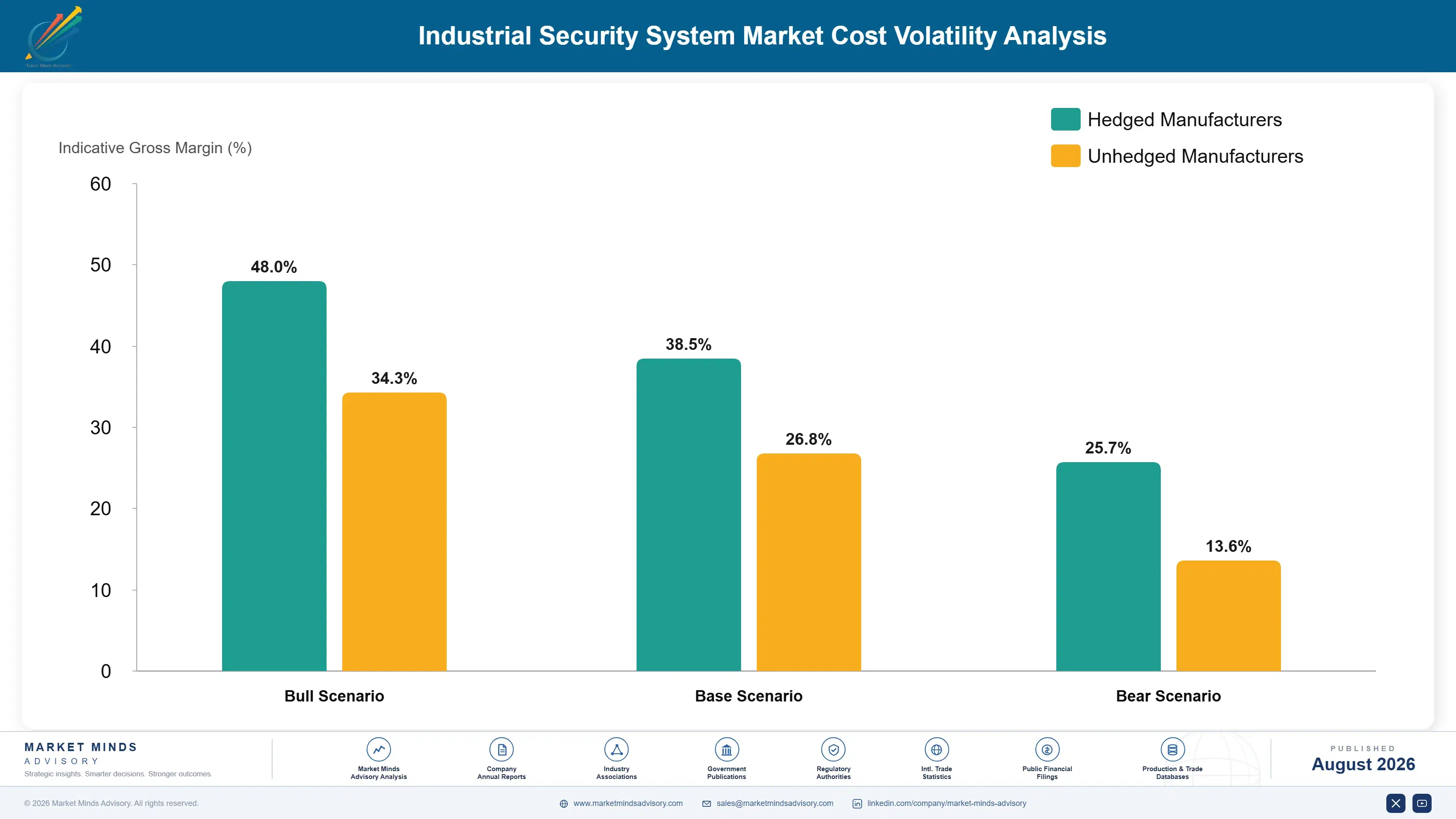
Semiconductor Sensor Cost Exposure

Semiconductor sensors and optical components together account for roughly 30 percent of industrial security hardware cost of goods sold, with specialized image sensor and lens manufacturing concentrated among a handful of qualified suppliers whose capacity cannot easily scale on short notice. Component sourcing is the sharper constraint, since specialized sensor fabrication capacity takes considerable time to expand and qualify.
Image sensor supply became a genuine bottleneck during 2021 and 2022 as broader semiconductor shortages constrained availability across the entire electronics industry, pushing lead times out substantially at several major camera manufacturers according to industry capacity tracking. Axis Communications' 2022 annual report cited component shortages as a factor limiting near-term shipment volume despite strong underlying demand, and several suppliers announced dedicated supply agreements specifically in response to the shortage becoming a genuine competitive constraint.

The disadvantage falls hardest on smaller suppliers without long-term semiconductor supply agreements or diversified sourcing relationships. Honeywell and Bosch, with scale to negotiate dedicated component supply contracts, absorb demand surges more smoothly than smaller specialized manufacturers dependent on standard distribution channels. That gap widens further during periods of component tightness, when large suppliers receive priority allocation smaller competitors often cannot secure.
industrial-security-system-market-cost-volatility-analysis-1787300975289

Expanding In-House Sensor and Optical Component Manufacturing

Leading suppliers are investing directly in dedicated image sensor and optical component manufacturing capacity rather than relying entirely on third-party semiconductor producers, reducing exposure to capacity constraints during periods of surging industry demand. Axis Communications and Bosch have both announced capacity expansion investments since 2023, and several suppliers are also qualifying secondary component manufacturers to build redundancy.

Diversifying Semiconductor Sourcing Partners

Several suppliers have moved to qualify multiple image sensor and semiconductor manufacturers rather than relying on a single producer, reducing exposure to any one supplier's capacity constraints or quality issues. This diversification adds modest coordination complexity but meaningfully reduces the risk of a single manufacturing disruption affecting an entire product line's availability across major markets.

Building Long-Term Semiconductor Capacity Reservation Agreements

Leading suppliers are negotiating long-term capacity reservation agreements with semiconductor manufacturers, securing guaranteed production slots ahead of anticipated demand rather than competing for available capacity on the spot market during periods of industry-wide tightness. This approach requires accurate demand forecasting but provides meaningfully more supply certainty than spot market purchasing offers most smaller competitors.

Portfolio Architecture for Margin Defence

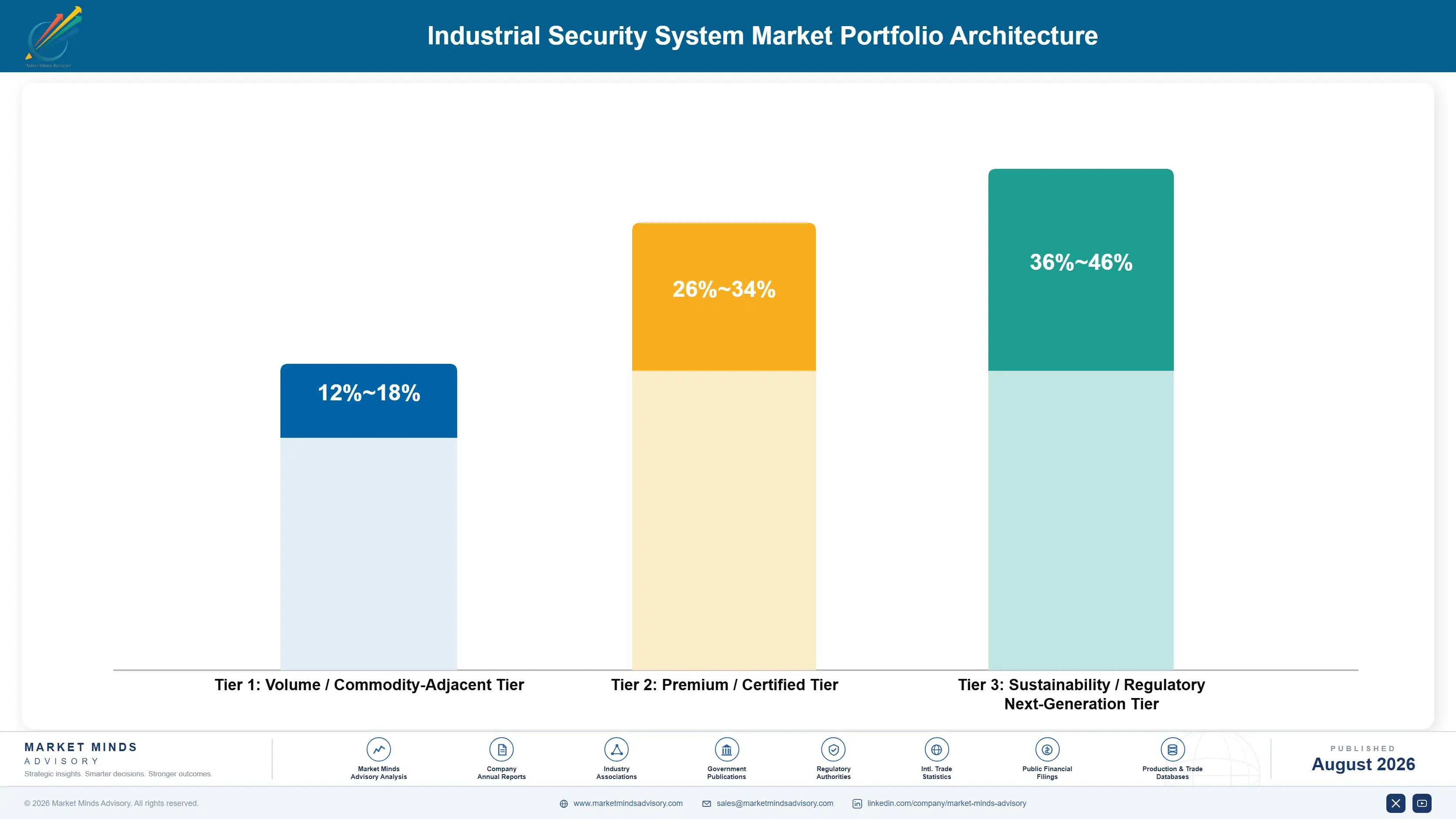
The portfolio splits into three tiers. Conventional standalone cameras and access control hardware sit at the volume base with thinner margins, competing mainly on price and installation reliability. AI-driven video analytics and integrated facility platforms occupy the middle tier, commanding stronger margins through specialized technical capability. Physical-cyber convergence platforms and network security-integrated systems sit at the top, where margins run richest given the specialized integ
The tension between volume and premium runs through how suppliers allocate research investment. Conventional camera hardware requires steady facility replacement cycles to justify continued manufacturing investment, pulling suppliers toward volume even as growth there slows relative to convergence platforms and analytics, while premium convergence capability demands sustained investment that only pays off once facility operators adopt integrated security budgets. Suppliers leaning too far toward either extreme risk losing either the steady cash generation volume provides or the margin growth premium platforms deliver.

High-value margin pools concentrate in physical-cyber convergence platforms and AI-driven analytics, where integration expertise keeps competition thin and facility operators pay premium prices for validated network security depth. That concentration is likely to deepen as plant network attacks and stricter regulation continue driving comprehensive platform upgrades across major manufacturing regions.

Volume / Commodity-Adjacent Tier

Conventional standalone cameras and access control hardware sold primarily on price and installation reliability to the broad base of facility operators worldwide, competing chiefly on cost, delivery, and warranty terms.
Gross Margin: 12%-18%

Premium / Certified Tier

AI-driven video analytics and integrated facility platforms sold with specialized technical support to operators managing growing detection and compliance complexity across manufacturing and broader national critical infrastructure sectors nationwide and internationally.
Gross Margin: 26%-34%

Sustainability / Regulatory / Next-Generation Tier

Physical-cyber convergence platforms and network security-integrated systems built for operators requiring validated protection against both physical intrusion and network-based cyberattacks at enterprise and multi-facility global scale worldwide each and every year.
Gross Margin: 36%-46%
industrial-security-system-market-portfolio-architecture-1787300975784

High-value Sub-segments and Strategic Watch-out

Physical-Cyber Convergence Platforms

Facility operators increasingly specify convergence platforms with limited existing supplier competition given the network security expertise required and long qualification cycles involved. Integration barriers keep the field narrow, and volume is expanding faster than almost any other category tracked in this report by a wide margin.
Gross Margin: 36%-46%

AI-Driven Analytics Subscriptions

AI-driven analytics subscription revenue grows steadily as operators standardize on proven detection platforms across their global facility networks and expanding camera deployments nationwide. Growth is moderate compared with convergence platform demand but margins are among the richest in the portfolio once technical expertise is built.
Gross Margin: 34%-42%

Conventional Standalone Hardware

The largest revenue base by volume, sold into facility operators worldwide on price and installation reliability rather than advanced technical differentiation or brand loyalty. Growth tracks facility construction and replacement cycles closely and margins stay thin, but the segment funds premium platform development across the broader portfolio.
Gross Margin: 12%-18%

Chinese Hardware Export Expansion

Chinese manufacturers are exporting increasingly credible camera and access control hardware at prices well below Western equivalents, though export restrictions limit their reach into critical infrastructure segments specifically and consistently. If those restrictions ease, this segment could pressure premium pricing industry-wide within the coming decade.
Gross Margin: 16%-24%

Recurring Revenue Across Facility Networks

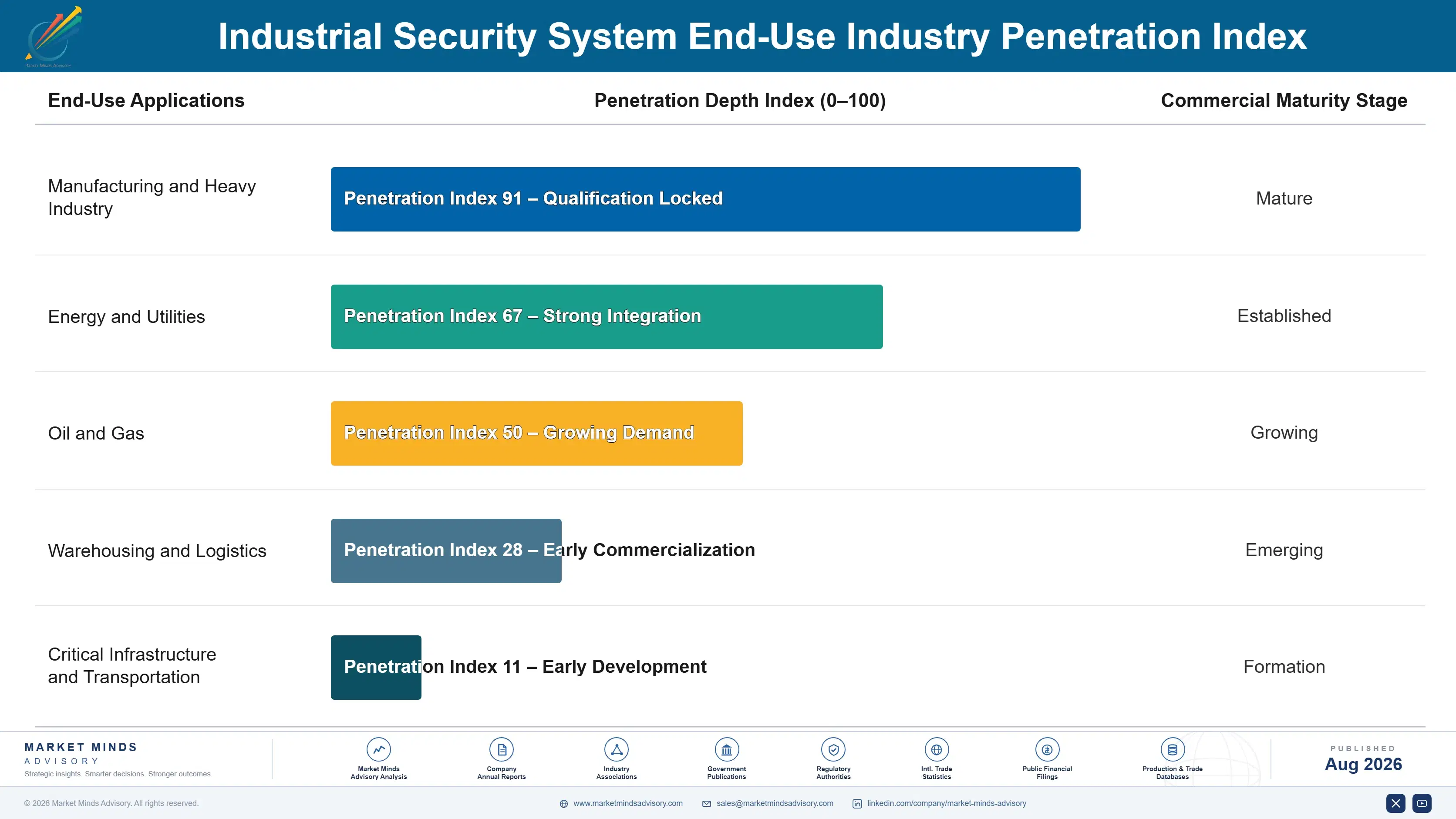
Industrial security generates revenue closer to an annuity than a one-time hardware sale once monitoring subscriptions, analytics software licensing, and maintenance contracts are included, since every facility operating a system consumes another cycle of software updates, sensor replacement, and monitoring service regardless of near-term capital spending volatility. That dynamic gives suppliers more predictable revenue than headline industrial capital expenditure volatility alone would suggest,
Adoption depth varies sharply by facility type. Large manufacturers sign multi-year platform agreements that lock in preferred suppliers across their global facility network, creating high switching costs once a technology is validated into an established security protocol. Smaller facilities behave differently, purchasing equipment more transactionally through regional integrators and remaining more price-sensitive, which keeps competition sharper but limits recurring revenue any single supplier can count on.

A generational shift in buyer profiles is underway as security directors who trained on integrated convergence platforms replace an older generation more familiar with standalone camera and badge reader systems. That shift favors suppliers with strong network security and analytics technology over those competing on conventional hardware reliability, and it is reshaping which suppliers get invited into new facility security specification.
industrial-security-system-market-end-use-penetration-index-1787300976275

Where MMA Sees the Opportunity

These are among the four positions where our research anticipates prominent divergence between winners and laggards over the coming forecast period. Each is grounded in the demand model, the regulatory perimeter, and the announced capacity pipeline.
01 / CONVERGENCE PLATFORM PRIORITY

Prioritize convergence platform development ahead of specification cycles

Facility operators are increasingly treating networked security hardware as a genuine network attack surface, and they favor suppliers with proven convergence platforms when specifying new security systems across their global facility networks and expanding regional manufacturing operations. Suppliers that have not yet invested in convergence platform capability risk missing the fastest-growing and most defensible segment of this market for years to come. MMA recommends prioritizing convergence investment over incremental improvements to conventional standalone hardware facing considerably more moderate growth prospects.
02 / SUBSCRIPTION REVENUE EXPANSION

Build subscription-based analytics capability to deepen customer relationships

Subscription-attached platform sales command meaningfully higher lifetime revenue than hardware-only sales, and suppliers without analytics subscription capability are increasingly excluded from the higher-margin contract structures Honeywell and other leaders have already built across their largest enterprise accounts nationwide. That gap will likely widen as operators standardize on suppliers offering integrated hardware and software platforms rather than assembling systems from multiple vendors independently. MMA recommends investing in subscription capability now, rather than continuing to compete purely on hardware specifications and price.
03 / ASSESSMENT SERVICE DEVELOPMENT

Build network security assessment services ahead of customer demand

Suppliers that build comprehensive network security assessment capability can meaningfully shorten customer qualification timelines, a genuine competitive advantage in a market where assessment speed increasingly determines purchasing decisions among time-constrained facility operators under compliance pressure. Suppliers without pre-packaged assessment documentation are losing deals to competitors like Johnson Controls that have invested in reducing this specific customer friction point. MMA recommends investing in assessment service development now, before competitors establish this capability as a standard expectation rather than a genuine differentiator.
04 / RETROFIT PORTFOLIO EXPANSION

Expand legacy retrofit gateway portfolios to capture upgrade demand

Legacy hardware integration costs have opened a meaningful commercial opportunity for suppliers offering retrofit-friendly gateway devices rather than requiring full system replacement, a considerably larger addressable customer base than greenfield sales alone could ever reach across most regions. Suppliers without retrofit capability are ceding this expanding customer segment to competitors like Bosch, which has built recurring revenue specifically around growing legacy facility upgrade demand. MMA recommends building or partnering into retrofit gateway capability rather than relying solely on full-replacement sales models.

Engagement Snapshot From the Field

A live engagement with an industry participant carrying material or product regulatory and market exposure ahead of a defining policy shift, showing how our research translates into a defensible multi-year portfolio strategy.
MARKET MINDS ADVISORY · CLIENT ENGAGEMENT SUMMARY
Industrial Security System Producer Strategic Portfolio Review and Transition Roadmap 2026·Investment Scenario on Industrial Security System Exposure Evaluation 2025-26
CLIENT PROFILE
The client is a mid-sized industrial manufacturer operating twelve production facilities across North America and Europe, reporting approximately 340 million dollars in annual revenue across its manufacturing operations (client-reported, unverified by MMA). The company had historically relied on standalone camera and access control systems and was evaluating whether to invest in a comprehensive convergence platform upgrade.
STRATEGIC CHALLENGE
Leadership needed to determine whether a comprehensive convergence platform upgrade across all twelve facilities would meaningfully reduce network attack exposure, or whether a phased approach starting with the highest-risk facilities offered comparable security at considerably lower upfront capital investment given budget constraints across the broader manufacturing organization and its capital planning cycle.
MMA APPROACH
MMA benchmarked convergence platform upgrade outcomes across comparable mid-sized manufacturers that pursued comprehensive versus phased rollout approaches, modeling total cost and risk reduction under both strategies over a multi-year implementation horizon. The engagement combined primary interviews with three facility security directors and secondary analysis of comparable manufacturer upgrade timelines and outcomes.
KEY FINDINGS
  1. Manufacturers that pursued phased rollouts starting with highest-risk facilities reduced overall implementation cost by an estimated 22 percent compared with comprehensive upgrades (client-reported, unverified by MMA).
  2. Phased rollouts extended total implementation timeline by roughly eight months compared with comprehensive approaches, delaying full network attack surface reduction across all facilities (client-reported, unverified by MMA).
  3. Facilities upgraded earliest in phased rollouts saw measurably fewer network security incidents than facilities still awaiting upgrade under the broader phased approach.
  4. Comprehensive upgrades required significant upfront capital commitment the client had not fully budgeted for, exceeding initial estimates by roughly 25 percent during detailed review (client-reported, unverified by MMA).
CLIENT PROFILE
The client is a mid-sized industrial manufacturer operating twelve production facilities across North America and Europe, reporting approximately 340 million dollars in annual revenue across its manufacturing operations (client-reported, unverified by MMA). The company had historically relied on standalone camera and access control systems and was evaluating whether to invest in a comprehensive convergence platform upgrade.
STRATEGIC CHALLENGE
Leadership needed to determine whether a comprehensive convergence platform upgrade across all twelve facilities would meaningfully reduce network attack exposure, or whether a phased approach starting with the highest-risk facilities offered comparable security at considerably lower upfront capital investment given budget constraints across the broader manufacturing organization and its capital planning cycle.
MMA APPROACH
MMA benchmarked convergence platform upgrade outcomes across comparable mid-sized manufacturers that pursued comprehensive versus phased rollout approaches, modeling total cost and risk reduction under both strategies over a multi-year implementation horizon. The engagement combined primary interviews with three facility security directors and secondary analysis of comparable manufacturer upgrade timelines and outcomes.
KEY FINDINGS
  1. Manufacturers that pursued phased rollouts starting with highest-risk facilities reduced overall implementation cost by an estimated 22 percent compared with comprehensive upgrades (client-reported, unverified by MMA).
  2. Phased rollouts extended total implementation timeline by roughly eight months compared with comprehensive approaches, delaying full network attack surface reduction across all facilities (client-reported, unverified by MMA).
  3. Facilities upgraded earliest in phased rollouts saw measurably fewer network security incidents than facilities still awaiting upgrade under the broader phased approach.
  4. Comprehensive upgrades required significant upfront capital commitment the client had not fully budgeted for, exceeding initial estimates by roughly 25 percent during detailed review (client-reported, unverified by MMA).
RECOMMENDED STRATEGY
Phase 1: Phase 1 (Months 1 to 6): Upgrade the three highest-risk facilities identified through detailed network vulnerability assessment and risk scoring. Phase 2: Phase 2 (Months 7 to 16): Extend convergence platform deployment to the next six facilities based on updated risk assessment. Phase 3: Phase 3 (Months 17 to 24): Complete deployment across remaining facilities and standardize monitoring and analytics configuration company-wide across all sites.
OUTCOME
Within twenty-four months, the client completed convergence platform deployment across all twelve facilities using the phased approach, reducing overall implementation cost by an estimated 20 percent compared with its original comprehensive rollout plan (client-reported, unverified by MMA). The company has since adopted phased rollout as its standard approach for future facility upgrades.

Frequently Asked Questions

Foundational context covering the market sizes, CAGR, scope, country, region and competition that inform every finding below. This section is provided to cover basics and most often pre-purchase conversations, answered from the MMA Primary Research Dataset.

What is the current size of the Industrial Security System Market?

The global industrial security system market was valued at approximately 42.0 billion dollars in 2025. Growth is driven primarily by convergence platform adoption and rising network attack exposure.

How large will the Industrial Security System Market be by 2036?

MMA forecasts the market reaching approximately 106.21 billion dollars by 2036, roughly 2.32 times its 2026 value. Convergence platforms and AI-driven analytics account for much of that growth.

What is the CAGR for the Industrial Security System Market 2026 to 2036?

The market is projected to grow at an 8.8 percent compound annual rate over the forecast period. Bull and bear scenarios range from 7.5 to 10.1 percent depending on attack frequency.

Which segment is growing fastest?

Physical-cyber security convergence platforms is the fastest-growing segment, expanding at roughly 1.48 times the overall market rate. Networked hardware attack surface concerns are the primary driver.

Who are the major companies in the Industrial Security System Market?

Honeywell, Johnson Controls, Bosch Security Systems, Axis Communications, and Hikvision lead the market on a revenue basis. Together they hold under half of global revenue given how fragmented this market remains.

Which country is growing fastest?

India is the fastest-growing country, driven by manufacturing expansion as companies diversify supply chains away from single-country concentration. Greenfield facility construction is scaling security infrastructure investment rapidly.

Report Segmentation Architecture

The full report scope spans multiple orthogonal segmentation dimensions, with cross-tabulated demand data provided for each dimension pair. Coverage extends further to regional breakdowns, trend trajectories, and the competitive detail needed to support segment-level decision-making.

By Product and Technology Type

  • Video Surveillance and Analytics Systems
  • Access Control and Identity Management Systems
  • Perimeter Intrusion Detection Systems
  • Physical-Cyber Security Convergence Platforms
  • Fire and Hazard Detection Integration Systems
  • Security Monitoring and Command Center Services

By End-Use Industry

  • Manufacturing and Heavy Industry
  • Energy and Utilities
  • Oil and Gas
  • Warehousing and Logistics
  • Critical Infrastructure and Transportation

By Commercial Model

  • Direct Hardware Sale
  • Monitoring Subscription Service
  • Analytics Licensing Agreement
  • System Integrator Distribution Channel

By Region

  • North America
  • Western Europe
  • East Asia
  • South Asia and Pacific
  • Latin America
  • Middle East and Africa
  • Eastern Europe

Scope, Methodology, and Coverage

Every figure in this report is reproducible from documented input assumptions. The scope below maps the historical period, the forecast horizon, the segmentation dimensions, and the countries covered, alongside the underlying primary and qualitative methodology.
Historical Period
2020 to 2025
Forecast Period
2026 to 2036
Base Year
2025 (USD billions; MMA Primary Research Dataset, August 2026)
Market Definition
The industrial security system market covers video surveillance and analytics systems, access control and identity management systems, perimeter intrusion detection systems, physical-cyber security convergence platforms, fire and hazard detection integration systems, and security monitoring and command center services deployed at manufacturing plants, critical infrastructure, and industrial logistics facilities. It excludes residential and retail security systems, general enterprise IT cybersecurity products unrelated to physical infrastructure, and consumer-grade smart home devices.
Quantitative Units
USD billions (current prices); installed system units and facility deployment counts where applicable
Segmentation Dimensions
By Product and Technology Type; By End-Use Industry; By Commercial Model; By Region
Regions Covered
North America, Western Europe, East Asia, South Asia and Pacific, Latin America, Middle East and Africa, Eastern Europe
Countries Covered
USA, China, Germany, France, UK, Japan, South Korea, India, Australia, Canada, Brazil, Mexico, Indonesia, Vietnam, Thailand, Malaysia, UAE, Saudi Arabia, South Africa, Nigeria, Turkey, Poland, Netherlands, Italy, Spain, Sweden, Switzerland, Argentina, Colombia, Singapore, and additional markets relevant to this sector
Key Companies Profiled
Honeywell, Johnson Controls, Bosch Security Systems, Axis Communications, Hikvision, Dahua Technology, Hanwha Vision, Genetec, Milestone Systems, Motorola Solutions, Pelco, Teledyne FLIR, ASSA ABLOY, Allegion, Gallagher Group, Siemens Building Technologies, Schneider Electric, WESCO International, Convergint Technologies, Securitas Technology
Quantitative Methodology
Primary survey, n=3,800 respondents, Q4 2025, six countries; demand-side model with trade association cross-validation
Qualitative Methodology
47 expert interviews, Q4 2025; applied to validate demand model assumptions, identify emerging dynamics, and assess competitive positioning
Report Format
PDF and XLSX data workbook (Word format preview document)
Publisher
Market Minds Advisory
Report Code
MMA-2026-CON-101
Published
August 2026
Contact
sales@marketmindsadvisory.com | www.marketmindsadvisory.com

Purchase the full Industrial Security System Market Report (2026 to 2036).

The full report provides detailed sizing and ten-year forecasts for each of the six product and technology categories tracked in this analysis, alongside country-level detail across thirty markets. It includes a complete competitive benchmarking of the top twenty suppliers on a revenue basis, with moat and risk analysis for the two market leaders. The report also contains a dedicated semiconductor and optical component supply chain risk assessment, plus scenario modeling across bull, base, and bear cases through 2036. Buyers receive access to the underlying primary survey and expert interview datasets referenced throughout the analysis.
Ten-year forecasts across all six product and technology categories
Competitive benchmarking of twenty profiled market suppliers
Semiconductor and optical component supply chain analysis
Bull, base, and bear scenario modeling through 2036
Country-level sizing across thirty tracked national markets
Access to underlying primary survey and interview data

Built For The People Who Decide

From boardroom strategy to bench-side execution, this report is read cover-to-cover by leaders shaping the next decade of their industry, turning demand scenarios, market dynamics and valuation benchmarks into decisions.
CXOs/ Presidents/ VPs/ Managers
M&A and Corporate Development
Strategy Teams and R&D Heads
Procurement and Product Directors
Regulatory and Compliance Leaders
Investor Relations and Equity Analysts