Market Minds Advisory
Industrial Safety Gloves Market

Industrial Safety Gloves Market: Certification and Liability Management Strategy

Manufacturers and construction contractors are replacing basic cotton and leather work gloves with cut-resistant and impact-rated versions as tightening workplace injury regulations and rising hand-injury liability costs converge to make advanced gloves a standard specification.

Lead Analyst

David Horsley

Published

August 2026

Make Smarter Decisions with Customized Research Insights

Request a free sample report and evaluate market opportunities, growth trends, and competitive dynamics relevant to your business needs.

2025 MARKET VALUE$9.8BMarket Size 2025
2036 FORECAST VALUE$19.3BBase Case , 2026 to 2036
CAGR 2026 TO 20366.4 %Bull 7.7% / Bear 5.1%
INCREMENTAL OPPORTUNITY$8.9BNet 10- year value creation
EXPANSION MULTIPLE1.86x2036 value over 2026 base
Strategic Levers
M&A Pipeline
Regional Outlook
Country Rankings
Competitive Intelligence
Segmental Deep-dive
Call-Us : 91 93563 13602

Executive Snapshot and Market Trajectory

Industrial safety gloves have moved from a basic PPE commodity into a liability management and compliance tool. Employers increasingly specify cut-resistant and impact-rated gloves because workplace injury regulations, insurance underwriting requirements, and hand-injury liability exposure now directly affect both compliance costs and workers' compensation claims each year.
Cut-resistant gloves are growing fastest, pulled by manufacturers' need for ANSI-rated hand protection on metal fabrication and glass handling lines, expanding roughly 47% faster than the category average. East Asia retains the largest regional share, supported by China's dominant manufacturing and construction workforce, tightening workplace safety enforcement, and the region's deep concentration of glove production capacity across multiple manufacturing hubs and supplier networks.
Competitive intensity centers on material innovation and certification depth rather than raw unit volume. Ansell and Honeywell are racing regional specialists to bundle high-performance fiber blends, ANSI cut-level certification, and ergonomic design into single validated glove platforms. Regulatory pressure, expanding OSHA hand protection enforcement in the United States and machinery safety directives in the EU, is pulling upgrade demand forward faster than glove failure rates alone would explain across most manufacturing and construction categories worldwide.
Market Definition
The Industrial Safety Gloves market covers hand protection equipment designed for occupational use in manufacturing, construction, oil and gas, and warehousing environments, including cut-resistant, chemical-resistant, impact-resistant, and coated work gloves sold to industrial employers and safety distributors. It excludes disposable medical examination gloves, household consumer gloves, and sporting or recreational hand protection products.
Base Year Value
$9.8B in 2025 (MMA Primary Research Dataset, August 2026)
Forecast Period
2026 to 2036, eleven discrete annual values
CAGR
6.4% base case. Bull 7.7%. Bear 5.1%.
Fastest Growth Segment
Cut-Resistant Gloves: 9.4% CAGR
Fastest Growth Country
Vietnam: 9.8% CAGR
Fastest Growth Region
South Asia and Pacific: 8.6% CAGR
Largest Region
East Asia: 28% of 2025 global value
Market Leaders
Ansell Limited, Honeywell International Inc., MCR Safety, Superior Glove Works Ltd., Showa Group. Source: MMA Analysis based on company annual reports.
Primary Survey
n=3,800 procurement and R&D decision-makers, Q4 2025, six countries
Methodology
Demand-side build-up, cross-validated against public data, 47 expert interviews

Industrial Safety Gloves Market Forecast Scenarios

industrial-safety-gloves-market-size-forecast-scenario-1787301995149
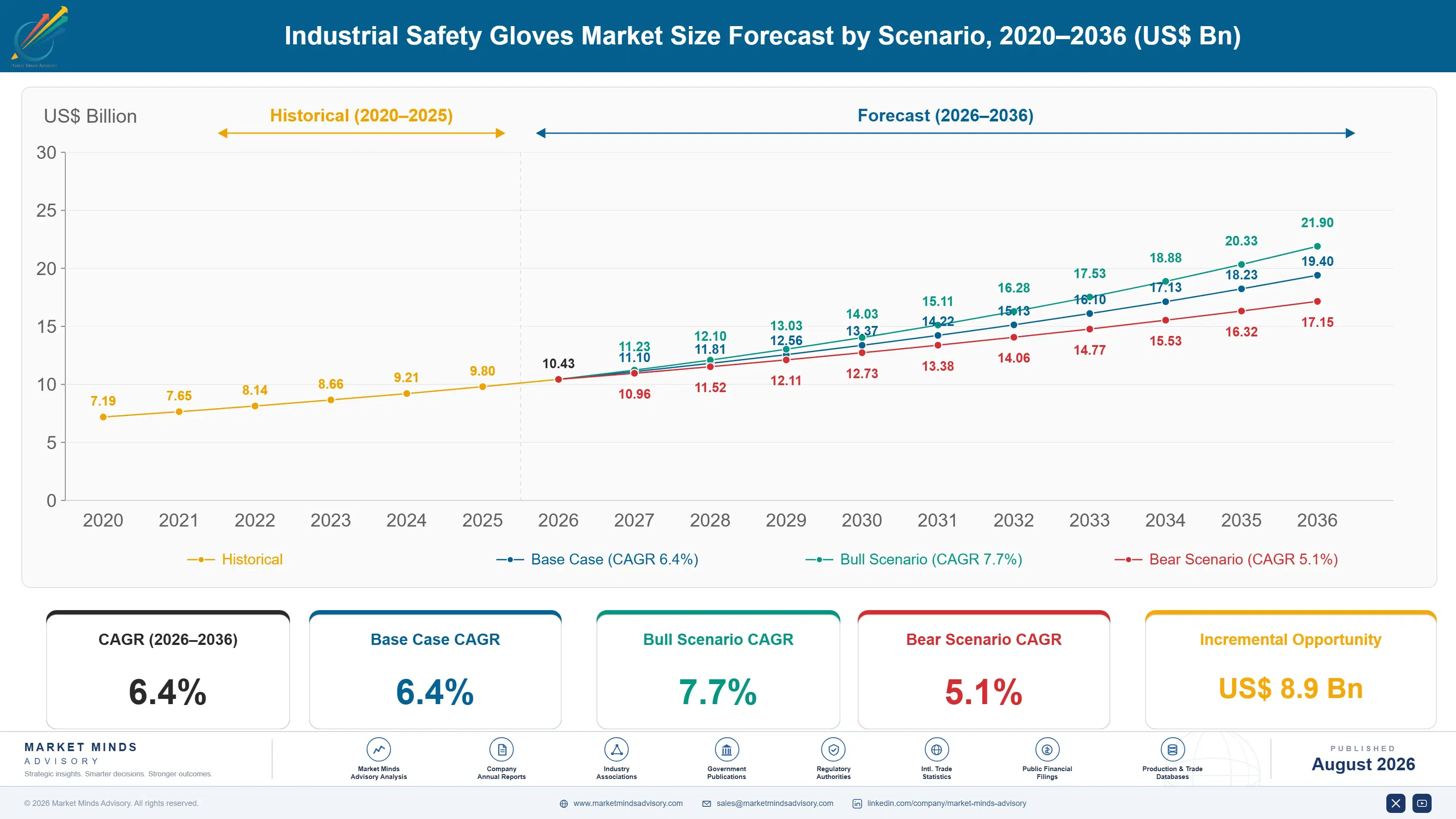
Industrial safety glove demand grew steadily through 2020 to 2025, slowed briefly in 2020 as manufacturing and construction activity paused during the pandemic, then accelerated as industrial employment recovered and workplace safety enforcement tightened across more jurisdictions. Cut-resistant glove adoption accelerated faster than the category as ANSI certification requirements expanded, producing a historical CAGR of 5.6% that understates the acceleration underway.
The base case assumes 6.4% annual growth through 2036, driven by three mechanisms. First, expanding OSHA and equivalent international workplace injury regulations require certified hand protection across more industrial job categories than in the past. Second, rising workers' compensation and liability costs are pushing employers to upgrade from basic gloves to certified cut-resistant and impact-rated versions. Third, new manufacturing and warehousing capacity across Asia, North America, and Europe requires initial glove procurement rather than replacement of existing stock.
The bull case assumes faster safety regulation enforcement and accelerated industrial employment growth pull growth toward 7.7%. The bear case centers on delayed enforcement and continued reliance on basic uncertified gloves in cost-constrained markets, pulling growth down toward 5.1% if global manufacturing capital spending disappoints relative to current employer procurement plans and industry forecasts across major manufacturing regions.

Material Innovation and Certification Depth Economics

Glove selection has become a liability management decision as much as a procurement one. Employers increasingly specify certified cut-resistant and impact-rated gloves because injury liability exposure and insurance underwriting requirements now directly depend on documentation the glove itself must support through certification.
CR5 CONCENTRATION34%Reflects moderate consolidation among global safety glove manufacturers
CUT-RESISTANT PRICE PREMIUM35-55%Premium buyers pay over standard uncoated work gloves
CHINA MANUFACTURING SHARE26%Share of global safety glove production located there currently
HAND INJURY REDUCTION RATE40-65%Typical injury reduction achieved through certified glove conversion
COMPONENT COST SHARE30-40%Portion of glove cost tied to fiber and coating materials
AVERAGE GLOVE REPLACEMENT CYCLE2-6 monthsTypical usage period before replacement due to wear
China generates roughly 26% of global safety glove production, reflecting both its dominant manufacturing and construction workforce and its deep concentration of glove production capacity relative to other regions still importing most specialty protective gloves. Manufacturers price accordingly, charging meaningfully more for fully certified, ANSI-rated cut-resistant packages sold into premium manufacturing and oil and gas applications than into cost-constrained regions still relying primarily on basic uncertified cotton gloves.
The next decade will reward manufacturers that integrate high-performance fiber blends, ANSI cut-level certification, and ergonomic design into single validated glove platforms faster than those still selling standalone basic gloves. Regulatory pressure, more than raw production volume, will set the pace of certified conversion in cost-constrained markets still running legacy uncertified gloves. Expect certification attachment rates to keep rising as OSHA and equivalent enforcement expands, compressing manufacturer margins even as total category revenue expands steadily across nearly every major manufacturing and construction market worldwide.
"A safety manager doesn't switch gloves because the old ones wore out faster, they switch because an OSHA inspector just cited them for uncertified hand protection on the fabrication floor. That's a very different purchasing conversation."
Director, Industrial Safety and Workplace Compliance Practice · MMA Construction

Market Trends

Cut-Resistant Certified Gloves Replace Basic Cotton Work Gloves

Manufacturers and construction employers increasingly specify ANSI-certified cut-resistant gloves as a standard requirement rather than an optional upgrade, since metal fabrication, glass handling, and sheet metal work generate hand injury rates that basic cotton gloves cannot adequately address. This certification requirement matters more as insurance underwriters and workers' compensation carriers increasingly tie premium pricing to documented PPE compliance across an employer's full workforce. Glove makers are responding by embedding high-performance fiber blends directly into standard glove configurations rather than offering them as premium add-ons, reducing injury rates and liability exposure for employers managing large industrial workforces.
Market Impact: Adds regulation-driven demand 10-16
Insurance Underwriting Requirements Accelerate Certified Glove Adoption

Expanding workers' compensation and general liability insurance underwriting requirements, including documented PPE compliance audits and hand injury claim history reviews, are pushing employers to replace uncertified gloves with ANSI-rated versions capable of supporting formal compliance documentation. Underwriting timelines vary by carrier, but the direction is consistent across major industrial insurance markets, giving glove makers a reliable multi-year replacement demand signal independent of underlying glove wear rates. Employers increasingly bundle glove certification upgrades with broader PPE compliance programs to capture efficiency from combined training and procurement site visits across multiple facilities each year.
Market Impact: Adds liability-driven demand 14-20%

Market Opportunities and Growth Drivers

Tightening Workplace Safety Regulation Requires Certified Hand Protection

OSHA and equivalent international workplace safety regulations increasingly require employers to provide certified, task-appropriate hand protection before workers can legally perform metal fabrication, glass handling, or chemical processing tasks rather than relying on general-purpose uncertified gloves. Employers in jurisdictions adopting stricter enforcement face compliance deadlines that create concentrated, time-bound replacement demand independent of the broader industrial capital spending cycle. Glove makers report that regulation-driven projects increasingly specify ANSI-certified configurations rather than basic uncertified units, since certification documentation simplifies the compliance audits regulators now require employers to maintain across every job site.
Market Impact: Raises per-unit cost by 35-55%

Rising Liability Costs Drive Employer Glove Upgrades

Employers and workers' compensation insurers are increasingly tracking hand injury claim costs that legacy uncertified gloves cannot adequately prevent, particularly in manufacturing, construction, and warehousing environments with high glove turnover and frequent hand contact tasks. This liability trend benefits glove makers directly, since liability-conscious employers typically specify certified configurations across their entire workforce rather than equipping only the highest-risk job categories. Employers report that liability-driven glove upgrades increasingly bundle training and compliance documentation support, since the incremental cost of certification is small relative to the potential injury claim cost employers otherwise absorb.
Market Impact: Compresses manufacturer margins by

Market Restraints and Challenges

Higher Certified Glove Cost Slows Smaller Employer Adoption

Fully certified cut-resistant and impact-rated gloves carry per-unit costs that can exceed the annual PPE budget of many smaller employers, particularly given the shorter replacement cycles certified gloves typically require compared to basic cotton alternatives. The root cause is that high-performance fiber blends and specialty coatings add meaningful cost on top of the base glove construction, and smaller employers often cannot justify that premium against their smaller workforce and lower liability exposure. Smaller employers unable to justify full conversion are responding by prioritizing certified gloves at their highest-risk job categories first rather than converting their entire workforce simultaneously.
Market Impact: Cuts hand injury rates by 40-65%

Fiber Material Cost Volatility Compresses Manufacturer Margins

High-performance cut-resistant fibers and specialty coating materials account for 30 to 40% of glove manufacturing cost, and raw material price volatility during 2021 and 2022 forced manufacturers to absorb margin compression or pass through mid-contract price increases that strained distributor relationships. The root cause is that manufacturers typically quote fixed annual pricing months before fiber procurement and production actually occur, leaving them exposed to material price movement between quote and delivery in a way shorter-lead-time categories are not. Manufacturers are responding by shortening quote validity periods and negotiating material price escalation clauses into larger distributor contracts.
Market Impact: Cuts liability claim costs by 25-40
3 additional market trends, 3 additional growth drivers, and 2 additional restraints and challenges are covered in the full report. Contact sales@marketmindsadvisory.com to access the complete intelligence.

Segment CAGR and Growth Architecture

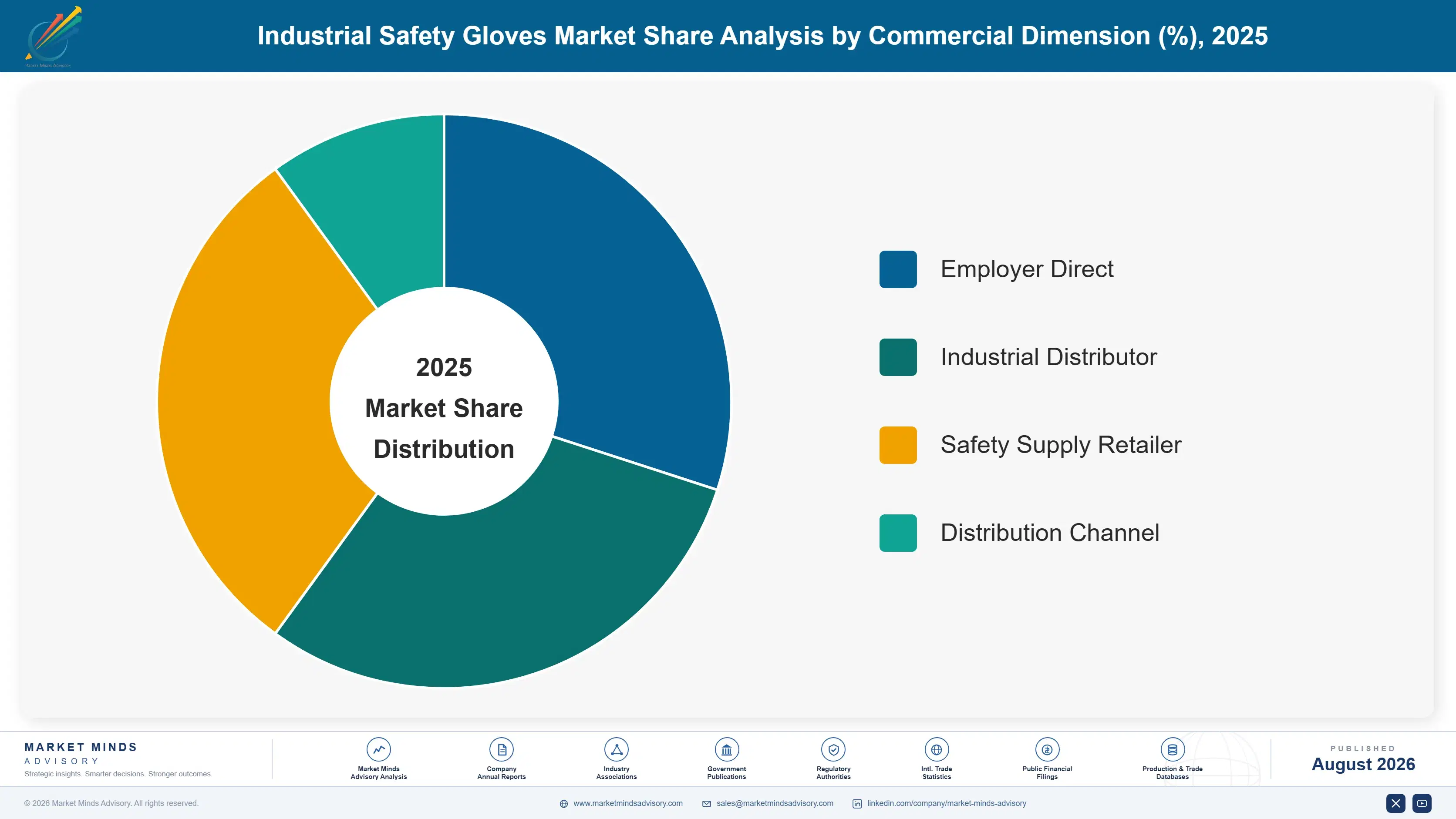
This report segments the industrial safety gloves market by material and technology type across cut-resistant gloves, chemical-resistant gloves, disposable nitrile gloves, leather and heavy-duty gloves, coated and dipped gloves, and impact-resistant gloves. Material type was chosen over end-use industry because purchasing decisions follow hazard protection capability rather than the specific industrial sector the glove ultimately serves.
industrial-safety-gloves-market-market-share-analysis-1787301995685

Cut-Resistant Gloves

Cut-resistant gloves are the fastest-growing category at 9.4% annually, roughly 47% faster than the market average. Metal fabrication and glass handling hazard requirements are the primary demand drivers, since ANSI-certified cut-resistant fiber blends deliver the documented protection that basic cotton and leather gloves cannot provide across high-risk manufacturing applications. Employers converting to certified cut-resistant gloves report meaningfully lower hand injury claim rates, letting safety managers demonstrate measurable compliance improvement to insurance underwriters and regulators. Ansell and Honeywell lead this category, with high-performance fiber blend technology increasingly differentiating premium certified configurations from basic cut-resistant gloves on cut level rating, dexterity, breathability, and durability under repeated heavy use across long manufacturing shifts.
CAGR 9.4%

Impact-Resistant Gloves

Impact-resistant gloves, the second-fastest category at 8.1% annually, benefit from their ability to combine TPR-reinforced back-of-hand protection with dexterity requirements that oil and gas, construction, and heavy equipment operators increasingly demand for tasks involving crush and impact hazards rather than cut hazards alone. Employers in these sectors increasingly specify impact-resistant gloves as standard equipment for crew members working around heavy machinery and vehicle maintenance tasks. Glove makers report impact-resistant configurations increasingly specified alongside cut-resistant certification, since many job sites carry both hazard types simultaneously. Adoption is concentrated among larger industrial employers with the safety budget and regulatory sophistication to specify hazard-appropriate glove categories by task, crew role, and shift assignment.
CAGR 8.1%
Full segment breakdown across 6 segments available in the complete report.

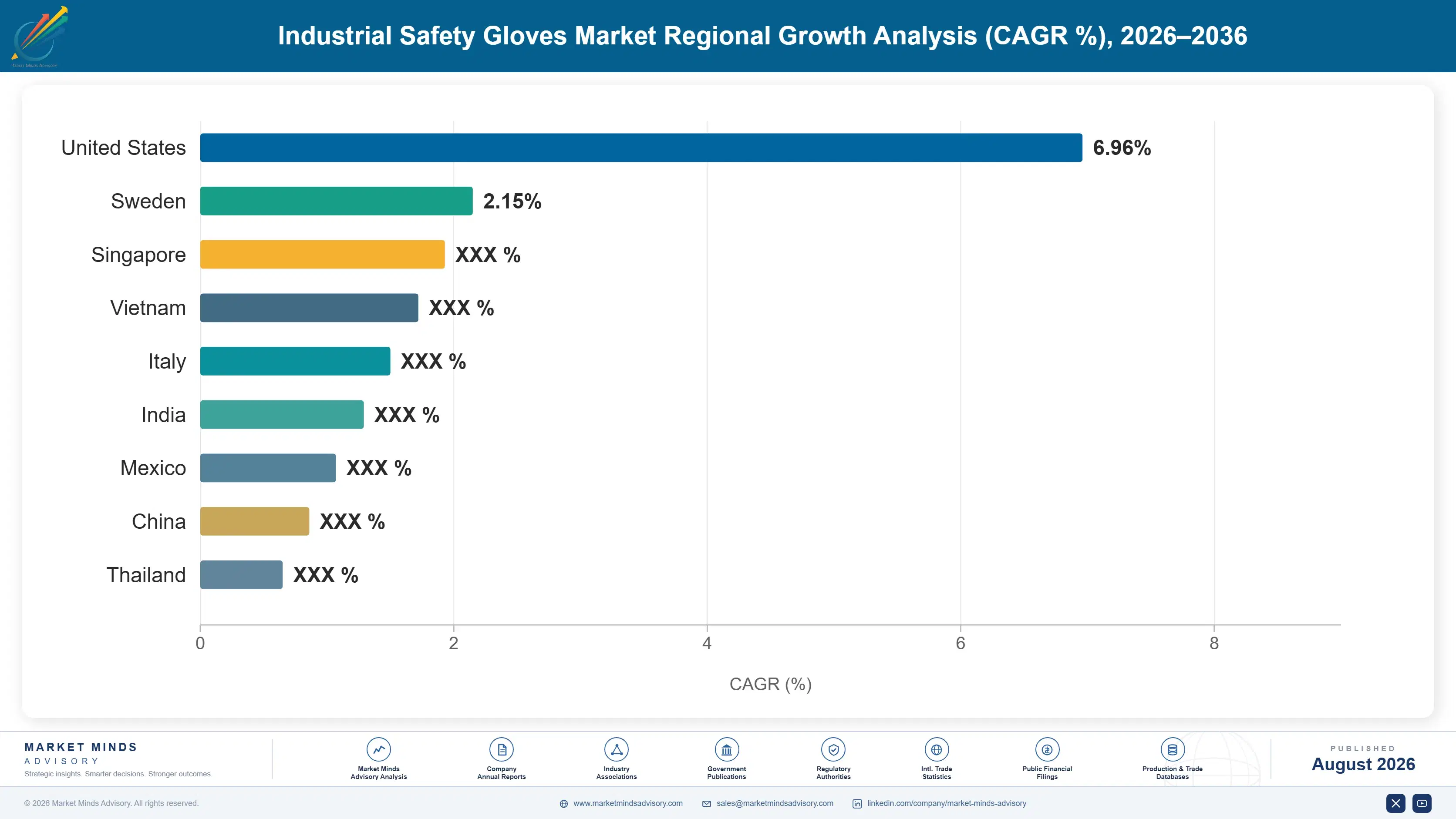
Regional Architecture and Country Demand Map

East Asia retains the largest regional share on China's manufacturing and construction workforce scale, with South Asia and Pacific expanding fastest as industrial employment and safety regulation enforcement both accelerate. North America and Western Europe follow, while other regions remain earlier-stage markets for certified conversion.

North America

US workplace safety enforcement under OSHA's hand protection standard is directing meaningful compliance spending toward certified glove procurement, generating steady replacement demand independent of the broader industrial capital spending cycle. Manufacturers and construction employers across metal fabrication, oil and gas, and warehousing sectors are converting basic gloves to certified cut-resistant and impact-resistant configurations to meet tightening liability and insurance underwriting requirements. Canada's resource sector and manufacturing base generate comparable demand dynamics to the US, though at smaller absolute scale given the smaller industrial workforce. Mexico's manufacturing sector, boosted by nearshoring investment, is generating growing industrial glove demand tied to new facility construction and expanded production lines across multiple industrial sectors.
Share: 24% | CAGR: 5.8% (2026 to 2036)

Western Europe

Germany, France, and the UK are advancing certification-driven glove conversion fastest within the region, supported by EU machinery safety directives and generally stricter enforcement of workplace hand protection compliance than in most other global markets. Germany's industrial manufacturing base gives it particular strength in higher-tier cut-resistant and chemical-resistant glove categories specifically, serving both domestic demand and meaningful export volume. The UK's construction sector, operating under regulatory pressure to reduce workplace injury claims, is a significant source of glove replacement demand. Southern European markets including Spain and Italy are converting legacy gloves somewhat more slowly, reflecting both later regulatory implementation and tighter employer PPE budgets across smaller manufacturing operations nationwide overall.
Share: 20% | CAGR: 4.9% (2026 to 2036)
Regional intelligence for 5 additional markets available in the complete report: East Asia, South Asia and Pacific, Latin America, Middle East and Africa, Eastern Europe. Contact sales@marketmindsadvisory.com.
industrial-safety-gloves-market-country-cagr-analysis-1787301996202

Where Safety Glove Margins Concentrate

Margin in this market increasingly sits in certification depth, specialty fiber technology, and compliance documentation services rather than the base glove construction alone. Four levers explain most of the gap between manufacturers still competing purely on unit price and those capturing recurring revenue across the full employer relationship from initial procurement through ongoing PPE compliance support.

Bundling Certification Testing and Compliance Documentation

Manufacturers offering integrated packages that bundle ANSI cut-level certification, compliance documentation, and safety training materials into a single validated procurement package command 35 to 55% price premiums over standalone basic gloves, since employers increasingly value audit-ready documentation and reduced liability exposure over marginal component-level cost savings. This bundling also reduces the specialized compliance hours employers need per glove category, since pre-documented packages require less independent verification than specifying gloves and certification separately for each job category. Manufacturers without bundling capability increasingly lose specification to competitors offering validated packages, particularly on large employer procurement contracts with compressed compliance timelines.
Market Impact: Commands a 35-55% premium over stan

Monetizing Cloud PPE Compliance Software Subscriptions

Manufacturers increasingly bundle cloud-based PPE compliance tracking software subscriptions with glove procurement contracts, charging employers an ongoing per-site or per-employee fee for injury tracking, replacement scheduling, and audit-ready compliance reporting layered on top of the physical glove sale. This subscription revenue carries margins closer to enterprise software than industrial PPE, and attachment rates are rising above 30% on new large-employer contracts as safety managers increasingly view automated compliance tracking as essential given regulatory documentation requirements. Manufacturers with the most capable compliance platforms report meaningfully higher customer retention across their installed employer base.
Market Impact: Compliance software subscription at

Expanding Safety Training and Fit Programs

Employers increasingly purchase multi-year safety training and glove fit assessment programs alongside procurement contracts, since maintaining proper hazard-appropriate glove selection requires ongoing worker training that many employers lack the in-house specialized expertise to deliver independently. These training programs carry margins meaningfully above the equipment sale itself, and manufacturers with dedicated field training organizations report renewal rates above 48% as employers increasingly value guaranteed compliance support for injury-prone job categories. Manufacturers without extensive training infrastructure are increasingly losing installed-base service revenue to independent safety consulting companies specializing in multi-vendor PPE programs.
Market Impact: Training program renewal rates now

Winning Large Employer Contracts Before Distributors

Manufacturers that engage large employers directly in procurement planning, before formal distributor bids are finalized, capture disproportionate contract share since direct engagement lets them influence technical specifications toward their own glove capabilities rather than competing purely on price against a fixed specification. This early engagement advantage compounds across an employer's broader safety program, since manufacturers that win early contracts build reference relationships and compliance track records that support winning subsequent renewal contracts. Manufacturers without dedicated key account resources lose roughly 18% of available specification value to competitors with more proactive employer relationships.
Market Impact: Captures an 18%+ share of large emp

Who Controls the Margin Pool

CR5 concentration sits at 34%, reflecting moderate consolidation among established glove manufacturers. Ansell and Honeywell lead on certification breadth and employer relationships, but the gap to challengers including MCR Safety and Superior Glove remains meaningful, since glove assembly itself requires less capital intensity than specialty fiber manufacturing, letting smaller specialists compete effectively on price and service.
Competitive activity plays out on three fronts. Certification and compliance bundling is the most visible, with nearly every major manufacturer now offering validated certification-documentation-training configurations. PPE compliance software is the second front, where Ansell and Honeywell use their cloud platform investment to differentiate beyond glove hardware alone. Large employer contract specification is the third front, where manufacturers compete for early procurement engagement that determines specification advantage across an entire safety program.

Pressure is building from two directions rankings have not caught up with. Malaysian and Chinese manufacturers have moved from budget alternatives into genuine technical competitors specifically on certified cut-resistant gloves, taking share from established Western suppliers in price-sensitive expansion markets. Industrial distributors are simultaneously expanding into direct compliance software and training services, threatening to disintermediate manufacturers from the employer relationship they have traditionally controlled.
industrial-safety-gloves-market-company-positioning-matrix-1787301996720

Competitive Moat and Risk Dimensions

ANSELL LIMITED

Moat: Broadest Hand Protection Portfolio

Ansell's position as a full-line hand protection supplier, spanning basic gloves through advanced cut-resistant and chemical-resistant categories, gives it cross-selling access to employer safety budgets that pure-play specialty glove makers cannot match, letting it win integrated PPE program contracts spanning multiple hazard categories across a single employer relationship.
ANSELL LIMITED

Risk: Premium Pricing Limits Access

Ansell's premium positioning and full-line engineering overhead translate into pricing that smaller employers increasingly find difficult to justify relative to competitively priced Asian alternatives offering comparable core certification levels without the broader integrated PPE program capability those larger employers actually value most in their own compliance planning.
HONEYWELL INTERNATIONAL INC.

Moat: Deep Industrial Safety Relationship Network

Honeywell's decades of broader industrial safety equipment relationships give its gloves a certification and reliability reputation in regulated manufacturing and construction applications that newer competitors, despite closing the price gap significantly, have not yet fully matched in the eyes of the most compliance-conscious safety managers.
HONEYWELL INTERNATIONAL INC.

Risk: Slower Specialty Fiber Innovation Pace

Honeywell's traditional strength in broader industrial safety equipment has translated less quickly into differentiated specialty fiber innovation than some competitors with dedicated glove materials research organizations, leaving it more exposed to losing premium cut-resistant specification share to specialist manufacturers entering the high-performance glove market aggressively.

Players Tracked

Prominent Players

Ansell Limited
Honeywell International Inc.
MCR Safety
Superior Glove Works Ltd.
Showa Group

Other Key Players

Towa Corporation
Top Glove Corporation Bhd.
Kossan Rubber Industries Bhd.
Supermax Corporation Bhd.
Hartalega Holdings Bhd.
Delta Plus Group
Uvex Safety Group
Lakeland Industries Inc.
Radians Inc.
Protective Industrial Products Inc.
Magid Glove & Safety Manufacturing Co. LLC
Wells Lamont Industrial
Mapa Professional
Ejendals AB
Marigold Industrial

Recent Developments

MAY 2025

Ansell Expands Cut-Resistant Glove Manufacturing Capacity

Ansell completed an organic capacity expansion at its cut-resistant glove manufacturing facility to add dedicated high-performance fiber production lines, responding to rising demand from manufacturing employers seeking ANSI-certified hand protection and shorter delivery lead times on new glove orders across North American and European markets currently expanding capacity.
Signal: Signals Ansell is committing manufacturing
SEPTEMBER 2025

Honeywell Acquires PPE Compliance Tracking Software Startup

Honeywell acquired a specialist PPE compliance tracking and injury analytics software startup to strengthen its safety program platform's reporting capability and reduce manual compliance documentation for employer customers, adding software engineering talent it previously lacked in-house for rapid feature development and faster commercial deployment across its portfolio.
Signal: Indicates glove makers are increasingly bu
JANUARY 2026

MCR Safety Signs Supply Agreement With Industrial Distributor Consortium

MCR Safety signed a multi-year supply agreement with a consortium of industrial safety distributors to provide certified gloves and compliance training support across their combined customer base, replacing a prior fragmented procurement approach with a single qualified supplier relationship spanning multiple distribution territories across the country.
Signal: Confirms industrial distributors are incre

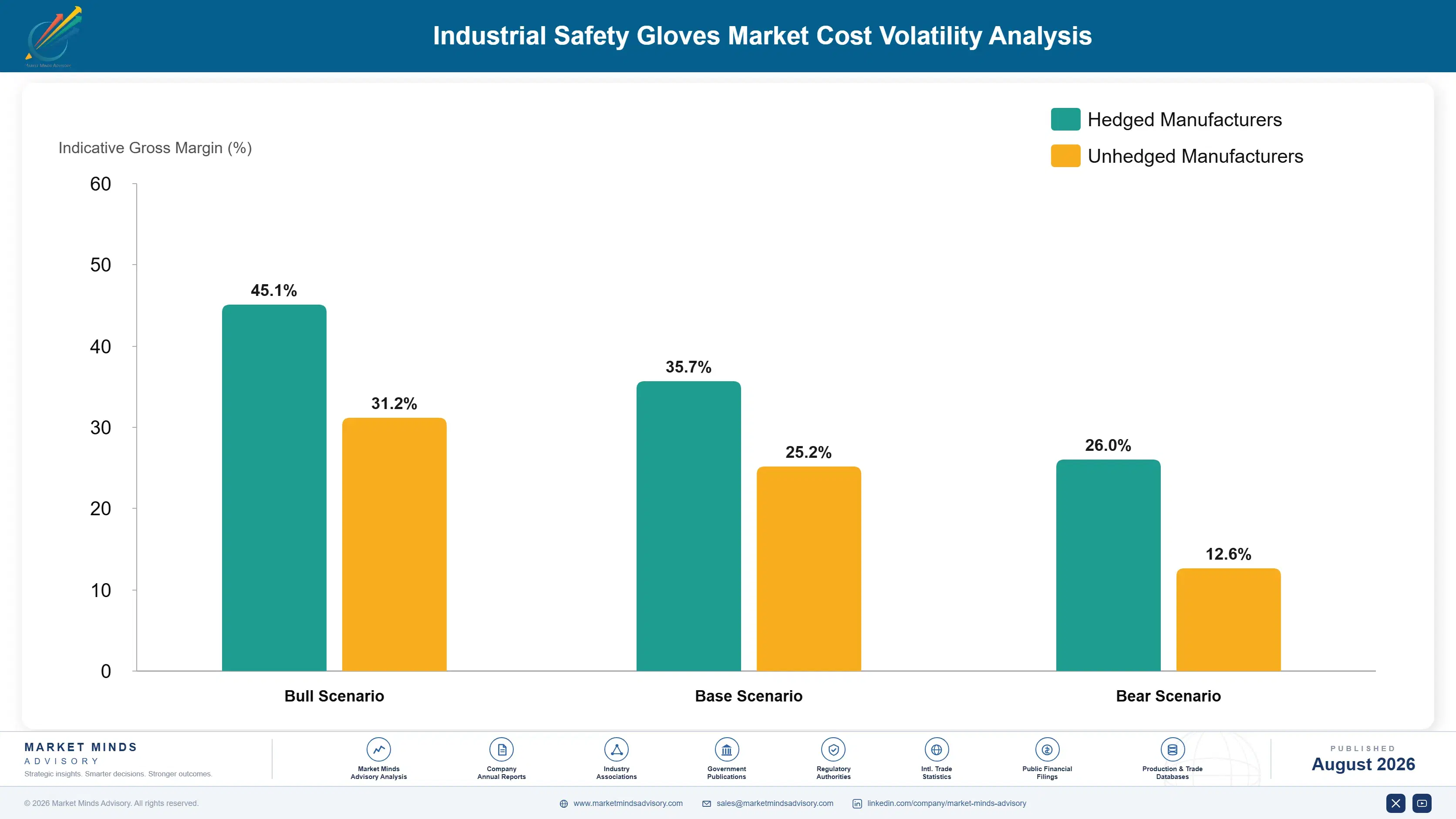
Specialty Fiber and Coating Material Exposure

High-performance cut-resistant fibers and specialty coating materials account for 30 to 40% of safety glove manufacturing cost, with base fabric and packaging making up most of the remainder. Specialty fiber materials are sourced from a concentrated group of major chemical and textile suppliers, while base fabric and packaging draw on a broader, more fragmented industrial supply base.
Specialty fiber and coating material prices rose more than 24% within two quarters during 2022 as broader petrochemical commodity volatility spilled into specialty textile material availability, according to company annual report disclosures from major glove manufacturers. That constraint forced several manufacturers to extend delivery lead times and, in some cases, substitute alternative fiber blends mid-contract, an unusual compromise for equipment where material specification typically requires extensive advance certification testing.

Scale manufacturers like Ansell and Honeywell negotiate specialty fiber and coating material supply contracts across their full global product portfolio, giving them better pricing than smaller regional specialists buying materials at lower volumes. Manufacturers with long-standing fiber supplier relationships carry a durable cost and availability advantage over competitors relying on spot-market purchasing, reshaping which manufacturers can credibly commit to large employer contract delivery timelines.
industrial-safety-gloves-market-cost-volatility-analysis-1787301996914

Qualifying Multiple Fiber Suppliers

Manufacturers are qualifying specialty fiber and coating material suppliers across multiple regions rather than relying on a single textile source, reducing exposure to any single supplier's capacity constraints or price movements during commodity shortages. This adds material qualification complexity but has measurably reduced delivery delays passed through to employer customers during recent petrochemical supply disruptions.

Locking Multi-Year Fiber Supply Agreements

Larger manufacturers are negotiating multi-year fixed-price specialty fiber and coating material supply agreements directly with textile producers, trading some upside if prices fall for protection against sudden spikes tied to broader petrochemical market volatility. Smaller manufacturers without comparable purchasing volume typically cannot access these terms and remain more exposed to spot material pricing swings throughout the year.

Building Fiber Inventory Buffer Stock

Several manufacturers are maintaining larger buffer inventory of critical specialty fiber and coating materials rather than ordering strictly against confirmed customer orders, trading working capital investment for delivery reliability during supply disruptions. Smaller manufacturers without comparable working capital access typically cannot pursue this path and remain more exposed to material availability and pricing constraints.

Portfolio Architecture for Margin Defence

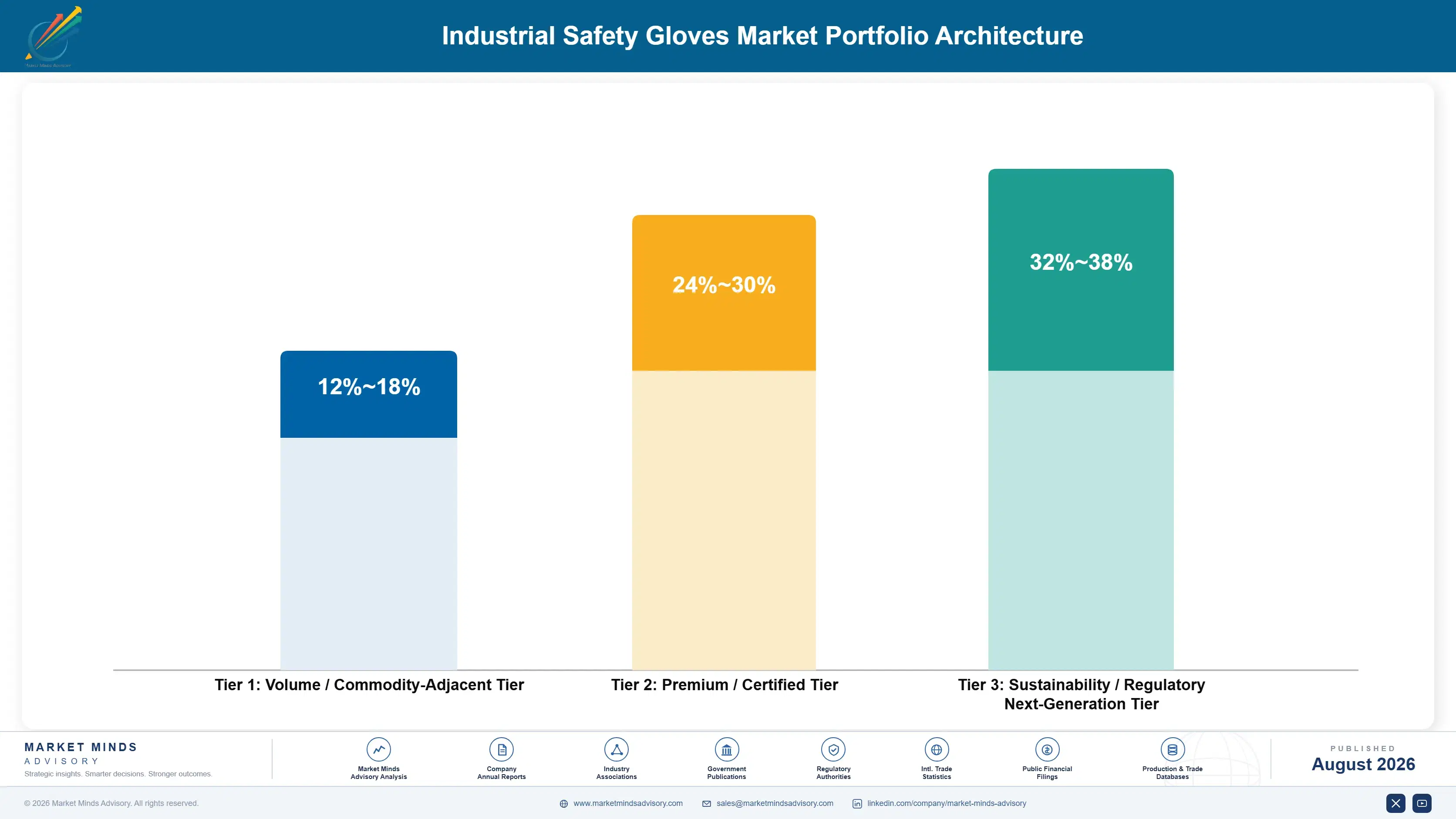
Portfolio economics split into three tiers. Volume commodity-adjacent gloves, primarily basic cotton and disposable nitrile configurations, run on thin margins driven by intense price competition among regional manufacturers and increasingly capable Asian suppliers. Premium and certified gloves, carrying ANSI cut-level certification and validated hazard performance data, command meaningfully better margins because employers pay for reduced liability exposure and documented compliance capability.
The tension between volume and premium runs deep, since cost-constrained smaller employers want the lowest acquisition cost per glove while liability-conscious and regulated industrial customers increasingly demand the certification capability that only premium-tier configurations deliver consistently. Ansell and Honeywell manage this by maintaining separate standard and premium product lines, letting employers choose configuration based on their specific hazard exposure and available budget.

High-value pools concentrate in cut-resistant and impact-resistant gloves, where specialty fiber technology and certification capability both support pricing power that ordinary basic gloves cannot replicate. Capital is flowing fastest into fiber blend development and compliance documentation software, as manufacturers race to establish the technology position that will define premium competitiveness through the next decade across every major regional market worldwide, not just the largest economies.

Volume / Commodity-Adjacent Tier

Basic cotton and disposable nitrile gloves without cut-level certification or specialty coating, priced primarily on unit cost and competing mainly on delivery speed and basic reliability across high-volume, price-sensitive light industrial applications.
Gross Margin: 12-18%

Premium / Certified Tier

ANSI-certified cut-resistant and impact-resistant gloves bundled with validated hazard performance data and compliance documentation that liability-conscious industrial customers value for reduced injury exposure and predictable regulatory compliance across the equipment lifecycle.
Gross Margin: 24-30%

Sustainability / Regulatory / Next-Generation Tier

Fully certified next-generation glove platforms with advanced fiber blends and compliance software integration addressing tightening workplace safety requirements, where material technology and early-mover advantage both support the strongest pricing power in the category currently.
Gross Margin: 32-38%
industrial-safety-gloves-market-portfolio-architecture-1787301997417

How Safety Glove Demand Recurs

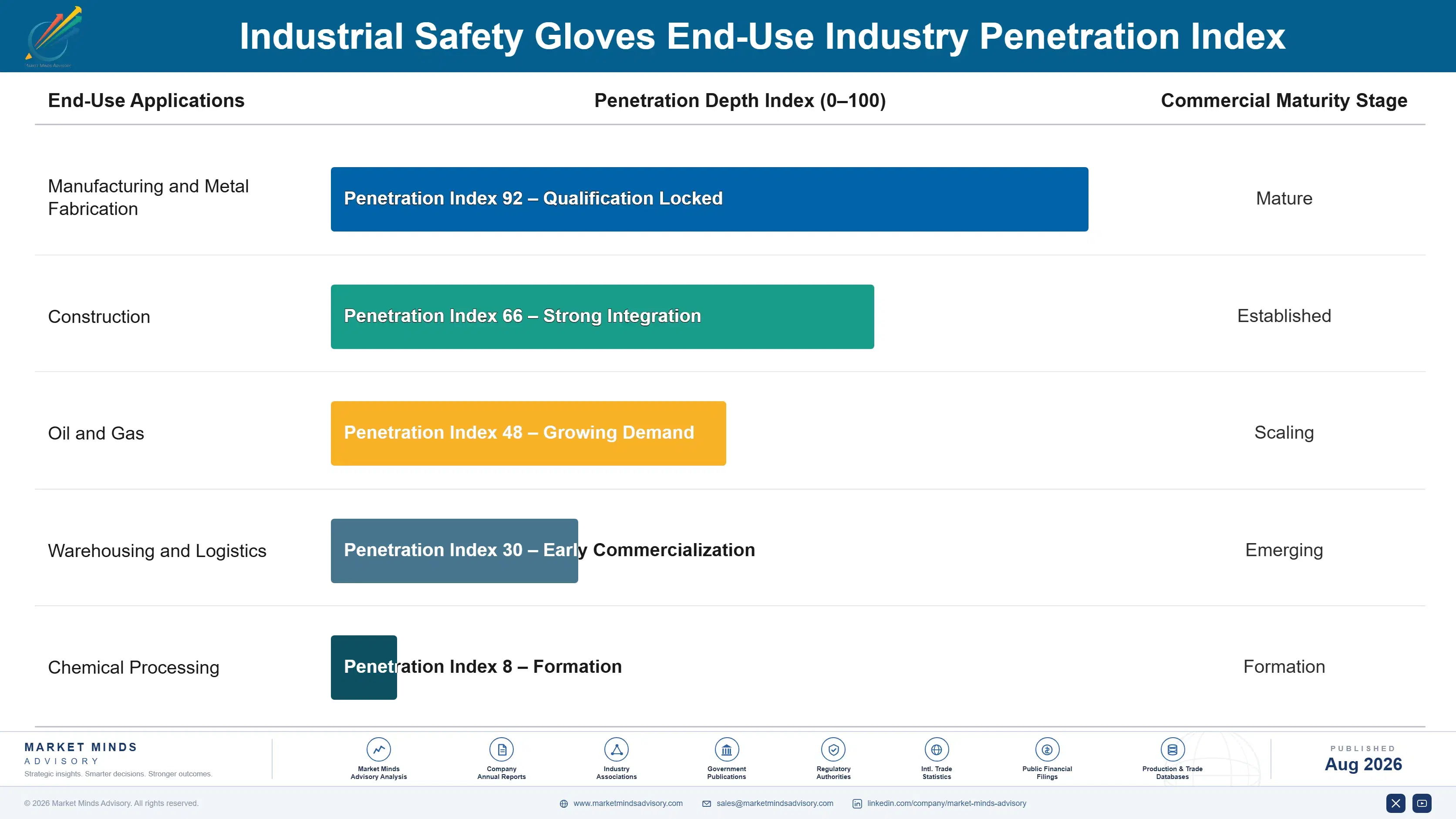
Industrial safety glove demand carries a genuine annuity quality through replacement cycles, compliance documentation subscriptions, and training programs layered on top of the initial procurement contract. Employers require ongoing glove replacement to preserve hazard protection regardless of capital spending cycles, and training program renewal rates above 48% give manufacturers a recurring revenue stream that persists independent of new employer acquisition cycles or broader capital spending
Adoption depth varies meaningfully by job category. Metal fabrication and high-hazard manufacturing roles show the deepest certified adoption, since injury rates and liability exposure are both most demanding there. Construction and warehousing roles show growing but more varied adoption, tracking regulatory implementation timelines more closely. General assembly and light industrial roles remain earlier-stage, since basic uncertified gloves still dominate those lower-value, more price-sensitive applications across most current markets globally.

A younger generation of safety managers, trained on data-driven compliance dashboards and documented hazard assessment rather than informal glove selection routines, is accelerating demand for certified glove platforms. That generational shift is reshaping which manufacturers even get invited into large employer procurement evaluation processes, reshaping vendor shortlist criteria as a result.
industrial-safety-gloves-market-end-use-penetration-index-1787301997903

What Wins in Safety Gloves

These are among the four positions where our research anticipates prominent divergence between winners and laggards over the coming forecast period. Each is grounded in the demand model, the regulatory perimeter, and the announced capacity pipeline.
01 / CERTIFICATION TECHNOLOGY INVESTMENT

Invest in fiber certification before it becomes standard equipment

Manufacturers that invest in specialty fiber certification ahead of it becoming standard equipment capture premium pricing and liability-driven specification access before that becomes a baseline market expectation rather than a differentiator. Waiting until certification becomes standard means competing for employer safety budgets against makers that built their fiber technology reputation years earlier, at a moment when demand is accelerating across the entire category simultaneously. Early movers are also better positioned to win large employer contracts that increasingly specify certification compatibility as an evaluation criterion.
02 / LARGE EMPLOYER ENGAGEMENT

Engage employers early in procurement planning cycles directly

Manufacturers that engage large employers early in procurement planning capture disproportionate contract share since early engagement lets them influence technical specifications before a distributor writes a fixed specification favoring a competitor's products. Waiting until formal bids are published means competing purely on price against requirements a competitor may have already shaped in their own favor. The window to establish these early relationships narrows as safety programs mature and employers develop established vendor relationships that become harder to displace over subsequent renewal cycles.
03 / COMPLIANCE SOFTWARE INVESTMENT

Build proprietary compliance software rather than relying on third parties

Manufacturers that build proprietary PPE compliance tracking software capture recurring subscription revenue that persists independent of new employer acquisition cycles, unlike those relying on third-party compliance platforms that capture much of that margin instead. Ansell's and Honeywell's compliance software subscription attachment rates above 30% demonstrate how sticky this revenue becomes once employers build safety workflows around a specific platform's dashboard and reporting configuration. The window for proprietary compliance software to function as genuine differentiation narrows as third-party platforms become more capable and cheaper to integrate.
04 / COST-COMPETITIVE PRODUCT STRATEGY

Develop lower-cost certified configurations for price-sensitive expansion markets

Manufacturers that develop lower-cost certified configurations for price-sensitive expansion markets in India and Southeast Asia capture volume specification share that premium-only product lines cannot access, protecting market position as Asian competitors close the technology gap while maintaining meaningfully lower pricing. Manufacturers that rely exclusively on premium-tier products risk ceding entire expansion markets to competitors offering adequate certification at more accessible capital cost. The window to develop this cost-competitive positioning narrows as expansion markets mature and vendor relationships solidify around early entrants.

Engagement Snapshot From the Field

A live engagement with an industry participant carrying material or product regulatory and market exposure ahead of a defining policy shift, showing how our research translates into a defensible multi-year portfolio strategy.
MARKET MINDS ADVISORY · CLIENT ENGAGEMENT SUMMARY
Industrial Safety Gloves Producer Strategic Portfolio Review and Transition Roadmap 2026·Investment Scenario on Industrial Safety Gloves Exposure Evaluation 2025-26
CLIENT PROFILE
The client is a diversified industrial manufacturer operating 14 production facilities across eight states with more than 6,800 production workers, more than 55% of which remain equipped with basic uncertified gloves rather than hazard-appropriate certified protection, and evaluating a PPE modernization capital budget exceeding US$22 million (client-reported, unverified by MMA). The manufacturer was evaluating vendor selection and rollout sequencing ahead of finalizing its modernization plan.
STRATEGIC CHALLENGE
The client needed to determine which facilities and job categories should receive priority certified glove conversion and which vendor would deliver sufficient hazard protection to satisfy both emerging OSHA enforcement priorities and internal injury reduction goals, given budget constraints that made workforce-wide conversion impractical within a single funding cycle without exceeding approved capital limits.
MMA APPROACH
MMA conducted a facility-by-facility analysis correlating current injury claim history, job hazard exposure, and regulatory risk against available glove vendor options and financing structures. The engagement combined primary interviews with the manufacturer's safety staff and comparative benchmarking against peer manufacturers that had already begun certified glove conversion programs of their own.
KEY FINDINGS
  1. Roughly 32% of the client's job categories, concentrated at the highest-hazard fabrication stations, accounted for a disproportionate share of historical hand injury claims and lost-time incidents.
  2. Certified conversion at the highest-hazard job categories alone would generate enough injury claim reduction savings to justify the investment within approximately two years.
  3. Available insurance underwriting incentives favored certified and compliance-documented configurations specifically, meaningfully reducing the client's effective incremental cost for the premium technology tier.
  4. Peer benchmarking showed manufacturers that prioritized high-hazard job categories for early conversion achieved better overall program returns than those converting facilities uniformly by age.
CLIENT PROFILE
The client is a diversified industrial manufacturer operating 14 production facilities across eight states with more than 6,800 production workers, more than 55% of which remain equipped with basic uncertified gloves rather than hazard-appropriate certified protection, and evaluating a PPE modernization capital budget exceeding US$22 million (client-reported, unverified by MMA). The manufacturer was evaluating vendor selection and rollout sequencing ahead of finalizing its modernization plan.
STRATEGIC CHALLENGE
The client needed to determine which facilities and job categories should receive priority certified glove conversion and which vendor would deliver sufficient hazard protection to satisfy both emerging OSHA enforcement priorities and internal injury reduction goals, given budget constraints that made workforce-wide conversion impractical within a single funding cycle without exceeding approved capital limits.
MMA APPROACH
MMA conducted a facility-by-facility analysis correlating current injury claim history, job hazard exposure, and regulatory risk against available glove vendor options and financing structures. The engagement combined primary interviews with the manufacturer's safety staff and comparative benchmarking against peer manufacturers that had already begun certified glove conversion programs of their own.
KEY FINDINGS
  1. Roughly 32% of the client's job categories, concentrated at the highest-hazard fabrication stations, accounted for a disproportionate share of historical hand injury claims and lost-time incidents.
  2. Certified conversion at the highest-hazard job categories alone would generate enough injury claim reduction savings to justify the investment within approximately two years.
  3. Available insurance underwriting incentives favored certified and compliance-documented configurations specifically, meaningfully reducing the client's effective incremental cost for the premium technology tier.
  4. Peer benchmarking showed manufacturers that prioritized high-hazard job categories for early conversion achieved better overall program returns than those converting facilities uniformly by age.
RECOMMENDED STRATEGY
Phase 1: Phase 1 (Months 1-3): Prioritize certified glove conversion at the highest-hazard job categories identified through the injury claim analysis conducted earlier. Phase 2: Phase 2 (Months 4-14): Expand conversion to remaining facilities, sequencing rollout by available insurance incentives and updated job hazard assessments. Phase 3: Phase 3 (Months 15-22): Evaluate program performance against injury reduction and compliance assumptions, then finalize remaining facility timelines and budget allocations.
OUTCOME
The client's phased conversion program reduced hand injury claims at the priority job categories meaningfully within the first operating year, exceeding its internal base case projection (client-reported, unverified by MMA). Prioritizing high-hazard job categories rather than uniform facility-wide conversion improved overall program return on investment across the full workforce network.

Frequently Asked Questions

Foundational context covering the market sizes, CAGR, scope, country, region and competition that inform every finding below. This section is provided to cover basics and most often pre-purchase conversations, answered from the MMA Primary Research Dataset.

What is the current size of the Industrial Safety Gloves Market?

The market was valued at US$9.8 billion in 2025 and is projected to reach US$10.4 billion in 2026 as manufacturing employment and safety regulation enforcement continue accelerating.

How large will the Industrial Safety Gloves Market be by 2036?

MMA projects the market will reach US$19.3 billion by 2036, roughly 1.86 times its 2026 value, driven by certified glove conversion and regulatory adoption growth.

What is the CAGR for the Industrial Safety Gloves Market 2026 to 2036?

The market is projected to grow at a 6.4% CAGR between 2026 and 2036, with a bull case of 7.7% and a bear case of 5.1%.

Which segment is growing fastest?

Cut-resistant gloves are the fastest-growing segment at 9.4% annually, roughly 47% faster than the category average, driven by metal fabrication and glass handling hazard demand.

Who are the major companies in the Industrial Safety Gloves Market?

Leading manufacturers include Ansell, Honeywell, MCR Safety, Superior Glove, and Showa Group, which together hold roughly one-third of category revenue on a disclosed-revenue basis globally.

Which country is growing fastest?

Vietnam leads country-level growth at an estimated 9.8% annually, supported by rapidly expanding manufacturing employment and improving workplace safety enforcement across major industrial provinces nationwide.

Report Segmentation Architecture

The full report scope spans multiple orthogonal segmentation dimensions, with cross-tabulated demand data provided for each dimension pair. Coverage extends further to regional breakdowns, trend trajectories, and the competitive detail needed to support segment-level decision-making.

By Material and Technology Type

  • Cut-Resistant Gloves
  • Chemical-Resistant Gloves
  • Disposable Nitrile Gloves
  • Leather and Heavy-Duty Gloves
  • Coated and Dipped Gloves
  • Impact-Resistant Gloves

By End-Use Industry

  • Manufacturing and Metal Fabrication
  • Construction
  • Oil and Gas
  • Warehousing and Logistics
  • Chemical Processing

By Commercial Dimension

  • Employer Direct
  • Industrial Distributor
  • Safety Supply Retailer
  • Distribution Channel

By Region

  • North America
  • Western Europe
  • East Asia
  • South Asia and Pacific
  • Latin America
  • Middle East and Africa
  • Eastern Europe

Scope, Methodology, and Coverage

Every figure in this report is reproducible from documented input assumptions. The scope below maps the historical period, the forecast horizon, the segmentation dimensions, and the countries covered, alongside the underlying primary and qualitative methodology.
Historical Period
2020 to 2025
Forecast Period
2026 to 2036
Base Year
2025 (USD billions; MMA Primary Research Dataset, August 2026)
Market Definition
The Industrial Safety Gloves market covers hand protection equipment designed for occupational use in manufacturing, construction, oil and gas, and warehousing environments, including cut-resistant, chemical-resistant, impact-resistant, and coated work gloves sold to industrial employers and safety distributors. It excludes disposable medical examination gloves, household consumer gloves, and sporting or recreational hand protection products.
Quantitative Units
USD billions (current prices); unit shipments in millions where disclosed by segment
Segmentation Dimensions
By Material and Technology Type; By End-Use Industry; By Commercial Dimension; By Region
Regions Covered
North America, Western Europe, East Asia, South Asia and Pacific, Latin America, Middle East and Africa, Eastern Europe
Countries Covered
USA, China, Germany, France, UK, Japan, South Korea, India, Australia, Canada, Brazil, Mexico, Indonesia, Vietnam, Thailand, Malaysia, UAE, Saudi Arabia, South Africa, Nigeria, Turkey, Poland, Netherlands, Italy, Spain, Sweden, Switzerland, Argentina, Colombia, Singapore, and additional markets relevant to this sector
Key Companies Profiled
Ansell Limited, Honeywell International Inc., MCR Safety, Superior Glove Works Ltd., Showa Group, Towa Corporation, Top Glove Corporation Bhd., Kossan Rubber Industries Bhd., Supermax Corporation Bhd., Hartalega Holdings Bhd., Delta Plus Group, Uvex Safety Group, Lakeland Industries Inc., Radians Inc., Protective Industrial Products Inc.
Quantitative Methodology
Primary survey, n=3,800 respondents, Q4 2025, six countries; demand-side model with trade association cross-validation
Qualitative Methodology
47 expert interviews, Q4 2025; applied to validate demand model assumptions, identify emerging dynamics, and assess competitive positioning
Report Format
PDF and XLSX data workbook (Word format preview document)
Publisher
Market Minds Advisory
Report Code
MMA-2026-CON-124
Published
August 2026
Contact
sales@marketmindsadvisory.com | www.marketmindsadvisory.com

Purchase the full Industrial Safety Gloves Market Report (2026 to 2036).

The full report delivers a complete quantitative and qualitative assessment of the industrial safety gloves market through 2036, including material-type and country-level forecasts across all seven MMA-tracked regions. It profiles the twenty leading manufacturers shaping competitive dynamics, with detailed moat and risk analysis for the top two players and a full development timeline of recent corporate activity. The report includes primary survey data from 3,800 respondents and 47 expert interviews conducted in Q4 2025, alongside a dedicated input cost and regulatory adoption analysis. Buyers receive segmentation, regional, and competitive datasets formatted for direct integration into internal strategic planning models.
Material-type and regional forecasts through 2036 inclusive
Competitive profiles of twenty leading global manufacturers
Primary survey data from 3,800 global respondents
Expert interview insights from 47 industry practitioners
Input cost and regulatory adoption risk analysis
Editable data tables for internal strategic modeling

Built For The People Who Decide

From boardroom strategy to bench-side execution, this report is read cover-to-cover by leaders shaping the next decade of their industry, turning demand scenarios, market dynamics and valuation benchmarks into decisions.
CXOs/ Presidents/ VPs/ Managers
M&A and Corporate Development
Strategy Teams and R&D Heads
Procurement and Product Directors
Regulatory and Compliance Leaders
Investor Relations and Equity Analysts