Market Minds Advisory
Industrial Nailers Market

Industrial Nailers Market: Cordless Conversion, Battery Platforms, and the Framing Cycle

Framing crews are trading fuel cells and air hoses for battery packs faster than tool makers can requalify supply chains, even as cordless nailers still cost more upfront than the pneumatic guns they replace.

Lead Analyst

David Horsley

Published

September 2026

Make Smarter Decisions with Customized Research Insights

Request a free sample report and evaluate market opportunities, growth trends, and competitive dynamics relevant to your business needs.

2025 MARKET VALUE$3.2BMarket Size 2025
2036 FORECAST VALUE$6.3BBase Case , 2026 to 2036
CAGR 2026 TO 20366.4 %Bull 7.7% / Bear 5.1%
INCREMENTAL OPPORTUNITY$2.9BNet 10- year value creation
EXPANSION MULTIPLE1.86x2036 value over 2026 base
Strategic Levers
M&A Pipeline
Regional Outlook
Country Rankings
Competitive Intelligence
Segmental Deep-dive
Call-Us : 91 93563 13602

Executive Snapshot and Market Trajectory

Cordless brushless nailers are converting professional framing crews away from pneumatic and fuel-powered guns faster than most tool makers had planned for, as battery platform convergence with drills and saws now makes a cordless nailer the easier purchase decision on nearly every crew replacement cycle.
Pneumatic nailers still carry the largest installed base, but cordless brushless and battery-pneumatic hybrid models pull growth fastest as contractors consolidate tool purchases around a single battery platform across their entire crew. North America hosts the largest regional share given wood-frame construction intensity unmatched elsewhere, while South Asia and Pacific compounds fastest as India's construction boom pulls power tool adoption past hand-nailing practices that dominated for decades.
Five suppliers hold well over half of a genuinely concentrated global market, and Stanley Black & Decker's broad DEWALT and Bostitch brand portfolio has proven durable even as Illinois Tool Works' Paslode fuel-cell franchise faces real long-term share erosion to cordless alternatives. Battery platform lock-in, housing start cyclicality, and cordless technology maturation now decide who wins large contractor fleet contracts faster than any single nailer design improvement moving through this category this decade.
Market Definition
The industrial nailers market covers powered fastener-driving tools engineered for professional and industrial nail-driving applications, spanning pneumatic, cordless battery, fuel-powered, and corded electric drive mechanisms. Consumer-grade craft nailers and upholstery staple guns are excluded from scope.
Base Year Value
$3.2B in 2025 (MMA Primary Research Dataset, August 2026)
Forecast Period
2026 to 2036, eleven discrete annual values
CAGR
6.4% base case. Bull 7.7%. Bear 5.1%.
Fastest Growth Segment
Cordless Brushless Direct-Drive Nailers: 11.2% CAGR
Fastest Growth Country
India: 8.5% CAGR
Fastest Growth Region
South Asia and Pacific: 8.5% CAGR
Largest Region
North America: 29% of 2025 global value
Market Leaders
Stanley Black & Decker, Illinois Tool Works, Techtronic Industries, Makita, and Robert Bosch. Source: MMA Primary Research Dataset, July 2026.
Primary Survey
n=3,800 procurement and R&D decision-makers, Q4 2025, six countries
Methodology
Demand-side build-up, cross-validated against public data, 47 expert interviews

Industrial Nailers Market Forecast Scenarios

industrial-nailers-market-size-forecast-scenario-1787300860346
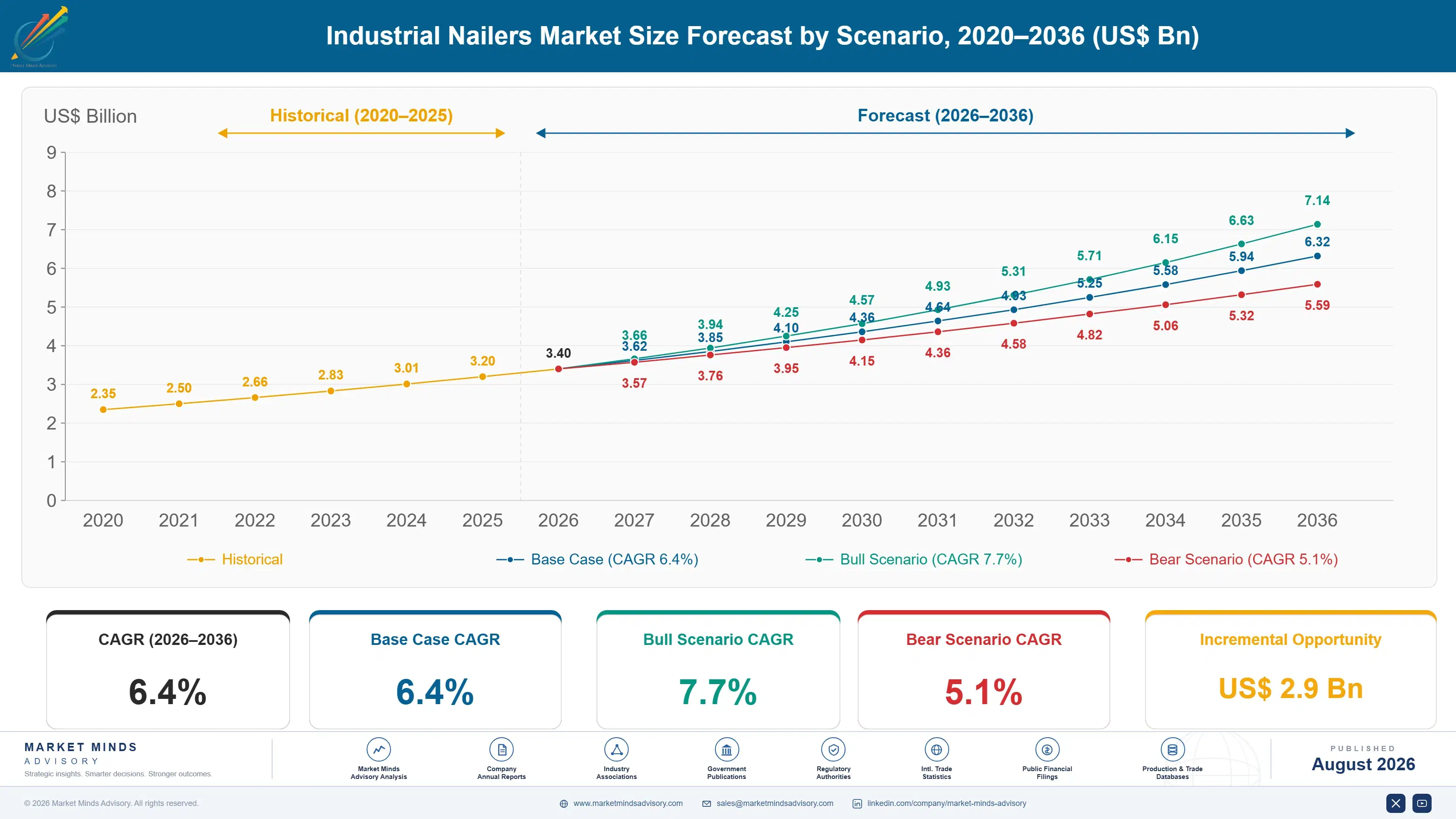
Industrial nailer demand grew near 5.4% annually between 2020 and 2025, distorted by a 2020 to 2021 pandemic-driven residential construction and home renovation surge before housing start normalisation and interest rate pressure moderated growth through the back half of the period across most major construction markets worldwide, particularly across mature North American and Western European economies.
The base case reaches 6.4% on three mechanisms. First, cordless brushless technology keeps maturing, closing the performance gap with pneumatic tools that once justified compressor and hose infrastructure on every job site. Second, battery platform convergence pulls contractors toward single-platform tool fleets that make cordless nailers the default purchase rather than a premium upgrade. Third, residential and commercial construction growth across South Asia and the Gulf sustains steady volume growth in markets still transitioning away from hand-nailing practices.
The bull case at 7.7% assumes cordless technology adoption accelerates faster than currently modelled and housing starts recover more strongly than presently expected across major construction markets simultaneously. The bear case at 5.1% assumes elevated interest rates continue suppressing residential construction activity and contractors defer fleet replacement cycles amid tighter project margins across the industry.

Battery Platform Economics Reshaping Tool Fleets

Industrial nailers behave like an accessory to a broader battery platform decision wearing a standalone tool label. Cordless nailers compete on platform compatibility and job site convenience, while pneumatic nailers compete on raw drive power and per-unit cost across an entirely different contractor purchasing calculus, and both formats draw on overlapping steel component and battery cell supply chains a single feedstock shock can disrupt at once.
CR5 CONCENTRATION58%Top five suppliers hold well over half of shipments
AVERAGE SELLING PRICEUSD 245 per unitBlended price across cordless and pneumatic formats today
LEADING PRODUCING COUNTRYChina, 31% shareOne country dominates global nailer manufacturing capacity broadly
CORDLESS PENETRATION RATE44% of new salesShare of new nailer purchases now specifying battery power
TRADE INTENSITY38% cross-borderA meaningful share of finished units crosses a border
BATTERY CELL SHARE18-24% of COGSLithium-ion cell packs dominate cordless format input cost
Commercial activity concentrates around contractor fleet standardisation rather than individual tool sales alone. Suppliers that hold the broadest cordless battery platform win fleet contracts that single-category pneumatic specialists increasingly cannot match once a contractor commits to one platform, since switching battery platforms mid-fleet carries real cost most contractors avoid unless genuinely forced to by a supplier's discontinued product line.
Over the next decade, battery platform lock-in and cordless technology maturation will matter more than any single nailer design improvement introduced this cycle. Housing start cycles, contractor fleet standardisation, and fuel-cell category decline will decide who captures the next wave of large contractor fleet contracts before purchasing decisions lock in for years at a time across most tracked construction markets globally.
"Pneumatic nailers won't disappear, but the premium contractors once paid for cordless convenience is now the price of staying inside a fleet's battery platform. Paslode's fuel-cell loyalists are the one segment cordless still hasn't fully cracked."
Director, Industrial Tools and Equipment Practice · MMA Construction and Fasteni

Market Trends

Battery Platform Convergence Locks In Contractor Fleet Purchases

Milwaukee Tool, DEWALT, and Makita have all expanded cordless nailer lines specifically designed to share battery packs with their existing drill, saw, and grinder platforms, converting a standalone tool purchase decision into a platform-wide fleet commitment. Contractors who already own a fleet of cordless drills and saws increasingly default to the matching cordless nailer rather than maintaining separate pneumatic compressor infrastructure, since one battery platform simplifies charging logistics and reduces the tools a crew must transport between job sites. This convergence has pulled cordless nailer adoption meaningfully ahead of what standalone nailer performance improvements alone would explain.
Market Impact: Matches 95% of pneumatic drive force
Paslode Fuel-Cell Franchise Faces Durable Cordless Competition

Illinois Tool Works' Paslode brand pioneered fuel-powered nailers decades ago, building a loyal framing contractor base around fuel-cell convenience that once meaningfully outperformed early pneumatic and cordless alternatives on job sites without compressor access. Modern cordless brushless nailers have closed much of that convenience gap while eliminating the recurring fuel cell purchase cost that framing crews previously accepted as a standard operating expense. Paslode has responded by expanding its own cordless product lines, though the brand's historic identity remains closely tied to fuel-cell technology that a growing share of contractors now view as a transitional rather than permanent solution.
Market Impact: Adds 6 million power tool users

Market Opportunities and Growth Drivers

Cordless Brushless Technology Closes The Pneumatic Performance Gap

Brushless motor technology has meaningfully improved cordless nailer drive power and firing speed over the past several product generations, closing a performance gap that once forced professional framing crews to accept pneumatic tools despite compressor and hose infrastructure requirements. Makita and Milwaukee both report cordless nailer sales now approaching pneumatic-equivalent drive force specifications that professional contractors previously considered non-negotiable for structural framing work specifically. This technology maturation removes the primary objection that had kept cordless adoption confined mostly to lighter finish and trim applications rather than heavy structural work overall.
Market Impact: Adds 40% to 60% upfront cost

South Asian Construction Boom Pulls Power Tool Adoption Forward

India's residential and commercial construction sector has expanded rapidly on rising urbanization and infrastructure investment, pulling power tool adoption past traditional hand-nailing practices that dominated smaller-scale construction for decades across the subcontinent. Domestic and multinational tool distributors report meaningfully accelerating nailer sales growth as formal construction contractors increasingly specify power tools over manual labour for productivity reasons specifically tied to project timeline pressure. This transition mirrors patterns seen in other developing construction markets a generation earlier, though compressed into a considerably shorter adoption timeline given available modern cordless technology today.
Market Impact: Swings demand 15% across cycles

Market Restraints and Challenges

Cordless Battery Cost Premium Slows Budget-Conscious Adoption

Cordless brushless nailers typically cost 40% to 60% more than comparable pneumatic tools once battery packs and chargers are included, a premium that budget-conscious contractors and price-sensitive emerging markets still find difficult to justify despite genuine convenience benefits. The root cause is lithium-ion battery cell cost, which has declined meaningfully over the past decade but remains a substantial component cost relative to simpler pneumatic tool mechanisms that need no onboard power source. Suppliers are mitigating this through mid-tier hybrid product lines priced closer to pneumatic tools, narrowing the gap gradually for cost-sensitive buyers.
Market Impact: Lifts cordless share 12 points yearly

Housing Start Cyclicality Creates Genuine Demand Volatility

Nailer demand tracks residential construction activity closely, and elevated interest rates since 2022 have suppressed housing starts across several major markets, directly reducing the fleet replacement and expansion purchases that drive a meaningful share of category volume. The root cause is the direct sensitivity of new home construction to mortgage financing cost, a relationship that has held consistently across multiple economic cycles regardless of underlying tool technology improvements. Suppliers are mitigating exposure by expanding renovation and commercial-channel sales, which cushion against pure new-construction demand swings more effectively than a single-channel focus would.
Market Impact: Cuts fuel nailer share 8 points
4 additional market trends, 3 additional growth drivers, and 2 additional restraints and challenges are covered in the full report. Contact sales@marketmindsadvisory.com to access the complete intelligence.

Segment CAGR and Growth Architecture

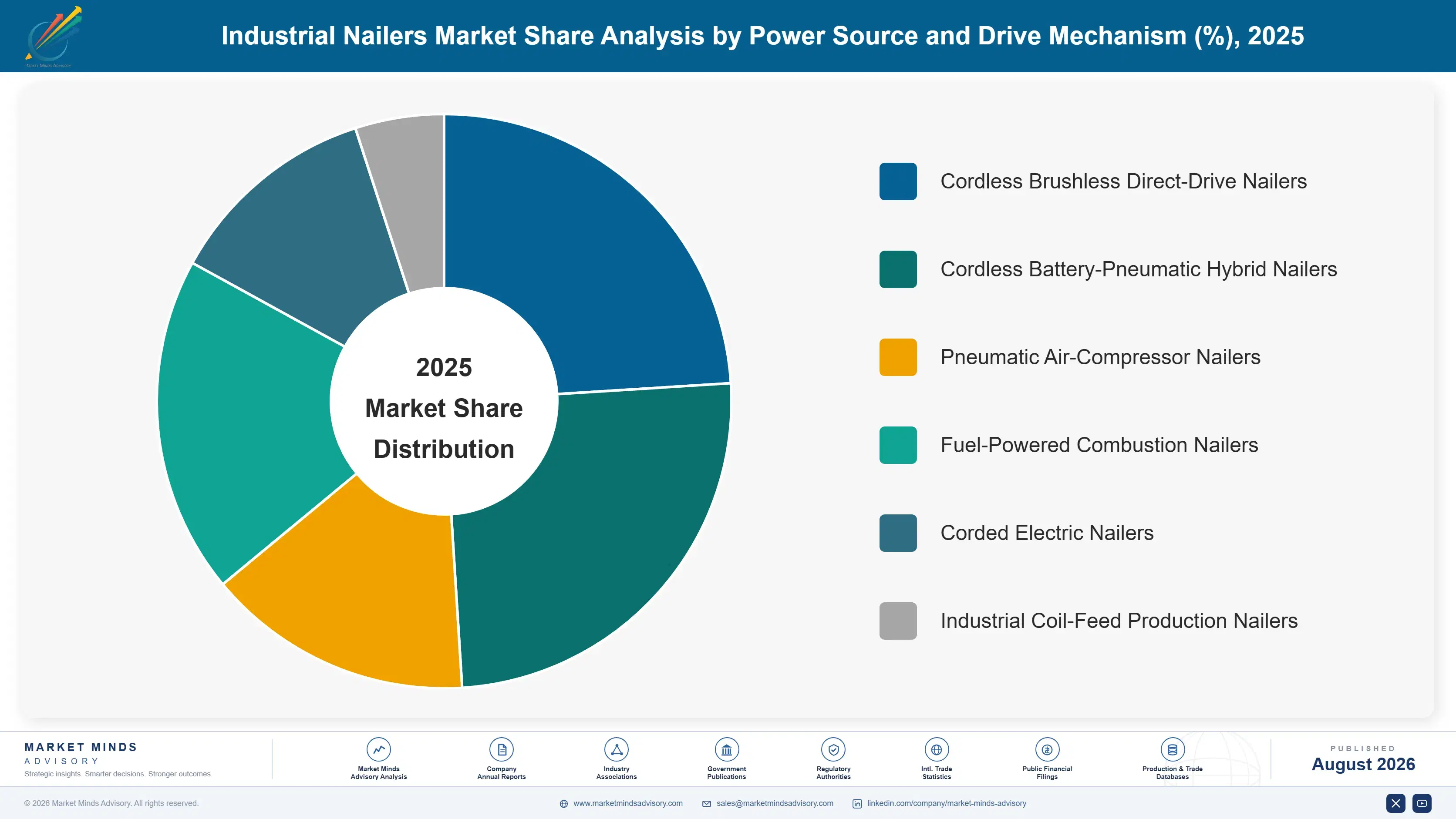
Segmentation follows power source and drive mechanism, a single classification logic grounded in how each nailer generates firing force, from brushless motor direct-drive to pneumatic air compression. Each mechanism carries its own capital equipment, battery or compressor dependency, and contractor purchasing calculus, so commercial position tracks drive technology rather than fastener application or job type.
industrial-nailers-market-market-share-analysis-1787300860883

Cordless Brushless Direct-Drive Nailers

Cordless brushless direct-drive nailers grow fastest at 11.2%, about 1.75 times the overall 6.4% rate, as brushless motor technology closes the drive-power gap with pneumatic tools that professional framing crews once considered non-negotiable for structural work. Makita and Milwaukee both lead this category specifically, having invested heavily in motor technology that eliminates the onboard compressor pneumatic-hybrid designs still require. This format benefits most directly from battery platform convergence, since a brushless nailer shares the same battery platform as a contractor's existing drills and saws without needing any separate compressed air infrastructure whatsoever. Adoption has moved beyond finish and trim applications into structural framing work as drive-power specifications now match pneumatic-equivalent performance for most job site requirements today.
CAGR 11.2%

Cordless Battery-Pneumatic Hybrid Nailers

Cordless battery-pneumatic hybrid nailers grow second-fastest at 9.5%, using a small onboard compressor powered by a standard battery pack to deliver pneumatic-equivalent drive force without requiring an external air hose connection. DEWALT pioneered this approach specifically, targeting contractors who wanted cordless convenience without sacrificing the drive consistency pneumatic tools have long delivered reliably. This hybrid format occupies a middle position between pure brushless direct-drive and traditional pneumatic tools, appealing to contractors transitioning away from compressor infrastructure but not yet fully confident in brushless-only drive power for the heaviest structural applications on site. Battery consumption runs higher than brushless direct-drive designs, a genuine trade-off contractors weigh against the format's drive-force reliability.
CAGR 9.5%
Full segment breakdown across 6 segments available in the complete report.

Regional Architecture and Country Demand Map

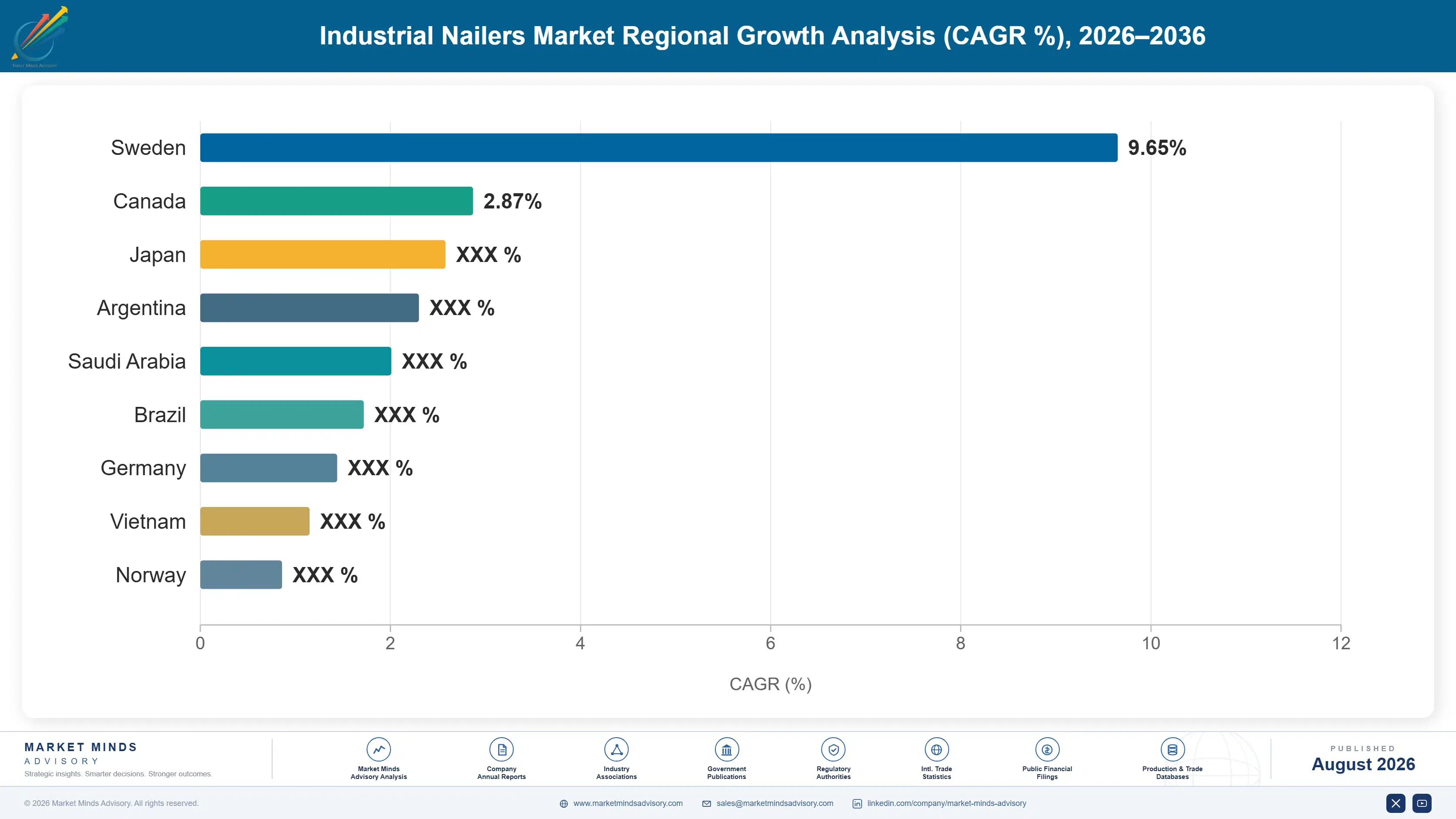
Seven regions divide between construction methodology and cordless adoption pace. North America holds the largest share given wood-frame construction intensity that consumes far more nailer volume per housing unit than masonry-dominant building methods, while South Asia and Pacific compounds fastest as India's construction boom pulls power tool adoption forward.

North America

Wood-frame residential construction, the dominant building method across the United States and Canada, consumes far more nailer volume per housing unit than the masonry and concrete construction methods common elsewhere globally, anchoring this region's outsized demand advantage. Stanley Black & Decker and Illinois Tool Works both maintain their primary manufacturing and product development operations domestically, giving the region genuine innovation leadership beyond just consumption scale. Cordless adoption runs ahead of other regions here, since major professional contractors were early to standardise fleets around single battery platforms from Milwaukee, DEWALT, and Makita specifically. Growth trails the fastest-expanding regions because the market is already large and mature, so incremental growth comes mainly from cordless format conversion rather than new construction volume overall.
Share: 29% | CAGR: 6.5% (2026 to 2036)

Western Europe

Masonry and concrete construction methods dominate across most Western European residential building, genuinely limiting nailer consumption per housing unit relative to North America's wood-frame construction intensity specifically and consistently. Bosch and Hilti both anchor substantial regional manufacturing and distribution operations, serving professional contractors across interior finish, roofing, and flooring applications where nailers remain genuinely essential regardless of the primary structural building method used. Germany and the UK's renovation and remodelling markets sustain steady demand independent of new construction cycles specifically. Growth trails East Asia and South Asia because the underlying construction methodology here fundamentally caps how much nailer volume the region can ever consume per completed building, year after year.
Share: 19% | CAGR: 4.9% (2026 to 2036)
Regional intelligence for 5 additional markets available in the complete report: East Asia, South Asia and Pacific, Latin America, Middle East and Africa, Eastern Europe. Contact sales@marketmindsadvisory.com.
industrial-nailers-market-country-cagr-analysis-1787300861445

How Nailer Makers Can Capture More Margin

Margin in this market concentrates where battery platform breadth, cell supply security, and fleet bundling protect a supplier from pneumatic price competition and contractor switching costs simultaneously across the entire purchasing relationship. The four moves below shift revenue toward contractors who pay for platform convenience rather than nailers priced purely off raw drive force alone.

Expand Cordless Lines To Defend Against Pneumatic Share Loss

Pneumatic nailer manufacturers without a credible cordless product line are losing contractor fleet contracts to competitors offering battery platform compatibility, regardless of how competitive their pneumatic pricing remains on a standalone basis. Suppliers expanding cordless brushless and hybrid product lines can capture pricing roughly 15% to 25% above equivalent pneumatic tools while also securing the fleet-wide contracts that pure pneumatic specialists increasingly cannot bid for. Milwaukee and Makita both moved early into cordless nailers specifically to defend broader battery platform relationships, and their resulting market position gives them leverage competitors entering later cannot easily close.
Market Impact: Captures a 15% to 25% cordless price premium

Build Battery Platform Bundles Across Drill And Saw Lines

Contractors increasingly evaluate nailer purchases as part of a broader battery platform decision rather than a standalone tool choice, and suppliers bundling nailers with drills, saws, and grinders on shared battery packs capture cross-sell revenue that single-category competitors cannot access. This bundling approach typically increases total fleet spend per contractor by roughly 20% to 30% compared with piecemeal individual tool purchases spread across competing brands. Suppliers without a broad cordless tool portfolio increasingly lose entire fleet contracts to platform competitors, regardless of how their standalone nailer compares on price or performance specifications.
Market Impact: Lifts fleet spend per contractor by 20% to 30%

Secure Long-Term Lithium-Ion Cell Supply Agreements

Lithium-ion battery cell cost represents a meaningful and growing share of cordless nailer production cost, and suppliers without secured long-term cell supply agreements face genuine margin exposure during tight battery demand cycles driven by broader electric vehicle and consumer electronics competition for the same cell manufacturing capacity. Suppliers locking multi-year cell supply agreements with battery manufacturers, rather than buying entirely on the spot market, typically secure pricing roughly 10% to 15% below spot rates during tight cycles specifically. This supply security increasingly separates suppliers who can maintain stable cordless pricing from those exposed to sudden cell cost spikes.
Market Impact: Secures cell pricing 10% to 15% below spot

Target South Asian Construction Growth With Entry-Level Cordless Tools

India and Vietnam's rapidly expanding construction sectors represent a genuinely underserved market for entry-level cordless nailers priced below the premium professional tools that dominate mature Western markets, where most contractors still use hand-nailing or basic pneumatic tools instead. Suppliers developing entry-level cordless product lines specifically for these price-sensitive but rapidly growing markets are capturing new customer acquisition at rates meaningfully above the category average in mature markets, roughly 35% to 45% higher new-user growth than suppliers focused solely on premium professional segments elsewhere. This represents a genuine first-mover opportunity before competitors recognise the addressable market scale.
Market Impact: Wins roughly 35% to 45% more new customers

Who Controls the Margin Pool

Concentration is genuine at CR5 58%, assessed on installed nailer shipment volume, and the gap between leader and challenger reflects brand portfolio breadth as much as manufacturing scale. Stanley Black & Decker's multi-brand distribution and Illinois Tool Works' Paslode franchise each defend distinct contractor loyalty neither has fully displaced.
Three dimensions define current activity. Cordless product line racing continues as suppliers expand brushless and hybrid formats faster than pneumatic-only competitors can respond credibly. Battery platform bundling is accelerating, as suppliers cross-sell nailers alongside drills and saws on shared platforms. Cell supply security keeps advancing too, as suppliers lock long-term lithium-ion agreements to insulate margin from battery demand competition with electric vehicles and consumer electronics.

Pressure is building from two directions at once. Regional Chinese manufacturers are expanding cordless capacity aggressively, testing whether established Western brands can defend premium positioning against steadily improving build quality. Meanwhile large retailers themselves are exploring private-label cordless tool lines, threatening to compress independent brand margin on commodity-grade contractor purchases specifically. Rankings will shift toward suppliers combining battery platform breadth with cell supply security, not toward whoever ships the most pneumatic tonnage globally.
industrial-nailers-market-company-positioning-matrix-1787300861963

Competitive Moat and Risk Dimensions

STANLEY BLACK & DECKER

Moat: Broadest Multi-Brand Distribution Portfolio

Stanley Black & Decker's DEWALT, Bostitch, and Porter-Cable brands together span professional, mid-tier, and value price points, letting it capture contractor spend across nearly every purchasing tier rivals with narrower portfolios cannot match. That breadth advantage compounds as more contractors consolidate purchasing toward fewer preferred suppliers.
STANLEY BLACK & DECKER

Risk: Housing Start Cyclicality Exposure

A substantial share of Stanley Black & Decker's nailer revenue ties to residential construction activity that fluctuates meaningfully with interest rate cycles and mortgage financing conditions beyond the company's direct control. A prolonged housing downturn would compress this revenue base faster than diversified industrial-focused competitors would feel it.
ILLINOIS TOOL WORKS (PASLODE)

Moat: Fuel-Cell Technology And Contractor Loyalty

Illinois Tool Works' Paslode brand built decades of framing contractor loyalty around fuel-cell convenience that once meaningfully outperformed early alternatives, and that brand equity still commands premium pricing among contractors who trust the format's reliability. Loyal repeat customers continue anchoring steady replacement demand despite broader category headwinds.
ILLINOIS TOOL WORKS (PASLODE)

Risk: Fuel-Powered Category Facing Cordless Erosion

The fuel-powered nailer category Paslode pioneered faces genuine long-term share erosion as cordless brushless alternatives close the convenience gap while eliminating recurring fuel cell purchase costs contractors increasingly resent. A faster-than-expected cordless conversion wave would compress Paslode's core franchise faster than diversified competitors would feel it.

Key Players

Stanley Black & Decker Inc.
Illinois Tool Works Inc. (Paslode brand)
Techtronic Industries Co. Ltd. (Milwaukee Tool, Ryobi brands)
Makita Corporation
Robert Bosch GmbH

Others

Koki Holdings Co. Ltd. (Metabo HPT / Hitachi Koki)
Hilti Corporation
Max Co. Ltd. (MAX USA)
Senco Brands Inc.
Grip-Rite (PrimeSource Building Products)
NuMax Tools
Freeman Tools
Campbell Hausfeld
Duo-Fast Corporation
Metabowerke GmbH
Ridgid
Fasco
Rapid Group
Powernail Company
WEN Products

Recent Developments

MARCH 2026

Stanley Black & Decker announced an expanded DEWALT cordless nailer lineup specifically targeted at structural framing applications, adding drive-force specifications matching pneumatic-equivalent performance that professional framing crews had previously considered non-negotiable for heavy structural work, backed by an accompanying battery platform expansion across the wider DEWALT tool line.
Signal: A product launch, not an acquisition, signals Stanley's push to defend cordless share against competing platforms.
NOVEMBER 2025

Several major US building code authorities updated fastener specification standards for structural framing applications, clarifying which cordless and pneumatic nailer drive-force ratings satisfy code requirements that had created ambiguity for contractors and inspectors since prior standard revisions, following extended consultation with framing contractor associations nationwide.
Signal: A code clarification, not a corporate transaction, removes ambiguity that had slowed some cordless adoption decisions.
JUNE 2025

Illinois Tool Works signed a multi-year lithium-ion cell supply agreement with a major battery manufacturer, securing contracted cell volume for its expanding Paslode cordless product line ahead of anticipated demand growth across the broader cordless nailer category, insulating margin from spot-market battery price volatility through the contract term.
Signal: A supply agreement, not a joint venture, secures cell pricing without equity entanglement or shared operational control.

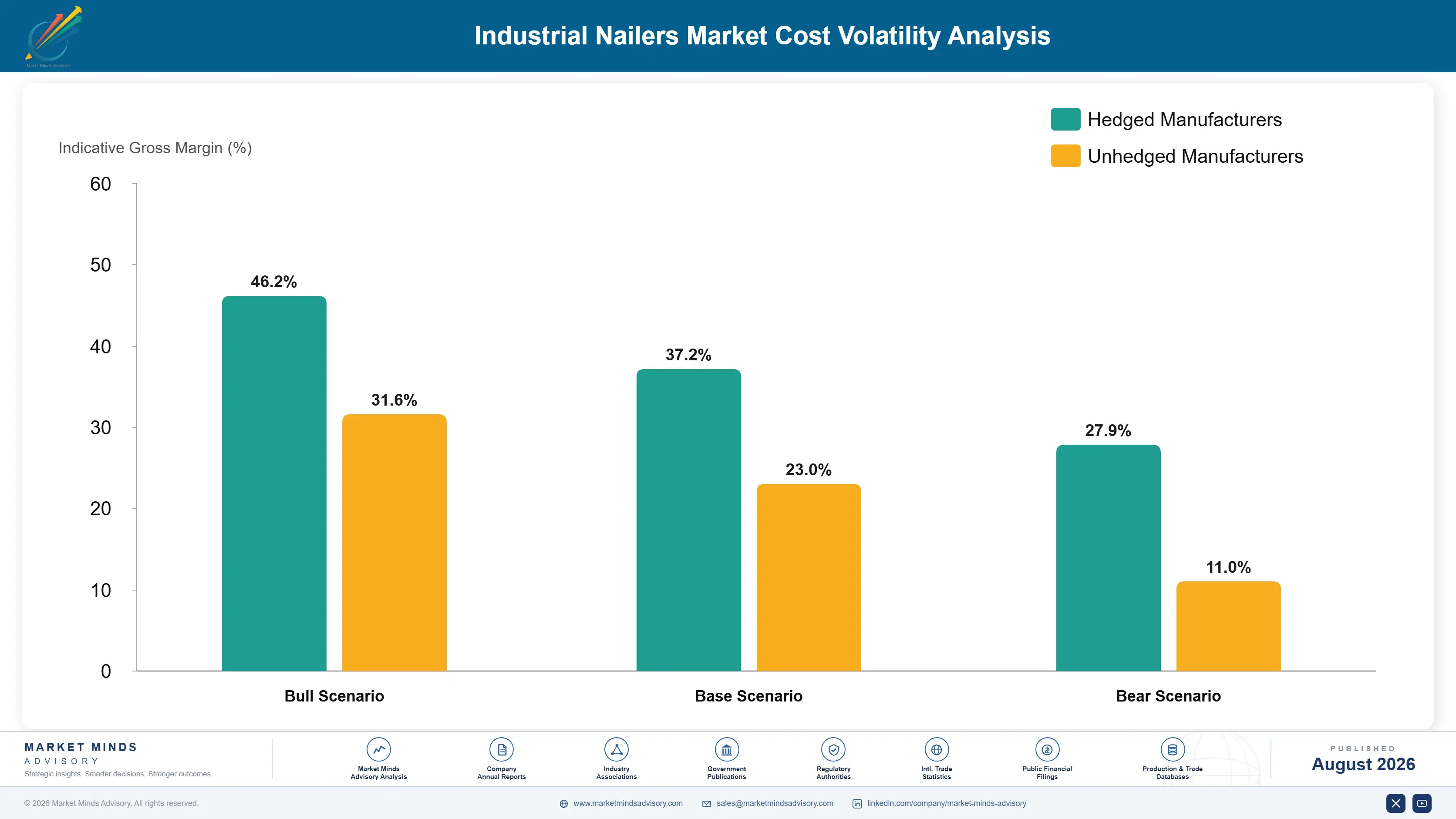
Where Nailer Cost Structures Face Pressure

Steel components, motor assemblies, and injection-molded housings together represent roughly 45% to 55% of pneumatic nailer COGS, sourced predominantly from Chinese and Taiwanese steel mills and component suppliers. Cordless formats add lithium-ion cell packs sourced mainly from South Korean and Chinese battery manufacturers, typically representing another meaningful share of finished unit cost once cell packs and battery management electronics are included.
Lithium carbonate prices swung sharply between 2021 and 2023, driven by surging electric vehicle demand competing directly with power tool manufacturers for the same cell manufacturing capacity, according to IEA battery supply chain tracking. Stanley Black & Decker's 2023 annual report cited elevated battery cell procurement cost as a meaningful drag on cordless product line gross margin during the period, before cell prices eased through 2024 as new manufacturing capacity came online globally.

Suppliers without long-term cell supply agreements absorb spot-market price swings directly into cordless product margin, a disadvantage smaller regional manufacturers feel more acutely than the five largest global suppliers who negotiate volume-based contracts. Exposure also varies by geography, since manufacturers sourcing steel domestically within North America face less currency and tariff volatility than competitors dependent on imported Chinese steel and battery cells.
industrial-nailers-market-cost-volatility-analysis-1787300862157

Lock Multi-Year Battery Cell Supply Contracts

Suppliers negotiating multi-year lithium-ion cell supply agreements directly with battery manufacturers, rather than purchasing on the spot market, insulate cordless product margin from the demand swings that electric vehicle and consumer electronics competition periodically create across shared cell manufacturing capacity worldwide, locking predictable input pricing well ahead of each new product generation launch cycle.

Diversify Steel Sourcing Beyond A Single Country

Manufacturers qualifying steel suppliers across multiple countries, rather than depending on one dominant source, reduce exposure to any single country's tariff policy, currency swing, or mill capacity disruption, though qualification and logistics costs rise modestly as sourcing diversity increases across supplier networks and additional quality audits become a recurring necessary operating expense each year.

Shift Housing Materials Toward Reinforced Polymer Blends

Suppliers substituting reinforced polymer composites for selected metal housing components reduce raw material cost exposure and product weight simultaneously, though the transition requires validating durability standards that professional contractors expect from tools used daily on demanding job sites, a certification process that typically spans multiple full product testing cycles before any wide commercial release nationwide.

Portfolio Architecture for Margin Defence

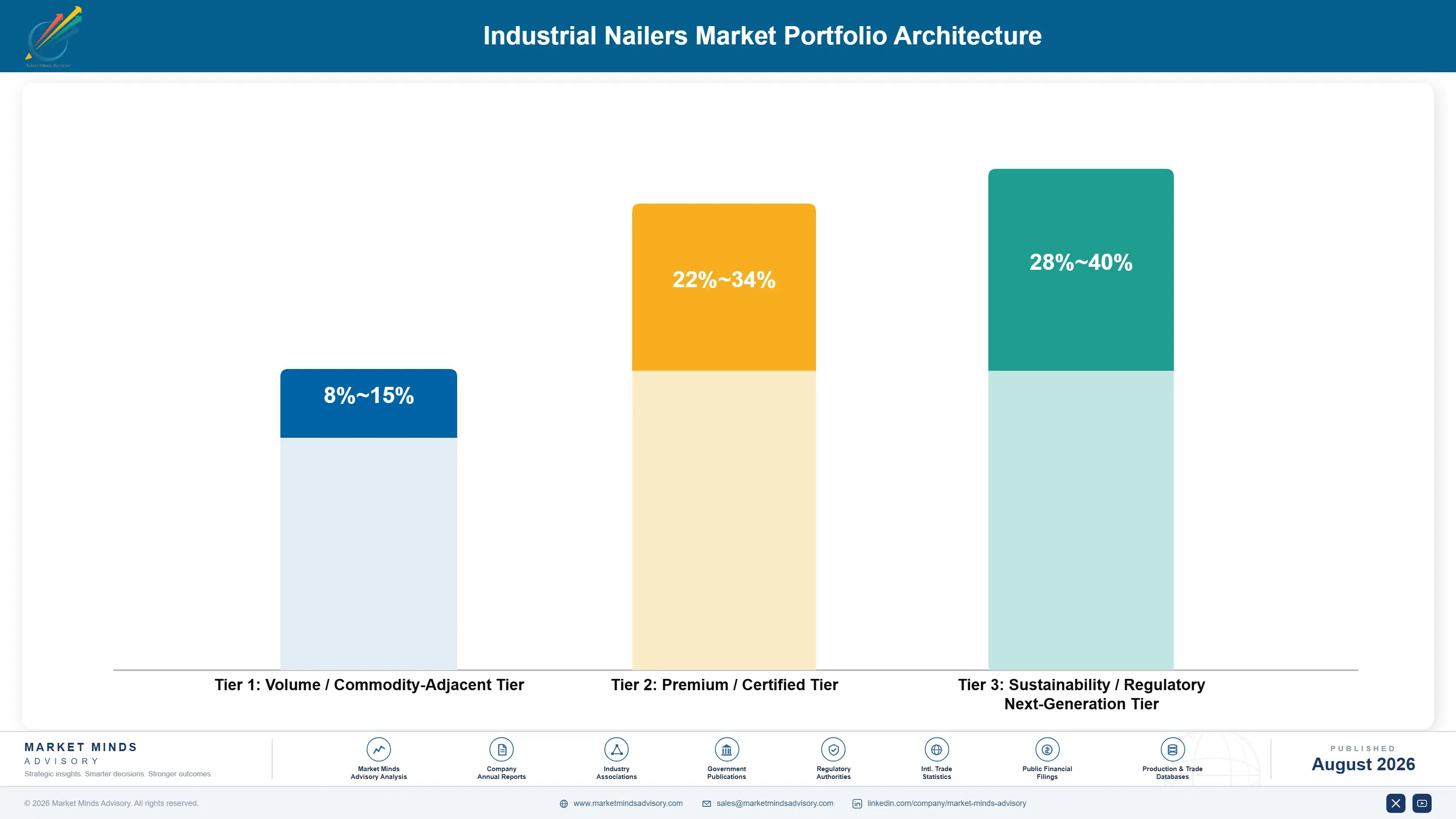
Three tiers define margin architecture in this market. Volume pneumatic and entry-level corded nailers compete almost entirely on unit price and distribution reach, leaving thin margin for manufacturers without genuine manufacturing scale advantages. Premium cordless brushless tools command materially better economics, since contractors pay for battery platform convenience rather than raw drive-force specifications alone, and that willingness to pay keeps widening as fleet standardisation spread
The volume versus premium tension shows up clearly in product roadmaps: suppliers cannot simultaneously chase the lowest pneumatic price point and fund the brushless motor research that premium cordless positioning demands, so most successful manufacturers now deliberately pick a lane rather than straddling both, reallocating capital away from legacy pneumatic tooling toward battery platform development instead.

High-value margin pools concentrate in cordless brushless and hybrid formats, where battery platform lock-in lets suppliers price above raw component cost. Fuel-powered and basic pneumatic tools increasingly sit in the volume tier, still generating meaningful revenue but facing steel and component cost pressure that limits how much margin expansion remains available there, pushing several established fuel-cell specialists to fund their own cordless conversion programmes.

Volume / Commodity-Adjacent Tier

Basic pneumatic and corded nailers sold on unit price and compressor compatibility, competing directly against regional manufacturers with minimal cordless or brushless differentiation in this segment today, where switching cost between competing suppliers stays genuinely low.
Gross Margin: 8-15%

Premium / Certified Tier

Cordless brushless and battery-pneumatic hybrid nailers certified against professional structural framing specifications, commanding premium pricing tied to battery platform compatibility with a contractor's existing drill and saw fleet across the crew.
Gross Margin: 22-34%

Sustainability / Regulatory / Next-Generation Tier

Emerging smart-connected nailers with digital fastener count tracking and job site inventory integration, positioned toward large contractors and rental fleets managing utilisation across dozens of active crews simultaneously and remotely.
Gross Margin: 28-40%
industrial-nailers-market-portfolio-architecture-1787300862653

High-value Sub-segments and Strategic Watch-out

Cordless Brushless Direct-Drive Nailers

Cordless brushless direct-drive nailers represent the high-value, high-growth pool, expanding at 11.2% as brushless motor technology closes the drive-power gap with pneumatic tools framing crews once considered non-negotiable. The margin range reflects manufacturing maturity, since established platforms capture the top end while newer entrants still refining efficiency earn less.
Gross Margin: 24-38%

Cordless Battery-Pneumatic Hybrid Nailers

Cordless battery-pneumatic hybrid nailers form the high-value, moderate-growth pool, expanding at 9.5% as contractors transitioning away from compressor infrastructure adopt hybrid designs before committing fully to brushless-only formats. Margin sits below pure brushless tools given the added onboard compressor component cost each hybrid unit still carries.
Gross Margin: 20-32%

Pneumatic Air-Compressor Nailers

Pneumatic air-compressor nailers remain the volume core, still carrying the largest installed base across professional and residential users despite slowing growth. Margin stays thin given intense price competition among established manufacturers and regional entrants, but replacement and consumable accessory sales sustain steady, dependable revenue regardless of new cordless adoption.
Gross Margin: 10-18%

Fuel-Powered Combustion Nailers

Fuel-powered combustion nailers are the strategic watch-out, facing durable long-term share erosion as cordless brushless alternatives eliminate the recurring fuel cell purchase cost that once justified the format's convenience advantage. Paslode's loyal contractor base still sustains near-term revenue, but the category's structural framing role keeps shrinking steadily.
Gross Margin: 12-20%

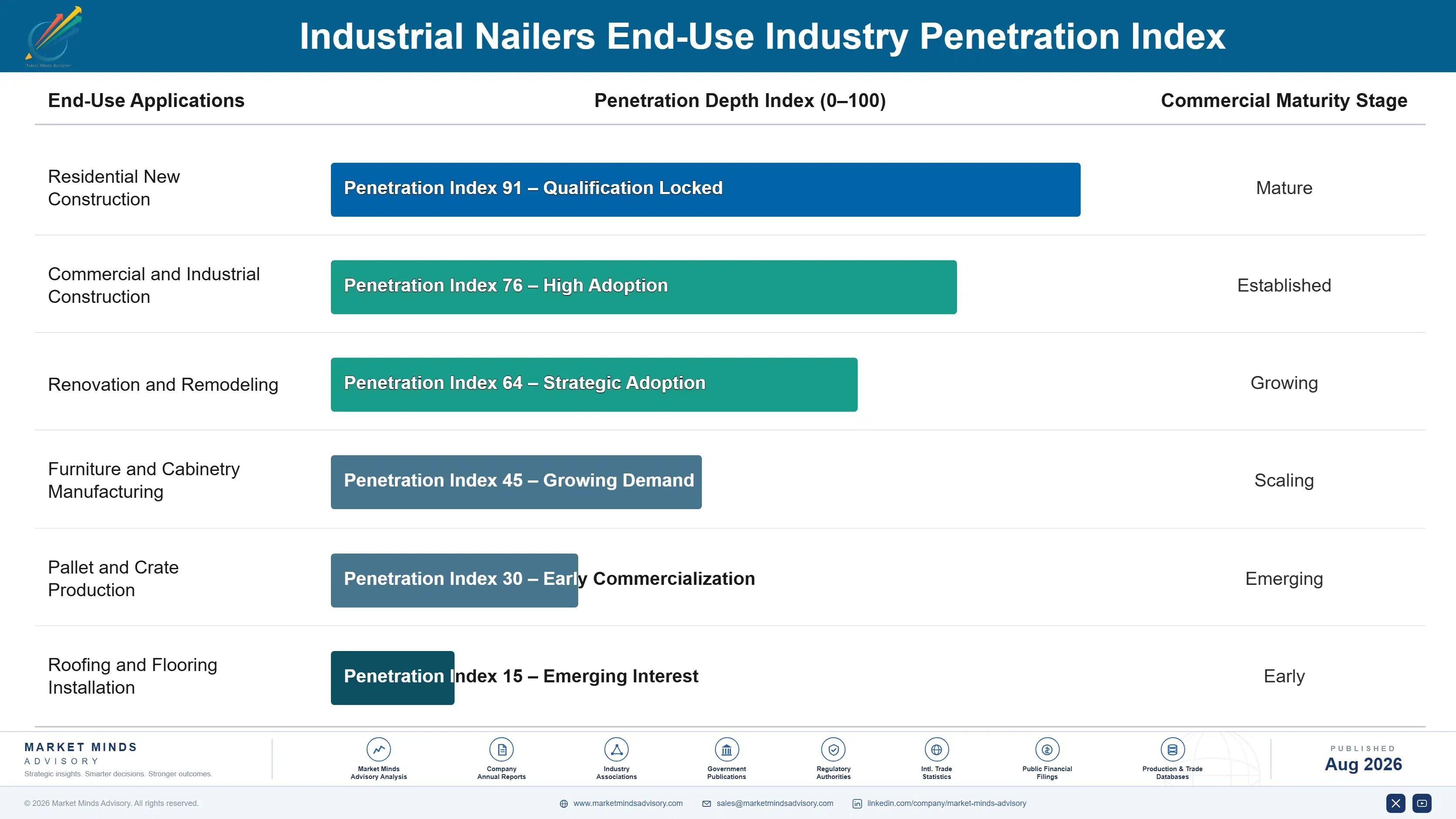
How Nailer Demand Really Renews

Nailer purchases behave less like one-time capital buys and more like an annuity once a contractor commits to a battery platform, since every subsequent tool purchase gravitates toward the same platform, avoiding duplicate chargers across a crew's truck inventory. This renewal pattern compounds over years, as batteries wear out and get replaced before the nailer itself, generating recurring revenue a transactional pneumatic sale never delivers.
Stickiness varies meaningfully by end-use vertical. Framing contractors, who replace tools most frequently given daily heavy job site use, show the deepest platform loyalty once committed, while finish carpentry and trim crews, using nailers occasionally, switch brands readily since their purchase frequency never builds the same battery sunk cost that framing crews accumulate. Roofing and flooring specialists sit between these two extremes, forming loyalty gradually as fleets expand.

A generational shift is underway in buyer profiles too. Younger contractors entering the trade over the past decade default to cordless tools from their first purchase, never developing the pneumatic infrastructure habits older contractors built over careers, which erodes the installed compressor base that once anchored pneumatic tool replacement demand. Distributors report this cohort researches battery compatibility online before visiting a store, reshaping how brands earn purchases.
industrial-nailers-market-end-use-penetration-index-1787300863140

Where Nailer Makers Should Focus

These are among the four positions where our research anticipates prominent divergence between winners and laggards over the coming forecast period. Each is grounded in the demand model, the regulatory perimeter, and the announced capacity pipeline.
01 / CORDLESS PLATFORM INVESTMENT

Winning requires owning the battery platform, not just the nailer

Manufacturers competing purely on standalone nailer specifications are losing fleet contracts to competitors who bundle nailers into a broader battery platform spanning drills, saws, and grinders across an entire crew. Contractors increasingly choose their nailer brand based on which battery they already own, not the other way around, and that decision now happens before any nailer-specific feature comparison even begins. Suppliers without a credible cordless platform investment plan risk losing entire fleet relationships rather than individual product sales over the coming decade of fleet renewal cycles.
02 / FUEL-CELL FRANCHISE TRANSITION

Paslode-style specialists need a credible cordless bridge strategy now

Fuel-powered nailer specialists face a genuine, durable decline as cordless brushless alternatives close the convenience gap that once justified fuel cell purchase costs on framing job sites nationwide and across renovation crews too. Waiting for cordless technology to plateau before responding risks ceding loyal contractor relationships permanently to faster-moving rivals who invest in cordless conversion earlier and more aggressively. The window to convert fuel-cell brand loyalty into cordless platform loyalty is narrowing steadily with every new product cycle that passes.
03 / EMERGING MARKET ENTRY TIMING

South Asian construction growth rewards early entry-level cordless positioning

India and Vietnam's construction sectors are transitioning from hand-nailing directly toward cordless tools, skipping the pneumatic infrastructure phase entirely that mature Western markets went through decades earlier during their own gradual adoption curve. Suppliers establishing entry-level cordless distribution now, ahead of demand fully maturing, capture first-mover brand loyalty that later entrants will find genuinely expensive to dislodge once contractor purchasing habits solidify. Distributors who wait for the market to mature further risk permanently ceding this early positioning advantage to faster-moving competitors.
04 / BATTERY SUPPLY CHAIN SECURITY

Cell supply agreements now separate margin winners from losers

Suppliers without secured long-term lithium-ion cell agreements remain exposed to spot-market volatility that electric vehicle and consumer electronics demand periodically triggers across shared battery manufacturing capacity worldwide, compressing cordless product margin unpredictably. This exposure increasingly separates suppliers who sustain stable cordless pricing from those forced into reactive price increases that frustrate contractors and erode brand loyalty over repeated purchase cycles. Securing multi-year cell contracts is no longer a defensive move; it has become a genuine prerequisite for competing credibly in the cordless tier.

Engagement Snapshot From the Field

A live engagement with an industry participant carrying material or product regulatory and market exposure ahead of a defining policy shift, showing how our research translates into a defensible multi-year portfolio strategy.
MARKET MINDS ADVISORY · CLIENT ENGAGEMENT SUMMARY
Industrial Nailers Producer Strategic Portfolio Review and Transition Roadmap 2026·Investment Scenario on Industrial Nailers Exposure Evaluation 2025-26
CLIENT PROFILE
A regional building products distributor operating across twelve states supplies power tools, fasteners, and job site consumables to several thousand professional contractor accounts. The client's tool division had historically sold primarily pneumatic nailers and compressors, but contractor requests for cordless brushless alternatives had grown noticeably over the prior two fiscal years, prompting a formal review of its supplier portfolio and inventory mix.
STRATEGIC CHALLENGE
The distributor's category managers disagreed on how aggressively to shift inventory toward cordless product lines, given uncertainty about how quickly contractor fleets would convert and concern that overcommitting to cordless stock would leave pneumatic inventory stranded. Leadership needed an evidence-based view of adoption pace before approving a multi-million-dollar inventory reallocation.
MMA APPROACH
MMA combined its quantitative contractor survey data with expert interviews across five brands to model cordless adoption pace by end-use vertical and region. The engagement benchmarked the client's existing supplier mix against category-wide battery platform trends and identified which cordless brands showed the strongest forward order momentum among comparable regional distributors.
KEY FINDINGS
  1. Framing-focused contractor accounts showed cordless brushless adoption running meaningfully ahead of the distributor's finish and trim carpentry accounts, confirming the vertical-specific stickiness pattern MMA's broader research had identified.
  2. Contractors increasingly requested nailers compatible with battery platforms they already owned from drill and saw purchases, rather than evaluating nailer brands independently on standalone merit.
  3. Two of the distributor's five current pneumatic-focused supplier relationships lacked a credible cordless roadmap, creating exposure to lost shelf space as contractor demand kept shifting.
  4. Regional competitors who had already reallocated toward cordless-heavy inventory mixes reported meaningfully stronger year-over-year revenue growth in their tool categories (client-reported, unverified by MMA).
CLIENT PROFILE
A regional building products distributor operating across twelve states supplies power tools, fasteners, and job site consumables to several thousand professional contractor accounts. The client's tool division had historically sold primarily pneumatic nailers and compressors, but contractor requests for cordless brushless alternatives had grown noticeably over the prior two fiscal years, prompting a formal review of its supplier portfolio and inventory mix.
STRATEGIC CHALLENGE
The distributor's category managers disagreed on how aggressively to shift inventory toward cordless product lines, given uncertainty about how quickly contractor fleets would convert and concern that overcommitting to cordless stock would leave pneumatic inventory stranded. Leadership needed an evidence-based view of adoption pace before approving a multi-million-dollar inventory reallocation.
MMA APPROACH
MMA combined its quantitative contractor survey data with expert interviews across five brands to model cordless adoption pace by end-use vertical and region. The engagement benchmarked the client's existing supplier mix against category-wide battery platform trends and identified which cordless brands showed the strongest forward order momentum among comparable regional distributors.
KEY FINDINGS
  1. Framing-focused contractor accounts showed cordless brushless adoption running meaningfully ahead of the distributor's finish and trim carpentry accounts, confirming the vertical-specific stickiness pattern MMA's broader research had identified.
  2. Contractors increasingly requested nailers compatible with battery platforms they already owned from drill and saw purchases, rather than evaluating nailer brands independently on standalone merit.
  3. Two of the distributor's five current pneumatic-focused supplier relationships lacked a credible cordless roadmap, creating exposure to lost shelf space as contractor demand kept shifting.
  4. Regional competitors who had already reallocated toward cordless-heavy inventory mixes reported meaningfully stronger year-over-year revenue growth in their tool categories (client-reported, unverified by MMA).
RECOMMENDED STRATEGY
Phase 1: Phase 1 (0 to 4 months): Reallocate roughly 20% of pneumatic nailer shelf space toward cordless brushless and hybrid product lines from suppliers with credible platforms. Phase 2: Phase 2 (4 to 10 months): Renegotiate terms with the two suppliers lacking cordless roadmaps, or begin qualifying replacement brands with stronger cordless commitments. Phase 3: Phase 3 (10 to 24 months): Track sell-through data by end-use vertical and adjust inventory mix quarterly as contractor conversion patterns continue to clarify further.
OUTCOME
The distributor approved the phased reallocation plan and began supplier renegotiations within the following quarter. Early sell-through data from the first reallocated territories showed cordless brushless nailer turnover meaningfully exceeding the pneumatic baseline, though full portfolio results remained pending at time of writing (client-reported, unverified by MMA).

Frequently Asked Questions

Foundational context covering the market sizes, CAGR, scope, country, region and competition that inform every finding below. This section is provided to cover basics and most often pre-purchase conversations, answered from the MMA Primary Research Dataset.

What is the current size of the Industrial Nailers Market?

The global industrial nailers market was valued at USD 3.2 billion in 2025. Cordless brushless direct-drive nailers account for the fastest-growing share of that total.

How large will the Industrial Nailers Market be by 2036?

MMA projects the market reaching USD 6.3 billion by 2036, roughly 1.86 times its 2026 value as cordless technology conversion continues across contractor fleets worldwide.

What is the CAGR for the Industrial Nailers Market 2026 to 2036?

The base case CAGR is 6.4% between 2026 and 2036. The bull case reaches 7.7% and the bear case falls to 5.1% depending on housing starts.

Which segment is growing fastest?

Cordless brushless direct-drive nailers grow fastest at 11.2%, about 1.75 times the overall market rate, as brushless motors close the pneumatic performance gap on professional job sites.

Who are the major companies in the Industrial Nailers Market?

Stanley Black & Decker, Illinois Tool Works, Techtronic Industries, Makita, and Robert Bosch lead the category. Together the top five suppliers hold roughly 58% of shipment volume.

Which country is growing fastest?

India posts the fastest national growth at 8.5%, as rapidly expanding construction activity pulls power tool adoption past traditional hand-nailing practices across the subcontinent quickly.

Report Segmentation Architecture

The full report scope spans multiple orthogonal segmentation dimensions, with cross-tabulated demand data provided for each dimension pair. Coverage extends further to regional breakdowns, trend trajectories, and the competitive detail needed to support segment-level decision-making.

By Power Source and Drive Mechanism

  • Cordless Brushless Direct-Drive Nailers
  • Cordless Battery-Pneumatic Hybrid Nailers
  • Pneumatic Air-Compressor Nailers
  • Fuel-Powered Combustion Nailers
  • Corded Electric Nailers
  • Industrial Coil-Feed Production Nailers

By End-Use Industry

  • Residential New Construction
  • Commercial and Industrial Construction
  • Renovation and Remodeling
  • Furniture and Cabinetry Manufacturing
  • Pallet and Crate Production
  • Roofing and Flooring Installation

By Commercial Dimension

  • Professional Contractor Direct Sales
  • Tool Rental Fleet Channel
  • Retail and Home Center Distribution
  • Industrial Distributor Channel
  • E-Commerce and Direct-to-Contractor Online

By Region

  • North America
  • Western Europe
  • East Asia
  • South Asia and Pacific
  • Latin America
  • Middle East and Africa
  • Eastern Europe

Scope, Methodology, and Coverage

Every figure in this report is reproducible from documented input assumptions. The scope below maps the historical period, the forecast horizon, the segmentation dimensions, and the countries covered, alongside the underlying primary and qualitative methodology.
Historical Period
2020 to 2025
Forecast Period
2026 to 2036
Base Year
2025 (USD billions; MMA Primary Research Dataset, August 2026)
Market Definition
The market covers powered fastener-driving tools engineered for professional and industrial nail-driving applications, spanning pneumatic, cordless battery, fuel-powered, and corded electric drive mechanisms sold through professional tool distribution and retail channels. Staple guns designed exclusively for upholstery and consumer-grade craft nailers are excluded from this scope.
Quantitative Units
USD billions (current prices); millions of units shipped where applicable
Segmentation Dimensions
By Power Source and Drive Mechanism; By End-Use Industry; By Commercial Dimension; By Region
Regions Covered
North America, Western Europe, East Asia, South Asia and Pacific, Latin America, Middle East and Africa, Eastern Europe
Countries Covered
USA, Canada, China, Japan, South Korea, Germany, UK, France, India, Vietnam, Indonesia, Australia, Mexico, Brazil, Argentina, Saudi Arabia, UAE, South Africa, Nigeria, Turkey, Poland, Czech Republic, Netherlands, Italy, Spain, Sweden, Switzerland, Colombia, Thailand, Malaysia, and additional markets relevant to this sector
Key Companies Profiled
Stanley Black & Decker, Illinois Tool Works, Techtronic Industries, Makita, Robert Bosch, Koki Holdings, Hilti, Max Co., Senco Brands, Grip-Rite, NuMax Tools, Freeman Tools, Campbell Hausfeld, Duo-Fast, Metabowerke, Ridgid, Fasco, Rapid Group, Powernail Company, WEN Products
Quantitative Methodology
Primary survey, n=3,800 respondents, Q4 2025, six countries; demand-side model with trade association cross-validation
Qualitative Methodology
47 expert interviews, Q4 2025; applied to validate demand model assumptions, identify emerging dynamics, and assess competitive positioning
Report Format
PDF and XLSX data workbook (Word format preview document)
Publisher
Market Minds Advisory
Report Code
MMA-2026-CON-110
Published
August 2026
Contact
sales@marketmindsadvisory.com | www.marketmindsadvisory.com

Purchase the full Industrial Nailers Market Report (2026 to 2036).

The full MMA Industrial Nailers report sizes the market across six drive-mechanism segments, seven regions, and twenty profiled participants through 2036 on a consistent shipment volume basis. It scores the top two suppliers on battery platform breadth and fuel-cell franchise durability. Scenario models quantify how cordless technology maturation, housing start cycles, and battery cell supply security move both demand and realised pricing across the forecast period. The report also includes delivered-cost modelling by drive mechanism, a battery cell supply exposure screen, and a cordless conversion tracking framework built for product, procurement, and investment teams.
Six-segment drive-mechanism forecast with volume and value detail
Seven-region demand map with country-level construction context
Twenty-company competitive profiles on shipment volume basis
Battery cell supply chain and steel cost exposure screen
Cordless conversion tracking across contractor end-use verticals
Fuel-cell franchise transition and margin defense playbook

Built For The People Who Decide

From boardroom strategy to bench-side execution, this report is read cover-to-cover by leaders shaping the next decade of their industry, turning demand scenarios, market dynamics and valuation benchmarks into decisions.
CXOs/ Presidents/ VPs/ Managers
M&A and Corporate Development
Strategy Teams and R&D Heads
Procurement and Product Directors
Regulatory and Compliance Leaders
Investor Relations and Equity Analysts