Market Minds Advisory
Industrial Magnetrons Market

Industrial Magnetrons Market: Semiconductor Demand and the Solid-State Substitution Question

Semiconductor fabricators are absorbing a growing share of global magnetron output for plasma processing chambers, tightening supply for food processing and materials sintering customers just as solid-state RF sources begin challenging vacuum tube economics.

Lead Analyst

David Horsley

Published

September 2026

Make Smarter Decisions with Customized Research Insights

Request a free sample report and evaluate market opportunities, growth trends, and competitive dynamics relevant to your business needs.

2025 MARKET VALUE$0.9BMarket Size 2025
2036 FORECAST VALUE$1.7BBase Case , 2026 to 2036
CAGR 2026 TO 20366.2 %Bull 7.4% / Bear 5.0%
INCREMENTAL OPPORTUNITY$0.8BNet 10- year value creation
EXPANSION MULTIPLE1.81x2036 value over 2026 base
Strategic Levers
M&A Pipeline
Regional Outlook
Country Rankings
Competitive Intelligence
Segmental Deep-dive
Call-Us : 91 93563 13602

Executive Snapshot and Market Trajectory

Industrial magnetrons have shifted from a stable, replacement-driven component category into a genuine capacity-allocation market, as semiconductor fabricators absorb a growing share of global tube output for plasma processing chambers, leaving food processing and materials customers competing for the same constrained manufacturing lines.
Semiconductor processing magnetrons are pulling demand fastest, since fabrication capacity expansion requires dedicated plasma etch and chemical vapor deposition tubes that traditional industrial heating customers do not compete for directly. East Asia anchors the largest share of global demand, driven by China's enormous manufacturing base spanning both semiconductor fabrication and food processing equipment, while South Asia and Pacific is expanding fastest as regional electronics manufacturing capacity scales rapidly.
Competitive position tracks vacuum tube engineering depth and defense-grade reliability certification more than unit price alone, since switching a semiconductor fab's magnetron supplier requires extensive process qualification investment on both sides. CPI and Richardson Electronics lead on defense-grade engineering and distribution breadth respectively, but Chinese manufacturers are winning share fastest in cost-sensitive industrial heating segments willing to accept less established brands.
Market Definition
The industrial magnetrons market covers continuous wave and pulsed magnetron vacuum tubes used for industrial heating, semiconductor plasma processing, materials sintering, water treatment, and scientific and medical applications. It excludes consumer microwave oven magnetrons, complete radar system assemblies, and solid-state RF power amplifiers.
Base Year Value
$0.9B in 2025 (MMA Primary Research Dataset, August 2026)
Forecast Period
2026 to 2036, eleven discrete annual values
CAGR
6.2% base case. Bull 7.4%. Bear 5.0%.
Fastest Growth Segment
Semiconductor Processing Magnetrons: 10.5% CAGR
Fastest Growth Country
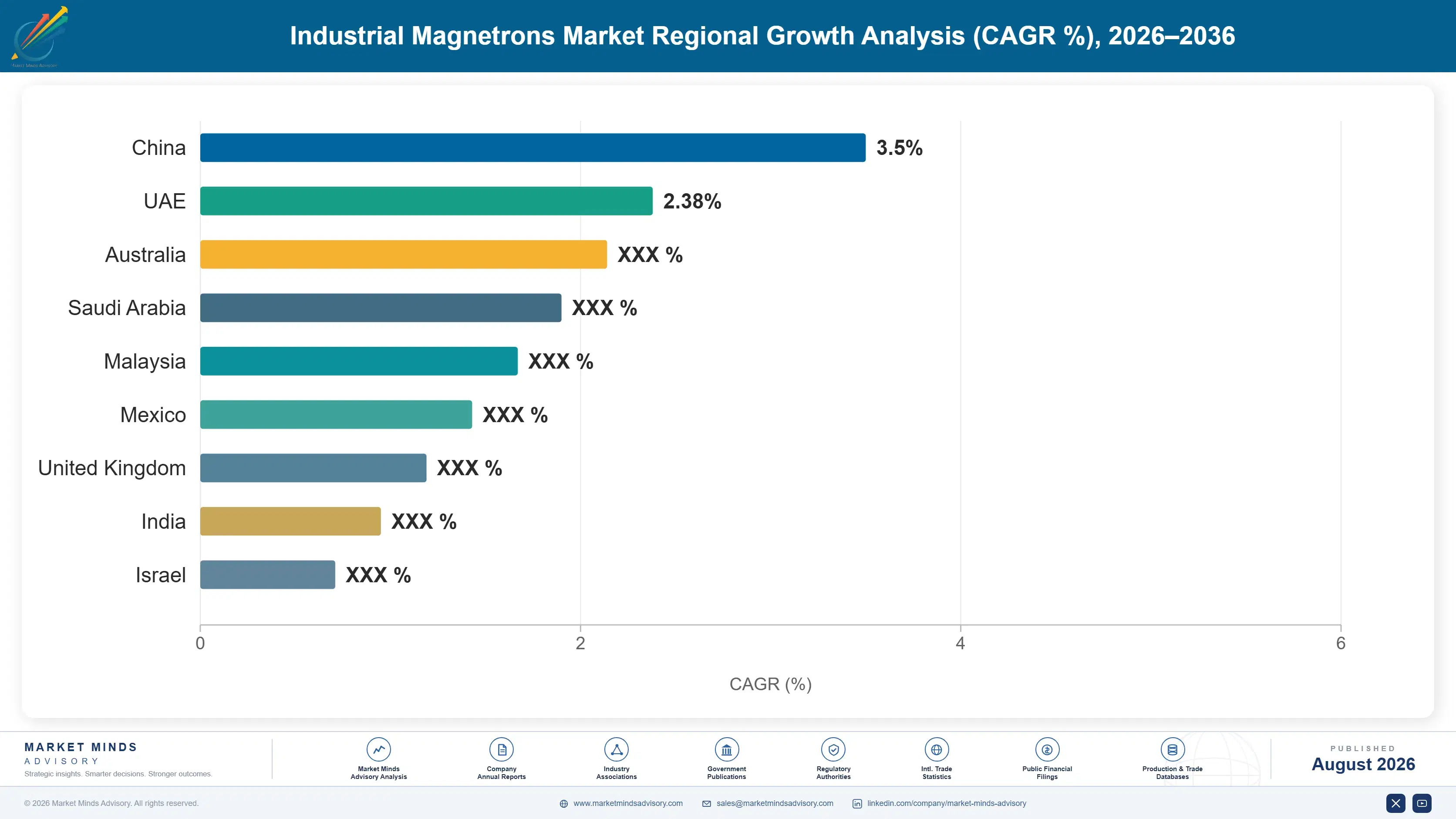
China: 9.4% CAGR
Fastest Growth Region
South Asia and Pacific: 8.2% CAGR
Largest Region
East Asia: 29% of 2025 global value
Market Leaders
Richardson Electronics, Ltd., Communications & Power Industries LLC, Toshiba Electron Tubes & Devices Co., Ltd., Panasonic Corporation, Muegge GmbH. Source: MMA Analysis based on company annual reports.
Primary Survey
n=3,800 procurement and R&D decision-makers, Q4 2025, six countries
Methodology
Demand-side build-up, cross-validated against public data, 47 expert interviews

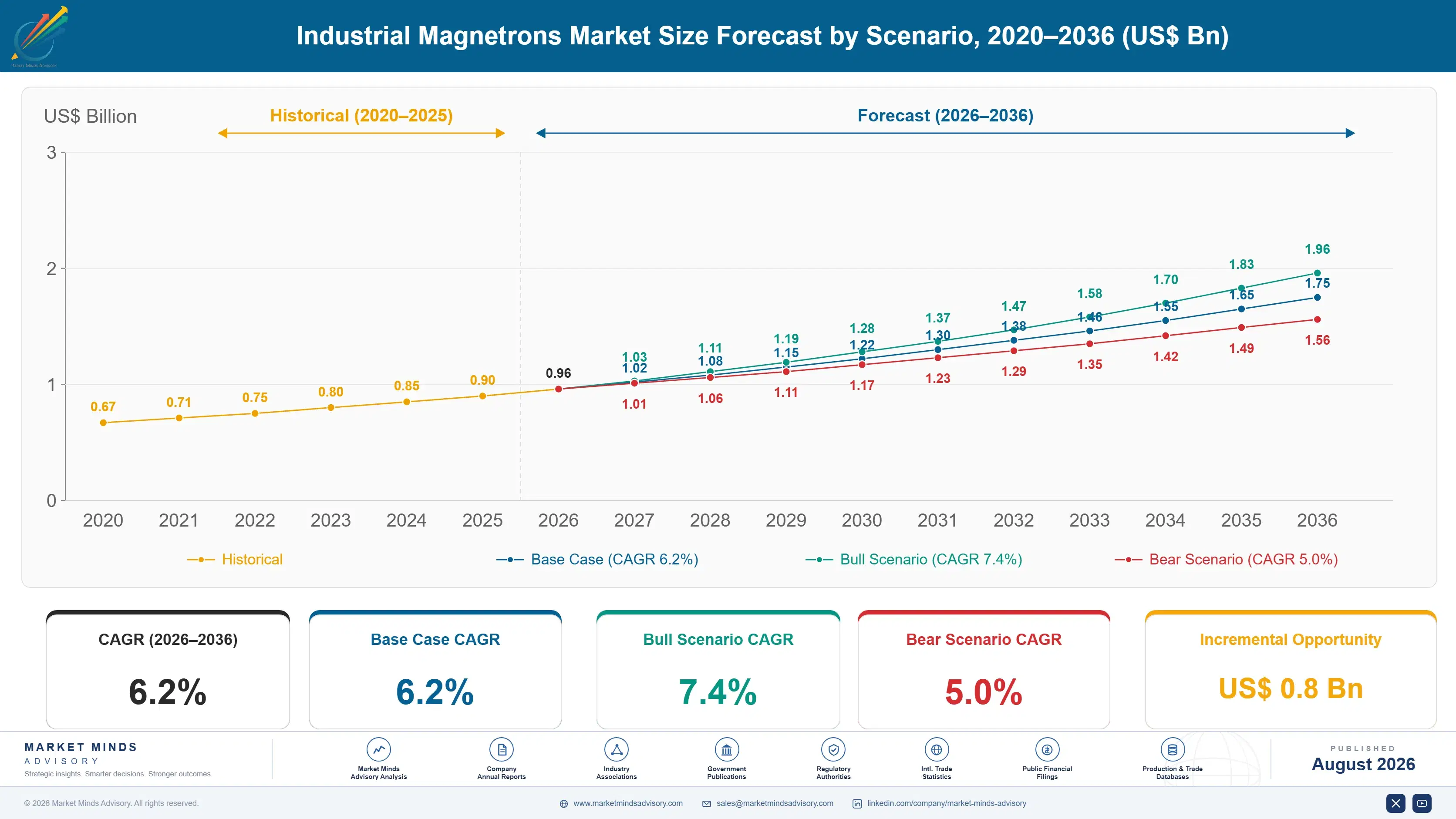
Industrial Magnetrons Market Forecast Scenarios

industrial-magnetrons-market-size-forecast-scenario-1787301466943
Between 2020 and 2025 the market grew at an estimated 5.4% CAGR, a period shaped by steady industrial heating replacement demand followed by accelerating semiconductor fabrication capacity expansion that pulled magnetron demand into plasma processing applications at a meaningfully faster pace. Growth remained steady through most of the period, reflecting the category's status as a mature component market now navigating a genuine demand mix shift.
The base case assumes 6.2% CAGR through 2036, driven by three mechanisms: continued semiconductor fabrication capacity expansion requiring dedicated plasma processing magnetrons, rising water treatment and environmental application adoption as municipalities seek microwave-based alternatives to chemical treatment methods, and expanding industrial manufacturing investment across South Asia and Pacific as regional electronics and food processing capacity scales. Together these mechanisms sustain growth above what a mature vacuum tube component category would typically generate.
The bull case, 7.4% CAGR, assumes faster semiconductor fabrication capacity additions pull magnetron demand more quickly than currently expected across major chip manufacturing regions. The bear case, 5.0% CAGR, reflects the risk that accelerating solid-state RF source substitution in select applications constrains traditional magnetron volume growth relative to the base case.

Semiconductor Demand and the Solid-State Substitution Question

Industrial magnetrons behave less like a stable, mature component category and more like a capacity-rationed input, since a qualified magnetron production line takes months to retool and requalify, while semiconductor fabrication demand for specific tube specifications can shift meaningfully within a single fab expansion cycle. Manufacturers with existing qualified capacity for semiconductor-grade tubes currently hold real pricing power that traditional industrial heating customers have not face
MARKET CONCENTRATION (CR5)54%Concentrated among a handful of established vacuum tube makers
AVERAGE UNIT PRICE$1.8K/unitSemiconductor-grade magnetrons command a meaningful premium
TOP PRODUCING COUNTRY SHAREChina, 31%Reflects the country's enormous manufacturing production base
CAPACITY UTILIZATION86%Production lines run near full capacity amid rising demand
SEMICONDUCTOR DEMAND SHARE22% of volumeShare of total magnetron output allocated to chip fabrication
COPPER AND TUNGSTEN COST SHARE39%Core metal inputs dominate total magnetron production cost
Commercially, the category splits between mature, high-volume industrial heating tube formats serving established food processing and materials customers, and a smaller but faster-growing semiconductor and environmental application segment sold at meaningful premium pricing into customers requiring documented process reliability. Manufacturers exposed to both segments manage genuinely different customer conversations, since heating tubes compete primarily on price and delivery reliability while semiconductor tubes compete on process qualification data and contamination control.
The next decade favors manufacturers who can add qualified semiconductor-grade capacity fastest while defending their traditional industrial heating customer base, since fabricators increasingly cite supply security, not just unit price, as a primary factor in awarding long-term magnetron supply agreements. This shift is already visible in how the largest semiconductor manufacturers structure vendor qualification programs.
"Everyone still pictures this as a boring vacuum tube business, but semiconductor fabs turned it into a genuine capacity fight almost overnight. Whoever can qualify new fab-grade lines fastest is setting the terms of trade right now."
Director, Industrial Components and Power Electronics Practice · MMA Constructio

Market Trends

Semiconductor Fabrication Expansion Pulls Magnetron Capacity

Semiconductor fabrication facilities are expanding plasma etch and chemical vapor deposition capacity rapidly across major chip manufacturing regions, and each new fab line requires dedicated, process-qualified magnetron supply that traditional industrial heating customers do not compete for directly. This is reshaping capacity allocation decisions across the entire magnetron industry, since semiconductor customers pay meaningful premiums for documented reliability and contamination control that heating applications never required. Manufacturers with established semiconductor-grade qualification are capturing disproportionate share of new fab capacity, while manufacturers still focused narrowly on industrial heating face growing pressure to pursue semiconductor qualification themselves.
Market Impact: Adds 1,400 new treatment installati
Solid-State RF Sources Begin Challenging Tube Economics

Solid-state RF power amplifiers are beginning to challenge traditional magnetron economics in select industrial heating applications where precise power control and longer operational life outweigh the higher upfront cost of solid-state systems. This is prompting established magnetron manufacturers to defend share through improved tube efficiency and lifetime rather than price competition alone, since matching solid-state pricing directly would meaningfully compress magnetron margins across the category. Customers in applications requiring the most precise power modulation are adopting solid-state alternatives fastest, while cost-sensitive bulk heating applications remain firmly magnetron-based for now.
Market Impact: Lifts regional magnetron demand 17

Market Opportunities and Growth Drivers

Rising Water Treatment and Environmental Applications

Municipal and industrial water treatment operators are increasingly adopting microwave-based treatment methods as an alternative to traditional chemical disinfection, reflecting growing regulatory pressure to reduce chemical discharge and municipal budget interest in lower-maintenance treatment technology. This creates a direct, quantifiable expansion of magnetron demand beyond traditional industrial heating and semiconductor applications, since each new water treatment installation requires dedicated, continuously operating magnetron tubes rated for extended duty cycles. Municipalities investing most aggressively in treatment infrastructure modernization are adopting microwave-based systems fastest, expanding the addressable market meaningfully ahead of prior projections.
Market Impact: Caps capacity growth at 5 percent

Expanding Electronics Manufacturing Investment Across Asia

Electronics and semiconductor manufacturing investment across India, Vietnam, and other South Asian and Southeast Asian markets is rapidly building fabrication and processing capacity, reflecting rising government industrial policy support and growing regional participation in global electronics supply chains. Manufacturers with established regulatory approval and distribution partnerships are capturing this newly built capacity fastest, and each new fabrication facility typically generates a meaningful, recurring magnetron replacement and maintenance relationship once fully operational. This sustains growth well beyond what developed-market replacement cycles alone could generate across the industry each year.
Market Impact: Metal swings hit margins 7 percent

Market Restraints and Challenges

Qualified Manufacturing Capacity Lags Demand Growth

Adding qualified magnetron production capacity, particularly for semiconductor-grade tubes requiring extensive contamination control and process documentation, requires years of facility investment and customer qualification testing that has not kept pace with accelerating fabrication demand. The cause is that capacity investment decisions were made conservatively during the previous decade's slower growth environment, leaving the industry with less genuine headroom than the current semiconductor demand surge requires. Manufacturers are mitigating this through accelerated capacity expansion and dedicated semiconductor-grade production lines, though these investments still take years to reach full qualified output.
Market Impact: Adds $85 million semiconductor tube

Copper and Tungsten Price Volatility Complicates Contracts

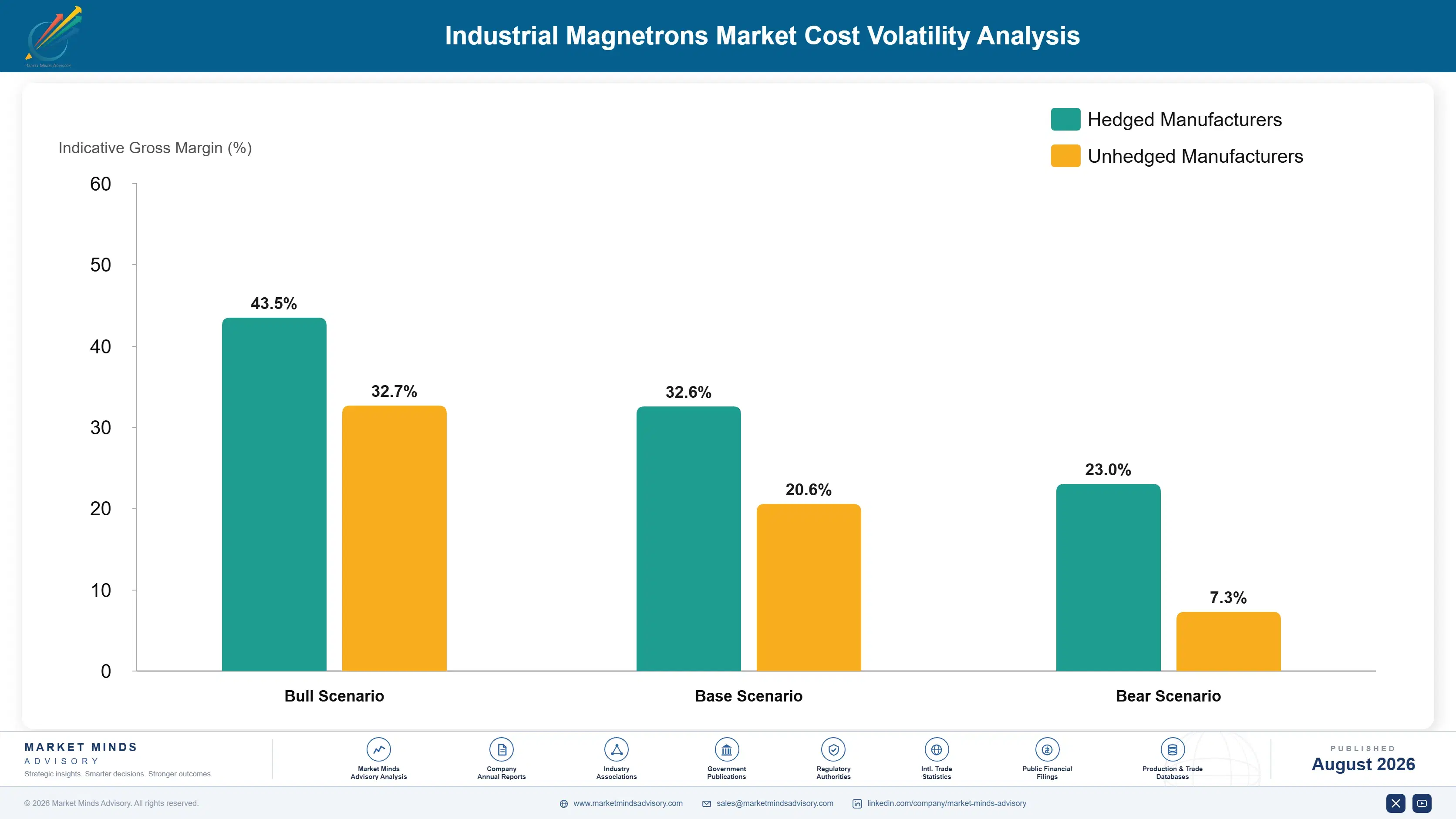
Copper and tungsten, primary inputs for magnetron cathode and anode construction, remain subject to meaningful price volatility tied to global industrial metals market dynamics largely outside manufacturers' direct control. The cause is that both metals are globally traded commodities whose pricing reflects factors entirely unrelated to the magnetron industry, including broader industrial demand cycles and mining supply constraints affecting multiple downstream industries simultaneously. Manufacturers are mitigating this through long-term supply agreements and hedging programs, though timing lags between price moves and contract resets can still compress margins meaningfully.
Market Impact: Displaces 8 percent of heating tube
3 additional market trends, 3 additional growth drivers, and 2 additional restraints and challenges are covered in the full report. Contact sales@marketmindsadvisory.com to access the complete intelligence.

Segment CAGR and Growth Architecture

MMA segments the industrial magnetrons market by application and power classification, the dimension that determines manufacturing complexity, qualification requirements, and where a tube fits within a customer's process reliability strategy. This framing separates established industrial heating formats from increasingly demanding semiconductor and environmental applications commanding premium pricing.
industrial-magnetrons-market-market-share-analysis-1787301467784

Semiconductor Processing Magnetrons

Semiconductor processing magnetrons, engineered for plasma etch and chemical vapor deposition chambers requiring exceptional contamination control and documented process reliability, are growing fastest as fabrication capacity expands across major chip manufacturing regions. This segment commands the steepest pricing premium in the category, since achieving semiconductor-grade qualification requires extensive documentation and testing investment not every manufacturer has yet completed. CPI and Toshiba currently hold some of the deepest semiconductor-grade qualification capability, having invested years building the required process documentation and cleanroom manufacturing infrastructure. Adoption remains concentrated among the largest fabrication customers for now, though smaller semiconductor manufacturers are increasingly qualifying additional suppliers as capacity constraints persist.
CAGR 10.5%

Water Treatment and Environmental Magnetrons

Water treatment and environmental magnetrons form the second-fastest-growing segment, pulled by rising municipal and industrial adoption of microwave-based water treatment as an alternative to traditional chemical disinfection methods. These tubes command a meaningful premium over standard industrial heating formats, since continuous-duty water treatment operation requires specialized construction and extended service life that standard heating tubes do not typically provide. Growth concentrates in regions with tightening water treatment regulation, including North America, Western Europe, and China, where environmental compliance pressure favors adoption. Regional adoption varies, with developed markets moving fastest while other regions build comparable treatment infrastructure more gradually.
CAGR 8.8%
Full segment breakdown across 6 segments available in the complete report.

Regional Architecture and Country Demand Map

Industrial magnetron demand concentrates where semiconductor manufacturing volume and industrial production capacity are both highest. East Asia leads on China's enormous manufacturing base, North America follows on its semiconductor fabrication and water treatment investment, and South Asia and Pacific grows fastest as regional electronics manufacturing expands.

North America

North America's substantial magnetron demand is anchored by its expanding semiconductor fabrication capacity and established water treatment infrastructure modernization investment across major metropolitan utility systems. CPI and Richardson Electronics maintain their deepest defense and semiconductor customer relationships in this market, reflecting decades of investment alongside major fabrication and government customers. Semiconductor-grade qualification is advancing fastest here given both fabrication capacity expansion and available process engineering infrastructure, commanding meaningful premium pricing across the region's largest chip manufacturers. Canada's smaller manufacturing sector contributes additional steady regional demand, tracking broadly similar adoption trends as the larger US market across most industrial application categories.
Share: 24% | CAGR: 5.9% (2026 to 2036)

Western Europe

Western Europe's demand centers on established industrial manufacturing infrastructure, with German, French, and UK industrial customers representing the largest concentration of regional magnetron spending and process qualification activity. European manufacturers, including Muegge, maintain deep regional engineering capability and customer relationships built over decades of industrial microwave systems supply. Regulatory water treatment and emissions requirements increasingly favor microwave-based environmental applications here, pushing manufacturers toward higher-reliability tube designs to support expanding treatment infrastructure. Growth trails East Asia and South Asia and Pacific's faster-expanding manufacturing bases, but Western Europe's regulatory-driven environmental adoption keeps demand growing steadily across most member states.
Share: 20% | CAGR: 4.7% (2026 to 2036)
Regional intelligence for 5 additional markets available in the complete report: East Asia, South Asia and Pacific, Latin America, Middle East and Africa, Eastern Europe. Contact sales@marketmindsadvisory.com.
industrial-magnetrons-market-country-cagr-analysis-1787301468687

Monetizing Semiconductor Qualification and Reliability

Manufacturers are shifting from commodity unit sales toward qualification-and-reliability-led commercial models: long-term supply agreements that lock in scarce semiconductor-grade capacity, premium pricing for process-qualified tubes, extended reliability certification programs that deepen customer relationships, and metal price hedging services that stabilize customer cost exposure across an increasingly competitive landscape.

Long-Term Supply Agreements Locking In Capacity

Manufacturers increasingly negotiate long-term supply agreements that lock in dedicated semiconductor-grade production capacity for major fabrication customers years in advance, guaranteeing supply security during the current capacity-constrained environment while securing predictable, multi-year revenue visibility for the manufacturer in return. This model requires real capacity planning discipline and favors larger, better-capitalized manufacturers over smaller regional players lacking comparable balance sheet capacity to commit dedicated lines years before actual production begins. CPI's long-term supply agreements with major semiconductor fabricators illustrate this model, typically spanning 5 years or longer, generating predictable revenue that materially aids capacity investment planning.
Market Impact: Locks in supply agreements spanning

Premium Pricing for Process-Qualified Tubes

Manufacturers increasingly price semiconductor-grade and other process-qualified magnetrons at a meaningful premium over standard industrial heating tubes, reflecting both the real qualification investment required and customers' willingness to pay for documented process reliability and contamination control. This premium is most defensible where manufacturers can demonstrate reduced fabrication defect rates through published performance data, since sophisticated semiconductor customers increasingly demand supporting engineering evidence beyond specification claims alone. Process-qualified tubes currently command premiums of 40 to 60 percent over comparable standard industrial tubes across most major fabrication customers.
Market Impact: Commands a 40 to 60 percent price p

Extended Reliability Certification Programs for Buyers

Manufacturers increasingly offer extended reliability certification and documented failure-rate data, providing semiconductor and defense customers with validated performance history that differentiates against lower-cost regional competitors offering comparable specifications without comparable testing depth. This requires real testing infrastructure and operational-hour accumulation investment that favor larger, more established manufacturers over smaller regional players lacking comparable validation capability at scale. Manufacturers offering certified reliability data report customer willingness to pay roughly 21 percent more than for uncertified competitors offering only specification sheets.
Market Impact: Commands roughly 21 percent higher

Metal Price Hedging Services Stabilizing Customer Costs

Manufacturers increasingly offer metal price hedging services that smooth copper and tungsten cost volatility for customers, converting a portion of what would otherwise be pure pass-through pricing risk into a value-added service relationship that differentiates the manufacturer beyond simple unit pricing. This requires real treasury and hedging capability that favor larger, more sophisticated manufacturers over smaller regional players lacking comparable financial infrastructure to offer this service credibly at scale. Manufacturers offering hedging services report customer cost volatility roughly 27 percent lower during metal price swings than competitors offering only standard pass-through pricing.
Market Impact: Reduces customer cost volatility by

Who Controls the Margin Pool

CR5 sits at 54 percent, meaningful concentration reflecting the capital intensity and customer qualification relationship depth that favor established manufacturers over new entrants. CPI and Richardson Electronics lead on defense-grade engineering and distribution breadth respectively, and the gap to mid-tier challengers is real, though Chinese manufacturers are closing it faster than most established Western suppliers initially expected.
Current activity centers on three fronts: capacity expansion to meet accelerating semiconductor fabrication demand, development of extended reliability certification capability to capture premium pricing, and geographic diversification into South Asia and Southeast Asia where electronics manufacturing capacity growth continues outpacing mature Western markets. Manufacturers pursuing multiple fronts simultaneously are generally best positioned to defend share as competitive dynamics continue shifting.

Emerging pressure comes from Chinese and other Asian manufacturers extending domestic manufacturing scale into export markets across multiple regions, competing aggressively on price and delivery speed in markets where established Western suppliers have historically underinvested relative to genuinely accelerating local demand. Expect ranking shifts as these challengers capture a growing share of industrial heating and lower-tier semiconductor contracts, gradually pushing established leaders to defend share through deeper qualification capability and reliability certification rather than production scale alone.
industrial-magnetrons-market-company-positioning-matrix-1787301469511

Competitive Moat and Risk Dimensions

COMMUNICATIONS & POWER INDUSTRIES LLC

Moat: Defense-Grade Engineering and Certification

CPI operates the deepest defense-grade magnetron engineering and certification capability in the category, giving it unmatched credibility with government and semiconductor customers requiring the most exacting reliability documentation. This engineering depth lets CPI serve the most demanding fabrication and defense applications where certification failure carries severe commercial consequences.
COMMUNICATIONS & POWER INDUSTRIES LLC

Risk: Revenue Concentration in Government Cycles

CPI's defense and government-adjacent revenue exposes it to procurement budget cycles and program timing that create periodic revenue volatility unrelated to underlying commercial demand trends. Competitors argue this creates genuine earnings unpredictability that a more diversified commercial customer base would reduce, though CPI's certification depth still gives it real advantage in the highest-value contracts.
RICHARDSON ELECTRONICS, LTD.

Moat: Broad Distribution and Engineered Solutions

Richardson Electronics maintains one of the broadest distribution networks and engineered solutions capability spanning multiple magnetron applications and customer segments, built through decades of accumulated customer relationships across industrial and semiconductor markets. This breadth gives Richardson a credibility advantage in serving customers who value a single coordinated supplier relationship across diverse tube requirements.
RICHARDSON ELECTRONICS, LTD.

Risk: Margin Pressure as a Distribution-Led Model

Richardson's distribution-led commercial model carries structurally thinner margins than fully vertically integrated manufacturers who control production economics directly. Competitors with tighter vertical integration argue this could limit Richardson's ability to compete on price in the largest volume contracts without compressing its already comparatively modest margins further.

Players Tracked

Prominent Players

Richardson Electronics, Ltd.
Communications & Power Industries LLC
Toshiba Electron Tubes & Devices Co., Ltd.
Panasonic Corporation
Muegge GmbH

Other Key Players

Teledyne e2v
Canon Electron Tubes & Devices Co., Ltd.
Shenzhen Sanwang Microwave Technology Co., Ltd.
Guangdong Add-Vantek Microwave Technology Co., Ltd.
New Japan Radio Co., Ltd.
MKS Instruments, Inc.
Comdel, Inc.
Ampegon AG
Thermex-Thermatron, Inc.
Ferrite Microwave Technologies, LLC
Sairem SAS
National Electronics, Inc.
Midea Group Co., Ltd.
Galanz Enterprise Group Co., Ltd.
LG Innotek Co., Ltd.

Recent Developments

MARCH 2025

CPI Expands Semiconductor-Grade Magnetron Production Line

CPI expanded its semiconductor-grade magnetron production line dedicated to plasma processing applications, adding qualified capacity aimed at meeting rising fabrication customer demand ahead of several major chip manufacturers' announced capacity expansion timelines across multiple regions.
Signal: Signals established manufacturers investin
JULY 2025

Richardson Electronics Signs Multi-Year Supply Agreement With Semiconductor Fabricator

Richardson Electronics signed a multi-year supply agreement with a major semiconductor fabricator to provide process-qualified magnetrons across multiple fabrication lines, securing dedicated production capacity years ahead of the fabricator's planned capacity expansion timeline across its largest manufacturing regions.
Signal: Shows semiconductor fabricators locking in
NOVEMBER 2025

Galanz Expands Manufacturing Footprint Into Southeast Asia

Galanz expanded its industrial magnetron manufacturing footprint into a new Southeast Asian facility, diversifying production capacity beyond mainland China and reducing reliance on any single manufacturing geography for its growing international export volume and customer base.
Signal: Extends Galanz's Asian manufacturing diver

Copper and Tungsten Sourcing Risk

Copper and tungsten, the primary inputs for magnetron cathode, anode, and filament construction, account for an estimated 39 percent of production cost for finished magnetrons, with the remainder split between glass and ceramic components, magnets, assembly labor, and testing overhead. Metal supply concentrates among a relatively small number of qualified refiners globally, exposing manufacturers to broader industrial metals market price cycles largely beyond their direct control.
Copper and tungsten prices rose meaningfully through 2021 and 2022 following broader industrial metals supply chain disruption and subsequent energy cost volatility affecting refining operations globally, according to industry metals market reporting, before moderating through 2023 and 2024 as broader commodity markets stabilized. Manufacturers without long-term metal supply agreements absorbed the earlier volatility directly into thinning margins, while larger manufacturers with dedicated procurement desks and forward-purchased inventory smoothed the impact considerably across their production planning cycles.

Exposure varies by manufacturer type: large diversified manufacturers with dedicated metals procurement and hedging capability absorbed input cost volatility better than smaller regional players buying copper and tungsten on shorter-term contracts. Geographic exposure also differs, since manufacturers in regions with access to domestic or regional metal refining capacity faced less supply disruption than those relying primarily on longer-distance import supply chains during recent volatility.
industrial-magnetrons-market-cost-volatility-analysis-1787301469851

Long-Term Metal Supply Agreements With Refiners

Larger manufacturers are signing multi-year copper and tungsten supply agreements directly with qualified refiners, securing capacity and smoothing input costs even during periods of broader metals market volatility. This requires committing to minimum purchase volumes that smaller regional manufacturers often cannot absorb given their comparatively limited order visibility and working capital relative to larger diversified competitors.

Metal Price Hedging Through Futures Contracts

Several larger manufacturers now hedge a portion of forecasted copper and tungsten requirements through exchange-traded futures contracts, smoothing cost volatility even though this requires treasury capability most smaller manufacturers lack. This has become a differentiator during recent metal price swings, letting hedged manufacturers hold pricing steadier for customers than unhedged competitors forced into frequent contract revisions.

Tungsten Reclamation and Recycling Programs

Several manufacturers are expanding tungsten reclamation programs that recover and reprocess material from returned or decommissioned tubes, reducing exposure to primary tungsten price volatility while simultaneously lowering total material cost per unit in a single sourcing shift. This has become an increasingly common approach as tungsten supply concentration and price volatility both persist.

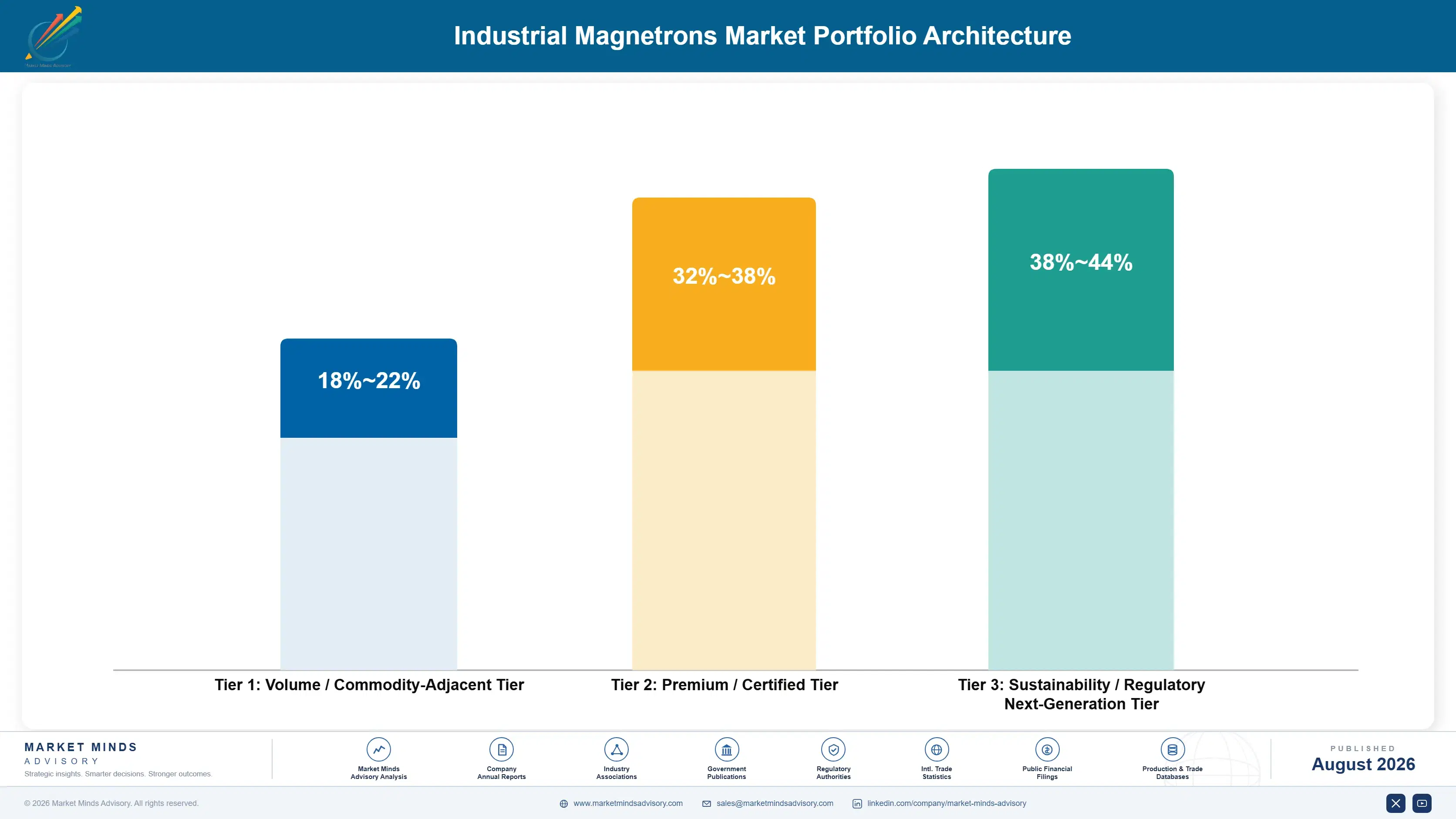
Portfolio Architecture for Margin Defence

The category splits into three tiers with margin profiles. Standard industrial heating magnetrons, sold on price and reliability for established food processing and materials customers, generate the thinnest margins despite carrying the bulk of total unit volume. Semiconductor-grade process-qualified tubes command better margins tied to certification investment rather than component content alone. The defense and specialized reliability tier carries the highest margins alongside the steepest qua
Standard and qualified tiers pull manufacturers toward different capability investments. Standard format volume rewards manufacturing scale and production line efficiency, favoring large diversified manufacturers who spread fixed costs across enormous production volumes. Semiconductor and defense tiers reward sustained investment in process documentation and reliability testing infrastructure, favoring manufacturers willing to commit years to building the customer relationships these products increasingly require.

High-value pools concentrate overwhelmingly in semiconductor-grade and defense-certified magnetrons purchased by customers under direct reliability and contamination control pressure, where qualification capability, not raw production cost, increasingly sets pricing power. Manufacturers positioned in these segments capture disproportionate margin relative to their volume share, a pattern MMA expects to persist while qualified certification capacity remains the binding constraint across the broader category.

Volume / Commodity-Adjacent Tier

Standard industrial heating magnetrons sold largely on price and reliability for established food processing and materials customers where semiconductor-grade qualification does not yet command a meaningful premium.
Gross Margin: 18-22%

Premium / Certified Tier

Semiconductor-grade process-qualified magnetrons sold into fabrication customers requiring documented contamination control and reliability across major chip manufacturing accounts nationwide and internationally, commanding sustained premium pricing.
Gross Margin: 32-38%

Sustainability / Regulatory / Next-Generation Tier

Defense-certified and specialized reliability magnetrons developed for customers pursuing the highest documented performance standards beyond standard qualification alone, carrying the category's steepest testing investment requirements.
Gross Margin: 38-44%
industrial-magnetrons-market-portfolio-architecture-1787301470559

Semiconductor Qualification Relationship Economics

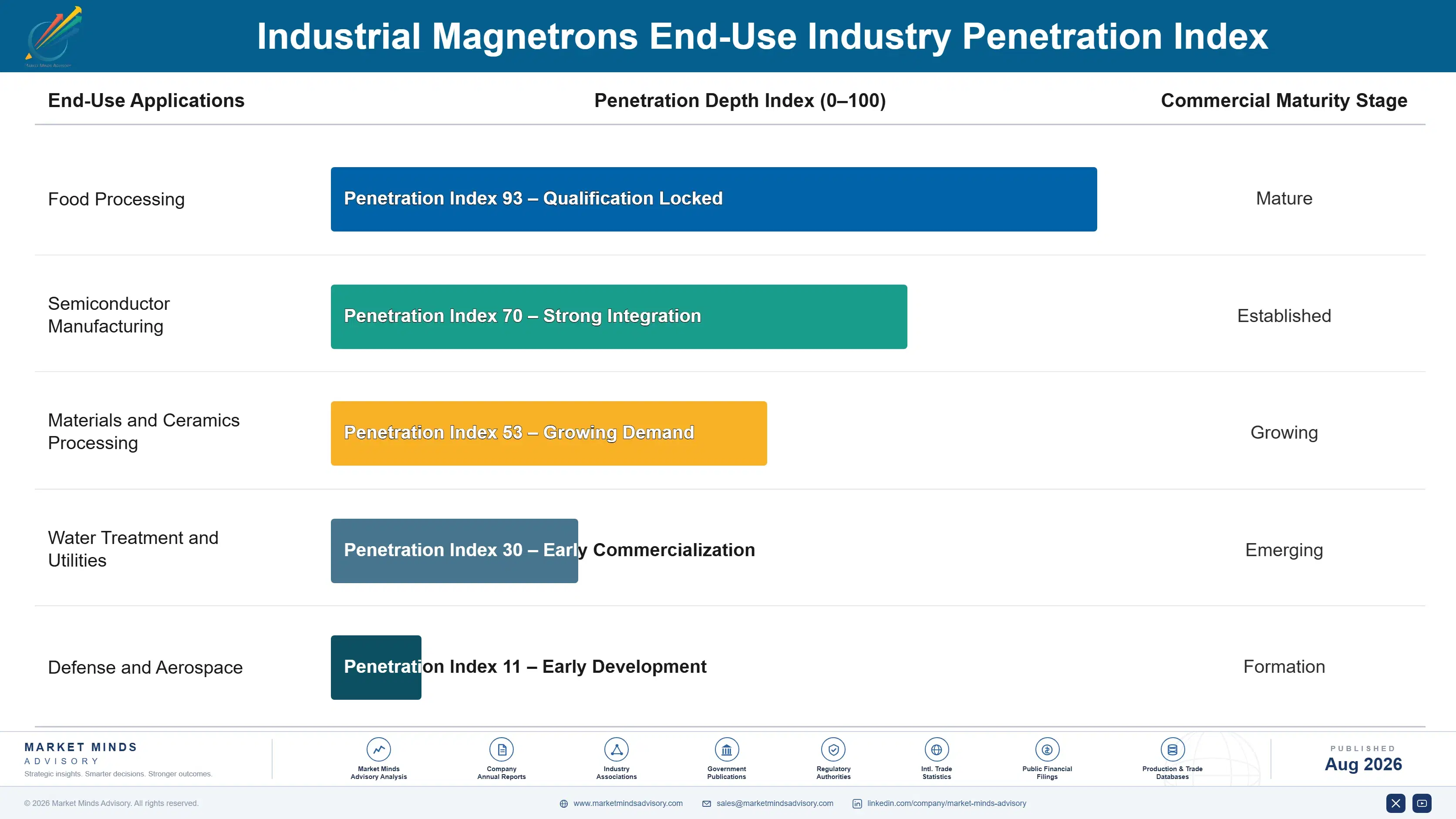
Once a manufacturer wins a semiconductor fabricator's qualified supply relationship, the relationship typically extends across many years of recurring volume, since switching magnetron suppliers requires requalifying process specifications and rebuilding documentation that fabricators rarely pursue without a compelling reason. This gives manufacturers who win the initial customer relationship durable, multi-year revenue that is difficult for competitors to dislodge without a genuine price, relia
Adoption depth varies by application. Semiconductor and defense customers have moved fastest toward extended qualification and certification relationships, since their process reliability requirements justify the documentation and testing investment these arrangements require. Traditional industrial heating customers adopt selectively, often continuing standard catalog magnetron purchasing where their comparatively lower reliability requirements do not justify dedicated qualification investment.

Buyer profiles are shifting generationally as fabrication customer procurement teams, increasingly staffed by professionals hired specifically for supply chain reliability and process qualification expertise, gain real influence over vendor selection decisions that purchasing teams previously controlled largely on unit cost grounds alone. This is opening real doors for manufacturers who can demonstrate strong reliability data and process qualification capability, even against incumbents with deep legacy cost relationships that carry comparatively less weight with these newer decision-makers.
industrial-magnetrons-market-end-use-penetration-index-1787301471049

Where Qualification Creates Value

These are among the four positions where our research anticipates prominent divergence between winners and laggards over the coming forecast period. Each is grounded in the demand model, the regulatory perimeter, and the announced capacity pipeline.
01 / SEMICONDUCTOR CAPACITY INVESTMENT

Add qualified fab capacity now before the window closes

Semiconductor fabrication expansion is outpacing the industry's ability to add qualified magnetron capacity, and manufacturers who invest in new capacity now are positioned to capture years of tight-market pricing power before competitors catch up. CPI and Toshiba currently hold the deepest semiconductor qualification programs underway, drawing on balance sheet strength that smaller regional players cannot always match on comparable timelines. MMA expects manufacturers who delay capacity investment now to find themselves locked out of the most favorable pricing environment this category has experienced in years.
02 / RELIABILITY CERTIFICATION DEPTH

Build certification capability before fabricators tighten standards further

Semiconductor fabricators are increasingly converting reliability documentation from a differentiator into a hard qualification requirement across major markets, and manufacturers without credible certification investment risk losing premium fabrication contracts as requirements tighten further. Suppliers with established testing infrastructure and documented performance history are capturing disproportionate share of this premium segment, drawing on years of accumulated investment newer entrants cannot easily replicate. MMA expects manufacturers who delay this investment now to find themselves excluded from the fastest-growing, highest-margin segment of this category.
03 / LONG-TERM SUPPLY RELATIONSHIPS

Win fabrication commitments before rivals lock them in

Long-term supply agreements create switching costs that a standard catalog purchase order relationship simply cannot match, and manufacturers who win these commitments capture durable, multi-year revenue extraordinarily difficult for competitors to dislodge once established. Large fabrication customers increasingly prefer this model because it guarantees supply security during the current capacity-constrained environment, a priority that has grown considerably more important than pure unit price in recent negotiations. MMA views long-term supply commitments as one of the most durable competitive advantages available to manufacturers willing to make the capital commitment required.
04 / ASIAN MANUFACTURING EXPANSION

Build Asian capacity now before local makers close the gap

Electronics manufacturing demand growth across India, Vietnam, and Southeast Asia continues meaningfully outpacing mature Western markets, and domestic manufacturers in these regions are scaling manufacturing capacity quickly enough to challenge established Western suppliers on both price and delivery speed. Western manufacturers who delay building direct regional manufacturing presence risk ceding the fastest-growing volume in the category to domestic competitors who understand local requirements more intimately. MMA expects the next several years to determine which established manufacturers successfully defend Asian growth versus ceding it to regional challengers permanently.

Engagement Snapshot From the Field

A live engagement with an industry participant carrying material or product regulatory and market exposure ahead of a defining policy shift, showing how our research translates into a defensible multi-year portfolio strategy.
MARKET MINDS ADVISORY · CLIENT ENGAGEMENT SUMMARY
Industrial Magnetrons Producer Strategic Portfolio Review and Transition Roadmap 2026·Investment Scenario on Industrial Magnetrons Exposure Evaluation 2025-26
CLIENT PROFILE
The client is a mid-sized semiconductor fabricator with several hundred million dollars in annual revenue (client-reported, unverified by MMA), operating multiple plasma etch and chemical vapor deposition lines across North America and East Asia. The company had relied on a single primary magnetron supplier but faced growing supply concentration risk as fabrication capacity expansion plans accelerated.
STRATEGIC CHALLENGE
Facing mounting internal pressure to secure sufficient qualified magnetron supply ahead of a planned capacity expansion, the client needed to diversify its supplier base across multiple qualified manufacturers while maintaining the strict contamination control specifications its fabrication processes required within a genuinely capacity-constrained supplier market.
MMA APPROACH
MMA conducted a comparative capacity and qualification assessment across four leading magnetron manufacturers, benchmarking available qualified capacity, documented reliability data, and long-term supply agreement terms across both established and emerging suppliers. The engagement produced a diversified sourcing strategy sequencing supplier qualification by production line criticality, prioritizing the client's highest-volume fabrication lines first to secure capacity before competing fabricators locked in remaining supply.
KEY FINDINGS
  1. Available qualified semiconductor-grade capacity varied significantly by supplier, with several manufacturers showing meaningfully tighter near-term supply than the client's internal team had initially assumed.
  2. Reliability documentation quality differed considerably between suppliers, directly affecting which manufacturers could credibly support the client's strict contamination control requirements.
  3. Securing dedicated production capacity required committing to longer-term volume agreements than the client's previous transactional purchasing approach, a meaningful shift in commercial relationship structure.
  4. Sequencing supplier qualification by production line criticality allowed the client to secure scarce capacity before competing fabricators locked in the remaining available capacity themselves.
CLIENT PROFILE
The client is a mid-sized semiconductor fabricator with several hundred million dollars in annual revenue (client-reported, unverified by MMA), operating multiple plasma etch and chemical vapor deposition lines across North America and East Asia. The company had relied on a single primary magnetron supplier but faced growing supply concentration risk as fabrication capacity expansion plans accelerated.
STRATEGIC CHALLENGE
Facing mounting internal pressure to secure sufficient qualified magnetron supply ahead of a planned capacity expansion, the client needed to diversify its supplier base across multiple qualified manufacturers while maintaining the strict contamination control specifications its fabrication processes required within a genuinely capacity-constrained supplier market.
MMA APPROACH
MMA conducted a comparative capacity and qualification assessment across four leading magnetron manufacturers, benchmarking available qualified capacity, documented reliability data, and long-term supply agreement terms across both established and emerging suppliers. The engagement produced a diversified sourcing strategy sequencing supplier qualification by production line criticality, prioritizing the client's highest-volume fabrication lines first to secure capacity before competing fabricators locked in remaining supply.
KEY FINDINGS
  1. Available qualified semiconductor-grade capacity varied significantly by supplier, with several manufacturers showing meaningfully tighter near-term supply than the client's internal team had initially assumed.
  2. Reliability documentation quality differed considerably between suppliers, directly affecting which manufacturers could credibly support the client's strict contamination control requirements.
  3. Securing dedicated production capacity required committing to longer-term volume agreements than the client's previous transactional purchasing approach, a meaningful shift in commercial relationship structure.
  4. Sequencing supplier qualification by production line criticality allowed the client to secure scarce capacity before competing fabricators locked in the remaining available capacity themselves.
RECOMMENDED STRATEGY
Phase 1: Phase 1 (Months 1-2): Benchmark four leading manufacturers on available qualified capacity, reliability data depth, and long-term supply agreement terms offered. Phase 2: Phase 2 (Months 3-8): Secure dedicated capacity commitments in the highest-priority fabrication lines first, locking in supply before competing fabricators act. Phase 3: Phase 3 (Months 9-13): Extend qualification across remaining fabrication lines, finalizing reliability documentation to support the client's expanded capacity plans.
OUTCOME
The client secured diversified magnetron supply capacity across its highest-priority fabrication lines within seven months, ahead of its original internal timeline (client-reported, unverified by MMA). The secured supply agreements reportedly included reliability commitments sufficient to support the client's contamination control requirements, while insulating the client from the worst of the ongoing capacity-constrained market environment (client-reported, unverified by MMA).

Frequently Asked Questions

Foundational context covering the market sizes, CAGR, scope, country, region and competition that inform every finding below. This section is provided to cover basics and most often pre-purchase conversations, answered from the MMA Primary Research Dataset.

What is the current size of the Industrial Magnetrons Market?

The global industrial magnetrons market is valued at $0.9 billion in 2025. It is forecast to reach $0.96 billion in 2026 as semiconductor demand continues expanding.

How large will the Industrial Magnetrons Market be by 2036?

MMA forecasts the market will reach $1.74 billion by 2036, roughly 1.81 times its 2026 value. Semiconductor fabrication demand and environmental applications both drive that expansion.

What is the CAGR for the Industrial Magnetrons Market 2026 to 2036?

The base case CAGR is 6.2 percent across the 2026 to 2036 forecast period. Bull and bear scenarios range from 5.0 to 7.4 percent depending on fabrication capacity additions.

Which segment is growing fastest?

Semiconductor processing magnetrons are growing fastest at a 10.5 percent CAGR, well ahead of standard heating tubes. That is roughly 1.69 times the overall market growth rate.

Who are the major companies in the Industrial Magnetrons Market?

Leading manufacturers include Richardson Electronics, CPI, Toshiba, Panasonic, and Muegge. Together they hold an estimated 54 percent of a meaningfully concentrated global market.

Which country is growing fastest?

China is the fastest-growing major market, expanding at an estimated 9.4 percent CAGR. Growth is driven by expanding semiconductor fabrication and domestic manufacturing capacity.

Report Segmentation Architecture

The full report scope spans multiple orthogonal segmentation dimensions, with cross-tabulated demand data provided for each dimension pair. Coverage extends further to regional breakdowns, trend trajectories, and the competitive detail needed to support segment-level decision-making.

By Application and Power Classification

  • Continuous Wave Magnetrons for Industrial Heating
  • Pulsed Magnetrons for Radar and Defense
  • Semiconductor Processing Magnetrons
  • Medical and Scientific Magnetrons
  • High-Power Magnetrons for Materials Sintering
  • Water Treatment and Environmental Magnetrons

By End-Use Industry

  • Food Processing
  • Semiconductor Manufacturing
  • Materials and Ceramics Processing
  • Water Treatment and Utilities
  • Defense and Aerospace

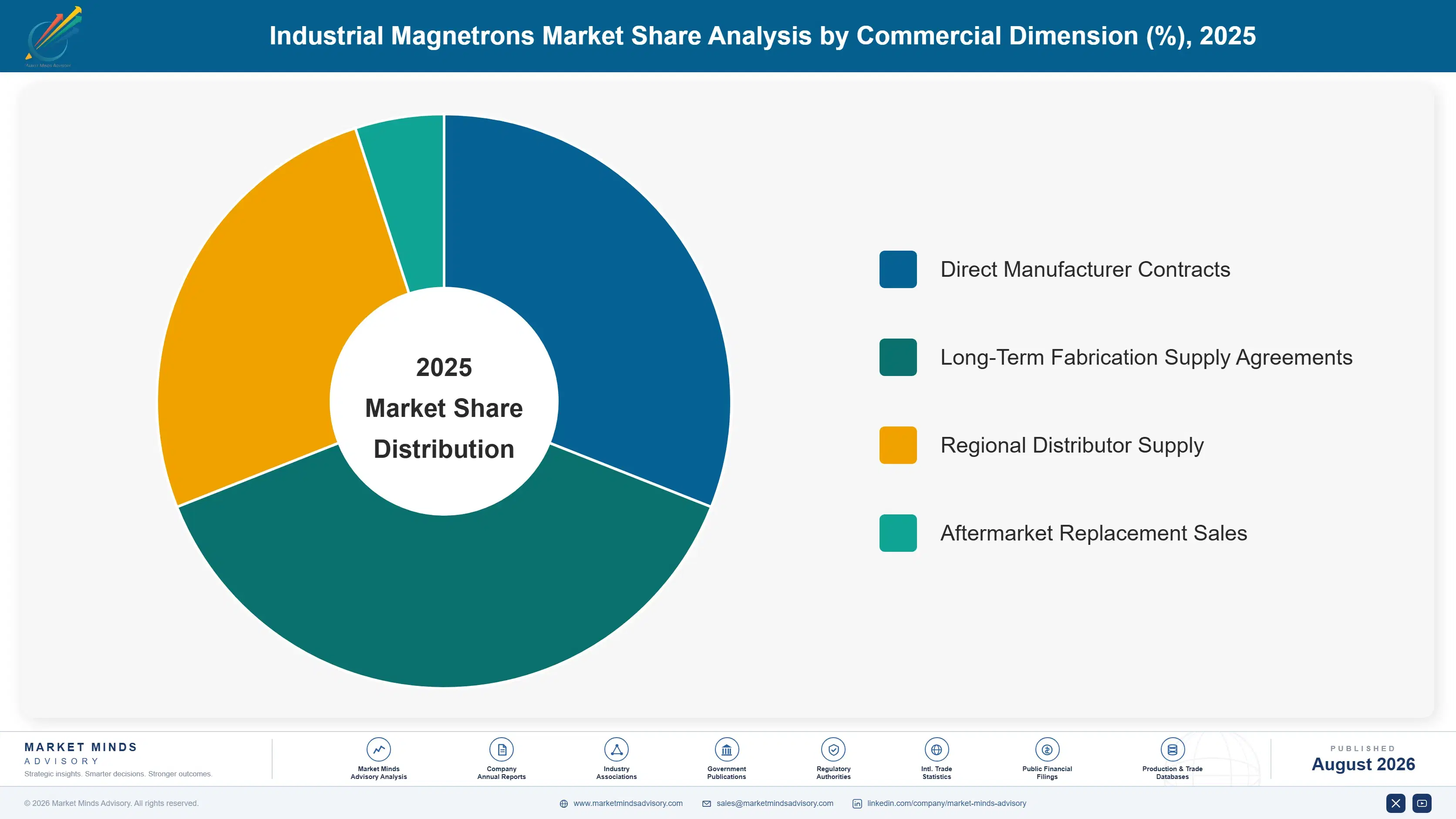
By Commercial Dimension

  • Direct Manufacturer Contracts
  • Long-Term Fabrication Supply Agreements
  • Regional Distributor Supply
  • Aftermarket Replacement Sales

By Region

  • North America
  • Western Europe
  • East Asia
  • South Asia and Pacific
  • Latin America
  • Middle East and Africa
  • Eastern Europe

Scope, Methodology, and Coverage

Every figure in this report is reproducible from documented input assumptions. The scope below maps the historical period, the forecast horizon, the segmentation dimensions, and the countries covered, alongside the underlying primary and qualitative methodology.
Historical Period
2020 to 2025
Forecast Period
2026 to 2036
Base Year
2025 (USD billions; MMA Primary Research Dataset, August 2026)
Market Definition
This report defines the industrial magnetrons market as continuous wave and pulsed magnetron vacuum tubes used for industrial heating, semiconductor plasma processing, materials sintering, water treatment, and scientific and medical applications. It excludes consumer microwave oven magnetrons, complete radar system assemblies, and solid-state RF power amplifiers.
Quantitative Units
USD billions (current prices); millions of magnetron units where applicable
Segmentation Dimensions
By Application and Power Classification; By End-Use Industry; By Commercial Dimension; By Region
Regions Covered
North America, Western Europe, East Asia, South Asia and Pacific, Latin America, Middle East and Africa, Eastern Europe
Countries Covered
USA, China, Germany, France, UK, Japan, South Korea, India, Australia, Canada, Brazil, Mexico, Indonesia, Vietnam, Thailand, Malaysia, UAE, Saudi Arabia, South Africa, Nigeria, Turkey, Poland, Netherlands, Italy, Spain, Sweden, Switzerland, Argentina, Colombia, Singapore, and additional markets relevant to this sector
Key Companies Profiled
Richardson Electronics, Ltd., Communications & Power Industries LLC, Toshiba Electron Tubes & Devices Co., Ltd., Panasonic Corporation, Muegge GmbH, Teledyne e2v, Canon Electron Tubes & Devices Co., Ltd., Shenzhen Sanwang Microwave Technology Co., Ltd., Guangdong Add-Vantek Microwave Technology Co., Ltd., New Japan Radio Co., Ltd., MKS Instruments, Inc., Comdel, Inc., Ampegon AG, Thermex-Thermatron, Inc., Ferrite Microwave Technologies, LLC, Sairem SAS, National Electronics, Inc., Midea Group Co., Ltd., Galanz Enterprise Group Co., Ltd., LG Innotek Co., Ltd.
Quantitative Methodology
Primary survey, n=3,800 respondents, Q4 2025, six countries; demand-side model with trade association cross-validation
Qualitative Methodology
47 expert interviews, Q4 2025; applied to validate demand model assumptions, identify emerging dynamics, and assess competitive positioning
Report Format
PDF and XLSX data workbook (Word format preview document)
Publisher
Market Minds Advisory
Report Code
MMA-2026-CON-208
Published
August 2026
Contact
sales@marketmindsadvisory.com | www.marketmindsadvisory.com

Purchase the full Industrial Magnetrons Market Report (2026 to 2036).

The full report provides a comprehensive assessment of the global industrial magnetrons market, including detailed sizing and ten-year forecasts across all seven regions and six application segments. It profiles twenty leading manufacturers, benchmarking qualification capability, reliability certification depth, and semiconductor-grade production capacity across the five largest players in particular. The analysis includes primary research drawn from MMA's Q4 2025 survey of 3,800 industrial and semiconductor procurement respondents across six countries and 47 expert interviews with power electronics and vacuum tube engineering leaders. Regional sections cover manufacturing capacity, qualification trends, and competitive dynamics specific to each market, supported by a standalone input cost and mitigation framework.
Ten-year market sizing and growth forecasts
Profiles of twenty leading magnetron manufacturers
Semiconductor qualification and capacity analysis
Copper and tungsten sourcing risk and mitigation framework
Primary survey data from 3,800 industry respondents
Forty-seven expert interviews with vacuum tube engineering leaders

Built For The People Who Decide

From boardroom strategy to bench-side execution, this report is read cover-to-cover by leaders shaping the next decade of their industry, turning demand scenarios, market dynamics and valuation benchmarks into decisions.
CXOs/ Presidents/ VPs/ Managers
M&A and Corporate Development
Strategy Teams and R&D Heads
Procurement and Product Directors
Regulatory and Compliance Leaders
Investor Relations and Equity Analysts