Market Minds Advisory
Industrial Lighting Cybersecurity Market

Industrial Lighting Cybersecurity Market: Industrial Lighting Cybersecurity Market. Connected Fixtures Expose a New Industrial Attack Surface

Facility managers deploying thousands of network-connected LED fixtures while auditors flag lighting controllers as an unmonitored attack surface are colliding as vendors race to extend industrial cybersecurity into a device category nobody used to guard.

Lead Analyst

Published

September 2026

Make Smarter Decisions with Customized Research Insights

Request a free sample report and evaluate market opportunities, growth trends, and competitive dynamics relevant to your business needs.

2025 MARKET VALUE$2.4BMarket Size 2025
2036 FORECAST VALUE$11.2BBase Case , 2026 to 2036
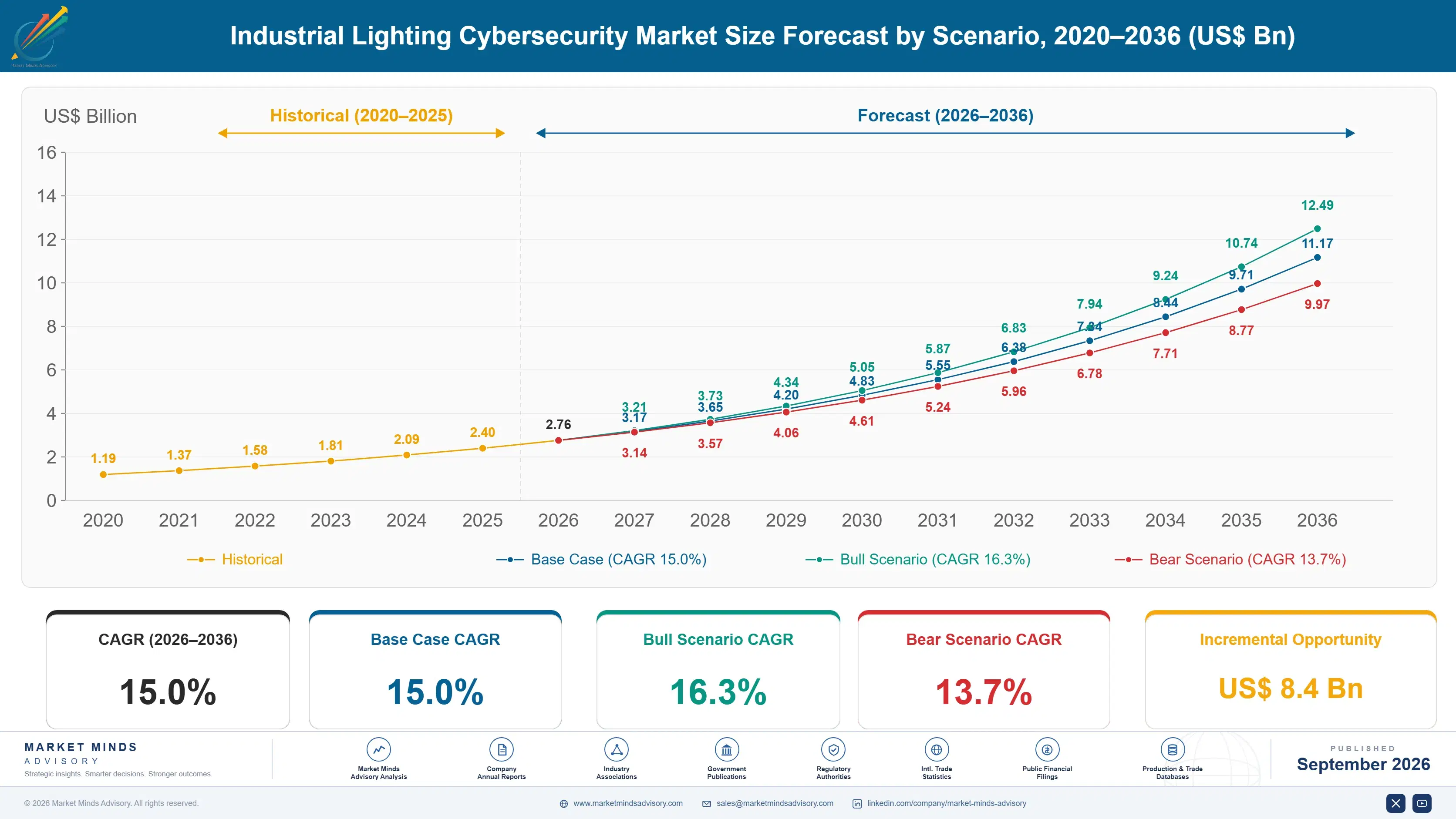
CAGR 2026 TO 203615.0 %Bull 16.3% / Bear 13.7%
INCREMENTAL OPPORTUNITY$8.4BNet 10- year value creation
EXPANSION MULTIPLE4.05x2036 value over 2026 base
Strategic Levers
M&A Pipeline
Regional Outlook
Country Rankings
Competitive Intelligence
Segmental Deep-dive
Call-Us : 91 93563 13602

Executive Snapshot and Market Trajectory.

Facility operators are discovering that network-connected LED lighting systems, installed purely for energy savings, now represent an unmonitored entry point into building networks that security teams never accounted for in their threat models. This gap is reshaping how facility managers and security teams evaluate vendor risk across each building portfolio.
Security audits increasingly flag lighting control systems as a genuine vulnerability as building automation networks converge with broader IT infrastructure, and East Asian manufacturers are adopting lighting cybersecurity fastest given the region's massive smart building construction volume. Critical infrastructure operators, including airports and hospitals, are separately driving demand as regulatory bodies extend industrial control system security requirements to building automation subsystems previously considered low-risk.
A fragmented vendor landscape still includes traditional industrial cybersecurity firms treating lighting as a minor subset of broader operational technology security, but specialist lighting security vendors are emerging directly from the lighting controls industry rather than the cybersecurity industry. Regulatory frameworks governing industrial control system security are forcing lighting manufacturers to document security practices with a rigor that barely existed five years ago. Vendors offering both are increasingly favored in procurement.
Market Definition
This report covers software and services that secure network-connected lighting control systems in industrial and commercial buildings, including network segmentation, monitoring, and vulnerability management tools, measured on a global revenue basis. It excludes general building automation cybersecurity not specific to lighting control networks and the lighting hardware itself.
Base Year Value
$2.4B in 2025 (MMA Primary Research Dataset, September 2026)
Forecast Period
2026 to 2036, eleven discrete annual values
CAGR
15.0% base case. Bull 16.3%. Bear 13.7%.
Fastest Growth Segment
Network Segmentation and Monitoring Software: 20.0% CAGR
Fastest Growth Country
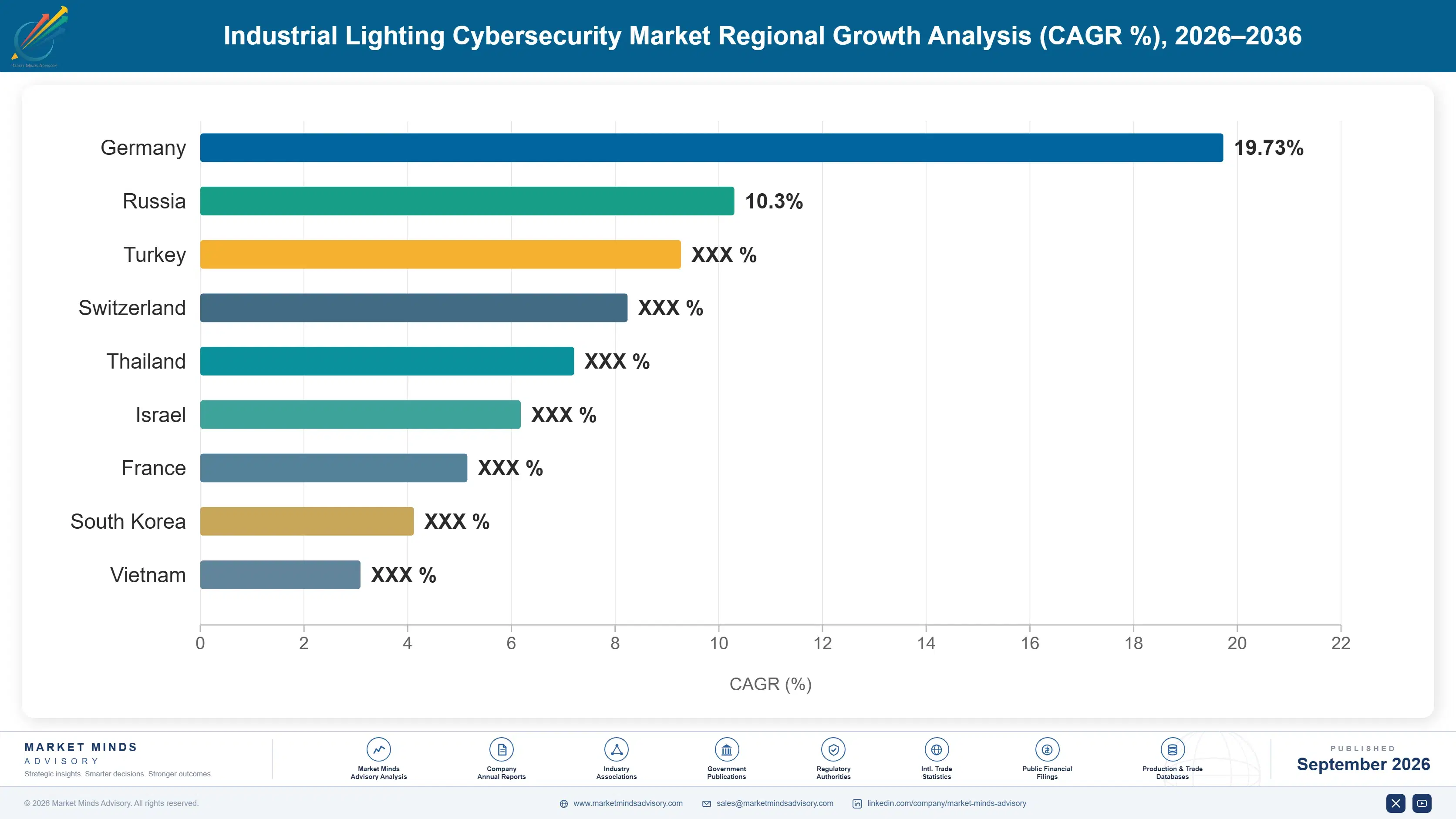
India: 20.5% CAGR
Fastest Growth Region
South Asia and Pacific: 17.2% CAGR
Largest Region
East Asia: 30% of 2025 global value
Market Leaders
Signify, Honeywell, Johnson Controls, Fortinet, Claroty
Primary Survey
n=3,800 procurement and R&D decision-makers, Q4 2025, six countries
Methodology
Demand-side build-up, cross-validated against public data, 47 expert interviews

Industrial Lighting Cybersecurity Market Forecast Scenarios

industrial-lighting-cybersecurity-market-size-forecast-scenario-1788417136053
Between 2020 and 2025 the industrial lighting cybersecurity market grew at roughly 13.6 percent annually from a very small base as network-connected LED adoption expanded rapidly across commercial and industrial buildings without corresponding security investment. Growth accelerated sharply once several publicized incidents demonstrated that lighting networks could serve as an entry point into broader building systems.
The base case assumes continued rapid expansion as three commercial mechanisms compound: regulatory bodies extend industrial control system security requirements to building automation subsystems including lighting, insurance underwriters begin factoring lighting network segmentation into commercial property risk assessments, and smart city infrastructure programs bundle in security requirements for connected streetlighting networks by default. Vendors respond by building dedicated lighting security product lines rather than treating lighting as a minor subset of broader operational technology security offerings.
The bull case centers on a major publicized security incident involving lighting infrastructure triggering emergency regulatory action across multiple countries simultaneously. The bear case centers on facility owners deprioritizing lighting-specific security investment during broader capital expenditure constraints, treating it as a lower-priority risk relative to more visible operational technology security concerns. Vendors could see meaningfully slower adoption in cost-constrained markets under this scenario.

Lighting Networks Become a Security Perimeter, Not an Afterthought

Security vendors are no longer selling a firewall appliance, they are selling continuous network visibility, and that shift is rewriting who counts as a credible supplier to a large facility operator. A vendor without lighting-protocol-specific detection cannot win a contract that now requires monitoring device categories most generic industrial security tools were never designed to recognize.
MARKET CONCENTRATION36% CR5Top five vendors hold a modest share of service revenue
AVERAGE DEPLOYMENT COST$15,000 per building siteCost varies widely based on facility size and network complexity
TOP ADOPTION COUNTRY SHAREChina, 24% of global revenueSingle country accounts for largest share of security service spending
VULNERABLE DEVICE PENETRATION70% of fixtures lack basic securityShare of connected lighting fixtures deployed without network segmentation
INCIDENT DETECTION IMPROVEMENT45% faster breach identificationReported gain in detection speed among facilities using monitoring tools
AVERAGE CONTRACT LENGTHTwo years per service agreementTypical duration of an industrial lighting cybersecurity service contract
Vendors that historically sold generic industrial cybersecurity tools are being squeezed out unless they build lighting-specific protocol expertise, since facility operators increasingly demand deep knowledge of lighting control communication standards rather than generic network security alone. Several smaller security consultancies have already exited this niche entirely, choosing instead to refer lighting-specific engagements to specialist partners who own the protocol expertise.
Lighting manufacturers are moving directly into cybersecurity services, competing with traditional security vendors who never built lighting protocol expertise, creating a market where neither pure lighting manufacturing nor pure cybersecurity positioning is defensible alone anymore. Facility operators increasingly evaluate vendors on lighting-specific vulnerability database depth almost as closely as general security credentials, a criterion that barely mattered in procurement decisions a decade ago when lighting was not considered part of the attack surface at all.
"Nobody put a firewall in front of the light switch until someone proved you could walk through it into the rest of the building."
Practice Lead, Industrial IoT Security · MMA Industrial IoT Cybersecurity Software and Services Practice · September 2026

Market Trends

Smart City Streetlighting Programs Embed Security Requirements

Municipal smart city programs deploying connected streetlighting networks across major cities are increasingly writing cybersecurity requirements directly into procurement specifications, treating lighting network security as a baseline requirement rather than an optional add-on. Over 60 major cities worldwide have launched connected streetlighting programs covering hundreds of thousands of fixtures each, creating a large and growing installed base that requires ongoing security monitoring. This shift is forcing lighting vendors without dedicated security capability to partner with specialist firms or risk exclusion from municipal tenders entirely. Vendors offering pre-certified municipal security packages win tenders faster than competitors building custom solutions per city.
Market Impact: Over 500 incidents reported annually
Building Automation Convergence Expands the Attack Surface

Lighting control networks are increasingly converging with broader building automation systems, including HVAC and access control, on shared IP-based network infrastructure rather than running on isolated proprietary networks as they historically did. This convergence means a vulnerability in a single lighting fixture can potentially provide a path into building systems that were never designed to be reachable from lighting network segments. Security researchers have documented over 200 distinct vulnerability classes across commonly deployed lighting control protocols, a figure that continues growing as researchers focus more attention on this previously overlooked device category.
Market Impact: Over 2 billion fixtures deployed globally

Market Opportunities and Growth Drivers

Ransomware Attacks Expose Overlooked IoT Device Categories

Ransomware groups have increasingly targeted overlooked internet-of-things device categories as an entry point once perimeter defenses on primary IT systems improved, and lighting controllers represent one of the largest unmonitored device populations in most commercial buildings. Documented industrial ransomware incidents have grown past 500 reported cases annually across critical infrastructure sectors, with several confirmed cases specifically tracing initial compromise back through building automation devices rather than traditional IT endpoints. Facility operators are responding by extending existing IT security monitoring practices to previously ignored operational technology device categories including lighting. Insurance underwriters increasingly demand proof of monitoring before issuing cyber coverage.
Market Impact: Adds 15 to 20 percent cost

Energy Efficiency Mandates Accelerate Connected Fixture Deployment

Government energy efficiency mandates requiring LED retrofits with networked controls for centralized dimming and scheduling are rapidly expanding the population of connected lighting fixtures that require security consideration. Over 2 billion connected lighting fixtures are expected to be deployed globally within the forecast period, each representing a potential network endpoint that facility security teams must account for in their threat models. This rapid fixture deployment is outpacing the corresponding growth in dedicated lighting security staffing and expertise at most facility operators. Manufacturers building security features directly into fixtures at the factory level are gaining a meaningful competitive edge.
Market Impact: Training gaps span 40 percent

Market Restraints and Challenges

Legacy Fixture Retrofit Cost Slows Security Upgrades

A large existing installed base of connected lighting fixtures was deployed without security features designed in, since manufacturers originally optimized purely for energy efficiency and did not anticipate cybersecurity as a design requirement at the time. The root cause is that lighting cybersecurity awareness emerged years after most currently deployed fixtures were already installed and budgeted for a decade-long service life. This forces facility operators to retrofit network-layer security around existing hardware rather than replacing fixtures outright, adding cost and complexity. Vendors are mitigating this by offering network-layer segmentation and monitoring solutions that do not require fixture replacement.
Market Impact: Over 60 major cities affected

Limited Security Awareness Among Facility Management Staff

Facility management teams historically responsible for lighting systems typically have limited cybersecurity training, since lighting was never previously considered part of the security perimeter requiring specialized monitoring skills. The underlying cause is that lighting and IT security have historically operated as separate organizational functions with little cross-training or shared incident response planning between the two teams. This forces vendors to build simplified monitoring interfaces that non-security specialists can operate effectively without extensive additional training. Vendors are mitigating this by partnering with facility management software providers to embed basic security alerts into tools staff already use daily.
Market Impact: Over 200 vulnerability classes documented
3 additional market trends, 4 additional growth drivers, and 3 additional restraints and challenges are covered in the full report. Contact sales@marketmindsadvisory.com to access the complete intelligence.

Segment CAGR and Growth Architecture

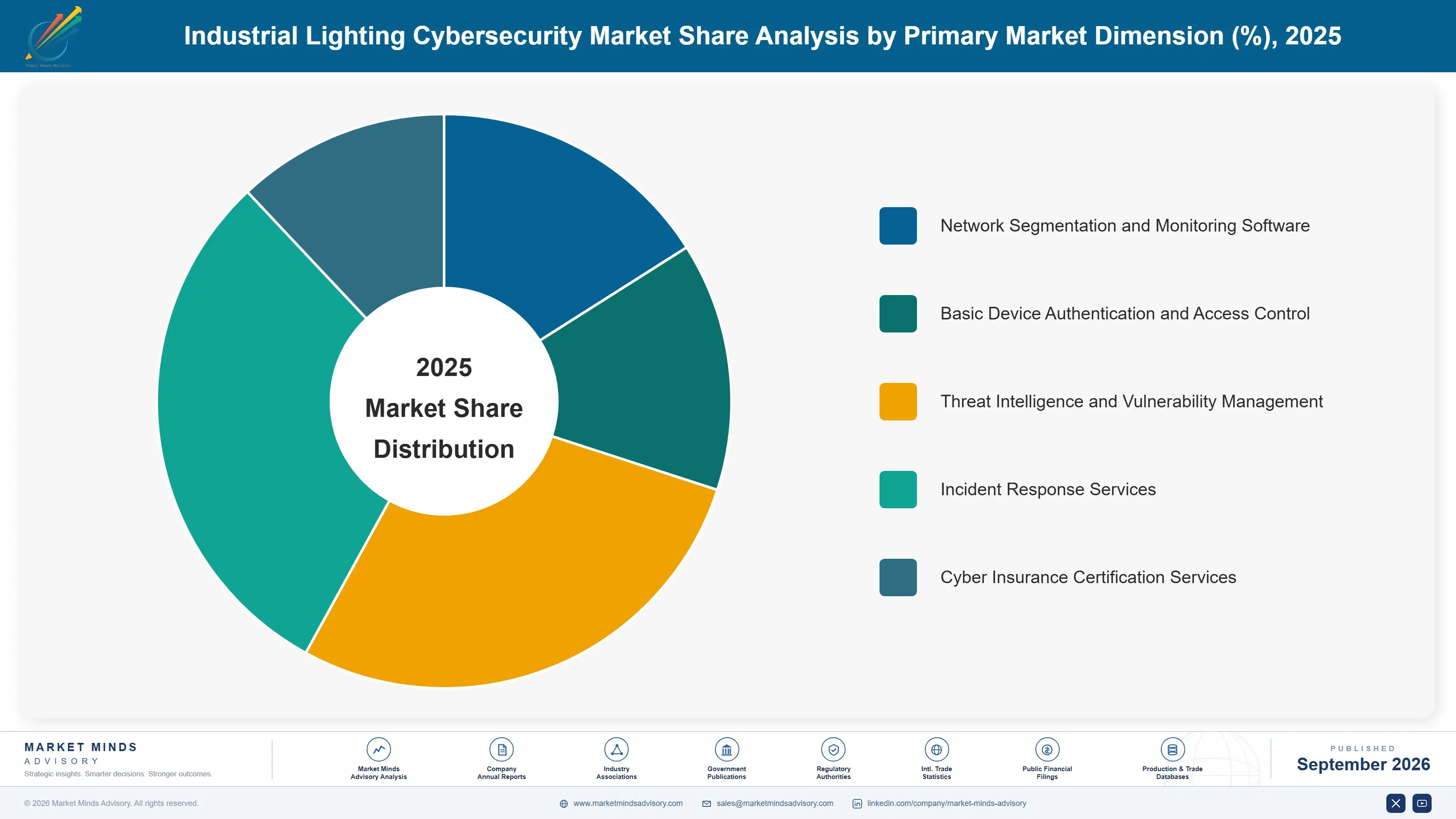
The industrial lighting cybersecurity market splits across five technology-defined segments spanning network security, device management, and vulnerability assessment software layers. Network segmentation and monitoring software leads growth as building automation convergence accelerates, while basic device authentication and access control tools still represent the largest installed base by unit count across smaller commercial facilities worldwide.
industrial-lighting-cybersecurity-market-market-share-analysis-1788417136602

Network Segmentation and Monitoring Software

Network segmentation and monitoring software isolates lighting control traffic from broader building IT networks while continuously monitoring for anomalous device behavior that could indicate compromise, letting security teams detect a threat before it spreads beyond the lighting network segment. This approach directly addresses the convergence risk created when lighting networks share infrastructure with more sensitive building systems, containing a potential breach to a limited blast radius. Growth here outpaces every other segment because it addresses the core underlying vulnerability of converged networks that facility operators increasingly recognize as their primary lighting-related security exposure. Vendors offering this capability are winning contracts from operators who previously treated lighting as entirely outside the security perimeter.
CAGR 20.0%

Basic Device Authentication and Access Control

Basic device authentication and access control tools remain the largest segment by installed unit count, covering the fundamental credential management and access restriction features that most connected lighting deployments include as a baseline capability rather than an advanced security layer. This tooling predates the current network segmentation boom and continues serving smaller facilities that face lower convergence risk given simpler, more isolated network architectures. Growth here is comparatively modest since these facilities have less complex security needs, with most new spending going toward incremental authentication feature additions rather than comprehensive network monitoring platform adoption. Vendors serving this segment compete primarily on price and ease of installation rather than the monitoring sophistication that differentiates network segmentation platforms.
CAGR 8.0%
Full segment breakdown across 6 segments available in the complete report.

Regional Architecture and Country Demand Map

East Asia leads global service revenue on the strength of China's massive connected streetlighting rollout and smart city investment, while North America holds a strong secondary share tied to industrial cybersecurity vendor concentration. South Asia and Pacific grows fastest as India expands its own smart city programs.

North America

Industrial cybersecurity vendor headquarters concentration defines North America's share more than raw fixture count alone. Honeywell, Fortinet, and Claroty all book the majority of their global security service revenue through United States entities, even as an increasing share of underlying connected fixture deployment sits overseas within multinational facility operator networks. Critical infrastructure operators, including airports and hospitals, face particularly strict regulatory scrutiny tied to industrial control system security mandates extending to building automation. Canada's smaller facility management sector follows a similar adoption pattern, though concentrated among a handful of major national operators. Insurance underwriters based in this region are also increasingly requiring proof of lighting network segmentation before issuing cyber liability coverage to large commercial operators.
Share: 24% | CAGR: 15.8% (2026 to 2036)

Western Europe

Western Europe's growth trails the global rate mainly because the region's stricter existing data protection and industrial control system regulation already forced meaningful baseline security investment before lighting-specific threats became a distinct industry focus elsewhere. Germany's manufacturing sector, running extensive operational technology alongside building systems, has driven some of the region's most sophisticated converged security deployments spanning both domains. The United Kingdom's critical national infrastructure designation framework continues extending security requirements to an expanding list of building subsystem categories including lighting. France and the Nordic countries have moved more slowly on lighting-specific tooling, favoring broader operational technology security platforms that treat lighting as one device category among many rather than a distinct focus.
Share: 19% | CAGR: 13.8% (2026 to 2036)
Regional intelligence for 5 additional markets available in the complete report: East Asia, South Asia and Pacific, Latin America, Middle East and Africa, Eastern Europe. Contact sales@marketmindsadvisory.com.
industrial-lighting-cybersecurity-market-country-cagr-analysis-1788417137123

Where Security Vendors Can Still Add Margin

Commoditizing basic monitoring features and thinning per-site service margins are pushing vendors toward adjacent revenue lines that ride on top of the same facility relationship rather than the security service contract itself. Four levers stand out as genuinely additive to core revenue rather than cannibalistic of it, each drawing on capability the vendor already has.

Offering Cyber Insurance Compliance Certification Services

Vendors with proven lighting network security assessment methodology can offer formal certification services that facility operators use to satisfy insurance underwriter requirements for cyber liability coverage, capturing revenue from a compliance requirement operators must satisfy regardless of vendor choice. This certification converts a growing insurance industry requirement into an integrated revenue line rather than leaving operators to manage a separate assessment relationship. Vendors offering this capability command certification fees running roughly 10 to 15 percent of the base security contract value annually. Building this certification credibility requires accumulating a track record most newer entrants have not yet established.
Market Impact: Certification fees add 10 to 15 percent yearly

Selling Threat Intelligence Feeds Specific to Lighting Protocols

Vendors with visibility into attack patterns across many facility deployments can aggregate anonymized threat data into lighting-protocol-specific intelligence feeds sold back to the broader industry, monetizing operational data that was previously discarded after each monitoring cycle. This model captures value from data the vendor already collects for its own detection purposes. Early providers of this service report intelligence revenue reaching 5 to 8 percent of total company revenue within two years of launching the offering commercially. Regulatory scrutiny of anonymized threat data resale is rising, requiring careful privacy-preserving aggregation methodology before distribution.
Market Impact: Intelligence revenue reaches 5 to 8 percent share

Providing Incident Response Retainer Services for Facility Operators

Vendors that build dedicated lighting-specific incident response teams can sell retainer agreements guaranteeing rapid response during an active security event, capturing recurring revenue beyond the base monitoring contract. This service has proven especially valuable to critical infrastructure operators facing regulatory requirements for documented incident response capability. Vendors offering this service report retainer fees adding roughly 15 to 20 percent on top of standard monitoring contract value. Building this response capability requires staffing a dedicated team with lighting-specific expertise that most vendors currently lack entirely. Vendors that build this early gain a head start over rivals still developing similar capability.
Market Impact: Retainer fees add 15 to 20 percent more

Selling Predictive Fixture Failure and Security Analytics

Device telemetry data collected through security monitoring can feed predictive models that flag fixtures likely to fail or exhibit anomalous behavior before a full compromise occurs, a capability vendors increasingly package as a paid subscription layered on top of the base monitoring contract. Facility operators value this because proactive replacement reduces both security exposure and maintenance costs simultaneously. Subscription attach rates above 25 percent among operators managing large connected fixture fleets are now achievable for vendors with sufficient installed base data. Building an accurate model requires years of telemetry data across a large installed fleet.
Market Impact: Attach rates now exceed a 25 percent mark

Who Controls the Margin Pool

Global service revenue concentrates modestly, with the top five vendors holding roughly 36 percent share on a service revenue basis, the consistent yardstick applied throughout this assessment. Honeywell and Johnson Controls lead the enterprise category, though Claroty's operational-technology-first scale gives it a distinct competitive position built on protocol-level detection depth rather than broad building automation breadth. The gap between these leaders and mid-tier challengers remains narrow enough that near-term ranking changes look plausible.
Current activity centers on lighting-protocol-specific detection expansion and municipal certification bundling rather than price competition on basic monitoring. Vendors are racing to extend protocol coverage across the many proprietary lighting control standards simultaneously, since facility operators increasingly refuse to work with a vendor that only monitors one control protocol. Several mid-tier players have pursued threat intelligence acquisitions specifically to capture the lighting-specific data layer.

Emerging pressure comes from lighting manufacturers entering cybersecurity services directly, competing with traditional security vendors who never built lighting protocol expertise. Ranking shifts are most likely in the mid-tier, where vendors lacking broad protocol coverage risk losing municipal contracts to faster-moving specialists. The very top of the market remains comparatively unsettled, unlike more mature technology categories.
industrial-lighting-cybersecurity-market-company-positioning-matrix-1788417137647

Competitive Moat and Risk Dimensions

HONEYWELL

Moat: Broad Building Automation Integration

Honeywell's building automation platform already manages HVAC and access control for thousands of large facilities, letting it extend lighting security monitoring into an existing customer relationship rather than selling a standalone point solution. This breadth reduces sales cycle length considerably. Customers already trust Honeywell with critical building systems, easing the sales conversation for a new security module.
HONEYWELL

Risk: Less Lighting-Specific Protocol Depth

Honeywell's broad building automation focus means its lighting-specific protocol coverage sometimes trails specialist vendors like Claroty who focus more narrowly on operational technology threat detection, risking share loss on the most technically demanding facility contracts. Facilities with unusually complex proprietary lighting networks may prefer a specialist over a generalist platform.
CLAROTY

Moat: Deep Operational Technology Protocol Expertise

Claroty's origins in industrial control system security give it protocol-level detection depth across a wide range of operational technology device categories including lighting, an advantage general building automation vendors struggle to match technically. This specialization has made Claroty a preferred choice among the most security-conscious critical infrastructure operators.
CLAROTY

Risk: Narrower Building Automation Bundle

Claroty lacks the broader building automation platform bundle that Honeywell and Johnson Controls offer, limiting its ability to win facility contracts where buyers prefer a single integrated vendor relationship across every building system rather than point solutions. Smaller facility operators without dedicated security budgets often prefer the simplicity of one vendor for everything.

Players Tracked

Prominent Players

Signify
Honeywell
Johnson Controls
Fortinet
Claroty

Other Key Players

Dragos
Nozomi Networks
Armis
Forescout Technologies
Tenable
CyberX
OSRAM
Acuity Brands
Cree Lighting
Legrand
Schneider Electric
Siemens Smart Infrastructure
Verkada
Genetec
Bosch Building Technologies

Recent Developments

MARCH 2026

Honeywell Launches Lighting-Specific Threat Detection Module

Honeywell launched a new lighting-specific threat detection module integrated into its broader building automation security platform, targeting facility operators seeking unified monitoring across HVAC, access control, and lighting systems within a single dashboard interface. The module launched first for existing enterprise customers before a broader commercial release later this year.
Signal: Bundled building automation security is becoming the default expectation rather than a premium differentiator industry-wide. broadly.
OCTOBER 2025

Claroty Wins Multi-Year Municipal Streetlighting Security Contract

Claroty secured a multi-year security monitoring contract with a major municipal streetlighting authority, expanding its presence beyond commercial building facilities into public infrastructure, a segment central to the industry's fastest-growing regional demand. Financial terms of the multi-year agreement were not disclosed by either party involved.
Signal: Municipal streetlighting programs are becoming a primary channel for winning meaningful protocol-specific security volume overall today.
MAY 2025

Signify Acquires Cybersecurity Startup for Fixture Integration

Signify completed the acquisition of a smaller cybersecurity startup specializing in embedded fixture-level security, adding factory-integrated protection capability to its lighting hardware portfolio rather than relying solely on third-party network security vendors. The acquisition closed for an undisclosed sum earlier this year according to public filings.
Signal: Vertical integration into embedded security is becoming a competitive necessity for lighting hardware manufacturers themselves. directly.

Talent and Threat Intelligence Cost Exposure

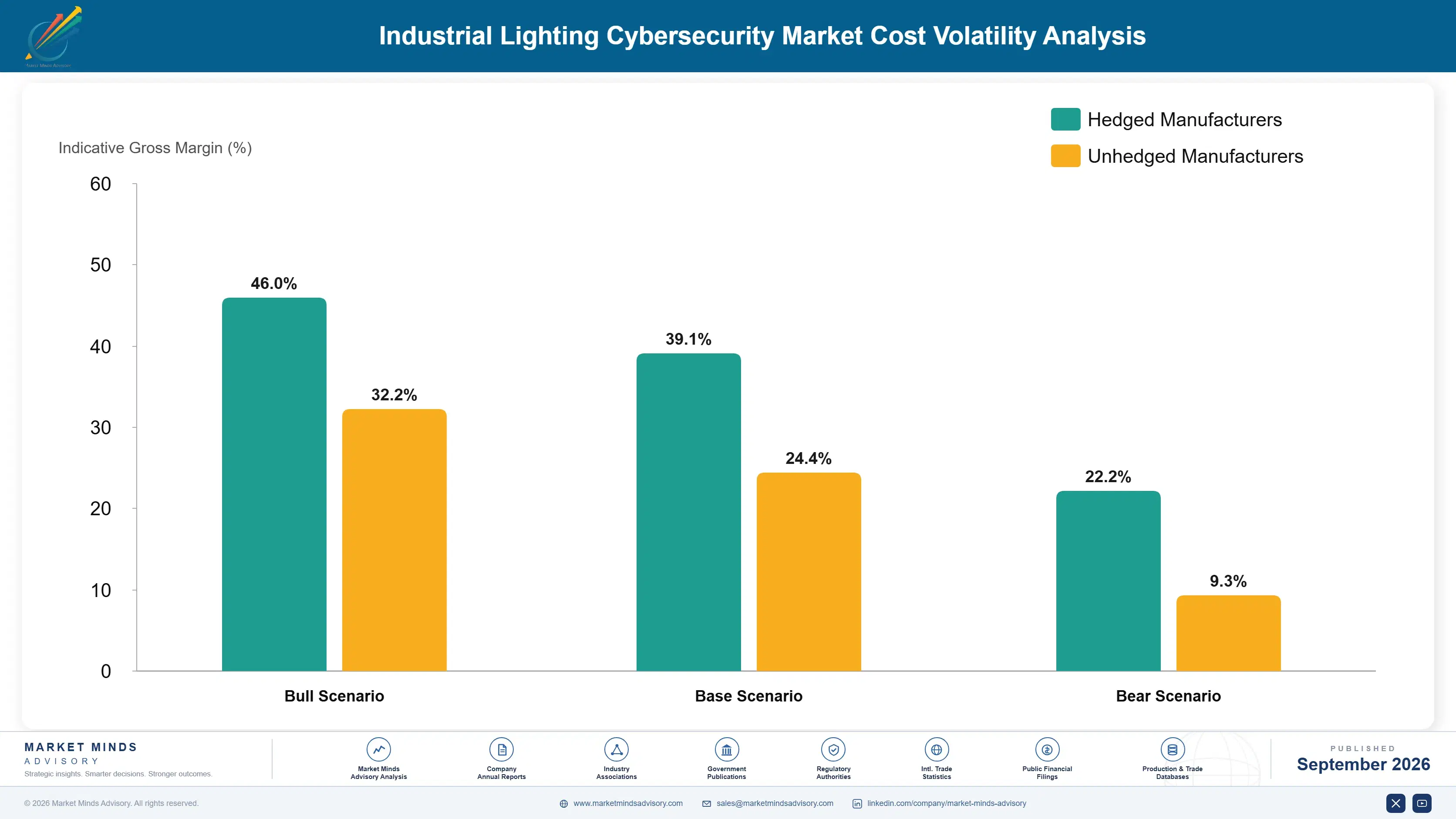
Specialized cybersecurity engineering talent accounts for roughly 40 to 48 percent of a typical industrial lighting security vendor's cost of goods sold, reflecting the scarcity of engineers with combined operational technology and lighting protocol expertise. Threat intelligence licensing and cloud monitoring infrastructure add a further 15 to 20 percent, sourced from specialized security data providers and major cloud platforms.
A 2023 cybersecurity talent shortage, documented in Fortinet's 2023 annual report as a material operational constraint, delayed several vendors' product roadmaps as competition for scarce operational technology security engineers intensified across the broader industry. Honeywell's 2023 annual report similarly cited talent acquisition cost as a factor in its decision to expand remote hiring beyond traditional engineering hub locations. These constraints pushed several vendors to expand internal training programs rather than relying solely on external hiring.

Smaller vendors face a genuine disadvantage here because they lack the compensation budgets to compete for scarce specialized talent against larger, better-funded competitors offering premium packages. Vendors based in regions with a smaller domestic cybersecurity talent pool face additional exposure, since they must compete globally for the same limited pool of operational technology security expertise.
industrial-lighting-cybersecurity-market-cost-volatility-analysis-1788417137843

Remote-First Specialized Talent Sourcing

Vendors are increasingly hiring operational technology security engineers from lower-cost regions through fully remote arrangements, reducing overall talent cost without sacrificing the specialized expertise required for effective lighting protocol threat detection. This approach requires mature remote collaboration processes and management practices that not every organization has successfully built at scale. at scale, reliably and consistently.

University Partnership Talent Pipeline Programs

Partnering with universities to build dedicated operational technology security training programs creates a pipeline of qualified engineers before competitors can recruit them, a longer-term strategy that smaller vendors increasingly find worthwhile despite the upfront investment. Building these university relationships takes years to mature into a reliable, steady source of qualified graduating engineers. each cohort.

Shared Threat Intelligence Consortium Membership

Joining industry threat intelligence sharing consortiums spreads the cost of threat data acquisition across member organizations rather than each vendor building independent intelligence capability from scratch, reducing per-vendor cost meaningfully. Membership requires contributing proprietary detection data back to the consortium, a tradeoff some vendors initially find uncomfortable. Most vendors accept this tradeoff given the alternative cost of independent intelligence building.

Portfolio Architecture for Margin Defence

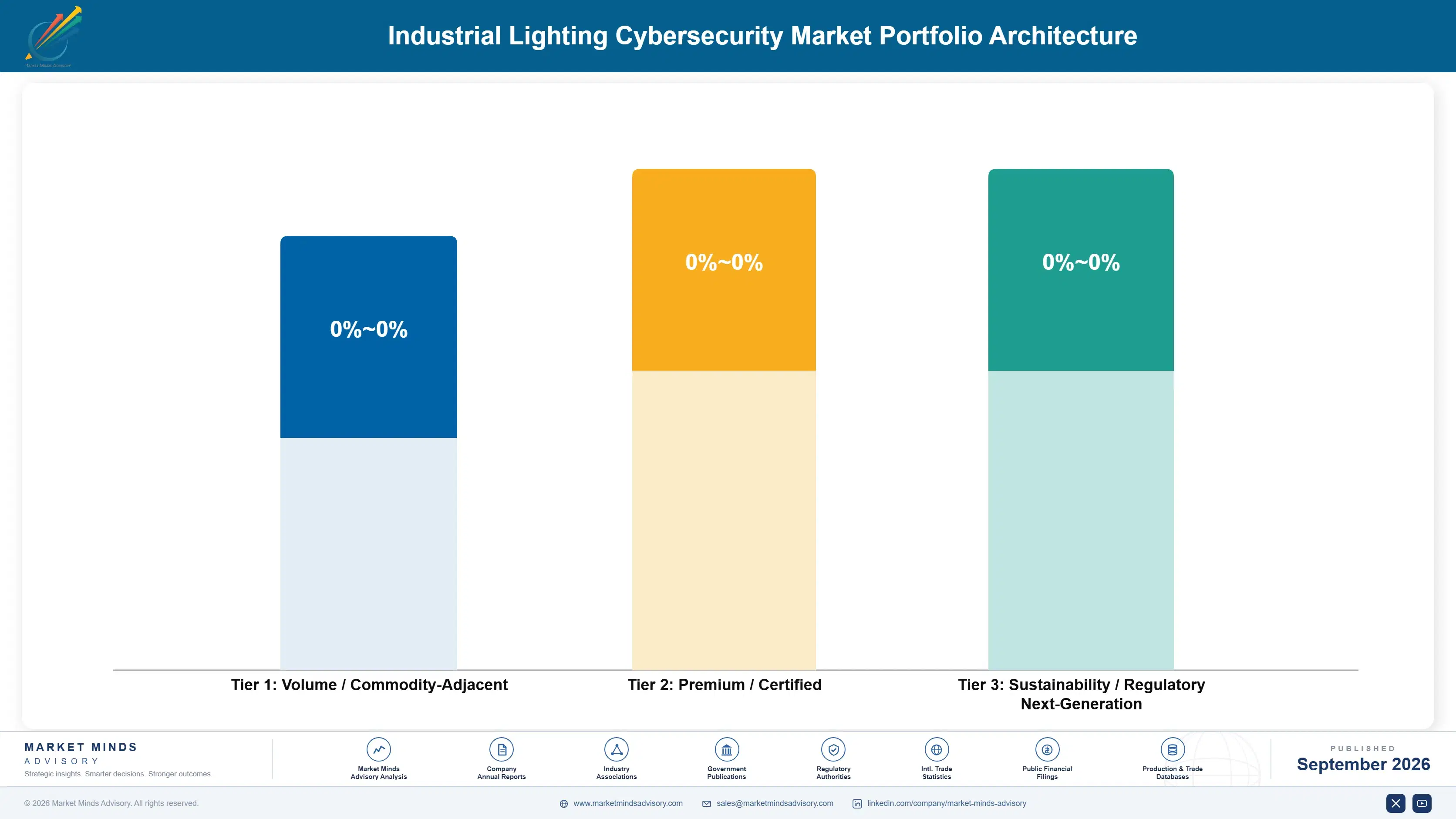
Lighting cybersecurity vendors operate across a widening tier structure as basic monitoring commoditizes and higher-margin certification and intelligence services concentrate pricing power elsewhere in the stack. Volume-tier monitoring now carries gross margins compressed by increasing competition, while premium platforms bundled with certification and incident response services retain meaningfully stronger pricing. Portfolio strategy increasingly determines profitability more than raw site count growth.
The tension between chasing site count and defending premium service positioning defines strategic choice across the industry. Vendors competing purely on per-site price find margin eroding faster than their cost base can adjust, while vendors segmenting customers by certification and retainer service uptake are protecting margin even as basic monitoring fees compress across the broader market. This divergence is reshaping how vendors allocate engineering investment across their facility base.

High-value margin pools concentrate in cyber insurance certification, threat intelligence, and incident response retainers sold as standalone offerings rather than bundled features. These pools grow faster than core monitoring revenue because they scale with data and expertise a vendor already owns rather than requiring incremental site deployments, making them the most defensible source of margin expansion available today. Vendors without such a plan risk the commodity tier over time.

Volume / Commodity-Adjacent

Basic device authentication and network monitoring sold to price-sensitive smaller facilities where per-site pricing is the primary purchase driver and switching cost remains modest. Operators in this tier churn readily toward whichever vendor offers the lowest visible per-site price.
Gross Margin: 8 to 14%

Premium / Certified

Network segmentation platforms bundled with cyber insurance certification and dedicated account management for large operators who value compliance assurance over marginal cost savings. These operators typically sign multi-year contracts, reducing acquisition cost per dollar of recurring revenue.
Gross Margin: 22 to 32%

Sustainability / Regulatory / Next-Generation

Threat intelligence feeds, incident response retainers, and predictive fixture analytics built to meet emerging regulatory mandates ahead of competitors, commanding premium pricing while scarce. Vendors here often price on a subscription basis tied to compliance scope rather than pure site count.
Gross Margin: 28 to 40%
industrial-lighting-cybersecurity-market-portfolio-architecture-1788417138345

High-value Sub-segments and Strategic Watch-out

Cyber Insurance Compliance Certification

High-value, high-growth pool as operators pay premium pricing for insurance-qualifying documentation, rewarding vendors who build credible certification programs earliest with durable multi-year contracts locked in ahead of rivals. Vendors absent from this capability risk losing the largest facility contracts entirely to faster-moving specialists. particularly early on.

Lighting-Specific Threat Intelligence Feeds

High-value, moderate-growth pool constrained by data privacy and aggregation methodology requirements, but delivering strong margin once a vendor has built sufficient installed base to generate meaningful intelligence. Expansion here depends heavily on how quickly a vendor can build a credible intelligence reputation in a competitive field.

Basic Device Authentication and Access Control

Volume core segment carrying the bulk of deployed fixtures but facing steady margin compression as network segmentation platforms and commoditized pricing erode differentiation across most basic offerings. Consolidation among smaller access control makers is likely as scale becomes the primary way to defend margin. thins.

Municipal Streetlighting Security Contracts

Strategic watch-out segment where shifting government funding priorities and smart city policy could rapidly change the competitive map, rewarding vendors with flexible multi-jurisdiction compliance infrastructure already built. A sudden shift in municipal budget priorities in any single major program could reroute meaningful volume quickly. suddenly.

Recurring Revenue Across the Fixture Fleet

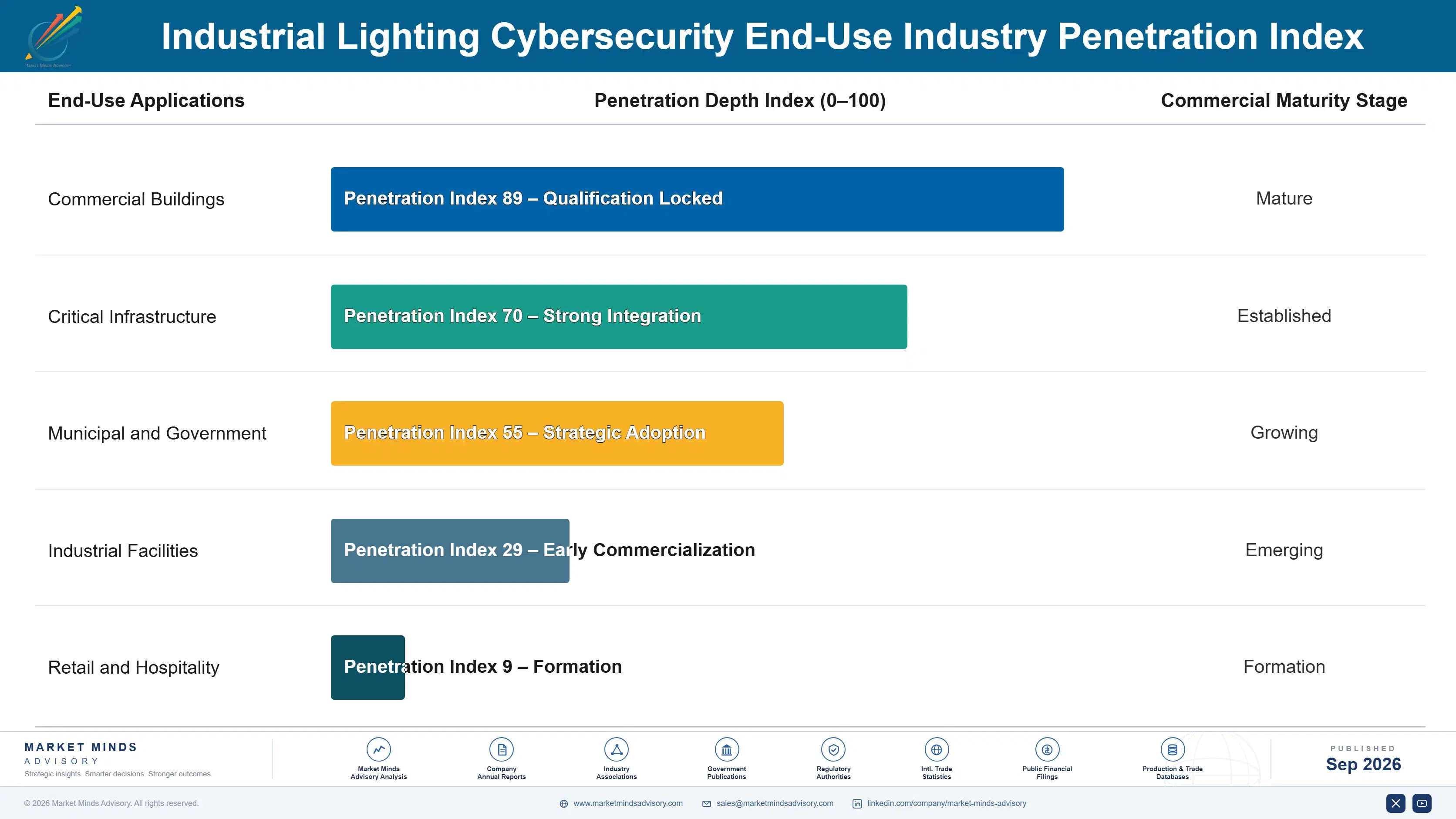
Security vendor revenue behaves like an annuity once a facility operator deploys network segmentation and monitoring across its lighting fleet, since switching vendors requires re-mapping network architecture and retraining facility staff, a cost most operators avoid unless service quality genuinely deteriorates. This stickiness means vendors earn recurring monitoring revenue for years after initial deployment, with almost no incremental sales cost.
Adoption depth varies sharply by end-use vertical. Critical infrastructure operators, including airports and hospitals, adopt security monitoring quickly since regulatory exposure directly affects compliance risk, while general commercial office buildings integrate more slowly due to cost sensitivity that can stretch adoption timelines past several years. Municipal streetlighting authorities sit at a different pace entirely, since adoption depends on public budget cycles rather than commercial demand.

Buyer profiles are shifting generationally as newer facility security managers, trained on converged IT and operational technology security principles, replace an older generation focused primarily on physical security and basic access control. Younger security leaders expect lighting monitoring to integrate directly with broader building security platforms from day one, treating a standalone lighting security tool as an outdated concept. This turnover is accelerating adoption of integrated, platform-based security tools faster than pricing alone would predict.
industrial-lighting-cybersecurity-market-end-use-penetration-index-1788417138837

Where MMA Sees the Real Bets

These are among the four positions where our research anticipates prominent divergence between winners and laggards over the coming forecast period. Each is grounded in the demand model, the regulatory perimeter, and the announced capacity pipeline.
01 / PROTOCOL COVERAGE PRIORITY

Build broad lighting protocol coverage before municipal tenders concentrate

Vendors with narrow protocol coverage are already losing municipal contracts to rivals who can monitor every major lighting control standard deployed across a city's entire fixture base without gaps. This gap widens every quarter a vendor delays investment, since large municipal tenders increasingly require comprehensive protocol coverage as a baseline qualification requirement. MMA views protocol breadth as the clearest predictor of which vendors win the largest municipal contracts over the next several years, more so than raw detection accuracy alone.
02 / CERTIFICATION SERVICE BUILD

Build cyber insurance certification capability ahead of underwriter demand

Insurance underwriters are increasingly asking pointed, detailed questions about lighting network segmentation during commercial property risk assessments, creating a genuinely large near-term revenue opportunity for whichever vendor can provide credible, auditor-grade certification quickly and reliably at scale. Vendors that build auditor-grade assessment methodology now can charge a meaningful premium before the capability becomes commoditized across the broader market. MMA strongly advises treating this as a standing product priority rather than a reactive feature bolted on once underwriters already require it.
03 / MUNICIPAL MARKET POSITIONING

Pursue municipal streetlighting contracts ahead of broader competition

Municipal streetlighting programs clearly represent a genuinely large-volume customer category that rewards vendors who can demonstrate proven, reliable capability at full city scale rather than single-building deployments alone. Vendors building dedicated municipal sales and support capability now are positioning well ahead of the broader industry shift toward comprehensive, mandatory smart city security requirements across every major program. MMA firmly and confidently regards early positioning here as a meaningfully lower risk than waiting for the segment to mature and competition to intensify.
04 / THREAT INTELLIGENCE MONETIZATION

Turn detection data into lighting-specific threat intelligence products

Vendors sitting on years of detection data across many facility deployments are clearly underusing that asset if they only monetize it through the core monitoring contract alone. Packaging this data into threat intelligence products sold back to the industry converts existing operational data into genuinely new revenue without requiring any incremental site deployments or hardware investment at all. MMA very strongly advises treating data monetization as a standing product priority rather than an afterthought bolted on once competitors already offer it.

Engagement Snapshot From the Field

A live engagement with an industry participant carrying material or product regulatory and market exposure ahead of a defining policy shift, showing how our research translates into a defensible multi-year portfolio strategy.
MARKET MINDS ADVISORY · CLIENT ENGAGEMENT SUMMARY
Industrial Lighting Cybersecurity Producer Strategic Portfolio Review and Transition Roadmap 2026·Investment Scenario on Industrial Lighting Cybersecurity Exposure Evaluation 2025-26
CLIENT PROFILE
The client is a mid-sized municipal government operating a connected streetlighting network of roughly 45,000 fixtures across its metropolitan area, deployed over the past five years as part of an energy efficiency modernization program. Its network operations center had no dedicated security monitoring for the lighting control system, relying solely on the vendor's basic operational dashboard.
STRATEGIC CHALLENGE
The city faced mounting pressure following a publicized security incident in a peer municipality that traced a network breach back through an unmonitored streetlighting system into other city infrastructure. Leadership needed a security retrofit strategy deployable within one budget cycle, without requiring wholesale fixture replacement across the existing network. Municipal budget approval required demonstrating concrete near-term risk reduction.
MMA APPROACH
MMA conducted a network architecture assessment alongside interviews with the city's IT and public works departments, then benchmarked three security vendors against retrofit complexity and total implementation cost. The engagement produced a phased segmentation plan prioritizing the highest-risk network zones first, sequenced to demonstrate security improvement before expanding citywide coverage.
KEY FINDINGS
  1. The city's streetlighting network shared unsegmented network infrastructure with traffic signal control systems, a critical undiscovered vulnerability affecting the entire city. directly.
  2. A network-layer segmentation approach avoided the need for fixture replacement, cutting projected implementation cost by roughly 70 percent overall for the city.
  3. Two of three vendors evaluated already held relevant municipal government security clearances, reducing procurement and vetting timeline significantly for this engagement. smoothly.
  4. Staff at the network operations center had received no prior training specific to lighting network security monitoring practices before this engagement began.
CLIENT PROFILE
The client is a mid-sized municipal government operating a connected streetlighting network of roughly 45,000 fixtures across its metropolitan area, deployed over the past five years as part of an energy efficiency modernization program. Its network operations center had no dedicated security monitoring for the lighting control system, relying solely on the vendor's basic operational dashboard.
STRATEGIC CHALLENGE
The city faced mounting pressure following a publicized security incident in a peer municipality that traced a network breach back through an unmonitored streetlighting system into other city infrastructure. Leadership needed a security retrofit strategy deployable within one budget cycle, without requiring wholesale fixture replacement across the existing network. Municipal budget approval required demonstrating concrete near-term risk reduction.
MMA APPROACH
MMA conducted a network architecture assessment alongside interviews with the city's IT and public works departments, then benchmarked three security vendors against retrofit complexity and total implementation cost. The engagement produced a phased segmentation plan prioritizing the highest-risk network zones first, sequenced to demonstrate security improvement before expanding citywide coverage.
KEY FINDINGS
  1. The city's streetlighting network shared unsegmented network infrastructure with traffic signal control systems, a critical undiscovered vulnerability affecting the entire city. directly.
  2. A network-layer segmentation approach avoided the need for fixture replacement, cutting projected implementation cost by roughly 70 percent overall for the city.
  3. Two of three vendors evaluated already held relevant municipal government security clearances, reducing procurement and vetting timeline significantly for this engagement. smoothly.
  4. Staff at the network operations center had received no prior training specific to lighting network security monitoring practices before this engagement began.
RECOMMENDED STRATEGY
Phase 1: Phase 1 (Months 1-3): segment the highest-risk network zones sharing infrastructure with traffic signal systems immediately and thoroughly. early on. Phase 2: Phase 2 (Months 4-8): extend segmentation and monitoring citywide across the remaining streetlighting network zones fully and completely. citywide fully. Phase 3: Phase 3 (Months 9-10): complete operations center staff training and finalize ongoing monitoring procedures thoroughly and formally. properly and permanently.
OUTCOME
The city completed priority zone segmentation within eleven weeks, ahead of the twelve-week target (client-reported, unverified by MMA). No further cross-system vulnerabilities were identified in a follow-up assessment conducted after citywide rollout completion (client-reported, unverified by MMA). The city has since cited the program as a model for other municipalities considering similar retrofits (client-reported, unverified by MMA).

Frequently Asked Questions

Foundational context covering the market sizes, CAGR, scope, country, region and competition that inform every finding below. This section is provided to cover basics and most often pre-purchase conversations, answered from the MMA Primary Research Dataset.

What is the current size of the Industrial Lighting Cybersecurity Market?

The Industrial Lighting Cybersecurity Market reached 2.4 billion dollars in 2025, the report's base year for all forecast calculations. This figure covers network segmentation, monitoring, and vulnerability management software globally.

How large will the Industrial Lighting Cybersecurity Market be by 2036?

The market is projected to reach 11.17 billion dollars by 2036, roughly 4.05 times its 2026 starting value. That growth reflects smart city mandates and building automation convergence.

What is the CAGR for the Industrial Lighting Cybersecurity Market 2026 to 2036?

The market is forecast to grow at a 15.0 percent compound annual rate between 2026 and 2036. Bull and bear scenarios range from 16.3 percent to 13.7 percent respectively.

Which segment is growing fastest?

Network segmentation and monitoring software leads growth at 20.0 percent CAGR, roughly 1.33 times the overall market rate. Building automation convergence is driving this expansion across most facility types.

Who are the major companies in the Industrial Lighting Cybersecurity Market?

Signify, Honeywell, Johnson Controls, Fortinet, and Claroty lead the market on a service revenue basis. Together these five vendors hold roughly 36 percent combined share.

Which country is growing fastest?

India leads country-level growth at 20.5 percent CAGR, driven by its expanding smart city program and domestic security vendor incentives. Municipal contracts are increasingly favoring indigenous technology providers.

Report Segmentation Architecture

The full report scope spans multiple orthogonal segmentation dimensions, with cross-tabulated demand data provided for each dimension pair. Coverage extends further to regional breakdowns, trend trajectories, and the competitive detail needed to support segment-level decision-making.

By Primary Market Dimension

  • Network Segmentation and Monitoring Software
  • Basic Device Authentication and Access Control
  • Threat Intelligence and Vulnerability Management
  • Incident Response Services
  • Cyber Insurance Certification Services

By End-Use Industry

  • Commercial Buildings
  • Critical Infrastructure
  • Municipal and Government
  • Industrial Facilities
  • Retail and Hospitality

By Commercial Dimension

  • Large Enterprise Facility Operators
  • Municipal Government Agencies
  • Critical Infrastructure Operators
  • Small and Medium Commercial Facilities

By Region

  • North America
  • Western Europe
  • East Asia
  • South Asia and Pacific
  • Latin America
  • Middle East and Africa
  • Eastern Europe

Scope, Methodology, and Coverage

Every figure in this report is reproducible from documented input assumptions. The scope below maps the historical period, the forecast horizon, the segmentation dimensions, and the countries covered, alongside the underlying primary and qualitative methodology.
Historical Period
2020 to 2025
Forecast Period
2026 to 2036
Base Year
2025 (USD billions; MMA Primary Research Dataset, September 2026)
Market Definition
This report covers software and services that secure network-connected lighting control systems in industrial and commercial buildings, including network segmentation, monitoring, and vulnerability management tools, measured on a global revenue basis. It excludes general building automation cybersecurity not specific to lighting control networks and the lighting hardware itself.
Quantitative Units
USD billions, global market size and forecast
Segmentation Dimensions
Product/technology type, end-use industry, commercial/customer dimension, region
Regions Covered
North America, Western Europe, East Asia, South Asia and Pacific, Latin America, Middle East and Africa, Eastern Europe
Countries Covered
United States, China, Germany, France, United Kingdom, Japan, South Korea, India, Canada, Brazil, Mexico, Indonesia, Vietnam, Thailand, Malaysia, United Arab Emirates, Saudi Arabia, South Africa, Nigeria, Turkey, Poland, Netherlands, Italy, Spain, Sweden, Switzerland, Argentina, Colombia, Australia, Singapore, and additional markets relevant to this sector
Key Companies Profiled
Signify, Honeywell, Johnson Controls, Fortinet, Claroty, Dragos, Nozomi Networks, Armis, Forescout Technologies, Tenable, CyberX, OSRAM, Acuity Brands, Cree Lighting, Legrand, Schneider Electric, Siemens Smart Infrastructure, Verkada, Genetec, Bosch Building Technologies
Quantitative Methodology
Primary survey, n=3,800 respondents, Q4 2025, six countries; demand-side model with trade association cross-validation
Qualitative Methodology
47 expert interviews, Q4 2025; applied to validate demand model assumptions, identify emerging dynamics, and assess competitive positioning
Report Format
PDF and XLSX data workbook (Word format preview document)
Publisher
Market Minds Advisory
Report Code
MMA-2026-TEC-134
Published
September 2026
Contact
sales@marketmindsadvisory.com | www.marketmindsadvisory.com

Purchase the full Industrial Lighting Cybersecurity Market Report (2026 to 2036).

This report delivers a comprehensive analysis of the global Industrial Lighting Cybersecurity Market, covering market sizing, segmentation, and regional dynamics through 2036. It profiles the competitive landscape across twenty leading vendors, benchmarked on a consistent service revenue basis. Regional analysis spans all seven major world regions, quantifying share and growth rate differences driven by regulatory, infrastructure, and technology adoption factors. The report also examines revenue diversification strategies, input cost exposure, and portfolio economics shaping vendor profitability. A dedicated case study illustrates practical implementation lessons for municipalities pursuing security retrofits.
Ten-year market size and CAGR forecast through 2036
Five-segment MECE market breakdown with growth rates
Seven-region share and growth rate analysis
Twenty-company competitive benchmarking on service revenue basis
Revenue diversification strategy analysis across four commercial levers
Anonymized client implementation case study with outcomes

Built For The People Who Decide

From boardroom strategy to bench-side execution, this report is read cover-to-cover by leaders shaping the next decade of their industry, turning demand scenarios, market dynamics and valuation benchmarks into decisions.
CXOs/ Presidents/ VPs/ Managers
M&A and Corporate Development
Strategy Teams and R&D Heads
Procurement and Product Directors
Regulatory and Compliance Leaders
Investor Relations and Equity Analysts