Market Minds Advisory
Industrial LiDAR Integrated Lighting Market

Industrial LiDAR Integrated Lighting Market: Industrial LiDAR Integrated Lighting Market. Trends and Forecast 2026 to 2036

Warehouse operators and factory safety managers are fusing LiDAR sensing into overhead lighting fixtures, turning routine illumination hardware into a real-time obstacle detection layer standalone sensor installations could never deliver as cheaply.

Lead Analyst

Published

September 2026

Make Smarter Decisions with Customized Research Insights

Request a free sample report and evaluate market opportunities, growth trends, and competitive dynamics relevant to your business needs.

2025 MARKET VALUE$0.8BMarket Size 2025
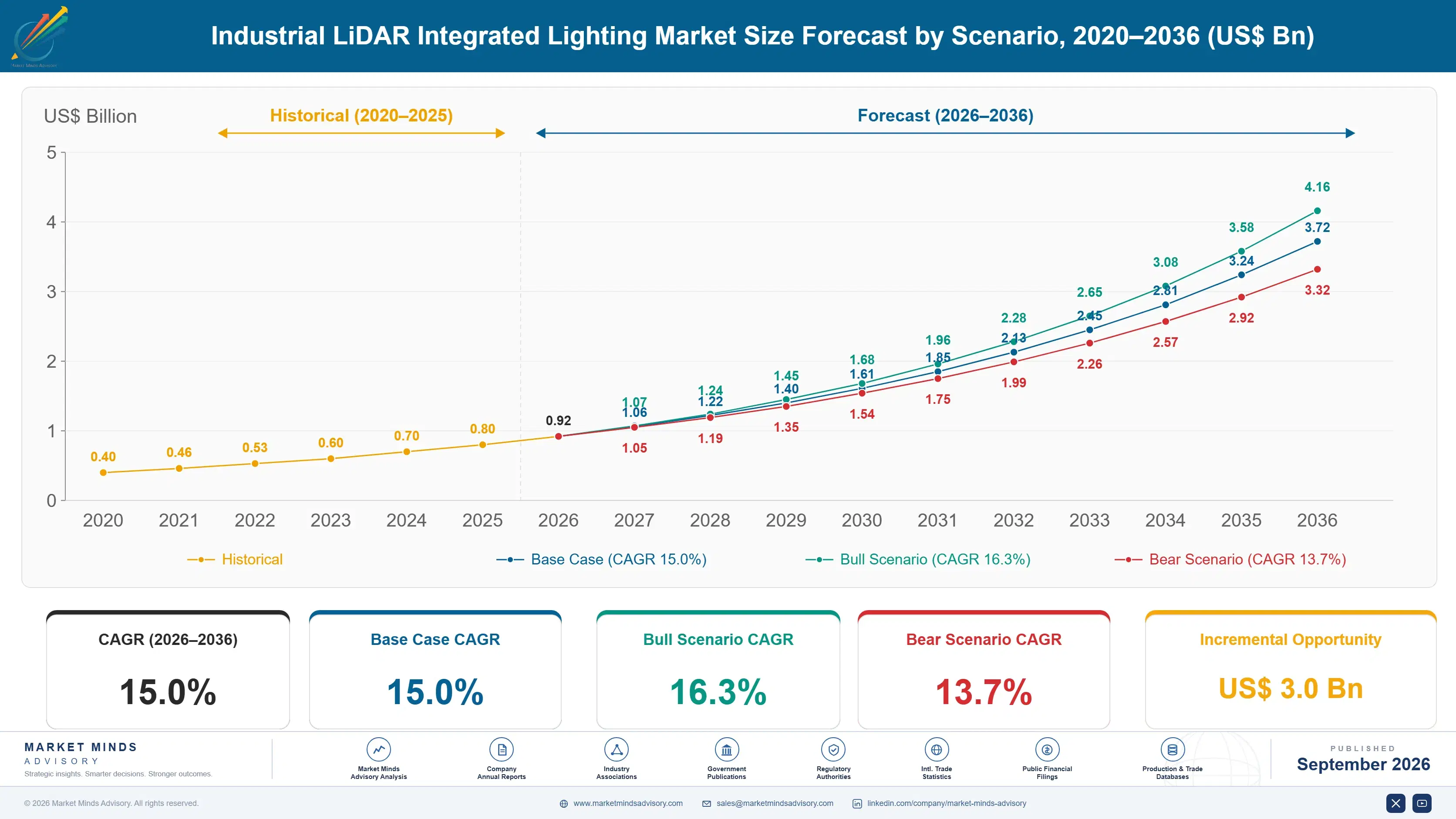
2036 FORECAST VALUE$4.0BBase Case , 2026 to 2036
CAGR 2026 TO 203615.0 %Bull 16.3% / Bear 13.7%
INCREMENTAL OPPORTUNITY$3.0BNet 10- year value creation
EXPANSION MULTIPLE4.05x2036 value over 2026 base
Strategic Levers
M&A Pipeline
Regional Outlook
Country Rankings
Competitive Intelligence
Segmental Deep-dive
Call-Us : 91 93563 13602

Executive Snapshot and Market Trajectory.

Warehouse automation budgets are quietly funding a new category: lighting fixtures that also see. Facility operators retrofitting high-bay warehouses for autonomous forklifts and mobile robots increasingly specify LiDAR-integrated fixtures rather than bolting separate sensor arrays onto existing overhead lighting infrastructure at additional installation cost and complexity.
China's warehouse automation buildout and Japan's aging industrial workforce are pulling most near-term demand, since both markets face acute pressure to reduce collision incidents and staffing needs at once. Logistics operators specifically favor combined fixtures because they eliminate a separate wiring run and mounting bracket for standalone sensor hardware, cutting installation labor cost meaningfully across large distribution center retrofits nationwide and across new facility construction projects underway.
Lighting manufacturers historically selling commodity fixtures now compete against sensor specialists entering from the opposite direction, creating an unusually fluid competitive landscape barely two years old and still consolidating rapidly. Safety regulation updates requiring documented collision avoidance systems in high-traffic industrial zones are compounding this technology shift, pushing facility owners toward combined fixtures faster than pure lighting replacement cycles alone would justify. Early customer feedback also points to lower long-term maintenance costs from consolidated hardware.
Market Definition
The Industrial LiDAR Integrated Lighting Market covers overhead and area lighting fixtures with embedded LiDAR sensing modules sold for warehouse, factory, and logistics facility deployment, measured by unit and system revenue. It excludes standalone LiDAR sensors sold separately from lighting hardware and general-purpose industrial lighting without integrated sensing capability.
Base Year Value
$0.8B in 2025 (MMA Primary Research Dataset, September 2026)
Forecast Period
2026 to 2036, eleven discrete annual values
CAGR
15.0% base case. Bull 16.3%. Bear 13.7%.
Fastest Growth Segment
LiDAR-Integrated High Bay Warehouse Fixtures: 19.0% CAGR
Fastest Growth Country
China: 17.5% CAGR
Fastest Growth Region
South Asia and Pacific: 17.0% CAGR
Largest Region
East Asia: 29% of 2025 global value
Market Leaders
Leading participants include Signify, Acuity Brands, Hesai Group, RoboSense, and Dialight.
Primary Survey
n=3,800 procurement and R&D decision-makers, Q4 2025, six countries
Methodology
Demand-side build-up, cross-validated against public data, 47 expert interviews

Industrial LiDAR Integrated Lighting Market Forecast Scenarios

industrial-lidar-integrated-lighting-market-size-forecast-scenario-1788417363934
LiDAR-integrated lighting barely existed as a distinct commercial category before 2023, with most early volume limited to pilot deployments inside a handful of advanced automated warehouses. Growth accelerated from 2023 onward as LiDAR sensor costs fell sharply, growing at an estimated 13.5% annual rate historically as component pricing crossed a threshold that made combined fixtures commercially viable for mainstream facility retrofits.
MMA's base case rests on three compounding mechanisms: falling LiDAR sensor unit costs make combined fixtures price-competitive with standalone sensor and lighting purchases separately, warehouse automation investment keeps expanding as labor costs rise, and safety regulators increasingly require documented collision avoidance coverage in high-traffic industrial zones. Together these mechanisms push adoption well beyond the automation pioneers who drove early volume into mainstream logistics and manufacturing facility retrofits across most regions.
The bull case centers on a single catalyst: mandatory collision avoidance documentation spreading from logistics into general manufacturing and construction site safety codes. The bear risk is standardization delay, where competing LiDAR wavelength and mounting specifications fragment the market long enough that facility operators default back to purchasing separate lighting and sensor systems from established specialist vendors instead.

Lighting Hardware Becomes a Sensing Layer

Combined LiDAR and lighting fixtures emerged from a straightforward observation: warehouses already run electrical wiring to every ceiling mount point, so adding sensing capability to that existing hardware costs far less than running a separate sensor network from scratch. Facility integrators report installation labor savings running as high as 35% compared with deploying standalone LiDAR units alongside conventional lighting fixtures separately, which meaningfully shortens project payback periods for warehouse operators.
MARKET CONCENTRATION42% CR5Top five vendors hold this combined revenue share currently
AVERAGE FIXTURE PRICE$380 per unitTypical combined lighting and sensing fixture price point
TOP PRODUCING COUNTRY34% ChinaShare of global combined fixture manufacturing volume reported
INSTALLATION LABOR SAVINGS35% reductionEstimated labor time saved versus separate sensor installation
WAREHOUSE ADOPTION RATE18% of new buildsShare of new facility construction specifying combined fixtures
SENSOR DETECTION RANGE40 to 60 metersTypical effective obstacle detection distance for warehouse deployment
Component cost curves are driving much of the recent commercial viability shift, as automotive-grade LiDAR sensor prices fell sharply once electric vehicle manufacturers scaled production volume across their own supply chains. Lighting manufacturers are now sourcing these same automotive-grade sensor components, adapting mounting and firmware design for stationary industrial use cases rather than the moving vehicle applications the sensors were originally engineered to support.
Facility safety officers increasingly treat combined fixtures as documentation infrastructure, since the sensor data stream provides an auditable record of near-miss collision events that pure lighting installations cannot generate at all. This documentation capability is becoming a genuine purchasing criterion in facilities pursuing formal safety certification, not merely a convenient secondary feature bundled alongside the core illumination function of the fixture itself.
"Facility managers didn't ask for smarter lighting. They asked for fewer collisions, and it turned out the ceiling was the cheapest place to put the sensor."
Senior Analyst, Industrial Automation and Sensing Practice · MMA Construction and Industrial Equipment Practice · September 2026

Market Trends

Automotive-Grade LiDAR Cost Declines Enable Fixture Integration

LiDAR sensor unit costs fell sharply over the past several years as electric vehicle manufacturers scaled production volume across shared automotive supply chains, pulling component prices down to levels lighting manufacturers can now absorb into a standard fixture bill of materials without pricing the product out of mainstream warehouse retrofit budgets. This cost decline is the single biggest reason combined fixtures became commercially viable only recently rather than a decade ago when LiDAR sensors first appeared in industrial contexts. Component suppliers expect further declines as production volume continues scaling upward.
Market Impact: New codes cover 45% of warehouses
Warehouse Automation Investment Expands Addressable Fixture Market

Autonomous mobile robots and forklifts require reliable real-time obstacle detection that standalone sensor arrays mounted separately from lighting infrastructure often struggle to calibrate consistently across a facility's full footprint without significant integration engineering work. Combined fixtures solve this calibration challenge by distributing sensing coverage evenly across the same grid pattern used for lighting layout, which facility engineers already understand well from decades of conventional lighting design practice. Warehouse automation capital budgets are increasingly allocating a dedicated line item for this combined sensing and lighting infrastructure category specifically. Vendors expect this budget line to become standard within a few years.
Market Impact: Safety staffing needs dropped nearly 20%

Market Opportunities and Growth Drivers

Safety Regulations Mandate Documented Collision Avoidance Coverage

Occupational safety regulators in several major manufacturing economies have updated workplace safety codes to require documented collision avoidance monitoring in facilities operating a meaningful share of autonomous material handling equipment on the floor. Facility operators facing audits increasingly find that combined LiDAR lighting fixtures generate the exact data trail regulators now expect, since every fixture location automatically logs detection events without requiring a separate monitoring system installation project. Compliance officers report this documentation capability alone often justifies the incremental fixture cost during initial capital budget approval discussions internally. Several logistics operators completed pilot retrofits ahead of formal enforcement deadlines.
Market Impact: Integration delays add 6 weeks typically

Labor Shortages Push Facilities Toward Automated Safety Monitoring

Persistent warehouse and factory labor shortages are pushing facility operators to rely more heavily on automated systems for tasks once handled by dedicated safety personnel walking the floor during each shift. Combined LiDAR lighting fixtures let a smaller safety team monitor a much larger facility footprint remotely, since detection alerts route directly to a central dashboard rather than requiring physical presence at every zone throughout an entire working day. Facilities report meaningfully reduced safety staffing requirements after completing a full combined fixture retrofit project. Vendors expect this staffing trend to continue as automation penetration deepens further across the industry.
Market Impact: Retrofit costs run 25% higher typically

Market Restraints and Challenges

Sensor Wavelength Fragmentation Slows Industry Standardization

Competing LiDAR wavelength choices and mounting specifications across different manufacturers mean fixtures from one vendor often cannot integrate with another vendor's facility management software without custom engineering work that raises total deployment cost meaningfully. The root cause traces to the sensing technology's automotive origins, where each vehicle manufacturer specified proprietary requirements never intended for cross-vendor interoperability in a stationary building context like a warehouse ceiling grid. Industry groups are now drafting voluntary interoperability standards, though full adoption across vendors remains several years away realistically. Vendors participating in these standards discussions expect meaningful convergence only after several more product generations ship.
Market Impact: Sensor costs fell roughly 60%

Ceiling Height and Mounting Constraints Limit Retrofit Scope

Older warehouse facilities with irregular ceiling heights or existing mounting hardware not designed for the added weight and cabling of combined fixtures often require costly structural modification before installation can proceed at all. The underlying cause is that most existing lighting infrastructure was designed decades ago without any expectation of future sensor integration requirements or the additional electrical load such sensors introduce. Manufacturers are exploring lighter sensor modules and universal mounting adapters to reduce this retrofit barrier for older facility types going forward. Facility owners weighing this cost sometimes delay retrofit projects until a broader renovation cycle is planned.
Market Impact: Automation budgets grew 28% yearly
3 additional market trends, 4 additional growth drivers, and 2 additional restraints and challenges are covered in the full report. Contact sales@marketmindsadvisory.com to access the complete intelligence.

Segment CAGR and Growth Architecture

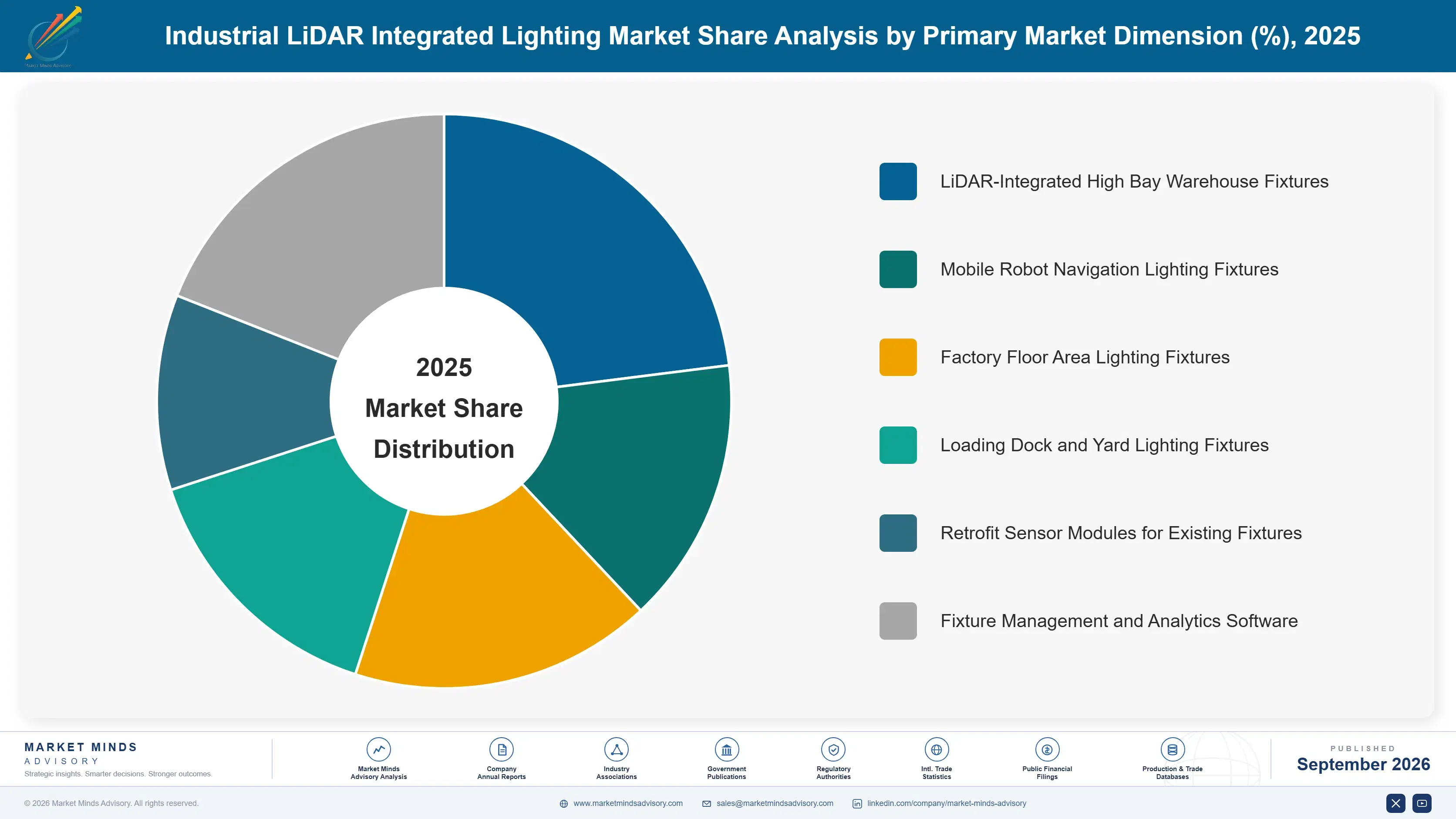
The Industrial LiDAR Integrated Lighting Market splits into six product-defined segments by fixture format and deployment context. High bay warehouse fixtures lead growth as automated distribution centers retrofit fastest, followed closely by mobile robot navigation lighting, since both categories directly serve the collision avoidance use case driving most current purchasing decisions. Retrofit modules round out the mix.
industrial-lidar-integrated-lighting-market-market-share-analysis-1788417364469

LiDAR-Integrated High Bay Warehouse Fixtures

High bay warehouse fixtures lead all segments because they concentrate the exact use case driving current purchasing decisions: overhead installation points already positioned above forklift and mobile robot traffic lanes where collision risk runs highest throughout a typical warehouse shift. Facility operators retrofitting distribution centers for autonomous material handling equipment favor these fixtures since the same mounting infrastructure already carries electrical wiring for lighting, letting integrators avoid a separate sensor network installation project entirely. Large third-party logistics operators managing dozens of facilities are increasingly standardizing on this fixture format across their entire real estate portfolio to simplify maintenance contracts and staff training requirements. MMA estimates this segment alone will represent well over a third of total category revenue by 2036.
CAGR 19.0%

Mobile Robot Navigation Lighting Fixtures

Mobile robot navigation lighting ranks second in growth as warehouse and manufacturing facilities expand autonomous mobile robot fleets that require denser sensor coverage than fixed forklift routes alone would demand. These fixtures feed real-time obstacle data directly into robot fleet management software, letting robots reroute around workers and equipment without relying solely on onboard sensors that can suffer reduced accuracy in dusty or poorly lit industrial environments. Robotics integrators increasingly specify this fixture category directly within initial facility automation proposals rather than treating it as a separate infrastructure purchase decision made later in the project timeline. MMA expects this category to scale quickly as robot fleet sizes continue expanding across most large distribution networks.
CAGR 17.5%
Full segment breakdown across 6 segments available in the complete report.

Regional Architecture and Country Demand Map

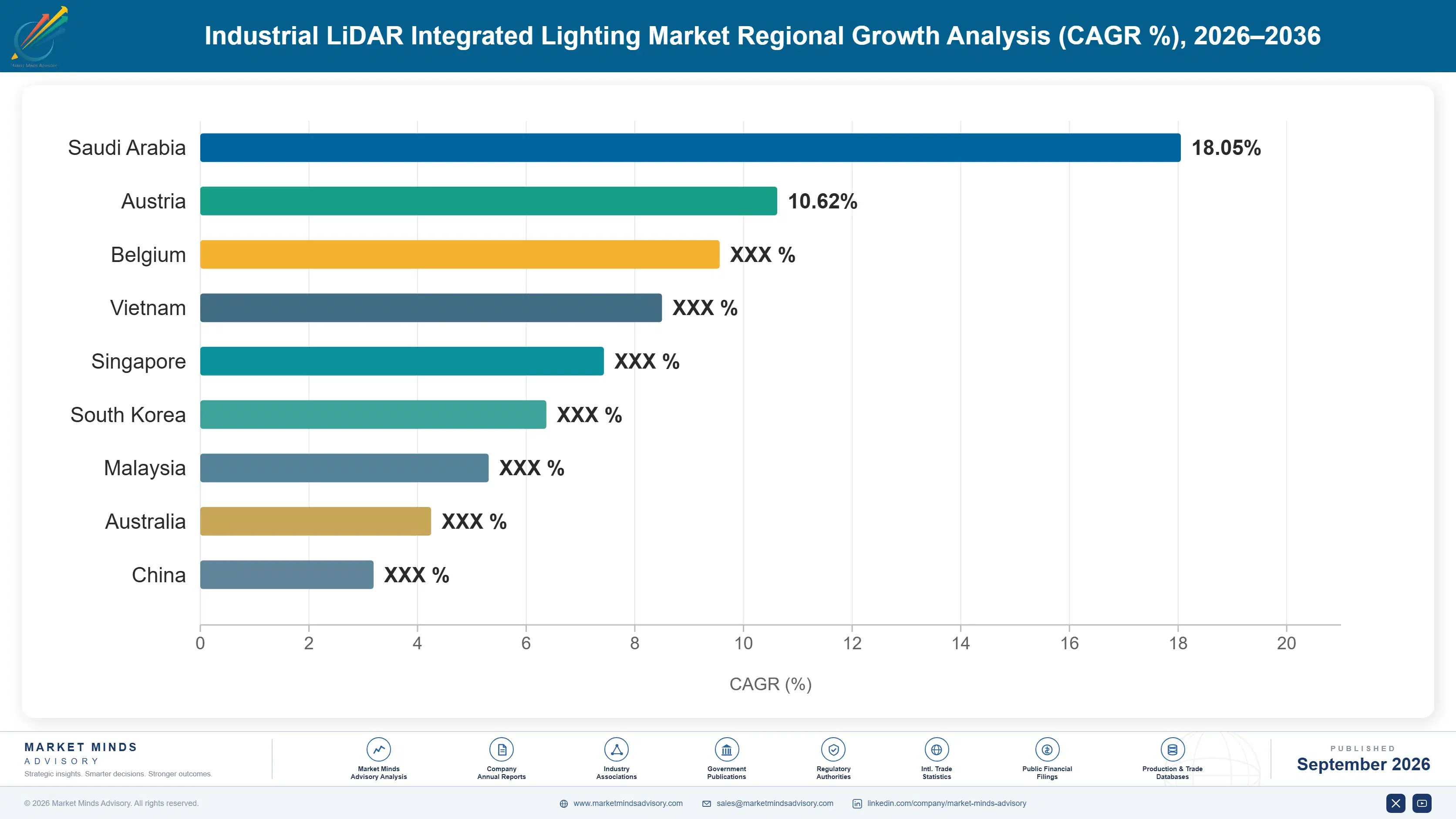
East Asia leads the Industrial LiDAR Integrated Lighting Market given China's warehouse automation buildout and its dense concentration of LiDAR sensor manufacturers, while North America follows closely through large logistics operator retrofits and rising safety regulation pressure across distribution center networks nationwide and across new construction projects.

North America

United States third-party logistics operators and e-commerce fulfillment networks drive the bulk of regional demand, retrofitting large distribution centers to meet internal safety targets ahead of any formal regulatory mandate. Canadian warehouse operators are following a similar pattern, particularly among cold storage facilities where visibility conditions make LiDAR sensing especially valuable compared with conventional camera-based monitoring systems. Acuity Brands and Dialight, both headquartered in the region, maintain deep channel relationships with facility integrators that accelerate combined fixture specification across new construction and major renovation projects alike nationwide. Insurance carriers underwriting warehouse operations are also beginning to factor collision avoidance systems into premium calculations, adding incentive for operators weighing incremental fixture cost against liability exposure.
Share: 27% | CAGR: 15.5% (2026 to 2036)

Western Europe

Germany's manufacturing sector leads regional adoption, integrating combined fixtures into new automated factory construction as part of broader Industry 4.0 modernization programs already well underway across the country's dense industrial base. The United Kingdom and France follow through logistics sector retrofits driven by rising warehouse labor costs and stricter workplace safety enforcement standards. Regional data protection rules add modest compliance overhead for fixtures capturing spatial data, which some facility operators cite as a reason for slower deployment relative to less regulated markets. Facility integrators across the region increasingly bundle combined fixture installation with broader factory automation consulting services, letting manufacturers address lighting, sensing, and process automation planning within a single coordinated vendor engagement rather than separate procurement tracks.
Share: 20% | CAGR: 13.5% (2026 to 2036)
Regional intelligence for 5 additional markets available in the complete report: East Asia, South Asia and Pacific, Latin America, Middle East and Africa, Eastern Europe. Contact sales@marketmindsadvisory.com.
industrial-lidar-integrated-lighting-market-country-cagr-analysis-1788417364994

How Fixture Vendors Capture Sensing Value

Vendors capture value across four distinct commercial mechanisms as combined fixtures move from pilot deployments toward mainstream warehouse retrofit specification, extending revenue well beyond a simple hardware unit sale into recurring analytics, service, and compliance reporting relationships that compound steadily over each facility's fixture lifecycle and renewal cycle. Vendors capable of executing all four are pulling ahead of single-mechanism competitors.

Fixture Management and Analytics Software Subscriptions

Vendors increasingly bundle a recurring software subscription covering fleet-wide fixture monitoring, firmware updates, and collision event analytics dashboards alongside the initial hardware sale, converting what was once a one-time capital purchase into an ongoing revenue relationship. Facility operators managing dozens of buildings particularly value centralized dashboards that aggregate detection data across every location into a single reporting interface. This software layer now represents roughly 18% of total account revenue for leading vendors within two years of initial installation across a typical multi-site customer relationship. Vendors report this recurring revenue carries meaningfully higher gross margin than the underlying hardware sale.
Market Impact: Software subscriptions add roughly 18% of total revenue

Installation and Sensor Calibration Service Contracts

Combined fixtures require careful sensor calibration during installation to avoid false collision alerts, a specialized skill most facility electricians lack, creating demand for dedicated vendor-certified installation service contracts sold alongside the hardware itself. These service contracts carry meaningfully higher margins than the underlying fixture hardware, since they draw on specialized calibration expertise vendors have spent years developing internally. Vendors report installation and calibration services now generate roughly 22% of first-year contract value for large multi-building facility retrofit projects specifically. Many vendors now require certified installation as a warranty condition, effectively guaranteeing this service revenue attaches to every hardware sale.
Market Impact: Installation services add roughly 22% of contract value

Compliance Documentation and Audit Reporting Packages

Vendors sell dedicated compliance reporting packages that automatically format detection event logs into documentation matching specific regulatory audit requirements, saving facility safety officers considerable manual reporting effort during inspection cycles. This packaged reporting capability commands a meaningful price premium over raw data export alone, since customers value the time savings and reduced audit risk more than the underlying data itself. Facilities in heavily regulated industries pay contract prices running roughly 15% higher for bundled compliance reporting packages compared with basic monitoring alone. Adoption of this reporting package is highest among logistics and manufacturing customers facing frequent third-party safety audits.
Market Impact: Compliance packages add roughly 15% pricing premium overall

Extended Warranty and Predictive Maintenance Bundles

Vendors bundle extended warranty coverage with predictive maintenance alerts that flag failing sensor components before they cause a fixture outage, reducing unplanned downtime that facility operators consider costly given the safety monitoring function these fixtures now serve. This bundled offering carries substantially higher margins than standard warranty extensions alone, since predictive maintenance software costs little to deliver at scale once developed. Facilities adopting this bundle report contract renewal rates running roughly 2 times higher than customers declining the bundled maintenance package. Vendors are actively expanding this bundle across additional fixture product lines given its strong impact on customer retention.
Market Impact: Bundle adoption lifts renewal rates roughly 2 times over

Who Controls the Margin Pool

Five vendors, evaluated on annual product revenue from combined fixture sales, together account for an estimated 42% of tracked market revenue, reflecting a still-consolidating category barely three years into meaningful commercial volume. Signify leads through its existing lighting channel relationships and manufacturing scale, while Hesai Group and RoboSense compete closely from the sensor side, entering lighting through fixture partnership agreements rather than acquiring lighting manufacturing capability outright themselves.
Current competitive activity centers on vertical integration, as sensor specialists and lighting manufacturers each try to control more of the combined product stack rather than relying on a partner for half the fixture. Partnership announcements between previously separate lighting and sensor companies have become the dominant deal structure over the past two years, since building integrated manufacturing capability from scratch takes longer than most vendors are willing to wait.

Emerging pressure comes from facility automation software vendors who could bundle fixture hardware directly into broader warehouse management system contracts, potentially disintermediating standalone fixture vendors for large enterprise accounts. Rankings could shift meaningfully if a major industrial automation platform acquires a leading sensor manufacturer outright, combining fixture hardware with existing enterprise software relationships that smaller specialists cannot easily replicate on their own.
industrial-lidar-integrated-lighting-market-company-positioning-matrix-1788417365522

Competitive Moat and Risk Dimensions

SIGNIFY

Moat: Existing Lighting Channel Reach

Signify's decades-old relationships with lighting distributors, electrical contractors, and facility management firms give it distribution reach no sensor-first entrant can replicate quickly, letting the company push combined fixtures through channels already trusted by facility buyers. This distribution advantage shortens sales cycles considerably compared with newer entrants building channel relationships from scratch.
SIGNIFY

Risk: Limited In-House Sensor Expertise

Signify depends on external LiDAR sensor suppliers for the sensing component of its combined fixtures, leaving the company exposed to component pricing and supply availability decisions made by sensor manufacturers pursuing their own vertical integration strategies. A supplier shifting focus toward direct fixture sales could disrupt this dependency significantly.
HESAI GROUP

Moat: Deep LiDAR Manufacturing Scale

Hesai's manufacturing scale, built originally to serve automotive customers, gives it cost advantages in sensor production that lighting-first competitors sourcing components externally cannot match easily. This scale advantage lets Hesai price combined fixtures competitively while maintaining margins comparable to its core automotive sensor business. This edge compounds as production volume scales further.
HESAI GROUP

Risk: Limited Lighting Design Experience

Hesai lacks the decades of lighting fixture design, thermal management, and electrical certification experience that established lighting manufacturers bring, creating product development friction as the company adapts automotive sensor technology to stationary building applications. Partnership dependencies with lighting specialists partially offset this gap for now.

Players Tracked

Prominent Players

Signify
Acuity Brands
Hesai Group
RoboSense
Dialight

Other Key Players

Cree Lighting
Eaton Lighting
Hubbell Lighting
OSRAM
Zumtobel Group
Ouster
Innoviz Technologies
Livox Technology
Cepton
Velodyne Lidar
GE Current
Thorn Lighting
LSI Industries
Legrand
Current Lighting Solutions

Recent Developments

APRIL 2025

Signify announced a strategic partnership with a leading automotive-grade LiDAR sensor supplier to co-develop combined high bay warehouse fixtures, targeting large-scale distribution center retrofit projects across North America and Western Europe. The partnership includes shared engineering resources to accelerate product certification timelines for both companies.
Signal: Signals lighting incumbents are choosing partnership over acquisition to enter the sensing category quickly and affordably.
AUGUST 2025

RoboSense launched a dedicated industrial lighting fixture line integrating its existing automotive LiDAR sensor technology, marking its first direct entry into stationary building infrastructure rather than solely supplying components to lighting partners. The launch follows two years of pilot testing with select logistics customers evaluating live performance.
Signal: Signals sensor manufacturers increasingly view direct fixture sales as more profitable than component supply alone overall.
DECEMBER 2025

Dialight acquired a small industrial sensor integration startup specializing in warehouse collision avoidance calibration software, adding in-house technical expertise the company previously lacked for combined fixture installation and after-sales support services. The acquired team will be integrated into Dialight's existing product engineering division to accelerate future combined fixture development.
Signal: Signals established lighting manufacturers are building internal sensor integration capability rather than relying solely on external partners.

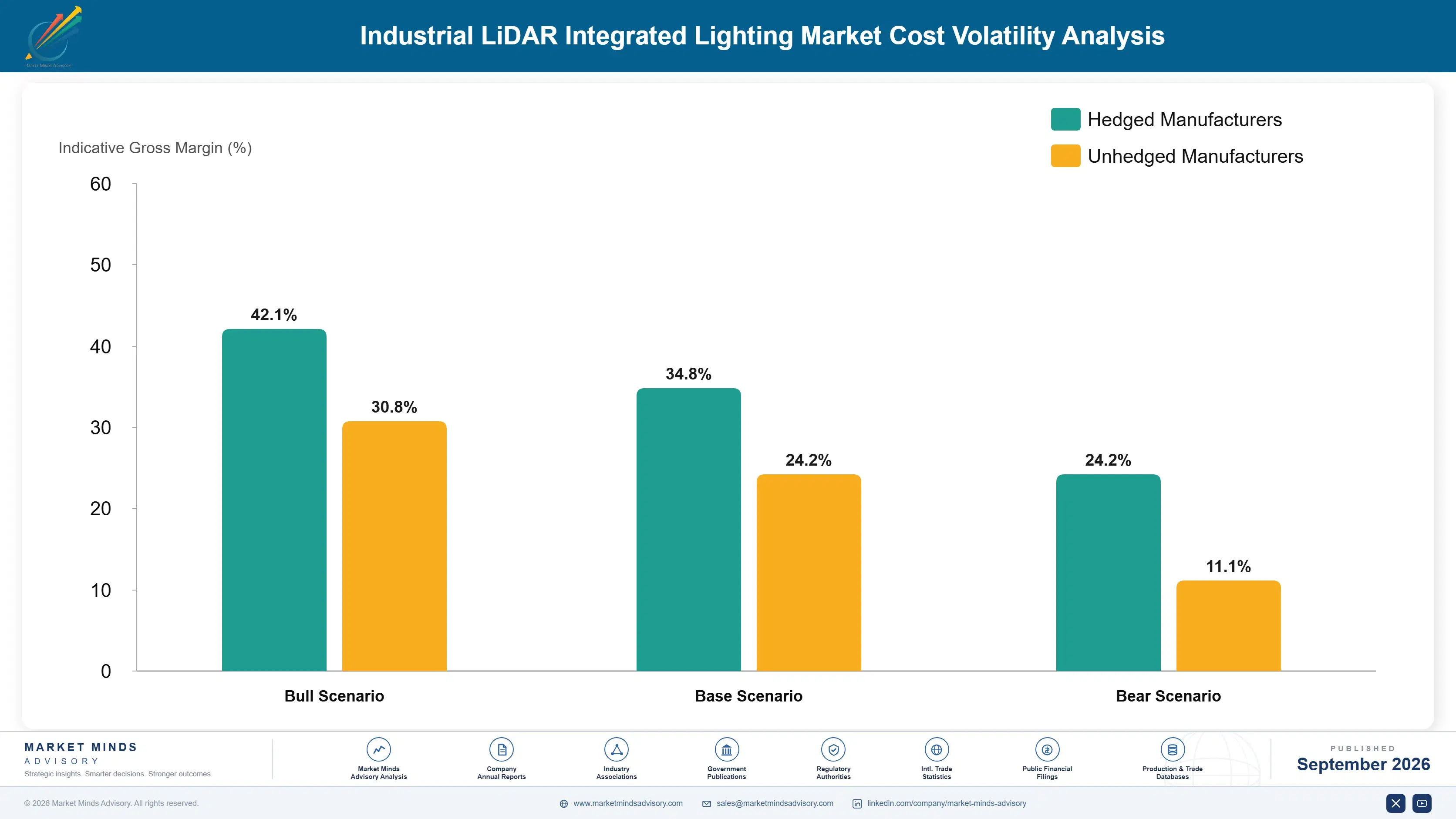
LiDAR Sensor and Rare Earth Magnet Exposure

LiDAR sensor modules account for an estimated 45% of total cost of goods sold for combined fixtures, sourced primarily from automotive-grade component manufacturers concentrated in China, Germany, and the United States. Aluminum housing and rare earth magnets used in fixture motors represent a second meaningful cost input, both subject to trade policy risk given geographic sourcing concentration.
China's export restrictions on certain rare earth materials in early 2025, reported in multiple manufacturer investor filings, forced several fixture manufacturers to qualify alternative motor suppliers on short notice, temporarily raising component costs and extending lead times for new fixture orders across the industry during the transition period. Several manufacturers reported the disruption added measurable delay to already committed customer delivery schedules that quarter. Delivery schedules gradually normalized within one quarter as alternative suppliers ramped output.

Manufacturers lacking direct relationships with LiDAR sensor suppliers pay meaningfully higher per-unit component costs than vertically integrated competitors who manufacture sensors internally or hold long-term supply agreements locking in volume pricing. This dynamic disproportionately disadvantages smaller regional lighting manufacturers entering the combined fixture category without established automotive supply chain relationships that larger incumbents built over many years.
industrial-lidar-integrated-lighting-market-cost-volatility-analysis-1788417365718

Dual Sourcing Across Sensor Suppliers

Leading manufacturers now qualify at least two LiDAR sensor suppliers per fixture product line to reduce dependency on any single component source and preserve negotiating leverage during price renewal discussions. This redundancy adds modest engineering cost but meaningfully lowers supply disruption risk. Vendors report meaningfully improved delivery reliability once a second qualified supplier is available for large orders.

Vertical Integration Into Motor Assembly

Some vendors are bringing motor and housing assembly in-house rather than outsourcing to third-party manufacturers, reducing exposure to rare earth material price swings passed through by external suppliers. This shift requires upfront capital investment but improves long-term cost control considerably. Several manufacturers expect this investment to pay back within roughly two to three years of combined fixture volume.

Portfolio Architecture for Margin Defence

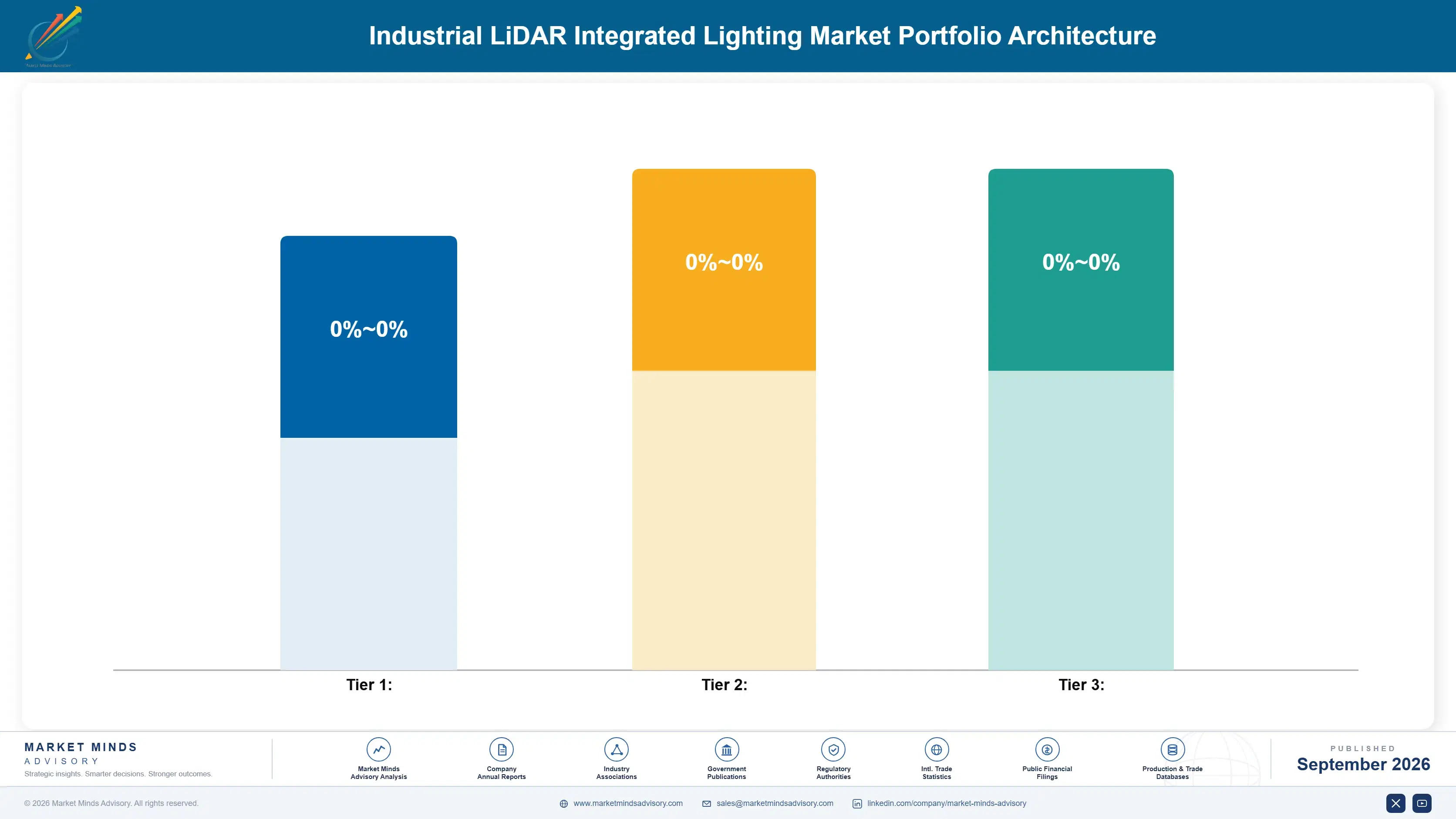
Fixture vendors architect pricing around three distinct tiers separating basic combined sensing and lighting from certified safety-grade systems and next-generation adaptive fixtures still emerging from pilot deployment. Gross margins widen meaningfully as customers move up this tier structure, since higher tiers embed proprietary analytics software and compliance documentation capability competitors cannot easily replicate without comparable engineering investment. Vendors moving customers up this structure over renewal cycles see improved account profitability.
Volume-tier fixtures targeting basic obstacle detection carry margins comparable to conventional commercial lighting, while certified safety-grade fixtures bundling compliance documentation and analytics command noticeably higher per-unit pricing. This tension between volume retrofit scale and premium differentiation shapes most vendor product roadmap decisions currently under active internal development. Vendors design roadmaps to nudge volume-tier customers upward through bundled trial access to compliance reporting features.

The highest-value pools concentrate among large logistics operators willing to pay for adaptive fixtures integrating directly with robot fleet management and compliance reporting platforms. Smaller vendors without this software integration capability increasingly compete on price within the volume tier alone, ceding higher-margin premium accounts to larger established platform incumbents. Vendors investing early in robot integration software are positioning to capture outsized share of this value pool.

Basic combined sensing and lighting fixtures priced comparably to standard commercial lighting, targeting cost-sensitive facility retrofits without complex compliance documentation or analytics software requirements attached. These accounts value predictable flat pricing over advanced feature depth.
Gross Margin

Certified safety-grade fixtures bundling compliance documentation and fleet analytics software, targeting regulated logistics and manufacturing customers commanding meaningfully higher per-unit pricing given embedded reporting capability. Renewal rates in this tier run notably higher than the volume segment.
Gross Margin

Adaptive fixtures integrating directly with robot fleet management software, still emerging from pilot deployment, priced at the highest premium given differentiated proprietary integration technology involved. Commercial availability remains limited to a handful of early pilots.
Gross Margin
industrial-lidar-integrated-lighting-market-portfolio-architecture-1788417366222

High-value Sub-segments and Strategic Watch-out

LiDAR-Integrated High Bay Warehouse Fixtures

This segment combines the fastest growth rate in the market with the strongest margin profile, as automated distribution centers retrofit fastest while enterprises pay premium pricing for documented collision avoidance that materially reduces liability exposure. MMA rates this segment the strongest combined opportunity in the entire portfolio.

Mobile Robot Navigation Lighting Fixtures

Strong growth continues here as robot fleets expand, though margins run somewhat thinner than warehouse fixtures given intensifying competition among sensor manufacturers entering lighting from the opposite direction at lower initial prices. Vendors should still prioritize investment here given the large addressable customer base. Early pilots show strong customer satisfaction.

Factory Floor Area Lighting Fixtures

This established segment anchors reliable core revenue for vendors serving general manufacturing facilities, growing more slowly than warehouse-specific alternatives but maintaining loyal customers with long-standing procurement relationships and lower switching incentive overall. This segment remains a dependable core revenue source for established vendors. Loyal customers renew at high rates.

Loading Dock and Yard Lighting Fixtures

Growth here trails the broader market meaningfully, and vendors should watch closely for signs of accelerating displacement by more integrated warehouse fixture categories that offer comparable outdoor coverage without requiring separate dedicated hardware. Vendors should monitor renewal rates closely for early signs of accelerating decline.

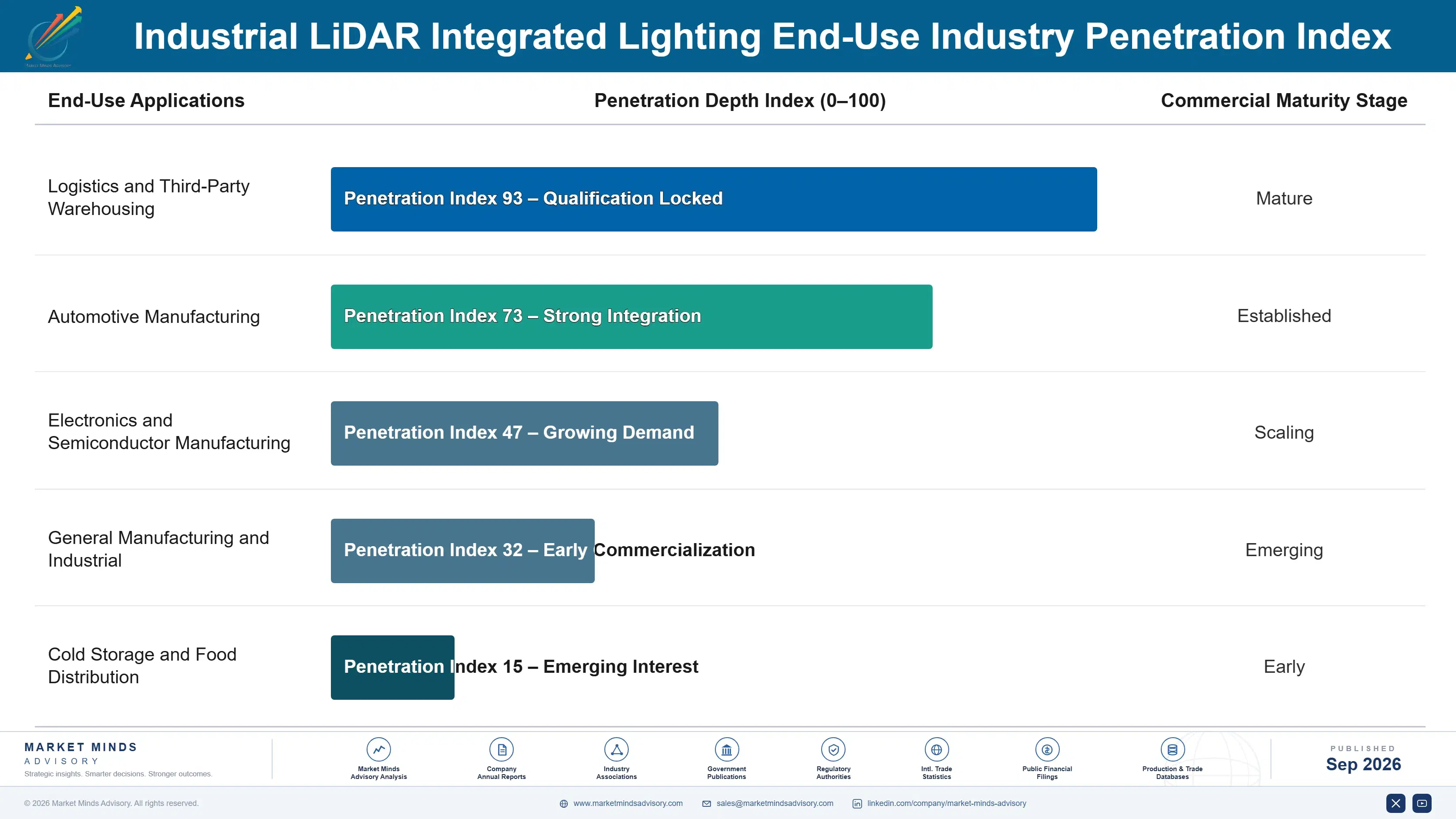
The Retrofit Annuity Behind Safety Compliance

Combined fixture contracts function much like a compliance annuity, since detection and documentation software renews automatically each year as safety audits and insurance underwriting requirements make removing the sensing layer practically unthinkable once a facility depends on it. This renewal pattern gives vendors predictable revenue visibility once a facility completes retrofit. Churn for fully retrofitted facilities runs notably lower than typical equipment categories, since switching cost grows each deployment year.
Adoption depth varies meaningfully by end-use vertical: logistics and warehousing operators embed combined fixtures across nearly every ceiling mount point given constant forklift and robot traffic, while general manufacturing facilities often limit deployment to high-traffic zones alone, leaving lower-risk areas on conventional lighting considerably longer. Manufacturing environments running mixed manual and automated handling still rely on human safety spotters for lower-risk zones.

Buyer profiles are shifting generationally as facility safety managers who built careers on manual inspection routines give way to a newer cohort trained on automated monitoring from early in their careers. This shift accelerates procurement, since newer buyers arrive already comfortable evaluating sensor dashboards. Vendors report shorter sales cycles engaging this cohort, since advocacy increasingly comes from within operations teams rather than executives.
industrial-lidar-integrated-lighting-market-end-use-penetration-index-1788417366704

Where Vendors Should Focus Next

These are among the four positions where our research anticipates prominent divergence between winners and laggards over the coming forecast period. Each is grounded in the demand model, the regulatory perimeter, and the announced capacity pipeline.
01 / SAFETY COMPLIANCE POSITIONING

Lead sales conversations with regulatory audit requirements

Safety regulation updates close facility deals faster than any lighting quality comparison exercise, since compliance officers and risk managers now approve fixture budget directly rather than deferring entirely to facilities teams. Vendors that lead sales conversations with specific audit documentation requirements convert prospects meaningfully faster than those leading purely with illumination quality claims alone. This approach matters most for vendors selling into logistics and manufacturing accounts facing the nearest safety audit deadlines and steepest penalty exposure under updated workplace safety codes.
02 / SENSOR SUPPLY DIVERSIFICATION

Qualify multiple LiDAR suppliers before component shortages hit

Fixture manufacturers depending on a single LiDAR sensor supplier risk production disruption whenever trade policy or component shortages affect that one relationship, as several vendors already experienced during recent rare earth export restrictions. Vendors qualifying at least two sensor suppliers per product line preserve negotiating leverage and protect delivery reliability during unexpected supply disruptions that competitors relying on single sourcing cannot easily absorb without delay. This diversification investment pays off most clearly during periods of geopolitical trade tension and sudden export policy shifts.
03 / SOFTWARE INTEGRATION INVESTMENT

Build robot fleet software integration ahead of rivals

Robot fleet management integration remains the single largest differentiator separating premium fixture vendors from commodity competitors selling standalone sensing hardware without any meaningful software connectivity layer built in. Vendors offering credible integration with leading robot fleet management platforms can command meaningfully higher per-unit pricing compared with rivals lacking this specific software capability and established platform partnership relationships. This investment pays off most clearly among enterprises operating large mixed robot and human worker warehouse floors requiring dense sensor coverage and continuous coordination.
04 / CHANNEL PARTNERSHIP EXPANSION

Build lighting and sensor channel partnerships in emerging regions

Regional adoption in South Asia, Latin America, and the Middle East is expanding faster than local integrator expertise can currently support, creating a meaningful channel gap for vendors willing to invest early. Vendors establishing local distribution and installation partnerships ahead of these expanding regional markets position themselves to capture new demand before less prepared competitors can arrive. This first-mover advantage compounds meaningfully as local facility operators increasingly favor vendors with established regional service and support presence over distant unfamiliar suppliers.

Engagement Snapshot From the Field

A live engagement with an industry participant carrying material or product regulatory and market exposure ahead of a defining policy shift, showing how our research translates into a defensible multi-year portfolio strategy.
MARKET MINDS ADVISORY · CLIENT ENGAGEMENT SUMMARY
Industrial LiDAR Integrated Lighting Producer Strategic Portfolio Review and Transition Roadmap 2026·Investment Scenario on Industrial LiDAR Integrated Lighting Exposure Evaluation 2025-26
CLIENT PROFILE
A third-party logistics operator running a network of large distribution centers across several states faced rising forklift and mobile robot collision incidents as automation penetration expanded across its facility floor operations. Leadership needed to reduce incident rates without slowing throughput during peak seasonal volume, and faced pressure to demonstrate measurable safety improvement to insurance underwriters ahead of an upcoming policy renewal cycle affecting premium costs across the entire facility network.
STRATEGIC CHALLENGE
Leadership needed to determine whether combined LiDAR lighting fixtures could meaningfully reduce collision incidents without requiring a costly full facility rewiring project, and faced pressure to complete the retrofit within a single facility shutdown window to avoid disrupting ongoing customer order fulfillment commitments during a particularly demanding operational period. Budget approval also depended on demonstrating a clear return on investment timeline.
MMA APPROACH
MMA benchmarked three candidate combined fixture vendors against the operator's specific collision reduction targets, existing electrical infrastructure compatibility, and installation timeline constraints, then modeled expected incident reduction and full multi-year total cost of ownership across each vendor option under consideration for this particular facility retrofit. Findings were shared with the operator's operations leadership ahead of final vendor selection and contract signing.
KEY FINDINGS
  1. Combined fixture retrofit reduced recorded collision incidents by a meaningful margin within the first quarter of full deployment (client-reported, unverified by MMA) across all monitored zones.
  2. Installation completed within the planned shutdown window since existing electrical infrastructure required no significant modification for the combined fixtures. Facility engineers confirmed compatibility during an initial site assessment visit.
  3. Insurance underwriters acknowledged the documented safety improvement during the subsequent policy renewal discussion ahead of the scheduled deadline. The renewal ultimately included more favorable premium terms than expected.
  4. Facility staff reported easier incident investigation given automatically logged detection events replacing manual eyewitness accounts previously relied upon. This shift also reduced average investigation time considerably across incidents.
CLIENT PROFILE
A third-party logistics operator running a network of large distribution centers across several states faced rising forklift and mobile robot collision incidents as automation penetration expanded across its facility floor operations. Leadership needed to reduce incident rates without slowing throughput during peak seasonal volume, and faced pressure to demonstrate measurable safety improvement to insurance underwriters ahead of an upcoming policy renewal cycle affecting premium costs across the entire facility network.
STRATEGIC CHALLENGE
Leadership needed to determine whether combined LiDAR lighting fixtures could meaningfully reduce collision incidents without requiring a costly full facility rewiring project, and faced pressure to complete the retrofit within a single facility shutdown window to avoid disrupting ongoing customer order fulfillment commitments during a particularly demanding operational period. Budget approval also depended on demonstrating a clear return on investment timeline.
MMA APPROACH
MMA benchmarked three candidate combined fixture vendors against the operator's specific collision reduction targets, existing electrical infrastructure compatibility, and installation timeline constraints, then modeled expected incident reduction and full multi-year total cost of ownership across each vendor option under consideration for this particular facility retrofit. Findings were shared with the operator's operations leadership ahead of final vendor selection and contract signing.
KEY FINDINGS
  1. Combined fixture retrofit reduced recorded collision incidents by a meaningful margin within the first quarter of full deployment (client-reported, unverified by MMA) across all monitored zones.
  2. Installation completed within the planned shutdown window since existing electrical infrastructure required no significant modification for the combined fixtures. Facility engineers confirmed compatibility during an initial site assessment visit.
  3. Insurance underwriters acknowledged the documented safety improvement during the subsequent policy renewal discussion ahead of the scheduled deadline. The renewal ultimately included more favorable premium terms than expected.
  4. Facility staff reported easier incident investigation given automatically logged detection events replacing manual eyewitness accounts previously relied upon. This shift also reduced average investigation time considerably across incidents.
RECOMMENDED STRATEGY
Phase 1: Phase one selected a vendor meeting both collision reduction targets and existing electrical infrastructure compatibility requirements precisely and fully. and budget constraints. Phase 2: Phase two scheduled installation during a single planned facility shutdown window to avoid disrupting ongoing order fulfillment. during peak season. Phase 3: Phase three trained facility staff on new incident investigation workflows using automatically logged detection event data. and new reporting tools available.
OUTCOME
The operator completed the retrofit within its planned shutdown window and recorded a meaningful reduction in collision incidents across the facility network (client-reported, unverified by MMA), while securing favorable terms during its subsequent insurance policy renewal discussion. Facility leadership credited the improved documentation with speeding future safety audits considerably.

Frequently Asked Questions

Foundational context covering the market sizes, CAGR, scope, country, region and competition that inform every finding below. This section is provided to cover basics and most often pre-purchase conversations, answered from the MMA Primary Research Dataset.

What is the current size of the Industrial LiDAR Integrated Lighting Market?

The Industrial LiDAR Integrated Lighting Market reached an estimated $0.85 billion in global revenue in 2025. This covers combined sensing and illumination fixtures deployed across warehouse, factory, and logistics facilities worldwide.

How large will the Industrial LiDAR Integrated Lighting Market be by 2036?

MMA projects the market will reach approximately $3.95 billion by 2036, driven mainly by warehouse automation investment and safety regulation pressure. That represents roughly a 4.05 fold expansion from 2026 levels.

What is the CAGR for the Industrial LiDAR Integrated Lighting Market 2026 to 2036?

The market is forecast to grow at a 15.0% compound annual rate between 2026 and 2036. Bull and bear scenarios range between roughly 13.7% and 16.3% depending on standardization pace.

Which segment is growing fastest?

LiDAR-integrated high bay warehouse fixtures lead all segments, expanding at an estimated 19.0% annually. That is well above the overall market's 15.0% average growth rate through the forecast period to 2036.

Who are the major companies in the Industrial LiDAR Integrated Lighting Market?

Signify, Acuity Brands, Hesai Group, RoboSense, and Dialight form the five leading vendors tracked in this report. Together they hold an estimated 42% combined share of tracked fixture revenue.

Which country is growing fastest?

China posts the fastest national growth rate in the study, expanding at an estimated 17.5% annually. Its expanding warehouse automation buildout and domestic LiDAR sensor manufacturing base drive unusually rapid adoption there.

Report Segmentation Architecture

The full report scope spans multiple orthogonal segmentation dimensions, with cross-tabulated demand data provided for each dimension pair. Coverage extends further to regional breakdowns, trend trajectories, and the competitive detail needed to support segment-level decision-making.

By Primary Market Dimension

  • LiDAR-Integrated High Bay Warehouse Fixtures
  • Mobile Robot Navigation Lighting Fixtures
  • Factory Floor Area Lighting Fixtures
  • Loading Dock and Yard Lighting Fixtures
  • Retrofit Sensor Modules for Existing Fixtures
  • Fixture Management and Analytics Software

By End-Use Industry

  • Logistics and Third-Party Warehousing
  • Automotive Manufacturing
  • Electronics and Semiconductor Manufacturing
  • General Manufacturing and Industrial
  • Cold Storage and Food Distribution

By Commercial Dimension

  • New Facility Construction Installation
  • Existing Facility Retrofit Installation
  • Direct Manufacturer Sales
  • Distributor and Integrator Channel Sales

By Region

  • North America
  • Western Europe
  • East Asia
  • South Asia and Pacific
  • Latin America
  • Middle East and Africa
  • Eastern Europe

Scope, Methodology, and Coverage

Every figure in this report is reproducible from documented input assumptions. The scope below maps the historical period, the forecast horizon, the segmentation dimensions, and the countries covered, alongside the underlying primary and qualitative methodology.
Historical Period
2020 to 2025
Forecast Period
2026 to 2036
Base Year
2025 (USD billions; MMA Primary Research Dataset, September 2026)
Market Definition
The Industrial LiDAR Integrated Lighting Market covers overhead and area lighting fixtures with embedded LiDAR sensing modules sold for warehouse, factory, and logistics facility deployment, measured by unit and system revenue. It excludes standalone LiDAR sensors sold separately from lighting hardware and general-purpose industrial lighting without integrated sensing capability.
Quantitative Units
USD Billion, CAGR (%), Share (%), 2020 to 2036
Segmentation Dimensions
By Primary Market Dimension; By End-Use Industry; By Commercial Dimension; By Region
Regions Covered
North America, Western Europe, East Asia, South Asia and Pacific, Latin America, Middle East and Africa, Eastern Europe
Countries Covered
United States, Canada, Germany, United Kingdom, France, China, Japan, South Korea, India, Australia, Brazil, Mexico, Saudi Arabia, United Arab Emirates, South Africa, Poland
Key Companies Profiled
Signify, Acuity Brands, Hesai Group, RoboSense, Dialight, Cree Lighting, Eaton Lighting, Hubbell Lighting, OSRAM, Zumtobel Group, Ouster, Innoviz Technologies, Livox Technology, Cepton, Velodyne Lidar, GE Current, Thorn Lighting, LSI Industries, Legrand, Current Lighting Solutions
Quantitative Methodology
Primary survey, n=3,800 respondents, Q4 2025, six countries; demand-side model with trade association cross-validation
Qualitative Methodology
47 expert interviews, Q4 2025; applied to validate demand model assumptions, identify emerging dynamics, and assess competitive positioning
Report Format
PDF and XLSX data workbook (Word format preview document)
Publisher
Market Minds Advisory
Report Code
MMA-2026-CON-616
Published
September 2026
Contact
sales@marketmindsadvisory.com | www.marketmindsadvisory.com

Purchase the full Industrial LiDAR Integrated Lighting Market Report (2026 to 2036).

The full report delivers a comprehensive analysis of the Industrial LiDAR Integrated Lighting Market, covering historical performance from 2020 through 2025 and forecasts extending to 2036. It provides detailed segmentation across six primary fixture categories, seven regional markets, and competitive profiles of the twenty leading vendors shaping industry structure. Readers gain access to quantified demand drivers, restraints, and revenue lever analysis grounded in primary survey data and expert interviews. The report also includes a detailed input cost exposure assessment and portfolio tier framework for strategic planning purposes.
Seven-region market sizing and forecast data
Twenty vendor competitive profiles and positioning
Segment-level CAGR and revenue projections through 2036
Primary survey data from 3,800 respondents
Expert interview insights from 47 industry specialists
Revenue lever and portfolio tier strategic frameworks

Built For The People Who Decide

From boardroom strategy to bench-side execution, this report is read cover-to-cover by leaders shaping the next decade of their industry, turning demand scenarios, market dynamics and valuation benchmarks into decisions.
CXOs/ Presidents/ VPs/ Managers
M&A and Corporate Development
Strategy Teams and R&D Heads
Procurement and Product Directors
Regulatory and Compliance Leaders
Investor Relations and Equity Analysts