Market Minds Advisory
Industrial Human-Machine Interface Market

Industrial Human-Machine Interface Market: Industrial Human-Machine Interface: IIoT Connectivity and the End of the Standalone Panel

Factory floors that once treated the operator panel as fixed hardware are now demanding cloud-connected touchscreens that feed production data directly into enterprise systems, forcing legacy panel makers to rebuild around software.

Lead Analyst

Published

September 2026

Make Smarter Decisions with Customized Research Insights

Request a free sample report and evaluate market opportunities, growth trends, and competitive dynamics relevant to your business needs.

2025 MARKET VALUE$6.8BMarket Size 2025
2036 FORECAST VALUE$14.9BBase Case , 2026 to 2036
CAGR 2026 TO 20367.4 %Bull 8.7% / Bear 6.1%
INCREMENTAL OPPORTUNITY$7.6BNet 10- year value creation
EXPANSION MULTIPLE2.04x2036 value over 2026 base
Strategic Levers
M&A Pipeline
Regional Outlook
Country Rankings
Competitive Intelligence
Segmental Deep-dive
Call-Us : 91 93563 13602

Executive Snapshot and Market Trajectory.

Plant operators are replacing standalone HMI panels with connected touchscreens that stream production data into enterprise systems in real time, and that shift is now the single biggest factor separating vendors buyers shortlist from those they quietly drop from consideration during vendor review.
Cloud-connected and IIoT-integrated HMI systems are pulling budget away from traditional panel-mounted terminals, and East Asian manufacturers are moving fastest, backed by domestic automation investment that treats connected operator interfaces as a baseline requirement rather than a premium upgrade across new production lines, while European automotive and machinery builders add a second, comparably sized pool of retrofit demand that vendors are only now beginning to fully capture and monetize.
Competitive character is shifting from a hardware-panel business toward a software and edge-analytics one, and legacy HMI manufacturers that built moats around display durability are racing to acquire IIoT software capability before automation-software vendors with no hardware legacy win the next generation of factory retrofit contracts outright, a shift that industrial cybersecurity requirements and cloud connectivity mandates are both accelerating considerably faster than most incumbents had originally planned for just two years ago.
Market Definition
The industrial human-machine interface market covers hardware panels, embedded displays, and software platforms that let plant operators monitor and control industrial equipment and processes. It excludes general-purpose consumer touchscreens sold without industrial-grade ruggedization and standalone SCADA software sold without an integrated operator display.
Base Year Value
$6.8B in 2025 (MMA Primary Research Dataset, September 2026)
Forecast Period
2026 to 2036, eleven discrete annual values
CAGR
7.4% base case. Bull 8.7%. Bear 6.1%.
Fastest Growth Segment
Cloud-Connected and IIoT-Integrated HMI Systems: 11.5% CAGR
Fastest Growth Country
China: 9.8% CAGR
Fastest Growth Region
South Asia and Pacific: 9.4% CAGR
Largest Region
East Asia: 30% of 2025 global value
Market Leaders
Siemens, Rockwell Automation, Schneider Electric, Mitsubishi Electric, and Beijer Electronics lead the market. Source: MMA Primary Research Dataset, July 2026.
Primary Survey
n=3,800 procurement and R&D decision-makers, Q4 2025, six countries
Methodology
Demand-side build-up, cross-validated against public data, 47 expert interviews

Industrial Human-Machine Interface Market Forecast Scenarios

industrial-human-machine-interface-market-size-forecast-scenario-1790010051259
Between 2020 and 2025 the market grew at an estimated 6.4 percent annual clip as manufacturers steadily replaced analog control panels with basic touchscreen HMIs across most major production lines worldwide, though most of those early deployments remained standalone units without meaningful connectivity to plant-wide production data systems or any broader enterprise reporting layer at all.
The base case assumes 7.4 percent annual growth through 2036, driven by three mechanisms: factory digitalization programmes requiring IIoT-connected operator interfaces as a baseline specification rather than an optional upgrade, cybersecurity regulations forcing replacement of legacy unpatched panels across regulated industries, and edge-analytics software increasingly bundled directly into HMI hardware rather than sold as a separate SCADA layer purchased independently. Replacement demand from aging installed panels adds a steadier layer of demand beneath these three primary growth mechanisms.
The bull case turns on accelerated factory retrofit spending as manufacturers race to meet tightening industrial cybersecurity mandates within a compressed timeline, pulling forward replacement demand industry-wide well ahead of current vendor roadmaps. The bear case centers on capital-expenditure caution during a manufacturing downturn delaying discretionary HMI upgrades that plants can readily defer without halting production entirely.

From Fixed Panels to Connected Operator Platforms

Manufacturers that spent a decade digitizing back-office production data are now confronting the much harder problem of connecting the physical operator interface itself to that data, and vendors that can bridge legacy panel hardware with modern IIoT platforms and edge analytics are capturing the largest share of new procurement across nearly every manufacturing vertical tracked in this report this year.
TOP-FIVE VENDOR CONCENTRATION42%Combined revenue share held by the leading global suppliers
AVERAGE PANEL ASP$680Blended average selling price across standard panel sizes
LEADING MANUFACTURING HUB SHARE36%Share of global unit production concentrated in one country
IIOT CONNECTIVITY ATTACH RATE54%Share of new units shipped with built-in cloud connectivity
PANEL REPLACEMENT CYCLE LENGTH8 yearsTypical interval between full operator panel hardware upgrades
INDUSTRIAL PROTOCOL COMPATIBILITY COVERAGE14 protocolsNumber of communication standards a leading platform supports natively
Commercial activity concentrates around large, multi-year factory digitalization programmes rather than one-off panel replacements, since an HMI platform choice typically locks a plant into a single vendor's software environment for years given the engineering effort required to migrate operator screens, control logic, and historical production data to a competing platform entirely from scratch across every affected production line.
Over the next decade, the decisive forces will be industrial cybersecurity regulations that force replacement of unpatched legacy panels, declining edge-computing hardware costs that make real-time analytics viable directly on the panel itself, and growing pressure from plant operators for interfaces that feel as intuitive as consumer touchscreens rather than dated industrial control equipment carried over from a much earlier generation of hardware design and interaction philosophy.
"The panel manufacturers losing bids aren't losing on screen quality. They're losing because their platform can't talk to anything else on the floor."
Director, Industrial Automation and Controls Practice · MMA Construction and Industrial Equipment Practice · September 2026

Market Trends

IEC 62443 Cybersecurity Standards Forcing Panel Replacement Cycles

The IEC 62443 industrial cybersecurity standard is increasingly written directly into procurement specifications for regulated manufacturing sectors, and legacy HMI panels running unsupported operating systems cannot meet its patching and network-segmentation requirements. That gap is forcing plants to replace panels years ahead of their normal hardware lifecycle rather than waiting for a scheduled refresh, and vendors that already ship IEC 62443-conformant firmware are winning replacement contracts well ahead of competitors still working through certification. Insurers in several regulated industries are separately beginning to reference the standard directly in industrial liability coverage terms.
Market Impact: Adds $1.4 billion domestic Chinese demand
Edge Analytics Increasingly Bundled Directly Into HMI Hardware

HMI vendors are embedding edge-computing capability directly into the panel itself, letting plants run predictive-maintenance and anomaly-detection models locally without routing every single data point through a separate industrial PC or cloud connection first each time a reading changes on the floor. This convergence is blurring the line between HMI hardware and the SCADA software layer that traditionally sat above it, and vendors that can deliver both in one integrated product are capturing budget that previously split between two separate purchase decisions and two separate vendor relationships across the same production line.
Market Impact: Reduces unplanned downtime by 24 percent

Market Opportunities and Growth Drivers

China's Smart Manufacturing Investment Driving Domestic HMI Demand

China's national smart manufacturing initiatives are pushing domestic factories to upgrade operator interfaces as part of much broader automation modernization programmes, and government procurement preferences increasingly favor domestic HMI suppliers over imported panels for state-linked manufacturing projects across most heavy industry sectors nationwide. Domestic vendors have used this preference to rapidly close the technical gap with established global suppliers, and several now compete directly for large multinational factory contracts that previously went exclusively to Western and Japanese vendors, reshaping vendor shortlists well beyond China's own domestic borders in the process.
Market Impact: Extends replacement cycles to 8 years

Predictive Maintenance Adoption Elevating HMI Into a Data Hub

Manufacturers deploying predictive-maintenance programmes need a consolidated point where sensor data, machine alarms, and maintenance schedules come together for the operator, and the HMI panel is increasingly that consolidation point rather than a separate maintenance dashboard running on its own hardware. Plants report catching a meaningful share of equipment failures before they cause unplanned downtime once predictive alerts are surfaced directly on the operator screen rather than in a separate application the operator has to check independently, making the panel itself a genuine driver of plant uptime rather than a passive display.
Market Impact: Raises integration costs 18 percent

Market Restraints and Challenges

Long Panel Lifecycles Slowing Replacement Sales Cycles

Industrial HMI panels are engineered for durability and often remain in service for a decade or more, meaning plants have little incentive to replace a working panel simply to gain IIoT connectivity if the underlying machine still functions normally. The root cause is that HMI purchasing decisions are typically bundled with much larger machine capital-expenditure cycles rather than made independently, so a panel upgrade often waits for the next full line replacement regardless of software obsolescence. Vendors are mitigating the friction by offering retrofit connectivity modules that add IIoT capability to existing panels without requiring full hardware replacement.
Market Impact: Adds $2.1 billion cybersecurity-driven replacement demand

Fragmented Industrial Protocol Standards Raising Integration Costs

Factories running equipment from multiple generations and multiple vendors often operate a patchwork of incompatible industrial communication protocols, and connecting a modern HMI platform across all of them requires custom integration work that can exceed the cost of the panel hardware itself. The root cause is decades of protocol fragmentation across the automation industry with no single dominant standard ever emerging. Vendors are mitigating the cost by building broader native protocol support directly into HMI firmware and offering protocol-translation gateways as a standard accessory rather than a custom engineering project.
Market Impact: Captures 60 percent of contracts
3 additional market trends, 2 additional growth drivers, and 4 additional restraints and challenges are covered in the full report. Contact sales@marketmindsadvisory.com to access the complete intelligence.

Segment CAGR and Growth Architecture

This report segments the market by product architecture rather than by end-use industry, since the same underlying panel or software platform typically serves automotive, food and beverage, and process manufacturing buyers interchangeably across very different plant environments and regulatory contexts. Six architecture segments capture how vendors differentiate on connectivity, form factor, and software integration depth.
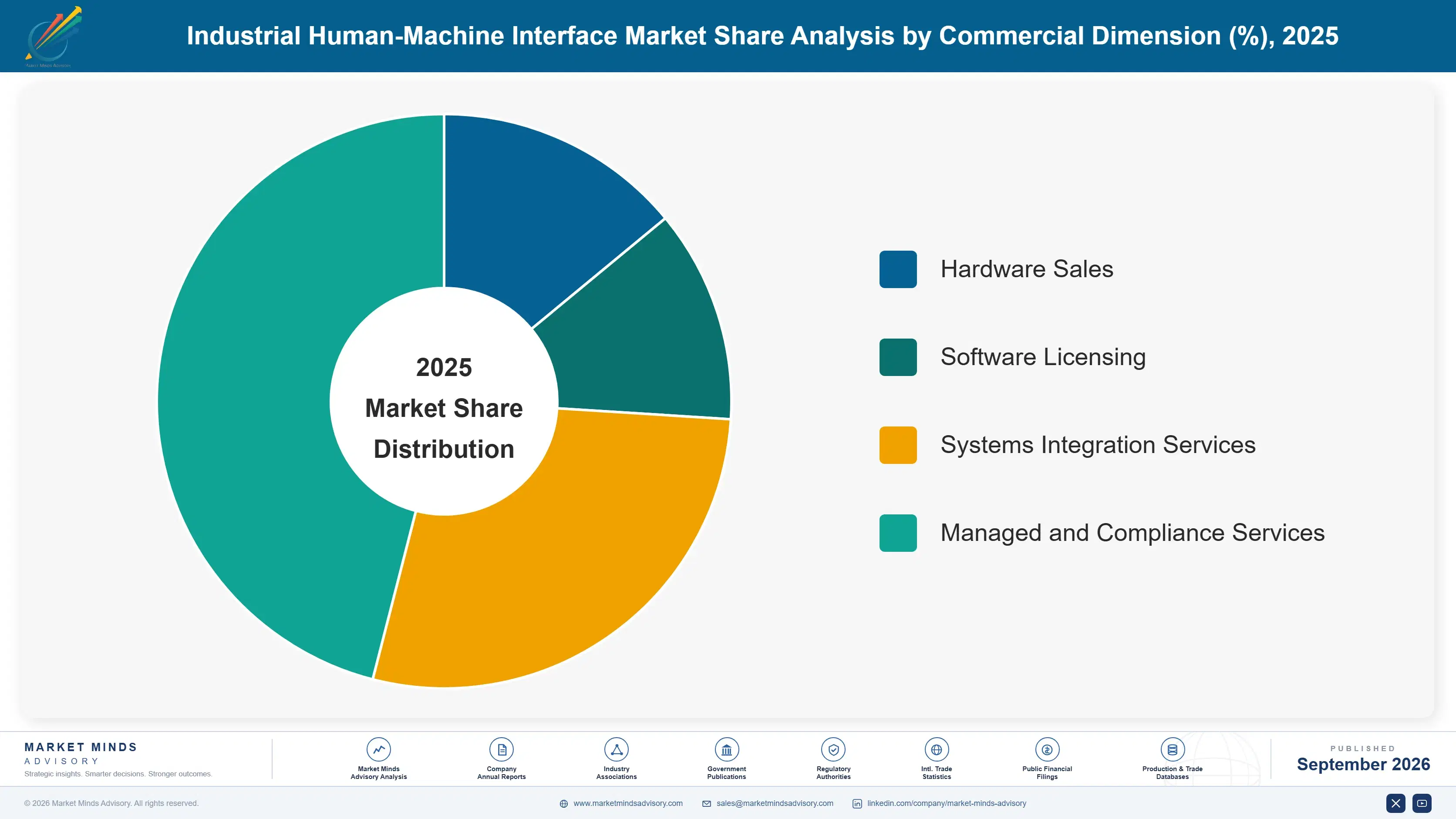
industrial-human-machine-interface-market-market-share-analysis-1790010051821

Cloud-Connected and IIoT-Integrated HMI Systems

Cloud-connected and IIoT-integrated HMI systems are growing fastest because plants increasingly treat the operator panel as a live, continuous data source rather than a standalone display, feeding production metrics directly into enterprise reporting and predictive-maintenance platforms without a separate industrial PC sitting in between the two systems at all any longer. Vendors that already ship native cloud connectivity are winning replacement contracts against legacy panel manufacturers still retrofitting connectivity as an add-on module, and cybersecurity regulations requiring patchable, network-aware hardware are accelerating the transition further across regulated manufacturing sectors worldwide. The segment also benefits from recurring software-subscription revenue that standalone panels never generated in their original hardware-only form of sale.
CAGR 11.5%

Wearable and Mobile HMI Devices

Wearable and mobile HMI devices, including tablets and augmented-reality headsets that let operators monitor and control equipment while walking the plant floor, are the second-fastest-growing segment as manufacturers extend visibility beyond the fixed control room and onto the shop floor itself. Maintenance technicians in particular are adopting mobile HMI to receive equipment alerts and work orders directly at the machine rather than returning to a central panel, cutting response time meaningfully across most shift patterns and plant layouts. Vendors that already sell fixed panels are extending their software platforms onto mobile form factors rather than ceding this segment entirely to pure-play mobile software startups with no installed base to build on.
CAGR 10.0%
Full segment breakdown across 6 segments available in the complete report.

Regional Architecture and Country Demand Map

East Asia leads on manufacturing scale and domestic HMI production, while North America and Western Europe concentrate the highest-value cybersecurity-driven retrofit contracts across regulated industries. South Asia and Pacific is expanding fastest as new factory capacity comes online across several of the region's fastest-growing manufacturing economies.

North America

North America's demand centers on cybersecurity-driven panel replacement and predictive-maintenance retrofits, with automotive and food-processing plants leading adoption of IEC 62443-conformant hardware ahead of tightening insurance and regulatory requirements across the region's most exposed manufacturing sectors nationwide. Discrete manufacturers are the primary buyers, since process industries here modernized their control rooms somewhat earlier and are now in a slower, steadier replacement phase rather than an initial adoption wave. Reshoring investment in domestic semiconductor and battery manufacturing is separately creating a wave of greenfield factory projects that specify connected HMI as a baseline requirement from the outset rather than retrofitting it later, adding a second distinct source of sustained demand across the continent.
Share: 24% | CAGR: 7.9% (2026 to 2036)

Western Europe

Western Europe's growth trails other regions somewhat because much of its manufacturing base already modernized control rooms during an earlier automation wave, leaving a smaller pool of legacy panels still needing replacement compared with faster-growing regions elsewhere in this report and this decade specifically. Germany's automotive and machinery sector remains the region's largest buyer by a wide margin over its neighbors, and its engineering standards heavily influence what global vendors build into their platforms worldwide. Regulatory pressure around industrial cybersecurity is nonetheless sustaining a steady replacement cycle even without the greenfield capacity growth driving demand in East Asia and South Asia, keeping vendor order books reasonably full despite slower headline growth overall.
Share: 22% | CAGR: 5.9% (2026 to 2036)
Regional intelligence for 5 additional markets available in the complete report: East Asia, South Asia and Pacific, Latin America, Middle East and Africa, Eastern Europe. Contact sales@marketmindsadvisory.com.
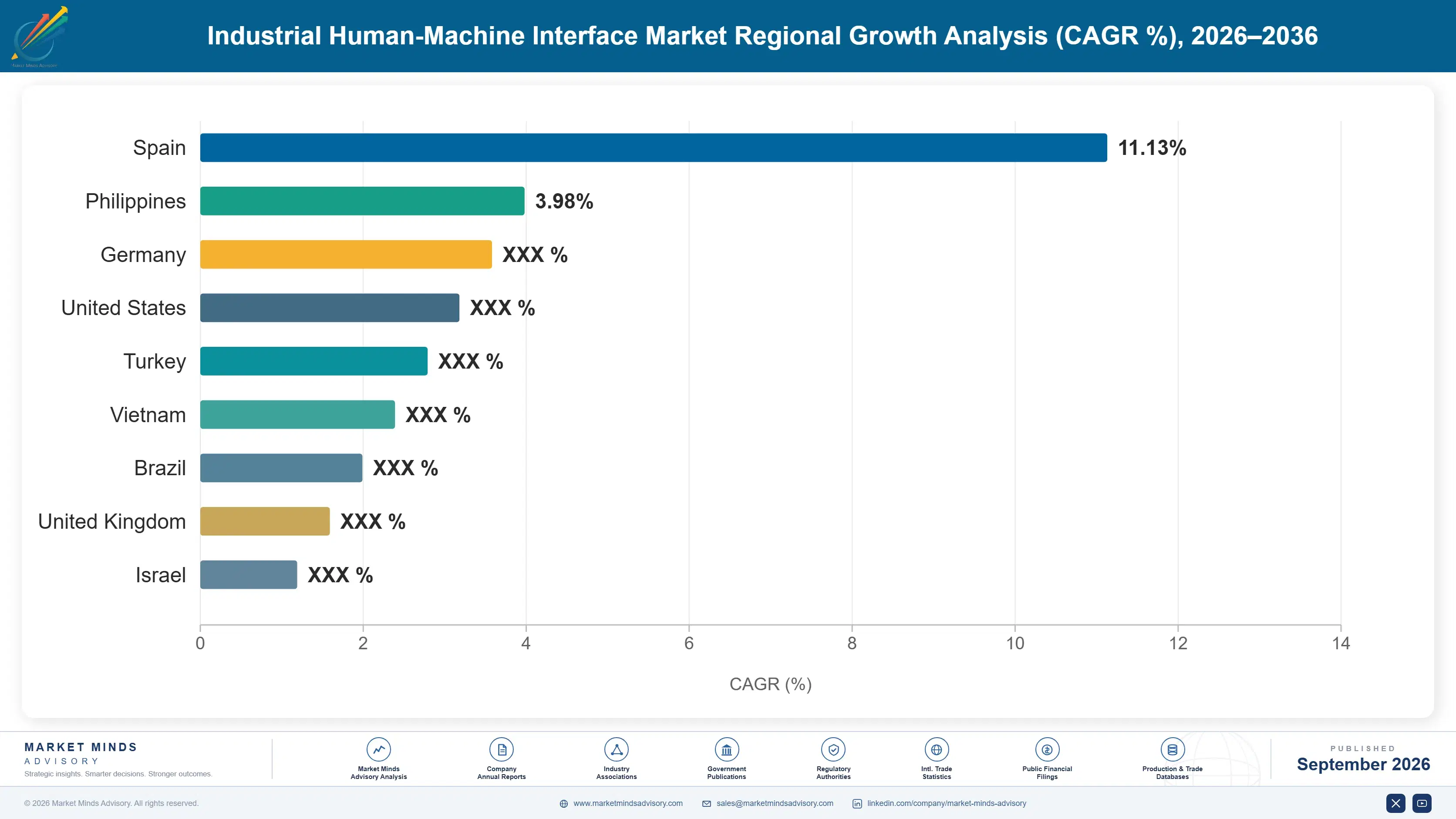
industrial-human-machine-interface-market-country-cagr-analysis-1790010052337

Monetizing Connectivity, Retrofit, and Analytics

Vendors are finding that the largest incremental margin sits outside the initial panel sale, in recurring edge-analytics subscriptions, retrofit connectivity modules, and cybersecurity certification services layered onto an installed base that plants across many manufacturing industries have already paid to deploy over the past several purchasing cycles and successive multi-year capital equipment budgets each year.

Selling Edge Analytics as Recurring Software Subscription

Vendors are packaging predictive-maintenance and anomaly-detection algorithms as a recurring software subscription priced per connected panel rather than bundling analytics into the one-time hardware sale at the point of purchase. This converts a portion of hardware revenue into a predictable annual stream, and vendors report subscription attach rates reaching roughly 45 percent of newly shipped connected panels within eighteen months of launch. Margin on the subscription layer runs well above hardware margin, since there is no manufacturing or logistics cost attached once the software platform is fully built and deployed.
Market Impact: Achieves a subscription attach rate near 45 percent

Retrofitting IIoT Connectivity Onto the Installed Base

Rather than waiting for plants to replace working panels, vendors are selling retrofit connectivity modules that add cloud and edge-analytics capability to existing hardware without requiring a full panel swap or production line downtime. This opens a large addressable base of installed panels that would otherwise generate no further vendor revenue until the next capital-expenditure cycle, and early adopters report retrofit attach rates above 20 percent among customers contacted directly during the initial rollout phase. The approach also builds a software relationship that positions the vendor favorably for the eventual full hardware replacement.
Market Impact: Captures a retrofit attach rate above 20 percent

Packaging Cybersecurity Certification as a Standing Service

As IEC 62443 requirements tighten, vendors are packaging certification maintenance, patch management, and compliance documentation into a standing annual service contract rather than a one-time certification project handled during initial deployment and largely forgotten afterward. Plants in regulated industries are paying a premium to offload this ongoing compliance burden entirely, and vendors offering the service report renewal rates roughly 14 percentage points higher among customers who purchase it compared with those handling compliance internally on their own. The service also creates a natural annual touchpoint for broader platform upsell conversations.
Market Impact: Lifts customer renewal rates by 14 percentage points

Bundling Remote Monitoring Into Multi-Site Service Contracts

Vendors are extending single-plant remote monitoring contracts into multi-site subscriptions that give corporate operations teams a consolidated view across every connected facility rather than plant-by-plant visibility alone confined to one location or one region entirely. Manufacturers with distributed operations are paying meaningfully more for this centralized visibility than for isolated single-site monitoring, and vendors pursuing the multi-site model report average contract value expanding by roughly 35 percent once a customer's second facility is added to an existing agreement within the same fiscal year, well ahead of the original contract renewal date.
Market Impact: Expands average contract value by roughly 35 percent

Who Controls the Margin Pool

At an estimated 42 percent combined share, the top five vendors hold a meaningful lead over a long tail of regional panel makers and single-product specialists, and the gap between the leading suppliers and the next tier is widening as IIoT platform depth becomes a harder capability for smaller challengers to replicate quickly without outside investment.
Current competitive activity centers on three fronts: acquiring IIoT software and edge-analytics startups rather than building comparable capability internally, forming cybersecurity certification partnerships with independent testing bodies to shorten sales cycles in regulated industries, and bundling retrofit connectivity modules with legacy panel product lines to defend installed-base revenue against cloud-native automation software entrants that lack an existing hardware relationship to protect.

Emerging pressure is coming from automation-software vendors with no hardware manufacturing legacy at all, undercutting incumbents on integration speed for greenfield factories with no installed panel base to migrate away from. Rankings are most likely to shift wherever a challenger wins a large multinational factory standardization contract before an incumbent does, since those contracts function as reference deployments that shape adjacent regional procurement decisions for years afterward and are difficult for slower rivals to dislodge.
industrial-human-machine-interface-market-company-positioning-matrix-1790010052862

Competitive Moat and Risk Dimensions

SIEMENS

Moat: TIA Portal Platform Switching Costs

Siemens's TIA Portal software environment ties HMI, PLC, and drive configuration into one integrated engineering workflow, and plants that standardized on it face substantial re-engineering cost to migrate control logic and operator screens to a competing platform. That switching cost gives Siemens durable renewal advantage across its installed automation base.
SIEMENS

Risk: Premium Pricing Vulnerability

Siemens's platform commands premium pricing relative to lower-cost Asian competitors, and price-sensitive manufacturers in cost-competitive industries are increasingly evaluating cheaper alternatives that now offer comparable core functionality at scale. That pricing gap risks ceding volume-tier contracts to challengers even as Siemens retains its premium installed-base advantage.
ROCKWELL AUTOMATION

Moat: North American Installed Base Depth

Rockwell Automation's decades-long presence in North American discrete manufacturing gives it an installed base and channel partner network that competitors find difficult to replicate quickly, particularly in automotive and food and beverage plants where Rockwell's control architecture is already deeply embedded across most existing production lines.
ROCKWELL AUTOMATION

Risk: Limited East Asian Manufacturing Presence

Rockwell Automation's manufacturing and channel presence in East Asia trails its North American footprint considerably, leaving it comparatively exposed as the region's factory investment accelerates faster than any other market tracked in this report. Domestic Chinese vendors are capturing much of that incremental growth instead of Rockwell.

Players Tracked

Prominent Players

Siemens
Rockwell Automation
Schneider Electric
Mitsubishi Electric
Beijer Electronics

Other Key Players

ABB
Omron
Honeywell
Advantech
Weintek
Kontron
Red Lion Controls
Exor International
IDEC Corporation
Hitachi Energy
Yokogawa Electric
Fuji Electric
Delta Electronics
Maple Systems
Moxa

Recent Developments

OCTOBER 2025

Siemens Launches AI-Enabled HMI Panel Line With Embedded Edge Analytics

Siemens launched a new AI-enabled HMI panel line with embedded edge-analytics processing, extending its TIA Portal software integration to include on-panel predictive-maintenance models that previously required a separate industrial PC to run, well ahead of several pending factory modernization tenders scheduled across Europe next year.
Signal: Extends Siemens's platform integration considerably ahead of several upcoming European factory modernization tenders scheduled next year
MARCH 2026

Rockwell Automation Acquires Mobile HMI Software Startup

Rockwell Automation acquired an HMI software startup specializing in mobile and wearable operator interfaces, adding capability that Rockwell had previously lacked internally and had been sourcing through smaller partnerships. The acquisition brings mobile HMI technology in-house ahead of several North American factory digitalization contracts scheduled for the coming year.
Signal: Brings mobile HMI technology fully in-house at Rockwell, closing a notable capability gap against key rivals
JULY 2025

Schneider Electric Forms Joint Venture for Southeast Asian IIoT HMI Deployment

Schneider Electric formed a joint venture with a Southeast Asian systems integrator to deliver IIoT-connected HMI platforms across the region's rapidly expanding electronics and automotive manufacturing base, combining Schneider's software platform directly with the integrator's already established local factory relationships and existing government procurement contacts.
Signal: Opens a new Southeast Asian distribution channel for Schneider through an established regional systems integration partner

Display, Processor, and Enclosure Cost Exposure

Touchscreen display modules and embedded processor components together account for roughly 35 to 42 percent of vendor cost of goods sold, with both sourced almost entirely from a concentrated group of East Asian display panel and semiconductor manufacturers. Ruggedized enclosure materials add a smaller but meaningful cost line, particularly for units rated for extreme temperature and vibration environments.
The 2024 display panel price increase, driven by strong demand from automotive and consumer electronics competing for the same LCD and touch-sensor production capacity industrial HMI vendors rely on, pushed component costs up meaningfully according to company annual report disclosures filed that year. Vendors with long-term display supply agreements maintained stable pricing, while smaller manufacturers without reserved capacity faced margin compression on fixed-price government contracts.

The competitive disadvantage falls hardest on smaller regional panel makers that lack the purchasing scale to negotiate reserved display and processor supply agreements, forcing them to buy components closer to spot prices than larger rivals. Vendors with in-house or long-term-contracted component supply can bid more aggressively on large factory standardization contracts, widening the cost gap between scaled global suppliers and smaller regional manufacturers over successive procurement cycles.
industrial-human-machine-interface-market-cost-volatility-analysis-1790010053058

Multi-Year Display Panel Supply Agreements

Leading vendors are locking in multi-year display panel and processor supply agreements with reserved production capacity to smooth exposure to component price spikes that periodically affect the broader electronics manufacturing industry as a whole. These agreements typically trade a modest capacity commitment premium for pricing stability that lets vendors bid confidently on large multi-year factory contracts.

Standardizing Modular Designs Across Product Lines

Vendors are designing HMI product families around shared display sizes, processor modules, and enclosure components rather than custom-engineering each individual product line separately, reducing the total number of distinct components purchased and increasing per-component order volume with suppliers considerably. This standardization improves negotiating position on unit pricing even without formal reserved-capacity contracts in place.

Portfolio Architecture for Margin Defence

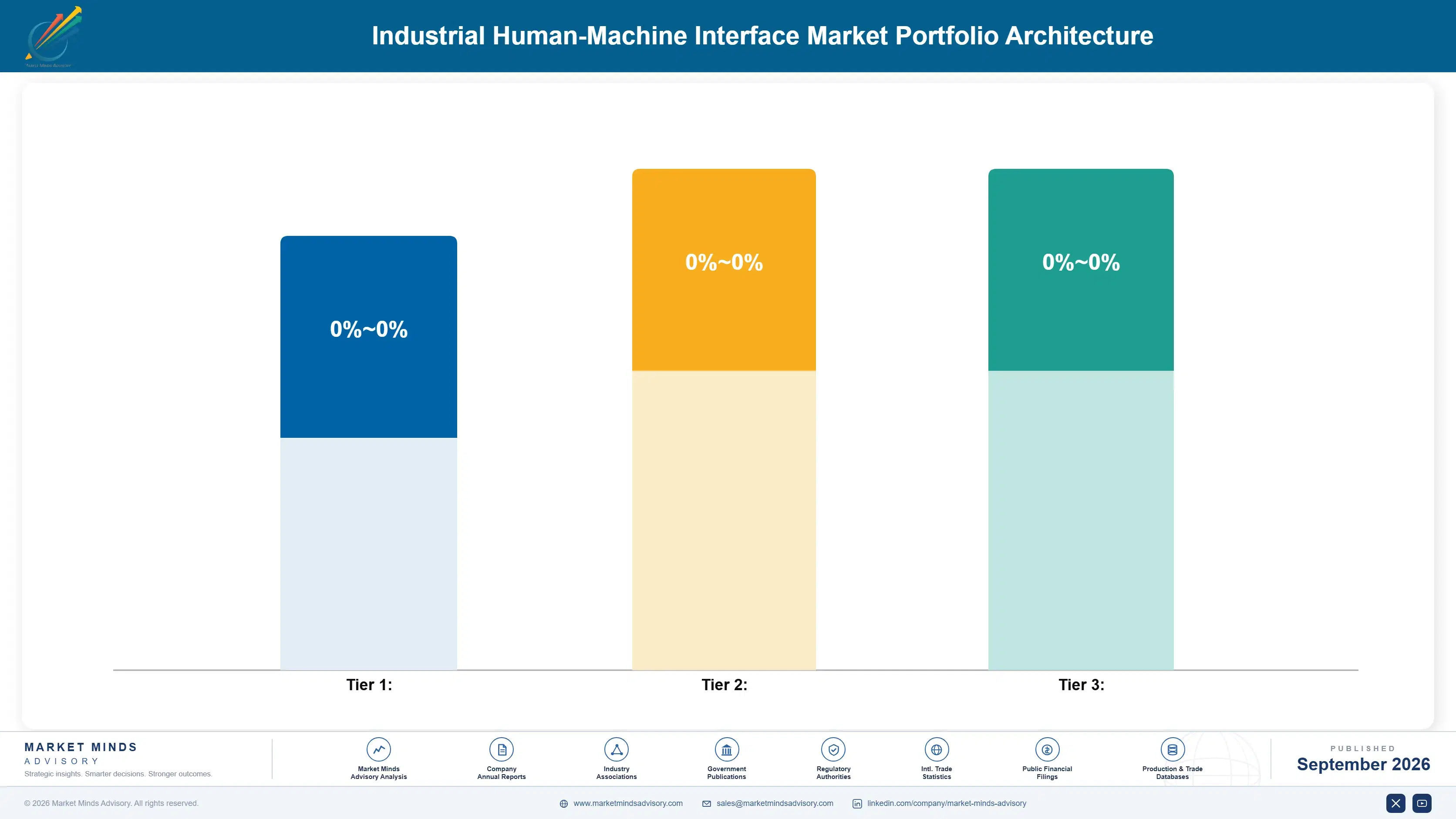
Portfolio economics split cleanly along three tiers: commodity panel-mounted terminals sold mostly on unit price, certified IIoT-connected platforms sold on cybersecurity and interoperability assurance, and next-generation edge-analytics and mobile HMI services sold on recurring subscription terms. Gross margin widens sharply moving up this ladder, since analytics and subscription revenue carries near-zero incremental production cost once the underlying software platform is fully built and the initial certification investment has already been made.
The volume tier still generates the largest unit shipment count by far, dominated by basic panel-mounted terminals sold into price-sensitive discrete manufacturing where buyers treat competing products as largely interchangeable on screen size and durability alone. Premium tiers instead compete on IIoT platform depth and cybersecurity certification, and plants there pay materially more for documented compliance and integration flexibility rather than for panel durability alone.

High-value margin pools concentrate almost entirely in edge-analytics subscriptions and cybersecurity certification services, where recurring software revenue commands premium pricing well above anything the volume tier can support today. Vendors positioned purely on panel hardware increasingly find themselves squeezed toward the bottom of the portfolio as plants pay for software capability rather than display quality alone.

Basic panel-mounted HMI terminals sold into price-sensitive discrete manufacturing, priced almost entirely on unit cost with thin differentiation between competing panel suppliers and limited room for software-driven margin expansion at all.
Gross Margin

Certified IIoT-connected platforms meeting industrial cybersecurity standards, sold into regulated manufacturers that require documented conformance before any factory contract is awarded and renewed annually under updated certification requirements and evolving standards.
Gross Margin

Edge-analytics and mobile HMI subscription services priced on recurring per-panel or per-facility licensing rather than one-time hardware cost, with margin scaling alongside connected unit count and platform usage over the contract term.
Gross Margin
industrial-human-machine-interface-market-portfolio-architecture-1790010053556

High-value Sub-segments and Strategic Watch-out

Edge-Analytics Subscription Services

Edge-analytics subscription services, where recurring per-panel software revenue justifies premium pricing and adoption is accelerating well ahead of most other segments as cybersecurity mandates compress replacement timelines across regulated industries this year, pulling forward demand from plants that had originally planned slower, more gradual upgrade cycles.

Cybersecurity Certification and Compliance Services

Cybersecurity certification and compliance services, where large factory contract values and steady multi-year renewal cycles deliver reliable margin even as unit growth moderates from earlier peak years across mature manufacturing regions that adopted binding standards first and fastest among their global industrial peers overall today.

Basic Panel-Mounted HMI Terminals

Basic panel-mounted terminals, the largest unit-volume segment overall but one facing continual price compression from commoditized display components and a steadily rising number of low-cost Asian suppliers entering established global markets with broadly comparable technical specifications and progressively thinner margin for incumbent vendors each year.

Standalone Legacy SCADA Software

Standalone legacy SCADA software sold separately from HMI hardware, which faces mounting displacement pressure as plants consolidate visualization and analytics functions onto integrated panel platforms instead, risking a lasting decline in point-solution demand across most manufacturing verticals and geographies over the coming several years ahead.

Why Platform Choice Outlasts the Panel

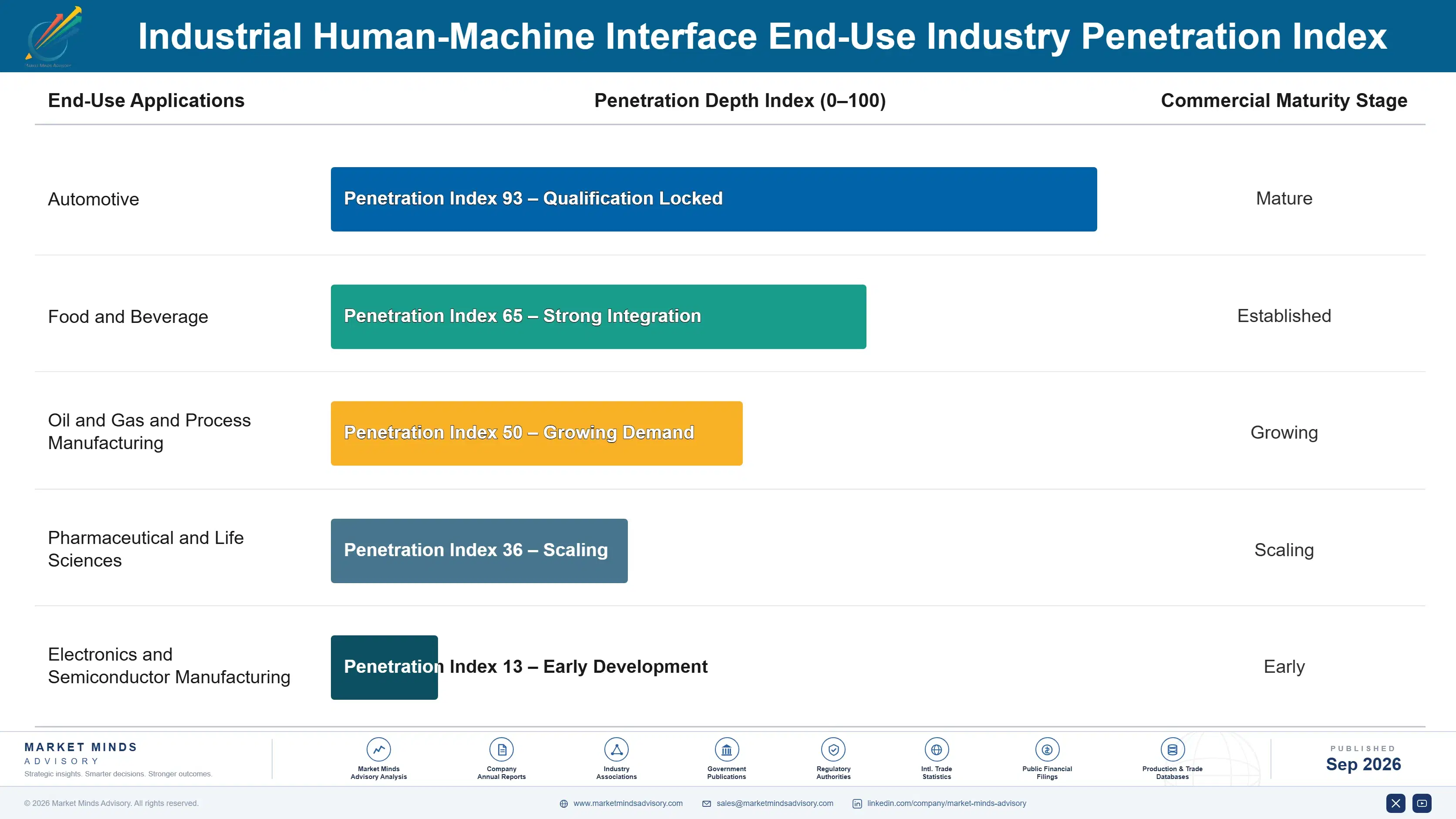
HMI platform relationships behave like annuities once control logic and operator screens are engineered around a specific vendor's software environment, since migrating requires rebuilding programming that took years to develop and validate across multiple production lines. Plants renew rather than switch vendors at the next hardware refresh, and renewal pricing typically holds steady as certification requirements tighten with each successive cycle.
Stickiness varies by vertical: automotive and pharmaceutical manufacturing renew at very high rates because validated control logic is expensive to re-certify and re-validate under regulatory oversight, while smaller job-shop manufacturers turn over vendors more freely since their control requirements are simpler and switching costs are correspondingly lower. Food and beverage plants sit between the two, renewing steadily but occasionally consolidating vendors during broader plant modernization projects.

A generational shift in buyer profile is underway as plant IT and cybersecurity leaders, rather than operations engineers focused purely on display durability, increasingly own the vendor selection decision, weighting network security and software integration over panel ruggedness alone. That shift favors vendors who can demonstrate platform-level capability over those competing on hardware specifications alone, reshaping how renewal negotiations unfold across nearly every account.
industrial-human-machine-interface-market-end-use-penetration-index-1790010054041

Where MMA Sees Durable Advantage

These are among the four positions where our research anticipates prominent divergence between winners and laggards over the coming forecast period. Each is grounded in the demand model, the regulatory perimeter, and the announced capacity pipeline.
01 / CYBERSECURITY CERTIFICATION DISCIPLINE

Prioritize vendors already conformant to IEC 62443 standards

Vendors that already ship IEC 62443-conformant HMI firmware are winning replacement contracts well before competitors still working through certification, since regulated manufacturers increasingly treat conformance as a procurement gate rather than a nice-to-have feature worth debating. Buyers evaluating new suppliers should weight certification currency at least as heavily as unit pricing, since a lapsed certificate can disqualify an otherwise strong bid outright and irreversibly. This dynamic will intensify as more regulated sectors adopt binding standards over the next several years.
02 / IIOT RETROFIT INVESTMENT TIMING

Retrofit connectivity onto the installed base before full replacement

Plants still running standalone panels should evaluate retrofit connectivity modules now rather than waiting for a full hardware refresh cycle, since vendors are already selling modules that add IIoT capability without requiring a costly panel swap across the entire production line at all. Waiting risks falling behind competitors who gain real-time production visibility years earlier at a fraction of the replacement cost. Early movers also build a software relationship that eases the eventual full hardware upgrade when it does eventually arrive.
03 / EAST ASIAN REFERENCE TIMING

Track China's domestic HMI vendors as an emerging competitive signal

Domestic Chinese HMI vendors are closing the technical gap with established global suppliers faster than most incumbents expected, and vendors that win large domestic reference contracts are increasingly competing for multinational factory tenders that previously went exclusively to Western and Japanese suppliers. Investors and buyers tracking vendor momentum should treat these domestic wins as a leading indicator of broader competitive repositioning rather than a purely regional phenomenon worth setting aside. The pattern has already repeated across multiple vendors this cycle alone.
04 / RECURRING SOFTWARE REVENUE

Shift pricing toward recurring analytics subscriptions early

Vendors and plant buyers alike underestimate how much long-term value sits in recurring edge-analytics subscriptions rather than in the initial panel sale itself, since subscription and certification-service revenue compounds meaningfully over the life of an installed base. Building a recurring revenue model early, rather than defaulting to a one-time hardware sale structure, measurably improves lifetime customer value and positions vendors well ahead of rivals still selling panels as a single isolated transaction. That discipline is becoming a genuine differentiator between vendors.

Engagement Snapshot From the Field

A live engagement with an industry participant carrying material or product regulatory and market exposure ahead of a defining policy shift, showing how our research translates into a defensible multi-year portfolio strategy.
MARKET MINDS ADVISORY · CLIENT ENGAGEMENT SUMMARY
Industrial Human-Machine Interface Producer Strategic Portfolio Review and Transition Roadmap 2026·Investment Scenario on Industrial Human-Machine Interface Exposure Evaluation 2025-26
CLIENT PROFILE
The client is a global automotive component manufacturer operating twelve production facilities across three continents, each running a mix of HMI panels from several different vendors accumulated over two decades of plant expansion and acquisition. Facing new customer cybersecurity audit requirements, the manufacturer needed to assess its entire installed HMI base and plan a phased replacement programme within a compressed budget cycle.
STRATEGIC CHALLENGE
The manufacturer's fragmented vendor base meant no single cybersecurity assessment could evaluate the whole installed fleet consistently, and several legacy panels running unsupported operating systems could not be patched to meet new customer audit standards at all. Leadership needed a prioritized replacement roadmap that addressed the highest-risk facilities first without disrupting ongoing production commitments.
MMA APPROACH
MMA assessed the installed HMI base across all twelve facilities against a common cybersecurity risk framework, ranking each panel by patchability, network exposure, and remaining useful life. The engagement included a phased replacement roadmap and a vendor consolidation recommendation designed to reduce the number of distinct platforms the manufacturer would need to maintain going forward.
KEY FINDINGS
  1. Four of the twelve total facilities were found running HMI panels with operating systems no longer receiving security patches from any vendor.
  2. Consolidating from six HMI vendors to two reduced projected annual maintenance and licensing cost by an estimated 18 percent (client-reported, unverified by MMA).
  3. The highest-risk facility's entire panel fleet was replaced within the first four months of the programme, well ahead of the customer's audit deadline.
  4. Staff retraining time for the newly standardized platform was shorter than the manufacturer's internal projections at every facility assessed (client-reported, unverified by MMA).
CLIENT PROFILE
The client is a global automotive component manufacturer operating twelve production facilities across three continents, each running a mix of HMI panels from several different vendors accumulated over two decades of plant expansion and acquisition. Facing new customer cybersecurity audit requirements, the manufacturer needed to assess its entire installed HMI base and plan a phased replacement programme within a compressed budget cycle.
STRATEGIC CHALLENGE
The manufacturer's fragmented vendor base meant no single cybersecurity assessment could evaluate the whole installed fleet consistently, and several legacy panels running unsupported operating systems could not be patched to meet new customer audit standards at all. Leadership needed a prioritized replacement roadmap that addressed the highest-risk facilities first without disrupting ongoing production commitments.
MMA APPROACH
MMA assessed the installed HMI base across all twelve facilities against a common cybersecurity risk framework, ranking each panel by patchability, network exposure, and remaining useful life. The engagement included a phased replacement roadmap and a vendor consolidation recommendation designed to reduce the number of distinct platforms the manufacturer would need to maintain going forward.
KEY FINDINGS
  1. Four of the twelve total facilities were found running HMI panels with operating systems no longer receiving security patches from any vendor.
  2. Consolidating from six HMI vendors to two reduced projected annual maintenance and licensing cost by an estimated 18 percent (client-reported, unverified by MMA).
  3. The highest-risk facility's entire panel fleet was replaced within the first four months of the programme, well ahead of the customer's audit deadline.
  4. Staff retraining time for the newly standardized platform was shorter than the manufacturer's internal projections at every facility assessed (client-reported, unverified by MMA).
RECOMMENDED STRATEGY
Phase 1: Phase 1 (Months 1-4): Replace HMI fleets at the two highest-risk facilities well ahead of the customer's fixed audit deadline. Phase 2: Phase 2 (Months 5-9): Consolidate all remaining facilities onto the two newly selected vendor platforms in strict priority order overall. Phase 3: Phase 3 (Months 10-14): Complete staff retraining and fully retire all remaining legacy, unsupported panels across the entire plant network.
OUTCOME
The manufacturer passed its customer cybersecurity audit at all twelve facilities and completed vendor consolidation ahead of the original schedule. Maintenance and licensing costs declined meaningfully following consolidation, and the manufacturer reported improved visibility into production data across facilities that previously ran incompatible platforms (client-reported, unverified by MMA).

Frequently Asked Questions

Foundational context covering the market sizes, CAGR, scope, country, region and competition that inform every finding below. This section is provided to cover basics and most often pre-purchase conversations, answered from the MMA Primary Research Dataset.

What is the current size of the Industrial Human-Machine Interface Market?

The industrial human-machine interface market is valued at approximately $6.8 billion in 2025. This figure covers hardware panels, embedded displays, and software platforms used to monitor and control industrial equipment.

How large will the Industrial Human-Machine Interface Market be by 2036?

MMA projects the market will reach approximately $14.9 billion by 2036. That represents just over a doubling from the 2026 base value of $7.3 billion.

What is the CAGR for the Industrial Human-Machine Interface Market 2026 to 2036?

The market is forecast to grow at a 7.4 percent compound annual rate between 2026 and 2036. Bull and bear scenarios range from 6.1 to 8.7 percent.

Which segment is growing fastest?

Cloud-connected and IIoT-integrated HMI systems are the fastest-growing segment, expanding at an estimated 11.5 percent CAGR through 2036. That is roughly 1.55 times the overall market growth rate.

Who are the major companies in the Industrial Human-Machine Interface Market?

Siemens, Rockwell Automation, Schneider Electric, Mitsubishi Electric, and Beijer Electronics lead the market. Together they hold an estimated 42 percent combined share on a revenue basis.

Which country is growing fastest?

China is the fastest-growing country, expanding at an estimated 9.8 percent CAGR through 2036. Growth is driven by domestic smart manufacturing programmes and rapidly closing technical gaps among local vendors.

Report Segmentation Architecture

The full report scope spans multiple orthogonal segmentation dimensions, with cross-tabulated demand data provided for each dimension pair. Coverage extends further to regional breakdowns, trend trajectories, and the competitive detail needed to support segment-level decision-making.

By Primary Market Dimension

  • Panel-Mounted HMI Terminals
  • Embedded and Modular HMI Displays
  • Multi-Touch and Gesture-Enabled HMI Panels
  • Cloud-Connected and IIoT-Integrated HMI Systems
  • HMI Software and SCADA Integration Platforms
  • Wearable and Mobile HMI Devices

By End-Use Industry

  • Automotive
  • Food and Beverage
  • Oil and Gas and Process Manufacturing
  • Pharmaceutical and Life Sciences
  • Electronics and Semiconductor Manufacturing

By Commercial Dimension

  • Hardware Sales
  • Software Licensing
  • Systems Integration Services
  • Managed and Compliance Services

By Region

  • North America
  • Western Europe
  • East Asia
  • South Asia and Pacific
  • Latin America
  • Middle East and Africa
  • Eastern Europe

Scope, Methodology, and Coverage

Every figure in this report is reproducible from documented input assumptions. The scope below maps the historical period, the forecast horizon, the segmentation dimensions, and the countries covered, alongside the underlying primary and qualitative methodology.
Historical Period
2020 to 2025
Forecast Period
2026 to 2036
Base Year
2025 (USD billions; MMA Primary Research Dataset, September 2026)
Market Definition
The industrial human-machine interface market covers hardware panels, embedded displays, and software platforms that let plant operators monitor and control industrial equipment and processes. It excludes general-purpose consumer touchscreens sold without industrial-grade ruggedization and standalone SCADA software sold without an integrated operator display.
Quantitative Units
USD billions (current prices); unit shipment volumes where applicable
Segmentation Dimensions
Product Architecture; End-Use Industry; Commercial Dimension; By Region
Regions Covered
North America, Western Europe, East Asia, South Asia and Pacific, Latin America, Middle East and Africa, Eastern Europe
Countries Covered
USA, China, Germany, France, UK, Japan, South Korea, India, Australia, Canada, Brazil, Mexico, Indonesia, Vietnam, Thailand, Malaysia, UAE, Saudi Arabia, South Africa, Nigeria, Turkey, Poland, Netherlands, Italy, Spain, Sweden, Switzerland, Argentina, Colombia, Singapore, and additional markets relevant to this sector
Key Companies Profiled
Siemens, Rockwell Automation, Schneider Electric, Mitsubishi Electric, Beijer Electronics, ABB, Omron, Honeywell, Advantech, Weintek, Kontron, Red Lion Controls, Exor International, IDEC Corporation, Hitachi Energy, Yokogawa Electric, Fuji Electric, Delta Electronics, Maple Systems, Moxa
Quantitative Methodology
Primary survey, n=3,800 respondents, Q4 2025, six countries; demand-side model with trade association cross-validation
Qualitative Methodology
47 expert interviews, Q4 2025; applied to validate demand model assumptions, identify emerging dynamics, and assess competitive positioning
Report Format
PDF and XLSX data workbook (Word format preview document)
Publisher
Market Minds Advisory
Report Code
MMA-2026-CON-612
Published
September 2026
Contact
sales@marketmindsadvisory.com | www.marketmindsadvisory.com

Purchase the full Industrial Human-Machine Interface Market Report (2026 to 2036).

This report provides a ten-year quantitative sizing and forecast model for the industrial human-machine interface market, covering hardware panels, embedded software, and IIoT-connected platforms across all seven global regions. It includes detailed segmentation by product architecture, competitive benchmarking of the top twenty vendors, and a proprietary MMA Primary Research dataset drawn from expert interviews and a large-scale quantitative survey. Buyers receive regional deep-dives, vendor moat and risk assessments, and forward-looking scenario modeling calibrated against historical adoption patterns. An anonymized case study and a full revenue-lever breakdown round out the deliverable for teams building vendor strategy or factory modernization roadmaps.
Ten-year quantitative market sizing and forecast model
Segmentation by HMI product architecture and connectivity
Vendor moat and risk assessment for top players
Regional deep-dives across all seven global regions
Primary survey and expert interview dataset access
Revenue lever and portfolio margin benchmarking analysis

Built For The People Who Decide

From boardroom strategy to bench-side execution, this report is read cover-to-cover by leaders shaping the next decade of their industry, turning demand scenarios, market dynamics and valuation benchmarks into decisions.
CXOs/ Presidents/ VPs/ Managers
M&A and Corporate Development
Strategy Teams and R&D Heads
Procurement and Product Directors
Regulatory and Compliance Leaders
Investor Relations and Equity Analysts