Market Minds Advisory
Industrial Counter Market

Industrial Counter Market: Controller absorption, safety certification and replacement channel economics to 2036

Almost half of new machine designs now count inside the controller, and the counter business survives on an installed base with a median age of fourteen years that turns over very slowly indeed.

Lead Analyst

David Horsley

Published

September 2026

Make Smarter Decisions with Customized Research Insights

Request a free sample report and evaluate market opportunities, growth trends, and competitive dynamics relevant to your business needs.

2025 MARKET VALUE$1.9BMarket Size 2025
2036 FORECAST VALUE$3.0BBase Case , 2026 to 2036
CAGR 2026 TO 20364.2 %Bull 5.4% / Bear 3.0%
INCREMENTAL OPPORTUNITY$1.0BNet 10- year value creation
EXPANSION MULTIPLE1.51x2036 value over 2026 base
Strategic Levers
M&A Pipeline
Regional Outlook
Country Rankings
Competitive Intelligence
Segmental Deep-dive
Call-Us : 91 93563 13602

Executive Snapshot and Market Trajectory

The dedicated counting device is being absorbed into the machine controller and has been for twenty years. Around 46% of new designs now count inside a programmable controller rather than in a panel-mounted box, and that share rises with every generation of cheaper processing. Nobody in this industry disputes it.
Vision-based counting systems grow at 6.3%, half again the market rate of 4.2%, because a camera counts and inspects in one operation where a photoelectric sensor only counts. East Asia holds 30% of value on machinery manufacture rather than machinery use. Electromechanical counters, still shipping in real volume, grow at under 1% and are simply running out. That spread is the whole picture.
Five manufacturers hold 29% of supply, which is unusually fragmented and reflects a product sold through catalogues at an average price near USD 84. Nobody visits a customer to sell a counter, so distribution reach decides everything. The interesting position is safety-rated counting, where certification under functional safety standards commands roughly six times the price of an unrated device and a controller function block cannot substitute without a certified safety controller behind it.
Market Definition
This report covers dedicated industrial counting devices, spanning electromechanical counters, panel-mount electronic counters, preset and batch control counters, vision-based counting systems, elapsed time indicators and safety-rated counting modules. Value is measured at manufacturer level across original equipment and replacement channels. Excluded are programmable logic controllers and their counting functions, encoders sold as position feedback, flow and energy meters, laboratory particle counters, and manufacturing execution software of any kind.
Base Year Value
$1.9B in 2025 (MMA Primary Research Dataset, August 2026)
Forecast Period
2026 to 2036, eleven discrete annual values
CAGR
4.2% base case. Bull 5.4%. Bear 3.0%.
Fastest Growth Segment
Vision-Based Counting Systems: 6.3% CAGR
Fastest Growth Country
India: 6.8% CAGR
Fastest Growth Region
South Asia and Pacific: 6.3% CAGR
Largest Region
East Asia: 30% of 2025 global value
Market Leaders
Omron, Panasonic, Schneider Electric, Kübler and Red Lion Controls lead the market. Source: MMA Primary Research Dataset, July 2026.
Primary Survey
n=3,800 procurement and R&D decision-makers, Q4 2025, six countries
Methodology
Demand-side build-up, cross-validated against public data, 47 expert interviews

Industrial Counter Market Forecast Scenarios

industrial-counter-market-size-forecast-scenario-1787553374602
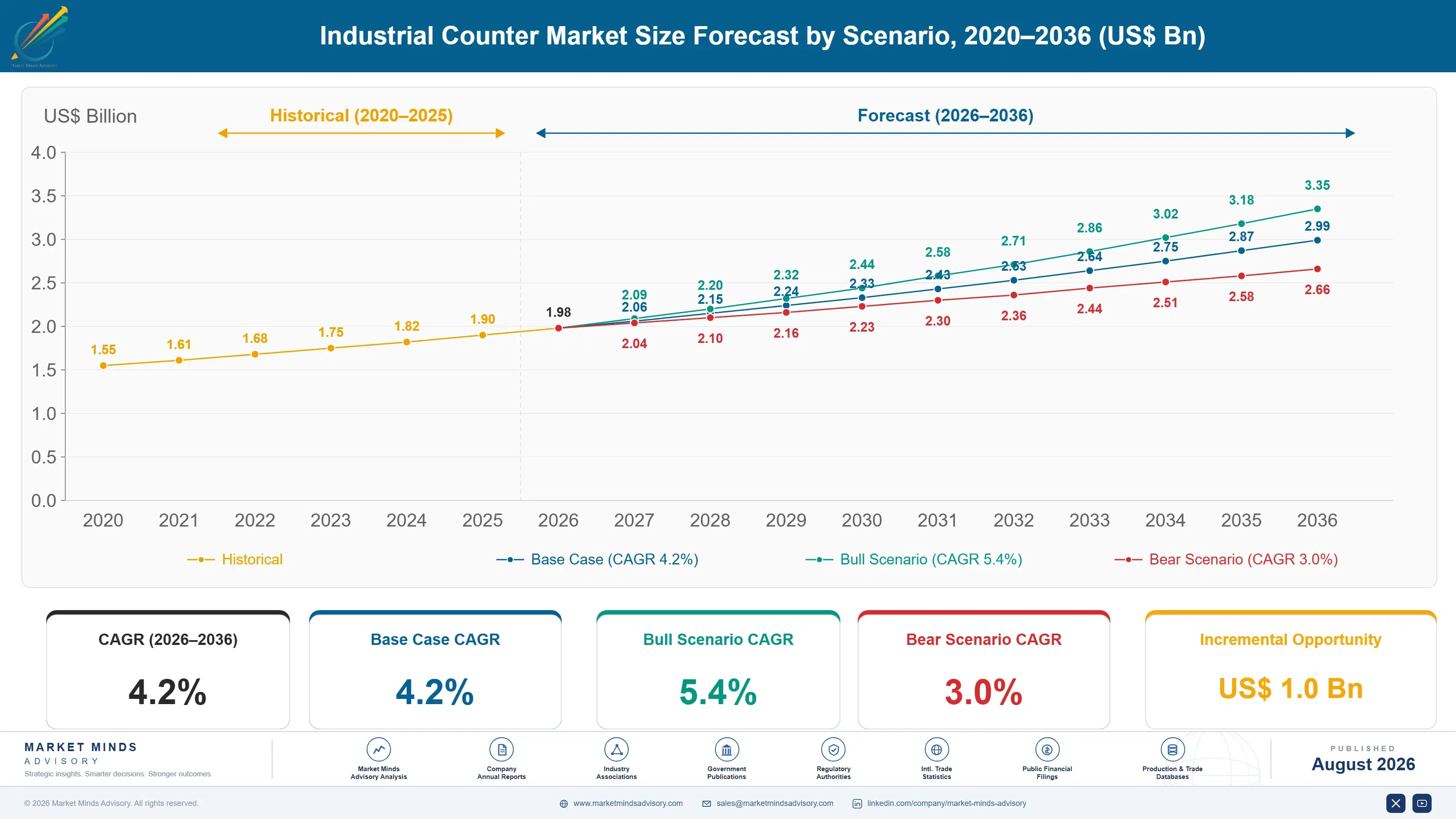
Growth ran at 3.2% between 2020 and 2025 and the number conceals a business quietly changing shape. Machinery production recovered strongly after 2020, which should have lifted counter demand, and controller absorption took most of that back. What actually raised the average was safety-rated modules and vision systems, both selling at multiples of a conventional device price into applications that did not previously buy anything.
The 4.2% base case rests on three mechanisms. Replacement demand into an installed base with a median age of fourteen years keeps generating volume long after the design decision moved elsewhere, and 57% of units already go into existing machinery. Machine safety regulation keeps pulling certified counting modules onto equipment where an unrated device was previously acceptable. And vision-based counting keeps taking high-speed packaging applications where photoelectric sensing simply cannot resolve the count reliably.
The 5.4% bull case is safety certification requirements spreading faster than expected, which would convert unrated volume into modules at six times the price. The 3.0% bear case is controller absorption accelerating past 46% as processing costs keep falling, and the installed base turning over faster than fourteen years as machinery renewal picks up in Europe and North America.

A Business Living On Its Past

Counting is not a hard problem and it stopped being a product problem long ago. A programmable controller counts pulses as a function block costing nothing extra, and around 46% of new machine designs do exactly that rather than fitting a separate device. The dedicated counter business is therefore in slow decline at the design end and has been for two decades, which everybody in it knows and rather few say aloud.
TOP-FIVE CONCENTRATION29%Combined position across industrial counter supply held by leaders
CONTROLLER ABSORPTION RATE46%New machine designs counting inside the controller rather than externally
AVERAGE DEVICE PRICEUSD 84Mean selling price across common panel-mount counting devices
INSTALLED BASE AGE14 yearsMedian age of counting devices still in industrial service
REPLACEMENT CHANNEL SHARE57%Portion of unit volume sold into existing installed machinery
SAFETY MODULE PRICE PREMIUM6.2 timesMultiple over an equivalent unrated industrial counting device
The reason it survives is arithmetic rather than argument. Around 57% of unit volume goes into machinery already installed, and the median age of counting devices in industrial service runs about fourteen years. That base turns over slowly, which means the replacement business outlives the design business by more than a decade. Average selling price sits near USD 84 and nobody visits a customer to sell one, so the distributor shelf is the entire commercial position.
Two places hardware still wins on merit. Safety-rated counting modules command roughly six times an unrated device because a controller function block needs a certified safety controller behind it to do the same job. And vision systems count things a photoelectric sensor cannot resolve at all.
"This is a declining product with an excellent business underneath it, which is a combination nobody in industrial automation finds comfortable to talk about. The manufacturers doing well have stopped defending the design win and started running the replacement channel like the annuity it actually is."
Principal, Industrial Automation Components Practice · MMA Technology Practice · August 2026

Market Trends

Vision systems count and inspect in one operation

A photoelectric sensor counts objects passing a point and knows nothing else about them. A camera counts the same objects and simultaneously checks fill level, label presence, seal integrity or whatever else the application needs, which turns two pieces of equipment into one. Falling camera and processing costs brought this within reach of applications that could never justify machine vision before. Growth at 6.3% follows packaging line speeds rising past what photoelectric sensing resolves reliably. The commercial shift is that the buyer becomes a quality engineer rather than a maintenance technician, which is a different budget and a different conversation.
Market Impact: Supplies 57% of unit volume
Functional safety certification protects hardware the controller cannot replace

A machine safety function has to be certified, and a counting operation inside a standard programmable controller cannot carry that certification without a safety-rated controller underneath it costing considerably more than the counter it replaced. Safety-rated counting modules therefore survive on regulation rather than on capability, commanding roughly six times an unrated device. Machine safety requirements have tightened steadily across European and American machinery directives, which converts previously unrated applications into certified ones. Growth at 5.7% follows those requirements. This is the one place in the market where a hardware manufacturer holds ground a software function block cannot take.
Market Impact: Delivers 30% of global value

Market Opportunities and Growth Drivers

Ageing installed base generates replacement volume for decades

The median counting device in industrial service is about fourteen years old and a great many are considerably older than that, sitting in machinery nobody intends to replace. Around 57% of unit volume goes into that base rather than into new machinery, which means the business generates revenue on decisions taken fifteen years ago. Replacement is usually like-for-like: a maintenance technician orders the same part number because rewiring a panel is not worth the trouble. That inertia is the single most valuable characteristic this market has and almost nobody manages it deliberately.
Market Impact: Absorbs 46% of new designs

Machinery manufacture keeps expanding across Asian production bases

Chinese and Indian machine building continues to grow, and machines built there carry counting devices whether or not the destination market is domestic. That matters because the design decision happens at the machine builder rather than at the end user, and Asian builders have specified discrete counting hardware more readily than European ones adopting controller functions. Indian packaging and textile machinery production adds volume at lower specification and higher unit count. Growth in these markets runs well ahead of the global average, and it is the only part of this business where new installation rather than replacement drives the numbers.
Market Impact: Caps effort at USD 84

Market Restraints and Challenges

Controller absorption removes the design decision entirely

A programmable controller fitted to a machine counts pulses as a software function at no additional hardware cost, and around 46% of new designs now do that rather than fitting a device. The root cause is that processing became free while a physical counter did not, and no amount of product development reverses that arithmetic. Commercially this removes the design win permanently, since nobody adds hardware back to a machine that works. Manufacturers have responded by moving into safety-rated and vision products the controller cannot absorb, and by treating the replacement channel as the business rather than as an afterthought.
Market Impact: Segment growing at 6.3%

Catalogue pricing leaves no room for commercial effort

An average selling price near USD 84 will not carry a sales visit, an application engineer or anything else a manufacturer might want to do commercially. The root problem is that the product is simple and the customer knows it, so any attempt to sell value runs into a distributor catalogue showing four equivalent devices at similar prices. Commercially this caps what anybody can spend on winning business and pushes everything through distribution. Manufacturers have responded by building configurator tools and stock availability rather than sales coverage, and by concentrating commercial effort on the few products where price supports it.
Market Impact: Commands 6.2 times unrated pricing
3 additional market trends, 4 additional growth drivers, and 2 additional restraints and challenges are covered in the full report. Contact sales@marketmindsadvisory.com to access the complete intelligence.

Segment CAGR and Growth Architecture

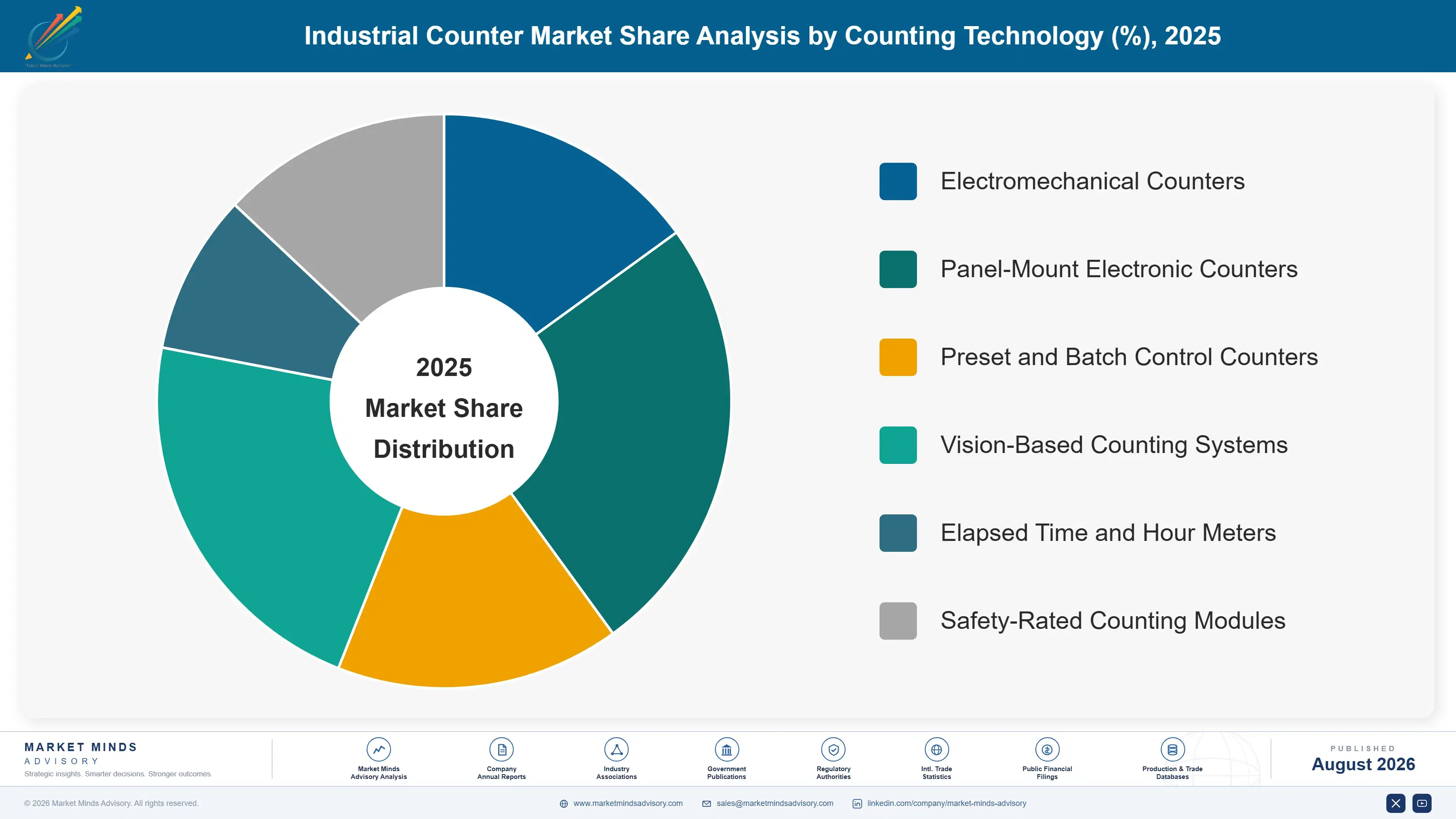
Devices are classified here by counting technology and the function they perform, because that decides whether a machine controller can absorb the job and what the device can be priced at. Application industry, mounting format and sales channel are handled separately in the framework, since a single device type serves packaging, textiles and process equipment without modification.
industrial-counter-market-market-share-analysis-1787553375164

Vision-Based Counting Systems

Growing at 6.3%, half again the market rate, this is the only segment where the product is genuinely better rather than merely surviving. A camera counts objects and inspects them in the same operation, which replaces two pieces of equipment and answers a quality question the counting device never could. Falling camera and processing cost brought machine vision into applications that could never justify it before. The commercial shift matters more than the technical one: the buyer becomes a quality engineer with a real budget rather than a maintenance technician replacing a part, and the price supports an actual sales conversation. Traditional counter manufacturers are mostly absent from this segment.
CAGR 6.3%

Safety-Rated Counting Modules

This segment exists because certification does, which makes it the most defensible position in the market and also the least glamorous. A counting function forming part of a machine safety system has to be certified, and doing that inside a standard controller requires a safety-rated controller costing far more than the module it would replace. Safety modules therefore command roughly six times an unrated device and face no competition from software at all. Machine safety requirements have tightened steadily across European and American directives, converting previously unrated applications. Growth at 5.7% follows regulation rather than machinery volume, which makes it considerably more predictable than anything else here. Very few manufacturers have certified product.
CAGR 5.7%
Full segment breakdown across 6 segments available in the complete report.

Regional Architecture and Country Demand Map

East Asia holds 30% of value on machinery manufacture rather than machinery use, since the design decision happens at the machine builder. North America follows at 24% on a large and elderly installed base. Where machines are built explains this map. Where machines are used explains rather less.

North America

A very large and genuinely old industrial installed base is what sustains demand here, and much of the machinery running in American plants was built before controller-based counting was normal practice. Replacement volume dominates completely. Machine safety requirements under American standards have pulled certified counting modules onto equipment that previously carried unrated devices, which raises value per unit against falling unit counts. Distribution runs through industrial supply houses and electrical wholesalers whose catalogue position decides most purchases. Growth at 3.8% is modest and the mix improvement underneath it is real, since safety modules and vision systems both sell at multiples of what they displace. Very few forecasts separate those two effects.
Share: 24% | CAGR: 3.8% (2026 to 2036)

Western Europe

Controller absorption went furthest here first, which is why growth at 2.7% is the weakest of the seven regions and also why the technical leadership sits here. German and Swiss manufacturers build the highest-specification counting and safety devices anywhere and export them into markets that have not yet reached European absorption levels. Machinery Directive requirements pushed functional safety certification onto counting applications earlier here than anywhere else, which created the safety module category that now defends the whole industry. Industrial machinery production is mature and flat. The value here is technical position rather than volume, and that has been true for some years now. Nobody expects the volume to return.
Share: 21% | CAGR: 2.7% (2026 to 2036)
Regional intelligence for 5 additional markets available in the complete report: East Asia, South Asia and Pacific, Latin America, Middle East and Africa, Eastern Europe. Contact sales@marketmindsadvisory.com.
industrial-counter-market-country-cagr-analysis-1787553375685

Where Counter Margin Actually Sits

Four moves matter in a business whose product is being absorbed into software and whose installed base will outlive that absorption by fifteen years. Two are about the categories software cannot take, and two are about running the replacement channel deliberately rather than accidentally. Defending the design win is not among them, because that argument is already lost.

Certify products against functional safety standards

A safety-rated counting module commands roughly 6.2 times an unrated device and faces no competition from a controller function block, because carrying that certification inside a standard controller requires a safety-rated controller costing far more. Certification is expensive and slow and it buys a category software cannot take. Machine safety requirements keep tightening across European and American directives, which converts previously unrated applications on a timetable nobody can defer. Manufacturers without certified product are competing entirely in the part of the market that is disappearing, which is an uncomfortable place to be.
Market Impact: Commands the full 6.2 times unrated device pricing

Run the replacement channel like an annuity

Around 57% of unit volume goes into machinery already installed and the median device in service is fourteen years old, which makes the replacement base a predictable revenue stream that almost nobody manages deliberately. Maintenance technicians reorder the same part number rather than rewiring a panel, so the manufacturer who was specified fifteen years ago collects for as long as the machine runs. Stock availability, part number continuity and distributor listing are the whole competitive position here. Discontinuing an old part number to simplify a catalogue hands that annuity to whoever still stocks a compatible device.
Market Impact: Protects the full 57% of replacement unit volume

Enter vision counting through the quality budget

Vision systems grow at 6.3% and the reason is commercial rather than technical: a camera counts and inspects in one operation, which means the buyer is a quality engineer with a real budget rather than a maintenance technician replacing an USD 84 part. That single change makes a sales conversation possible where the counter business never could support one. Traditional counter manufacturers are mostly absent from this segment and the vision companies serving it do not think about counting at all. The opening sits precisely between the two and nobody is standing in it.
Market Impact: Reaches a growing segment compounding at 6.3% annually

Buy distributor shelf position rather than sales coverage

An average price near USD 84 will not fund a sales visit and never has, which means the distributor catalogue is the entire route to market and the only thing worth spending on. Stock depth, configurator tooling, cross-reference tables against competitor part numbers and rapid delivery decide who gets ordered when a technician needs a device today. Manufacturers running field sales teams against this product are spending money the price cannot carry. The ones doing well built distribution economics instead and treat the catalogue listing as the commercial asset it genuinely is.
Market Impact: Matches the USD 84 average selling price properly

Who Controls the Margin Pool

Five manufacturers hold 29% of industrial counter supply, measured on device revenue at manufacturer level across original equipment and replacement channels, the basis used throughout this section. That is unusually fragmented for an industrial component and it follows directly from a product simple enough that many companies can make one. The gap between the leaders and everybody else is distributor listing breadth and safety certification, neither of which shows in a product comparison.
Competition runs on three dimensions and product capability is barely one of them. Distributor listing and stock depth, which decides who gets ordered at all. Safety certification breadth, which decides who can serve the only defensible category. And part number continuity across decades, which decides who keeps the replacement annuity. Price competes hardest in the conventional devices being absorbed into controllers anyway.

Rankings shift where the market shrinks rather than where competitors take share, which is a different dynamic and it favours whoever concentrated early. Chinese manufacturers hold cost positions Western builders cannot approach on conventional devices. Safety-rated and vision products hold longest, because certification and camera engineering are both capabilities a low-cost assembler does not acquire quickly.
industrial-counter-market-company-positioning-matrix-1787553376201

Competitive Moat and Risk Dimensions

OMRON

Moat: Automation portfolio breadth

Omron sells counting devices alongside controllers, sensors, safety products and vision systems, which means a machine builder can source an entire control architecture from one catalogue and one relationship. That breadth matters more as counting migrates into controllers, since Omron captures the function either way rather than losing it. Competitors selling counters alone lose the customer when the function moves.
OMRON

Risk: Counters barely register

Counting devices are a small line inside an automation business measured in billions, which means they receive attention and investment proportional to that scale rather than to the opportunity. Specialist competitors treating counting as their whole business can commit engineering and certification resource that a large portfolio company would never approve for the category.
KÜBLER

Moat: Safety certification depth

Kübler built functional safety capability across counting and position measurement devices earlier than most competitors, which positioned it exactly where machinery directives eventually pushed the market. Certification takes years, and it defends a category that software cannot take. That combination is rare in a product this simple and it is the reason a specialist can compete against automation majors here.
KÜBLER

Risk: Narrow product base

Specialising in counting and measurement devices means no other business absorbs a downturn in industrial machinery, and no adjacent product carries the customer relationship when the counting function migrates into a controller. Automation majors capture that function either way. A specialist watches it leave and has nothing else to offer the same customer.

Players Tracked

Prominent Players

Omron
Panasonic
Schneider Electric
Kübler
Red Lion Controls

Other Key Players

Autonics
Hengstler
Baumer
ifm electronic
Trumeter
Danaher
ENM Company
Koyo Electronics
Fuji Electric
Siemens
Eaton
Curtis Instruments
Delta Electronics
Lika Electronic
Simex

Recent Developments

FEBRUARY 2025

Kübler expanded functional safety product certification across its counting range

Kübler completed functional safety certification across an extended range of counting and measurement devices, adding certified variants where previously only unrated versions existed. The work was internal and funded organically, with no partner involved, and it responded to machinery directive requirements reaching applications that had not previously needed certification.
Signal: Certification investment is where the surviving value sits, and manufacturers without it are competing in the shrinking half
JULY 2025

Omron expanded vision-based counting and inspection product availability

Omron widened availability of compact vision systems combining counting with inline inspection, aimed at packaging lines running faster than photoelectric sensing resolves reliably. This was an organic product range extension rather than an acquisition or partnership, and it targets quality engineering budgets rather than maintenance ones.
Signal: The buyer is being deliberately changed from maintenance to quality, which is the only route to a real sales conversation
NOVEMBER 2025

Red Lion Controls extended part number continuity commitments across its counter range

Red Lion Controls published extended availability commitments on legacy counter part numbers, guaranteeing supply into installed machinery for a defined period rather than discontinuing older devices. This was a commercial policy decision rather than any transaction, and it addresses replacement demand into an ageing industrial base.
Signal: Part number continuity is being treated as a commercial asset, which is the correct reading of where this business lives

What Moves Device Cost

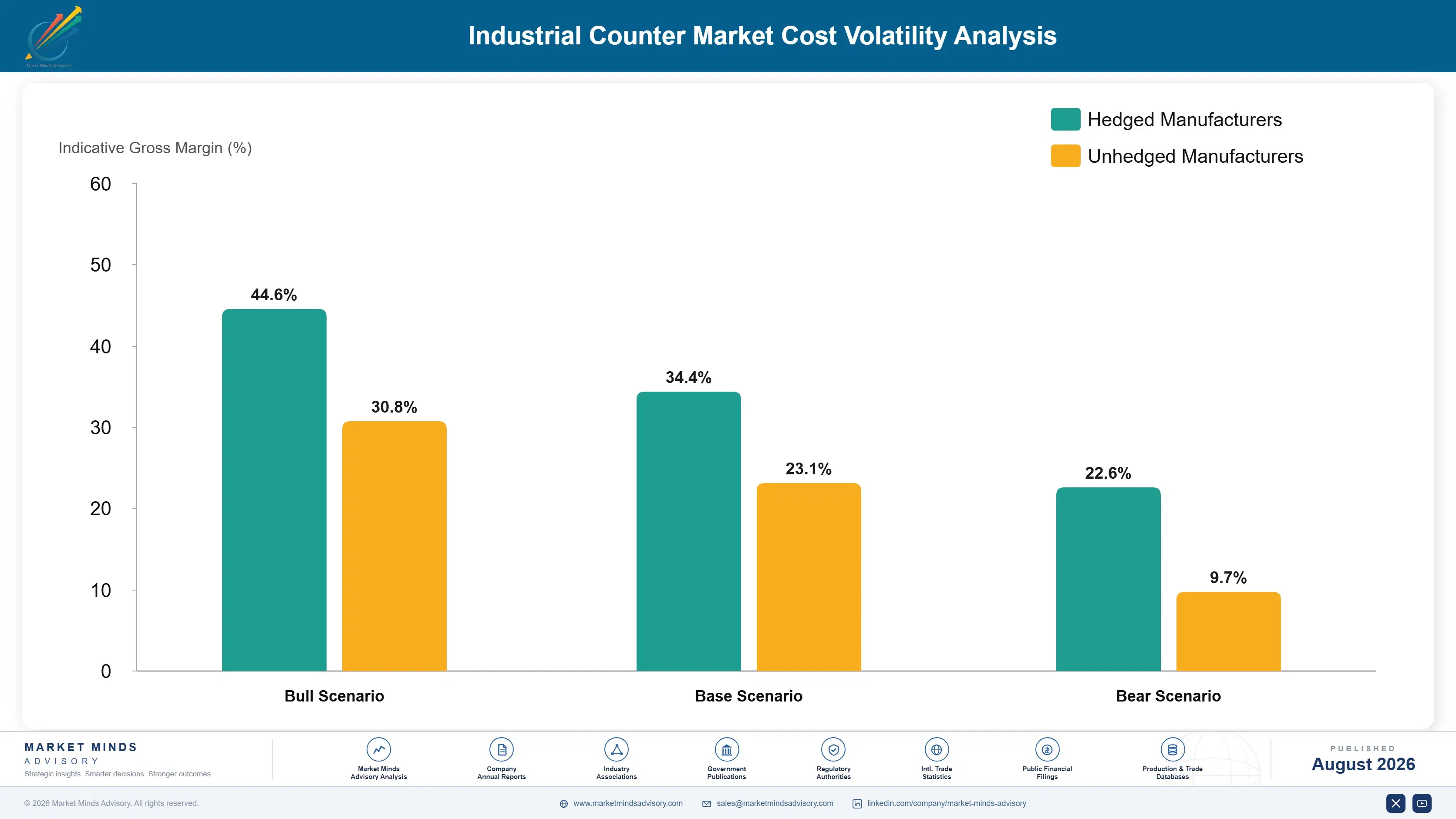
Electronic components account for around 36% of device cost of goods, with enclosure moulding, display modules, assembly labour and testing making up the balance. Microcontrollers and display drivers come from Asian and American semiconductor producers through distribution. Certification and compliance testing sits as a fixed cost spread across volume that keeps falling on conventional devices.
The semiconductor shortage through 2021 and 2022 hit this product harder than its price suggests, because a device selling at USD 84 cannot absorb a microcontroller bought on the broker market at ten times list. Omron reported component supply and cost pressure across its industrial automation business in its Annual Report 2022. Manufacturers on distributor price lists could not reprice, since catalogue pricing is published.

Published catalogue pricing is what makes this exposure unusual. A manufacturer cannot quietly absorb a cost increase or pass it on, because every competitor price sits on the same distributor page. Certification costs fall hardest on manufacturers with narrow ranges, since the same testing spreads across fewer units. Manufacturers with automation portfolios absorb component cost movement across many products; specialists carry it alone on a product priced at USD 84.
industrial-counter-market-cost-volatility-analysis-1787553376396

Buy semiconductor components on multi-year agreements

A device priced at USD 84 cannot absorb a microcontroller bought at broker market prices, and the 2021 shortage demonstrated what that does to a product with published catalogue pricing. Multi-year agreements with committed volume secure both allocation and a price that survives the next disruption. Manufacturers who kept buying on the spot market are still explaining that decision internally.

Design one platform across the whole product range

Certification and compliance testing costs fall on every product variant separately unless the electronics platform is shared, which punishes manufacturers carrying many similar devices on different designs. Consolidating onto one hardware platform with software differentiation spreads that fixed cost across the whole range. It also simplifies component purchasing at exactly the point where allocation matters most.

Keep legacy part numbers available rather than rationalising them

Discontinuing an old part number to simplify a catalogue looks like discipline and hands replacement revenue to whoever stocks a compatible device. The installed base has a median age of fourteen years, which means today's obsolete product is tomorrow's order. Carrying cost on slow-moving stock is small against the annuity that walks away when a technician cannot find the part.

Portfolio Architecture for Margin Defence

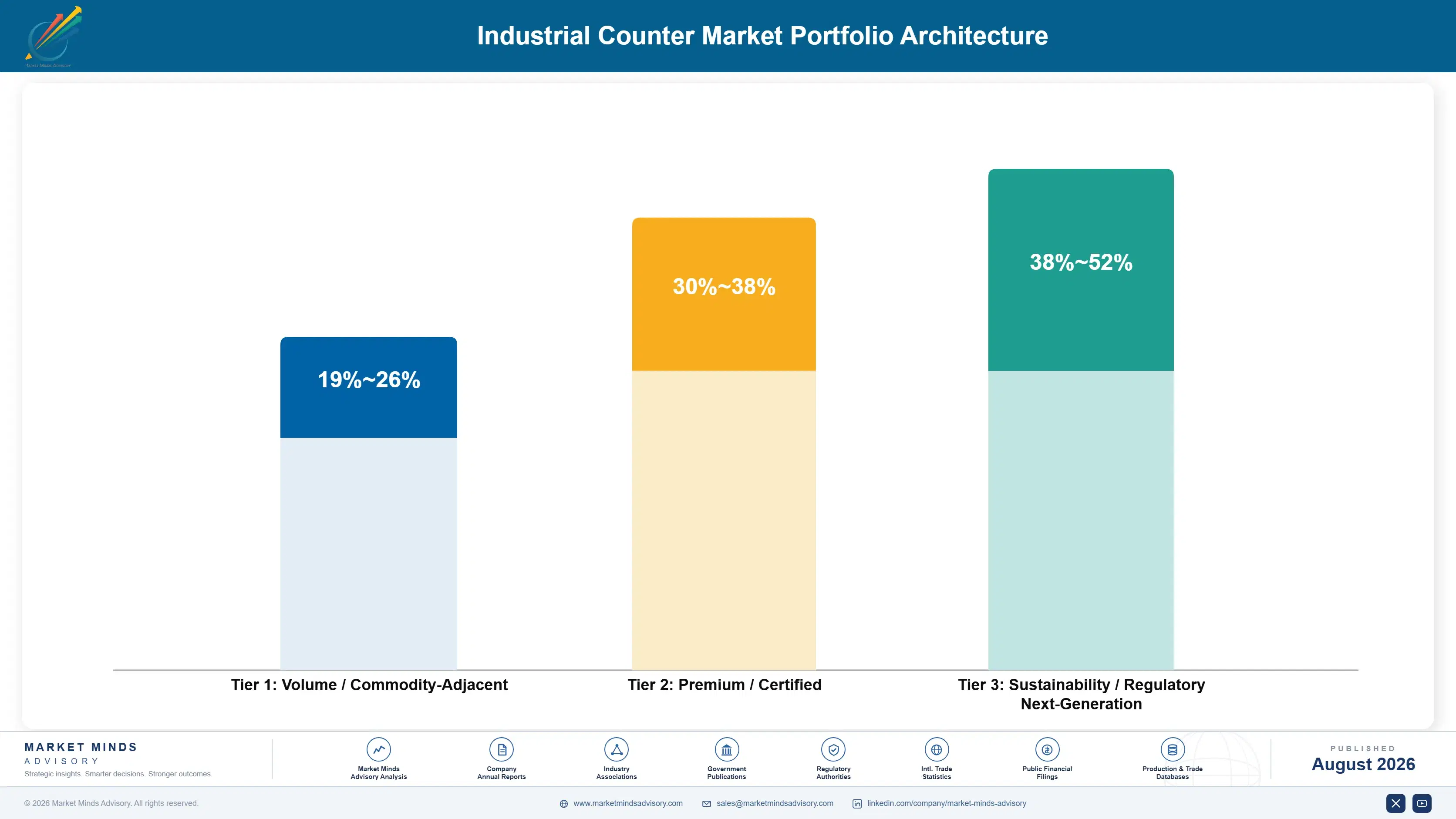
Margin in counting devices tracks what software cannot do rather than what the hardware costs to make, since assembly is straightforward and many companies manage it. Conventional panel-mount and electromechanical devices run at gross margins in the low twenties, competing on catalogue price against equivalent products from several manufacturers. Safety-rated modules run considerably higher, because certification excludes competitors and software cannot substitute. Vision systems run higher again on a completely different value proposition and a completely different buyer.
The tension is that conventional volume funds the distribution relationships and the defensible products earn the returns, and both depend on the same distributor listing. A manufacturer rationalising its conventional range to improve margin loses catalogue position that the safety and vision products also rely on. Several have discovered that the hard way. The conventional business is worth running for channel presence long after it stops being worth running for profit, which is a difficult argument to make to a board.

High-value pools sit in safety-rated modules, vision counting systems and the replacement annuity that part number continuity protects. None of the three is where most of the unit volume is. Manufacturing capacity by itself defends nothing whatsoever in this market.

Volume / Commodity-Adjacent

Electromechanical and panel-mount electronic counters sold through distributor catalogues against several equivalent products where price and stock availability decide every order. The seven-point range separates manufacturers with shared electronics platforms from those carrying separate designs across similar devices.
Gross Margin: 19%-26%

Premium / Certified

Preset and batch control counters and elapsed time indicators supplied into applications where accuracy or traceability requirements exclude the cheapest alternatives. The eight-point spread reflects whether the manufacturer holds distributor listing breadth or competes for shelf space each year.
Gross Margin: 30%-38%

Sustainability / Regulatory / Next-Generation

Safety-rated counting modules certified against functional safety standards and vision-based counting systems sold into quality budgets. The fourteen-point range is wide because pricing reflects certification scarcity and application value rather than any component cost a buyer can compare.
Gross Margin: 38%-52%
industrial-counter-market-portfolio-architecture-1787553376890

High-value Sub-segments and Strategic Watch-out

Safety-Rated Counting Modules

Compounding at 5.7% on machinery directive requirements and commanding roughly six times an unrated device, defended by certification that software genuinely cannot substitute. This is the only position in the market where a hardware manufacturer holds ground a controller function block cannot take. Very few hold certified product.
Gross Margin: 40%-52%

Vision Counting Systems

Growing at 6.3% and the only segment where the buyer has a real budget, because a camera counts and inspects together and answers to quality rather than maintenance. Traditional counter manufacturers are absent and vision companies ignore counting. Nobody occupies that gap. That will not last long.
Gross Margin: 38%-50%

Conventional Panel-Mount Devices

The volume that funds distributor relationships, being absorbed into controllers at 46% of new designs and growing at barely 2%. Worth running for channel presence long after it stops being worth running for profit, which is a difficult argument internally. Most boards get it wrong.
Gross Margin: 19%-26%

Replacement Part Number Continuity

Around 57% of volume goes into an installed base with a median age of fourteen years, and the manufacturer specified fifteen years ago collects for as long as the machine runs. Discontinuing legacy parts hands that annuity straight to a competitor. Catalogue rationalisation is expensive.
Gross Margin: 30%-44%

How Counter Demand Renews

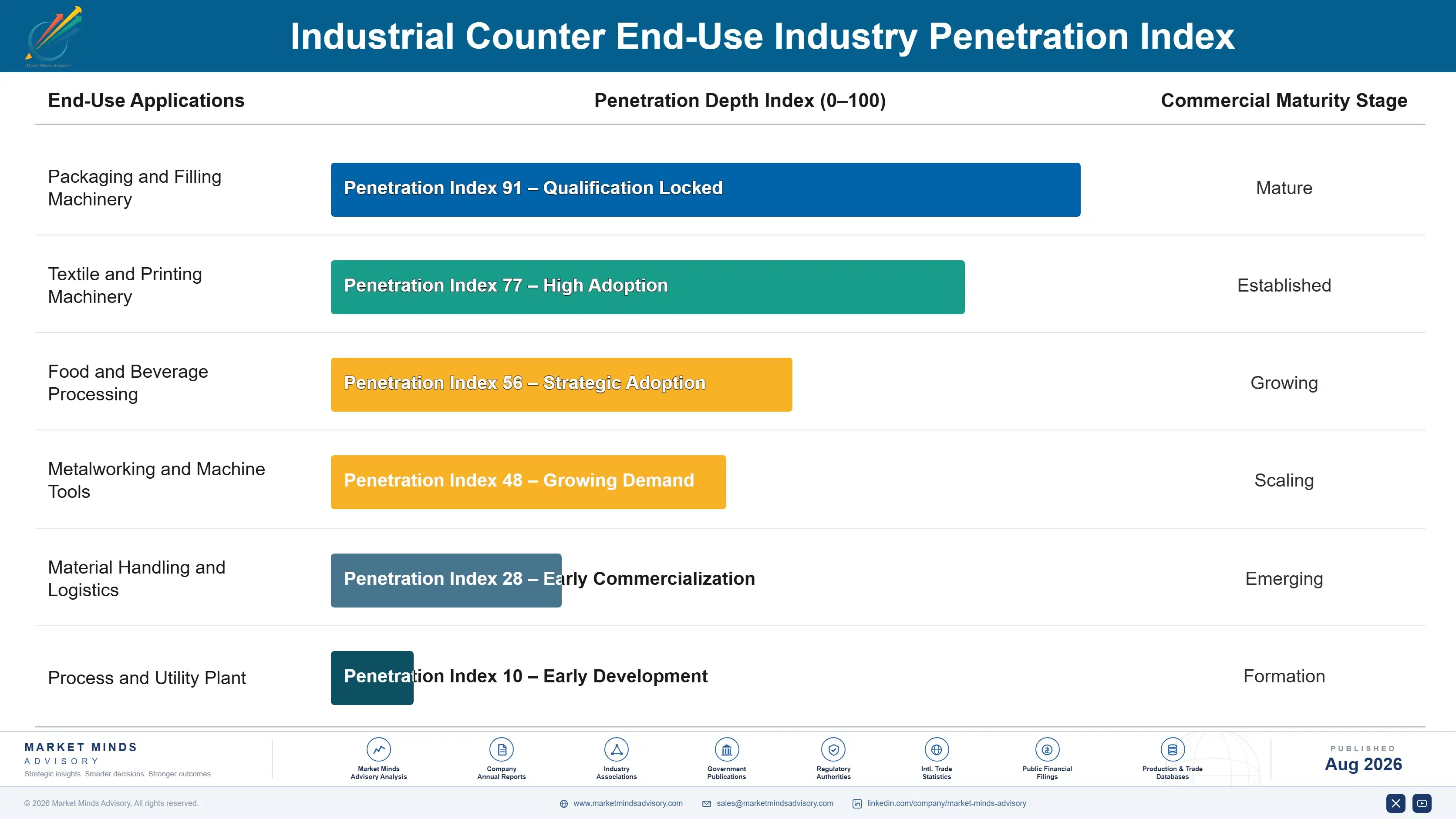
Counter demand renews on two clocks. New machinery demand follows the machine builder's design decision, made once per platform and increasingly made in favour of a controller function block instead. Replacement demand follows the installed base, which has a median age of fourteen years and turns over slowly, generating 57% of unit volume on decisions taken fifteen years ago. The second clock is the business.
Stickiness runs through inertia rather than through relationship. A maintenance technician orders the same part number because rewiring a panel is not worth an afternoon, which makes replacement almost automatic as long as the part is available. Safety-rated applications are stickier still, since substituting an uncertified device would invalidate the machine's safety assessment. Vision systems are the least sticky, because each one is a fresh engineering decision.

The buyer has split rather than moved. Conventional replacement still sits with a maintenance technician at a distributor counter. Safety modules sit with a machine safety engineer working to a directive. Vision systems sit with a quality engineer holding a budget nobody in this industry used to reach. Three different customers, one product category, and most manufacturers still selling to all of them the same way.
industrial-counter-market-end-use-penetration-index-1787553377378

Where To Place The Bet

These are among the four positions where our research anticipates prominent divergence between winners and laggards over the coming forecast period. Each is grounded in the demand model, the regulatory perimeter, and the announced capacity pipeline.
01 / SAFETY CERTIFICATION INVESTMENT

Certify the range or leave the market

A safety-rated counting module commands roughly six times an unrated device and faces no competition from a controller function block, because certifying that function inside a standard controller requires a safety-rated controller costing far more than the module it would replace. Machine safety requirements keep tightening across European and American directives on timetables nobody can defer or negotiate away at all. Manufacturers without certified product are competing entirely inside the half of this market that software is steadily removing from them.
02 / REPLACEMENT CHANNEL MANAGEMENT

Treat part number continuity as the asset

Around 57% of unit volume goes into an installed base with a median age of fourteen years, and a maintenance technician reorders the same part number rather than rewiring a panel to accommodate anything different at all. That makes the manufacturer specified fifteen years ago the automatic beneficiary for as long as the machine runs and the part remains available. Discontinuing legacy part numbers to tidy a catalogue looks like cost discipline and hands that annuity directly to a competitor instead.
03 / VISION SEGMENT ENTRY

Follow the quality budget into vision counting

Vision counting compounds at 6.3% and the reason is commercial rather than technical, since a camera counts and inspects in one operation and therefore answers to a quality engineer with a real budget instead of a technician replacing an eighty-four dollar part. That single change makes a sales conversation possible where the conventional counter business never could support one at all. Traditional counter manufacturers are largely absent and vision companies ignore counting entirely, which leaves the gap completely unoccupied today.
04 / DISTRIBUTION ECONOMICS FOCUS

Spend on shelf position, not sales coverage

An average selling price near eighty-four dollars will not fund a field sales visit and never has, which makes the distributor catalogue the entire route to market and the only place worth spending any commercial money on. Stock depth, configurator tooling, cross-reference tables against competitor part numbers and next-day delivery decide who gets ordered when a technician needs a device today rather than tomorrow. Manufacturers running field teams against this product are spending money the price simply cannot carry at all.

Engagement Snapshot From the Field

A live engagement with an industry participant carrying material or product regulatory and market exposure ahead of a defining policy shift, showing how our research translates into a defensible multi-year portfolio strategy.
MARKET MINDS ADVISORY · CLIENT ENGAGEMENT SUMMARY
Industrial Counter Producer Strategic Portfolio Review and Transition Roadmap 2026·Investment Scenario on Industrial Counter Exposure Evaluation 2025-26
CLIENT PROFILE
A European industrial component manufacturer with annual revenue around EUR 210 million (client-reported, unverified by MMA), of which counting and timing devices accounted for roughly 45%. The business sold entirely through industrial distributors across fourteen countries and held no functional safety certifications on any counting product. A catalogue rationalisation programme had been approved but not yet executed.
STRATEGIC CHALLENGE
Counter volume had fallen 19% across four years (client-reported, unverified by MMA) while the machinery markets it served had grown, and the board had attributed the gap to competitive loss. Margin pressure had driven the catalogue rationalisation decision, which would discontinue roughly a third of legacy part numbers. Nobody had modelled what that would do to replacement revenue.
MMA APPROACH
MMA separated the client's volume decline into controller absorption and competitive loss using machine builder interviews across the expert programme rather than accepting the internal assumption. Replacement revenue attached to the part numbers marked for discontinuation was modelled against installed base age. Functional safety certification cost and timeline were established with notified bodies, and distributor listing positions were reviewed across all fourteen markets.
KEY FINDINGS
  1. Roughly four-fifths of the volume decline came from controller absorption rather than competitive loss, which meant the business was losing to software rather than to rivals.
  2. The part numbers marked for discontinuation carried replacement revenue worth considerably more over ten years than the catalogue simplification would save in the same period.
  3. Functional safety certification on three product families would cost less than the client assumed and open a category growing while everything else in the range declined.
  4. Distributor listing had quietly narrowed in five markets where the client no longer met stock turn thresholds, which explained more of the volume gap than anybody internally had realised.
CLIENT PROFILE
A European industrial component manufacturer with annual revenue around EUR 210 million (client-reported, unverified by MMA), of which counting and timing devices accounted for roughly 45%. The business sold entirely through industrial distributors across fourteen countries and held no functional safety certifications on any counting product. A catalogue rationalisation programme had been approved but not yet executed.
STRATEGIC CHALLENGE
Counter volume had fallen 19% across four years (client-reported, unverified by MMA) while the machinery markets it served had grown, and the board had attributed the gap to competitive loss. Margin pressure had driven the catalogue rationalisation decision, which would discontinue roughly a third of legacy part numbers. Nobody had modelled what that would do to replacement revenue.
MMA APPROACH
MMA separated the client's volume decline into controller absorption and competitive loss using machine builder interviews across the expert programme rather than accepting the internal assumption. Replacement revenue attached to the part numbers marked for discontinuation was modelled against installed base age. Functional safety certification cost and timeline were established with notified bodies, and distributor listing positions were reviewed across all fourteen markets.
KEY FINDINGS
  1. Roughly four-fifths of the volume decline came from controller absorption rather than competitive loss, which meant the business was losing to software rather than to rivals.
  2. The part numbers marked for discontinuation carried replacement revenue worth considerably more over ten years than the catalogue simplification would save in the same period.
  3. Functional safety certification on three product families would cost less than the client assumed and open a category growing while everything else in the range declined.
  4. Distributor listing had quietly narrowed in five markets where the client no longer met stock turn thresholds, which explained more of the volume gap than anybody internally had realised.
RECOMMENDED STRATEGY
Phase 1: Phase one: cancel the catalogue rationalisation entirely and publish extended availability commitments on legacy part numbers instead, which protects replacement revenue. Phase 2: Phase two: fund functional safety certification on the three identified product families, accepting eighteen months before any certified product reaches the catalogue. Phase 3: Phase three: rebuild distributor listing in the five affected markets through stock consignment rather than through price concession, which addresses the actual threshold problem.
OUTCOME
The rationalisation was cancelled and extended availability commitments were published. Certification is running on all three product families with first certified product expected in 2027. Distributor listing recovered in four of the five markets, and the client reports counter volume stabilising for the first time in five years (client-reported, unverified by MMA).

Frequently Asked Questions

Foundational context covering the market sizes, CAGR, scope, country, region and competition that inform every finding below. This section is provided to cover basics and most often pre-purchase conversations, answered from the MMA Primary Research Dataset.

What is the current size of the Industrial Counter Market?

The market was valued at USD 1.9 billion in 2025, rising to an estimated USD 1.98 billion in 2026. East Asia holds the largest regional share at 30% of value.

How large will the Industrial Counter Market be by 2036?

MMA forecasts USD 2.99 billion by 2036 under the base case, an expansion multiple of 1.51 times the 2026 value. That represents USD 1.01 billion of incremental value.

What is the CAGR for the Industrial Counter Market 2026 to 2036?

The base case runs at 4.2% compound annual growth between 2026 and 2036, with a bull case at 5.4% and a bear case at 3.0%. Historical growth from 2020 to 2025 was 3.2%.

Which segment is growing fastest?

Vision-based counting systems lead at 6.3%, half again the market rate, because a camera counts and inspects in one operation. Safety-rated counting modules follow at 5.7%.

Who are the major companies in the Industrial Counter Market?

Omron, Panasonic, Schneider Electric, Kübler and Red Lion Controls hold 29% between them. Distributor listing breadth and safety certification sustain those positions rather than product capability.

Which country is growing fastest?

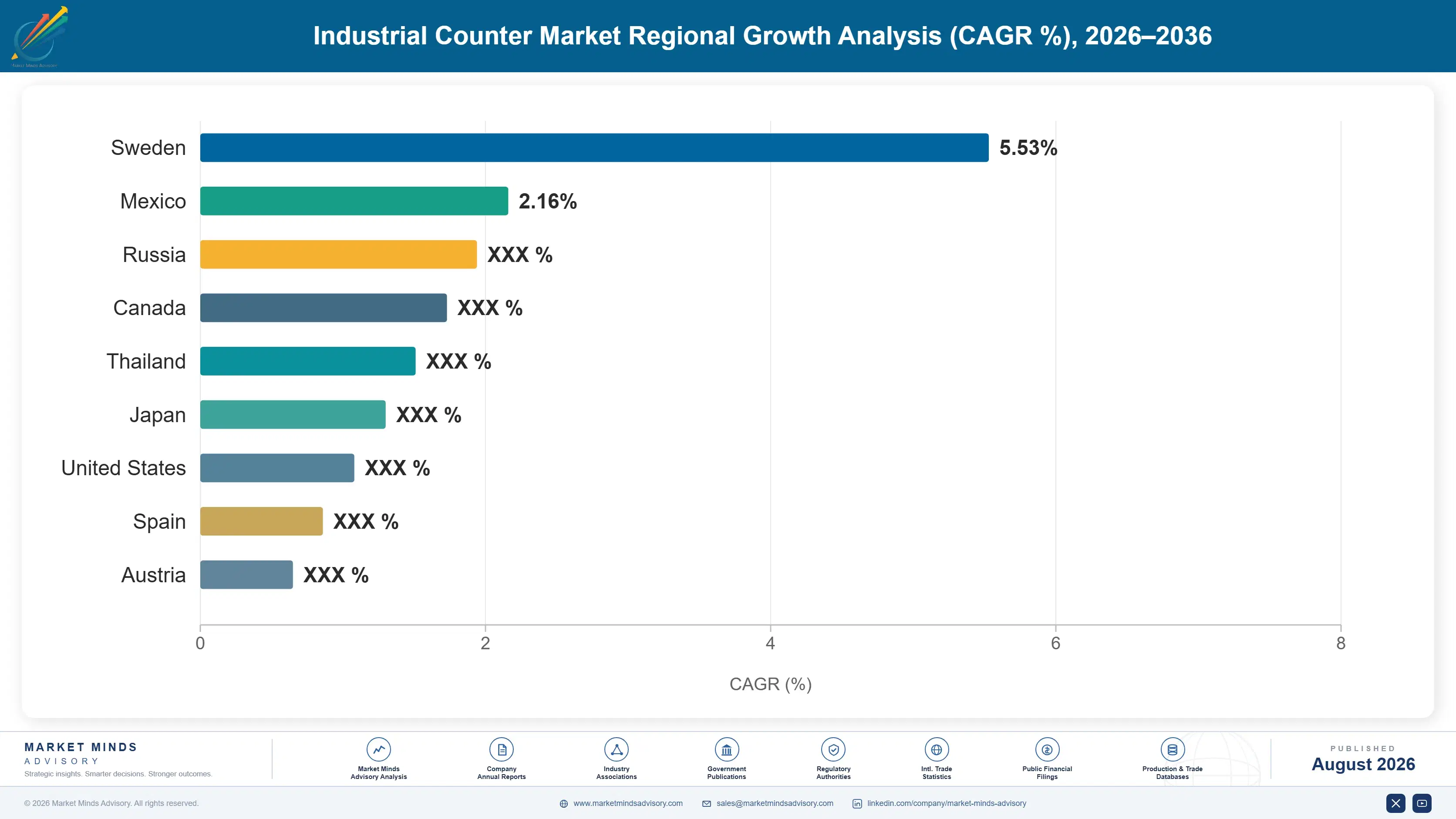
India leads at 6.8%, driven by machine building expansion where builders specify discrete counting hardware more readily than European ones do. New machinery drives it entirely.

Report Segmentation Architecture

The full report scope spans multiple orthogonal segmentation dimensions, with cross-tabulated demand data provided for each dimension pair. Coverage extends further to regional breakdowns, trend trajectories, and the competitive detail needed to support segment-level decision-making.

By Counting Technology

  • Electromechanical Counters
  • Panel-Mount Electronic Counters
  • Preset and Batch Control Counters
  • Vision-Based Counting Systems
  • Elapsed Time and Hour Meters
  • Safety-Rated Counting Modules

By End-Use Industry

  • Packaging and Filling Machinery
  • Textile and Printing Machinery
  • Food and Beverage Processing
  • Metalworking and Machine Tools
  • Material Handling and Logistics
  • Process and Utility Plant

By Sales Channel

  • Industrial Distributor Catalogue
  • Electrical Wholesaler Distribution
  • Machine Builder Direct Supply
  • Online and Configurator Channel
  • Maintenance Contract Supply

By Region

  • North America
  • Western Europe
  • East Asia
  • South Asia and Pacific
  • Latin America
  • Middle East and Africa
  • Eastern Europe

Scope, Methodology, and Coverage

Every figure in this report is reproducible from documented input assumptions. The scope below maps the historical period, the forecast horizon, the segmentation dimensions, and the countries covered, alongside the underlying primary and qualitative methodology.
Historical Period
2020 to 2025
Forecast Period
2026 to 2036
Base Year
2025 (USD billions; MMA Primary Research Dataset, August 2026)
Market Definition
The market comprises dedicated industrial counting devices supplied for event, unit and time counting in machinery and process applications, covering electromechanical counters, panel-mount electronic counters, preset and batch control counters, vision-based counting systems, elapsed time indicators and safety-rated counting modules. Value is measured at manufacturer level across original equipment and replacement channels. Programmable logic controllers and their internal counting functions, encoders sold as position feedback, flow and energy meters, laboratory particle counters, weighing equipment and manufacturing execution software fall outside scope.
Quantitative Units
USD billions (current prices); million counting devices shipped annually; USD per device by counting technology
Segmentation Dimensions
By Counting Technology; By End-Use Industry; By Sales Channel; By Region
Regions Covered
North America, Western Europe, East Asia, South Asia and Pacific, Latin America, Middle East and Africa, Eastern Europe
Countries Covered
China, Japan, South Korea, Taiwan, India, Thailand, Vietnam, Indonesia, Australia, United States, Canada, Mexico, Germany, Switzerland, Italy, France, United Kingdom, Spain, Netherlands, Sweden, Poland, Czechia, Romania, Hungary, Brazil, Argentina, Chile, Turkey, Saudi Arabia, South Africa
Key Companies Profiled
Omron, Panasonic, Schneider Electric, Kübler, Red Lion Controls, Autonics, Hengstler, Baumer, ifm electronic, Trumeter, Danaher, ENM Company, Koyo Electronics, Fuji Electric, Siemens, Eaton, Curtis Instruments, Delta Electronics, Lika Electronic, Simex
Quantitative Methodology
Primary survey, n=3,800 respondents, Q4 2025, six countries; demand-side model with trade association cross-validation
Qualitative Methodology
47 expert interviews, Q4 2025; applied to validate demand model assumptions, identify emerging dynamics, and assess competitive positioning
Report Format
PDF and XLSX data workbook (Word format preview document)
Publisher
Market Minds Advisory
Report Code
MMA-2026-TEC-089
Published
August 2026
Contact
sales@marketmindsadvisory.com | www.marketmindsadvisory.com

Purchase the full Industrial Counter Market Report (2026 to 2036).

The full report sizes the global industrial counter market to 2036 across six counting technologies and seven regions, measured at manufacturer level across original equipment and replacement channels. It separates controller absorption from competitive loss throughout, and models the replacement annuity attached to an installed base with a median age of fourteen years. Competitive analysis covers 20 participants evaluated on device revenue at manufacturer level, with moat and risk assessment for the two leaders. Distribution economics are traced from catalogue listing through to stock turn thresholds, and input cost exposure runs from semiconductor supply to published pricing. Four quantified revenue levers close the analysis.
Six-technology segment sizing with segment-level growth rates
Seven-region share and growth breakdown to 2036
Twenty-participant competitive map on one revenue basis
Controller absorption separated from competitive share loss
Input cost exposure traced to semiconductor and display supply
Four quantified revenue levers with commercial impact ranges

Built For The People Who Decide

From boardroom strategy to bench-side execution, this report is read cover-to-cover by leaders shaping the next decade of their industry, turning demand scenarios, market dynamics and valuation benchmarks into decisions.
CXOs/ Presidents/ VPs/ Managers
M&A and Corporate Development
Strategy Teams and R&D Heads
Procurement and Product Directors
Regulatory and Compliance Leaders
Investor Relations and Equity Analysts