Market Minds Advisory
Industrial Condensing Units Market

Industrial Condensing Units Market: Refrigerant transition, pressure capability and installer channel economics to 2036

Electricity is 71% of what a condensing unit costs its owner over twelve years, and almost every purchasing conversation in this industry is still about the price on the quotation instead.

Lead Analyst

David Horsley

Published

September 2026

Make Smarter Decisions with Customized Research Insights

Request a free sample report and evaluate market opportunities, growth trends, and competitive dynamics relevant to your business needs.

2025 MARKET VALUE$6.2BMarket Size 2025
2036 FORECAST VALUE$12.5BBase Case , 2026 to 2036
CAGR 2026 TO 20366.6 %Bull 7.9% / Bear 5.4%
INCREMENTAL OPPORTUNITY$5.9BNet 10- year value creation
EXPANSION MULTIPLE1.89x2036 value over 2026 base
Strategic Levers
M&A Pipeline
Regional Outlook
Country Rankings
Competitive Intelligence
Segmental Deep-dive
Call-Us : 91 93563 13602

Executive Snapshot and Market Trajectory

The refrigerant a condensing unit uses is now decided by regulation rather than by engineering. The revised European F-Gas Regulation and the American technology transitions rule remove most high global warming potential fluids from new equipment, and the replacement chemistries need components that operate at 120 bar rather than 30.
Transcritical carbon dioxide units grow at 9.9%, half again the market rate of 6.6%, and hydrocarbon units follow at 9.2% now that the international charge limit has risen to 500 grams. East Asia holds 27% of value on cold chain construction and manufacturing volume together. Conventional fluorinated units, still the largest installed category by a wide margin, grow at under 2%. Two very different trajectories.
Five manufacturers hold 44% of supply and the concentration understates how the market actually works, because a twelve year replacement cycle means the installing contractor chooses the brand far more often than the food processor paying for it does. Manufacturers who built contractor relationships and training programmes hold positions that no product advantage displaces, and the transition to unfamiliar refrigerants has made that channel more valuable rather than less. That channel is the whole game.
Market Definition
This report covers packaged refrigeration condensing units combining compressor, condenser and receiver for commercial and industrial refrigeration duty, spanning fluorinated, hydrocarbon, carbon dioxide and ammonia working fluids across air-cooled, water-cooled and evaporative heat rejection. Value is measured at manufacturer level across new installation and replacement supply. Excluded are comfort air conditioning equipment, process chillers, standalone compressors and heat exchangers, refrigerant fluids themselves, and installation labour.
Base Year Value
$6.2B in 2025 (MMA Primary Research Dataset, August 2026)
Forecast Period
2026 to 2036, eleven discrete annual values
CAGR
6.6% base case. Bull 7.9%. Bear 5.4%.
Fastest Growth Segment
Transcritical Carbon Dioxide Units: 9.9% CAGR
Fastest Growth Country
India: 9.8% CAGR
Fastest Growth Region
South Asia and Pacific: 9.0% CAGR
Largest Region
East Asia: 27% of 2025 global value
Market Leaders
Emerson Electric, Danfoss, Carrier, Bitzer and GEA Group lead the market. Source: MMA Primary Research Dataset, July 2026.
Primary Survey
n=3,800 procurement and R&D decision-makers, Q4 2025, six countries
Methodology
Demand-side build-up, cross-validated against public data, 47 expert interviews

Industrial Condensing Units Market Forecast Scenarios

industrial-condensing-units-market-size-forecast-scenario-1787553355841
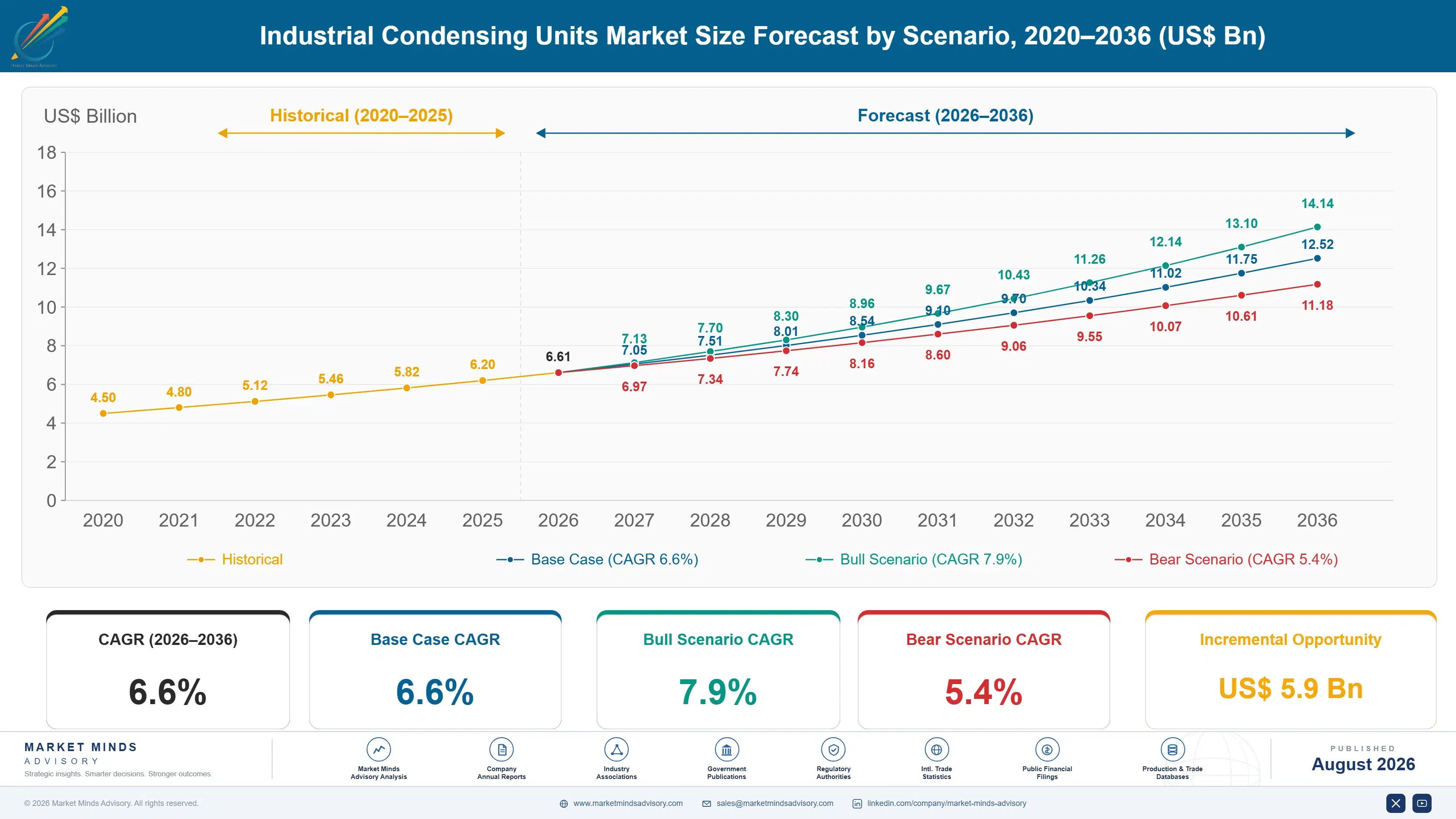
Growth ran at 5.3% between 2020 and 2025 and the composition changed considerably underneath it. Food retail refrigeration investment paused through 2020 and returned strongly, cold storage construction accelerated on grocery delivery volumes that never fully receded, and natural refrigerant conversion began moving from European early adopters into mainstream specification. The average conceals three quite separate movements.
The 6.6% base case rests on three mechanisms. The revised European F-Gas Regulation and the American technology transitions rule keep converting installed base to natural refrigerants on published timetables that nobody can defer. Cold chain construction across India and Southeast Asia keeps expanding on food loss reduction programmes with real government funding behind them. And energy efficiency requirements keep pulling replacement forward, since electricity is 71% of lifetime ownership cost and older equipment is expensive to keep running.
The 7.9% bull case is electricity prices staying high enough that efficiency-driven early replacement becomes routine rather than exceptional. The 5.4% bear case is installation capacity: transcritical carbon dioxide requires contractor skills that take years to build, and a shortage of trained installers slows conversion regardless of what any regulation requires by when. Nobody has modelled that constraint properly.

What Actually Decides The Purchase

Two facts govern this market and neither appears on a specification sheet. The first is that electricity accounts for around 71% of what a unit costs to own across a twelve year life, so the purchase price is a small part of the decision and gets treated as the whole of it anyway. The second is that the person choosing the equipment is usually the installing contractor rather than the business paying for it, which means the manufacturer's real customer is a refrigeration engineer with a van.
TOP-FIVE CONCENTRATION44%Combined position across condensing unit supply held by leaders
NATURAL REFRIGERANT SHARE38%Portion of new European installations using non-fluorinated working fluids
TRANSCRITICAL OPERATING PRESSURE120 barPeak pressure a carbon dioxide system must contain safely
REPLACEMENT CYCLE LENGTH12 yearsTypical service life before a condensing unit is replaced
ENERGY COST SHARE71%Portion of lifetime ownership cost attributable to electricity consumption
PROPANE CHARGE LIMIT500 gramsMaximum permitted charge under revised international safety standards
The refrigerant transition sits on top of both. Natural refrigerants already take 38% of new European installations and the share keeps climbing on a published regulatory timetable. Carbon dioxide is the technically demanding answer: a transcritical system holds 120 bar where a fluorinated one holds around 30, and that changes compressors, valves, brazing practice and every safety consideration around the plant room.
Propane solves the same regulatory problem differently and the charge limit rising to 500 grams under revised international standards opened a whole class of smaller units to it. Charge limits still bind above that, which keeps the two technologies serving different sizes rather than competing directly.
"Manufacturers keep launching products for the end user and the end user has almost never chosen a condensing unit. Whoever trains the contractors on carbon dioxide gets specified for the next fifteen years, and most of this industry is still thinking about it as a product problem."
Director, Refrigeration and Cold Chain Systems Practice · MMA Industrial Equipment Practice · August 2026

Market Trends

Regulation removes fluorinated refrigerants on a published timetable

The revised European F-Gas Regulation sets quota reductions and equipment bans running through the next decade, and the American technology transitions rule under the AIM Act sets global warming potential limits on new refrigeration equipment from the middle of this decade. Neither is a target anybody can negotiate. Natural refrigerants already take 38% of new European installations and the figure climbs every year. The commercially important detail is that this converts a discretionary equipment purchase into a compliance deadline, which removes the price argument and rewards whoever has product available and contractors trained to install it.
Market Impact: Sets 71% of ownership cost
Higher propane charge limits open smaller units to hydrocarbons

The revised international safety standard raised the permitted propane charge in commercial refrigeration equipment from 150 grams to 500 grams, which sounds technical and changed the addressable market completely. At 150 grams a hydrocarbon system could only serve very small display cases. At 500 grams it reaches a substantial range of commercial condensing units, and propane is efficient, cheap and entirely unregulated on global warming grounds. Growth at 9.2% follows that standard change rather than any customer demand. Installers remain the constraint, since flammable refrigerant work requires training and certification many do not yet hold.
Market Impact: Grows at 9.0% regionally

Market Opportunities and Growth Drivers

Electricity cost drives replacement ahead of failure

A condensing unit consumes electricity continuously for twelve years and that electricity accounts for around 71% of what the equipment costs its owner across that life. When power prices rise, the payback on replacing functional but inefficient equipment shortens sharply, and cold storage operators start replacing on economics rather than on breakdown. European energy costs since 2022 pulled a meaningful volume of replacement forward this way. The commercial lesson is that manufacturers selling on efficiency to the asset owner reach a different budget entirely from those quoting equipment price to a contractor.
Market Impact: Constrains 38% conversion rate

Cold chain construction expands across India and Southeast Asia

Post-harvest food loss across India runs at levels that make cold storage investment a national policy question rather than a commercial one, and government schemes have funded substantial capacity additions. Southeast Asian aquaculture and processed food export operations add further demand at higher specification. This is new installation rather than replacement, which means volume growth without any of the refrigerant transition complexity that dominates European and American markets. Growth here runs well ahead of the market average and the equipment specified is generally conventional, because natural refrigerant capability among local contractors barely exists yet.
Market Impact: Degrades above 31 degrees C

Market Restraints and Challenges

Contractor capability limits how fast conversion can happen

A transcritical carbon dioxide system holds 120 bar, uses components a refrigeration engineer has never handled, and fails in ways that fluorinated experience does not prepare anybody for. The root cause is that this trade learns on the job and the job has been fluorinated for forty years. Commercially this caps conversion regardless of what regulation requires, because an operator cannot install equipment nobody local can commission or service. Manufacturers have responded by running training academies and certification programmes at their own cost, and several now treat installer training as a commercial function rather than an aftersales one.
Market Impact: Covers 27 member state markets

Carbon dioxide efficiency falls away in hot climates

A transcritical carbon dioxide cycle loses efficiency as ambient temperature rises, and above roughly thirty degrees the penalty becomes commercially awkward against a fluorinated system. The root cause is thermodynamic rather than engineering: the critical point of carbon dioxide sits at thirty-one degrees and the cycle simply behaves differently above it. Commercially this makes the European answer a poor fit for Gulf, Indian and Southeast Asian installations facing the same regulatory direction. Parallel compression, ejectors and adiabatic gas coolers recover much of the loss and add cost and complexity that smaller installations cannot carry.
Market Impact: Raises charge limit to 500 grams
3 additional market trends, 4 additional growth drivers, and 2 additional restraints and challenges are covered in the full report. Contact sales@marketmindsadvisory.com to access the complete intelligence.

Segment CAGR and Growth Architecture

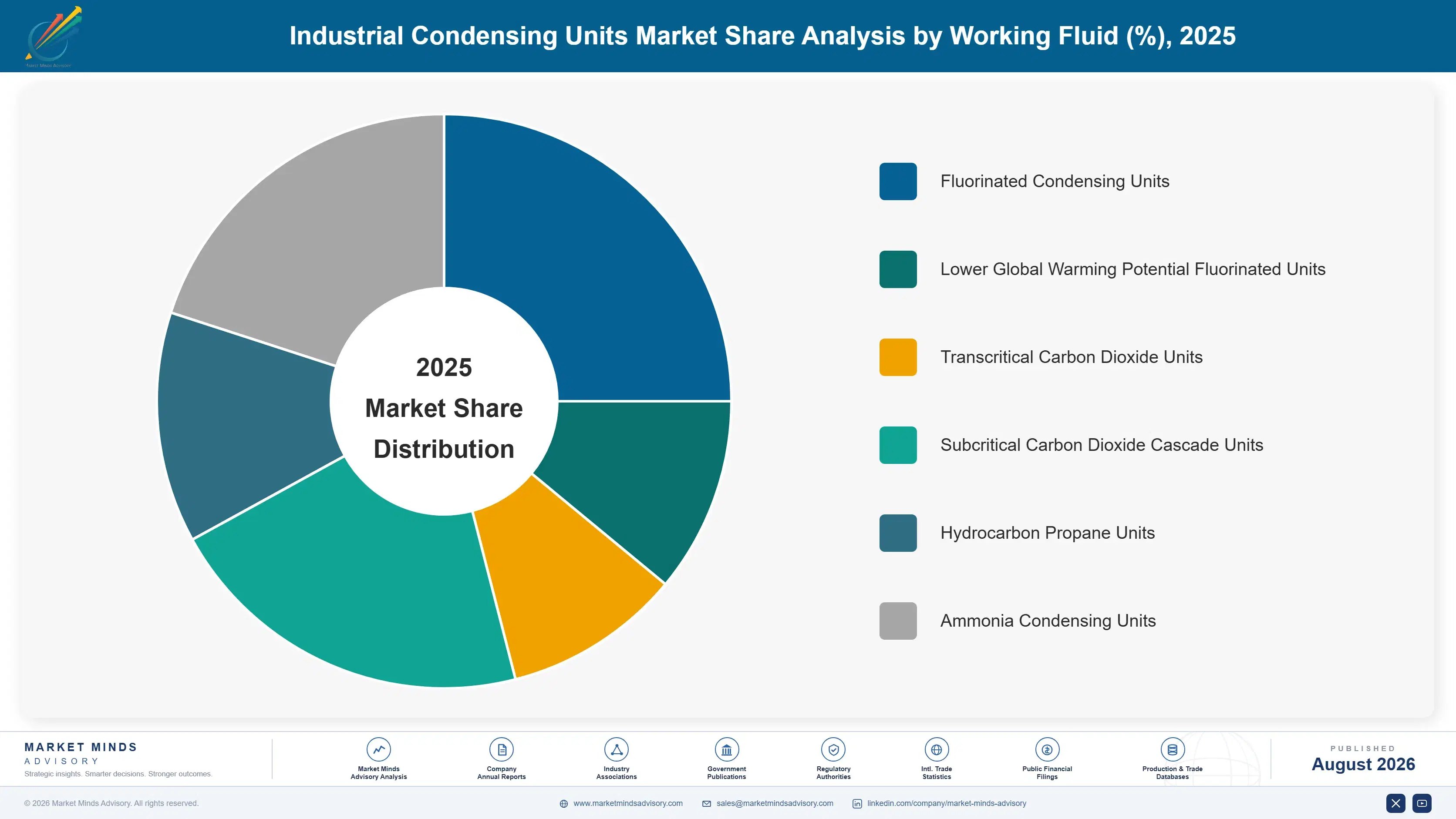
Units are classified here by working fluid, since the refrigerant determines operating pressure, component selection, safety requirements and regulatory exposure together. Heat rejection method, compressor type, capacity band and sales channel are handled separately in the framework, because a single refrigerant serves several configurations across quite different applications. Regulation lands on the fluid. Everything else follows from it.
industrial-condensing-units-market-market-share-analysis-1787553356379

Transcritical Carbon Dioxide Units

Growing at 9.9%, half again the market rate, this is where European regulation has pushed commercial refrigeration and where the engineering is hardest. A transcritical system holds 120 bar against roughly 30 for a fluorinated one, which changes compressors, valves, tubing, brazing practice and every pressure vessel consideration in the plant room. Manufacturers who invested in high pressure capability years ago are collecting on it now, and the ones who did not cannot enter quickly because the component supply chain is separate. Efficiency falls away above thirty-one degrees ambient, which limits the technology geographically in ways the European experience does not reveal. Contractor capability constrains adoption more than product availability does.
CAGR 9.9%

Hydrocarbon Propane Units

Propane is thermodynamically excellent, costs almost nothing, has no global warming exposure worth mentioning and burns, which is the entire commercial story compressed into one sentence. The revised international standard raising permitted charge from 150 grams to 500 grams opened a substantial range of commercial condensing units that were previously closed to hydrocarbons. Growth at 9.2% follows that standard change. The practical constraint is installer certification: flammable refrigerant work requires training many refrigeration engineers do not hold, and insurers ask questions that a fluorinated installation never triggered. Above the charge limit the technology simply stops, which keeps it and carbon dioxide serving different equipment sizes rather than competing. Insurers ask questions nobody expected.
CAGR 9.2%
Full segment breakdown across 6 segments available in the complete report.

Regional Architecture and Country Demand Map

East Asia holds 27% of value on cold chain construction and manufacturing volume arriving together. North America follows at 26% as the technology transitions rule pulls conversion forward. Regulation explains the developed markets and food logistics explains the rest of this map. Nothing about that map is stable.

North America

The technology transitions rule under the AIM Act put global warming potential limits onto new refrigeration equipment on a firm timetable, and American operators who had watched European conversion from a distance found themselves inside it. Supermarket chains moved first and food processing has followed. Cold storage construction on grocery delivery volumes added capacity that has not receded since. Contractor capability on carbon dioxide is thinner here than in Europe and improving quickly, largely because manufacturers are funding the training themselves. Growth at 6.4% mixes regulatory conversion with genuine capacity expansion, and separating the two is harder than most forecasts admit. Both mechanisms have several years left in them. Neither shows any sign of slowing.
Share: 26% | CAGR: 6.4% (2026 to 2036)

Western Europe

Natural refrigerants already take 38% of new installations here and the regulatory timetable makes the direction unambiguous, which is why this region led the transition and now leads on contractor capability rather than on volume. German, Italian and Danish manufacturers built transcritical carbon dioxide expertise years before the regulation forced it and export that capability globally. Nordic and German food retail converted first and the southern European markets are following more slowly, partly because ambient temperature makes the carbon dioxide argument weaker. Growth at 5.0% is the weakest of the seven regions and reflects a converted market rather than a stalled one. Capability is now the export product here. Volume moved elsewhere some time ago.
Share: 22% | CAGR: 5.0% (2026 to 2036)
Regional intelligence for 5 additional markets available in the complete report: East Asia, South Asia and Pacific, Latin America, Middle East and Africa, Eastern Europe. Contact sales@marketmindsadvisory.com.
industrial-condensing-units-market-country-cagr-analysis-1787553356894

Where Unit Margin Actually Sits

Four moves matter in a market where regulation decides the product, the contractor decides the brand, and electricity decides whether the customer was right. None of them involves competing on the quotation price, which is where almost every manufacturer in this industry still spends its commercial energy. That habit is expensive. Price is the least defensible ground available.

Train the contractors before the regulation arrives

A refrigeration engineer who has commissioned carbon dioxide systems specifies carbon dioxide, and one who has not specifies whatever is familiar regardless of what the regulation says. Contractor capability constrains conversion more than product availability does, and natural refrigerants already take 38% of new European installations largely because manufacturers there funded training for a decade. Running certification academies costs money years ahead of revenue and buys specification position that no product feature reaches. Manufacturers treating training as an aftersales cost rather than a commercial investment are conceding the channel to whoever thought about it differently.
Market Impact: Supports the full 38% natural refrigerant conversion share

Sell lifetime electricity, not equipment price

Electricity is around 71% of what a condensing unit costs its owner across twelve years, which makes the quotation price a rounding error the industry treats as the whole decision. Presenting modelled energy consumption to the asset owner rather than a price to the contractor reaches a completely different budget and a completely different argument. Cold storage operators running thin margins understand power cost better than anybody. Very few manufacturers prepare that analysis, mostly because the sales organisation calls on contractors and contractors do not pay the electricity bill. The analysis takes an afternoon.
Market Impact: Attacks the full 71% of lifetime ownership cost

Build high pressure component capability rather than buying it

Transcritical carbon dioxide compounds at 9.9% and holding 120 bar reliably requires compressors, valves and heat exchangers from a supply chain separate from conventional refrigeration. Manufacturers who invested early hold positions competitors cannot enter quickly, because the components are not available to buy in the volumes needed. That barrier looks likely to hold for several years yet. Manufacturers assembling purchased components compete on price against everybody else doing the same, while those with captive capability compete on availability and lead time. Lead time is the competitive weapon here rather than price.
Market Impact: Enters a scarce segment compounding at 9.9% annually

Design for hot ambient rather than European conditions

Carbon dioxide efficiency falls away above thirty-one degrees and the Gulf, India, Southeast Asia and much of Latin America sit above that for months every year, which makes the European answer commercially poor across roughly a third of the world market. Hydrocarbon systems within the 500 gram charge limit, ammonia at larger capacity and low global warming potential blends all serve those conditions better. Manufacturers exporting European product specifications into hot climates are selling equipment that underperforms and blaming the installation. The opportunity belongs to whoever engineers for the climate rather than the regulation.
Market Impact: Addresses markets running above 31 degrees C annually

Who Controls the Margin Pool

Five manufacturers hold 44% of condensing unit supply, measured on unit revenue at manufacturer level across new installation and replacement, the basis used throughout this section. Concentration is moderate and it understates the practical position, because a twelve year replacement cycle and a contractor-led specification process mean incumbency compounds in ways market share does not capture. The gap between leaders and everybody else is high pressure component capability and installed contractor relationships.
Competition runs on three dimensions. Natural refrigerant product availability, which decides who can bid at all as regulatory dates arrive. Contractor training reach, which decides who gets specified once product exists. And component supply position on transcritical systems, where availability rather than price constrains who can deliver. Quotation price competes hardest in the conventional fluorinated equipment that is leaving the market anyway.

Rankings shift where Chinese manufacturers follow their domestic cold chain expertise into export markets, carrying cost positions Western builders cannot approach. That is already visible across Southeast Asia and Africa. European positions hold longest on transcritical carbon dioxide, where the component supply chain and the contractor capability both remain concentrated there.
industrial-condensing-units-market-company-positioning-matrix-1787553357414

Competitive Moat and Risk Dimensions

EMERSON ELECTRIC

Moat: Compressor technology depth

Emerson develops compressor technology across scroll, reciprocating and transcritical platforms inside the same business, which means the condensing unit is engineered around a compressor the company controls rather than assembled around one it buys. That vertical position decides availability and lead time on carbon dioxide platforms where components are genuinely scarce, and it took decades of investment to build.
EMERSON ELECTRIC

Risk: Broad portfolio dilutes attention

Refrigeration sits alongside automation, measurement and other industrial businesses inside a large group, which means condensing unit investment competes internally against opportunities in entirely unrelated markets. Specialist competitors focused solely on refrigeration can commit to a component programme without arguing it against a software acquisition first.
BITZER

Moat: Refrigeration specialisation only

Bitzer does refrigeration and nothing else, which concentrates engineering attention and contractor relationships where diversified competitors spread them thin. The company invested in transcritical carbon dioxide compressors well before regulation forced the market that way, and refrigeration contractors across Europe learned the technology on that equipment. Reputation of that kind compounds and cannot be purchased.
BITZER

Risk: No diversification cushion

Concentrating entirely in refrigeration means any slowdown in food retail or cold storage investment reaches the whole business at once, with nowhere else to put capital or capacity. Diversified competitors ride out equipment cycles that a specialist has to absorb, and refrigeration investment is genuinely cyclical with construction activity.

Players Tracked

Prominent Players

Emerson Electric
Danfoss
Carrier
Bitzer
GEA Group

Other Key Players

Johnson Controls
Daikin Industries
LU-VE Group
Güntner
Panasonic
Tecumseh Products
Frascold
Officine Mario Dorin
Rivacold
Mayekawa
Kirloskar Pneumatic
Snowman Holdings
Baltimore Aircoil
Alfa Laval
SCM Frigo

Recent Developments

MARCH 2025

Bitzer expanded transcritical carbon dioxide compressor production in Germany

Bitzer commissioned additional transcritical carbon dioxide compressor capacity at a German site, converting existing floor space rather than building new. The investment was organic and funded internally, with no partner involved, and it followed order intake the existing lines could not cover as European conversion accelerated.
Signal: High pressure component capacity is expanding ahead of demand, which suggests manufacturers expect conversion to accelerate rather than plateau
AUGUST 2025

Emerson Electric signed a multi-year supply and training agreement with a European retail chain

Emerson Electric entered a multi-year agreement covering transcritical carbon dioxide condensing units and contractor training across a European grocery chain's store conversion programme. The arrangement was a supply and service agreement rather than a joint venture, with no equity participation of any kind. Training was contracted alongside the equipment.
Signal: Training is being contracted alongside equipment, which confirms installer capability is the constraint manufacturers actually worry about
DECEMBER 2025

Danfoss expanded hydrocarbon component production for higher charge applications

Danfoss increased production capacity for components rated for hydrocarbon refrigerant service, responding to the revised international charge limit opening larger commercial equipment to propane. This was an organic capacity expansion funded internally rather than an acquisition or partnership. Standard change drove the demand entirely. Nobody had forecast that shift.
Signal: A safety standard revision moved more equipment volume than a decade of environmental argument managed to shift

What Moves Unit Cost

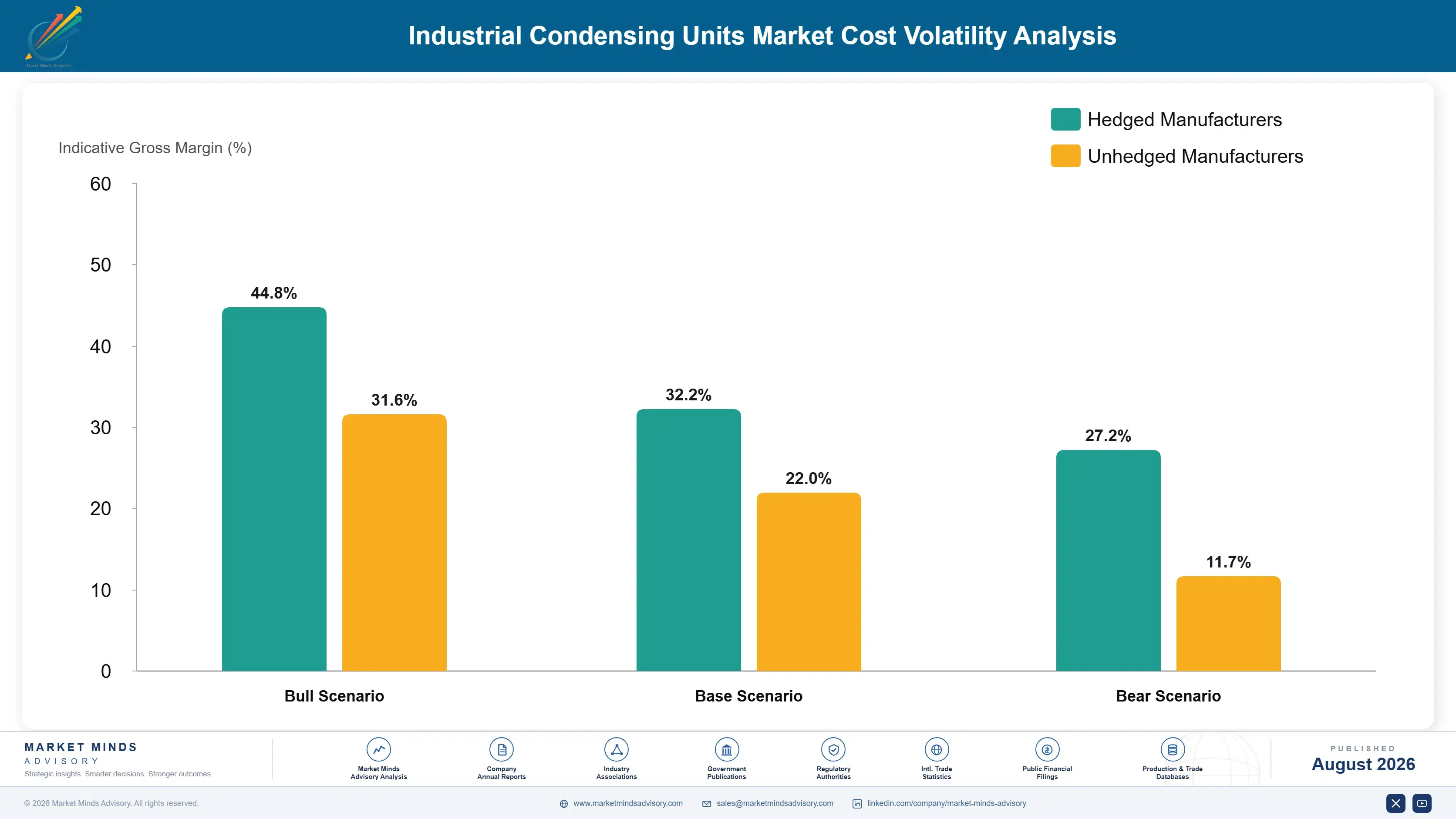
Copper, steel and aluminium together account for around 39% of condensing unit cost of goods, with the compressor, electronics, assembly labour and the pressure vessel work making up the balance. Copper tube comes from European and Asian mills on annual contracts. Compressors are bought in for many manufacturers and made captive by a few. High pressure components for transcritical systems come from a genuinely narrow supply base.
Copper prices rose sharply through 2021 and again during 2024, and European energy costs through 2022 raised fabrication expense alongside. IEA data show European industrial electricity well above American levels then. Carrier recorded input cost pressure across its refrigeration operations in its Annual Report 2022. Manufacturers on project pricing agreed months earlier absorbed most of the movement, since a quotation for a cold storage project cannot be reopened once construction starts.

The project quotation horizon makes this exposure awkward. A manufacturer pricing equipment nine months out carries metal risk it cannot hedge cheaply. Aftermarket and spare parts pricing moves freely, which is one reason that channel matters. Manufacturers with captive compressor production carry different exposure from those buying them. Asian producers gain further from metal proximity European operations cannot match.
industrial-condensing-units-market-cost-volatility-analysis-1787553357608

Index project quotations to published metal benchmarks

Quoting a cold storage project for delivery nine months out against fixed metal assumptions transfers volatility to the manufacturer across a period nobody can forecast. Indexing to published copper and steel benchmarks with reset at order confirmation removes the argument, and contractors accept it because they face the same exposure. Resistance comes from purchasing departments rather than from project engineering.

Secure high pressure component supply under long agreements

Transcritical components come from a supply base narrow enough that availability rather than price constrains who can deliver, and spot purchasing in that market is expensive and occasionally impossible. Multi-year agreements with committed volume give suppliers a reason to expand and buyers a position competitors cannot match on lead time. Very few manufacturers have contracted forward this way.

Design aluminium heat exchangers where copper prices justify it

Copper is the largest single metal input and aluminium performs adequately in many condenser applications at considerably lower cost, though it demands different joining practice and corrosion protection. Manufacturers who developed aluminium designs before the price signal arrived carry a genuine cost advantage now. Those who did not are redesigning under pressure, which produces worse products.

Portfolio Architecture for Margin Defence

Margin in condensing units tracks technical difficulty and component scarcity rather than manufacturing scale, since assembling a unit is not hard and many companies do it. Conventional fluorinated units run at gross margins in the mid to high teens, competing on quotation price against capable rivals in a category regulation is removing anyway. Transcritical carbon dioxide units run considerably higher, because the components are scarce and few competitors can deliver on lead time. Aftermarket parts and service run higher again across a twelve year installed life.
The tension is that conventional volume fills assembly capacity and natural refrigerant products earn the returns, and the two need different engineering organisations as well as different component supply. A business optimised for assembling bought-in compressors into standard units handles high pressure engineering badly. Manufacturers running both from one structure have generally found the volume side consuming the engineering resource that the transition work needed most.

High-value pools sit in transcritical carbon dioxide platforms, hot-climate natural refrigerant designs and the contractor training relationships that decide specification. None of the three is where the current volume is. Assembly capacity by itself defends nothing whatsoever now.

Volume / Commodity-Adjacent

Conventional fluorinated condensing units sold on quotation price into applications where regulation has not yet bitten and several manufacturers offer equivalent equipment. The seven-point range separates manufacturers with captive compressor production from those assembling bought-in components.
Gross Margin: 15%-22%

Premium / Certified

Hydrocarbon and lower global warming potential fluorinated units engineered for particular applications and certified against current safety standards. The eight-point spread reflects how much application engineering the manufacturer contributes against how much the contractor works out alone.
Gross Margin: 26%-34%

Sustainability / Regulatory / Next-Generation

Transcritical carbon dioxide platforms, hot-climate natural refrigerant designs and contracted training programmes sold alongside equipment. The thirteen-point range is wide because pricing reflects component scarcity and lead time rather than any settled cost basis a buyer can benchmark.
Gross Margin: 33%-46%
industrial-condensing-units-market-portfolio-architecture-1787553358106

High-value Sub-segments and Strategic Watch-out

Transcritical Carbon Dioxide Platforms

Compounding at 9.9% on European and American regulation, defended by a 120 bar component supply chain competitors cannot enter quickly. Availability rather than price constrains who delivers, which is an unusual and temporarily very profitable position to hold in this industry. Very few competitors can enter.
Gross Margin: 34%-46%

Contractor Training Programmes

The refrigeration engineer chooses the brand far more often than the food processor paying for it does, and a twelve year replacement cycle makes each of those decisions worth a great deal. Training builds specification position no product feature reaches. Most manufacturers still treat it as cost.
Gross Margin: 36%-50%

Conventional Fluorinated Units

The volume that fills assembly lines, growing at under 2% and being removed by regulation on a published timetable nobody can defer. Chinese manufacturers following their cold chain expertise into export markets are the immediate threat. Manage it for cash and utilisation. The decline is not reversible.
Gross Margin: 15%-22%

Hot Climate Natural Refrigerant Designs

Carbon dioxide efficiency collapses above thirty-one degrees and roughly a third of the world market sits above that for months annually, which leaves the European answer commercially poor there. Nobody has engineered properly for those conditions. That is a genuine opening. Somebody will engineer for it.
Gross Margin: 32%-44%

How Unit Demand Renews

Condensing unit demand renews on a twelve year replacement clock and a construction cycle running alongside it. Replacement is the larger and steadier half: equipment installed today comes back in a decade regardless of the economy. New installation follows cold storage and retail construction, which is cyclical and geographically uneven. Regulation now accelerates the replacement clock by making functional equipment non-compliant before it is worn out.
Stickiness runs through the contractor rather than through the end user, which is unusual. A refrigeration engineer who has been trained on one manufacturer's equipment specifies it repeatedly, and the food processor rarely questions the choice. Large retail chains with in-house engineering are the exception and they specify directly. Cold storage operators sit between the two. Depth follows the same line: trained contractors buy across the manufacturer's range while untrained ones buy whatever the wholesaler stocks.

The buyer has started moving and most manufacturers have not noticed. Equipment selection once sat entirely with contractors weighing familiarity and wholesaler availability. It increasingly sits with sustainability functions asking about refrigerant global warming potential, and with finance functions asking what the equipment costs to run. Neither has ever spoken to a refrigeration wholesaler.
industrial-condensing-units-market-end-use-penetration-index-1787553358593

Where To Place The Bet

These are among the four positions where our research anticipates prominent divergence between winners and laggards over the coming forecast period. Each is grounded in the demand model, the regulatory perimeter, and the announced capacity pipeline.
01 / CONTRACTOR TRAINING INVESTMENT

Fund training years before the regulation arrives

Contractor capability constrains natural refrigerant conversion more tightly than product availability does, because an operator cannot install equipment nobody local can commission or service properly at all. Natural refrigerants already take 38% of new European installations largely because manufacturers there funded certification academies for a decade before regulation forced the issue. A refrigeration engineer trained on one manufacturer's carbon dioxide equipment specifies it repeatedly across a twelve year replacement cycle, which is specification position no product feature has ever managed to reach.
02 / LIFETIME COST POSITIONING

Sell electricity consumption, not equipment price

Electricity accounts for around 71% of what a condensing unit costs its owner across twelve years, which makes the quotation price a small part of the decision that this industry treats as the entire decision anyway regardless. Presenting modelled consumption to the asset owner reaches a budget and an argument that a contractor quotation never touches, and cold storage operators running thin margins understand power cost better than anybody selling to them. Very few manufacturers prepare that analysis at all today.
03 / HIGH PRESSURE CAPABILITY

Own the 120 bar component supply chain

Transcritical carbon dioxide compounds at 9.9% and the constraint on delivery is component availability rather than price, because 120 bar compressors, valves and heat exchangers come from a supply base that did not exist twenty years ago at all. Manufacturers who invested early hold positions that competitors cannot enter quickly, since the components simply are not purchasable in the volumes anybody actually requires. That barrier looks likely to hold for several more years at least, which is unusual in industrial equipment.
04 / HOT CLIMATE ENGINEERING

Engineer for the ambient, not the regulation

Carbon dioxide efficiency falls away above thirty-one degrees and the Gulf, India, Southeast Asia and much of Latin America sit well above that for months of every year, which makes the European technology answer commercially poor across roughly a third of the world market. Hydrocarbons within the 500 gram charge limit, ammonia at larger capacity and low global warming potential blends all serve those conditions better. Manufacturers exporting European specifications into hot climates are blaming their installers for physics they cannot change.

Engagement Snapshot From the Field

A live engagement with an industry participant carrying material or product regulatory and market exposure ahead of a defining policy shift, showing how our research translates into a defensible multi-year portfolio strategy.
MARKET MINDS ADVISORY · CLIENT ENGAGEMENT SUMMARY
Industrial Condensing Units Producer Strategic Portfolio Review and Transition Roadmap 2026·Investment Scenario on Industrial Condensing Units Exposure Evaluation 2025-26
CLIENT PROFILE
A European cold storage operator with annual revenue around EUR 520 million (client-reported, unverified by MMA), running 34 temperature-controlled facilities across six countries. Most sites operated fluorinated refrigeration installed between 2010 and 2016. Energy costs had become the largest single operating line after labour. No refrigerant transition plan existed at group level anywhere. Nobody had costed the conversion.
STRATEGIC CHALLENGE
The revised F-Gas Regulation would make servicing much of the installed base progressively harder and eventually impossible, and the operations team estimated conversion capital at roughly EUR 180 million (client-reported, unverified by MMA) if all sites converted on the compliance deadline. The board wanted to know whether that number was avoidable or merely delayable.
MMA APPROACH
MMA modelled site-by-site conversion economics against energy consumption rather than against compliance dates alone, establishing where efficiency gains alone justified early replacement. Contractor capability on carbon dioxide across each country was assessed through the expert interview programme. Ambient temperature profiles were run against transcritical performance for the southern sites, and equipment availability and lead times were benchmarked with manufacturers directly.
KEY FINDINGS
  1. Eleven sites justified conversion on energy savings alone at prevailing electricity prices, entirely independent of any compliance requirement or regulatory deadline at all.
  2. Converting on the compliance deadline would place the client into a contractor market already saturated by everybody else doing the same thing at the same moment.
  3. Four southern sites showed poor transcritical economics on ambient temperature grounds, and hydrocarbon or ammonia systems suited those conditions considerably better than transcritical would.
  4. Equipment lead times on transcritical units already ran past nine months and would extend further as the compliance date approached, which nobody internally had modelled.
CLIENT PROFILE
A European cold storage operator with annual revenue around EUR 520 million (client-reported, unverified by MMA), running 34 temperature-controlled facilities across six countries. Most sites operated fluorinated refrigeration installed between 2010 and 2016. Energy costs had become the largest single operating line after labour. No refrigerant transition plan existed at group level anywhere. Nobody had costed the conversion.
STRATEGIC CHALLENGE
The revised F-Gas Regulation would make servicing much of the installed base progressively harder and eventually impossible, and the operations team estimated conversion capital at roughly EUR 180 million (client-reported, unverified by MMA) if all sites converted on the compliance deadline. The board wanted to know whether that number was avoidable or merely delayable.
MMA APPROACH
MMA modelled site-by-site conversion economics against energy consumption rather than against compliance dates alone, establishing where efficiency gains alone justified early replacement. Contractor capability on carbon dioxide across each country was assessed through the expert interview programme. Ambient temperature profiles were run against transcritical performance for the southern sites, and equipment availability and lead times were benchmarked with manufacturers directly.
KEY FINDINGS
  1. Eleven sites justified conversion on energy savings alone at prevailing electricity prices, entirely independent of any compliance requirement or regulatory deadline at all.
  2. Converting on the compliance deadline would place the client into a contractor market already saturated by everybody else doing the same thing at the same moment.
  3. Four southern sites showed poor transcritical economics on ambient temperature grounds, and hydrocarbon or ammonia systems suited those conditions considerably better than transcritical would.
  4. Equipment lead times on transcritical units already ran past nine months and would extend further as the compliance date approached, which nobody internally had modelled.
RECOMMENDED STRATEGY
Phase 1: Phase one: convert the eleven energy-justified sites immediately on their own economics, which builds contractor relationships before the market tightens further. Phase 2: Phase two: specify hydrocarbon or ammonia at the four southern sites rather than defaulting to the transcritical standard applied across the northern estate. Phase 3: Phase three: contract equipment supply forward for the remaining sites rather than ordering against compliance dates alongside everybody else in the market.
OUTCOME
Seven of the eleven energy-justified sites have converted and the client reports energy savings running slightly ahead of the model. Southern site specifications were changed to ammonia. Forward equipment contracting is agreed with two manufacturers, and the client reports total programme capital tracking roughly 14% below the original estimate (client-reported, unverified by MMA).

Frequently Asked Questions

Foundational context covering the market sizes, CAGR, scope, country, region and competition that inform every finding below. This section is provided to cover basics and most often pre-purchase conversations, answered from the MMA Primary Research Dataset.

What is the current size of the Industrial Condensing Units Market?

The market was valued at USD 6.2 billion in 2025, rising to an estimated USD 6.61 billion in 2026. East Asia holds the largest regional share at 27% of value.

How large will the Industrial Condensing Units Market be by 2036?

MMA forecasts USD 12.52 billion by 2036 under the base case, an expansion multiple of 1.89 times the 2026 value. That represents USD 5.91 billion of incremental value.

What is the CAGR for the Industrial Condensing Units Market 2026 to 2036?

The base case runs at 6.6% compound annual growth between 2026 and 2036, with a bull case at 7.9% and a bear case at 5.4%. Historical growth from 2020 to 2025 was 5.3%.

Which segment is growing fastest?

Transcritical carbon dioxide units lead at 9.9%, half again the market rate, driven by European and American refrigerant regulation. Hydrocarbon propane units follow at 9.2%.

Who are the major companies in the Industrial Condensing Units Market?

Emerson Electric, Danfoss, Carrier, Bitzer and GEA Group hold 44% between them. Compressor technology depth and contractor relationships sustain those positions rather than assembly scale.

Which country is growing fastest?

India leads at 9.8%, driven by cold storage construction funded through food loss reduction schemes rather than by any refrigerant transition. New installation dominates completely.

Report Segmentation Architecture

The full report scope spans multiple orthogonal segmentation dimensions, with cross-tabulated demand data provided for each dimension pair. Coverage extends further to regional breakdowns, trend trajectories, and the competitive detail needed to support segment-level decision-making.

By Working Fluid

  • Fluorinated Condensing Units
  • Lower Global Warming Potential Fluorinated Units
  • Transcritical Carbon Dioxide Units
  • Subcritical Carbon Dioxide Cascade Units
  • Hydrocarbon Propane Units
  • Ammonia Condensing Units

By End-Use Industry

  • Food Retail and Grocery
  • Cold Storage and Logistics
  • Food and Beverage Processing
  • Pharmaceutical and Life Science Storage
  • Hospitality and Food Service
  • Industrial Process Refrigeration

By Sales Channel

  • Contractor and Installer Channel
  • Refrigeration Wholesaler Distribution
  • Direct Project Supply
  • Original Equipment Integration
  • Service and Replacement Contract

By Region

  • North America
  • Western Europe
  • East Asia
  • South Asia and Pacific
  • Latin America
  • Middle East and Africa
  • Eastern Europe

Scope, Methodology, and Coverage

Every figure in this report is reproducible from documented input assumptions. The scope below maps the historical period, the forecast horizon, the segmentation dimensions, and the countries covered, alongside the underlying primary and qualitative methodology.
Historical Period
2020 to 2025
Forecast Period
2026 to 2036
Base Year
2025 (USD billions; MMA Primary Research Dataset, August 2026)
Market Definition
The market comprises packaged refrigeration condensing units combining compressor, condenser and liquid receiver for commercial and industrial refrigeration duty, covering fluorinated, lower global warming potential fluorinated, transcritical and subcritical carbon dioxide, hydrocarbon and ammonia working fluids across air-cooled, water-cooled and evaporative heat rejection. Value is measured at manufacturer level across new installation and replacement supply. Comfort air conditioning equipment, process water chillers, standalone compressors, heat exchangers sold separately, refrigerant fluids, controls sold independently and installation labour fall outside scope.
Quantitative Units
USD billions (current prices); thousand condensing units shipped annually; USD per kilowatt of refrigeration capacity by working fluid
Segmentation Dimensions
By Working Fluid; By End-Use Industry; By Sales Channel; By Region
Regions Covered
North America, Western Europe, East Asia, South Asia and Pacific, Latin America, Middle East and Africa, Eastern Europe
Countries Covered
China, Japan, South Korea, Taiwan, India, Thailand, Vietnam, Indonesia, Australia, United States, Canada, Mexico, Germany, Italy, Denmark, France, United Kingdom, Spain, Netherlands, Sweden, Poland, Romania, Czechia, Hungary, Brazil, Chile, Argentina, Saudi Arabia, United Arab Emirates, South Africa
Key Companies Profiled
Emerson Electric, Danfoss, Carrier, Bitzer, GEA Group, Johnson Controls, Daikin Industries, LU-VE Group, Güntner, Panasonic, Tecumseh Products, Frascold, Officine Mario Dorin, Rivacold, Mayekawa, Kirloskar Pneumatic, Snowman Holdings, Baltimore Aircoil, Alfa Laval, SCM Frigo
Quantitative Methodology
Primary survey, n=3,800 respondents, Q4 2025, six countries; demand-side model with trade association cross-validation
Qualitative Methodology
47 expert interviews, Q4 2025; applied to validate demand model assumptions, identify emerging dynamics, and assess competitive positioning
Report Format
PDF and XLSX data workbook (Word format preview document)
Publisher
Market Minds Advisory
Report Code
MMA-2026-CON-256
Published
August 2026
Contact
sales@marketmindsadvisory.com | www.marketmindsadvisory.com

Purchase the full Industrial Condensing Units Market Report (2026 to 2036).

The full report sizes the global industrial condensing unit market to 2036 across six working fluids and seven regions, measured at manufacturer level across new installation and replacement supply. It maps the revised European F-Gas Regulation and the American technology transitions rule against product availability and contractor capability, treating installer training as the binding constraint it actually is. Competitive analysis covers 20 participants evaluated on unit revenue at manufacturer level, with moat and risk assessment for the two leaders. Lifetime ownership economics are modelled against energy consumption, and input cost exposure runs from copper supply to project quotation horizons. Four quantified revenue levers close the analysis.
Six-fluid segment sizing with segment-level growth rates
Seven-region share and growth breakdown to 2036
Twenty-participant competitive map on one revenue basis
Contractor capability mapped against regulatory conversion timetables
Input cost exposure traced to copper and high pressure components
Four quantified revenue levers with commercial impact ranges

Built For The People Who Decide

From boardroom strategy to bench-side execution, this report is read cover-to-cover by leaders shaping the next decade of their industry, turning demand scenarios, market dynamics and valuation benchmarks into decisions.
CXOs/ Presidents/ VPs/ Managers
M&A and Corporate Development
Strategy Teams and R&D Heads
Procurement and Product Directors
Regulatory and Compliance Leaders
Investor Relations and Equity Analysts