Market Minds Advisory
Industrial Bluetooth Market

Industrial Bluetooth Market: Industrial Bluetooth Market. Low Energy Sensor Modules, Wearables, and Mesh Networking, 2026 to 2036

Factory operators replacing hardwired sensor networks with Bluetooth mesh connectivity are forcing chipmakers to prove multi-year battery life and deterministic latency rather than raw wireless throughput specifications across every industrial deployment.

Lead Analyst

Published

September 2026

Make Smarter Decisions with Customized Research Insights

Request a free sample report and evaluate market opportunities, growth trends, and competitive dynamics relevant to your business needs.

2025 MARKET VALUE$3.2BMarket Size 2025
2036 FORECAST VALUE$8.7BBase Case , 2026 to 2036
CAGR 2026 TO 20369.5 %Bull 10.8% / Bear 8.2%
INCREMENTAL OPPORTUNITY$5.2BNet 10- year value creation
EXPANSION MULTIPLE2.48x2036 value over 2026 base
Strategic Levers
M&A Pipeline
Regional Outlook
Country Rankings
Competitive Intelligence
Segmental Deep-dive
Call-Us : 91 93563 13602

Executive Snapshot and Market Trajectory.

Industrial Bluetooth has moved decisively beyond simple wireless headsets and consumer peripherals into mission-critical factory sensor networks, worker safety wearables, and mesh-connected asset tracking systems operating reliably across harsh industrial environments today, replacing cabling infrastructure that once dominated factory floor design entirely across most manufacturing facilities.
Bluetooth Low Energy sensor modules are growing fastest as manufacturers replace hardwired vibration, temperature, and pressure sensors with battery-powered wireless alternatives that eliminate costly cabling runs across sprawling factory floors and warehouse facilities. East Asia leads regional demand given its concentration of electronics manufacturing and assembly operations deploying dense sensor networks across production lines at genuinely massive scale nationwide and across the broader region.
Competitive character increasingly centers on multi-year battery life and mesh network reliability rather than raw data throughput specifications, since industrial buyers prioritize sensors that survive years without maintenance intervention over marginal speed improvements few applications actually require in practice across the deployed sensor fleet. Vendors offering certified intrinsically safe modules for hazardous environments win disproportionate share of new contracts signed across oil, gas, and chemical processing facilities each fiscal year and across every region served.
Market Definition
The Industrial Bluetooth Market covers Bluetooth-based wireless connectivity modules, chipsets, and finished devices designed for industrial sensing, asset tracking, worker safety, and factory automation applications operating in harsh manufacturing and processing environments. It excludes consumer Bluetooth audio devices, Wi-Fi and cellular industrial connectivity products, and wired industrial fieldbus systems.
Base Year Value
$3.2B in 2025 (MMA Primary Research Dataset, September 2026)
Forecast Period
2026 to 2036, eleven discrete annual values
CAGR
9.5% base case. Bull 10.8%. Bear 8.2%.
Fastest Growth Segment
Bluetooth Low Energy Sensor Modules: 14.0% CAGR
Fastest Growth Country
Vietnam: 12.5% CAGR
Fastest Growth Region
South Asia and Pacific: 11.5% CAGR
Largest Region
East Asia: 29% of 2025 global value
Market Leaders
Leading vendors: Nordic Semiconductor, Texas Instruments, STMicroelectronics, Silicon Labs, Qualcomm. Source: MMA Primary Research Dataset, July 2026.
Primary Survey
n=3,800 procurement and R&D decision-makers, Q4 2025, six countries
Methodology
Demand-side build-up, cross-validated against public data, 47 expert interviews

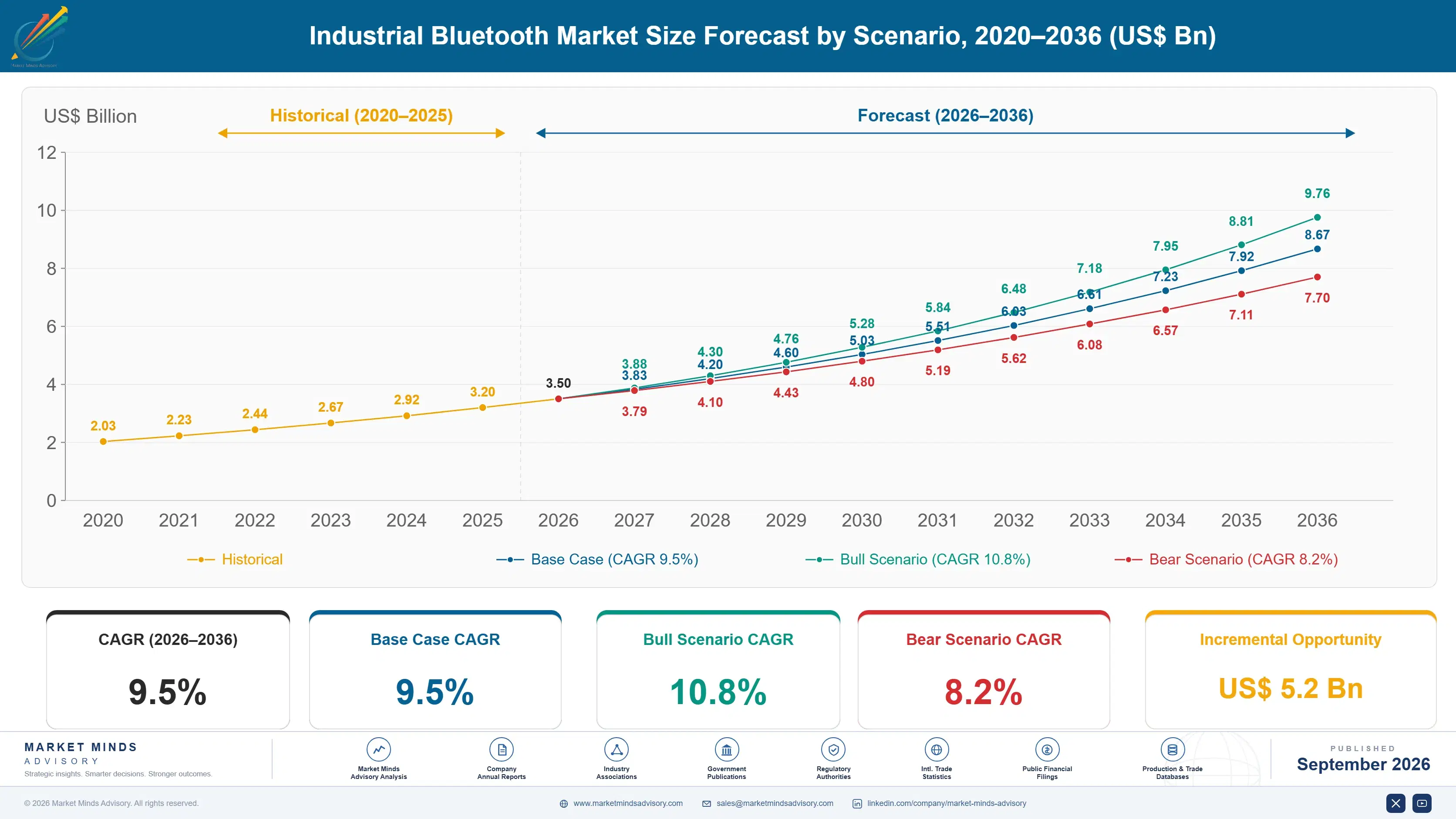
Industrial Bluetooth Market Forecast Scenarios

industrial-bluetooth-market-size-forecast-scenario-1789995745982
Growth through 2020 to 2025 accelerated as chipmakers extended Bluetooth Low Energy battery life from months to multiple years while adding mesh networking capability that let sensors relay data across distances no single radio could reach alone, opening industrial deployment scenarios that earlier Bluetooth generations simply could not support reliably across a large factory footprint.
Base case growth through 2036 rests on three commercial mechanisms: continued replacement of hardwired factory sensors with battery-powered wireless alternatives eliminating costly cabling infrastructure across sprawling production facilities and warehouse floors nationwide, expanding worker safety wearable adoption driven by regulatory pressure and insurance incentives tied to real-time hazard monitoring across hazardous work sites, and growing asset tracking deployment across warehouses and logistics facilities seeking real-time inventory visibility at meaningfully lower cost than alternative technologies available today.
A bull scenario turns on faster adoption of mesh networking standards that let a single gateway cover an entire industrial facility rather than requiring dense access point infrastructure. The bear risk is that competing low-power wide-area technologies capture applications requiring longer range, compressing the addressable market for Bluetooth specifically in outdoor and large-campus industrial deployments over the coming years.

The Battery Life Economics Behind Every Sensor Module

Chipmakers no longer compete primarily on raw data throughput or transmission range, since most industrial sensing applications need only small, infrequent data packets transmitted occasionally throughout the day, but rather on power efficiency that stretches coin cell battery life from months into multiple years without a single maintenance visit to a hard-to-reach sensor location deep inside a facility.
MARKET CONCENTRATIONCR5: 35%Top five chipmakers hold just over a third share
AVERAGE MODULE UNIT PRICE$4.20Typical wholesale cost for a certified sensor module
TOP PRODUCING COUNTRY SHAREChina: 34%Reflects concentration of module manufacturing and assembly capacity
RATED BATTERY LIFESPAN5 yearsTypical rated coin cell life under normal duty cycle
MESH NETWORK ADOPTION RATE41%Share of new industrial deployments using mesh topology
INTRINSICALLY SAFE CERTIFICATION RATE27%Share of modules certified for hazardous location deployment
Pricing has shifted from per-unit component sales toward bundled module-plus-certification packages, since industrial buyers increasingly value pre-certified hazardous location approval bundled directly into the chipset rather than pursuing separate, costly certification processes themselves after purchasing a bare uncertified component from a third-party supplier. Vendors offering pre-certified modules win larger deployments because integrators avoid months of regulatory delay and extensive paperwork.
Mesh networking capability has become the single largest differentiator behind design wins in large facility deployments, since a mesh topology lets sensors relay data across an entire factory floor using only a handful of gateways rather than requiring dense point-to-point access point infrastructure installed everywhere across the building. Vendors offering mature, field-proven mesh stacks report meaningfully higher design win rates than those relying solely on point-to-point connectivity architectures alone.
"Nobody cares about megabits per second on a factory floor. They care whether the sensor is still transmitting five years from now without anyone climbing a ladder to change a battery."
Practice Lead, Industrial IoT and Wireless Connectivity Research · MMA Technology Practice · September 2026

Market Trends

Bluetooth Mesh Displaces Point-to-Point Sensor Architecture

Vendors have shifted rapidly from simple point-to-point Bluetooth connections requiring a dedicated gateway near every sensor toward mesh networking architectures that let a signal hop across multiple nodes to reach a single facility-wide gateway, cutting infrastructure cost sharply for large industrial deployments spanning many thousands of square feet across the entire building footprint, every production line, and every storage area. Roughly 41 percent of new industrial deployments in 2025 now use mesh topology, up sharply from under 15 percent just three years earlier as the standard matured considerably across the industry.
Market Impact: Wireless beats $3 per foot
Direction Finding Enables Precise Indoor Asset Location

New Bluetooth direction finding capability lets receivers calculate a transmitting tag's precise angle and distance rather than only detecting rough proximity, enabling centimeter-level indoor asset location tracking that earlier Bluetooth generations could never achieve reliably at any meaningful scale across a large warehouse or manufacturing facility of any real size at all. Warehouse and logistics operators have adopted this capability fastest, with roughly 33 percent of new industrial asset tracking deployments in 2025 specifying direction finding hardware, up from under 8 percent two years earlier as accuracy requirements tightened considerably.
Market Impact: 2,400 incidents flagged earlier

Market Opportunities and Growth Drivers

Retrofit Demand Rises as Cabling Costs Keep Climbing

Copper cabling and conduit installation labor costs have risen sharply across most industrial markets over the past several years, pushing facility operators to evaluate wireless sensor retrofits as a genuinely cost-competitive alternative rather than a compromise solution accepted only when cabling proved physically impossible to run through existing structures. Roughly 3 dollars per foot of installed cable cost, plus labor, now makes a wireless Bluetooth sensor cheaper than a hardwired equivalent in most brownfield retrofit scenarios, a threshold that shifted decisively in wireless technology's favor within the past three years alone.
Market Impact: Reliability falls below 95% locally

Worker Safety Regulation Mandates Real-Time Hazard Monitoring

Occupational safety regulators in several major industrial economies now require or strongly incentivize real-time monitoring of worker exposure to hazardous gases, extreme temperatures, and confined space conditions, driving rapid adoption of Bluetooth-connected wearable safety devices across heavy industry sectors including mining, oil and gas, and chemical processing facilities nationwide, internationally, and across every region as well. Roughly 2,400 documented workplace safety incidents in high-risk industrial settings during 2025 involved conditions that connected wearable monitoring could have flagged earlier, reinforcing regulatory and insurer pressure for broader deployment across every single shift and facility.
Market Impact: Certification adds 2 quarters to launch

Market Restraints and Challenges

Radio Interference in Dense Industrial Environments Degrades Reliability

Factory floors packed with motors, welding equipment, and competing wireless protocols create a genuinely difficult radio frequency environment where Bluetooth signals can suffer interference and dropped connections that a clean laboratory test environment never reveals during product certification. The root cause is that the crowded 2.4 gigahertz band hosts Wi-Fi, other Bluetooth devices, and industrial equipment noise simultaneously in the same physical space. Some facilities report connection reliability below 95 percent in the worst-affected zones. Vendors now offer adaptive frequency hopping and mesh redundancy specifically engineered to route around persistently noisy channels automatically.
Market Impact: 41% of deployments now use mesh

Certification Costs Delay Time to Market for New Modules

Achieving intrinsically safe and hazardous location certification for a new Bluetooth module requires extensive third-party testing that can take a year or longer and cost several hundred thousand dollars per product variant, a burden that smaller specialist vendors struggle to absorb as easily as larger incumbents. The underlying cause is that certification bodies test each specific hardware and firmware combination individually rather than certifying a general platform once. This delay routinely pushes new product launches back by two full quarters. Several vendors now design modular certified cores that speed re-certification across product variants substantially.
Market Impact: 33% now use direction finding
3 additional market trends, 4 additional growth drivers, and 3 additional restraints and challenges are covered in the full report. Contact sales@marketmindsadvisory.com to access the complete intelligence.

Segment CAGR and Growth Architecture

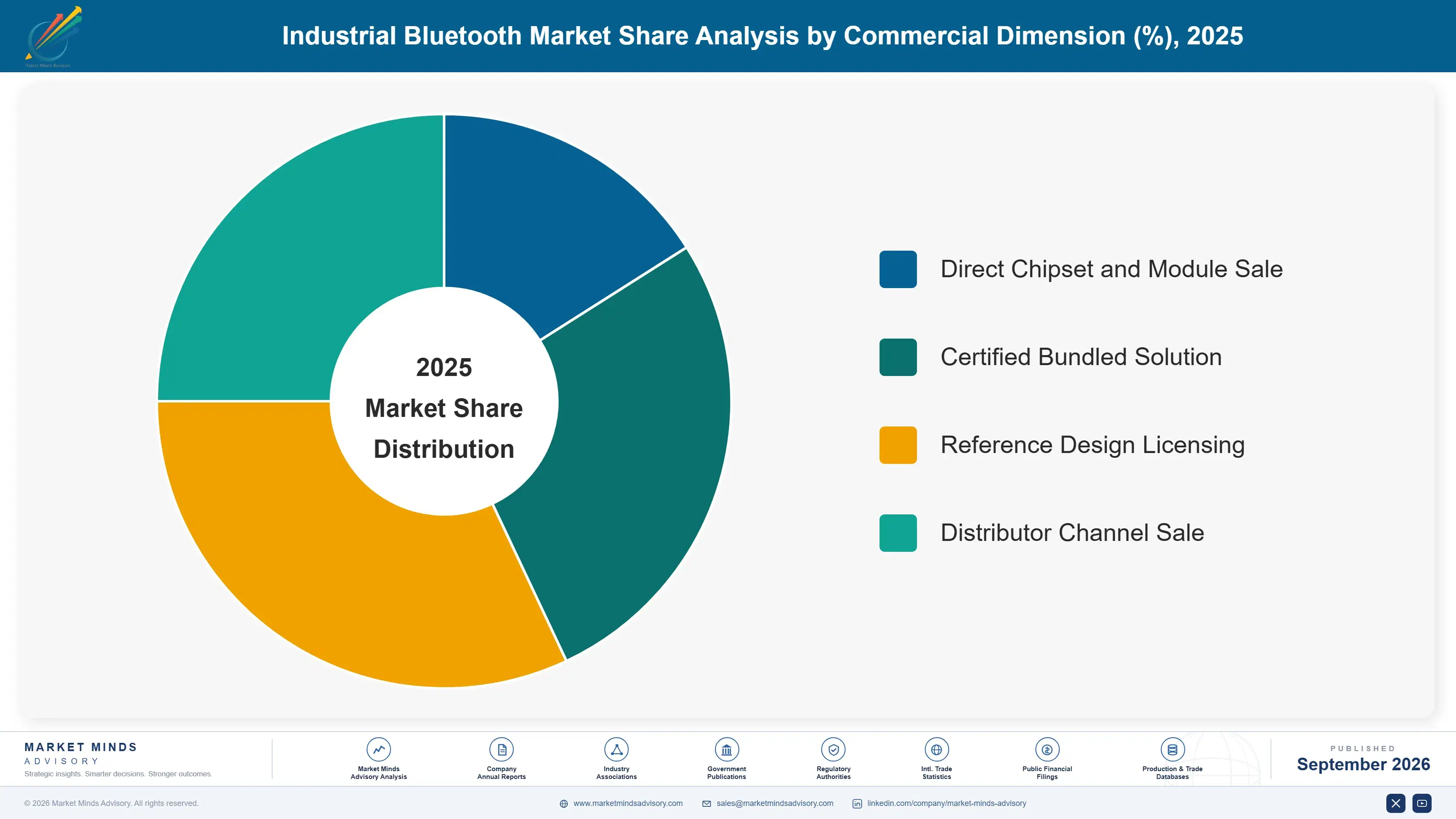
The market splits by application category rather than by chipset generation or protocol version, since certification requirements, battery life demands, and pricing structures vary sharply across each specific use case and buyer type. Six categories cover the field: BLE sensor modules, industrial wearables, mesh networking, asset tracking beacons, industrial gateways, and machine diagnostic modules.
industrial-bluetooth-market-market-share-analysis-1789995746516

Bluetooth Low Energy Sensor Modules

Bluetooth Low Energy sensor modules are the fastest-growing category by a wide margin, driven by manufacturers replacing hardwired vibration, temperature, and pressure sensors with battery-powered wireless alternatives that eliminate costly cabling infrastructure across sprawling production facilities. Adoption started in discrete manufacturing but has spread rapidly into continuous process industries like chemicals and oil refining, where retrofit economics favor wireless even more strongly given the difficulty of running new cable through existing hazardous piping infrastructure. Pricing has shifted from bare component sales toward pre-certified module packages that bundle hazardous location approval directly into the chipset, and vendors increasingly bundle mesh networking firmware into the base module rather than selling it as a separate licensed add-on.
CAGR 14.0%

Industrial Wearables and Worker Safety Devices

Industrial wearables and worker safety devices address a genuinely distinct commercial need, since regulatory pressure and insurer incentives increasingly require real-time monitoring of worker exposure to hazardous conditions rather than periodic manual safety checks conducted occasionally throughout a typical work shift or day. Adoption has concentrated among mining, oil and gas, and heavy manufacturing sectors facing the highest injury rates and correspondingly the strongest regulatory scrutiny of workplace safety practices industry-wide today. This category commands premium pricing relative to basic sensor modules given the specialized ruggedization and battery engineering required for continuous body-worn operation, and vendors report that safety directors increasingly drive purchasing decisions previously made by operations teams alone entirely.
CAGR 12.5%
Full segment breakdown across 6 segments available in the complete report.

Regional Architecture and Country Demand Map

East Asia leads on module manufacturing scale and electronics assembly concentration, Vietnam leads on the fastest growth rate through expanding electronics manufacturing investment, and North America contributes strong demand from process industry retrofit programs replacing aging hardwired sensor infrastructure across major refining and chemical facilities.

North America

US process industries, particularly oil and gas refining and chemical manufacturing, drive substantial regional demand as facility operators retrofit aging hardwired sensor networks with wireless Bluetooth alternatives rather than undertaking costly cable replacement during scheduled maintenance shutdowns. Canada contributes meaningful volume through its own mining and oil sands operations facing similar retrofit economics. The region's demand reflects genuine buyer sophistication around total installed cost calculations rather than any unique technological advantage held only by vendors headquartered here. Federal manufacturing incentive programs have separately encouraged domestic factory automation investment. Utility and pipeline operators are piloting Bluetooth-connected leak detection sensors across aging infrastructure. Insurance-driven safety wearable mandates in high-risk sectors add further momentum to this already sizable demand base.
Share: 27% | CAGR: 9.0% (2026 to 2036)

Western Europe

Germany leads regional adoption through its concentrated automotive and industrial machinery manufacturing base, where factory automation programs increasingly specify wireless sensor connectivity as a standard design choice for new production line installations. The chemical processing sector across the region has adopted intrinsically safe Bluetooth modules fastest, driven by stringent European hazardous location safety regulations. Growth trails East Asia meaningfully since the region's manufacturing base skews toward high-value, lower-volume production that generates less aggregate sensor demand than high-volume East Asian assembly operations running at massive scale. Nordic countries have moved fastest within the region on mesh networking adoption specifically for offshore energy applications. Italian and Spanish manufacturers are following the German pattern from a somewhat smaller installed base.
Share: 20% | CAGR: 8.0% (2026 to 2036)
Regional intelligence for 5 additional markets available in the complete report: East Asia, South Asia and Pacific, Latin America, Middle East and Africa, Eastern Europe. Contact sales@marketmindsadvisory.com.
industrial-bluetooth-market-country-cagr-analysis-1789995747029

Where Chipmakers Actually Capture Value

Bare sensor chipset margin has thinned as competition intensifies among established semiconductor vendors, so the strongest performers capture additional margin through pre-certification bundling, mesh networking software licensing, reference design support, and volume-tiered supply contracts layered on top of the base component sale rather than through the chip price alone across every deployed customer program and product line.

Bundle Hazardous Location Certification Into the Base Module

Vendors that bundle pre-completed hazardous location certification directly into the base module price capture 35 to 45 percent more revenue per unit than those selling bare, uncertified chipsets, since integrators avoid months of costly independent testing and gladly pay a premium for a ready-to-deploy certified component already validated and proven. This bundling also builds durable customer loyalty, since re-certifying a design around a competing uncertified chipset requires restarting the entire testing process from scratch. Contract renewal conversations increasingly start from this certified baseline directly rather than from a bare price quote.
Market Impact: Certification bundling adds 35 to 45% more revenue

License Mesh Networking Firmware as a Recurring Fee

Chipmakers increasingly license proprietary mesh networking firmware stacks as a recurring per-unit royalty rather than a one-time inclusion in the hardware price, capturing 8 to 12 percent of unit revenue on an ongoing basis as deployment volume scales across a customer's entire product line and installed base of devices. This recurring revenue model also gives vendors an ongoing incentive to keep improving mesh reliability and range for the customers already relying on it. Renewal rates in these firmware-licensed accounts run noticeably higher as a direct result of this ongoing arrangement.
Market Impact: Firmware licensing adds 8 to 12% more revenue

Sell Reference Design and Certification Support Packages

Vendors increasingly sell paid reference design and certification consulting packages to smaller integrators lacking in-house radio frequency engineering expertise, charging a premium typically running 20 to 30 percent above the base component price for hands-on design support through the entire certification process from start to finish. This service tier has become especially popular among smaller industrial equipment makers entering wireless sensing for the first time without dedicated internal expertise or staff of their own. Larger integrator accounts routinely pay well above this stated baseline figure for genuinely expedited support work.
Market Impact: Design support commands 20 to 30% price premium

Charge Volume-Tiered Pricing for Long-Term Supply Contracts

Vendors negotiate multi-year volume-tiered supply agreements with large industrial customers, trading guaranteed order volume for pricing that still captures 10 to 15 percent more margin than spot-market component sales, since customers value supply security highly enough to accept less aggressive price negotiation than a one-time transactional purchase would otherwise produce for them. This arrangement also locks customers into a specific chipset architecture for the entire duration of the supply contract term. Larger volume commitments routinely exceed this baseline threshold considerably each contract renewal year across every product category and customer segment served.
Market Impact: Volume contracts capture 10 to 15% more margin

Who Controls the Margin Pool

CR5 sits at 35 percent, evaluated on annual industrial Bluetooth module and chipset revenue across each vendor's full product line, leaving this market meaningfully more fragmented than adjacent semiconductor categories with fewer viable suppliers. Nordic Semiconductor holds the clearest lead given its early specialization in low-power wireless chipsets, though the gap to Texas Instruments has narrowed noticeably as broader semiconductor portfolios gain traction among industrial buyers seeking a single supplier.
Competitive activity today centers on pre-certification depth and mesh networking software maturity rather than raw radio specifications, which have largely converged across leading chipset vendors. Nordic Semiconductor, Texas Instruments, and Silicon Labs have all expanded dedicated intrinsically safe product lines over the past two years, while smaller specialist vendors focus on vertical-specific reference designs for narrow applications larger vendors deprioritize in their broader roadmap.

Emerging pressure comes from Chinese chipset manufacturers rapidly closing the technical gap on low-power radio design while undercutting established Western vendors on price for standard, non-certified modules sold into cost-sensitive domestic manufacturing applications. Rankings are most likely to shift in the worker safety wearable segment, where battery and ruggedization engineering matter more than radio chipset heritage, giving newer specialist entrants a genuine opening against established incumbents.
industrial-bluetooth-market-company-positioning-matrix-1789995747559

Competitive Moat and Risk Dimensions

NORDIC SEMICONDUCTOR

Moat: Low-Power Wireless Specialization

Nordic built its entire business around low-power wireless chipsets rather than treating Bluetooth as one product line among many, giving it deeper engineering focus on the battery life optimization that industrial buyers value most. This specialization also gives Nordic an early-mover advantage in emerging direction finding and mesh capability.
NORDIC SEMICONDUCTOR

Risk: Narrower Product Portfolio Breadth

Nordic's focus on wireless connectivity chipsets specifically leaves it without the broader semiconductor portfolio that competitors like Texas Instruments can offer customers directly, occasionally costing it deals to buyers preferring a single supplier across multiple component categories and product lines at once during procurement decisions.
TEXAS INSTRUMENTS

Moat: Broad Semiconductor Portfolio Integration

Texas Instruments offers Bluetooth connectivity alongside a vast portfolio of sensors, microcontrollers, and power management chips, letting it win integrated design wins where a customer prefers sourcing multiple components from a single established supplier. This breadth advantage is difficult for narrower connectivity specialists to replicate quickly.
TEXAS INSTRUMENTS

Risk: Slower Connectivity-Specific Innovation

Texas Instruments' broad portfolio focus means its Bluetooth connectivity roadmap sometimes advances more slowly than pure-play wireless specialists dedicating their entire engineering organization to connectivity innovation specifically and exclusively, occasionally ceding leading-edge feature launches to smaller, more focused competitors moving considerably faster on every release.

Players Tracked

Prominent Players

Nordic Semiconductor
Texas Instruments
STMicroelectronics
Silicon Labs
Qualcomm

Other Key Players

Infineon Technologies
Microchip Technology
u-blox
Laird Connectivity
Telit Cinterion
Panasonic
Murata Manufacturing
TDK Corporation
Renesas Electronics
Espressif Systems
Sena Technologies
Ruuvi Innovations
Kontakt.io
MOKOSMART
Minew

Recent Developments

JANUARY 2026

Nordic Semiconductor Launches Intrinsically Safe Module Line

Nordic Semiconductor launched a new intrinsically safe module line pre-certified for Zone 0 hazardous locations, targeting oil and gas and chemical processing customers who previously had to complete third-party certification themselves after purchasing a bare, uncertified chipset from a component supplier directly without any support at all.
Signal: Confirms pre-certification bundling has become a required competitive baseline across the entire chipset industry now, industrywide.
SEPTEMBER 2025

Silicon Labs Acquires Mesh Networking Software Startup

Silicon Labs acquired a smaller mesh networking software startup to strengthen its industrial mesh stack maturity, closing a specific capability gap identified by enterprise customers evaluating its platform against Nordic Semiconductor's more established and thoroughly field-proven mesh networking offering already available on the market today.
Signal: Shows chipset vendors continuing to acquire software capability rather than build it entirely in-house on their own.
MAY 2025

Texas Instruments Expands Direction Finding Reference Designs

Texas Instruments expanded its direction finding reference design portfolio to cover several additional antenna array configurations, simplifying development considerably for asset tracking customers who previously needed extensive radio frequency engineering expertise to fully implement the capability themselves entirely from scratch on their own without assistance.
Signal: Signals direction finding is moving from a specialist feature toward mainstream chipset portfolio coverage more broadly.

Silicon Wafer Exposure Behind Every Chipset

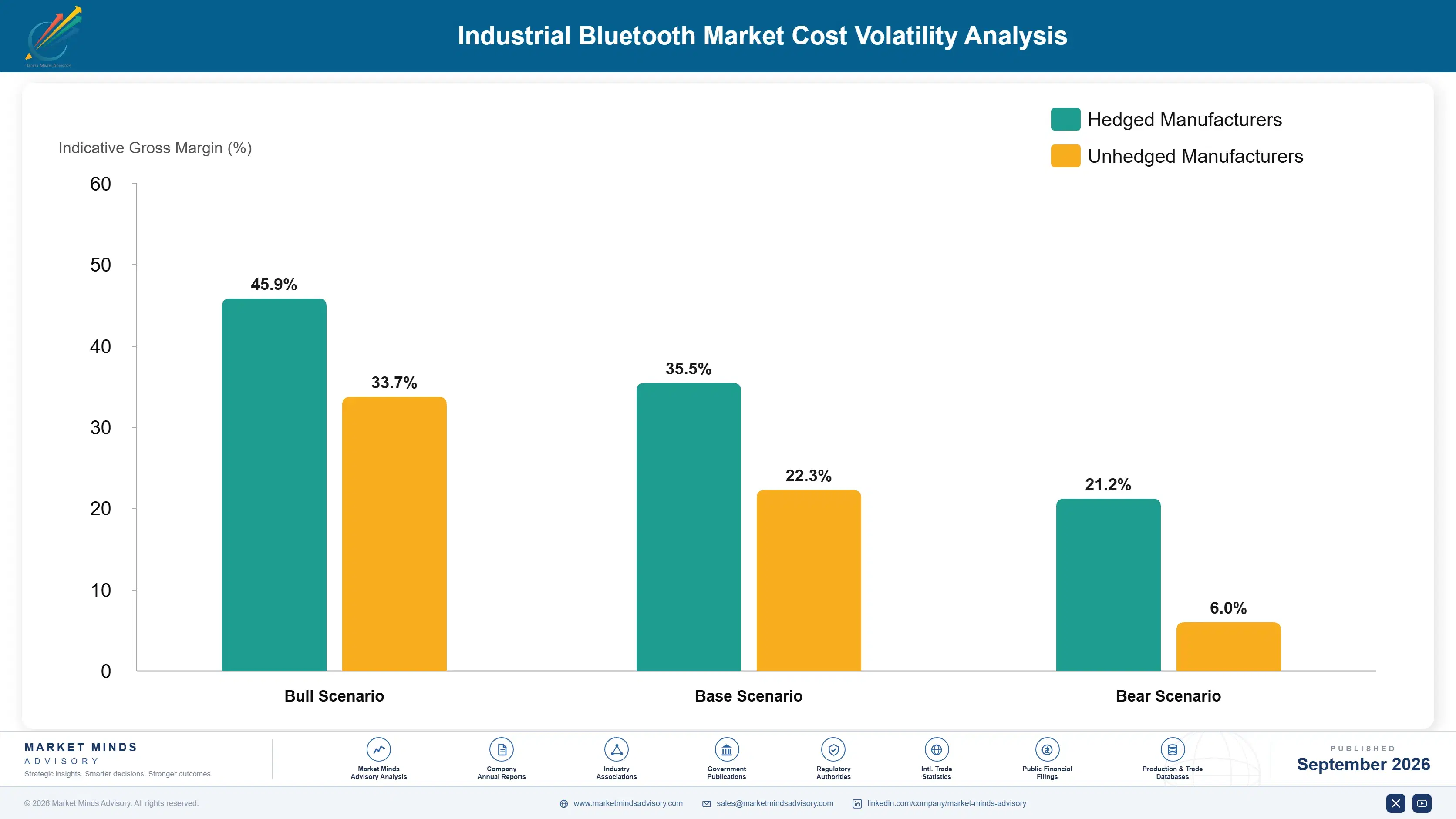
Silicon wafer and semiconductor foundry capacity account for roughly 40 percent of cost of goods sold for a typical industrial Bluetooth chipset vendor, with the remainder split across packaging, testing, and radio frequency certification expenses paid throughout the entire product lifecycle. Foundry capacity concentrates heavily in Taiwan and South Korea rather than the markets where finished modules are ultimately assembled and sold to end customers.
A 2025 foundry capacity allocation shift toward higher-margin advanced logic chips, documented in supplier annual reports reviewed by MMA analysts, pushed wafer lead times for mature-node Bluetooth chipsets from twelve weeks to over twenty weeks within a single year as foundries prioritized more profitable orders across their available capacity. Vendors without long-term capacity reservation agreements already in place absorbed the resulting delay and cost pressure directly.

Smaller chipset vendors relying entirely on spot-market foundry capacity face far more allocation risk than the largest vendors that negotiate long-term capacity agreements directly with major foundries at meaningful volume and scale. That negotiating leverage gap increasingly determines which vendors can guarantee reliable delivery timelines to industrial customers who plan production schedules months in advance around a specific component's availability and cost.
industrial-bluetooth-market-cost-volatility-analysis-1789995747757

Reserve Foundry Capacity Through Long-Term Agreements

Larger vendors negotiate long-term wafer capacity agreements directly with major foundries, trading a volume commitment for guaranteed allocation priority that shields them from the lead time swings smaller vendors face during periods of tight industrywide foundry capacity across every single mature process node and full product family portfolio worldwide. Larger customer volume commitments earn even better priority treatment.

Qualify Multiple Foundries for the Same Design

Several vendors now qualify a given chipset design across two or more separate foundries simultaneously rather than relying on a single manufacturing source, adding modest qualification cost upfront but eliminating the single-point allocation risk that caused the 2025 lead time extension industrywide across most mature-node product lines and categories. This dual-sourcing approach has become nearly standard industry practice.

Shift Mature Designs to Older, Less Contested Process Nodes

Vendors increasingly migrate mature Bluetooth chipset designs to older, less contested process nodes where advanced logic chips do not compete directly for the same capacity, trading marginal performance for meaningfully more reliable allocation and lead time predictability across the entire product line and full customer base served worldwide. Customers rarely notice any difference in real-world field performance.

Portfolio Architecture for Margin Defence

Gross margin in industrial Bluetooth chipsets spreads widely depending on certification depth and how much software licensing revenue accompanies the base component sale. A bare, uncertified chipset sold at competitive commodity pricing clears margin well below what a pre-certified, mesh-enabled module commands, since the latter embeds specialized certification and firmware engineering that buyers pay a real, sustained premium to access reliably.
Volume and premium tiers pull vendors toward genuinely different customer bases and engineering investment levels. Volume players compete on low-cost, bare chipsets sold broadly into non-hazardous, cost-sensitive applications, while premium players concentrate on hazardous location and safety-critical applications willing to pay substantially more for pre-certification and mesh reliability built in. Few vendors execute both strategies at once, since certification investment and sales motion diverge sharply between the two approaches.

High-value margin pools concentrate specifically in hazardous location certification, mesh networking firmware licensing, and long-term supply agreements rather than in bare chipset sales, which increasingly function as a low-margin, high-volume entry point that funds the engineering infrastructure supporting the much higher-margin certified and licensed business built on top of that same underlying silicon platform and shared radio design across the company.

Volume / Commodity-Adjacent

Bare, uncertified Bluetooth chipsets sold at low, competitive pricing into non-hazardous applications, competing mainly on unit price, delivery lead time, and broad distributor availability across every region and market worldwide.
Gross Margin: 20-28%

Premium / Certified

Pre-certified modules bundled with mesh networking firmware and hazardous location approval sold to industrial customers across process industries and heavy manufacturing sectors worldwide, spanning multiple distinct end markets and geographies.
Gross Margin: 38-46%

Sustainability / Regulatory / Next-Generation

Direction finding and worker safety wearable chipsets meeting emerging occupational safety and precision location standards demanded by mining, oil and gas, and logistics buyers operating under strict, continuous regulatory oversight.
Gross Margin: 42-50%
industrial-bluetooth-market-portfolio-architecture-1789995748261

High-value Sub-segments and Strategic Watch-out

Hazardous Location Certification Bundling

The highest-margin pool in the category, growing fastest as process industry buyers increasingly demand pre-certified components rather than pursuing costly independent third-party certification themselves after purchasing a bare, uncertified chipset from a supplier. Adoption keeps rising sharply among process industry buyers with the largest deployed sensor fleets.
Gross Margin: 44-52%

Direction Finding and Precision Location

High-value, software-enabled capability commanding strong margin as warehouse and logistics operators demand centimeter-level indoor asset location accuracy well beyond simple proximity detection that earlier generations of hardware offered customers previously and consistently. Renewal and expansion rates in these accounts run consistently higher than the base tier.
Gross Margin: 40-48%

Commodity Bluetooth Chipsets

The largest volume core of the market, mature and increasingly low-margin, facing continued commoditization pressure as Chinese chipset manufacturers steadily close the technical gap on both price and radio performance metrics. Vendors increasingly treat this tier as a lead generation channel for premium upsell opportunities.
Gross Margin: 16-24%

Alternative Wireless Protocol Substitution

A strategic watch-out segment where competing low-power wide-area technologies capture applications requiring longer range, threatening to compress the addressable market for Bluetooth in outdoor and large industrial campus deployments nationwide and abroad. Vendors must differentiate sharply on range and battery life to defend this segment.
Gross Margin: N/A

Why Chipset Designs Become Sticky Fast

An industrial Bluetooth chipset design win behaves more like an annuity than a one-time component sale once it becomes embedded inside a customer's certified end product, since re-qualifying an entire product design around a competing chipset requires repeating hazardous location certification, firmware validation, and reliability testing from scratch. That certification cost alone can exceed the annual value of the underlying chipset business itself many times over.
Stickiness varies sharply by end-use vertical and certification depth achieved during initial design. Hazardous location and safety-critical customers show the deepest lock-in, since re-certifying a design around a new chipset can take a year or longer and cost hundreds of thousands of dollars. Consumer-adjacent and non-hazardous industrial customers show comparatively shallower stickiness, since switching a bare, uncertified chipset requires far less validation effort overall.

Buyer profiles are shifting generationally as dedicated industrial IoT engineering teams, rather than general electrical engineers handling wireless connectivity as one task among many, increasingly drive chipset selection decisions. This generational shift favors vendors offering strong reference designs and mesh networking software over vendors competing primarily on raw component price and basic radio specifications alone.
industrial-bluetooth-market-end-use-penetration-index-1789995748754

Where to Compete in Industrial Wireless

These are among the four positions where our research anticipates prominent divergence between winners and laggards over the coming forecast period. Each is grounded in the demand model, the regulatory perimeter, and the announced capacity pipeline.
01 / CERTIFICATION BUNDLING STRATEGY

Bundle hazardous certification before it becomes a baseline expectation

Pre-certified hazardous location modules already command a substantial price premium over bare chipsets, yet many smaller vendors still sell uncertified components requiring customers to complete testing themselves at real cost, delay, and significant engineering effort. A challenger investing early in bundled certification can win process industry design wins before this becomes a baseline requirement every competitor offers as standard practice across the entire market. That differentiation window narrows measurably each year as certification becomes increasingly commoditized across the entire industry.
02 / MESH SOFTWARE INVESTMENT

Build field-proven mesh networking software before it commoditizes

Mesh networking reliability increasingly determines design wins in large facility deployments, yet many vendors still offer immature mesh stacks that have not been genuinely proven at industrial scale across real, genuinely demanding facilities. A vendor that invests in field-proven mesh software now can win large facility deployments away from competitors with less mature stacks still working through early reliability issues in the field. This differentiation narrows as mesh standards mature and spread more broadly across the entire industry over time.
03 / DUAL FOUNDRY SOURCING

Qualify multiple foundries before the next capacity allocation shock

The 2025 foundry capacity allocation shift demonstrated clearly how exposed single-foundry vendors are to sudden lead time extensions entirely beyond their direct control or influence over available global semiconductor supply chains and capacity. Vendors that qualify designs across multiple foundries now protect their own delivery reliability against the next allocation shock far better than competitors dependent on just one single manufacturing source alone without alternatives. This diversification decision increasingly separates reliable, well-prepared vendors from those facing unpredictable, costly delivery delays.
04 / DIRECTION FINDING EXPANSION

Expand direction finding capability to capture asset tracking demand

Direction finding adoption in asset tracking deployments has grown rapidly as warehouse and logistics operators demand centimeter-level location accuracy that older proximity-based Bluetooth simply cannot deliver reliably at any real scale or precision level required. Vendors that expand direction finding reference designs and antenna array support now can capture this growing demand before it becomes a standard, undifferentiated feature every vendor offers as a matter of course. This window will not stay open indefinitely as the underlying capability matures further.

Engagement Snapshot From the Field

A live engagement with an industry participant carrying material or product regulatory and market exposure ahead of a defining policy shift, showing how our research translates into a defensible multi-year portfolio strategy.
MARKET MINDS ADVISORY · CLIENT ENGAGEMENT SUMMARY
Industrial Bluetooth Producer Strategic Portfolio Review and Transition Roadmap 2026·Investment Scenario on Industrial Bluetooth Exposure Evaluation 2025-26
CLIENT PROFILE
The client operates three chemical processing facilities across two states, running production lines that had relied on hardwired vibration and temperature sensors installed decades ago, reporting client-reported annual revenue of approximately $480 million (client-reported, unverified by MMA). Facing rising maintenance costs on aging cable infrastructure, leadership sought an independent evaluation of wireless Bluetooth sensor retrofit options before the next scheduled facility shutdown.
STRATEGIC CHALLENGE
The client's aging cable infrastructure required increasingly frequent and costly maintenance interventions across all three facilities, yet a full wireless retrofit involved evaluating hazardous location certification requirements, mesh network reliability in a facility with substantial radio interference, and total cost of ownership against simply replacing the existing hardwired cabling instead entirely.
MMA APPROACH
MMA analysts evaluated three candidate Bluetooth sensor vendors against a total cost of ownership model comparing wireless retrofit against cable replacement, conducted on-site radio frequency interference testing across all three facilities, and validated hazardous location certification coverage against the client's specific processing zone classifications over a full six-week assessment period.
KEY FINDINGS
  1. Wireless retrofit cost roughly 60 percent less than full cable replacement once installation labor and facility downtime during rewiring were properly factored into the comparison.
  2. Radio frequency interference testing revealed one facility required a denser mesh node deployment than initially planned, adding roughly 15 percent to the projected hardware cost.
  3. Only one of the three candidate vendors offered pre-certified modules covering all three of the client's specific hazardous processing zone classifications without modification.
  4. The selected vendor's mesh networking approach reduced required gateway infrastructure by roughly 70 percent (client-reported, unverified by MMA) compared with a point-to-point alternative design.
CLIENT PROFILE
The client operates three chemical processing facilities across two states, running production lines that had relied on hardwired vibration and temperature sensors installed decades ago, reporting client-reported annual revenue of approximately $480 million (client-reported, unverified by MMA). Facing rising maintenance costs on aging cable infrastructure, leadership sought an independent evaluation of wireless Bluetooth sensor retrofit options before the next scheduled facility shutdown.
STRATEGIC CHALLENGE
The client's aging cable infrastructure required increasingly frequent and costly maintenance interventions across all three facilities, yet a full wireless retrofit involved evaluating hazardous location certification requirements, mesh network reliability in a facility with substantial radio interference, and total cost of ownership against simply replacing the existing hardwired cabling instead entirely.
MMA APPROACH
MMA analysts evaluated three candidate Bluetooth sensor vendors against a total cost of ownership model comparing wireless retrofit against cable replacement, conducted on-site radio frequency interference testing across all three facilities, and validated hazardous location certification coverage against the client's specific processing zone classifications over a full six-week assessment period.
KEY FINDINGS
  1. Wireless retrofit cost roughly 60 percent less than full cable replacement once installation labor and facility downtime during rewiring were properly factored into the comparison.
  2. Radio frequency interference testing revealed one facility required a denser mesh node deployment than initially planned, adding roughly 15 percent to the projected hardware cost.
  3. Only one of the three candidate vendors offered pre-certified modules covering all three of the client's specific hazardous processing zone classifications without modification.
  4. The selected vendor's mesh networking approach reduced required gateway infrastructure by roughly 70 percent (client-reported, unverified by MMA) compared with a point-to-point alternative design.
RECOMMENDED STRATEGY
Phase 1: Phase 1 (Months 1 to 2): Deploy the selected wireless sensor system at the facility with the least radio interference to validate performance before full commitment. Phase 2: Phase 2 (Months 3 to 5): Extend deployment to the remaining two facilities, incorporating the denser mesh node configuration required for the higher-interference site. Phase 3: Phase 3 (Month 6): Decommission legacy hardwired sensors and cabling infrastructure, completing the transition ahead of the next scheduled maintenance shutdown.
OUTCOME
The client completed the full wireless retrofit across all three facilities on schedule and reported maintenance cost savings of approximately 45 percent (client-reported, unverified by MMA) in the first year compared with maintaining the prior hardwired infrastructure. Sensor data reliability improved measurably following the resolution of the interference issue.

Frequently Asked Questions

Foundational context covering the market sizes, CAGR, scope, country, region and competition that inform every finding below. This section is provided to cover basics and most often pre-purchase conversations, answered from the MMA Primary Research Dataset.

What is the current size of the Industrial Bluetooth Market?

The Industrial Bluetooth Market reached $3.2 billion in base-year value in 2025, spanning sensor modules, industrial wearables, mesh networking, and asset tracking hardware worldwide today.

How large will the Industrial Bluetooth Market be by 2036?

The market is projected to reach $8.67 billion by 2036, expanding roughly 2.48 times its 2026 value as manufacturers replace hardwired sensors with wireless alternatives.

What is the CAGR for the Industrial Bluetooth Market 2026 to 2036?

The market is forecast to grow at a compound annual growth rate of 9.5 percent between 2026 and 2036, driven by sensor retrofit demand and worker safety regulation.

Which segment is growing fastest?

Bluetooth Low Energy sensor modules lead all segments at a 14.0 percent CAGR, roughly 1.47 times the overall market rate, as manufacturers eliminate hardwired sensor cabling.

Who are the major companies in the Industrial Bluetooth Market?

Nordic Semiconductor, Texas Instruments, STMicroelectronics, Silicon Labs, and Qualcomm lead the competitive field, evaluated on annual module and chipset revenue across every product line and region.

Which country is growing fastest?

Vietnam leads all countries tracked at a 12.5 percent CAGR, fueled by rapid expansion of electronics manufacturing investment relocating from China across the broader region.

Report Segmentation Architecture

The full report scope spans multiple orthogonal segmentation dimensions, with cross-tabulated demand data provided for each dimension pair. Coverage extends further to regional breakdowns, trend trajectories, and the competitive detail needed to support segment-level decision-making.

By Primary Market Dimension

  • Bluetooth Low Energy Sensor Modules
  • Industrial Wearables and Worker Safety Devices
  • Bluetooth Mesh Networking for Factory Automation
  • Asset Tracking and Location Beacons
  • Bluetooth-Enabled Industrial Gateways
  • Machine-to-Machine Diagnostic Modules

By End-Use Industry

  • Discrete Manufacturing
  • Oil, Gas, and Chemical Processing
  • Mining
  • Warehousing and Logistics
  • Automotive Manufacturing

By Commercial Dimension

  • Direct Chipset and Module Sale
  • Certified Bundled Solution
  • Reference Design Licensing
  • Distributor Channel Sale

By Region

  • North America
  • Western Europe
  • East Asia
  • South Asia and Pacific
  • Latin America
  • Middle East and Africa
  • Eastern Europe

Scope, Methodology, and Coverage

Every figure in this report is reproducible from documented input assumptions. The scope below maps the historical period, the forecast horizon, the segmentation dimensions, and the countries covered, alongside the underlying primary and qualitative methodology.
Historical Period
2020 to 2025
Forecast Period
2026 to 2036
Base Year
2025 (USD billions; MMA Primary Research Dataset, September 2026)
Market Definition
The Industrial Bluetooth Market covers Bluetooth-based wireless connectivity modules, chipsets, and finished devices designed for industrial sensing, asset tracking, worker safety, and factory automation applications operating in harsh manufacturing and processing environments. It excludes consumer Bluetooth audio devices, Wi-Fi and cellular industrial connectivity products, and wired industrial fieldbus systems.
Quantitative Units
USD billions (current prices); module and chipset unit shipment volume where applicable
Segmentation Dimensions
By Primary Market Dimension; By End-Use Industry; By Commercial Dimension; By Region
Regions Covered
North America, Western Europe, East Asia, South Asia and Pacific, Latin America, Middle East and Africa, Eastern Europe
Countries Covered
USA, China, Germany, France, UK, Japan, South Korea, India, Australia, Canada, Brazil, Mexico, Indonesia, Vietnam, Thailand, Malaysia, UAE, Saudi Arabia, South Africa, Nigeria, Turkey, Poland, Netherlands, Italy, Spain, Sweden, Switzerland, Argentina, Colombia, Singapore, and additional markets relevant to this sector
Key Companies Profiled
Nordic Semiconductor, Texas Instruments, STMicroelectronics, Silicon Labs, Qualcomm, Infineon Technologies, Microchip Technology, u-blox, Laird Connectivity, Telit Cinterion, Panasonic, Murata Manufacturing, TDK Corporation, Renesas Electronics, Espressif Systems, Sena Technologies, Ruuvi Innovations, Kontakt.io, MOKOSMART, Minew
Quantitative Methodology
Primary survey, n=3,800 respondents, Q4 2025, six countries; demand-side model with trade association cross-validation
Qualitative Methodology
47 expert interviews, Q4 2025; applied to validate demand model assumptions, identify emerging dynamics, and assess competitive positioning
Report Format
PDF and XLSX data workbook (Word format preview document)
Publisher
Market Minds Advisory
Report Code
MMA-2026-TEC-212
Published
September 2026
Contact
sales@marketmindsadvisory.com | www.marketmindsadvisory.com

Purchase the full Industrial Bluetooth Market Report (2026 to 2036).

This report delivers a comprehensive assessment of the Industrial Bluetooth Market from 2026 through 2036, covering sizing, segmentation, and regional demand patterns across all seven world regions tracked. It profiles twenty companies competing on certification depth, mesh networking maturity, and foundry supply resilience rather than raw radio specifications alone. Readers get detailed analysis of revenue levers, input cost exposure, and portfolio margin economics specific to this hardware category and its buyers. The report closes with a strategic verdict identifying exactly where new capital should concentrate over the coming decade.
Full seven-region market sizing and forecast data
Twenty-company competitive profiling and moat analysis
Segment-level CAGR and market share breakdown
Foundry cost exposure and mitigation pathway analysis
Revenue lever and portfolio margin economics detail
Anonymized client case study with recommended strategy

Built For The People Who Decide

From boardroom strategy to bench-side execution, this report is read cover-to-cover by leaders shaping the next decade of their industry, turning demand scenarios, market dynamics and valuation benchmarks into decisions.
CXOs/ Presidents/ VPs/ Managers
M&A and Corporate Development
Strategy Teams and R&D Heads
Procurement and Product Directors
Regulatory and Compliance Leaders
Investor Relations and Equity Analysts