Market Minds Advisory
Industrial Adhesives Market

Industrial Adhesives Market: Lightweighting and Electronics Assembly Reshaping Industrial Bonding Chemistry

Vehicle lightweighting programmes, electronics miniaturization, and the shift toward structural bonding over mechanical fasteners are pushing manufacturers toward higher-performance epoxy, polyurethane, and UV-curable adhesive formulations across every major assembly-driven industry worldwide.

Lead Analyst

Bilal Shaikh

Published

August 2026

Make Smarter Decisions with Customized Research Insights

Request a free sample report and evaluate market opportunities, growth trends, and competitive dynamics relevant to your business needs.

2025 MARKET VALUE$48.5BMarket Size 2025
2036 FORECAST VALUE$93.0BBase Case , 2026 to 2036
CAGR 2026 TO 20366.1 %Bull 7.3% / Bear 4.9%
INCREMENTAL OPPORTUNITY$41.6BNet 10- year value creation
EXPANSION MULTIPLE1.81x2036 value over 2026 base
Strategic Levers
M&A Pipeline
Regional Outlook
Country Rankings
Competitive Intelligence
Segmental Deep-dive
Call-Us : 91 93563 13602

Executive Snapshot and Market Trajectory

Manufacturers across automotive, electronics, and construction are replacing mechanical fasteners and welding with structural adhesive bonding as lightweighting targets and mixed-material assembly requirements make traditional joining methods increasingly impractical this year. That reformulation pressure is reshaping supplier qualification criteria across most manufacturing sectors currently.
Electric vehicle battery pack assembly and electronics miniaturization are concentrating demand in higher-performance epoxy and UV-curable formulations, while general industrial assembly sustains steady conventional adhesive volume across mature manufacturing regions. China's expanding electronics and EV manufacturing base is pulling incremental adhesive demand toward East Asian production hubs at a pace outstripping growth elsewhere, forcing global suppliers to reconsider where they locate new formulation and blending capacity across their manufacturing footprint worldwide.
Competitive intensity centers on formulation performance and technical service capability rather than price, since manufacturers increasingly specify adhesives by bond strength, cure speed, and substrate compatibility certification. Regional capacity consolidation and tightening raw material sourcing standards are reshaping which suppliers can bid on large automotive and electronics original equipment manufacturer framework contracts. Buyers increasingly weigh documented qualification speed alongside price when awarding large platform-level supply contracts. That shift is already visible in how procurement teams.
Market Definition
This market covers adhesives formulated for industrial bonding applications across automotive, electronics, construction, and general manufacturing, including epoxy, polyurethane, acrylic, silicone, UV-curable, and hot-melt chemistries. It excludes consumer and household adhesive products sold through retail channels.
Base Year Value
$48.5B in 2025 (MMA Primary Research Dataset, August 2026)
Forecast Period
2026 to 2036, eleven discrete annual values
CAGR
6.1% base case. Bull 7.3%. Bear 4.9%.
Fastest Growth Segment
UV-Curable Adhesives: 9.6% CAGR
Fastest Growth Country
China: 9.2% CAGR
Fastest Growth Region
South Asia and Pacific: 8.1% CAGR
Largest Region
East Asia: 29% of 2025 global value
Market Leaders
Henkel, 3M, Sika, H.B. Fuller, and Arkema (Bostik). Source: MMA Analysis based on company annual reports.
Primary Survey
n=3,800 procurement and R&D decision-makers, Q4 2025, six countries
Methodology
Demand-side build-up, cross-validated against public data, 47 expert interviews

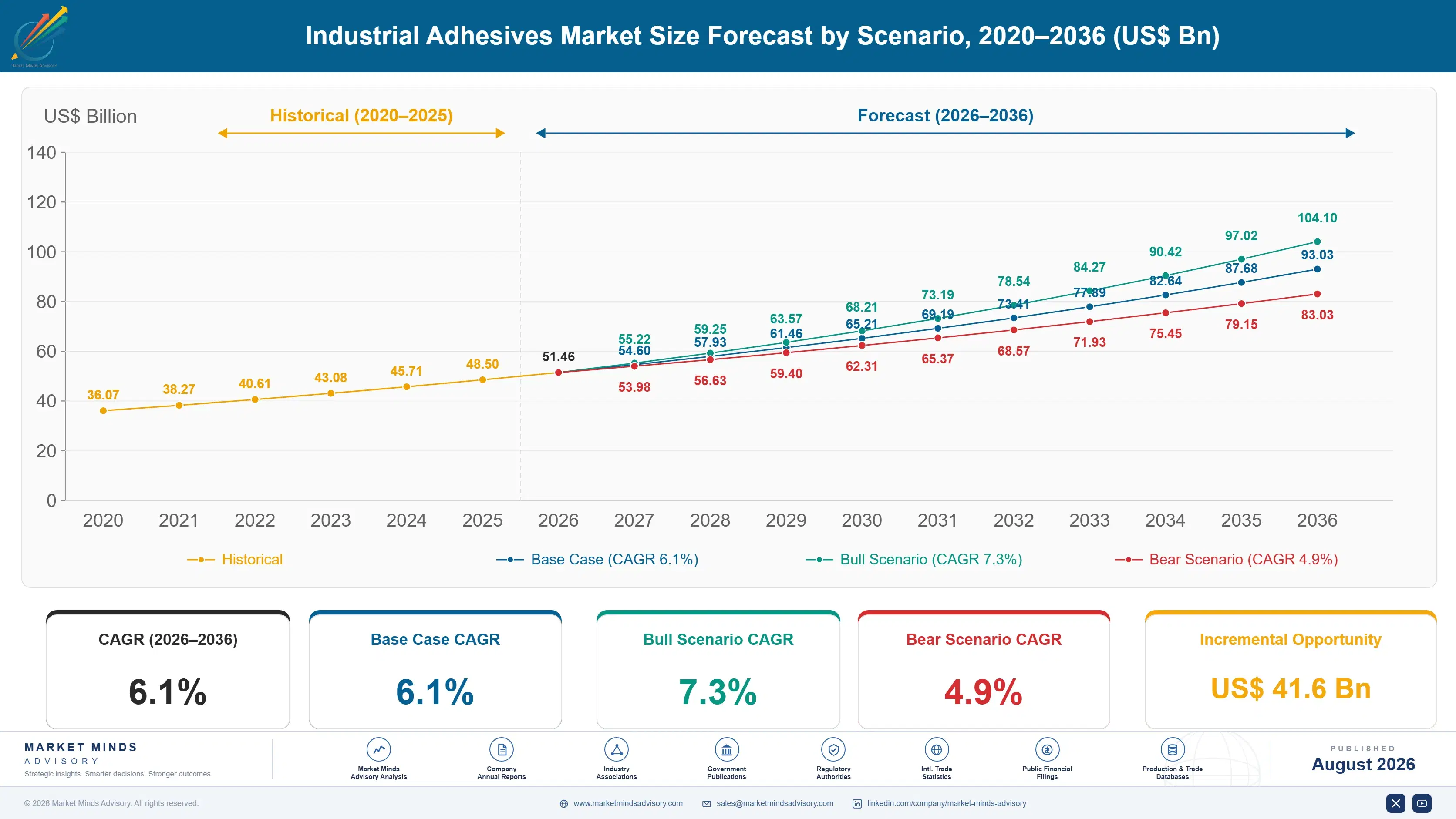
Industrial Adhesives Market Forecast Scenarios

industrial-adhesives-market-size-forecast-scenario-1787310918341
Between 2020 and 2025 demand grew steadily as manufacturing output recovered from pandemic-era disruption and accelerated further from 2022 as electric vehicle production ramped across multiple regions, requiring substantially more adhesive volume per vehicle than internal combustion platforms, implying roughly 5.2% historical annual growth over the period as measured against comparable manufacturing output data. US Census Bureau manufacturing output data confirms this acceleration pattern clearly.
The base case assumes continued growth anchored in three commercial mechanisms: electric vehicle battery pack and body assembly requiring extensive structural and thermal management adhesive volume, electronics manufacturers adopting UV-curable formulations for increasingly miniaturized component assembly, and construction firms specifying structural glazing and panel bonding adhesives replacing mechanical fastening in modern building envelope design. Together these mechanisms sustain above-trend demand even where broader industrial capital spending slows periodically across individual regional markets.
A bull scenario centers on faster-than-expected electric vehicle production ramp across multiple manufacturing regions, lifting structural adhesive volumes sharply. The bear case involves delayed vehicle electrification timelines and softer construction activity, which would push several announced adhesive capacity expansions beyond their original commissioning timelines and soften near-term demand growth across affected end markets. Suppliers positioned for either outcome should maintain flexible structural formulation.

Structural Bonding Displacing Mechanical Fastening

Vehicle lightweighting and mixed-material assembly are pushing manufacturers toward adhesive bonding over mechanical fastening, even as overall vehicle production volumes grow more slowly than headline manufacturing figures would suggest, since electric vehicles and multi-material vehicle bodies require substantially more adhesive volume per unit than conventional single-material platforms being gradually phased out. That reallocation is already visible in how formulators structure their product
MARKET CONCENTRATION (CR5)34%moderately concentrated supplier base across all major regions
AVERAGE SELLING PRICE TREND+4.6% p.a.higher-performance formulations commanding a steady rising price premium
TOP PRODUCING REGION SHAREEast Asia, 29%largest electronics and vehicle manufacturing base found globally
AUTOMOTIVE APPLICATION SHARE34%vehicle assembly represents the largest single end-use category
RAW MATERIAL SHARE58%petrochemical resin and curing agent inputs dominate production cost
STRUCTURAL BONDING PENETRATION27%share of volume used in load-bearing structural applications
Commercial activity increasingly rewards suppliers who can demonstrate substrate compatibility certification and technical service capability over suppliers competing purely on unit price, a shift that favors integrated formulators with dedicated application engineering teams and established relationships with automotive and electronics original equipment manufacturer design teams across multiple regions. Smaller regional distributors increasingly struggle to compete without comparable technical depth. Suppliers without documented certification depth increasingly struggle to win the largest contracts available.
Over the next decade, electric vehicle production ramp pace, electronics miniaturization trends, and raw material feedstock cost pressures will determine which adhesive categories capture the fastest incremental revenue pools within this market as manufacturers continue shifting away from mechanical fastening across most industries. Suppliers positioned ahead of these shifts stand to capture outsized incremental share. Government policy continuity around vehicle electrification remains a key.
"An engineer once told me the best weld is the one you never have to inspect. That's exactly what a properly specified structural adhesive promises, and buyers are noticing."
Director, Chemicals and Advanced Materials Practice · MMA Chemicals and Material

Market Trends

Electric Vehicle Battery Assembly Driving Structural Adhesive Demand

Electric vehicle battery pack assembly requires extensive structural and thermal management adhesive volume for cell bonding, module sealing, and pack-to-chassis attachment, applications with limited precedent in internal combustion vehicle manufacturing. Global electric vehicle production has grown consistently since 2021, and each vehicle typically requires several times more adhesive volume by weight than a comparable internal combustion platform, creating durable demand growth even where overall vehicle production volumes remain roughly flat across several major manufacturing regions currently transitioning their assembly lines toward electrified vehicle platforms and corresponding battery pack production capacity.
Market Impact: Adds bonding area across 15 platfor
Electronics Miniaturization Accelerating UV-Curable Adhesive Adoption

Electronics manufacturers are increasingly specifying UV-curable adhesives for component assembly as devices shrink and require faster, more precise bonding processes than traditional thermal-cure chemistries can reliably deliver at scale. UV-curable formulations now represent a meaningfully growing share of total industrial adhesive volume in electronics assembly applications, up from a smaller share five years earlier, and suppliers with established UV-curable formulation expertise are capturing disproportionate share of this transition across smartphone, semiconductor, and display manufacturing facilities worldwide currently expanding production capacity to meet growing global demand. Suppliers without UV-curable capability increasingly struggle to compete for these fast-cycle contracts.
Market Impact: Adds facade demand across 8 markets

Market Opportunities and Growth Drivers

Vehicle Lightweighting Regulations Pushing Multi-Material Assembly

Fuel efficiency and emissions regulations across major automotive markets are pushing manufacturers toward multi-material vehicle bodies combining steel, aluminum, and composite components, assembly methods that require structural adhesives rather than traditional welding to join dissimilar materials without compromising strength or triggering galvanic corrosion. Automakers have announced lightweighting targets across multiple vehicle platforms through the early 2030s, and each new platform generation typically increases adhesive bonding area compared to its predecessor, creating sustained structural adhesive demand growth regardless of overall vehicle production volume trends across most manufacturing regions. Early platform relationships position suppliers to capture repeat volume across future models.
Market Impact: Extends qualification cycles beyond

Construction Industry Adoption of Structural Glazing Systems

Modern building envelope design increasingly specifies structural glazing and panel bonding adhesives that eliminate visible mechanical fasteners while meeting wind load and thermal cycling performance requirements, particularly in commercial and high-rise construction. Structural silicone glazing adoption has expanded steadily across major construction markets since 2021, driven by architectural preferences for cleaner facade aesthetics and improved building envelope thermal performance, creating fresh adhesive demand even where overall construction activity growth remains modest across several mature building markets globally. Suppliers without established structural glazing relationships risk losing these growing facade contracts to better-prepared competitors.
Market Impact: Compresses margins by 3.2 percentag

Market Restraints and Challenges

Higher Cost and Complexity of Structural Adhesive Qualification

Structural adhesives typically require extensive testing and certification before automotive and aerospace manufacturers approve them for load-bearing applications, a qualification process that can take a year or more and deters smaller manufacturers from switching suppliers even when better-performing alternatives become available. The root cause is the high cost of failure in structural bonding applications, where inadequate adhesion can compromise vehicle or building safety. Some suppliers are investing in accelerated testing protocols and closer collaboration with manufacturer engineering teams during early product development to shorten qualification timelines without compromising safety validation rigor.
Market Impact: Adds 3x adhesive volume per EV

Petrochemical Feedstock Price Volatility Compressing Formulator Margins

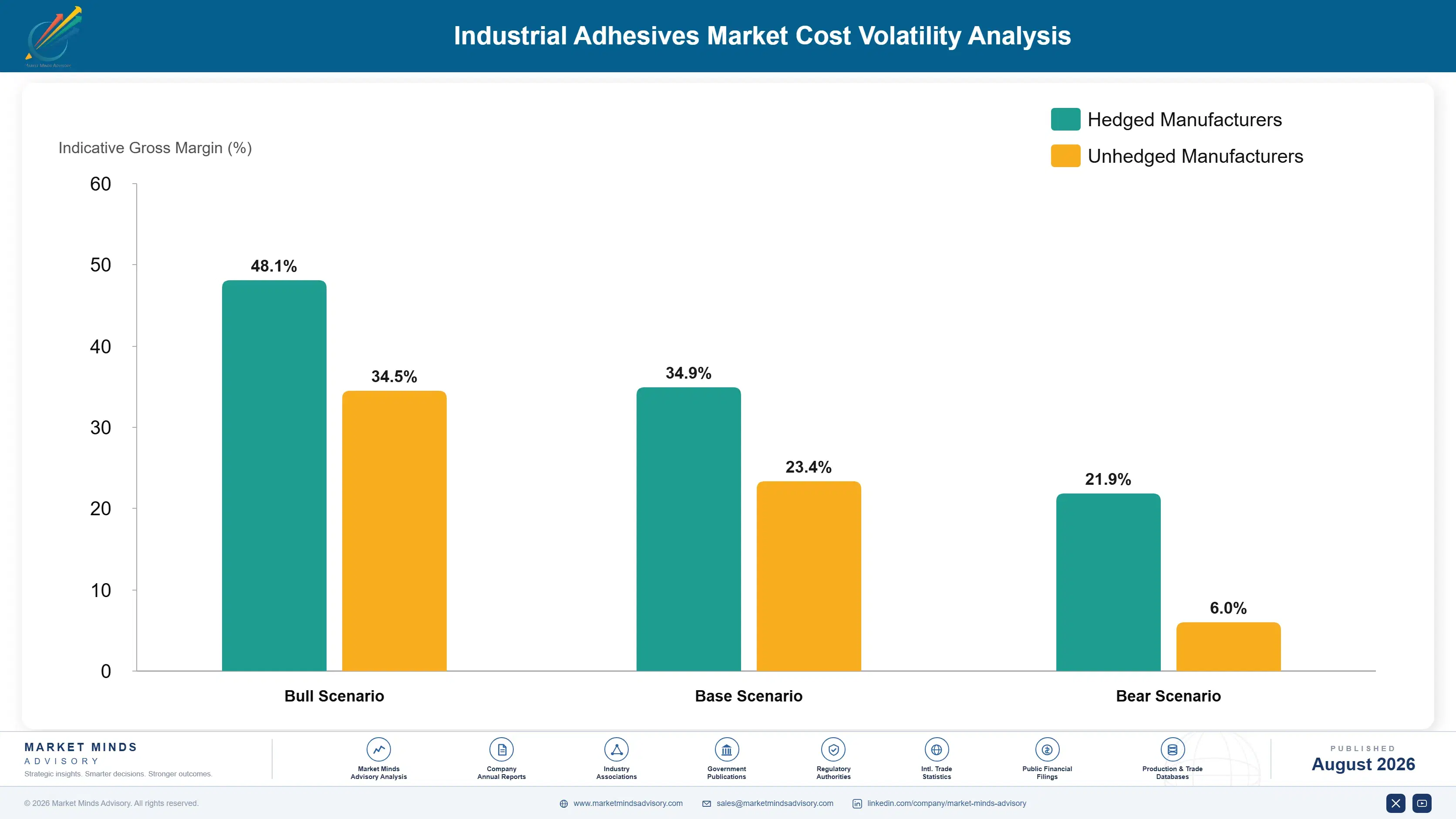
Epoxy resin, polyurethane precursor, and acrylic monomer pricing has grown more volatile since 2022 due to refinery capacity shifts and natural gas price swings in key producing regions, creating margin pressure that formulators struggle to fully pass through under competitive automotive and electronics contract pricing. The root cause is thin global capacity buffers for key petrochemical intermediates. Several producers are exploring feedstock diversification and longer-term hedging arrangements to reduce quarter-to-quarter margin volatility across their industrial adhesive product lines and broader specialty chemical portfolios. This dynamic increasingly separates vertically integrated producers from smaller spot-market-dependent formulators.
Market Impact: Lifts UV-curable share by 9 points
3 additional market trends, 4 additional growth drivers, and 3 additional restraints and challenges are covered in the full report. Contact sales@marketmindsadvisory.com to access the complete intelligence.

Segment CAGR and Growth Architecture

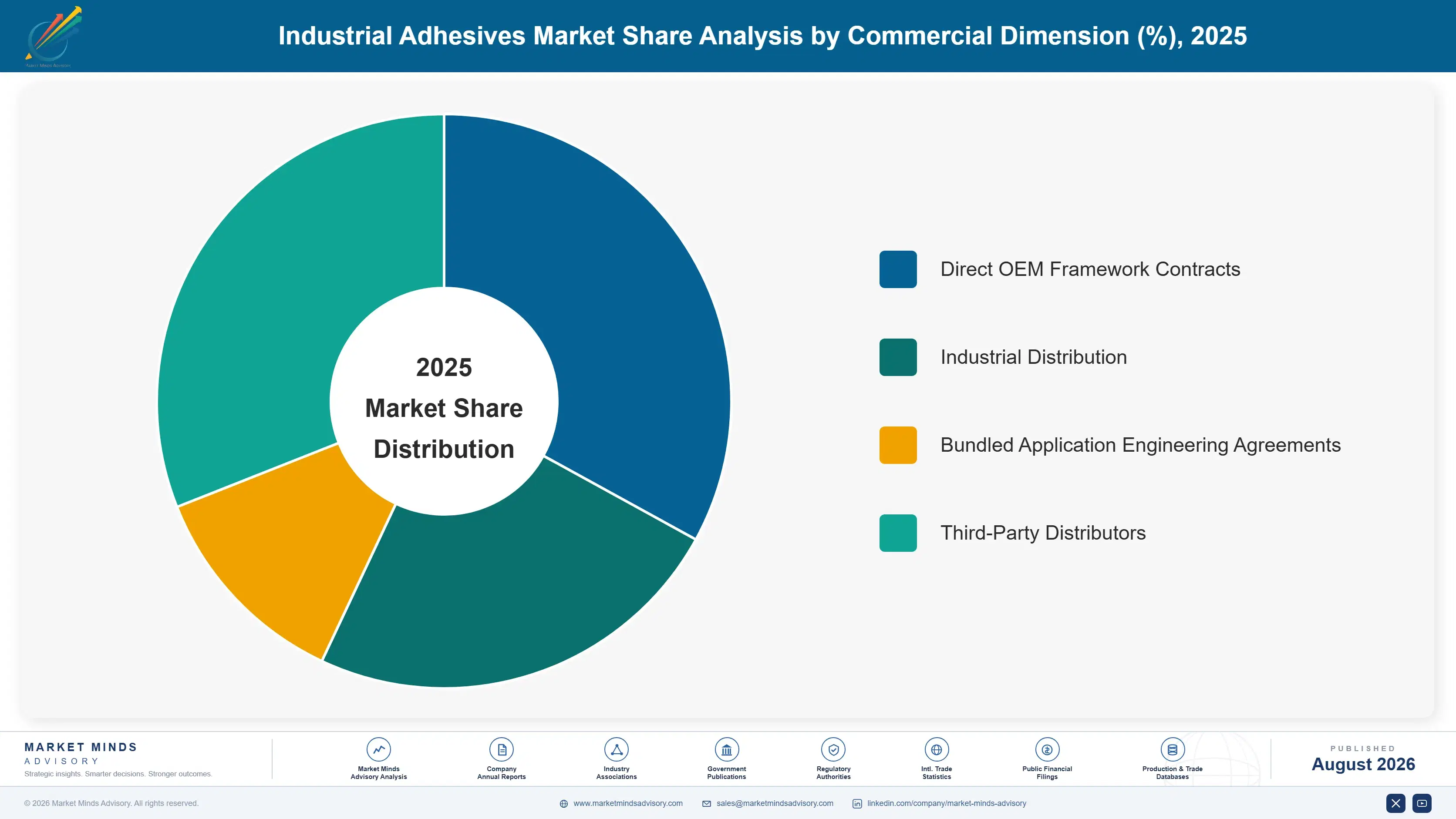
The market is segmented by resin technology, the classification that best reflects how manufacturers actually specify and procure adhesives, since bond strength, cure mechanism, and substrate compatibility requirements follow resin chemistry rather than end-use industry or application format considerations across most purchasing decisions. Each dimension carries distinct qualification cycles that materially affect long-term switching costs.
industrial-adhesives-market-market-share-analysis-1787310918873

UV-Curable Adhesives

UV-curable adhesives are the fastest-growing resin category as electronics manufacturers seek faster, more precise bonding processes for increasingly miniaturized components that traditional thermal-cure chemistries cannot reliably support at high production volumes. These formulations cure in seconds under controlled ultraviolet exposure rather than requiring extended thermal cycles, meaningfully improving manufacturing line throughput for smartphone, semiconductor, and display assembly applications. Demand is concentrated among electronics contract manufacturers and component suppliers in East Asia, where production line speed directly determines competitive cost position. Suppliers with established formulation depth in low-shrinkage, optically clear UV-curable chemistries are capturing disproportionate share of new electronics assembly contracts, since cure speed and optical clarity requirements continue tightening across successive generations of increasingly compact consumer electronic devices.
CAGR 9.6%

Polyurethane Adhesives

Polyurethane adhesives are growing quickly as automotive manufacturers and construction firms seek flexible, impact-resistant bonding chemistries suited to structural glazing, panel bonding, and multi-material vehicle assembly applications requiring both strength and elasticity to accommodate thermal expansion differences between dissimilar materials. Vehicle windshield bonding represents an established and steadily growing application, while structural body panel bonding represents a newer and faster-growing use case tied to vehicle lightweighting programmes. Suppliers differentiate through formulation stability across wide temperature ranges and adhesion promoter technology enabling reliable bonding to painted and coated substrates without extensive surface preparation, a capability increasingly valued by manufacturers seeking to simplify assembly line processes while maintaining consistent bond quality across production runs.
CAGR 8.2%
Full segment breakdown across 6 segments available in the complete report.

Regional Architecture and Country Demand Map

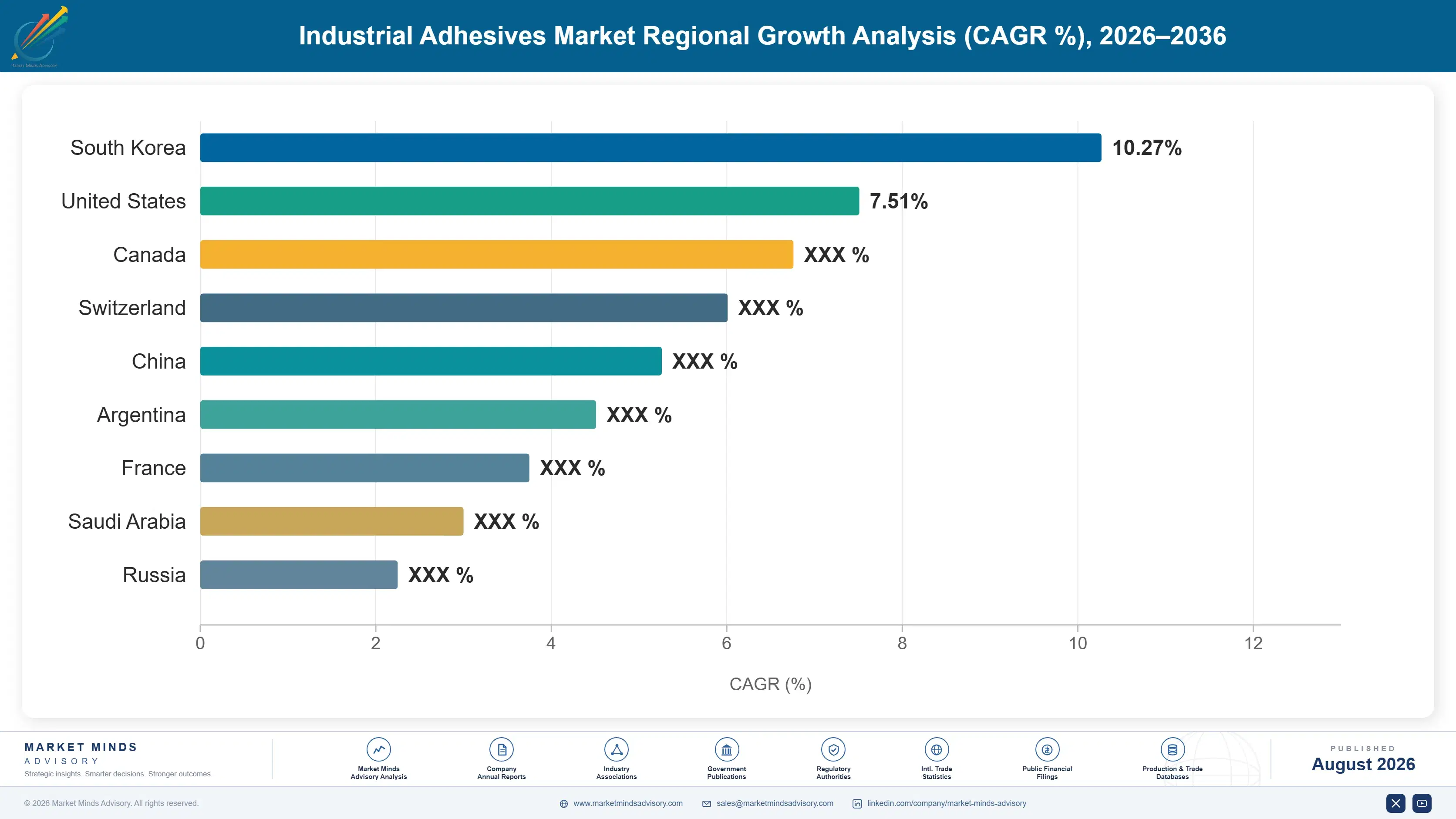
East Asia leads global demand on the strength of China's electronics and vehicle manufacturing base, while South Asia and Pacific posts the fastest growth, driven by expanding electronics assembly and automotive manufacturing capacity through 2036. Trade linkage and manufacturing hub proximity explain variation across the remaining five regions.

North America

Electric vehicle production ramp anchors most incremental demand across this region, with automakers in the United States and Mexico expanding battery pack and multi-material body assembly capacity requiring substantial structural adhesive volume per vehicle produced. Electronics assembly demand concentrates in semiconductor and consumer electronics manufacturing clusters supported by federal incentive programmes, requiring UV-curable and thermally conductive adhesive formulations at growing scale. Canadian demand grows more steadily, tracking general industrial manufacturing and construction activity. Suppliers with established automotive original equipment manufacturer relationships and dedicated application engineering support are capturing disproportionate share of new vehicle platform adhesive qualification contracts across both countries' expanding vehicle assembly footprint. Suppliers without dedicated application engineering teams increasingly struggle to win the largest platform contracts available today.
Share: 24% | CAGR: 6.4% (2026 to 2036)

Western Europe

Western Europe's growth trails the global average because its manufacturing base is already substantially mature, shifting demand toward higher-performance formulation upgrades rather than wholesale capacity expansion. German and French automotive manufacturers continue leading structural adhesive adoption for multi-material vehicle bodies, given the region's early emphasis on vehicle lightweighting to meet strict emissions targets. Nordic and Benelux construction markets show above-average structural glazing adoption tied to energy-efficient building envelope design preferences. Southern European markets including Spain and Italy show comparatively steadier growth tied to general industrial manufacturing and renovation construction activity across established commercial and residential building stock. Nordic markets round out regional demand with steady general industrial and construction adhesive purchasing programmes.
Share: 20% | CAGR: 4.8% (2026 to 2036)
Regional intelligence for 5 additional markets available in the complete report: East Asia, South Asia and Pacific, Latin America, Middle East and Africa, Eastern Europe. Contact sales@marketmindsadvisory.com.
industrial-adhesives-market-country-cagr-analysis-1787310919381

Converting Application Engineering Into Contract Wins

Suppliers that treat application engineering support as a differentiator rather than a cost center are capturing disproportionate share of new automotive and electronics contracts. The levers below outline where formulation depth and technical service investment translate most directly into premium pricing and durable customer relationships. Producers who ignore this shift risk ceding their best long-term contracts to faster-moving rivals.

Bundling Application Engineering Support With Structural Adhesive Supply

Suppliers who pair structural adhesive supply with dedicated application engineering support reduce a manufacturer's internal qualification workload substantially when introducing new multi-material bonding processes, creating a service advantage that pure chemistry suppliers cannot match. This approach has let leading formulators command price premiums of roughly 10 to 16% above standard structural adhesive pricing on new vehicle platform contracts, since manufacturers value the reduced qualification risk and faster development timeline more than marginal per-unit cost differences across comparable product specifications. Manufacturers increasingly write qualification speed clauses directly into these large platform agreements.
Market Impact: Adds 10 to 16% pricing premium on c

Expanding UV-Curable Formulation Capability for Electronics Assembly

Suppliers investing in dedicated UV-curable formulation research and development capability are capturing disproportionate share of electronics manufacturing contracts, since this segment requires continuous formulation improvement to keep pace with shrinking component tolerances and faster production line speeds. Companies with established UV-curable expertise report contract renewal rates above 88% on electronics assembly accounts, compared to notably lower renewal rates among suppliers competing purely on price without comparable formulation depth. This retention advantage compounds meaningfully over multiple platform generations as formulation depth accumulates further. Suppliers lacking this capability increasingly lose bids even at comparable base chemistry pricing levels.
Market Impact: Lifts contract renewal rates above

Localizing Blending Capacity Near Vehicle Assembly Clusters

Building regional blending capacity near expanding vehicle assembly clusters in Mexico, China, and Southeast Asia reduces logistics costs and delivery lead times, which matters disproportionately for automotive manufacturers running just-in-time production schedules that cannot tolerate delayed adhesive deliveries. Suppliers with regional production announced capacity investments exceeding $260 million across new facilities near major assembly hubs since 2023, positioning themselves ahead of competitors lacking comparable local delivery reliability. Competitors without comparable regional footprint increasingly struggle to match delivery reliability on time-sensitive contracts. New facility announcements give suppliers only a narrow window to build qualified local capacity.
Market Impact: Requires roughly $260 million in to

Accelerating Structural Adhesive Qualification Testing Programmes

Suppliers who invest in accelerated testing protocols and closer collaboration with manufacturer engineering teams during early product development shorten qualification timelines that otherwise extend beyond twelve months, securing earlier design-in positions on new vehicle and electronics platforms. Early movers in accelerated qualification have captured design-in positions across several dozen new vehicle platforms since 2023, locking in multi-year supply relationships before slower competitors complete comparable qualification processes. Early movers have captured design-in positions across roughly 45 new vehicle platforms since 2023. Utilities value proven track records over promised future qualification capability when evaluating new supplier bids.
Market Impact: Secures design-in positions across

Who Controls the Margin Pool

This market carries moderate concentration, with the top five suppliers holding roughly 34% combined share on a revenue basis, leaving a long tail of regional formulators and distributors that compete mainly on price and local service responsiveness rather than formulation innovation or application engineering depth. That gap has widened as application engineering becomes a harder qualification barrier to replicate quickly.
Current competitive activity centers on three dimensions: expanding structural adhesive and UV-curable formulation capability to serve electric vehicle and electronics assembly growth, building regional blending capacity near fast-growing manufacturing clusters in Mexico and Southeast Asia, and developing accelerated qualification testing programmes that shorten design-in timelines for automotive and electronics original equipment manufacturers. Several producers are also expanding brownfield blending capacity to reduce logistics costs near growing hubs.

Emerging pressure comes from Asian regional formulators scaling production to serve domestic electronics and general industrial demand at lower cost than multinational suppliers, gradually eroding share in commodity adhesive categories while multinational leaders retreat toward higher-margin structural and UV-curable segments where technical differentiation still commands premium pricing across most automotive and electronics accounts. Rankings among mid-tier suppliers are shifting fastest as formulation depth becomes a stronger competitive differentiator.
industrial-adhesives-market-company-positioning-matrix-1787310919901

Competitive Moat and Risk Dimensions

HENKEL

Moat: Broad Formulation Portfolio Depth

Henkel's extensive formulation portfolio spanning structural, UV-curable, and general industrial adhesive chemistries gives it cross-selling access and technical credibility that narrower competitors cannot match. Its established relationships with automotive and electronics original equipment manufacturers across multiple regions position it favorably for large platform-level supply contracts requiring consistent formulation quality across every assembly location.
HENKEL

Risk: Complex Portfolio Prioritization Challenges

Henkel's scale and diversified adhesive portfolio create meaningful organizational complexity when prioritizing investment across its many formulation categories and end-use verticals, potentially leaving it slower than more narrowly focused competitors to respond decisively to fast-moving UV-curable or structural bonding development timelines in specific high-growth segments like electric vehicle assembly.
3M

Moat: Advanced Materials Science Depth

3M's deep materials science research capability and extensive patent portfolio across bonding chemistries give it formulation advantages that smaller regional competitors cannot easily replicate, particularly in specialized structural and electronics bonding applications. Its cross-industry technical expertise, built across decades of advanced materials development, supports premium pricing on its most differentiated product lines serving demanding industrial applications.
3M

Risk: Price Competition Vulnerability

3M's premium positioning and higher cost structure leave it comparatively vulnerable to aggressive price competition from regional Asian formulators in less differentiated commodity adhesive categories, where technical service value is less pronounced. This exposes it to gradual share erosion in price-sensitive industrial contracts across developing markets prioritizing cost over performance depth.

Players Tracked

Prominent Players

Henkel
3M
Sika
H.B. Fuller
Arkema (Bostik)

Other Key Players

Dow
Huntsman Corporation
Avery Dennison
Illinois Tool Works
PPG Industries
Ashland
DuPont
Wacker Chemie
Master Bond
Permabond
Jowat
Kisling
DELO Industrial Adhesives
Panacol
Chemence

Recent Developments

FEBRUARY 2026

Henkel Expands Structural Adhesive Production in Mexico

Henkel commissioned an expanded structural adhesive production line at its existing Mexico facility, targeting growing demand from automotive manufacturers expanding nearshoring-driven vehicle assembly capacity. The expansion adds meaningful annual capacity aimed at reducing delivery lead times for new vehicle platform structural bonding contracts across the North American manufacturing region.
Signal: Regional blending capacity near assembly c
OCTOBER 2025

3M Signs Long-Term Supply Agreement With Electronics Contract Manufacturer Consortium

3M signed a multi-year UV-curable adhesive supply agreement with a consortium of electronics contract manufacturers across South Korea and Taiwan. The agreement was a long-term supply contract, not an acquisition or joint venture, and includes provisions for joint formulation development targeting next-generation component miniaturization requirements across the covered manufacturing facilities.
Signal: Long-term electronics supply agreements ar
JUNE 2025

H.B. Fuller Acquires Specialty Structural Adhesive Formulator in Germany

H.B. Fuller completed the acquisition of a mid-sized German structural adhesive formulator specializing in automotive lightweighting applications, gaining formulation capability and customer relationships in the European vehicle assembly market. The transaction was structured as a full acquisition rather than a joint venture or minority equity stake in the target company's.
Signal: Acquisitions of specialty formulators are

Petrochemical Resin and Curing Agent Exposure

Epoxy resin, polyurethane precursor, and acrylic monomer inputs together represent roughly 58% of production cost of goods sold, with the remainder split across curing agents, energy, and packaging. Most resin and precursor supply originates from a concentrated set of petrochemical producers, creating exposure to regional feedstock disruptions. Rising demand from adjacent battery and electronics chemical sectors is further tightening available capacity.
Natural gas price spikes across Europe following supply disruptions in 2022 drove sharp increases in epoxy resin and polyurethane precursor input costs, a volatility event documented in the IEA's European gas market reports. Several European formulators temporarily curtailed production during the peak of that period, tightening regional adhesive supply and lifting spot prices well above longer-term contract pricing for several consecutive quarters before conditions gradually normalized through 2023.

This cost exposure disadvantages smaller regional formulators lacking long-term feedstock hedging arrangements or vertically integrated production, since they must pass through input cost spikes immediately or absorb margin compression. Larger integrated producers with diversified feedstock sourcing and multi-year supply contracts weather volatility more smoothly, widening the competitive gap during periods of feedstock price disruption. Producers absent from long-term contracts face the sharpest earnings volatility during disruption periods.
industrial-adhesives-market-cost-volatility-analysis-1787310920098

Diversifying Resin and Monomer Sourcing Across Regions

Leading formulators are qualifying secondary resin and monomer suppliers across multiple regions to reduce dependence on any single feedstock source, cutting exposure to regional supply disruptions. This diversification has reduced average feedstock lead time volatility for several major adhesive manufacturers over the past two years across comparable production facilities and blending operations. This also shortens requalification timelines during disruption.

Locking Multi-Year Petrochemical Supply Contracts

Larger formulators are negotiating multi-year resin and precursor supply contracts at fixed or collared pricing to shield production economics from short-term spot market volatility. This approach has helped several producers avoid the sharpest cost spikes experienced by spot-market-dependent competitors during recent periods of European gas price disruption and refining capacity constraints. Fixed terms also simplify budgeting for multi-year contracts.

Developing Bio-Based Resin Alternatives

Several producers are investing in bio-based epoxy and polyurethane resin chemistries derived from renewable feedstocks, reducing exposure to petrochemical price swings while also addressing growing customer preference for lower-carbon adhesive options. Early commercial volumes remain modest but are growing steadily across automotive and construction pilot programmes testing these alternative formulations. Regulatory incentives are improving these alternative chemistry economics.

Portfolio Architecture for Margin Defence

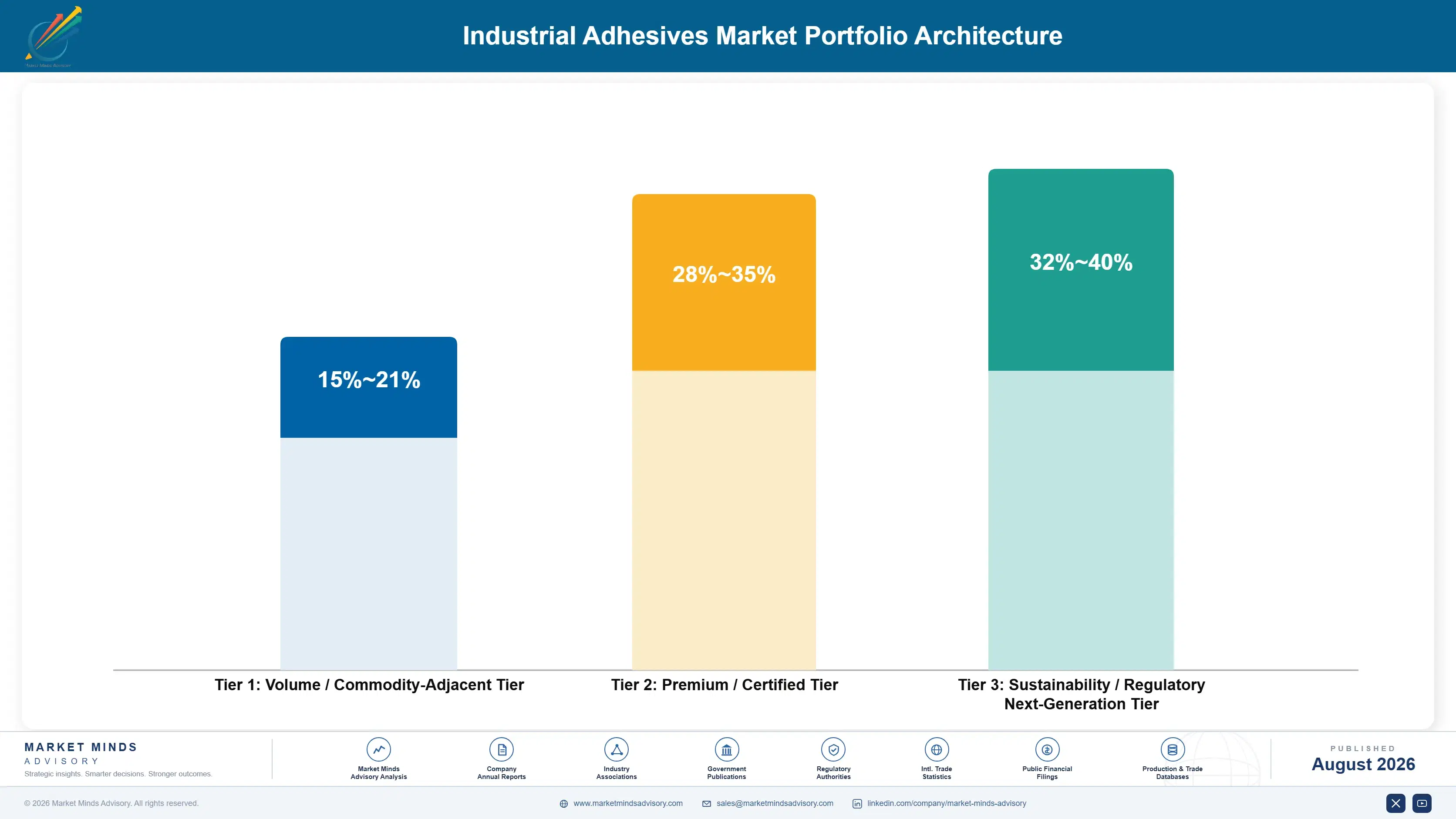
Portfolio economics split across three tiers. Volume commodity-adjacent general industrial adhesives carry thin margins driven by feedstock cost pass-through, while premium certified structural and UV-curable formulations qualified for automotive and electronics platforms command meaningfully higher gross margins reflecting formulation complexity and the qualification barriers competitors must clear to enter these categories. Buyers in each tier evaluate suppliers on different criteria, complica
The tension between volume and premium positioning defines supplier strategy. Commodity general industrial adhesive volume remains large but slow-growing and price-competitive, while premium structural and UV-curable formulations represent a smaller but much faster-growing and higher-margin pool that rewards suppliers with dedicated application engineering and formulation research capability across their expanding customer base. Suppliers unable to run both playbooks well risk losing ground on at least one competitive front nationwide.

High-value margin pools concentrate specifically in electric vehicle structural adhesives, UV-curable electronics bonding chemistries, and application-engineering-bundled service contracts, where technical differentiation and qualification barriers remain highest relative to commodity general industrial adhesive categories sold mainly on price. Suppliers absent from these pools risk being confined to thinner-margin commodity competition long-term.

Volume / Commodity-Adjacent Tier

Standard general industrial adhesives sold mainly on price to broad manufacturing buyers with thin, feedstock-sensitive margins nationwide. These buyers typically negotiate primarily on delivered price and minimum order volume commitments each cycle.
Gross Margin: 15-21%

Premium / Certified Tier

Structural and UV-curable formulations qualified for automotive and electronics platforms, commanding steadier premium pricing from original equipment manufacturers. Qualification testing cycles can take a year or more before a new supplier is fully approved.
Gross Margin: 28-35%

Sustainability / Regulatory / Next-Generation Tier

Bio-based resin formulations and application-engineering-bundled offerings capturing early-mover sustainability and service premiums from demanding buyers. Adoption remains early-stage but is expanding steadily as manufacturers formalize sustainability procurement scoring criteria. and construction buyers.
Gross Margin: 32-40%
industrial-adhesives-market-portfolio-architecture-1787310920600

High-value Sub-segments and Strategic Watch-out

EV Structural and Thermal Management Adhesives

Highest-value, fastest-growing pool tied directly to electric vehicle production ramp, commanding premium pricing on formulation depth and platform-level qualification relationships. Contracts here typically run multiple years and carry the highest switching costs across the entire portfolio. Delivery penalties in these contracts make reliability the biggest differentiator in this segment overall.
Gross Margin: 34-42%

UV-Curable Electronics Assembly Adhesives

High-value pool growing steadily alongside electronics miniaturization trends, anchored in cure-speed differentiation and long-term contract manufacturer supply relationships overall. Suppliers embedded early in a contract manufacturer's supply chain rarely get displaced once production stabilizes. International certification renewal cycles create additional recurring qualification touchpoints for suppliers to capture.
Gross Margin: 30-37%

General Industrial and Construction Adhesives

Largest volume core segment, price-competitive and feedstock-exposed, generating steady but comparatively low-margin revenue across mature manufacturing demand nationwide currently. Producers here compete mainly on logistics efficiency and regional proximity rather than deep technical differentiation. Consolidation pressure is intensifying as low-cost regional formulators expand capacity faster than demand.
Gross Margin: 15-20%

Import-Dependent Commodity Resin Categories

Strategic watch-out segment facing rising exposure to petrochemical feedstock volatility and freight costs; formulators reliant on imports face ongoing margin compression risk. Suppliers reliant on these categories should actively diversify sourcing to reduce feedstock exposure risk. Feedstock volatility could compress this segment's already thin margins further with limited advance notice.
Gross Margin: 12-17%

Platform Qualification Cycles and Design-In Economics

Adhesive demand behaves like an annuity once a supplier is qualified on a specific vehicle or electronics platform, since switching suppliers mid-platform requires re-validating bond performance across extensive testing protocols, a process most manufacturers avoid unless forced by persistent cost or performance problems with their supplier. Requalifying an alternative supplier mid-platform can add unwanted risk to a manufacturer's production schedule.
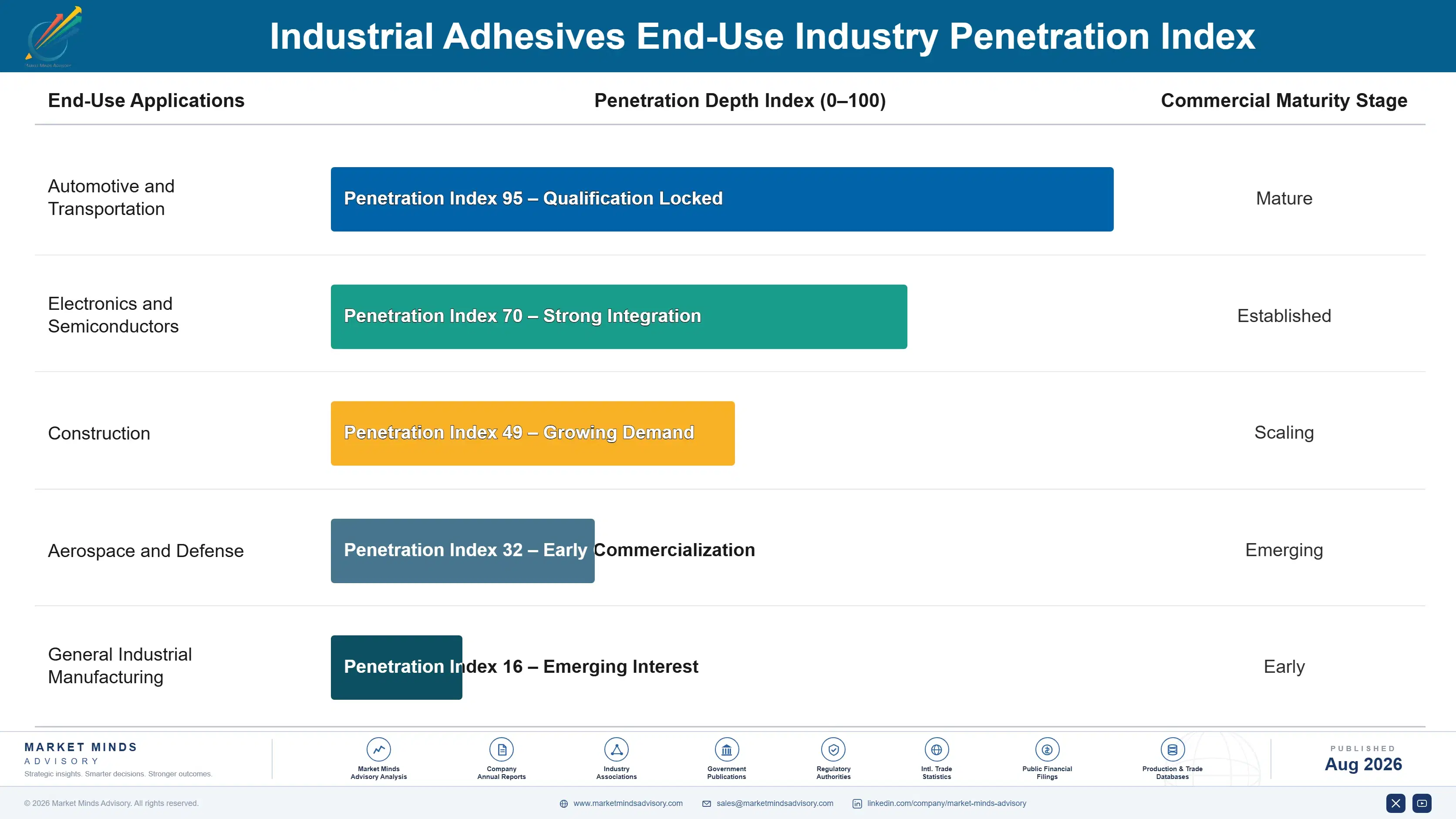
Adoption stickiness varies meaningfully by end-use vertical. Automotive structural bonding applications show the deepest stickiness given multi-year platform cycles and strict safety qualification requirements, while general industrial buyers show moderate stickiness tied to periodic competitive tendering, and electronics assembly buyers show intermediate stickiness that strengthens considerably once a supplier proves reliable performance during initial high-volume production ramp-up phases across component lines. Aerospace buyers increasingly mirror automotive-level stickiness given similarly demanding safety qualification requirements.

A generational shift in buyer profiles is underway as manufacturer procurement teams increasingly include dedicated materials engineering specialists rather than relying solely on purchasing staff, changing how suppliers must present technical performance data and application engineering support during the qualification and platform renewal process across most large automotive and electronics accounts globally. Younger engineering staff also weigh sustainability data more heavily than their predecessors did previously.
industrial-adhesives-market-end-use-penetration-index-1787310921087

Where Application Engineering Beats Price

These are among the four positions where our research anticipates prominent divergence between winners and laggards over the coming forecast period. Each is grounded in the demand model, the regulatory perimeter, and the announced capacity pipeline.
01 / STRUCTURAL BONDING INVESTMENT

Prioritize structural adhesive qualification ahead of EV platform ramp

Suppliers who invest early in structural adhesive formulation depth and secure design-in positions on new electric vehicle platforms will capture a disproportionate share of the substantial adhesive volume growth tied to battery pack and multi-material body assembly through the coming decade. Waiting until platform decisions are finalized risks losing qualification slots to faster-moving competitors who have already built the necessary testing and application engineering track record. Early movers can also charge meaningful premiums for documented qualification speed that slower competitors cannot yet offer.
02 / REGIONAL CAPACITY EXPANSION

Build regional blending capacity near nearshoring assembly clusters

Localizing blending capacity near Mexico, China, and Southeast Asian vehicle and electronics assembly clusters reduces delivery lead times for adhesives requiring frequent replenishment, a meaningful competitive advantage over distant suppliers relying on longer shipping routes. This positioning matters most given how much new manufacturing capacity is concentrating in these regions as nearshoring and supply chain diversification accelerate, and suppliers without this reach face a widening gap versus faster-moving regional formulators. Suppliers without local capacity risk losing contracts to regional formulators who can guarantee faster, more reliable delivery.
03 / APPLICATION ENGINEERING SERVICES

Bundle application engineering support to defend structural pricing

Bundling application engineering support with structural adhesive supply creates a service advantage that pure commodity suppliers cannot replicate, defending premium pricing of 10 to 16% on new platform qualification contracts. This approach matters most for automotive and electronics manufacturers navigating complex multi-material bonding challenges, where engineering risk outweighs marginal cost differences, and suppliers without comparable engineering capability increasingly lose bids at similar base pricing levels. Suppliers without this capability should expect gradual share erosion in accounts where competitors already offer bundled support.
04 / PORTFOLIO CAPITAL REBALANCING

Shift capital away from commodity adhesives toward structural and UV-curable lines

Commodity general industrial adhesive categories face thinning margins from feedstock volatility and regional price competition, while structural and UV-curable formulations offer substantially higher and more durable margins tied to qualification barriers competitors struggle to clear quickly. Suppliers should redirect capital expenditure toward structural and UV-curable production lines rather than defending commodity volume share against lower-cost regional competitors undercutting on price. This rebalancing protects long-term profitability even if it means accepting some gradual commodity volume share loss in the nearer term across established markets and customer accounts.

Engagement Snapshot From the Field

A live engagement with an industry participant carrying material or product regulatory and market exposure ahead of a defining policy shift, showing how our research translates into a defensible multi-year portfolio strategy.
MARKET MINDS ADVISORY · CLIENT ENGAGEMENT SUMMARY
Industrial Adhesives Producer Strategic Portfolio Review and Transition Roadmap 2026·Investment Scenario on Industrial Adhesives Exposure Evaluation 2025-26
CLIENT PROFILE
The client is a tier-one automotive components supplier operating several body assembly and battery pack integration facilities across North America, with combined annual revenue in the range of $2.1 billion (client-reported, unverified by MMA). The supplier was consolidating from eight regional adhesive vendors to a smaller preferred panel ahead of a new electric vehicle platform launch requiring extensive structural bonding qualification.
STRATEGIC CHALLENGE
The supplier needed to select adhesive vendors capable of meeting stricter structural bonding qualification standards required by the new electric vehicle platform while consolidating purchasing volume to secure better pricing terms. Existing vendor relationships varied widely in formulation quality and application engineering support, creating inconsistent bonding performance across the supplier's different assembly plants.
MMA APPROACH
MMA conducted a comparative supplier capability assessment covering six candidate structural adhesive vendors, evaluating formulation qualification status, application engineering capacity, and pricing structure across consolidated contract volumes. The engagement included facility visits and review of supplier performance data against the specific bonding requirements applicable to each assembly line and vehicle component type.
KEY FINDINGS
  1. Only two of six candidate vendors had formulations meeting the structural qualification standards required by the new electric vehicle platform. across the supplier's assembly plants.
  2. Consolidating purchasing volume to a two-vendor panel reduced projected annual adhesive spend by an estimated 14% (client-reported, unverified by MMA). once the transition was fully complete.
  3. Vendors offering bundled application engineering support demonstrated measurably faster qualification timelines across comparable structural bonding applications. during the qualification review process. overall.
  4. Three candidate vendors lacked sufficient regional application engineering staffing to support the supplier's planned multi-plant expansion timeline. within the supplier's planned timeline.
CLIENT PROFILE
The client is a tier-one automotive components supplier operating several body assembly and battery pack integration facilities across North America, with combined annual revenue in the range of $2.1 billion (client-reported, unverified by MMA). The supplier was consolidating from eight regional adhesive vendors to a smaller preferred panel ahead of a new electric vehicle platform launch requiring extensive structural bonding qualification.
STRATEGIC CHALLENGE
The supplier needed to select adhesive vendors capable of meeting stricter structural bonding qualification standards required by the new electric vehicle platform while consolidating purchasing volume to secure better pricing terms. Existing vendor relationships varied widely in formulation quality and application engineering support, creating inconsistent bonding performance across the supplier's different assembly plants.
MMA APPROACH
MMA conducted a comparative supplier capability assessment covering six candidate structural adhesive vendors, evaluating formulation qualification status, application engineering capacity, and pricing structure across consolidated contract volumes. The engagement included facility visits and review of supplier performance data against the specific bonding requirements applicable to each assembly line and vehicle component type.
KEY FINDINGS
  1. Only two of six candidate vendors had formulations meeting the structural qualification standards required by the new electric vehicle platform. across the supplier's assembly plants.
  2. Consolidating purchasing volume to a two-vendor panel reduced projected annual adhesive spend by an estimated 14% (client-reported, unverified by MMA). once the transition was fully complete.
  3. Vendors offering bundled application engineering support demonstrated measurably faster qualification timelines across comparable structural bonding applications. during the qualification review process. overall.
  4. Three candidate vendors lacked sufficient regional application engineering staffing to support the supplier's planned multi-plant expansion timeline. within the supplier's planned timeline.
RECOMMENDED STRATEGY
Phase 1: Phase 1 (Months 1 to 2): Finalize vendor panel selection based on qualification status, engineering capacity, and consolidated pricing terms offered. Phase 2: Phase 2 (Months 3 to 8): Transition existing assembly plants to the new preferred vendor panel while monitoring bonding performance metrics closely. Phase 3: Phase 3 (Months 9 to 14): Extend the new vendor relationships to the electric vehicle platform launch facilities as production ramps up.
OUTCOME
The automotive supplier consolidated to a two-vendor panel offering bundled application engineering support and formulations meeting all required structural qualification standards. Annual adhesive procurement costs came in approximately 12% below the prior multi-vendor arrangement (client-reported, unverified by MMA), while bonding performance consistency improved meaningfully across all covered assembly facilities.

Frequently Asked Questions

Foundational context covering the market sizes, CAGR, scope, country, region and competition that inform every finding below. This section is provided to cover basics and most often pre-purchase conversations, answered from the MMA Primary Research Dataset.

What is the current size of the Industrial Adhesives Market?

The market is valued at approximately $48.5 billion in 2025. Growth is driven by vehicle lightweighting, electronics miniaturization, and structural bonding adoption across most major manufacturing regions.

How large will the Industrial Adhesives Market be by 2036?

The market is projected to reach approximately $93.03 billion by 2036. Sustained electric vehicle production growth and electronics assembly expansion together drive this trajectory forward.

What is the CAGR for the Industrial Adhesives Market 2026 to 2036?

The market is forecast to grow at a compound annual growth rate of 6.1% between 2026 and 2036. UV-curable adhesives are growing considerably faster than the overall market average.

Which segment is growing fastest?

UV-curable adhesives are growing fastest at approximately 9.6% CAGR, roughly 1.57 times the overall market rate. Growth is driven by electronics miniaturization and faster production line speeds.

Who are the major companies in the Industrial Adhesives Market?

Leading suppliers include Henkel, 3M, Sika, H.B. Fuller, and Arkema (Bostik), together holding roughly 34% combined market share globally, with regional formulators making up the remainder.

Which country is growing fastest?

China is the fastest-growing major market at approximately 9.2% CAGR, driven by electronics and electric vehicle manufacturing expansion. India follows closely behind across the same period.

Report Segmentation Architecture

The full report scope spans multiple orthogonal segmentation dimensions, with cross-tabulated demand data provided for each dimension pair. Coverage extends further to regional breakdowns, trend trajectories, and the competitive detail needed to support segment-level decision-making.

By Resin Technology

  • Epoxy Adhesives
  • Polyurethane Adhesives
  • Acrylic Adhesives
  • Silicone Adhesives
  • UV-Curable Adhesives
  • Hot-Melt Adhesives

By End-Use Industry

  • Automotive and Transportation
  • Electronics and Semiconductors
  • Construction
  • Aerospace and Defense
  • General Industrial Manufacturing

By Commercial Dimension

  • Direct OEM Framework Contracts
  • Industrial Distribution
  • Bundled Application Engineering Agreements
  • Third-Party Distributors

By Region

  • North America
  • Western Europe
  • East Asia
  • South Asia and Pacific
  • Latin America
  • Middle East and Africa
  • Eastern Europe

Scope, Methodology, and Coverage

Every figure in this report is reproducible from documented input assumptions. The scope below maps the historical period, the forecast horizon, the segmentation dimensions, and the countries covered, alongside the underlying primary and qualitative methodology.
Historical Period
2020 to 2025
Forecast Period
2026 to 2036
Base Year
2025 (USD billions; MMA Primary Research Dataset, August 2026)
Market Definition
This report covers adhesives formulated for industrial bonding applications across automotive, electronics, construction, and general manufacturing, including epoxy, polyurethane, acrylic, silicone, UV-curable, and hot-melt chemistries. It excludes consumer and household adhesive products sold through retail channels.
Quantitative Units
USD billions (current prices); metric tons where volume data is available
Segmentation Dimensions
By Resin Technology; By End-Use Industry; By Commercial Dimension; By Region
Regions Covered
North America, Western Europe, East Asia, South Asia and Pacific, Latin America, Middle East and Africa, Eastern Europe
Countries Covered
USA, China, Germany, France, UK, Japan, South Korea, India, Australia, Canada, Brazil, Mexico, Indonesia, Vietnam, Thailand, Malaysia, UAE, Saudi Arabia, South Africa, Nigeria, Turkey, Poland, Netherlands, Italy, Spain, Sweden, Switzerland, Argentina, Colombia, Singapore, and additional markets relevant to this sector
Key Companies Profiled
Henkel, 3M, Sika, H.B. Fuller, Arkema (Bostik), Dow, Huntsman Corporation, Avery Dennison, Illinois Tool Works, PPG Industries, Ashland, DuPont, Wacker Chemie, Master Bond, Permabond, Jowat, Kisling, DELO Industrial Adhesives, Panacol, Chemence
Quantitative Methodology
Primary survey, n=3,800 respondents, Q4 2025, six countries; demand-side model with trade association cross-validation
Qualitative Methodology
47 expert interviews, Q4 2025; applied to validate demand model assumptions, identify emerging dynamics, and assess competitive positioning
Report Format
PDF and XLSX data workbook (Word format preview document)
Publisher
Market Minds Advisory
Report Code
MMA-2026-CHM-104
Published
August 2026
Contact
sales@marketmindsadvisory.com | www.marketmindsadvisory.com

Purchase the full Industrial Adhesives Market Report (2026 to 2036).

The full report delivers detailed segment-level sizing across all six resin technology categories, country-level regional breakdowns for all seven regions, and in-depth competitive profiles covering twenty companies active in this market. It includes granular analysis of electric vehicle adhesive consumption trends by platform, petrochemical feedstock cost sensitivity modeling, and supplier qualification pathway guidance for manufacturers navigating structural bonding adoption. The report also profiles emerging bio-based resin chemistries gaining early commercial traction. Buyers also receive access to underlying data tables and a dedicated analyst briefing call.
Country-level sizing across thirty markets covered
EV adhesive consumption tracker by vehicle platform
Feedstock cost sensitivity modeling and forecasting tools
Twenty-company competitive benchmarking profiles provided in full
Supplier qualification pathway guidance provided throughout
Dedicated analyst briefing call included at no cost

Built For The People Who Decide

From boardroom strategy to bench-side execution, this report is read cover-to-cover by leaders shaping the next decade of their industry, turning demand scenarios, market dynamics and valuation benchmarks into decisions.
CXOs/ Presidents/ VPs/ Managers
M&A and Corporate Development
Strategy Teams and R&D Heads
Procurement and Product Directors
Regulatory and Compliance Leaders
Investor Relations and Equity Analysts