Market Minds Advisory
India Period Panties Market

India Period Panties Market: India Period Panties Market. Reusable Absorbent Wear Goes Mainstream

India's period panty category shifts from niche urban e-commerce purchase toward mainstream retail as absorbency technology improves and price points fall, while rural distribution gaps determine which brands convert awareness into repeat purchase.

Lead Analyst

Published

September 2026

Make Smarter Decisions with Customized Research Insights

Request a free sample report and evaluate market opportunities, growth trends, and competitive dynamics relevant to your business needs.

2025 MARKET VALUE$0.5BMarket Size 2025
2036 FORECAST VALUE$1.9BBase Case , 2026 to 2036
CAGR 2026 TO 203613.5 %Bull 14.8% / Bear 12.2%
INCREMENTAL OPPORTUNITY$1.4BNet 10- year value creation
EXPANSION MULTIPLE3.56x2036 value over 2026 base
Strategic Levers
M&A Pipeline
Regional Outlook
Country Rankings
Competitive Intelligence
Segmental Deep-dive
Call-Us : 91 93563 13602

Executive Snapshot and Market Trajectory.

India's period panty category has moved from a niche urban e-commerce purchase into a mainstream retail consideration, as improved absorbency technology and falling price points bring the product within reach of buyers who previously dismissed it as an imported luxury item beyond their reach financially and culturally.
Overnight and heavy-flow absorbency variants are pulling disproportionate growth as brands solve the leakage and comfort complaints that limited adoption among first-time buyers, while direct-to-consumer digital marketing normalizes menstrual product conversations that traditional Indian retail advertising has historically avoided discussing openly, particularly across smaller cities and towns where menstrual stigma remains considerably more entrenched than in metropolitan markets across most demographic and income segments nationwide, slowing category-wide adoption considerably even in otherwise receptive urban markets.
Domestic startups compete on affordability and vernacular-language marketing while multinational hygiene brands push premium absorbency claims through pharmacy and modern trade channels, and rural distribution remains the unresolved frontier neither group has cracked at meaningful commercial scale yet, leaving a substantial share of the country's population largely unreached by either strategy despite years of urban-focused digital marketing investment and awareness campaigns spanning multiple states so far.
Market Definition
The India period panties market covers reusable, washable absorbent underwear designed to replace or supplement disposable pads and tampons during menstruation, sold through e-commerce, pharmacy, and modern trade retail channels. It excludes disposable sanitary pads, tampons, and menstrual cups.
Base Year Value
$0.5B in 2025 (MMA Primary Research Dataset, September 2026)
Forecast Period
2026 to 2036, eleven discrete annual values
CAGR
13.5% base case. Bull 14.8%. Bear 12.2%.
Fastest Growth Segment
Multi-Layer Overnight Absorbency Panties: 19.8% CAGR
Fastest Growth Country
India: 15.5% CAGR
Fastest Growth Region
South Asia and Pacific: 15.5% CAGR
Largest Region
South Asia and Pacific: 24% of 2025 global value
Market Leaders
Nykaa Fashion, Sirona Hygiene, Newme, Adira by Fateh, Carmesi. Source: MMA Analysis based on company filings and primary research.
Primary Survey
n=3,800 procurement and R&D decision-makers, Q4 2025, six countries
Methodology
Demand-side build-up, cross-validated against public data, 47 expert interviews

India Period Panties Market Forecast Scenarios

india-period-panties-market-size-forecast-scenario-1790024329672
Between 2020 and 2025 the category grew at roughly 12.5 percent annually, almost entirely through direct-to-consumer e-commerce channels, as domestic startups built awareness through digital marketing that traditional Indian retail advertising had historically avoided addressing directly and openly with consumers, particularly outside major metropolitan areas and among English-speaking urban demographics that dominated the category's earliest years.
The base case assumes 13.5 percent annual growth through 2036, anchored in three commercial mechanisms: absorbency technology improvements that resolve the leakage complaints limiting repeat purchase, modern trade and pharmacy expansion that finally puts the product on physical shelves beyond e-commerce alone, and falling manufacturing costs that bring price points within reach of middle-income buyers previously priced out entirely. Regional-language marketing campaigns reinforce this by reaching buyers metropolitan-focused digital advertising has largely missed.
A 14.8 percent bull scenario emerges if rural distribution partnerships accelerate faster than expected, reaching the population segment neither domestic startups nor multinational brands have served at scale so far. A 12.2 percent bear scenario follows if persistent menstrual stigma in smaller cities continues limiting retail visibility and word-of-mouth adoption more than most manufacturers currently anticipate in their planning models.

Trust and Absorbency as Competitive Currency

Three forces converge on this category at once: absorbency technology that finally resolves the leakage complaints limiting repeat purchase, digital marketing that normalizes menstrual product conversations in a market where such discussion remained largely taboo until quite recently, and falling manufacturing costs that bring price points within reach of middle-income buyers previously priced out entirely.
MARKET CONCENTRATION26% CR5reflects combined revenue share held by top five brands
AVERAGE UNIT PRICE699 Rupeestypical two-piece starter pack retail price point nationwide
LEADING RETAIL CHANNEL62% E-Commercemeasures reliance on direct online sales rather than stores
MATERIAL INPUT COST SHARE38% of COGSreflects certified organic cotton and absorbent core sourcing costs
URBAN MARKET CONCENTRATIONTier 1, 58%captures revenue share concentrated in major metropolitan cities
REPEAT PURCHASE RATE44% Within Yearcaptures how often buyers reorder within twelve months typically
Commercially, the category behaves less like a hygiene commodity and more like a trust-building consumer product, where absorbency reliability and comfort reviews increasingly determine brand loyalty more than price alone among repeat buyers across most income segments. Brands that treat product testing and customer feedback as core infrastructure rather than an occasional marketing exercise are converting first-time buyers into habitual repeat purchasers at meaningfully higher rates than competitors relying on advertising alone.
Over the next decade, rural distribution expansion, absorbency technology improvements, and persistent regional stigma will jointly determine which brands can convert early urban adoption into genuinely national scale reach. Companies that treat vernacular-language marketing and last-mile distribution as defensible infrastructure, rather than a later expansion phase, remain best placed to capture the category's remaining decade of growth through 2036.
"The brands winning here are not the ones with the flashiest influencer campaign, they are the ones whose absorbent core actually holds up through an overnight flow."
Director, Consumer Health and Personal Care Practice · MMA Consumer Products Practice · September 2026

Market Trends

Absorbency Technology Finally Solves Overnight Leakage Complaints

Multi-layer absorbent core technology, combining certified organic cotton with high-capacity absorbent inserts, has resolved the overnight leakage problem that discouraged many first-time buyers from trusting period panties as a primary rather than backup product. Sirona Hygiene and Newme have both launched extended-wear variants tested for eight to ten hours of continuous absorbency, addressing the specific complaint that dominated early product reviews on e-commerce platforms. This technical improvement is pulling volume away from disposable pads for the first time among buyers who previously used period panties only as overnight backup rather than primary protection.
Market Impact: 58% cite workplace convenience as driver
Regional-Language Marketing Reaches Beyond Metro Buyers

Domestic brands have begun producing marketing content in Hindi, Tamil, Bengali, and other regional languages rather than relying exclusively on English-language digital advertising concentrated in metropolitan markets and affluent urban neighborhoods. Adira by Fateh and Carmesi have both launched regional campaigns specifically targeting tier-two and tier-three cities, a demographic English-language marketing had largely failed to reach despite years of category investment and awareness spending. This linguistic expansion is opening a substantial buyer population that metropolitan-focused digital marketing strategies previously left almost entirely untouched and unaware of the product category's existence.
Market Impact: reaches populations across 10 plus states

Market Opportunities and Growth Drivers

Rising Female Workforce Participation Expands Buyer Base

India's female urban workforce participation has climbed steadily over the past decade, and working women increasingly seek menstrual products that reduce mid-day changing frequency and discomfort during long commutes and extended office hours across most major metropolitan employment centers. MMA primary survey data shows 58 percent of employed female respondents citing workplace convenience as a primary reason for adopting period panties over disposable alternatives. This workforce-driven demand provides a more stable growth channel than purely awareness-driven adoption, since employment-linked need does not fluctuate with marketing campaign cycles or seasonal promotional activity.
Market Impact: under 15% of rural stores stock

Government Menstrual Hygiene Programs Build Category Awareness

State government menstrual hygiene schemes, originally designed to expand disposable pad access in rural and semi-urban areas, have increasingly begun including reusable product education as part of broader sustainability and cost-savings messaging to budget-conscious households. Several state health departments have piloted period panty distribution alongside traditional pad programs, introducing the category to populations that private-sector digital marketing had not yet reached through commercial advertising alone. This government-backed awareness channel is helping normalize the category in regions where cultural stigma around menstrual products remains considerably more entrenched than in metropolitan markets.
Market Impact: limits adoption in 60% of districts

Market Restraints and Challenges

Rural Distribution Gaps Limit National Retail Penetration

Period panties remain largely absent from general and kirana stores across rural and semi-urban India, where most disposable pad purchases still occur, leaving e-commerce as the only realistic access point for a large share of the country's population. The root cause is unit economics: rural retail margins on a higher-priced, lower-turnover product like period panties compare unfavorably to fast-moving disposable pads for small shopkeepers. Some brands are experimenting with women's self-help group distribution networks as an alternative channel, though rollout remains limited to a handful of pilot states so far.
Market Impact: 8 to 10 hours tested absorbency

Persistent Menstrual Stigma Slows Word-of-Mouth Adoption

Cultural stigma around openly discussing menstrual products continues limiting the word-of-mouth referral and in-store browsing behavior that drives adoption for most consumer categories, particularly in smaller cities and more conservative households across several states. The commercial impact falls hardest on brands lacking discreet packaging and vernacular-language educational content that addresses cultural sensitivities directly rather than assuming a Western-style openness that does not translate locally. Several brands are responding with plain, unbranded packaging and community health worker partnerships that introduce the category through trusted local intermediaries rather than direct advertising alone.
Market Impact: reaches over 400 tier-two cities
4 additional market trends, 3 additional growth drivers, and 2 additional restraints and challenges are covered in the full report. Contact sales@marketmindsadvisory.com to access the complete intelligence.

Segment CAGR and Growth Architecture

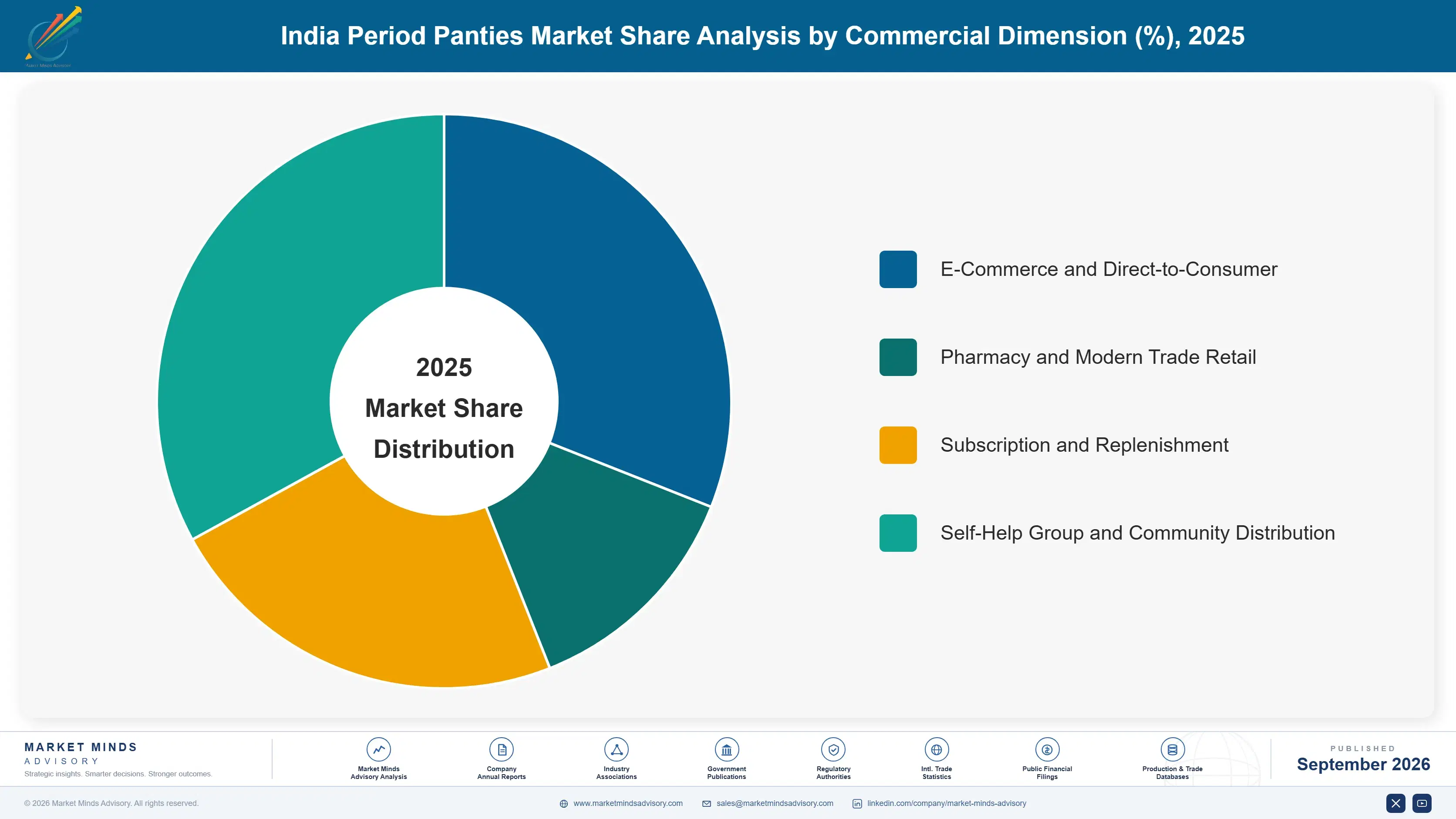
The market segments by absorbency capacity and construction technology rather than by brand or price tier, since absorbency performance, not packaging or marketing claims, determines which products can credibly replace disposable pads for a given flow intensity and use occasion. Six distinct technology categories together capture the full addressable scope of this market nationwide.
india-period-panties-market-market-share-analysis-1790024330234

Multi-Layer Overnight Absorbency Panties

Multi-layer overnight absorbency panties are growing fastest as brands finally solve the leakage problem that discouraged buyers from trusting the category for heavy-flow days rather than light backup use alone, a shift several years in the making. Certified organic cotton combined with high-capacity absorbent cores now delivers eight to ten hours of tested protection, converting buyers who previously used period panties only as overnight backup into primary-protection users during their heaviest flow days each cycle. Sirona Hygiene and Newme both lead this segment with clinically tested formulations, giving them a meaningful head start over smaller domestic brands still relying on unverified absorbency claims and marketing language alone to sell products.
CAGR 19.8%

Light-Flow Daily Wear Panties

Light-flow daily wear panties rank second-fastest as buyers increasingly adopt the category for everyday menstrual protection and spotting rather than only during heaviest flow days each cycle. This segment benefits from lower absorbent core cost relative to overnight variants, letting brands price entry-level products more competitively against disposable pad alternatives that dominate first-time buyer price comparisons across most income segments nationwide, particularly among first-time buyers. Domestic startups have concentrated their distribution effort here specifically to compete on affordability, since light-flow products require less absorbent material per unit than overnight variants, improving unit economics for brands still building manufacturing scale and national retail distribution reach across most states and union territories.
CAGR 16.5%
Full segment breakdown across 6 segments available in the complete report.

Regional Architecture and Country Demand Map

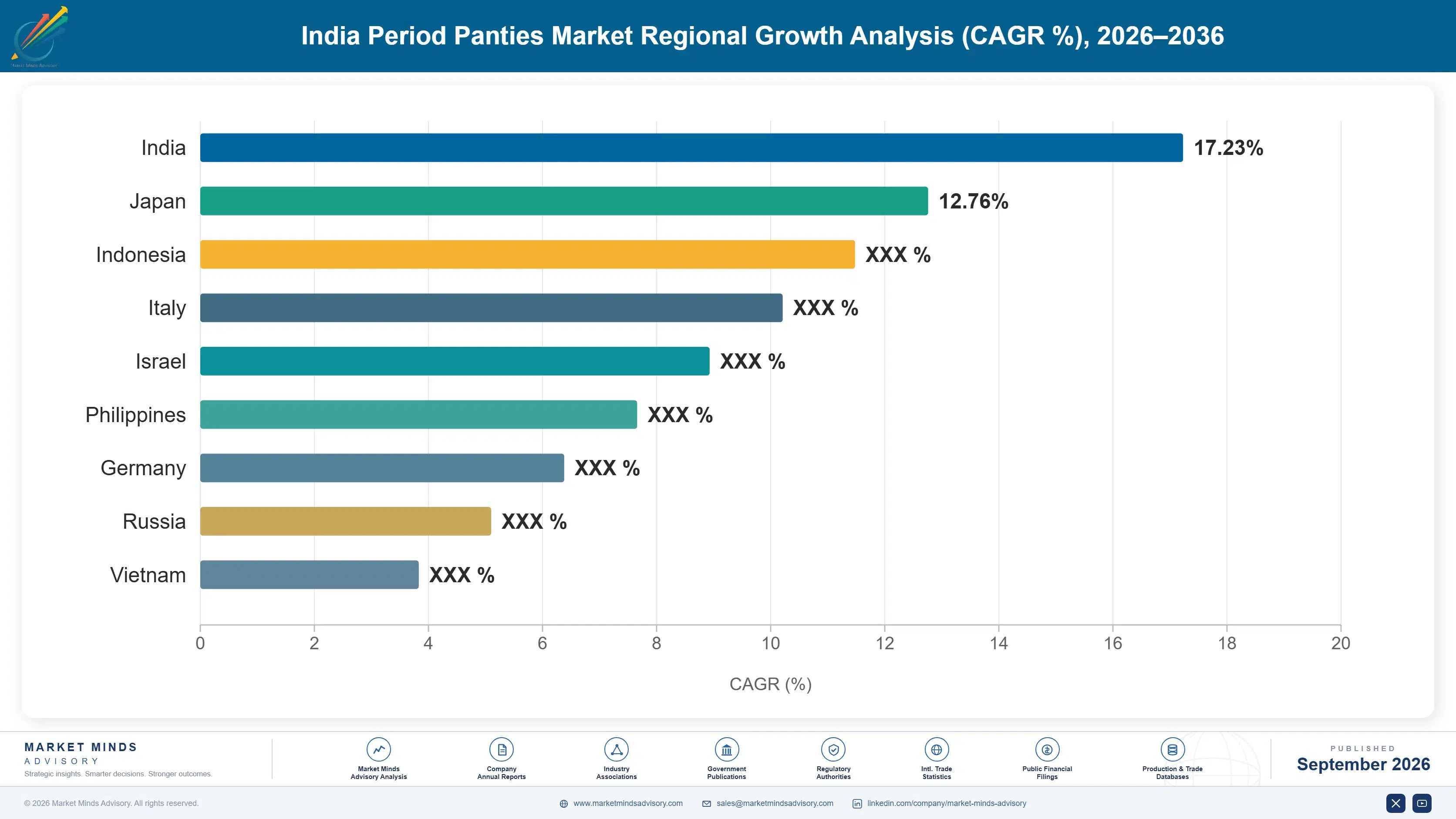
South Asia and Pacific leads on the strength of India's own domestic demand, well ahead of East Asia and North America, while smaller regions show comparable growth rates as the category expands globally from a low installed base across most developed and developing markets alike.

South Asia and Pacific

South Asia and Pacific holds a share well above the standard regional band because this report's core scope is India's own domestic market, where a population of over 350 million menstruating women represents by far the category's largest single addressable opportunity worldwide today. Domestic startups including Sirona Hygiene, Newme, and Carmesi built their entire commercial strategy around Indian buyers before considering export markets, unlike categories where India represents merely one growth market among several comparable options globally. Bangladesh and Pakistan contribute smaller but growing volume as regional e-commerce platforms extend distribution beyond India's own borders, while Australia represents a separate, much smaller, mature market within the same broader region entirely.
Share: 24% | CAGR: 15.5% (2026 to 2036)

East Asia

East Asia's growth stems primarily from China and South Korea, where reusable menstrual product adoption has grown steadily alongside broader sustainability consciousness among younger urban consumers seeking alternatives to disposable hygiene products sold nationwide. Domestic Chinese manufacturers increasingly export absorbent core technology components to Indian and Southeast Asian brands, reflecting the region's manufacturing scale advantage even where domestic consumption lags behind India's regulatory and cultural adoption drivers considerably. Japanese buyers show comparatively slower adoption given strong existing brand loyalty to established disposable hygiene product categories that dominate retail shelf space nationwide, leaving less room for reusable alternatives to gain meaningful traction quickly across most retail formats and online marketplaces alike.
Share: 22% | CAGR: 14.5% (2026 to 2036)
Regional intelligence for 5 additional markets available in the complete report: North America, Western Europe, Latin America, Middle East and Africa, Eastern Europe. Contact sales@marketmindsadvisory.com.
india-period-panties-market-country-cagr-analysis-1790024330747

Where Period Panty Brands Can Capture Margin

Four commercial angles determine which brands convert category growth into durable margin rather than simply riding urban e-commerce momentum: absorbency technology investment, regional-language marketing built for local nuance, rural distribution partnerships through community networks, and subscription-based replenishment relationships that reduce dependence on one-time e-commerce transactions across most retail formats and price segments nationwide over time.

Investing Early in Clinically Tested Absorbency Technology

Brands that fund clinical absorbency testing rather than relying on unverified marketing claims command meaningful price premiums, with tested overnight-absorbency panties retailing at roughly 45 percent above unverified equivalents in the same retail channel and price segment. The investment case rests on defensibility: clinical data and testing partnerships create trust advantages private label imitators cannot easily replicate through packaging alone. Brands that delay this investment risk losing credibility entirely as buyers increasingly compare absorbency claims across brands on social media and e-commerce review platforms nationwide before making a final purchase decision online.
Market Impact: Supports roughly a 45% price premium overall today

Building Regional-Language Digital Marketing Teams Nationally

Formal regional-language content strategies convert tier-two and tier-three city buyers at meaningfully higher rates than English-only marketing, with MMA survey data showing conversion rates roughly 35 percent higher among buyers exposed to vernacular-language content before purchase. Brands investing here typically fund dedicated regional content teams rather than translating English campaigns directly, since cultural nuance around menstrual stigma requires locally attuned messaging rather than literal translation. This lever compounds as accumulated regional trust becomes a durable brand asset over several years of sustained investment in community-specific messaging, outreach, and long-term trust-building efforts.
Market Impact: Drives conversion rates roughly 35% higher overall today

Piloting Women's Self-Help Group Distribution Channels

Brands increasingly partner with women's self-help groups and community health workers to distribute period panties in rural and semi-urban areas general retail has not reached, capturing volume without bearing the full cost of traditional retail expansion, with pilot programs reporting unit sales growing an estimated 50 percent faster than comparable e-commerce-only rural outreach. This approach lets brands monetize trust networks already embedded in local communities rather than building awareness from scratch. The tradeoff is real: scaling these partnerships nationally requires far more operational coordination and field staffing than digital marketing alone.
Market Impact: Grows rural unit sales by roughly 50% overall

Scaling Subscription-Based Replacement Programs Nationwide Today

Subscription and auto-replenishment programs reduce customer acquisition cost over the lifetime of a buyer relationship, with brands operating direct subscription channels reporting repeat purchase rates roughly 40 percentage points higher than buyers acquired through one-time e-commerce purchases alone. These programs also generate first-party usage data that informs faster absorbency and fit iteration than waiting on marketplace review aggregation. Brands without direct digital channels remain dependent on marketplace algorithms and promotional calendars, limiting their ability to build the kind of habitual, long-term replenishment relationship that well-designed subscriptions are specifically built to create.
Market Impact: Lifts repeat purchase rate by 40 points overall

Who Controls the Margin Pool

Combined estimated retail revenue from period panty product lines gives the top five companies roughly 26 percent share, a moderate concentration ranked by cumulative e-commerce and retail revenue since the category still lacks reliable public shipment volume disclosure. The gap between Nykaa Fashion, the category's largest player by this measure, and mid-tier challengers remains wide, driven mainly by distribution reach across both e-commerce and physical retail rather than absorbency technology alone.
Current competitive activity centers on three dimensions: absorbency technology development and clinical testing, regional-language digital marketing expansion into tier-two and tier-three cities, and rural distribution experimentation through community health worker and self-help group partnerships. Multinational hygiene brands increasingly launch India-specific product variants rather than importing global formulations unchanged, reshaping how competitive advantage transfers across company origin.

Emerging pressure comes from regional vernacular-first brands that build trust in tier-two and tier-three cities before metropolitan-focused competitors even enter those markets. Rankings are likely to shift over the next several years as rural distribution partnerships mature and force brands still concentrated purely in e-commerce to either build physical retail presence or cede share to competitors with broader distribution reach.
india-period-panties-market-company-positioning-matrix-1790024331275

Competitive Moat and Risk Dimensions

NYKAA FASHION

Moat: Integrated Beauty Retail Distribution

Nykaa's existing beauty and personal care retail platform gives its period panty line instant visibility to a large, already-engaged buyer base that standalone period panty brands must acquire through separate marketing spend entirely. This integrated distribution advantage compounds as cross-category purchase bundling improves conversion rates beyond what a single-category brand can achieve.
NYKAA FASHION

Risk: Limited Category-Specific Innovation Focus

Nykaa's broad beauty and personal care portfolio means period panties receive comparatively less dedicated research and development attention than specialist brands like Sirona Hygiene that focus entirely on menstrual health products. This gap could become a genuine competitive problem as absorbency technology increasingly differentiates leading brands from generic alternatives.
SIRONA HYGIENE

Moat: Specialist Menstrual Health Focus

Sirona's exclusive focus on menstrual and intimate health products gives it a genuine technical head start in absorbency testing and clinical substantiation that broader beauty retailers have not prioritized to the same degree. This specialist credibility resonates particularly with buyers who research absorbency claims carefully before purchase rather than buying on brand recognition alone.
SIRONA HYGIENE

Risk: Narrower Retail Distribution Footprint

Sirona lacks the broad retail distribution and cross-category customer base of platforms like Nykaa, limiting how quickly it can convert its specialist credibility into comparable market share. Larger, better-capitalized competitors could replicate its clinical testing approach and out-distribute Sirona before it fully converts its innovation lead into lasting share.

Players Tracked

Prominent Players

Nykaa Fashion
Sirona Hygiene
Newme
Adira by Fateh
Carmesi

Other Key Players

Thinx Inc.
Knix Wear
Modibodi
Saathi Pads
Nua Woman
Pee Safe
Anandi Life
Boondh
Sanfe
Aisle (Lunapads)
Freda
She Bear
Everteen
Prettyvvish
Livlong Wellness

Recent Developments

APRIL 2025

Sirona Hygiene Launches Clinically Tested Overnight Absorbency Line

Sirona Hygiene launched a clinically tested overnight absorbency period panty line rated for eight to ten hours of continuous protection, directly addressing the leakage complaints that had limited category adoption among buyers with heavier menstrual flow requiring extended overnight coverage during sleep and long daily commutes.
Signal: Confirms clinical absorbency testing is becoming a competitive requirement rather than an optional marketing claim nationwide.
AUGUST 2025

Carmesi Expands Regional-Language Marketing Into Tier-Two Cities

Carmesi launched dedicated Hindi, Bengali, and Tamil marketing campaigns specifically targeting tier-two and tier-three cities nationwide, extending well beyond the English-language digital advertising that had concentrated almost its entire earlier growth in metropolitan markets and affluent urban neighborhoods for several consecutive years, according to company statements.
Signal: Indicates domestic brands increasingly treat regional-language marketing as essential for reaching beyond metropolitan buyer bases nationwide.
JANUARY 2026

Newme Partners with Women's Self-Help Groups for Rural Distribution

Newme signed a distribution partnership with women's self-help groups across three states to introduce period panties in rural and semi-urban markets that general retail had not previously reached at all, testing an alternative distribution model to traditional e-commerce and physical retail expansion across the wider country.
Signal: Signals brands are beginning to treat rural distribution as a strategic priority rather than a distant future consideration.

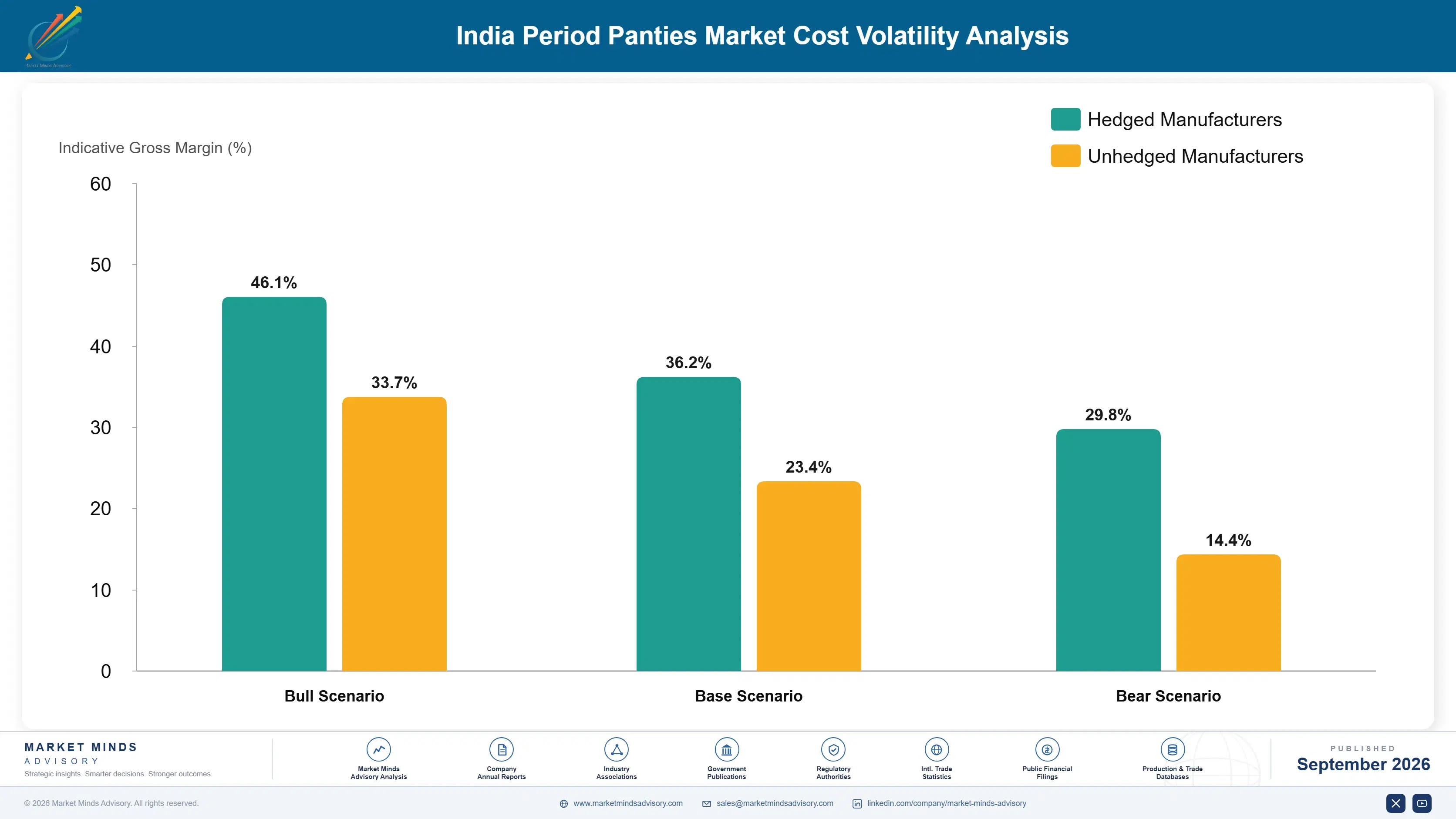
What Drives Material Cost Volatility Here

Certified organic cotton, high-capacity absorbent core material, and antimicrobial fabric treatment together account for roughly 38 percent of cost of goods sold in a typical period panty, with the remainder split between elastic components, packaging, and quality testing. Cotton is sourced predominantly from Indian growers, while absorbent core technology depends on specialty textile producers concentrated in China and South Korea.
Cotton prices spiked sharply following erratic monsoon patterns affecting Indian cotton yields beginning in 2023, pushing raw material costs higher across manufacturers reliant on domestic sourcing, according to USDA cotton production data for South Asian growing regions. Smaller domestic startups without long-term supply contracts absorbed the increase directly into margin, while larger manufacturers with diversified sourcing weathered the disruption with comparatively limited cost pass-through to end buyers overall.

This exposure disadvantages independent and mid-tier brands most severely, since they typically lack the purchasing volume needed to negotiate multi-year fixed-price cotton supply contracts that larger manufacturers secure routinely. Geographic exposure also varies: brands manufacturing domestically face the direct impact of monsoon-driven cotton price swings, while brands importing absorbent core technology from East Asia face currency-driven volatility instead.
india-period-panties-market-cost-volatility-analysis-1790024331473

Diversifying Cotton Sourcing Across Growing Regions

Manufacturers are increasingly qualifying cotton suppliers across multiple Indian states and neighboring South Asian countries rather than depending on a single growing region. This reduces exposure to any single monsoon disruption or regional crop failure, though qualification testing for new cotton grades typically takes several months before large-scale production use begins in earnest across most manufacturing lines.

Locking Multi-Year Fixed-Price Cotton Supply Contracts

Larger manufacturers are negotiating multi-year fixed-price agreements directly with cotton growers and ginning mills, trading some short-term pricing flexibility for insulation against sudden monsoon-driven cost spikes across regions and growing seasons. Smaller brands increasingly pool purchasing volume through shared sourcing cooperatives to access similar pricing terms previously available only to the largest, most established manufacturers.

Portfolio Architecture for Margin Defence

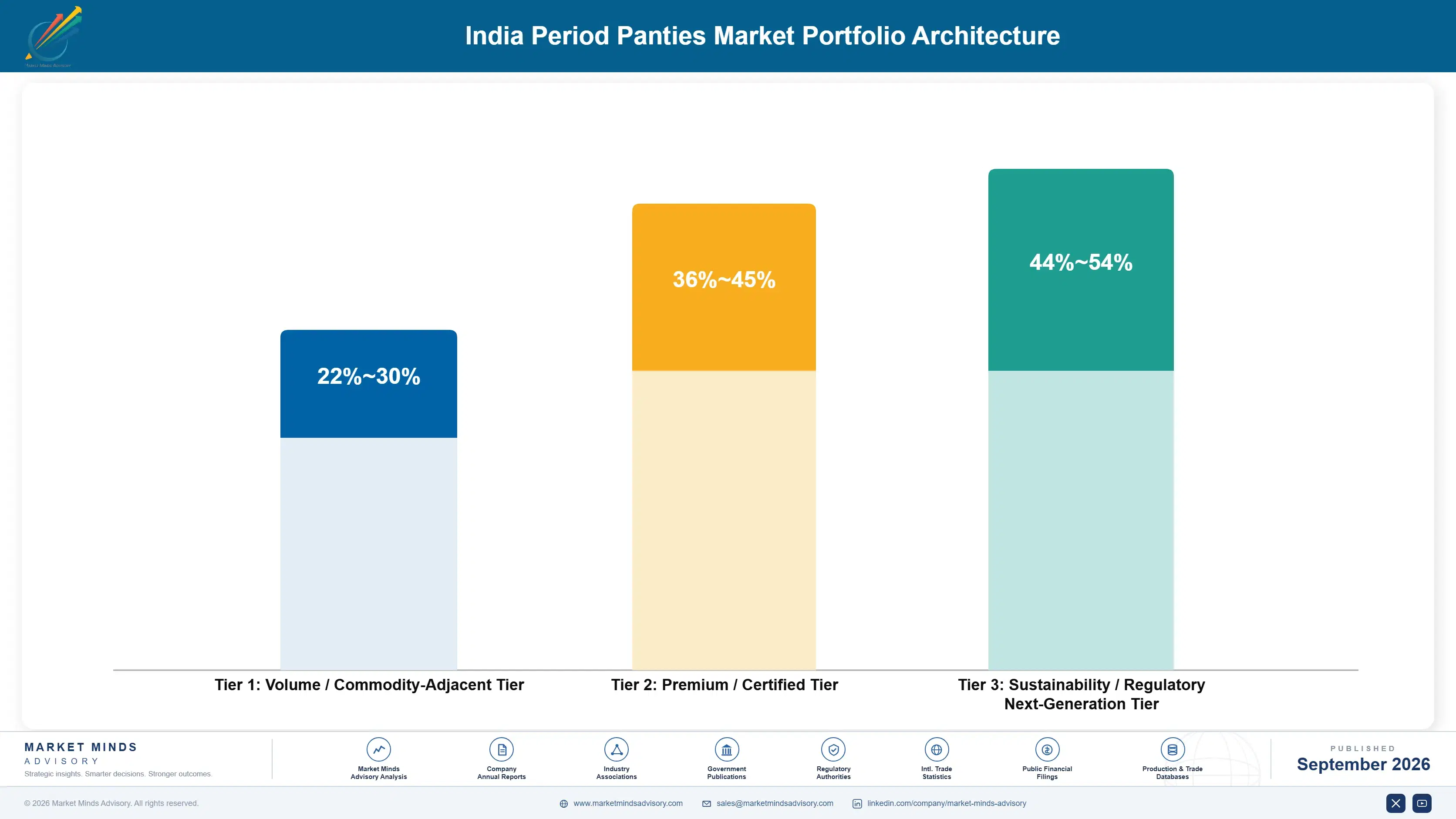
The market splits into three tiers with sharply different margin economics: volume commodity-adjacent panties sold as a basic disposable alternative, premium certified formulations emphasizing clinical absorbency testing and organic cotton, and next-generation products built around extended-wear multi-layer technology positioned as a genuine hygiene device rather than a basic undergarment, sold across every major retail channel nationwide and increasingly online.
Volume tension is real: mass e-commerce platforms keep expanding unbranded generic panties that undercut branded mid-tier pricing, forcing established startups to either defend premium positioning through sustained absorbency technology investment or compete directly on price with progressively thinner margins over time. Brands caught between these two strategies without a clear commitment tend to lose share fastest to more decisive, better-funded competitors with clearer strategic focus.

High-value margin pools concentrate overwhelmingly in the premium and next-generation tiers, where clinical absorbency credibility justifies meaningfully higher price points across most urban markets and income segments. Volume-tier products generate the bulk of unit sales but comparatively thin per-unit margin, making tier mix a more important profitability lever than absolute volume growth alone for most brands operating across urban and semi-urban markets alike.

Volume / Commodity-Adjacent Tier

Basic single-layer panties sold through generic e-commerce listings at accessible price points, marketed primarily as a disposable alternative rather than a clinically tested absorbency product for daily use among first-time, price-sensitive buyers.
Gross Margin: 22%-30%

Premium / Certified Tier

Clinically tested formulations using certified organic cotton sold through branded e-commerce and modern trade channels, commanding meaningfully higher price points through testing credibility and accumulated brand trust built over repeated purchase cycles.
Gross Margin: 36%-45%

Sustainability / Regulatory / Next-Generation Tier

Extended-wear multi-layer overnight formulations built on proprietary absorbent core technology, commanding the category's strongest pricing power among buyers seeking full-day or full-night protection reliability, comfort, and dermatologically tested, skin-safe material certification.
Gross Margin: 44%-54%
india-period-panties-market-portfolio-architecture-1790024331979

High-value Sub-segments and Strategic Watch-out

Multi-Layer Overnight Absorbency Panties

The fastest-growing, highest-margin pocket in the category, combining premium pricing power with the strongest volume growth as certified organic cotton and high-capacity absorbent cores finally deliver tested overnight protection, converting skeptical buyers into primary users during their heaviest flow days each menstrual cycle across most urban and semi-urban markets nationwide.
Gross Margin: 48%-56%

Light-Flow Daily Wear Panties

A high-value segment growing at a steadier pace than overnight products, anchored in everyday convenience and spotting protection that builds durable habitual use over time rather than through a single heavy-flow purchase occasion or a seasonal promotional campaign aimed specifically at first-time, more price-conscious buyers.
Gross Margin: 38%-46%

Standard Single-Layer Panties

The volume core of the category, generating the largest unit sales base through e-commerce platforms at accessible price points nationwide, though margin per unit remains comparatively thin against the premium and next-generation tiers described earlier in this portfolio assessment overall across most price-sensitive buyer segments.
Gross Margin: 20%-27%

Unbranded Generic Panties

A strategic watch-out segment expanding rapidly on price alone through unbranded e-commerce listings, threatening to erode branded mid-tier volume without offering the absorbency testing differentiation that protects premium and next-generation products from similar low-cost substitution across most e-commerce platforms tracked closely by most established brands.
Gross Margin: 12%-18%

Habit Formation, Not One-Time Trial

The category behaves increasingly like an annuity business rather than a one-time trial purchase, since buyers who successfully adopt period panties typically replace their disposable routine entirely rather than using both products interchangeably. Brands capturing that full habit-switch at first purchase convert a single trial sale into a recurring monthly relationship rather than a one-off transaction competitors must win repeatedly.
Adoption depth varies considerably by end-use vertical: working urban women adopt the category as a complete disposable replacement across every cycle, while rural and semi-urban buyers, where the category exists at all, often use period panties only as overnight backup alongside conventional pads rather than as primary protection. Younger, digitally native buyers show the deepest habitual adoption, since social media review culture builds sustained rather than occasional purchasing confidence.

Older buyers and buyers in smaller cities increasingly discover the category through regional-language content and community health worker recommendation rather than English-language digital marketing that dominated the category's earliest growth years. This generational and geographic shift favors brands with vernacular content and rural distribution investment over metropolitan-focused competitors relying on digital advertising alone to reach new buyers.
india-period-panties-market-end-use-penetration-index-1790024332473

Where This Market Is Headed

These are among the four positions where our research anticipates prominent divergence between winners and laggards over the coming forecast period. Each is grounded in the demand model, the regulatory perimeter, and the announced capacity pipeline.
01 / ABSORBENCY CREDIBILITY RACE

Clinical testing is becoming the category's real trust signal

Brands that invest in clinical absorbency testing rather than relying on marketing claims alone are capturing the buyer trust that untested competitors increasingly struggle to hold onto as social media review culture spreads absorbency complaints rapidly across most digital platforms. This advantage compounds as testing credibility becomes a genuine purchase driver rather than a nice-to-have feature, widening the gap between tested and untested brands considerably over time. Brands still relying on unverified claims face a shrinking window before buyer skepticism catches up entirely and forces costly reformulation and re-marketing.
02 / REGIONAL-LANGUAGE MARKETING EXPANSION

Vernacular marketing opens tier-two and tier-three cities

Regional-language content addresses the cultural nuance around menstrual stigma that English-only marketing cannot resolve, and this approach remains underdeveloped relative to its addressable population size outside metropolitan India entirely. Brands building dedicated regional content teams now will capture disproportionate share as more buyers in tier-two and tier-three cities come online and discover the category for the first time. Brands relying solely on English-language digital marketing risk missing this broader national audience entirely, ceding ground to competitors already fluent in local language and custom.
03 / RURAL DISTRIBUTION TIMING

Self-help group partnerships offer the fastest path to rural reach

Traditional retail expansion into rural India requires capital and time most startups cannot easily commit, while women's self-help group and community health worker partnerships offer a faster, trust-based alternative distribution channel already embedded in local communities nationwide. Brands piloting these partnerships now will establish relationships competitors cannot easily replicate once local trust is built and referral networks take hold across multiple states. Brands waiting for e-commerce penetration to reach rural buyers organically risk losing years of head start to more proactive, community-embedded competitors.
04 / CATEGORY STIGMA REDUCTION

Whoever normalizes the conversation first wins long-term loyalty

Persistent menstrual stigma remains the category's deepest, most persistent barrier, and brands that successfully normalize open conversation through community health worker partnerships and discreet, culturally sensitive marketing build loyalty that outlasts any single product feature or price promotion entirely. This normalization work compounds over years rather than delivering immediate returns, rewarding brands with patient capital and genuinely long time horizons. Brands treating stigma reduction as someone else's problem risk permanently ceding the trust advantage to more patient, community-focused competitors nationwide.

Engagement Snapshot From the Field

A live engagement with an industry participant carrying material or product regulatory and market exposure ahead of a defining policy shift, showing how our research translates into a defensible multi-year portfolio strategy.
MARKET MINDS ADVISORY · CLIENT ENGAGEMENT SUMMARY
India Period Panties Producer Strategic Portfolio Review and Transition Roadmap 2026·Investment Scenario on India Period Panties Exposure Evaluation 2025-26
CLIENT PROFILE
The client is a domestic Indian period panty startup with roughly 32 crore rupees in annual revenue (client-reported, unverified by MMA), selling primarily through e-commerce platforms in metropolitan markets without meaningful physical retail or rural distribution presence. The company had built a loyal urban customer base through digital marketing but had not yet tested expansion into tier-two cities, where menstrual stigma and language barriers posed different challenges.
STRATEGIC CHALLENGE
Management needed to decide whether to invest in regional-language marketing to reach tier-two and tier-three cities directly, pursue rural distribution through self-help group partnerships, or continue concentrating resources on deepening metropolitan market share where the brand already held meaningful recognition. Limited marketing budget meant pursuing all three paths simultaneously risked diluting effectiveness across each individually.
MMA APPROACH
MMA conducted primary interviews with buyers in three tier-two cities to assess awareness and purchase barriers, benchmarked regional-language marketing costs against expected conversion improvements, and modeled rural distribution partnership economics using this report's proprietary segment and regional growth data. The engagement combined this primary research with comparative analysis of competitor regional expansion strategies already underway.
KEY FINDINGS
  1. Tier-two city buyers expressed strong interest in the category but had never seen marketing content in their own regional language before this campaign.
  2. Regional-language digital campaigns would cost considerably less than rural distribution partnerships while still reaching a comparably large total buyer population overall today.
  3. Existing metropolitan customers showed limited additional growth headroom, since brand awareness there had already reached a meaningful saturation point some time previously.
  4. Self-help group distribution pilots elsewhere in the category showed promising early results but required significantly longer timelines to scale nationally across states.
CLIENT PROFILE
The client is a domestic Indian period panty startup with roughly 32 crore rupees in annual revenue (client-reported, unverified by MMA), selling primarily through e-commerce platforms in metropolitan markets without meaningful physical retail or rural distribution presence. The company had built a loyal urban customer base through digital marketing but had not yet tested expansion into tier-two cities, where menstrual stigma and language barriers posed different challenges.
STRATEGIC CHALLENGE
Management needed to decide whether to invest in regional-language marketing to reach tier-two and tier-three cities directly, pursue rural distribution through self-help group partnerships, or continue concentrating resources on deepening metropolitan market share where the brand already held meaningful recognition. Limited marketing budget meant pursuing all three paths simultaneously risked diluting effectiveness across each individually.
MMA APPROACH
MMA conducted primary interviews with buyers in three tier-two cities to assess awareness and purchase barriers, benchmarked regional-language marketing costs against expected conversion improvements, and modeled rural distribution partnership economics using this report's proprietary segment and regional growth data. The engagement combined this primary research with comparative analysis of competitor regional expansion strategies already underway.
KEY FINDINGS
  1. Tier-two city buyers expressed strong interest in the category but had never seen marketing content in their own regional language before this campaign.
  2. Regional-language digital campaigns would cost considerably less than rural distribution partnerships while still reaching a comparably large total buyer population overall today.
  3. Existing metropolitan customers showed limited additional growth headroom, since brand awareness there had already reached a meaningful saturation point some time previously.
  4. Self-help group distribution pilots elsewhere in the category showed promising early results but required significantly longer timelines to scale nationally across states.
RECOMMENDED STRATEGY
Phase 1: Phase 1 (Months 1 to 4): Launch dedicated Hindi and regional-language digital marketing campaigns targeting three tier-two states directly and immediately. Phase 2: Phase 2 (Months 5 to 9): Pilot a limited self-help group distribution partnership in one state to test rural viability. Phase 3: Phase 3 (Months 10 to 16): Scale whichever channel showed stronger unit economics based on the pilot's measured results and feedback.
OUTCOME
The client launched regional-language marketing campaigns within three months and began a limited self-help group distribution pilot shortly after in one state. Management reported a 24 percent increase in tier-two city order volume within the first year of implementation (client-reported, unverified by MMA), attributing the gain primarily to the regional-language campaigns rather than the still-early rural distribution pilot.

Frequently Asked Questions

Foundational context covering the market sizes, CAGR, scope, country, region and competition that inform every finding below. This section is provided to cover basics and most often pre-purchase conversations, answered from the MMA Primary Research Dataset.

What is the current size of the India Period Panties Market?

The India period panties market reached an estimated 0.48 billion dollars in 2025. This figure covers reusable, washable absorbent underwear sold through e-commerce, pharmacy, and modern trade channels.

How large will the India Period Panties Market be by 2036?

The market is projected to reach approximately 1.92 billion dollars by 2036. This represents more than three and a half times the market's 2026 value over the ten-year forecast period.

What is the CAGR for the India Period Panties Market 2026 to 2036?

The market is expected to grow at a compound annual growth rate of 13.5 percent between 2026 and 2036. Bull and bear scenarios range from 14.8 percent to 12.2 percent depending on rural distribution progress.

Which segment is growing fastest?

Multi-layer overnight absorbency panties are growing fastest at a 19.8 percent CAGR, roughly 1.47 times the overall market rate. Growth is driven by certified organic cotton and high-capacity absorbent cores finally resolving leakage complaints.

Who are the major companies in the India Period Panties Market?

Leading companies include Nykaa Fashion, Sirona Hygiene, Newme, Adira by Fateh, and Carmesi. Together these five companies hold an estimated 26 percent combined market share.

Which country is growing fastest?

India itself posts the fastest growth among major markets at a 15.5 percent CAGR, driven by rising female workforce participation and regional-language marketing expansion. East Asia and North America follow at more moderate growth rates.

Report Segmentation Architecture

The full report scope spans multiple orthogonal segmentation dimensions, with cross-tabulated demand data provided for each dimension pair. Coverage extends further to regional breakdowns, trend trajectories, and the competitive detail needed to support segment-level decision-making.

By Absorbency Technology

  • Multi-Layer Overnight Absorbency Panties
  • Light-Flow Daily Wear Panties
  • Standard Single-Layer Panties
  • Extended-Wear Heavy-Flow Panties
  • Postpartum Recovery Panties
  • Teen and First-Cycle Panties

By End-Use Demographic

  • Urban Working Women
  • Students and Young Adults
  • Rural and Semi-Urban Buyers
  • Postpartum and New Mothers
  • Institutional and Bulk Buyers

By Commercial Dimension

  • E-Commerce and Direct-to-Consumer
  • Pharmacy and Modern Trade Retail
  • Subscription and Replenishment
  • Self-Help Group and Community Distribution

By Region

  • North America
  • Western Europe
  • East Asia
  • South Asia and Pacific
  • Latin America
  • Middle East and Africa
  • Eastern Europe

Scope, Methodology, and Coverage

Every figure in this report is reproducible from documented input assumptions. The scope below maps the historical period, the forecast horizon, the segmentation dimensions, and the countries covered, alongside the underlying primary and qualitative methodology.
Historical Period
2020 to 2025
Forecast Period
2026 to 2036
Base Year
2025 (USD billions; MMA Primary Research Dataset, September 2026)
Market Definition
The India period panties market comprises reusable, washable absorbent underwear designed to replace or supplement disposable pads and tampons during menstruation, sold through e-commerce, pharmacy, and modern trade retail channels. It excludes disposable sanitary pads, tampons, and menstrual cups.
Quantitative Units
USD billions (current prices); unit shipment volume in millions of units where applicable
Segmentation Dimensions
By Absorbency Technology; By End-Use Demographic; By Commercial Dimension; By Region
Regions Covered
North America, Western Europe, East Asia, South Asia and Pacific, Latin America, Middle East and Africa, Eastern Europe
Countries Covered
USA, China, Germany, France, UK, Japan, South Korea, India, Australia, Canada, Brazil, Mexico, Indonesia, Vietnam, Thailand, Malaysia, UAE, Saudi Arabia, South Africa, Nigeria, Turkey, Poland, Netherlands, Italy, Spain, Sweden, Switzerland, Argentina, Colombia, Singapore, and additional markets relevant to this sector
Key Companies Profiled
Nykaa Fashion, Sirona Hygiene, Newme, Adira by Fateh, Carmesi, Thinx Inc., Knix Wear, Modibodi, Saathi Pads, Nua Woman, Pee Safe, Anandi Life, Boondh, Sanfe, Aisle (Lunapads), Freda, She Bear, Everteen, Prettyvvish, Livlong Wellness
Quantitative Methodology
Primary survey, n=3,800 respondents, Q4 2025, six countries; demand-side model with trade association cross-validation
Qualitative Methodology
47 expert interviews, Q4 2025; applied to validate demand model assumptions, identify emerging dynamics, and assess competitive positioning
Report Format
PDF and XLSX data workbook (Word format preview document)
Publisher
Market Minds Advisory
Report Code
MMA-2026-CON-142
Published
September 2026
Contact
sales@marketmindsadvisory.com | www.marketmindsadvisory.com

Purchase the full India Period Panties Market Report (2026 to 2036).

This report delivers a complete assessment of the India period panties market, sizing the category from 2025 through 2036 across absorbency technology, end-use demographic, and commercial distribution dimensions. It profiles twenty companies spanning domestic startups and international reusable hygiene brands, benchmarking competitive positioning, absorbency technology investment, and material cost exposure. Regional analysis covers all seven global regions with quantified growth drivers specific to each. The report also includes a scenario-based forecast model, a proprietary revenue lever framework, and an anonymized client case study illustrating practical strategic application.
A complete ten-year market sizing and forecast model
A detailed six-segment absorbency technology breakdown analysis
All seven global regions individually quantified and profiled
Twenty-company competitive benchmarking and positioning analysis included
Scenario-based bull and bear forecast projections through 2036
An anonymized client engagement case study included

Built For The People Who Decide

From boardroom strategy to bench-side execution, this report is read cover-to-cover by leaders shaping the next decade of their industry, turning demand scenarios, market dynamics and valuation benchmarks into decisions.
CXOs/ Presidents/ VPs/ Managers
M&A and Corporate Development
Strategy Teams and R&D Heads
Procurement and Product Directors
Regulatory and Compliance Leaders
Investor Relations and Equity Analysts