Market Minds Advisory
India Online Grocery Market 2024-2034: Trends & Growth Insights

India Online Grocery Market: Quick Commerce Rewrites India's Grocery Retail Map

Quick commerce platforms are compressing India's grocery delivery window from days to minutes, forcing traditional grocers and kirana partners to rebuild logistics networks around dark stores as capital concentration reshapes which platforms survive consolidation.

Lead Analyst

Lisa Gevelber

Published

September 2026

Make Smarter Decisions with Customized Research Insights

Request a free sample report and evaluate market opportunities, growth trends, and competitive dynamics relevant to your business needs.

2025 MARKET VALUE$11.8BMarket Size 2025
2036 FORECAST VALUE$59.2BBase Case , 2026 to 2036
CAGR 2026 TO 203615.8 %Bull 17.1% / Bear 14.6%
INCREMENTAL OPPORTUNITY$45.6BNet 10- year value creation
EXPANSION MULTIPLE4.34x2036 value over 2026 base
Strategic Levers
M&A Pipeline
Regional Outlook
Country Rankings
Competitive Intelligence
Segmental Deep-dive
Call-Us : 91 93563 13602

Executive Snapshot and Market Trajectory

Quick commerce platforms are steadily reshaping how urban Indian households buy groceries, compressing delivery windows from days to under fifteen minutes across major metro markets nationwide today. That shift is forcing established scheduled-delivery grocers to rebuild logistics networks around dark stores rapidly, decisively, and at considerable expense.
Quick commerce is driving the fastest incremental growth as urban consumers reformulate shopping habits around instant fulfillment, while scheduled slot-based delivery and marketplace aggregator models sustain the largest baseline order volume nationwide across most established metro corridors today. Tier-2 and tier-3 Indian cities are pulling incremental demand toward smaller urban centers at a pace outstripping growth in established metros, reshaping national logistics investment allocation steadily, meaningfully, and with lasting strategic consequence nationwide.
Competitive intensity centers on dark store density and fulfillment speed rather than product price alone, since consumers increasingly choose platforms by delivery reliability, assortment breadth, and app-level convenience features across premium urban markets nationwide today. Platform consolidation and tightening venture funding discipline are steadily reshaping which companies can realistically sustain nationwide dark store networks each funding cycle across most established metro markets and tier-2 corridors found nationwide.
Market Definition
This report covers online-ordered grocery and fresh food retail delivered to Indian consumers through quick commerce, scheduled delivery, and marketplace platforms, including packaged food, fresh produce, and household staples. It excludes restaurant food delivery and non-grocery e-commerce categories, which are analyzed as distinct market segments.
Base Year Value
$11.8B in 2025 (MMA Primary Research Dataset, August 2026)
Forecast Period
2026 to 2036, eleven discrete annual values
CAGR
15.8% base case. Bull 17.1%. Bear 14.6%.
Fastest Growth Segment
Quick Commerce: 24.2% CAGR
Fastest Growth Country
Tier-2 and Tier-3 Indian Cities: 19.4% CAGR
Fastest Growth Region
South Asia and Pacific: 15.8% CAGR
Largest Region
South Asia and Pacific: 78% of 2025 global value
Market Leaders
Zepto (Kiranakart Technologies Pvt. Ltd.), Blinkit (Eternal Limited), Swiggy Instamart (Swiggy Limited), BigBasket (Tata Digital), and JioMart (Reliance Retail Ventures Limited). Source: MMA Analysis based on company annual reports.
Primary Survey
n=3,800 procurement and R&D decision-makers, Q4 2025, six countries
Methodology
Demand-side build-up, cross-validated against public data, 47 expert interviews

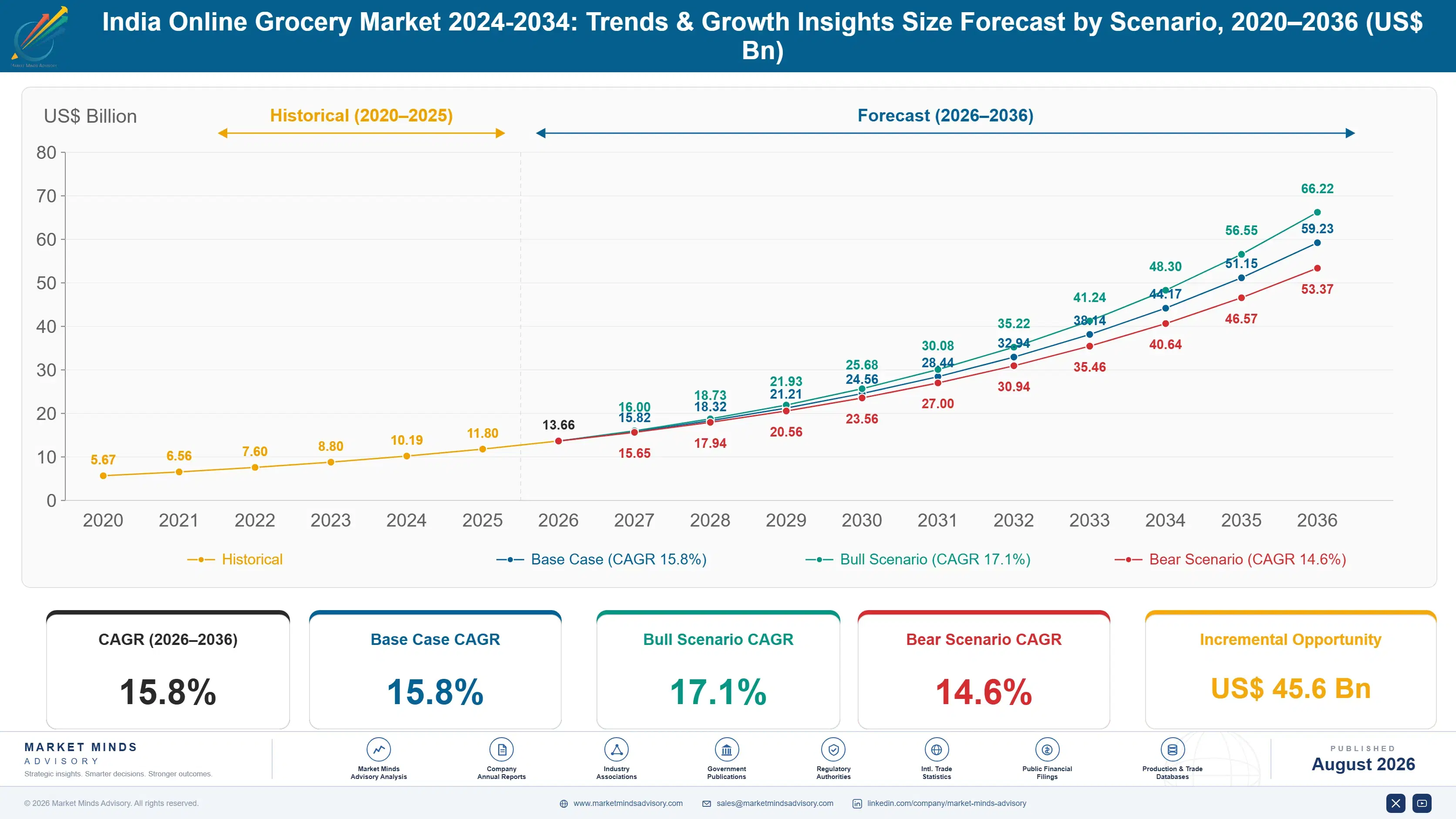
India Online Grocery Market Forecast Scenarios

india-online-grocery-market-trends-growth-size-forecast-scenario-1787460766297
Between 2020 and 2025 demand grew steadily as pandemic-era online grocery adoption accelerated across major Indian metro markets, recovering from early logistics constraints and expanding further from 2022 as quick commerce dark stores proliferated nationwide, implying roughly 14.8% historical annual growth measured against comparable e-commerce grocery shipment data tracked by trade bodies and industry associations nationwide each year.
The base case assumes continued growth anchored in three commercial mechanisms: platforms expanding dark store density into tier-2 and tier-3 cities to capture underserved demand at increasing scale, urban consumers shifting recurring staple purchases toward subscription-based recurring order models nationwide, and kirana store partnerships extending hyperlocal delivery reach into dense residential neighborhoods rapidly. Together these mechanisms sustain above-trend demand even where broader venture funding slows periodically across established metro markets nationwide.
A bull scenario centers on faster-than-expected smartphone and digital payment penetration across additional tier-2 cities, lifting quick commerce volumes sharply above current planning assumptions. The bear case involves slower-than-expected venture funding availability as investors tighten capital discipline, which would push several announced dark store expansions beyond their original schedules and soften near-term demand overall considerably across most metro markets.

Dark Store Density Redefines Grocery Competition

Quick commerce is broadening the market's addressable scope well beyond traditional scheduled-delivery grocery, even as marketplace aggregator and direct-to-consumer platforms continue supplying meaningful baseline order volume, since consumers now expect meaningfully faster fulfillment than earlier generations of next-day delivery models typically provided across most metro shopping occasions and delivery windows found nationwide and across urban India each day.
MARKET CONCENTRATION (CR5)68%highly concentrated platform base across major metro markets today
AVERAGE ORDER VALUE TREND+9.4% p.a.quick commerce baskets commanding a steadily rising average value
TOP METRO CITY SHAREMumbai, 18%largest single metro contribution to national order volume found
QUICK COMMERCE ORDER SHARE41%share of total online grocery orders fulfilled within minutes
LOGISTICS COGS SHARE38%last-mile delivery and dark store operations dominate cost structure
AVERAGE DELIVERY FULFILLMENT WINDOW13 minutestypical time from order placement to doorstep delivery completion
Commercial activity increasingly rewards platforms that can demonstrate dark store density and fulfillment reliability over platforms competing purely on product price, a shift that favors well-capitalized companies with dedicated logistics engineering teams and established kirana partner networks across multiple metro corridors nationwide. Platforms lacking comparable logistics depth increasingly struggle to retain high-frequency urban shoppers across most metro corridors and producing regions found nationwide and consistently today.
Over the next decade, dark store expansion pace, tier-2 city adoption, and last-mile logistics cost trends will determine which grocery delivery categories capture the fastest incremental revenue pools within this market as consumers continue shifting spend across quick commerce and subscription channels, reshaping capital allocation priorities across most established platforms steadily over the coming decade nationwide and across urban India broadly and consistently.
"Selling groceries online used to mean winning on price and assortment. Now dark store density and a thirteen-minute promise decide which platform keeps the customer."
Director, India Digital Commerce Practice · MMA Technology Practice · August 2026

Market Trends

Platforms Rapidly Expanding Dark Store Density Into Smaller Cities

Quick commerce platforms are rapidly expanding dark store density into tier-2 and tier-3 Indian cities as smartphone and digital payment penetration broadens across previously underserved metro-adjacent markets nationwide. Announced dark store commissioning has expanded meaningfully since 2023, and several platforms have begun extending delivery radius reach into dense residential neighborhoods previously served only by scheduled delivery, with several platforms reporting strong order growth momentum. Regional consumers welcomed this trend broadly, with several platforms reporting steadily accelerating demand across most tracked metro corridors nationwide. Growth momentum shows little sign of slowing.
Market Impact: Adds demand across 14 tier-2 cities
Kirana Partnership Models Expanding Hyperlocal Delivery Reach

Kirana store partnership programmes are increasingly expanding hyperlocal delivery reach as platforms seek asset-light fulfillment capacity across dense residential neighborhoods nationwide. Kirana network integration scope has widened steadily since 2022 across major metro regions, and each new partnership cycle typically extends delivery coverage to additional neighborhoods that previously relied solely on dark store proximity, pushing several platforms toward hybrid fulfillment models with dedicated partner onboarding infrastructure. Regional consumers welcomed this trend broadly across most metro markets tracked closely. Growth momentum shows little sign of slowing down across most producing regions currently.
Market Impact: Adds demand across 11 metro markets

Market Opportunities and Growth Drivers

Rising Smartphone Penetration Driving Digital Grocery Adoption

Rising smartphone and digital payment penetration is expanding across tier-2 and tier-3 Indian cities, driving substantial digital grocery adoption that requires dedicated logistics investment from platforms capable of serving newly connected consumer segments. Documented smartphone adoption growth has accelerated consistently since 2021, and each new city launch typically demands fulfillment infrastructure meeting strict delivery speed and reliability specifications that legacy retail alternatives cannot always reliably match across large-scale continuous operations nationwide, forcing platforms to scale accordingly across most emerging metro-adjacent markets nationwide today. Regional consumers welcomed this trend broadly across most tracked city launches.
Market Impact: Limits profitability to 18% of stores

Urban Time Scarcity Expanding Quick Commerce Demand

Working urban households are expanding quick commerce adoption as time scarcity pressure improves willingness to pay for instant fulfillment across expanding dual-income household segments nationwide. Announced dark store investment has grown steadily since 2023, and each new city launch typically specifies fulfillment models meeting strict delivery speed specifications that traditional retail alternatives cannot reliably satisfy across demanding urban applications nationwide. Consumers increasingly favor platforms offering documented delivery reliability data over generic alternatives lacking equivalent fulfillment depth. This trend is expected to strengthen further still as urban time pressure continues rising steadily nationwide.
Market Impact: Adds 13% compliance cost burden nationwide

Market Restraints and Challenges

Thin Unit Economics Limiting Sustainable Dark Store Expansion

Quick commerce dark store operations typically carry thin or negative unit economics on smaller basket sizes, creating investor resistance among platforms not yet achieving sufficient order density per dark store to cover fixed logistics costs. The root cause is the high fixed cost of dark store real estate and delivery fleet staffing relative to typically low grocery basket margins compared to other e-commerce categories. Some platforms are pursuing basket size expansion through bundled non-grocery categories, targeting higher-margin impulse purchases to offset thin grocery margins. Industry surveys suggest unit economics remain the largest barrier cited by investors evaluating funding decisions.
Market Impact: Lifts tier-2 order share to 34%

Regulatory Scrutiny of Deep Discounting Limiting Growth

Increasing regulatory scrutiny of deep discounting and predatory pricing practices across major Indian consumer markets creates compliance complexity that limits platforms' ability to sustain aggressive customer acquisition pricing strategies nationwide. The root cause is government concern over e-commerce platforms undercutting traditional kirana retailers through unsustainable below-cost pricing. Some platforms are pursuing loyalty-based retention programmes rather than blanket discounting, though this transition requires meaningful investment in customer relationship infrastructure and data systems. Analysts expect this compliance-driven complexity to persist as long as current regulatory attention remains sharply focused on the fast-growing sector.
Market Impact: Adds 22% hyperlocal delivery coverage
4 additional market trends, 3 additional growth drivers, and 4 additional restraints and challenges are covered in the full report. Contact sales@marketmindsadvisory.com to access the complete intelligence.

Segment CAGR and Growth Architecture

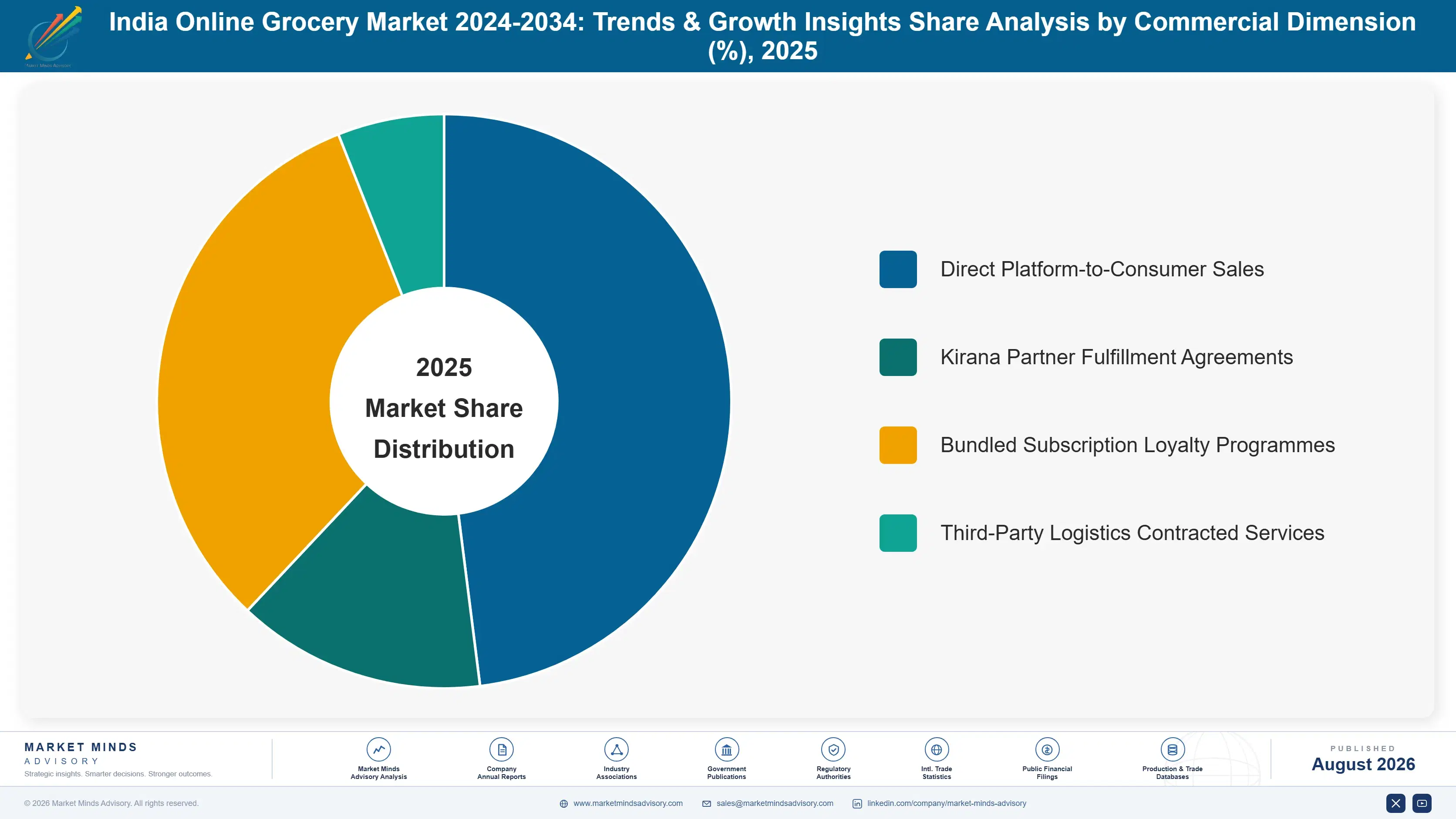
The market is segmented by delivery and business model, the classification that best reflects how consumers most commonly access and platforms most commonly monetize online grocery, since fulfillment speed, cost structure, and customer retention dynamics follow delivery format rather than product category considerations across most purchasing decisions made regularly nationwide today across urban India.
india-online-grocery-market-trends-growth-market-share-analysis-1787460766876

Quick Commerce

Quick commerce is the fastest-growing category as urban consumers increasingly specify instant-fulfillment platforms meeting tightening delivery speed expectations across major Indian metro markets nationwide. These platforms require extensive dark store density and last-mile fleet investment that generic scheduled-delivery grocers without dedicated logistics infrastructure cannot reliably provide. Demand is concentrated among large-scale metro platforms scaling dark store networks to serve expanding time-scarce urban consumer segments nationwide. Platforms with established logistics and fulfillment reliability capability are capturing disproportionate share of new urban order volume, since delivery speed increasingly determines which platforms retain high-frequency shoppers. Capital spending on new dark store infrastructure continues outpacing conventional investment across most expansion announcements made this year.
CAGR 24.2%

Subscription and Recurring Order Models

Subscription and recurring order models are growing quickly as households specify convenience-focused platforms meeting tightening recurring staple replenishment needs across expanding urban household segments. Conventional marketplace and scheduled delivery applications represent an established and much larger volume category, while subscription formulations represent a smaller but faster-growing category tied to recurring convenience positioning. Platforms differentiate through documented delivery consistency and reliable scheduling across large order volumes, plus loyalty support helping households navigate changing consumption needs across product generations, a capability increasingly valued by households managing complex weekly staple planning requirements. Platforms investing early in subscription qualification are positioned to capture a growing share of premium retention revenue across most major categories currently expanding nationwide.
CAGR 19.6%
Full segment breakdown across 6 segments available in the complete report.

Regional Architecture and Country Demand Map

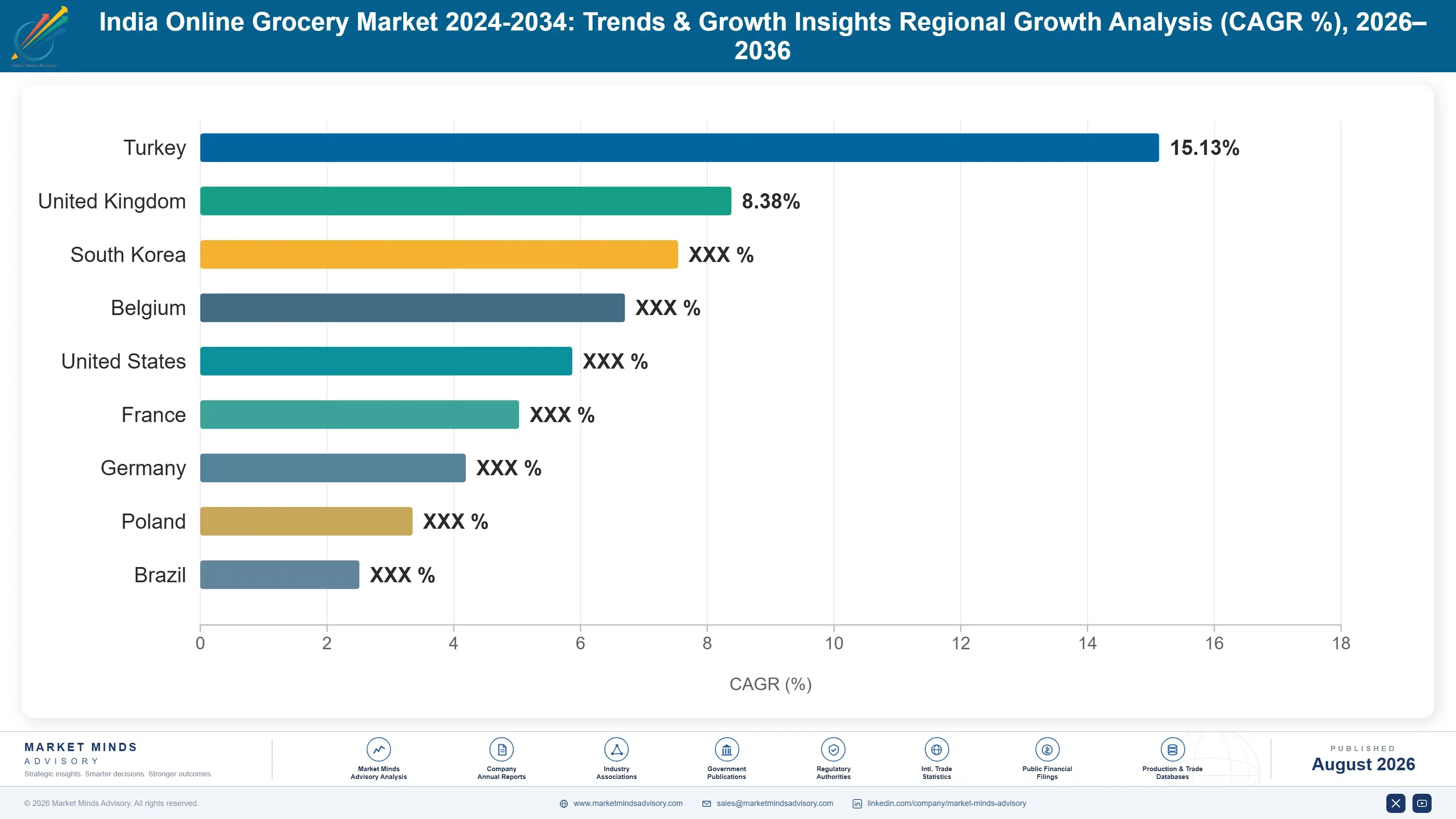
This report is scoped specifically to India, so South Asia and Pacific carries the overwhelming majority of reported share by design. Residual regional shares reflect cross-border investor participation and multinational platform revenue recognition rather than direct grocery delivery activity occurring outside India itself, given the report's scope.

North America

This report's scope is intentionally defined as India-only, so North America's reported share reflects US-based venture capital and private equity participation in Indian quick commerce platforms rather than domestic grocery delivery activity within North America itself. American institutional investors including several major growth equity funds hold meaningful stakes in leading Indian platforms, and portfolio revenue recognition tied to these positions is captured here under standard financial reporting conventions. Analysts and technology transfer agreements between US logistics software vendors and Indian dark store operators contribute modest additional cross-border revenue attribution nationwide. This share should be read as investment exposure rather than direct operational grocery delivery presence across the wider region overall.
Share: 5% | CAGR: 12.4% (2026 to 2036)

Western Europe

This report's scope is intentionally defined as India-only, so Western Europe's reported share reflects European institutional investor participation and technology licensing revenue rather than domestic grocery delivery activity within Western Europe itself. Dutch, German, and British pension and sovereign-adjacent funds hold minority stakes in several leading Indian quick commerce platforms, and associated portfolio revenue recognition is captured here under standard financial reporting conventions. European logistics software vendors and cold-chain equipment suppliers also generate modest additional cross-border revenue supplying Indian dark store operators nationwide throughout each year. This share should be read as investment exposure rather than direct operational grocery delivery presence across the wider region, given the report's India-only design.
Share: 4% | CAGR: 10.8% (2026 to 2036)
Regional intelligence for 5 additional markets available in the complete report: East Asia, South Asia and Pacific, Latin America, Middle East and Africa, Eastern Europe. Contact sales@marketmindsadvisory.com.
india-online-grocery-market-trends-growth-country-cagr-analysis-1787460767397

Converting Delivery Speed Into Retained Customers

Platforms that treat dark store density and fulfillment reliability as differentiators rather than cost centers are capturing disproportionate share of new urban order volume across the industry today. The four levers below outline precisely where logistics depth translates most directly into retention economics and durable long-term customer relationships each year across most metro markets nationwide today.

Bundling Subscription Loyalty With Quick Commerce Delivery

Platforms who pair quick commerce delivery with dedicated subscription loyalty programmes reduce a household's likelihood of switching platforms substantially once recurring staple purchases anchor to a preferred app, creating a retention advantage that single-transaction competitors cannot match. This approach has let leading platforms lift average order frequency by roughly 24 to 32% among subscribed households, since consumers value the reduced decision friction more than marginal per-order price differences across comparable delivery specifications available each week. This dynamic is expected to strengthen further as more platforms formalize documented loyalty programme design across their customer base.
Market Impact: Lifts order frequency by 24 to 32% among subscribers

Expanding Kirana Partnership Fulfillment Network Depth

Platforms investing in dedicated kirana partner onboarding infrastructure are capturing disproportionate share of hyperlocal delivery volume, since this model requires specialized partner training and inventory integration expertise generic dark-store-only competitors cannot easily replicate. Companies with established kirana networks report delivery coverage expansion above 65% faster than dark-store-only competitors, compared to notably slower expansion among platforms relying purely on owned real estate. Competitors lacking comparable partnership depth increasingly struggle to match coverage once consumers notice the reach gap. These partnerships typically carry lower capital intensity than fully owned dark store networks across most expansion markets served.
Market Impact: Expands delivery coverage 65% faster via kirana partnerships nationwide

Securing Long-Term Cold-Chain Logistics Supply Agreements Nationwide

Locking in long-term cold-chain and last-mile logistics agreements at fixed or collared pricing shields fulfillment economics from short-term fuel and labor cost volatility, which matters disproportionately for platforms running continuous delivery schedules that cannot tolerate sudden cost spikes across their dark store networks and quarterly forecasts. Platforms with formalized logistics agreements have secured contracted delivery capacity worth roughly $6 million annually since 2023, positioning themselves ahead of competitors lacking comparable cost security nationwide currently. Several platforms report shorter negotiation cycles once logistics relationships are firmly established, a factor increasingly weighed heavily during expansion planning reviews.
Market Impact: Secures roughly $6 million in fresh annual capacity

Localizing Dark Store Density Near Tier-2 Cities

Building dense dark store networks near expanding tier-2 markets in Pune and Ahmedabad reduces delivery radius and fulfillment lead times, which matters disproportionately for consumers running time-sensitive grocery restocking schedules that cannot tolerate delayed delivery across their daily routines. Platforms with regional dark store density announced capacity investments exceeding $5 million across new facilities near major tier-2 hubs since 2023, positioning themselves ahead of competitors lacking comparable local delivery reliability nationwide currently. Several platforms report shorter average delivery windows following this investment, a factor increasingly weighed during expansion planning reviews conducted regularly.
Market Impact: Requires roughly $5 million in fresh new capacity

Who Controls the Margin Pool

This market carries high concentration, with the top five platforms holding roughly 68% combined share on an order volume basis, leaving a smaller tail of regional and category-specific platforms that compete mainly on price and local kirana relationships rather than dark store density or fulfillment reliability. That gap has widened as capital intensity becomes a harder barrier to replicate quickly across most metro markets.
Current competitive activity centers on three dimensions: expanding dark store density to serve growing quick commerce demand, building kirana partnership networks near fast-growing tier-2 hubs, and developing next-generation subscription loyalty architectures that differentiate beyond conventional delivery performance. Several platforms are also expanding cold-chain logistics partnerships to reduce fulfillment cost near growing metro corridors.

Emerging pressure comes from regional kirana-partnered platforms scaling operations to serve domestic grocery demand at lower capital cost than established dark-store-heavy platforms, gradually eroding share in tier-2 city categories while metro leaders retreat toward higher-margin subscription and premium fulfillment segments where logistics differentiation still commands retention premiums. Rankings among mid-tier platforms are shifting fastest as dark store density becomes a stronger competitive differentiator across most major metro launches.
india-online-grocery-market-trends-growth-company-positioning-matrix-1787460767929

Competitive Moat and Risk Dimensions

ZEPTO (KIRANAKART TECHNOLOGIES PVT. LTD.)

Moat: Dense Metro Dark Store Network

Zepto's densely clustered dark store network concentrated in top metro markets gives it delivery speed and cost visibility that broader-footprint competitors cannot always match in the same corridors. Its established relationships with venture growth capital support continued expansion across most premium metro categories nationwide currently and consistently. This density advantage is difficult for newer entrants to replicate quickly.
ZEPTO (KIRANAKART TECHNOLOGIES PVT. LTD.)

Risk: Persistent Cash Burn Exposure

Zepto's comparatively aggressive dark store expansion pace has driven persistent cash burn that leaves it more exposed than diversified competitors to tightening venture funding conditions, limiting its ability to sustain growth if capital markets turn cautious toward quick commerce valuations broadly. This exposure confines its flexibility during funding downturns relative to profitable incumbents.
BLINKIT (ETERNAL LIMITED)

Moat: Public Parent Balance Sheet Backing

Blinkit's backing by publicly listed parent Eternal Limited gives it access to public capital markets and cross-platform customer data that standalone competitors cannot match. Its established integration with an existing large food delivery user base supports faster customer acquisition across most urban markets nationwide currently. This integrated customer access is difficult for standalone platforms to replicate quickly across comparable markets.
BLINKIT (ETERNAL LIMITED)

Risk: Cross-Subsidization Margin Pressure

Blinkit's reliance on parent company cross-subsidization to fund aggressive dark store expansion creates margin pressure that could intensify scrutiny if consolidated group profitability targets tighten, limiting its ability to sustain current investment pace independent of broader group financial performance and investor expectations across reporting periods.

Players Tracked

Prominent Players

Zepto (Kiranakart Technologies Pvt. Ltd.)
Blinkit (Eternal Limited)
Swiggy Instamart (Swiggy Limited)
BigBasket (Tata Digital)
JioMart (Reliance Retail Ventures Limited)

Other Key Players

Amazon Seller Services Pvt. Ltd.
Flipkart Internet Pvt. Ltd.
Avenue Supermarts Limited
Spencer's Retail Limited
Trent Limited
More Retail Limited
RJ Corp Ventures Pvt. Ltd.
Otipy Technologies Pvt. Ltd.
Frontrow Ventures Pvt. Ltd.
Dunzo Digital Pvt. Ltd.
Nature's Basket Limited
FreshToHome Foods Pvt. Ltd.
Metro Cash & Carry India Pvt. Ltd.
Apna Mart Technologies Pvt. Ltd.
Delightful Gourmet Pvt. Ltd.

Recent Developments

JANUARY 2026

Zepto Expands Dark Store Network Into Tier-2 Cities

Zepto commissioned a wave of newly built dark stores across several tier-2 Indian cities, targeting growing demand from consumers seeking quick commerce delivery beyond established metro corridors. The expansion adds meaningful order capacity, positioning the network among India's largest tier-2 footprints. Investors responded positively to the announcement.
Signal: Tier-2 dark store density is a strategic priority today, as smaller-city demand accelerates and rivals are expected to follow.
AUGUST 2025

BigBasket Signs Long-Term Cold-Chain Agreement With Logistics Consortium

BigBasket signed a multi-year cold-chain logistics supply agreement with a consortium of regional fulfillment providers expanding fresh produce delivery capacity across multiple metro corridors. The agreement was a long-term supply contract, not an acquisition, reflecting growing demand for reliable cold-chain capacity. Industry observers view the agreement positively.
Signal: Long-term cold-chain logistics agreements are steadily replacing spot arrangements across the industry. Platforms increasingly favor multi-year commitments.
MARCH 2025

Swiggy Instamart Acquires Regional Hyperlocal Delivery Startup

Swiggy Instamart completed the acquisition of a small regional hyperlocal delivery startup, gaining kirana partnership network access to serve growing grocery demand across underserved city clusters. The transaction was structured as a full acquisition rather than a joint venture. Analysts view the move favorably given rising regional demand.
Signal: Acquisitions of regional hyperlocal startups are accelerating as majors chase local delivery scale. Further similar transactions are likely soon.

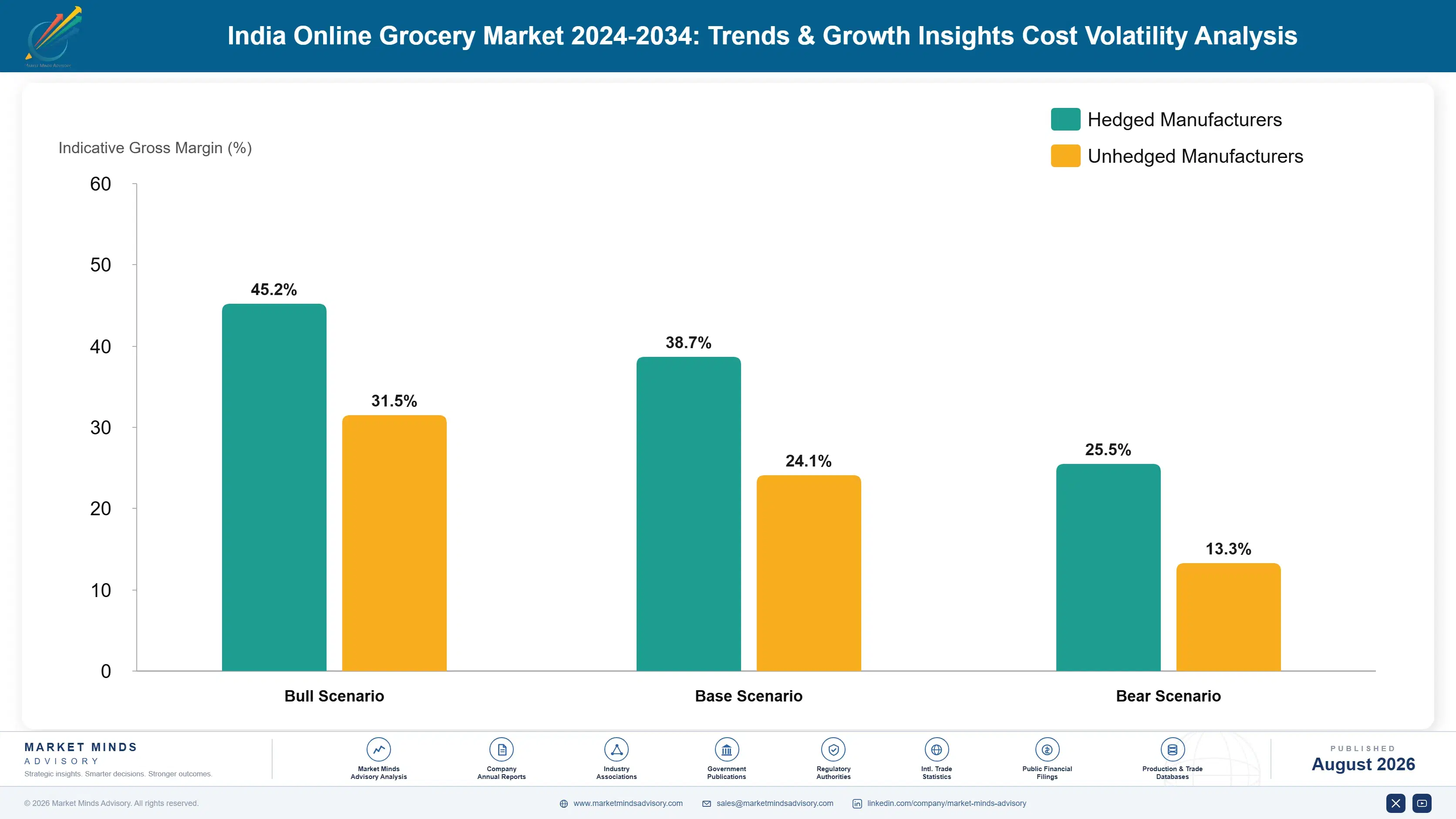
Last-Mile Logistics Cost Exposure

Last-mile logistics and dark store operating costs represent roughly 38% of total operating cost structure, with the remainder split across technology infrastructure, marketing, and warehousing costs. Most delivery fleet and cold-chain capacity originates from a concentrated set of third-party logistics providers and gig-economy delivery partners, creating meaningful exposure to fuel pricing volatility and labor availability disruption across most established metro markets each year.
Fuel price spikes tied to global crude oil volatility during 2022 and 2023 drove sharp increases in last-mile delivery costs, a volatility event documented in IEA-adjacent energy data and company annual reports. Several platforms reported elevated delivery partner incentive payouts during this period as fuel costs squeezed gig-worker take-home pay, compressing margins for several consecutive quarters before conditions gradually normalized through 2024. Platforms reported difficulty retaining delivery partners during this window, prompting several to raise incentive structures.

This cost exposure disadvantages smaller regional platforms lacking long-term logistics partner agreements or vertically integrated delivery fleet operations, since they must pass through fuel cost spikes immediately or absorb margin compression. Larger integrated platforms with diversified logistics sourcing and multi-year fleet contracts weather volatility more smoothly, widening the competitive gap during periods of fuel price disruption across most metro markets.
india-online-grocery-market-trends-growth-cost-volatility-analysis-1787460768126

Diversifying Delivery Fleet Sourcing Across Providers

Leading platforms are qualifying secondary delivery fleet sourcing across multiple third-party logistics providers to reduce dependence on any single fuel-exposed partner, cutting exposure to regional supply disruptions. This diversification has reduced average delivery partner attrition for several major platforms, a practice becoming standard in fleet planning. This practice is now standard across most major fleet planning decisions.

Locking Multi-Year Cold-Chain Logistics Contracts

Larger platforms are negotiating multi-year cold-chain and last-mile logistics contracts at fixed or collared pricing to shield fulfillment economics from short-term fuel market volatility. This approach has helped several platforms avoid the sharpest cost spikes experienced by spot-market-dependent competitors, with contracts spanning two to three years. Coverage terms typically extend across a meaningful share of annual delivery volume.

Investing in Diversified Fulfillment Capability

Several platforms today are investing steadily in diversified fulfillment capability to reduce dependence heavily on single-source delivery fleet supply cycles, diversifying their cost exposure while also meaningfully improving overall logistics reliability for consumers requiring documented delivery consistency across most major metro and tier-2 regions nationwide, especially among mid-sized platforms seeking long-term operational stability and resilience.

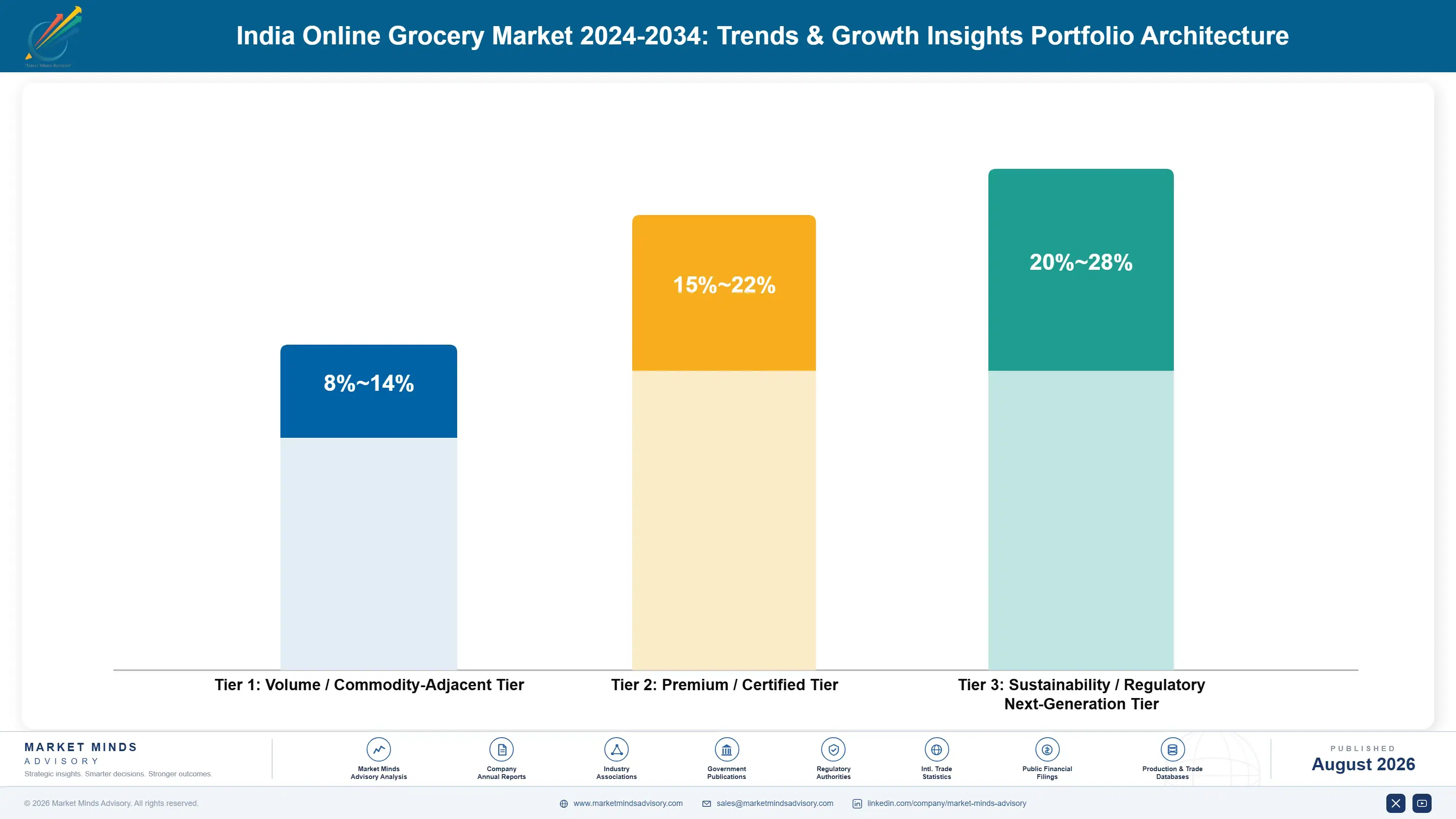
Portfolio Architecture for Margin Defence

Portfolio economics split across three tiers. Volume commodity-adjacent standard marketplace orders carry thin margins driven by delivery cost pass-through, while premium quick commerce orders qualified for instant-fulfillment applications command meaningfully higher gross margins reflecting logistics complexity and the capital barriers competitors must clear to enter these lucrative categories in the first place. Consumers increasingly treat this segmentation as a starting point for platform loyalty decisions rather than a fixed classification.
The tension between volume and premium positioning defines platform strategy across the industry today. Commodity standard-grade marketplace volume remains steady but slow-growing and price-competitive, while premium quick commerce and subscription offerings represent a smaller but much faster-growing and higher-margin pool that rewards platforms with dedicated logistics capability across their expanding customer base nationwide currently, a gap that keeps widening each year.

High-value margin pools concentrate specifically in quick commerce fulfillment, documented subscription retention for convenience-focused households, and kirana-partnership-bundled service contracts, where logistics differentiation and capital barriers remain highest relative to commodity standard-grade categories sold mainly on price and delivery reach alone nationwide. Platforms investing early in these categories are positioning themselves for durable margin advantages over the coming decade and beyond.

Volume / Commodity-Adjacent Tier

Standard marketplace and scheduled delivery orders sold mainly on price to general urban buyers, carrying thin, delivery-cost-sensitive margins nationwide currently. Platforms here compete mainly on assortment breadth and reliable delivery rather than speed differentiation.
Gross Margin: 8-14%

Premium / Certified Tier

Quick commerce orders meeting sub-fifteen-minute delivery standards, commanding steadier premium pricing from demanding urban buyers. Platforms in this tier typically invest meaningfully in dark store density and delivery fleet reliability capability.
Gross Margin: 15-22%

Sustainability / Regulatory / Next-Generation Tier

Subscription and kirana-partnered hybrid models capturing early-mover retention and technology transition premiums from demanding convenience-focused households seeking documented reliability. Platforms here differentiate through loyalty depth rather than volume or price competition across most accounts.
Gross Margin: 20-28%
india-online-grocery-market-trends-growth-portfolio-architecture-1787460768633

High-value Sub-segments and Strategic Watch-out

Subscription Retention-Track Households

Highest-value, fastest-growing pool tied directly to convenience demand, commanding premium retention on documented delivery consistency and loyalty programme depth nationwide currently and consistently. Platforms here are investing heavily to defend early qualification advantages against fast-following competitors. Demand here shows little sign of slowing across most tracked accounts.
Gross Margin: 21-29%

Documented Kirana Partnership Coverage

High-value pool growing steadily alongside hyperlocal delivery trends, anchored in partnership documentation and long-term neighborhood relationships that reward logistics depth overall today across most premium categories. Platforms with established kirana relationships hold a durable advantage in this category. Growth here tracks hyperlocal adoption trends closely.
Gross Margin: 14-21%

General Standard-Grade Marketplace Volume

Largest volume core segment, price-competitive and delivery-cost-exposed, generating steady but comparatively low-margin revenue across mature demand nationwide currently and consistently over time across most established metro markets. Platforms here must optimize logistics and fleet efficiency to protect already-thin operating margins. Volume growth here remains steady but unspectacular overall.
Gross Margin: 6-12%

Deep Discounting Regulatory Exposure

Strategic watch-out segment facing rising exposure to regulatory scrutiny and compliance cost pressure across multiple state jurisdictions; platforms reliant on aggressive discounting face ongoing policy risk during regulatory tightening periods. Platforms with diversified retention strategies are better positioned to weather this exposure than discount-reliant competitors overall.
Gross Margin: 5-11%

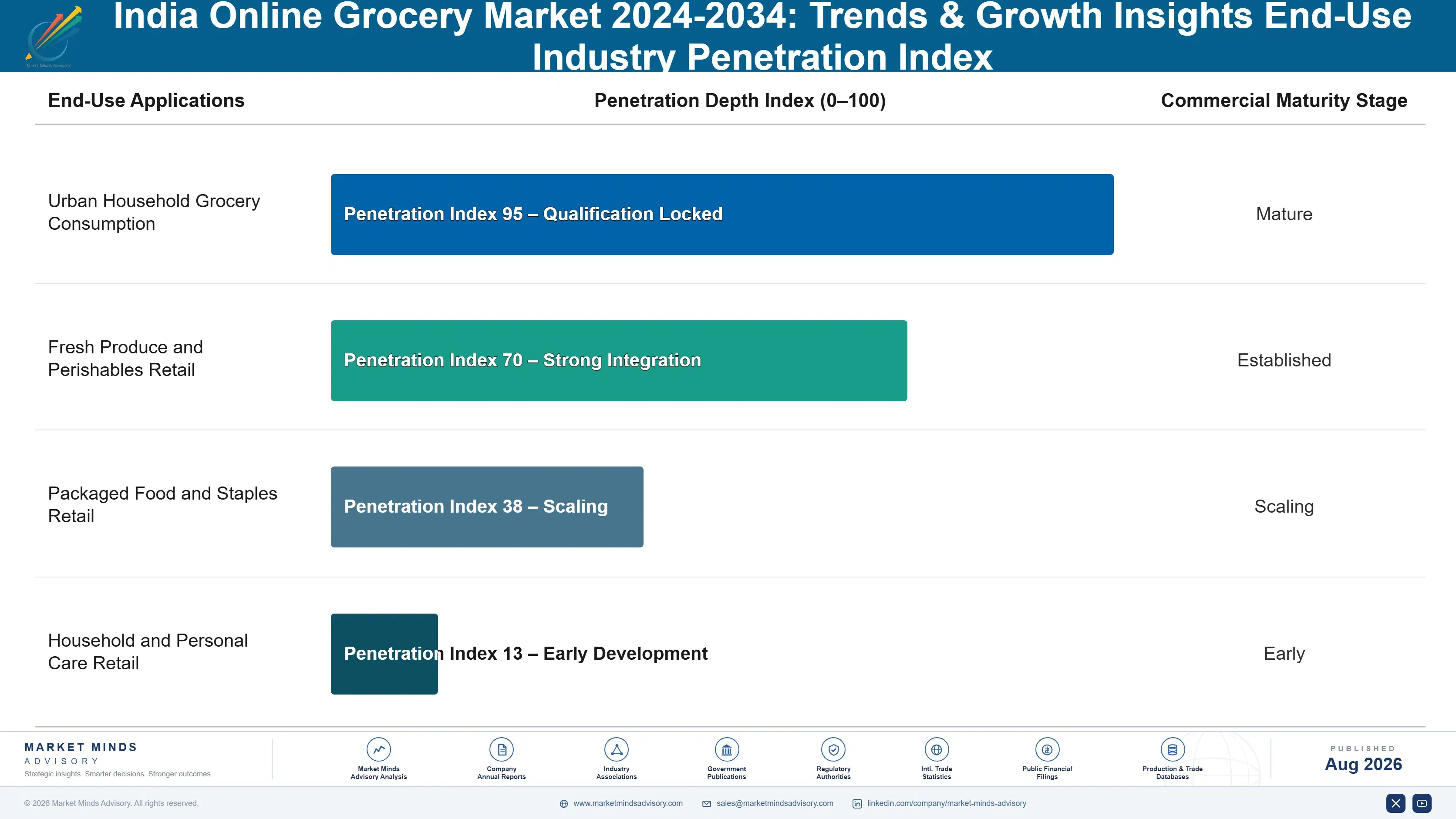
Habit Formation and Delivery Reliability

Online grocery demand behaves like an annuity once a household forms a habitual ordering pattern on a preferred platform, since switching platforms requires re-learning app navigation and rebuilding saved order lists, a process most households avoid unless forced by persistent delivery reliability problems with their existing platform relationship overall. That stickiness reinforces the durability of established platform relationships across most accounts today.
Adoption stickiness varies meaningfully by end-use vertical. Premium quick commerce and subscription programmes show the deepest stickiness given strict delivery speed expectations and recurring order cycles, while conventional marketplace buyers show more moderate stickiness tied to periodic price-driven switching across competing platforms, and kirana-partnered hyperlocal shoppers show intermediate stickiness that strengthens once a platform proves reliable consistency over consecutive delivery cycles. That variation shapes retention priorities across each customer category.

A generational shift in buyer profiles is underway as younger urban households increasingly expect app-native convenience features rather than relying solely on traditional in-store shopping habits, changing how platforms must present delivery reliability during the acquisition and retention process across most large metro accounts and long-standing customer relationships nationwide. This shift rewards platforms able to present consistent, quantified delivery performance evidence consistently overall.
india-online-grocery-market-trends-growth-end-use-penetration-index-1787460769126

Where Delivery Speed Beats Assortment Breadth

These are among the four positions where our research anticipates prominent divergence between winners and laggards over the coming forecast period. Each is grounded in the demand model, the regulatory perimeter, and the announced capacity pipeline.
01 / DARK STORE INVESTMENT PRIORITY

Prioritize dark store density ahead of demand growth

Platforms who invest early in dark store density and secure documented fulfillment reliability for new tier-2 city launches will capture a disproportionate share of the substantial quick-commerce-driven volume growth tied to consumer demand through the coming decade and beyond. Waiting until competitor networks are established risks losing market share to faster-moving platforms who have already built the necessary logistics and delivery track record. Early movers can also charge meaningful premiums for documented delivery speed that slower competitors cannot yet offer at comparable scale.
02 / KIRANA PARTNERSHIP PRIORITY

Expand kirana partnership networks ahead of demand

Expanding kirana partnership networks creates a differentiation advantage that pure dark-store-only competitors cannot easily replicate, defending coverage expansion above 65% faster across most premium tier-2 categories served nationwide today. This approach matters most as smaller-city demand accelerates rapidly across major consuming regions nationwide, where partnership depth is increasingly the primary adoption barrier rather than price alone. Platforms without comparable partnership depth should expect gradual share erosion in accounts served today, particularly among demanding tier-2 households seeking documented, consistent delivery reliability.
03 / LOGISTICS COST SECURITY

Secure long-term cold-chain contracts ahead of volatility

Locking in long-term cold-chain and last-mile logistics agreements at fixed or collared pricing shields fulfillment economics from short-term fuel market volatility, a decisive advantage during periods of persistent fuel price disruption across most metro markets nationwide currently. This approach matters most for platforms competing primarily on commodity standard-grade volume, where fuel cost management is the primary determinant of margin survival rather than technical differentiation across categories. Platforms who delay contracting risk facing sharper margin compression during future disruptions across most affected accounts today.
04 / PORTFOLIO CAPITAL REBALANCING

Shift capital toward quick commerce and subscription lines

Commodity standard-grade marketplace categories face thinning margins from delivery cost volatility and regional price competition, while quick commerce and subscription offerings provide substantially higher and more durable margins tied to logistics barriers competitors struggle to clear quickly at meaningful commercial scale. Platforms should redirect capital expenditure toward these categories rather than defending commodity marketplace share against lower-cost regional competitors undercutting on price across most established accounts. This rebalancing protects long-term profitability even if it means accepting some gradual marketplace volume share loss overall.

Engagement Snapshot From the Field

A live engagement with an industry participant carrying material or product regulatory and market exposure ahead of a defining policy shift, showing how our research translates into a defensible multi-year portfolio strategy.
MARKET MINDS ADVISORY · CLIENT ENGAGEMENT SUMMARY
India Online Grocery 2024-2034: Trends & Growth Insights Producer Strategic Portfolio Review and Transition Roadmap 2026·Investment Scenario on India Online Grocery 2024-2034: Trends & Growth Insights Exposure Evaluation 2025-26
CLIENT PROFILE
The client is a mid-sized regional fresh food retailer expanding online grocery presence to serve growing urban quick commerce demand, with combined annual revenue in the range of $85 million (client-reported, unverified by MMA). The retailer was launching a new dark store expansion initiative requiring documented logistics reliability and sought an independent platform evaluation ahead of a multi-year technology partnership decision covering initial and scale-up delivery volumes.
STRATEGIC CHALLENGE
The retailer needed to select a logistics and fulfillment technology partner capable of delivering dark store operations meeting strict delivery speed and reliability requirements while managing budget exposure to premium infrastructure pricing overall. Existing delivery relationships lacked documented fulfillment consistency sufficient to support the planned expansion timeline and scale, creating considerable pressure to act quickly and decisively.
MMA APPROACH
MMA conducted a comparative platform capability assessment today covering five candidate logistics technology partners, evaluating delivery reliability certification status, dark store network capacity, and pricing structure across comparable contract volumes and expansion timelines. The engagement included facility audits and review of partner quality documentation against the specific delivery requirements applicable to the retailer's expansion plan.
KEY FINDINGS
  1. Only two of five candidate partners had delivery reliability certification meeting the retailer's specific requirements today, limiting the effective partner pool available for the planned expansion.
  2. Bundled logistics support reduced projected internal onboarding testing needs by an estimated 13% (client-reported, unverified by MMA), a meaningful efficiency gain given the retailer's tight launch timeline.
  3. Price differentials between qualified partners narrowed to within 7% once documentation support was factored into total cost of ownership, making documentation depth a more decisive factor than headline pricing.
  4. Two candidate partners lacked sufficient dark store network capacity to guarantee delivery timelines matching the retailer's planned launch schedule, eliminating them from consideration despite otherwise competitive commercial terms.
CLIENT PROFILE
The client is a mid-sized regional fresh food retailer expanding online grocery presence to serve growing urban quick commerce demand, with combined annual revenue in the range of $85 million (client-reported, unverified by MMA). The retailer was launching a new dark store expansion initiative requiring documented logistics reliability and sought an independent platform evaluation ahead of a multi-year technology partnership decision covering initial and scale-up delivery volumes.
STRATEGIC CHALLENGE
The retailer needed to select a logistics and fulfillment technology partner capable of delivering dark store operations meeting strict delivery speed and reliability requirements while managing budget exposure to premium infrastructure pricing overall. Existing delivery relationships lacked documented fulfillment consistency sufficient to support the planned expansion timeline and scale, creating considerable pressure to act quickly and decisively.
MMA APPROACH
MMA conducted a comparative platform capability assessment today covering five candidate logistics technology partners, evaluating delivery reliability certification status, dark store network capacity, and pricing structure across comparable contract volumes and expansion timelines. The engagement included facility audits and review of partner quality documentation against the specific delivery requirements applicable to the retailer's expansion plan.
KEY FINDINGS
  1. Only two of five candidate partners had delivery reliability certification meeting the retailer's specific requirements today, limiting the effective partner pool available for the planned expansion.
  2. Bundled logistics support reduced projected internal onboarding testing needs by an estimated 13% (client-reported, unverified by MMA), a meaningful efficiency gain given the retailer's tight launch timeline.
  3. Price differentials between qualified partners narrowed to within 7% once documentation support was factored into total cost of ownership, making documentation depth a more decisive factor than headline pricing.
  4. Two candidate partners lacked sufficient dark store network capacity to guarantee delivery timelines matching the retailer's planned launch schedule, eliminating them from consideration despite otherwise competitive commercial terms.
RECOMMENDED STRATEGY
Phase 1: Phase 1 (Months 1 to 2): Finalize partner selection based on delivery reliability certification status and available dark store capacity, weighting documented experience heavily. Phase 2: Phase 2 (Months 3 to 6): Pilot initial metro rollout with the selected partner ahead of the planned commercial launch expansion. Phase 3: Phase 3 (Months 7 to 12): Scale delivery volume alongside launch expansion while renegotiating multi-year pricing terms with the partner.
OUTCOME
The retailer selected a partner offering bundled logistics support and completed delivery reliability qualification roughly five weeks ahead of the planned expansion launch date. Estimated annual logistics costs came in approximately 6% below initial budget projections once volume commitments were finalized (client-reported, unverified by MMA), while qualification workload dropped meaningfully.

Frequently Asked Questions

Foundational context covering the market sizes, CAGR, scope, country, region and competition that inform every finding below. This section is provided to cover basics and most often pre-purchase conversations, answered from the MMA Primary Research Dataset.

What is the current size of the India Online Grocery Market?

The market is valued at approximately $11.8 billion in 2025. Growth is driven by expanding quick commerce adoption and dark store network expansion across major metro markets.

How large will the India Online Grocery Market be by 2036?

The market is projected to reach approximately $59.2 billion by 2036. Sustained quick-commerce-driven growth and tier-2 city expansion together drive this trajectory forward across urban India nationwide.

What is the CAGR for the India Online Grocery Market 2026 to 2036?

The market is forecast to grow at a compound annual growth rate of 15.8% between 2026 and 2036. Quick commerce is growing considerably faster than the overall market average.

Which segment is growing fastest?

Quick commerce is growing fastest at approximately 24.2% CAGR, roughly 1.53 times the overall market rate, driven by instant fulfillment demand and expanding dark store investment.

Who are the major companies in the India Online Grocery Market?

Leading platforms include Zepto, Blinkit, Swiggy Instamart, BigBasket, and JioMart, together holding roughly 68% combined market share on an order volume basis across metro India nationwide.

Which region is growing fastest within India?

Tier-2 and tier-3 Indian cities are the fastest-growing geography today at approximately 19.4% CAGR, driven by rapidly expanding smartphone and digital payment penetration across smaller urban centers nationwide.

Report Segmentation Architecture

The full report scope spans multiple orthogonal segmentation dimensions, with cross-tabulated demand data provided for each dimension pair. Coverage extends further to regional breakdowns, trend trajectories, and the competitive detail needed to support segment-level decision-making.

By Delivery and Business Model

  • Quick Commerce
  • Scheduled Slot-Based Delivery
  • Marketplace and Aggregator Model
  • Direct-to-Consumer Retailer-Owned Platforms
  • Subscription and Recurring Order Models
  • Hyperlocal Kirana-Partnered Delivery

By End-Use Industry

  • Urban Household Grocery Consumption
  • Fresh Produce and Perishables Retail
  • Packaged Food and Staples Retail
  • Household and Personal Care Retail

By Commercial Dimension

  • Direct Platform-to-Consumer Sales
  • Kirana Partner Fulfillment Agreements
  • Bundled Subscription Loyalty Programmes
  • Third-Party Logistics Contracted Services

By Region

  • North America
  • Western Europe
  • East Asia
  • South Asia and Pacific
  • Latin America
  • Middle East and Africa
  • Eastern Europe

Scope, Methodology, and Coverage

Every figure in this report is reproducible from documented input assumptions. The scope below maps the historical period, the forecast horizon, the segmentation dimensions, and the countries covered, alongside the underlying primary and qualitative methodology.
Historical Period
2020 to 2025
Forecast Period
2026 to 2036
Base Year
2025 (USD billions; MMA Primary Research Dataset, August 2026)
Market Definition
This report covers online-ordered grocery and fresh food retail delivered to Indian consumers through quick commerce, scheduled delivery, and marketplace platforms, including packaged food, fresh produce, and household staples. It excludes restaurant food delivery and non-grocery e-commerce categories, which are analyzed as distinct market segments.
Quantitative Units
USD billions (current prices); order volume where data is available
Segmentation Dimensions
By Delivery and Business Model; By End-Use Industry; By Commercial Dimension; By Region
Regions Covered
North America, Western Europe, East Asia, South Asia and Pacific, Latin America, Middle East and Africa, Eastern Europe
Countries Covered
India (Mumbai, Delhi NCR, Bengaluru, Pune, Ahmedabad, Jaipur, Hyderabad, Chennai, Kolkata metro regions)
Key Companies Profiled
Zepto (Kiranakart Technologies Pvt. Ltd.), Blinkit (Eternal Limited), Swiggy Instamart (Swiggy Limited), BigBasket (Tata Digital), JioMart (Reliance Retail Ventures Limited), Amazon Seller Services Pvt. Ltd., Flipkart Internet Pvt. Ltd., Avenue Supermarts Limited, Spencer's Retail Limited, Trent Limited, More Retail Limited, RJ Corp Ventures Pvt. Ltd., Otipy Technologies Pvt. Ltd., Frontrow Ventures Pvt. Ltd., Dunzo Digital Pvt. Ltd., Nature's Basket Limited, FreshToHome Foods Pvt. Ltd., Metro Cash & Carry India Pvt. Ltd., Apna Mart Technologies Pvt. Ltd., Delightful Gourmet Pvt. Ltd.
Quantitative Methodology
Primary survey, n=3,800 respondents, Q4 2025, six countries; demand-side model with trade association cross-validation
Qualitative Methodology
47 expert interviews, Q4 2025; applied to validate demand model assumptions, identify emerging dynamics, and assess competitive positioning
Report Format
PDF and XLSX data workbook (Word format preview document)
Publisher
Market Minds Advisory
Report Code
MMA-2026-TEC-142
Published
August 2026
Contact
sales@marketmindsadvisory.com | www.marketmindsadvisory.com

Purchase the full India Online Grocery Market 2024-2034: Trends & Growth Insights Report (2026 to 2036).

The full report delivers detailed segment-level sizing across all six delivery and business model categories, city-level breakdowns across major Indian metro and tier-2 markets, and in-depth competitive profiles covering twenty companies active in this market today. It includes granular analysis of dark store expansion timelines, last-mile logistics cost sensitivity modeling, and platform qualification pathway guidance for investors navigating funding and regulatory documentation requirements. The report also profiles emerging kirana partnership and subscription retention technologies gaining early commercial traction across leading platforms. Buyers also receive access to underlying data tables and a dedicated analyst briefing call.
City-level sizing across nine major Indian metro markets
Dark store expansion tracker by city and category
Last-mile cost sensitivity modeling and forecasting tools
Twenty-company competitive benchmarking profiles included throughout
Platform qualification pathway guidance provided throughout
Dedicated analyst briefing call included at no cost

Built For The People Who Decide

From boardroom strategy to bench-side execution, this report is read cover-to-cover by leaders shaping the next decade of their industry, turning demand scenarios, market dynamics and valuation benchmarks into decisions.
CXOs/ Presidents/ VPs/ Managers
M&A and Corporate Development
Strategy Teams and R&D Heads
Procurement and Product Directors
Regulatory and Compliance Leaders
Investor Relations and Equity Analysts