Market Minds Advisory
India Loyalty Program Market

India Loyalty Program Market: India Loyalty Program Market: Breakage Under Pressure, Payment Rails Without Interchange and Paid Membership

Loyalty economics everywhere else are funded by card interchange, and the rail carrying most Indian retail payment has none, which is why members are increasingly asked to pay for the programme themselves.

Lead Analyst

Published

September 2026

Make Smarter Decisions with Customized Research Insights

Request a free sample report and evaluate market opportunities, growth trends, and competitive dynamics relevant to your business needs.

2025 MARKET VALUE$2.1BMarket Size 2025
2036 FORECAST VALUE$6.9BBase Case , 2026 to 2036
CAGR 2026 TO 203611.6 %Bull 12.9% / Bear 10.4%
INCREMENTAL OPPORTUNITY$4.6BNet 10- year value creation
EXPANSION MULTIPLE3.00x2036 value over 2026 base
Strategic Levers
M&A Pipeline
Regional Outlook
Country Rankings
Competitive Intelligence
Segmental Deep-dive
Call-Us : 91 93563 13602

Executive Snapshot and Market Trajectory.

Western loyalty economics do not transfer here, and the payment rail is why. Card interchange funds rewards almost everywhere else. Roughly 79% of Indian retail digital transactions run on a rail carrying none, so no pool exists at the payment layer. Design here follows from that absence.
Quick commerce and marketplace programmes grow at 17.4%, half again the market rate of 11.6%, because order frequency in that channel makes a small benefit compound into a habit. Paid membership and subscription programmes follow at 14.9%, having solved the funding problem by charging the member directly. Bank and card reward programmes grow slowest at 8.4%, squeezed by regulatory disclosure requirements and by the rail shift itself.
Breakage carries the profit and it is narrowing. Around 41% of issued points expire unredeemed, which is what makes most programmes viable, and reward disclosure requirements alongside the Digital Personal Data Protection Act are both tightening around that. Enrolment numbers mean very little here: only about 23% of enrolled members transact through a programme in a given quarter. A phone number captured at a billing counter is not consent to anything.
Market Definition
This market covers spending on consumer loyalty programmes operating in India, including platform licensing, programme operation, points issuance and redemption infrastructure, and analytics services, across retail coalition, bank and card, travel frequency, quick commerce, fuel and paid membership programmes. Sizing is at programme operating and platform spend. Employee reward schemes, business-to-business incentive programmes, gift card issuance outside a loyalty programme, and payment network fees are excluded.
Base Year Value
$2.1B in 2025 (MMA Primary Research Dataset, September 2026)
Forecast Period
2026 to 2036, eleven discrete annual values
CAGR
11.6% base case. Bull 12.9%. Bear 10.4%.
Fastest Growth Segment
Quick Commerce And Marketplace Programmes: 17.4% CAGR
Fastest Growth Country
Bengaluru: 15.2% CAGR
Fastest Growth Region
South Asia and Pacific: 13.4% CAGR
Largest Region
South Asia and Pacific: 61% of 2025 global value
Market Leaders
Capillary Technologies, Tata Digital, Reliance Retail, Amazon, Eternal. Source: MMA Primary Research Dataset, July 2026.
Primary Survey
n=3,800 procurement and R&D decision-makers, Q4 2025, six countries
Methodology
Demand-side build-up, cross-validated against public data, 47 expert interviews

India Loyalty Program Market Forecast Scenarios

india-loyalty-program-market-size-forecast-scenario-1790022188428
Growth of 10.3% between 2020 and 2025 came from a channel that barely existed at the start of it. Quick commerce and food delivery built frequency-based programmes on order volumes no Indian retailer had previously seen, while traditional retail coalition schemes stagnated. Bank reward programmes grew until 2022 and then flattened as disclosure requirements arrived and payment volume migrated away from cards.
Three mechanisms carry the base case. Paid membership continues expanding at 14.9% because charging the member solves a funding problem the payment rail created. Quick commerce order frequency keeps compounding small benefits into habit, and Bengaluru grows at 15.2%, the fastest metropolitan market covered here. Data protection compliance is itself a spending driver, since consent management and purpose limitation require platform capability most programmes never previously bought, and it has become a selection criterion.
The bull case is redemption liquidity. If points become transferable between programmes, perceived value rises and enrolment converts into activity. The bear case is breakage regulation. Around 41% of issued points expire unredeemed and that is what funds most programmes, so any requirement to extend validity or refund lapsed value would remove the economics from a large part of the market at once.

Why The Western Model Does Not Transfer

Every loyalty programme needs someone to pay for the reward, and in most markets that someone is the card network through interchange. India routed around 79% of retail digital transactions onto a rail that carries no interchange at all, which removed the funding mechanism before most retailers had built a programme on it. That single fact explains why Indian loyalty looks unlike loyalty anywhere else. Programmes imported from Western playbooks arrive without the pool their design assumed, and pay for benefits from retail margin instead.
TOP FIVE CONCENTRATION31%Combined programme spend share held by the five largest participants
ACTIVE MEMBER SHARE23%Enrolled members transacting through a programme each quarter
AVERAGE POINTS BREAKAGE41%Issued points that expire before any member redeems them
UPI TRANSACTION SHARE79%Retail digital payments carrying no interchange to fund rewards
PAID MEMBERSHIP PENETRATION14%Households paying an annual fee for programme access
PROGRAMME OPERATING COST3.2%Programme running cost as a proportion of attributed sales
Membership figures reported in this market should be treated with caution. Only about 23% of enrolled members transact through a programme in a given quarter, and enrolment is frequently not a choice: a phone number captured at billing enrols the customer whether or not they wanted a programme. Counting those enrolments as members produces numbers that impress and predict nothing at all.
Breakage funds the economics and it is under pressure from two directions at once. Roughly 41% of issued points expire unredeemed. Reserve Bank of India requirements on reward disclosure in credit card programmes and the consent obligations under the Digital Personal Data Protection Act both narrow the room that breakage has historically occupied.
"Indian programmes report member counts the way a gym reports sign-ups in January. The number that matters is how many people transacted last quarter, and that number is roughly a quarter of what the press releases say."
Director, Digital Commerce and Customer Analytics Practice · MMA Technology Practice · September 2026

Market Trends

Paid Membership Replaces Interchange As The Funding Source

When the payment rail stops paying for rewards, someone else has to, and Indian programmes increasingly ask the member. Annual fee memberships across marketplace, food delivery and quick commerce grow at 14.9% against a category rate of 11.6%, and household penetration has reached roughly 14%. The model also inverts the engagement problem: a member who paid a fee has an incentive to use the programme rather than to forget it, which lifts active rates well above the 23% category norm. Programmes without a paid tier are funding rewards from margin they do not have.
Market Impact: Fastest segment at 17.4%
Data Protection Compliance Becomes A Platform Purchase

The Digital Personal Data Protection Act requires consent capture, purpose limitation and deletion capability that most Indian loyalty programmes were never built to provide. Programmes collecting a phone number at billing and using it for marketing now need an auditable consent trail for each purpose. That converts a legal obligation into a platform requirement, and it is a genuine spending driver rather than a cost avoidance exercise. Participants selling consent management and preference infrastructure alongside loyalty capability are winning platform decisions that would previously have gone on campaign features alone.
Market Impact: Bengaluru grows at 15.2%

Market Opportunities and Growth Drivers

Quick Commerce Frequency Compounds Small Benefits Into Habit

Ten minute grocery delivery generates order frequencies that no Indian retail format has previously produced, with committed users ordering several times a week rather than several times a month. At that frequency even a small percentage benefit accumulates into something a member notices and plans around. Quick commerce and marketplace programmes grow at 17.4%, the fastest segment covered here. The channel also captures basket-level data continuously rather than at occasional visits, which makes personalisation genuinely feasible rather than aspirational. Benefit structures here are typically instant rather than accrued, which sidesteps breakage entirely.
Market Impact: Only 23% transact quarterly

Metropolitan Digital Retail Deepens Beyond The Largest Cities

Programme spending has historically concentrated in Mumbai, Delhi and Bengaluru, and tier two metropolitan demand is now growing faster than any of them. Bengaluru still leads at 15.2% on the strength of quick commerce density and technology sector employment, but Pune, Hyderabad, Ahmedabad and Jaipur are all expanding programme participation from lower bases. That geographic spread changes programme design, since benefit structures calibrated for metropolitan basket sizes translate poorly to smaller ones without recalibration. Very few participants have recalibrated benefit structures for smaller baskets rather than simply replicating what worked in the largest cities.
Market Impact: 41% of points expire unused

Market Restraints and Challenges

Enrolment Numbers Conceal Almost Total Member Inactivity

Only about 23% of enrolled members transact through a programme in a given quarter, and the root cause is that enrolment is rarely a decision. A phone number given at billing enrols the customer automatically, so the member list measures footfall rather than intent. Commercially this misleads investment: programmes are scaled on enrolment growth that carries no incremental revenue behind it. Participants are responding by reporting quarterly active members separately and by building re-engagement paths, though very few disclose the distinction publicly. The headline number falls by three quarters the day anyone reports the distinction honestly.
Market Impact: Reaches 14% household penetration

Breakage Economics Face Regulatory Narrowing From Two Sides

Around 41% of issued points expire unredeemed and that unredeemed liability is what makes most programmes profitable. The root cause is a design that issues generously and redeems awkwardly, with minimum thresholds and short validity discouraging use. Reserve Bank of India disclosure requirements on credit card reward programmes and Digital Personal Data Protection Act consent obligations both narrow that space. Participants are shifting toward paid membership and instant benefit structures, which earn revenue rather than depending on members forgetting what they were owed. That earns revenue rather than depending on members forgetting what they were owed.
Market Impact: Adds 1 new platform requirement
4 additional market trends, 3 additional growth drivers, and 2 additional restraints and challenges are covered in the full report. Contact sales@marketmindsadvisory.com to access the complete intelligence.

Segment CAGR and Growth Architecture

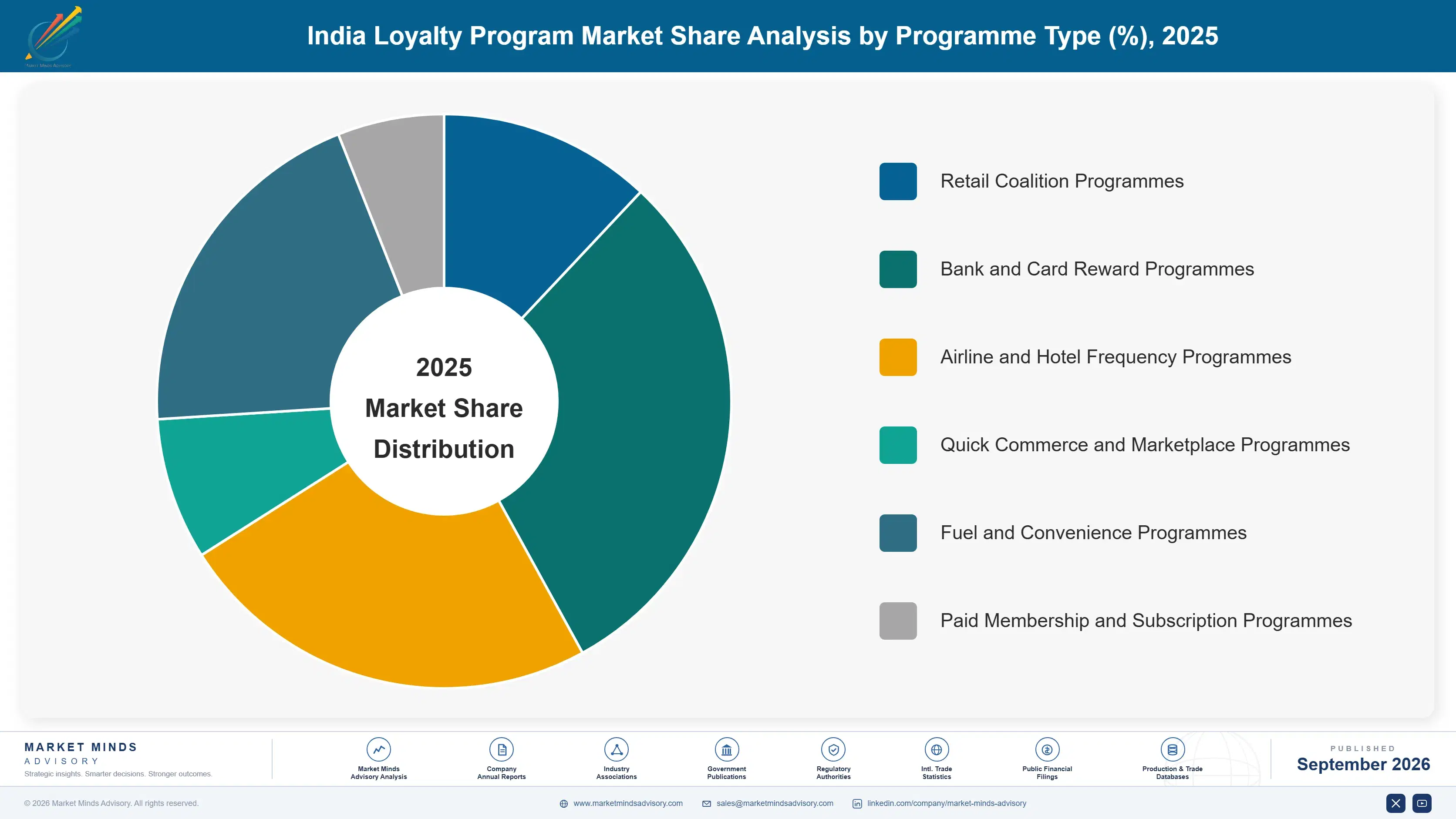
Segmentation follows programme type, the dimension on which funding source, benefit structure, regulatory treatment and platform requirement all divide together. Six programme types are assessed at operating and platform spend. Employee reward schemes, business incentive programmes, standalone gift card issuance and payment network fees sit outside the defined scope. Benefit face value is discussed but not sized here.
india-loyalty-program-market-market-share-analysis-1790022189018

Quick Commerce And Marketplace Programmes

Quick commerce and marketplace programmes grow at 17.4%, half again the market rate of 11.6%, and frequency rather than generosity explains it. Committed quick commerce users order several times a week, which means a benefit worth a few rupees per basket accumulates into something a member plans around rather than forgets. No Indian retail format has previously generated that transaction rhythm. The channel also produces continuous basket-level data rather than occasional snapshots, which makes personalisation practical instead of aspirational. Benefit structures here are typically instant rather than accrued, which sidesteps the breakage question entirely and is one reason the segment sits outside the regulatory pressure affecting points programmes. Unit economics in the channel itself remain unproven.
CAGR 17.4%

Paid Membership And Subscription Programmes

Paid membership programmes grow at 14.9% because they answer the question the Indian payment rail created: if interchange does not fund the reward, who does. Charging the member an annual fee makes the funding explicit and, unusually, improves engagement rather than suppressing it. A member who has paid has a reason to use the programme, and active rates across paid tiers run far above the 23% category norm. Household penetration has reached about 14%, concentrated in metropolitan quick commerce, food delivery and marketplace users. The commercial risk is that a paid member expects delivered value continuously and will cancel visibly, which is a discipline free programmes never face. Free programmes never face that test at all.
CAGR 14.9%
Full segment breakdown across 6 segments available in the complete report.

Regional Architecture and Country Demand Map

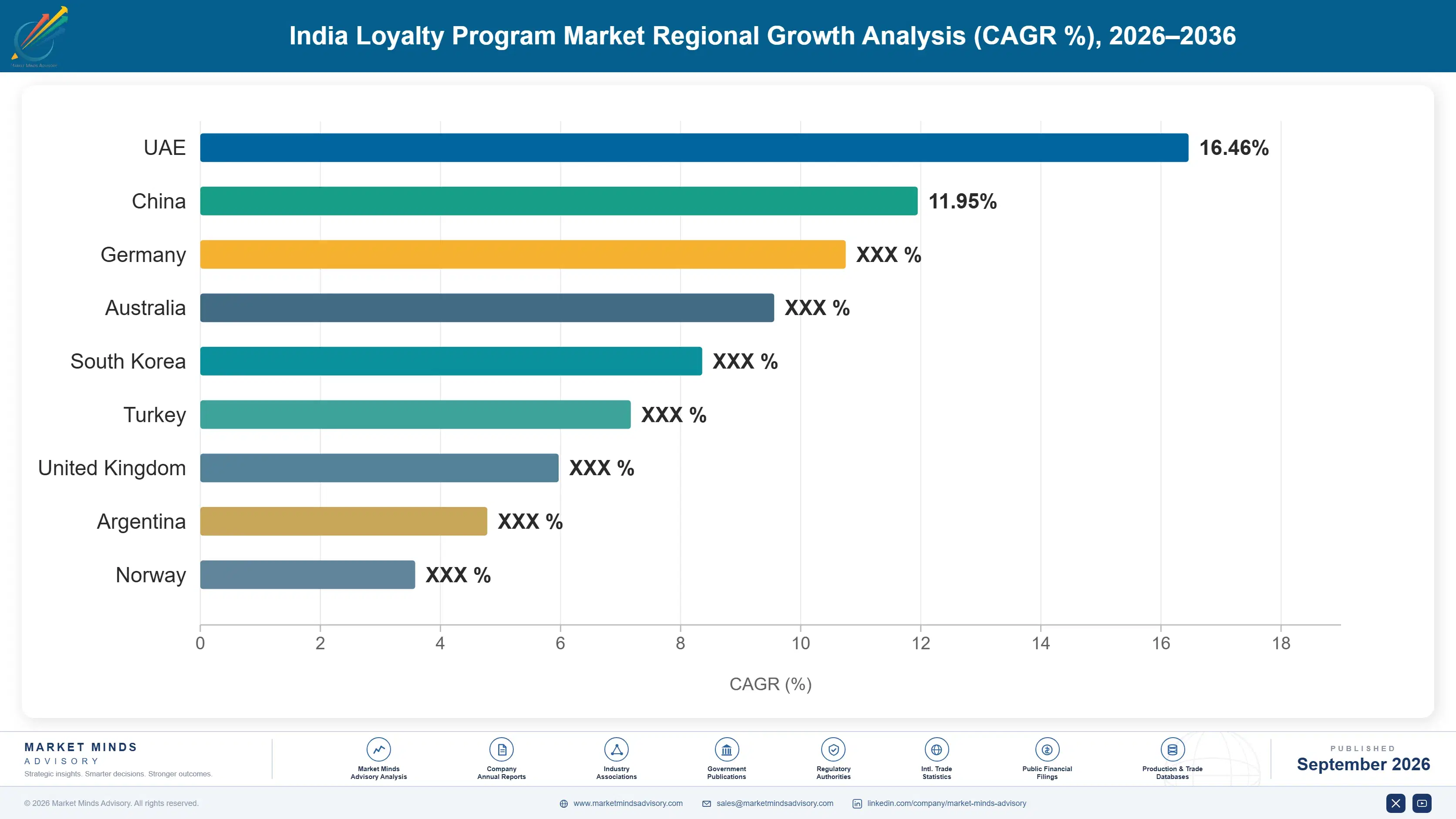
This regional table records where the platforms, technology and operating capability serving Indian programmes originate, not where members are, because the market itself is country-scoped. All seven regions consequently sit outside their standard share bands. This is a country-scoped report and the deviation is flagged for operator ruling.

South Asia and Pacific

Domestic capability holds 61% of supply, far outside the standard band because this is a country-scoped market where local origin is the natural condition rather than an exception. Capillary Technologies built genuine platform depth serving Indian retail before expanding outward, and Tata Digital and Reliance Retail operate programmes on infrastructure developed in-house rather than licensed. Quick commerce operators build loyalty capability inside their own applications, which keeps that spending domestic entirely. Indian engineering cost also makes local platform development cheaper than licensing foreign software for most mid-sized programmes. Growth of 13.4% is the fastest of any supply origin covered here. Transaction data also stays with the operator rather than the vendor, which compounds the domestic advantage.
Share: 61% | CAGR: 13.4% (2026 to 2036)

North America

United States platform vendors supply 18% of the capability serving Indian programmes, below the standard band and concentrated at the enterprise end. Large bank and airline programmes license American customer data platforms and campaign management software because those products carry integration depth and audit capability that Indian alternatives are still building. Amazon operates its Indian membership programme on infrastructure developed globally. The Digital Personal Data Protection Act has complicated this position, since data residency and consent requirements demand configuration that global products did not originally anticipate. Growth of 10.8% reflects steady enterprise renewal rather than new share. Consent configuration was not anticipated when these products were designed, which has slowed deployments.
Share: 18% | CAGR: 10.8% (2026 to 2036)
Regional intelligence for 5 additional markets available in the complete report: East Asia, Western Europe, Middle East and Africa, Eastern Europe, Latin America. Contact sales@marketmindsadvisory.com.
india-loyalty-program-market-country-cagr-analysis-1790022189549

Four Moves Worth Making Now

These four address the two facts that decide profitability in Indian loyalty: the payment rail funds nothing, and enrolment numbers hide almost complete inactivity. Each has been executed by at least one participant with measurable results, and none requires a new platform build or a change to existing payment arrangements. Three of the four are decisions rather than builds.

Charge For The Programme Instead Of Funding It

Card interchange funds rewards in most markets and roughly 79% of Indian retail digital payment carries none, which leaves programmes paying for benefits out of margin. Charging an annual membership fee makes the funding explicit and improves engagement rather than suppressing it, because a member who paid has a reason to use what they bought. Participants operating paid tiers report active rates around 3.1 times their free tier equivalents. Household penetration of paid membership has reached about 14% and the ceiling is clearly higher. The ceiling on paid penetration is clearly higher than the current figure.
Market Impact: Raises active rates to roughly 3.1 times higher

Report Quarterly Active Members Not Enrolments

Only about 23% of enrolled members transact in a given quarter, because a phone number captured at billing enrols someone who never chose a programme. Scaling investment against enrolment growth therefore funds activity that does not exist. Participants who shifted internal targets to quarterly active members report programme return on spend improving by roughly 44%, entirely through reallocation rather than additional budget. The change is a measurement decision and it is uncomfortable, since the headline number falls by three quarters the day it is made. It is uncomfortable because the headline falls immediately.
Market Impact: Lifts programme return on spend by roughly 44%

Move Benefits From Accrued Points To Instant Value

Around 41% of issued points expire unredeemed, and regulatory pressure from reward disclosure requirements and consent obligations is narrowing the room breakage occupies. Instant benefits applied at the basket avoid the liability entirely and are valued more highly by members, who discount future points heavily. Participants who converted report redemption-equivalent engagement rising by about 29% at similar benefit cost. The transition removes a profit source that depended on members forgetting, and replaces it with one that does not require regulatory tolerance. Members discount future points heavily and value present benefits accurately.
Market Impact: Raises measured member engagement by roughly 29% overall

Sell Consent Infrastructure As Programme Capability

The Digital Personal Data Protection Act requires consent capture, purpose limitation and deletion capability that programmes built on billing counter phone numbers cannot provide. That is a platform requirement rather than a legal review, and it is a genuine spending driver. Vendors bundling consent and preference management with loyalty capability report win rates around 1.7 times those competing on campaign features alone. The requirement affects every programme in the market simultaneously, which is an unusually clean commercial opportunity for whoever is ready first. Every programme in the market faces the requirement simultaneously.
Market Impact: Raises platform win rates to roughly 1.7 times

Who Controls the Margin Pool

Concentration is moderate at 31% held by the top five, measured consistently on programme operating and platform spend rather than on member counts. The leader to challenger gap is wide in transaction data depth, where a quick commerce operator sees baskets several times a week and a coalition programme sees them monthly, and narrow in platform technology, where capable software is available from several vendors.
Competition runs on three dimensions currently. Transaction frequency decides how much a programme can actually personalise, which favours quick commerce and food delivery over every traditional retail format. Compliance capability decides enterprise platform selection following the Digital Personal Data Protection Act. Funding model decides sustainability, and programmes still paying for benefits out of retail margin are competing against ones whose members fund them directly.

Pressure is building on breakage-dependent programmes and on anyone reporting enrolment as a performance measure, and both are where positions will move. Bank and card programmes face disclosure requirements while their payment volume migrates to a rail that funds nothing. Participants whose platforms cannot demonstrate consent management are being excluded from enterprise selection processes they would previously have won on features.
india-loyalty-program-market-company-positioning-matrix-1790022190075

Competitive Moat and Risk Dimensions

CAPILLARY TECHNOLOGIES

Moat: Indian Retail Platform Depth

Years of programme operation across Indian retail have produced integration depth with domestic point of sale systems, billing practices and messaging infrastructure that global vendors have to build from scratch. The Kognitiv acquisition added international enterprise capability without diluting that local position, which is a combination no competitor currently matches in this market.
CAPILLARY TECHNOLOGIES

Risk: Platform Rather Than Data Position

Selling capability to programme owners means the transaction data sits with the client rather than the vendor, so the compounding advantage accrues to Reliance, Tata and the quick commerce operators instead. As those participants build internally, the addressable enterprise market narrows toward mid-sized retailers with less to spend.
TATA DIGITAL

Moat: Cross Group Redemption Breadth

NeuCoins earned in one Tata business and spent in another give the programme redemption liquidity that single-brand schemes cannot offer, across grocery, air travel, hospitality, electronics and financial services. That breadth addresses the perceived-value problem directly, since a point usable in many places is worth more than one usable in a single store.
TATA DIGITAL

Risk: Earn Rate Economics Across Brands

Funding a cross-group currency requires each business to accept the cost of points earned elsewhere, and internal transfer pricing on that has been revised more than once. Group brands with thinner margins have limited ability to absorb an earn rate set for the programme rather than for their own operation, which constrains how generous the currency can be.

Players Tracked

Prominent Players

Capillary Technologies
Tata Digital
Reliance Retail
Amazon
Eternal

Other Key Players

Swiggy
Flipkart
Payback India
Loylty Rewardz
Xoxoday
Almonds Ai
Comarch
Collinson Group
HDFC Bank
ICICI Bank
IndianOil Corporation
InterGlobe Aviation
Shoppers Stop
Lifestyle International
Nykaa

Recent Developments

SEPTEMBER 2024

Capillary Technologies completes acquisition of Kognitiv

The company acquired the loyalty technology business Kognitiv, adding international enterprise programme capability to its Indian retail platform base. This was a completed acquisition rather than a merger or joint venture, and both platforms continue operating under common ownership. Indian retail integration depth was retained unchanged.
Signal: Indian platform vendors are buying enterprise capability rather than building it over several years. Buying beats building at this stage.
JANUARY 2025

Tata Digital revises NeuCoins earn rates across group brands

The company adjusted earn rates for its cross-group loyalty currency, differentiating by business rather than applying a uniform rate. This was an internal commercial decision on programme economics, involving no partnership, acquisition or external party of any kind. Redemption breadth across group brands was left unchanged.
Signal: Cross group loyalty currencies are proving considerably harder to fund uniformly than their breadth advantage suggests.
MAY 2025

Eternal extends Gold membership benefits across group platforms

The company widened its paid membership programme to cover additional group services beyond food delivery, increasing the value proposition attached to a single annual fee. This was an internal programme design change with no external partner or acquisition involved. Annual fee pricing was held at its existing level.
Signal: Paid membership is being deepened rather than discounted, which suggests the annual fee model is working.

What Running A Programme Costs

The benefit itself dominates programme cost at roughly 46%, whether issued as points carrying a liability or as instant basket-level value. Platform licensing and technology account for about 21%, with domestic vendors pricing well below international enterprise software for comparable mid-market capability. Member communication adds around 14%, spread across messaging, application notifications and electronic mail, and analytics staffing accounts for most of what remains.
Communication cost moved sharply after Indian commercial messaging regulation tightened. Registration requirements for commercial message templates and sender identities raised both compliance overhead and per-message delivery cost across the industry, and programmes running high-frequency campaigns felt it immediately. Reserve Bank of India disclosure requirements on credit card reward programmes added a separate compliance layer for bank programmes during the same period, arriving from a different regulator entirely.

Exposure varies sharply by funding model and by data ownership. Programmes funding benefits from retail margin carry the full benefit cost with no offset, while paid membership programmes recover much of it through fees collected in advance. Quick commerce operators owning their own platform avoid licensing cost but carry engineering headcount instead. Bank programmes carry a compliance burden retail programmes do not.
india-loyalty-program-market-cost-volatility-analysis-1790022190271

Shift benefit issuance from accrued points to instant value

Accrued points create a liability that sits on the balance sheet until it expires or is redeemed, and regulatory pressure is narrowing how long that can be assumed. Instant basket-level benefits cost the same to deliver and are valued more highly by members, who discount future rewards heavily. The change removes an accounting exposure alongside a regulatory one.

Consolidate member messaging into fewer higher value contacts

Commercial messaging registration requirements raised per-message cost, and most programmes responded by absorbing it rather than by sending less. Consolidating campaign contacts into fewer, better-targeted messages reduces cost while improving response, since Indian members receive a very high volume of commercial messaging from every direction already. Indian members already receive very high commercial message volumes.

Build consent capture into enrolment rather than retrofitting later

Programmes enrolling members through a phone number captured at billing have no consent trail for marketing use, and retrofitting one across an existing base is far more expensive than capturing it at the point of enrolment. New enrolment flows cost a development cycle. Recontacting an existing base for consent costs both money and a share of the base itself.

Portfolio Architecture for Margin Defence

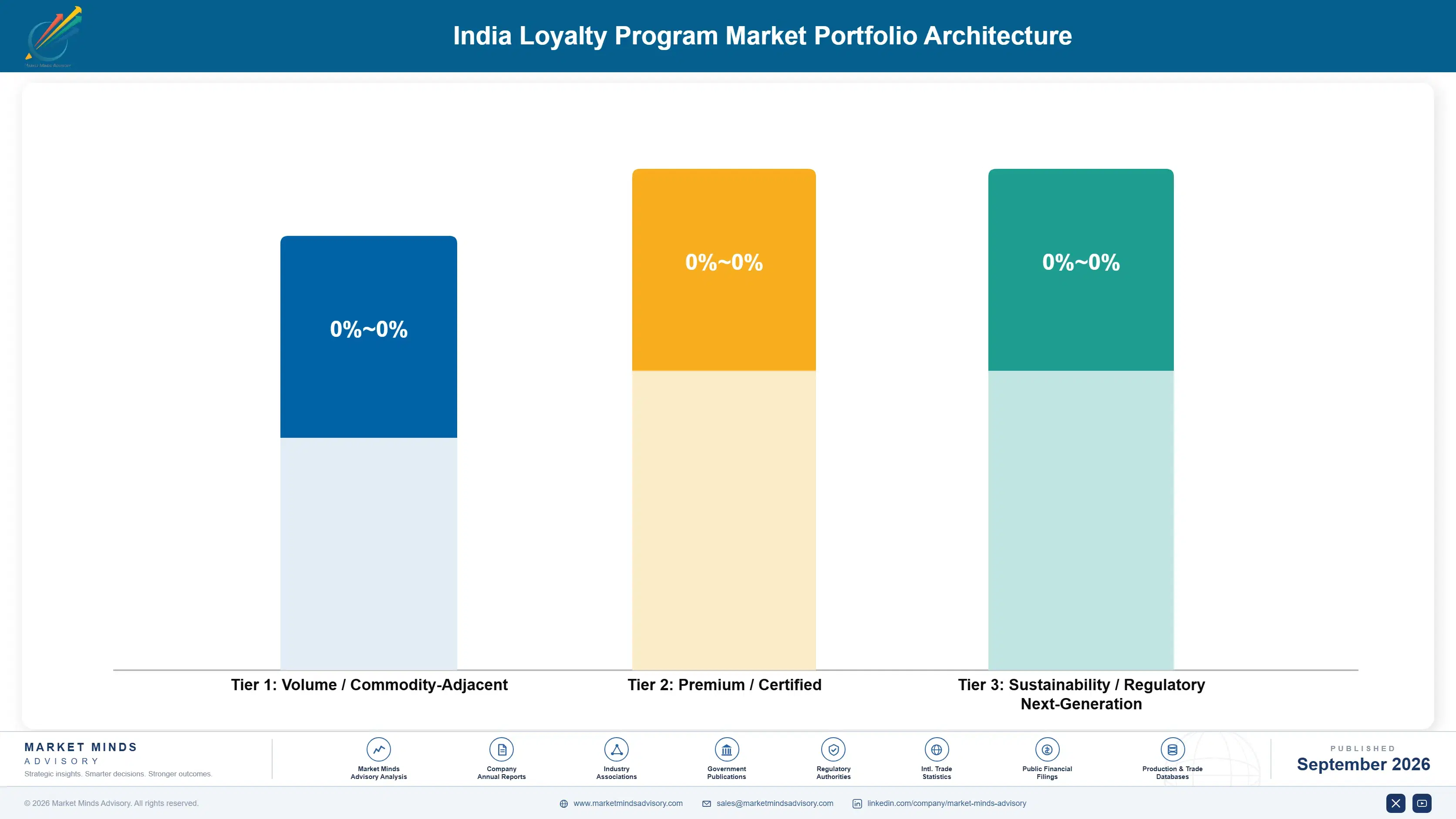
Margin architecture divides by funding model far more than by programme sophistication, which is not how most participants organise their thinking. Programmes funding benefits from retail margin with no member fee and no interchange run at operating margins in the high teens to mid twenties, and there is no path to widening that while the benefit cost sits entirely on the operator.
Platform and technology provision to programme owners holds margins in the mid thirties to low forties. The spread reflects whether compliance capability is included, since Digital Personal Data Protection Act consent management is now a selection criterion rather than a feature. Vendors competing on campaign functionality alone are being excluded from enterprise processes they would have won two years ago on the same product.

The highest-value pool sits in paid membership, where the member funds the programme in advance and the operator holds the cash before delivering the benefit. Those programmes run at margins in the low fifties to low sixties once penetration passes the point where fixed programme cost is covered. Free enrolment programmes generate data. They do not generate margin on their own.

Volume / Commodity-Adjacent

Free enrolment programmes funding benefits from retail margin with no member fee and no interchange support. The eight-point range reflects benefit generosity rather than efficiency, since the operator carries the full reward cost.
Gross Margin: 18 to 26%

Premium / Certified

Platform and technology provision to programme owners. The eight-point range reflects whether consent and preference management is included, which has become a selection criterion rather than an optional feature. Feature-led vendors are losing processes they would have won.
Gross Margin: 34 to 42%

Sustainability / Regulatory / Next-Generation

Paid membership programmes where the member funds the benefit in advance. The ten-point range reflects penetration against fixed programme cost, which is the variable that decides whether the model works at all.
Gross Margin: 52 to 62%
india-loyalty-program-market-portfolio-architecture-1790022190768

High-value Sub-segments and Strategic Watch-out

Paid Membership Programmes

High value and high growth at 14.9%. Household penetration has reached 14% and active rates run around 3.1 times free tier equivalents, because a member who paid has a reason to use what they bought. Cancellation is visible and immediate. That visibility is a discipline free programmes never face.
Gross Margin: 54 to 62%

Consent And Compliance Platform Capability

High value and moderate growth. Data protection obligations affect every programme in the market simultaneously, and vendors bundling consent management with loyalty capability report win rates around 1.7 times feature-led competitors. The obligation arrives for every programme in this market at exactly the same moment.
Gross Margin: 38 to 44%

Free Enrolment Retail Programmes

Volume core, carrying the full benefit cost with no offsetting funding source. Enrolment growth continues while quarterly active share sits near 23%, so the reported scale considerably overstates the commercial position. Enrolment is automatic at billing, so the member list measures footfall rather than any intent.
Gross Margin: 18 to 25%

Breakage Dependent Points Programmes

Strategic watch-out. Around 41% of issued points expire unredeemed and that is what funds the economics. Reserve Bank disclosure requirements and consent obligations are both narrowing the space breakage has occupied. Two separate regulators are moving on that space at once, leaving very little room to wait.
Gross Margin: 26 to 38%

What Keeps Members Active

Programme revenue is frequency-anchored rather than enrolment-anchored, and confusing the two has misdirected a great deal of investment in this market. A member who transacts weekly generates data, habit and redemption behaviour that compounds; a member enrolled by a phone number at a billing counter generates a record and nothing else. Only about 23% of enrolled members transact in a given quarter, which is the number that should drive planning.
Stickiness varies sharply by funding model and by channel. Paid members are the most engaged group by a wide margin, since the fee creates an obligation to extract value and cancellation is a visible decision. Quick commerce members follow closely, because order frequency keeps the programme present. Bank and card programme members are the least engaged, often unaware of what they have accumulated until a statement or an expiry notice reaches them.

Member expectations shifted in one direction after paid membership arrived. Consumers who pay an annual fee for one programme now evaluate free programmes against that standard and find the benefit thin, which has raised the effective floor across the whole market. That cohort asks what a programme delivers now, and abandons accrual schemes faster than earlier members did.
india-loyalty-program-market-end-use-penetration-index-1790022191258

Where Programmes Actually Pay

These are among the four positions where our research anticipates prominent divergence between winners and laggards over the coming forecast period. Each is grounded in the demand model, the regulatory perimeter, and the announced capacity pipeline.
01 / FUNDING MODEL CHOICE

Ask the member to pay for the programme

Card interchange funds rewards in most markets and roughly 79% of Indian retail digital payment carries none, which leaves free programmes paying for benefits out of retail margin they do not have. An annual membership fee makes the funding explicit and improves engagement rather than suppressing it, because a member who paid has a reason to use what they bought. Participants operating paid tiers report active rates around 3.1 times their free tier equivalents at comparable benefit cost, and paid penetration has reached about 14% with a clearly higher ceiling.
02 / ACTIVITY MEASUREMENT HONESTY

Stop counting enrolments as if they were members

Only about 23% of enrolled members transact in a given quarter, because a phone number captured at a billing counter enrols someone who never chose a programme at all. Investment scaled against enrolment growth therefore funds activity that does not exist anywhere. Participants who moved internal targets to quarterly active members report programme return on spend improving by roughly 44% through reallocation alone, on a measurement decision that cuts the headline number by three quarters, which is uncomfortable precisely because the reported scale collapses the day it is made.
03 / BENEFIT STRUCTURE REDESIGN

Give value now rather than banking on forgetting

Roughly 41% of issued points expire unredeemed and that unredeemed liability is what makes most points programmes profitable in the first place. Reward disclosure requirements and data protection consent obligations are narrowing that space from two different regulators at once. Instant basket-level benefits cost the same to deliver, are valued more highly by members who discount future rewards heavily, and participants who converted report engagement rising by about 29%, which replaces a profit source depending on members forgetting with one that does not.
04 / COMPLIANCE CAPABILITY BUNDLING

Sell consent management as loyalty platform capability

Data protection obligations require consent capture, purpose limitation and deletion capability that programmes built on billing counter phone numbers simply cannot provide today. That is a platform purchase rather than a legal review, and it affects every programme in the market at the same moment. Vendors bundling consent and preference management with loyalty capability report win rates around 1.7 times competitors selling campaign features, which is an unusually clean opportunity for whoever is ready first, and it affects every programme operating in the market at exactly the same moment.

Engagement Snapshot From the Field

A live engagement with an industry participant carrying material or product regulatory and market exposure ahead of a defining policy shift, showing how our research translates into a defensible multi-year portfolio strategy.
MARKET MINDS ADVISORY · CLIENT ENGAGEMENT SUMMARY
India Loyalty Program Producer Strategic Portfolio Review and Transition Roadmap 2026·Investment Scenario on India Loyalty Program Exposure Evaluation 2025-26
CLIENT PROFILE
A national Indian retailer operating across grocery, apparel and general merchandise with a free enrolment loyalty programme reporting 41 million members and annual programme spend near USD 34 million (client-reported, unverified by MMA). Enrolment was automatic on phone number capture at billing. Points carried a twelve month validity and no paid tier existed anywhere in the business.
STRATEGIC CHALLENGE
Programme spend had tripled over four years while attributed incremental sales had grown far less, and management could not establish whether the programme was creating demand or discounting demand that already existed. A further budget increase had been proposed on the strength of member growth. Nobody had separated active members from enrolled ones in any internal reporting.
MMA APPROACH
MMA separated the member base into quarterly active, dormant and never-transacted cohorts, then measured incremental sales against a matched non-member control across eighteen months. Points liability and breakage were modelled by cohort. Consent trails were audited against data protection requirements, and 29 dormant members were interviewed about why they had stopped.
KEY FINDINGS
  1. Quarterly active members numbered 8.9 million against 41 million enrolled, and 61% of the enrolled base had never transacted through the programme even once.
  2. Incremental sales against matched control were concentrated almost entirely in the active cohort, with programme spend distributed across the full enrolled base regardless of activity.
  3. Points breakage ran at 47%, above the market norm of 41%, and dormant member interviews attributed non-redemption to minimum thresholds rather than to lack of interest.
  4. No auditable consent trail existed for marketing use of phone numbers captured at billing, which affected the entire enrolled base rather than any subset of it.
CLIENT PROFILE
A national Indian retailer operating across grocery, apparel and general merchandise with a free enrolment loyalty programme reporting 41 million members and annual programme spend near USD 34 million (client-reported, unverified by MMA). Enrolment was automatic on phone number capture at billing. Points carried a twelve month validity and no paid tier existed anywhere in the business.
STRATEGIC CHALLENGE
Programme spend had tripled over four years while attributed incremental sales had grown far less, and management could not establish whether the programme was creating demand or discounting demand that already existed. A further budget increase had been proposed on the strength of member growth. Nobody had separated active members from enrolled ones in any internal reporting.
MMA APPROACH
MMA separated the member base into quarterly active, dormant and never-transacted cohorts, then measured incremental sales against a matched non-member control across eighteen months. Points liability and breakage were modelled by cohort. Consent trails were audited against data protection requirements, and 29 dormant members were interviewed about why they had stopped.
KEY FINDINGS
  1. Quarterly active members numbered 8.9 million against 41 million enrolled, and 61% of the enrolled base had never transacted through the programme even once.
  2. Incremental sales against matched control were concentrated almost entirely in the active cohort, with programme spend distributed across the full enrolled base regardless of activity.
  3. Points breakage ran at 47%, above the market norm of 41%, and dormant member interviews attributed non-redemption to minimum thresholds rather than to lack of interest.
  4. No auditable consent trail existed for marketing use of phone numbers captured at billing, which affected the entire enrolled base rather than any subset of it.
RECOMMENDED STRATEGY
Phase 1: Phase one: restate all internal programme reporting on quarterly active members and reallocate spend away from the never-transacted cohort entirely. Phase 2: Phase two: remove minimum redemption thresholds and pilot instant basket-level benefits against accrued points in matched stores. Thresholds rather than interest drove non-redemption. Phase 3: Phase three: build consent capture into enrolment and launch a paid tier for the most active member decile. Consent cannot be retrofitted cheaply across an existing base.
OUTCOME
Programme return on spend improved by roughly 51% across three quarters without any increase in budget (client-reported, unverified by MMA), driven entirely by reallocation away from inactive cohorts. The paid tier pilot reached 9% penetration of the active base within two quarters and its members transacted at more than twice the free tier rate.

Frequently Asked Questions

Foundational context covering the market sizes, CAGR, scope, country, region and competition that inform every finding below. This section is provided to cover basics and most often pre-purchase conversations, answered from the MMA Primary Research Dataset.

What is the current size of the India Loyalty Program Market?

The market was valued at USD 2.1 billion in 2025, rising to USD 2.3 billion in 2026. Sizing covers programme operating and platform spend rather than the value of benefits issued.

How large will the India Loyalty Program Market be by 2036?

MMA forecasts USD 6.9 billion by 2036, an increase of USD 4.6 billion over the 2026 base. That represents expansion of 3.00 times across the forecast period.

What is the CAGR for the India Loyalty Program Market 2026 to 2036?

The base case CAGR is 11.6%, with a bull case of 12.9% and a bear case of 10.4%. Historical growth between 2020 and 2025 ran at 10.3%.

Which segment is growing fastest?

Quick commerce and marketplace programmes grow at 17.4%, half again the market rate, because order frequency turns small benefits into habit. Paid membership programmes follow at 14.9%.

Who are the major companies in the India Loyalty Program Market?

Capillary Technologies, Tata Digital, Reliance Retail, Amazon and Eternal lead on programme and platform spend, holding a combined 31%. Quick commerce operators increasingly build capability inside their own applications.

Which country is growing fastest?

This report is scoped to India, so comparison is between metropolitan markets rather than countries. Bengaluru grows fastest at 15.2%, on quick commerce density and technology sector employment.

Report Segmentation Architecture

The full report scope spans multiple orthogonal segmentation dimensions, with cross-tabulated demand data provided for each dimension pair. Coverage extends further to regional breakdowns, trend trajectories, and the competitive detail needed to support segment-level decision-making.

By Programme Type

  • Retail Coalition Programmes
  • Bank and Card Reward Programmes
  • Airline and Hotel Frequency Programmes
  • Quick Commerce and Marketplace Programmes
  • Fuel and Convenience Programmes
  • Paid Membership and Subscription Programmes

By End-Use Industry

  • Grocery and Food Retail
  • Fashion and Lifestyle Retail
  • Banking and Financial Services
  • Travel and Hospitality
  • Fuel and Automotive Services
  • Consumer Electronics Retail

By Programme Delivery Model

  • Licensed Platform Software
  • Managed Programme Operation
  • In-House Built Capability
  • Coalition Operator Managed
  • Points Exchange and Redemption Services
  • Analytics and Personalisation Services

By Region

  • South Asia and Pacific
  • North America
  • East Asia
  • Western Europe
  • Middle East and Africa
  • Eastern Europe
  • Latin America

Scope, Methodology, and Coverage

Every figure in this report is reproducible from documented input assumptions. The scope below maps the historical period, the forecast horizon, the segmentation dimensions, and the countries covered, alongside the underlying primary and qualitative methodology.
Historical Period
2020 to 2025
Forecast Period
2026 to 2036
Base Year
2025 (USD billions; MMA Primary Research Dataset, September 2026)
Market Definition
This market covers spending on consumer loyalty programmes operating in India, including platform licensing, managed programme operation, points issuance and redemption infrastructure, and programme analytics services, across retail coalition, bank and card, airline and hotel, quick commerce and marketplace, fuel and paid membership programme types. Sizing is at programme operating and platform spend rather than at the face value of benefits issued. Employee reward schemes, business-to-business incentive programmes, gift card issuance outside a loyalty programme, and payment network interchange or scheme fees are excluded throughout.
Quantitative Units
USD billions at programme operating and platform spend; members in millions; breakage and activity as percentages.
Segmentation Dimensions
Programme type, end-use industry, programme delivery model, and supply origin region.
Regions Covered
South Asia and Pacific, North America, East Asia, Western Europe, Middle East and Africa, Eastern Europe, Latin America
Countries Covered
India, with metropolitan analysis across Mumbai, Delhi, Bengaluru, Hyderabad, Pune and Ahmedabad
Key Companies Profiled
Capillary Technologies, Tata Digital, Reliance Retail, Amazon, Eternal, Swiggy, Flipkart, Payback India, Loylty Rewardz, Xoxoday, Almonds Ai, Comarch, Collinson Group, HDFC Bank, ICICI Bank, IndianOil Corporation, InterGlobe Aviation, Shoppers Stop, Lifestyle International, Nykaa
Quantitative Methodology
Primary survey, n=3,800 respondents, Q4 2025, six countries; demand-side model with trade association cross-validation
Qualitative Methodology
47 expert interviews, Q4 2025; applied to validate demand model assumptions, identify emerging dynamics, and assess competitive positioning
Report Format
PDF and XLSX data workbook (Word format preview document)
Publisher
Market Minds Advisory
Report Code
MMA-2026-TEC-773
Published
September 2026
Contact
sales@marketmindsadvisory.com | www.marketmindsadvisory.com

Purchase the full India Loyalty Program Market Report (2026 to 2036).

The full report sizes the Indian loyalty programme market across six programme types, six end-use industries and six delivery models, with supply-origin analysis covering all seven global regions. It includes member base decomposition separating quarterly active, dormant and never-transacted cohorts across participating programmes. Points breakage is modelled by cohort and by validity structure, and incremental sales are measured against matched non-member controls. Regulatory impact from data protection consent obligations and reward disclosure requirements is assessed programme type by programme type. Competitive assessment covers 20 participants on a consistent programme and platform spend basis.
Member bases decomposed into active and dormant cohorts
Points breakage modelled by cohort and validity
Incremental sales measured against matched controls
Regulatory impact assessed by programme type
Six programme types sized through 2036
Twenty participants assessed on programme spend

Built For The People Who Decide

From boardroom strategy to bench-side execution, this report is read cover-to-cover by leaders shaping the next decade of their industry, turning demand scenarios, market dynamics and valuation benchmarks into decisions.
CXOs/ Presidents/ VPs/ Managers
M&A and Corporate Development
Strategy Teams and R&D Heads
Procurement and Product Directors
Regulatory and Compliance Leaders
Investor Relations and Equity Analysts