Market Minds Advisory
Incidence Management Software Market

Incidence Management Software Market: Incidence Management Software Market. IT Incident Detection and Automated Response Platforms

Incident management software is being reshaped by AI-driven anomaly detection replacing manual triage, rising system complexity across microservices architectures, and mounting pressure to shrink outage resolution time as digital operations become mission-critical.

Lead Analyst

Published

September 2026

Make Smarter Decisions with Customized Research Insights

Request a free sample report and evaluate market opportunities, growth trends, and competitive dynamics relevant to your business needs.

2025 MARKET VALUE$4.1BMarket Size 2025
2036 FORECAST VALUE$14.3BBase Case , 2026 to 2036
CAGR 2026 TO 203612.0 %Bull 13.3% / Bear 10.7%
INCREMENTAL OPPORTUNITY$9.7BNet 10- year value creation
EXPANSION MULTIPLE3.11x2036 value over 2026 base
Strategic Levers
M&A Pipeline
Regional Outlook
Country Rankings
Competitive Intelligence
Segmental Deep-dive
Call-Us : 91 93563 13602

Executive Snapshot and Market Trajectory.

Incident management software is shifting from a reactive alerting tool into a proactive AI-driven response platform, as engineering teams demand systems that detect anomalies and correlate root causes automatically rather than waking on-call engineers for every threshold breach across increasingly complex distributed systems and cloud infrastructure. and vendor roadmaps.
Demand is concentrated among technology, financial services, and e-commerce enterprises running complex microservices architectures, while AI-driven detection and automated triage capability commands premium pricing over traditional alerting tools given the substantial engineering hours it saves during incident response. North America and East Asia account for the bulk of enterprise spending given cloud-native adoption and digital infrastructure investment scale respectively across both regions today.
The competitive field is bifurcating between established incident response platforms defending share through integration breadth and newer AI-native entrants racing to capture automated triage design wins, a split intensified by generative AI capability increasingly determining which vendors win the largest enterprise renewal contracts going forward across the industry landscape as a whole. This favors well-capitalized platform vendors over smaller point-solution alerting tools lacking comparable roadmap investment and engineering depth across their teams. today.
Market Definition
The incident management software market covers software platforms that detect, alert, coordinate response to, and document resolution of IT operational incidents across enterprise infrastructure and applications. It excludes general-purpose project management tools and customer support ticketing systems that do not specifically address operational incident response.
Base Year Value
$4.1B in 2025 (MMA Primary Research Dataset, September 2026)
Forecast Period
2026 to 2036, eleven discrete annual values
CAGR
12.0% base case. Bull 13.3%. Bear 10.7%.
Fastest Growth Segment
AI-Driven Incident Detection and Triage: 19.0% CAGR
Fastest Growth Country
Brazil: 15.5% CAGR
Fastest Growth Region
South Asia and Pacific: 14.0% CAGR
Largest Region
North America: 29% of 2025 global value
Market Leaders
PagerDuty, Atlassian, ServiceNow, Splunk, Datadog lead the global incident management software market. Source: MMA Analysis, July 2026.
Primary Survey
n=3,800 procurement and R&D decision-makers, Q4 2025, six countries
Methodology
Demand-side build-up, cross-validated against public data, 47 expert interviews

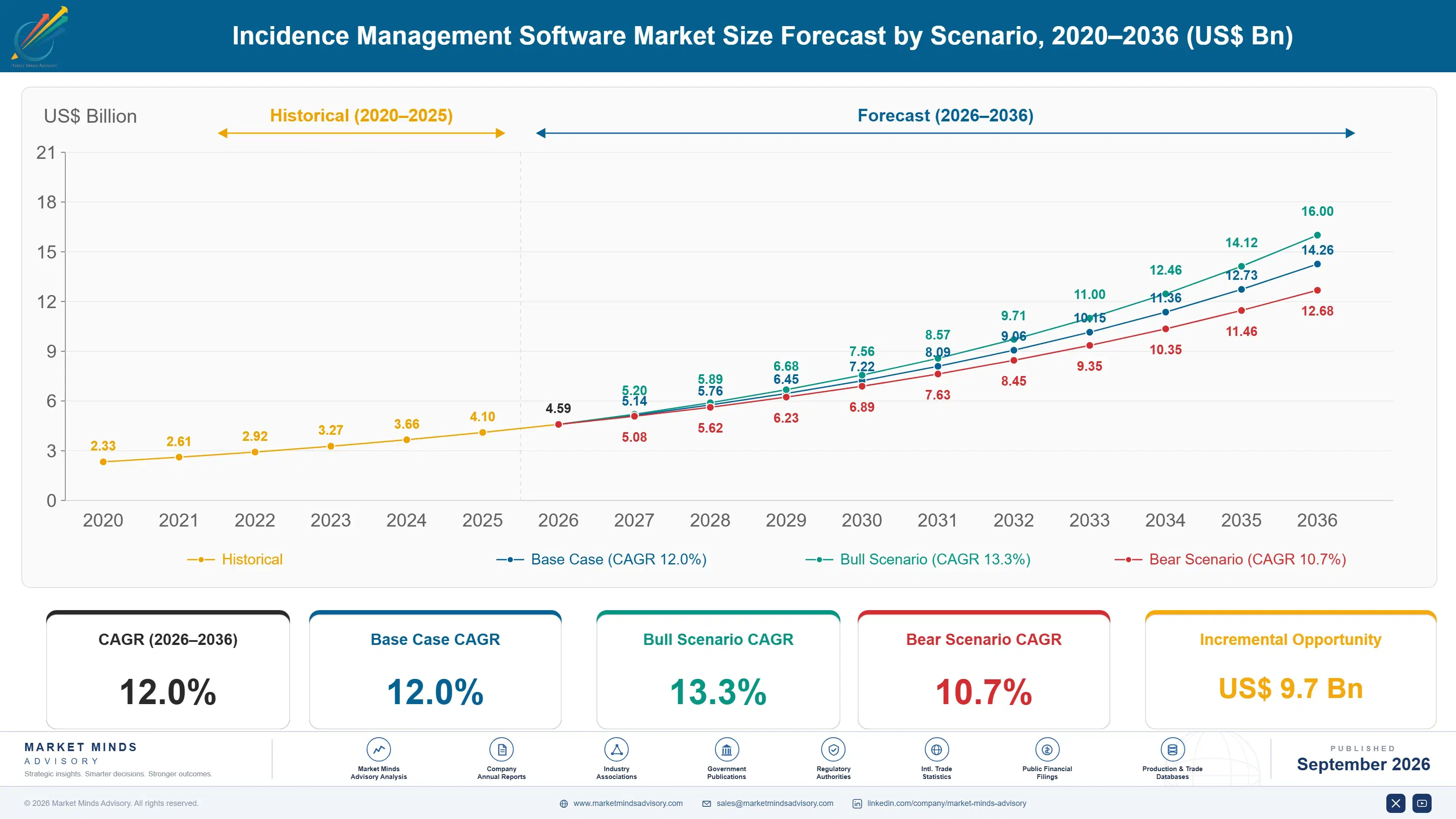
Incidence Management Software Market Forecast Scenarios

incidence-management-software-market-size-forecast-scenario-1788418698879
Incident management software grew steadily through 2023 as cloud migration continued its baseline expansion, before generative AI-driven detection and automated triage capability began contributing an increasingly meaningful share of incremental value growth that had previously depended mostly on seat-based alerting subscription expansion across enterprise engineering teams. Vendors have restructured product roadmaps accordingly, reshaping engineering investment and long-term platform architecture decisions across the broader supplier base.
The base case assumes sustained double-digit growth driven by three mechanisms: continued microservices architecture adoption expanding the number of monitored services and corresponding incident volume substantially, generative AI capability automating root cause correlation and reducing mean time to resolution meaningfully, and enterprise digital operations becoming increasingly mission-critical as more revenue depends directly on system uptime. Enterprise procurement processes have also matured, moving toward longer-term platform commitments reflecting deeper infrastructure integration requirements.
A bull case centers on AI-driven automation accelerating faster than currently projected, expanding average contract value substantially. A bear case assumes enterprise IT budget consolidation into broader observability platforms erodes standalone incident management software revenue as buyers increasingly prefer bundled coverage over point solutions. Vendors are already hedging by diversifying across observability, automation, and traditional alerting product lines simultaneously.

AI Triage Redefines Response Time Economics

Incident management platform economics increasingly hinge on AI-driven noise reduction and root cause correlation rather than pure alerting reliability, since engineers burn out quickly under high false-positive volume and enterprises now measure vendor value partly by how much alert fatigue a platform eliminates. Vendors that master this AI-driven filtering capture disproportionate share of the highest-margin enterprise segment. across the current forecast period.
MARKET CONCENTRATION44% CR5Top five vendors combined hold under half the market
AVERAGE CONTRACT VALUE$65,000Typical annual enterprise incident management platform subscription value
TOP COUNTRY SHARE31%United States share of global platform revenue generated annually
MEAN TIME TO RESOLUTION38 minAverage incident resolution time for platforms with AI triage
ALERT NOISE REDUCTION58%Typical reduction in false-positive alerts achieved by AI filtering
ENTERPRISE RENEWAL RATE89%Annual enterprise subscription renewal rate across deployed customer base
Integration breadth with the broader observability and infrastructure monitoring stack has become a genuine differentiator, as enterprises increasingly prefer platforms that ingest signals from dozens of monitoring tools rather than requiring engineers to manually correlate incidents across disconnected dashboards during high-pressure outage response. Vendors slow to build comparable integration depth risk losing consideration during vendor evaluation processes entirely. across most enterprise procurement cycles.
Renewal rates remain high once deployed, reflecting genuine operational value, but new logo growth increasingly depends on demonstrable AI triage accuracy rather than pure feature checklist comparisons, since buyers now run structured proof-of-concept evaluations before committing to multi-year enterprise contracts. This shift toward evidence-based procurement increasingly favors vendors with genuinely superior AI capability over marketing claims alone. through successive renewal negotiations.
"Every vendor claims AI triage now. The ones actually cutting resolution time in half are winning enterprise deals, and everyone else is quietly losing renewal conversations."
Practice Lead, IT Operations and Digital Infrastructure · MMA IT Incident Detection Practice · September 2026

Market Trends

Generative AI Root Cause Correlation Becomes Standard

Incident management vendors are racing to embed generative AI capability that automatically correlates related alerts, suggests probable root causes, and drafts incident summaries, moving the platform from passive alerting toward active diagnostic assistance during high-pressure outage response. Roughly 49 percent of surveyed enterprise buyers report AI-driven root cause correlation as a mandatory evaluation criterion in vendor selection since 2024, up sharply from a low base only two years earlier, forcing vendors without comparable AI capability to either accelerate development or risk losing enterprise renewal conversations to more advanced competitors entirely.
Market Impact: 44 percent now calculate downtime cost
Microservices Complexity Multiplies Monitored Surface Area

Enterprise adoption of microservices architectures continues expanding the number of independently deployed services requiring monitoring, multiplying the potential incident surface area and the volume of interdependent alerts that engineering teams must correlate during active outages across their production infrastructure and dependency graphs. Roughly 41 percent of surveyed enterprises report their monitored service count more than doubling since 2022 as microservices adoption accelerated, sustaining steady platform demand as manual triage methods can no longer reliably handle correlation at scale, a gap AI-driven correlation increasingly closes for enterprise buyers. overall. industry-wide today.
Market Impact: 37 percent cite burnout as justification

Market Opportunities and Growth Drivers

Digital Revenue Dependency Raises Downtime Stakes

Enterprises increasingly generate substantial revenue directly through digital channels, making system downtime a direct and quantifiable revenue loss rather than an abstract operational inconvenience that engineering teams could previously deprioritize relative to feature development work. Roughly 44 percent of surveyed enterprises report calculating downtime cost explicitly when justifying incident management platform budget to executive leadership, a practice barely formalized five years earlier, sustaining budget approval momentum for platforms that demonstrably reduce mean time to resolution across critical revenue-generating systems and customer-facing applications. across the enterprise's core revenue-generating digital properties. today.
Market Impact: 29 percent expect bundled inclusion now

On-Call Burnout Drives Automation Investment Directly

Engineering leaders increasingly prioritize reducing on-call burden as a retention strategy, since alert fatigue and frequent after-hours interruptions have become a leading cause of engineering attrition at technology companies competing for scarce specialized talent. Roughly 37 percent of surveyed engineering leaders report on-call burnout as a primary justification for incident management platform investment, treating AI-driven noise reduction and automated triage as an employee retention tool rather than purely an operational efficiency improvement, a framing that has meaningfully expanded budget approval across engineering organizations. Vendors emphasizing this retention angle are winning budget approval competitors focused purely on efficiency metrics cannot match.
Market Impact: 26 percent limit AI to advisory

Market Restraints and Challenges

Observability Platform Bundling Erodes Standalone Pricing

Broader observability platform vendors increasingly bundle incident management capability at no incremental cost, a friction point rooted in platform vendors treating incident response as a retention feature within a larger monitoring subscription rather than a standalone revenue line. Roughly 29 percent of enterprise buyers surveyed now expect incident management included in their core observability platform subscription rather than budgeted separately, compressing standalone vendor deal sizes considerably. Several independent vendors are responding by deepening AI differentiation that bundled offerings have not yet replicated. across most mid-market and enterprise deal segments tracked closely.
Market Impact: 49 percent now require AI correlation

AI Correlation Accuracy Concerns Slow Full Automation Trust

Engineering teams remain cautious about fully trusting AI-driven root cause suggestions during high-stakes production outages, a friction point rooted in early AI correlation tools producing enough false attributions that engineers learned to treat suggestions skeptically rather than act on them directly. Roughly 26 percent of surveyed engineering teams report limiting AI automation to advisory suggestions rather than autonomous remediation actions, slowing the pace of full automation adoption. Vendors are responding by publishing accuracy benchmarks and building confidence scoring into AI suggestions. across most enterprise production environments monitored closely. today. overall.
Market Impact: 41 percent doubled monitored service count
4 additional market trends, 3 additional growth drivers, and 3 additional restraints and challenges are covered in the full report. Contact sales@marketmindsadvisory.com to access the complete intelligence.

Segment CAGR and Growth Architecture

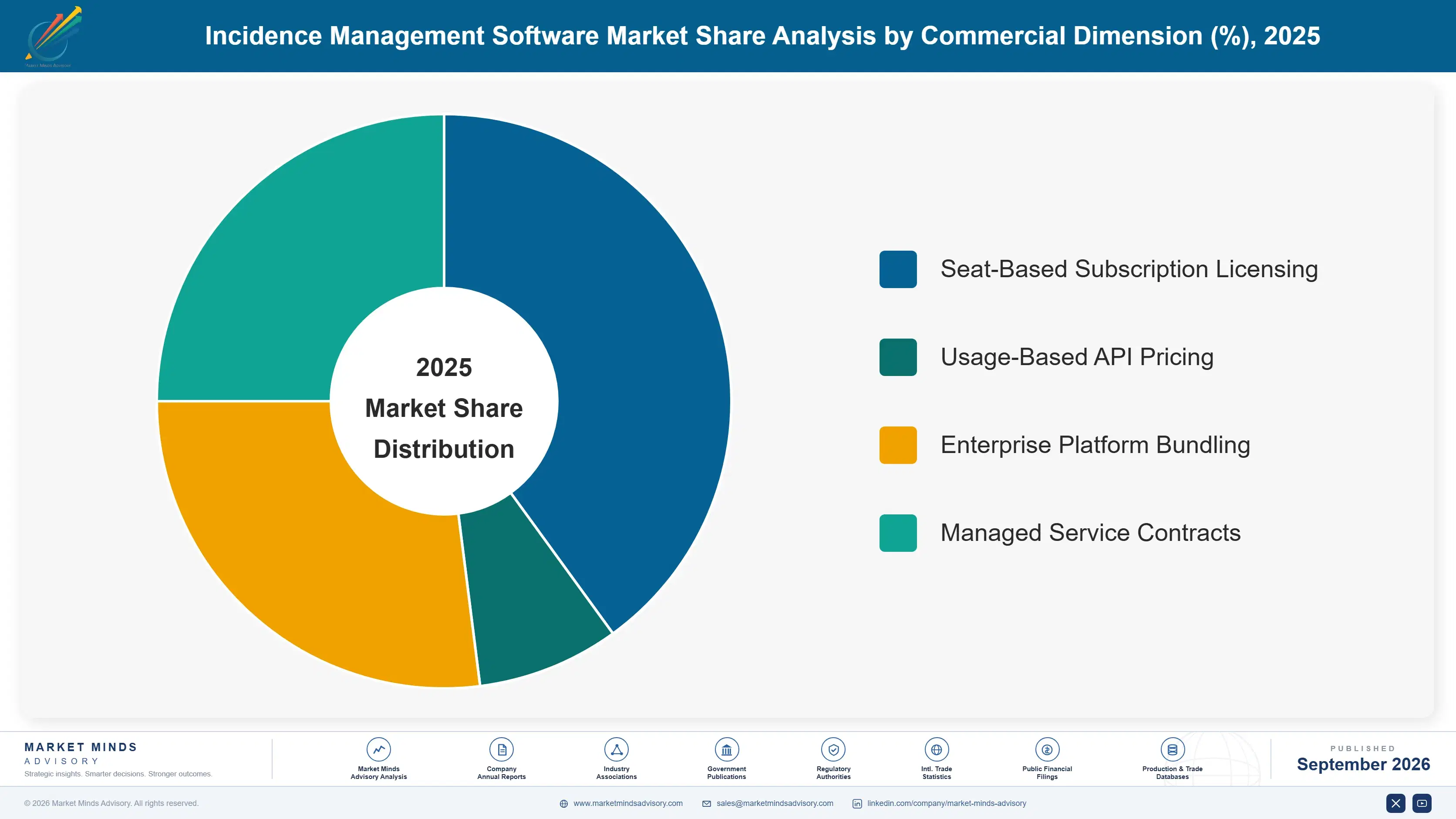
The incident management software market segments by capability tier, spanning core alerting, AI-driven detection and triage, automated remediation, status page communication, and post-incident review tooling used across enterprise engineering and site reliability organizations worldwide today. AI-driven detection is expanding fastest as enterprises prioritize root cause correlation over traditional threshold-based alerting entirely. and site operations teams.
incidence-management-software-market-market-share-analysis-1788418699439

AI-Driven Incident Detection and Triage

AI-driven incident detection and triage platforms use machine learning to correlate related alerts, identify probable root causes, and draft incident summaries automatically, reducing the manual correlation work engineers previously performed during high-pressure outage response. This segment is expanding fastest as enterprises prioritize demonstrable resolution time reduction over traditional feature checklist comparisons, treating AI capability as a genuine differentiator rather than a marketing claim to be evaluated skeptically. Vendors including PagerDuty and Datadog have invested heavily in correlation accuracy, and roughly 49 percent of enterprise buyers now require AI-driven correlation as a mandatory evaluation criterion. Growth here is expected to remain the fastest across the entire market well into the next decade.
CAGR 19.0%

Core Alerting and On-Call Scheduling

Core alerting and on-call scheduling platforms remain the largest revenue segment by a substantial margin, providing the foundational notification routing and escalation policy management that every incident management deployment requires regardless of additional AI capability layered on top. This segment carries the lowest differentiation in the market, favoring established vendors with the broadest set of integrations and reliability track record over newer entrants lacking comparable enterprise trust built over years of production deployment. Growth has moderated as AI-driven capability increasingly captures incremental enterprise budget allocation instead. Suppliers with the deepest integration breadth continue defending share even as unit growth decelerates industry-wide considerably. across most large enterprise deployments. globally today. overall.
CAGR 6.5%
Full segment breakdown across 6 segments available in the complete report.

Regional Architecture and Country Demand Map

North America leads global demand given concentrated technology and financial services enterprise spending. East Asia follows through digital infrastructure investment scale, while South Asia and Pacific posts the fastest regional growth rate as cloud-native adoption accelerates across the region's largest and fastest-growing technology markets. today.

North America

The United States anchors North American demand through its concentration of technology, financial services, and e-commerce enterprises running complex microservices architectures that generate substantial incident volume requiring dedicated management platforms. Engineering talent scarcity has also pushed enterprises toward AI-driven automation as a retention and efficiency strategy, sustaining premium platform demand across the region's largest technology employers. Canada contributes a smaller but growing share, driven primarily by financial services and technology sector digital transformation investment supporting nearby American enterprise relationships. This lead should persist as technology and financial services investment continues expanding across the region substantially and its position as the largest single platform consumption market by contract value globally and their supplier base.
Share: 29% | CAGR: 13.5% (2026 to 2036)

Western Europe

Regulatory data residency requirements shape Western European demand more than pure technology adoption pace, as enterprises across the bloc increasingly require incident management platforms with documented data handling and hosting location compliance. German and French financial institutions lead regional adoption, while United Kingdom-based technology companies increasingly specify AI-driven correlation capability for complex distributed systems. Growth trails North America somewhat given the region's more conservative enterprise software budget cycles and longer procurement committee review processes. Adoption should still accelerate as data residency and AI compliance requirements continue clarifying across member states across the bloc's largest financial services economies and their supplier relationships and their sourcing decisions across the bloc's largest markets.
Share: 20% | CAGR: 10.5% (2026 to 2036)
Regional intelligence for 5 additional markets available in the complete report: East Asia, South Asia and Pacific, Latin America, Middle East and Africa, Eastern Europe. Contact sales@marketmindsadvisory.com.
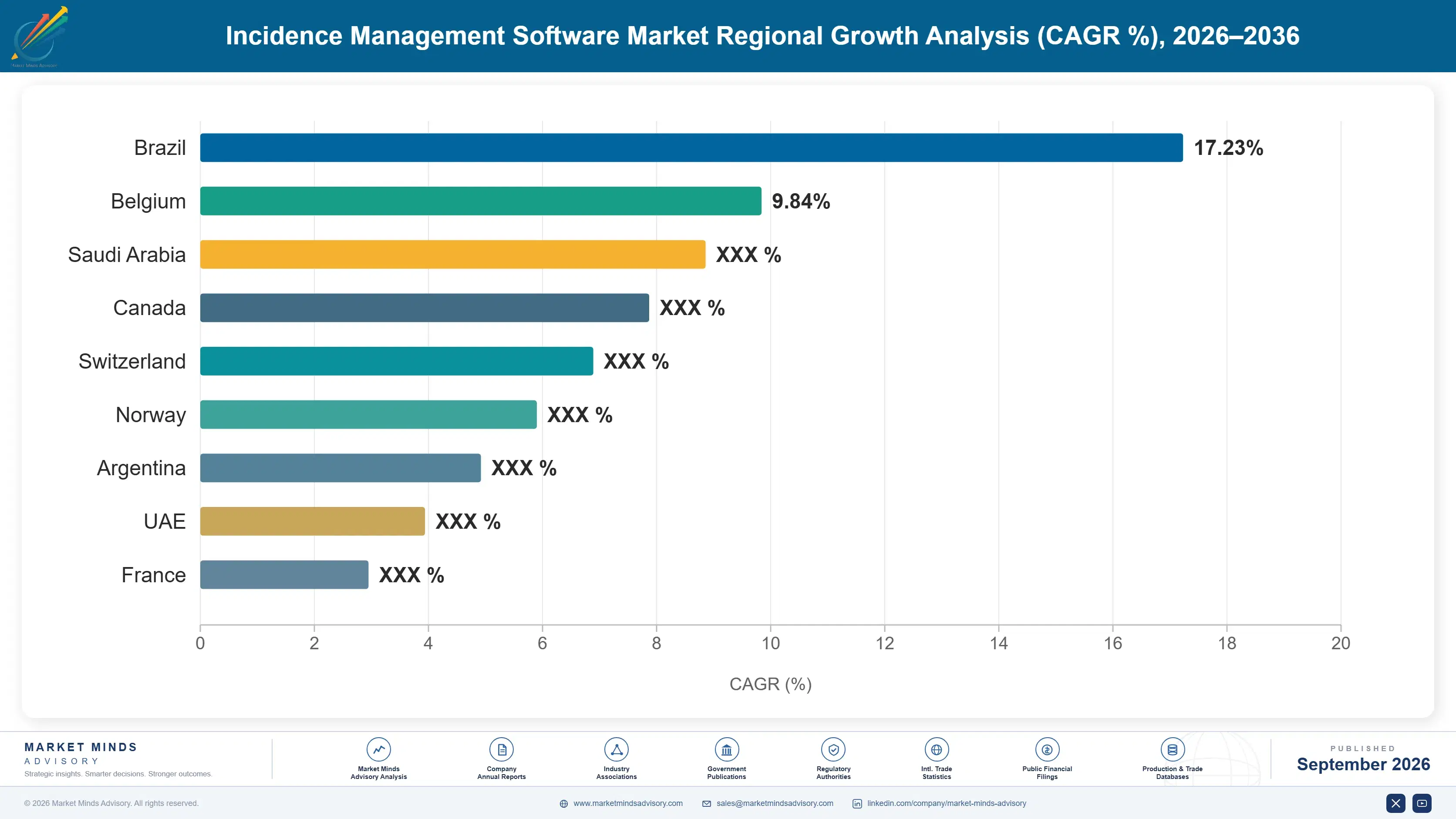
incidence-management-software-market-country-cagr-analysis-1788418699953

Where Vendors Can Defend Renewal Pricing

As observability platforms increasingly bundle basic alerting at no incremental cost, standalone incident management vendors must move up the value chain toward AI-driven correlation depth, automated remediation capability, and retention-focused positioning that generalist competitors cannot easily replicate given their narrower engineering focus. Vendors that delay risk being squeezed out of the highest-value segments entirely.

Deepen AI Root Cause Correlation Accuracy

Vendors can invest directly in AI model accuracy and training data quality to improve root cause correlation reliability, addressing the roughly 49 percent of enterprise buyers who now require demonstrable AI correlation capability as a mandatory evaluation criterion during procurement. Vendors with superior correlation accuracy win structured proof-of-concept evaluations against competitors more consistently, converting technical superiority directly into enterprise contract wins and premium renewal pricing that generic alerting tools cannot command. Vendors slow to pursue this depth risk losing ground to more accurate competitors entirely across enterprise renewal conversations. today.
Market Impact: Captures a growing share of 49 percent requirement

Position Platforms as Engineering Retention Tools

Vendors can reframe incident management platform value around engineering retention rather than pure operational efficiency, directly addressing the roughly 37 percent of engineering leaders citing on-call burnout as their primary investment justification. This positioning shift expands the buyer conversation beyond IT operations budget into broader talent strategy discussions, opening budget sources that purely efficiency-focused vendors struggle to access when competing against other operational tooling priorities. Vendors slow to build this framing risk missing budget conversations happening entirely outside traditional IT operations procurement channels. This positioning also strengthens executive-level budget conversations considerably beyond pure IT operations stakeholders.
Market Impact: Targets the 37 percent citing burnout concerns directly

Build Confidence Scoring Into AI Suggestions

Vendors can develop transparent confidence scoring that shows engineers how certain an AI-driven root cause suggestion actually is, directly addressing the roughly 26 percent of engineering teams currently limiting AI automation to advisory-only suggestions due to trust concerns. Confidence scoring accelerates the transition from advisory to autonomous remediation trust, opening premium pricing tiers tied to automated remediation capability that skeptical engineering teams currently decline to purchase. Vendors slow to build this scoring capability risk losing premium tier revenue to more transparent, trust-building competitors entirely. This transparency also builds durable trust that compounds meaningfully across successive product releases and updates.
Market Impact: Converts the 26 percent of advisory-only skeptics directly

Expand Data Residency and Compliance Certification

Vendors can invest in regional data hosting infrastructure and compliance certification that Western European and other regulated buyers increasingly require before signing enterprise contracts, differentiating from competitors treating compliance as a secondary consideration. This certification investment opens enterprise segments in regulated industries and jurisdictions that vendors lacking documented data handling evidence cannot credibly compete for regardless of their underlying platform capability or AI correlation depth. Vendors slow to build this certification risk losing regulated market segments worth roughly 20 percent of enterprise revenue to more compliance-forward competitors permanently. overall today.
Market Impact: Opens segments worth roughly 20 percent premium pricing

Who Controls the Margin Pool

The incident management software market remains moderately concentrated at a 44 percent five-company share on an annual recognized revenue basis, with a meaningful gap separating PagerDuty and Atlassian, whose broad enterprise installed base and integration breadth anchor leading positions, from challengers still building comparable AI correlation depth. Both leaders now differentiate primarily on AI correlation accuracy and integration breadth rather than pure alerting reliability alone.
Current competitive activity centers on AI correlation accuracy expansion and platform integration breadth, as vendors race to either defend alerting volume through established installed base or capture premium AI-driven design wins through correlation technology that generalist observability platforms cannot easily match at comparable accuracy levels. This shift is squeezing margins for vendors that have not yet invested in comparable AI accuracy or integration depth.

Rankings are likely to shift as AI correlation accuracy increasingly determines long-term competitive positioning, favoring vendors that build genuine technical depth over those competing purely on brand recognition or bundling, a dynamic increasingly separating technically differentiated leaders from broad platform incumbents relying on installed base alone. Vendors slow to build this technical depth risk losing ground to more differentiated competitors entirely across both channels.
incidence-management-software-market-company-positioning-matrix-1788418700496

Competitive Moat and Risk Dimensions

PAGERDUTY

Moat: Deep Enterprise Installed Base

PagerDuty's long-established enterprise installed base and extensive third-party integration catalog give it switching cost advantages that newer AI-native entrants cannot replicate without years of comparable integration development and enterprise trust building across their customer base. This distribution and trust advantage compounds with every new integration the company adds to its extensive catalog.
PAGERDUTY

Risk: AI Correlation Catch-Up Pressure

PagerDuty faces mounting pressure to match the AI correlation accuracy of newer AI-native entrants built from the ground up around machine learning, requiring substantial engineering investment to avoid losing renewal conversations. Product teams increasingly compete for scarce capital against higher-growth automation product lines internally. today.
ATLASSIAN

Moat: Broad Developer Tool Suite Integration

Atlassian's incident management capability integrates natively with its widely deployed Jira and Confluence suite, giving it cross-selling relationships into existing enterprise engineering organizations that standalone competitors cannot easily replicate. This cross-sell motion lowers customer acquisition cost meaningfully compared to standalone incident management vendors. today. overall.
ATLASSIAN

Risk: Perceived as Secondary Product Line

Atlassian's incident management offering sometimes gets perceived as a secondary feature within its broader developer tool suite rather than a best-of-breed standalone platform, potentially limiting appeal to buyers prioritizing specialized depth. Competitors with dedicated AI-native platforms are winning deals Atlassian's broader suite positioning cannot access.

Players Tracked

Prominent Players

PagerDuty
Atlassian
ServiceNow
Splunk
Datadog

Other Key Players

xMatters
FireHydrant
incident.io
Squadcast
Zenduty
Better Stack
BigPanda
Moogsoft
New Relic
Freshworks
IBM
Dynatrace
SolarWinds
Ivanti
OpenText

Recent Developments

FEBRUARY 2026

PagerDuty Expands AI Correlation Model Training Investment

PagerDuty announced expanded investment in AI correlation model training using anonymized incident data from its enterprise customer base, targeting improved root cause accuracy across complex microservices architectures and distributed system dependencies. The investment targets closing correlation accuracy gaps against newer AI-native platform competitors. today. broadly.
Signal: Signals established vendors racing to close AI accuracy gaps against newer, faster-moving AI-native entrants industry-wide today.
OCTOBER 2025

Atlassian Acquires Automated Remediation Startup

Atlassian acquired an automated remediation startup to expand its incident management capability beyond detection and alerting into autonomous resolution actions, addressing customer demand for reduced manual intervention during routine incidents. Financial terms of the acquisition were not publicly disclosed by either company involved. overall. today.
Signal: Reflects growing vendor focus on automated remediation as a key competitive differentiation strategy across the broader sector.
MAY 2025

Datadog Signs Enterprise Platform Bundling Partnership

Datadog signed a bundling partnership agreement embedding incident management capability within its broader observability platform subscription, targeting enterprise customers seeking consolidated monitoring and incident response tooling under one vendor relationship. Bundled pricing terms were not publicly disclosed by either company involved in the partnership. directly.
Signal: Indicates observability platforms are increasingly absorbing standalone incident management functionality across the broader competitive market landscape.

Cloud Compute and AI Talent Exposure

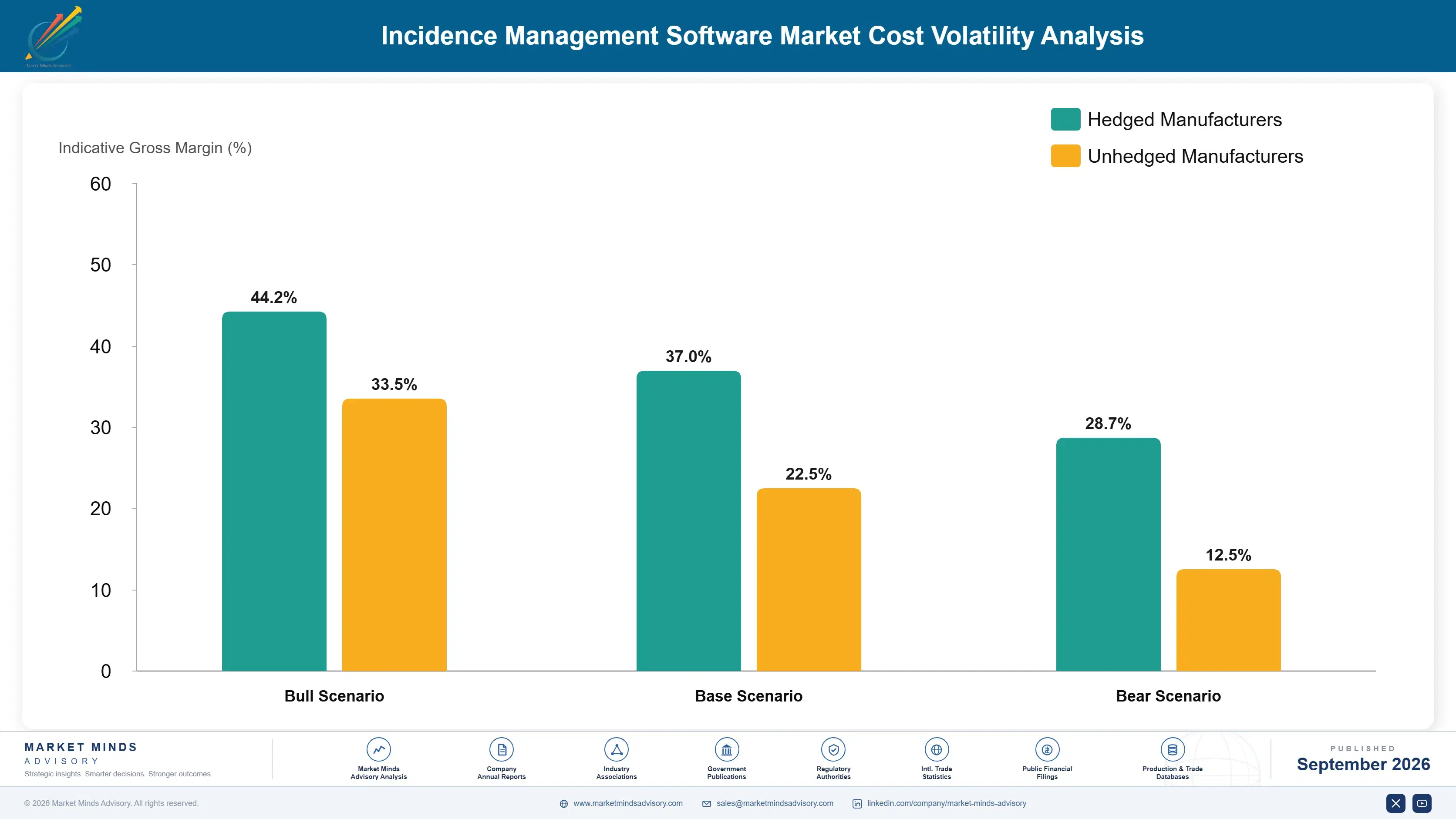
Cloud infrastructure hosting and specialized machine learning engineering talent together represent roughly 40 percent of total cost of goods sold for incident management vendors, since AI correlation model training and continuous inference at scale require substantial compute capacity and ongoing engineering investment to keep correlation accuracy competitive against evolving customer environments. across every active customer deployment and product line the company operates internationally.
Cloud compute pricing rose meaningfully during 2023 and 2024 as sustained global demand for artificial intelligence workloads competed for the same underlying infrastructure capacity that incident management vendors depend on for correlation model training, according to company annual reports and public hyperscaler pricing disclosures, squeezing margins for vendors running AI infrastructure at meaningful scale. particularly during peak correlation model training cycles ahead of major product release milestones worldwide.

This exposure disadvantages smaller independent vendors lacking hyperscaler volume discounts far more than platform leaders like PagerDuty and Atlassian, which negotiate infrastructure pricing across a much larger combined customer base, allowing them to absorb compute cost increases without passing them through to customers as aggressively as smaller competitors must. and existing long-term customer relationships built over multiple product generations and years of collaboration.
incidence-management-software-market-cost-volatility-analysis-1788418700692

Multi-Cloud Infrastructure Diversification Strategy

Vendors increasingly distribute AI training and inference workloads across multiple cloud providers rather than relying on a single hyperscaler, reducing exposure to any one provider's pricing decisions and improving negotiating leverage during annual enterprise agreement renewal cycles across their combined infrastructure footprint. This proactive sourcing strategy also improves production planning predictability across multi-year infrastructure roadmaps and budgets.

Engineering Talent Retention Programs

Vendors invest in structured career development and retention programs for specialized machine learning engineering talent, reducing costly turnover and the extended ramp-up time required to train replacement engineers on correlation model architecture and customer environment complexity. This retention investment also improves correlation model quality consistency across successive product releases and updates. across teams. overall.

Model Efficiency Optimization Investment

Vendors increasingly invest in model efficiency optimization that reduces inference compute costs per correlation without sacrificing accuracy, lowering the specialized infrastructure dependency that has historically constrained scaling and margin expansion across the broader vendor landscape and customer base. This efficiency investment also accelerates product development cycles across the vendor's broader platform capability roadmap. today.

Portfolio Architecture for Margin Defence

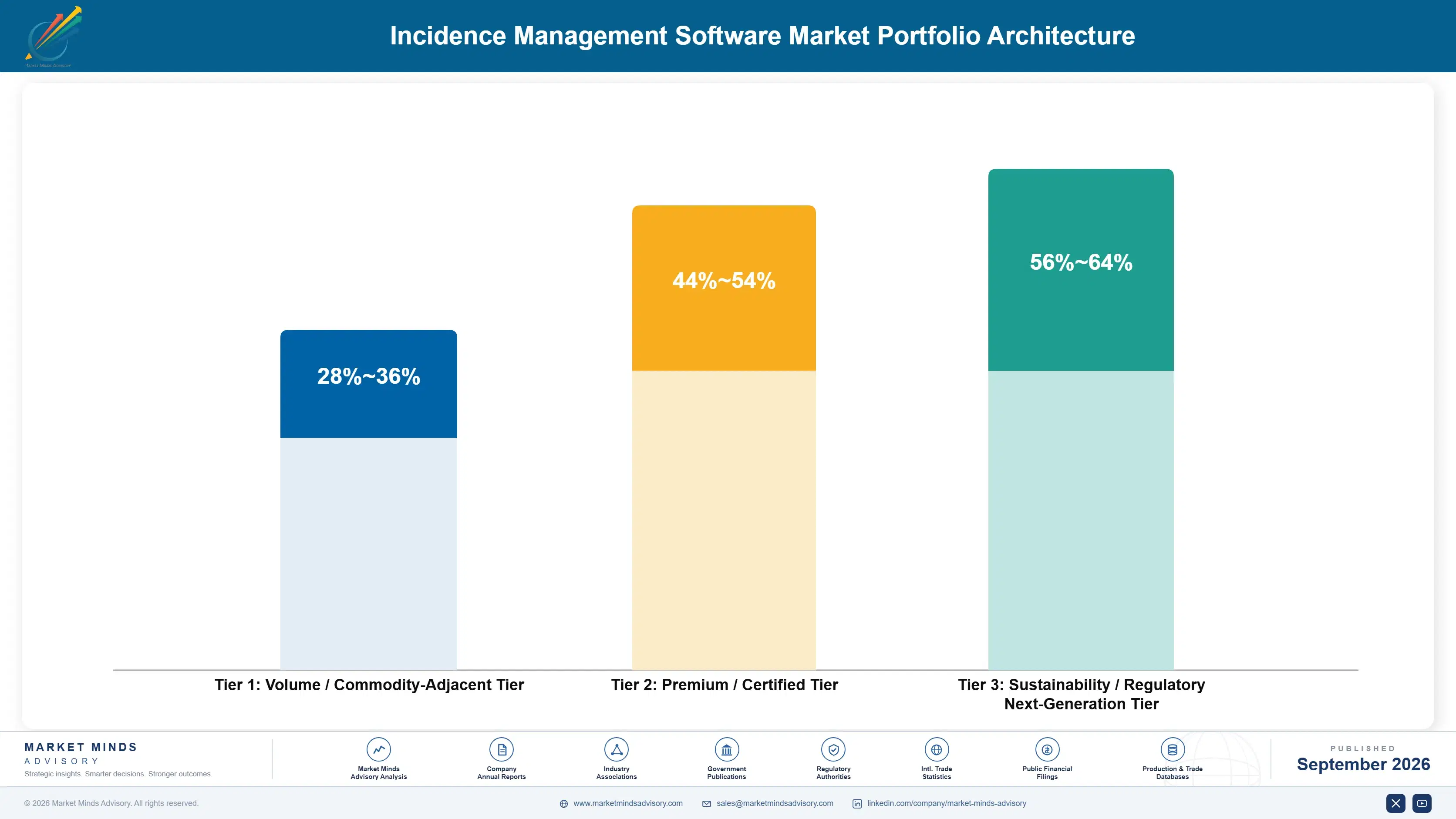
Incident management software margins split across a three-tier architecture shaped heavily by AI capability depth rather than pure seat count alone. Volume commodity-adjacent core alerting competes largely on price against established installed base leaders, while premium certified AI-driven correlation platforms command meaningful margin premiums tied to demonstrable resolution time reduction and automated remediation capability. This distribution-driven split increasingly determines who wins the largest enterprise renewal contracts.
The sustainability and next-generation tier, anchored by AI correlation and automated remediation platforms, now captures a disproportionate share of gross profit dollars relative to its current deployment volume, reflecting how enterprises pay durable premiums for measurable resolution time improvement that commodity alerting tools cannot easily replicate. This pattern strengthens further as more enterprises formalize resolution time reduction as a procurement criterion.

Volume tier core alerting still anchors installed base and revenue scale for most established vendors, but the real strategic tension now sits between defending that commodity revenue base and investing in the AI correlation and automation capability where growth and profitability both concentrate most heavily going forward through the current forecast period. Vendors that delay this shift risk losing relevance entirely within a few product cycles.

Volume / Commodity-Adjacent Tier

Basic alerting and on-call scheduling tools competing primarily on price and existing installed base, serving smaller engineering teams with straightforward escalation policy requirements. Margins remain thin given intense price competition and limited differentiation across most comparable alerting offerings.
Gross Margin: 28-36%

Premium / Certified Tier

AI-driven correlation and triage platforms carrying demonstrable accuracy certification that justify premium pricing above commodity alerting alternatives across enterprise technology and financial services segments. Contract sizes here run meaningfully larger than commodity tier deals given demonstrable resolution time improvement.
Gross Margin: 44-54%

Sustainability / Regulatory / Next-Generation Tier

Automated remediation and compliance-certified platforms commanding the highest margins on autonomous resolution capability, data residency documentation, and measurable resolution time reduction evidence. This tier increasingly attracts the largest enterprise contracts as automation requirements shape procurement decisions directly.
Gross Margin: 56-64%
incidence-management-software-market-portfolio-architecture-1788418701192

High-value Sub-segments and Strategic Watch-out

Automated Remediation Platforms

The highest-value pool in the market, capturing premium enterprise contracts through autonomous resolution capability that generalist alerting competitors cannot match regardless of their underlying correlation accuracy claims today. Vendors positioned early here could capture disproportionate share as automation trust continues building steadily further. industry-wide. overall.
Gross Margin: 58-66%

AI-Driven Correlation and Triage

A high-value pool growing at a rapid pace as enterprises prioritize demonstrable resolution time reduction over feature checklist comparisons, converting technical accuracy directly into premium renewal pricing overall. Growth here is expected to accelerate further as enterprises scale AI evaluation criteria across procurement processes. today.
Gross Margin: 46-54%

Core Alerting and Scheduling Tools

The volume core of the market, generating predictable installed base expansion even as growth rates moderate relative to newer AI-driven correlation categories gaining enterprise budget share steadily each year. Vendors here increasingly compete on integration breadth rather than differentiated AI correlation or automation capability. overall.
Gross Margin: 28-36%

Status Page and Communication Tools

A strategic watch-out segment where broader incident management platform bundling could materially reshape competitive positioning for point-solution vendors still dependent on standalone communication tooling revenue. Vendors overexposed here risk sudden revenue disruption as bundling accelerates across most platform categories. across most enterprise segments over the current forecast period.
Gross Margin: 34-42%

Correlation Accuracy Builds Sticky Renewal Economics

Incident management platforms generate durable annuity-like economics once correlation models are tuned to a customer's specific infrastructure and alert history, since switching vendors means losing months of accumulated training data that made the platform genuinely accurate, giving established vendors a renewal advantage over competitors offering comparable raw capability but lacking equivalent tuned model performance across contested production conditions. across the vendor's entire enterprise customer base and renewal contract portfolio.
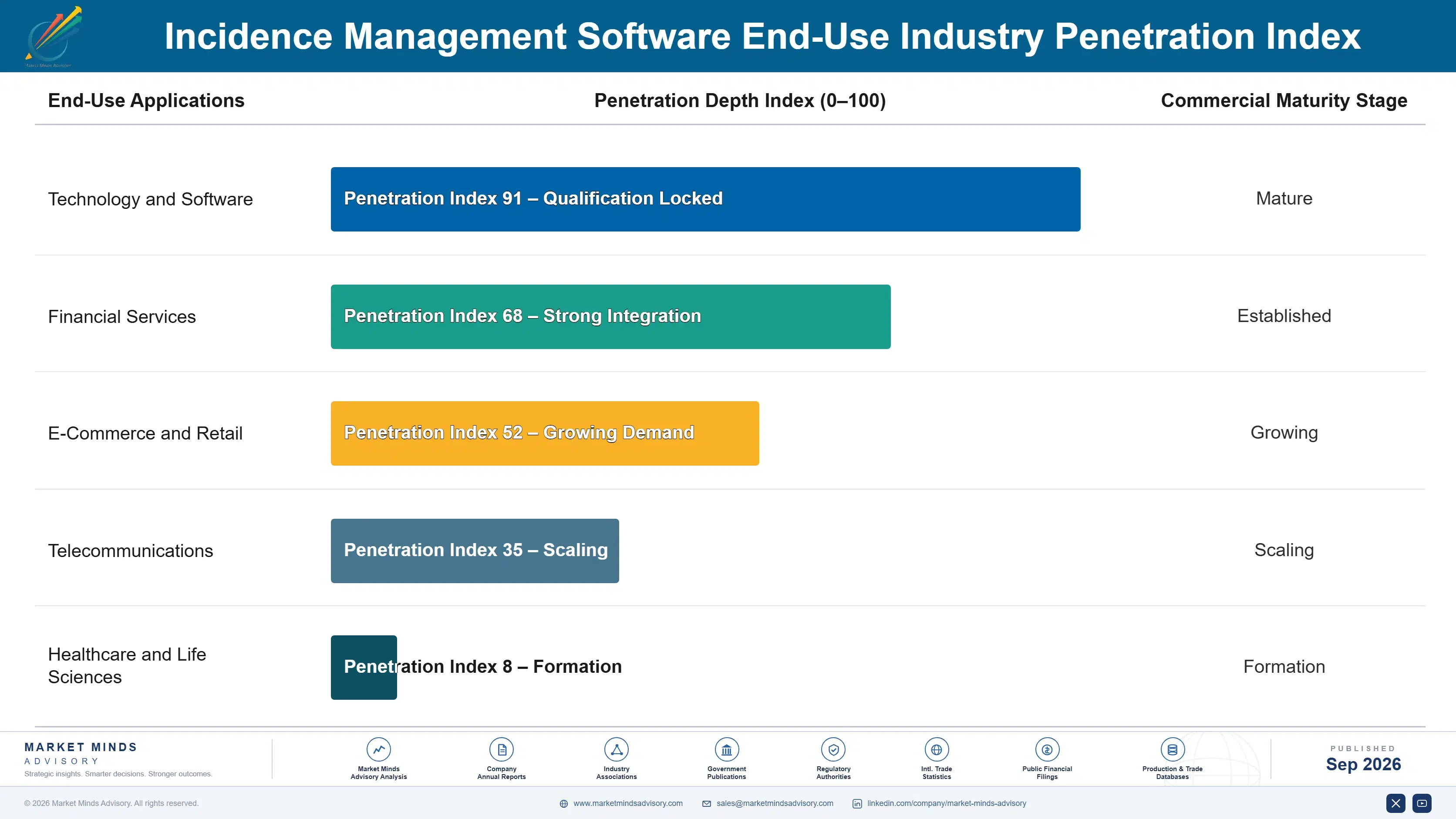
Adoption depth varies sharply by end-use vertical. Technology and financial services buyers embed vendor relationships deepest, treating AI-driven platforms as strategic operational infrastructure integrated tightly with their monitoring stack, while smaller engineering teams remain more price-sensitive and switch readily whenever a competitor offers comparable specifications at a meaningfully lower price point. Mid-market buyers sit between these extremes, valuing reliability but remaining more cost-conscious than large enterprise procurement teams.

A generational shift in buyer profile is underway as site reliability engineers increasingly influence procurement decisions over IT operations managers who historically favored established alerting vendors, a dynamic accelerating adoption of AI-driven correlation platforms ahead of legacy threshold-based alerting tools across enterprise renewal cycles and budget conversations. Technical evaluators increasingly outrank cost-focused procurement officers in enterprise buying committees across most technology organizations.
incidence-management-software-market-end-use-penetration-index-1788418701686

Where MMA Sees Incident Management Heading

These are among the four positions where our research anticipates prominent divergence between winners and laggards over the coming forecast period. Each is grounded in the demand model, the regulatory perimeter, and the announced capacity pipeline.
01 / AI CORRELATION PRIORITY

AI correlation accuracy deserves priority investment as buyers demand demonstrable proof

Roughly 49 percent of surveyed enterprise buyers now require AI-driven root cause correlation as a mandatory evaluation criterion, making correlation accuracy a genuine competitive moat rather than a marketing claim vendors could previously get away with asserting loosely. Vendors that build genuine correlation depth now will win structured proof-of-concept evaluations against competitors before those competitors catch up, since model training cycles take years to replicate credibly. This gap widens further as more buyers formalize AI evaluation criteria into procurement processes.
02 / RETENTION POSITIONING SHIFT

Framing platforms as retention tools opens budget beyond IT operations

Roughly 37 percent of surveyed engineering leaders cite on-call burnout as their primary justification for incident management investment, representing a budget conversation extending well beyond traditional IT operations efficiency metrics into broader talent retention strategy. Vendors that reposition their value proposition around this retention framing access budget sources that purely efficiency-focused competitors struggle to reach when competing against other operational tooling priorities and stakeholders. This positioning advantage compounds as engineering talent scarcity persists across the industry, missing budget conversations that happen entirely outside traditional procurement channels.
03 / AUTOMATION TRUST BUILDING

Confidence scoring accelerates the shift from advisory to autonomous remediation

Roughly 26 percent of surveyed engineering teams currently limit AI automation to advisory suggestions rather than autonomous remediation actions, reflecting genuine trust concerns that transparent confidence scoring can meaningfully address over successive product interactions and releases. Vendors that build this transparency now will accelerate customer trust and access premium automated remediation pricing tiers before competitors establish comparable credibility across their customer base. This capability increasingly separates trust-building leaders from vendors still treated skeptically by cautious engineering teams across the industry.
04 / COMPLIANCE CERTIFICATION FOCUS

Data residency certification opens regulated enterprise segments worth defending

Western European and other regulated buyers increasingly require documented data handling and hosting location compliance before signing enterprise contracts, a requirement vendors lacking certification cannot credibly satisfy regardless of their underlying platform capability or AI correlation depth and sophistication. Vendors that invest in compliance certification now will access regulated market segments before competitors establish comparable documentation and regional infrastructure across multiple jurisdictions. This certification advantage compounds as more jurisdictions formalize data residency requirements further across the globe and regulated sectors.

Engagement Snapshot From the Field

A live engagement with an industry participant carrying material or product regulatory and market exposure ahead of a defining policy shift, showing how our research translates into a defensible multi-year portfolio strategy.
MARKET MINDS ADVISORY · CLIENT ENGAGEMENT SUMMARY
Incidence Management Software Producer Strategic Portfolio Review and Transition Roadmap 2026·Investment Scenario on Incidence Management Software Exposure Evaluation 2025-26
CLIENT PROFILE
A mid-market fintech company with roughly $85 million in annual technology operations spending (client-reported, unverified by MMA) approached MMA after experiencing escalating engineer burnout tied to alert fatigue and requested a structured vendor evaluation before its next engineering leadership offsite planning session addressing retention concerns. The engagement carried added urgency given the compressed timeline before the leadership offsite and rising attrition risk.
STRATEGIC CHALLENGE
The client's existing alerting tool generated substantial false-positive volume that engineers had learned to ignore, creating genuine risk that a real incident would go unnoticed amid alert noise, yet switching platforms mid-quarter risked disrupting an active on-call rotation already trained on existing escalation procedures and workflows. Engineering leadership required a resolution before quarterly retention metrics were formally reviewed with executive stakeholders.
MMA APPROACH
MMA benchmarked five candidate vendors against AI correlation accuracy, false-positive reduction rates, and total cost of ownership over a two-year horizon, supplementing vendor claims with structured interviews of peer fintech companies that had already completed comparable platform transitions without disrupting active on-call operations. MMA also modeled migration risk explicitly, given the client's active on-call rotation commitments at engagement start.
KEY FINDINGS
  1. The client's existing platform generated false-positive rates nearly three times higher than AI-driven competitors, directly contributing to the alert fatigue driving engineering attrition concerns.
  2. Vendors offering AI-driven correlation reduced projected false-positive volume by roughly 55 percent (client-reported, unverified by MMA) compared to the client's existing threshold-based alerting approach.
  3. A phased migration approach, running both platforms in parallel for one on-call rotation cycle, avoided disrupting active operations while validating new vendor reliability under production conditions.
  4. Engineering leadership cited reduced alert fatigue as a measurable factor in subsequent retention conversations, directly linking platform investment to talent retention outcomes.
CLIENT PROFILE
A mid-market fintech company with roughly $85 million in annual technology operations spending (client-reported, unverified by MMA) approached MMA after experiencing escalating engineer burnout tied to alert fatigue and requested a structured vendor evaluation before its next engineering leadership offsite planning session addressing retention concerns. The engagement carried added urgency given the compressed timeline before the leadership offsite and rising attrition risk.
STRATEGIC CHALLENGE
The client's existing alerting tool generated substantial false-positive volume that engineers had learned to ignore, creating genuine risk that a real incident would go unnoticed amid alert noise, yet switching platforms mid-quarter risked disrupting an active on-call rotation already trained on existing escalation procedures and workflows. Engineering leadership required a resolution before quarterly retention metrics were formally reviewed with executive stakeholders.
MMA APPROACH
MMA benchmarked five candidate vendors against AI correlation accuracy, false-positive reduction rates, and total cost of ownership over a two-year horizon, supplementing vendor claims with structured interviews of peer fintech companies that had already completed comparable platform transitions without disrupting active on-call operations. MMA also modeled migration risk explicitly, given the client's active on-call rotation commitments at engagement start.
KEY FINDINGS
  1. The client's existing platform generated false-positive rates nearly three times higher than AI-driven competitors, directly contributing to the alert fatigue driving engineering attrition concerns.
  2. Vendors offering AI-driven correlation reduced projected false-positive volume by roughly 55 percent (client-reported, unverified by MMA) compared to the client's existing threshold-based alerting approach.
  3. A phased migration approach, running both platforms in parallel for one on-call rotation cycle, avoided disrupting active operations while validating new vendor reliability under production conditions.
  4. Engineering leadership cited reduced alert fatigue as a measurable factor in subsequent retention conversations, directly linking platform investment to talent retention outcomes.
RECOMMENDED STRATEGY
Phase 1: Phase 1 (Months 1 to 2): Select the AI-driven correlation vendor and begin parallel deployment alongside the existing alerting tool without disruption. Phase 2: Phase 2 (Months 2 to 4): Validate correlation accuracy and false-positive reduction across a full on-call rotation cycle before full platform transition. Phase 3: Phase 3 (Months 4 to 6): Complete full platform transition and formally track alert fatigue metrics as part of engineering retention reporting.
OUTCOME
The client completed the platform transition within the recommended six-month window and reported a measurable reduction in alert fatigue, with engineering leadership citing the platform change as a contributing factor in improved retention metrics (client-reported, unverified by MMA). The AI-driven vendor evaluation framework is now the client's standard approach for future operational tooling decisions.

Frequently Asked Questions

Foundational context covering the market sizes, CAGR, scope, country, region and competition that inform every finding below. This section is provided to cover basics and most often pre-purchase conversations, answered from the MMA Primary Research Dataset.

What is the current size of the Incidence Management Software Market?

The global incident management software market reached an estimated $4.1 billion in 2025. Growth is concentrated in AI-driven correlation and automated triage capability serving complex enterprise infrastructure.

How large will the Incidence Management Software Market be by 2036?

MMA projects the market will reach $14.26 billion by 2036, roughly a 3.11 times expansion from its 2026 base value, driven primarily by AI-driven automation and enterprise digital operations investment.

What is the CAGR for the Incidence Management Software Market 2026 to 2036?

The market is projected to grow at a 12.0 percent compound annual growth rate between 2026 and 2036, with a bull case of 13.3 percent and a bear case of 10.7 percent.

Which segment is growing fastest?

AI-driven incident detection and triage platforms are the fastest-growing segment, expanding at roughly 19.0 percent annually as enterprises increasingly prioritize automated root cause correlation depth.

Who are the major companies in the Incidence Management Software Market?

Leading companies include PagerDuty, Atlassian, ServiceNow, Splunk, and Datadog, together holding an estimated 44 percent of the global market on an annual recognized revenue basis.

Which country is growing fastest?

Brazil is the fastest-growing major country market, expanding at approximately 15.5 percent annually as its fintech and e-commerce sectors scale digital infrastructure investment substantially further.

Report Segmentation Architecture

The full report scope spans multiple orthogonal segmentation dimensions, with cross-tabulated demand data provided for each dimension pair. Coverage extends further to regional breakdowns, trend trajectories, and the competitive detail needed to support segment-level decision-making.

By Primary Market Dimension

  • Core Alerting and On-Call Scheduling
  • AI-Driven Incident Detection and Triage
  • Automated Remediation
  • Status Page Communication
  • Post-Incident Review Tooling
  • Runbook Automation

By End-Use Industry

  • Technology and Software
  • Financial Services
  • E-Commerce and Retail
  • Telecommunications
  • Healthcare and Life Sciences

By Commercial Dimension

  • Seat-Based Subscription Licensing
  • Usage-Based API Pricing
  • Enterprise Platform Bundling
  • Managed Service Contracts

By Region

  • North America
  • Western Europe
  • East Asia
  • South Asia and Pacific
  • Latin America
  • Middle East and Africa
  • Eastern Europe

Scope, Methodology, and Coverage

Every figure in this report is reproducible from documented input assumptions. The scope below maps the historical period, the forecast horizon, the segmentation dimensions, and the countries covered, alongside the underlying primary and qualitative methodology.
Historical Period
2020 to 2025
Forecast Period
2026 to 2036
Base Year
2025 (USD billions; MMA Primary Research Dataset, September 2026)
Market Definition
The incident management software market covers software platforms that detect, alert, coordinate response to, and document resolution of IT operational incidents across enterprise infrastructure and applications. It excludes general-purpose project management tools and customer support ticketing systems that do not specifically address operational incident response.
Quantitative Units
USD billions (current prices); enterprise subscription seat count where disclosed
Segmentation Dimensions
By Primary Market Dimension; By End-Use Industry; By Commercial Dimension; By Region
Regions Covered
North America, Western Europe, East Asia, South Asia and Pacific, Latin America, Middle East and Africa, Eastern Europe
Countries Covered
USA, China, Germany, France, UK, Japan, South Korea, India, Australia, Canada, Brazil, Mexico, Indonesia, Vietnam, Thailand, Malaysia, UAE, Saudi Arabia, South Africa, Nigeria, Turkey, Poland, Netherlands, Italy, Spain, Sweden, Switzerland, Argentina, Colombia, Singapore, and additional markets relevant to this sector
Key Companies Profiled
PagerDuty, Atlassian, ServiceNow, Splunk, Datadog, xMatters, FireHydrant, incident.io, Squadcast, Zenduty, Better Stack, BigPanda, Moogsoft, New Relic, Freshworks, IBM, Dynatrace, SolarWinds, Ivanti, OpenText
Quantitative Methodology
Primary survey, n=3,800 respondents, Q4 2025, six countries; demand-side model with trade association cross-validation
Qualitative Methodology
47 expert interviews, Q4 2025; applied to validate demand model assumptions, identify emerging dynamics, and assess competitive positioning
Report Format
PDF and XLSX data workbook (Word format preview document)
Publisher
Market Minds Advisory
Report Code
MMA-2026-TEC-273
Published
September 2026
Contact
sales@marketmindsadvisory.com | www.marketmindsadvisory.com

Purchase the full Incidence Management Software Market Report (2026 to 2036).

The full report provides comprehensive market sizing, ten-year forecasts, and segment-level analysis across all six incident management software categories and seven global regions. It includes detailed competitive profiling of twenty companies, input cost and AI infrastructure risk assessment, and portfolio margin analysis by capability tier. Readers gain access to primary survey data spanning 3,800 respondents and forty-seven expert interviews conducted across six countries during the fourth quarter of 2025. The report also includes a proprietary revenue lever framework identifying specific commercial actions vendors can take to defend margin.
Ten-year market size and CAGR forecasts
Segment-level growth rates and share analysis
Seven-region demand, pricing, and share breakdown
Twenty-company competitive benchmarking and positioning profiles
Input cost and AI infrastructure risk mapping
Portfolio margin tier analysis and watch segments

Built For The People Who Decide

From boardroom strategy to bench-side execution, this report is read cover-to-cover by leaders shaping the next decade of their industry, turning demand scenarios, market dynamics and valuation benchmarks into decisions.
CXOs/ Presidents/ VPs/ Managers
M&A and Corporate Development
Strategy Teams and R&D Heads
Procurement and Product Directors
Regulatory and Compliance Leaders
Investor Relations and Equity Analysts