Market Minds Advisory
In-Wheel Motors Market

In-Wheel Motors Market: Direct-Drive Architecture Gains Ground in Electric Vehicles

Removing the motor from the chassis and placing it directly inside the wheel eliminates an entire drivetrain layer, and specialty electric vehicle makers are betting that tradeoff is finally worth the added unsprung mass.

Lead Analyst

David Horsley

Published

September 2026

Make Smarter Decisions with Customized Research Insights

Request a free sample report and evaluate market opportunities, growth trends, and competitive dynamics relevant to your business needs.

2025 MARKET VALUE$0.9BMarket Size 2025
2036 FORECAST VALUE$4.7BBase Case , 2026 to 2036
CAGR 2026 TO 203615.5 %Bull 16.8% / Bear 14.2%
INCREMENTAL OPPORTUNITY$3.5BNet 10- year value creation
EXPANSION MULTIPLE4.23x2036 value over 2026 base
Strategic Levers
M&A Pipeline
Regional Outlook
Country Rankings
Competitive Intelligence
Segmental Deep-dive
Call-Us : 91 93563 13602

Executive Snapshot and Market Trajectory

In-wheel motors eliminate the driveshaft, differential, and transmission entirely by placing the electric motor directly inside the wheel hub, a design that sounds obviously better until engineers explain why unsprung mass has kept it niche for decades across most vehicle segments worldwide and across most vehicle types.
Protean Electric and Elaphe continue supplying established in-wheel motor systems for specialty electric vehicles and micromobility applications, since that architecture remains the primary commercial application proven at meaningful volume across most current programs and platforms worldwide and across most vehicle types available today. High-torque in-wheel motors for commercial vehicles are capturing disproportionate growth as delivery fleets and off-highway equipment makers value the packaging flexibility that eliminating a central drivetrain provides.
Schaeffler and ZF Friedrichshafen are investing in reduced unsprung mass designs specifically to address the ride quality and suspension tuning challenges that have historically limited in-wheel motor adoption in passenger vehicles across most mainstream platforms worldwide today and for many years still to come and well beyond. Suppliers without genuine unsprung mass reduction technology increasingly find themselves confined to niche specialty vehicle contracts rather than mainstream passenger vehicle platforms and broader production programs entirely.
Market Definition
The in-wheel motors market covers standard in-wheel motors for passenger vehicles, high-torque in-wheel motors for commercial vehicles, in-wheel motors for micromobility and light electric vehicles, reduced unsprung mass in-wheel motor designs, in-wheel motor control and inverter systems, and aftermarket in-wheel motor conversion kits. It excludes conventional centrally mounted electric motors and hub-mounted motors sold for pure bicycle applications.
Base Year Value
$0.9B in 2025 (MMA Primary Research Dataset, August 2026)
Forecast Period
2026 to 2036, eleven discrete annual values
CAGR
15.5% base case. Bull 16.8%. Bear 14.2%.
Fastest Growth Segment
High-Torque In-Wheel Motors for Commercial Vehicles: 19.0% CAGR
Fastest Growth Country
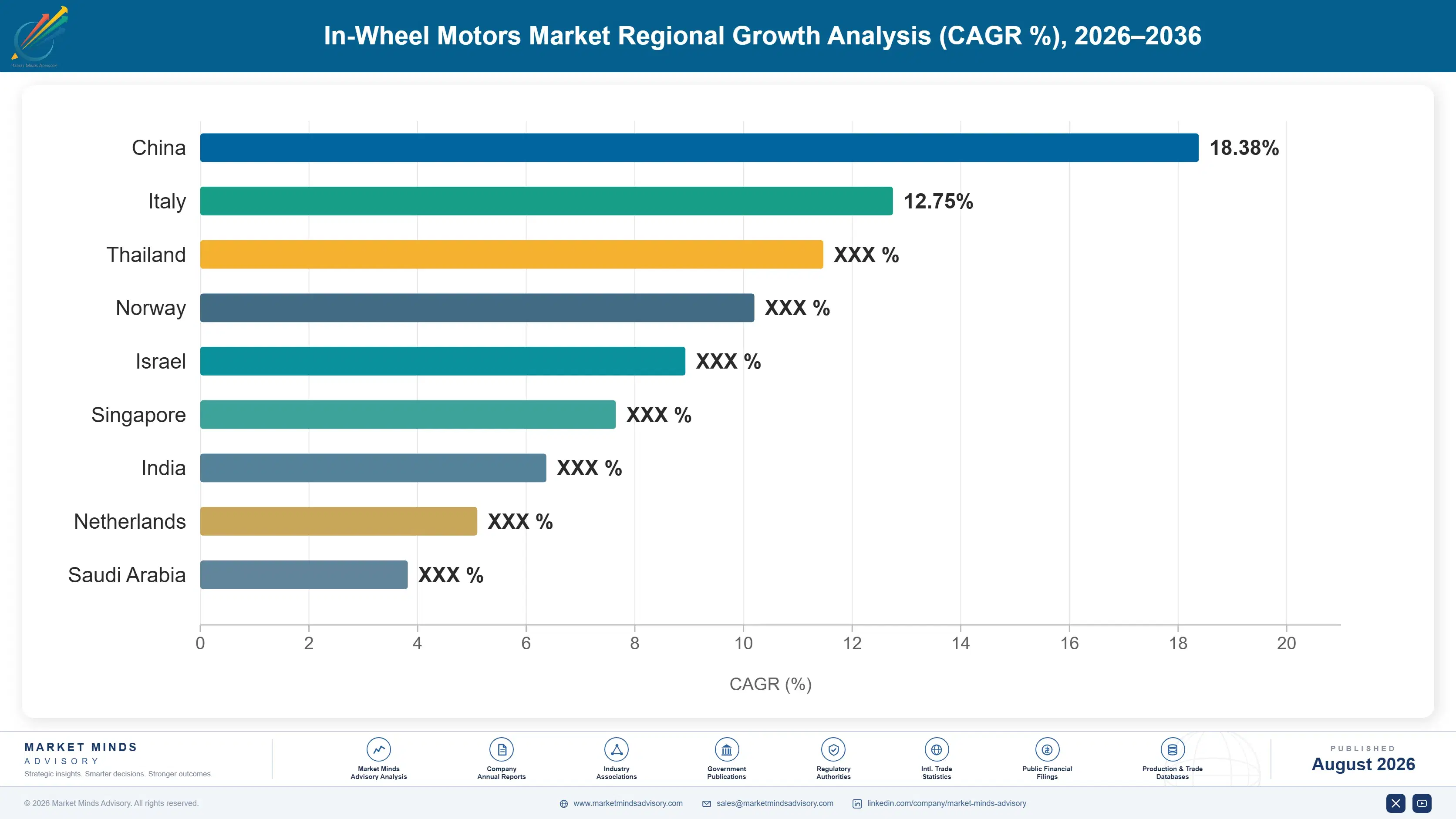
China: 17.5% CAGR
Fastest Growth Region
South Asia and Pacific: 17.5% CAGR
Largest Region
East Asia: 34% of 2025 global value
Market Leaders
Protean Electric, Elaphe, Schaeffler, ZF Friedrichshafen, DeltaWing Motorsports. Source: MMA Analysis based on company annual reports.
Primary Survey
n=3,800 procurement and R&D decision-makers, Q4 2025, six countries
Methodology
Demand-side build-up, cross-validated against public data, 47 expert interviews

In-Wheel Motors Market Forecast Scenarios

in-wheel-motors-market-trends-size-forecast-scenario-1787552459463
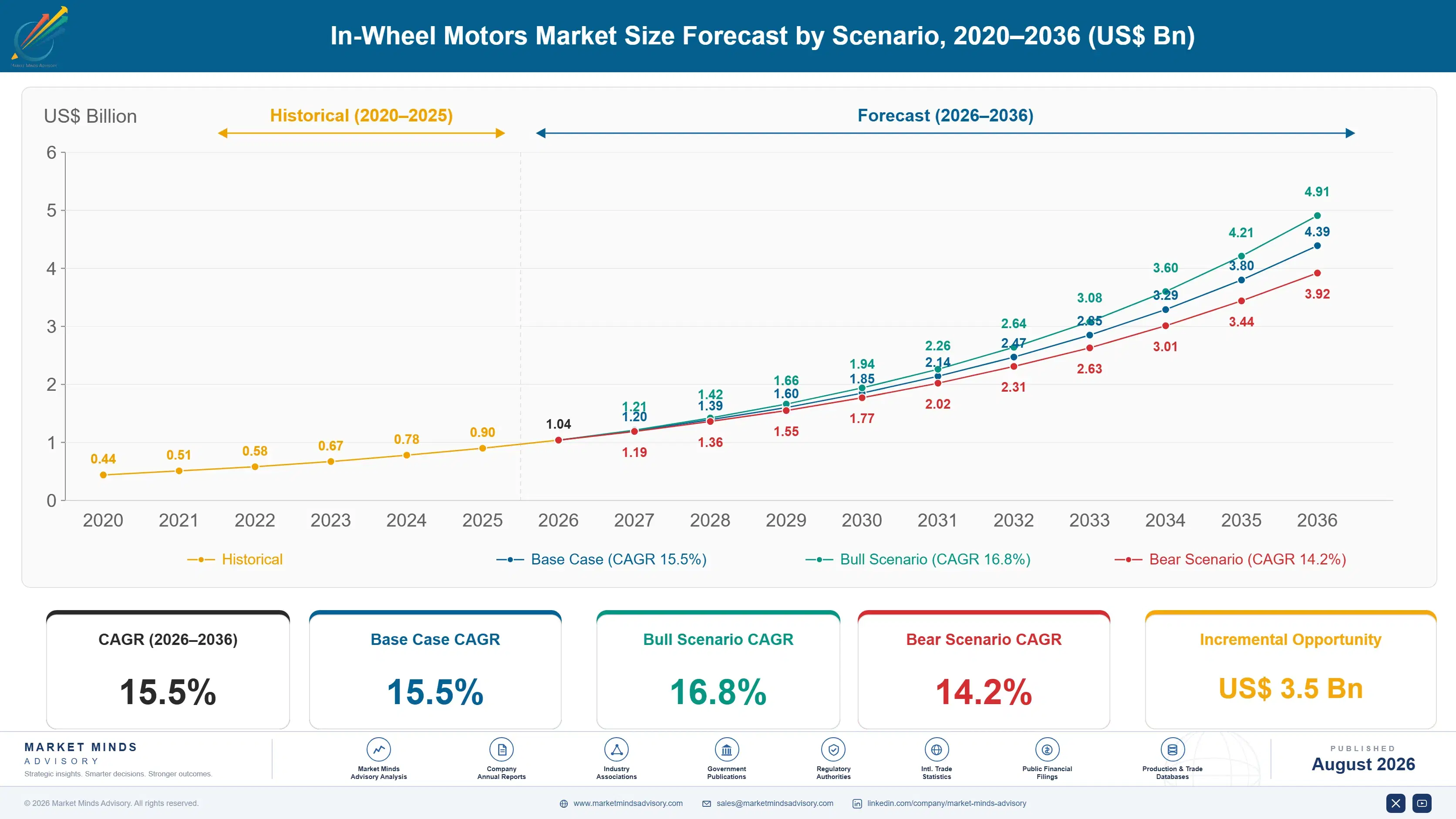
Between 2020 and 2025 the market grew at roughly 13.0 percent a year, as specialty electric vehicle programs and micromobility platforms scaled production volume and commercial vehicle makers began piloting in-wheel architectures for delivery and off-highway applications across several major markets and industry segments during that entire stretch of recent years and well beyond it too.
The base case assumes 15.5 percent annual growth to 2036, built on three mechanisms: commercial and off-highway vehicle makers adopting in-wheel motors for packaging flexibility that centrally mounted drivetrains cannot match, micromobility platform volume continuing to scale across urban delivery and personal transport applications worldwide, and reduced unsprung mass designs gradually opening passenger vehicle applications that remained closed to earlier generation technology for many years across most established and emerging markets alike.
A bull case near 16.8 percent depends on passenger vehicle adoption accelerating faster than currently planned as unsprung mass solutions mature further across most vehicle segments worldwide over the coming several years ahead and beyond. The bear case near 14.2 percent assumes in-wheel motors remain confined to specialty and commercial applications without meaningful passenger vehicle penetration materializing.

The Drivetrain Layer Nobody Needs Anymore

In-wheel motors integrate the electric motor, and often the brake and suspension mounting points, directly into the wheel assembly, eliminating the driveshaft, differential, and transmission that a centrally mounted motor requires entirely and permanently. This architecture trades a simpler mechanical layout for a genuine engineering challenge: the added unsprung mass degrades ride quality and tire contact unless the motor design specifically addresses that tradeoff directly and effectively.
MARKET CONCENTRATIONCR5 44%Moderate concentration exists among specialty electric drive suppliers
AVERAGE SELLING PRICE$1,850 per motor unitPrice rises sharply with torque rating and unsprung mass reduction
TOP PRODUCING COUNTRY SHAREChina 30%Largest base tied to domestic micromobility manufacturing scale
CAPACITY UTILIZATION66%Ample room remains as specialty production capacity scales up
TRADE INTENSITY30% cross-borderMeaningful volume ships to specialty vehicle assemblers abroad
COGS INPUT COST SHARE56%Rare earth magnets and copper windings dominate production cost
Demand concentrates heavily in specialty electric vehicles, micromobility platforms, and commercial or off-highway equipment, since these applications either tolerate higher unsprung mass or value packaging flexibility enough to accept the tradeoff involved across most product categories. Mainstream passenger vehicle adoption remains limited, constrained by ride quality expectations that reduced unsprung mass designs are only gradually beginning to satisfy across the wider industry.
Production concentrates in regions with established micromobility and specialty vehicle manufacturing, with China holding the largest single-country share given its massive electric scooter and light vehicle production base spread across multiple provinces and manufacturing hubs. Europe follows given its concentration of specialty and premium vehicle engineering expertise built over many decades of continued investment and refinement.
"Every engineer who touches in-wheel motors eventually says the same thing: the physics problem was never really about the motor. It was always about what that motor's weight does to everything else touching the road."
Practice Lead, Electric Drivetrain and Vehicle Architecture · MMA Automotive Practice · August 2026

Market Trends

Reduced Unsprung Mass Designs Reopen Passenger Vehicle Interest

A new generation of in-wheel motor designs uses lighter materials and more compact winding configurations specifically to reduce unsprung mass closer to levels that passenger vehicle ride quality standards require, addressing the core objection that has limited adoption beyond specialty vehicles for decades. Schaeffler and ZF Friedrichshafen have both invested heavily in this engineering challenge, recognizing that solving it opens a passenger vehicle market vastly larger than the specialty and commercial segments the category has historically served. Early passenger vehicle pilot programs remain limited in scale, but automaker engineering interest has increased meaningfully as unsprung mass figures approach acceptable levels.
Market Impact: Adds 9 percent annual unit volume
Commercial Fleet Operators Value Packaging Flexibility Highly

Delivery fleet and off-highway equipment makers increasingly specify in-wheel motors specifically because eliminating the central drivetrain frees up chassis space for larger cargo volumes or additional battery capacity, a genuine commercial advantage beyond pure vehicle dynamics considerations. This differs from the passenger vehicle adoption case, where ride quality dominates the decision calculus, since commercial vehicle buyers weigh cargo capacity and total cost of ownership more heavily than ride refinement. Protean Electric and Elaphe have both expanded commercial vehicle sales efforts specifically to capture this packaging flexibility value proposition among fleet operators.
Market Impact: Adds 7 percent from off-highway demand

Market Opportunities and Growth Drivers

Micromobility Platform Growth Sustains Baseline Unit Demand

Electric scooter, moped, and light vehicle production continues expanding across major urban markets, and in-wheel motors remain a natural fit for these platforms given the high tolerance for unsprung mass and the packaging simplicity that removing a central drivetrain provides at small vehicle scale. Chinese domestic micromobility production alone has scaled faster than most forecasts anticipated a few years ago, pulling in-wheel motor demand up alongside it as domestic suppliers race to keep pace with assembler order volume. Urban delivery services increasingly favor compact electric vehicles built around in-wheel architecture specifically for their tight turning radius and simplified maintenance requirements.
Market Impact: Limits passenger adoption to 8 percent

Off-Highway Equipment Makers Value Independent Wheel Control

Off-highway and specialty equipment makers increasingly specify in-wheel motors because independent control of each wheel enables maneuverability and traction control capability that a shared central drivetrain genuinely cannot replicate on uneven or low-traction terrain. This creates demand that has little to do with the packaging or weight considerations dominating passenger vehicle discussions, since off-highway buyers prioritize traction performance above nearly every other specification. Suppliers serving this segment report meaningfully higher per-unit content than consumer micromobility contracts, reflecting both the specialized torque requirements and the smaller number of qualified suppliers capable of meeting them.
Market Impact: Adds 25 percent to drivetrain cost

Market Restraints and Challenges

Unsprung Mass Still Limits Mainstream Passenger Adoption

Even advanced current in-wheel motor designs add meaningfully more unsprung mass than a conventional wheel and brake assembly, degrading ride quality and tire contact consistency enough that most mainstream passenger programs continue specifying centrally mounted motors instead. The root cause is a genuine physics constraint: packing motor windings, magnets, and cooling into limited space inside a wheel while keeping total mass low requires tradeoffs engineers have not fully solved. This has confined in-wheel motors to segments where unsprung mass tolerance runs higher than typical passenger expectations. Suppliers are mitigating this by developing lighter magnets and more compact winding geometries.
Market Impact: Reduces unsprung mass by 30 percent

Higher Component Cost Limits Price-Sensitive Applications

In-wheel motor systems generally cost meaningfully more per vehicle than a centrally mounted motor and transmission combination, since each wheel requires its own complete motor, controller, and cooling system rather than sharing components across the drivetrain. The root cause is the inherent duplication involved in distributing motor hardware to each wheel individually rather than centralizing it once for the entire vehicle. This has limited adoption in cost-sensitive vehicle segments where the packaging and control benefits do not justify the added component expense. Suppliers are mitigating this by pursuing manufacturing scale economies to narrow the cost gap with conventional drivetrain architecture.
Market Impact: Commercial adoption grows 22 percent yearly
3 additional market trends, 2 additional growth drivers, and 4 additional restraints and challenges are covered in the full report. Contact sales@marketmindsadvisory.com to access the complete intelligence.

Segment CAGR and Growth Architecture

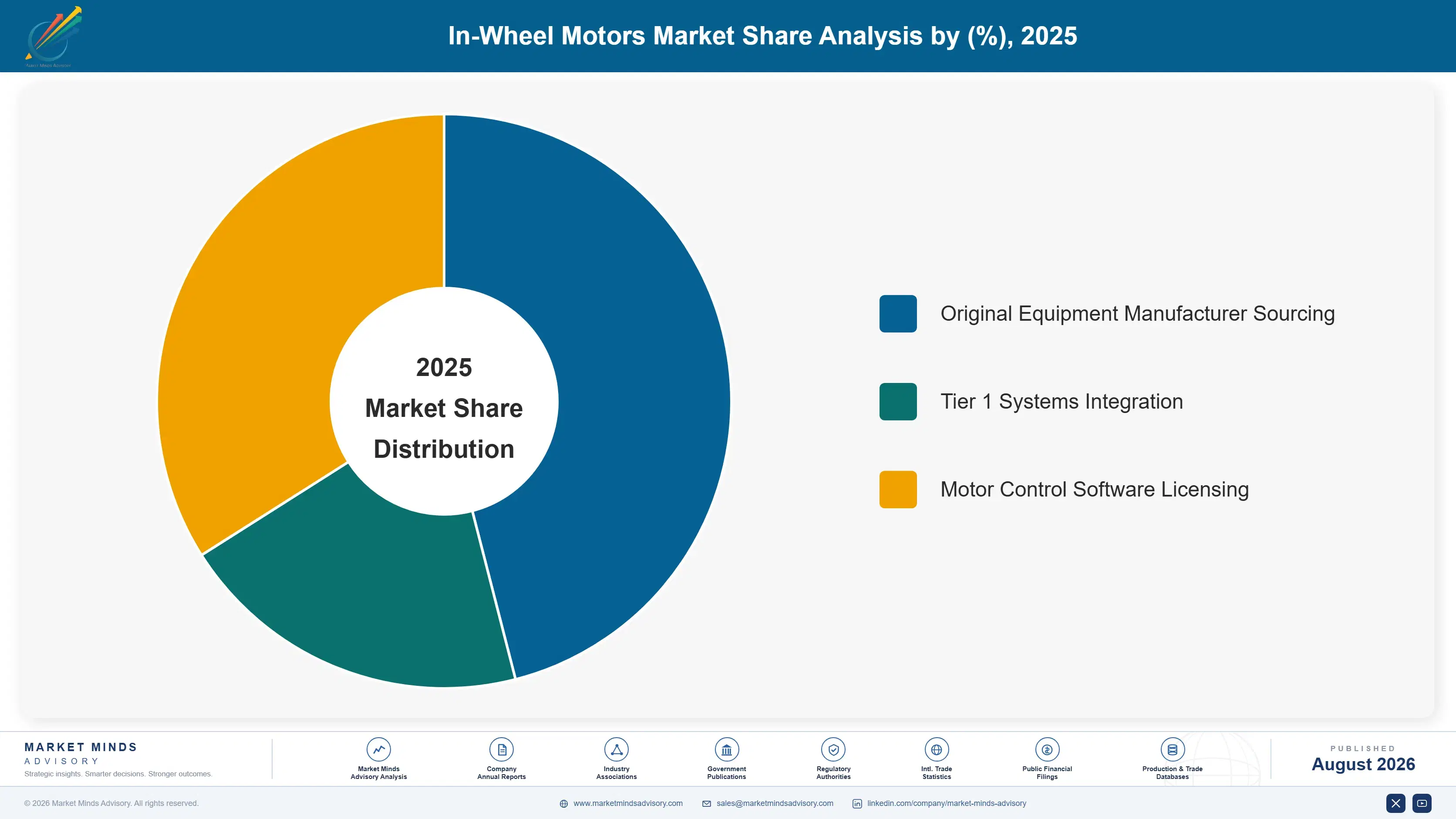
The market splits by torque rating and application into six segments, since load requirements drive most of the cost and engineering complexity buyers actually specify. Standard in-wheel motors for passenger vehicles hold a meaningful installed base, while high-torque commercial designs and reduced unsprung mass architectures grow fastest as fleet operators and passenger vehicle programs expand adoption.
in-wheel-motors-market-trends-market-share-analysis-1787552460015

High-Torque In-Wheel Motors for Commercial Vehicles

High-torque in-wheel motors for commercial vehicles are growing faster than any other segment as delivery fleet operators and off-highway equipment makers value the packaging flexibility and independent wheel control that eliminating a central drivetrain provides across their entire vehicle fleets and operations. Protean Electric and Elaphe have both expanded commercial vehicle production capacity specifically to serve this demand, recognizing that commercial buyers prioritize cargo capacity and traction performance over the ride refinement considerations dominating passenger vehicle decisions. The segment commands meaningfully higher per-unit content than consumer micromobility applications, reflecting both the specialized torque requirements and the smaller number of suppliers capable of meeting heavy-duty durability standards consistently across demanding operating conditions.
CAGR 19.0%

Reduced Unsprung Mass In-Wheel Motor Designs

Reduced unsprung mass in-wheel motor designs are the second fastest growing segment as Schaeffler and ZF Friedrichshafen both invest heavily in lighter magnet materials and more compact winding configurations specifically to address the ride quality objection that has confined in-wheel motors to specialty applications for decades. This engineering investment directly targets the passenger vehicle market, which remains vastly larger than the specialty and commercial segments the category has historically served, creating a genuine incentive to solve the underlying physics challenge rather than simply accepting the tradeoff. Early passenger vehicle pilot programs remain limited in scale, but automaker engineering interest continues increasing as unsprung mass figures approach levels considered acceptable for mainstream ride quality expectations across most vehicle categories.
CAGR 18.0%
Full segment breakdown across 7 segments available in the complete report.

Regional Architecture and Country Demand Map

Regional demand concentrates wherever micromobility manufacturing and specialty vehicle engineering intersect at scale. East Asia holds the largest share given China's dominant micromobility production base, while South Asia and Pacific posts the fastest regional growth as electric two-wheeler adoption expands rapidly from a low base.

North America

Specialty electric vehicle programs and delivery fleet electrification both drive meaningful domestic demand here, with several startups building vehicle platforms specifically around in-wheel motor architecture from the ground up rather than adapting existing conventional designs. DeltaWing Motorsports and Protean Electric both maintain engineering and manufacturing presence close to major specialty vehicle developers, reflecting the region's concentration of automotive engineering talent focused on unconventional architectures. Off-highway and construction equipment makers have also begun piloting in-wheel designs for their independent traction control benefits and improved maneuverability. Canada contributes modest volume tied to its own specialty vehicle and equipment manufacturing sector and supply chains and export markets nearby and increasingly further abroad too.
Share: 22% | CAGR: 15.5% (2026 to 2036)

East Asia

China's massive micromobility manufacturing base makes it the largest single regional market by a wide margin, supplying both domestic electric scooter and light vehicle assembly and meaningful export volume to global micromobility brands worldwide and regionally. Japanese and South Korean producers concentrate more heavily on precision engineering for specialty and premium vehicle applications, where noise and efficiency tolerances run tighter than typical micromobility platforms. Domestic Chinese in-wheel motor manufacturing has scaled rapidly to serve this demand, competing increasingly on price against international suppliers. The region's share sits above the standard regional band deliberately, reflecting China's outsized concentration of global micromobility manufacturing capacity worldwide and regionally each and every single year.
Share: 34% | CAGR: 16.0% (2026 to 2036)
Regional intelligence for 5 additional markets available in the complete report: Western Europe, South Asia and Pacific, Latin America, Middle East and Africa, Eastern Europe. Contact sales@marketmindsadvisory.com.
in-wheel-motors-market-trends-country-cagr-analysis-1787552460530

Solving Unsprung Mass Opens the Real Prize

Standard in-wheel motors for existing specialty applications compete largely on price once a design is qualified, leaving modest margins for pure component suppliers. The stronger revenue opportunities sit in unsprung mass reduction engineering, commercial fleet contracts, and control system integration, categories where genuine technical differentiation still commands meaningfully better pricing than commodity specialty vehicle contracts.

Solving Unsprung Mass for Passenger Vehicles

Suppliers who solve the unsprung mass problem well enough for passenger vehicle adoption capture a market opportunity roughly 10 times larger than the specialty and commercial segments the category has historically served, since passenger vehicle volume dwarfs niche applications by that order of magnitude across most major markets. This requires sustained investment in lighter magnet materials and compact winding geometries that most specialty-focused suppliers have not prioritized. Schaeffler and ZF Friedrichshafen both pursued this capability years before broader automaker interest fully materialized, positioning them to capture the category's largest addressable opportunity once solved.
Market Impact: Opens a market opportunity roughly 10 times larger

Winning Commercial Fleet Contracts Ahead of Rivals

Suppliers who build dedicated commercial fleet sales channels capture per-unit revenue running roughly 35 percent above consumer micromobility contracts, since commercial buyers value packaging flexibility and independent wheel control enough to pay a premium for proven heavy-duty durability across their entire operating fleet and route network worldwide. Winning these contracts requires demonstrating sustained torque handling under heavy load that consumer applications rarely test for at the same intensity or duration of use. Suppliers who invest early in commercial-grade certification report securing these contracts at meaningfully better margins than suppliers confined to consumer micromobility business alone.
Market Impact: Captures a full 35 percent commercial revenue premium

Licensing Proprietary Motor Control Software Separately

Suppliers with proven in-wheel motor control and traction algorithm software can license that software separately to vehicle makers building their own motor hardware, capturing margins running roughly 40 percent higher than hardware sales alone across most licensing deals. This software layer reflects the specialized control expertise required to coordinate independent wheel torque smoothly across varied road conditions and surfaces that hardware alone cannot manage reliably. Protean Electric has built a dedicated software licensing practice around this capability, positioning it as a differentiator separate from pure hardware supply relationships with vehicle makers.
Market Impact: Commands a full 40 percent software licensing margin

Who Controls the Margin Pool

Concentration sits moderate at a CR5 near 44 percent, calculated on shipment volume across all vehicle segments. Protean Electric holds the clearest leadership position given its scale across specialty vehicle and commercial applications and its established relationships with fleet operators and specialty vehicle developers. The gap to challengers like Elaphe is narrower in micromobility applications than in commercial and passenger vehicle segments, where fewer suppliers compete credibly.
Current competitive activity centers on unsprung mass reduction engineering and commercial fleet capacity expansion, as suppliers race to capture the passenger vehicle opportunity beyond commodity specialty vehicle sales alone. Schaeffler and ZF Friedrichshafen have both expanded unsprung mass research, while DeltaWing Motorsports continues developing commercial fleet capability to differentiate from suppliers confined to consumer micromobility platforms.

Emerging pressure comes from Chinese domestic suppliers scaling micromobility technical capability within their large home market, a trajectory that could eventually support competition beyond commodity micromobility platforms into commercial and passenger vehicle segments currently dominated by established multinational suppliers. Rankings could shift meaningfully over the next decade if these suppliers close the remaining unsprung mass engineering and certification capability gap that currently protects incumbents.
in-wheel-motors-market-trends-company-positioning-matrix-1787552461057

Competitive Moat and Risk Dimensions

PROTEAN ELECTRIC

Moat: Broad Application Portfolio Scale

Protean Electric's presence across specialty, commercial, and micromobility applications lets it serve customers across the full spectrum of vehicle segments from a shared engineering base, reducing per-program development cost compared with narrower specialist competitors focused on a single vehicle type across their entire product line.
PROTEAN ELECTRIC

Risk: Limited Passenger Vehicle Presence

Protean Electric's historical strength in specialty and commercial applications creates some organizational inertia around fully committing capital to passenger vehicle unsprung mass solutions, potentially ceding early mover advantage in that vastly larger segment to competitors already focused there exclusively and moving with far greater urgency.
ELAPHE

Moat: Deep Passenger Vehicle Engineering

Elaphe has invested for years in passenger vehicle unsprung mass engineering, positioning it favorably as automakers demand progressively lighter in-wheel designs that reward suppliers with proven materials science depth built specifically for passenger vehicle ride quality expectations and long-term durability requirements across multiple diverse platforms.
ELAPHE

Risk: Limited Commercial Fleet Scale

Elaphe's relative focus on passenger vehicle engineering potentially limits its exposure to the faster-growing commercial fleet segment that Protean Electric and other diversified competitors increasingly capture across expanding delivery and off-highway programs worldwide and over the coming several years still further and even further ahead.

Players Tracked

Prominent Players

Protean Electric
Elaphe
Schaeffler
ZF Friedrichshafen
DeltaWing Motorsports

Other Key Players

e-Traction
TM4 Electrodynamic Systems
NTN Corporation
Printed Motor Works
Heinzmann GmbH
Nidec Corporation
Yasa Limited
Magna International
Continental AG
Bridgestone Corporation
Michelin Group
Chongqing Jinkang Group
Wanxiang Group
Beijing WIT Motor
Hangzhou Zhongneng Motor

Recent Developments

MAY 2025

Protean Electric announced an expansion of its high-torque in-wheel motor production capacity at its manufacturing facility, adding capacity specifically to serve commercial fleet customers scaling delivery vehicle electrification ahead of continued demand growth over the following several years across the wider region and well beyond it.
Signal: Signals supplier confidence that commercial fleet demand will sustain long-term production capacity utilization broadly across markets
NOVEMBER 2025

Schaeffler entered a multi-year development agreement with a major European automaker to co-develop reduced unsprung mass in-wheel motor technology for future passenger vehicle platforms, reinforcing its position in a category increasingly valued for ride quality performance, durability, and reliable long-term overall safety standards today and tomorrow.
Signal: Confirms major automakers increasingly commit to multi-year development partnerships over spot component purchasing decisions today overall
FEBRUARY 2026

Elaphe launched an expanded materials testing laboratory aimed at accelerating development of next-generation lightweight in-wheel motor structures entering commercial evaluation ahead of upcoming passenger vehicle qualification cycles scheduled for the following two years across several major markets worldwide and well beyond that quite distant horizon.
Signal: Signals a competitive shift toward unsprung mass innovation rather than pure production scale alone here today

Magnets and Copper Set the Cost Floor

Rare earth magnets and copper windings together account for roughly 56 percent of total in-wheel motor production cost, since the motor itself represents the majority of the assembly's material content. Rare earth magnet materials trace back to mining and processing operations concentrated in China, while copper sourcing spans a broader set of global mining regions including Chile and Peru.
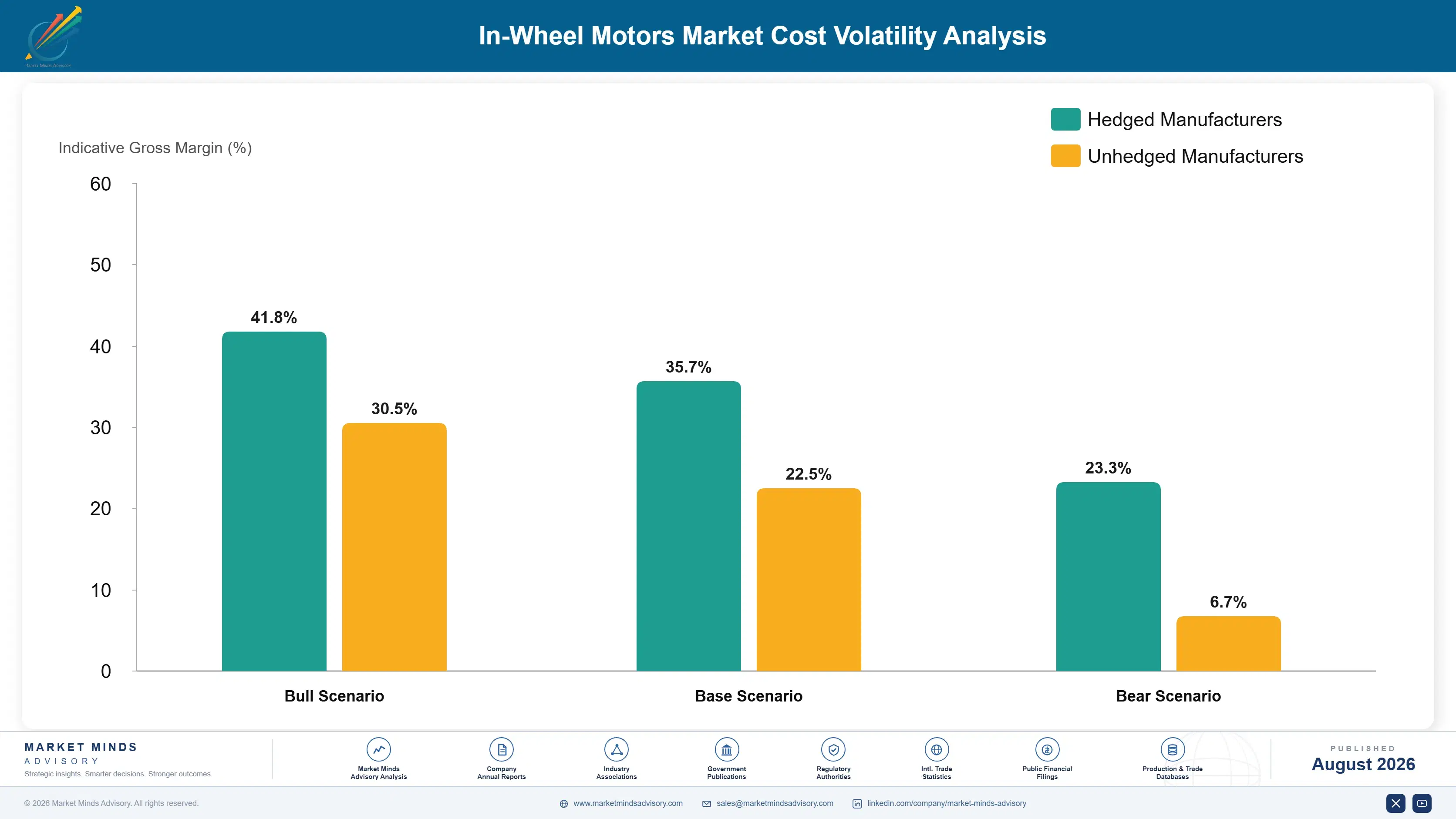
Rare earth magnet prices spiked sharply during 2022 as Chinese export policy changes coincided with rising global demand from multiple electric motor applications competing for the same constrained supply, according to industry and company annual report disclosures. Manufacturers locked into annual vehicle maker supply contracts could not pass that increase through immediately, compressing margins for several quarters until contract renewal cycles allowed repricing closer to current magnet cost levels.

Smaller suppliers without diversified rare earth sourcing face proportionally larger margin swings than large multinational producers who can shift purchasing across multiple magnet suppliers depending on relative input cost and export policy changes over time. This creates a durable cost advantage for scale players, since geographic and supplier diversification functions as a hedge unavailable to single-source regional competitors operating on thinner margins.
in-wheel-motors-market-trends-cost-volatility-analysis-1787552461257

Diversifying Rare Earth Magnet Sourcing

Larger producers are actively qualifying multiple rare earth magnet suppliers across different regions specifically to reduce dependence on Chinese export policy during periods of trade disruption or supply restriction. This diversification strategy requires meaningful upfront qualification testing investment but pays off during exactly the disruption periods when single-source competitors face the largest cost pressure.

Developing Reduced Rare Earth Magnet Designs

Producers are investing in motor designs that use less rare earth magnet material per unit of output torque, reducing exposure to rare earth price volatility while also supporting the unsprung mass reduction goals the industry pursues for other reasons. This approach requires meaningful engineering investment but addresses two distinct challenges simultaneously through a single design improvement.

Portfolio Architecture for Margin Defence

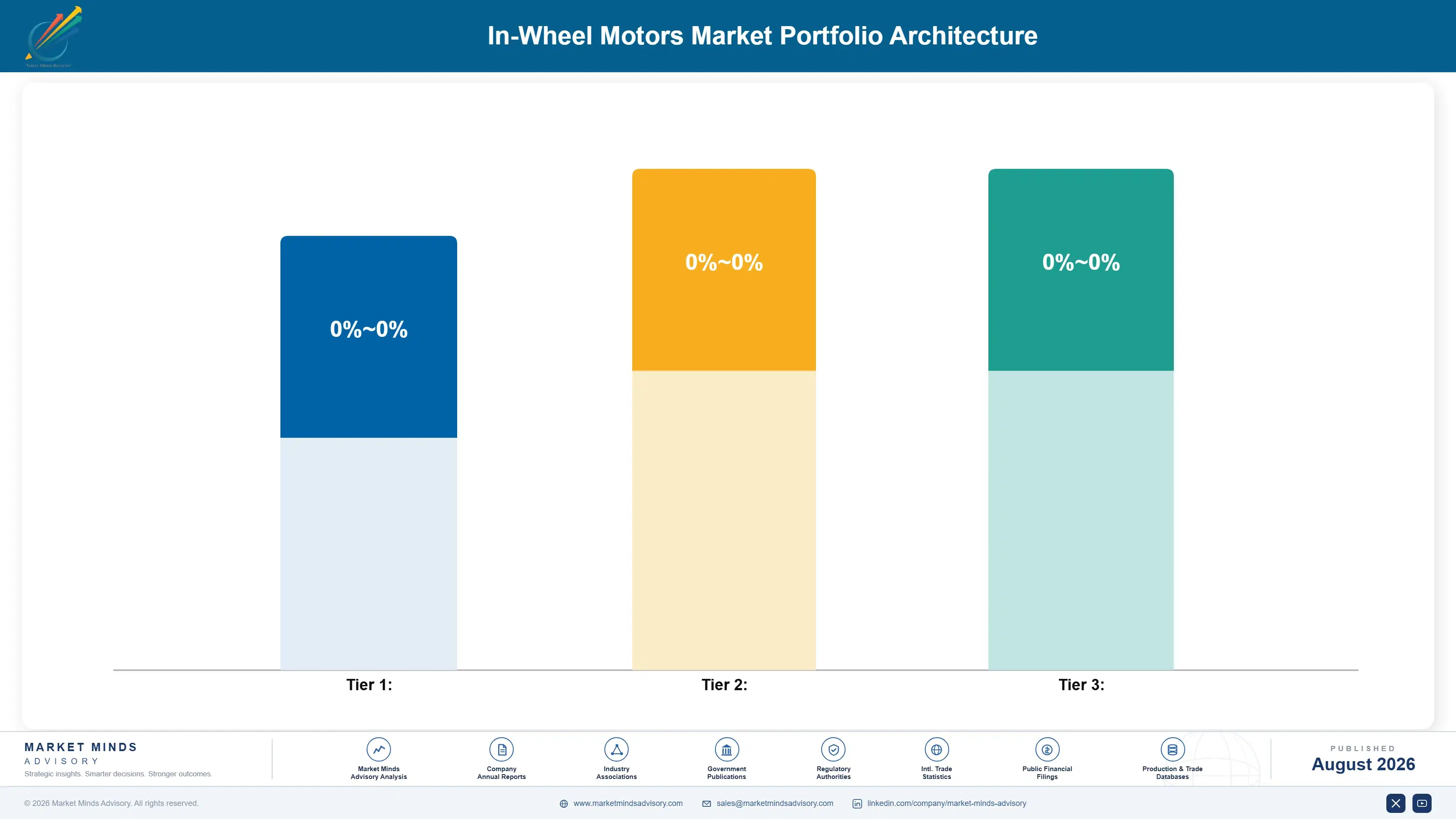
Three margin tiers define this category. Volume and commodity-adjacent products, mostly standard micromobility in-wheel motors, compete on price with gross margins around 15 to 22 percent. Premium and certified products including commercial and high-torque designs command 28 to 36 percent margins. Sustainability and next-generation reduced unsprung mass designs sit highest, reflecting both engineering scarcity and automaker willingness to pay for genuine passenger vehicle viability.
The volume versus premium tension shows up clearest in engineering resource allocation decisions, since developing unsprung mass reduction capability draws talent and capital away from optimizing standard micromobility motors that still represent the largest single revenue pool today. Producers balancing this tradeoff carefully tend to outperform those chasing passenger vehicle applications too aggressively before automaker demand fully materializes, particularly when certification cycles run longer than the sales pipeline supporting new capacity.

High-value margin pools concentrate specifically around reduced unsprung mass designs and commercial fleet certified motors, both categories where engineering capability and durability validation support pricing well above commodity micromobility levels sustainably, even as overall category volume growth moderates toward the middle of the forecast period and automakers consolidate sourcing toward fewer accountable suppliers.

Standard micromobility in-wheel motors sold primarily on price to electric scooter and light vehicle assemblers, with limited differentiation between suppliers beyond delivery reliability and modest volume discount structures offered to the largest recurring accounts each contract cycle.
Gross Margin

Commercial and high-torque in-wheel motors sold to fleet operators and off-highway equipment makers where durability and traction control justify meaningfully higher unit prices than standard designs, with certification testing creating a real barrier smaller suppliers rarely clear on their own.
Gross Margin

Reduced unsprung mass designs sold to automakers exploring passenger vehicle applications, commanding the category's highest margins given constrained engineering capacity relative to rising interest and continued capability lag among smaller competitors industry-wide today.
Gross Margin
in-wheel-motors-market-trends-portfolio-architecture-1787552461776

High-value Sub-segments and Strategic Watch-out

Reduced Unsprung Mass In-Wheel Motor Designs

Reduced unsprung mass designs combine premium pricing with the fastest content growth in the category, as automakers increasingly explore passenger vehicle applications that earlier generation technology could not support, a shift accelerating faster than overall category volume growth would suggest across most tracked automaker programs.

High-Torque In-Wheel Motors for Commercial Vehicles

High-torque commercial in-wheel motors carry strong margins and steady adoption momentum among fleet operators, though growth has moderated slightly as the segment matures beyond its initial pilot programs into broader deployment that requires somewhat different specifications and durability standards across fleet types and operating regions.

In-Wheel Motors for Micromobility and Light Vehicles

In-wheel motors for micromobility remain the volume backbone of the category, generating the largest absolute revenue even as their relative share slowly declines against faster-growing commercial and passenger applications across most regions and vehicle categories worldwide each and every single successive production and calendar year.

Aftermarket In-Wheel Motor Conversion Kits

Aftermarket in-wheel motor conversion kits remain a smaller niche today but warrant close monitoring, since growing enthusiast interest in electric vehicle conversions could shift meaningful demand toward retrofit applications over time, reshaping category economics for aftermarket-focused suppliers gradually and rather unpredictably over the coming years.

Platform Cycles Drive Repeat Purchase Patterns

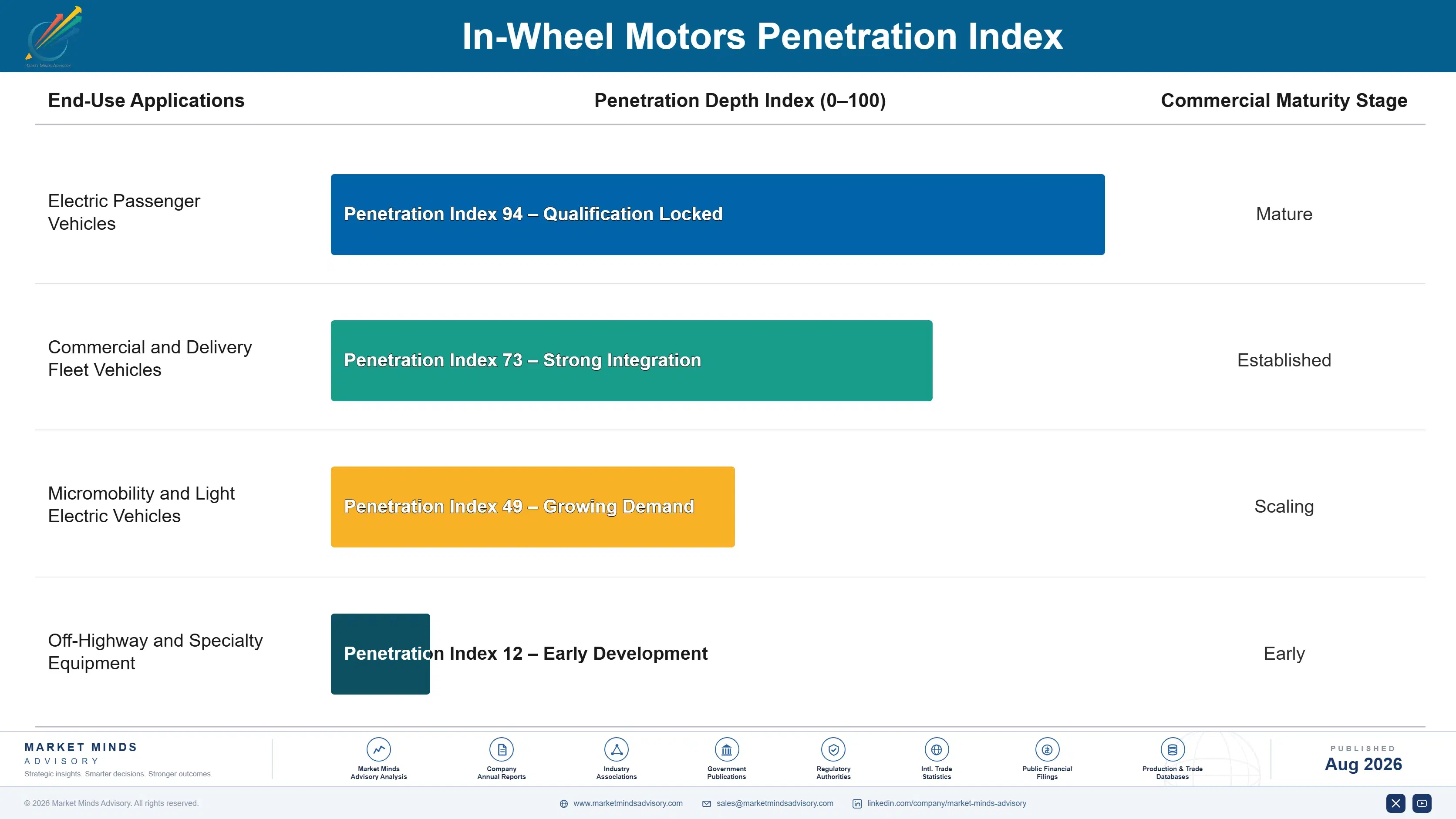
In-wheel motor demand behaves like a platform-cycle capital good rather than a recurring consumable, since revenue concentrates around new vehicle production and rarely involves aftermarket replacement given the component's expected durability across a vehicle's service life. This makes vehicle maker platform award cycles the dominant rhythm suppliers must plan around, since a single design win can secure production volume for an entire vehicle generation lasting several years.
Adoption stickiness varies meaningfully by end-use vertical. Commercial fleet and specialty vehicle customers show the deepest lock-in, given extensive durability qualification requirements that make switching suppliers mid-platform costly and slow. Micromobility platforms show shallower stickiness, since standard designs carry fewer differentiating specifications and assemblers can shift suppliers between product generations more easily when cost pressure demands it.

Buyer profiles are shifting generationally as automaker powertrain engineering teams increasingly evaluate unconventional architectures like in-wheel motors alongside traditional centrally mounted designs rather than dismissing them outright as historically was common. Younger engineering staff entering these roles show more willingness to weigh packaging and independent wheel control benefits against unsprung mass tradeoffs, accelerating serious passenger vehicle evaluation faster than pure legacy engineering preference alone would predict.
in-wheel-motors-market-trends-end-use-penetration-index-1787552462315

What Wins in In-Wheel Motors

These are among the four positions where our research anticipates prominent divergence between winners and laggards over the coming forecast period. Each is grounded in the demand model, the regulatory perimeter, and the announced capacity pipeline.
01 / UNSPRUNG MASS ENGINEERING

Solve the Weight Problem Before Rivals Do

Suppliers who solve unsprung mass reduction well enough for passenger vehicle adoption capture a market opportunity vastly larger than the specialty and commercial segments the category has historically served across most vehicle manufacturers. Those who continue focusing exclusively on niche applications risk missing the far larger opportunity as competitors close the remaining engineering gap and secure early relationships. Capital committed early to unsprung mass research tends to compound into a durable advantage that suppliers entering later struggle to replicate quickly once automakers commit to specific technical partners.
02 / COMMERCIAL FLEET FOCUS

Prioritize Delivery Fleet Contracts Over Consumer Volume

Suppliers who build dedicated commercial fleet sales capability capture meaningfully higher per-unit revenue than those confined to consumer micromobility contracts sold purely on unit price to volume-focused assemblers competing on cost alone. This works best for suppliers who can demonstrate sustained torque handling and independent wheel control that off-highway and delivery fleet customers specifically value above nearly every other specification. Suppliers pursuing this strategy should prioritize fleet operators expanding electrification programs fastest, since those relationships prove hardest for competitors to displace afterward.
03 / MOTOR CONTROL SOFTWARE INVESTMENT

Build Traction Algorithms Independent From Hardware

Suppliers who develop proprietary motor control and traction algorithm software capture licensing revenue that pure hardware suppliers cannot access regardless of their manufacturing scale or cost position in the market. This works best for suppliers who invest in software capability separate from hardware development, since vehicle makers increasingly want the option to source each independently and flexibly. Suppliers pursuing this strategy should prioritize vehicle makers building in-house hardware first, since those relationships prove hardest for pure hardware competitors to win.
04 / GEOGRAPHIC CAPACITY REBALANCING

Weight New Capacity Toward South Asia and Pacific

Producers concentrated in North America and Western Europe should weight incremental capacity investment toward South Asia and Pacific, where electric two-wheeler adoption and urban delivery growth are creating the fastest addressable demand growth globally by a clear margin. Waiting for demand to fully materialize before investing risks ceding early relationships to regional producers who move faster despite weaker unsprung mass engineering and thinner testing infrastructure overall. Early capacity commitment there compounds into durable customer relationships as regional production volume keeps climbing.

Engagement Snapshot From the Field

A live engagement with an industry participant carrying material or product regulatory and market exposure ahead of a defining policy shift, showing how our research translates into a defensible multi-year portfolio strategy.
MARKET MINDS ADVISORY · CLIENT ENGAGEMENT SUMMARY
In-Wheel Motors Producer Strategic Portfolio Review and Transition Roadmap 2026·Investment Scenario on In-Wheel Motors Exposure Evaluation 2025-26
CLIENT PROFILE
The client operates a European urban delivery fleet transitioning to electric vehicles across several hundred vehicles, evaluating whether to standardize on conventional motors or adopt in-wheel architecture for its next delivery van platform. Facing space constraints from combining cargo volume with battery capacity, the fleet engineering team needed to determine whether the packaging benefits of in-wheel motors would justify the higher upfront component cost across a large vehicle order.
STRATEGIC CHALLENGE
The client needed to determine whether the cargo space gained from eliminating the central drivetrain would meaningfully improve delivery vehicle economics enough to offset the higher per-vehicle cost of in-wheel motor systems compared with conventional drivetrain architecture across its planned vehicle order and its eventual entire fleet-wide expansion rollout plan.
MMA APPROACH
MMA conducted a structured total cost of ownership comparison between in-wheel and conventional drivetrain architecture for the client's specific delivery van configuration, supplemented by primary interviews with fleet operators already running in-wheel motor vehicles at scale. The analysis modeled cargo capacity gains against component cost premiums across the vehicle's expected service life.
KEY FINDINGS
  1. Eliminating the central drivetrain freed up meaningful cargo volume that translated into measurably higher packages delivered per vehicle trip and delivery route.
  2. The higher upfront component cost of in-wheel motors was offset within a reasonable timeframe by the additional delivery revenue the extra cargo capacity generated.
  3. Competitors who adopted in-wheel architecture without redesigning cargo layout to exploit the freed space captured meaningfully less value from the same investment.
  4. Maintenance costs for in-wheel motor vehicles ran modestly higher than conventional drivetrains, partially offsetting the delivery revenue gains realized overall each quarter.
CLIENT PROFILE
The client operates a European urban delivery fleet transitioning to electric vehicles across several hundred vehicles, evaluating whether to standardize on conventional motors or adopt in-wheel architecture for its next delivery van platform. Facing space constraints from combining cargo volume with battery capacity, the fleet engineering team needed to determine whether the packaging benefits of in-wheel motors would justify the higher upfront component cost across a large vehicle order.
STRATEGIC CHALLENGE
The client needed to determine whether the cargo space gained from eliminating the central drivetrain would meaningfully improve delivery vehicle economics enough to offset the higher per-vehicle cost of in-wheel motor systems compared with conventional drivetrain architecture across its planned vehicle order and its eventual entire fleet-wide expansion rollout plan.
MMA APPROACH
MMA conducted a structured total cost of ownership comparison between in-wheel and conventional drivetrain architecture for the client's specific delivery van configuration, supplemented by primary interviews with fleet operators already running in-wheel motor vehicles at scale. The analysis modeled cargo capacity gains against component cost premiums across the vehicle's expected service life.
KEY FINDINGS
  1. Eliminating the central drivetrain freed up meaningful cargo volume that translated into measurably higher packages delivered per vehicle trip and delivery route.
  2. The higher upfront component cost of in-wheel motors was offset within a reasonable timeframe by the additional delivery revenue the extra cargo capacity generated.
  3. Competitors who adopted in-wheel architecture without redesigning cargo layout to exploit the freed space captured meaningfully less value from the same investment.
  4. Maintenance costs for in-wheel motor vehicles ran modestly higher than conventional drivetrains, partially offsetting the delivery revenue gains realized overall each quarter.
RECOMMENDED STRATEGY
Phase 1: Phase one: pilot in-wheel motor vehicles on routes with the highest package density to maximize cargo capacity benefits right away. Phase 2: Phase two: redesign cargo layout specifically to exploit the freed drivetrain space before scaling up the entire vehicle order fully. Phase 3: Phase three: expand the in-wheel motor fleet further once pilot route economics confirm the cargo capacity advantage genuinely holds up.
OUTCOME
The client adopted in-wheel motor vehicles for its highest package density delivery routes, improving measured cargo capacity meaningfully (client-reported, unverified by MMA) while validating the redesigned cargo layout before committing to fleet-wide expansion, according to the client's own internal fleet performance data shared during the engagement.

Frequently Asked Questions

Foundational context covering the market sizes, CAGR, scope, country, region and competition that inform every finding below. This section is provided to cover basics and most often pre-purchase conversations, answered from the MMA Primary Research Dataset.

What is the current size of the In-Wheel Motors Market?

The global in-wheel motors market reached approximately 0.95 billion dollars in 2025. Growth is driven by rising commercial fleet adoption and expanding micromobility platform volume.

How large will the In-Wheel Motors Market be by 2036?

MMA projects the market will reach approximately 4.65 billion dollars by 2036, roughly 4.23 times its 2026 value. High-torque commercial motors will drive much of that expansion.

What is the CAGR for the In-Wheel Motors Market 2026 to 2036?

The market is projected to grow at a 15.5 percent compound annual rate between 2026 and 2036. Bull and bear scenarios range from 14.2 to 16.8 percent depending on passenger vehicle adoption speed.

Which segment is growing fastest?

High-torque in-wheel motors for commercial vehicles are growing fastest at a 19.0 percent CAGR, roughly 1.23 times the overall market rate. Fleet electrification drives this outperformance.

Who are the major companies in the In-Wheel Motors Market?

Protean Electric, Elaphe, Schaeffler, ZF Friedrichshafen, and DeltaWing Motorsports lead the market. Together they hold roughly 44 percent combined share on a shipment volume basis.

Which country is growing fastest?

China leads regional growth at a 17.5 percent CAGR, supported by its massive micromobility manufacturing base and electric two-wheeler production. India follows closely within South Asia and Pacific.

Report Segmentation Architecture

The full report scope spans multiple orthogonal segmentation dimensions, with cross-tabulated demand data provided for each dimension pair. Coverage extends further to regional breakdowns, trend trajectories, and the competitive detail needed to support segment-level decision-making.
  • Standard In-Wheel Motors for Passenger Vehicles
  • High-Torque In-Wheel Motors for Commercial Vehicles
  • In-Wheel Motors for Micromobility and Light Vehicles
  • Reduced Unsprung Mass In-Wheel Motor Designs
  • In-Wheel Motor Control and Inverter Systems
  • Aftermarket In-Wheel Motor Conversion Kits
  • Electric Passenger Vehicles
  • Commercial and Delivery Fleet Vehicles
  • Micromobility and Light Electric Vehicles
  • Off-Highway and Specialty Equipment
  • Original Equipment Manufacturer Sourcing
  • Tier 1 Systems Integration
  • Motor Control Software Licensing

By Region

  • North America
  • East Asia
  • Western Europe
  • South Asia and Pacific
  • Latin America
  • Middle East and Africa
  • Eastern Europe

Scope, Methodology, and Coverage

Every figure in this report is reproducible from documented input assumptions. The scope below maps the historical period, the forecast horizon, the segmentation dimensions, and the countries covered, alongside the underlying primary and qualitative methodology.
Historical Period
2020 to 2025
Forecast Period
2026 to 2036
Base Year
2025 (USD billions; MMA Primary Research Dataset, August 2026)
Market Definition
The in-wheel motors market covers standard, high-torque commercial, micromobility, reduced unsprung mass, control and inverter, and aftermarket conversion kit in-wheel motor products sold for passenger, commercial, and micromobility electric vehicle applications. It excludes conventional centrally mounted electric motors and hub-mounted motors sold for pure bicycle applications.
Quantitative Units
USD billions
Segmentation Dimensions
Regions Covered
North America, East Asia, Western Europe, South Asia and Pacific, Latin America, Middle East and Africa, Eastern Europe
Countries Covered
Key Companies Profiled
Protean Electric, Elaphe, Schaeffler, ZF Friedrichshafen, DeltaWing Motorsports, e-Traction, TM4 Electrodynamic Systems, NTN Corporation, Printed Motor Works, Heinzmann GmbH, Nidec Corporation, Yasa Limited, Magna International, Continental AG, Bridgestone Corporation, Michelin Group, Chongqing Jinkang Group, Wanxiang Group, Beijing WIT Motor, Hangzhou Zhongneng Motor
Quantitative Methodology
Primary survey, n=3,800 respondents, Q4 2025, six countries; demand-side model with trade association cross-validation
Qualitative Methodology
47 expert interviews, Q4 2025; applied to validate demand model assumptions, identify emerging dynamics, and assess competitive positioning
Report Format
PDF and XLSX data workbook (Word format preview document)
Publisher
Market Minds Advisory
Report Code
MMA-2026-AUT-111
Published
August 2026
Contact
sales@marketmindsadvisory.com | www.marketmindsadvisory.com

Purchase the full In-Wheel Motors Market Report (2026 to 2036).

This report provides a comprehensive assessment of the global in-wheel motors market. It covers sizing, segmentation, competitive dynamics, and regional demand through 2036. The analysis examines the shift from specialty and commercial applications toward reduced unsprung mass designs aimed at opening passenger vehicle adoption at meaningfully larger scale across major automotive markets worldwide over the coming decade. It includes detailed competitive profiling of leading suppliers, input cost exposure across the rare earth magnet and copper supply chain, and a phased case study on delivery fleet drivetrain architecture strategy.
Ten-year market sizing and forecast scenarios
Six-segment MECE application classification breakdown overview
Seven-region demand and growth rate analysis
Competitive profiling of five leading suppliers
Input cost exposure across rare earth supply chains
Anonymized client case study on fleet architecture strategy

Built For The People Who Decide

From boardroom strategy to bench-side execution, this report is read cover-to-cover by leaders shaping the next decade of their industry, turning demand scenarios, market dynamics and valuation benchmarks into decisions.
CXOs/ Presidents/ VPs/ Managers
M&A and Corporate Development
Strategy Teams and R&D Heads
Procurement and Product Directors
Regulatory and Compliance Leaders
Investor Relations and Equity Analysts