Market Minds Advisory
In-Chassis Cooling Market

In-Chassis Cooling Market: AI Accelerator Density and the Liquid Cooling Transition

Rising AI accelerator power density is pushing server chassis past the thermal limits of air cooling, forcing hyperscalers toward cold plate liquid loops years earlier than planned, while quick-disconnect qualification cycles gate deployment schedules.

Lead Analyst

David Horsley

Published

August 2026

Make Smarter Decisions with Customized Research Insights

Request a free sample report and evaluate market opportunities, growth trends, and competitive dynamics relevant to your business needs.

2025 MARKET VALUE$4.2BMarket Size 2025
2036 FORECAST VALUE$20.5BBase Case , 2026 to 2036
CAGR 2026 TO 203615.5 %Bull 16.8% / Bear 14.2%
INCREMENTAL OPPORTUNITY$15.7BNet 10- year value creation
EXPANSION MULTIPLE4.23x2036 value over 2026 base
Strategic Levers
M&A Pipeline
Regional Outlook
Country Rankings
Competitive Intelligence
Segmental Deep-dive
Call-Us : 91 93563 13602

Executive Snapshot and Market Trajectory

In-chassis cooling has moved from a component afterthought to a first-order server design constraint. Chassis architects now select compute platforms partly around cooling loop compatibility, and thermal headroom, not raw silicon availability, increasingly caps how densely AI accelerators can be packed into a single rack.
Cold plate liquid cooling modules are growing at roughly 1.2x the broader market average as accelerator thermal design power keeps climbing past what air cooling can economically dissipate. East Asia has extended its lead in both production and consumption, anchored by Taiwan's server ODM assembly base, while North American hyperscalers race to qualify liquid-ready chassis fast enough to match GPU delivery schedules already booked years in advance.
Competitive intensity concentrates among a handful of thermal specialists and diversified infrastructure conglomerates that increasingly bundle cold plates, manifolds, and fluid qualification services into a single design-in relationship. Component reliability and leak risk, not raw thermal resistance specifications alone, increasingly determine which suppliers win multi-year server platform contracts from hyperscale customers. Suppliers unable to demonstrate hyperscale-scale field data increasingly lose design consideration entirely, regardless of how competitive their raw thermal resistance numbers appear on paper.
Market Definition
The in-chassis cooling market covers thermal management hardware integrated directly within server and compute chassis, including cold plate liquid cooling modules, in-chassis manifolds and quick-disconnect fittings, high-performance heat sinks and fan modules, immersion cooling enclosures, and thermal interface materials. It serves data center, HPC, and AI accelerator server platforms. Rack-level coolant distribution units, rear-door heat exchangers, and facility-level chilled water infrastructure are excluded.
Base Year Value
$4.2B in 2025 (MMA Primary Research Dataset, August 2026)
Forecast Period
2026 to 2036, eleven discrete annual values
CAGR
15.5% base case. Bull 16.8%. Bear 14.2%.
Fastest Growth Segment
Cold Plate Liquid Cooling Modules: 19.0% CAGR
Fastest Growth Country
Taiwan: 18.5% CAGR
Fastest Growth Region
South Asia and Pacific: 17.6% CAGR
Largest Region
East Asia: 30% of 2025 global value
Market Leaders
Vertiv Holdings, CoolIT Systems, Boyd Corporation, Delta Electronics, Asetek A/S. Source: MMA Analysis based on company annual reports.
Primary Survey
n=3,800 procurement and R&D decision-makers, Q4 2025, six countries
Methodology
Demand-side build-up, cross-validated against public data, 47 expert interviews

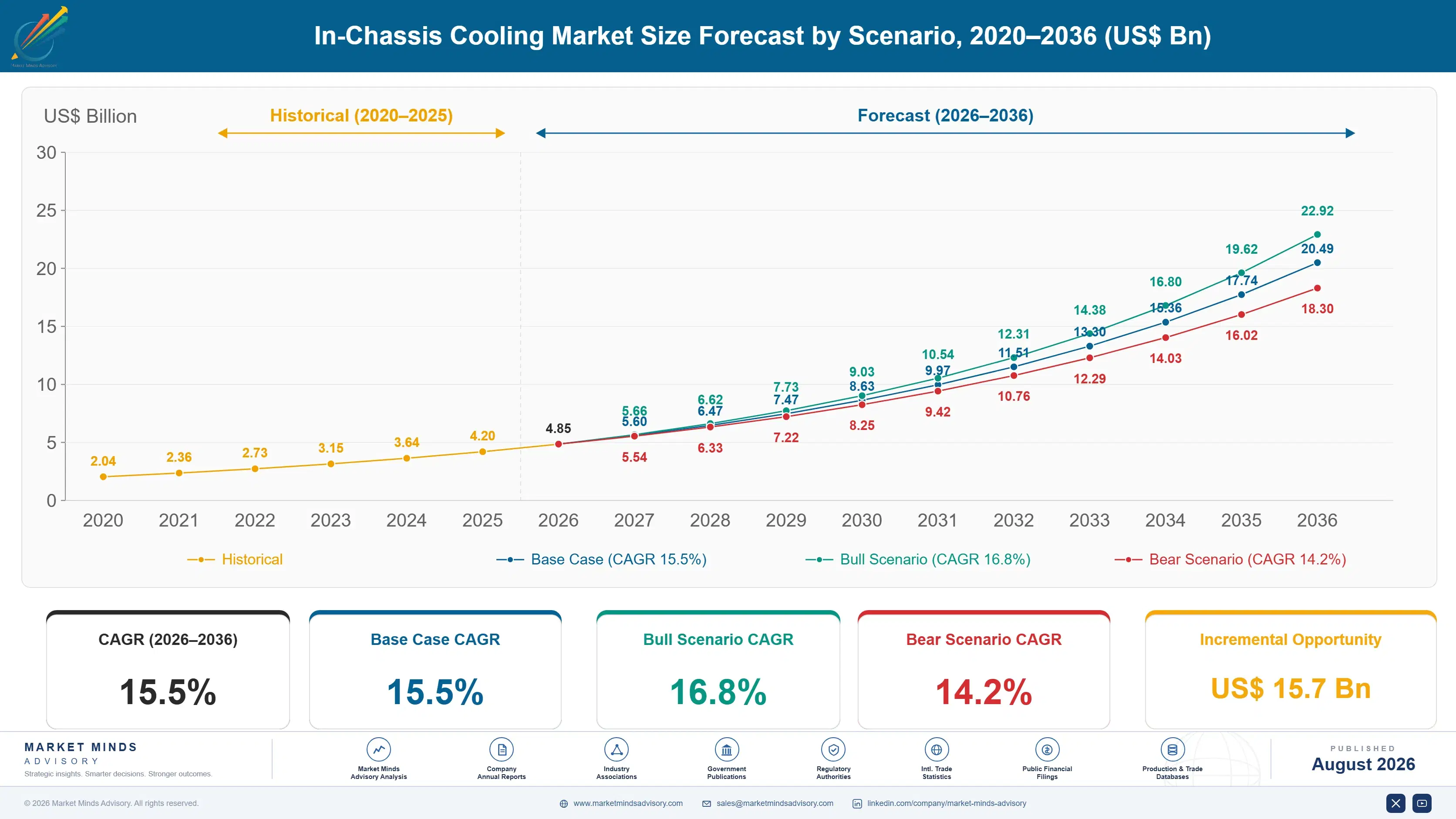
In-Chassis Cooling Market Forecast Scenarios

in-chassis-cooling-market-size-forecast-scenario-1787302266297
Between 2020 and 2025 the market expanded at an estimated 14.5% historical CAGR, growing steadily on rising server density before accelerating sharply from 2023 onward as generative AI accelerator thermal design power roughly doubled across successive chip generations. Early liquid cooling adoption stayed confined to specialized HPC clusters until mainstream hyperscale deployment made it a default design choice.
The base case assumes 15.5% CAGR through 2036, resting on three mechanisms: accelerator thermal design power continuing to climb faster than air cooling's practical dissipation ceiling, hyperscalers standardizing on liquid-ready chassis architectures across entire fleet refresh cycles rather than isolated pilot racks, and rising rack power density pushing mainstream servers toward hybrid air-liquid designs. Immersion cooling adoption among select hyperscale operators adds a reinforcing tailwind as facilities seek density gains beyond cold plates alone.
A bull scenario, near 16.8% CAGR, assumes even faster accelerator power density growth and broader enterprise liquid cooling adoption pull deployment forward. The bear case, near 14.2%, assumes AI capital spending growth moderates and chip designers slow thermal design power increases, extending the useful life of air-cooled chassis architectures longer than currently projected. Either scenario still implies liquid cooling becomes dominant for accelerator platforms before the decade closes.

Thermal Headroom Now Gates Rack Density Roadmaps

Three forces are converging on in-chassis cooling simultaneously: an AI accelerator thermal design power curve that is outrunning air cooling's physical limits, a parallel hyperscale standardization push toward liquid-ready chassis platforms, and a component reliability bar that keeps rising as leak risk becomes a board-level infrastructure concern. Buyers increasingly treat fluid qualification and leak detection as core specification criteria alongside raw thermal resistance numbers.
MARKET CONCENTRATION42%Combined revenue share held by top five suppliers
COLD PLATE ASP$180Blended selling price for a standard accelerator cold plate
QUALIFICATION CYCLE9-12 moTypical span from design submission to production approval
LIQUID-READY ATTACH RATE37%Share of new AI server shipments including liquid cooling
TOP ASSEMBLY COUNTRYTaiwanLeading country for finished server chassis integration volume
LEAK INCIDENT RATE0.4%Share of installed cold plate loops reporting field failures
Commercially, the category behaves less like a component sale and more like a platform design partnership. Server OEMs and ODMs commit engineering resources to a cooling vendor years before a chassis ships, and switching suppliers mid-platform requires costly requalification that most customers avoid once a design is locked. Component makers increasingly compete on fluid chemistry compatibility and long-term reliability data rather than headline thermal resistance figures alone.
Over the next decade, expect cold plate liquid cooling to become the default for accelerator-class servers, continued consolidation among smaller thermal specialists unable to fund qualification testing at hyperscale volume, and growing scrutiny of fluid and material compatibility as facilities mix cooling technologies from multiple vendors within the same data hall, a trend that rewards suppliers with transparent compatibility documentation over those without it.
"Buyers used to ask how cold a plate could run. Now the first question is whether it will still be leak-free in five years, because a single failed loop can take down a rack worth more than the cooling contract itself."
Director, Data Center Infrastructure and Thermal Practice · MMA Data Center Ther

Market Trends

Cold Plates Become Standard on Accelerator-Class Servers

Server OEMs and ODMs are increasingly shipping accelerator-class platforms with cold plate liquid cooling as the default configuration rather than an optional upgrade, driven by thermal design power levels that now regularly exceed what forced-air cooling can economically dissipate within standard rack envelopes. Each new accelerator generation pushes chip-level power density higher, forcing chassis designers to commit to liquid cooling architecture years before a platform reaches volume production. Hyperscale customers report qualifying cold plate suppliers earlier in the design cycle than in prior server generations, reflecting how central thermal architecture has become to overall platform viability.
Market Impact: Adds 2.8 million cold plate units
Leak Detection and Fluid Reliability Become Board-Level Concerns

As liquid cooling scales from pilot racks to entire data halls, leak risk has become a board-level infrastructure concern rather than a purely engineering consideration, since a single undetected leak can damage adjacent equipment worth many times the cooling system's own cost. Suppliers are racing to integrate redundant leak sensing, dripless quick-disconnect fittings, and dielectric fluid formulations that minimize damage risk even in a failure scenario. Facility operators report qualifying a new cooling vendor now routinely includes multi-month accelerated leak and corrosion testing that earlier server generations rarely required before deployment approval.
Market Impact: Adds 340 new liquid-ready data hall

Market Opportunities and Growth Drivers

AI Accelerator Thermal Design Power Outpaces Air Cooling Limits

Successive generations of AI training and inference accelerators have roughly doubled thermal design power within a few product cycles, and each new chip generation pushes rack-level power density past thresholds that forced-air cooling can no longer dissipate economically within standard data hall footprints. Hyperscale customers report committing to liquid-ready chassis architecture as a prerequisite for next-generation accelerator deployment rather than a differentiating feature. This compressed timeline is straining cold plate and manifold supplier production capacity, since qualifying new fluid pathways and connector designs against hyperscale reliability standards takes many months even under expedited engineering schedules.
Market Impact: Raises retrofit capex by roughly 45

Hyperscale Fleet Standardization Locks In Liquid Cooling Architecture

Leading hyperscale operators are standardizing chassis and rack architecture across entire fleet refresh cycles rather than running isolated liquid cooling pilots, since a single validated design can then be deployed across dozens of data halls without repeated qualification cycles. Each hyperscaler's standardization decision effectively locks in cooling vendor relationships for multiple years, since switching architecture mid-fleet requires costly requalification and risks compatibility issues across an already deployed installed base. Suppliers report standardization decisions increasingly happen years ahead of volume deployment, rewarding vendors who can demonstrate reliability data at scale earlier than competitors still running smaller pilot programmes.
Market Impact: Adds 6 to 8 weeks

Market Restraints and Challenges

Retrofit Cost Strains Existing Air-Cooled Data Hall Economics

Converting an existing air-cooled data hall to support liquid cooling requires new coolant distribution infrastructure, floor loading assessment, and often facility power upgrades, and the root cause is that most data halls built over the past decade were never designed around the piping and structural loads liquid cooling requires. The commercial impact falls hardest on colocation and enterprise operators without hyperscale capital budgets, some of which are delaying accelerator deployment or renting hyperscale capacity instead of retrofitting owned facilities. Operators are mitigating this exposure by phasing retrofits and prioritizing capacity where AI workload demand is most immediate.
Market Impact: Adds 19% CAGR to cold plates

Fluid and Material Compatibility Complicates Multi-Vendor Deployments

Data halls increasingly mix cooling hardware from multiple vendors as capacity scales quickly, and the root cause is that different cold plate and fluid chemistries are not always compatible when mixed within a shared coolant loop, risking corrosion or material degradation over time. The commercial impact concentrates hardest on facility operators managing multi-vendor deployments across successive server generations, since incompatible fluid mixing can void warranties or accelerate component failure. Suppliers are mitigating this exposure by publishing detailed fluid compatibility matrices and offering compatibility testing services ahead of mixed-vendor deployment commitments.
Market Impact: Cuts leak incident rate to 0.4%
3 additional market trends, 3 additional growth drivers, and 2 additional restraints and challenges are covered in the full report. Contact sales@marketmindsadvisory.com to access the complete intelligence.

Segment CAGR and Growth Architecture

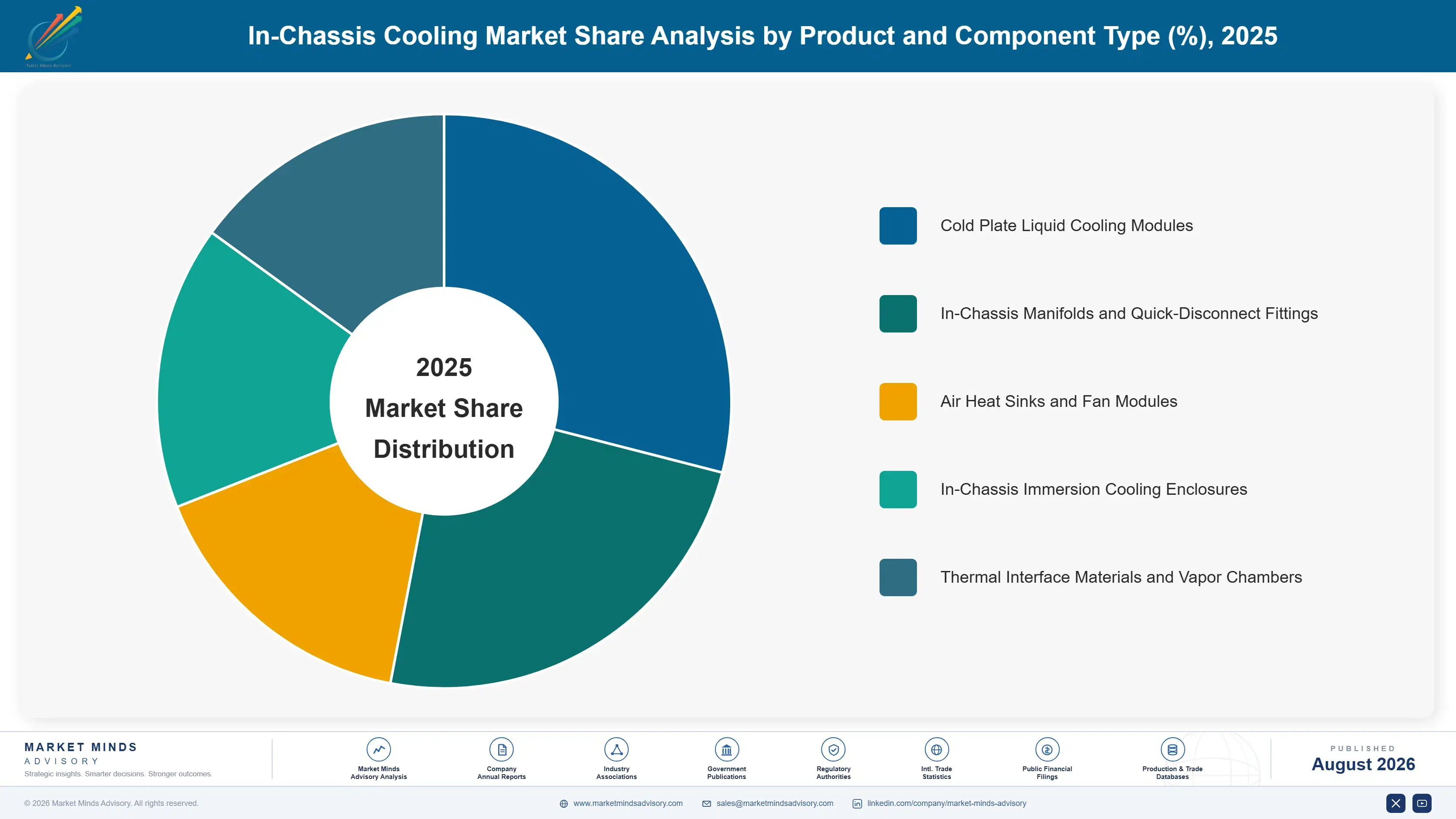
Segmentation follows in-chassis product and component type, the dimension chassis designers specify against when architecting a thermal solution. Cold plates, manifolds and fittings, air heat sinks and fans, immersion enclosures, and thermal interface materials each address a distinct stage of the heat removal path, keeping upstream fluid chemistry and downstream facility infrastructure separate across every layer of the stack.
in-chassis-cooling-market-market-share-analysis-1787302266828

Cold Plate Liquid Cooling Modules

Cold plates mount directly onto accelerator and CPU packages, transferring heat into a circulating coolant loop far more efficiently than air cooling can achieve within the same physical footprint. Adoption is concentrated among AI accelerator server platforms where thermal design power now regularly exceeds what forced-air cooling can economically dissipate. Growth outpaces the broader in-chassis cooling market by roughly 1.2x as hyperscalers standardize liquid-ready chassis architecture across entire fleet refresh cycles rather than isolated pilot deployments. Suppliers with proven reliability data at hyperscale volume are capturing outsized share, since qualification for a new cold plate design routinely requires many months of accelerated leak and corrosion testing before a hyperscale customer approves production deployment across its fleet.
CAGR 19.0%

In-Chassis Immersion Cooling Enclosures

Immersion enclosures submerge server components directly in dielectric fluid, achieving density gains beyond what cold plates alone can deliver for the highest power density accelerator configurations. Adoption remains concentrated among select hyperscale and colocation operators pursuing maximum rack density in space-constrained facilities where every additional watt of cooling capacity commands a premium. Growth is fastest among operators retrofitting existing facilities where floor space, not power availability, is the binding constraint on expansion. Suppliers with dielectric fluid compatibility across multiple accelerator generations are capturing disproportionate share, since fluid and enclosure requalification for each new chip generation represents a meaningful ongoing engineering investment for both suppliers and their hyperscale customers alike. This dynamic is expected to persist well into the next decade.
CAGR 17.5%
Full segment breakdown across 5 segments available in the complete report.

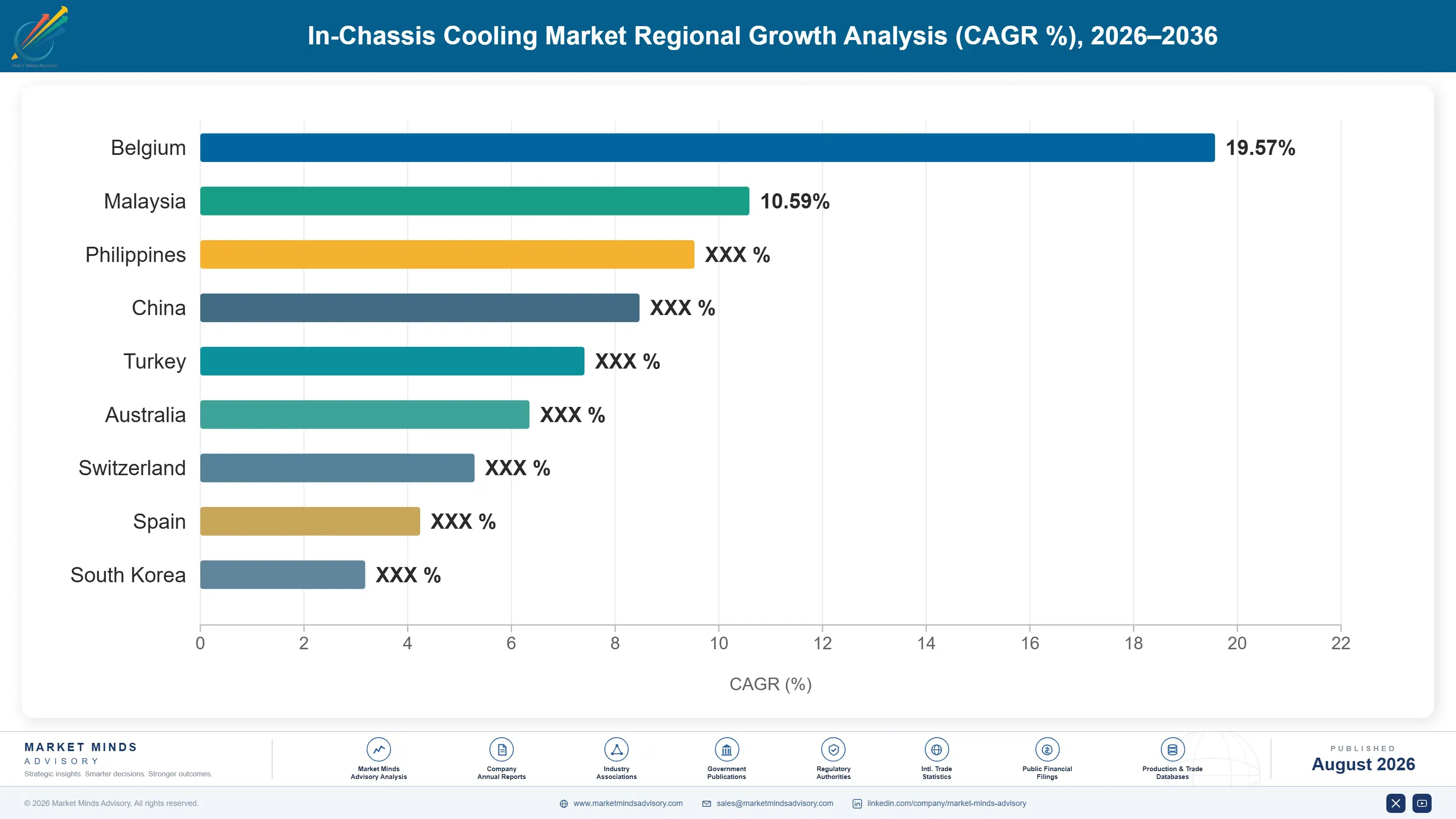
Regional Architecture and Country Demand Map

East Asia leads on both production and consumption as Taiwan's server ODM assembly base integrates cooling hardware directly into chassis production, while North America's hyperscale AI capital spending drives the fastest absolute deployment volume growth across new and retrofitted data halls. Western Europe adds a distinct sustainability driven adoption pattern.

North America

United States hyperscale AI data center construction, concentrated across Virginia, Texas, and the Pacific Northwest, drives the region's fastest absolute deployment volume as operators race to bring accelerator capacity online against already-booked GPU delivery schedules. Domestic server integration capacity is expanding to reduce dependence on fully assembled chassis imports, though most cooling components themselves still originate from Asian manufacturing partners under long-term supply agreements. Canadian data center operators are increasingly attracting hyperscale investment tied to favorable power availability and cooler ambient climates that reduce facility cooling load. Growth trails East Asia because the region's server chassis integration capacity remains smaller in absolute volume despite its currently faster deployment pace across new AI-focused data hall construction projects underway nationwide.
Share: 27% | CAGR: 16.5% (2026 to 2036)

Western Europe

Western Europe hosts several leading thermal component engineering and manufacturing operations, giving the region meaningful technical influence even as large-scale AI data hall construction lags North America and East Asia in absolute volume. German and Nordic operators are increasingly favoring liquid cooling for its ability to support district heat reuse programmes, adding a regional sustainability driver largely absent elsewhere in the forecast. European Union data center energy efficiency regulation is accelerating liquid cooling adoption ahead of what pure thermal necessity alone would require. Growth trails the global rate as the region's hyperscale capital investment pace remains more measured than the aggressive capacity buildout underway across leading American and Asian operators currently.
Share: 19% | CAGR: 14.0% (2026 to 2036)
Regional intelligence for 5 additional markets available in the complete report: East Asia, South Asia and Pacific, Latin America, Middle East and Africa, Eastern Europe. Contact sales@marketmindsadvisory.com.
in-chassis-cooling-market-country-cagr-analysis-1787302267345

Monetizing Qualification Depth and Fleet Standardization

Suppliers are shifting commercial emphasis from one-time component sales toward design partnership agreements, qualification services, and reliability data subscriptions, since hyperscale customers now value proven field performance and engineering support as much as raw thermal specifications alone. This mirrors a broader shift across data center infrastructure toward relationship-based commercial structures rather than transactional annual pricing.

Structuring Multi-Year Hyperscale Design Partnership Agreements

Leading suppliers increasingly structure multi-year design partnership agreements that embed engineering teams directly within a hyperscale customer's platform development process well before a chassis reaches volume production. This shifts commercial risk toward the supplier, who commits dedicated engineering resources ahead of confirmed order volume, in exchange for design-in exclusivity across the customer's next several server generations. Suppliers with established design partnerships report win rates on subsequent platform generations well above 70%, since switching a qualified cooling architecture mid-fleet requires costly requalification most hyperscale customers avoid without compelling reason to justify the disruption.
Market Impact: Secures design-in exclusivity acros

Field Reliability Data and Leak Monitoring Subscriptions

Suppliers are increasingly bundling remote leak detection and thermal performance monitoring subscriptions alongside cold plate and manifold hardware sales, giving facility operators real-time visibility into loop health across thousands of installed units. This service layer reduces unplanned downtime incidents by an estimated 30 to 40% versus reactive maintenance models, a meaningful improvement given that a single undetected leak can damage equipment worth many times the cooling system's own cost. Suppliers report subscription attach rates rising fastest among operators managing liquid cooling at scale for the first time, who value the reduced operational risk highly.
Market Impact: Cuts unplanned downtime by 30 to 40

Fluid Compatibility Testing and Certification Services

As data halls increasingly mix cooling hardware from multiple vendors, suppliers are monetizing fluid and material compatibility testing as a standalone service, certifying that a customer's specific fluid chemistry and component mix will not risk corrosion or accelerated degradation over the installed system's service life. This certification service shortens customer qualification timelines by an estimated 6 to 8 weeks versus independent in-house testing, a meaningful advantage when hyperscale deployment schedules are already tightly compressed. Suppliers offering certification are increasingly positioned as the trusted default for multi-vendor deployment decisions across the industry.
Market Impact: Cuts qualification timelines by 6 t

Retrofit Engineering and Facility Conversion Services

Suppliers are increasingly offering full retrofit engineering services that assess floor loading, piping routing, and facility power upgrade requirements for operators converting existing air-cooled data halls to liquid cooling, bundling design consulting directly with hardware sales. This service layer converts what was previously a fragmented, multi-vendor retrofit project into a single accountable relationship, reducing project timeline risk for facility operators managing complex brownfield conversions. Suppliers report retrofit engineering attach rates rising fastest among colocation operators lacking dedicated in-house thermal engineering teams of their own, and the bundled model now covers roughly 40% of retrofit contracts.
Market Impact: Cuts retrofit project timelines by

Who Controls the Margin Pool

The top five suppliers hold roughly 42% combined share, a moderate concentration that reflects both the technical specialization required for hyperscale-grade thermal engineering and the continued entry of new specialists chasing rapid category growth. The gap between the leading diversified infrastructure conglomerates and focused thermal specialists is narrowing as hyperscale customers increasingly qualify multiple suppliers per platform to reduce single-source dependency risk.
Current competitive activity centers on three fronts: cold plate and manifold reliability data at hyperscale volume, dielectric fluid and immersion enclosure development for maximum density applications, and design partnership depth with leading server OEMs and ODMs. Several specialist thermal vendors are pursuing aggressive hyperscale qualification pushes, a faster but capital-intensive route to scale than the diversified conglomerates' broader infrastructure relationship model.

Emerging pressure comes from Asian component manufacturers moving up the value chain from commodity heat sinks into fully qualified liquid cooling systems, sold initially to regional ODM customers but increasingly targeting export markets as reliability data accumulates. Rankings among the top five could shift meaningfully over the next several years if incumbents fail to match the pace of hyperscale fleet standardization decisions, since customers increasingly commit years in advance to whichever supplier demonstrates reliability at scale first.
in-chassis-cooling-market-company-positioning-matrix-1787302267874

Competitive Moat and Risk Dimensions

VERTIV HOLDINGS

Moat: Full-stack infrastructure bundling

Vertiv's ability to bundle in-chassis cooling with power distribution, rack infrastructure, and facility-level thermal management gives it a design-in advantage with hyperscale customers seeking a single accountable infrastructure partner rather than piecemeal component sourcing across multiple vendors. That bundling advantage compounds with every additional facility deployed.
VERTIV HOLDINGS

Risk: Slower specialist responsiveness

Vertiv's scale and broad infrastructure portfolio can slow its response to niche cold plate design requests that focused thermal specialists serve more quickly, occasionally costing it accounts among customers prioritizing peak thermal performance over full-stack integration convenience. That responsiveness gap is unlikely to close soon.
COOLIT SYSTEMS

Moat: Deep hyperscale reliability data

CoolIT's years of accumulated field reliability data across large-scale liquid cooling deployments give it durable credibility with hyperscale customers who weigh proven field performance heavily, since qualifying a new cooling vendor without comparable field history carries meaningful deployment risk at fleet scale. That data advantage compounds with every new deployment.
COOLIT SYSTEMS

Risk: Concentrated hyperscale customer base

CoolIT's revenue concentration among a small number of large hyperscale accounts leaves it more exposed than diversified competitors to any single customer's platform architecture decision, since losing one major design-in can materially affect near-term revenue relative to broader infrastructure suppliers with wider, more diversified customer bases.

Players Tracked

Prominent Players

Vertiv Holdings
CoolIT Systems
Boyd Corporation
Delta Electronics
Asetek A/S

Other Key Players

Nidec Corporation
Midas Green Technologies
Submer
LiquidStack
ZutaCore
JetCool Technologies
Motivair Corporation
Rittal
nVent Electric
Asia Vital Components
Auras Technology
Cooler Master Technology
Ebara Corporation
Envicool
Chilldyne

Recent Developments

SEPTEMBER 2025

CoolIT Systems Expands Cold Plate Production Capacity in Texas

CoolIT Systems announced expanded cold plate manufacturing capacity at its Texas facility, aiming to serve growing demand from United States hyperscale customers deploying AI accelerator platforms. The expansion reflects organic capacity growth rather than any acquisition or joint venture, funded through CoolIT's ongoing capital investment programme.
Signal: Confirms domestic cold plate capacity expa
JANUARY 2026

Vertiv Signs Multi-Year Supply Agreement With Leading Server ODM

Vertiv signed a multi-year in-chassis cooling supply agreement with a leading Taiwan-based server ODM, securing design-in priority across upcoming accelerator platform generations. The agreement is a supply arrangement rather than a joint venture or acquisition, extending Vertiv's presence within the Asian server integration supply chain.
Signal: Highlights design partnership depth as the
APRIL 2026

Boyd Corporation Acquires Dielectric Fluid Immersion Startup

Boyd Corporation completed the acquisition of a privately held dielectric fluid and immersion enclosure startup, adding specialized fluid chemistry and enclosure design capability to its existing thermal management portfolio. The deal strengthens Boyd's positioning in the fastest-growing immersion cooling segment across the entire industry today.
Signal: Signals continued consolidation of special

Copper, Fluid, and Precision Machining Exposure

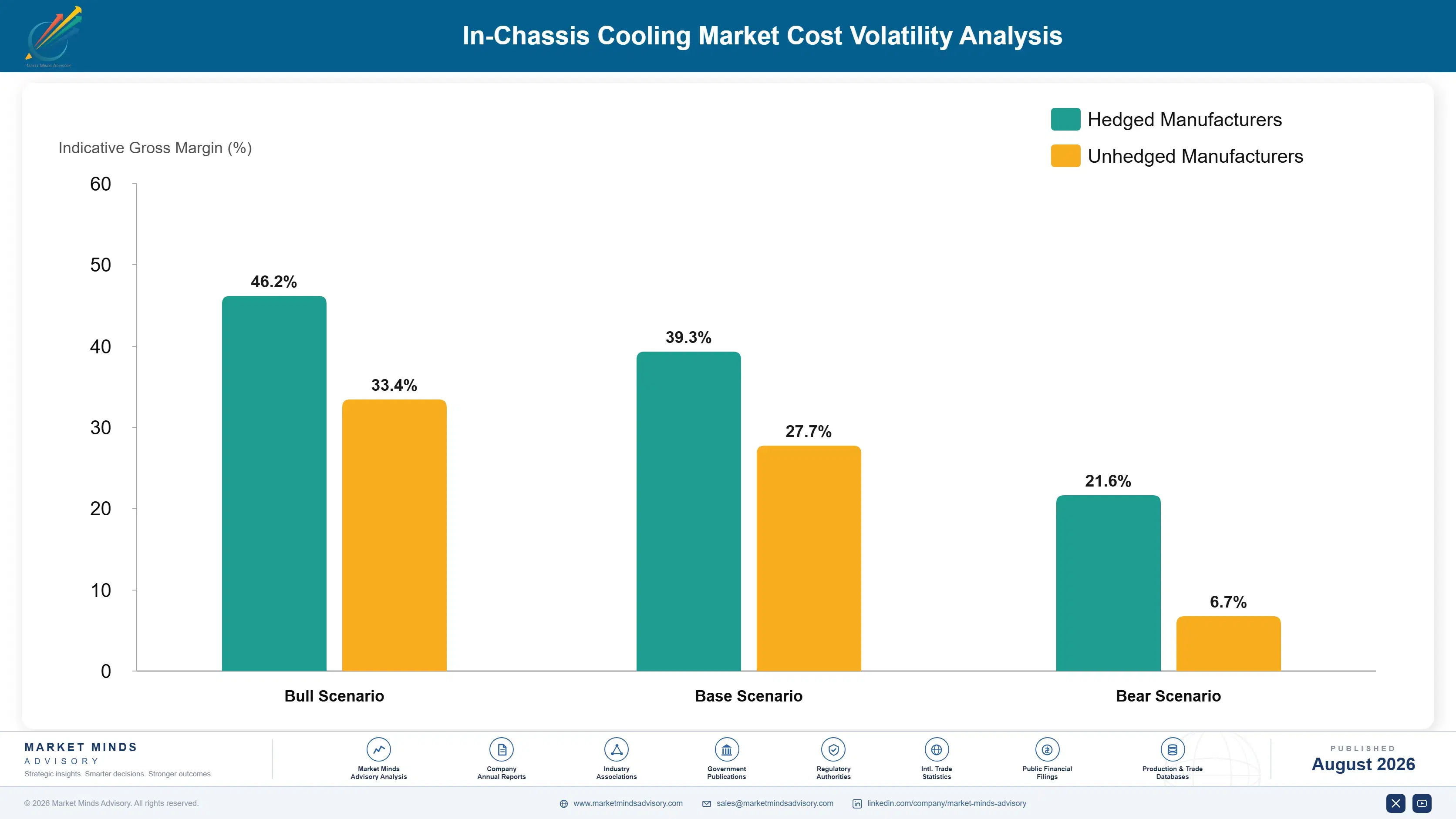
Copper cold plate bodies, specialty dielectric and glycol-based coolants, and precision-machined manifold and fitting components together represent an estimated 45 to 55% of in-chassis cooling system cost of goods sold. Copper price volatility flows directly into cold plate cost given the material's central role in thermal transfer performance, while dielectric fluid supply remains concentrated among a small number of specialty chemical producers.
Copper prices rose meaningfully during 2024 and 2025 amid broader industrial and electrification-driven demand, a trend the IEA's critical minerals reporting flagged as a persistent risk across multiple electronics-intensive categories, not cooling hardware alone. Several suppliers disclosed in annual reports that precision-machined fitting lead times stretched beyond sixteen weeks during peak hyperscale ordering periods, forcing some cold plate makers to requalify secondary machining partners to maintain delivery commitments.

Smaller thermal specialists carry disproportionate exposure to these input swings since they lack the purchasing scale to negotiate multi-year fixed pricing directly with copper suppliers and precision machining partners that the top five suppliers secure. This gap is widest for specialists reliant on single-source dielectric fluid formulations, leaving them more vulnerable to margin compression during supply tightness than diversified competitors able to shift specifications across multiple qualified fluid suppliers.
in-chassis-cooling-market-cost-volatility-analysis-1787302268070

Multi-Sourcing Precision Machining Capacity

Leading suppliers now qualify at least two precision machining partners per fitting design, avoiding the single-source exposure that stretched lead times beyond sixteen weeks during peak hyperscale ordering periods and protecting delivery commitments on multi-year design partnership contracts signed with large hyperscale accounts, even when individual machining partners face unexpected capacity constraints of their own.

Long-Term Copper Supply Contracts

Top five suppliers increasingly lock multi-year pricing with copper producers and refiners, smoothing cold plate input costs and insulating margin from the spot price volatility smaller thermal specialists remain exposed to directly, a practice that has become standard procurement policy since 2024 across the leading tier of suppliers, shielding margin during the copper price volatility of the past two years.

Dual-Qualified Dielectric Fluid Formulations

Manufacturers are increasingly qualifying cold plates and immersion enclosures against more than one dielectric fluid formulation, avoiding total dependence on a single fluid supplier that could otherwise constrain production during a supply disruption or formulation discontinuation event affecting the broader market, a flexibility that has already proven valuable during at least one recent supplier transition.

Portfolio Architecture for Margin Defence

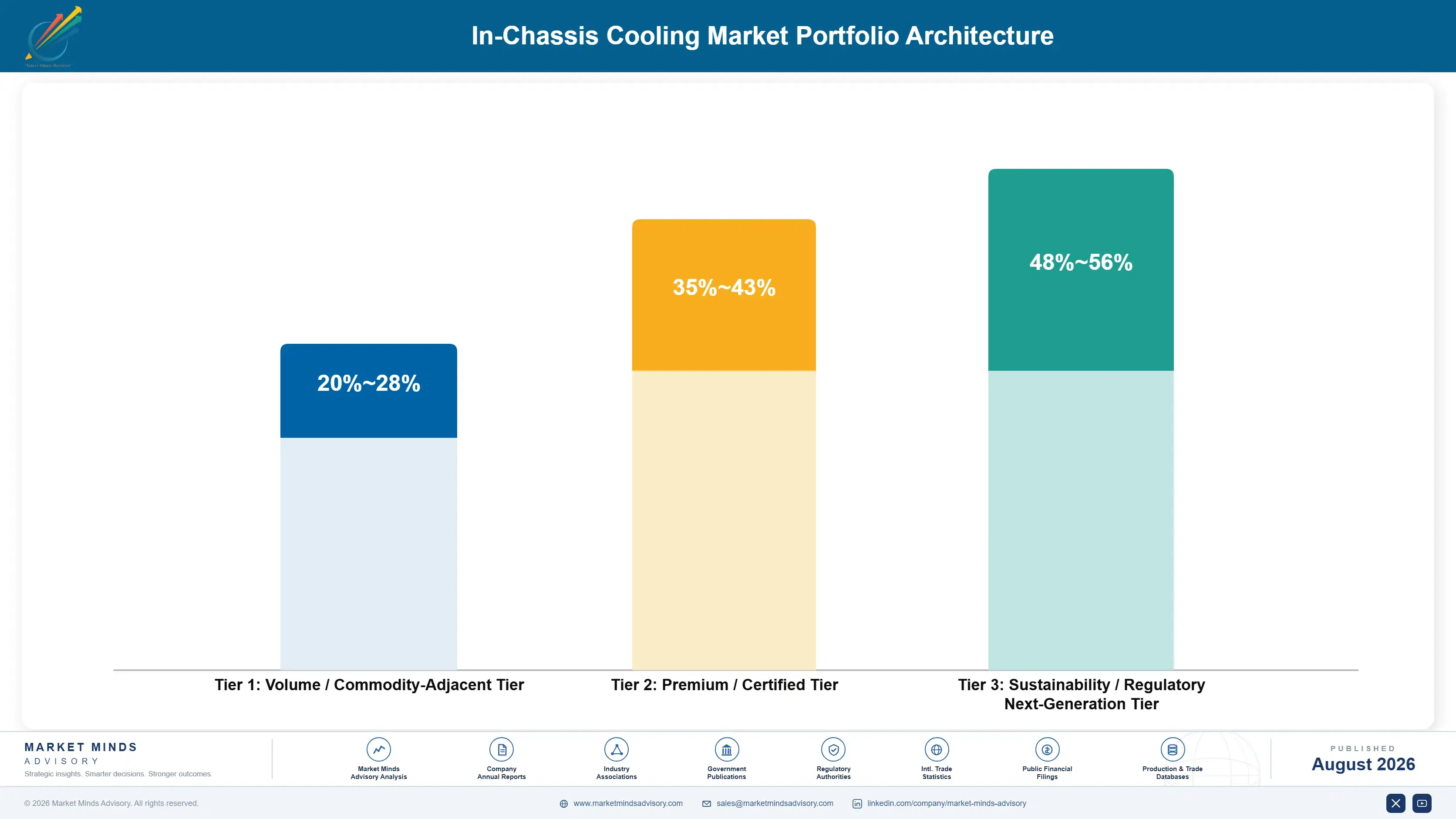
Portfolio architecture splits across three tiers: volume priced air heat sinks and fan modules competing on established, largely stable pricing, certified cold plate and manifold systems carrying hyperscale qualification barriers that support durable pricing, and next-generation immersion enclosures bundled with fluid chemistry and design partnership services. Gross margins widen meaningfully moving up this ladder as qualification and engineering barriers concentrate hardest at the newest tier.
The volume versus premium tension is sharpest in standard air cooling hardware, where commodity competition has compressed prices fastest, pushing established vendors to defend share through design services and reliability data rather than matching commodity pricing directly. Hyperscale-qualified liquid cooling systems retain the strongest pricing power because qualification cost and multi-year design partnerships discourage customers from switching suppliers mid-platform.

High value margin pools concentrate in cold plate and immersion systems paired with reliability data subscriptions, where design partnership depth and recurring service revenue together support gross margins well above the portfolio average. Suppliers across the value chain are consequently prioritizing capital and engineering investment toward liquid cooling even though it remains a minority of total unit volume shipped today, betting the mix shifts decisively within the decade.

Volume / Commodity-Adjacent Tier

Standard air heat sinks and fan modules serving mainstream enterprise servers, competing primarily on unit price against Asian commodity manufacturers with thin margins and limited service attach across the board.
Gross Margin: 20-28%

Premium / Certified Tier

Hyperscale-qualified cold plate and manifold systems serving accelerator-class servers, where qualification cost and platform lock-in support durable, defensible pricing across multi-year design partnership contracts signed well before production actually begins each cycle.
Gross Margin: 35-43%

Sustainability / Regulatory / Next-Generation Tier

Immersion cooling enclosures and dielectric fluid systems bundled with design partnership and reliability data services, sold on density and engineering value rather than unit price alone today across every deployment.
Gross Margin: 48-56%
in-chassis-cooling-market-portfolio-architecture-1787302268577

Fleet Standardization Locks In Recurring Demand

In-chassis cooling economics function like a multi-year annuity once a supplier wins design-in on a hyperscale platform, since the qualified architecture typically remains locked in across the full fleet refresh cycle, often three to five years spanning multiple server generations built on the same cooling foundation. This is why suppliers invest so heavily in early design partnerships, treating qualification wins as a foothold rather than the primary profit event.
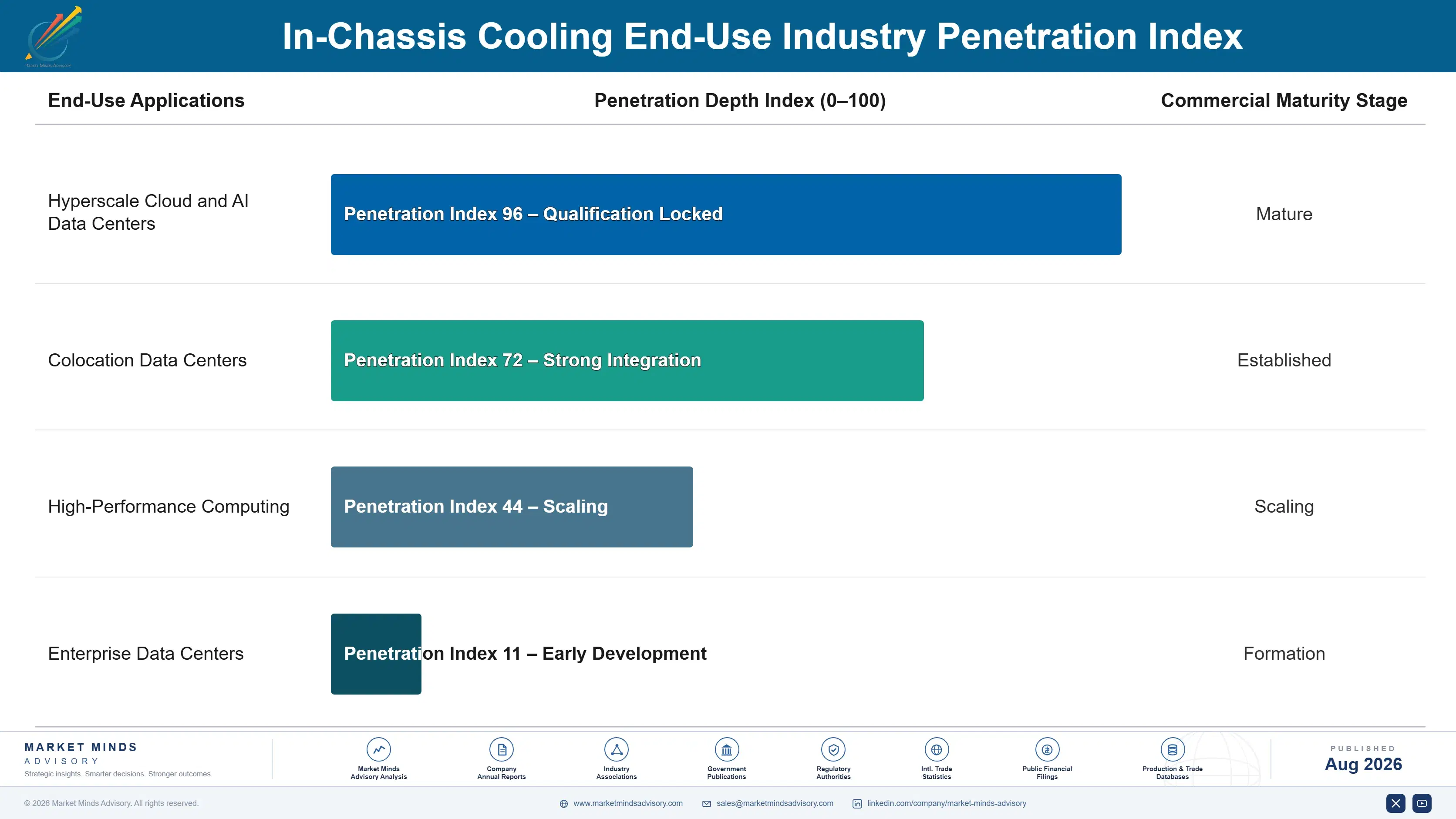
Adoption depth varies sharply by end-use vertical. Hyperscale AI accelerator platforms are pushing hardest into liquid cooling to defend performance density, while general enterprise and mainstream cloud servers adopt more selectively, extending air cooling life through improved airflow design rather than converting entire fleets given more cost-sensitive economics across commodity compute workloads that rarely justify the incremental liquid cooling investment.

Buyer profiles are shifting generationally as data center thermal engineers who trained primarily on liquid cooling workflows increasingly influence facility design decisions alongside veteran facilities managers who remember when air cooling handled nearly every deployment. This is accelerating willingness to commit early to liquid cooling capital budgets even among historically conservative enterprise operators who once waited for mature, de-risked technology before committing capital.
in-chassis-cooling-market-end-use-penetration-index-1787302269072

Where Thermal Infrastructure Strategy Should Focus

These are among the four positions where our research anticipates prominent divergence between winners and laggards over the coming forecast period. Each is grounded in the demand model, the regulatory perimeter, and the announced capacity pipeline.
01 / DESIGN PARTNERSHIP PRIORITY

Secure hyperscale design-in years before fleet refresh begins

Design-in, not component pricing, has become the binding constraint on hyperscale relationship depth, and suppliers who delay pursuing partnership agreements risk losing multiple fleet refresh cycles to rivals who committed earlier. Reliability data depth increasingly determines design-in sequencing more than unit pricing or delivery lead time alone. Vendors that treat hyperscale qualification as a routine sales process rather than a strategic priority risk finding themselves several years behind competitors who understood the stakes sooner and acted with urgency across every relevant platform generation.
02 / LIQUID COOLING ROADMAP

Build cold plate and immersion capability in parallel now

Cold plates are growing at roughly 1.2x the overall market rate as the default accelerator cooling architecture, but immersion cooling is capturing meaningful share in density-constrained facilities where floor space, not power, binds expansion. Suppliers that build credible capability across both architectures avoid being locked out of whichever technology a given hyperscale customer ultimately standardizes on. Vendors betting exclusively on one architecture risk losing multi-year design-in opportunities to rivals with broader platform coverage across the full accelerator segment and every density tier.
03 / RELIABILITY DATA INVESTMENT

Treat field reliability data as a durable competitive moat

Hyperscale customers increasingly evaluate cooling vendors on accumulated field reliability data rather than headline thermal resistance specifications alone, since a single undetected leak can damage equipment worth many times the cooling system's own cost. Suppliers investing early in leak detection, monitoring subscriptions, and transparent failure reporting build a data advantage that compounds with every additional deployed unit. Competitors entering later without comparable field history face a meaningfully steeper path to winning hyperscale trust and design-in consideration at scale across every accelerator generation.
04 / SUPPLY CHAIN RESILIENCE

Diversify copper and fluid sourcing ahead of the next cycle

The 2024 and 2025 copper price volatility demonstrated how quickly input cost swings can compress margins for suppliers lacking multi-year fixed pricing arrangements with upstream producers. Suppliers still dependent on single-source dielectric fluid formulations or unqualified secondary machining partners remain exposed to the next disruption cycle in a market where hyperscale delivery penalties are contractually enforced. Diversifying sourcing now, ahead of the next tightening cycle, offers a more durable margin position than reacting after a shortage has already begun to bite.

Engagement Snapshot From the Field

A live engagement with an industry participant carrying material or product regulatory and market exposure ahead of a defining policy shift, showing how our research translates into a defensible multi-year portfolio strategy.
MARKET MINDS ADVISORY · CLIENT ENGAGEMENT SUMMARY
In-Chassis Cooling Producer Strategic Portfolio Review and Transition Roadmap 2026·Investment Scenario on In-Chassis Cooling Exposure Evaluation 2025-26
CLIENT PROFILE
The client operates hyperscale data centers across three continents supporting a global cloud and AI infrastructure business, generating revenue in the high single digit billions from infrastructure operations (client-reported, unverified by MMA). Facing rapidly rising accelerator thermal design power across successive GPU generations, the client's existing air-cooled chassis fleet was approaching the practical limit of forced-air thermal dissipation within its standard rack footprint.
STRATEGIC CHALLENGE
Corporate infrastructure leadership sought a standardized liquid cooling architecture deployable across all three regions within twenty-four months, while minimizing the number of qualified vendors to simplify field service and spare parts logistics across a rapidly scaling global fleet, without disrupting already-committed accelerator delivery schedules across any of the three target regions.
MMA APPROACH
MMA benchmarked six candidate cooling suppliers against reliability data depth, manufacturing capacity scalability, and total cost of ownership over a five-year fleet horizon, then modeled a phased regional rollout sequence designed to validate the chosen architecture at limited scale before committing to full global standardization across every facility in the fleet.
KEY FINDINGS
  1. Four of six suppliers evaluated could not demonstrate field reliability data at a scale comparable to the client's planned fleet deployment size.
  2. Standardizing on two qualified suppliers rather than one was projected to reduce single-source supply risk without materially complicating field service logistics (client-reported, unverified by MMA).
  3. Design partnership depth, more than unit pricing, most strongly predicted which suppliers could scale manufacturing fast enough to match deployment schedules reliably.
  4. Phased regional validation was found to meaningfully reduce the risk of a global rollout failure by surfacing site-specific issues early in the process.
CLIENT PROFILE
The client operates hyperscale data centers across three continents supporting a global cloud and AI infrastructure business, generating revenue in the high single digit billions from infrastructure operations (client-reported, unverified by MMA). Facing rapidly rising accelerator thermal design power across successive GPU generations, the client's existing air-cooled chassis fleet was approaching the practical limit of forced-air thermal dissipation within its standard rack footprint.
STRATEGIC CHALLENGE
Corporate infrastructure leadership sought a standardized liquid cooling architecture deployable across all three regions within twenty-four months, while minimizing the number of qualified vendors to simplify field service and spare parts logistics across a rapidly scaling global fleet, without disrupting already-committed accelerator delivery schedules across any of the three target regions.
MMA APPROACH
MMA benchmarked six candidate cooling suppliers against reliability data depth, manufacturing capacity scalability, and total cost of ownership over a five-year fleet horizon, then modeled a phased regional rollout sequence designed to validate the chosen architecture at limited scale before committing to full global standardization across every facility in the fleet.
KEY FINDINGS
  1. Four of six suppliers evaluated could not demonstrate field reliability data at a scale comparable to the client's planned fleet deployment size.
  2. Standardizing on two qualified suppliers rather than one was projected to reduce single-source supply risk without materially complicating field service logistics (client-reported, unverified by MMA).
  3. Design partnership depth, more than unit pricing, most strongly predicted which suppliers could scale manufacturing fast enough to match deployment schedules reliably.
  4. Phased regional validation was found to meaningfully reduce the risk of a global rollout failure by surfacing site-specific issues early in the process.
RECOMMENDED STRATEGY
Phase 1: Phase 1 (Months 1-6): Validate the selected cold plate architecture across a limited pilot deployment in one priority region first. Phase 2: Phase 2 (Months 7-16): Scale the validated architecture across remaining regions in order of accelerator deployment urgency and readiness assessed. Phase 3: Phase 3 (Months 17-24): Standardize field service and spare parts logistics across the fully deployed global fleet footprint entirely worldwide.
OUTCOME
The client completed standardized liquid cooling deployment across all three regions within the twenty-four month window, reporting meaningfully improved field service efficiency from consolidating around two qualified suppliers (client-reported, unverified by MMA). Infrastructure leadership reported the phased validation approach caught site-specific issues early enough to avoid costly rework during full-scale rollout.

Frequently Asked Questions

Foundational context covering the market sizes, CAGR, scope, country, region and competition that inform every finding below. This section is provided to cover basics and most often pre-purchase conversations, answered from the MMA Primary Research Dataset.

What is the current size of the In-Chassis Cooling Market?

The global in-chassis cooling market reached an estimated $4.2 billion in 2025. Growth is driven by rising AI accelerator thermal design power and hyperscale liquid cooling standardization.

How large will the In-Chassis Cooling Market be by 2036?

The market is projected to reach approximately $20.5 billion by 2036, roughly 4.23 times its 2026 value. Cold plate liquid cooling and immersion systems drive most of the added value.

What is the CAGR for the In-Chassis Cooling Market 2026 to 2036?

The base case CAGR is 15.5% through 2036. Bull and bear scenarios range from roughly 14.2% to 16.8%, depending on AI accelerator power density growth and capital spending cycles.

Which segment is growing fastest?

Cold plate liquid cooling modules lead at a 19.0% CAGR, about 1.2x the overall market rate. Growth is concentrated among AI accelerator server platforms exceeding air cooling's practical limits.

Who are the major companies in the In-Chassis Cooling Market?

Vertiv Holdings, CoolIT Systems, Boyd Corporation, Delta Electronics, and Asetek A/S lead the category. Combined, the top five suppliers hold roughly 42% of global revenue.

Which country is growing fastest?

Taiwan leads country level growth at an estimated 18.5% CAGR. Server ODM assembly expansion is driving sustained cooling component demand from an already large manufacturing base.

Report Segmentation Architecture

The full report scope spans multiple orthogonal segmentation dimensions, with cross-tabulated demand data provided for each dimension pair. Coverage extends further to regional breakdowns, trend trajectories, and the competitive detail needed to support segment-level decision-making.

By Product and Component Type

  • Cold Plate Liquid Cooling Modules
  • In-Chassis Manifolds and Quick-Disconnect Fittings
  • Air Heat Sinks and Fan Modules
  • In-Chassis Immersion Cooling Enclosures
  • Thermal Interface Materials and Vapor Chambers

By End-Use Industry

  • Hyperscale Cloud and AI Data Centers
  • Colocation Data Centers
  • High-Performance Computing
  • Enterprise Data Centers

By Commercial Dimension

  • Direct OEM and ODM Sales
  • Hyperscale Design Partnership Agreements
  • Retrofit and Conversion Services
  • Reliability Data Subscription Services

By Region

  • North America
  • Western Europe
  • East Asia
  • South Asia and Pacific
  • Latin America
  • Middle East and Africa
  • Eastern Europe

Scope, Methodology, and Coverage

Every figure in this report is reproducible from documented input assumptions. The scope below maps the historical period, the forecast horizon, the segmentation dimensions, and the countries covered, alongside the underlying primary and qualitative methodology.
Historical Period
2020 to 2025
Forecast Period
2026 to 2036
Base Year
2025 (USD billions; MMA Primary Research Dataset, August 2026)
Market Definition
The in-chassis cooling market covers thermal management hardware integrated directly within server and compute chassis, including cold plate liquid cooling modules, in-chassis manifolds and quick-disconnect fittings, high-performance heat sinks and fan modules, immersion cooling enclosures, and thermal interface materials. Rack-level coolant distribution units and facility-level chilled water infrastructure are excluded.
Quantitative Units
USD billions (current prices); unit shipment volume where disclosed
Segmentation Dimensions
By Product and Component Type; By End-Use Industry; By Commercial Dimension; By Region
Regions Covered
North America, Western Europe, East Asia, South Asia and Pacific, Latin America, Middle East and Africa, Eastern Europe
Countries Covered
USA, China, Germany, France, UK, Japan, South Korea, India, Australia, Canada, Brazil, Mexico, Indonesia, Vietnam, Thailand, Malaysia, UAE, Saudi Arabia, South Africa, Nigeria, Turkey, Poland, Netherlands, Italy, Spain, Sweden, Switzerland, Argentina, Colombia, Singapore, and additional markets relevant to this sector
Key Companies Profiled
Vertiv Holdings, CoolIT Systems, Boyd Corporation, Delta Electronics, Asetek A/S, Nidec Corporation, Midas Green Technologies, Submer, LiquidStack, ZutaCore, JetCool Technologies, Motivair Corporation, Rittal, nVent Electric, Asia Vital Components, Auras Technology, Cooler Master Technology, Ebara Corporation, Envicool, Chilldyne
Quantitative Methodology
Primary survey, n=3,800 respondents, Q4 2025, six countries; demand-side model with trade association cross-validation
Qualitative Methodology
47 expert interviews, Q4 2025; applied to validate demand model assumptions, identify emerging dynamics, and assess competitive positioning
Report Format
PDF and XLSX data workbook (Word format preview document)
Publisher
Market Minds Advisory
Report Code
MMA-2026-TEC-104
Published
August 2026
Contact
sales@marketmindsadvisory.com | www.marketmindsadvisory.com

Purchase the full In-Chassis Cooling Market Report (2026 to 2036).

The full report delivers a complete quantitative and qualitative assessment of the global in-chassis cooling market through 2036. It includes detailed segmentation by product and component type, end-use industry, and commercial channel, alongside country level sizing across thirty markets covering every major data center demand center. Competitive profiles cover twenty companies with capability, reliability, and design partnership benchmarking assessed on a consistent revenue basis. Buyers also receive access to the underlying primary survey and expert interview datasets referenced throughout the analysis, along with editable data tables.
Segment level CAGR and sizing tables
Regional and country level market breakdowns
Twenty company competitive profiles and benchmarks
Detailed liquid cooling readiness benchmarking matrix
Input cost and supply chain risk analysis
Primary survey and expert interview datasets

Built For The People Who Decide

From boardroom strategy to bench-side execution, this report is read cover-to-cover by leaders shaping the next decade of their industry, turning demand scenarios, market dynamics and valuation benchmarks into decisions.
CXOs/ Presidents/ VPs/ Managers
M&A and Corporate Development
Strategy Teams and R&D Heads
Procurement and Product Directors
Regulatory and Compliance Leaders
Investor Relations and Equity Analysts