Market Minds Advisory
Impact-Resistant Composite Radome Structures for High-Bandwidth Antennas Market

Impact-Resistant Composite Radome Structures for High-Bandwidth Antennas Market: Impact-Resistant Composite Radome Structures Market. Satellite Bandwidth Demand Reshapes Antenna Enclosure Materials

Satellite operators demanding higher-frequency bandwidth while aircraft and ground terminals face harsher impact and weather exposure are colliding as radome manufacturers race to certify composite materials that transmit signal without sacrificing physical durability.

Lead Analyst

Published

September 2026

Make Smarter Decisions with Customized Research Insights

Request a free sample report and evaluate market opportunities, growth trends, and competitive dynamics relevant to your business needs.

2025 MARKET VALUE$1.1BMarket Size 2025
2036 FORECAST VALUE$2.7BBase Case , 2026 to 2036
CAGR 2026 TO 20368.5 %Bull 9.8% / Bear 7.2%
INCREMENTAL OPPORTUNITY$1.5BNet 10- year value creation
EXPANSION MULTIPLE2.26x2036 value over 2026 base
Strategic Levers
M&A Pipeline
Regional Outlook
Country Rankings
Competitive Intelligence
Segmental Deep-dive
Call-Us : 91 93563 13602

Executive Snapshot and Market Trajectory.

Satellite and aircraft antenna manufacturers are pushing radome materials toward higher-frequency bandwidth transmission while simultaneously demanding greater impact resistance, forcing a materials tradeoff that older composite formulations cannot satisfy simultaneously. This shift is reshaping procurement criteria across nearly every major antenna system manufacturer worldwide today.
Expanding low-Earth-orbit satellite constellations and next-generation aircraft connectivity terminals are pulling demand toward radome materials engineered specifically for higher frequency bands, and East Asian manufacturers are scaling production fastest given the region's growing satellite ground terminal manufacturing base. Military and defense radar applications are separately driving demand as next-generation radar systems require radome materials that maintain signal clarity under combat-relevant stress conditions. Warranty terms now increasingly reference impact resistance certification as a standard specification requirement.
A small number of established aerospace materials manufacturers still dominate radome contracts given the extreme certification barriers involved, but specialist composite formulators are entering directly from advanced materials science backgrounds rather than the traditional aerospace manufacturing side, changing who counts as a credible competitor. Frequency-selective surface integration requirements are forcing manufacturers to navigate a genuinely more complex design and certification landscape. Vendors combining both expertise areas increasingly win the largest contracts.
Market Definition
This report covers composite material radome structures engineered for impact resistance and radio frequency transparency in high-bandwidth antenna applications across satellite, aircraft, and ground terminal systems, measured on a global unit and revenue basis. It excludes non-composite metal and ceramic radome structures and antenna systems sold without an integrated radome enclosure.
Base Year Value
$1.1B in 2025 (MMA Primary Research Dataset, September 2026)
Forecast Period
2026 to 2036, eleven discrete annual values
CAGR
8.5% base case. Bull 9.8%. Bear 7.2%.
Fastest Growth Segment
Frequency-Selective Surface Composite Radomes: 12.0% CAGR
Fastest Growth Country
India: 12.5% CAGR
Fastest Growth Region
South Asia and Pacific: 10.5% CAGR
Largest Region
North America: 32% of 2025 global value
Market Leaders
Saint-Gobain, Cobham Advanced Electronic Solutions, L3Harris, Meggitt, Genesis Systems
Primary Survey
n=3,800 procurement and R&D decision-makers, Q4 2025, six countries
Methodology
Demand-side build-up, cross-validated against public data, 47 expert interviews

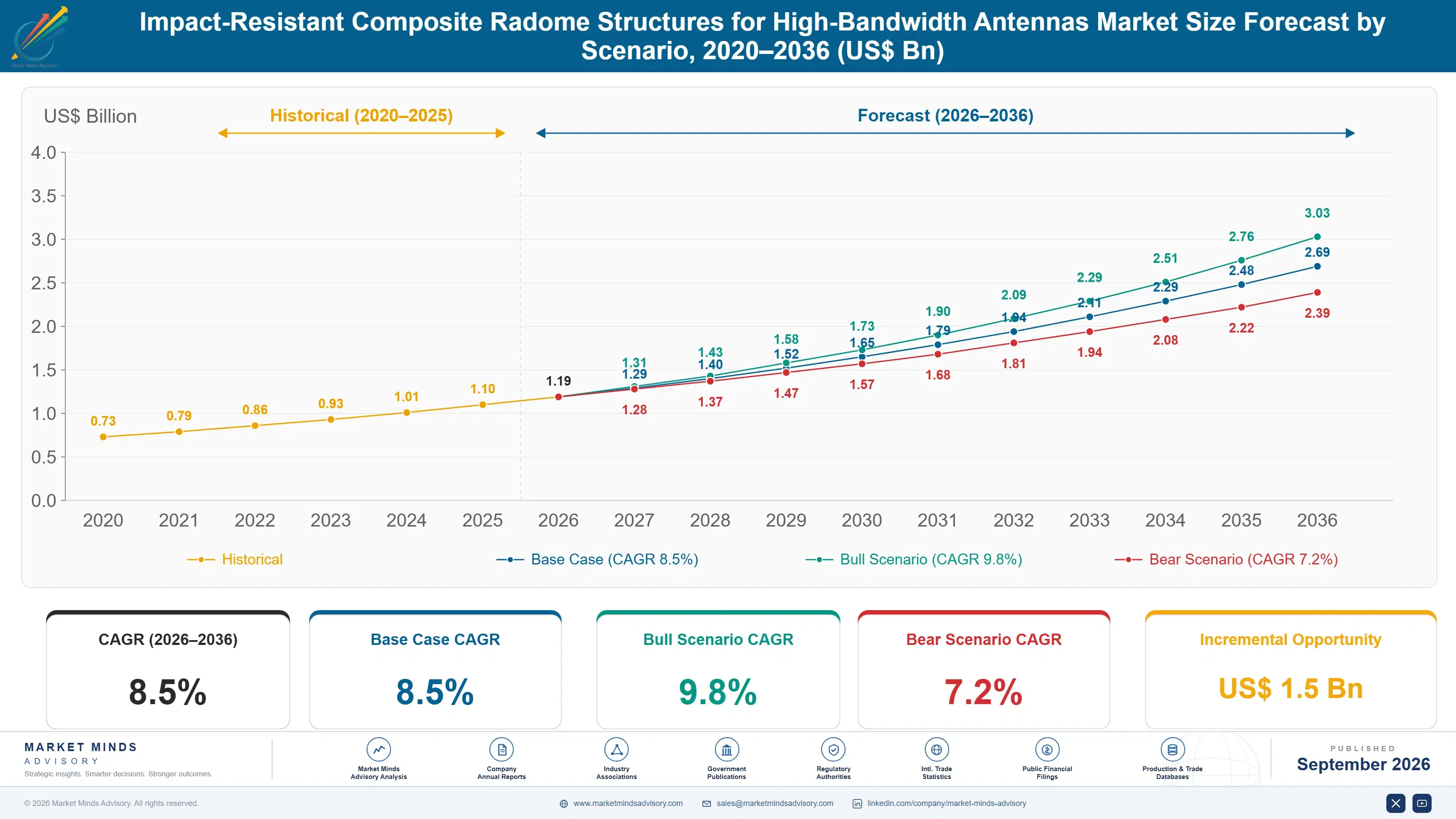
Impact-Resistant Composite Radome Structures for High-Bandwidth Antennas Market Forecast Scenarios

impact-resistant-composite-radome-structures-for-h-size-forecast-scenario-1788419070557
Composite radome demand grew at a 7.5 percent historical rate between 2020 and 2025 as commercial satellite constellations expanded and legacy metal designs lost ground to lighter, radio frequency transparent alternatives that qualified faster under evolving military and civil aviation certification standards. Aircraft retrofit programs added incremental volume once airlines began prioritizing weight reduction for fuel efficiency gains across long-haul fleets.
The base case assumes 8.5 percent annual growth through 2036, anchored by three commercial mechanisms working in tandem: expanding satellite ground terminal deployment across telecom operators, aircraft connectivity retrofit mandates spreading from wide-body to narrow-body fleets, and defense radar modernization programs requiring frequency-selective surface integration. Certification backlogs at qualified test facilities remain the binding constraint on how quickly suppliers can convert order pipelines into recognized revenue across all three channels simultaneously.
A bull case near 9.8 percent growth hinges on Starlink-class constellation operators standardizing composite radome specifications across thousands of ground terminals annually, pulling smaller suppliers into qualified programs faster than expected. A bear case near 7.2 percent follows a defense budget slowdown in a major NATO market delaying radar modernization contracts, pushing volume into later forecast years and compressing near-term supplier margins.

Radome Materials Enter a Certification-Driven Upgrade Cycle

Composite radome production sits at the intersection of two demanding qualification regimes, aerospace structural certification and radio frequency performance validation, which together keep new entrants out even when raw materials science is not the limiting factor. Established suppliers have spent decades building the test infrastructure and program relationships that shorten qualification timelines for new antenna platforms, and that accumulated experience is proving difficult for well-funded newcomers to replicate quickly.
MARKET CONCENTRATIONCR5 56%Top five suppliers hold slightly over half of contracts
AVERAGE SELLING PRICE$18,500 per unitReflects frequency-selective surface integration complexity across most contracted programs
TOP PRODUCING COUNTRY SHAREUnited States 28%Concentrated around established aerospace materials manufacturing hubs nationally
CAPACITY UTILIZATION74%Qualified production lines remain the binding capacity constraint
TRADE INTENSITY42% cross-borderReflects global satellite terminal and aircraft retrofit demand
FEEDSTOCK COST SHAREResin and fiber 38%Aerospace-grade composite feedstock dominates total production cost structure
Frequency-selective surface integration is now the dominant technical differentiator separating suppliers who win multi-year satellite ground terminal contracts from those confined to lower-margin legacy metal replacement work. Suppliers combining materials science depth with electromagnetic design capability increasingly capture the largest programs, while single-discipline specialists get squeezed into narrower niches. Program managers increasingly ask for both capabilities under one contract rather than splitting the work across two vendors.
Capacity remains geographically concentrated around a handful of qualified production sites in the United States, France, and the United Kingdom, and that concentration is unlikely to shift quickly given how long new facility qualification takes. Buyers are responding by locking in multi-year supply agreements well ahead of program need dates, a defensive posture that further entrenches the incumbents already holding qualified capacity.
"Radome suppliers used to compete on weight and durability alone. Now the ones who can also tune electromagnetic performance at the material level are the ones writing the multi-year contracts."
Practice Lead, Aerospace Materials and Composite Structures · MMA Aerospace Composite Materials and Antenna Enclosure Systems Practice · September 2026

Market Trends

Frequency-Selective Surfaces Become Standard Specification Items

Antenna designers increasingly specify frequency-selective surface layers embedded directly into radome laminates rather than treating electromagnetic tuning as a downstream add-on. This shift lets a single radome support multiple frequency bands simultaneously, reducing the number of physical apertures a satellite terminal or aircraft nose section needs, which in turn lowers overall vehicle weight and drag. Program offices across at least a dozen major satellite constellation operators have written FSS integration into new supplier qualification requirements since 2023, forcing suppliers without in-house electromagnetic design teams to partner with specialist electromagnetic firms or acquire that capability outright and quickly.
Market Impact: Adds $340 million contracted defense volume
Low-Earth-Orbit Constellation Buildout Drives Ground Terminal Volume

Commercial satellite operators expanding low-Earth-orbit constellations are placing volume orders for ground terminal radomes at a scale the industry has not previously handled, with some single programs requesting production runs exceeding ten thousand units annually across multiple supplier sites and geographies. This volume shift is pushing suppliers to invest in automated layup and curing processes previously reserved for high-mix aerospace work, changing the economics of a category that used to run on small-batch, high-touch manufacturing methods built around single aircraft programs and slower delivery cadences than most buyers had previously come to expect.
Market Impact: Covers 4,000+ narrow-body retrofits

Market Opportunities and Growth Drivers

Military Radar Modernization Programs Specify Composite Radomes

Defense procurement agencies across NATO member states and allied Asia-Pacific partners are replacing legacy metal and ceramic radome housings on radar systems with composite alternatives that maintain signal clarity under combat-relevant vibration and thermal stress. Several active fighter and ground-based radar modernization contracts awarded since 2024 specify composite radome materials as a baseline requirement rather than an optional upgrade. This shift is pulling specialist materials suppliers directly into defense prime contractor supply chains for the first time, expanding the addressable customer base beyond traditional aerospace radome buyers into adjacent radar system manufacturers.
Market Impact: Extends 18-month qualification queue

Aircraft Connectivity Retrofit Demand Spreads to Narrow-Body Fleets

Airlines are extending in-flight connectivity retrofit programs from wide-body long-haul aircraft to narrow-body single-aisle fleets as passenger expectations for broadband internet access become standard rather than premium. Each retrofit requires a dedicated radome housing engineered for the specific antenna array and aircraft fuselage geometry, and narrow-body fleets represent a substantially larger installed base than wide-body aircraft globally across nearly every major carrier network. Over four thousand narrow-body aircraft are expected to undergo connectivity retrofits through 2030 across major global carriers, creating a volume opportunity distinct from the slower-moving wide-body replacement cycle that dominated the prior decade.
Market Impact: Adds 6-month buffer inventory cost

Market Restraints and Challenges

Certification Backlogs Delay New Supplier Qualification Timelines

Qualified test facilities capable of validating both structural impact resistance and radio frequency transparency remain scarce, with only a handful of accredited labs worldwide able to run the full certification battery a new radome design requires. The root cause is chronic underinvestment in test infrastructure relative to program demand growth, since building a new facility takes years and significant capital most mid-size suppliers cannot justify alone. The commercial impact shows up as eighteen-month-plus qualification queues that push new entrants' revenue recognition past original program timelines. Several suppliers now pool capital into shared regional test facilities to spread that fixed cost.
Market Impact: Adds 14% design complexity premium

Aerospace-Grade Resin Feedstock Faces Persistent Supply Tightness

Specialty resin systems formulated for radio frequency transparency and impact resistance depend on a narrow supplier base concentrated in the United States and Western Europe, and that concentration leaves radome manufacturers exposed whenever a single feedstock producer faces a plant outage or allocation shortfall. The underlying cause is limited commercial incentive for chemical producers to qualify additional capacity against a market this small relative to their broader specialty chemicals portfolios. Suppliers have responded by dual-sourcing resin formulations wherever possible and building six-month buffer inventories, though that mitigation adds real carrying cost that ultimately gets passed through to program pricing.
Market Impact: Drives 10,000+ unit annual orders
3 additional market trends, 2 additional growth drivers, and 4 additional restraints and challenges are covered in the full report. Contact sales@marketmindsadvisory.com to access the complete intelligence.

Segment CAGR and Growth Architecture

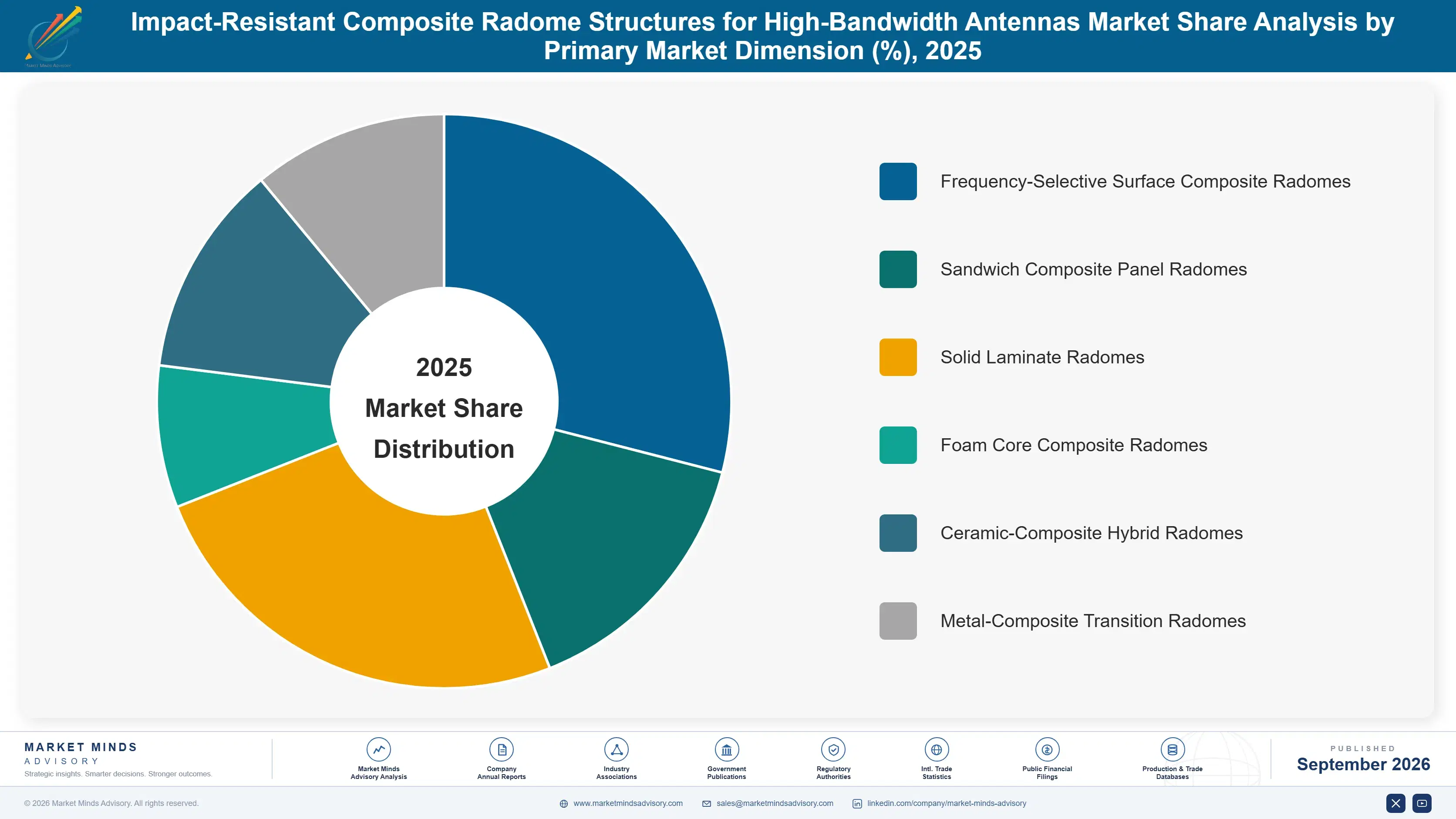
Composite radome structures segment by material and construction technology across six categories spanning sandwich composite panels, solid laminate structures, and specialized frequency-selective surface designs engineered for multi-band electromagnetic performance. Each category serves distinct performance requirements across satellite, aircraft, and ground terminal applications, with certification pathways differing meaningfully by construction type and end platform served.
impact-resistant-composite-radome-structures-for-h-market-share-analysis-1788419071094

Frequency-Selective Surface Composite Radomes

Frequency-selective surface composite radomes integrate electromagnetic filtering directly into the laminate structure, letting a single radome support multiple frequency bands without adding physical apertures or separate antenna housings. Satellite ground terminal operators are the primary adopters, since consolidating frequency bands into one enclosure reduces both weight and installation complexity across large terminal farms deployed at scale. Defense radar programs are following closely behind, drawn by the same multi-band consolidation logic applied to combat radar systems facing increasingly congested spectrum environments. Qualified suppliers combining electromagnetic design expertise with composite manufacturing capability capture a disproportionate share of new contracts in this category, and that combination remains genuinely scarce across the supplier base industry-wide.
CAGR 12.0%

Sandwich Composite Panel Radomes

Sandwich composite panel radomes, built from honeycomb or foam cores bonded between fiberglass or quartz laminate skins, remain the largest-volume category by unit count given decades of established use across commercial and military aircraft nose sections and ground radar enclosures worldwide. Manufacturers continue refining core materials to improve impact resistance without adding meaningful weight, since weight remains a direct fuel-cost driver for airline customers operating long-haul routes on tight fuel-cost margins industry-wide. Growth here trails the frequency-selective surface category but the installed base replacement cycle alone sustains steady multi-year order volume across established aircraft platforms and legacy ground radar installations still operating on original equipment nearing end of service life.
CAGR 10.0%
Full segment breakdown across 6 segments available in the complete report.

Regional Architecture and Country Demand Map

Radome demand concentrates around established aerospace materials manufacturing hubs and satellite ground terminal deployment zones, with certification infrastructure availability shaping regional competitiveness as much as raw demand volume across every major geography this report tracks, from mature aerospace primes to newer national space program buildouts.

North America

North America holds the largest share of composite radome revenue, anchored by Saint-Gobain's US operations, L3Harris, Cobham Advanced Electronic Solutions, and Meggitt's American facilities, all clustered around dense qualified test infrastructure built up over decades of military and civil aerospace program work. The region's concentration of both defense radar modernization contracts and commercial satellite ground terminal manufacturing gives it a durable manufacturing edge that newer entrants elsewhere struggle to replicate quickly. NASA and Department of Defense procurement programs continue specifying domestically qualified suppliers for national security sensitive applications, reinforcing the region's position even as competitors elsewhere add capacity. Boeing's aircraft retrofit backlog adds further steady volume. Investor confidence in continued defense budget growth keeps capital flowing into new production lines.
Share: 32% | CAGR: 8.9% (2026 to 2036)

East Asia

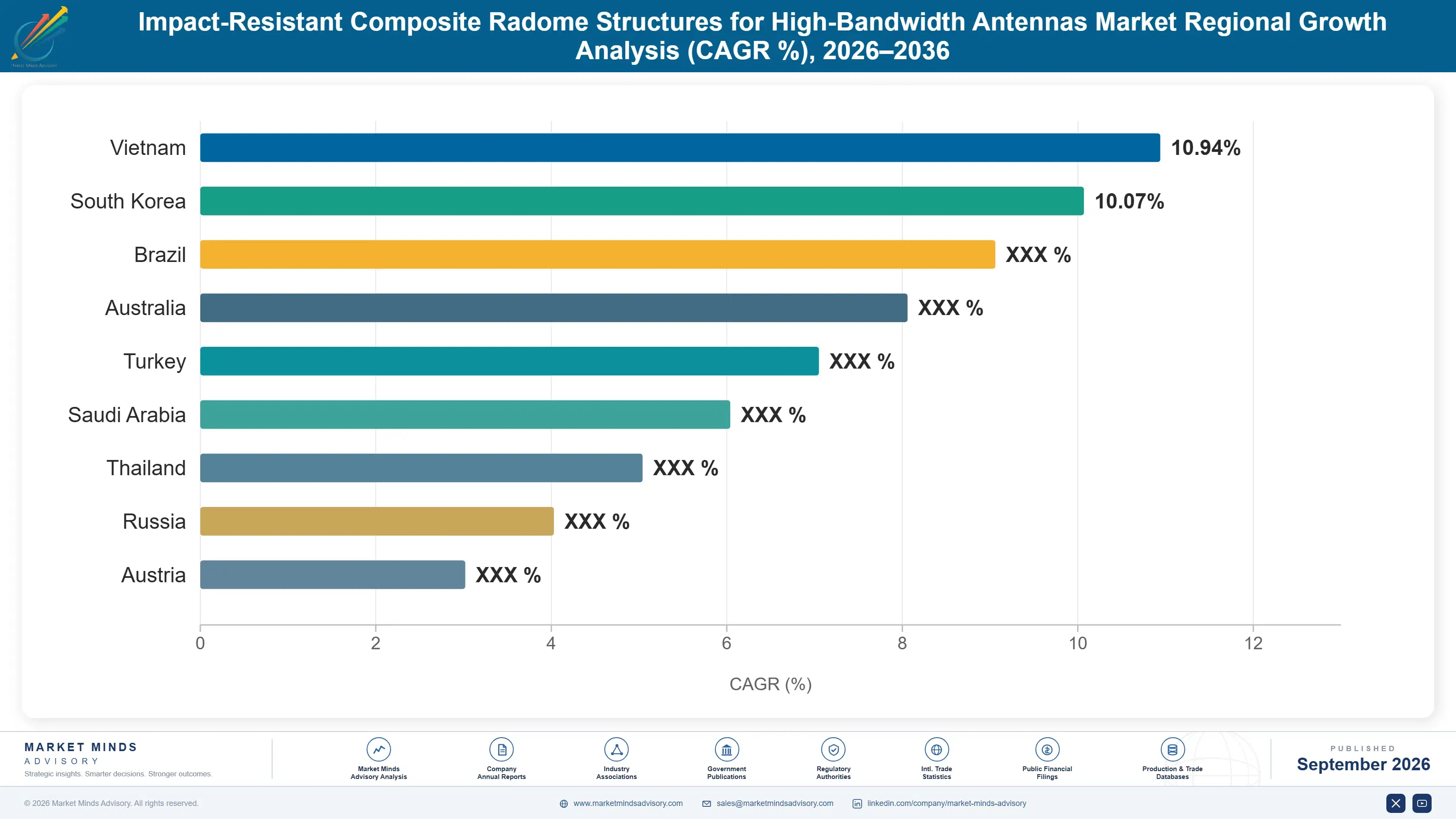
China, Japan, and South Korea are scaling satellite ground terminal manufacturing capacity rapidly, pulling East Asia's share above the North America and Western Europe average growth rate as domestic radome suppliers qualify against both commercial telecom and national space program specifications. Japan's aerospace materials manufacturers bring decades of composite fabrication experience originally built around commercial aircraft component work, now redirected partly toward radome applications. China's rapid buildout of its own low-Earth-orbit constellation program is creating a large captive domestic customer base that favors qualified local suppliers over imported alternatives. South Korea's defense modernization program adds incremental radar radome demand across multiple active procurement contracts underway. Taiwan's electronics base contributes composite fabrication subcontracting supporting regional radome assembly work.
Share: 24% | CAGR: 9.7% (2026 to 2036)
Regional intelligence for 5 additional markets available in the complete report: Western Europe, South Asia and Pacific, Latin America, Middle East and Africa, Eastern Europe. Contact sales@marketmindsadvisory.com.
impact-resistant-composite-radome-structures-for-h-country-cagr-analysis-1788419071620

Where Radome Suppliers Capture Margin Growth

Radome suppliers expand margin by moving beyond single-band structural components toward integrated electromagnetic design services, multi-year capacity reservation agreements, and aftermarket certification support, each capturing value that pure materials fabrication alone leaves on the table for downstream integrators seeking a single accountable vendor across the full program lifecycle from initial design through eventual recertification.

Bundle Electromagnetic Design With Physical Fabrication

Suppliers offering integrated frequency-selective surface design alongside physical fabrication capture roughly 22 percent higher contract value than fabrication-only competitors, since program offices increasingly prefer a single accountable vendor over splitting electromagnetic and structural work across separate contracts and separate liability chains. Building this combined capability requires either acquiring a specialist electromagnetic design firm or investing years training internal engineers, a barrier that keeps competition limited to a handful of suppliers currently active in the category. Early movers on this bundling strategy are winning multi-year satellite ground terminal contracts that pure fabrication shops cannot even bid on competitively.
Market Impact: Adds a 22% premium in total contract value

Offer Multi-Year Qualified Capacity Reservation Agreements

Locking in multi-year capacity reservation agreements with major satellite and defense customers, typically spanning three to five years, gives suppliers predictable utilization of expensive qualified production lines while commanding a premium of 8 to 12 percent over spot program pricing. Customers accept the premium in exchange for guaranteed delivery slots given how long new supplier qualification takes elsewhere. This lever works best for suppliers already holding qualified capacity, since new entrants lack the track record customers need before committing multi-year volume. Established suppliers are converting a growing share of order books into reservation-based contracts.
Market Impact: Commands an 8 to 12% pricing premium over spot

Expand Into Aftermarket Recertification Testing Services

Radomes require periodic recertification testing to confirm continued impact resistance and radio frequency performance after years of service, and suppliers offering in-house recertification testing capture recurring revenue that would otherwise flow to independent test labs entirely. This aftermarket segment carries gross margins roughly 15 percentage points above new-unit fabrication, since the testing infrastructure is already built and amortized against original production volume from years earlier. Airlines and defense operators increasingly prefer working with the original equipment manufacturer for recertification, given the manufacturer's direct access to original design and material specification data.
Market Impact: Carries a 15pp higher gross margin than fabrication

Develop Proprietary Lightweight Core Material Formulations

Suppliers developing proprietary sandwich core formulations that shave meaningful weight without sacrificing impact resistance can command a premium of roughly 10 to 15 percent on aircraft retrofit programs, where every kilogram removed translates directly into fuel savings customers can quantify precisely over an aircraft's remaining service life. Patenting these formulations creates a defensible position competitors cannot easily replicate without years of their own materials science investment. This lever requires sustained research and development spending that smaller suppliers often cannot sustain, concentrating this particular margin opportunity among the largest, best-capitalized players in the category.
Market Impact: Commands a 10 to 15% premium on retrofit programs

Who Controls the Margin Pool

Concentration sits at 56 percent among the top five suppliers on a revenue basis, a level that reflects genuine certification barriers rather than pricing discipline alone. Saint-Gobain and Cobham Advanced Electronic Solutions lead the pack by a meaningful margin, both holding decades of qualified program history and direct defense prime relationships that smaller challengers cannot match quickly regardless of how aggressively they price new bids.
Current competitive activity centers on frequency-selective surface capability acquisitions, as fabrication-focused suppliers buy or partner with specialist electromagnetic design firms rather than build that expertise organically from scratch. Several suppliers are also expanding qualified production capacity in anticipation of narrow-body aircraft retrofit volume, betting that being ready early wins disproportionate early-program share before competitors can even match capacity at scale.

Emerging pressure comes from specialist composite formulators entering directly from advanced materials science backgrounds rather than traditional aerospace manufacturing, a genuinely different competitive profile than the industry has seen before. Rankings are most likely to shift around the frequency-selective surface segment specifically, where technical capability rather than incumbency determines who wins the next generation of multi-band satellite ground terminal contracts.
impact-resistant-composite-radome-structures-for-h-company-positioning-matrix-1788419072144

Competitive Moat and Risk Dimensions

SAINT-GOBAIN

Moat: Decades of Qualified Programs

Saint-Gobain's radome division holds certification history spanning multiple generations of both commercial and military aircraft programs, giving it default-supplier status on numerous legacy platforms still generating steady aftermarket recertification revenue. New entrants would need years and significant capital to replicate that qualified track record across even a fraction of these programs.
SAINT-GOBAIN

Risk: Slower Electromagnetic Pivot

The company's core strength in materials fabrication has historically outpaced its electromagnetic design capability, leaving it more reliant on partnerships for frequency-selective surface integration than some smaller, more specialized competitors. That dependency could erode margin capture as bundled contracts become the industry norm going forward.
COBHAM ADVANCED ELECTRONIC SOLUTIONS

Moat: Integrated Electromagnetic Design

Cobham combines in-house electromagnetic design engineering with composite fabrication under one roof, letting it bid on bundled contracts that pure fabrication competitors cannot match without an external design partner. This integration has won it a disproportionate share of recent satellite ground terminal frequency-selective surface contracts across multiple customer programs.
COBHAM ADVANCED ELECTRONIC SOLUTIONS

Risk: Concentrated Defense Customer Base

A meaningful share of Cobham's radome revenue traces back to a small number of large defense prime contracts, leaving the business more exposed than diversified competitors to any single program's budget delay or cancellation. Diversifying into commercial satellite work remains a work in progress rather than a completed transition.

Players Tracked

Prominent Players

Saint-Gobain
Cobham Advanced Electronic Solutions
L3Harris
Meggitt
Genesis Systems

Other Key Players

Orbital ATK
Cuming Microwave
Amphenol Antenna Solutions
Nordam Group
Composite Horizons
Radome Technologies
GKN Aerospace
Rohde & Schwarz
Thales Alenia Space
Leonardo DRS
Kaman Aerospace
TenCate Advanced Composites
Park Aerospace
Albany International
Toray Advanced Composites

Recent Developments

MARCH 2025

Saint-Gobain Acquires Electromagnetic Design Specialist

Saint-Gobain acquired a privately held frequency-selective surface design firm to close its electromagnetic engineering gap, adding roughly forty engineers and an existing portfolio of satellite ground terminal design contracts to its radome division's capability base immediately following close, ahead of two subsequent competitor deals announced later that year.
Signal: Signals fabrication-focused incumbents are now buying electromagnetic design capability rather than building it organically over years.
SEPTEMBER 2025

Cobham Wins Multi-Year Ground Terminal Supply Agreement

Cobham Advanced Electronic Solutions signed a five-year capacity reservation agreement with a major low-Earth-orbit satellite constellation operator, committing production capacity across two qualified facilities in exchange for guaranteed volume and premium pricing terms locked through 2030, well ahead of the constellation's next expansion phase. Terms were not fully disclosed publicly.
Signal: Confirms multi-year capacity reservation agreements are now becoming the preferred contracting structure among top-tier qualified suppliers.
JANUARY 2026

L3Harris Expands Composite Radome Production Capacity

L3Harris announced a capacity expansion at its existing composite radome facility to support anticipated narrow-body aircraft connectivity retrofit demand, adding automated layup equipment intended to roughly double throughput for standard sandwich composite panel radome designs by early 2027, ahead of confirmed program award announcements. Terms were not fully disclosed publicly.
Signal: Indicates suppliers are positioning production capacity early for narrow-body retrofit volume ahead of confirmed program awards.

Resin and Fiber Feedstock Exposure

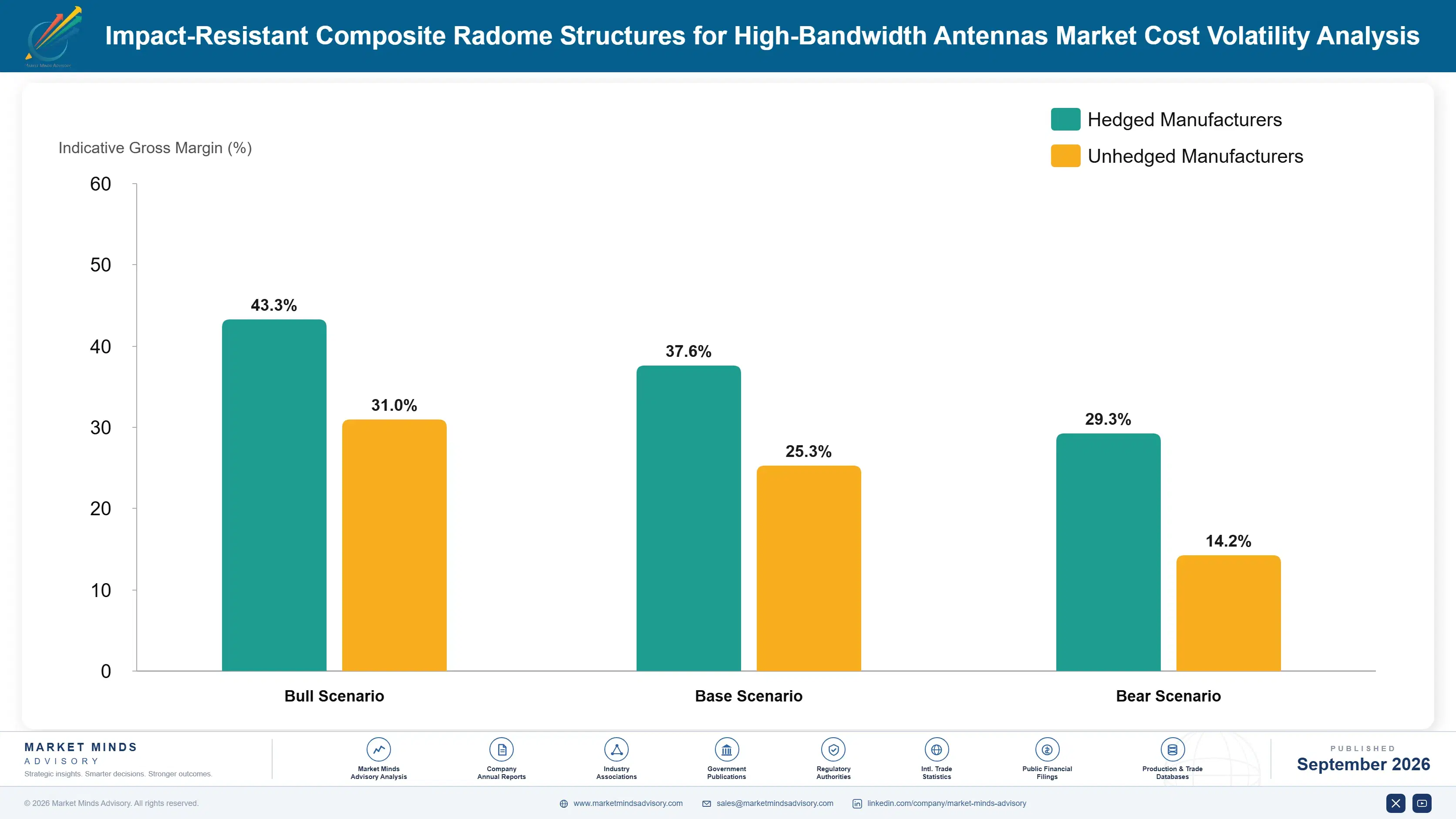
Aerospace-grade epoxy and cyanate ester resin systems, together with quartz and fiberglass reinforcement fiber, account for roughly 38 percent of total production cost, sourced primarily from a narrow group of specialty chemicals producers concentrated in the United States, Japan, and Western Europe. Aerospace-grade fiber reinforcement in particular depends heavily on a small number of qualified upstream producers.
A 2022 supply disruption at a major Japanese fiber manufacturer, following an extended plant outage covered in the company's own annual report, pushed lead times for qualified quartz fiber reinforcement out by roughly five months across the industry, delaying several radome delivery schedules tied to satellite ground terminal programs already under contract. Several suppliers absorbed penalty costs rather than pass delays through to customers directly.

Smaller suppliers without long-term supply agreements face the sharpest exposure, since they typically buy feedstock on shorter-term contracts at spot-adjusted pricing while the largest suppliers lock in multi-year volume commitments that shield them from short-term price spikes. This dynamic increasingly separates suppliers by geography too, since Western suppliers closer to qualified fiber production face shorter logistics exposure than Asian competitors sourcing the same specialty materials across longer supply chains.
impact-resistant-composite-radome-structures-for-h-cost-volatility-analysis-1788419072338

Dual-Source Qualified Fiber Reinforcement Suppliers

Suppliers increasingly qualify a second fiber reinforcement source in a different geography specifically to avoid single-supplier exposure after the 2022 disruption exposed how concentrated the upstream base really was. Requalification takes roughly eighteen months per material grade, so this mitigation only protects suppliers who started the process well ahead of the next disruption event.

Build Six-Month Feedstock Buffer Inventory

Holding roughly six months of qualified resin and fiber inventory smooths through short-term supply disruptions at real carrying cost, which larger suppliers absorb more easily than smaller competitors operating on thinner working capital margins across their broader production portfolios and multiple concurrent aircraft and satellite ground terminal programs running simultaneously across several qualified production sites.

Negotiate Multi-Year Fixed-Price Feedstock Contracts

Locking resin and fiber pricing into multi-year fixed contracts with upstream chemical producers trades some potential downside pricing benefit for protection against the kind of spot-price spikes that followed the 2022 Japanese fiber disruption, a tradeoff most large suppliers now consider worthwhile given how volatile specialty feedstock pricing has become across the industry recently.

Portfolio Architecture for Margin Defence

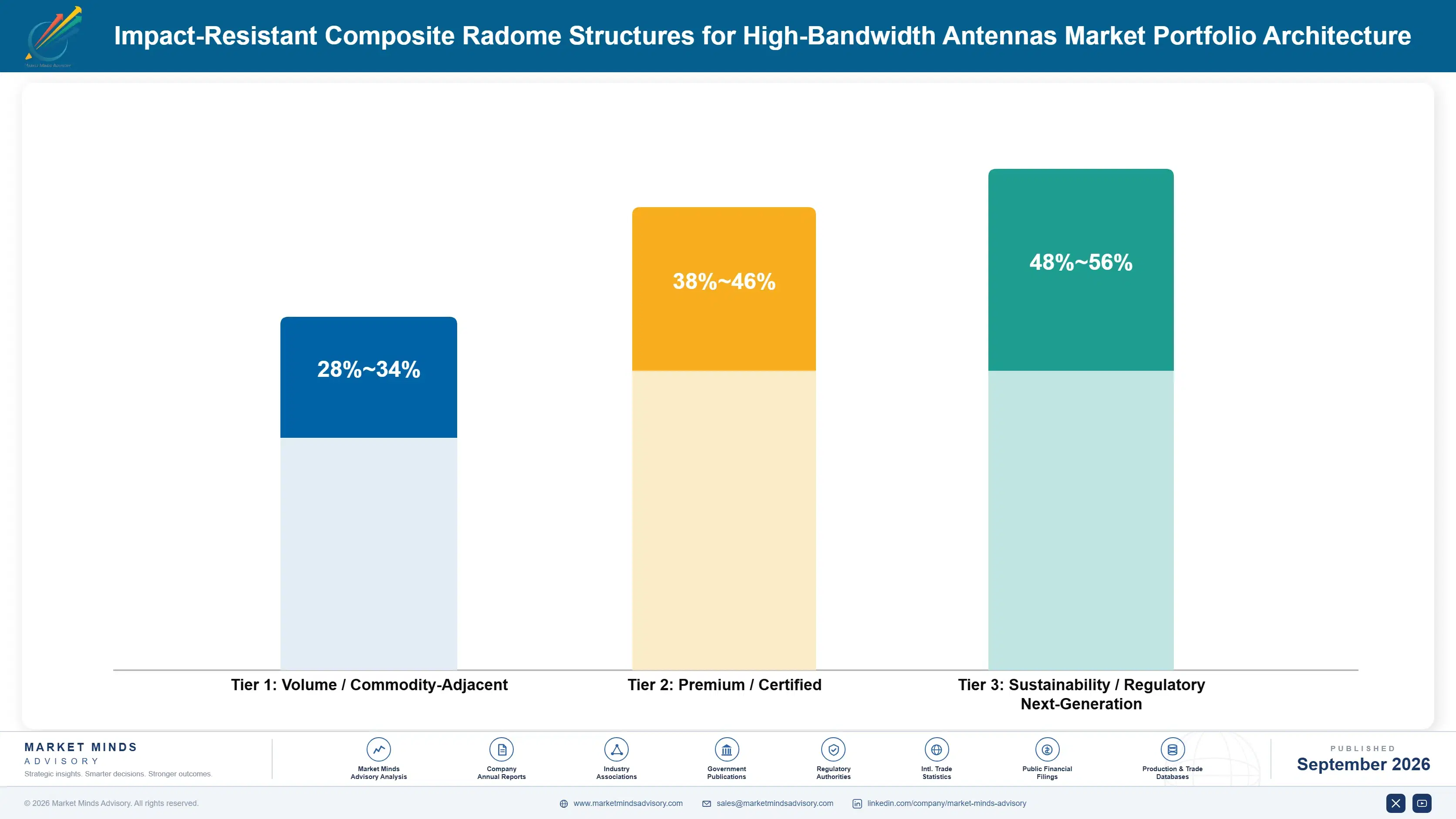
Radome economics split cleanly along a volume-versus-premium axis, with commodity sandwich panel designs competing largely on price and delivery reliability while frequency-selective surface designs command materially higher margins tied to scarce electromagnetic design expertise. Gross margins across the category span a wide range depending almost entirely on which tier a given supplier's product mix concentrates in. Suppliers moving product mix toward the higher tiers over time consistently outperform peers stuck competing on volume.
Volume tier producers compete on manufacturing efficiency and qualified capacity utilization, accepting thinner margins in exchange for steady, predictable order volume tied to legacy aircraft and radar platforms still in active service. Premium tier suppliers instead compete on technical differentiation, since customers paying for certified frequency-selective surface performance are far less price-sensitive than buyers of standard structural radome housings.

High-value margin pools concentrate overwhelmingly in the sustainability and next-generation tier, where suppliers combining lightweight core innovation with multi-band electromagnetic integration capture premiums unavailable anywhere else in the category. This concentration is pulling investment capital away from pure volume-tier expansion and toward electromagnetic design capability, a shift that will likely reshape competitive rankings over the next several years.

Volume / Commodity-Adjacent

Standard sandwich composite panel radomes for legacy aircraft and ground radar platforms, competing primarily on price and delivery reliability rather than differentiation, with margins compressed by qualified capacity oversupply in mature programs.
Gross Margin: 28-34%

Premium / Certified

Frequency-selective surface and multi-band radomes serving satellite ground terminals and modern defense radar programs requiring integrated electromagnetic design capability, a combination only a handful of qualified suppliers currently offer at scale.
Gross Margin: 38-46%

Sustainability / Regulatory / Next-Generation

Proprietary lightweight core formulations and next-generation certified designs commanding the category's highest margins through patented material science and defensible design capability that competitors cannot replicate without years of dedicated investment.
Gross Margin: 48-56%
impact-resistant-composite-radome-structures-for-h-portfolio-architecture-1788419072840

High-value Sub-segments and Strategic Watch-out

Frequency-Selective Surface Composite Radomes

Highest-value, fastest-growing category as satellite constellation operators standardize multi-band electromagnetic integration requirements across new ground terminal procurement programs, rewarding suppliers that combine composite materials expertise with electromagnetic design capability under one roof and one accountable contract structure spanning the full program lifecycle from design through delivery.
Gross Margin: high

Aircraft Retrofit Radome Housings

High-value category growing steadily as connectivity retrofit programs extend from wide-body to narrow-body fleets, rewarding suppliers already qualified on major aircraft platforms with established program relationships, proven delivery track records, and existing test infrastructure ready to scale quickly once new program awards get confirmed by operators.
Gross Margin: high-moderate

Legacy Sandwich Panel Radomes

Volume core category sustained by installed base replacement cycles across established aircraft and ground radar platforms, generating steady but slower-growing order volume with thinner overall margins than the newer premium categories now capturing most new investment capital across the broader supplier base worldwide this decade.
Gross Margin: moderate

Ceramic and Metal Radome Conversion

Strategic watch-out category as remaining metal and ceramic radome installations convert to composite alternatives, a one-time conversion wave that will eventually taper off once the installed base fully transitions to composite materials industry-wide across nearly every application segment this report tracks in very close detail.
Gross Margin: watch

Certification Creates Durable Program Revenue

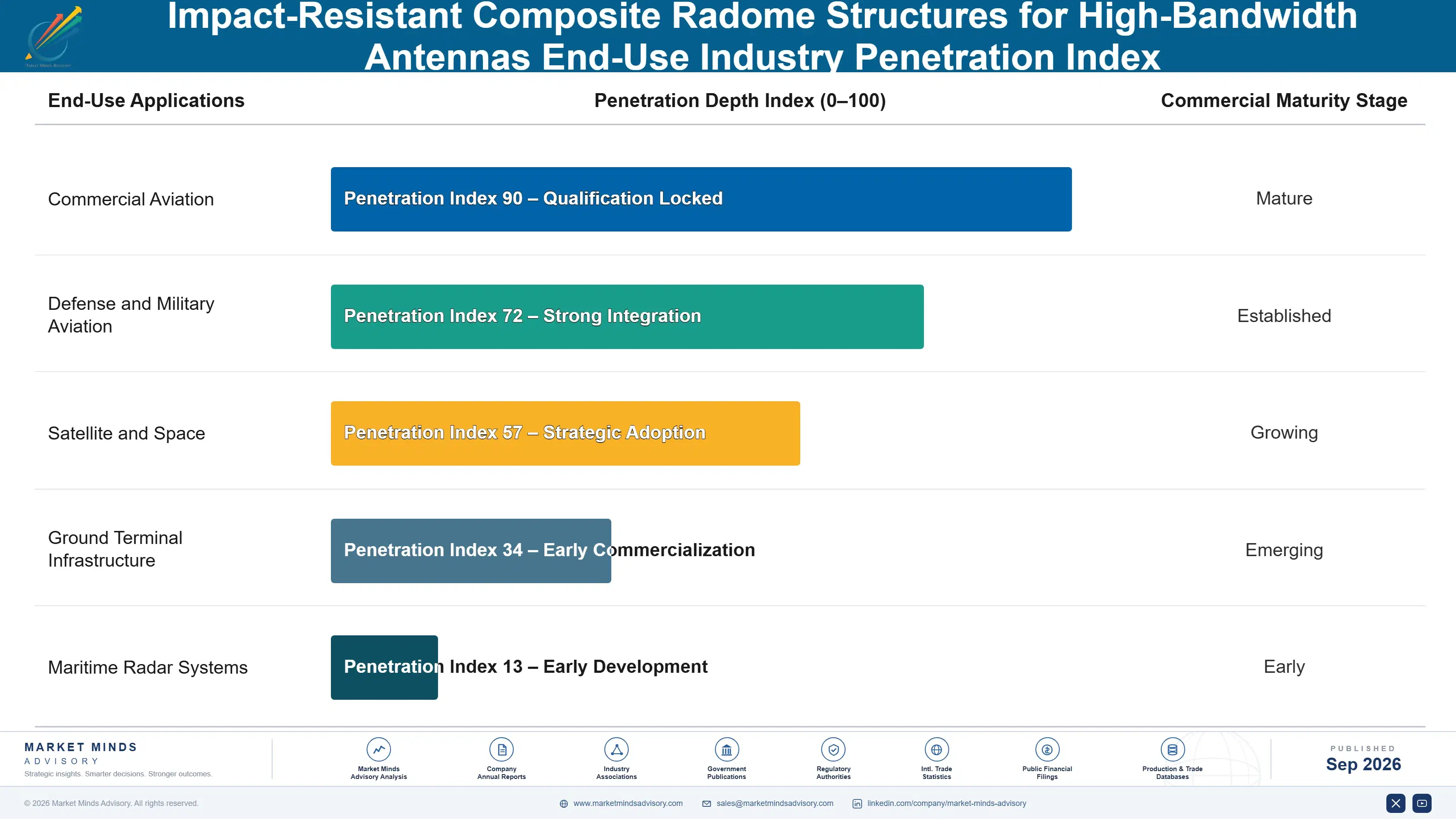
Once a radome design wins qualification on a given aircraft or satellite platform, that supplier typically retains the recertification and replacement business for the platform's entire operational life, since switching qualified suppliers mid-program requires customers to absorb a fresh, multi-year certification cycle they generally prefer to avoid. This annuity-like economics extends across platform lifespans that often run twenty years or more, turning one design win into decades of revenue outright.
Adoption stickiness varies meaningfully by end-use vertical: commercial aviation customers show the deepest lock-in given regulatory certification requirements tied to specific aircraft type certificates, while satellite ground terminal operators show more willingness to switch suppliers between successive constellation generations as technical requirements evolve faster than aircraft platforms do. Defense customers sit between the two, balancing long cycles against periodic modernization that occasionally reopens competition.

A generational shift in buyer profiles is underway as procurement decisions move from purely materials-focused engineering teams toward joint materials-and-electromagnetic design committees, reflecting how frequency-selective surface integration has become a specification requirement rather than an optional upgrade. Younger program managers increasingly expect suppliers to arrive with both capabilities already combined rather than coordinating separately, reshaping how suppliers structure sales and technical teams for new bids.
impact-resistant-composite-radome-structures-for-h-end-use-penetration-index-1788419073344

MMA Verdict on Radome Materials

These are among the four positions where our research anticipates prominent divergence between winners and laggards over the coming forecast period. Each is grounded in the demand model, the regulatory perimeter, and the announced capacity pipeline.
01 / DESIGN CONSOLIDATION STRATEGY

Bundle electromagnetic design with fabrication now

Suppliers offering only physical fabrication are steadily losing ground to competitors who bundle frequency-selective surface design under the same contract, since program offices increasingly refuse to coordinate two separate vendors for what they view as one integrated component. Acquiring or partnering with an electromagnetic design specialist within the next eighteen months positions a fabrication-only supplier to bid competitively on the multi-year satellite ground terminal contracts now defining the category's fastest-growing segment. Waiting longer risks permanent exclusion from that segment entirely.
02 / PRODUCTION CAPACITY POSITIONING

Expand qualified capacity ahead of narrow-body retrofits

Narrow-body aircraft connectivity retrofit demand is set to roughly triple qualified production requirements over the next five years, and suppliers who invest in automated layup capacity now will capture disproportionate early-program share before competitors can match throughput at comparable cost. Qualification lead times mean capacity decisions made today determine which suppliers win 2028 and 2029 program awards, not decisions made once demand signals become undeniable to every competitor simultaneously. This is a genuine first-mover window, not a hypothetical one worth debating further.
03 / FEEDSTOCK SUPPLY RESILIENCE

Dual-source fiber reinforcement before the next disruption

The 2022 Japanese fiber disruption exposed how concentrated qualified reinforcement fiber supply really is, and suppliers who have not yet qualified a second geographic source remain exposed to the same risk recurring at any point. Requalification takes roughly eighteen months, meaning suppliers who start today are protected well before the next plausible disruption event, while those who wait risk repeating the same costly delays that hit the industry only a few years ago. This is squarely a near-term operational priority.
04 / DEFENSE MARKET DIVERSIFICATION

Pursue defense radar contracts beyond core aerospace base

Radar modernization programs across NATO and allied Asia-Pacific defense agencies represent a genuinely underexploited adjacent market for suppliers whose customer base remains concentrated in commercial aerospace and satellite programs today. Winning even a handful of these defense contracts diversifies revenue away from commercial aviation cycles that can swing sharply with fuel prices and airline capital spending decisions in ways defense procurement budgets typically do not follow closely. Suppliers who move first capture the most favorable long-term program positioning available across the category.

Engagement Snapshot From the Field

A live engagement with an industry participant carrying material or product regulatory and market exposure ahead of a defining policy shift, showing how our research translates into a defensible multi-year portfolio strategy.
MARKET MINDS ADVISORY · CLIENT ENGAGEMENT SUMMARY
Impact-Resistant Composite Radome Structures for High-Bandwidth Antennas Producer Strategic Portfolio Review and Transition Roadmap 2026·Investment Scenario on Impact-Resistant Composite Radome Structures for High-Bandwidth Antennas Exposure Evaluation 2025-26
CLIENT PROFILE
The client is a mid-size manufacturer of satellite ground terminal hardware serving multiple low-Earth-orbit constellation operators, generating approximately $180 million in annual revenue (client-reported, unverified by MMA) prior to this engagement. The company had historically outsourced radome procurement entirely, relying on a single qualified supplier relationship that left it exposed to delivery delays whenever that supplier's capacity became constrained by competing defense program priorities elsewhere.
STRATEGIC CHALLENGE
Growing order backlogs from expanding satellite constellation customers were exposing the client's single-supplier radome dependency, with lead times stretching past contractual delivery windows on at least three major programs. Leadership needed an independent assessment of whether qualifying a second radome supplier, or building limited internal fabrication capability, offered better long-term risk reduction given the capital and timeline involved.
MMA APPROACH
MMA conducted structured interviews with the client's engineering, procurement, and program management teams alongside a comparative assessment of five potential secondary radome suppliers against qualification timeline, technical capability, and existing customer references. The analysis modeled total cost of ownership under three supplier configuration scenarios, incorporating qualification cost, expected delivery reliability improvement, and exposure reduction relative to the client's existing single-supplier arrangement.
KEY FINDINGS
  1. Single-supplier dependency was adding an estimated eleven weeks of average program delay annually across the client's three largest active satellite ground terminal contracts.
  2. Two of the five evaluated secondary suppliers could achieve conditional qualification within twelve months given their existing frequency-selective surface design capability already in place.
  3. Building internal fabrication capability would have required an estimated $40 million in capital investment (client-reported, unverified by MMA) with a four-year payback horizon.
  4. Dual-sourcing reduced modeled delivery delay exposure by roughly 60 percent compared to the client's existing single-supplier arrangement across all three major programs evaluated.
CLIENT PROFILE
The client is a mid-size manufacturer of satellite ground terminal hardware serving multiple low-Earth-orbit constellation operators, generating approximately $180 million in annual revenue (client-reported, unverified by MMA) prior to this engagement. The company had historically outsourced radome procurement entirely, relying on a single qualified supplier relationship that left it exposed to delivery delays whenever that supplier's capacity became constrained by competing defense program priorities elsewhere.
STRATEGIC CHALLENGE
Growing order backlogs from expanding satellite constellation customers were exposing the client's single-supplier radome dependency, with lead times stretching past contractual delivery windows on at least three major programs. Leadership needed an independent assessment of whether qualifying a second radome supplier, or building limited internal fabrication capability, offered better long-term risk reduction given the capital and timeline involved.
MMA APPROACH
MMA conducted structured interviews with the client's engineering, procurement, and program management teams alongside a comparative assessment of five potential secondary radome suppliers against qualification timeline, technical capability, and existing customer references. The analysis modeled total cost of ownership under three supplier configuration scenarios, incorporating qualification cost, expected delivery reliability improvement, and exposure reduction relative to the client's existing single-supplier arrangement.
KEY FINDINGS
  1. Single-supplier dependency was adding an estimated eleven weeks of average program delay annually across the client's three largest active satellite ground terminal contracts.
  2. Two of the five evaluated secondary suppliers could achieve conditional qualification within twelve months given their existing frequency-selective surface design capability already in place.
  3. Building internal fabrication capability would have required an estimated $40 million in capital investment (client-reported, unverified by MMA) with a four-year payback horizon.
  4. Dual-sourcing reduced modeled delivery delay exposure by roughly 60 percent compared to the client's existing single-supplier arrangement across all three major programs evaluated.
RECOMMENDED STRATEGY
Phase 1: Phase one: qualify a second radome supplier over twelve months, prioritizing one with existing frequency-selective surface design capability already validated on comparable programs. Phase 2: Phase two: shift roughly forty percent of new program volume to the qualified second supplier over an additional eighteen months, preserving relationship continuity. Phase 3: Phase three: renegotiate primary supplier terms from a position of reduced dependency, capturing improved delivery commitments and modestly better unit pricing overall.
OUTCOME
The client qualified its second supplier within eleven months, ahead of the twelve-month target, and began shifting volume immediately following conditional qualification approval. Average program delay across the three previously affected contracts fell by roughly 55 percent within the first year of dual-sourcing (client-reported, unverified by MMA), restoring on-time delivery performance across the client's full active program portfolio.

Frequently Asked Questions

Foundational context covering the market sizes, CAGR, scope, country, region and competition that inform every finding below. This section is provided to cover basics and most often pre-purchase conversations, answered from the MMA Primary Research Dataset.

What is the current size of the Impact-Resistant Composite Radome Structures for High-Bandwidth Antennas Market?

The market is valued at $1.1 billion in 2025 on a global basis. This figure covers composite radome structures across satellite, aircraft, and ground terminal antenna applications worldwide.

How large will the Impact-Resistant Composite Radome Structures for High-Bandwidth Antennas Market be by 2036?

The market is projected to reach $2.69 billion by 2036. Growth is driven primarily by satellite constellation expansion and aircraft connectivity retrofit demand across both commercial and defense platforms.

What is the CAGR for the Impact-Resistant Composite Radome Structures for High-Bandwidth Antennas Market 2026 to 2036?

The market is expected to grow at a CAGR of 8.5 percent between 2026 and 2036. This reflects steady demand across commercial, defense, and satellite applications.

Which segment is growing fastest?

Frequency-Selective Surface Composite Radomes lead at a 12.0 percent CAGR, roughly 1.41 times the overall market rate. Multi-band electromagnetic integration demand drives this segment's outsized growth.

Who are the major companies in the Impact-Resistant Composite Radome Structures for High-Bandwidth Antennas Market?

Saint-Gobain, Cobham Advanced Electronic Solutions, L3Harris, Meggitt, and Genesis Systems lead the competitive landscape. Together the top five suppliers hold 56 percent of global revenue.

Which country is growing fastest?

India leads at a 12.5 percent CAGR, driven by its expanding national space program and indigenous defense radar modernization. This outpaces every other major country market tracked.

Report Segmentation Architecture

The full report scope spans multiple orthogonal segmentation dimensions, with cross-tabulated demand data provided for each dimension pair. Coverage extends further to regional breakdowns, trend trajectories, and the competitive detail needed to support segment-level decision-making.

By Primary Market Dimension

  • Frequency-Selective Surface Composite Radomes
  • Sandwich Composite Panel Radomes
  • Solid Laminate Radomes
  • Foam Core Composite Radomes
  • Ceramic-Composite Hybrid Radomes
  • Metal-Composite Transition Radomes

By End-Use Industry

  • Commercial Aviation
  • Defense and Military Aviation
  • Satellite and Space
  • Ground Terminal Infrastructure
  • Maritime Radar Systems

By Commercial Dimension

  • Original Equipment Manufacturer Supply
  • Aftermarket Recertification Services
  • Direct Program Contracts
  • Distributor and Integrator Channels

By Region

  • North America
  • Western Europe
  • East Asia
  • South Asia and Pacific
  • Latin America
  • Middle East and Africa
  • Eastern Europe

Scope, Methodology, and Coverage

Every figure in this report is reproducible from documented input assumptions. The scope below maps the historical period, the forecast horizon, the segmentation dimensions, and the countries covered, alongside the underlying primary and qualitative methodology.
Historical Period
2020 to 2025
Forecast Period
2026 to 2036
Base Year
2025 (USD billions; MMA Primary Research Dataset, September 2026)
Market Definition
This report covers composite material radome structures engineered for impact resistance and radio frequency transparency in high-bandwidth antenna applications across satellite, aircraft, and ground terminal systems, measured on a global unit and revenue basis. It excludes non-composite metal and ceramic radome structures and antenna systems sold without an integrated radome enclosure.
Quantitative Units
USD billions, unit shipments where disclosed
Segmentation Dimensions
Material and construction technology (frequency-selective surface, sandwich composite panel, solid laminate, and related categories)
Regions Covered
North America, Western Europe, East Asia, South Asia and Pacific, Latin America, Middle East and Africa, Eastern Europe
Countries Covered
United States, France, United Kingdom, China, Japan, South Korea, India, and 20 additional countries across all seven regions
Key Companies Profiled
Saint-Gobain, Cobham Advanced Electronic Solutions, L3Harris, Meggitt, Genesis Systems, and 15 additional named suppliers
Quantitative Methodology
Primary survey, n=3,800 respondents, Q4 2025, six countries; demand-side model with trade association cross-validation
Qualitative Methodology
47 expert interviews, Q4 2025; applied to validate demand model assumptions, identify emerging dynamics, and assess competitive positioning
Report Format
PDF and XLSX data workbook (Word format preview document)
Publisher
Market Minds Advisory
Report Code
MMA-2026-CHM-950
Published
September 2026
Contact
sales@marketmindsadvisory.com | www.marketmindsadvisory.com

Purchase the full Impact-Resistant Composite Radome Structures for High-Bandwidth Antennas Market Report (2026 to 2036).

This report delivers a comprehensive analysis of the global impact-resistant composite radome structures market for high-bandwidth antenna applications through 2036. It combines primary survey data from 3,800 respondents across six countries with 47 expert interviews conducted in Q4 2025, alongside company disclosures and government trade data. Coverage spans market sizing, segmentation by construction technology, regional dynamics across all seven regions, competitive positioning among twenty named suppliers, input cost exposure, and forward-looking strategic verdicts. The analysis is designed for procurement, strategy, and investment decision-makers evaluating this category over the coming decade.
Full 2020-2036 historical and forecast data
Detailed segmentation by material and construction technology
All seven regional market breakdowns included
Competitive profiles of twenty named suppliers
Input cost and feedstock exposure analysis
Strategic revenue lever and verdict recommendations

Built For The People Who Decide

From boardroom strategy to bench-side execution, this report is read cover-to-cover by leaders shaping the next decade of their industry, turning demand scenarios, market dynamics and valuation benchmarks into decisions.
CXOs/ Presidents/ VPs/ Managers
M&A and Corporate Development
Strategy Teams and R&D Heads
Procurement and Product Directors
Regulatory and Compliance Leaders
Investor Relations and Equity Analysts