Market Minds Advisory
Immersion Heater Market

Immersion Heater Market: A Spread Trade On Energy Prices Wearing Industrial Clothing

Electrifying process heat below four hundred degrees is technically settled and commercially undecided. This product converts electricity to heat at the point of use, and the argument is entirely about price.

Lead Analyst

David Horsley

Published

September 2026

Make Smarter Decisions with Customized Research Insights

Request a free sample report and evaluate market opportunities, growth trends, and competitive dynamics relevant to your business needs.

2025 MARKET VALUE$1.7BMarket Size 2025
2036 FORECAST VALUE$3.3BBase Case , 2026 to 2036
CAGR 2026 TO 20366.2 %Bull 7.4% / Bear 5.0%
INCREMENTAL OPPORTUNITY$1.5BNet 10- year value creation
EXPANSION MULTIPLE1.82x2036 value over 2026 base
Strategic Levers
M&A Pipeline
Regional Outlook
Country Rankings
Competitive Intelligence
Segmental Deep-dive
Call-Us : 91 93563 13602

Executive Snapshot and Market Trajectory

Process heat is roughly a fifth of industrial energy use and almost all of it comes from burning something. Below four hundred degrees an immersion heater does the same job electrically and the only question is price. The market reaches USD 1.7 billion in 2025 and grows at 6.2%.
Circulation and inline heaters grow fastest at 9.8%, about 1.58 times the market rate, because electrifying a process stream means heating fluid in motion rather than in a tank. East Asia holds 31% of value on Chinese manufacturing and process industry demand together, more than any other region. North America takes 24% and Western Europe 20%, the latter driven hardest by carbon pricing. Carbon pricing is doing most of the work in Europe.
Concentration sits at 29%, low because a sheathed element in a flange is a design many competent firms build. Competition turns on thermal application engineering rather than on the element itself, since almost every failure is a watt density error rather than a manufacturing defect. Suppliers who size for the actual fluid sell fewer replacements and considerably more systems. Sizing rather than manufacturing decides who keeps the customer here.
Market Definition
The immersion heater market covers electric heating elements installed directly into a liquid or gas to raise its temperature, together with the thermowells, controls, and terminal enclosures supplied as part of the assembly. It spans circulation and inline heaters, flanged, screw plug, over-the-side, and tank suction formats across industrial process, commercial, and water heating duty. Boilers, heat exchangers, furnaces, heat pumps, surface-mounted band and cartridge heaters, and radiant heating are excluded.
Base Year Value
$1.7B in 2025 (MMA Primary Research Dataset, August 2026)
Forecast Period
2026 to 2036, eleven discrete annual values
CAGR
6.2% base case. Bull 7.4%. Bear 5.0%.
Fastest Growth Segment
Circulation and Inline Heaters: 9.8% CAGR
Fastest Growth Country
India: 8.6% CAGR
Fastest Growth Region
South Asia and Pacific: 8.2% CAGR
Largest Region
East Asia: 31% of 2025 global value
Market Leaders
Watlow, Chromalox, Thermon, NIBE Element, Zoppas Industries. Source: MMA Primary Research Dataset, July 2026.
Primary Survey
n=3,800 procurement and R&D decision-makers, Q4 2025, six countries
Methodology
Demand-side build-up, cross-validated against public data, 47 expert interviews

Immersion Heater Market Forecast Scenarios

immersion-heater-market-size-forecast-scenario-1787334029917
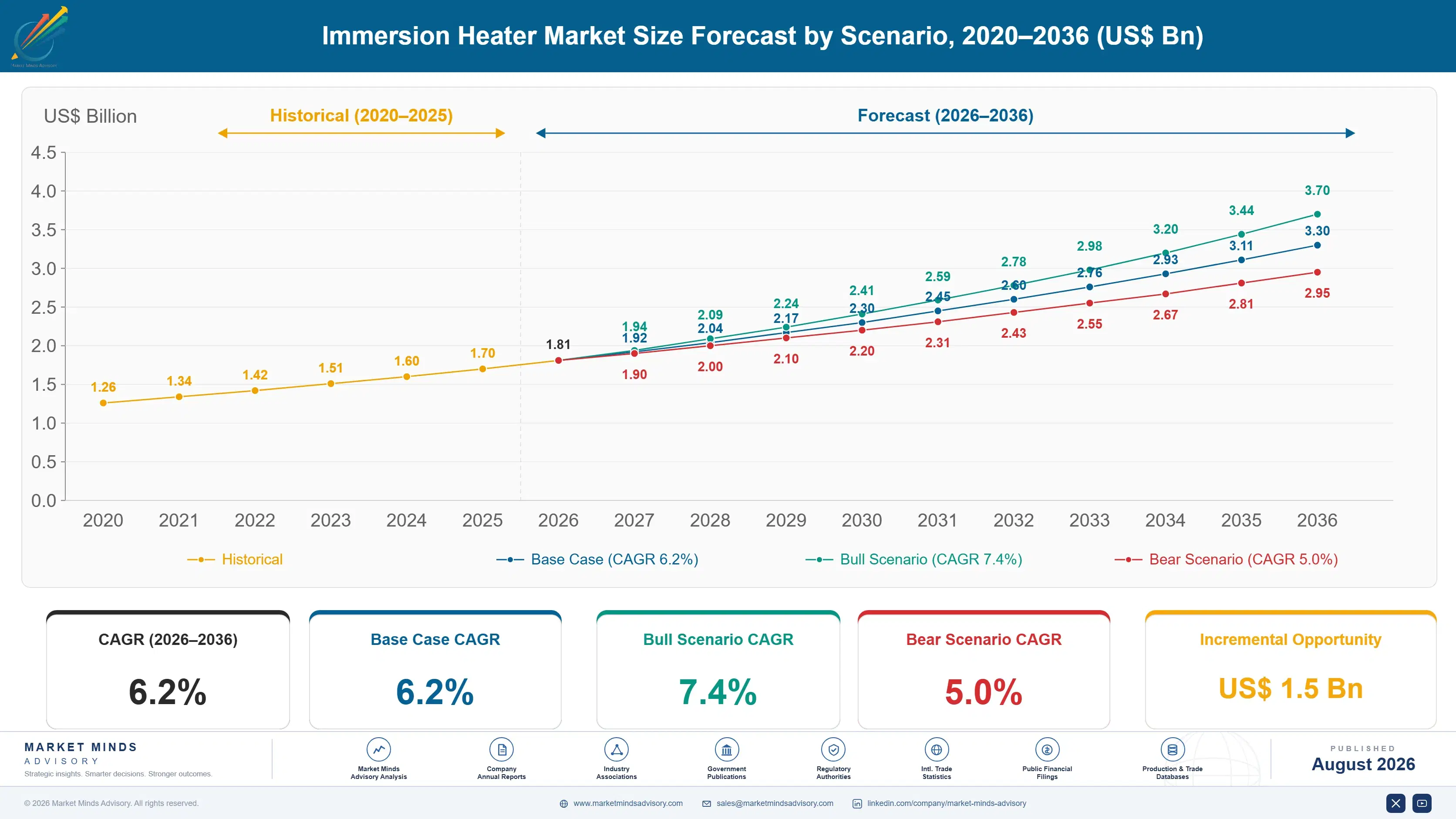
Between 2020 and 2025 the case for electric process heat improved and the spending did not follow immediately. European gas prices after 2021 made electrification arithmetic work in places it never had, and carbon pricing widened the gap further. Industrial buyers hesitated anyway, because a grid connection upgrade costs more than the heater and takes longer to obtain. A 5.1% historical CAGR reflects that hesitation rather than the underlying economics.
Three mechanisms carry the 6.2% base case. Carbon pricing is the largest, since a European industrial operator paying for emissions on a gas burner sees the spread against electricity narrow every year the price rises. Corporate decarbonisation commitments are the second and reach operators no regulation obliges. And Asian process industry construction keeps adding capacity that specifies electric heating where the grid supports it and gas infrastructure does not exist.
The 7.4% bull case turns on industrial electricity pricing separating from gas through renewable procurement, which would make the arithmetic work without any carbon price at all. The 5.0% bear case is grid connection queues, since an operator who cannot get the capacity connected does not buy the heater however good the case looks. Neither scenario concerns the product.

The Element Is Fine, The Application Is Not

An immersion heater turns electricity into heat inside the fluid, which means essentially nothing is lost between the meter and the process. A gas burner loses heat up a flue and through the vessel wall before any of it reaches the product. That efficiency difference is real and it still does not settle the argument, because electricity costs several times what gas does per unit of energy in most industrial markets. The efficiency argument is true and insufficient on its own.
TOP FIVE CONCENTRATION29%Many regional makers build a design nobody protects any more
AVERAGE HEATER PRICEUSD 1,480Blended across screw plug, flanged, and circulation heater formats
APPLICATION FAILURE SHAREOver 80 percentPortion of failures caused by sizing rather than manufacturing defect
ELEMENT SERVICE LIFE6 to 12 yearsOperating years before sheath replacement becomes economically necessary
CONVERSION EFFICIENCYAbove 98 percentElectrical energy delivered as heat at the point of use
LEADING PRODUCER SHARE41%Element manufacturing concentrates where sheath and winding capacity exists
So the purchase is a spread trade. Wherever carbon pricing, renewable procurement, or the absence of gas infrastructure narrows that spread, the heater gets specified. Where it does not, an operator keeps the burner and revisits the question next year. Nothing about the product decides it. Nothing about the product decides it, and nothing ever has.
The failure mode is what separates suppliers. Over 80% of immersion heater failures are watt density errors rather than defects: the sheath ran too hot for a viscous oil, a scaling deposit insulated it, or low flow left an element dry. A manufacturer who sizes for the actual fluid sells fewer warranty replacements and more repeat systems.
"Nobody has an immersion heater problem. They have a fluid problem, a flow problem, or a scaling problem, and the heater is where it becomes visible. Every warranty claim I have ever seen investigated turned out to be an application question somebody answered badly at quotation."
Director, Industrial Heating Practice · MMA Construction and Industrial Equipmen

Market Trends

Process Electrification Moves From Argument To Specification

Industrial heat below four hundred degrees can be delivered electrically with no technical compromise, and the question was never whether it works. What changed is that carbon pricing, corporate emissions commitments, and volatile gas prices together narrowed a cost gap that used to settle the matter instantly. Circulation heaters suit the application best, because most process electrification means heating a stream in motion rather than a tank of liquid. Operators now run the comparison seriously rather than dismissing it, and that alone has moved the segment to 9.8% growth against a market at 6.2%.
Market Impact: Carbon adds 30% to gas heat
Grid Connection Capacity Becomes The Real Constraint

An operator converting a burner to electric heat needs several megawatts of additional connected load, and in much of Europe and North America that connection takes years to obtain rather than months. The heater itself is frequently the cheapest part of the project once transformers, switchgear, and network reinforcement are counted. Suppliers who arrive with a heater specification and no view on connection cost lose the project at the feasibility stage. Those who model the whole electrical scope reach a conversation the customer is genuinely struggling with and has nobody to help on.
Market Impact: Asian capacity adds 9% annually

Market Opportunities and Growth Drivers

Carbon Pricing Narrows The Spread Against Gas Directly

A European industrial operator burning gas pays for the emissions under the trading scheme, and every increase in that price moves the comparison against electricity in one direction only. The mechanism is arithmetic rather than persuasion, which makes it unusually reliable as a demand driver. Border adjustment arrangements extend the same logic to imported goods and therefore to producers outside the region selling into it. Operators who modelled the conversion three years ago and shelved it are running the numbers again, and the answer keeps changing in the same direction each time.
Market Impact: Electricity costs 3 times gas

Asian Process Capacity Specifies Electric Where Gas Is Absent

New chemical, pharmaceutical, food, and specialty processing capacity across China, India, and Southeast Asia frequently sits where gas distribution does not reach but grid supply does, which removes the comparison entirely. Electric process heating becomes the default rather than the alternative in those locations. Plant designers there also specify circulation heating for temperature control precision that burners cannot match on smaller streams. That produces genuine first-installation demand rather than the conversion demand driving Western markets, and it accounts for most of the volume growth in this category. First installation rather than conversion, throughout.
Market Impact: Over 80% of failures are sizing

Market Restraints and Challenges

Electricity Costs Several Times Gas Per Unit Delivered

Industrial electricity in most markets prices at three to five times gas per unit of energy, and no efficiency advantage at the point of use closes a gap that size on operating cost alone. The root cause is generation economics and network charging rather than anything either fuel does. Commercially this means electrification proceeds only where carbon cost, renewable procurement, or infrastructure absence changes the arithmetic. Suppliers are mitigating by modelling total cost including maintenance, flue losses, and emissions liability, and by targeting applications where precision or cleanliness carries independent value.
Market Impact: Heat below 400 degrees electrifies

Watt Density Errors Destroy Elements And Supplier Reputations

A sheath running hotter than the fluid can carry away burns out regardless of how well the element was made, and viscous oils, scaling water, and low flow conditions all cause it. The root cause is that sizing requires knowing the actual fluid, its condition, and its flow behaviour, which the person requesting a quotation frequently does not. Commercially this produces warranty claims that look like quality failures and are not. Suppliers are mitigating with application questionnaires, thermal modelling at quotation, sheath materials tolerant of poor conditions, and over-temperature protection as standard.
Market Impact: Connections take 3 to 7 years
3 additional market trends, 4 additional growth drivers, and 2 additional restraints and challenges are covered in the full report. Contact sales@marketmindsadvisory.com to access the complete intelligence.

Segment CAGR and Growth Architecture

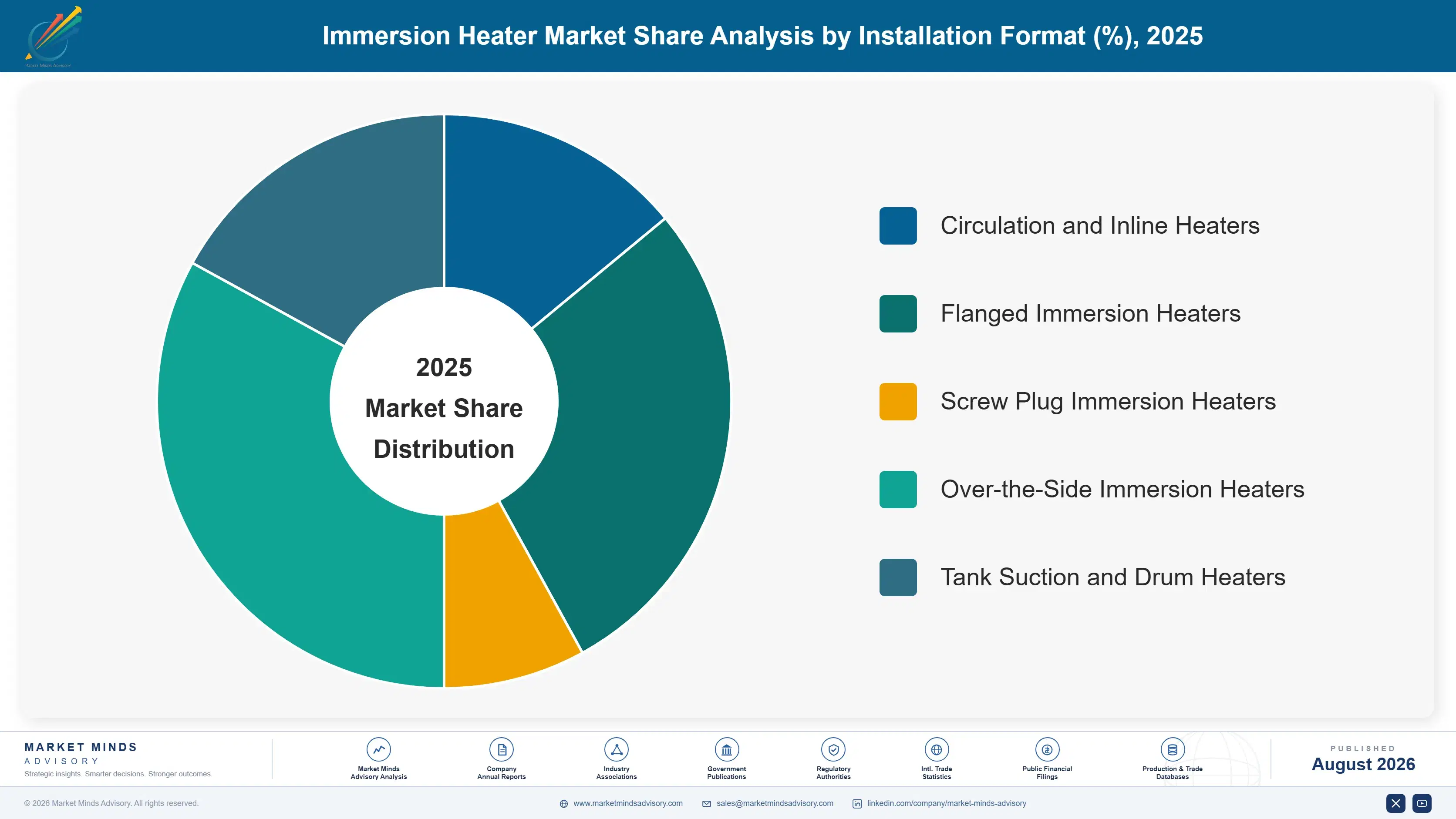
Segmentation follows installation format, meaning how the heater enters the vessel or pipeline, because that determines the watt density achievable, the fluids it suits, the pressure rating it carries, and the maintenance access it allows. Sheath material, control method, and end-use industry are handled in the framework and commentary instead. Nothing else divides this market so cleanly.
immersion-heater-market-market-share-analysis-1787334030457

Circulation and Inline Heaters

Circulation heaters grow fastest at 9.8%, about 1.58 times the market rate, because process electrification means heating fluid in motion rather than sitting in a tank. An inline vessel with an internal element bundle gives controlled outlet temperature, predictable flow across every element, and a package that drops into existing pipework without touching a vessel. Flow guarantees the sheath stays cooled, which removes the failure mode that afflicts every other format. Higher pressures and temperatures are achievable than any tank arrangement supports. Capital cost per kilowatt is above a simple flanged heater and the application engineering is more demanding, which is exactly why suppliers with process capability win this work rather than component makers.
CAGR 9.8%

Flanged Immersion Heaters

Flanged heaters grow at 7.1%, holding the large tank and vessel applications where a bolted flange gives a pressure-rated seal and a bundle can be withdrawn for maintenance without draining anything. Storage tank heating, boiler feedwater, oil heating, and process vessel duty all specify the format because it scales to high power in a single penetration. Sheath material selection matters enormously here, since the element sits static in fluid that may scale, sludge, or stratify around it. Removable bundles are the practical advantage buyers cite most, particularly on installations where taking a tank out of service is expensive or seasonally impossible. Withdrawable bundles are the practical advantage buyers cite most consistently, particularly where taking a tank offline is expensive.
CAGR 7.1%
Full segment breakdown across 7 segments available in the complete report.

Regional Architecture and Country Demand Map

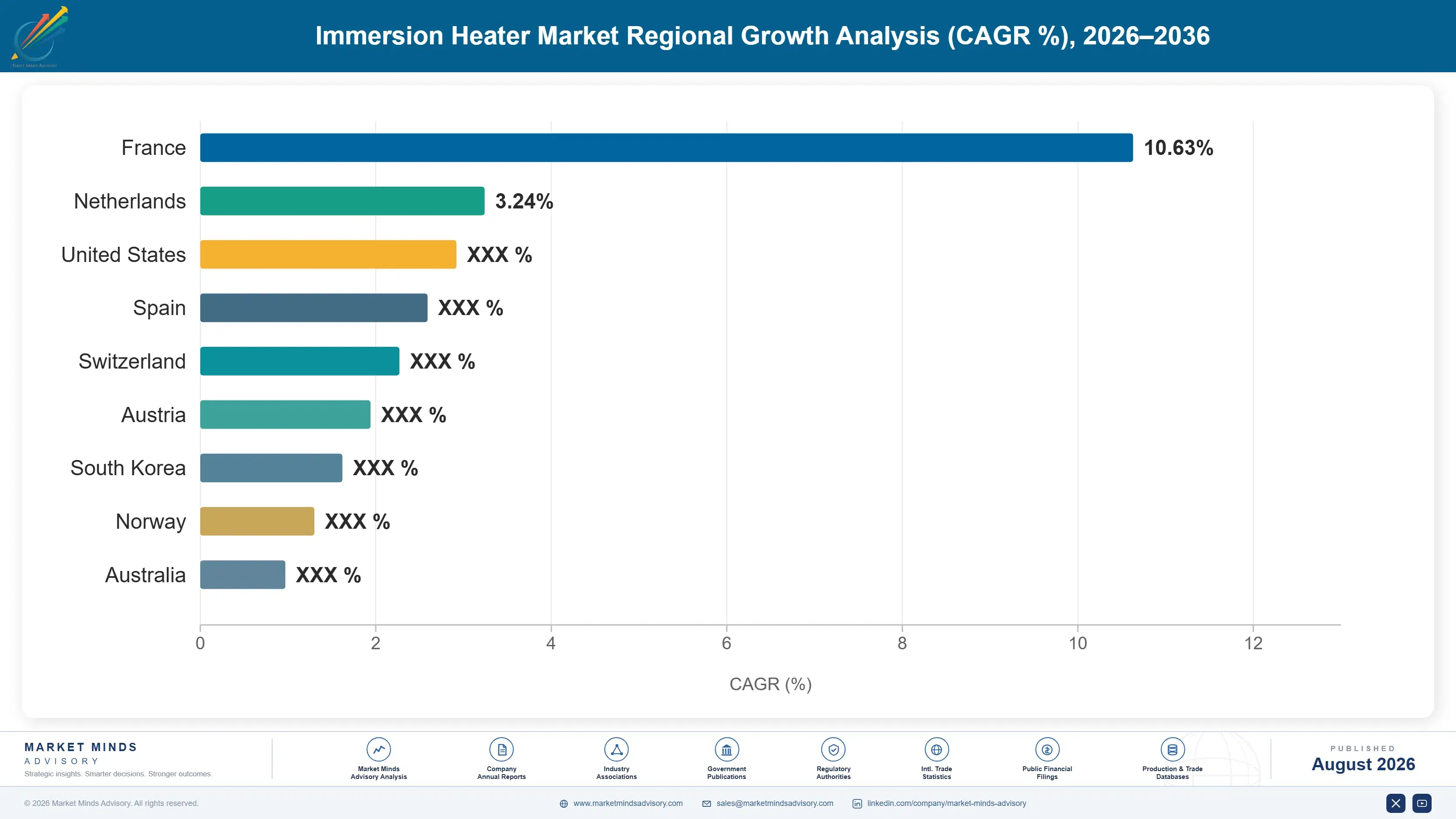
Regional shares here follow process industry capacity and the local price of electricity against gas, which is why the map looks nothing like general industrial output. Growth depends on which of those two forces each region is running on rather than on any product preference.

East Asia

East Asia holds 31% of value, above the 30% ceiling this framework applies, because Chinese chemical, pharmaceutical, food, and specialty processing capacity is being built at a scale nowhere else approaches and much of it specifies electric heating from the outset. Domestic manufacturers supply most of that volume at prices Western suppliers cannot reach, though demanding process applications still favour imported product on application engineering rather than on hardware. Japanese and Korean demand is replacement-weighted and technically exacting, with semiconductor and battery materials processing driving unusually high specification. Growth at 6.9% exceeds the global rate on capacity additions rather than on any conversion from gas, since much of that plant never had a burner to convert.
Share: 31% | CAGR: 6.9% (2026 to 2036)

Western Europe

Carbon pricing rather than construction explains Western Europe's 20% share and every trend within it. An operator burning gas pays for the emissions under the trading scheme, and each price increase narrows the comparison against electricity in one direction only, which is why conversion projects shelved three years ago keep being reopened. German, Dutch, and Nordic chemical and food processing lead that reconsideration, with Nordic operators helped considerably by low-carbon power pricing. The binding constraint is grid connection capacity rather than the economics, and queues run into years across much of the region. Growth at 5.2% is the slowest recorded here, held back by connection delays rather than by any weakness in the underlying commercial case for conversion.
Share: 20% | CAGR: 5.2% (2026 to 2036)
Regional intelligence for 5 additional markets available in the complete report: North America, South Asia and Pacific, Latin America, Middle East and Africa, Eastern Europe. Contact sales@marketmindsadvisory.com.
immersion-heater-market-country-cagr-analysis-1787334030969

Where Heater Suppliers Actually Earn

Four levers matter here, and the element is not one of them, because a sheathed resistance wire has been a solved problem for a century. Application engineering, electrical scope, conversion modelling, and sheath material selection decide outcomes instead. A supplier quoting a kilowatt rating against another kilowatt rating competes on the one dimension where both are identical.

Size For The Fluid, Not For The Kilowatts

Over 80% of immersion heater failures are watt density errors: a sheath running hotter than a viscous oil or scaling water can carry away, or an element left dry by low flow. The customer requesting a quotation frequently does not know the fluid condition well enough to specify correctly, and a supplier who simply quotes what was asked for inherits the failure. Asking the application questions at quotation costs an engineer an hour and prevents a warranty claim that reads as a quality problem. It also produces a specification competitors quoting from the enquiry cannot match.
Market Impact: Over 80% of failures are sizing err

Quote The Electrical Scope, Not Just The Heater

Converting a burner to electric heat needs several megawatts of connected load, and transformers, switchgear, and network reinforcement usually cost 3 times what the heater does. Connection queues run three to seven years across much of Europe and North America. A supplier arriving with only a heater price loses at feasibility, because nobody can evaluate it. One arriving with the full electrical scope modelled is helping with the problem the customer actually has and has nobody else to ask about. That capability costs an electrical engineer and wins projects competitors never see decided.
Market Impact: Connections take 3 to 7 years to ob

Model The Conversion Against Carbon, Not Against Gas

Comparing electricity price to gas price makes electric heating look indefensible in almost every market, which is why operators dismiss it in minutes. Comparing total delivered cost including flue losses, burner maintenance, combustion air handling, and emissions liability under a rising carbon price produces a different answer in a growing number of cases. Carbon already adds roughly 30% to European gas heating cost and the trajectory is one way. A supplier who builds that model for the customer is reframing the decision rather than losing it on the number the customer arrived with.
Market Impact: Carbon adds 30% to gas process heat

Specify The Sheath Material For The Worst Day

Sheath choice between steel, stainless, Incoloy, and titanium determines whether an element survives scaling, chloride attack, or a temperature excursion that lasts a few minutes. The premium between grades is under 20% against the cost of a failed heater and a stopped process, yet buyers routinely take the cheapest option because nobody presented the comparison properly. A supplier who specifies for the worst plausible condition rather than the nominal one sells a slightly more expensive heater that lasts several times longer. That is a better outcome for both parties and a harder sale to lose.
Market Impact: Elements last 6 to 12 years correct

Who Controls the Margin Pool

Concentration sits at 29% for the top five, low because a sheathed element in a flanged head is a design nobody protects and many competent firms build. The gap between leaders and challengers is application engineering capability and hazardous area certification rather than element quality. All participants here are assessed on one basis, revenue from immersion heating assemblies and their integrated controls. Engineering capability rather than production is what separates suppliers.
Competition runs on four lines. Application engineering decides whether the heater survives, which is the only thing the customer eventually judges. Hazardous area certification decides which process plants a supplier may serve at all. Electrical scope capability decides who reaches conversion projects. Price decides standard water heating and general duty, where regional manufacturers set the level.

Two pressures will shift positions. Chinese manufacturers hold cost positions Western suppliers cannot approach and are working through the certifications that currently keep them out of regulated process work. Meanwhile electrification projects need electrical engineering that most heater companies do not employ. Positions favour whoever combines process application depth with genuine electrical scope capability, and very few firms hold both.
immersion-heater-market-company-positioning-matrix-1787334031490

Competitive Moat and Risk Dimensions

WATLOW

Moat: Thermal engineering and control integration

Watlow sells thermal systems rather than heating elements, combining heaters, sensors, and control into assemblies engineered for a specific process. That capability reaches applications where a component supplier cannot bid and produces designs competitors struggle to quote against. Semiconductor and demanding process positions built over decades carry qualification barriers that take years to replicate.
WATLOW

Risk: Premium position in commodity duty

An engineering-led cost base is difficult to defend in standard water heating and general industrial duty, which carries most of the unit volume in this category. Asian manufacturers reach those applications at prices no American engineering organisation matches. Semiconductor exposure also brings cycle volatility that broader industrial heating businesses do not carry.
CHROMALOX

Moat: Process heating breadth and certification

Chromalox holds unusually wide hazardous area and process certification coverage across circulation, flanged, and immersion formats, which decides eligibility in chemical, oil and gas, and pharmaceutical work before any price is discussed. Systems capability extends to complete electric process heating packages rather than components. Installed base across process industry generates dependable replacement demand.
CHROMALOX

Risk: Exposure to conversion project timing

Growth depends heavily on industrial electrification projects that stall on grid connection availability rather than on any commercial decision the supplier influences. Standard duty product faces the same Asian cost pressure everybody does. Certification breadth is expensive to maintain across jurisdictions and provides no advantage in the unregulated half of the market.

Players Tracked

Prominent Players

Watlow
Chromalox
Thermon
NIBE Element
Zoppas Industries

Other Key Players

Vulcan Electric
Tempco Electric Heater
Wattco
Heatrex
Durex Industries
Hotwatt
Türk und Hillinger
Elmatic
Kanthal
Omega Engineering
Gaumer Process Instruments
Indeeco
Friedr. Freek
Hi-Heat Industries
Process Heating Company

Recent Developments

FEBRUARY 2025

European carbon pricing widens the electrification comparison further

Carbon prices under the European trading scheme and the tightening of free allocation moved the delivered cost comparison between gas and electric process heating further toward electricity across several industrial sectors. These were policy effects rather than commercial events, and they reopen conversion cases operators had previously shelved as uneconomic.
Signal: A carbon price reopens a decision that was
AUGUST 2024

Grid connection queues lengthen across industrial electrification projects

Network operators across Europe and North America reported extended timescales for large industrial connection applications, with connection queues in several regions now running to multiple years. These were capacity constraints rather than transactions, and they delay conversion projects whose commercial case is otherwise complete and approved.
Signal: The constraint moved from the economics to
JUNE 2024

Asian process capacity specifies electric heating from design stage

New chemical and specialty processing capacity across China, India, and Southeast Asia increasingly specified electric process heating at design rather than as a conversion, driven by grid availability where gas distribution does not reach. These were design decisions rather than commercial transactions, and they represent genuinely new demand.
Signal: A plant designed electric from the start n

Alloy Sheath, Nickel Wire, Controls

Cost structure is dominated by two metals and a certification burden. Sheath tubing in stainless, Incoloy, or titanium carries 26% to 40% of assembly cost, from specialist tube suppliers with limited alternatives at the higher grades. Nickel chromium resistance wire runs 12% to 20% and moves on nickel pricing directly. Terminal enclosures and controls add 18% to 28%, more where hazardous area certification applies.
Nickel moved violently in March 2022 and stayed volatile afterwards, which reached both the resistance wire and the higher sheath grades at the same time, while European energy costs raised tube production cost across the period. The IEA documented the underlying industrial energy constraint. Watlow and NIBE both disclosed input cost pressure across those years. Suppliers holding catalogue prices and framework agreements had limited pass-through and absorbed much of the movement.

Each range above exceeds three points because a titanium sheathed heater and a steel water heating element share almost nothing beyond the terminal box. Exposure separates by grade mix. A process-weighted supplier carries alloy tube risk with few substitution options at high grades. A commodity supplier carries steel and nickel exposure it can index. Asian manufacturers hold tube proximity, winding labour, and assembly cost together.
immersion-heater-market-cost-volatility-analysis-1787334031684

Index framework prices to nickel, not to inflation

Nickel chromium wire and high grade sheath tubing together carry over a third of assembly cost and move on a metal that has swung by multiples inside a single week. A framework agreement without a nickel index leaves that exposure entirely uncovered. Indexation is standard in adjacent alloy products and absent from a surprising number of heater contracts.

Qualify a second source for high grade sheath tube

Incoloy and titanium tube comes from a narrow supplier base, and changing source means requalifying weld procedures and any hazardous area certification attached to the assembly. That work takes months and cannot be compressed. Doing it while supply is comfortable costs testing time only, and the alternative is a process heater range unable to ship during a shortage nobody predicted.

Certify one enclosure platform across the range

Hazardous area certification on terminal enclosures behaves as a fixed cost, and approving a single enclosure design across many heater configurations spreads that burden far wider than certifying assemblies individually. Most manufacturers certify reactively as customers ask, which fragments the spend and leaves gaps that lose process work. One coordinated programme costs less and closes more applications.

Portfolio Architecture for Margin Defence

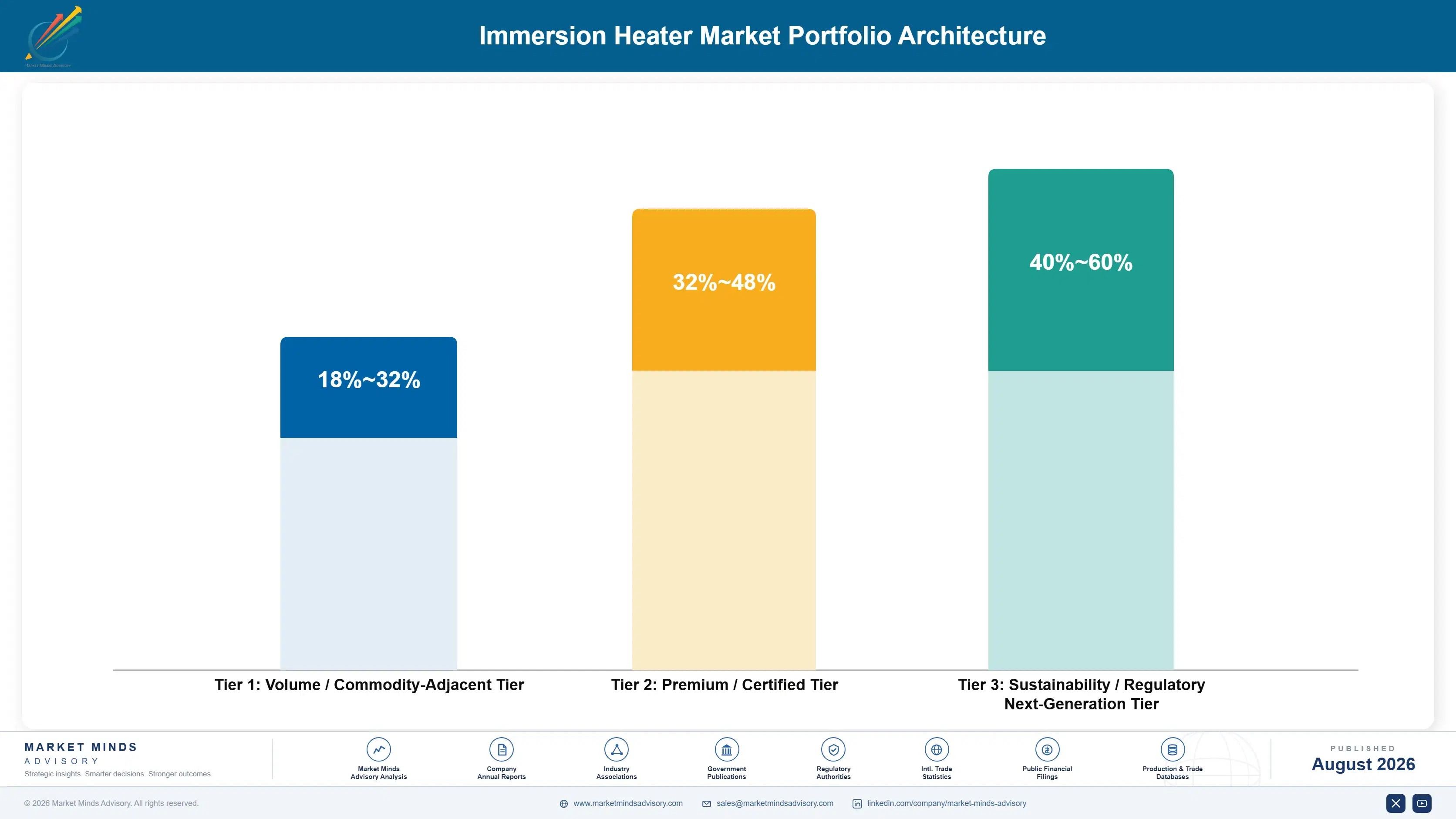
Three tiers sit inside this category and application demand draws the lines. Standard water and general duty heaters form the volume tier, where the design is unprotected and regional manufacturers set pricing. Certified process heaters with hazardous area approval earn more, because certification decides eligibility before price is discussed. Engineered circulation systems with controls and electrical scope price highest, since they solve a problem rather than supply a component.
The tension is between catalogue volume that keeps the winding line busy and engineered work that earns the return. Standard elements ship in quantity against Asian competition on cost alone. Engineered process systems need thermal and electrical engineers who cost money in years when nothing sells. Suppliers who fund only the first find the process half closed to them, and the ones who fund only the second cannot cover their overhead.

High-value pools concentrate where engineering or certification limits competition: circulation systems for process electrification, hazardous area certified assemblies, high grade sheath applications in aggressive fluids, and anything sold with the electrical scope modelled. The commodity end is standard immersion elements for water and general duty, where price is the only variable and imports set the level.

Volume / Commodity-Adjacent Tier

Standard screw plug and over-the-side elements for water and general industrial duty. The range is wide because Asian winding and assembly cost positions differ enormously from Western ones on functionally identical elements.
Gross Margin: 18-32%

Premium / Certified Tier

Flanged and circulation heaters carrying hazardous area certification and process pressure ratings. The range is wide because certified suppliers hold pricing in regulated work while the same product competes hard wherever approval is not required.
Gross Margin: 32-48%

Sustainability / Regulatory / Next-Generation Tier

Engineered circulation systems with controls, high grade sheath materials, and electrification packages including electrical scope. The range is wide because engineering content varies enormously while alloy cost moves independently of it.
Gross Margin: 40-60%
immersion-heater-market-portfolio-architecture-1787334032185

High-value Sub-segments and Strategic Watch-out

Circulation and Inline Heaters

High value and high growth at 9.8%, the fastest format, because process electrification means heating fluid in motion and flow keeps the sheath cooled. Higher pressures and temperatures are achievable than any tank arrangement supports, and the application engineering is where suppliers separate from one another.
Gross Margin: 40-60%

Flanged Immersion Heaters

High value with strong growth at 7.1%, holding tank and vessel duty where a bolted flange gives a pressure seal and the bundle withdraws for maintenance. Sheath material selection matters most here, since the element sits static in fluid that scales and stratifies around it.
Gross Margin: 32-48%

Screw Plug Immersion Heaters

The volume core by units at 5.4%, the default fitting on smaller tanks and vessels across every industry and the format every manufacturer builds. Design content is minimal, imports compete freely, and price is essentially the only variable discussed at quotation. Nobody defends anything in this tier.
Gross Margin: 18-32%

Over-the-Side Immersion Heaters

The strategic watch-out at 3.9%, serving plating tanks and open vessels where nothing penetrates the wall and the heater lifts out for cleaning. Volume is stable rather than growing, and plating industry contraction in developed markets keeps removing installed base. Plating contraction keeps removing the installed base steadily.
Gross Margin: 18-32%

How Heater Demand Actually Repeats

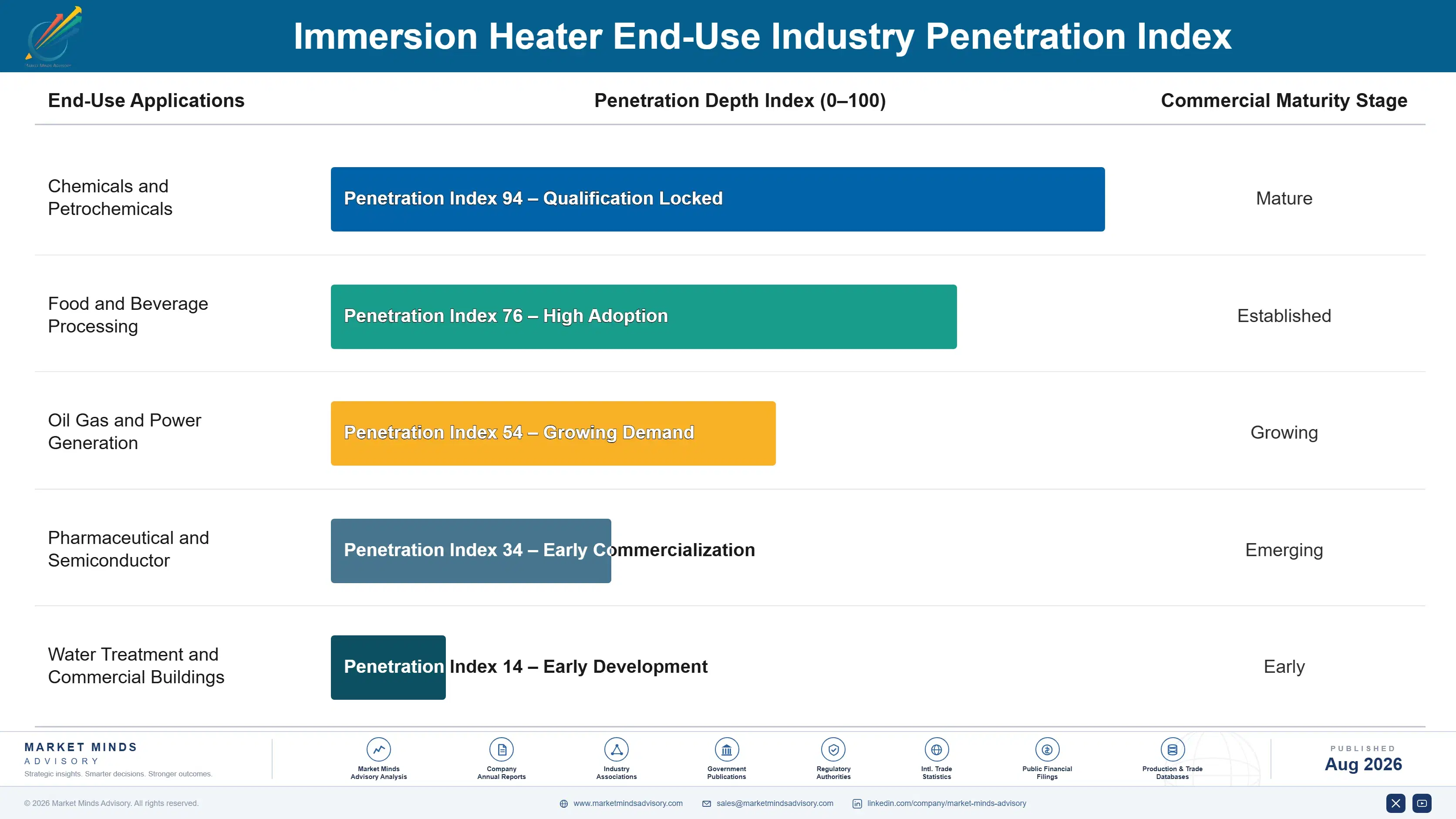
Demand commits at plant design or conversion and then repeats as element replacement every six to twelve years. A heater sized correctly becomes the specification a plant reorders without reconsidering, because the sizing was the difficult part. That gives a supplier who engineered the original a durable position at almost no defence cost. The competitive moments are a new plant, a fluid or duty change, and a failure the incumbent caused.
Stickiness varies with how difficult the application is. Aggressive and viscous fluid duty sticks hardest, since no plant engineer experiments with a working solution. Hazardous area installations stick nearly as hard through certification records tied to specific assemblies. General process duty sticks moderately. Water heating and standard tank duty sticks least, because the buyer compares prices at each replacement and switches easily.

The buyer has moved from a maintenance engineer replacing an element to a project team evaluating a fuel switch. Twenty years ago somebody ordered the same heater again. Now an energy manager, an electrical engineer, and a sustainability lead all have a view, and the question is whether to convert at all. Suppliers still selling elements are addressing the smallest part of that conversation.
immersion-heater-market-end-use-penetration-index-1787334032672

Our Call On Immersion Heaters

These are among the four positions where our research anticipates prominent divergence between winners and laggards over the coming forecast period. Each is grounded in the demand model, the regulatory perimeter, and the announced capacity pipeline.
01 / APPLICATION ENGINEERING DISCIPLINE

The sizing is the product, the element is not

More than 80% of immersion heater failures are watt density errors rather than manufacturing defects, caused by a sheath running hotter than a viscous oil, a scaling deposit, or a low flow condition can carry away. The customer requesting a quotation usually cannot specify correctly, and a supplier quoting exactly what was asked inherits the failure and the reputational damage. Asking the application questions costs an engineer an hour and produces a specification competitors quoting from the enquiry cannot match.
02 / ELECTRICAL SCOPE CAPABILITY

Sell the connection problem, not the heater

Converting an industrial burner to electric heat requires several megawatts of additional connected load, and transformers, switchgear, and network reinforcement routinely cost more than the heater while connection queues run three to seven years across Europe and North America. A supplier arriving with only a heater price loses at feasibility stage because nobody can evaluate the proposal in isolation. One arriving with the whole electrical scope modelled is helping with the problem the customer genuinely has and has nobody else to ask about it.
03 / CARBON COST FRAMING

Compare delivered cost, never fuel price

Electricity prices at three to five times gas per unit of energy, which makes electric process heating look indefensible in about ninety seconds if that is the comparison presented. Total delivered cost including flue losses, burner maintenance, combustion air handling, and emissions liability under a carbon price already adding roughly 30% to European gas heating produces a materially different answer in a growing number of cases. A supplier who builds that model reframes the decision rather than losing it on the number the customer walked in holding.
04 / SHEATH MATERIAL SELECTION

Specify for the worst day, not the datasheet

Sheath choice between steel, stainless, Incoloy, and titanium determines whether an element survives chloride attack, scaling, or a temperature excursion lasting a few minutes, and the premium between grades is trivial against a failed heater and a stopped process. Buyers routinely take the cheapest option because nobody presented the comparison in terms of what actually happens to the element. A supplier specifying for the worst plausible condition sells a slightly dearer heater lasting several times longer, which is a difficult sale to lose.

Engagement Snapshot From the Field

A live engagement with an industry participant carrying material or product regulatory and market exposure ahead of a defining policy shift, showing how our research translates into a defensible multi-year portfolio strategy.
MARKET MINDS ADVISORY · CLIENT ENGAGEMENT SUMMARY
Immersion Heater Producer Strategic Portfolio Review and Transition Roadmap 2026·Investment Scenario on Immersion Heater Exposure Evaluation 2025-26
CLIENT PROFILE
A European process heater manufacturer with roughly USD 88 million in annual revenue engaged MMA after electrification enquiries rose sharply while orders did not follow (client-reported, unverified by MMA). The company quoted a large number of conversion projects across two years and converted very few of them, and nobody internally could explain where in the process the opportunities were being lost.
STRATEGIC CHALLENGE
Sales believed the quotations were priced too high and wanted a discount structure. Engineering wanted to develop a higher temperature circulation range. Nobody had followed a sample of lost quotations through to find out what the customer decided and why. The board needed a position before committing the next development budget.
MMA APPROACH
MMA traced forty lost electrification quotations through to the customer's eventual decision, interviewing the project engineer in each case. We compared the client's proposal scope against what the customer needed to evaluate the project at all. We then modelled three routes: price reduction, higher temperature product development, and building electrical scope capability into the quotation process.
KEY FINDINGS
  1. Only four of the forty lost quotations went to a competing heater supplier, and the rest stalled before any comparison because the project itself was not approved (client-reported, unverified by MMA).
  2. Grid connection cost and lead time was the stated blocker in most cases, and the client proposals addressed none of that scope at all.
  3. Customers who received a full electrical scope estimate from any supplier were considerably more likely to progress that project through to full approval.
  4. Price reduction modelled worst of the three routes, because the quotations were not being lost on price at any point in the process.
CLIENT PROFILE
A European process heater manufacturer with roughly USD 88 million in annual revenue engaged MMA after electrification enquiries rose sharply while orders did not follow (client-reported, unverified by MMA). The company quoted a large number of conversion projects across two years and converted very few of them, and nobody internally could explain where in the process the opportunities were being lost.
STRATEGIC CHALLENGE
Sales believed the quotations were priced too high and wanted a discount structure. Engineering wanted to develop a higher temperature circulation range. Nobody had followed a sample of lost quotations through to find out what the customer decided and why. The board needed a position before committing the next development budget.
MMA APPROACH
MMA traced forty lost electrification quotations through to the customer's eventual decision, interviewing the project engineer in each case. We compared the client's proposal scope against what the customer needed to evaluate the project at all. We then modelled three routes: price reduction, higher temperature product development, and building electrical scope capability into the quotation process.
KEY FINDINGS
  1. Only four of the forty lost quotations went to a competing heater supplier, and the rest stalled before any comparison because the project itself was not approved (client-reported, unverified by MMA).
  2. Grid connection cost and lead time was the stated blocker in most cases, and the client proposals addressed none of that scope at all.
  3. Customers who received a full electrical scope estimate from any supplier were considerably more likely to progress that project through to full approval.
  4. Price reduction modelled worst of the three routes, because the quotations were not being lost on price at any point in the process.
RECOMMENDED STRATEGY
Phase 1: Phase 1 (0 to 9 months): Stop the discount proposal and add electrical scope estimating to every conversion quotation issued. Phase 2: Phase 2 (9 to 22 months): Build partnerships with electrical contractors able to price connection and switchgear scope credibly. Credibly and quickly. Phase 3: Phase 3 (22 to 38 months): Develop the higher temperature range once conversion projects are actually converting to orders. Not before then.
OUTCOME
The board rejected the discount structure and funded electrical estimating capability, which the sales director initially thought irrelevant to a heater business. Conversion rates on quoted projects improved materially within three quarters, and the client reports being invited into feasibility discussions it previously never saw (client-reported, unverified by MMA). The higher temperature range remains deferred.

Frequently Asked Questions

Foundational context covering the market sizes, CAGR, scope, country, region and competition that inform every finding below. This section is provided to cover basics and most often pre-purchase conversations, answered from the MMA Primary Research Dataset.

What is the current size of the Immersion Heater Market?

The global market is valued at USD 1.7 billion in 2025, covering circulation, flanged, screw plug, over-the-side, and tank suction electric immersion heaters. Boilers, heat exchangers, and surface-mounted heaters are excluded.

How large will the Immersion Heater Market be by 2036?

The market is forecast to reach USD 3.30 billion by 2036 in the base case, about 1.82 times the 2026 level. That represents incremental value of roughly USD 1.49 billion.

What is the CAGR for the Immersion Heater Market 2026 to 2036?

The market grows at a 6.2% CAGR in the base case, with bull and bear scenarios at 7.4% and 5.0%. The spread turns on industrial electricity pricing and on grid connection availability.

Which segment is growing fastest?

Circulation and inline heaters grow fastest at 9.8%, about 1.58 times the overall rate, because process electrification means heating fluid in motion. Flanged immersion heaters follow at 7.1%.

Who are the major companies in the Immersion Heater Market?

Leading participants include Watlow, Chromalox, Thermon, NIBE Element, and Zoppas Industries. Concentration is low at roughly 29%, because a sheathed element in a flanged head is a design nobody protects.

Which country is growing fastest?

India grows fastest at an 8.6% CAGR, as chemical and pharmaceutical capacity locates where grid supply reaches and gas distribution does not. China follows on continued process plant construction.

Report Segmentation Architecture

The full report scope spans multiple orthogonal segmentation dimensions, with cross-tabulated demand data provided for each dimension pair. Coverage extends further to regional breakdowns, trend trajectories, and the competitive detail needed to support segment-level decision-making.

By Installation Format

  • Circulation and Inline Heaters
  • Flanged Immersion Heaters
  • Screw Plug Immersion Heaters
  • Over-the-Side Immersion Heaters
  • Tank Suction and Drum Heaters

By End-Use Industry

  • Chemicals and Petrochemicals
  • Food and Beverage Processing
  • Oil Gas and Power Generation
  • Pharmaceutical and Semiconductor
  • Water Treatment and Commercial Buildings

By Sales Model

  • Direct Sale with Application Engineering
  • Engineering Contractor Project Supply
  • Industrial Distribution Channel
  • Original Equipment Manufacturer Supply

By Region

  • East Asia
  • Western Europe
  • North America
  • South Asia and Pacific
  • Latin America
  • Middle East and Africa
  • Eastern Europe

Scope, Methodology, and Coverage

Every figure in this report is reproducible from documented input assumptions. The scope below maps the historical period, the forecast horizon, the segmentation dimensions, and the countries covered, alongside the underlying primary and qualitative methodology.
Historical Period
2020 to 2025
Forecast Period
2026 to 2036
Base Year
2025 (USD billions; MMA Primary Research Dataset, August 2026)
Market Definition
The immersion heater market comprises the manufacture and sale of electric heating elements installed directly into a liquid or gaseous medium to raise its temperature, valued at manufacturer selling prices to end users, engineering contractors, equipment builders, and industrial distributors. It spans circulation and inline heater vessels, flanged, screw plug, over-the-side, tank suction, and drum heater formats, in steel, stainless, Incoloy, titanium, and quartz sheath constructions, together with the thermowells, thermostats, over-temperature protection, terminal enclosures, hazardous area certification, and integrated control panels supplied as part of the assembly. Boilers and steam generators, heat exchangers and calorifiers, fired heaters and furnaces, heat pumps, surface-mounted band, cartridge, strip and cable heaters that do not enter the medium, infrared and radiant heating, HVAC duct heaters, and induction and dielectric heating equipment are excluded. Heater installation, commissioning, and thermal survey services sold independently sit outside scope.
Quantitative Units
USD billions (current prices); volume in millions of heater assemblies shipped
Segmentation Dimensions
By Installation Format; By End-Use Industry; By Sales Model; By Region
Regions Covered
East Asia, Western Europe, North America, South Asia and Pacific, Latin America, Middle East and Africa, Eastern Europe
Countries Covered
China, Japan, South Korea, Taiwan, India, Germany, Netherlands, Sweden, Italy, France, Spain, UK, Switzerland, USA, Canada, Mexico, Australia, Singapore, Thailand, Vietnam, Indonesia, Malaysia, Brazil, Chile, Peru, Colombia, Argentina, Saudi Arabia, United Arab Emirates, Qatar, Egypt, South Africa, Turkey, Poland, Czechia, Hungary, Romania, and additional markets relevant to this sector
Key Companies Profiled
Watlow, Chromalox, Thermon, NIBE Element, Zoppas Industries, Vulcan Electric, Tempco Electric Heater, Wattco, Heatrex, Durex Industries, Hotwatt, Türk und Hillinger, Elmatic, Kanthal, Omega Engineering, Gaumer Process Instruments, Indeeco, Friedr. Freek, Hi-Heat Industries, Process Heating Company
Quantitative Methodology
Primary survey, n=3,800 respondents, Q4 2025, six countries; demand-side model with trade association cross-validation
Qualitative Methodology
47 expert interviews, Q4 2025; applied to validate demand model assumptions, identify emerging dynamics, and assess competitive positioning
Report Format
PDF and XLSX data workbook (Word format preview document)
Publisher
Market Minds Advisory
Report Code
MMA-2026-CON-533
Published
August 2026
Contact
sales@marketmindsadvisory.com | www.marketmindsadvisory.com

Purchase the full Immersion Heater Market Report (2026 to 2036).

The full MMA Immersion Heater report sizes the market across five installation formats, five end-use industries, four sales models, and seven regions through 2036. It profiles 20 participants on a consistent basis of immersion heating assembly revenue, scoring each on application engineering depth, hazardous area certification coverage, electrical scope capability, and sheath material range. Scenario models quantify how carbon pricing, industrial electricity costs, and grid connection availability move both volume and achievable margin. The report also includes electrification breakeven modelling by country and fuel price, grid connection queue analysis by region, failure mode assessment across formats, and certification coverage benchmarking by supplier.
Five-format and four-channel market sizing to 2036
Twenty-participant benchmark on immersion heating assembly revenue
Electrification breakeven modelling by country and fuel price
Grid connection queue analysis across major industrial regions
Failure mode assessment across installation formats and fluids
Hazardous area certification coverage benchmarking by supplier

Built For The People Who Decide

From boardroom strategy to bench-side execution, this report is read cover-to-cover by leaders shaping the next decade of their industry, turning demand scenarios, market dynamics and valuation benchmarks into decisions.
CXOs/ Presidents/ VPs/ Managers
M&A and Corporate Development
Strategy Teams and R&D Heads
Procurement and Product Directors
Regulatory and Compliance Leaders
Investor Relations and Equity Analysts