Market Minds Advisory
Immersion Cooling Market

Immersion Cooling Market: Rack Density Forced The Decision Nobody Wanted To Make

A commercial reading of liquid immersion, where accelerator power density made air cooling physically impossible, fluid chemistry carries regulatory risk, and retrofitting an existing hall costs more than the tanks inside it.

Lead Analyst

David Horsley

Published

September 2026

Make Smarter Decisions with Customized Research Insights

Request a free sample report and evaluate market opportunities, growth trends, and competitive dynamics relevant to your business needs.

2025 MARKET VALUE$1.1BMarket Size 2025
2036 FORECAST VALUE$8.7BBase Case , 2026 to 2036
CAGR 2026 TO 203620.5 %Bull 21.9% / Bear 19.2%
INCREMENTAL OPPORTUNITY$7.3BNet 10- year value creation
EXPANSION MULTIPLE6.46x2036 value over 2026 base
Strategic Levers
M&A Pipeline
Regional Outlook
Country Rankings
Competitive Intelligence
Segmental Deep-dive
Call-Us : 91 93563 13602

Executive Snapshot and Market Trajectory

Nobody adopted immersion cooling because it was elegant. Accelerator racks now draw power at densities where moving enough air through the cabinet is physically impossible, so operators submerged the hardware in dielectric fluid because the alternative was simply not building the facility at all. Necessity sells faster than efficiency.
The market stands at USD 1.1 billion in 2025 and reaches USD 8.65 billion by 2036 at a 20.5% CAGR. Two-phase immersion systems grow fastest at 27.4%, about 1.34 times the overall rate, because boiling removes heat at densities single-phase circulation cannot reach. East Asia holds 30% of value on Chinese and Taiwanese deployment, while India posts the quickest national growth at 31.6% from almost nothing on new data centre construction alone.
Concentration is moderate, with the top five holding roughly 41% of deployed system value and a crowded field of fluid suppliers and integrators beneath. Two forces are now shaping the category. Accelerator power draw keeps rising faster than any air-cooling roadmap accommodates, and fluorochemical restriction has put the dielectric fluids that two-phase systems depend on under regulatory review across multiple jurisdictions at the same time as demand accelerates.
Market Definition
The immersion cooling market covers systems that submerge electronic equipment directly in dielectric fluid to remove heat, spanning single-phase immersion tanks and systems, two-phase immersion systems, dielectric fluids and coolants, heat rejection and secondary loop equipment supplied with immersion systems, and design, installation, and maintenance services. Direct-to-chip cold plate liquid cooling, rear-door heat exchangers, air-cooled and chilled water systems, industrial process cooling chemicals, and the servers or accelerators being cooled are excluded.
Base Year Value
$1.1B in 2025 (MMA Primary Research Dataset, August 2026)
Forecast Period
2026 to 2036, eleven discrete annual values
CAGR
20.5% base case. Bull 21.9%. Bear 19.2%.
Fastest Growth Segment
Two-Phase Immersion Systems: 27.4% CAGR
Fastest Growth Country
India: 31.6% CAGR
Fastest Growth Region
South Asia and Pacific: 22.8% CAGR
Largest Region
East Asia: 30% of 2025 global value
Market Leaders
Submer, GRC, LiquidStack, Vertiv, Iceotope. Source: MMA Analysis based on company annual reports.
Primary Survey
n=3,800 procurement and R&D decision-makers, Q4 2025, six countries
Methodology
Demand-side build-up, cross-validated against public data, 47 expert interviews

Immersion Cooling Market Forecast Scenarios

immersion-cooling-market-size-forecast-scenario-1787324587470
Growth from 2020 to 2025 compounded near 19.0% from a base so small that the rate flatters it. Cryptocurrency mining drove the earliest commercial deployments and then largely abandoned them when returns collapsed, which cost the category credibility it took years to rebuild. Accelerator computing then arrived with power densities nobody had planned facilities around. Adoption shifted from a cost argument to a physical necessity within about two years.
Three mechanisms carry the base case to 20.5%. First, accelerator density: rack power draw has moved well past what air can remove, and each new generation raises it again rather than settling. Second, water scarcity and reporting, since immersion removes evaporative water almost entirely and operators now disclose consumption. Third, heat reuse, because liquid captures thermal energy at temperatures district heating schemes can actually use, which air cooling never delivered.
The bull case at 21.9% assumes accelerator deployment continues at current build rates and fluid regulation resolves without removing two-phase chemistries from the market. The bear case at 19.2% assumes direct-to-chip cold plate cooling takes most of the addressable density growth as a less disruptive retrofit, fluorochemical restriction eliminates two-phase options, and operators default to the approach that fits existing halls.

Why Rack Density Removed The Choice Entirely

Three forces set demand. Accelerator power density provides the necessity, since a rack drawing well beyond thirty kilowatts cannot be cooled by moving air through it whatever the fan design. Water scarcity provides the second, because immersion removes evaporative consumption almost entirely and operators now report water use publicly alongside energy. And heat reuse provides a third, as liquid captures thermal energy at temperatures district heating schemes can actually accept.
MARKET CONCENTRATIONCR5: 41%Moderately consolidated across system builders and fluid suppliers
AIR COOLING DENSITY LIMITAbout 30 kWRack power beyond which forced air becomes physically impractical
IMMERSION DENSITY CAPABILITYUp to 200 kWRack power a well-designed immersion tank can remove reliably
FLUID COST SHAREAbout 34%Dielectric coolant as a portion of installed system cost
WATER CONSUMPTION REDUCTIONUp to 95%Evaporative water removed against conventional cooling tower operation
RETROFIT COST PREMIUM1.8 to 3.2 timesCost of converting an existing hall against greenfield installation
The commercial character is dominated by where the installation goes rather than what it costs. A greenfield facility designed around immersion is straightforward. Retrofitting an existing hall means floor loading assessments, fluid containment, changed maintenance procedures, and hardware warranty conversations with server vendors, and the premium runs 1.8 to 3.2 times greenfield cost. That gap explains why adoption concentrates in new build and why operators with existing estates hesitate.
The next decade turns on two things. Whether fluorochemical restriction removes the fluids two-phase systems depend on, since the regulatory review underway covers chemistries with no straightforward replacement at equivalent performance. And whether direct-to-chip cold plate cooling absorbs the density growth instead, because it fits existing halls with far less disruption even though it reaches lower densities than immersion does.
"Operators did not choose immersion, they ran out of alternatives. The moment a rack passes what air can physically remove, the conversation stops being about efficiency and starts being about whether the building works at all, which is a much shorter sales cycle."
Director, Data Centre Infrastructure and Thermal Practice · MMA Technology / Dat

Market Trends

Accelerator Density Outran Every Air Cooling Roadmap

A rack of current-generation accelerators draws power at levels that make forced air physically inadequate rather than merely inefficient, since the volume of air required cannot pass through the cabinet at acceptable velocity or noise. Each hardware generation has raised the figure again, and vendor roadmaps show no inflection. Immersion removes heat at up to 200 kilowatts per rack against roughly 30 for practical air cooling. That gap converted a debate about efficiency into an engineering constraint, which is why adoption accelerated sharply once accelerator deployment became the dominant data centre workload.
Market Impact: Water consumption falls 95%

Fluorochemical Restriction Threatens Two-Phase Fluid Chemistry Directly

Two-phase immersion depends on engineered fluids that boil at low temperature, and several of those chemistries fall within the broad per- and polyfluoroalkyl substance restriction proposal under European review. One major producer has already announced exit from related fluorochemical manufacturing. The commercial exposure is severe because no drop-in replacement matches the boiling point, dielectric properties, and material compatibility simultaneously. Single-phase systems using hydrocarbon or synthetic ester fluids face no comparable risk, which is quietly redirecting buyer preference regardless of the density advantage two-phase offers. Buyers now raise it before discussing thermal performance.
Market Impact: Reuse needs 45 degree return

Market Opportunities and Growth Drivers

Water Reporting Makes Evaporative Cooling A Liability

Hyperscale operators now disclose facility water withdrawal and consumption alongside energy, and evaporative cooling towers consume enormous volumes in exactly the water-stressed regions where cheap land and power attracted the data centres. Immersion removes up to 95% of that consumption by rejecting heat through closed liquid loops rather than evaporation. Several planning authorities have begun conditioning permits on water use, which converts a reporting metric into a construction permission. That makes immersion a siting enabler rather than merely an efficiency measure, and it reaches decisions taken well above facilities engineering.
Market Impact: Retrofit costs 3.2 times greenfield

Liquid Captures Heat At Reusable Temperatures

Air cooling produces waste heat at temperatures too low for anything except venting, which is why decades of heat reuse ambition produced almost nothing. Liquid immersion returns coolant warm enough for district heating networks, greenhouse operations, and industrial process preheat without additional heat pump lift. Nordic and Dutch operators have connected facilities to municipal networks on exactly this basis, and several jurisdictions now require heat reuse assessment in planning applications. The revenue is modest against cooling savings, but the planning advantage it confers is worth considerably more than the heat itself.
Market Impact: Qualification covers under 20% of m

Market Restraints and Challenges

Retrofitting Existing Halls Costs More Than Tanks

Converting a conventional data hall to immersion means assessing floor loading for fluid-filled tanks, installing containment and spill management, rebuilding maintenance procedures around wet hardware, and negotiating warranty coverage with server vendors who did not design for submersion. Costs run 1.8 to 3.2 times greenfield installation. The root cause is that existing facilities were designed around air handling that immersion makes redundant, so the conversion strands infrastructure rather than reusing it. Suppliers mitigate through partial-hall deployments, tanks sized to existing floor limits, and hybrid designs cooling only the highest-density equipment.
Market Impact: Immersion handles 200 kW racks

Server Vendors Restrict Warranty On Submerged Hardware

Hardware manufacturers designed servers for air and their warranty terms reflect that, so submerging equipment in dielectric fluid frequently voids coverage unless the vendor has specifically qualified the configuration. The root cause is liability rather than technical failure, since fluid compatibility with labels, thermal interface materials, and optical connectors genuinely varies. Commercially this makes operators nervous about hardware they have already bought. Vendors and immersion suppliers are addressing it through joint qualification programmes, factory-filled sealed units, and increasingly immersion-ready server designs offered as standard configurations. Sealed factory-filled units are becoming the practical answer.
Market Impact: Restriction covers over 10,000 subs
3 additional market trends, 4 additional growth drivers, and 2 additional restraints and challenges are covered in the full report. Contact sales@marketmindsadvisory.com to access the complete intelligence.

Segment CAGR and Growth Architecture

Segmentation follows system architecture, a single thermal logic describing how the fluid removes heat from the submerged hardware. Each architecture carries its own fluid chemistry, density capability, regulatory exposure, and installation requirement, so commercial position tracks the design rather than the facility served. End-use application and delivery model appear separately within the framework as distinct dimensions.
immersion-cooling-market-market-share-analysis-1787324588002

Two-Phase Immersion Systems

Two-phase immersion systems grow fastest at 27.4%, about 1.34 times the overall 20.5% rate, using a fluid that boils on contact with hot components and condenses on a coil above the tank. Latent heat transfer removes energy at densities single-phase circulation cannot approach, which suits the highest-power accelerator deployments specifically. The commercial risk is chemistry rather than engineering: the engineered fluids that boil at the right temperature fall within fluorochemical restriction proposals under European review, and one major producer has already exited related manufacturing. No drop-in replacement matches boiling point, dielectric behaviour, and material compatibility together. Buyers increasingly weigh that regulatory exposure against the density advantage, which is slowing adoption despite the performance case.
CAGR 27.4%

Dielectric Fluids and Coolants

Dielectric fluids and coolants grow at 23.6%, the second-fastest category, and they account for roughly 34% of installed system cost, which makes them the largest single line rather than a consumable afterthought. Single-phase systems use hydrocarbon oils, synthetic esters, or silicone fluids that face no meaningful regulatory exposure and cost considerably less per litre. Two-phase requires engineered fluorochemicals under active restriction review. Fluid also determines material compatibility, fire classification, and disposal treatment, so the choice constrains everything downstream of it. Replacement and top-up demand builds a recurring revenue stream as the installed base grows, which is why fluid suppliers have become more commercially interesting than tank builders. Suppliers holding fluid positions have become the interesting ones.
CAGR 23.6%
Full segment breakdown across 5 segments available in the complete report.

Regional Architecture and Country Demand Map

Data centre construction and accelerator deployment together set this distribution, moderated by water scarcity and grid constraints. East Asia leads on Chinese and Taiwanese build volume, while North America holds a value share reflecting hyperscale accelerator capacity more than facility count. Facility count explains little of it.

North America

North America holds 28% of value on hyperscale accelerator deployment that no other region matches in concentration. Water scarcity across Arizona, Texas, and Nevada has made evaporative cooling a permitting problem rather than merely a cost, and several planning authorities now condition approvals on consumption. Greenfield campuses designed around liquid cooling from the outset are the dominant adoption route, since retrofitting the enormous existing estate costs 1.8 to 3.2 times more. Grid connection constraints push operators toward maximum density per megawatt secured, which favours immersion directly. Growth of 21.0% reflects accelerator build rates and water permitting pressure arriving together across the same regions. Grid scarcity rewards maximum density per megawatt secured.
Share: 28% | CAGR: 21.0% (2026 to 2036)

Western Europe

Heat reuse regulation does something here that exists nowhere else. Western Europe holds 22% of value, with German efficiency requirements, Dutch planning conditions, and Nordic district heating connections all rewarding liquid cooling for reasons beyond thermal performance. Fluorochemical restriction under European chemical review is simultaneously the largest threat to two-phase systems anywhere, which has pushed regional buyers toward single-phase designs decisively. Energy costs make efficiency gains worth more per megawatt than in cheaper power markets. Growth of 19.0% is the slowest of the seven, held back by data centre construction that planning authorities have restricted in several major hubs including Dublin and Amsterdam. Two-phase exposure has redirected buyers decisively here.
Share: 22% | CAGR: 19.0% (2026 to 2036)
Regional intelligence for 5 additional markets available in the complete report: East Asia, South Asia and Pacific, Latin America, Middle East and Africa, Eastern Europe. Contact sales@marketmindsadvisory.com.
immersion-cooling-market-country-cagr-analysis-1787324588509

Where Immersion Suppliers Actually Win Deployments

Selling thermal efficiency to a facilities team was a losing pitch for a decade, and then rack density removed the argument entirely. The four moves below reach the decisions that now matter: greenfield design participation, fluid supply that recurs, server vendor qualification, and the permitting problems immersion solves that cooling technology alone never could.

Get Into Greenfield Design Before Construction Begins

Retrofitting an existing hall costs 1.8 to 3.2 times greenfield installation because floor loading, containment, and maintenance procedures all need rebuilding around infrastructure designed for air. A facility designed around immersion from the outset carries none of that penalty. Suppliers engaging with operators and design consultants at the site planning stage capture deployments that never reach a competitive tender, while those arriving after the building is designed are quoting into a cost comparison they will lose. Design participation is the whole commercial game here. Nothing else in this business compounds the same way.
Market Impact: Retrofit costs 1.8 to 3.2 times gre

Own The Fluid Rather Than Just The Tank

Dielectric coolant represents roughly 34% of installed system cost and generates replacement and top-up demand across the life of every deployment, which the tank never does. Fluid also determines material compatibility, fire classification, and disposal treatment, so the supplier holding it constrains everything downstream. Growing at 23.6% against a market at 20.5%, fluid is becoming the more interesting commercial position of the two. System builders without a fluid position should secure exclusive supply arrangements rather than treating coolant as a pass-through line item. Coolant recurs while the tank is sold exactly once.
Market Impact: Fluid is 34% of total installed sys

Fund Joint Qualification With Server Manufacturers

Warranty coverage on submerged hardware is voided unless the vendor has qualified the specific configuration, and under 20% of server models carry that approval today. Operators will not submerge equipment they have already bought without it, whatever the thermal case. Immersion suppliers funding joint qualification programmes with server manufacturers remove the single largest objection in the sales process and gain a reference configuration competitors must replicate individually. The cost is engineering time and test hardware, which is trivial against the deployments the objection currently blocks. The objection blocks more deployments than price ever has.
Market Impact: Fewer than 20% of server models car

Sell Permitting Approval Rather Than Cooling Efficiency

Water scarcity has turned evaporative consumption into a planning condition in Arizona, Texas, Dublin, and a growing list of jurisdictions, and immersion removes up to 95% of it. An operator refused permission does not build at all, which makes water reduction worth more than any efficiency saving on the same site. Suppliers should engage planning and real estate teams alongside facilities engineering, because the person who cannot obtain a permit evaluates this technology completely differently from one comparing operating costs. A refused permit ends the project rather than delaying it.
Market Impact: Evaporative water consumption falls

Who Controls the Margin Pool

Concentration is moderate: the top five hold roughly 41% of deployed system value, with specialists, infrastructure incumbents, fluid producers, and server manufacturers competing from different positions. The gap between leaders and challengers is one of deployment references and server qualification rather than tank engineering, which is broadly comparable. All participants here are assessed on one basis, revenue from immersion systems, fluids, and services, excluding direct-to-chip cooling an
Competition runs along four lines. First, server vendor qualification, since unqualified hardware voids warranty and stops the deployment. Second, deployment references at scale, because operators will not commit a hall to technology nobody has run at volume. Third, fluid position, where the recurring revenue and the regulatory exposure both sit. Fourth, design participation, which decides whether a supplier competes or arrives after the building is specified.

Pressure is building from two directions. Direct-to-chip cold plate cooling is taking density growth as the less disruptive retrofit, and several hyperscale operators have standardised on it for exactly that reason. Meanwhile fluorochemical restriction threatens the chemistry two-phase systems depend on. Rankings should favour suppliers with single-phase capability, server qualification depth, and greenfield design relationships over those holding two-phase technology and few references.
immersion-cooling-market-company-positioning-matrix-1787324589035

Competitive Moat and Risk Dimensions

SUBMER

Moat: Single-phase depth and references

Submer built its position on single-phase immersion using fluids facing no meaningful regulatory exposure, which looks considerably better now than when two-phase carried the performance narrative. Deployment references across hyperscale and colocation operators give it the operational evidence buyers require before committing a hall. Server manufacturer qualification work provides the warranty coverage that unblocks purchases.
SUBMER

Risk: Scale and infrastructure incumbents

Competing against infrastructure incumbents with global service networks and existing operator relationships is difficult for a specialist however good the technology. Direct-to-chip cooling is taking density growth as the less disruptive option, which threatens the addressable market rather than the product. Capital requirements for scaling manufacturing and service alongside hyperscale build rates are substantial and continuous.
VERTIV

Moat: Infrastructure incumbency and service reach

Vertiv already supplies power and thermal infrastructure across most large data centre operators, which places it inside the design conversation before any immersion specialist is invited. Its global service network supports uptime commitments that specialists cannot credibly match at scale. Breadth across air, direct-to-chip, and immersion lets it recommend whichever approach fits the facility rather than defending one technology.
VERTIV

Risk: Technology neutrality and focus

Breadth across cooling approaches means immersion competes internally against direct-to-chip and air products with larger installed bases and easier sales cycles. Specialists move faster on immersion-specific engineering and accumulate deeper deployment learning in the format. Its scale also makes the small absolute revenue in immersion easy to deprioritise against businesses that are considerably larger today.

Players Tracked

Prominent Players

Submer
GRC
LiquidStack
Vertiv
Iceotope

Other Key Players

Asperitas
Midas Immersion Cooling
Shell
TotalEnergies
Castrol
Engineered Fluids
Chemours
Solvay
Schneider Electric
Munters
Wiwynn
Supermicro
Inspur
Sugon
DUG Technology

Recent Developments

DECEMBER 2024

European chemicals agency progresses broad fluorochemical restriction dossier

Assessment continued on the proposed restriction covering per- and polyfluoroalkyl substances, a grouping that includes engineered fluids used in two-phase immersion cooling. This was regulatory assessment of an existing proposal rather than an adopted restriction, and it left two-phase system buyers weighing chemistry availability against thermal performance.
Signal: Group restriction removes the substitution
MARCH 2024

Major server manufacturers publish immersion-ready configurations

Several server manufacturers released hardware configurations qualified for single-phase immersion deployment, extending warranty coverage to submerged operation under defined fluid and installation conditions. These were product qualification announcements rather than any corporate transaction, and they addressed the warranty objection blocking operator adoption. Fluid and installation conditions were specified precisely.
Signal: Warranty coverage removes the single large
AUGUST 2025

Water use conditions attached to data centre planning approvals

Planning authorities in several water-stressed jurisdictions began conditioning data centre approvals on documented water consumption limits, affecting facilities relying on evaporative cooling towers. This was planning policy application rather than legislation, and it converted water use from a reported metric into a construction permission requirement.
Signal: An operator refused permission does not bu

Dielectric Fluid, Tanks, Heat Rejection, Engineering

Fluid dominates this cost sheet in a way most equipment markets never see. Dielectric coolant accounts for roughly 34% of installed system cost, and engineered two-phase fluids cost several times the hydrocarbon and ester alternatives used in single-phase systems. Tanks, pumps, and containment hardware take 22% to 30%. Heat rejection and secondary loop equipment adds 16% to 22%, with engineering, installation, and commissioning a further 12% to 18%.
Fluorochemical availability rather than price has been the sharpest pressure on this market. One major producer announced exit from related fluorochemical manufacturing, and European restriction assessment created supply uncertainty no purchasing strategy resolves. Chemours and Solvay have both disclosed fluorochemical portfolio decisions in recent reporting. Hydrocarbon and ester fluid supply faces no comparable constraint, which is quietly repricing the two architectures against each other independent of thermal performance.

Exposure separates by fluid architecture above everything else. A single-phase supplier buys hydrocarbon or ester coolant from a broad field of producers at prices that move with ordinary petrochemical markets. A two-phase supplier depends on engineered chemistries from very few producers, under active regulatory review, with no drop-in substitute. That difference now outweighs installation cost and thermal performance in most procurement conversations.
immersion-cooling-market-cost-volatility-analysis-1787324589231

Qualify systems on multiple fluid chemistries from the outset

A system designed around one coolant inherits that chemistry's regulatory and supply exposure entirely, which two-phase suppliers are discovering expensively. Qualifying material compatibility, seals, and thermal performance across several fluids at design stage costs testing effort once and preserves optionality permanently. Buyers increasingly ask about it directly, which makes the work commercially visible rather than merely prudent engineering.

Contract fluid supply on multi-year volume commitments

Coolant is the largest cost line and generates recurring demand across every deployment, so spot purchasing surrenders margin and security. Multi-year agreements with producers secure price and availability while creating the supply position that system builders can then sell against. The commitment is uncomfortable for a young company forecasting uncertain deployment volumes, which is why few competitors make it.

Standardise tank and containment design across deployments

Bespoke tank engineering for every installation consumes design hours that never recur and produces service complexity across an installed base. Standard modules sized to common floor loading and rack dimensions convert engineering into configuration, which matters enormously as deployment volume grows. The constraint is that greenfield operators specify freely while retrofits impose whatever the existing building allows.

Portfolio Architecture for Margin Defence

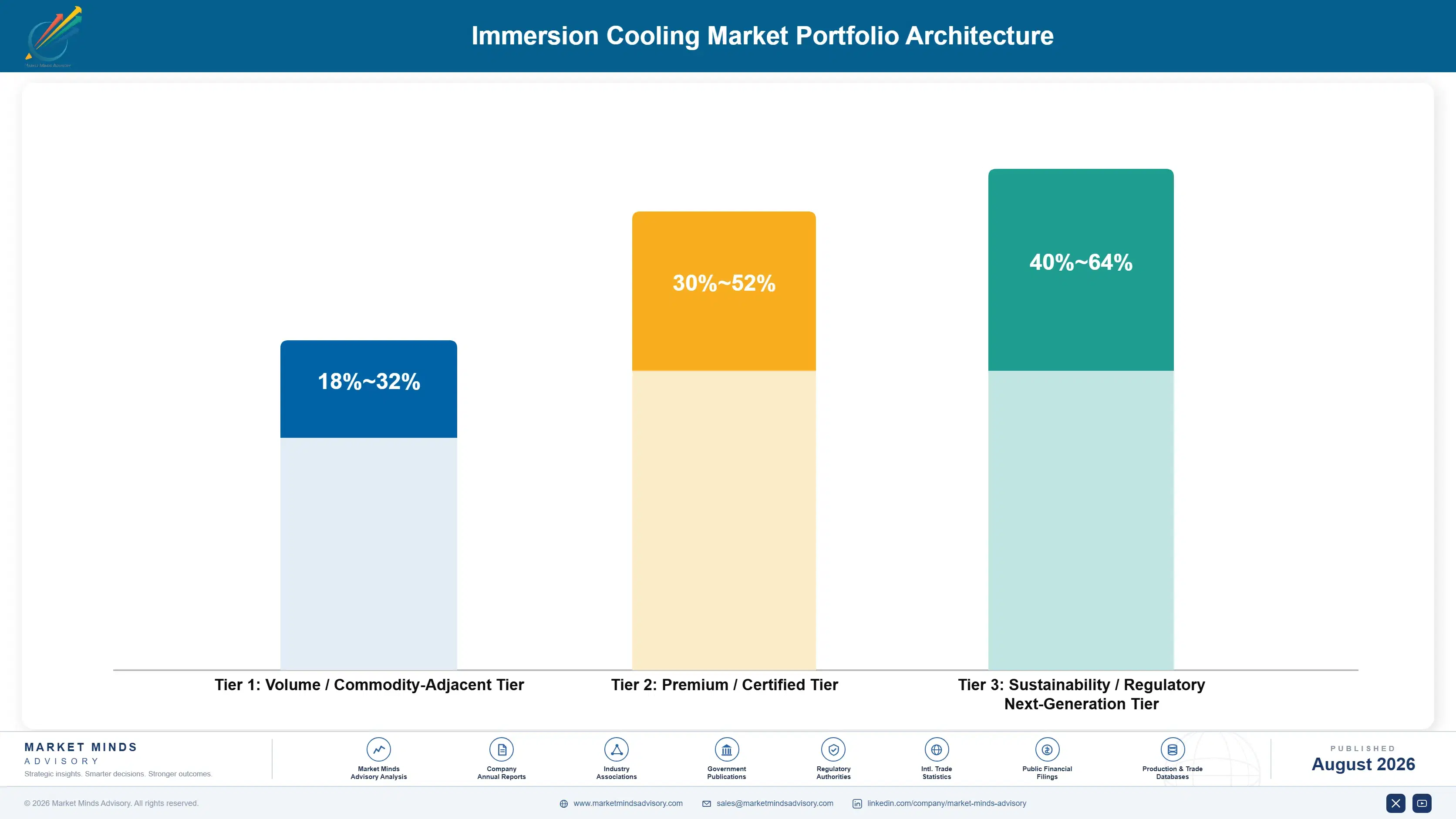
The portfolio splits into three tiers with sharply different economics. Tanks, pumps, and containment hardware form the volume tier, competing on price and delivery with margin depending on manufacturing standardisation. Fluid supply and heat rejection systems earn more because chemistry and integration narrow the field. Design services, server qualification, and heat reuse integration sit differently again, priced against the problem solved rather than equipment supplied.
The tension runs between hardware that wins the deployment and fluid that earns across its life. Tanks are what the operator thinks they are buying, and they create the fluid demand that recurs afterwards, so retreating from hardware surrenders the entry point. Yet tank engineering is broadly comparable and price competition is arriving as volumes grow. Suppliers handling this well use hardware to establish position and build fluid revenue behind it.

High-value pools concentrate where chemistry, qualification, or design access limits competition: single-phase fluid supply free of regulatory exposure, server configurations qualified for submerged warranty coverage, greenfield design participation ahead of tender, and heat reuse integration that secures planning approval. All four escape the equipment price comparison. Standard tanks and pumps sit at the other end, competing against any manufacturer building to the same dimensions.

Volume / Commodity-Adjacent Tier

Immersion tanks, circulation pumps, containment hardware, and standard mechanical assemblies. The range is wide because manufacturing standardisation varies enormously and bespoke engineering for every deployment destroys margin that volume producers retain.
Gross Margin: 18-32%

Premium / Certified Tier

Dielectric fluid supply, heat rejection and secondary loop integration, and systems carrying server manufacturer qualification. The range is wide because single-phase fluid competes on petrochemical economics while qualified configurations price on the objection they remove.
Gross Margin: 30-52%

Sustainability / Regulatory / Next-Generation Tier

Heat reuse integration, water reduction design for permitting, greenfield facility design services, and non-fluorinated two-phase development. The range is wide because permitting-critical work prices strongly while next-generation chemistry still carries unrecovered development cost.
Gross Margin: 40-64%
immersion-cooling-market-portfolio-architecture-1787324589757

High-value Sub-segments and Strategic Watch-out

Two-Phase Immersion Systems

High value and high growth at 27.4%, the fastest architecture, removing heat at densities single-phase circulation cannot approach through latent heat transfer. Fluorochemical restriction is a genuine threat to the chemistry rather than a compliance inconvenience, and no drop-in replacement exists. Latent heat transfer is genuinely superior here.
Gross Margin: 34-56%

Dielectric Fluids and Coolants

High value with strong growth at 23.6%, representing roughly 34% of installed cost and generating recurring replacement demand across every deployment. Fluid choice constrains material compatibility, fire classification, and disposal, so the supplier holding it shapes everything downstream. Replacement demand builds a recurring revenue stream.
Gross Margin: 32-54%

Single-Phase Immersion Systems

The volume core by deployments, growing at 19.8% on hydrocarbon and ester fluids facing no meaningful regulatory exposure. Density capability sits below two-phase but above anything air can achieve, which suits most accelerator deployments perfectly well today. Most accelerator deployments do not need more than this.
Gross Margin: 22-40%

Design, Installation, and Maintenance Services

The strategic watch-out, growing at 18.4% and scaling with engineering headcount rather than with equipment volume, which caps margin. Standardisation across deployments is the only escape, and retrofit work resists it because every existing building differs. Standardisation across deployments is the only route to acceptable margin.
Gross Margin: 26-44%

How Immersion Deployments Actually Commit

Demand commits at facility design and repeats as the campus expands. An operator specifying immersion for one hall builds the containment, procedures, and relationships that make the second straightforward, so the first deployment is disproportionately valuable. Losing it usually means losing the campus and often the operator entirely. Fluid then generates recurring revenue across the installed life, which is the annuity behind an otherwise lumpy equipment business.
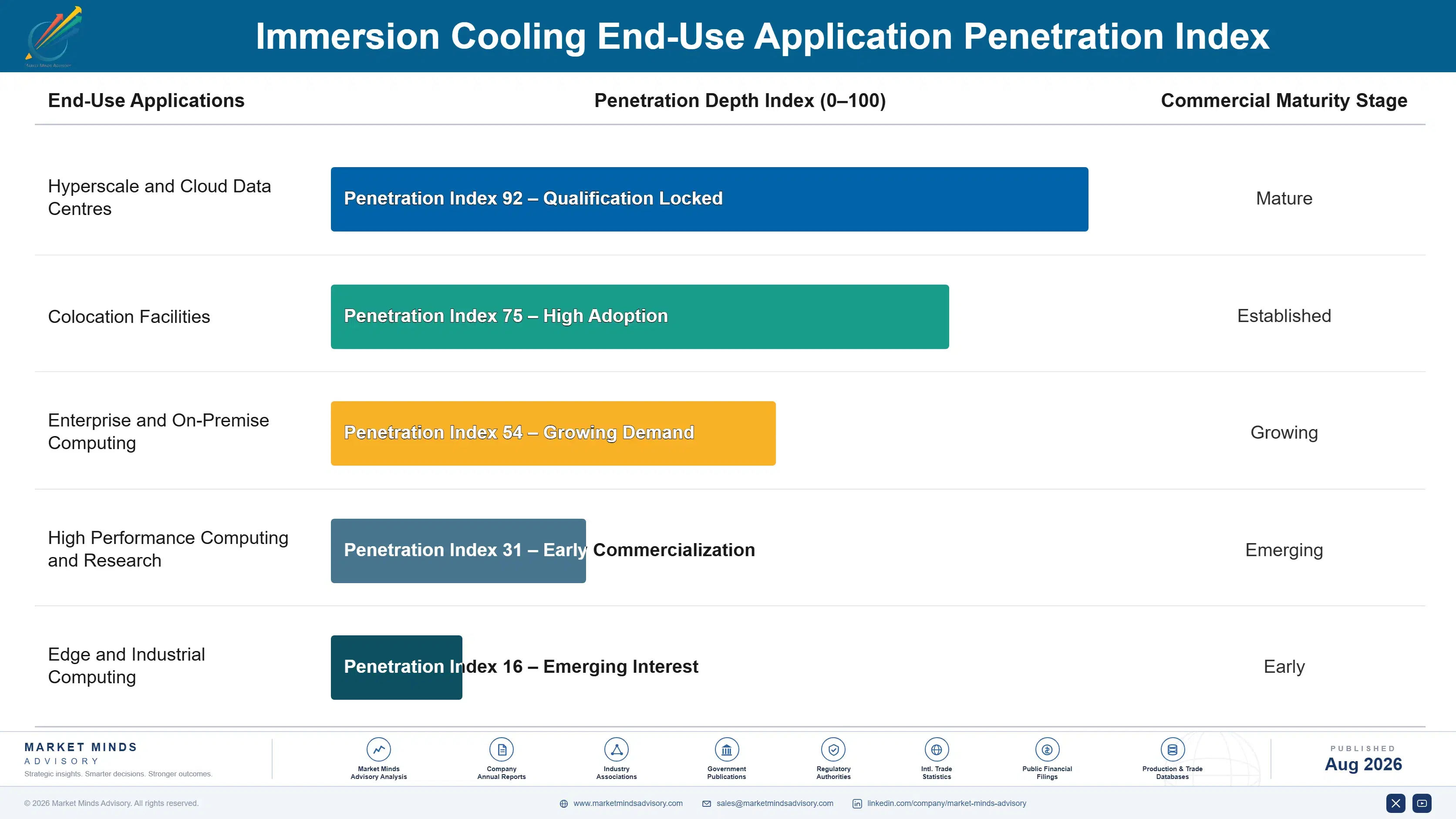
Stickiness varies sharply by deployment type. Greenfield campuses stick hardest, since the building was designed around the supplier's tank dimensions and containment approach. Colocation providers stick through tenant service commitments and standardised hall design. Enterprise retrofits stick least, because they are usually single-hall projects with no expansion behind them. Cryptocurrency operators historically stuck not at all, which is why their earlier adoption did the category little lasting good.

Buyer profiles have shifted from facilities engineers evaluating cooling efficiency toward design and construction teams, sustainability functions reporting water use, and increasingly planning and real estate groups managing permitting. That last shift matters most, because an operator refused permission evaluates water reduction completely differently from one comparing costs. Younger design teams also start from liquid cooling assumptions rather than treating it as an exception.
immersion-cooling-market-end-use-penetration-index-1787324590249

Our Call On Immersion Cooling

These are among the four positions where our research anticipates prominent divergence between winners and laggards over the coming forecast period. Each is grounded in the demand model, the regulatory perimeter, and the announced capacity pipeline.
01 / DENSITY REMOVED CHOICE

Physics decided this before any business case did

A rack drawing well beyond thirty kilowatts cannot be cooled by forced air at acceptable velocity, while immersion removes heat at up to 200 kilowatts per rack, which converts a debate about efficiency into a hard engineering constraint. Adoption accelerated the moment accelerator deployment became the dominant workload rather than at any point when the payback improved. Suppliers should lead with the density limit and what happens beyond it, because that argument closes far faster than any operating cost comparison has ever managed.
02 / FLUID CARRIES THE RISK

Chemistry exposure now outweighs thermal performance

Two-phase immersion depends on engineered fluids caught within broad fluorochemical restriction proposals, and no drop-in replacement matches boiling point, dielectric behaviour, and material compatibility all at once. Single-phase hydrocarbon and ester fluids face no comparable regulatory exposure at all. Buyers are now weighing that regulatory risk above the density advantage two-phase offers, which means suppliers should qualify systems across multiple chemistries at design stage rather than defending a single architecture into a restriction outcome they cannot influence at all, whatever the engineering merits.
03 / DESIGN ACCESS DECIDES

Arriving after the building is specified means losing

Retrofitting an existing hall costs 1.8 to 3.2 times greenfield installation because floor loading, containment, and maintenance procedures all need rebuilding around infrastructure originally designed for air handling. A supplier engaging at the site planning stage captures deployments that never reach a competitive tender at all, which is where the margin actually sits. Those arriving afterwards are quoting into a cost comparison weighted against them from the start, so commercial resource belongs with design consultants and construction teams rather than with facilities procurement.
04 / PERMITTING BEATS EFFICIENCY

Water reduction sells where cooling savings never could

Evaporative consumption has become a planning condition across Arizona, Texas, Dublin, and a growing list of water-stressed jurisdictions, and immersion removes up to 95% of that consumption through closed liquid loops. An operator refused permission does not build the facility at all, which values water reduction far above any efficiency saving available on the same site. Suppliers should engage planning and real estate functions directly, because those buyers evaluate this technology on completely different criteria from anyone sitting in facilities engineering.

Engagement Snapshot From the Field

A live engagement with an industry participant carrying material or product regulatory and market exposure ahead of a defining policy shift, showing how our research translates into a defensible multi-year portfolio strategy.
MARKET MINDS ADVISORY · CLIENT ENGAGEMENT SUMMARY
Immersion Cooling Producer Strategic Portfolio Review and Transition Roadmap 2026·Investment Scenario on Immersion Cooling Exposure Evaluation 2025-26
CLIENT PROFILE
A colocation operator running eleven facilities across three countries engaged MMA after two prospective accelerator tenants specified rack densities its halls could not cool. The client reported that no existing facility could exceed roughly 35 kilowatts per rack, and that the two tenancies at risk represented about USD 46 million of annual contracted revenue (client-reported, unverified by MMA).
STRATEGIC CHALLENGE
Retrofitting existing halls looked prohibitively expensive, and the engineering team had defaulted to two-phase immersion on density grounds without assessing the fluorochemical restriction exposure attached to it. Meanwhile a greenfield site already in planning could accommodate either approach if the decision were made before design freeze. The board needed a technology choice it would not have to reverse within five years.
MMA APPROACH
MMA assessed both immersion architectures and direct-to-chip cooling against the client's actual tenant density requirements rather than against maximum capability claims. We modelled fluorochemical restriction scenarios and their effect on two-phase fluid availability and cost across the asset life. We then costed partial-hall retrofit against greenfield design participation, using the client's own floor loading and containment constraints.
KEY FINDINGS
  1. Tenant requirements sat below 90 kilowatts per rack, which single-phase immersion handled comfortably without any two-phase fluid exposure (client-reported, unverified by MMA).
  2. Two-phase fluid availability carried genuine risk across the asset life, and no drop-in replacement matched boiling point and material compatibility together at equivalent performance.
  3. Partial-hall retrofit at one facility cost roughly 2.1 times greenfield equivalent but retained a tenancy worth considerably more than the difference over the contract term.
  4. Committing the greenfield site to immersion before design freeze avoided about 40% of the cost a later conversion would have carried (client-reported, unverified by MMA).
CLIENT PROFILE
A colocation operator running eleven facilities across three countries engaged MMA after two prospective accelerator tenants specified rack densities its halls could not cool. The client reported that no existing facility could exceed roughly 35 kilowatts per rack, and that the two tenancies at risk represented about USD 46 million of annual contracted revenue (client-reported, unverified by MMA).
STRATEGIC CHALLENGE
Retrofitting existing halls looked prohibitively expensive, and the engineering team had defaulted to two-phase immersion on density grounds without assessing the fluorochemical restriction exposure attached to it. Meanwhile a greenfield site already in planning could accommodate either approach if the decision were made before design freeze. The board needed a technology choice it would not have to reverse within five years.
MMA APPROACH
MMA assessed both immersion architectures and direct-to-chip cooling against the client's actual tenant density requirements rather than against maximum capability claims. We modelled fluorochemical restriction scenarios and their effect on two-phase fluid availability and cost across the asset life. We then costed partial-hall retrofit against greenfield design participation, using the client's own floor loading and containment constraints.
KEY FINDINGS
  1. Tenant requirements sat below 90 kilowatts per rack, which single-phase immersion handled comfortably without any two-phase fluid exposure (client-reported, unverified by MMA).
  2. Two-phase fluid availability carried genuine risk across the asset life, and no drop-in replacement matched boiling point and material compatibility together at equivalent performance.
  3. Partial-hall retrofit at one facility cost roughly 2.1 times greenfield equivalent but retained a tenancy worth considerably more than the difference over the contract term.
  4. Committing the greenfield site to immersion before design freeze avoided about 40% of the cost a later conversion would have carried (client-reported, unverified by MMA).
RECOMMENDED STRATEGY
Phase 1: Phase 1 (0 to 6 months): Select single-phase immersion and commit the greenfield site to it before design freeze rather than after. Phase 2: Phase 2 (6 to 18 months): Retrofit one existing hall partially to retain the at-risk tenancy while greenfield capacity is built. Phase 3: Phase 3 (18 to 32 months): Standardise tank and containment design across the estate and negotiate multi-year fluid supply agreements.
OUTCOME
The client retained both tenancies and committed its greenfield site to single-phase immersion ahead of design freeze, avoiding the conversion premium entirely. Standardised containment design across subsequent halls cut engineering cost per deployment noticeably, and the fluorochemical exposure the engineering team had nearly accepted was avoided altogether (client-reported, unverified by MMA).

Frequently Asked Questions

Foundational context covering the market sizes, CAGR, scope, country, region and competition that inform every finding below. This section is provided to cover basics and most often pre-purchase conversations, answered from the MMA Primary Research Dataset.

What is the current size of the Immersion Cooling Market?

The global immersion cooling market is valued at USD 1.1 billion in 2025, covering single-phase and two-phase systems, dielectric fluids, heat rejection equipment, and associated services. Direct-to-chip cold plate cooling and conventional air systems are excluded.

How large will the Immersion Cooling Market be by 2036?

The market is forecast to reach USD 8.65 billion by 2036 in the base case, about 6.46 times the 2026 level. That represents incremental value of roughly USD 7.31 billion across the decade.

What is the CAGR for the Immersion Cooling Market 2026 to 2036?

The market grows at a 20.5% CAGR in the base case, with bull and bear scenarios at 21.9% and 19.2%. The spread turns mainly on fluorochemical restriction and whether direct-to-chip cooling takes the density growth.

Which segment is growing fastest?

Two-phase immersion systems grow fastest at 27.4%, about 1.34 times the overall rate, because latent heat transfer reaches densities circulation cannot. Dielectric fluids and coolants follow at 23.6%.

Who are the major companies in the Immersion Cooling Market?

Leading participants include Submer, GRC, LiquidStack, Vertiv, and Iceotope. Concentration is moderate, with the top five holding roughly 41% of deployed system value across specialists and infrastructure incumbents.

Which country is growing fastest?

India grows fastest at a 31.6% CAGR from almost nothing, as data centre construction accelerates where ambient heat and contested water both favour immersion. China follows on construction volume and efficiency targets.

Report Segmentation Architecture

The full report scope spans multiple orthogonal segmentation dimensions, with cross-tabulated demand data provided for each dimension pair. Coverage extends further to regional breakdowns, trend trajectories, and the competitive detail needed to support segment-level decision-making.

By System Architecture

  • Single-Phase Immersion Systems
  • Two-Phase Immersion Systems
  • Dielectric Fluids and Coolants
  • Heat Rejection and Secondary Loop Equipment
  • Design, Installation, and Maintenance Services

By End-Use Application

  • Hyperscale and Cloud Data Centres
  • Colocation Facilities
  • Enterprise and On-Premise Computing
  • High Performance Computing and Research
  • Edge and Industrial Computing

By Delivery Model

  • Direct Sale To Operator
  • Design and Build Contract
  • Fluid Supply Agreement
  • Integrator and Channel Partner

By Region

  • North America
  • Western Europe
  • East Asia
  • South Asia and Pacific
  • Latin America
  • Middle East and Africa
  • Eastern Europe

Scope, Methodology, and Coverage

Every figure in this report is reproducible from documented input assumptions. The scope below maps the historical period, the forecast horizon, the segmentation dimensions, and the countries covered, alongside the underlying primary and qualitative methodology.
Historical Period
2020 to 2025
Forecast Period
2026 to 2036
Base Year
2025 (USD billions; MMA Primary Research Dataset, August 2026)
Market Definition
The immersion cooling market comprises systems that remove heat from electronic computing equipment by submerging it directly in thermally conductive dielectric fluid, valued at supplier revenue from equipment, fluids, and associated services. It spans single-phase immersion tanks and circulation systems, two-phase immersion systems using boiling and condensing fluids, dielectric coolants and their replacement supply, heat rejection and secondary loop equipment supplied as part of an immersion installation, and the design, installation, commissioning, and maintenance services attached to them. Direct-to-chip cold plate liquid cooling, rear-door heat exchangers, conventional air-cooled and chilled water systems, industrial process cooling chemicals and water treatment, building cooling systems, and the servers, accelerators, or mining hardware being cooled are excluded.
Quantitative Units
USD billions (current prices); deployed cooling capacity in megawatts where applicable
Segmentation Dimensions
By System Architecture; By End-Use Application; By Delivery Model; By Region
Regions Covered
North America, Western Europe, East Asia, South Asia and Pacific, Latin America, Middle East and Africa, Eastern Europe
Countries Covered
USA, China, Germany, France, UK, Japan, South Korea, India, Australia, Canada, Brazil, Mexico, Indonesia, Vietnam, Thailand, Malaysia, UAE, Saudi Arabia, South Africa, Nigeria, Turkey, Poland, Netherlands, Italy, Spain, Sweden, Switzerland, Argentina, Colombia, Singapore, and additional markets relevant to this sector
Key Companies Profiled
Submer, GRC, LiquidStack, Vertiv, Iceotope, Asperitas, Midas Immersion Cooling, Shell, TotalEnergies, Castrol, Engineered Fluids, Chemours, Solvay, Schneider Electric, Munters, Wiwynn, Supermicro, Inspur, Sugon, DUG Technology
Quantitative Methodology
Primary survey, n=3,800 respondents, Q4 2025, six countries; demand-side model with trade association cross-validation
Qualitative Methodology
47 expert interviews, Q4 2025; applied to validate demand model assumptions, identify emerging dynamics, and assess competitive positioning
Report Format
PDF and XLSX data workbook (Word format preview document)
Publisher
Market Minds Advisory
Report Code
MMA-2026-TEC-204
Published
August 2026
Contact
sales@marketmindsadvisory.com | www.marketmindsadvisory.com

Purchase the full Immersion Cooling Market Report (2026 to 2036).

The full MMA Immersion Cooling report sizes the market across five system architectures, five end-use applications, four delivery models, and seven regions through 2036. It profiles 20 participants on a consistent basis of immersion system, fluid, and service revenue, scoring each on server qualification depth, deployment references at scale, fluid position, and design participation reach. Scenario models quantify how accelerator density, fluorochemical restriction, and water permitting move both deployment volume and achievable margin by architecture. The report also includes retrofit versus greenfield cost modelling, fluid regulatory exposure assessment by chemistry, server qualification coverage mapping, and water permitting condition tracking across major data centre markets.
Five-architecture and four-model market sizing to 2036
Twenty-participant benchmark on immersion system and fluid revenue
Retrofit versus greenfield installation cost modelling by facility type
Fluid regulatory exposure assessment across two-phase and single-phase chemistries
Server manufacturer qualification coverage mapping by hardware model
Water permitting condition tracking across major data centre markets

Built For The People Who Decide

From boardroom strategy to bench-side execution, this report is read cover-to-cover by leaders shaping the next decade of their industry, turning demand scenarios, market dynamics and valuation benchmarks into decisions.
CXOs/ Presidents/ VPs/ Managers
M&A and Corporate Development
Strategy Teams and R&D Heads
Procurement and Product Directors
Regulatory and Compliance Leaders
Investor Relations and Equity Analysts