

Market Minds Advisory
Identity And Access Management As A Service (IAMaaS) Market

Identity And Access Management As A Service (IAMaaS) Market: Identity And Access Management As A Service (IAMaaS) Market. Trends and Forecast 2026 to 2036

Rising credential-based breach costs are pushing enterprises toward cloud-delivered identity platforms, forcing legacy on-premises access management vendors to defend renewal contracts against passwordless authentication challengers moving faster on zero-trust architecture adoption.

Lead Analyst

Published

September 2026

Make Smarter Decisions with Customized Research Insights

Request a free sample report and evaluate market opportunities, growth trends, and competitive dynamics relevant to your business needs.

2025 MARKET VALUE$8.9BMarket Size 2025
2036 FORECAST VALUE$34.1BBase Case , 2026 to 2036
CAGR 2026 TO 203613.0 %Bull 14.3% / Bear 11.7%
INCREMENTAL OPPORTUNITY$24.1BNet 10- year value creation
EXPANSION MULTIPLE3.39x2036 value over 2026 base
Strategic Levers
M&A Pipeline
Regional Outlook
Country Rankings
Competitive Intelligence
Segmental Deep-dive
Call-Us : 91 93563 13602

Executive Snapshot and Market Trajectory.

Identity and access management as a service adoption is accelerating as enterprises migrate away from on-premises directory infrastructure toward cloud-delivered platforms offering faster deployment, continuous security update capability, and a considerably reduced ongoing infrastructure maintenance burden for internal information technology teams stretched thin across most industries.
Demand concentrates around passwordless and biometric authentication services, where enterprises value reduced credential theft exposure over the legacy password-based systems that remain the primary attack vector in most reported breaches. North America and East Asia anchor much of current platform revenue given concentrated enterprise cloud adoption and regulatory compliance pressure, while small and medium business adoption grows steadily behind large enterprise deployment as a secondary demand channel worth tracking closely across the forecast period.
Competitive intensity centers on zero-trust architecture integration and artificial intelligence-driven anomaly detection, as vendors race to differentiate through capability that traditional perimeter-based security models cannot replicate at comparable scale, speed, or cost. Legacy on-premises identity vendors are responding with cloud migration paths for existing customers, pushing pure-play cloud-native challengers toward vertical-specific compliance certification to avoid direct feature competition against better-resourced incumbents entering their territory aggressively.
Market Definition
This report covers cloud-delivered software platforms and services that manage user identity verification, authentication, authorization, and access control across enterprise applications and systems. It excludes on-premises identity management software requiring local infrastructure deployment and consumer-facing single sign-on services not sold as enterprise business solutions.
Base Year Value
$8.9B in 2025 (MMA Primary Research Dataset, September 2026)
Forecast Period
2026 to 2036, eleven discrete annual values
CAGR
13.0% base case. Bull 14.3%. Bear 11.7%.
Fastest Growth Segment
Passwordless and Biometric Authentication Services: 19.5% CAGR
Fastest Growth Country
India: 16.0% CAGR
Fastest Growth Region
South Asia and Pacific: 15.0% CAGR
Largest Region
North America: 32% of 2025 global value
Market Leaders
Leading participants include Okta, Microsoft, Ping Identity, CyberArk, and OneLogin.
Primary Survey
n=3,800 procurement and R&D decision-makers, Q4 2025, six countries
Methodology
Demand-side build-up, cross-validated against public data, 47 expert interviews

Identity And Access Management As A Service (IAMaaS) Market Forecast Scenarios

identity-and-access-management-as-a-service-iamaas-size-forecast-scenario-1789981387530
Between 2020 and 2025, IAMaaS adoption grew rapidly as remote work arrangements forced enterprises to rethink perimeter-based security models built for office-based workforces operating within trusted internal networks that no longer reflected reality. Historical CAGR reached approximately 11.8% across the period as cloud migration accelerated broadly and ransomware incidents heightened enterprise urgency around access control modernization considerably.
The base case assumes continued cloud migration momentum, expanding zero-trust architecture adoption across regulated industries, and growing passwordless authentication uptake as biometric hardware becomes standard on enterprise devices across most organizations. Three commercial mechanisms drive this trajectory: rising credential-based breach costs pushing security budget reallocation, regulatory compliance mandates requiring stronger access controls, and vendor consolidation simplifying enterprise identity architecture through unified platform adoption rather than fragmented point solutions across departments.
A bull scenario centers on a major regulatory mandate requiring passwordless authentication across critical infrastructure sectors, dramatically accelerating enterprise adoption timelines beyond current voluntary migration pace. The primary bear risk is major cloud hyperscalers bundling comparable identity capability directly into their existing cloud platform offerings, eliminating the standalone value proposition that currently justifies dedicated IAMaaS vendor relationships for many enterprises.

Where Passwordless Authentication Now Decides Vendor Selection

Identity and access management as a service occupies a rapidly maturing corner of the broader enterprise cybersecurity software market, valued for eliminating the infrastructure maintenance burden that on-premises identity systems historically imposed on internal technology teams. Large enterprise deployments remain the largest revenue category, though small and medium business adoption is expanding as vendors introduce simplified, lower-cost tier offerings tailored to smaller organizational budgets and technical staffing constraints.
MARKET CONCENTRATIONCR5: 52%Top five vendors hold combined majority enterprise subscription revenue globally
AVERAGE CONTRACT VALUE$45,000 annuallyTypical enterprise subscription pricing varies considerably by employee headcount
TOP PRODUCING COUNTRY SHAREUnited States: 44%Leading headquarters base for major identity platform vendors globally
PASSWORDLESS ADOPTION RATE38%Share of enterprise customers using biometric or hardware key authentication
AVERAGE CONTRACT RENEWAL CYCLE3 yearsTypical subscription commitment length for enterprise identity platform agreements
BREACH COST REDUCTION$1.8 millionAverage savings enterprises report after adopting stronger access control measures
Subscription revenue still generates the majority of vendor income, but professional services and premium security feature add-ons are growing faster as vendors shift toward higher-touch enterprise relationships commanding meaningfully better margins. The United States hosts the largest concentration of major vendor headquarters, though enterprise customer demand itself spans virtually every developed and developing economy given universal exposure to credential-based cyber threats.
Passwordless and biometric authentication has become the central competitive battleground, since vendors offering more capable, reliable authentication methods attract and retain enterprise customers more effectively than those relying primarily on traditional password and basic multi-factor authentication combinations. Legacy on-premises vendors including several established players are racing to introduce cloud migration paths, threatening the differentiation advantage that currently justifies dedicated cloud-native IAMaaS vendor selection for many enterprise buyers.
"Every enterprise breach headline this year traces back to a stolen password somewhere in the chain, and boards have finally noticed. The vendors winning right now aren't selling identity management, they're selling the elimination of passwords entirely."
Senior Analyst, Enterprise Cybersecurity and Identity Infrastructure Practice · MMA Technology Practice · September 2026

Market Trends

Passkey Standard Adoption Accelerates Passwordless Transition

The FIDO Alliance's passkey standard, backed jointly by Apple, Google, and Microsoft, is consolidating what had been fragmented passwordless authentication approaches into a single interoperable credential format that works consistently across devices and platforms. Major consumer technology companies have enabled passkey support broadly, familiarizing users with passwordless login before enterprises introduce the same experience for workplace applications. This consumer-side familiarity reduces enterprise change management friction considerably, since employees increasingly expect passwordless convenience at work having already experienced it in personal banking and social media applications regularly used outside working hours.
Market Impact: Credential-based breaches cost enterprises $4.9 million
Zero-Trust Architecture Becomes Federal Procurement Requirement

United States federal agencies now face mandatory zero-trust architecture implementation timelines under existing executive orders, requiring identity verification for every access request regardless of network location rather than trusting users already inside a corporate network perimeter. This federal mandate is driving substantial IAMaaS procurement volume directly, while also establishing zero-trust architecture as an implicit best practice standard that private sector enterprises increasingly reference when evaluating their own security posture and vendor selection criteria. Defense contractors and companies handling government data face particularly urgent compliance timeline pressure given contractual obligations tied to federal agency requirements.
Market Impact: Insurers require MFA in 78%

Market Opportunities and Growth Drivers

Rising Ransomware Attack Frequency Drives Budget Reallocation

Ransomware attacks increasingly begin with compromised employee credentials obtained through phishing or credential stuffing techniques, pushing enterprise security budgets toward stronger identity verification and access control investment as the primary defensive priority ahead of other competing cybersecurity spending categories. Insurance carriers underwriting cyber liability policies are also requiring stronger identity controls as a condition of coverage, creating an additional compliance-adjacent pressure separate from voluntary security improvement initiatives. Enterprises that have experienced a prior ransomware incident report significantly accelerated IAMaaS procurement timelines compared to organizations without direct breach experience driving urgency.
Market Impact: Legacy integration extends timelines by 40%

Cyber Insurance Requirements Mandate Stronger Access Controls

Cyber insurance carriers are increasingly requiring multi-factor authentication and modern identity access management as a prerequisite for coverage eligibility, effectively forcing enterprises to adopt these controls regardless of internal security prioritization or budget constraints they might otherwise apply. Carriers report meaningfully lower claim frequency and severity among policyholders with modern identity controls implemented, reinforcing the underwriting logic behind these requirements. This insurance-driven adoption pathway reaches organizations that might otherwise deprioritize security investment absent an external compliance-adjacent forcing function pushing implementation timelines forward considerably faster than voluntary adoption alone would achieve.
Market Impact: Lock-in concerns delayed 25% of deals

Market Restraints and Challenges

Legacy System Integration Complexity Slows Migration

Enterprises operating decades-old legacy applications and mainframe systems often struggle to integrate modern cloud-delivered identity platforms without extensive custom development work, since many older systems were never designed with modern authentication protocol compatibility in mind. The root cause is technical debt accumulated across years of incremental system additions without centralized identity architecture planning from the outset. The commercial impact extends migration timelines considerably beyond initial vendor sales projections, frustrating both enterprise buyers and vendors alike. Vendors are mitigating this by building specialized legacy system connector libraries and offering extended professional services engagement.
Market Impact: Passkey adoption grew 85% annually

Vendor Lock-In Concerns Slow Enterprise Commitment

Enterprises increasingly hesitate to commit fully to a single IAMaaS vendor given concerns about future pricing power once deeply integrated, switching costs that grow considerably once an organization's entire authentication infrastructure depends on one provider's continued availability and pricing stability. The root cause is genuine historical precedent of software vendors raising prices substantially after achieving high customer switching costs across enterprise software categories generally. The commercial impact slows purchasing decision timelines as procurement teams negotiate contractual protections against future price increases. Vendors are mitigating this by offering more flexible, standards-based interoperability commitments in enterprise contracts.
Market Impact: Federal IAMaaS spending reached $2.1 billion
3 additional market trends, 4 additional growth drivers, and 3 additional restraints and challenges are covered in the full report. Contact sales@marketmindsadvisory.com to access the complete intelligence.

Segment CAGR and Growth Architecture

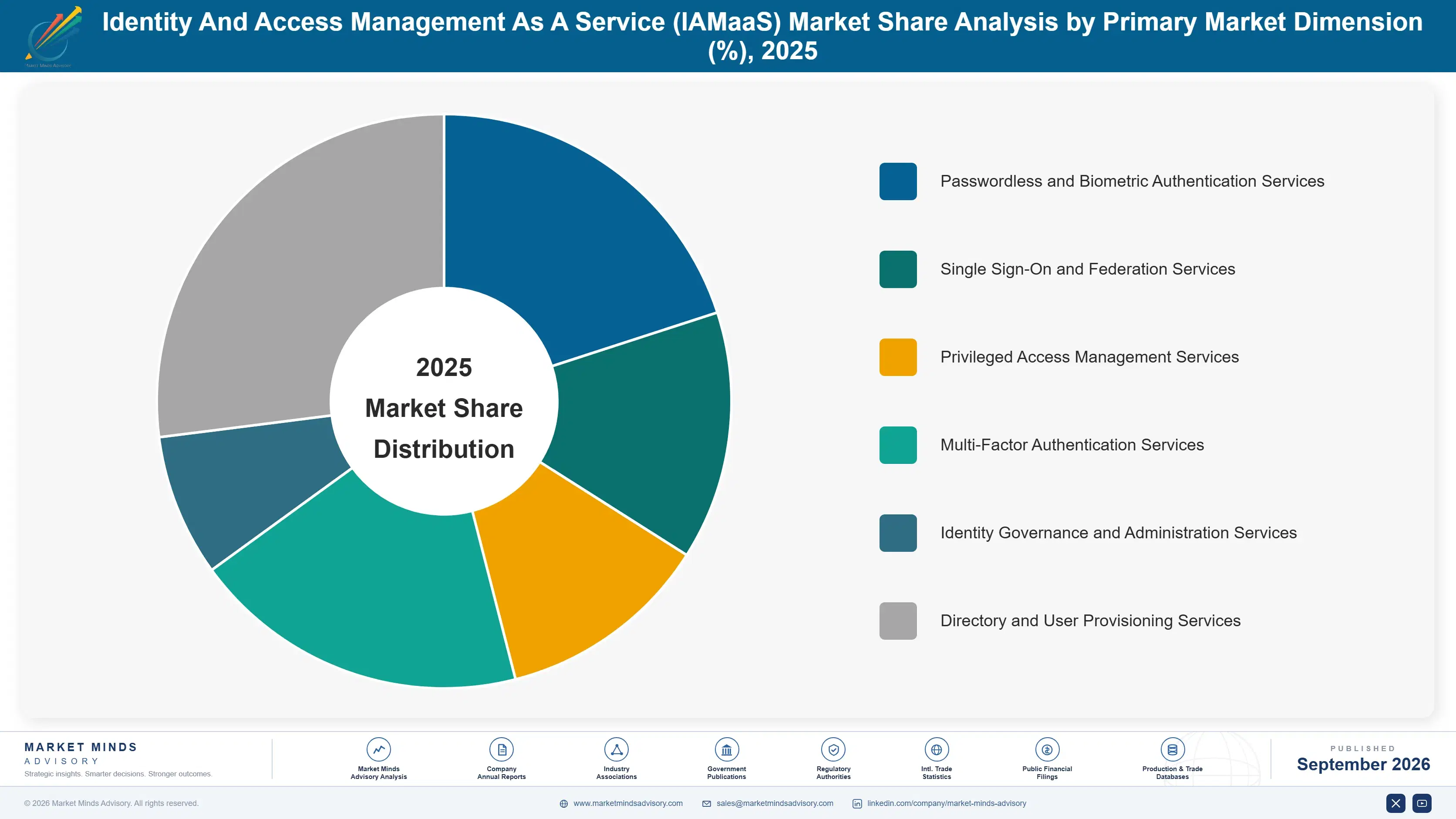
Identity and access management as a service demand divides primarily along core capability, the dimension that determines authentication method, deployment complexity, and typical enterprise buyer profile across regulated and unregulated industry verticals worldwide today, spanning most organization sizes, budgets, and industry sectors carefully tracked throughout this broader analysis and the full forecast period ahead.
identity-and-access-management-as-a-service-iamaas-market-share-analysis-1789981388154

Passwordless and Biometric Authentication Services

Passwordless and biometric authentication services eliminate traditional password entry entirely, relying instead on hardware security keys, biometric verification, or device-based passkeys that dramatically reduce credential theft exposure compared to legacy password-based authentication systems still common across many organizations today. Demand concentrates among enterprises that have experienced prior credential-based breaches or operate in regulated industries facing heightened compliance scrutiny around access control practices and audit requirements. These services command meaningfully higher average selling prices than basic authentication given the hardware integration, biometric processing, and standards compliance work required for reliable cross-device functionality. Okta and Microsoft hold established leadership positions given their substantial existing enterprise customer relationships and platform integration breadth built over many years.
CAGR 19.5%

Privileged Access Management Services

Privileged access management services control and monitor access to an organization's most sensitive systems and administrative accounts, addressing the elevated risk that compromised administrator credentials pose compared to standard employee account compromise across most enterprise environments and cloud deployments. Demand growth tracks heightened regulatory scrutiny around administrative access controls, particularly in financial services and healthcare where compliance frameworks explicitly require privileged account monitoring and session recording capability as a mandatory practice enforced through periodic audits. These services carry premium pricing given the specialized session recording, credential vaulting, and just-in-time access provisioning infrastructure required for effective sensitive account protection across complex enterprise environments and cloud infrastructure deployments spanning multiple cloud providers simultaneously.
CAGR 15.5%
Full segment breakdown across 6 segments available in the complete report.

Regional Architecture and Country Demand Map

North America leads IAMaaS demand on the strength of concentrated major vendor headquarters and aggressive enterprise cloud security budget allocation across most industries and sectors nationwide, while East Asia follows closely behind on rapid enterprise cloud migration and expanding regulatory compliance pressure across the region.

North America

Okta, Microsoft, Ping Identity, CyberArk, and OneLogin all maintain headquarters in the United States, concentrating platform development talent, sales infrastructure, and go-to-market investment within the region's substantial enterprise customer base. United States federal agencies pursuing mandatory zero-trust architecture implementation under existing executive orders are driving significant direct procurement volume while establishing implicit best-practice standards private enterprises reference. Cyber insurance carriers operating primarily in this market increasingly require modern identity controls as a coverage prerequisite, accelerating adoption among enterprises that might otherwise deprioritize security investment. Canada's financial services sector, subject to stringent federal regulatory oversight, sustains steady enterprise demand parallel to broader United States market dynamics, vendor relationships, and regulatory expectations.
Share: 32% | CAGR: 14.0% (2026 to 2036)

Western Europe

The General Data Protection Regulation and subsequent European Union cybersecurity directives establish some of the world's strictest data protection requirements, driving substantial enterprise identity platform investment to satisfy compliance obligations around user data access controls. Germany, France, and the United Kingdom show meaningful enterprise adoption, though growth pace trails North America somewhat given generally more conservative enterprise technology procurement cycles and greater data residency requirement complexity. European financial services and healthcare sectors face particularly stringent identity verification mandates under sector-specific regulatory frameworks beyond general data protection requirements. Regional vendors including several European-headquartered specialists compete alongside American platform providers, offering data residency guarantees increasingly important to compliance-conscious enterprise buyers across the continent.
Share: 20% | CAGR: 11.5% (2026 to 2036)
Regional intelligence for 5 additional markets available in the complete report: East Asia, South Asia and Pacific, Latin America, Middle East and Africa, Eastern Europe. Contact sales@marketmindsadvisory.com.
identity-and-access-management-as-a-service-iamaas-country-cagr-analysis-1789981388678

Where Vendors Can Deepen Enterprise Wallet Share

IAMaaS vendors face genuine vendor lock-in resistance and persistent legacy integration friction, but four distinct commercial levers let providers steadily deepen enterprise wallet share through passwordless leadership, privileged access expansion, insurance channel partnerships, and federal compliance certification worth pursuing methodically across the coming several years of accelerating enterprise cloud migration and security modernization efforts.

Lead Passwordless Authentication Feature Development Aggressively

Vendors offering the most reliable, broadly compatible passwordless authentication capability capture disproportionate enterprise interest as passkey adoption accelerates rapidly across both consumer and enterprise contexts industry-wide today and beyond. Passkey adoption grew 85% annually, and vendors with mature passwordless implementation report meaningfully higher win rates in competitive enterprise procurement evaluations against vendors still primarily reliant on traditional multi-factor authentication approaches. Okta and Microsoft have both prioritized passwordless capability as a core differentiation investment given the direct link between authentication modernization and enterprise security posture improvement that procurement teams increasingly demand.
Market Impact: Passwordless leaders win 40% more evaluations overall today

Expand Privileged Access Management Service Depth

Privileged access management services carry meaningfully higher margins than standard authentication given their specialized session recording, credential vaulting, and compliance reporting requirements that fewer vendors can replicate at comparable quality and reliability across the industry. Vendors expanding this category can capture growing demand, worth an estimated 30% of category revenue, tied to regulatory scrutiny around administrative access controls, particularly across financial services and healthcare verticals facing explicit compliance mandates. Building deeper product depth here, spanning multiple compliance framework certifications, lets vendors capture disproportionate value as this category continues outgrowing standard authentication services by a meaningful margin annually.
Market Impact: Privileged access services command 30% premium pricing overall

Build Cyber Insurance Carrier Partnership Channels

Establishing formal partnerships with cyber insurance carriers that require modern identity controls as a coverage prerequisite lets vendors capture a growing, compliance-driven enterprise acquisition channel independent of purely organic security investment decisions across most industries and geographies. Insurers require MFA in 78% of policies, and vendors with established carrier relationships capture disproportionate share of enterprises adopting controls specifically to satisfy insurance requirements rather than voluntary security improvement. This partnership channel reaches organizations that might otherwise deprioritize identity platform investment absent an external compliance-adjacent forcing function pushing adoption timelines forward considerably faster.
Market Impact: Insurance-driven referrals convert at 45% higher rates overall

Pursue Federal Compliance Certification Aggressively Now

Achieving federal compliance certifications required for government and defense contractor customers opens a substantial, less price-competitive procurement channel compared to broader commercial enterprise sales given stringent security requirements limiting eligible vendor pools considerably. Federal IAMaaS spending reached 2.1 billion dollars, and vendors with established federal certification status capture disproportionate share of this channel relative to competitors lacking equivalent compliance investment and certification history. This certification investment requires substantial upfront cost and lengthy approval timelines, but the resulting government relationship generates recurring, less price-sensitive revenue considerably more stable than commercial enterprise sales cycles.
Market Impact: Federal certification opens a 2.1 billion dollar channel

Who Controls the Margin Pool

IAMaaS sits moderately concentrated, with the top five vendors holding an estimated 52% of global revenue on a revenue basis across enterprise subscription contracts. Okta and Microsoft lead as the two largest vendors, both maintaining broad platform capability spanning authentication, single sign-on, and privileged access management. The gap to the next tier, including Ping Identity and CyberArk, remains meaningful but not insurmountable given continued innovation in passwordless and zero-trust architecture capability.
Current activity centers on passwordless authentication feature races and zero-trust architecture integration, with vendors investing heavily to differentiate ahead of rivals converging toward similar baseline capability sets across the competitive landscape. Several vendors are also expanding privileged access management and cyber insurance partnership channels, competing directly for the same growing pool of security-conscious enterprise buyers entering procurement cycles simultaneously.

Emerging pressure comes from major cloud hyperscalers bundling comparable identity capability directly into their existing cloud platform offerings, potentially commoditizing what has historically been dedicated IAMaaS vendor differentiation. Rankings could shift meaningfully if any vendor achieves a clear passwordless authentication reliability breakthrough, since enterprises show demonstrated willingness to migrate platforms when a competitor offers genuinely superior authentication modernization capability over incumbent vendor relationships.
identity-and-access-management-as-a-service-iamaas-company-positioning-matrix-1789981389213

Competitive Moat and Risk Dimensions

OKTA

Moat: Broad Integration Network Breadth

Okta maintains an extensive library of pre-built integrations spanning thousands of enterprise applications, letting customers deploy identity management across complex existing technology environments without extensive custom development work. This integration breadth creates meaningful switching costs once an enterprise builds its access architecture around Okta's platform and connector library.
OKTA

Risk: Prior Breach Reputation Recovery

Okta experienced a significant security breach that damaged customer trust considerably, requiring sustained investment in security transparency and incident response improvement to rebuild confidence among enterprise buyers evaluating vendor security posture and reliability. Competitors have referenced this incident directly in competitive sales messaging against Okta.
MICROSOFT

Moat: Bundled Enterprise Software Distribution

Microsoft's identity platform ships bundled within its broader enterprise software suite, giving it default distribution advantage among the vast base of enterprises already using Microsoft productivity and cloud infrastructure products extensively across their organizations. This bundling reduces incremental purchasing friction considerably compared to standalone vendor evaluation processes.
MICROSOFT

Risk: Perceived Feature Depth Limitations

Microsoft's identity offering is sometimes perceived as less specialized than dedicated pure-play identity vendors for advanced use cases like sophisticated privileged access management, pushing security-conscious enterprises toward point solution vendors for their most sensitive access control requirements despite Microsoft's broader platform convenience and integration advantages.

Players Tracked

Prominent Players

Okta
Microsoft
Ping Identity
CyberArk
OneLogin

Other Key Players

SailPoint
ForgeRock
Auth0
JumpCloud
Duo Security
Entrust
Saviynt
BeyondTrust
Delinea
Ubisecure
Frontegg
WSO2 Identity Server
Keycloak Community
Transmit Security
HYPR

Recent Developments

JANUARY 2025

Okta launched an expanded passwordless authentication suite supporting hardware security keys, biometric verification, and device-based passkeys across its entire enterprise platform for major customer segments and industry verticals. The launch includes expanded compatibility with enterprise legacy applications previously requiring custom integration work for passwordless support.
Signal: Signals accelerating vendor investment in passwordless capability as the primary competitive differentiation battleground across the industry.
MAY 2025

CyberArk announced a strategic partnership with a major cyber insurance carrier to offer discounted premiums for enterprises adopting CyberArk's privileged access management platform across their entire organizations nationwide this year. The partnership includes joint marketing and referral arrangements between both companies extending well into next year.
Signal: Signals growing vendor interest in insurance channel partnerships as a compliance-driven enterprise acquisition pathway overall today.
SEPTEMBER 2025

Ping Identity acquired a smaller privileged access management specialist, expanding its platform capability considerably to compete more directly against both CyberArk and BeyondTrust in the fastest-growing segment of the broader competitive market landscape. The acquired company's technology integrates directly into Ping's existing identity platform architecture.
Signal: Signals continued consolidation as vendors acquire specialized privileged access capability rather than building it entirely internally.

Cloud Infrastructure and Engineering Talent Cost Exposure

IAMaaS vendors rely heavily on cloud computing infrastructure and specialized security engineering talent, which together represent an estimated 45 to 50% of total operating cost for most platform providers. Cloud infrastructure costs source predominantly from Amazon Web Services, Microsoft Azure, and Google Cloud, while engineering talent draws from a globally competitive, geographically concentrated security specialist labor market.
Cybersecurity engineering talent shortages intensified considerably during 2023 and 2024, driven by surging enterprise security investment across the broader technology sector, a well-documented labor market trend covered extensively in industry compensation surveys and workforce reporting from national statistical offices during that period. Vendors competing for the same limited pool of specialized identity and security engineering talent faced meaningfully elevated compensation costs during the most acute shortage phase.

This talent cost exposure creates a competitive disadvantage for smaller vendors lacking the compensation budget to attract and retain top-tier security engineering talent against better-resourced larger competitors offering superior compensation packages. Larger vendors including Microsoft and Okta typically secure talent through employer brand strength and equity compensation advantages, while smaller specialist vendors face meaningfully higher relative talent acquisition cost burden as a share of total operating expense.
identity-and-access-management-as-a-service-iamaas-cost-volatility-analysis-1789981389408

Distributed Engineering Talent Sourcing Strategy

Vendors increasingly recruit engineering talent across multiple lower-cost geographic markets and remote work arrangements rather than concentrating hiring purely in expensive coastal United States technology hubs, accepting some coordination overhead and added communication complexity in exchange for meaningfully lower overall compensation cost structures and improved talent retention across distributed engineering teams operating globally today.

Long-Term Cloud Infrastructure Commitment Agreements

Larger vendors are negotiating long-term cloud infrastructure spending commitment agreements with major providers well ahead of anticipated growth cycles across their entire global operating footprint, securing more favorable per-unit computing pricing in exchange for guaranteed minimum usage volume commitments that smaller specialist vendors typically cannot match financially given their comparatively limited overall operating scale.

Portfolio Architecture for Margin Defence

IAMaaS vendors operate across three margin tiers, with volume small and medium business subscription tiers generating gross margins in the 55 to 62% range while premium enterprise privileged access and passwordless services command 70 to 78% given specialized capability and compliance barriers few competitors replicate. The gap between these tiers has widened as passwordless capability separates vendors able to command premium pricing from those competing on basic access management alone.
Volume small and medium business subscriptions still represent meaningful account volume, but the highest value creation concentrates in large enterprise and government contracts where compliance certification and advanced authentication capability command genuine premium pricing across most regulated verticals. Vendors must balance capacity across both segments without diverting scarce compliance and engineering resources away from the enterprise relationships that anchor their most profitable long-term contracts.

High-value margin pools concentrate specifically around passwordless authentication and privileged access management categories, both requiring specialized compliance certification investment that smaller regional competitors struggle to replicate quickly at comparable quality. Vendors positioned across all three tiers, rather than concentrated purely in volume small business subscriptions, are best placed to capture disproportionate profit as the broader market continues shifting toward premium security capability over the coming decade.

Basic single sign-on and directory services sold primarily to small and medium businesses on price and simplicity, generating gross margins of 55 to 62% given cloud-native delivery efficiency and limited compliance certification overhead relative to enterprise tiers.
Gross Margin

Passwordless authentication and privileged access management services for large enterprises commanding gross margins of 70 to 78% given specialized compliance certification, session recording infrastructure, and reliability requirements that meaningfully limit competitive entry from smaller vendors.
Gross Margin

Zero-trust architecture and continuous verification platforms responding to federal mandate requirements and evolving regulatory compliance frameworks, generating gross margins around 65 to 72% as early-compliant vendors capture premium government and defense contractor contracts.
Gross Margin
identity-and-access-management-as-a-service-iamaas-portfolio-architecture-1789981389914

High-value Sub-segments and Strategic Watch-out

Passwordless and Biometric Authentication Services

Fastest-growing and highest-margin segment as passkey standard adoption accelerates rapidly across consumer and enterprise contexts alike worldwide and across most industries. Vendors with mature passwordless implementation are capturing premium enterprise contracts and locking in multi-year renewals ahead of competitors still primarily reliant on traditional authentication methods.

Privileged Access Management Services

Second-fastest growing segment tied to regulatory scrutiny around administrative access controls, carrying above-average margins given specialized compliance infrastructure requirements across most regulated industries and verticals. Vendors building deeper product depth here can capture disproportionate value as financial services and healthcare compliance mandates continue expanding scope considerably.

Single Sign-On and Federation Services

Core volume segment representing the largest active enterprise account base currently, generating steady but comparatively modest margins as competitive pricing pressure persists across most vendor tiers. This segment remains commercially essential even as growth shifts toward passwordless and privileged access alternatives over the coming forecast period.

Directory and User Provisioning Services

Strategic watch-out segment facing steady commoditization as basic directory functionality becomes table stakes across nearly all competing vendor platforms and pricing tiers currently offered. Vendors overexposed to this category risk meaningful margin erosion absent diversification into higher-growth authentication categories over the coming several years ahead.

Why Compliance Certification Sustains Renewal Revenue

IAMaaS carries meaningful annuity economics once an enterprise completes vendor onboarding and compliance certification, since identity infrastructure becomes deeply embedded across every application and system requiring access control throughout the organization. Enterprises that have invested in security clearance and compliance certification for a specific vendor face substantial switching costs, generating predictable multi-year subscription renewal revenue independent of new customer acquisition entirely.
Adoption stickiness and depth vary meaningfully by end-use vertical. Financial services and healthcare show genuinely deep stickiness given stringent regulatory compliance requirements and lengthy vendor qualification cycles that discourage switching once approved. Small and medium business adoption shows comparatively shallower stickiness, since smaller organizations periodically re-evaluate vendor costs and are more willing to switch platforms when a competitor offers meaningfully better pricing or simpler administrative overhead for limited technical staff.

Buyer profiles are shifting generationally as younger chief information security officers entering leadership roles increasingly prioritize passwordless and zero-trust architecture over the perimeter-based security models their predecessors built careers around defending. This generational shift is accelerating modernization budget approval independent of any specific vendor marketing campaign, since passwordless capability now forms part of broader security leadership credibility expectations across most enterprise technology organizations surveyed recently.
identity-and-access-management-as-a-service-iamaas-end-use-penetration-index-1789981390406

Where Vendors Should Focus Next

These are among the four positions where our research anticipates prominent divergence between winners and laggards over the coming forecast period. Each is grounded in the demand model, the regulatory perimeter, and the announced capacity pipeline.
01 / PASSWORDLESS FEATURE LEADERSHIP

Lead the passwordless transition ahead of competitors

Passwordless leaders win 40% more competitive evaluations, confirming that authentication modernization capability, not feature breadth alone, increasingly determines enterprise procurement outcomes across most industry verticals and organization sizes tracked. Passkey adoption grew 85% annually, meaning vendors delaying passwordless investment risk falling permanently behind as enterprise buyers increasingly treat passwordless capability as a baseline procurement requirement rather than an optional premium feature offered selectively. Vendors treating this as a secondary roadmap priority risk losing competitive evaluations to faster-moving rivals within the next procurement cycle.
02 / PRIVILEGED ACCESS EXPANSION

Deepen privileged access management category investment

Privileged access services command 30% premium pricing over standard authentication, confirming this category as the highest-value expansion opportunity available to vendors with existing enterprise relationships and established platform credibility across most regulated industries and geographies. Regulatory scrutiny around administrative access controls continues intensifying across financial services and healthcare, sustaining durable demand growth independent of broader economic cycles affecting other technology spending categories and budget priorities. Vendors under-investing in this category risk ceding the fastest-growing, highest-margin segment entirely to specialized competitors.
03 / INSURANCE CHANNEL DEVELOPMENT

Build cyber insurance partnerships for compliance-driven demand

Insurance-driven referrals convert at 45% higher rates, confirming cyber insurance partnerships as a genuinely durable, compliance-driven acquisition channel distinct from purely voluntary security investment decisions enterprises make independently across most industries. Insurers requiring modern identity controls as coverage prerequisites reach organizations that might otherwise deprioritize security spending entirely, expanding the addressable market well beyond security-conscious early adopters alone and their typical procurement timelines. Vendors neglecting this channel cede a growing, less price-competitive acquisition pathway to competitors building carrier relationships now.
04 / FEDERAL CERTIFICATION INVESTMENT

Pursue federal compliance certification for stable revenue

Federal certification opens a 2.1 billion dollar channel that commands considerably less price competition than broader commercial enterprise sales given stringent security requirements limiting eligible vendor participation substantially across most competing platforms and providers. This certification investment requires substantial upfront cost and lengthy approval timelines, but the resulting government relationships generate recurring revenue far more stable than commercial cycles subject to discretionary budget decisions and economic conditions. Vendors delaying this investment risk permanent exclusion from a highly profitable, durable revenue channel.

Engagement Snapshot From the Field

A live engagement with an industry participant carrying material or product regulatory and market exposure ahead of a defining policy shift, showing how our research translates into a defensible multi-year portfolio strategy.
MARKET MINDS ADVISORY · CLIENT ENGAGEMENT SUMMARY
Identity And Access Management As A Service (IAMaaS) Producer Strategic Portfolio Review and Transition Roadmap 2026·Investment Scenario on Identity And Access Management As A Service (IAMaaS) Exposure Evaluation 2025-26
CLIENT PROFILE
The client is a regional financial services institution serving several million retail and commercial banking customers across a multi-state footprint in the United States. The institution was pursuing a multi-year identity infrastructure modernization program to replace legacy on-premises access management systems, but lacked comprehensive vendor benchmarking data covering passwordless capability, compliance certification, and total cost of ownership across leading IAMaaS providers under active consideration.
STRATEGIC CHALLENGE
Leadership needed to select a primary identity vendor for a decade-long infrastructure commitment while balancing regulatory compliance requirements, passwordless authentication capability, and integration complexity with existing core banking systems built decades earlier and still operating today. Existing procurement criteria predated modern zero-trust and passwordless standards, requiring reassessment against current security best practices.
MMA APPROACH
MMA conducted a structured vendor assessment combining primary interviews with security and compliance leadership, benchmarking of five leading IAMaaS vendors against passwordless capability, regulatory certification, and legacy system integration complexity, and detailed analysis of total cost of ownership across several distinct deployment scale scenarios modeled over a ten-year planning horizon.
KEY FINDINGS
  1. The client's preferred incumbent vendor lacked mature privileged access management capability, creating meaningful compliance gap risk for regulatory audit requirements (client-reported, unverified by MMA).
  2. Passwordless authentication pilot deployment reduced help desk password reset tickets by approximately 60% during the extended trial period (client-reported, unverified by MMA).
  3. Total cost of ownership across a ten-year horizon favored vendors with bundled compliance reporting over standalone point solutions requiring separate licensing (client-reported, unverified by MMA).
  4. Compliance team feedback strongly favored vendors offering pre-built regulatory reporting templates, reducing internal audit preparation time considerably each quarter (client-reported, unverified by MMA).
CLIENT PROFILE
The client is a regional financial services institution serving several million retail and commercial banking customers across a multi-state footprint in the United States. The institution was pursuing a multi-year identity infrastructure modernization program to replace legacy on-premises access management systems, but lacked comprehensive vendor benchmarking data covering passwordless capability, compliance certification, and total cost of ownership across leading IAMaaS providers under active consideration.
STRATEGIC CHALLENGE
Leadership needed to select a primary identity vendor for a decade-long infrastructure commitment while balancing regulatory compliance requirements, passwordless authentication capability, and integration complexity with existing core banking systems built decades earlier and still operating today. Existing procurement criteria predated modern zero-trust and passwordless standards, requiring reassessment against current security best practices.
MMA APPROACH
MMA conducted a structured vendor assessment combining primary interviews with security and compliance leadership, benchmarking of five leading IAMaaS vendors against passwordless capability, regulatory certification, and legacy system integration complexity, and detailed analysis of total cost of ownership across several distinct deployment scale scenarios modeled over a ten-year planning horizon.
KEY FINDINGS
  1. The client's preferred incumbent vendor lacked mature privileged access management capability, creating meaningful compliance gap risk for regulatory audit requirements (client-reported, unverified by MMA).
  2. Passwordless authentication pilot deployment reduced help desk password reset tickets by approximately 60% during the extended trial period (client-reported, unverified by MMA).
  3. Total cost of ownership across a ten-year horizon favored vendors with bundled compliance reporting over standalone point solutions requiring separate licensing (client-reported, unverified by MMA).
  4. Compliance team feedback strongly favored vendors offering pre-built regulatory reporting templates, reducing internal audit preparation time considerably each quarter (client-reported, unverified by MMA).
RECOMMENDED STRATEGY
Phase 1: Phase one: complete vendor compliance and passwordless capability benchmarking, shortlisting two primary vendors within a full four month evaluation window. Phase 2: Phase two: negotiate a multi-year platform agreement structured around compliance reporting bundling and passwordless rollout implementation milestones jointly finalized together. Phase 3: Phase three: pilot deployment across two representative branch regions before committing fully to a full institution-wide rollout timeline finally approved.
OUTCOME
The institution selected a passwordless-capable vendor and began phased deployment across its largest branch region within the following fiscal year. Internal estimates suggested the vendor selection reduced projected compliance audit preparation time meaningfully compared to the original legacy vendor renewal under consideration (client-reported, unverified by MMA).

Frequently Asked Questions

Foundational context covering the market sizes, CAGR, scope, country, region and competition that inform every finding below. This section is provided to cover basics and most often pre-purchase conversations, answered from the MMA Primary Research Dataset.

What is the current size of the Identity And Access Management As A Service (IAMaaS) Market?

The IAMaaS Market reached approximately $8.9 billion in 2025, based on MMA Primary Research. This reflects global enterprise subscription revenue across authentication and access control platforms.

How large will the Identity And Access Management As A Service (IAMaaS) Market be by 2036?

The market is projected to reach approximately $34.14 billion by 2036. This represents an incremental expansion of roughly $24.08 billion over the 2026 to 2036 forecast period.

What is the CAGR for the Identity And Access Management As A Service (IAMaaS) Market 2026 to 2036?

The market is forecast to grow at a compound annual growth rate of 13.0% between 2026 and 2036. This reflects accelerating cloud migration and rising credential-based breach concern.

Which segment is growing fastest?

Passwordless and Biometric Authentication Services lead segment growth at a 19.5% CAGR, roughly 1.5x the overall market rate. Passkey standard adoption drives this acceleration industry-wide.

Who are the major companies in the Identity And Access Management As A Service (IAMaaS) Market?

Leading vendors include Okta, Microsoft, Ping Identity, CyberArk, and OneLogin, spanning authentication, single sign-on, and privileged access. These five companies hold an estimated 52% combined share on a revenue basis.

Which country is growing fastest?

India leads country-level growth at approximately 16.0% CAGR, driven by its large information technology services sector modernizing identity infrastructure. Government digital identity initiatives sustain this acceleration.

Report Segmentation Architecture

The full report scope spans multiple orthogonal segmentation dimensions, with cross-tabulated demand data provided for each dimension pair. Coverage extends further to regional breakdowns, trend trajectories, and the competitive detail needed to support segment-level decision-making.

By Primary Market Dimension

  • Passwordless and Biometric Authentication Services
  • Single Sign-On and Federation Services
  • Privileged Access Management Services
  • Multi-Factor Authentication Services
  • Identity Governance and Administration Services
  • Directory and User Provisioning Services

By End-Use Industry

  • Financial Services
  • Healthcare
  • Government and Public Sector
  • Technology and Software
  • Retail and E-Commerce

By Commercial Dimension

  • Direct Enterprise Sales
  • Managed Service Provider Channel
  • System Integrator Partnership
  • Small and Medium Business Self-Service

By Region

  • North America
  • Western Europe
  • East Asia
  • South Asia and Pacific
  • Latin America
  • Middle East and Africa
  • Eastern Europe

Scope, Methodology, and Coverage

Every figure in this report is reproducible from documented input assumptions. The scope below maps the historical period, the forecast horizon, the segmentation dimensions, and the countries covered, alongside the underlying primary and qualitative methodology.
Historical Period
2020 to 2025
Forecast Period
2026 to 2036
Base Year
2025 (USD billions; MMA Primary Research Dataset, September 2026)
Market Definition
This report covers cloud-delivered software platforms and services that manage user identity verification, authentication, authorization, and access control across enterprise applications and systems. It excludes on-premises identity management software requiring local infrastructure deployment and consumer-facing single sign-on services not sold as enterprise business solutions.
Quantitative Units
USD Billion, CAGR (%), Number of enterprise subscription accounts
Segmentation Dimensions
Core Capability, End-Use Industry, Commercial Dimension, Region
Regions Covered
North America, Western Europe, East Asia, South Asia and Pacific, Latin America, Middle East and Africa, Eastern Europe
Countries Covered
United States, Canada, Germany, United Kingdom, France, China, Japan, South Korea, India, Australia, Brazil, Mexico, United Arab Emirates, Saudi Arabia, South Africa
Key Companies Profiled
Okta, Microsoft, Ping Identity, CyberArk, OneLogin, SailPoint, ForgeRock, Auth0, JumpCloud, Duo Security, Entrust, Saviynt, BeyondTrust, Delinea, Ubisecure, Frontegg, WSO2 Identity Server, Keycloak Community, Transmit Security, HYPR
Quantitative Methodology
Primary survey, n=3,800 respondents, Q4 2025, six countries; demand-side model with trade association cross-validation
Qualitative Methodology
47 expert interviews, Q4 2025; applied to validate demand model assumptions, identify emerging dynamics, and assess competitive positioning
Report Format
PDF and XLSX data workbook (Word format preview document)
Publisher
Market Minds Advisory
Report Code
MMA-2026-TEC-907
Published
September 2026
Contact
sales@marketmindsadvisory.com | www.marketmindsadvisory.com

Purchase the full Identity And Access Management As A Service (IAMaaS) Market Report (2026 to 2036).

This report delivers a comprehensive assessment of the global IAMaaS Market, covering sizing, segmentation, regional dynamics, and competitive positioning across the 2026 to 2036 forecast period. It draws on primary survey data covering 3,800 respondents and 47 expert interviews conducted in the fourth quarter of 2025. Analysis spans core capability segmentation, all seven global regions, cloud infrastructure cost exposure, and portfolio margin economics. The report profiles twenty leading vendors and includes a detailed competitive benchmarking framework. Buyers gain actionable guidance on vendor selection, compliance strategy, and revenue lever prioritization.
Full segmentation across six core capability categories
All seven regional markets with growth forecasts
Competitive benchmarking of twenty profiled vendors
Cloud infrastructure cost exposure and mitigation analysis
Revenue lever prioritization for margin expansion
Anonymized case study with actionable strategic recommendations

Built For The People Who Decide

From boardroom strategy to bench-side execution, this report is read cover-to-cover by leaders shaping the next decade of their industry, turning demand scenarios, market dynamics and valuation benchmarks into decisions.
CXOs/ Presidents/ VPs/ Managers
M&A and Corporate Development
Strategy Teams and R&D Heads
Procurement and Product Directors
Regulatory and Compliance Leaders
Investor Relations and Equity Analysts