

Market Minds Advisory
Ice Maker Machines Market

Ice Maker Machines Market: Ice Maker Machines Market. Nugget Ice Preference and Countertop Convenience Reshape a Mature Equipment Category.

Nugget ice preference and countertop convenience are reshaping a mature commercial and residential equipment category once defined entirely by bulky built-in units and narrow industrial-only distribution channels across most markets worldwide.

Lead Analyst

Published

September 2026

Make Smarter Decisions with Customized Research Insights

Request a free sample report and evaluate market opportunities, growth trends, and competitive dynamics relevant to your business needs.

2025 MARKET VALUE$2.6BMarket Size 2025
2036 FORECAST VALUE$4.6BBase Case , 2026 to 2036
CAGR 2026 TO 20365.4 %Bull 6.6% / Bear 4.2%
INCREMENTAL OPPORTUNITY$1.9BNet 10- year value creation
EXPANSION MULTIPLE1.69x2036 value over 2026 base
Strategic Levers
M&A Pipeline
Regional Outlook
Country Rankings
Competitive Intelligence
Segmental Deep-dive
Call-Us : 91 93563 13602

Executive Snapshot and Market Trajectory.

Ice makers are splitting into two distinct growth stories: commercial foodservice replacement demand growing steadily and residential countertop nugget ice adoption accelerating quite fast as home consumers chase the chewable ice experience popularized by drive-in restaurant chains, social media content, and consistent positive word-of-mouth recommendation among friends and family.
Portable countertop nugget ice makers are pulling ahead of built-in and commercial modular units as residential consumers seek the soft, chewable ice format without requiring plumbing installation or professional service contracts of any kind whatsoever. North America leads global demand on the strength of an established nugget ice cultural preference dating back several decades, giving the region a genuine consumption advantage beyond typical appliance category patterns seen elsewhere across most comparable markets.
Competitive intensity centers on ice production speed and clarity quality rather than price alone, as commercial equipment manufacturers compete against direct-to-consumer residential brands built around portable, plumbing-free convenience and countertop simplicity for everyday home use across most markets. Water filtration and mineral buildup maintenance requirements are becoming a meaningful differentiation point, particularly for residential buyers unfamiliar with commercial equipment servicing expectations and maintenance schedules.
Market Definition
The Ice Maker Machines Market covers standalone equipment that produces cube, nugget, flake, or clear ice for commercial foodservice and residential use, including countertop, built-in, and modular commercial formats. It excludes integrated refrigerator-freezer ice dispensers and industrial ice production equipment used outside foodservice and residential applications.
Base Year Value
$2.6B in 2025 (MMA Primary Research Dataset, September 2026)
Forecast Period
2026 to 2036, eleven discrete annual values
CAGR
5.4% base case. Bull 6.6%. Bear 4.2%.
Fastest Growth Segment
Portable Countertop Nugget Ice Makers: 8.8% CAGR
Fastest Growth Country
China: 9.5% CAGR
Fastest Growth Region
South Asia and Pacific: 7.5% CAGR
Largest Region
North America: 30% of 2025 global value
Market Leaders
Hoshizaki Corporation, Welbilt Inc, Scotsman Ice Systems, Ice-O-Matic, GE Appliances (Haier). Source: MMA Analysis, company annual reports.
Primary Survey
n=3,800 procurement and R&D decision-makers, Q4 2025, six countries
Methodology
Demand-side build-up, cross-validated against public data, 47 expert interviews

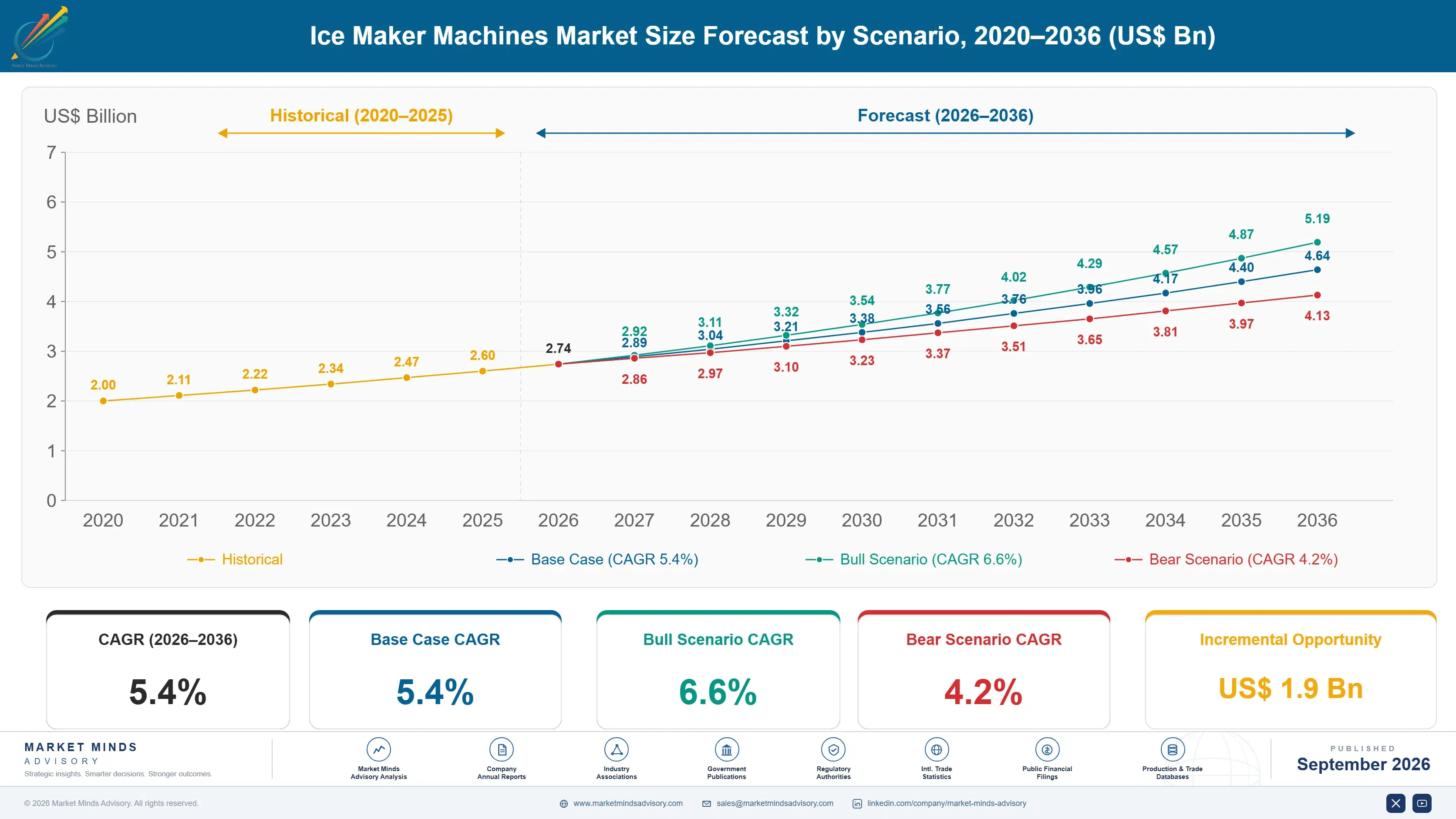
Ice Maker Machines Market Forecast Scenarios

ice-maker-machines-market-size-forecast-scenario-1790025246998
Between 2020 and 2025 the market grew at a 4.7 percent historical CAGR, reflecting steady commercial foodservice replacement demand alongside accelerating residential nugget ice maker adoption that began during pandemic-era home improvement spending and has continued expanding steadily since across most major consumer markets, demographic segments, income brackets, and geographic regions worldwide today and consistently.
The base case projects 5.4 percent annual growth through 2036, anchored by three mechanisms: sustained commercial foodservice replacement cycles tied to health code equipment lifespan requirements across restaurants, hotels, hospitals, and broader hospitality venues everywhere globally and consistently, continued residential nugget ice maker adoption driven by social media exposure and consistent word-of-mouth recommendation, and gradual clear ice technology improvement expanding premium residential segment appeal beyond early adopters into mainstream buyers.
A bull scenario built on accelerated residential nugget ice adoption across international markets beyond North America's established base could push growth toward 6.6 percent annually through the forecast window. A bear case tied to commercial foodservice capital spending slowdown and residential category saturation among early-adopter households would compress growth toward 4.2 percent, primarily by slowing replacement-cycle purchases rather than eliminating baseline demand.

Nugget Ice Preference Redefines Residential Equipment Demand

Ice makers occupy a genuinely bifurcated position within kitchen equipment, spanning durable commercial machines with decade-long replacement cycles and rapidly growing residential countertop products with much shorter ownership periods measured in years rather than full decades. This dual structure gives the category two distinct demand rhythms operating largely independently of each other, each with its own commercial dynamics, buyer relationships, and sales channels.
MARKET CONCENTRATIONCR5 42%top five equipment manufacturers hold under half global revenue
AVERAGE SELLING PRICE$450 per unitstandard commercial modular ice machine excluding installation cost
TOP PRODUCING COUNTRYChina 45% shareconcentrates global compressor and component manufacturing capacity broadly
REPLACEMENT CYCLE LENGTH7 to 10 yearstypical commercial equipment lifespan before health code replacement
RESIDENTIAL SEGMENT SHARE38% of revenuereflects growing countertop nugget ice maker consumer adoption trend
COMPRESSOR COST SHARE28% of COGSrefrigeration compressor and component sourcing as share of cost
China dominates component and compressor manufacturing capacity, supplying both domestic assembly and export volume to equipment brands worldwide across nearly every price tier and product category currently. Residential nugget ice makers now represent a meaningful share of total category revenue, reflecting the format's rapid transition from a niche appliance into a mainstream small kitchen purchase category over just a few short years.
Commercial equipment replacement remains tied closely to health code inspection cycles and equipment lifespan requirements rather than discretionary upgrade decisions made independently by restaurant operators and hospitality managers alike today. Compressor and refrigeration component costs represent a meaningful share of production expense, creating real margin sensitivity to commodity metal and semiconductor component price swings across most manufacturers and geographies worldwide.
"Nugget ice did what most kitchen appliance trends never manage: it turned a purely functional purchase into something consumers actively seek out and recommend."
Practice Lead, Refrigeration and Kitchen Equipment Practice · MMA Refrigeration and Ice Making Equipment Practice · September 2026

Market Trends

Residential Nugget Ice Demand Reshapes Retail Product Development

Appliance manufacturers are increasingly developing dedicated residential nugget ice product lines rather than treating the format as a simple commercial equipment variant scaled down for home use, reflecting genuine recognition that residential buyers prioritize entirely different features than commercial operators typically do. Countertop portability, quiet operation, and compact footprint now matter more to residential purchase decisions than the production capacity metrics that dominate commercial equipment marketing. Brands that treat residential nugget ice as a distinct product category rather than a commercial afterthought are capturing disproportionate growth in this expanding segment.
Market Impact: Mandated replacement every 7-10 years
Water Filtration Integration Addresses Maintenance Concerns

Manufacturers are increasingly integrating built-in water filtration systems into residential ice makers, addressing mineral buildup and taste concerns that previously required separate filtration equipment or frequent manual descaling by residential owners unfamiliar with commercial maintenance routines and regular servicing schedules entirely and consistently over recent time. This integration reduces the ownership friction that historically limited residential adoption beyond enthusiast buyers willing to tolerate meaningful maintenance complexity. Brands offering integrated filtration report meaningfully lower return rates and noticeably higher customer satisfaction scores than comparable unfiltered models sold at similar price points.
Market Impact: 8.8% CAGR in residential segment

Market Opportunities and Growth Drivers

Health Code Requirements Sustain Commercial Replacement Demand

Restaurant and foodservice health inspection standards mandate periodic equipment replacement or certified sanitation servicing that ages out older ice machines regardless of whether they remain mechanically functional, creating a demand base entirely independent of discretionary restaurant capital spending decisions and consistently over time and across regions. This regulatory-driven replacement cycle gives commercial equipment manufacturers a predictable baseline demand that persists through economic downturns when restaurants might otherwise defer non-mandatory equipment purchases entirely and indefinitely. Larger foodservice chains with standardized equipment specifications drive particularly consistent replacement volume across their store networks.
Market Impact: Return rates run 15% above average

Social Media Exposure Accelerates Residential Adoption Rates

Widespread social media content featuring nugget ice makers has introduced the format to millions of potential residential buyers who previously had no awareness that home-use versions existed outside commercial foodservice settings entirely and consistently over time. This exposure mechanism operates largely independently of traditional appliance marketing spend, instead relying on organic content creation and consumer sharing behavior that brands can influence but not fully control. Retailers report that search volume and purchase inquiries for nugget ice makers spike noticeably following viral social media moments, indicating genuine demand responsiveness to content exposure.
Market Impact: Independent operators delay replacement 18 months

Market Restraints and Challenges

Residential Maintenance Complaints Generate Negative Purchase Reviews

Residential nugget ice makers require more frequent cleaning and descaling than most buyers anticipate when purchasing, since mineral buildup accumulates faster in compact residential units than in larger commercial machines with more advanced filtration systems. The root cause traces to marketing that emphasizes convenience while understating routine maintenance requirements, creating a mismatch between buyer expectations and actual ownership experience. The commercial impact shows up in elevated return rates and negative online reviews that discourage prospective buyers. Manufacturers are increasingly including clearer maintenance guidance and simplified cleaning mechanisms to address this gap directly.
Market Impact: 8.8% CAGR in nugget ice segment

Commercial Equipment Financing Constraints Delay Replacement Purchases

Independent restaurants and small foodservice operators often delay mandated equipment replacement due to capital constraints, sometimes operating well past recommended service life until financing becomes available or health inspectors force immediate corrective action directly. The root cause traces to thin operating margins in independent foodservice businesses that leave little room for discretionary or even semi-mandatory capital expenditure without external financing support. The commercial impact creates lumpy, unpredictable replacement demand for equipment manufacturers rather than smooth annual volume. Manufacturers increasingly offer equipment leasing and financing programs to smooth this purchasing friction.
Market Impact: 38% of residential revenue currently
3 additional market trends, 4 additional growth drivers, and 3 additional restraints and challenges are covered in the full report. Contact sales@marketmindsadvisory.com to access the complete intelligence.

Segment CAGR and Growth Architecture

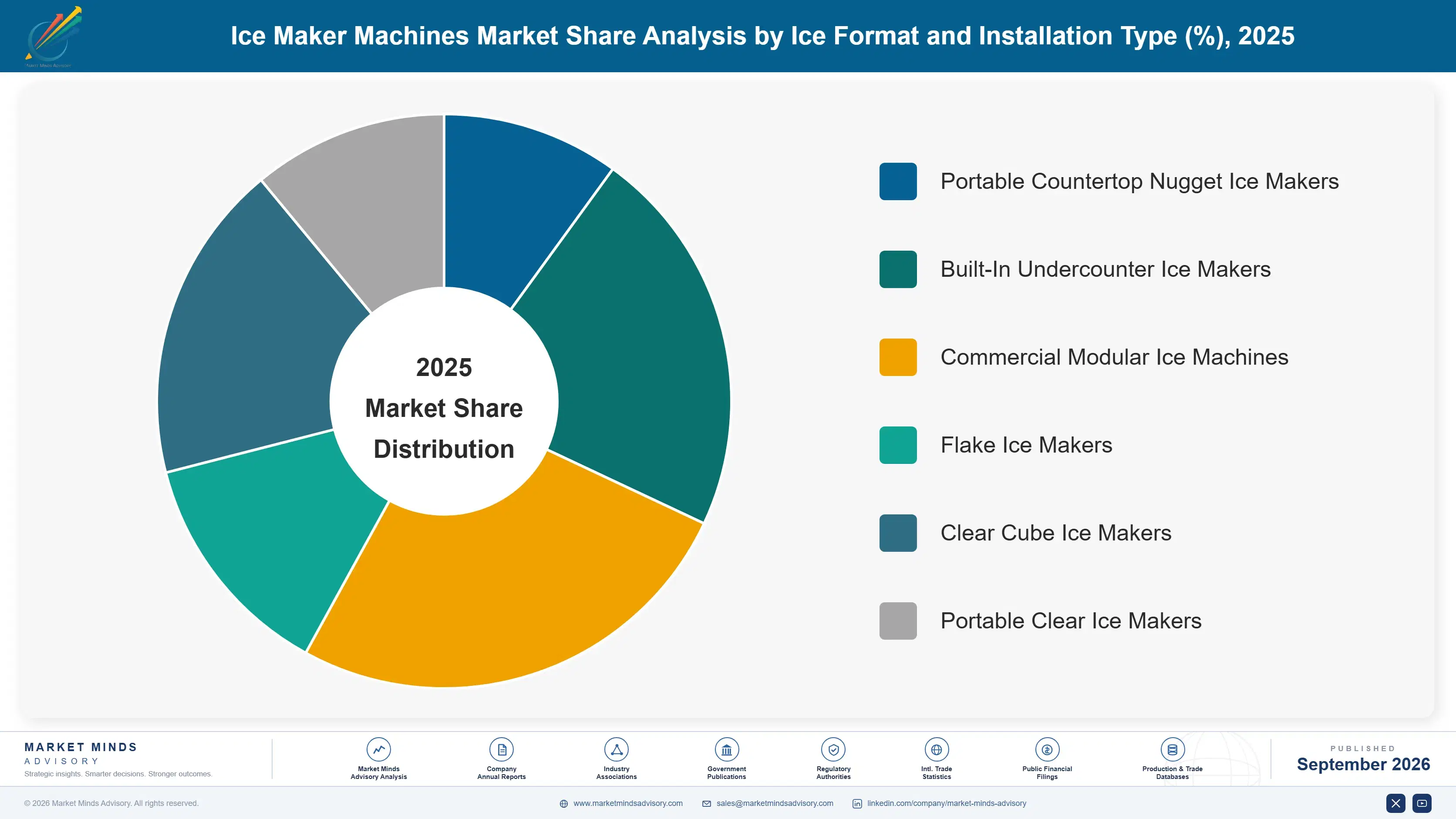
Segment logic follows ice format and installation type rather than capacity alone, since these dimensions drive the category's real purchasing decisions and buyer segmentation. Six segments span portable nugget ice makers, built-in undercounter units, commercial modular machines, flake ice makers, clear cube makers, and portable clear ice makers, reflecting how retailers and distributors organize the category.
ice-maker-machines-market-market-share-analysis-1790025247622

Portable Countertop Nugget Ice Makers

Portable countertop nugget ice makers are the category's fastest-growing segment, driven by residential consumers seeking the soft, chewable ice format popularized by drive-in restaurant chains without requiring plumbing installation or professional service contracts of any kind whatsoever today or well into the distant future ahead of us. These products typically produce smaller daily volumes than commercial equipment but command meaningful price premiums relative to basic freezer ice trays, reflecting genuine engineering investment in compact ice-making mechanisms and refrigeration technology. Manufacturers increasingly differentiate within this segment through integrated water filtration and quieter compressor technology that appeals to residential buyers unwilling to tolerate commercial-grade operating noise in home kitchen and living spaces nationwide.
CAGR 8.8%

Portable Clear Ice Makers

Portable clear ice makers appeal to consumers prioritizing aesthetics and slower-melting cocktail-grade ice over the soft, quickly-melting nugget format, particularly among home bartending and entertaining enthusiasts willing to accept considerably longer production cycles for genuine visual presentation quality, texture, and reliably consistent results overall today. These products require more sophisticated freezing technology to achieve genuine clarity rather than the cloudy appearance typical of conventional freezer ice, commanding meaningful price premiums that reflect real engineering differentiation and design investment. Growth here trails nugget ice adoption somewhat, since clear ice appeals to a narrower enthusiast audience rather than the broader convenience-driven consumer base driving nugget ice category expansion nationwide and internationally today.
CAGR 7.0%
Full segment breakdown across 6 segments available in the complete report.

Regional Architecture and Country Demand Map

Demand concentrates where nugget ice cultural preference, commercial foodservice density, and manufacturing capacity all genuinely intersect across most global regions and markets today. North America leads on decades-established nugget ice consumption culture, while East Asia anchors component manufacturing and rapidly growing commercial foodservice demand nationwide.

North America

North America holds the largest share on the strength of an established nugget ice cultural preference dating back several decades to drive-in restaurant chains, giving the region a genuine consumption advantage that distinguishes it clearly from typical appliance category leadership patterns seen elsewhere across most comparable equipment markets worldwide, internationally, and consistently over the past several decades. The United States dominates regional volume across both commercial foodservice replacement demand and rapidly growing residential countertop adoption, with social media exposure accelerating awareness among consumers previously unfamiliar with the format entirely and completely. Canada mirrors broadly similar consumption patterns at a smaller absolute scale, tracking comparable commercial and residential adoption trends closely.
Share: 30% | CAGR: 5.8% (2026 to 2036)

Western Europe

Western Europe trails North America meaningfully, reflecting a much weaker nugget ice cultural tradition and continued strong preference for clear cube ice across most European foodservice and residential settings historically and consistently over many recent decades and even prior generations. The United Kingdom, Germany, and France show the highest regional adoption, concentrated primarily among commercial foodservice replacement demand rather than residential countertop purchases, which remain a niche category here relative to North America. Growth here runs somewhat slower than the global average as nugget ice awareness spreads gradually through social media exposure rather than existing cultural familiarity. Southern European markets show even lower nugget ice penetration currently, broadly, and consistently.
Share: 20% | CAGR: 4.0% (2026 to 2036)
Regional intelligence for 5 additional markets available in the complete report: East Asia, South Asia and Pacific, Latin America, Middle East and Africa, Eastern Europe. Contact sales@marketmindsadvisory.com.
ice-maker-machines-market-country-cagr-analysis-1790025248176

Where Ice Machine Margin Actually Concentrates

Margin in ice makers concentrates disproportionately around residential nugget ice branding, service and financing contracts, and water filtration attachments rather than basic commercial unit volume alone across most global markets. Suppliers winning on genuine consumer brand recognition and recurring service relationships capture meaningfully wider margins than those competing purely on commercial equipment price alone.

Residential Nugget Ice Consumer Brand Extensions

Manufacturers introducing consumer-branded residential nugget ice lines capture meaningfully wider margins from buyers who genuinely value brand recognition and design aesthetics over pure commercial-grade production capacity specifications and technical performance metrics entirely and completely. This extension strategy lets equipment manufacturers enter retail distribution channels entirely separate from their traditional foodservice wholesale relationships, opening a new revenue stream without cannibalizing existing commercial accounts. Early data from brands pursuing this strategy shows residential lines carrying gross margins roughly 20 percentage points above comparable commercial equipment, a gap reflecting genuine retail brand premium capture.
Market Impact: 20 percentage point margin premium on residential lines

Commercial Equipment Financing and Leasing Programs

Manufacturers offering equipment financing and leasing programs eliminate the upfront capital barrier that delays commercial replacement purchases among independent restaurants and small foodservice operators with constrained budgets and quite limited cash reserves nationwide and internationally. This financing approach converts hesitant buyers facing capital constraints into immediate customers, expanding the addressable market beyond operators capable of outright purchase entirely and completely. Manufacturers offering financing report closing rates roughly 30 percent higher among independent operators compared with cash-only sales terms, converting delayed replacement decisions into immediate revenue and considerably stronger customer relationships.
Market Impact: 30 percent higher closing rates via financing programs

Integrated Water Filtration System Attachments for Retention

Equipment manufacturers bundling integrated water filtration systems with ice makers capture meaningfully wider margins from buyers who would otherwise purchase separate filtration equipment or accept mineral buildup maintenance issues over the entire ownership life of the machine itself and quite completely. This attachment strategy also generates recurring filter replacement revenue that continues well after the initial equipment sale, creating an annuity-like revenue stream uncommon in durable equipment categories generally. Manufacturers offering integrated filtration report average per-unit revenue roughly 25 percent higher than comparable unfiltered models over a five-year ownership period.
Market Impact: 25 percent higher lifetime revenue per unit sold

Long-Term Institutional Service Contracts for Foodservice Chains

Large foodservice chain operators increasingly award multi-year equipment service and maintenance contracts rather than one-time equipment purchases, trading a modest per-unit discount for guaranteed recurring service revenue across their entire national store network and franchise system. Suppliers that win these contracts gain forecastable revenue and can plan technician staffing and parts inventory well ahead of need, reducing exposure to lumpy replacement demand that affects smaller service providers more severely. Contract terms typically run 3 to 5 years and can represent a meaningful share of a supplier's total annual service revenue.
Market Impact: Contracts covering up to 22% of service revenue

Who Controls the Margin Pool

Concentration remains moderate at a CR5 near 42 percent, reflecting a category with meaningful fragmentation as commercial equipment specialists compete alongside residential appliance brands entering the nugget ice segment at an accelerating pace. Hoshizaki and Welbilt hold the clearest leadership positions on combined commercial revenue and installed base, with a visible gap separating them from mid-tier challengers still building national service networks and brand recognition.
Most current competitive activity centers on residential nugget ice product development and service financing programs rather than price, as commercial specialists race to capture growing residential demand beyond their traditional foodservice customer base entirely. Several players are also expanding water filtration integration to differentiate residential offerings from basic competitors. Regional manufacturers in developing markets compete primarily on price for commercial tender contracts rather than brand positioning.

Emerging pressure comes from residential appliance brands entering the nugget ice segment without traditional commercial equipment heritage, narrowing the credibility gap that historically protected established commercial specialists from newer entrants. Rankings are most likely to shift as residential nugget ice revenue grows relative to commercial foodservice, redrawing which brands hold genuine category leadership overall and long term.
ice-maker-machines-market-company-positioning-matrix-1790025248698

Competitive Moat and Risk Dimensions

HOSHIZAKI CORPORATION

Moat: Broad Commercial Foodservice Distribution Network

Hoshizaki carries decades of relationships with foodservice equipment distributors and service technicians that give it commercial installed-base presence competitors struggle to replicate quickly and affordably. This distribution depth lets Hoshizaki win large multi-unit chain contracts that smaller challengers cannot service reliably across wide geographic footprints.
HOSHIZAKI CORPORATION

Risk: Limited Residential Consumer Brand Recognition

Hoshizaki's brand recognition remains concentrated almost entirely among commercial foodservice buyers rather than individual retail consumers, leaving it exposed to residential appliance brands with stronger direct-to-consumer marketing capability. Building comparable residential brand equity requires consumer marketing investment Hoshizaki has historically directed toward commercial channels instead.
WELBILT INC

Moat: Diversified Multi-Brand Equipment Portfolio

Welbilt's Manitowoc Ice brand operates alongside a much broader foodservice equipment portfolio spanning refrigeration, cooking, and beverage equipment, giving the company cross-selling opportunities and bundled contract leverage that single-category ice equipment specialists cannot easily match when negotiating large multi-unit chain accounts and long-term service agreements.
WELBILT INC

Risk: Slower Residential Segment Entry

Welbilt's commercial equipment heritage and B2B sales infrastructure are not well suited to residential retail distribution, leaving the company considerably slower to capture growing residential nugget ice demand than newer appliance brands with existing consumer retail relationships and direct-to-consumer marketing capability already firmly in place.

Players Tracked

Prominent Players

Hoshizaki Corporation
Welbilt Inc
Scotsman Ice Systems
Ice-O-Matic
GE Appliances (Haier)

Other Key Players

Follett LLC
Cornelius Inc
Electrolux Professional
Vollrath Company
True Manufacturing Co Inc
Whirlpool Corporation
Midea Group Co Ltd
Newair LLC
Frigidaire (Electrolux)
Danby Products Ltd
Igloo Products Corp
Costway
Whynter LLC
Euhomy
Della

Recent Developments

MARCH 2026

GE Appliances Expands Residential Nugget Ice Maker Product Line

GE Appliances expanded its residential nugget ice maker product line with additional capacity and finish options, responding to strong initial consumer demand that exceeded the company's original sales projections. The expansion includes integrated water filtration across all new models, addressing maintenance concerns that generated early negative customer reviews.
Signal: Signals established appliance manufacturers are treating residential nugget ice as a durable category rather than a passing trend.
JULY 2025

Hoshizaki Acquires Regional Equipment Financing Company

Hoshizaki acquired a regional equipment financing company specializing in restaurant and foodservice capital equipment loans, gaining in-house financing capability rather than relying on third-party lenders for customer purchase financing. The acquisition allows Hoshizaki to offer bundled equipment and financing packages directly to independent restaurant operators.
Signal: Signals commercial equipment manufacturers increasingly view financing capability as a competitive necessity for independent operator sales.
NOVEMBER 2025

Ice-O-Matic Launches Extended Warranty Service Contract Program

Ice-O-Matic launched an extended warranty and service contract program targeting independent foodservice operators seeking predictable maintenance costs beyond the standard manufacturer warranty period. The program bundles preventive maintenance visits with parts coverage, reducing unexpected repair costs that previously discouraged smaller operators from timely equipment servicing.
Signal: Signals commercial equipment manufacturers increasingly compete on service contract terms rather than upfront equipment price alone.

Compressor Cost Exposure Across Equipment Tiers

Compressors and refrigeration components represent the largest cost inputs in ice maker manufacturing, typically 26 to 32 percent of cost of goods sold, with compressors specifically sourced from a concentrated group of global refrigeration component suppliers. Component sourcing concentrates heavily in China and Japan, where the bulk of compressor and refrigeration component manufacturing capacity resides.
Compressor and semiconductor component prices spiked sharply during 2021 and 2022 as global supply chain disruptions and chip shortages raised production costs across refrigeration component manufacturers simultaneously, a volatility event documented in Whirlpool's fiscal year annual report covering that period. Manufacturers without forward component purchasing agreements absorbed cost increases directly into thinning margins, since compressor substitution options remain limited without compromising cooling performance and equipment reliability certification.

Larger manufacturers with vertically integrated compressor production or long-term supply contracts absorb price swings more easily than smaller residential brands that buy components on spot markets and must pass costs directly to price-sensitive consumers. This exposure gap widens further for brands sourcing from multiple contract manufacturers, since coordinating forward pricing across several suppliers proves considerably harder than negotiating with a single vertically integrated compressor partner.
ice-maker-machines-market-cost-volatility-analysis-1790025248894

Forward Compressor Purchasing Agreements

Larger manufacturers increasingly lock in compressor and component prices through forward purchasing agreements spanning six to twelve months, insulating margins from short-term supply chain and semiconductor volatility across most sourcing regions. This requires working capital most smaller residential brands lack access to, concentrating the practice among top-tier multinational suppliers with established banking relationships and stronger balance sheets.

Diversified Compressor Supplier Relationships

Some manufacturers are qualifying multiple compressor suppliers across different regions to reduce dependence on any single producer and its associated feedstock and semiconductor exposure during periods of sustained global market volatility. Diversification adds supplier qualification cost in the near term but meaningfully reduces exposure to any single supplier's price movements over the longer term.

Vertically Integrated Component Manufacturing Investment

Several larger manufacturers are investing directly in compressor and component manufacturing capacity rather than relying entirely on third-party suppliers, reducing exposure to external price volatility over time and across cycles. Adoption remains limited to the largest manufacturers given the substantial capital investment required, but successful vertical integration could meaningfully diversify the category's supply structure long term.

Portfolio Architecture for Margin Defence

Ice makers span a wide margin range from basic commercial modular machines to premium residential nugget ice and service-attached lines, with gross margins varying meaningfully across that spectrum depending heavily on distribution channel and brand positioning chosen by each manufacturer. Volume-tier commercial products compete on price and service network reach, while premium residential tiers compete on brand recognition and design.
The tension between commercial equipment volume and residential brand positioning shapes supplier strategy across the category more than in most comparable equipment segments today. Manufacturers serving large commercial chains must hold competitive bulk pricing even as compressor costs fluctuate seasonally and unpredictably, while residential nugget ice brands sustain meaningfully wider margins tied to consumer brand equity rather than production volume alone.

High-value margin pools concentrate specifically around residential nugget ice brand extensions, service and financing contracts, and water filtration attachments, none of which represent the bulk of unit volume sold globally at any given time. Manufacturers that can straddle both commercial volume and residential premium positioning simultaneously, rather than choosing one exclusively, capture the widest share of total category profit pools over the forecast period.

Volume / Commodity-Adjacent

Basic commercial modular ice machines and value-tier residential models sold through wholesale distribution and mass retail channels, competing chiefly on unit price with limited brand differentiation beyond production capacity specifications.
Gross Margin: 20-26%

Premium / Certified

Branded commercial equipment and mid-tier residential nugget ice makers carrying established brand loyalty and service network support, purchased through commercial distributors and mainstream retail at established price points above value tier.
Gross Margin: 32-40%

Sustainability / Regulatory / Next-Generation

Premium residential nugget ice brands, service-attached commercial contracts, and filtration-integrated products serving buyers willing to pay meaningfully more for genuine brand recognition and recurring service relationships built over considerable time.
Gross Margin: 42-50%
ice-maker-machines-market-portfolio-architecture-1790025249391

High-value Sub-segments and Strategic Watch-out

Portable Countertop Nugget Ice Makers

Portable countertop nugget ice makers combine the category's fastest unit growth with meaningful brand-driven margins, propelled by residential consumers seeking the chewable ice experience without commercial equipment complexity. This segment concentrates supplier profitability and is attracting the most consumer marketing investment across the competitive set.
Gross Margin: 42-50%

Portable Clear Ice Makers

Portable clear ice makers pair solid growth with premium pricing tied to aesthetic and cocktail-grade quality positioning, as home entertaining enthusiasts increasingly favor genuinely clear ice over standard freezer output. Margins here exceed standard residential nugget pricing, reflecting genuine engineering differentiation rather than marketing alone.
Gross Margin: 36-44%

Commercial Modular Ice Machines

Commercial modular ice machines remain the category's institutional volume core, sustaining baseline unit demand across restaurants and hospitality venues even as growth concentrates in residential formats elsewhere in the portfolio. Thin margins and health-code-driven replacement cycles make this segment a scale business rather than a profit driver.
Gross Margin: 18-24%

Flake Ice Makers

Flake ice makers carry the slowest growth and warrant monitoring for consolidation risk, as broader cube and nugget formats increasingly substitute for flake ice in commercial applications beyond specialized seafood display and medical use. Consumer and commercial preference shifts threaten continued demand for this narrower segment.
Gross Margin: 20-26%

Dual Replacement Cycles of Ice Equipment

Commercial ice equipment functions closer to a mandated replacement cycle than a discretionary purchase, since health code inspection standards force equipment turnover on a predictable schedule regardless of whether machines remain mechanically functional or otherwise still fully operational. Residential nugget ice makers follow a very different rhythm entirely, driven by consumer discovery and gift-giving occasions rather than regulatory compliance timing.
Adoption stickiness varies meaningfully by buyer type across the category. Commercial foodservice operators who standardize equipment specifications across multi-unit chains show strong brand loyalty tied to service network reliability and technician familiarity with specific equipment models used daily. Residential buyers show considerably less brand loyalty, since most purchase decisions are driven by social media exposure and price comparison rather than prior brand relationships.

Buyer profiles are shifting generationally as younger commercial operators increasingly expect financing flexibility and digital service scheduling that older equipment manufacturers built on pure distribution scale are considerably slower to offer credibly at comparable trust levels. Younger residential buyers entering the category also show greater willingness to research products through social media before purchasing rather than relying on in-store demonstration and staff advice.
ice-maker-machines-market-end-use-penetration-index-1790025249885

MMA Verdict on Category Direction

These are among the four positions where our research anticipates prominent divergence between winners and laggards over the coming forecast period. Each is grounded in the demand model, the regulatory perimeter, and the announced capacity pipeline.
01 / RESIDENTIAL BRAND INVESTMENT PRIORITY

Build credible residential brand positioning before appliance incumbents commit

Residential nugget ice carries the category's widest margins and fastest growth, yet most commercial equipment specialists remain considerably slower to build genuine consumer retail brands than appliance companies entering the segment entirely fresh. Manufacturers that invest in credible residential brand positioning now, rather than simply rebadging commercial equipment for home use, secure a multi-year advantage before appliance incumbents fully commit resources to this segment. This window narrows every year as more established consumer brands launch competing nugget ice product lines.
02 / FINANCING CAPABILITY EXPANSION

Build in-house financing infrastructure before independent operators defect

Equipment financing programs convert delayed replacement decisions into immediate revenue, with closing rates running roughly 30 percent higher than cash-only sales across most independent operator segments, yet many commercial equipment manufacturers still lack any in-house financing capability whatsoever. Suppliers that build genuine financing infrastructure now capture the independent operator segment that larger competitors with cash-only terms consistently lose to more flexible rivals. Manufacturers delaying this capability risk ceding an expanding, price-sensitive customer base entirely to competitors purpose-built for flexible purchasing terms.
03 / COMPRESSOR SOURCING RISK MANAGEMENT

Diversify compressor supplier relationships before the next volatility cycle

Compressor and semiconductor pricing has already demonstrated its capacity to compress margins sharply during global supply chain disruptions, and smaller residential brands without forward purchasing agreements bore the brunt of the last volatility cycle documented across multiple company filings. Vertically integrated manufacturers weathered the same period with meaningfully smaller margin swings, a gap the market clearly rewards as component supply concentration in China and Japan persists. Manufacturers should diversify supplier relationships and lock in pricing mechanisms now rather than waiting for the next volatility event.
04 / MAINTENANCE EXPERIENCE IMPROVEMENT

Fix residential maintenance friction before it damages category reputation

Residential maintenance complaints already generate elevated return rates and negative reviews that could undermine the entire nugget ice category's growth trajectory if left unaddressed by leading manufacturers and retailers. Brands that invest in simplified cleaning mechanisms and clearer maintenance guidance now, rather than treating this as a minor customer service issue, capture disproportionate trust advantage among skeptical repeat buyers researching carefully before purchase. Manufacturers ignoring this friction risk return rates that erode margins and category reputation for years to come.

Engagement Snapshot From the Field

A live engagement with an industry participant carrying material or product regulatory and market exposure ahead of a defining policy shift, showing how our research translates into a defensible multi-year portfolio strategy.
MARKET MINDS ADVISORY · CLIENT ENGAGEMENT SUMMARY
Ice Maker Machines Producer Strategic Portfolio Review and Transition Roadmap 2026·Investment Scenario on Ice Maker Machines Exposure Evaluation 2025-26
CLIENT PROFILE
The client is a mid-sized commercial ice equipment manufacturer with an established foodservice distribution network but no residential consumer product line. Leadership had observed appliance brands and smaller startups capturing disproportionate growth in residential nugget ice makers and sought to understand whether entering the residential segment made commercial sense given the company's commercial equipment heritage.
STRATEGIC CHALLENGE
The client had no consumer retail brand recognition or direct-to-consumer distribution capability whatsoever, raising real doubt about whether the company could compete against established appliance brands with existing retail relationships and marketing budgets. Leadership also needed clarity on realistic pricing and margin expectations before committing meaningful capital to residential product development.
MMA APPROACH
MMA conducted retail channel landscape mapping to identify viable entry paths for a commercial-heritage brand entering residential retail for the first time, then modeled brand positioning options against competitor pricing and margin structures across several proposed price points. The engagement included consumer research on brand perception and price elasticity testing before finalizing go-to-market recommendations.
KEY FINDINGS
  1. Consumer research found that 54 percent of buyers (client-reported, unverified by MMA) valued commercial-grade engineering credibility over pure brand familiarity when purchasing.
  2. Retail channel landscape mapping identified three specialty appliance retailers willing to carry a new commercial-heritage residential brand within the client's twelve-month launch window.
  3. Price elasticity testing identified an optimal launch premium of roughly 12 percent below established appliance brand competitors to build early initial trial.
  4. Post-launch tracking showed the residential line reaching 18 percent of total company revenue (client-reported, unverified by MMA) within the first eighteen months.
CLIENT PROFILE
The client is a mid-sized commercial ice equipment manufacturer with an established foodservice distribution network but no residential consumer product line. Leadership had observed appliance brands and smaller startups capturing disproportionate growth in residential nugget ice makers and sought to understand whether entering the residential segment made commercial sense given the company's commercial equipment heritage.
STRATEGIC CHALLENGE
The client had no consumer retail brand recognition or direct-to-consumer distribution capability whatsoever, raising real doubt about whether the company could compete against established appliance brands with existing retail relationships and marketing budgets. Leadership also needed clarity on realistic pricing and margin expectations before committing meaningful capital to residential product development.
MMA APPROACH
MMA conducted retail channel landscape mapping to identify viable entry paths for a commercial-heritage brand entering residential retail for the first time, then modeled brand positioning options against competitor pricing and margin structures across several proposed price points. The engagement included consumer research on brand perception and price elasticity testing before finalizing go-to-market recommendations.
KEY FINDINGS
  1. Consumer research found that 54 percent of buyers (client-reported, unverified by MMA) valued commercial-grade engineering credibility over pure brand familiarity when purchasing.
  2. Retail channel landscape mapping identified three specialty appliance retailers willing to carry a new commercial-heritage residential brand within the client's twelve-month launch window.
  3. Price elasticity testing identified an optimal launch premium of roughly 12 percent below established appliance brand competitors to build early initial trial.
  4. Post-launch tracking showed the residential line reaching 18 percent of total company revenue (client-reported, unverified by MMA) within the first eighteen months.
RECOMMENDED STRATEGY
Phase 1: Phase one: retail channel landscape mapping and consumer brand perception research across three specialty appliance retailer candidates and product formats. Phase 2: Phase two: price elasticity testing across multiple proposed launch price points, followed by a limited regional retail pilot program launch. Phase 3: Phase three: national retail rollout with post-launch revenue tracking and ongoing retailer relationship management through the entire first eighteen months.
OUTCOME
The client successfully launched its residential nugget ice line within the planned twelve-month window, achieving 18 percent of total company revenue (client-reported, unverified by MMA) within the first eighteen months on shelf. Consumer research's projection that commercial-grade engineering credibility would outweigh brand unfamiliarity proved accurate, validating the below-market launch pricing strategy.

Frequently Asked Questions

Foundational context covering the market sizes, CAGR, scope, country, region and competition that inform every finding below. This section is provided to cover basics and most often pre-purchase conversations, answered from the MMA Primary Research Dataset.

What is the current size of the Ice Maker Machines Market?

The Ice Maker Machines Market is valued at 2.6 billion dollars in 2025. This reflects steady commercial replacement demand alongside rapidly growing residential nugget ice adoption globally.

How large will the Ice Maker Machines Market be by 2036?

MMA projects the market will reach approximately 4.64 billion dollars by 2036. Accelerating residential adoption and sustained commercial replacement cycles drive this steady growth trajectory.

What is the CAGR for the Ice Maker Machines Market 2026 to 2036?

The market is forecast to grow at a 5.4 percent compound annual growth rate between 2026 and 2036. This places it within the mature industrial growth band.

Which segment is growing fastest?

Portable countertop nugget ice makers are the fastest-growing segment at an 8.8 percent CAGR, roughly 1.6 times the overall market rate. Residential discovery drives this.

Who are the major companies in the Ice Maker Machines Market?

Leading companies include Hoshizaki, Welbilt, Scotsman, Ice-O-Matic, and GE Appliances. These five companies together hold a combined CR5 of approximately 42 percent of the market.

Which country is growing fastest?

China leads country-level growth at a 9.5 percent CAGR, driven by combined manufacturing scale and rising domestic commercial foodservice demand. This outpaces the broader East Asia region.

Report Segmentation Architecture

The full report scope spans multiple orthogonal segmentation dimensions, with cross-tabulated demand data provided for each dimension pair. Coverage extends further to regional breakdowns, trend trajectories, and the competitive detail needed to support segment-level decision-making.

By Ice Format and Installation Type

  • Portable Countertop Nugget Ice Makers
  • Built-In Undercounter Ice Makers
  • Commercial Modular Ice Machines
  • Flake Ice Makers
  • Clear Cube Ice Makers
  • Portable Clear Ice Makers

By End-Use Industry

  • Commercial Foodservice
  • Hospitality and Hotels
  • Residential Home Use
  • Healthcare and Institutional

By Commercial Dimension

  • Direct Retail Purchase
  • Commercial Wholesale Distribution
  • Equipment Financing and Leasing
  • Service Contract Bundle

By Region

  • North America
  • Western Europe
  • East Asia
  • South Asia and Pacific
  • Latin America
  • Middle East and Africa
  • Eastern Europe

Scope, Methodology, and Coverage

Every figure in this report is reproducible from documented input assumptions. The scope below maps the historical period, the forecast horizon, the segmentation dimensions, and the countries covered, alongside the underlying primary and qualitative methodology.
Historical Period
2020 to 2025
Forecast Period
2026 to 2036
Base Year
2025 (USD billions; MMA Primary Research Dataset, September 2026)
Market Definition
The Ice Maker Machines Market covers standalone equipment that produces cube, nugget, flake, or clear ice for commercial foodservice and residential use, including countertop, built-in, and modular commercial formats. It excludes integrated refrigerator-freezer ice dispensers and industrial ice production equipment used outside foodservice and residential applications.
Quantitative Units
USD billions, unit volume in millions of units
Segmentation Dimensions
Ice format and installation type, end-use industry, commercial dimension
Regions Covered
North America, Western Europe, East Asia, South Asia and Pacific, Latin America, Middle East and Africa, Eastern Europe
Countries Covered
35+ countries across seven global regions
Key Companies Profiled
Hoshizaki Corporation, Welbilt Inc, Scotsman Ice Systems, Ice-O-Matic, GE Appliances (Haier), and 15 additional participants
Quantitative Methodology
Primary survey, n=3,800 respondents, Q4 2025, six countries; demand-side model with trade association cross-validation
Qualitative Methodology
47 expert interviews, Q4 2025; applied to validate demand model assumptions, identify emerging dynamics, and assess competitive positioning
Report Format
PDF and XLSX data workbook (Word format preview document)
Publisher
Market Minds Advisory
Report Code
MMA-2026-CON-221
Published
September 2026
Contact
sales@marketmindsadvisory.com | www.marketmindsadvisory.com

Purchase the full Ice Maker Machines Market Report (2026 to 2036).

The full Ice Maker Machines Market report delivers a complete forecast model spanning 2026 through 2036. Granular segmentation spans ice format and installation type, end-use industry, and commercial dimension. It includes detailed competitive profiles for all twenty tracked participants, regional demand analysis across seven geographies, and input cost exposure modeling grounded in primary survey and expert interview data. The report further examines portfolio margin economics, revenue lever strategies, and demand architecture across the category's replacement cycle dynamics. A fully anonymized client engagement case study illustrates practical application of the underlying research findings.
Full regional breakdown across all seven global markets
Company-level competitive benchmarking with moat and risk assessment
Segment-by-segment growth rate forecasts through 2036
Input cost exposure analysis and mitigation pathway detail
Portfolio tiering framework with margin economics detail
Primary survey data collected across six countries

Built For The People Who Decide

From boardroom strategy to bench-side execution, this report is read cover-to-cover by leaders shaping the next decade of their industry, turning demand scenarios, market dynamics and valuation benchmarks into decisions.
CXOs/ Presidents/ VPs/ Managers
M&A and Corporate Development
Strategy Teams and R&D Heads
Procurement and Product Directors
Regulatory and Compliance Leaders
Investor Relations and Equity Analysts