

Market Minds Advisory
Hyperpigmentation Skin Treatment Market

Hyperpigmentation Skin Treatment Market: Hyperpigmentation Skin Treatment Market. Combination Therapy Protocols Displace Single-Agent Brightening Regimens

Growing dermatological demand for combination therapy protocols is pushing hyperpigmentation treatment past single-agent brightening toward multimodal regimens pairing topical actives with in-office energy-based devices across most global dermatology treatment markets.

Lead Analyst

Published

September 2026

Make Smarter Decisions with Customized Research Insights

Request a free sample report and evaluate market opportunities, growth trends, and competitive dynamics relevant to your business needs.

2025 MARKET VALUE$9.8BMarket Size 2025
2036 FORECAST VALUE$22.8BBase Case , 2026 to 2036
CAGR 2026 TO 20368.0 %Bull 9.3% / Bear 6.7%
INCREMENTAL OPPORTUNITY$12.3BNet 10- year value creation
EXPANSION MULTIPLE2.16x2036 value over 2026 base
Strategic Levers
M&A Pipeline
Regional Outlook
Country Rankings
Competitive Intelligence
Segmental Deep-dive
Call-Us : 91 93563 13602

Executive Snapshot and Market Trajectory.

Hyperpigmentation treatment is shifting decisively from single-agent topical brightening toward combination protocols that pair prescription actives with energy-based devices for faster, more durable results across nearly every treatment setting worldwide today, from mass dermatology clinics to boutique medspas and physician-dispensed retail channels alike. Combined regimens now anchor most premium plans.
Dermatology clinics and medspas are driving the fastest growth as combination topical-device protocols outperform standalone creams on patient-reported outcomes, particularly for melasma and post-inflammatory hyperpigmentation in higher-skin-tone populations underserved by earlier formulations across most global dermatology markets served today. East Asia and North America concentrate the bulk of procedural volume today, while specialty formulation innovation increasingly originates in Korea and Japan. Regional capacity keeps expanding steadily.
Competition spans pharmaceutical topical manufacturers, device makers, and physician-dispensed cosmeceutical brands, each competing on a somewhat different commercial basis entirely depending on distribution channel, regulatory pathway, and target patient demographic served. Regulatory scrutiny of hydroquinone concentration limits is reshaping product formulation strategy across major markets, while newer non-hydroquinone actives such as tranexamic acid and cysteamine gain share as dermatologists seek longer-term maintenance options for their patients between successive procedural visits over time.
Market Definition
This report covers the global market for products and procedures treating hyperpigmentation, including topical prescription and over-the-counter brightening agents, chemical peels, and energy-based devices such as lasers and intense pulsed light systems. It excludes general anti-aging skincare without a specific pigmentation-correction claim and excludes surgical dermatologic procedures.
Base Year Value
$9.8B in 2025 (MMA Primary Research Dataset, September 2026)
Forecast Period
2026 to 2036, eleven discrete annual values
CAGR
8.0% base case. Bull 9.3%. Bear 6.7%.
Fastest Growth Segment
Combination Topical-Device Protocols: 12.5% CAGR
Fastest Growth Country
South Korea: 10.5% CAGR
Fastest Growth Region
South Asia and Pacific: 10.0% CAGR
Largest Region
North America: 30% of 2025 global value
Market Leaders
Galderma, Merz Aesthetics, Allergan Aesthetics, Bausch Health, Cutera. Source: MMA Primary Research Dataset, July 2026.
Primary Survey
n=3,800 procurement and R&D decision-makers, Q4 2025, six countries
Methodology
Demand-side build-up, cross-validated against public data, 47 expert interviews

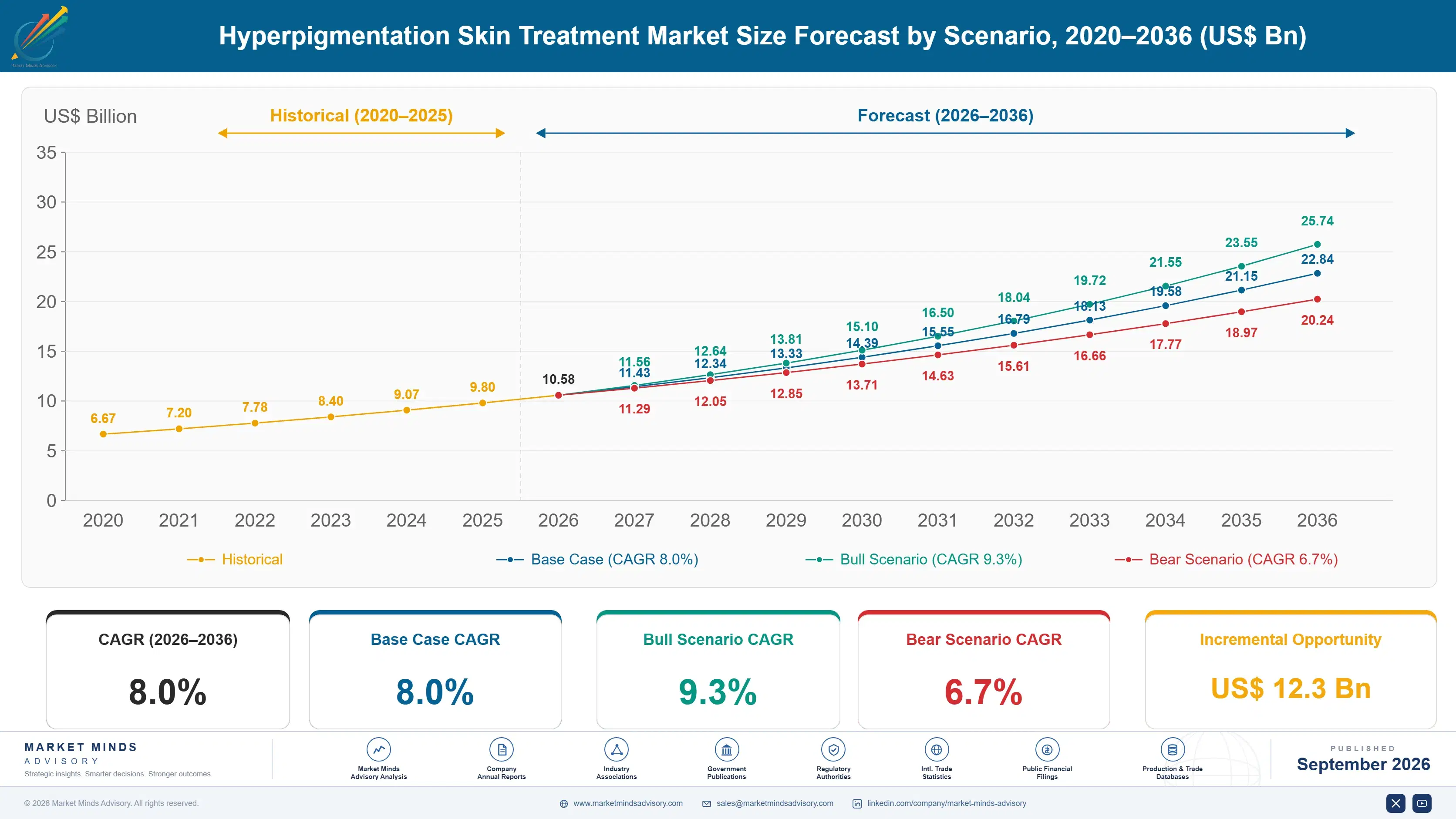
Hyperpigmentation Skin Treatment Market Forecast Scenarios

hyperpigmentation-skin-treatment-market-size-forecast-scenario-1790017417142
Between 2020 and 2025 hyperpigmentation treatment grew steadily as telehealth dermatology expanded access to prescription topicals and consumer awareness of melasma and post-inflammatory hyperpigmentation broadened well beyond dermatology clinics into mainstream skincare retail and specialty beauty channels across most developed markets. This period saw a historical CAGR near 6.8 percent supporting gradual category maturation without major disruption.
The base case assumes continued conversion from single-agent to combination topical-device protocols across most treatment settings worldwide, expanding dermatology clinic and medspa capacity in East Asia and North America as procedural volume grows steadily year over year, and sustained regulatory tightening on hydroquinone concentration that pushes formulators toward newer non-hydroquinone actives commanding premium pricing across most channels and patient segments served today throughout the full ten-year forecast window that lies ahead.
The bull case assumes faster device miniaturization brings combination protocols into home-use settings sooner than currently expected, expanding the addressable patient base considerably beyond clinical settings. The bear case assumes reimbursement pressure and tighter cosmetic device import regulation in key Asian markets slow procedural volume growth meaningfully across the full ten-year forecast period, dampening device segment expansion specifically.

Combination Protocols Reshape Pigmentation Correction Economics

Hyperpigmentation correction has moved well past single-agent hydroquinone creams into a multimodal category spanning prescription topicals, in-office chemical peels, and energy-based devices delivered across dermatology clinics and medspas serving an increasingly diverse patient population worldwide, including higher-skin-tone patients historically underserved by conventional single-agent formulations that dominated the category for decades before combination protocols emerged.
MARKET CONCENTRATION32% CR5Top five players hold about one third share
AVERAGE TREATMENT COST$340Per combination protocol session across major clinic markets
TOP TREATING COUNTRYUnited States 24%Leads global procedural volume by total clinic count nationwide
DEVICE UTILIZATION RATE68%Share of clinic device capacity actively booked each month
RECURRENCE RATE41%Share of patients requiring repeat maintenance treatment every year
ACTIVE INGREDIENT COST SHARE24% of COGSReflects specialty active sourcing and formulation complexity overall
Combination protocols pairing topical actives with laser or intense pulsed light devices now anchor premium treatment plans, since dermatologists report meaningfully better outcomes for melasma and post-inflammatory hyperpigmentation than either modality achieves alone across nearly every skin tone treated in clinical practice today. Device makers and topical formulators increasingly co-market bundled protocols directly to clinics and larger medspa chains expanding nationally, reinforcing this shift toward integrated care models across the specialty channel.
Regulatory tightening on hydroquinone concentration limits across multiple jurisdictions is accelerating a shift toward non-hydroquinone actives such as tranexamic acid, cysteamine, and azelaic acid, which dermatologists increasingly favor for long-term maintenance given lower irritation profiles and fewer restrictions on extended use duration compared with legacy hydroquinone-based formulations still sold in some regional markets today under comparatively looser regulatory frameworks that persist in select geographies.
"Hydroquinone is no longer the default. Formulators betting on longevity are already building around the alternatives dermatologists actually want to prescribe long term."
Practice Lead, Dermatology and Aesthetic Devices · MMA Topical Practice · September 2026

Market Trends

Combination Topical-Device Protocols Replace Standalone Regimens

Dermatology clinics increasingly bundle prescription topicals with in-office laser or intense pulsed light sessions rather than prescribing either modality alone, since combined regimens show meaningfully faster pigment clearance and lower relapse rates across melasma and post-inflammatory hyperpigmentation cases treated in controlled clinical settings over recent years across most major markets. Device manufacturers now co-develop treatment protocols with topical formulators, packaging both together for clinic purchase rather than selling equipment as a standalone capital investment separate from the ongoing consumable topical revenue stream that follows each device sale across the clinic's active patient roster.
Market Impact: Expands diagnosed patient base 22 percent

Non-Hydroquinone Actives Gain Share Amid Regulatory Tightening

Regulatory restrictions on hydroquinone concentration and duration of use across the European Union, parts of Asia, and select United States jurisdictions are pushing formulators toward tranexamic acid, cysteamine, and azelaic acid as primary active ingredients rather than secondary alternatives held in reserve. These newer actives carry lower irritation profiles suited to extended maintenance therapy, which dermatologists increasingly prefer for patients requiring years rather than months of ongoing pigment management. Formulators investing early in non-hydroquinone pipelines are capturing prescriber loyalty ahead of competitors still reliant on legacy formulations facing tightening restrictions.
Market Impact: Adds 1.2 million new annual prescriptions

Market Opportunities and Growth Drivers

Rising Prevalence Among Higher Skin Tone Populations

Growing recognition among dermatologists that hyperpigmentation disproportionately affects patients with higher Fitzpatrick skin types has expanded diagnostic screening and treatment referral rates across urban dermatology practices in North America, Latin America, and parts of Asia. Manufacturers are responding with formulations and device settings specifically calibrated for darker skin tones, a segment historically underserved by treatments originally developed and validated primarily for lighter-skinned patient populations in earlier clinical trial programs. Insurance coverage expansion for melasma-related visits in several markets is reinforcing this shift toward broader diagnostic access across most participating clinic networks.
Market Impact: Cuts hydroquinone launches 27 percent

Telehealth Dermatology Expands Prescription Topical Access

Telehealth dermatology platforms have made prescription-strength topical hyperpigmentation treatments accessible to patients without convenient access to in-person specialist appointments, particularly across suburban and rural markets where dermatologist density remains low relative to patient demand. Platforms partnering directly with compounding pharmacies now ship customized topical formulations within days of a virtual consultation, shortening the traditional multi-week wait time between diagnosis and first treatment substantially. This channel has become a meaningful new prescription volume source for pharmaceutical topical manufacturers seeking incremental growth beyond traditional in-clinic channels alone in most regions currently served.
Market Impact: Cuts patient retention 19 percent

Market Restraints and Challenges

Hydroquinone Regulatory Restrictions Limit Formulation Options

Regulatory agencies across the European Union and several Asian markets have tightened hydroquinone concentration limits and duration-of-use guidelines, citing long-term skin sensitization and ochronosis risk from extended unsupervised use. The root cause traces to historical over-the-counter availability at concentrations dermatologists now consider unsafe for unsupervised long-term use without periodic clinical monitoring. This restricts formulators from relying on hydroquinone as a primary active in new product launches, forcing costly reformulation cycles. Manufacturers are mitigating impact by accelerating non-hydroquinone active pipelines and pursuing prescription-only distribution models that satisfy increasingly tightening regulatory requirements overall.
Market Impact: Lifts combination adoption 34 percent

Treatment Relapse Undermines Long-Term Patient Retention

Hyperpigmentation frequently recurs after initial treatment success, particularly for melasma cases with a strong hormonal or sun-exposure component, which undermines patient confidence in any single treatment approach and drives channel switching between providers. The root cause is that most treatments address visible pigment rather than the underlying melanocyte activity driving recurrence, leaving patients vulnerable to relapse triggered by sun exposure or hormonal changes. Clinics are mitigating this by bundling maintenance topical prescriptions with in-office procedures and educating patients on strict sun protection protocols to extend visible results between successive treatment cycles.
Market Impact: Non-hydroquinone actives capture 41 percent
3 additional market trends, 4 additional growth drivers, and 4 additional restraints and challenges are covered in the full report. Contact sales@marketmindsadvisory.com to access the complete intelligence.

Segment CAGR and Growth Architecture

Hyperpigmentation treatment segments by modality across topical prescription and over-the-counter agents, chemical peels, and energy-based devices, with combination protocols increasingly blurring the line between categories as clinics bundle multiple modalities into unified treatment plans for patients seeking faster, more durable pigment correction results across every major skincare, dermatology, and specialty medspa retail channel worldwide.
hyperpigmentation-skin-treatment-market-market-share-analysis-1790017417752

Combination Topical-Device Protocols

Combination protocols pairing prescription topicals with laser, intense pulsed light, or microneedling devices represent the fastest-growing segment as dermatologists document meaningfully better outcomes than either modality delivers alone across most patient skin types treated. Clinics increasingly package these protocols as multi-visit treatment plans rather than single procedures, generating recurring revenue across months of scheduled follow-up visits and consumable topical sales. Device manufacturers now co-develop compatible topical lines specifically formulated to complement post-procedure skin recovery, deepening the commercial relationship between device and topical categories further. This segment commands premium pricing relative to standalone topical prescriptions or device sessions purchased independently by patients seeking only a single treatment modality at a time.
CAGR 12.5%

Non-Hydroquinone Prescription Topicals

Non-hydroquinone prescription topicals built around tranexamic acid, cysteamine, and azelaic acid are gaining share as regulatory tightening on hydroquinone concentration pushes both prescribers and patients toward alternatives suited for extended maintenance use without the sensitization risk associated with legacy formulations sold for decades. Pharmaceutical manufacturers are investing heavily in clinical trials to substantiate efficacy claims for these newer actives, supporting premium pricing versus older generic hydroquinone products losing prescriber favor. Compounding pharmacies increasingly customize concentration blends for individual patients, adding a personalization dimension that legacy over-the-counter brightening creams have never offered at comparable scale, precision, or long-term consistency across repeat prescription refills over the full duration of a patient's maintenance therapy.
CAGR 9.5%
Full segment breakdown across 6 segments available in the complete report.

Regional Architecture and Country Demand Map

North America leads global hyperpigmentation treatment demand through concentrated dermatology procedure volume and insurance-supported melasma care, while East Asia sustains strong combination protocol innovation feeding global product pipelines steadily, and South Asia and Pacific accelerates fastest on rising dermatologist density and expanding medical tourism access.

North America

North America commands the largest regional share on the strength of dense dermatology clinic networks, high per-capita disposable income for aesthetic procedures, and growing insurance reimbursement support for melasma-related visits classified as medically necessary rather than purely cosmetic. The United States alone hosts thousands of board-certified dermatologists offering combination topical-device protocols, and telehealth platforms have meaningfully expanded prescription topical access into suburban and rural markets previously underserved by specialist scarcity. Canadian clinics increasingly mirror American combination protocol adoption patterns. Higher Fitzpatrick skin type representation across the region's growing Hispanic and Black populations continues expanding the diagnosed and treated patient base each year. Specialty retail chains are expanding dedicated pigmentation-correction consultation counters nationwide.
Share: 30% | CAGR: 8.5% (2026 to 2036)

Western Europe

Regulatory conservatism shapes Western Europe's treatment mix more than any other single factor, since the European Union enforces stricter hydroquinone concentration limits than most other regions, pushing formulators toward non-hydroquinone actives earlier than elsewhere. Germany, France, and the United Kingdom host well-established dermatology infrastructure, but growth trails North America and East Asia because market penetration for combination protocols is already comparatively mature in flagship urban clinics. Nordic markets show particular enthusiasm for clean-formulation non-hydroquinone topicals aligned with regional consumer preferences for ingredient transparency. Reimbursement remains limited to severe cases, keeping most treatment spending private-pay and price-sensitive across the broader region. Regulatory clarity is drawing formulation investment toward compliant alternatives steadily.
Share: 20% | CAGR: 6.5% (2026 to 2036)
Regional intelligence for 5 additional markets available in the complete report: East Asia, South Asia and Pacific, Latin America, Middle East and Africa, Eastern Europe. Contact sales@marketmindsadvisory.com.
hyperpigmentation-skin-treatment-market-country-cagr-analysis-1790017418282

Combination Protocol Margin Capture Strategy

Clinics and manufacturers capture disproportionate margin by bundling topical maintenance prescriptions together with in-office device procedures across scheduled visits, by publishing outcome data that supports premium combination pricing over an extended maintenance period, and by building structured multi-visit treatment plans that lock in recurring clinic revenue rather than relying on a single one-time transaction billed entirely upfront.

Structured Multi-Visit Combination Treatment Plan Packaging

Clinics packaging combination protocols as structured multi-visit treatment plans rather than single procedures capture significantly more lifetime revenue per patient than transactional single-session pricing allows, since patients commit upfront to a full course of treatment before seeing results. This structure also improves patient outcomes by ensuring consistent follow-through on maintenance visits that would otherwise lapse after initial improvement. Clinics adopting structured multi-visit packages report per-patient revenue increases of roughly 45 percent over comparable single-session pricing models across a full treatment course. Manufacturers supplying compatible topical products alongside device packages further reinforce this recurring revenue structure.
Market Impact: Raises average per-patient treatment revenue by 45 percent

Published Outcome Data Supports Premium Pricing

Publishing clinical outcome data on combination protocol efficacy supports premium pricing that single-modality competitors cannot credibly match without comparable evidence behind their claims. This approach also strengthens referral relationships with primary care physicians who increasingly want documented efficacy before referring patients into specialty dermatology channels. Clinics and manufacturers with published outcome data report meaningfully stronger patient conversion from initial consultation to full treatment plan enrollment. Practices citing peer-reviewed outcome studies report conversion rate improvements near 31 percent relative to practices relying on marketing claims alone. This evidence-driven approach also justifies faster premium pricing adoption industrywide.
Market Impact: Improves patient consultation conversion rates by 31 percent

Ongoing Maintenance Topical Subscription Revenue Bundling

Bundling ongoing maintenance topical prescriptions into a subscription model tied to periodic in-office check-ins reduces the relapse-driven revenue loss that plagues single-transaction treatment models across most dermatology practices. Patients enrolled in maintenance subscriptions show measurably better long-term outcomes since consistent product use between clinic visits prevents the pigment recurrence that otherwise drives costly re-treatment. Practices offering maintenance subscriptions retain enrolled patients at meaningfully higher rates than practices without a structured post-treatment maintenance offering, extending customer lifetime value by roughly 38 percent across additional cycles. Manufacturers benefit through predictable recurring topical sales volume tied directly to clinic referral relationships.
Market Impact: Lifts twelve-month patient retention rate by 38 percent

Tiered Device Access Licensing for Smaller Clinics

Device manufacturers offering tiered access licensing, allowing smaller independent clinics to access premium combination-protocol equipment through per-use fees rather than full capital purchase, expand addressable clinic volume considerably beyond large well-capitalized dermatology chains alone across most regional markets served. This model reduces the upfront capital barrier that previously excluded independent practitioners from offering combination protocols entirely, opening valuable new distribution channels. Manufacturers running tiered licensing programs report meaningfully higher device utilization rates across their installed base, since more clinics actively use equipment, lifting utilization rates by roughly 26 percent rather than leaving it idle between scheduled patient procedures.
Market Impact: Expands installed device utilization rate by 26 percent

Who Controls the Margin Pool

Hyperpigmentation treatment competition sits at moderate concentration, with the top five players holding roughly 32 percent combined share on a revenue basis across topical, device, and procedural categories. Galderma and Merz Aesthetics lead through diversified portfolios spanning both prescription topicals and injectable adjacent treatments, while device specialists like Cutera compete on a narrower but deeper technology base. The gap between category leaders and mid-tier challengers is widening as regulatory compliance costs rise.
Current competitive activity centers on non-hydroquinone reformulation, combination protocol co-marketing between device and topical manufacturers, and clinical outcome data publication rather than pure price competition. Companies are racing to secure dermatologist endorsement and clinic-level exclusivity agreements before rivals establish similar relationships in the same metropolitan markets. Telehealth partnership deals have become a meaningful new competitive battleground for prescription topical distribution.

Emerging pressure is coming from Asian device manufacturers offering lower-cost combination protocol equipment to independent clinics previously priced out of premium Western device brands entirely. This threatens established device makers' pricing power in price-sensitive growth markets. Expect further reshuffling as compounding pharmacy networks expand direct-to-clinic topical distribution, potentially disintermediating traditional pharmaceutical sales channels over the coming several years.
hyperpigmentation-skin-treatment-market-company-positioning-matrix-1790017418806

Competitive Moat and Risk Dimensions

GALDERMA

Moat: Diversified Dermatology Portfolio Depth

Galderma's breadth across prescription topicals, injectables, and aesthetic devices lets it cross-sell combination protocols to dermatology clinics as a single vendor relationship, reducing the procurement complexity clinics face when sourcing multiple modalities from separate specialized suppliers. That bundled commercial relationship is difficult for narrower competitors to replicate quickly.
GALDERMA

Risk: Regulatory Exposure Across Markets

Operating across dozens of regulatory jurisdictions simultaneously exposes Galderma to compounding compliance costs whenever a single major market tightens hydroquinone or device import rules, since reformulation and re-registration must happen market by market rather than centrally, straining resources across its entire global topical portfolio. Compliance teams grow accordingly.
CUTERA

Moat: Energy-Based Device Technology Depth

Cutera's specialized focus on energy-based device technology gives it deeper engineering expertise in laser and intense pulsed light systems than diversified competitors spreading research investment across many product categories simultaneously. Dermatologists trust the platform's clinical track record for pigmentation-specific applications built over many years. That reputation compounds over years of published clinical results.
CUTERA

Risk: Narrow Category Concentration Risk

Reliance on device sales alone, without a complementary topical portfolio, leaves Cutera more exposed to capital equipment purchase cycles and clinic capital expenditure slowdowns than diversified rivals who can offset device revenue softness with steadier topical prescription revenue streams during downturns. Diversification into topicals remains a longer-term strategic option under consideration.

Players Tracked

Prominent Players

Galderma
Merz Aesthetics
Allergan Aesthetics
Bausch Health
Cutera

Other Key Players

Cynosure
Candela
Lumenis
Sciton
Sinclair Pharma
BTL Aesthetics
Venus Concept
InMode
Fotona
Alma Lasers
Classys
Jeisys Medical
PCA Skin
ZO Skin Health
Obagi Medical

Recent Developments

FEBRUARY 2026

Galderma Expands Non-Hydroquinone Topical Line

Galderma launched an expanded non-hydroquinone topical line combining tranexamic acid and azelaic acid, targeting dermatologists seeking longer-term maintenance alternatives ahead of anticipated regulatory tightening in several key markets. The launch represents a proactive reformulation ahead of expected restrictions rather than a reactive response. Distribution begins next quarter.
Signal: Manufacturers are reformulating proactively ahead of anticipated hydroquinone regulatory restrictions across several major markets today nationwide
OCTOBER 2025

Cutera Signs Clinic Distribution Partnership

Cutera signed a multi-year distribution partnership with a major North American medspa chain to supply combination protocol devices across its expanding clinic network, securing predictable equipment placement volume ahead of a broader chain expansion planned over several years within the region. The deal was structured as a supply agreement.
Signal: Device makers are securing long-term supply agreements directly with rapidly expanding medspa chains across the region
MAY 2025

Merz Acquires Topical Formulation Specialist

Merz Aesthetics acquired a specialty topical formulation company focused on cysteamine-based actives, expanding its non-hydroquinone product pipeline ahead of anticipated regulatory tightening across European and Asian markets. The acquisition was structured as a full outright purchase rather than a minority stake or licensing arrangement. Terms were not fully disclosed.
Signal: Established aesthetic companies are acquiring specialty formulation expertise to build durable non-hydroquinone product pipelines ahead of tightening rules

Formulation and Device Cost Exposure

Specialty active ingredients including tranexamic acid, cysteamine, azelaic acid, and hydroquinone together represent roughly 24 percent of cost of goods sold for a typical prescription topical formulation sold through dermatology channels. These actives are manufactured primarily at Chinese and Indian fine chemical facilities, with specialty-grade cysteamine sourced increasingly from smaller Western European producers serving pharmaceutical-grade formulators requiring tighter purity specifications.
Energy-based device components, particularly laser diodes and optical assemblies, source heavily from a concentrated group of Asian and North American semiconductor and photonics suppliers serving multiple medical device categories simultaneously. The IEA and industry reports noted semiconductor supply tightness during 2024 that spilled into medical device component availability, delaying device shipments by several weeks at multiple manufacturers and raising per-unit component costs across the entire category.

Independent clinics and smaller device makers without diversified component sourcing face a meaningful competitive disadvantage relative to vertically integrated majors like Galderma and Merz Aesthetics, which negotiate direct supplier contracts at better terms and can absorb short-term cost spikes without immediately passing them through to clinic customers or patients across their distribution networks. Regulatory compliance costs for reformulation add a further layer of disadvantage for smaller operators.
hyperpigmentation-skin-treatment-market-cost-volatility-analysis-1790017419002

Diversifying Specialty Active Ingredient Sourcing

Formulators are qualifying additional cysteamine and tranexamic acid suppliers across multiple geographies to reduce dependence on any single fine chemical producer facing potential regulatory or capacity disruption in the near term across major sourcing regions. This diversification also shortens qualification timelines for future formulation changes. Clinics benefit from more stable pricing as a result.

Long-Term Component Supply Agreements

Device manufacturers are locking in multi-year supply agreements with laser diode and optical component suppliers to secure allocation priority during periods of semiconductor tightness, trading pricing flexibility for guaranteed component availability across their global production footprint. Smaller manufacturers without comparable purchasing scale often struggle to secure similar priority terms. This trade-off is increasingly viewed as worthwhile.

Vertical Integration Into Formulation

Larger aesthetic companies are acquiring or building in-house formulation capacity for key specialty actives, reducing reliance on external fine chemical suppliers and capturing margin previously paid to third-party manufacturers across the full formulation supply chain. This shift also reduces exposure to third-party pricing volatility over the medium term. Margins improve steadily as reliance decreases.

Portfolio Architecture for Margin Defence

Hyperpigmentation treatment margin architecture splits across three tiers, with volume-oriented over-the-counter brightening creams competing on price accessibility while premium combination protocols and certified clinical formulations command far wider margins on procedural sophistication and substantiated efficacy claims. The gap between mass retail brightening products and premium clinic protocols keeps widening as dermatologist-directed care captures more category spend. Insurance reimbursement expansion for medically classified melasma visits reinforces this shift.
Volume and premium tiers pull commercial strategy in different directions across the category. Mass retail rewards shelf accessibility and low price points for basic brightening creams, while dermatology clinics reward procedural sophistication, combination protocol depth, and documented outcomes. Companies straddling both risk diluting the clinical credibility that justifies premium procedural pricing, which is why most successful players commit clearly to one commercial lane.

The highest-value margin pools concentrate in combination topical-device protocols delivered through dermatology clinics and medspas, where providers control pricing and capture full procedural margin rather than sharing it with retail intermediaries. Regulatory-driven non-hydroquinone reformulation is smaller today but growing fastest as hydroquinone restrictions tighten and prescribers seek longer-term maintenance alternatives across an expanding patient population. Compounding pharmacies increasingly participate in this margin pool through customized dermatologist prescriptions.

Volume / Commodity-Adjacent

Basic over-the-counter brightening creams sold through mass retail and drugstore channels on price accessibility rather than procedural sophistication or clinical substantiation, targeting cost-conscious everyday buyers. Shelf placement and price promotion drive most purchase decisions in this tier.
Gross Margin: 30 to 40 percent

Premium / Certified

Prescription topicals and combination topical-device protocols delivered through dermatology clinics with documented clinical outcomes, commanding meaningfully higher procedural pricing per treatment course and repeat visit. Dermatologist trust anchors pricing power here.
Gross Margin: 50 to 62 percent

Sustainability / Regulatory / Next-Generation

Non-hydroquinone formulations developed to satisfy tightening regulatory restrictions, targeting long-term maintenance patients seeking lower irritation profiles and extended safe use duration across multiple prescribing cycles. Regulatory momentum favors continued expansion.
Gross Margin: 48 to 58 percent
hyperpigmentation-skin-treatment-market-portfolio-architecture-1790017419509

High-value Sub-segments and Strategic Watch-out

Combination Topical-Device Protocols

The fastest-growing and highest-value segment, pairing prescription topicals with energy-based devices at premium procedural price points backed by documented clinical outcomes across most dermatology clinic networks currently expanding nationally. Manufacturers increasingly co-develop these bundled offerings directly with clinic partners. This segment increasingly sets category pricing benchmarks.
Gross Margin: 58 to 68 percent

Non-Hydroquinone Prescription Topicals

A large and steadily growing segment built around tranexamic acid and cysteamine, capturing meaningful prescriber loyalty as regulatory tightening accelerates the shift away from legacy hydroquinone-based formulations across most major treatment markets. Compounding pharmacies further extend this segment's reach into personalized prescribing. Growth here outpaces most adjacent segments.
Gross Margin: 48 to 58 percent

Basic Over-the-Counter Brightening Creams

The volume core of the category, sold at accessible price points through mass retail, sustaining category awareness even as growth concentrates elsewhere in clinic-delivered combination protocols gaining specialty channel share. Private label retail brands sustain steady baseline demand within this tier. Volume remains resilient despite share erosion elsewhere.
Gross Margin: 30 to 38 percent

Chemical Peel and Resurfacing Procedures

A strategic watch-out segment facing competitive pressure from device-based alternatives, currently steady but requiring differentiation investment as combination protocols increasingly capture procedural volume across most dermatology practices nationwide. Providers bundling peels with topical maintenance retain more patients. Differentiated technique remains its main defense. Clinics offering both compete more effectively.
Gross Margin: 40 to 50 percent

Maintenance Care Retention Economics

Hyperpigmentation treatment behaves like an annuity relationship once a patient enters a maintenance regimen, since pigment recurrence without ongoing care is common enough that dermatologists routinely prescribe multi-month follow-up protocols. Clinics capturing that recurring maintenance relationship retain revenue for years, and the recurrence dynamic itself is what makes subscription topical bundling and structured multi-visit device protocols commercially durable across the category.
Adoption depth varies meaningfully by end-use vertical. Dermatology and clinical-aesthetic patients layer combination protocols alongside broader skincare regimens and show the deepest stickiness, while mass retail brightening cream buyers show shallower loyalty, often switching between brands based on price promotions rather than committing to a single formulation. Medspa patients sit between these extremes, building loyalty around a trusted provider relationship more than a specific product.

Generational buyer shifts are reshaping demand architecture. Younger patients increasingly research combination protocol outcomes and dermatologist credentials before booking, a behavior far less common a decade ago, and they favor providers publishing outcome data over legacy reputation alone. Older patients still respond primarily to direct dermatologist recommendation. Providers serving both cohorts need distinctly different marketing and consultation approaches rather than one unified script.
hyperpigmentation-skin-treatment-market-end-use-penetration-index-1790017420000

Where to Compete Next

These are among the four positions where our research anticipates prominent divergence between winners and laggards over the coming forecast period. Each is grounded in the demand model, the regulatory perimeter, and the announced capacity pipeline.
01 / COMBINATION PROTOCOL PRIORITY

Prioritize combination protocol capability over single-modality expansion

Combination topical-device protocols are growing at roughly 12.5 percent annually, nearly one and a half times the overall category rate, and dermatologists increasingly steer patients toward providers offering both modalities together rather than either alone. Clinics and manufacturers still organized around a single modality are losing referral volume to competitors offering integrated protocols under one roof across most major treatment markets. The window to build combined capability before referral patterns fully solidify around integrated providers is closing within roughly three years.
02 / NON-HYDROQUINONE PIPELINE INVESTMENT

Accelerate non-hydroquinone pipeline investment ahead of restrictions

Regulatory tightening on hydroquinone concentration is already reshaping formulation strategy across the European Union and parts of Asia, and further restrictions in additional jurisdictions remain plausible given current enforcement trends across major markets. Companies with non-hydroquinone pipelines already in clinical development are positioned to capture prescriber loyalty as restrictions expand into new markets over the coming several years ahead of most rivals. Waiting until restrictions arrive locally means competing against companies that already built dermatologist trust and prescribing habits well beforehand.
03 / GEOGRAPHIC ACCESS EXPANSION

Expand access in South Asia and Pacific through telehealth

South Asia and Pacific is growing near 10.0 percent, the fastest of any region, driven by rising dermatologist density and expanding medical tourism into regional hubs like Thailand and Singapore serving nearby markets. Providers establishing telehealth and direct clinic partnerships now will capture underserved patients in secondary cities before domestic competitors and international medical tourism operators consolidate the strongest local relationships across the broader region. Waiting for infrastructure to mature further means entering against providers who built patient trust years earlier.
04 / INSURANCE REIMBURSEMENT STRATEGY

Pursue reimbursement classification for medically necessary melasma care

Growing insurance reimbursement support for melasma classified as medically necessary rather than purely cosmetic is expanding the addressable patient base in North America and parts of Western Europe considerably across most major metropolitan markets. Providers and manufacturers documenting clinical severity and functional impact are positioned to benefit most as payers refine coverage criteria over the next several policy cycles ahead of slower-moving competitors. Providers relying solely on private-pay pricing risk losing patients to competitors who have already secured broader reimbursement classification and coverage.

Engagement Snapshot From the Field

A live engagement with an industry participant carrying material or product regulatory and market exposure ahead of a defining policy shift, showing how our research translates into a defensible multi-year portfolio strategy.
MARKET MINDS ADVISORY · CLIENT ENGAGEMENT SUMMARY
Hyperpigmentation Skin Treatment Producer Strategic Portfolio Review and Transition Roadmap 2026·Investment Scenario on Hyperpigmentation Skin Treatment Exposure Evaluation 2025-26
CLIENT PROFILE
A regional dermatology clinic group operating twelve locations across the southeastern United States, generating roughly $62 million in annual revenue (client-reported, unverified by MMA), with hyperpigmentation treatment historically limited to prescription topical prescriptions and occasional referral to outside laser providers for device-based combination procedures increasingly requested by patients across most of its served metropolitan markets.
STRATEGIC CHALLENGE
Leadership observed patients leaving for competing medspas offering combination topical-device protocols in-house, resulting in lost procedural revenue and weakened patient retention across the group's core dermatology service lines. The group needed to decide whether to invest in owned laser equipment, partner with an external device provider, or continue referring patients externally and accept the associated revenue loss.
MMA APPROACH
MMA conducted primary interviews with the client's referring physicians and a patient exit survey across three locations losing the most referral volume to quantify demand for in-house combination protocols. The engagement combined competitive benchmarking against five regional medspa competitors with equipment return-on-investment modeling across three acquisition scenarios, benchmarked against category-wide device utilization data from MMA's primary research dataset.
KEY FINDINGS
  1. Patient exit survey data showed 64 percent of patients referred externally for device treatment never returned to the group for subsequent topical maintenance care (client-reported, unverified by MMA).
  2. Competitive benchmarking revealed that four of five regional medspa competitors bundled topical and device treatment under one visit, a convenience factor patients repeatedly cited as their primary reason for switching providers.
  3. Equipment return-on-investment modeling showed that owned laser equipment at two flagship locations broke even within eighteen months given the group's existing prescription topical patient volume base.
  4. Physician interviews identified a training gap as the main internal barrier to device adoption, more significant than the capital cost concern leadership had initially assumed drove hesitation.
CLIENT PROFILE
A regional dermatology clinic group operating twelve locations across the southeastern United States, generating roughly $62 million in annual revenue (client-reported, unverified by MMA), with hyperpigmentation treatment historically limited to prescription topical prescriptions and occasional referral to outside laser providers for device-based combination procedures increasingly requested by patients across most of its served metropolitan markets.
STRATEGIC CHALLENGE
Leadership observed patients leaving for competing medspas offering combination topical-device protocols in-house, resulting in lost procedural revenue and weakened patient retention across the group's core dermatology service lines. The group needed to decide whether to invest in owned laser equipment, partner with an external device provider, or continue referring patients externally and accept the associated revenue loss.
MMA APPROACH
MMA conducted primary interviews with the client's referring physicians and a patient exit survey across three locations losing the most referral volume to quantify demand for in-house combination protocols. The engagement combined competitive benchmarking against five regional medspa competitors with equipment return-on-investment modeling across three acquisition scenarios, benchmarked against category-wide device utilization data from MMA's primary research dataset.
KEY FINDINGS
  1. Patient exit survey data showed 64 percent of patients referred externally for device treatment never returned to the group for subsequent topical maintenance care (client-reported, unverified by MMA).
  2. Competitive benchmarking revealed that four of five regional medspa competitors bundled topical and device treatment under one visit, a convenience factor patients repeatedly cited as their primary reason for switching providers.
  3. Equipment return-on-investment modeling showed that owned laser equipment at two flagship locations broke even within eighteen months given the group's existing prescription topical patient volume base.
  4. Physician interviews identified a training gap as the main internal barrier to device adoption, more significant than the capital cost concern leadership had initially assumed drove hesitation.
RECOMMENDED STRATEGY
Phase 1: Phase one: acquire combination-protocol laser equipment for the two highest-volume flagship locations, prioritizing physician training alongside equipment installation and setup. Phase 2: Phase two: launch bundled topical-device treatment packages at those locations, marketed directly to the existing prescription topical patient base first. Phase 3: Phase three: evaluate expansion to additional locations based on flagship utilization data and updated return-on-investment benchmarks after twelve full months.
OUTCOME
Within eighteen months of equipment installation, the two flagship locations reported meaningfully reduced external referral leakage and recovered a substantial share of previously lost device-related revenue (client-reported, unverified by MMA). The group subsequently approved equipment acquisition for two additional locations based on the flagship results observed.

Frequently Asked Questions

Foundational context covering the market sizes, CAGR, scope, country, region and competition that inform every finding below. This section is provided to cover basics and most often pre-purchase conversations, answered from the MMA Primary Research Dataset.

What is the current size of the Hyperpigmentation Skin Treatment Market?

The global hyperpigmentation skin treatment market was valued at $9.8 billion in 2025. Growth is driven by rising combination protocol adoption and expanding dermatology clinic access across major markets.

How large will the Hyperpigmentation Skin Treatment Market be by 2036?

The market is projected to reach approximately $22.84 billion by 2036. This represents a 2.16 times expansion driven primarily by combination protocol adoption and non-hydroquinone reformulation.

What is the CAGR for the Hyperpigmentation Skin Treatment Market 2026 to 2036?

The market is forecast to grow at an 8.0 percent CAGR between 2026 and 2036. Bull and bear scenarios range from 6.7 to 9.3 percent depending on regulatory and adoption trends.

Which segment is growing fastest?

Combination Topical-Device Protocols lead growth at a 12.5 percent CAGR, roughly 1.56 times the overall market rate. This reflects dermatologist preference for integrated treatment approaches over standalone modalities.

Who are the major companies in the Hyperpigmentation Skin Treatment Market?

Leading players include Galderma, Merz Aesthetics, Allergan Aesthetics, Bausch Health, and Cutera. Together they hold roughly 32 percent combined market share on a revenue basis.

Which country is growing fastest?

South Korea leads country-level growth at a 10.5 percent CAGR. Concentrated formulation innovation and dense dermatology clinic networks are driving faster adoption than in most Western markets.

Report Segmentation Architecture

The full report scope spans multiple orthogonal segmentation dimensions, with cross-tabulated demand data provided for each dimension pair. Coverage extends further to regional breakdowns, trend trajectories, and the competitive detail needed to support segment-level decision-making.

By Primary Market Dimension

  • Combination Topical-Device Protocols
  • Non-Hydroquinone Prescription Topicals
  • Hydroquinone-Based Prescription Topicals
  • Chemical Peel and Resurfacing Procedures
  • Over-the-Counter Brightening Products
  • Energy-Based Device Systems

By End-Use Industry

  • Dermatology Clinics
  • Medspas and Aesthetic Centers
  • Hospital Dermatology Departments
  • Retail Pharmacy Channels
  • Telehealth Platforms

By Commercial Dimension

  • Prescription-Only Distribution
  • Over-the-Counter Retail Sale
  • Direct Clinic Procedural Billing
  • Subscription Maintenance Programs

By Region

  • North America
  • Western Europe
  • East Asia
  • South Asia and Pacific
  • Latin America
  • Middle East and Africa
  • Eastern Europe

Scope, Methodology, and Coverage

Every figure in this report is reproducible from documented input assumptions. The scope below maps the historical period, the forecast horizon, the segmentation dimensions, and the countries covered, alongside the underlying primary and qualitative methodology.
Historical Period
2020 to 2025
Forecast Period
2026 to 2036
Base Year
2025 (USD billions; MMA Primary Research Dataset, September 2026)
Market Definition
This report covers the global market for products and procedures treating hyperpigmentation, including topical prescription and over-the-counter brightening agents, chemical peels, and energy-based devices such as lasers and intense pulsed light systems. It excludes general anti-aging skincare without a specific pigmentation-correction claim and excludes surgical dermatologic procedures.
Quantitative Units
USD billions, market share percentages, CAGR percentages
Segmentation Dimensions
Product and procedure type, end-use industry, commercial distribution channel, region
Regions Covered
North America, Western Europe, East Asia, South Asia and Pacific, Latin America, Middle East and Africa, Eastern Europe
Countries Covered
United States, Canada, Germany, United Kingdom, France, China, Japan, South Korea, India, Australia, Brazil, Mexico, Saudi Arabia, United Arab Emirates, Poland
Key Companies Profiled
Galderma, Merz Aesthetics, Allergan Aesthetics, Bausch Health, Cutera, Cynosure, Candela, Lumenis, Sciton, Sinclair Pharma, BTL Aesthetics, Venus Concept, InMode, Fotona, Alma Lasers, Classys, Jeisys Medical, PCA Skin, ZO Skin Health, Obagi Medical
Quantitative Methodology
Primary survey, n=3,800 respondents, Q4 2025, six countries; demand-side model with trade association cross-validation
Qualitative Methodology
47 expert interviews, Q4 2025; applied to validate demand model assumptions, identify emerging dynamics, and assess competitive positioning
Report Format
PDF and XLSX data workbook (Word format preview document)
Publisher
Market Minds Advisory
Report Code
MMA-2026-HLT-303
Published
September 2026
Contact
sales@marketmindsadvisory.com | www.marketmindsadvisory.com

Purchase the full Hyperpigmentation Skin Treatment Market Report (2026 to 2036).

This report delivers a comprehensive analysis of the global hyperpigmentation skin treatment market and its shifting competitive dynamics. It covers modality segmentation, regional demand patterns, and competitive dynamics across the full forecast period from 2026 through 2036 in careful detail. The analysis combines primary survey data from 3,800 respondents across six countries with 47 expert interviews to quantify combination protocol adoption trends and regulatory pressure reshaping formulation strategy across the category. Analysts examine input cost exposure, margin architecture, and revenue lever strategy across topical, device, and procedural categories throughout the full report.
Seven-region demand share and CAGR breakdown
Five to six segment competitive positioning analysis
Twenty-company competitive landscape and moat assessment
Input cost exposure and mitigation strategy review
Revenue growth lever and margin expansion playbook
Anonymized client engagement case study analysis

Built For The People Who Decide

From boardroom strategy to bench-side execution, this report is read cover-to-cover by leaders shaping the next decade of their industry, turning demand scenarios, market dynamics and valuation benchmarks into decisions.
CXOs/ Presidents/ VPs/ Managers
M&A and Corporate Development
Strategy Teams and R&D Heads
Procurement and Product Directors
Regulatory and Compliance Leaders
Investor Relations and Equity Analysts