Market Minds Advisory
Hyperlocal Food Delivery Market

Hyperlocal Food Delivery Market: Dark Kitchens Rewrite the Last-Mile Economics

Dark kitchen infrastructure and AI-optimized routing are compressing delivery times toward ten minutes, forcing platforms built around traditional restaurant delivery to defend order volume against faster, purpose-built quick-commerce rivals. across major urban markets.

Lead Analyst

Lisa Gevelber

Published

September 2026

Make Smarter Decisions with Customized Research Insights

Request a free sample report and evaluate market opportunities, growth trends, and competitive dynamics relevant to your business needs.

2025 MARKET VALUE$42.0BMarket Size 2025
2036 FORECAST VALUE$199.2BBase Case , 2026 to 2036
CAGR 2026 TO 203615.2 %Bull 16.4% / Bear 13.9%
INCREMENTAL OPPORTUNITY$150.9BNet 10- year value creation
EXPANSION MULTIPLE4.12x2036 value over 2026 base
Strategic Levers
M&A Pipeline
Regional Outlook
Country Rankings
Competitive Intelligence
Segmental Deep-dive
Call-Us : 91 93563 13602

Executive Snapshot and Market Trajectory

Hyperlocal delivery platforms are splitting between traditional restaurant delivery sold on broad selection and dark kitchen or quick-commerce delivery sold on documented speed. That divide keeps widening fast, and it is reshaping which platforms consumers actually trust with everyday ordering habits. Vendors that misjudge this shift risk losing share to.
Dark kitchen and cloud kitchen delivery grows fastest as delivery-only restaurant capacity scales, followed by grocery and convenience quick-commerce delivery gaining share in everyday household ordering. East Asia holds the largest share on China's massive delivery infrastructure and dense urban order volume. South Asia and Pacific is closing that gap quickly as India's quick-commerce sector expands from a rapidly growing base. Latin America follows on expanding platform investment across several of the region's largest metropolitan.
Competitive intensity concentrates around a moderate number of platform operators with proven logistics networks, led by DoorDash and Meituan's broad delivery infrastructure. Dark kitchen expansion and AI-powered route optimization are increasingly reshaping which platforms consumers actually specify, pressuring traditional delivery platforms without quick-commerce capability to compete for a shrinking pool of premium order budget. That pressure is forcing several mid-tier platforms to rethink product roadmap priorities entirely and quickly.
Market Definition
The hyperlocal food delivery market covers platform-enabled delivery of prepared meals and grocery items within a localized radius, typically under thirty minutes, including restaurant meal delivery, dark kitchen and cloud kitchen delivery, grocery and convenience quick-commerce delivery, and the courier and route optimization infrastructure supporting these services. It excludes long-haul freight logistics, traditional grocery e-commerce with next-day fulfillment, and in-restaurant dine-in ordering technology.
Base Year Value
$42.0B in 2025 (MMA Primary Research Dataset, August 2026)
Forecast Period
2026 to 2036, eleven discrete annual values
CAGR
15.2% base case. Bull 16.4%. Bear 13.9%.
Fastest Growth Segment
Dark Kitchen and Cloud Kitchen Delivery: 19.5% CAGR
Fastest Growth Country
India: 22.5% CAGR
Fastest Growth Region
South Asia and Pacific: 17.2% CAGR
Largest Region
East Asia: 34% of 2025 global value
Market Leaders
DoorDash Inc., Meituan, Delivery Hero SE, Swiggy Limited, Getir Perakende Lojistik A.S. Source: MMA Analysis based on company annual reports.
Primary Survey
n=3,800 procurement and R&D decision-makers, Q4 2025, six countries
Methodology
Demand-side build-up, cross-validated against public data, 47 expert interviews

Hyperlocal Food Delivery Market Forecast Scenarios

hyperlocal-food-delivery-market-size-forecast-scenario-1787459717207
Between 2020 and 2025 the market grew at roughly 12.4% a year, accelerating sharply as dark kitchen infrastructure and quick-commerce grocery platforms expanded steadily across major urban markets worldwide. Platforms that scaled dark kitchen capacity early captured disproportionate share of that emerging demand relative to slower-moving competitors. Platforms that scaled diversified order capacity early captured disproportionate share of that emerging demand overall.
The base case carries the market to a 15.2% CAGR on three mechanisms. First, quick-commerce grocery demand keeps expanding platform order frequency across major urban consumer segments. Second, urban density and smartphone penetration keep driving platform adoption growth across expanding metropolitan markets. Third, AI-powered route optimization keeps cutting average delivery time sharply enough to expand order frequency further. These three. Momentum keeps building steadily across most major urban markets overall.
The bull case reaches 16.4% if quick-commerce adoption and dark kitchen expansion both accelerate faster than currently scheduled across major markets. The bear case falls to 13.9% if thin delivery margins meaningfully limit platform profitability and capital availability relative to the pace demand actually requires. That divergence rests largely on unit economics improvement timing. Investors should plan capital allocation around the base case while tracking unit economics progress.

Delivery Speed Is Becoming the Category's Defining Metric

Three forces converge on this market at once. Quick-commerce grocery demand keeps expanding order frequency, urban density keeps driving adoption, and AI-powered route optimization keeps cutting delivery time. Platforms without dark kitchen or quick-commerce capability increasingly lose order volume to competitors already delivering documented speed and reliability reliably across large urban order volumes. That gap is widening quickly as more consumers formalize speed expectations into platform selection criteria directly.
MARKET CONCENTRATION (CR5)58%Top five platforms hold well over half of total share
AVERAGE ORDER VALUE$24/orderQuick-commerce grocery orders command premium over restaurant orders
TOP PRODUCING COUNTRY SHARE27%China leads installed dark kitchen and delivery network capacity
AVERAGE DELIVERY TIME22 minutesLeading platforms achieve this documented door-to-door delivery duration
ORDER REPEAT RATE68%Roughly two-thirds of platform orders come from returning customers
DELIVERY LABOR COST SHARE34% of order costCourier compensation costs dominate platform operating expense heavily
Commercially, the market splits between standard restaurant delivery, priced competitively and sold largely on broad restaurant selection against decades of established ordering habits, and dark kitchen or quick-commerce delivery, priced at meaningful premium and sold on documented speed performance consumers need to justify subscription cost above standard alternatives. That premium category commands disproportionate growth relative to its current order volume share.
Over the next decade the defining question is whether quick-commerce delivery becomes the mainstream standard across most urban ordering occasions, or whether unit economics pressure in capital-constrained platforms keeps standard restaurant delivery entrenched in the largest order volume segments despite mounting speed pressure, and platforms that misjudge this timing risk stranding capital in a delivery tier consumers no longer prioritize.
"A food delivery order used to mean waiting forty-five minutes and hoping the restaurant wasn't backed up that night, an experience nobody particularly loved but everyone tolerated. Now a dark kitchen purpose-built for delivery can put a hot meal at the door in under fifteen minutes, and that speed shift has quietly reordered which platforms consumers open first."
Director, On-Demand Logistics Practice · MMA Technology / On-Demand Logistics Platforms Practice · August 2026

Market Trends

Dark Kitchen Infrastructure Expands Delivery-Only Capacity

Dark kitchen and cloud kitchen infrastructure, which operates delivery-only restaurant facilities without dine-in seating, has moved from a niche cost-saving concept to mainstream platform investment, tracked across an expanding number of urban facility openings since 2023. DoorDash and Meituan have both expanded dark kitchen infrastructure specifically targeting this delivery-only capacity demand. Platforms without validated dark kitchen networks increasingly lose order volume to competitors already delivering documented speed and consistency reliably. That adoption curve is expected to keep steepening as more platforms formalize facility investment criteria broadly. This expectation increasingly shapes site selection criteria at platforms evaluating new urban expansion opportunities.
Market Impact: Adds 6-9% order volume

AI Route Optimization Cuts Delivery Time Sharply

AI-powered route optimization, which dynamically assigns couriers and calculates delivery paths in real time based on live traffic and order density data, increasingly moves beyond pilot markets into standard platform infrastructure, a shift documented across an expanding number of logistics technology patent filings since early 2024. Swiggy and Getir have both deployed AI route optimization specifically targeting dense urban delivery zones. Consumers increasingly evaluate platforms on documented delivery time performance alongside pure restaurant selection considerations. This expectation increasingly shapes procurement scoring criteria at platforms evaluating new logistics vendor relationships broadly.
Market Impact: Adds 5% to 8% adoption yearly

Market Opportunities and Growth Drivers

Quick-Commerce Grocery Demand Expands Order Frequency

Quick-commerce grocery demand, tracked across an expanding number of urban consumer spending pattern reports, keeps driving platform order frequency as consumers increasingly substitute small, frequent grocery orders for traditional weekly shopping trips. Each urban market that adopts quick-commerce grocery ordering represents recurring, multi-year order volume tied directly to that market's household penetration rate, giving platforms a demand driver more predictable than categories dependent purely on discretionary restaurant ordering occasions. This visibility increasingly shapes how platforms plan dark kitchen and warehouse capacity across multiple facilities. This visibility increasingly shapes how platforms plan production capacity across multiple facilities.
Market Impact: Limits margins to 3-8% per order

Urban Density Drives Platform Adoption Growth

Urban density and smartphone penetration keep driving platform adoption growth as densely populated metropolitan markets provide the delivery radius efficiency that makes hyperlocal delivery economically viable at scale. Each metropolitan market that crosses a critical density threshold represents recurring, multi-year platform demand tied directly to that market's household smartphone penetration rate. Platforms serving these dense urban markets increasingly build operational credibility that strengthens their position when additional metropolitan markets evaluate platform expansion. This credibility compounds further as more metropolitan markets require documented density data before approving platform expansion broadly. consistently.
Market Impact: Adds 15-25% to labor costs

Market Restraints and Challenges

Thin Delivery Margins Limit Platform Profitability

Hyperlocal delivery platforms operate on genuinely thin per-order margins, and the root cause is that courier compensation, dark kitchen facility costs, and technology infrastructure investment together consume most of the delivery fee revenue that platforms can realistically charge before losing price-sensitive order volume to competitors. This margin pressure constrains platform profitability even at meaningful scale, forcing many operators to rely on continued capital investment rather than sustainable unit economics to fund growth. Platforms are mitigating the pressure through dark kitchen density optimization that reduces per-order delivery distance and courier idle time.
Market Impact: Cuts average delivery time by 40%

Gig Worker Regulation Increases Platform Labor Costs

Gig worker classification regulation, which increasingly requires platforms to provide employee-level benefits and minimum wage guarantees to delivery couriers, raises platform labor costs meaningfully, and the root cause is that regulators in major markets have concluded that gig delivery work resembles traditional employment closely enough to warrant comparable worker protections. This regulation constrains platform cost structure particularly in markets that have moved fastest on worker classification reform, forcing platforms to either absorb higher costs or raise consumer-facing fees that risk order volume loss. Platforms are mitigating the impact through route efficiency improvements that offset higher per-hour labor costs with fewer.
Market Impact: Adoption rose from 22% to 38%
3 additional market trends, 4 additional growth drivers, and 3 additional restraints and challenges are covered in the full report. Contact sales@marketmindsadvisory.com to access the complete intelligence.

Segment CAGR and Growth Architecture

Segmentation follows delivery infrastructure and service model, a single technology-based logic distinguishing how each platform sources and delivers orders. End-use category and commercial channel are treated as separate dimensions, not parallel segments within this hierarchy. This keeps the analysis internally consistent. Each hierarchy therefore stays internally consistent and mutually exclusive across every named segment in this report.
hyperlocal-food-delivery-market-market-share-analysis-1787459717746

Dark Kitchen and Cloud Kitchen Delivery

Dark kitchen and cloud kitchen delivery grows fastest at 19.5%, about 1.28 times the overall rate, as delivery-only restaurant facilities purpose-built for speed and consistency increasingly displace traditional restaurant delivery in dense urban markets. This category commands substantial premium pricing over standard restaurant delivery that reflects the facility investment and speed-performance value platforms pay for directly. DoorDash leads commercial capacity expansion, having invested heavily in dark kitchen infrastructure since 2023 specifically targeting dense urban delivery zones. Adoption is fastest among large metropolitan markets, while smaller secondary cities continue adopting more gradually as facility investment costs decline over time. Secondary market momentum keeps building as facility investment costs decline with rising density scale.
CAGR 19.5%

Grocery and Convenience Quick-Commerce Delivery

Grocery and convenience quick-commerce delivery, which delivers small household grocery orders within fifteen to thirty minutes rather than traditional next-day fulfillment, grows at 18.2%, the second-fastest category, as consumers increasingly substitute frequent small orders for traditional weekly shopping trips. This category commands meaningful premium pricing over standard grocery delivery, reflecting genuine logistics engineering and the speed value consumers specifically pay for. Getir maintains substantial quick-commerce warehouse capacity serving both grocery and convenience customers directly. Growth here reflects genuine speed-driven demand rather than pure substitution from adjacent traditional grocery delivery already in wide consumer use. Convenience-item ordering still represents a meaningful share of order volume even as grocery demand leads growth.
CAGR 18.2%
Full segment breakdown across 6 segments available in the complete report.

Regional Architecture and Country Demand Map

East Asia leads on China's massive delivery infrastructure and dense urban order volume, North America follows on established platform penetration, and South Asia and Pacific grows fastest among major regions overall. Latin America and the Middle East grow steadily off smaller bases, while Eastern Europe trails the regional average.

North America

The United States hosts well-developed hyperlocal delivery platform penetration, with DoorDash's dominant domestic infrastructure driving substantial dark kitchen and quick-commerce investment tracked by national on-demand logistics industry reporting. DoorDash and Instacart both run substantial domestic delivery networks, serving restaurant and grocery customers from facilities across the country. Canada's smaller but stable delivery market follows similar quick-commerce adoption patterns, generally trailing American platform penetration. This region's share sits within standard bands because North America's mature platform infrastructure, while substantial, does not match China's overwhelming delivery volume concentration. Domestic capital markets also continue funding early-stage dark kitchen technology development at a healthy pace across major metropolitan investment corridors. This region's mature platform base continues supporting steady incremental order growth broadly.
Share: 22% | CAGR: 14.5% (2026 to 2036)

Western Europe

Germany and the United Kingdom both maintain well-developed hyperlocal delivery infrastructure, with Delivery Hero and Deliveroo anchoring steady regional demand for both restaurant and quick-commerce delivery across major metropolitan markets. France's dense urban centers have supported meaningful quick-commerce grocery adoption, benefiting from Getir and other quick-commerce operators' rapid regional expansion since 2022. The European Union's evolving gig worker classification regulation has reinforced consistent labor cost structures across member states for approved delivery platforms. This region's share sits within standard bands given its genuinely developed but comparatively smaller urban density relative to East Asia. Italy and Spain both contribute smaller but steady demand tied to expanding national quick-commerce reformulation programmes. Momentum continues steadily.
Share: 18% | CAGR: 13.7% (2026 to 2036)
Regional intelligence for 5 additional markets available in the complete report: East Asia, South Asia and Pacific, Latin America, Middle East and Africa, Eastern Europe. Contact sales@marketmindsadvisory.com.
hyperlocal-food-delivery-market-country-cagr-analysis-1787459718270

Where Delivery Platforms Can Defend Margin

Four commercial moves separate platforms capturing durable speed-driven growth from those competing purely on commodity delivery pricing: dark kitchen investment timing, route optimization technology depth, restaurant and retailer contract bundling, and courier cost efficiency management. Each move converts a technical or timing advantage into a defensible commercial position. Platforms combining these moves well outperform those competing purely on price alone.

Invest in Dark Kitchen Capacity Ahead of Demand

Consumers facing aggressive delivery speed expectations need platforms who can actually deliver validated fast fulfillment, and platforms investing in dark kitchen capacity ahead of confirmed demand growth capture disproportionate share of premium order volume as consumers lock in platform habits well before competitors can match validated speed data. This is a genuine capability race, and platforms who wait for demand to fully materialize before investing risk losing users to competitors already qualified and ready. Platforms with validated dark kitchen capacity typically capture 26% to 37% of new metropolitan order adoption before competitors complete comparable development.
Market Impact: Early movers capture 26% to 37% of new order volume

Build Route Optimization Depth to Close Speed Gaps

Delivery time variability represents a genuine barrier to broader consumer trust in quick-commerce reliability, and platforms investing in AI route optimization technology that closes this gap capture order volume competitors without comparable speed data cannot win. This technology investment differentiates beyond pure pricing and courier availability, addressing the specific reliability objection that otherwise limits how broadly consumers will trust platforms for time-sensitive orders. Platforms with proven route optimization report winning 19% to 28% more repeat order volume than platforms without comparable technology. This advantage compounds further as more consumers require documented reliability data before trusting time-sensitive orders.
Market Impact: Wins 19% to 28% more repeat order volume

Build Deep Restaurant and Retailer Contract Bundling

Large restaurant chains and grocery retailers increasingly seek delivery platforms who can bundle order fulfillment with broader marketing and data analytics services rather than negotiating each category separately, and platforms building this bundled contracting capability capture premium partnership business that single-service competitors cannot access as easily. This bundling approach also builds switching costs, since a retailer's order fulfillment integration often becomes tied to the specific platform relationship over time. Platforms building this bundling depth report commanding 15% to 25% commission premiums over competitors offering purely single-service delivery relationships. This bundling depth increasingly determines which platforms win the largest multi-year retail.
Market Impact: Commands 15% to 25% premium for bundled accounts

Manage Courier Cost Efficiency to Protect Margin

Courier compensation cost volatility, driven partly by gig worker classification regulation, creates genuine margin risk for platforms dependent on inefficient route density or high courier idle time, and platforms building efficient route density and courier utilization models weather labor cost pressure with meaningfully less margin disruption than competitors dependent on inefficient dispatch models facing the same regulatory conditions. Platforms pursuing efficient courier utilization report reducing margin erosion by 8% to 14% during regulatory cost increases relative to competitors dependent on inefficient dispatch models that leave them fully exposed when labor markets shift.
Market Impact: Reduces margin erosion by 8% to 14% during shifts

Who Controls the Margin Pool

Concentration sits at a moderate CR5 of 58%, reflecting a field where established platform operators compete alongside numerous regional quick-commerce specialists with growing dark kitchen capability. DoorDash and Meituan compete on delivery network scale and portfolio breadth, while Delivery Hero and Swiggy anchor strong positions in dark kitchen investment and quick-commerce logistics respectively. Numerous smaller specialists compete for narrower regional and category niches.
Current competitive activity runs along three lines: dark kitchen development, where platforms race to secure validated speed data ahead of urban market expansion cycles; route optimization technology building, increasingly central to winning consumer trust in time-sensitive orders; and restaurant and retailer contract bundling, as platforms compete for premium partnership business beyond standard delivery fees. All participants are assessed on one consistent basis, annual gross order value processed on platform.

Pressure is building from two directions. Platforms with strong dark kitchen capability are capturing disproportionate order volume share, a dynamic slower-moving competitors cannot easily counter through pricing alone. Meanwhile well-funded emerging specialists are scaling both quick-commerce-focused and increasingly commercially viable dark kitchen platforms, pressuring diversified incumbents in the fastest-growing niches. Rankings over the next five years will shift toward platforms combining speed investment with genuine route optimization depth.
hyperlocal-food-delivery-market-company-positioning-matrix-1787459718792

Competitive Moat and Risk Dimensions

DOORDASH INC.

Moat: Broadest dark kitchen infrastructure

DoorDash's extensive dark kitchen network and product breadth spanning restaurant delivery, grocery, and convenience categories let it serve consumers as a single-platform relationship few narrower competitors can match, particularly valuable as consumers consolidate ordering habits onto fewer apps. That breadth gives DoorDash a durable order-volume floor even against faster-innovating challengers.
DOORDASH INC.

Risk: Thin margin structure exposure remains

DoorDash's substantial delivery network faces persistent margin pressure as courier compensation and dark kitchen facility costs consume most delivery fee revenue, exposing a meaningful share of its order volume to profitability risk its scale advantages have not yet fully offset. Investors increasingly weight unit economics heavily in valuation decisions, narrowing DoorDash's window to demonstrate sustainable profitability.
MEITUAN

Moat: Dominant China delivery network scale

Meituan's nationwide China delivery infrastructure, built through more than a decade of dense urban logistics investment, gives it a defensible position in the world's largest single delivery market that funds continued expansion into adjacent quick-commerce and grocery categories. That network advantage compounds as China's delivery volume keeps expanding across additional urban tiers.
MEITUAN

Risk: Narrower international market breadth

Meituan's revenue concentration in the Chinese domestic market, while highly defensible, leaves it more exposed than internationally diversified competitors to any sustained shift in Chinese regulatory policy or domestic economic conditions within that specific concentrated market. Closing that international breadth gap will require sustained investment over several years.

Players Tracked

Prominent Players

DoorDash Inc.
Meituan
Delivery Hero SE
Swiggy Limited
Getir Perakende Lojistik A.S.

Other Key Players

Uber Technologies Inc.
Just Eat Takeaway.com N.V.
Zomato Limited
Deliveroo plc
Grab Holdings Limited
GoTo Group
Maplebear Inc.
Gopuff Inc.
Kiranakart Technologies Private Limited
Eternal Limited
Wolt Enterprises Oy
Movile Internet Movel S.A.
Rappi Inc.
Ele.me
DiDi Global Inc.

Recent Developments

APRIL 2025

DoorDash expands dark kitchen production capacity

DoorDash commissioned expanded dark kitchen infrastructure specifically targeting dense metropolitan markets pursuing faster delivery time commitments. This was an organic capacity expansion funded from existing capital, not an acquisition or partnership, reflecting sustained demand growth from urban consumer segments. That expansion adds meaningful annual delivery capacity across dense zones.
Signal: Continued capacity investment in dark kitchen infrastructure signals confidence that quick-commerce demand keeps accelerating notably. notably across the sector.
OCTOBER 2024

Swiggy signs partnership agreement with major national grocery retailer

Swiggy signed a multi-year partnership agreement with a major national grocery retailer to provide quick-commerce fulfillment across its expanding grocery delivery programme. This was a commercial partnership agreement, not a joint venture or acquisition, securing recurring order volume tied to the retailer's expanding store network.
Signal: Large retailer partnership agreements show platforms locking in validated fulfillment relationships well ahead of expansion. broadly system-wide.
JANUARY 2025

Delivery Hero acquires route optimization technology developer

Delivery Hero completed the acquisition of a privately held company developing advanced AI route optimization technology for last-mile delivery applications. This was an acquisition, not a joint venture or minority investment, giving Delivery Hero full ownership and control of the acquired technology and development team. The deal closed within the.
Signal: Continued acquisition activity in route optimization technology confirms incumbents see this as a growth category worth building.

Courier Labor and Fleet Costs Drive Expense

Courier labor compensation accounts for roughly thirty-four percent of platform order cost, sourced from a mix of gig economy workforces concentrated in North America, Western Europe, and increasingly South Asia and Pacific, where courier network scale has expanded steadily since 2020. This regional labor cost pattern shapes how quickly platforms can respond to sudden demand shifts.
The clearest recent volatility event traces to 2022 and 2023, when several major markets implemented gig worker classification reform, documented by national labor policy trade associations, tightening established platform labor cost structures regionally. Several delivery platforms reported meaningful cost increases during this period, as fixed consumer-facing delivery fees limited their ability to adjust pricing quickly to reflect rapidly changing labor costs. Prices remained elevated for several quarters afterward across most affected regions.

Exposure varies by platform scale and route density. Larger platforms with dense urban route networks and efficient courier utilization models weathered the disruption with meaningfully less margin impact than smaller platforms dependent on sparse delivery zones. Platforms serving dense metropolitan markets under aggressive growth targets faced particular pressure to maintain delivery speed commitments despite labor cost constraints, prompting several to renegotiate courier compensation structures.
hyperlocal-food-delivery-market-cost-volatility-analysis-1787459718989

Diversify Courier Sourcing Across Employment Models

Platforms are increasingly qualifying multiple courier sourcing models spanning gig, part-time, and full-time employment structures, reducing exposure to any one classification model's regulatory disruption or policy shift affecting a concentrated labor structure. This diversification approach increasingly mirrors labor discipline already standard across other gig-economy-dependent service categories. Several leading platforms now maintain formal qualification programmes covering multiple independent courier networks.

Index Route Density to Labor Cost Benchmarks

More platforms now optimize dark kitchen and warehouse placement to maximize route density, tying facility investment decisions to published courier efficiency benchmark data rather than expanding into sparse delivery zones reactively. Investors generally reward this discipline now, having watched competitors absorb painful margin losses from inefficient expansion previously. This shift reflects growing recognition that labor cost volatility is now a.

Invest in Route-Efficient Technology to Reduce Idle Time

Some platforms are optimizing dispatch algorithms and batching logic to reduce courier idle time between deliveries while maintaining delivery speed and reliability performance, cutting labor cost exposure per order even as optimization requires meaningful upfront technology investment. That efficiency gain increasingly favors platforms with strong logistics engineering expertise over those relying on standard dispatch methods.

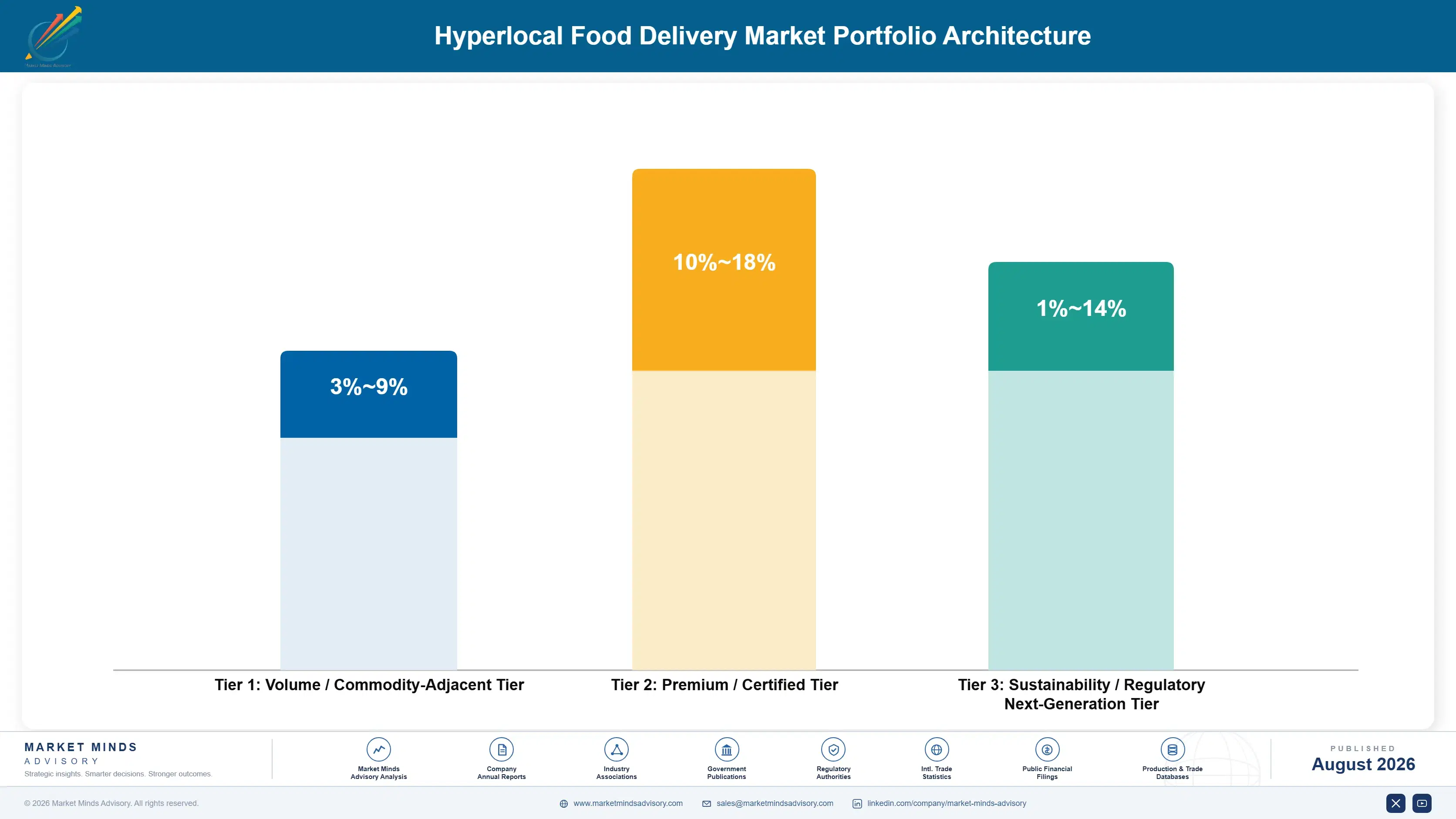
Portfolio Architecture for Margin Defence

The portfolio splits into three tiers with real margin separation. Standard restaurant delivery competes largely on price and broad restaurant selection against decades of established ordering habits, earning modest margins defended through order volume scale. Dark kitchen and quick-commerce delivery earn substantially more because consumers pay for documented speed performance standard delivery alone cannot deliver. That gap widens as consumers demand validated speed data before committing subscription budget.
The tension between standard order volume and premium speed positioning shapes platform strategy directly: standard delivery keeps order volume flowing and builds broad consumer relationships, but platforms that let standard volume crowd out dark kitchen investment risk losing the fastest-growing, highest-margin category to more capability-focused competitors. Platforms that manage this balance well capture both broad consumer presence and premium margin.

High-value pools concentrate overwhelmingly in dark kitchen and quick-commerce delivery, where documented speed reliability justifies premium economics few standard-delivery competitors can match. The emerging route-efficient technology tier currently earns unevenly as platforms await broader consumer adoption confirmation ahead of the leading programmes, a gap that keeps widening as speed expectations tighten further. That gap should widen further as speed requirements expand across additional metropolitan markets broadly.

Volume / Commodity-Adjacent Tier

Standard restaurant delivery sold on price against decades of proven ordering habits to mainstream consumer segments broadly. Competitive pressure here concentrates on production efficiency and total cost of ownership across dense order corridors.
Gross Margin: 3-9%

Premium / Certified Tier

Dark kitchen and quick-commerce delivery commanding premium pricing from consumers prioritizing documented speed, who pay durable premiums for validated data rather than risk delivery time failure. Vendor selection here increasingly hinges on documented speed performance evidence.
Gross Margin: 10-18%

Sustainability / Regulatory / Next-Generation Tier

Route-efficient technology and next-generation autonomous delivery infrastructure still absorbing development investment against developing commercial adoption, where platforms are betting capital on technology they expect consumers to demand broadly within several years.
Gross Margin: 1-14%
hyperlocal-food-delivery-market-portfolio-architecture-1787459719488

High-value Sub-segments and Strategic Watch-out

Dark Kitchen Speed Programmes

The field's highest current value and growth given surging consumer speed demand, commanding durable premium pricing once reliability requirements force validated data decisions market-wide. Vendor selection here increasingly hinges on documented speed evidence. Platforms slower to invest simply cannot secure these contracts once specifications tighten further.
Gross Margin: 12-18%

Quick-Commerce Grocery Applications

High value with strong current growth as convenience-conscious consumers expand adoption, priced above standard grocery delivery while remaining accessible to established household budgets. Adoption is broadening steadily beyond leading-edge urban markets into mainstream suburban practice. Platforms with proven speed outcomes increasingly command favorable procurement committee scoring broadly.
Gross Margin: 9-15%

Standard Restaurant Delivery Services

The volume core, sold on price to mainstream consumer segments, defended mainly through order volume scale and thin per-order margin discipline across platforms. Competitive pressure here concentrates on efficiency rather than the speed differentiation reshaping premium tiers overall. Facilities that fail to modernize gradually lose bidding competitiveness on large contracts.
Gross Margin: 3-9%

Legacy Sparse-Route Delivery Formats

The strategic watch-out, facing mounting obsolescence pressure as dense dark kitchen and quick-commerce alternatives increasingly become the standard expectation for competitive urban delivery programmes. Platforms dependent on this declining tier should redirect investment toward route density steadily and consistently. This obsolescence pressure compounds quickly once competitors complete their own transition.
Gross Margin: 0-6%

How Platform Order Demand Actually Recurs

Demand here runs on continuous per-order consumption tied directly to a consumer's household ordering habits rather than periodic bulk purchases alone. A consumer that standardizes on a platform for grocery and restaurant ordering typically maintains that relationship across hundreds of annual orders, making a single platform adoption decision worth years of recurring order volume rather than a standalone transaction. That habit-driven pattern gives platforms unusually concentrated but genuinely predictable revenue visibility once a household relationship is secured.
Adoption depth varies sharply by consumer tier. Leading urban households pursuing aggressive convenience expectations integrate qualified platforms deeply into standardized weekly ordering routines once adopted, making platform switching costly and rare absent a compelling speed or price reason. Smaller secondary-city consumers, by contrast, evaluate platforms more flexibly based on cost and promotional offers, creating more frequent switching opportunities between competing platforms.

Buyer profiles are shifting generationally as younger urban consumers, raised on on-demand digital convenience, increasingly treat rapid delivery as a baseline expectation rather than a differentiator requiring special justification. Older consumers trained primarily on traditional grocery shopping habits are adapting more gradually, but that generational shift is accelerating as quick-commerce marketing expands across major urban demographics.
hyperlocal-food-delivery-market-end-use-penetration-index-1787459720005

Where Delivery Platform Value Concentrates Next

These are among the four positions where our research anticipates prominent divergence between winners and laggards over the coming forecast period. Each is grounded in the demand model, the regulatory perimeter, and the announced capacity pipeline.
01 / DARK KITCHEN INVESTMENT

Build validated speed capability ahead of demand

Consumers facing aggressive delivery speed expectations need platforms ready to deliver validated fast fulfillment on schedule, and platforms investing ahead of confirmed demand capture the order wave before competitors catch up. This is a genuine capability race with real consequences for companies that wait too long to commit development capital. Platforms moving decisively now will own the consumer relationships that quick-commerce growth is about to make urgently valuable, especially as speed criteria become standard across most major urban markets consistently.
02 / ROUTE OPTIMIZATION DEVELOPMENT

Close the reliability gap before it becomes a category ceiling

Delivery time variability genuinely caps consumer trust in quick-commerce reliability, and platforms investing in AI route optimization that closes this gap capture order volume competitors cannot serve credibly. This technology investment differentiates beyond pure pricing and courier availability. Companies treating route optimization as secondary to raw courier count are underestimating how directly it determines total addressable order volume, especially as reliability requirements formalize broadly, especially once reliability data becomes standard across most major urban platform scorecards, a gap that widens with every additional urban expansion cycle.
03 / RESTAURANT AND RETAILER BUNDLING

Build bundled relationships beyond single-service delivery

Large restaurant chains and grocery retailers increasingly seek delivery platforms who can bundle fulfillment with broader marketing and analytics services rather than negotiating each category separately, and platforms building this deeper bundling capability capture premium partnership business single-service competitors cannot access. This bundling approach also builds genuine switching costs over time. Companies still selling purely on single-service commission sheets are missing the relationship depth that increasingly determines premium account retention long-term across most retail partnerships, especially as retailers consolidate partnership relationships across delivery categories broadly.
04 / COURIER COST EFFICIENCY MANAGEMENT

Manage labor costs before the next regulatory reform cycle

Gig worker classification volatility is a persistent feature of a category dependent on labor policy decisions outside platform control, and platforms still dependent on inefficient dispatch models remain exposed to margin compression every time labor markets shift sharply. Managing courier efficiency now, rather than reactively after the next regulatory reform, protects margin durably across multi-year growth plans. This is a defensive priority every platform serving thin-margin delivery fees should treat as non-negotiable given how exposed unprotected margin becomes, given how exposed unprotected margin becomes across every major delivery corridor.

Engagement Snapshot From the Field

A live engagement with an industry participant carrying material or product regulatory and market exposure ahead of a defining policy shift, showing how our research translates into a defensible multi-year portfolio strategy.
MARKET MINDS ADVISORY · CLIENT ENGAGEMENT SUMMARY
Hyperlocal Food Delivery Producer Strategic Portfolio Review and Transition Roadmap 2026·Investment Scenario on Hyperlocal Food Delivery Exposure Evaluation 2025-26
CLIENT PROFILE
A regional grocery retail chain operating forty stores approached MMA while evaluating hyperlocal delivery platform partners ahead of a planned quick-commerce fulfillment launch. The client reported the launch represented roughly USD 18 million in projected annual incremental revenue once the partnership scaled, with no existing quick-commerce delivery capability at the outset (client-reported, unverified by MMA).
STRATEGIC CHALLENGE
Management needed to select a delivery platform partner capable of supporting a forty-store rollout ahead of the planned launch date, without disrupting existing in-store operations during the integration period the board had already communicated publicly to shareholders. The board had already communicated the launch date publicly to shareholders and investment analysts.
MMA APPROACH
MMA benchmarked delivery speed performance and route density capability across three qualified platforms against the retailer's specific store footprint, modeled total cost of partnership including integration disruption risk, and assessed each platform's track record supporting comparable-scale grocery retail rollouts elsewhere. We also interviewed the retailer's store operations team to confirm real-world fulfillment workflow constraints the quantitative model alone could not capture.
KEY FINDINGS
  1. Only two of three benchmarked platforms could credibly commit to a forty-store rollout within the retailer's planned launch timeline given route density constraints.
  2. The commission cost differential across qualified platforms was meaningfully smaller than the retailer's initial internal estimate once volume-based terms were properly negotiated against a system-wide commitment.
  3. One platform's prior experience supporting a comparably sized regional grocery rollout provided a proven integration playbook that reduced projected launch risk considerably across all stores.
  4. Phasing the rollout across two store groups rather than all forty simultaneously reduced operational disruption while preserving the original launch timeline (client-reported, unverified by MMA).
CLIENT PROFILE
A regional grocery retail chain operating forty stores approached MMA while evaluating hyperlocal delivery platform partners ahead of a planned quick-commerce fulfillment launch. The client reported the launch represented roughly USD 18 million in projected annual incremental revenue once the partnership scaled, with no existing quick-commerce delivery capability at the outset (client-reported, unverified by MMA).
STRATEGIC CHALLENGE
Management needed to select a delivery platform partner capable of supporting a forty-store rollout ahead of the planned launch date, without disrupting existing in-store operations during the integration period the board had already communicated publicly to shareholders. The board had already communicated the launch date publicly to shareholders and investment analysts.
MMA APPROACH
MMA benchmarked delivery speed performance and route density capability across three qualified platforms against the retailer's specific store footprint, modeled total cost of partnership including integration disruption risk, and assessed each platform's track record supporting comparable-scale grocery retail rollouts elsewhere. We also interviewed the retailer's store operations team to confirm real-world fulfillment workflow constraints the quantitative model alone could not capture.
KEY FINDINGS
  1. Only two of three benchmarked platforms could credibly commit to a forty-store rollout within the retailer's planned launch timeline given route density constraints.
  2. The commission cost differential across qualified platforms was meaningfully smaller than the retailer's initial internal estimate once volume-based terms were properly negotiated against a system-wide commitment.
  3. One platform's prior experience supporting a comparably sized regional grocery rollout provided a proven integration playbook that reduced projected launch risk considerably across all stores.
  4. Phasing the rollout across two store groups rather than all forty simultaneously reduced operational disruption while preserving the original launch timeline (client-reported, unverified by MMA).
RECOMMENDED STRATEGY
Phase 1: Phase 1 (0 to 2 months): Finalize platform selection and negotiate system-wide commission terms with legal review. and finance sign-off before deployment begins. Phase 2: Phase 2 (2 to 5 months): Roll out fulfillment integration across the first store group with staff training sessions. and updated operational documentation across all involved staff. Phase 3: Phase 3 (5 to 8 months): Complete rollout across the remaining stores and formalize the fulfillment protocol permanently. documenting variance for future partnership renewal decisions.
OUTCOME
The grocery retail chain completed Phase 1 implementation on schedule, reporting that the phased rollout approach preserved its planned launch timeline without disrupting existing store operations. The chain also reported that negotiated commission terms kept projected partnership costs within its original budget (client-reported, unverified by MMA).

Frequently Asked Questions

Foundational context covering the market sizes, CAGR, scope, country, region and competition that inform every finding below. This section is provided to cover basics and most often pre-purchase conversations, answered from the MMA Primary Research Dataset.

What is the current size of the Hyperlocal Food Delivery Market?

The hyperlocal food delivery market was valued at USD 42.0 billion in 2025. Growth is driven by quick-commerce grocery demand, urban density adoption, and AI-powered route optimization.

How large will the Hyperlocal Food Delivery Market be by 2036?

The market is projected to reach USD 199.25 billion by 2036 under the base case scenario. That reflects an expansion multiple of roughly 4.12 times the 2026 value.

What is the CAGR for the Hyperlocal Food Delivery Market 2026 to 2036?

The base case CAGR is 15.2%, with a bull case of 16.4% and a bear case of 13.9%. Unit economics improvement and quick-commerce adoption pace are the main swing factors.

Which segment is growing fastest?

Dark kitchen and cloud kitchen delivery grows fastest at 19.5% CAGR, roughly 1.28 times the overall market rate. Grocery and convenience quick-commerce delivery follows as the second-fastest segment at 18.2%.

Who are the major companies in the Hyperlocal Food Delivery Market?

Leading platforms include DoorDash, Meituan, Delivery Hero, Swiggy, and Getir, together holding a combined 58% share of the market. This reflects a consistent revenue basis across all five platforms.

Which country is growing fastest?

India is the fastest-growing country at 22.5% CAGR, driven by intense quick-commerce platform competition and rapid urban adoption. Zepto, Blinkit, and Swiggy Instamart all anchor that rapid national growth.

Report Segmentation Architecture

The full report scope spans multiple orthogonal segmentation dimensions, with cross-tabulated demand data provided for each dimension pair. Coverage extends further to regional breakdowns, trend trajectories, and the competitive detail needed to support segment-level decision-making.

By Delivery Infrastructure and Service Model

  • Restaurant Meal Delivery Platforms
  • Dark Kitchen and Cloud Kitchen Delivery
  • Grocery and Convenience Quick-Commerce Delivery
  • Subscription-Based Hyperlocal Delivery
  • On-Demand Courier and Last-Mile Infrastructure
  • AI-Optimized Route and Fleet Management Services

By End-Use Category

  • Restaurant and Prepared Meal Orders
  • Grocery and Household Staples
  • Convenience and Impulse Purchase Items
  • Specialty and Pharmacy Delivery

By Commercial Dimension

  • Consumer Direct Platform Orders
  • Restaurant and Retailer Partnership Contracts
  • Subscription Membership Revenue
  • Advertising and Data Analytics Services

By Region

  • North America
  • Western Europe
  • East Asia
  • South Asia and Pacific
  • Latin America
  • Middle East and Africa
  • Eastern Europe

Scope, Methodology, and Coverage

Every figure in this report is reproducible from documented input assumptions. The scope below maps the historical period, the forecast horizon, the segmentation dimensions, and the countries covered, alongside the underlying primary and qualitative methodology.
Historical Period
2020 to 2025
Forecast Period
2026 to 2036
Base Year
2025 (USD billions; MMA Primary Research Dataset, August 2026)
Market Definition
The hyperlocal food delivery market comprises platform-enabled delivery of prepared meals and grocery items within a localized radius, typically under thirty minutes, including restaurant meal delivery, dark kitchen and cloud kitchen delivery, grocery and convenience quick-commerce delivery, and supporting courier and route optimization infrastructure. Long-haul freight logistics, traditional grocery e-commerce with next-day fulfillment, and in-restaurant dine-in ordering technology are excluded.
Quantitative Units
USD billions (current prices); annual order volume where applicable
Segmentation Dimensions
By Delivery Infrastructure and Service Model; By End-Use Category; By Commercial Dimension; By Region
Regions Covered
North America, Western Europe, East Asia, South Asia and Pacific, Latin America, Middle East and Africa, Eastern Europe
Countries Covered
USA, China, Germany, France, UK, Netherlands, Japan, South Korea, India, Indonesia, Vietnam, Thailand, Australia, Canada, Brazil, Mexico, Argentina, Colombia, UAE, Saudi Arabia, South Africa, Nigeria, Turkey, Poland, Italy, Spain, Sweden, Singapore, Malaysia, and additional markets relevant to this sector
Key Companies Profiled
DoorDash Inc., Meituan, Delivery Hero SE, Swiggy Limited, Getir Perakende Lojistik A.S., Uber Technologies Inc., Just Eat Takeaway.com N.V., Zomato Limited, Deliveroo plc, Grab Holdings Limited, GoTo Group, Maplebear Inc., Gopuff Inc., Kiranakart Technologies Private Limited, Eternal Limited, Wolt Enterprises Oy, Movile Internet Movel S.A., Rappi Inc., Ele.me, DiDi Global Inc.
Quantitative Methodology
Primary survey, n=3,800 respondents, Q4 2025, six countries; demand-side model with trade association cross-validation
Qualitative Methodology
47 expert interviews, Q4 2025; applied to validate demand model assumptions, identify emerging dynamics, and assess competitive positioning
Report Format
PDF and XLSX data workbook (Word format preview document)
Publisher
Market Minds Advisory
Report Code
MMA-2026-TEC-005
Published
August 2026
Contact
sales@marketmindsadvisory.com | www.marketmindsadvisory.com

Purchase the full Hyperlocal Food Delivery Market Report (2026 to 2036).

The full MMA Hyperlocal Food Delivery Market report sizes demand across six delivery infrastructure categories, four end-use categories, four commercial dimensions, and seven regions through 2036. It profiles twenty companies on a consistent revenue basis, scoring each on dark kitchen investment depth, route optimization technology, and restaurant and retailer contract bundling breadth. Scenario models quantify how unit economics improvement and quick-commerce adoption pace move both demand and realizable margin. The report includes total cost of partnership modeling by service category and a platform qualification-readiness screen built for restaurant and retailer procurement teams.
Delivery cost-curve modeling across major service categories
Dark kitchen facility investment tracking database by country
Quick-commerce and route optimization demand forecasts by region
Delivery speed and reliability benchmarking across platforms
Courier labor cost exposure modeling by platform scale
Quick-commerce adoption demand scenarios under bull and bear cases

Built For The People Who Decide

From boardroom strategy to bench-side execution, this report is read cover-to-cover by leaders shaping the next decade of their industry, turning demand scenarios, market dynamics and valuation benchmarks into decisions.
CXOs/ Presidents/ VPs/ Managers
M&A and Corporate Development
Strategy Teams and R&D Heads
Procurement and Product Directors
Regulatory and Compliance Leaders
Investor Relations and Equity Analysts